
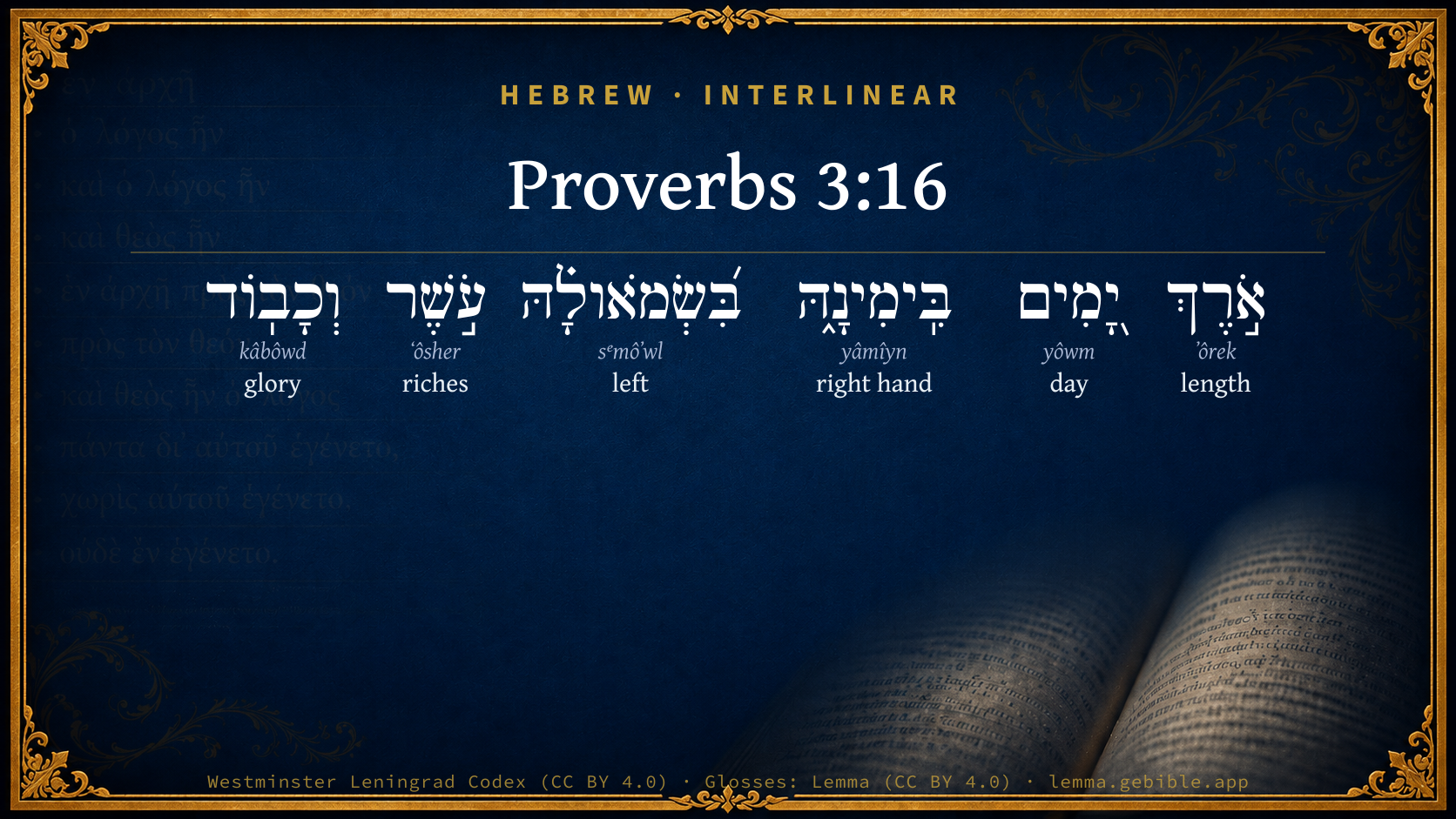
Proverbs 3:16

Hebrew (Westminster Leningrad Codex) Proverbs 3:16 appears in the Hebrew Old Testament. The text above is from the Westminster Leningrad Codex. Each word links to its Strong’s number, a concise gloss, and parsing drawn from the Open Scriptures Hebrew Bible morphology. Click any word for its full Brown-Driver-Briggs (BDB) entry.
Download image
Cite this verse

Proverbs 3:16 (World English Bible). Public Domain. Lemma interlinear Bible study tool, https://lemma.gebible.app/v/proverbs/3/16.

Show BibTeX & RIS
BibTeX
RIS
English Translation
Length of days is in her right hand. In her left hand are riches and honor.
World English Bible · Public Domain
Download a study sheet

One document with this verse’s original text, its word-by-word gloss line, the meaning frame, cross-references with their text, attributed commentary, and full source and license credits — printable, and it pastes into notes with its structure intact.

This verse Autodidact and up

Study sheet (.html) Plain text (.txt)

A passage Seminary Student

Up to 50 verses in one chapter. A passage sheet keeps up to 6 commentary sources and 12 cross-references per verse, in the order this page ranks them, and says so on the sheet whenever that leaves anything out. Ask for a single verse and you get the Autodidact verse sheet above.

Everything on this page stays free to read, with no account — the sheet is a download of what is already on screen, not access to it.

Want to remove ads? Support Godless Engineer
Compare translations 3

The same verse in 3 English versions, stacked beneath the original-language interlinear above. Click any original word for its lexicon entry.

Each is an independent rendering of the whole verse — the interlinear is not word-aligned to these translations.

Highlighted words mark where these versions differ — a whole-verse word diff, not a word-by-word alignment.

  • World English Bible Public Domain
    Length of days is in her right hand. In her left hand are riches and honor.
  • King James Version Public Domain
    Length of days is in her right hand; and in her left hand riches and honour.
  • unfoldingWord Literal Text CC BY-SA 4.0
    Length of days in her right hand; in her left hand riches and honor.

unfoldingWord Literal Text — © unfoldingWord, licensed CC BY-SA 4.0. Word-aligned USFM3 via Door43 (git.door43.org/unfoldingWord/en_ult).

Versions to compare (up to 4)

3 of 4 selected

Show all 18 translations

Every available English version of this verse, each an independent rendering of the whole verse.

  • World English Bible Public Domain
    Length of days is in her right hand. In her left hand are riches and honor.
  • Berean Standard Bible Public Domain
    Long life is in her right hand; in her left hand are riches and honor.
  • Majority Standard Bible Public Domain
    Long life is in her right hand; in her left hand are riches and honor.
  • King James Version Public Domain
    Length of days is in her right hand; and in her left hand riches and honour.
  • American Standard Version (1901) Public Domain
    Length of days is in her right hand; In her left hand are riches and honor.
  • Revised Version (1885) Public Domain
    Length of days is in her right had; in her left hand are riches and honour.
  • Geneva Bible (1599) Public Domain
    Length of dayes is in her right hand, and in her left hand riches and glory.
  • Douay-Rheims (1899) Public Domain
    Length of days is in her right hand, and in her left hand riches and glory.
  • Young's Literal Translation Public Domain
    Length of days `is' in her right hand, In her left `are' wealth and honour.
  • Literal Standard Version CC BY-SA 4.0
    Length of days [is] in her right hand, || In her left [are] wealth and honor.
  • Unlocked Literal Bible CC BY-SA 4.0
    She has length of days in her right hand; in her left hand are riches and honor.
  • unfoldingWord Literal Text CC BY-SA 4.0
    Length of days in her right hand; in her left hand riches and honor.
  • Darby Bible Public Domain
    Length of days is in her right hand; in her left hand riches and honour.
  • World Messianic Bible Public Domain
    Length of days is in her right hand. In her left hand are riches and honor.
  • Webster's Bible Public Domain
    Length of days is in her right hand; and in her left hand riches and honor.
  • Free Bible Version CC BY-SA 4.0
    She offers long life in one hand, and riches and honor in the other.
  • Bible in Basic English Public Domain
    Long life is in her right hand, and in her left are wealth and honour.
  • JPS Tanakh (1917) Public Domain
    Length of days is in her right hand; in her left hand are riches and honour.

Literal Standard Version (2020), Covenant Press — licensed CC BY-SA 4.0. Text via the HelloAO Bible API (eBible.org). Unlocked Literal Bible (unfoldingWord) — licensed CC BY-SA 4.0. Text via the HelloAO Bible API (eBible.org). unfoldingWord Literal Text — © unfoldingWord, licensed CC BY-SA 4.0. Word-aligned USFM3 via Door43 (git.door43.org/unfoldingWord/en_ult). Free Bible Version, Dr. Jonathan Gallagher — licensed CC BY-SA 4.0. Text via the HelloAO Bible API (eBible.org).

Word by word

More ways to search: Search by grammar → Find every occurrence → Compare this word →

Practice this passage: Drill this verse → Learn its vocabulary →

About this verse

These counts appear in no published source. They are computed here, from the morphology-tagged text and Lemma’s own curated glosses. What Lemma adds →

6
words
6
distinct lemmas
Wisdom
section

Shared distinctive vocabulary

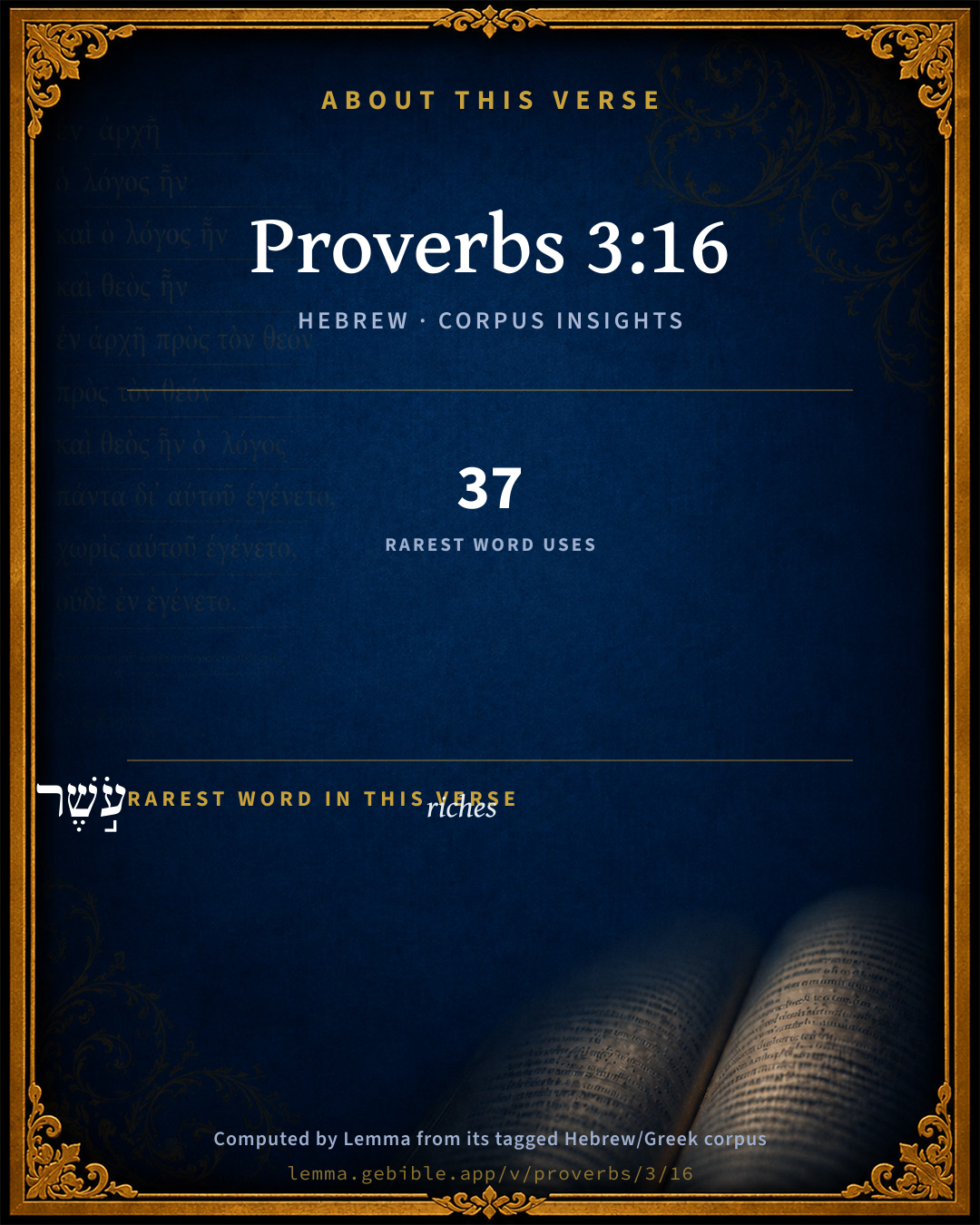
עֹ֣שֶׁר riches H6239 occurs in 36 verses of the Hebrew Bible. Also found in:

Grammatical profile

  • 6 nouns

Hebrew & Septuagint length

In English translation the verse runs 16 words from the Hebrew and 37 from the Septuagint (LXX English) — the Septuagint runs noticeably longer here. See the side-by-side →

A rough comparison of the two English renderings, which tokenize alike — not a word-level alignment.

Word counts can differ between the Hebrew and the Greek without any difference in meaning — e.g. the Hebrew direct-object marker אֵת has no separate Greek word, and Greek often adds the article ὁ.

Cross-references

11

Topical passages linked to Proverbs 3:16 in the Treasury of Scripture Knowledge — connected by theme and wording, ordered by reader-vote popularity; previews shown in the World English Bible.

  • Proverbs 3:2 For length of days, and years of life, And peace, will they add to you.
  • 2 Corinthians 6:10 as sorrowful, yet always rejoicing; as poor, yet making many rich; as having nothing, and yet possessing all things.
  • Proverbs 22:4 The result of humility and the fear of Yahweh Is wealth, honor, and life.
  • 1 Kings 3:13 I have also given you that which you have not asked, both riches and honor, so that there shall not be any among the kings like you, all your days.
  • Mark 10:30 but he will receive one hundred times more now in this time, houses, brothers, sisters, mothers, children, and land, with persecutions; and in the age to come eternal life.
  • 1 Timothy 4:8 For bodily exercise has some value, but godliness has value for all things, having the promise of the life which is now, and of that which is to come.
  • Psalms 21:4 He asked life of you, you gave it to him, Even length of days forever and ever.
  • Proverbs 4:6–10 Don't forsake her, and she will preserve you. Love her, and she will keep you.

Cross-references courtesy of OpenBible.info (CC BY 4.0).

Hebrew and Greek witnesses Masoretic Hebrew ↔ Greek Septuagint

The same verse in the two great witnesses to the Old Testament, shown verse-for-verse.

Here the Septuagint runs noticeably longer than the Hebrew — LXX2012 (modern English Septuagint) 37 words vs World English Bible 16. A rough length comparison of the two English translations, not a word-level alignment — read both below.

These are two independent witnesses, not word-aligned to each other, and the Septuagint is shown in lemma (dictionary) form.

Hebrew Proverbs 3:16 Masoretic · Westminster Leningrad Codex

אֹ֣רֶךְ יָ֭מִים בִּֽימִינָ֑הּ בִּ֝שְׂמֹאולָ֗הּ עֹ֣שֶׁר וְכָבֽוֹד

Length of days is in her right hand. In her left hand are riches and honor.

World English Bible · Public Domain

Greek LXX Proverbs 3:16 Septuagint · lemma form

μῆκος γάρ βίος καί ἔτος ζωή ἐν ὁ δεξιός αὐτός ἐν δέ ὁ ἀριστερός αὐτός πλοῦτος καί δόξα ἐκ ὁ στόμα αὐτός ἐκπορεύομαι δικαιοσύνη νόμος δέ καί ἔλεος ἐπί γλῶσσα φορέω

For length of existence and years of life are in her right hand; and in her left hand are wealth and glory: out of her mouth proceeds righteousness, and she carries law and mercy upon her tongue.

LXX2012 (modern English Septuagint) · Public Domain

On this verse, Keil & Delitzsch discusses the Septuagint’s reading. Read the note in Commentary ↓

Hebrew: Westminster Leningrad Codex (CC BY 4.0). Greek: Septuagint (public domain); English from LXX2012 (modern English Septuagint) (Public Domain). How the Septuagint differs from the Hebrew →

Commentary

Notes on Proverbs 3:16 from classic Christian and Jewish commentators (each source and its license shown beneath its notes). The classic Christian expositions comment on the surrounding passage and are grouped to its opening verse, so a note may address several verses; the Jewish commentaries on the Tanakh (Rashi and others) are per-verse, so they appear only where the commentator wrote on this verse.

Lemma curates 59 commentaries, every one of them public domain or Creative Commons licensed, each selected and text-cleaned for this edition rather than reprinted as found. About our sources →

Trapp's Complete Commentary

John Trapp

Pro 3:16 Length of days [is] in her right hand; [and] in her left hand riches and honour.

Ver. 16. Length of days is in her right hand.] This is the same in effect with Pro 3:2. {See Trapp on "Pro 3:2"} Oυ μονον ταυτα αλλα και περι ταυτων, said Socrates. The same again may be profitably said over; Solomon wanted neither matter, nor words, and yet he repeats and inculcates (for his readers’ greater benefit) the same matter in the self same words almost. Nunquam satis dicitur quod nunquam satis discitur. {a} As to the text, health and long life is that which every man covets. Now, Non domus et fundus, non aeris acervus et auri aegroto domini deducant corpore febres. {b} "Riches avail not in the day of wrath, but righteousness delivereth from death." {Pro 10:2} The honourable garter cannot cure the gout, nor the chair of state ease the colic, nor a crown remove the headache. Nugas, the Scythian, despising the rich presents and ornaments that were sent unto him by Michael Paleologus, Emperor of Constantinople, asked whether those things could drive away calamities, diseases, or death? {c} No; this they cannot do; as Henry Beaufort (that rich and wretched Cardinal) found by woeful experience in the reign of Henry the Sixth. For perceiving death at hand, he asked, Wherefore should I die, being so rich? If the whole realm would save my life, I am able either by policy to get it, or by riches to buy it. Fie! quoth he, will not death be hired? will money do nothing? {d} No; money in this case bears no mastery. Death (as the jealous man) will not regard any ransom, neither will he rest content though thou offer many gifts. {Pro 6:35}

And in her left hand riches and honour.] Bonus Deus Constantinum Magnum tantis terrenis implevit muneribus, quanta optare nullus auderet. {e} The good Lord heaped so much outward happiness upon his faithful servant, Constantine the Great, as no man ever durst to have wished more, saith Augustine. If God give his people a crown, he will not deny them a crust. If they have bona throni, the good things of a throne, they shall be sure of bona scabelli, the good things of the footstool.

{a} Seneca.

{b} Horat.

{c} Pachymer. Hist., lib. v.

{d} Foxe, Martyrol., vol. i. p 925.

{e} Aug., De Civit. Dei, lib. v. cap. 25.

John Trapp, A Commentary or Exposition upon All the Books of the Old and New Testament (1647–1656) — public domain. Text from a community e-Sword module.

The Biblical Illustrator

Joseph S. Exell

Pro_3:16

Length of days is in her right hand.

Godliness a help to longevity

So far from being true that good men, women, and children die sooner than others, the reverse is actually the case. As wickedness acts as a shortener of life, so does a regard for Gods wholesome laws help to lengthen it. It is an unnatural thing for one to desire to die before he has finished his work on earth. It cannot be wrong in us to love life, when God promises it to His children as a special blessing. It is easy to discover why religion is conducive to length of days. Obedient children will be most likely to avoid the vices and crimes which shorten life. The love of life is not peculiar to man as a fallen being. Why do we desire that length of days should be our portion?

I. Because life is pleasant, and the world, in spite of seasons of clouds and storms, is a beautiful one. Illustrate by the summer landscape. We love life for its many comforts and enjoyments. Who can estimate the pleasures of the family circle, the genial intercourse of friends, the cultivation of refinement and taste, the peculiar satisfaction which attends literary labours, the accumulation of property as a provision against the season of old age, and that we bear our part in works of beneficence and charity?

II. Because it is a season of usefulness.

III. Because through length of days on earth, we may be the better prepared to meet God. Eternity alone is the real life-time of the soul. A life without a purpose is utterly unworthy of him on whom God has bestowed mental gifts and the gift of immortality. (John N. Norton.)

The fruits of wisdom

There is a great difference between the Old Testament and the New, with respect to the motives by which religious virtue is severally enforced in them. In the old covenant there was an established connection between obedience and outward prosperity. The New Testament differeth from this very widely, both in its general declarations and the instances of fact which its history containeth. Our Lord assured His disciples that they must expect tribulation. Length of days, riches, and honours, instead of being promised as the rewards of Christianity, in some cases, must be renounced by all the servants and disciples of Jesus Christ. It may be that we are reminded of two expressions which seem to promise material prosperity (Mat_6:33; 1Ti_4:8). But in the first our Lords design is to show the folly of an inordinate carefulness, not about abundance of worldly things, outward splendour, and great wealth, but the necessaries of life, what we shall eat and drink, and wherewithal we shall be clothed. The promise therefore must be understood to extend no farther than to answer the intention of superseding our thoughtfulness about these needful things. As to the other text, it seemeth to mean that in the practice of true religion we may hope that, ordinarily, Gods gracious care will be employed for our support and preservation. If we observe the ordinary methods of Divine providence, and the general course and state of things, with their connection and dependence in this world, we shall find that, for the most part, the practice of the Christian virtues hath a tendency even to our outward advantage, and to promote our present interest, rather than the contrary. The observation holdeth more universally with respect to communities, some of which have risen from very small beginnings to great and powerful nations, by industry, frugality, the exact distribution of justice, fidelity, and other virtues; on the other hand, the history of all ages showeth that the most opulent and flourishing kingdoms have been precipitated into ruin by avarice, oppression, luxury, and injustice.

I. Wisdoms gift is length of days. Life importeth the capacity for enjoyments, and is the foundation of them all. Length of days has the preference of riches and honour, but not of an approving conscience. That a religious or virtuous course of life tendeth to prolong our days we may be convinced by experience. Temperance, meekness, and patience contribute to long life. Benevolence and the social virtues tend to secure life against that foreign violence to which the unjust, the cruel, and the inhumane are obnoxious.

II. Wisdoms gift is riches. There are abuses of wealth. But it may lawfully be sought after as the means of living easy, and enjoying the comforts of this world with moderation. Nature teacheth, and religion doth not forbid it, that we should endeavour to render our condition in this world tolerable. And wealth should also be valued as the means and ability of doing good in a religious and moral sense. Men ordinarily acquire riches by their parsimony, their industry and their credit, and to all these the moral virtues comprehended in wisdom are eminently serviceable. The natural effect of temperance, chastity, humility is to retrench a great many exorbitancies. And diligence is specially commended in religion. Mutual confidence is of great advantage for the getting of riches, and religious character is the sure ground of confidence.

III. Wisdoms gift is honour--that esteem, with the outward tokens and expressions of it, which men have in the world. This is a certain effect of wisdom or religious virtue, because virtue itself maketh the very character which is honourable, or the subject of esteem. Men cannot help having in their heart a veneration for the man who, by the whole course of his behaviour, appears to be pious, sober, just, and charitable, let his condition be what it will. (J. Abernethy, M. A.)

The discreet behaviour of the Christian respecting his outward welfare

Well-being in externals, though not the most important part of our happiness, is yet always a part of it, and consequently a care for its conservation and advancement cannot be absolutely wrong.

1. See that all your efforts to promote your outward welfare are innocent. Employ none other than fair and honest means to that end.

2. Never let your efforts so engross and occupy your mind as to allow you neither inclination nor leisure, time nor ability, to care and labour for that which more proximately and directly promotes the perfection of your spirit.

3. Do not assume that your efforts for your outward welfare must necessarily succeed, or that they are absolutely lost if they fail of success.

4. Dignify your efforts by forming just conceptions of the ultimate end of all earthly goods and outward distinctions.

5. Enjoy the fruits of your labour, in proportion as you reap them, and postpone not the legitimate, discreet use and enjoyment of them, till you shall have acquired and accumulated such or such a store of them. Enjoy all the pleasures, the comforts, the conveniencies of life, with a cheerful temper and without anxious care for the future. Enjoy them as men, not as children; enjoy them as Christians. (G. J. Zollikofer.)

The gain of true religion

Sir Henry Mitchell, a distinguished Methodist layman, made an interesting speech at Bradford, in which he referred to the late Sir Isaac Holden, who was a life-long Methodist. He died respected by every one who knew him, and more than a millionaire. Sir Henry went to see Sir Isaac a little while before his death, and said to him, You owe most to your religion and to Methodism. To which Sir Isaac replied, Everything. Sir Isaac added that his study of Methodist doctrine and experience had exercised a most wholesome discipline upon his mind, and had contributed very largely--perhaps more than any other influence that had been brought to bear upon his character--to his success in life.

The advantages of religion

Honour can only be attained by religion and virtue.

I. The true nature of honour.

1. Used to denote worthy and creditable parentage.

2. Or it signifies titles of place and dignity. Veneration is due to some callings and relations of men, though the persons themselves should not be virtuous.

3. The term is sometimes used for the esteem and reputation which a man hath in the world, especially amongst virtuous persons. Such honour is power, enabling a man to do things great and worthy; and it is safety, as it gives a man an interest in the esteem and affection of others.

II. Religion and virtue are the only means of attaining honour. This can be proved--

1. By testimony; from Scripture, from the concurrent opinion of wise men in all ages.

2. By reason. There may be a twofold cause of things--moral and natural. A moral cause is that which doth dispose a man to such a condition, upon the account of fitness or desert, and in this sense honour is the reward of virtue. The natural cause of a thing, by its own immediate efficacy, produces the effect; and in this sense likewise virtue is the cause of honour.

3. By experience; that practical knowing which every man may attain by his own observation. Two objections may be urged against what is thus proved--

(1) Good men have met with dishonour, as Christ and His disciples did.

(2) Vicious men have sometimes been had in honour. External honour may be due to them; internal honour is only given by those who do not know them. (Bp. John Wilkins.)

The Biblical Illustrator, edited by Joseph S. Exell (c. 1880s–1900s) — public domain. Text from a community e-Sword module.

Joseph Benson's Commentary

Pro 3:16-18. Length of days is in her right hand — Wisdom is here represented as a great and generous princess, distributing gifts to her subjects. She holds forth in her right hand the great blessing of health and length of days unto all those who will walk in the way to which she points; and it was but just to place this in her right hand, that is, to give it the precedence, because it was the chief promise of the law, and, indeed, unless when affliction is necessary for our chastisement, trial, or purification, the most desirable of all earthly blessings. After this follow wealth and reputation, which he places in her left hand, as inferior blessings, but which proceed also from her gift. Spiritually considered, these blessings refer to eternity, and the glories of heaven. Her ways are ways of pleasantness — Are exceeding delightful, namely, to those who know them and walk in them; whose judgment is certainly to be preferred before the contrary opinion of ungodly men, who are grossly ignorant of them, and professed enemies to them. Observe, reader, the enjoyments and entertainments of sense are not to be compared to the pleasures which gracious souls have in communion with God and doing good. And all her paths are peace — Produce a blessed tranquillity in a man’s mind and conscience, with confidence and cheerfulness in all conditions, and the joy which arises from a full persuasion that all things shall work for good here, and from a lively hope of eternal rest with God hereafter. There is not only peace in the end, but peace in the way; and not only in the way of religion in general, but in all the particular paths of that way; in all the several acts, instances, and duties of it: one does not imbitter what another sweetens, as it is with the allays of this world; but they are all peace; not only sweet, but safe, and full of quietness, assurance, and consolation, Isa 32:17. She is a tree of life — She is a certain pledge and means of everlasting life and happiness; to them that lay hold upon her — That eagerly pursue after her, and, when they overtake her, gladly apprehend and embrace her, as the Hebrew word here used signifies. He alludes to the tree of life in paradise, mentioned Gen 2:9; Gen 3:22, all right to eat of which was lost by the fall, and he here intimates that the wisdom of which he speaks is the only thing that can restore the life to us then lost. Happy is every one that retaineth her — That holds her fast, and is constantly resolved not to forsake her.

Joseph Benson's Commentary on the Old and New Testaments (1811–1818) — public domain. Text from a community e-Sword module.

Keil & Delitzsch

C. F. Keil & F. Delitzsch

That wisdom is of such incomparable value is here confirmed:

16 Length of days is in her right hand;

In her left, riches and honour.

17 Her ways are pleasant ways,

And all her paths are peace.

18 A tree of life is she to those that lay hold upon her,

And he who always holdeth her fast is blessed.

As in the right hand of Jahve, according to Psa 16:11, are pleasures for evermore, so Wisdom holds in her right hand "length of days," viz., of the days of life, thus life, the blessing of blessings; in her left, riches and honour (Pro 8:18), the two good things which, it is true, do not condition life, but, received from Wisdom, and thus wisely, elevate the happiness of life-in the right hand is the chief good, in the left the προσθήκη, Mat 6:33. Didymus: Per sapientiae dextram divinarum rerum cognitio, ex qua immortalitatis vita oritur, significatur; per sinistram autem rerum humanarum notitia, ex qua gloria opumque abundantia nascitur. The lxx, as between 15a and 15b, so also here after Pro 3:16, interpolate two lines: "From her mouth proceedeth righteousness; justice and mercy she bears upon her tongue," - perhaps translated from the Hebr., but certainly added by a reader.

Pro 3:17

דּרכי־נעם are ways on which one obtains what is agreeable to the inner and the outer man, and which it does good to enjoy. The parallel שׁלום is not a genitive to נתיבות to be supplied; that paths of Wisdom are themselves שׁלום, for she brings well-being on all sides and deep inwards satisfaction (peace). In regard to נתיבה, via eminens, elata, Schultens is right (vid., under Pro 1:15);

(Note: The root is not תב, to grope, but נת; whence Arab. natt, to bubble up, natâ, to raise oneself, to swell up, etc.)

נתיבותיה has Munach, and instead of the Metheg, Tarcha, vid., under Pro 1:31. The figure of the tree of life the fruit of which brings immortality, is, as Pro 11:30; Pro 15:4 (cf. Pro 13:12), Rev 2:7, taken from the history of paradise in the Book of Genesis. The old ecclesiastical saying, Lignum vitae crux Christi, accommodates itself in a certain measure, through Mat 11:19; Luk 11:49, with this passage of the Book of Proverbs. החזיק ב means to fasten upon anything, more fully expressed in Gen 21:18, to bind the hand firm with anything, to seize it firmly. They who give themselves to Wisdom, come to experience that she is a tree of life whose fruit contains and communicates strength of life, and whoever always keeps fast hold of Wisdom is blessed, i.e., to be pronounced happy (Psa 41:3, vid., under Psa 137:8). The predicate מאשּׁר, blessed, refers to each one of the תּמכיה, those who hold her, cf. Pro 27:16; Num 24:9. It is the so-called distributive singular of the predicate, which is freely used particularly in those cases where the plur. of the subject is a participle (vid., under Pro 3:35).

Keil & Delitzsch — Biblical Commentary on the Old Testament (1861–1891) — public domain (CC PDM 1.0). Text via the HelloAO Bible API. (Old Testament only.)

Geneva Bible (1599)

Geneva Bible translators

Meaning, that he that seeketh wisdom, that is, suffereth himself to be governeth by the Word of God, shall have all prosperity both corporal and spiritual.

Geneva Bible (1599) marginal notes — public domain. Text via Bolls.life.

Jamieson, Fausset & Brown

Robert Jamieson, A. R. Fausset & David Brown

Wisdom personified as bringing the best blessings (compare Mat 6:33; Ti1 4:8).

Jamieson, Fausset & Brown — Commentary Critical and Explanatory on the Whole Bible (1871) — public domain (CC PDM 1.0). Text via the HelloAO Bible API.

Adam Clarke's Commentary

Verse 16. Length of days is in her right hand] A wicked man shortens his days by excesses; a righteous man prolongs his by temperance.

In her left hand riches and honour.] That is, her hands are full of the choicest benefits. There is nothing to be understood here by the right hand in preference to the left.

Adam Clarke's Commentary on the Bible (1810–1826) — public domain. Text from a community e-Sword/MySword module.

The Cambridge Bible for Schools and Colleges

gen. ed. J. J. S. Perowne

16. The LXX. add at the end of this verse:

“Out of her mouth proceedeth righteousness;

Instruction and compassion she beareth upon her tongue.”

The Cambridge Bible for Schools and Colleges (gen. ed. J. J. S. Perowne; Cambridge University Press, 1878–1918) — public domain. Text from a community e-Sword module.

John Gill's Exposition

Length of days is in her right hand,.... Wisdom is here represented as a queen, as indeed she is above all kings and queens; see Pro 8:15; holding in one hand, instead of a sceptre, "length of days"; and in the other, instead of a globe, riches and honour: the allusion is thought by some on this clause to be to an ancient custom of numbering things, and the ages of men, by the hand and fingers, beginning with the left hand, and when they came to a hundred went to the right (z); so that in that might be truly said to be "length of days", few arriving to that number: or rather the reference is to what Solomon received of the Lord, who, asking wisdom, had not that only, but a long life, and riches and honour; see Kg1 3:11. Some think that only temporal blessings are here meant, and, because health and long life are preferable to wealth and honour, the former are said to be in the right hand, and the latter in the left; but seeing in the preceding verses the advantages of wisdom are superior to silver, gold, and precious stones, it can hardly be thought that she should be represented as only having temporal blessings in her hands to bestow on her followers. Others are of opinion that spiritual and eternal blessings are the right hand ones, being the principal; and temporal blessings are the left hand ones, as being the less valuable, Mat 6:33; but to me they seem all of one sort, all spiritual and eternal ones, even those of the left hand, by comparing this passage with Pro 8:18. By "length of days" is meant "length of days for ever and ever", Psa 21:4; or eternal life, a life of vision or enjoyment of God; a life of perfect knowledge, holiness, and pleasure; being free from all the imperfections, difficulties, and distresses of the present one, and which will last for ever; this is in the hand of Christ, not the promise and grant of it only, but the thing itself, in consequence of his asking it of his Father: and which he has in a covenant way, and so has a right and power to bestow it: and it being in his hands shows both the valuableness and the security and safety of it; and also that it is to be had from him, and is in his gift, and in no other; and is a pure gift of his grace; wherefore happy is the man that finds Wisdom, or Christ, since he finds and has eternal life in him;

and in her left hand riches and honour; by "riches" are meant not temporal riches, for these are not always to the wise, nor to the children of Wisdom, nor of Christ; and all that have these are not happy, nor are they durable: but spiritual riches are intended, the riches of grace; of pardoning, justifying, and sanctifying grace, and of all supplies of grace; and also the riches of glory, which are solid and satisfying, immense and unsearchable, lasting and durable: and by "honour" is designed not the honour which comes from men, or the honour of this world; for such who find Christ, and are possessed of him, and profess him, have but a small share of this, being, generally speaking, accounted the faith and offscouring of the world; but yet they are the children of God, and so have that name which is better than to be the sons and daughters of the greatest monarch; they are the spouse of Christ, and so his queen that stands at his right hand in gold of Ophir; they are made kings and priests unto God, and shall reign with Christ for evermore; this honour have all the saints, and is what is in the hands of Christ to give, and does give, to all that believe in him: or "glory" (a), as the word signifies; the glory of God, eternal glory; this as well as grace is Christ's gift, Psa 84:11.

(z) Vid. Nebrissens. Quinquagena, c. 16. & Alex. ab Alex. Genial. Dier l. 1. c. 14. to which Juvenial refers, when speaking of Nestor, "----suos jam dextra computat annos", Satyr. 10. v. 249. (a) "gloria", V. L. Pagninus, Montanus, Mercerus, Gejerus, Cocceius, Schultens.

John Gill's Exposition of the Whole Bible (1746–1763) — public domain (CC PDM 1.0). Text via the HelloAO Bible API.

Haydock's Catholic Bible Commentary

Glory. Her hands are full, and she grants favours with profusion, (Haydock) as with both hands, promising eternal life. (Worthington)

George Leo Haydock (1774–1849), Haydock's Catholic Family Bible and Commentary, 1859 edition — public domain. Excludes Psalms (Douay-Rheims chapter numbering differs from Protestant) and Deuterocanonical books (Catholic canon only).

Matthew Poole's English Annotations

Wisdom is here represented as a great and generous princess distributing gifts to her subjects. She giveth them long life, &c., unless when she foresees that these things would prove snares and mischiefs to them, as they very frequently do to others.

Matthew Poole's English Annotations on the Holy Bible (1683–1685) — public domain. Text from a community e-Sword/MySword module.

Whedon's Commentary on the Bible

Daniel D. Whedon

16. Right hand… left hand — Wisdom is here represented as dispensing her blessings with both hands, that is, abundantly. Some of the older commentators, and also some of the later, think that the blessings of the right hand have the precedence in value. “It was but just,” says Patrick, “to place length of days in her right hand; that is, to give it the precedence, because it was the chief promise of the law, and, indeed, the most desirable of earthly blessings, without which nothing can be enjoyed: after this follow wealth and reputation, things that men mightily covet, which he places in her left hand, as inferior blessings, but which come also from her gift.” Others think this a fanciful elaboration of the simple idea. “It is highly probable that Solomon alludes here to the promise of God to him. 1Ki_3:11-14; 2Ch_1:11-12.” — Muenscher.

Daniel D. Whedon (gen. ed.), Commentary on the Old and New Testaments (1874–1909) — public domain. Text from a community e-Sword module.

The Pulpit Commentary

The remaining three verses (16-18) state in what respects Wisdom is incomparable in value. Length of days; orek yamim, as in ver. 2. Wisdom is here represented as holding in her right hand that which ispreviously promised to obedience. Length of days is the blessing of blessings, the condition of all prosperity and enjoyment, and hence is placed in the right hand, the chief place, for among the Hebrews and other Oriental nations, as also among the Greeks the right hand was regarded as the position of highest honour; (Ps 110 Ps 50 1Ki_2:19 RAPC 1Ma 10:63 Mat_22:24) cf. Psa_16:11. in which the psalmist says of Jehovah, "In thy right hand there are pleasures forevermore." The two hands, the right and the left, signify the abundance of Wisdom"s gifts. Riches and honour stand here for prosperity in general. The same expression occurs in Pro_8:8, where riches are explained as "durable riches." A spiritual interpretation can, of course, be given to this passage length of days being understood of eternal life; riches, of heavenly riches; and honour, not "the honour that cometh of men," but honour conferred by God; (1Sa_5:4 Joh_12:26) see Wardlaw, in loc. The thought of the verse is, of course, that Wisdom not only holds these blessings in her hands, but also confers them on those who seek her. The LXX adds, "Out of her month proceedeth righteousness; justice and mercy she beareth upon her tongue;" possibly suggested by Pro_8:3. The words of the teacher remind us of the saying of Menander, O diaferwn logismw pant ecei , "He who excels in prudence possesses all things."

The Pulpit Commentary (1880–1919), ed. H.D.M. Spence-Jones & Joseph S. Exell — public domain. Text from a community e-Sword module.

Bridges on Proverbs

Charles Bridges

Behold this heavenly Queen dispensing her blessings! Her right hand presents the promise of both worlds (Pro 3:2 . Psa 91:16 . 1Ti 6:8 ) — the rich enjoyment of the world’s lawful comforts (1Ti 6:17 ), and the yet higher joy of serving the Lord and his church — a privilege for which the apostle was content for a while to be detained from heaven. (Php 1:23-24 .) Add length of days for eternity to the balance; and the amount sets at nought all computation. Her left hand offers riches and honour,†1 so far as may be for her children’s good; yet in their highest splendour, only a faint shadow of her more "durable riches," and of the honour of a heavenly crown.

But what say we of her ways? Is she a sullen matron, who entertains her followers only on sighs and tears; so that to obtain the joys of the next life, we must bid eternal adieu to the contents of this life; ’we must never more expect a cheerful hour, a clear day, a bright thought to shine upon us?’†2 This is the world’s creed — a slander of the great forger of lies, to deter us from wisdom’s ways. They must be ways of pleasantness, because "Thus saith the LORD." And if we feel them not to be so, we know them not.

The man of pleasure utterly mistakes both his object and his pursuit. The only happiness worth seeking is found here; that which will live in all circumstances, and abide the ceaseless changes of this mortal life. The ways may be dark and lonely; yet how does the sunshine of reconciliation beam upon their entrance! Every step is lighted from above, and strewed with promises; a step in happiness, a step to heaven. Wisdom’s work is its own reward (Psa 19:11 . Isa 32:17 ) — strictness without bondage (Mat 11:29-30 .) God rules children, not slaves. They work neither from compulsion, nor for hire; but from an ingenuous principle of gratitude to their Benefactor; filial delight in their Father. Pleasant therefore must be the labour — yea — the sacrifices — of love; short the path; cheerful the way, when the heart goes freely in it.

It is saying far too little, that the trials of these ways are not inconsistent with their pleasantness. They are the very principles of the most elevated pleasure. ’The verdict of Christ’ — says Dr. South — ’makes the discipline of self-denial and the cross — those terrible blows to flesh and blood — the indispensable requisite to the being his disciples.’†3 And yet, paradoxical as it may appear, in this deep gloom is the sunshine of joy. For if our natural will be "enmity to God" (Rom 8:7 ), it must be the enemy to our own happiness. Our pleasure, therefore, must be to deny, not to indulge it; to mortify sinful appetites, that only "bring forth fruit unto death." (Rom 7:5 .) Even what may be called the austerities of godliness are more joyous than "the pleasures of sin." Far better to cross the will, than to wound the conscience. The very chains of Christ are glorious. (Act 5:41-42 ; Act 16:24-25 .) Moses endured not "his reproach" as a trial. He "esteemed it as a treasure — greater riches than the treasures of Egypt." (Heb 11:26 .) Our principles are never more consoling than when we are making a sacrifice for them. Hannah yielded up her dearest earthly joy. But did she sink under the trial? Did she grudge the sacrifice? "Hannah prayed and said — My heart rejoiceth in the LORD" (1Sa 1:26 ; 1Sa 2:1 ); while — to show that none serve him for nought — for one child that was resigned, five were added. (1Sa 2:20-21 .)

In fact, the world have no just conception of the real character of wisdom’s ways. Religion to them is associated with cold, heartless forms and irksome restraints — much to do, but nothing to enjoy. But they only see half the prospect. They see what religion takes away. But they see not what it gives. They cannot discern, that, while it denies sinful, it abounds in spiritual, pleasures. We drudge in the ways of sin. But we "shall sing in the ways of the LORD." (Isa 57:10 ; with Psa 138:5 .) Here is the only thing below worth the name of joy — solid — abiding — overflowing — satisfying (Hab 3:18 ) — God’s own joy. (Joh 15:11 ; Joh 17:13 .) It is not a mere impulse of vapid sentimentalism, but a principle of Christian energy, invigorating for duty, supporting for trial. (Neh 8:10 .) Here, then, "we have less toil, and reap more fruit." For will not any reasonable man, upon the hearing of the names of the things only, presently yield, that "love, joy, peace, and gentleness," which are "fruits of the Spirit," are far more lovely, more easy, fuller of sweetness and calmness, less vexatious, than are "hatreds, emulations, murders," and those other "works of the flesh"?†4

But ways of pleasantness are not always safe. Yet all wisdom’s paths are peace. The deadly breach is healed. The cloud vanishes. Heaven smiles. And peace, the Savior’s last bequest, is realized even in the heat of "this world’s tribulation." (Joh 16:33 .) "The feet are shod" for the rugged path "with the preparation of the Gospel of peace." (Eph 6:15 ; with Deu 33:25 .) The subjugation of the will, the sorrow of contrition, the weariness of the cross — all end in peace. (Psa 37:37 . Isa 57:2, with Isa 57:20-21 .)

Yet nothing can make wisdom’s ways palatable to a carnal mind. "They that are after the flesh do mind the things of the flesh;" so that, as "they cannot please God," God’s ways cannot please them. (Rom 8:5, Rom 8:8 .) Nor again — though wisdom’s ways are ways of pleasantness, are wisdom’s children always happy. Sometimes a naturally morose temper gives a gloomy tinge to religion. Professors forget, that it is no matter of option, whether they should be happy or not; that it is their obligation no less than their privilege to be so; that the commands of God on this duty†5 carry weight, and demand obedience. The prophets in the burst of their rapture search heaven and earth, bring forth the most beautiful objects of nature; nay — call the inanimate creation into glowing sympathy with the joys of the Gospel. (Psa 96:11-13 ; Psa 98:1-9 . Isa 44:23 ; Isa 55:12-13 .) A rejoicing spirit is the character of the servants of God (Php 3:3 . Act 2:46-47 ), specially in affliction. (2Co 6:10 ; 2Co 8:2 . 1Pe 1:6-8 .) Is then thy happiness clouded? Has there not been some deviation from wisdom’s paths? Thy God calls thee to search, to humble thyself, to return. (Jer 2:17-19 . Hos 5:15 ; Hos 6:1 .)

Lastly — to the glory, beauty, and fruitfulness of wisdom, the Paradise of God alone can furnish the full counterpart. (Rev 2:7 .) ’The tree of life was the means ordained of God for the preservation of lasting life, and continual vigour and health, before man sinned. So true wisdom maintains man in the spiritual life of God’s grace, and the communion of his Spirit.’†6 Once our way was barred up, and none could touch her. (Gen 3:22-24 .) Now our way is opened to her in a better paradise. (Heb 10:19-22 .) We "sit down under her shadow with great delight." Her branches bend down upon this world of sin and misery. Her clusters hang within the reach of the youngest child, and "the fruit is sweet to the taste" (Song of Son 2:3 ); sweeter than ever man tasted, since he became an exile from Eden. For what is so refreshing, as near communion with God; access to him; boldness in his presence; admission to his most holy delights? And if the earthly shadow and fruit be so rich, what will be "on the other side of the river," — her monthly fruits, her healing leaves! (Rev 22:2 .) And yet only the weeping, wrestling soul can lay hold upon the beloved object (Gen 32:26-28 . Hos 12:3-4 ), and embrace it in despite of all the enemy’s struggle to loosen the grasp. (Mat 11:12 .) And even, when Almighty power has enabled us to lay hold, the same continual miracle of grace, the same continually-renewed effort of faith, is needed to retain it. (1Ti 6:12 .) There must be "continuance in the ways (Isa 64:5 . Joh 8:31 ); "settled, rooted, and grounded" (Col 1:23 ; Col 2:7 ); "keeping the works;" Holding the beginning of our confidence steadfast "unto the end." (Rev 2:26 . Heb 3:6, Heb 3:14 .) Happy is every one that retaineth her. The promises are "to him that overcometh." (Revelation 2. 3.) God honours perseverance in the weakest saint.

This lovely description of wisdom’s blessing is no fancy picture, but Divine reality. Rest not, till thine heart is filled with its substance. Take it to the Lord in prayer; and ere long, thou shalt rejoice in thy portion.

Footnotes

†1 See the treasures of right and left hand promised to the wise man himself, 1Ki 3:12-14 .

†2 Bishop Hopkins’ Works, iv 354, 355.

†3 Sermons, vol. i. Mat 16:24 .

†4 Bishop Sanderson’s Sermon on Gal 5:22-23 .

†5 Such as Psa 32:11 ; Psa 37:5 . Php 4:4 . 1Th 5:16 . Compare the warning, Deu 28:47-48 .

†6 Diodati.

Charles Bridges, An Exposition of the Book of Proverbs (1846) — public domain. Text from a community e-Sword module.

Rashi

Rabbi Shlomo Yitzchaki (Rashi)

in its right hand Those who make the right use of it and engage in it for its own sake will have length of days and surely riches and honor, but those who make the wrong [lit. left] use of it, who engage in it not for its own sake, will still have riches and honor.

Rashi on the Tanakh — English translations: “The Judaica Press complete Tanach with Rashi, translated by A. J. Rosenberg” (CC BY 4.0); “Pentateuch with Rashi's commentary by M. Rosenbaum and A.M. Silbermann, 1929-1934” (public domain); “The Metsudah Tanach series, Lakewood, N.J” (CC BY 4.0); and “The Book of Joshua, Metsudah Publications, 1997” (CC BY 4.0). Text via Sefaria.

Lesson kit

Teaching starters — assembled from the data on this page, not authored interpretation. Every prompt links to the verse data it draws on. Edit before teaching.

Proverbs, in the Wisdom, opens this verse with 6 words (6 distinct Hebrew lemmas). Its most distinctive word is ʻôsher (“riches”). The Greek Septuagint runs longer here. A historical commentator’s framing appears above. Read the whole chapter for the surrounding context.

Discussion questions

  1. What does “riches” (ʻôsher) contribute to the verse as a whole?
  2. How does Genesis 31:16, which shares the word «riches», read alongside this verse?
  3. The Septuagint runs longer here than the Hebrew. What might account for the difference?
  4. These translations render this verse differently. What is at stake in choosing one wording over another?
  5. Compare how Trapp's Complete Commentary and The Biblical Illustrator read this verse. Where do they agree or differ?

Things to notice

Reading settings

Reading text

Shown beneath each verse's original-language words.

Old Testament
Old Testament edition

Read the OT as the Masoretic Hebrew (MT) or the Greek Septuagint (LXX).

English shown for the Greek Septuagint (in the Hebrew ↔ Greek comparison).

Comparing translations? Open the Compare panel on any verse page to stack up to four side by side.