
Zechariah 12:6

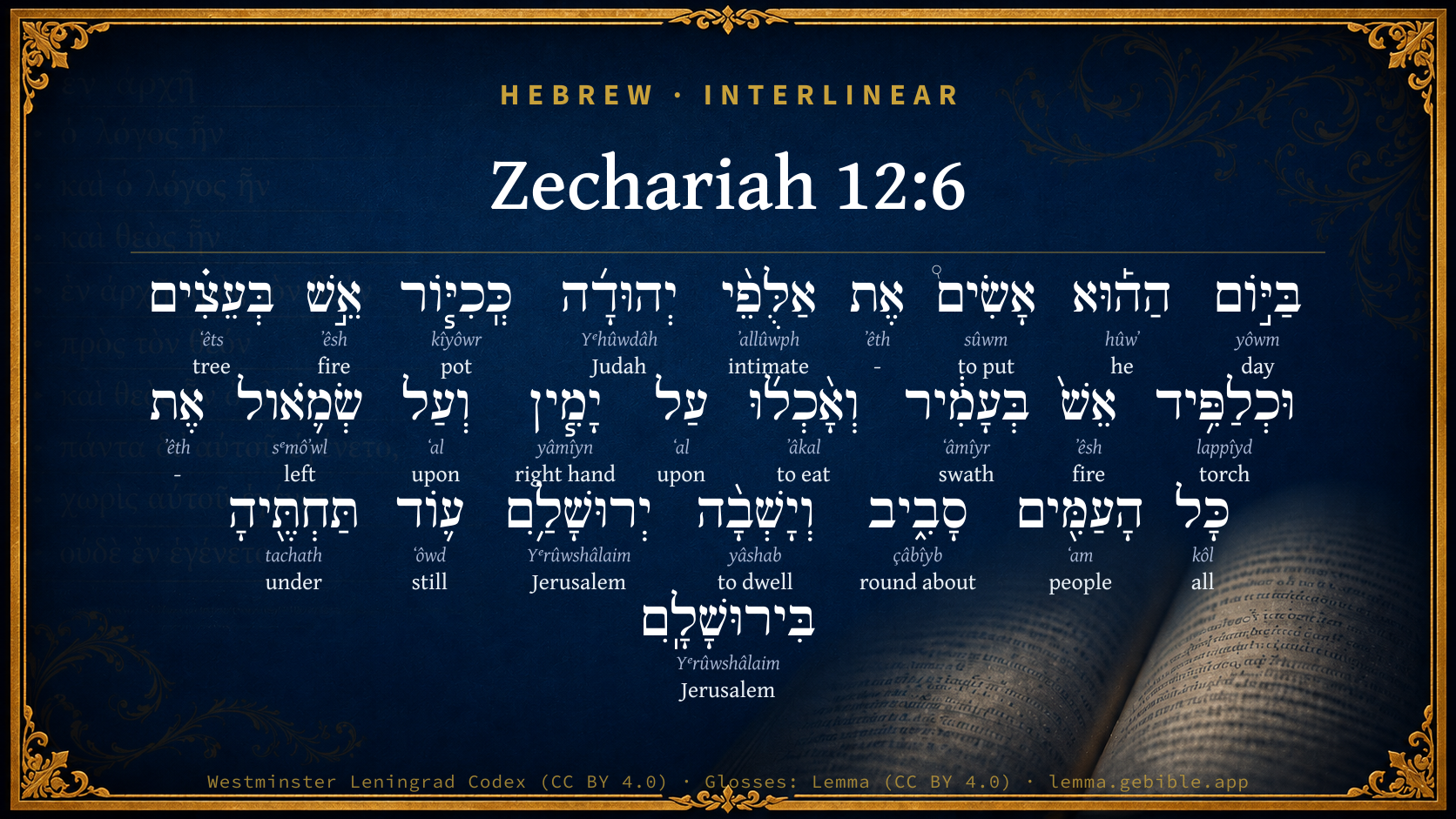
Hebrew (Westminster Leningrad Codex) Zechariah 12:6 appears in the Hebrew Old Testament. The text above is from the Westminster Leningrad Codex. Each word links to its Strong’s number, a concise gloss, and parsing drawn from the Open Scriptures Hebrew Bible morphology. Click any word for its full Brown-Driver-Briggs (BDB) entry.
Download image
Cite this verse

Zechariah 12:6 (World English Bible). Public Domain. Lemma interlinear Bible study tool, https://lemma.gebible.app/v/zechariah/12/6.

Show BibTeX & RIS
BibTeX
RIS
English Translation
In that day I will make the chieftains of Judah like a pan of fire among wood, and like a flaming torch among sheaves; and they will devour all the surrounding peoples, on the right hand and on the left; and Jerusalem will yet again dwell in their own place, even in Jerusalem.
World English Bible · Public Domain
Download a study sheet

One document with this verse’s original text, its word-by-word gloss line, the meaning frame, cross-references with their text, attributed commentary, and full source and license credits — printable, and it pastes into notes with its structure intact.

This verse Autodidact and up

Study sheet (.html) Plain text (.txt)

A passage Seminary Student

Up to 50 verses in one chapter. A passage sheet keeps up to 6 commentary sources and 12 cross-references per verse, in the order this page ranks them, and says so on the sheet whenever that leaves anything out. Ask for a single verse and you get the Autodidact verse sheet above.

Everything on this page stays free to read, with no account — the sheet is a download of what is already on screen, not access to it.

Want to remove ads? Support Godless Engineer
Compare translations 3

The same verse in 3 English versions, stacked beneath the original-language interlinear above. Click any original word for its lexicon entry.

Each is an independent rendering of the whole verse — the interlinear is not word-aligned to these translations.

Highlighted words mark where these versions differ — a whole-verse word diff, not a word-by-word alignment.

  • World English Bible Public Domain
    In that day I will make the chieftains of Judah like a pan of fire among wood, and like a flaming torch among sheaves; and they will devour all the surrounding peoples, on the right hand and on the left; and Jerusalem will yet again dwell in their own place, even in Jerusalem.
  • King James Version Public Domain
    In that day will I make the governors of Judah like an hearth of fire among the wood, and like a torch of fire in a sheaf; and they shall devour all the people round about, on the right hand and on the left: and Jerusalem shall be inhabited again in her own place, even in Jerusalem.
  • unfoldingWord Literal Text CC BY-SA 4.0
    On that day I will make the leaders of Judah like firepots among wood and like a flaming torch among standing grain, for they will consume all the surrounding peoples on their right and on their left. Jerusalem will again live in her own place.”

unfoldingWord Literal Text — © unfoldingWord, licensed CC BY-SA 4.0. Word-aligned USFM3 via Door43 (git.door43.org/unfoldingWord/en_ult).

Versions to compare (up to 4)

3 of 4 selected

Show all 18 translations

Every available English version of this verse, each an independent rendering of the whole verse.

  • World English Bible Public Domain
    In that day I will make the chieftains of Judah like a pan of fire among wood, and like a flaming torch among sheaves; and they will devour all the surrounding peoples, on the right hand and on the left; and Jerusalem will yet again dwell in their own place, even in Jerusalem.
  • Berean Standard Bible Public Domain
    On that day I will make the clans of Judah like a firepot in a woodpile, like a flaming torch among the sheaves; they will consume all the peoples around them on the right and on the left, while the people of Jerusalem remain secure there.
  • Majority Standard Bible Public Domain
    On that day I will make the clans of Judah like a firepot in a woodpile, like a flaming torch among the sheaves; they will consume all the peoples around them on the right and on the left, while the people of Jerusalem remain secure there.
  • King James Version Public Domain
    In that day will I make the governors of Judah like an hearth of fire among the wood, and like a torch of fire in a sheaf; and they shall devour all the people round about, on the right hand and on the left: and Jerusalem shall be inhabited again in her own place, even in Jerusalem.
  • American Standard Version (1901) Public Domain
    In that day will I make the chieftains of Judah like a pan of fire among wood, and like a flaming torch among sheaves; and they shall devour all the peoples round about, on the right hand and on the left; and `they of' Jerusalem shall yet again dwell in their own place, even in Jerusalem.
  • Revised Version (1885) Public Domain
    In that day will I make the chieftains of Judah like a pan of fire among wood, and like a torch of fire among sheaves; and they shall devour all the peoples round about, on the right hand and on the left: and Jerusalem shall yet again dwell in her own place, even in Jerusalem.
  • Geneva Bible (1599) Public Domain
    In that day will I make the princes of Iudah like coles of fire among the wood, and like a fire brand in the sheafe, and they shall deuoure all the people round about on the right hand, and on the left: and Ierusalem shall be inhabited againe in her owne place, euen in Ierusalem.
  • Douay-Rheims (1899) Public Domain
    In that day I will make the governors of Juda like a furnace of fire amongst wood, and as a firebrand amongst hay: and they shall devour all the people round about, to the right hand, and to the left: and Jerusalem shall be inhabited again in her own place in Jerusalem.
  • Young's Literal Translation Public Domain
    In that day I make the leaders of Judah As a hearth of fire among trees, And as a torch of fire in a sheaf, And they have consumed -- on the right and on the left -- all the peoples round about, And Jerusalem hath inhabited again her place in Jerusalem.
  • Literal Standard Version CC BY-SA 4.0
    In that day I make the leaders of Judah || As a hearth of fire among trees, || And as a torch of fire in a sheaf, || And they have consumed—on the right and on the left—all the surrounding peoples, || And Jerusalem has again inhabited her place in Jerusalem.
  • Unlocked Literal Bible CC BY-SA 4.0
    On that day I will make the leaders of Judah like firepots among wood and like a flaming torch among standing grain, for they will consume all the surrounding peoples on their right and on their left. Jerusalem will again live in her own place.”
  • unfoldingWord Literal Text CC BY-SA 4.0
    On that day I will make the leaders of Judah like firepots among wood and like a flaming torch among standing grain, for they will consume all the surrounding peoples on their right and on their left. Jerusalem will again live in her own place.”
  • Darby Bible Public Domain
    In that day will I make the leaders of Judah like a hearth of fire among wood, and like a torch of fire in a sheaf; and they shall devour all the peoples round about, on the right hand and on the left; and Jerusalem shall dwell again in her own place, in Jerusalem.
  • World Messianic Bible Public Domain
    In that day I will make the chieftains of Judah like a pan of fire among wood, and like a flaming torch among sheaves. They will devour all the surrounding peoples on the right hand and on the left; and Jerusalem will yet again dwell in their own place, even in Jerusalem.
  • Webster's Bible Public Domain
    In that day will I make the governors of Judah like a hearth of fire among the wood, and like a torch of fire in a sheaf; and they shall devour all the people around, on the right hand and on the left: and Jerusalem shall be inhabited again in her own place, even in Jerusalem.
  • Free Bible Version CC BY-SA 4.0
    On that day I will make the families of Judah like burning coals in a wood, like a flaming torch in a field of straw. They will burn up to the right and to the left all the surrounding peoples, while the people of Jerusalem will live safely in their city.
  • Bible in Basic English Public Domain
    In that day I will make the families of Judah like a pot with fire in it among trees, and like a flaming stick among cut grain; they will send destruction on all the peoples round about, on the right hand and on the left: and Jerusalem will be living again in the place which is hers, that is, in Jerusalem.
  • JPS Tanakh (1917) Public Domain
    In that day will I make the chiefs of Judah like a pan of fire among the wood, and like a torch of fire among sheaves; and they shall devour all the peoples round about, on the right hand and on the left; and Jerusalem shall be inhabited again in her own place, even in Jerusalem.

Literal Standard Version (2020), Covenant Press — licensed CC BY-SA 4.0. Text via the HelloAO Bible API (eBible.org). Unlocked Literal Bible (unfoldingWord) — licensed CC BY-SA 4.0. Text via the HelloAO Bible API (eBible.org). unfoldingWord Literal Text — © unfoldingWord, licensed CC BY-SA 4.0. Word-aligned USFM3 via Door43 (git.door43.org/unfoldingWord/en_ult). Free Bible Version, Dr. Jonathan Gallagher — licensed CC BY-SA 4.0. Text via the HelloAO Bible API (eBible.org).

Word by word

More ways to search: Search by grammar → Find every occurrence → Compare this word →

Practice this passage: Drill this verse → Learn its vocabulary →

בְּעָמִ֔יר
ʻâmîyr
H5995
“in/at · swath”
Preposition + Noun, Common, Masculine, Singular, Absolute
Part of Speech
Preposition + Noun
Type
Common
Gender
Masculine
Number
Singular
State
Absolute
Full BDB Definition

Origin: from H6014

TWOT: 1645c

swath, a row of fallen grain
  1. בַּיּ֣וֹם yôwm H3117 “in/at the · day” Preposition, Determined + Noun, Common, Masculine, Singular, Absolute
  2. הַה֡וּא hûwʼ H1931 “the · he” Particle, Definite Article + Pronoun, Personal, 3rd Person, Masculine, Singular
  3. אָשִׂים֩ sûwm H7760 “to put” Verb, Qal, Imperfect, 1st Person, Common, Singular
  4. אֶת ʼêth H853 “-” Particle, Direct Object
  5. אַלֻּפֵ֨י ʼallûwph H441 “intimates of” Noun, Common, Masculine, Plural, Construct
  6. יְהוּדָ֜ה Yᵉhûwdâh H3063 “Judah” Noun, Proper
  7. כְּֽכִיּ֧וֹר kîyôwr H3595 “like/as · pot of” Preposition + Noun, Common, Masculine, Singular, Construct
  8. אֵ֣שׁ ʼêsh H784 “fire” Noun, Common, Both, Singular, Absolute
  9. בְּעֵצִ֗ים ʻêts H6086 “in/at · trees” Preposition + Noun, Common, Masculine, Plural, Absolute
  10. וּכְלַפִּ֥יד lappîyd H3940 “and · like/as · torch of” Conjunction + Preposition + Noun, Common, Masculine, Singular, Construct
  11. אֵשׁ֙ ʼêsh H784 “fire” Noun, Common, Both, Singular, Absolute
  12. וְאָ֨כְל֜וּ ʼâkal H398 “and · to eat” Conjunction + Verb, Qal, Sequential Perfect, 3rd Person, Common, Plural
  13. עַל ʻal H5921 “upon” Preposition
  14. יָמִ֧ין yâmîyn H3225 “right hand” Noun, Common, Feminine, Singular, Absolute
  15. וְעַל ʻal H5921 “and · upon” Conjunction + Preposition
  16. שְׂמֹ֛אול sᵉmôʼwl H8040 “left” Noun, Common, Masculine, Singular, Absolute
  17. אֶת ʼêth H853 “-” Particle, Direct Object
  18. כָּל kôl H3605 “all of” Noun, Common, Masculine, Singular, Construct
  19. הָעַמִּ֖ים ʻam H5971 “the · peoples” Particle, Definite Article + Noun, Common, Masculine, Plural, Absolute
  20. סָבִ֑יב çâbîyb H5439 “round about” Noun, Common, Both, Singular, Absolute
  21. וְיָשְׁבָ֨ה yâshab H3427 “and · to dwell” Conjunction + Verb, Qal, Sequential Perfect, 3rd Person, Feminine, Singular
  22. יְרוּשָׁלִַ֥ם Yᵉrûwshâlaim H3389 “Jerusalem” Noun, Proper
  23. ע֛וֹד ʻôwd H5750 “still” Adverb
  24. תַּחְתֶּ֖יהָ tachath H8478 “under · her” Preposition + Suffix, Personal, 3rd Person, Feminine, Singular
  25. בִּירוּשָׁלִָֽם Yᵉrûwshâlaim H3389 “in/at · Jerusalem” Preposition + Noun, Proper

About this verse

These counts appear in no published source. They are computed here, from the morphology-tagged text and Lemma’s own curated glosses. What Lemma adds →

26
words
22
distinct lemmas
Prophets
section

Notable vocabulary

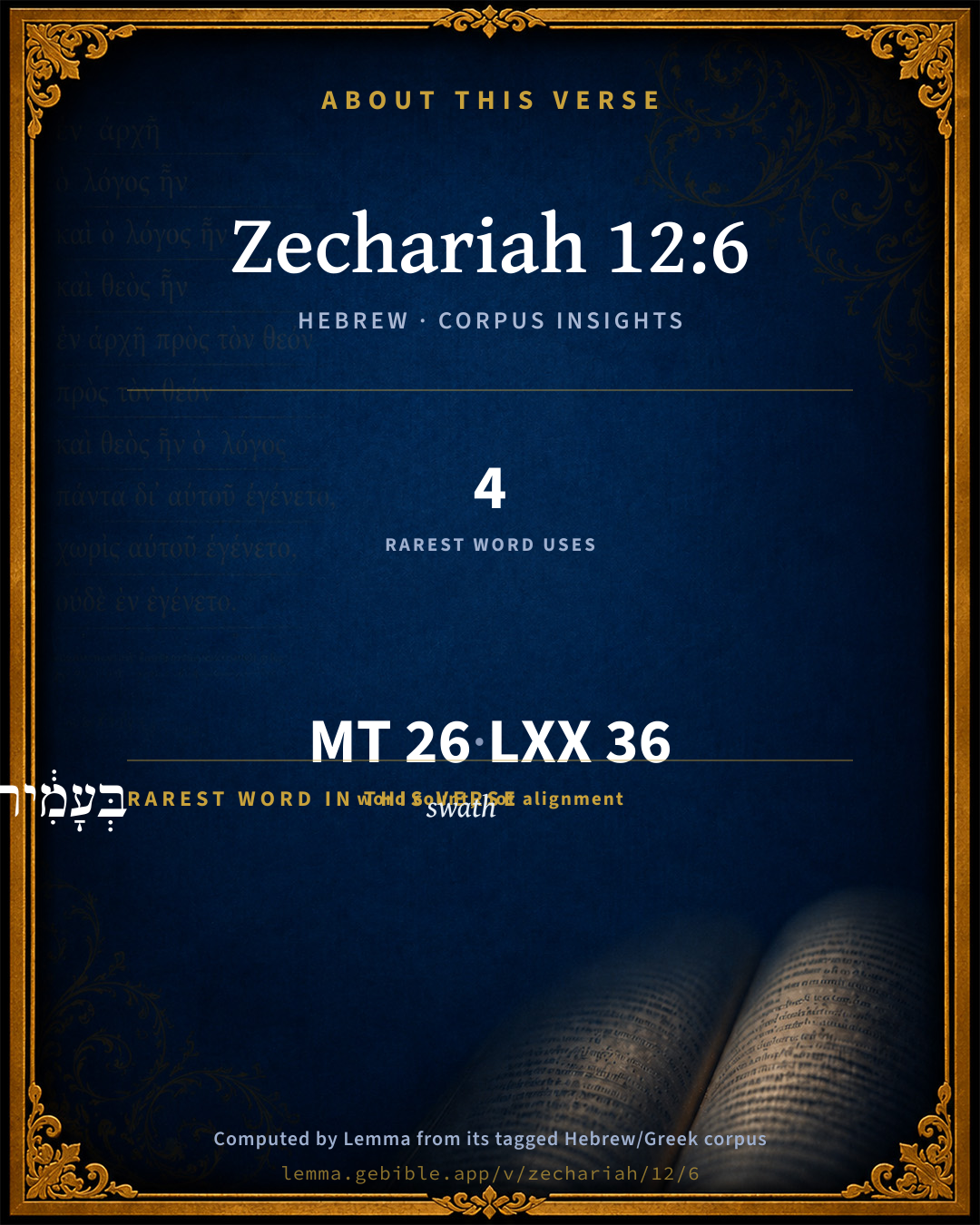
The rarest word here is בְּעָמִ֔יר swath H5995 — appearing just 4 times in the whole Hebrew Bible.

Shared distinctive vocabulary

בְּעָמִ֔יר swath H5995 occurs in 4 verses of the Hebrew Bible. Also found in:

Grammatical profile

  • 3 verbs
  • 16 nouns
  • 1 pronoun
  • 3 prepositions
  • 1 adverb
  • 2 particles

Verb forms

  • אָשִׂים֩ Qal · Imperfect
  • וְאָ֨כְל֜וּ Qal · Sequential Perfect
  • וְיָשְׁבָ֨ה Qal · Sequential Perfect

Repetition

Words recur within this verse — often emphatic in Hebrew:

  • אֵ֣שׁ fire H784 ×2
  • עַל upon H5921 ×2
  • יְרוּשָׁלִַ֥ם Jerusalem H3389 ×2

Hebrew & Septuagint length

In English translation the verse runs 53 words from the Hebrew and 52 from the Septuagint (LXX English) — closely comparable.

A rough comparison of the two English renderings, which tokenize alike — not a word-level alignment.

Word counts can differ between the Hebrew and the Greek without any difference in meaning — e.g. the Hebrew direct-object marker אֵת has no separate Greek word, and Greek often adds the article ὁ.

In the original languages it is 26 Hebrew tokens and 36 Greek tokens — but the two are counted differently (Hebrew bundles its prefixes and suffixes into one token; the Greek is in lemma form), so that isn’t a like-for-like length.

Cross-references

24

Topical passages linked to Zechariah 12:6 in the Treasury of Scripture Knowledge — connected by theme and wording, ordered by reader-vote popularity; previews shown in the World English Bible.

  • Obadiah 1:18 The house of Jacob will be a fire, the house of Joseph a flame, and the house of Esau for stubble. They will burn among them, and devour them. There will not be any remaining to the house of Esau." Indeed, Yahweh has spoken.
  • Psalms 149:6–9 May the high praises of God be in their mouths, And a two-edged sword in their hand;
  • Daniel 2:44–45 In the days of those kings shall the God of heaven set up a kingdom which shall never be destroyed, nor shall the sovereignty of it be left to another people; but it shall break in pieces and consume all these kingdoms, and it shall stand forever.
  • Micah 5:5–8 He will be our peace when Assyria invades our land, And when he marches through our fortresses, Then we will raise against him seven shepherds, And eight leaders of men.
  • Zechariah 2:4 and said to him, "Run, speak to this young man, saying, 'Jerusalem will be inhabited as villages without walls, because of the multitude of men and cattle in it.
  • Nehemiah 11:1–36 The princes of the people lived in Jerusalem: the rest of the people also cast lots, to bring one of ten to dwell in Jerusalem the holy city, and nine parts in the [other] cities.
  • Isaiah 9:20 One shall snatch on the right hand, and be hungry; and he shall eat on the left hand, and they shall not be satisfied: they shall eat every man the flesh of his own arm:
  • Isaiah 10:16–18 Therefore will the Lord, Yahweh of Hosts, send among his fat ones leanness; and under his glory there shall be kindled a burning like the burning of fire.
  • Isaiah 41:15–16 Behold, I have made you [to be] a new sharp threshing instrument having teeth; you shall thresh the mountains, and beat them small, and shall make the hills as chaff.
  • Isaiah 54:3 For you shall spread aboard on the right hand and on the left; and your seed shall possess the nations, and make the desolate cities to be inhabited.
  • Jeremiah 30:18 Thus says Yahweh: Behold, I will turn again the captivity of Jacob's tents, and have compassion on his dwelling-places; and the city shall be built on its own hill, and the palace shall be inhabited after its own manner.
  • Jeremiah 31:38–40 Behold, the days come, says Yahweh, that the city shall be built to Yahweh from the tower of Hananel to the gate of the corner.
  • Ezekiel 48:30–35 These are the exits of the city: On the north side four thousand and five hundred [reeds] by measure;
  • Daniel 2:34–35 You saw until a stone was cut out without hands, which struck the image on its feet that were of iron and clay, and broke them in pieces.
  • Micah 4:13 Arise and thresh, daughter of Zion; For I will make your horn iron, And I will make your hoofs brass; And you will beat in pieces many peoples: And I will devote their gain to Yahweh, And their substance to the Lord of the whole earth.
  • Zechariah 8:3–5 Thus says Yahweh: "I have returned to Zion, and will dwell in the midst of Jerusalem. Jerusalem shall be called 'The City of Truth;' and the mountain of Yahweh of Hosts, 'The Holy Mountain.'"
  • Zechariah 9:15 Yahweh of Hosts will defend them; And they will destroy and overcome with sling-stones; And they will drink, and roar as through wine; And they will be filled like bowls, Like the corners of the altar.
  • Zechariah 14:10–11 All the land will be made like the Arabah, from Geba to Rimmon south of Jerusalem; and she will be lifted up, and will dwell in her place, from Benjamin's gate to the place of the first gate, to the corner gate, and from the tower of Hananel to the king's wine-presses.
  • Zechariah 1:16 Therefore thus says Yahweh: "I have returned to Jerusalem with mercy. My house shall be built in it," says Yahweh of Hosts, "and a line shall be stretched forth over Jerusalem."'
  • Zechariah 2:12 Yahweh will inherit Judah as his portion in the holy land, and will again choose Jerusalem.
  • Zechariah 11:1 Open your doors, Lebanon, That the fire may devour your cedars.
  • 2 Corinthians 6:7 in the word of truth, in the power of God; by the armor of righteousness on the right hand and on the left,
  • Revelation 19:19–20 I saw the beast, and the kings of the earth, and their armies, gathered together to make war against him who sat on the horse, and against his army.
  • Revelation 20:9 They went up over the breadth of the earth, and surrounded the camp of the saints, and the beloved city. Fire came down out of heaven from God, and devoured them.

Cross-references courtesy of OpenBible.info (CC BY 4.0).

Hebrew and Greek witnesses Masoretic Hebrew ↔ Greek Septuagint

The same verse in the two great witnesses to the Old Testament, shown verse-for-verse.

These are two independent witnesses, not word-aligned to each other, and the Septuagint is shown in lemma (dictionary) form.

Hebrew Zechariah 12:6 Masoretic · Westminster Leningrad Codex

בַּיּ֣וֹם הַה֡וּא אָשִׂים֩ אֶת אַלֻּפֵ֨י יְהוּדָ֜ה כְּֽכִיּ֧וֹר אֵ֣שׁ בְּעֵצִ֗ים וּכְלַפִּ֥יד אֵשׁ֙ בְּעָמִ֔יר וְאָ֨כְל֜וּ עַל יָמִ֧ין וְעַל שְׂמֹ֛אול אֶת כָּל הָעַמִּ֖ים סָבִ֑יב וְיָשְׁבָ֨ה יְרוּשָׁלִַ֥ם ע֛וֹד תַּחְתֶּ֖יהָ בִּירוּשָׁלִָֽם

In that day I will make the chieftains of Judah like a pan of fire among wood, and like a flaming torch among sheaves; and they will devour all the surrounding peoples, on the right hand and on the left; and Jerusalem will yet again dwell in their own place, even in Jerusalem.

World English Bible · Public Domain

Greek LXX Zechariah 12:6 Septuagint · lemma form

ἐν ὁ ἡμέρα ἐκεῖνος τίθημι ὁ χιλίαρχος ιουδα ὡς δαλός πῦρ ἐν ξύλον καί ὡς λαμπάς πῦρ ἐν καλάμη καί καταἐσθίω ἐκ δεξιός καί ἐκ εὐώνυμος πᾶς ὁ λαός κυκλόθεν καί καταοἰκέω ἰερουσαλήμ ἔτι κατά ἑαυτοῦ

In that day I will make the captains of thousands of Juda as a firebrand among wood, and as a torch of fire in stubble; and they shall devour on the right hand and on the left all the nations round about: and Jerusalem shall dwell again by herself, even in Jerusalem.

LXX2012 (modern English Septuagint) · Public Domain

On this verse, Haydock's Catholic Bible Commentary discusses the Septuagint’s reading. Read the note in Commentary ↓

Hebrew: Westminster Leningrad Codex (CC BY 4.0). Greek: Septuagint (public domain); English from LXX2012 (modern English Septuagint) (Public Domain). How the Septuagint differs from the Hebrew →

Targum (Aramaic paraphrase)

1

The Targum is the ancient Jewish Aramaic paraphrase of the Hebrew Scriptures — an interpretive translation, not the Hebrew text itself. Onkelos (literal) and Pseudo-Jonathan (expansive) render the Torah, and Jonathan the Prophets. Coverage is partial: where no permissively-licensed English translation exists for a verse, only the Aramaic is shown. This is verse-level text, not a word-by-word alignment to the Hebrew.

  1. Targum Jonathan Prophets (Joshua–Malachi)
    בְּעִדָנָא הַהִיא אֲשַׁוֵי יַת רַבְרְבֵי יְהוּדָה כִּלְבוּשׁ דִינוּר בַּאֲעַיָא וּכְבִיעוּר דְאֶשָׁא בַּעֲמִירָא וְיִבְזוּן מִן דָרוֹמָא וּמִן צִפּוּנָא יַת כָּל נִכְסֵי עַמְמַיָא סְחוֹר סְחוֹר וְתִתַּב יְרוּשְׁלֵם עוֹד בְּאַתְרָהּ וְתִצְלַח יְרוּשְׁלֵם:

    (no public-domain English translation for this verse)

    Targum Jonathan — Aramaic: “Mikraot Gedolot” (public domain). English: “Sefaria Community Translation” (CC0 1.0 (public-domain dedication)); “London "Chaldee Paraphrase," 1871” (public domain). Text via Sefaria.

Commentary

Notes on Zechariah 12:6 from classic Christian and Jewish commentators (each source and its license shown beneath its notes). The classic Christian expositions comment on the surrounding passage and are grouped to its opening verse, so a note may address several verses; the Jewish commentaries on the Tanakh (Rashi and others) are per-verse, so they appear only where the commentator wrote on this verse.

Lemma curates 59 commentaries, every one of them public domain or Creative Commons licensed, each selected and text-cleaned for this edition rather than reprinted as found. About our sources →

Trapp's Complete Commentary

John Trapp

Zec 12:6 In that day will I make the governors of Judah like an hearth of fire among the wood, and like a torch of fire in a sheaf; and they shall devour all the people round about, on the right hand and on the left: and Jerusalem shall be inhabited again in her own place, [even] in Jerusalem.

Ver. 6. In that day will I make the governors, &c.] This is the third similitude, whereof the Scripture is full; according to that, I will open my mouth in parables. These are of excellent use to adorn and explain; and yet they are evermore inferior to the matter in hand. They are borrowed from things well known and easy to be conceived; as here from a hearth of fire among wood; now we can all tell how great a matter (or wood) a little fire kindleth, Jas 3:5. When Nero, for his pleasure’s sake, set Rome on fire, among other stately buildings that were quickly burnt down, the circus or race yard was one, being about half a mile in length, of an oval form, with rows of seats one above another, capable of at least 150,000 spectators, without uncivil shoulderings. "As the fire burneth a wood; and as the flame setteth the mountains on fire; so persecute them with thy tempest, and make them afraid with thy storm," saith the Church, Psa 83:14-15. Thus they prayed, and thus it is here promised; and was accordingly performed in those first wars of the Maccabees; as appeareth in the first book of their story, and in Josephus. Diodati and others understand this text to be the apostles and evangelists, who should fill the world with wars and dissensions by preaching the gospel, Luk 12:49, whereby the enemies should be ruined and the Church re-established, Oba 1:18, through the spirit of judgment and of burning, Isa 4:4. To which purpose Chrysostem saith, that Peter was a man made of fire walking among stubble. Basil was compared to a pillar of fire. John Baptist is by our Saviour said to be a burning and a shining lamp. And Elijah (in whose spirit the Baptist came) was a man of that transcendent zeal, that to heighten the expression thereof some have legended of him, that when he drew his mother’s breasts he was seen to suck in fire.

And Jerusalem shall be inhabited again in her own place] sc. Where she was built at first, and not in another near place, as Tyre was; and Rome is at this day quite off her old seven hills; so that a man may look for Rome in Rome. And Jerusalem that now is hath Mount Calvary in the very midst of it (which was anciently without the city), and not one hundred families of Jews are therein to be found. That they shall one day cast out therehence Gog and Magog, inhabit it in the old place, and have excellent strength and valour ministered by God to them, all equally for their common defence, none lifting up themselves above another, but all alike ascribing the glory unto God, is concluded by some and those not inconsiderable divines out of this and the following verses.

John Trapp, A Commentary or Exposition upon All the Books of the Old and New Testament (1647–1656) — public domain. Text from a community e-Sword module.

Joseph Benson's Commentary

Zec 12:6. In that day will I make the governors of Judah like a hearth of fire, &c. — The word may be rendered, a pot. The Arabs, according to Harmer, (vol. 1. p. 233,) make a fire in a great stone pitcher, and when it is heated, spread paste upon it, which is baked almost in an instant. By a hearth of fire, however, here may be meant, a firebrand taken from the hearth, which, though small, will set other things on fire, and even whole cities. This is thought by some to be a very apt resemblance of the mischief done by the small forces of the Jews, under Judas Maccabæus, to the armies of Antiochus. It may, however, be a resemblance equally, and even more apt, of the destruction made of Gog and Magog, in the latter days, by the Jews restored to their own land. And they shall devour all the people round about — They shall destroy all the enemies that annoy them; on the right hand and on the left — That is, on the south and on the north: see note on Eze 16:46. The Targum explains the right hand, and the left, of the south and the north. And Jerusalem shall be inhabited again in her own place — Shall be situated and inhabited on the very spot where she formerly stood: see note on Zec 14:10.

Joseph Benson's Commentary on the Old and New Testaments (1811–1818) — public domain. Text from a community e-Sword module.

Tyndale Open Study Notes

Tyndale Open Resources

12:6 flame (literally firepan): Bronze or gold firepans were used to carry hot coals to and from the sacrificial altars of the Tabernacle and the Temple (Exod 27:3; 1 Kgs 7:50). God would set Israel among the nations like a burning firepan to destroy or purify them.

Tyndale Open Study Notes — © Tyndale Open Resources, licensed CC BY-SA 4.0. Text via the HelloAO Bible API.

Jamieson, Fausset & Brown

Robert Jamieson, A. R. Fausset & David Brown

On "governors of Judah," see on Zac 9:7.

hearth--or pan.

torch . . . in a sheaf--Though small, it shall consume the many foes around. One prophet supplements the other. Thus Isa. 29:1-24; Joel 3:1-21; Zec. 12:1-14:21, describe more Antichrist's army than himself. Daniel represents him as a horn growing out of the fourth beast or fourth kingdom; St. John, as a separate beast having an individual existence. Daniel dwells on his worldly conquests as a king; St. John, more on his spiritual tyranny, whence he adds a second beast, the false prophet coming in a semblance of spirituality. What is briefly described by one is more fully prophesied by the other [ROOS].

Jamieson, Fausset & Brown — Commentary Critical and Explanatory on the Whole Bible (1871) — public domain (CC PDM 1.0). Text via the HelloAO Bible API.

Adam Clarke's Commentary

Verse 6. Jerusalem shall be inhabited again] This seems to refer to the future conversion of the Jews, and their "return to their own land."

Adam Clarke's Commentary on the Bible (1810–1826) — public domain. Text from a community e-Sword/MySword module.

John Calvin's Commentaries

He adds another metaphor for the sake of a further confirmation; for he says, that the chiefs of Judah would be like a melting pot: some render it a hearth, but improperly and without meaning. He afterwards compares them to a flaming torch, and heathen nations to wood and stubble or chaff. The Spirit speaks thus also in other places; and the reason is to be noticed; for when the ungodly assail the Church of God, all things seem to threaten its ruin; but God declares that they shall be like chaff or wood. “The house of Israel,” says Isaiah, “shall be a flaming fire, and shall consume all the wood of the forest:” so also in this place, “There shall be indeed a great host of enemies, assembled against Israel; but the Lord will consume them, for he will be like fire in the midst of his people, and his people also shall be through the secret power of the Spirit like a burning pot or a torch, which shall consume the chaff, in which there is nothing substantial.”

But the Prophet shows again that the deliverance of the Church is ever wonderful: and hence foolishly do they act who rely on human and earthly instrumentality, and wilfully bind God to their own ways; for whenever God promises to be their deliverer, their inquiry is, “But how can this be? whence will come this aid to us? how will the hand of the Lord be stretched forth to us? whence will he gather his army?” Inasmuch then as we are wont thus anxiously to inquire, and thus drive away from us the aid of God, let this truth, taught by the Prophet, be borne in mind, — that though enemies in great numbers may come upon us, they shall yet be like a heap of wood, and we like fire; for though we have no strength, yet the Lord by his hidden favor will cause that our enemies shall even, by coming nigh us, be consumed.

To the same purpose is the next similitude, — that they would be a torch in handfuls of chaff; for here also the singular number is used for the plural. Then follows an explanation, Consume shall they on the right hand, and on the left, all nations around. Zechariah seems here to ascribe an insatiable cruelty, and a revengeful passion to the faithful, who yet are to be influenced by a meek spirit, so that they may imitate their heavenly Father. But here he speaks not of their disposition and feeling, but only shows, that all the ungodly shall be frustrated in their expectation of success, and not only so, but that they shall also be destroyed. The more furiously then they assail the Church, the more sudden shall be their destruction; for though the faithful may wish to spare them, yet God, the righteous judge, will not spare them. In short, the work of God himself, as in other places, is ascribed to the Church.

In the last place he declares, that Jerusalem shall stand in its own place, where it was. There is here a sort of repetition; and it was made, because enemies thought, as we have already stated, that they could destroy Jerusalem so as wholly to obliterate it: but the Prophet on the other hand says, that it would be established in its own place, because God had chosen it as the place where he purposed to be worshipped, and he had chosen it, as it is often said by Moses, to commemorate his own name. In a word, he intimates, that the Church would be perpetually established: though all mortals conspired for its ruin and assailed it on every side, yet the sanctuary of God, as he had promised, would continue there still, even to the advent of Christ; for then, we know, Jerusalem was to be wholly destroyed, together with the temple, as an end was to come on all these things, and the world was to be renewed.

John Calvin's Commentaries (1540-1563) — public domain. Text from the Calvin Translation Society English edition (1840s-50s) via the Christian Classics Ethereal Library (ccel.org). Calvin's coverage is partial (roughly two-thirds of the Bible); uncommented books and verses are honest gaps, never fabricated. The 19th-century editor's footnotes and remarks are omitted so the notes are faithfully Calvin's own voice.

Ellicott's Commentary for English Readers

(6) Comp. Oba_1:18.

People.—Better, nations. (Comp. Zec_11:10.)

A Bible Commentary for English Readers, edited by Charles John Ellicott (1878–1897) — public domain. Text from a community e-Sword module.

The Cambridge Bible for Schools and Colleges

gen. ed. J. J. S. Perowne

6. a hearth] Rather, pan. The word is used in 1Sa_2:14 of a “pan,” or cooking vessel. Elsewhere it is a bason or laver, Exo_30:18; Exo_30:28; 1Ki_7:38; and once a pulpit or platform, 2Ch_6:13. Here the figure would seem to be of a chafing-pan full of fire set among wood or faggots.

in a sheaf] among sheaves, R. V.

The Cambridge Bible for Schools and Colleges (gen. ed. J. J. S. Perowne; Cambridge University Press, 1878–1918) — public domain. Text from a community e-Sword module.

John Gill's Exposition

In that day will I make the governors of Judah like a hearth of fire among the wood,.... As a large hearth of fire, with wood all about it, devours and consumes it; so shall the governors of Judah be to the nations that shall come up against Jerusalem. The Targum renders it,

"as a garment of fire among wood:''

and like a torch of fire in a sheaf; of wheat, which presently destroys it; see Oba 1:18,

and they shall devour all the people round about, on the right hand and on the left; on the south and on the north, as the Targum interprets it. The phrase denotes the utter destruction of the people on all sides:

and Jerusalem shall be inhabited again in her own place, even in Jerusalem; upon that very spot of ground which was formerly called Jerusalem shall the city be built again, and inhabited; and shall continue, notwithstanding the attempts of all the nations of the earth to destroy it; see Jer 30:18.

John Gill's Exposition of the Whole Bible (1746–1763) — public domain (CC PDM 1.0). Text via the HelloAO Bible API.

Albert Barnes' Notes on the Bible

I will make the governors of Judah like a hearth - or “cauldron” of fire large, broad, deep, and full of fire, among the wood which is prepared for burning, and like a torch of fire in a sheaf The fire could not kindle the wood or the sheaf, of itself, unless applied to it. All is of the agency of God: “I will make.”

Ribera: “He foretells the increase of the Church, which by such persecutions shall not be diminished, but shall be marvelously increased. The preachers of the Church shall raise up all the peoples round about, shall destroy all unbelief, and shall kindle the hearts of hearers with the fire of the divine word.” “On the right hand and on the left.” Ribera: “He indicates the strength and success of the preachers, whom no one can resist nor hinder,” as our Lord says, “I will give you a mouth and wisdom, which all your adversaries shall not be able to gainsay nor resist” Luk 21:15.

And Jerusalem shall again - Rather, “yet, be inhabited.” “Yet” is a sort of burden in Zechariah’s prophecies . Osorius: “They at once burned up by the flame all the defilement of vices, and kindled the minds of people with the torch of divine love; at once consumed the enemy and cast a heavenly fire into the human heart: ‘yet;’ in despite of all appearances, of all which is against her. ‘She shall yet dwell in her own place in Jerusalem;’ for, however the waves of this world chafe and lash themselves into foam against her, they break themselves, not her; as soon as they have reached their utmost height, they fall back; if they toss themselves, and, for a moment, hide her light, they fall down at all sides, and the ray shines out, steady as before; for she is ‘founded on a rock,’ against which ‘the gates of hell’ should not ‘prevail’ Mat 16:18.

Albert Barnes' Notes on the Bible (1834–1885) — public domain. Text from a community e-Sword/MySword module.

Haydock's Catholic Bible Commentary

Furnace. Septuagint, "firebrand among wood, and as a burning lamp amid straw." (Haydock) --- Left. The Samaritans shall fall as well as the Idumeans. --- Place. The temple and city had been deserted, while the troops of Epiphanes occupied the citadel, 1 Machabees iii. 45., and iv. 38.

George Leo Haydock (1774–1849), Haydock's Catholic Family Bible and Commentary, 1859 edition — public domain. Excludes Psalms (Douay-Rheims chapter numbering differs from Protestant) and Deuterocanonical books (Catholic canon only).

Matthew Poole's English Annotations

The governors: see Zec 12:5.

Like a hearth of fire; a hearth on which fire is thoroughly kindled.

Among the wood; the more is laid on, the more is consumed and burnt up: so the enemies of Judah and Jerusalem shall be, their multitudes shall no more save themselves than much wood cast on a great fire in the hearth can preserve itself.

Like a torch of fire in a sheaf; which immediately sets the whole sheaf on fire, and it is consumed.

They shall devour, & c.; the governors of Judah with their handful of men shall thus surely and speedily consume their enemies which set upon them.

Jerusalem shall be inhabited again; as indeed it was, and continued so till Christ’s death, and forty years after; for of these times doth the prophet speak, and not of times still to come.

In her own place; not built as Nineveh, Tyre, Babylon, or Rome, in some place near to the old cities of that name, but in the very same place where old Jerusalem did, shall re-edified Jerusalem again stand.

Even in Jerusalem; so you shall find Jerusalem in Jerusalem; or thus, spiritual Jerusalem shall be that Jerusalem in which you ought to look, and where you shall find the old typical Jerusalem, which though it lie waste, and I fear must never be built, yet is in more ample manner built up in the church, spiritual Jerusalem.

Matthew Poole's English Annotations on the Holy Bible (1683–1685) — public domain. Text from a community e-Sword/MySword module.

Whedon's Commentary on the Bible

Daniel D. Whedon

6. Jehovah will use the forces of Judah to complete the defeat of the nations.

Governors — As in Zec_12:5.

Like an hearth — Better, R.V., “like a pan.” Judah will utterly destroy the hostile nations as fire devours wood or dry sheaves.

Jerusalem shall be inhabited again — R.V., more literally, “shall yet again dwell in their own place.” If the last clause, “even in Jerusalem,” is original, the name is used first of the inhabitants, then of the city. The inhabitants shall again dwell in the city. Since there is no reference to a deportation some have taken dwell as equivalent to dwell in peace. After the enemies are defeated the inhabitants of Jerusalem shall again dwell in peace. In several important manuscripts of LXX. “even in Jerusalem” is omitted; it may be an accidental repetition. If it is omitted the thought is that Jerusalem will remain unshaken by any of the events just described.

Daniel D. Whedon (gen. ed.), Commentary on the Old and New Testaments (1874–1909) — public domain. Text from a community e-Sword module.

The Pulpit Commentary

A hearth; literally, a pan. The victory should be easy and complete. The chieftains of Judah shall be like a chafing dish full of fire set among dry faggots. (comp. Oba_1:18 Nah_1:10) In a sheaf; among sheaves. Jerusalem shall be inhabited again; rather, Jerusalem shall yet again dwell. Jerusalem is personified as a female. In spite of all the attacks of the enemy, who tried to destroy and remove her, she shall remain firm and unshaken in her own place. In Jerusalem, the centre of the theocracy where God has set her. So against the Church the gates of hell shall not prevail, and the persecutions which she suffers increase her stability and add to her numbers.

The Pulpit Commentary (1880–1919), ed. H.D.M. Spence-Jones & Joseph S. Exell — public domain. Text from a community e-Sword module.

John Wesley's Explanatory Notes

Like a hearth - A hearth on which fire is thoroughly kindled. In her own place - Not built as Nineveh, Babylon, or Rome, in some place near old cities, but in the very same place where old Jerusalem stood.

John Wesley, Explanatory Notes Upon the Whole Bible (1754–1765) — public domain. Text via the GEBible commentary corpus.

unfoldingWord translationNotes

Door43 World Missions Community

General Information:

This verse continues telling about the coming attack against Jerusalem and how God will rescue the city.

like firepots among wood ... standing grain

This simile means Yahweh will enable the leaders of Judah to be strong and able to lead the people to defeat their enemies. AT: "like firepots among stacked firewood ... unharvested stalks of grain standing in a field" (See: Simile)

firepots

clay pots in which ancient people often carried burning coals

flaming torch

a wooden stick that is burning at one end which gives light as one travels or carries fire somewhere

will consume all the surrounding peoples

Completely destroying the peoples is spoken of as if the people of Judah will "devour" them. AT: "will destroy the surrounding peoples" (See: Metaphor)

on their right and on their left

Here "right" and "left" represent every direction. AT: "in every direction" (See: Merism)

Jerusalem will again live in her own place

Here "Jerusalem" represents the people who live there. AT: "The people of Jerusalem will again live in their own city" (See: Metonymy)

translationWords

kingdom of Judah

grain

consume

Jerusalem

life

unfoldingWord translationNotes — © Distant Shores Media and the Door43 World Missions Community, licensed CC BY-SA 4.0. Source: git.door43.org/Door43/en_tn.

Rashi

Rabbi Shlomo Yitzchaki (Rashi)

I will make the princes of Judah They will return and wage war with those who brought them there.

as a fiery stove Like a great bonfire. The word כִּיוֹר is an expression of כִּירָה, a stove. So did Menahem (Machbereth, p. 109) classify it.

in its place lit. under it.

Rashi on the Tanakh — English translations: “The Judaica Press complete Tanach with Rashi, translated by A. J. Rosenberg” (CC BY 4.0); “Pentateuch with Rashi's commentary by M. Rosenbaum and A.M. Silbermann, 1929-1934” (public domain); “The Metsudah Tanach series, Lakewood, N.J” (CC BY 4.0); and “The Book of Joshua, Metsudah Publications, 1997” (CC BY 4.0). Text via Sefaria.

Lesson kit

Teaching starters — assembled from the data on this page, not authored interpretation. Every prompt links to the verse data it draws on. Edit before teaching.

Zechariah, in the Prophets, opens this verse with 26 words (22 distinct Hebrew lemmas). Its most distinctive word is ʻâmîyr (“swath”). A historical commentator’s framing appears above. Read the whole chapter for the surrounding context.

Discussion questions

  1. What does “swath” (ʻâmîyr) contribute to the verse as a whole?
  2. Jeremiah 9:22 shares the word «swath» with this verse. How do the two illuminate each other?
  3. “fire” occurs 2× in this one verse. What is the effect of the repetition?
  4. These translations render this verse differently. What is at stake in choosing one wording over another?
  5. The verb «אָשִׂים֩» is Qal Imperfect. How does its form color the action?
  6. Reading how Trapp's Complete Commentary and Joseph Benson's Commentary read this verse, where do the two commentators agree and where do they part?

Things to notice

Reading settings

Reading text

Shown beneath each verse's original-language words.

Old Testament
Old Testament edition

Read the OT as the Masoretic Hebrew (MT) or the Greek Septuagint (LXX).

English shown for the Greek Septuagint (in the Hebrew ↔ Greek comparison).

Comparing translations? Open the Compare panel on any verse page to stack up to four side by side.