Isaiah 41:13

Hebrew (Westminster Leningrad Codex) Isaiah 41:13 appears in the Hebrew Old Testament. The text above is from the Westminster Leningrad Codex. Each word links to its Strong’s number, a concise gloss, and parsing drawn from the Open Scriptures Hebrew Bible morphology. Click any word for its full Brown-Driver-Briggs (BDB) entry.
Download image
Cite this verse

Isaiah 41:13 (World English Bible). Public Domain. Lemma interlinear Bible study tool, https://lemma.gebible.app/v/isaiah/41/13.

Show BibTeX & RIS
BibTeX
RIS
English Translation
For I, Yahweh your God, will hold your right hand, saying to you, Don't be afraid; I will help you.
World English Bible · Public Domain
Download a study sheet

One document with this verse’s original text, its word-by-word gloss line, the meaning frame, cross-references with their text, attributed commentary, and full source and license credits — printable, and it pastes into notes with its structure intact.

This verse Autodidact and up

Study sheet (.html) Plain text (.txt)

A passage Seminary Student

Up to 50 verses in one chapter. A passage sheet keeps up to 6 commentary sources and 12 cross-references per verse, in the order this page ranks them, and says so on the sheet whenever that leaves anything out. Ask for a single verse and you get the Autodidact verse sheet above.

Everything on this page stays free to read, with no account — the sheet is a download of what is already on screen, not access to it.

Want to remove ads? Support Godless Engineer
Compare translations 3

The same verse in 3 English versions, stacked beneath the original-language interlinear above. Click any original word for its lexicon entry.

Each is an independent rendering of the whole verse — the interlinear is not word-aligned to these translations.

Highlighted words mark where these versions differ — a whole-verse word diff, not a word-by-word alignment.

  • World English Bible Public Domain
    For I, Yahweh your God, will hold your right hand, saying to you, Don't be afraid; I will help you.
  • King James Version Public Domain
    For I the LORD thy God will hold thy right hand, saying unto thee, Fear not; I will help thee.
  • unfoldingWord Literal Text CC BY-SA 4.0
    For I, Yahweh, your God, holding your right hand, the one saying to you, ‘May you not fear; I, I will help you.’

unfoldingWord Literal Text — © unfoldingWord, licensed CC BY-SA 4.0. Word-aligned USFM3 via Door43 (git.door43.org/unfoldingWord/en_ult).

Versions to compare (up to 4)

3 of 4 selected

Show all 18 translations

Every available English version of this verse, each an independent rendering of the whole verse.

  • World English Bible Public Domain
    For I, Yahweh your God, will hold your right hand, saying to you, Don't be afraid; I will help you.
  • Berean Standard Bible Public Domain
    For I am the LORD your God, who takes hold of your right hand and tells you: Do not fear, I will help you.
  • Majority Standard Bible Public Domain
    For I am the LORD your God, who takes hold of your right hand and tells you: Do not fear, I will help you.
  • King James Version Public Domain
    For I the LORD thy God will hold thy right hand, saying unto thee, Fear not; I will help thee.
  • American Standard Version (1901) Public Domain
    For I, Jehovah thy God, will hold thy right hand, saying unto thee, Fear not; I will help thee.
  • Revised Version (1885) Public Domain
    For I the LORD thy God will hold thy right hand, saying unto thee, Fear not; I will help thee.
  • Geneva Bible (1599) Public Domain
    For I the Lord thy God will hold thy right hand, saying vnto thee, Feare not, I wil helpe thee.
  • Douay-Rheims (1899) Public Domain
    For I am the Lord thy God, who take thee by the hand, and say to thee: Fear not, I have helped thee.
  • Young's Literal Translation Public Domain
    For I, Jehovah thy God, Am strengthening thy right hand, He who is saying to thee, `Fear not, I have helped thee.'
  • Literal Standard Version CC BY-SA 4.0
    For I, your God YHWH, || Am strengthening your right hand, || He who is saying to you, “Do not fear, I have helped you.”
  • Unlocked Literal Bible CC BY-SA 4.0
    For I, Yahweh your God, will hold your right hand, saying to you, 'Do not fear; I am helping you.'
  • unfoldingWord Literal Text CC BY-SA 4.0
    For I, Yahweh, your God, holding your right hand, the one saying to you, ‘May you not fear; I, I will help you.’
  • Darby Bible Public Domain
    For I, Jehovah, thy God, hold thy right hand, saying unto thee, Fear not; I will help thee.
  • World Messianic Bible Public Domain
    For I, the LORD your God, will hold your right hand, saying to you, ‘Don’t be afraid. I will help you.’
  • Webster's Bible Public Domain
    For I the LORD thy God will hold thy right hand, saying to thee, Fear not; I will help thee.
  • Free Bible Version CC BY-SA 4.0
    For I the Lord will grab you by the hand and tell you, “Don't be afraid! I myself will help you.
  • Bible in Basic English Public Domain
    For I, the Lord your God, have taken your right hand in mine, saying to you, Have no fear; I will be your helper.
  • JPS Tanakh (1917) Public Domain
    For I the LORD thy God hold thy right hand, who say unto thee: 'Fear not, I help thee.'

Literal Standard Version (2020), Covenant Press — licensed CC BY-SA 4.0. Text via the HelloAO Bible API (eBible.org). Unlocked Literal Bible (unfoldingWord) — licensed CC BY-SA 4.0. Text via the HelloAO Bible API (eBible.org). unfoldingWord Literal Text — © unfoldingWord, licensed CC BY-SA 4.0. Word-aligned USFM3 via Door43 (git.door43.org/unfoldingWord/en_ult). Free Bible Version, Dr. Jonathan Gallagher — licensed CC BY-SA 4.0. Text via the HelloAO Bible API (eBible.org).

Word by word

More ways to search: Search by grammar → Find every occurrence → Compare this word →

Practice this passage: Drill this verse → Learn its vocabulary →

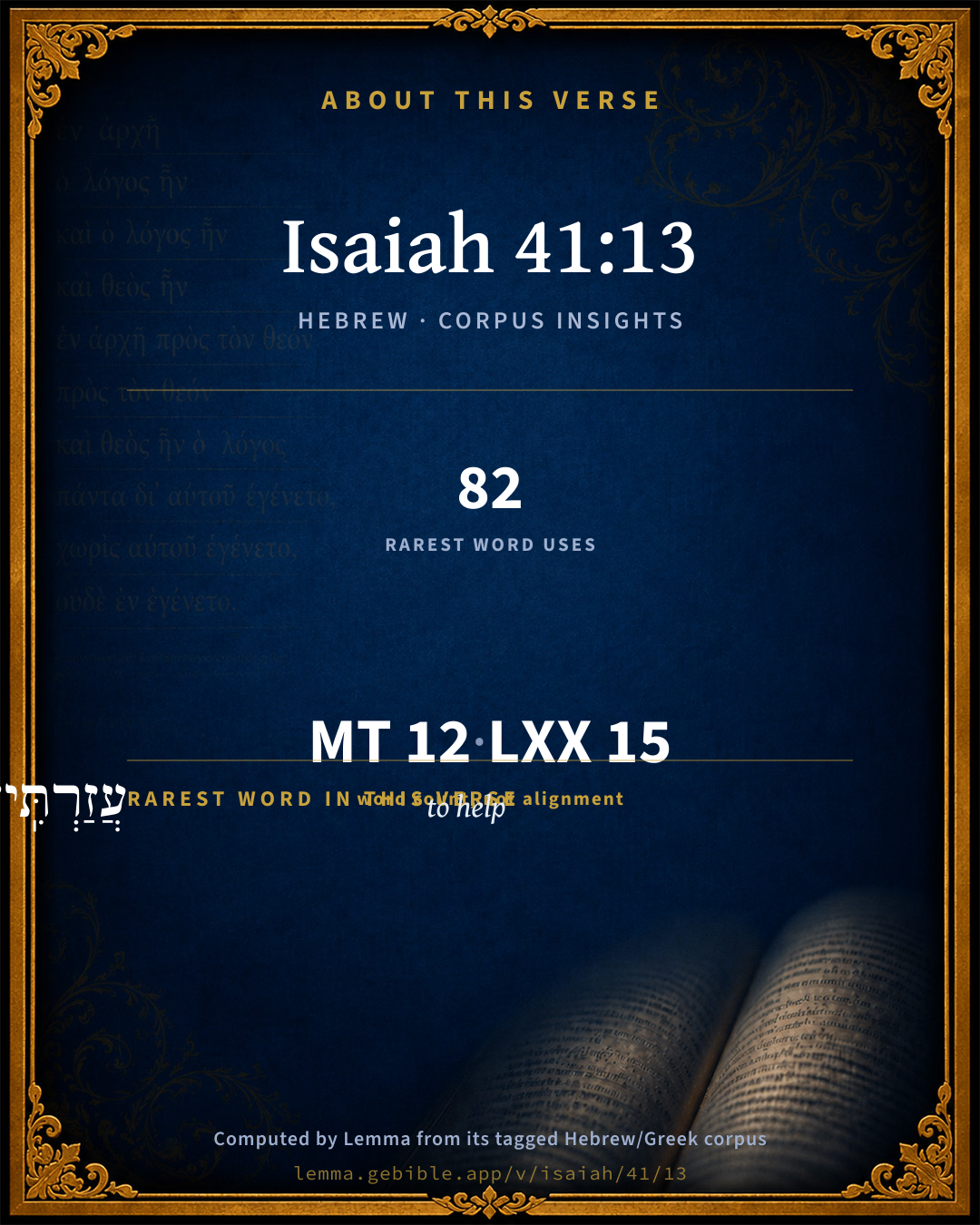
עֲזַרְתִּֽיךָ
ʻâzar
H5826
“to help · you”
Verb, Qal, Perfect, 1st Person, Common, Singular + Suffix, Personal, 2nd Person, Masculine, Singular
Part of Speech
Verb
Stem
Qal
Form
Perfect
Person
1st Person
Gender
Common
Number
Singular
Full BDB Definition

Origin: a primitive root

TWOT: 1598

to help, succour, support - (Qal) to help - (Niphal) to be helped - (Hiphil) to help
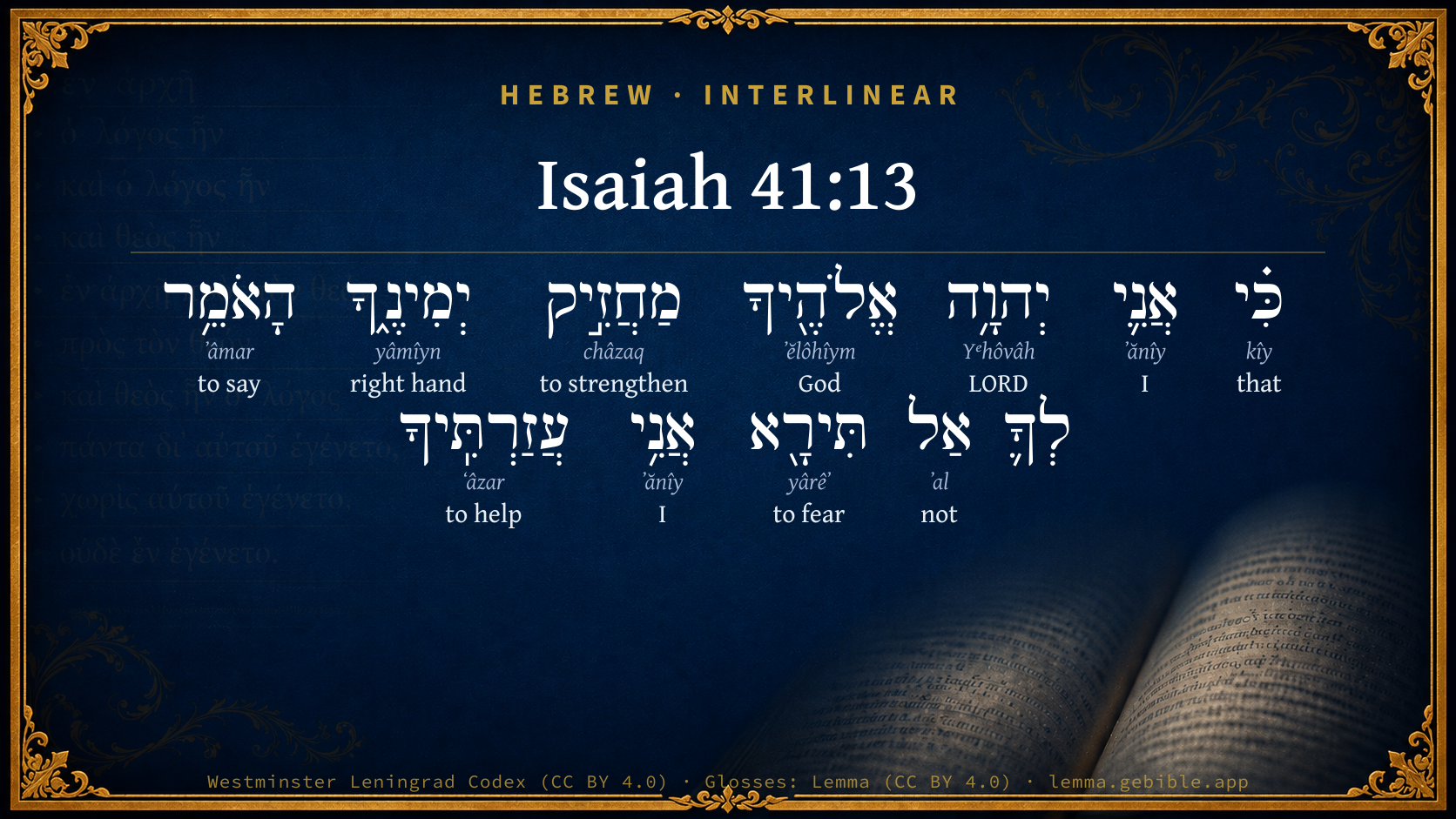
  1. כִּ֗י kîy H3588 “that” Conjunction
  2. אֲנִ֛י ʼănîy H589 “I” Pronoun, Personal, 1st Person, Common, Singular
  3. יְהוָ֥ה Yᵉhôvâh H3068 “LORD” Noun, Proper
  4. אֱלֹהֶ֖יךָ ʼĕlôhîym H430 “God(s) · your” Noun, Common, Masculine, Plural, Construct + Suffix, Personal, 2nd Person, Masculine, Singular
  5. מַחֲזִ֣יק châzaq H2388 “strengthening” Verb, Hiphil, Participle Active, Masculine, Singular, Absolute
  6. יְמִינֶ֑ךָ yâmîyn H3225 “right hand · your” Noun, Common, Feminine, Singular, Construct + Suffix, Personal, 2nd Person, Masculine, Singular
  7. הָאֹמֵ֥ר ʼâmar H559 “the · saying” Particle, Definite Article + Verb, Qal, Participle Active, Masculine, Singular, Absolute
  8. אַל ʼal H408 “not” Particle, Negative
  9. תִּירָ֖א yârêʼ H3372 “to fear” Verb, Qal, Jussive, 2nd Person, Masculine, Singular
  10. אֲנִ֥י ʼănîy H589 “I” Pronoun, Personal, 1st Person, Common, Singular

About this verse

These counts appear in no published source. They are computed here, from the morphology-tagged text and Lemma’s own curated glosses. What Lemma adds →

12
words
10
distinct lemmas
Prophets
section

Grammatical profile

  • 4 verbs
  • 3 nouns
  • 2 pronouns
  • 1 preposition
  • 1 conjunction
  • 1 particle

Verb forms

  • מַחֲזִ֣יק Hiphil · Participle Active
  • הָאֹמֵ֥ר Qal · Participle Active
  • תִּירָ֖א Qal · Jussive
  • עֲזַרְתִּֽיךָ Qal · Perfect

Repetition

A word recurs within this verse — often emphatic in Hebrew:

  • אֲנִ֛י I H589 ×2

Hebrew & Septuagint length

In English translation the verse runs 20 words from the Hebrew and 14 from the Septuagint (LXX English) — the Septuagint runs noticeably shorter here. See the side-by-side →

A rough comparison of the two English renderings, which tokenize alike — not a word-level alignment.

Word counts can differ between the Hebrew and the Greek without any difference in meaning — e.g. the Hebrew direct-object marker אֵת has no separate Greek word, and Greek often adds the article ὁ.

In the original languages it is 12 Hebrew tokens and 15 Greek tokens — but the two are counted differently (Hebrew bundles its prefixes and suffixes into one token; the Greek is in lemma form), so that isn’t a like-for-like length.

Cross-references

10

Topical passages linked to Isaiah 41:13 in the Treasury of Scripture Knowledge — connected by theme and wording, ordered by reader-vote popularity; previews shown in the World English Bible.

  • Isaiah 41:10 Don't you be afraid, for I am with you; don't be dismayed, for I am your God; I will strengthen you; yes, I will help you; yes, I will uphold you with the right hand of my righteousness.
  • Psalms 73:23 Nevertheless, I am continually with you. You have held my right hand.
  • Psalms 63:8 My soul stays close to you. Your right hand holds me up.
  • Psalms 109:31 For he will stand at the right hand of the needy, To save him from those who judge his soul.
  • Isaiah 42:6 I, Yahweh, have called you in righteousness, and will hold your hand, and will keep you, and give you for a covenant of the people, for a light of the Gentiles;
  • 2 Timothy 4:17 But the Lord stood by me, and strengthened me, that through me the message might be fully proclaimed, and that all the Gentiles might hear; and I was delivered out of the mouth of the lion.
  • Isaiah 45:1 Thus says Yahweh to his anointed, to Cyrus, whose right hand I have held, to subdue nations before him, and I will loose the loins of kings; to open the doors before him, and the gates shall not be shut:
  • Deuteronomy 33:26–29 There is none like God, Jeshurun, Who rides on the heavens for your help, In his excellency on the skies.
  • Isaiah 43:6 I will tell the north, Give up; and to the south, Don't keep back; bring my sons from far, and my daughters from the end of the earth;
  • Isaiah 51:18 There is none to guide her among all the sons whom she has brought forth; neither is there any who takes her by the hand among all the sons who she has brought up.

Cross-references courtesy of OpenBible.info (CC BY 4.0).

Hebrew and Greek witnesses Masoretic Hebrew ↔ Greek Septuagint

The same verse in the two great witnesses to the Old Testament, shown verse-for-verse.

Here the Septuagint runs noticeably shorter than the Hebrew — LXX2012 (modern English Septuagint) 14 words vs World English Bible 20. A rough length comparison of the two English translations, not a word-level alignment — read both below.

These are two independent witnesses, not word-aligned to each other, and the Septuagint is shown in lemma (dictionary) form.

Hebrew Isaiah 41:13 Masoretic · Westminster Leningrad Codex

כִּ֗י אֲנִ֛י יְהוָ֥ה אֱלֹהֶ֖יךָ מַחֲזִ֣יק יְמִינֶ֑ךָ הָאֹמֵ֥ר לְךָ֛ אַל תִּירָ֖א אֲנִ֥י עֲזַרְתִּֽיךָ

For I, Yahweh your God, will hold your right hand, saying to you, Don't be afraid; I will help you.

World English Bible · Public Domain

Greek LXX Isaiah 41:13 Septuagint · lemma form

ὅτι ἐγώ ὁ θεός σύ ὁ κράτος ὁ δεξιός σύ ὁ λέγω σύ μή φοβέω

For I am your God, who holds your right hand, who says to you,

LXX2012 (modern English Septuagint) · Public Domain

Hebrew: Westminster Leningrad Codex (CC BY 4.0). Greek: Septuagint (public domain); English from LXX2012 (modern English Septuagint) (Public Domain). How the Septuagint differs from the Hebrew →

Targum (Aramaic paraphrase)

1

The Targum is the ancient Jewish Aramaic paraphrase of the Hebrew Scriptures — an interpretive translation, not the Hebrew text itself. Onkelos (literal) and Pseudo-Jonathan (expansive) render the Torah, and Jonathan the Prophets. Coverage is partial: where no permissively-licensed English translation exists for a verse, only the Aramaic is shown. This is verse-level text, not a word-by-word alignment to the Hebrew.

  1. Targum Jonathan Prophets (Joshua–Malachi)
    אֲרֵי אֲנָא יְיָ אֱלָהָךְ מַתְקֵיף יְמִינָךְ דַאֲמָרִית לָךְ לָא תִדְחַל מֵימְרִי בְסַעֲדָךְ:

    For I am the Lord thy God, that will hold thee fast by thy right hand; who saith unto thee, Fear not, my WORD shall be thy help.

    Targum Jonathan — Aramaic: “Mikraot Gedolot” (public domain). English: “Sefaria Community Translation” (CC0 1.0 (public-domain dedication)); “London "Chaldee Paraphrase," 1871” (public domain). Text via Sefaria.

Commentary

Notes on Isaiah 41:13 from classic Christian and Jewish commentators (each source and its license shown beneath its notes). The classic Christian expositions comment on the surrounding passage and are grouped to its opening verse, so a note may address several verses; the Jewish commentaries on the Tanakh (Rashi and others) are per-verse, so they appear only where the commentator wrote on this verse.

Lemma curates 59 commentaries, every one of them public domain or Creative Commons licensed, each selected and text-cleaned for this edition rather than reprinted as found. About our sources →

Trapp's Complete Commentary

John Trapp

Isa 41:13 For I the LORD thy God will hold thy right hand, saying unto thee, Fear not; I will help thee.

Ver. 13. For I the Lord thy God will hold thy right hand.] As a tender father taketh his dear child by the hand, in dirty or dangerous ways especially, lifting him over; so the saints are said to sit down at God’s feet, {Deu 33:3} or to stand between his legs, as little ones do.

John Trapp, A Commentary or Exposition upon All the Books of the Old and New Testament (1647–1656) — public domain. Text from a community e-Sword module.

The Biblical Illustrator

Joseph S. Exell

Isa_41:13

For I the Lord thy God will hold thy right hand

The Christians help

I.

IT IS A PERSONAL HELP. I will help thee. When the religious element was strongly felt amongst the Jews, they looked to the King eternal for guidance and protection; nothing but His counsel would satisfy them. Man seems to have the special intuition of a personal God, as if nothing but personal contact with Him could revive the latent powers. Truth in the abstract cannot touch the heart so as to cause an inner revolution. Truth must come from God as from a living Being.

II. THIS PERSONAL HELP WILL BE GIVEN ONLY IN THE WAY OF RIGHTEOUSNESS. The children of Israel had departed from the right way, and as long as they sought their own gratification they could not expect help from the God of their fathers. The way of righteousness is not the most pleasant at all times for flesh and blood, but it is always the safest.

III. IT IS THE MOST TENDER AND CONSTANT HELP WITHIN THE REACH OF MAN. The Jewish people were bruised by their terrible fall, they had but little strength left, they were almost hopeless of ever seeing their own country. The Lord knew their helplessness, so these words are full of the greatest kindness. The way of holiness, the way to heaven, is so strange to a person who has defiled himself with sin that but little progress could be made without a guide. So the Lord tenderly takes each traveller by the hand. (Homilist.)

The promised help

I. THE LORD GIVETH STRENGTH. What a precious truth is this, if believed in, to such a feeble creature as man. It is as a covenant God in Christ that the Lord comforts the believing soul with the promise, I the Lord thy God will hold thy right hand, etc. The Lord thy God.

II. MAN NEEDS THE STRENGTH which the Lord promises, and which He alone can give. Man needs strength for obedience to Gods holy laws. Vain is the help or salvation of man, even far more in things spiritual and eternal than in our temporal concerns; so that those who trust in and pray to saints and angels, and expect salvation from them, will be overcome: they will not tread down their enemies, nor obtain the conquerors crown. (W. Firth, B. D.)

Courage, its source and its necessity

I. ITS SOURCE. I will hold thy right hand. The grasp of the hand is significant of close and present friendship, of the living nearness of the deliverer. And that sense of Gods presence, so near that our faith can touch His hand and hear the deep still music of His voice--realised as it may be in Christ, is the source of a courage which no danger can dispel, no suffering exhaust, and no death destroy. The clearest way of illustrating this will be to take the higher forms of courage among men, and observe what states of soul are most conducive to it.

1. Beginning with the courage of active resistance, we find its great element in the fixed survey of the means of conquest.

2. Passing on to the courage needful for passive endurance, we find that its great feature is self-surrender to the highest law of life. The Christian endures, because the law of his being has become resignation to the will of God.

II. ITS NECESSITY.

1. It requires courage to manifest the Christian character before men.

2. To maintain steadfast obedience to the will of God.

3. To hold fast to our highest aspirations. (E. L. Hull, B. A.)

The repetitions of love

God repeats His love for, and His purpose concerning, Israel. Lacordaire said that love is always saying the same thing, yet never repeats itself. And though God repeats in both parts His love and purpose, yet it would be new all through to the Jew, sick with his sorrow and captivity; and the sum of the consolation is--I am with thee. Fear not; rather rejoice. No trial could or would befall the Jew but God would help him to bear it. (J. A. Davies, B. D.)

Held by Gods hand

A little lad in the hospital was asked if he could bear a severe operation. Yes, was his reply, if father will hold my hand. When we feel Gods hand holding us in times of trial, the touch gives us nerve and calm. (J. A. Davies, B. D.)

The Biblical Illustrator, edited by Joseph S. Exell (c. 1880s–1900s) — public domain. Text from a community e-Sword module.

The Preacher's Complete Homiletical Commentary

Joseph S. Exell (gen. ed.)

COURAGE—ITS SOURCE AND NECESSITY

Isa_41:13. For I the Lord thy God will hold thy right hand, &c.

These words were spoken to the Jews in an age of national peril and dismay; they had slowly been losing their ancient strength through a spirit of indifference, and at length the alarm had come that awoke them from their dream. The Assyrian invasion had paralysed them with fear; no sooner had they been saved from it than the prophet was commissioned to announce an invasion from Babylon that would carry them into a strange land. Then it was that Isaiah proclaimed the source of courage, the power of which he himself had proved. The Jews might seem as nothing before the great surrounding nations; but the Lord was at their side; His voice was in their midst, crying, “Fear not; I will help thee.”

The words which give us the secret of the old Hebrew courage reveal the source of the courage we need as Christians. The notion, indeed, has gone forth that the ancient fortitude has no place in the life of the Christian,—it has declined before the gentler graces of spiritual life; but if this means that the Christian is to be only a loving, and not a righteous man, then the teaching of Christ Himself contradicts it. Not only so, but the gentler graces demand as much fortitude of soul as the stronger and sterner virtues; and, above all, steadfast obedience to God amid sorrows, and temptations, and failures, requires a courage more deep and real than that of the Jewish warrior.

Our subject is—Courage, its source and necessity.

I. ITS SOURCE.

What a broad sense of the Divine presence and aid in the figure: “I will hold thy right hand!” The grasp of the hand is significant of close and present friendship; and that sense of God’s presence—so near that our faith can touch His hand and hear the deep still music of His voice—realised as it may be in Christ, is the source of a courage which nothing can shake. Take the higher forms of courage seen among men, and it will be seen how this belief creates at once that state in which courage rises, and in which it attains its highest power. We may pass by animal courage—the bravery of instinct or temperament—as not proceeding from any principle, and so totally unlike courage of soul. The higher and true form of courage is of two kinds:—

1. The courage of active resistance. Its great element is found in the fixed survey of the means of conquest; fear rises from the contemplation of difficulties—courage from the perception of the thing to be done. There is always a lion in the path of a man who expects to find one. Intense concentration on the means of action creates the courage that actively resists danger. This is especially true of spiritual courage. It is by the aid of God that we conquer in spiritual battle; and while our gaze is fixed on that, fear vanishes; with the sense of omnipotence grasping and cheering his spirit, a man can defy the world, and death, and hell to make him turn aside from the path of Divine duty (H. E. I. 1911–1919).

2. The courage needful for passive endurance. It is harder of attainment; for while there is anything to be done, we find relief in action; but when we can only be still and endure, then it is supremely difficult to resist the assaults of cowardice. The great feature of this aspect of spiritual courage is self-surrender to the highest law of life; but if we could hear God’s voice, amid the dismay and darkness, proclaiming “All is well,” should we not be trustful, courageous, and strong?

II. ITS NECESSITY.

It is essential to Christian life for three reasons:—

1. It requires courage to manifest the Christian character before men (H. E. I. 1042–1046). Regarding the two sides of that character as seen in Christ—the strong and the tender, the severely true and the forbearing, sympathising, forgiving—we feel the incompleteness of any other character, and both of these aspects demand courage for their manifestation. What can give us courage to do the right regardless of consequences but the grasp of God’s hand and the sound of His voice?

2. It requires courage to maintain steadfast obedience to the will of God. Christian life is more than visible Christ-like character; it means Christ-like obedience amid the inner and unseen temptations of the soul. Every man has his own cross to bear.

3. It demands courage to hold fast to our highest aspirations. As Christian men, we are bound to aim at being our highest and best. The revelations of our aspirations must become our practical ideals; if we do not strive to realise them, we shall degenerate. If we would gain the far-off summits, we must keep our eye fixed on the gleaming heights. And can anything give us power and courage to do so but the knowledge that the Everlasting arms are round about us, and the voice of the Eternal cheering us onward? And here, as in all the storm and strife of our earthly pilgrimage, we are simply driven to the man Christ Jesus. He knows our weakness, and left us the legacy of everlasting power when He said, “Lo, I am with you alway, even unto the end of the world.”—E. L. Hull, B.A.: Sermons, Third Series, pp. 157–167.

The Preacher's Complete Homiletical Commentary (gen. ed. Joseph S. Exell; Funk & Wagnalls, c. 1892) — public domain (pre-1929). A full-Bible homiletical/sermon-outline anthology covering 65 of 66 books (2 John is absent from the source module). Text from a community e-Sword module.

Jamieson, Fausset & Brown

Robert Jamieson, A. R. Fausset & David Brown

(Deu 33:26, Deu 33:29).

Jamieson, Fausset & Brown — Commentary Critical and Explanatory on the Whole Bible (1871) — public domain (CC PDM 1.0). Text via the HelloAO Bible API.

The Cambridge Bible for Schools and Colleges

gen. ed. J. J. S. Perowne

13. will hold … will help] do hold … do help. For saying render: I who say.

The Cambridge Bible for Schools and Colleges (gen. ed. J. J. S. Perowne; Cambridge University Press, 1878–1918) — public domain. Text from a community e-Sword module.

John Gill's Exposition

For I the Lord thy God will hold thy right hand,.... Take hold of it, join in league and alliance with his people as it were, go hand in hand with them; and having such an one with them, and on their side, they need fear no enemy: or it is expressive of great freedom, familiarity, and friendship, which may assure believers of the strong affection of God towards them; and they may conclude themselves safe, being held by him as a child in the hand of its parents, which is then not afraid of anything. The Lord holds the right hand of his people, teaching them to walk by faith, leading them into his presence, and to communion with himself, and keeps them from falling: or, he "will strengthen their right hand" (r); to do his work and service, and oppose their enemies; or he will relieve their wants, and fill their hands with his good things, which is sometimes the sense of the phrase, Eze 16:45,

saying unto thee, fear not, I will help thee; as one friend takes another by the hand in distress, and bids him be of good cheer, promising him all needful assistance and supply. See Gill on Isa 41:10.

(r) "qui confortat dexteram tuam", Gataker.

John Gill's Exposition of the Whole Bible (1746–1763) — public domain (CC PDM 1.0). Text via the HelloAO Bible API.

Matthew Poole's English Annotations

Will hold thy right hand; or, will strengthen, &c, as this word properly signifieth; will assist and enable thee to vanquish all thine enemies.

Matthew Poole's English Annotations on the Holy Bible (1683–1685) — public domain. Text from a community e-Sword/MySword module.

Whedon's Commentary on the Bible

Daniel D. Whedon

13. The stated reasons continue for hope, and not doubt; they lie in God’s continually encouraging, Fear not. In all these verses God is the speaker. Time past and time future is always to him time present.

Daniel D. Whedon (gen. ed.), Commentary on the Old and New Testaments (1874–1909) — public domain. Text from a community e-Sword module.

The Pulpit Commentary

I the Lord thy God will hold thy right hand. God himself will be their Strength, will personally interfere on their behalf, taking them as it were by their right hand. Saying unto thee; rather, I who say to thee.

Vers. 13, 14. The supreme prayer.

"Lord, help me;" responded to by God in the gracious assurance, "I will help thee, saith the Lord, and thy Redeemer, the Holy One of Israel." Likening Israel to a worm, reminds us of its despised and depressed condition in captivity. "However weak and despised and trodden underfoot thou mayest be, in thy captivity and exile, yet fear not, I will help thee." It is a painful suggestion of hopelessness and helplessness that no cry can now rise but the brief, intense, "Lord, help me." And yet it is full of hope that any cry at all can rise, and that, even in despair, men are turning yearning eyes toward God. Of this we may be assured, when man cries, out of the depths, his cry, "Lord, help me," God will answer, out of his heavens, "I will help thee." The associations of the ancient goel, or family avenger, may be used in illustration, as the word translated "Redeemer" is in the original Goel. And the certainty of response to prayer by him who liveth, and is our God and Father, may be illustrated by an incident in the life of Luther. Usually he was of a cheerful temperament, but he was subject to occasional fits of severe depression. Once, when nothing seemed to avail, he was induced to leave home for a few days, in the hope that he might recover his cheerfulness; but he returned with a cloudy and dejected countenance. How great was his surprise, on entering the house, to find his wife seated in the middle of the room, attired in black garments, and with a mourning cloak thrown over her, while she pressed to her eyes her handkerchief, as if weeping bitterly! He eagerly inquired the cause of her distress, which she seemed loth at first to communicate; but on his again imploring her to speak, she answered, "Only think, dear doctor, our Father in heaven is dead! Judge if I have not cause for my grief." Upon this, immediately comprehending her riddle, he laughed, and embracing her, said, "You are right, dear Kate; I am acting as if there were no God in heaven;" and from that hour his melancholy left him. Only two points are suggested for elaboration and illustration.

I PRAYER NEVER REACHES ITS FULL INTENSITY WHILE IT CAN BE SET IN HUMAN WORDS. We say the same of grief. It never hurts, or imperils reason or life, while it can find expression. Silent grief hurts. A man is not utterly broken down while he can make a prayer and express his wants.

II PRAYER REACHES ITS INTENSITY WHEN IT CAN BE NO MORE THAN A VOICELESS CRY. A simple "Lord, help me." When the soul is quite full there can be no utterance. A man must go into the presence of God, and leave him to read heart, thought, and desire. Such experiences only come at times into any life. Yet they are the times when we are most really, most wholly, cast on God. Here is a sacred paradox our best times of prayer are the times when we cannot pray. R.T.

The Pulpit Commentary (1880–1919), ed. H.D.M. Spence-Jones & Joseph S. Exell — public domain. Text from a community e-Sword module.

John Wesley's Explanatory Notes

Will hold - Will enable thee to vanquish all thine enemies.

John Wesley, Explanatory Notes Upon the Whole Bible (1754–1765) — public domain. Text via the GEBible commentary corpus.

J. A. Alexander on Isaiah

Joseph Addison Alexander

“For My Jehovah thy God, (am) holding fast thy right hand; the (one) saying to thee, Fear not, I have helped thee,” (i.e., I, who command thee not to fear, have already helped thee, or secured thy safety.)

Joseph Addison Alexander, The Prophecies of Isaiah (1846–1847; New York: Scribner, 1870–1878) — public domain. Text from a community e-Sword module.

Ibn Ezra

Rabbi Abraham ibn Ezra

For I, the Lord, etc. For this is a wonderful event, that Babylon was taken, that her armies were destroyed in their own land, and the Israelites remained unhurt.

Ibn Ezra on the Tanakh — English translations: “Sefaria Community Translation” (CC0 1.0 (public-domain dedication)); “Yalkut, Sifsei Chachomim Chumash, Metsudah Publications, 2009” (CC BY 4.0); and “Commentary of Ibn Ezra on Isaiah - trans. by M. Friedlander, 1873” (public domain). Text via Sefaria.

Lesson kit

Teaching starters — assembled from the data on this page, not authored interpretation. Every prompt links to the verse data it draws on. Edit before teaching.

Isaiah, in the Prophets, opens this verse with 12 words (10 distinct Hebrew lemmas). Its most distinctive word is ʻâzar (“to help”). The Greek Septuagint runs shorter here. A historical commentator’s framing appears above. Read the whole chapter for the surrounding context.

Discussion questions

  1. The word ʻâzar carries the sense “to help.” How does it shape the verse?
  2. Isaiah 41:10 shares this passage’s theme. How do the two illuminate each other?
  3. “I” occurs 2× in this one verse. What is the effect of the repetition?
  4. Compared with the Hebrew, the Septuagint runs shorter here. What questions does that raise?
  5. These translations render this verse differently; the difference is in the English rendering, not the original. What questions does that raise?
  6. The verb «מַחֲזִ֣יק» is Hiphil Participle Active. How does its form color the action?
  7. Reading how Trapp's Complete Commentary and The Biblical Illustrator read this verse, where do the two commentators agree and where do they part?

Things to notice

Reading settings

Reading text

Shown beneath each verse's original-language words.

Old Testament
Old Testament edition

Read the OT as the Masoretic Hebrew (MT) or the Greek Septuagint (LXX).

English shown for the Greek Septuagint (in the Hebrew ↔ Greek comparison).

Comparing translations? Open the Compare panel on any verse page to stack up to four side by side.