
Judges 5:26

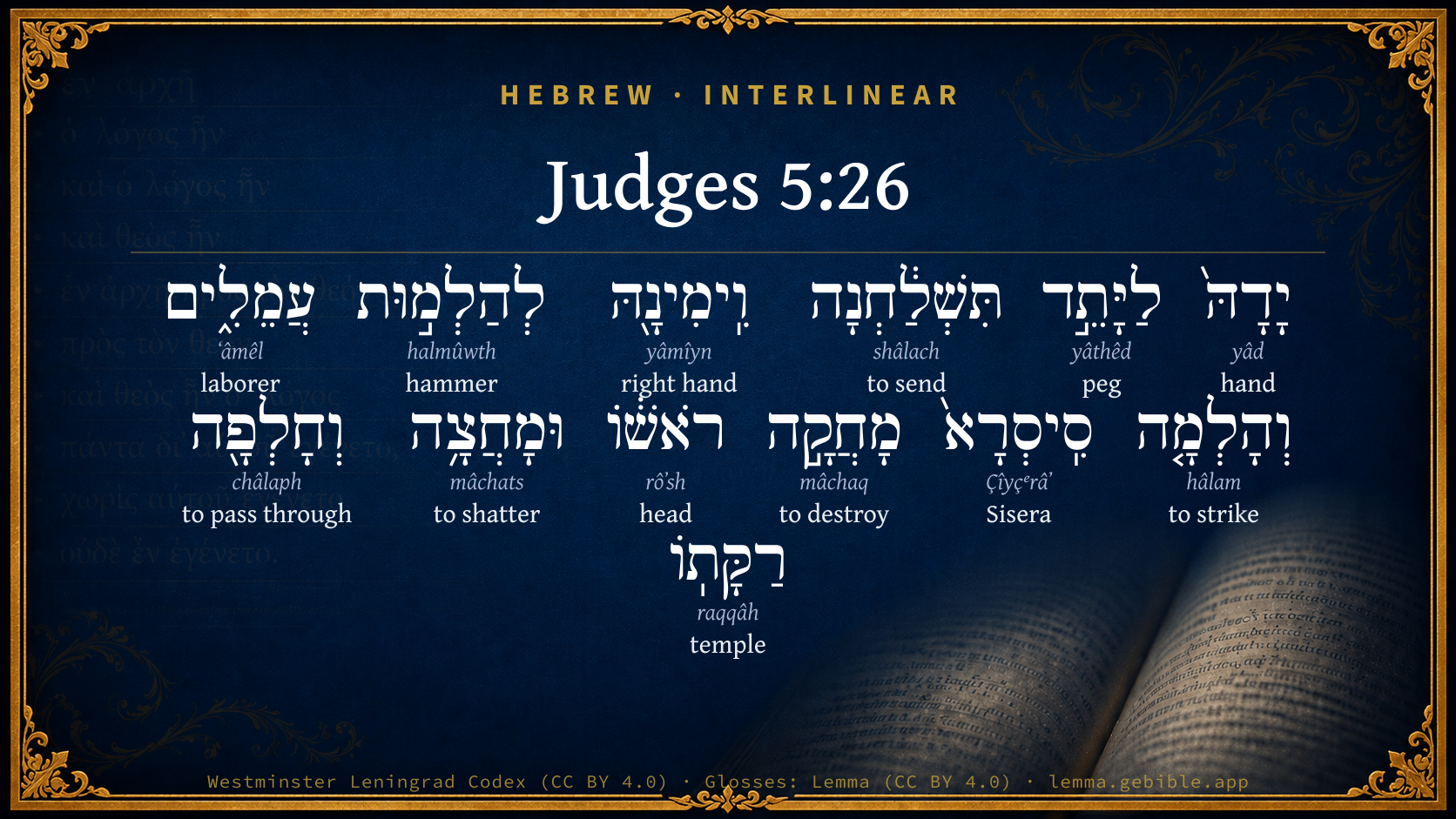
Hebrew (Westminster Leningrad Codex) Judges 5:26 appears in the Hebrew Old Testament. The text above is from the Westminster Leningrad Codex. Each word links to its Strong’s number, a concise gloss, and parsing drawn from the Open Scriptures Hebrew Bible morphology. Click any word for its full Brown-Driver-Briggs (BDB) entry.
Download image
Cite this verse

Judges 5:26 (World English Bible). Public Domain. Lemma interlinear Bible study tool, https://lemma.gebible.app/v/judges/5/26.

Show BibTeX & RIS
BibTeX
RIS
English Translation
She put her hand to the tent-pin, Her right hand to the workmen's hammer; With the hammer she struck Sisera, she struck through his head; Yes, she pierced and struck through his temples.
World English Bible · Public Domain
Highlights
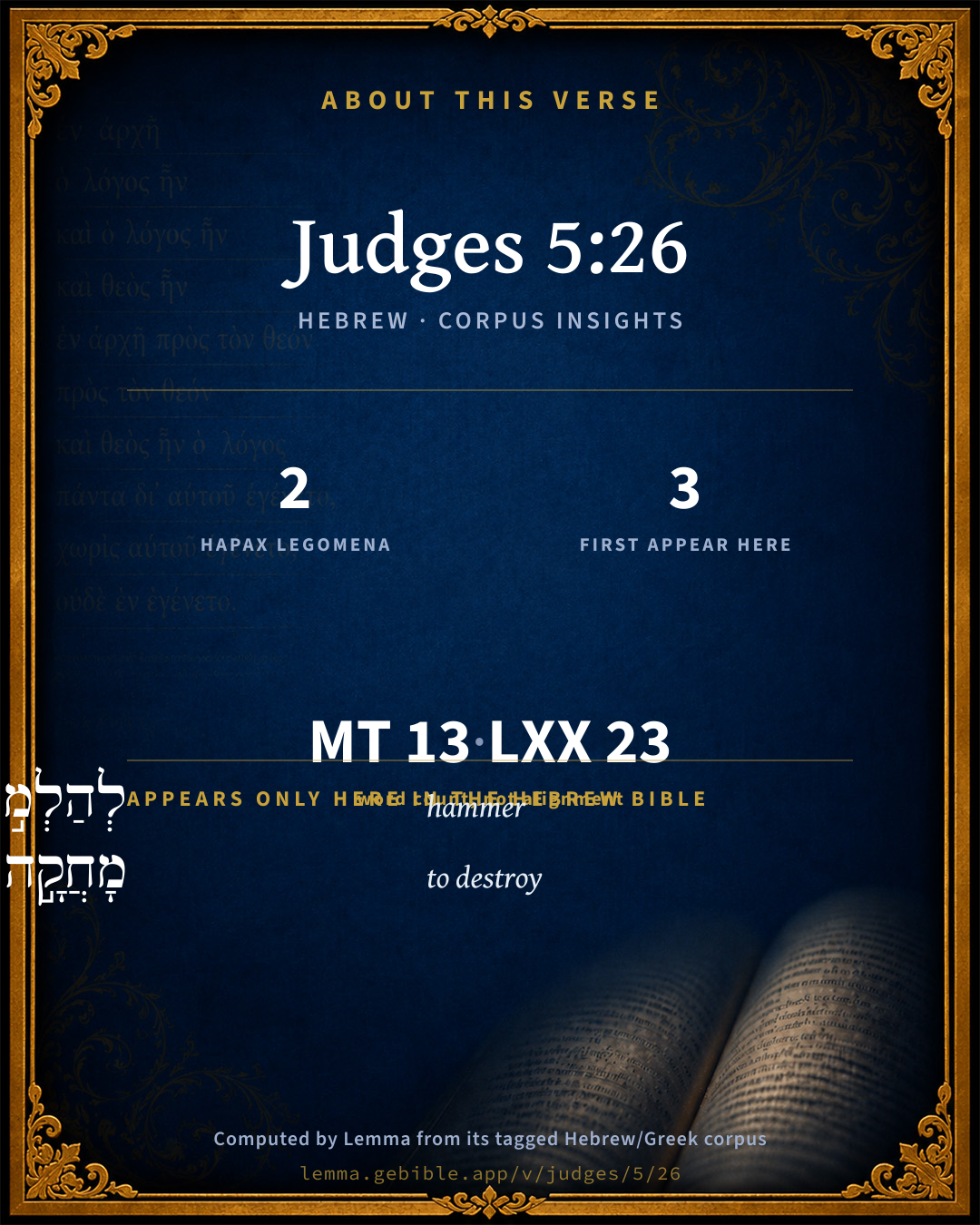
  • 2 hapax legomena — only here in the Hebrew Bible
  • 3 first appearances in the Hebrew Bible
Full analysis ↓
Download a study sheet

One document with this verse’s original text, its word-by-word gloss line, the meaning frame, cross-references with their text, attributed commentary, and full source and license credits — printable, and it pastes into notes with its structure intact.

This verse Autodidact and up

Study sheet (.html) Plain text (.txt)

A passage Seminary Student

Up to 50 verses in one chapter. A passage sheet keeps up to 6 commentary sources and 12 cross-references per verse, in the order this page ranks them, and says so on the sheet whenever that leaves anything out. Ask for a single verse and you get the Autodidact verse sheet above.

Everything on this page stays free to read, with no account — the sheet is a download of what is already on screen, not access to it.

Want to remove ads? Support Godless Engineer
Compare translations 3

The same verse in 3 English versions, stacked beneath the original-language interlinear above. Click any original word for its lexicon entry.

Each is an independent rendering of the whole verse — the interlinear is not word-aligned to these translations.

Highlighted words mark where these versions differ — a whole-verse word diff, not a word-by-word alignment.

  • World English Bible Public Domain
    She put her hand to the tent-pin, Her right hand to the workmen's hammer; With the hammer she struck Sisera, she struck through his head; Yes, she pierced and struck through his temples.
  • King James Version Public Domain
    She put her hand to the nail, and her right hand to the workmen's hammer; and with the hammer she smote Sisera, she smote off his head, when she had pierced and stricken through his temples.
  • unfoldingWord Literal Text CC BY-SA 4.0
    They reached out, her hand to the peg and her right hand to a hammer of workmen. And she struck Sisera, she crushed his head, and she shattered and pierced his temple.

unfoldingWord Literal Text — © unfoldingWord, licensed CC BY-SA 4.0. Word-aligned USFM3 via Door43 (git.door43.org/unfoldingWord/en_ult).

Versions to compare (up to 4)

3 of 4 selected

Show all 18 translations

Every available English version of this verse, each an independent rendering of the whole verse.

  • World English Bible Public Domain
    She put her hand to the tent-pin, Her right hand to the workmen's hammer; With the hammer she struck Sisera, she struck through his head; Yes, she pierced and struck through his temples.
  • Berean Standard Bible Public Domain
    She reached for the tent peg, her right hand for the workman’s hammer. She struck Sisera and crushed his skull; she shattered and pierced his temple.
  • Majority Standard Bible Public Domain
    She reached for the tent peg, her right hand for the workman’s hammer. She struck Sisera and crushed his skull; she shattered and pierced his temple.
  • King James Version Public Domain
    She put her hand to the nail, and her right hand to the workmen's hammer; and with the hammer she smote Sisera, she smote off his head, when she had pierced and stricken through his temples.
  • American Standard Version (1901) Public Domain
    She put her hand to the tent-pin, And her right hand to the workmen's hammer; And with the hammer she smote Sisera, she smote through his head; Yea, she pierced and struck through his temples.
  • Revised Version (1885) Public Domain
    She put her hand to the nail, and her right hand to the workmen’s hammer; and with the hammer she smote Sisera, she smote through his head, yea, she pierced and struck through his temples.
  • Geneva Bible (1599) Public Domain
    She put her hand to the naile, and her right hand to the workemans hammer: with the hammer smote she Sisera: she smote off his head, after she had wounded, and pearsed his temples.
  • Douay-Rheims (1899) Public Domain
    She put her left hand to the nail, and her right hand to the workman's hammer, and she struck Sisara, seeking in his head a place for the wound, and strongly piercing through his temples.
  • Young's Literal Translation Public Domain
    Her hand to the pin she sendeth forth, And her right hand to the labourers' hammer, And she hammered Sisera -- she smote his head, Yea, she smote, and it passed through his temple.
  • Literal Standard Version CC BY-SA 4.0
    She sends forth her hand to the pin, || And her right hand to the laborers’ hammer, || And she hammered Sisera—she struck his head, || Indeed, she struck, and it passed through his temple.
  • Unlocked Literal Bible CC BY-SA 4.0
    She put her hand to the tent peg, and her right hand to the workman's hammer; with the hammer she struck Sisera, she crushed his head. She smashed his skull into pieces when she pierced him through the side of his head.
  • unfoldingWord Literal Text CC BY-SA 4.0
    They reached out, her hand to the peg and her right hand to a hammer of workmen. And she struck Sisera, she crushed his head, and she shattered and pierced his temple.
  • Darby Bible Public Domain
    She put her hand to the tent peg and her right hand to the workmen's mallet; she struck Sis'era a blow, she crushed his head, she shattered and pierced his temple.
  • World Messianic Bible Public Domain
    She put her hand to the tent peg, and her right hand to the workmen’s hammer. With the hammer she struck Sisera. She struck through his head. Yes, she pierced and struck through his temples.
  • Webster's Bible Public Domain
    She put her hand to the nail, and her right hand to the workmen's hammer; and with the hammer she smote Sisera, she smote off his head, when she had pierced and struck through his temples.
  • Free Bible Version CC BY-SA 4.0
    With one hand she picked up the tent peg, and with her right hand she held a workman's hammer. She hit Sisera and smashed his skull; she shattered and pierced his temple.
  • Bible in Basic English Public Domain
    She put out her hand to the tent-pin, and her right hand to the workman's hammer; and she gave Sisera a blow, crushing his head, wounding and driving through his brow.
  • JPS Tanakh (1917) Public Domain
    Her hand she put to the tent-pin, and her right hand to the workmen's hammer; and with the hammer she smote Sisera, she smote through his head, yea, she pierced and struck through his temples.

Literal Standard Version (2020), Covenant Press — licensed CC BY-SA 4.0. Text via the HelloAO Bible API (eBible.org). Unlocked Literal Bible (unfoldingWord) — licensed CC BY-SA 4.0. Text via the HelloAO Bible API (eBible.org). unfoldingWord Literal Text — © unfoldingWord, licensed CC BY-SA 4.0. Word-aligned USFM3 via Door43 (git.door43.org/unfoldingWord/en_ult). Free Bible Version, Dr. Jonathan Gallagher — licensed CC BY-SA 4.0. Text via the HelloAO Bible API (eBible.org).

Word by word

More ways to search: Search by grammar → Find every occurrence → Compare this word →

Practice this passage: Drill this verse → Learn its vocabulary →

לְהַלְמ֣וּת
halmûwth
H1989
“to/for · hammer of”
Preposition + Noun, Common, Feminine, Singular, Construct
Part of Speech
Preposition + Noun
Type
Common
Gender
Feminine
Number
Singular
State
Construct
Full BDB Definition

Origin: from H1986

TWOT: 502a

hammer, mallet
  1. יָדָהּ֙ yâd H3027 “hand · her” Noun, Common, Both, Singular, Construct + Suffix, Personal, 3rd Person, Feminine, Singular
  2. לַיָּתֵ֣ד yâthêd H3489 “to/for the · peg” Preposition, Determined + Noun, Common, Feminine, Singular, Absolute
  3. תִּשְׁלַ֔חְנָה shâlach H7971 “to send” Verb, Qal, Imperfect, 3rd Person, Feminine, Plural
  4. וִֽימִינָ֖הּ yâmîyn H3225 “and · right hand · her” Conjunction + Noun, Common, Feminine, Singular, Construct + Suffix, Personal, 3rd Person, Feminine, Singular
  5. עֲמֵלִ֑ים ʻâmêl H6001 “laborers” Noun, Common, Masculine, Plural, Absolute
  6. וְהָלְמָ֤ה hâlam H1986 “and · to strike” Conjunction + Verb, Qal, Perfect, 3rd Person, Feminine, Singular
  7. סִֽיסְרָא֙ Çîyçᵉrâʼ H5516 “Sisera” Noun, Proper
  8. מָחֲקָ֣ה mâchaq H4277 “to destroy” Verb, Qal, Perfect, 3rd Person, Feminine, Singular
  9. רֹאשׁ֔וֹ rôʼsh H7218 “head · his” Noun, Common, Masculine, Singular, Construct + Suffix, Personal, 3rd Person, Masculine, Singular
  10. וּמָחֲצָ֥ה mâchats H4272 “and · to shatter” Conjunction + Verb, Qal, Perfect, 3rd Person, Feminine, Singular
  11. וְחָלְפָ֖ה châlaph H2498 “and · to pass through” Conjunction + Verb, Qal, Perfect, 3rd Person, Feminine, Singular
  12. רַקָּתֽוֹ raqqâh H7541 “temple · his” Noun, Common, Feminine, Singular, Construct + Suffix, Personal, 3rd Person, Masculine, Singular

About this verse

These counts appear in no published source. They are computed here, from the morphology-tagged text and Lemma’s own curated glosses. What Lemma adds →

13
words
13
distinct lemmas
Historical
section

Notable vocabulary

2 hapax legomena — words that appear only here in the entire Hebrew Bible:

  • לְהַלְמ֣וּת hammer H1989
  • מָחֲקָ֣ה to destroy H4277

First appearance in Scripture

These words make their first canonical appearance in the Hebrew Bible here:

  • לְהַלְמ֣וּת hammer H1989
  • עֲמֵלִ֑ים laborer H6001
  • מָחֲקָ֣ה to destroy H4277

Shared distinctive vocabulary

רַקָּתֽוֹ temple H7541 occurs in 5 verses of the Hebrew Bible. Also found in:

Grammatical profile

  • 5 verbs
  • 8 nouns

Verb forms

  • תִּשְׁלַ֔חְנָה Qal · Imperfect
  • וְהָלְמָ֤ה Qal · Perfect
  • מָחֲקָ֣ה Qal · Perfect
  • וּמָחֲצָ֥ה Qal · Perfect
  • וְחָלְפָ֖ה Qal · Perfect

Hebrew & Septuagint length

In English translation the verse runs 33 words from the Hebrew and 36 from the Septuagint (LXX English) — closely comparable.

A rough comparison of the two English renderings, which tokenize alike — not a word-level alignment.

Word counts can differ between the Hebrew and the Greek without any difference in meaning — e.g. the Hebrew direct-object marker אֵת has no separate Greek word, and Greek often adds the article ὁ.

In the original languages it is 13 Hebrew tokens and 23 Greek tokens — but the two are counted differently (Hebrew bundles its prefixes and suffixes into one token; the Greek is in lemma form), so that isn’t a like-for-like length.

Cross-references

3

Topical passages linked to Judges 5:26 in the Treasury of Scripture Knowledge — connected by theme and wording, ordered by reader-vote popularity; previews shown in the World English Bible.

  • 1 Samuel 17:49–51 David put his hand in his bag, and took there a stone, and slang it, and struck the Philistine in his forehead; and the stone sank into his forehead, and he fell on his face to the earth.
  • Judges 4:21 Then Jael Heber's wife took a tent-pin, and took a hammer in her hand, and went softly to him, and struck the pin into his temples, and it pierced through into the ground; for he was in a deep sleep; so he swooned and died.
  • 2 Samuel 20:22 Then the woman went to all the people in her wisdom. They cut off the head of Sheba the son of Bichri, and threw it out to Joab. He blew the trumpet, and they were dispersed from the city, every man to his tent. Joab returned to Jerusalem to the king.

Cross-references courtesy of OpenBible.info (CC BY 4.0).

Hebrew and Greek witnesses Masoretic Hebrew ↔ Greek Septuagint

The same verse in the two great witnesses to the Old Testament, shown verse-for-verse.

These are two independent witnesses, not word-aligned to each other, and the Septuagint is shown in lemma (dictionary) form.

Hebrew Judges 5:26 Masoretic · Westminster Leningrad Codex

יָדָהּ֙ לַיָּתֵ֣ד תִּשְׁלַ֔חְנָה וִֽימִינָ֖הּ לְהַלְמ֣וּת עֲמֵלִ֑ים וְהָלְמָ֤ה סִֽיסְרָא֙ מָחֲקָ֣ה רֹאשׁ֔וֹ וּמָחֲצָ֥ה וְחָלְפָ֖ה רַקָּתֽוֹ

She put her hand to the tent-pin, Her right hand to the workmen's hammer; With the hammer she struck Sisera, she struck through his head; Yes, she pierced and struck through his temples.

World English Bible · Public Domain

Greek LXX Judges 5:26 Septuagint · lemma form

χείρ αὐτός ἀριστερός εἰς πάσσαλος ἐκτείνω καί δεξιός αὐτός εἰς σφῦρα κοπιάω καί σφυροκοπέω σισαρα διαἡλόω κεφαλή αὐτός καί πατάσσω διαἡλόω κρόταφος αὐτός

She stretched forth her left hand to the nail, and her right to the hand workman's hammer, and she struck Sisara with it, she nailed through his head and struck him; she nailed through his temples.

LXX2012 (modern English Septuagint) · Public Domain

On this verse, John Gill's Exposition discusses the Septuagint’s reading. Read the note in Commentary ↓

Hebrew: Westminster Leningrad Codex (CC BY 4.0). Greek: Septuagint (public domain); English from LXX2012 (modern English Septuagint) (Public Domain). How the Septuagint differs from the Hebrew →

Targum (Aramaic paraphrase)

1

The Targum is the ancient Jewish Aramaic paraphrase of the Hebrew Scriptures — an interpretive translation, not the Hebrew text itself. Onkelos (literal) and Pseudo-Jonathan (expansive) render the Torah, and Jonathan the Prophets. Coverage is partial: where no permissively-licensed English translation exists for a verse, only the Aramaic is shown. This is verse-level text, not a word-by-word alignment to the Hebrew.

  1. Targum Jonathan Prophets (Joshua–Malachi)
    טַבְתָא יָעֵל אִתַת חֶבֶר שַׁלְמָאָה דְקַיְמַת מַה דִכְתִיב בִּסְפַר אוֹרַיְתָא דְמֹשֶׁה לָא יֱהֶוֵי תִקוּן זֵין דִגְבַר עַל אִתְּתָא וְלָא יְתַקֵן גְבַר בְּתִקוּנֵי אִתְּתָא אֱלָהֵן יְדָהָא לְסִכְתָא אוֹשִׁיטַת וִימִינָא לְאַרְזַפְתָּא דְנַפְחִין לְמִתְבַּר רַשִׁיעִין וַאֲנוּסִין מַחֲתֵיהּ לְסִיסְרָא תַּבְרַת רֵישֵׁיהּ פַּצְעַת מוֹחֵיהּ אַעֲבָרַת סִכְתָא בְּצִדְעֵיהּ:

    (no public-domain English translation for this verse)

    Targum Jonathan — Aramaic: “Mikraot Gedolot” (public domain). English: “Sefaria Community Translation” (CC0 1.0 (public-domain dedication)); “London "Chaldee Paraphrase," 1871” (public domain). Text via Sefaria.

Commentary

Notes on Judges 5:26 from classic Christian and Jewish commentators (each source and its license shown beneath its notes). The classic Christian expositions comment on the surrounding passage and are grouped to its opening verse, so a note may address several verses; the Jewish commentaries on the Tanakh (Rashi and others) are per-verse, so they appear only where the commentator wrote on this verse.

Lemma curates 59 commentaries, every one of them public domain or Creative Commons licensed, each selected and text-cleaned for this edition rather than reprinted as found. About our sources →

Trapp's Complete Commentary

John Trapp

Jdg 5:26 She put her hand to the nail, and her right hand to the workmen’s hammer; and with the hammer she smote Sisera, she smote off his head, when she had pierced and stricken through his temples.

Ver. 26. She smote off his head.] Sept., She bored through, or pierced his head; as Ulysses perforated Polyphemus’s eye.

John Trapp, A Commentary or Exposition upon All the Books of the Old and New Testament (1647–1656) — public domain. Text from a community e-Sword module.

Joseph Benson's Commentary

Jdg 5:26. She smote off his head — Or rather, smote through his head, for there is not the least hint given in the story that she cut off his head. The latter part of the verse, When she pierced, &c., may be rendered, She wounded and pierced through his temples.

Joseph Benson's Commentary on the Old and New Testaments (1811–1818) — public domain. Text from a community e-Sword module.

Adam Clarke's Commentary

Verse 26. She smote off his head] The original does not warrant this translation; nor is it supported by fact. She smote his head, and transfixed him through the temples. It was his head that received the death wound, and the place where this wound was inflicted was the temples. The manner in which Jael despatched Sisera seems to have been this:

1. Observing him to be in a profound sleep she took a workman's hammer, probably a joiner's mallet, and with one blow on the head deprived him of all sense.

2. She then took a tent nail and drove it through his temples, and thus pinned him to the earth; which she could not have done had she not previously stunned him with the blow on the head. Thus she first smote his head, and secondly pierced his temples.

Adam Clarke's Commentary on the Bible (1810–1826) — public domain. Text from a community e-Sword/MySword module.

Ellicott's Commentary for English Readers

(26) Nail. . . . workmen’s hammer.—See on Jdg_4:21.

Smote.—Hammered.

Smote off his head.—Rather, shattered his head. The Hebrew is onomatopoetic, i.e., the sound echoes the sense, recalling the smashing and crashing blows of the hammer. The repetition of these terrible alliterative verbs, “hammered,” “shattered,” “battered,” “transfixed,” the signs that the imagination of the prophetess seems to revel in the description, have been ascribed to “the delight of a satisfied thirst for revenge.” This is hardly a right view of her character. It must be remembered that the feelings of modern times are far more refined and complex than those of previous ages. The sense of tenderness, the quickness of compassion, the value set on human life, are immeasurably increased, and with them the power of realising by universal sympathy the position and sufferings of others. In ancient days no close moral analysis was applied to acts of which the general tendency was approved as right and beneficial. Caesar was not inherently a cruel man, yet he records without a shudder the massacre and misery of multitudes of Gaulish men, women, and children at Alesia; and he suffered the brave Vercingetorix to be led away from his triumph, to be strangled in the Tullianum, without the slightest qualm of pity. Deborah, in the spirit of her day, seems to regard with pitiless exultation the wild throes of Sisera’s death, and the agonising frustration of his mother’s hopes. only because she views those events in the single aspect of the deliverance of Israel. The tenderness of the Mother of Israel was absorbed in the thought of her own long-afflicted, but now rescued, race. “She was a mother in Israel, and with the vehemency of a mother’s and a patriot’s love, she had shot the light of love from her eyes, and poured the blessings of love from her lips on the people that had jeopardised their lives unto the death against the oppressors, and the bitterness awakened and borne aloft by the same love she precipitates in curses on the selfish and cowardly recreants who came not to the help of the Lord against the unjust” (Coleridge); and we may add, on all connected with the cruel oppressor.

A Bible Commentary for English Readers, edited by Charles John Ellicott (1878–1897) — public domain. Text from a community e-Sword module.

The Cambridge Bible for Schools and Colleges

gen. ed. J. J. S. Perowne

26. While he was standing (Jdg_5:27) and about to drink, Jael dealt him a shattering blow with a wooden implement. We are tempted to suppose that, if he had drunk, he would have been protected by the laws of Eastern hospitality. So in The Talisman, Sir Walter Scott makes Saladin dash the cup from the hand of the Grand Master of the Templars before assassinating him; had he tasted it, he would have been safe. Talisman p. 535 (ed. 1879 A. and C. Black). In Jdg_4:19, however, Jael has no scruples about killing Sisera after he has partaken of her hospitality.

According to the parallelism of Hebr. poetry her hand and her right hand mean the same thing; and so should nail and workmen’s hammer. But can the latter term be thus rendered? workmen ought rather to be sufferers, worn out with toil and misery, Job_3:20; Job_20:22; the meaning labourer is only found in Pro_16:26 (late); moreover hammer (a doubtful form, and a different word from mallet in Jdg_4:21) can hardly be another name for nail or tent-peg. What is meant by this synonym we do not know; but it is clear that Jael used one weapon, not two. The account in Jdg_4:21 gives a different version of the tradition. Translate the last two lines:

And she hammered Sisera, shattered his head,

And crushed and clave his temples.

The word rendered clave might perhaps mean caused to pass away, made to vanish; properly it = pass on, or through, here apparently in the sense of piercing, cf. Job_20:24. The description is that of a heavy, crushing blow.

The Cambridge Bible for Schools and Colleges (gen. ed. J. J. S. Perowne; Cambridge University Press, 1878–1918) — public domain. Text from a community e-Sword module.

John Gill's Exposition

She put her hand to the nail,.... Her left hand, as the Septuagint, Arabic, and Vulgate Latin versions express it, and as appears by what follows; she having taken up a pin from her tent, with which it was fastened to the ground, she clapped it to the temples of Sisera:

and her right hand to the workman's hammer; in her right hand she took a hammer, such as carpenters, and such like workmen, make use of, and workman like went about her business she had devised, and was determined upon, being under a divine impulse, and so had no fear or dread upon her:

and with the hammer she smote Sisera; not that with the hammer she struck him on the head, and stunned him, but smote the nail she had put to his temples and drove it into them:

she smote off his head; after she had driven the nail through his temples, she took his sword perhaps and cut off his head, as David cut off Goliath's, after he had slung a stone into his forehead; though as this seems needless, nor is there any hint of it in the history of this affair, the meaning may only be, that she struck the nail through his head, as the Septuagint, or broke his head, as the Targum:

when she had pierced and stricken through his temples; that being the softest and tenderest part of the head, she drove the nail quite through them to the ground, Jdg 4:21.

John Gill's Exposition of the Whole Bible (1746–1763) — public domain (CC PDM 1.0). Text via the HelloAO Bible API.

Albert Barnes' Notes on the Bible

Rather “she smote his head, and she struck and pierced through his temple.”

Albert Barnes' Notes on the Bible (1834–1885) — public domain. Text from a community e-Sword/MySword module.

Haydock's Catholic Bible Commentary

Sisara. Hebrew says with the hammer; (Protestants,) "she smote off his head, when she had pierced and stricken (the nail) through his temples." But we may rather translate, (Haydock) "she pierced his head, she struck it, and pierced through this temples." (Calmet) --- For we cannot suppose that she severed his head from his body with the hammer; but she fastened it to the ground with the nail, chap. iv. 21.

George Leo Haydock (1774–1849), Haydock's Catholic Family Bible and Commentary, 1859 edition — public domain. Excludes Psalms (Douay-Rheims chapter numbering differs from Protestant) and Deuterocanonical books (Catholic canon only).

Matthew Poole's English Annotations

Her hand, i.e. her left hand, as appears from the nature of the thing; and from the

right hand, which is opposed to it. Smote off, or, struck through, as the LXX. and Syriac render it; or brake, as the Chaldee hath it.

When she had pierced, Heb. and she pierced; or, and the nail pierced.

Matthew Poole's English Annotations on the Holy Bible (1683–1685) — public domain. Text from a community e-Sword/MySword module.

The Pulpit Commentary

With the hammer. These words are not in the Hebrew, and should be omitted. She smote (not smote off), yea, she wounded; (Psa_68:21) she pierced through his temples.

The Pulpit Commentary (1880–1919), ed. H.D.M. Spence-Jones & Joseph S. Exell — public domain. Text from a community e-Sword module.

Keil & Delitzsch

C. F. Keil & F. Delitzsch

"Her hand," i.e., the left hand, as is shown by the antithesis, "her right hand," which follows. On the form תּשׁלחנה, the third pers. fem. sing. with נה attached, to distinguish it the more clearly from the second pers., see the remarks on Exo 1:10. עמלים הלמוּת, hammer or mallet of the hard workers, is a large heavy hammer. For the purpose of depicting the boldness and greatness of the deed, the words are crowded together in the second hemistich: הלם, to hammer, or smite with the hammer; מחק, ἁπ. λεγ., to smite in pieces, smite through; מחץ, to smite or dash in pieces; חלף, to pierce or bore through. The heaping up of the words in Jdg 5:27 answers the same purpose. They do not "express the delight of a satisfied thirst for revenge," but simply bring out the thought that Sisera, who was for years the terror of Israel, was now struck dead with a single blow. כּרע בּאשׁר, at the place where he bowed, there he fell שׁדוּד, overpowered and destroyed. In conclusion, the singer refers once more in the last strophe (Jdg 5:28-30) to the mother of Sisera, as she waited impatiently for the return of her son, and foreboded his death, whilst the prudent princesses who surrounded her sought to cheer her with the prospect of a rich arrival of booty.

Keil & Delitzsch — Biblical Commentary on the Old Testament (1861–1891) — public domain (CC PDM 1.0). Text via the HelloAO Bible API. (Old Testament only.)

unfoldingWord translationNotes

Door43 World Missions Community

She put her hand to the tent peg

"Jael grabbed the tent peg with her left hand"

tent peg

This is a pointed piece of wood or metal, like a large nail, that is hammered into the ground to hold down a corner of a tent. See how you translated this in Judges 4:21.

her right hand to the workman's hammer

This can be stated as a complete sentence. AT: "she grabbed a hammer with her right hand" (See: Ellipsis)

hammer

This is a heavy tool made of wood used to hit a tent peg into the ground. See how you translated this in Judges 4:21.

Sisera

See how you translated this man's name in Judges 4:2.

limp

without strength or movement

he was violently killed

This can be stated in active form. AT: "she killed him" or "he died" (See: Active or Passive)

translationWords

hand

tent

skull

unfoldingWord translationNotes — © Distant Shores Media and the Door43 World Missions Community, licensed CC BY-SA 4.0. Source: git.door43.org/Door43/en_tn.

Rashi

Rabbi Shlomo Yitzchaki (Rashi)

To batter the exhausted Sisera, who was exhausted, totally fatigued.

Penetrated. From חִיקּוּי, "penetration".

Inflicted grievous injury. From מַחַץ, "injury".

Impaled. It emerged from the other side.

Rashi on the Tanakh — English translations: “The Judaica Press complete Tanach with Rashi, translated by A. J. Rosenberg” (CC BY 4.0); “Pentateuch with Rashi's commentary by M. Rosenbaum and A.M. Silbermann, 1929-1934” (public domain); “The Metsudah Tanach series, Lakewood, N.J” (CC BY 4.0); and “The Book of Joshua, Metsudah Publications, 1997” (CC BY 4.0). Text via Sefaria.

Radak

Rabbi David Kimhi (Radak)

Her hand reached (tishlachenah) for the tent pin: It is like tishlach (the singular conjugation, and not the plural, which tishlachenah would otherwise be). And the [final letters] nun and hay are extra - as [in] (Judges 3:23), "misdaronah"; (Judges 3:22), "parshedonah" - even though this is not customary. And my master, my father, may his memory be blessed, explained,"tishlachenah," [as] her [left] hand and her right hand sent out (such that the verb is understandably conjugated in the plural) for the tent pin and the hammer. She required her left hand for the tent peg; and her right, for the hammer. And it attributed sending to the hands because they performed the act. And similar to this is (Ecclesiastes 2:10), "And everything that my eyes requested"; (Proverbs 7:11), "her feet did not reside at home"; (Psalms 78:72) "and he led them with the skill of his palms." But if you say that tishlachenah is singular, there is no need for all this. As the explanation is that her [left] hand and her right hand were extended for the sake of the tent peg and the hammer. And my teacher, my brother, Rabbi Moshe, may his memory be blessed, explained it [as] lacking (though having the meaning as if it had) the comparative [letter] kaf - as [in] (Proverbs 17:22), "A joyful heart is brightness," the understanding of which is, "is like brightness." And likewise did he explain, "her hand," [as,] "like her hand." And it is in the way of a question: Since it stated (Judges 5:24), "More blessed than women is Yael," it said that she is more fitting for blessing than other women, as she did this powerful act that other women do not do. For acts of power are not done by women, but rather by men. Hence it said by way of a question, "Do the other women send out [their hands] - like her hand - for the tent peg, and the right hand for the worker's hammer (halmut)?" And halmut is the name of the tool with which working craftsmen strike.

She machakah his head: She removed his head. It is from the usage, machak, in the words of our Rabbis, may their memory be blessed (Bava Batra 89a) - "We do not flatten (mochakim) [produce] in a place that they heap [it]." And a machak is a tool that we pass over a measure to remove everything above it.

And she smashed: It is from [the same usage as] (Isaiah 30:26), "and the crushing of its wound."

And she chalfah: She passed the tent peg through his temple. And so did Yonatan translate (in the Targum), "she passed it through his temple." Or, "and she chalfah," can be from [the same usage as] (Job 11:10), "yachalof and confine," which is an expression of cutting off.

Radak on the Tanakh — English translations: “Sefaria Community Translation” (CC0 1.0 (public-domain dedication)); “Eliyahu Munk, HaChut Hameshulash” (CC BY 4.0); “Rabbi Mike Feuer, Jerusalem Anthology” (CC BY 4.0); and “R. David Kimhi on the first book of Psalms, Translated by R.G. Finch, London, 1919” (public domain). Text via Sefaria.

Lesson kit

Teaching starters — assembled from the data on this page, not authored interpretation. Every prompt links to the verse data it draws on. Edit before teaching.

Judges, in the Historical, opens this verse with 13 words (13 distinct Hebrew lemmas). Its most distinctive word is halmûwth (“hammer”). A historical commentator’s framing appears above. Read the whole chapter for the surrounding context.

Discussion questions

  1. How does “hammer” (halmûwth) shape what this verse is saying?
  2. 2 words here appear nowhere else in the Hebrew Bible. Why might the author reach for such rare wording?
  3. 3 words make their first appearance in Scripture here. What does this debut establish?
  4. How does Judges 4:21, which shares the word «temple», read alongside this verse?
  5. The translations on this page render this verse differently — a whole-verse word diff, not a word-by-word alignment. What might account for the different wordings?
  6. «תִּשְׁלַ֔חְנָה» is a Qal Imperfect verb. How does that grammatical form shape the action described?
  7. Compare how Trapp's Complete Commentary and Joseph Benson's Commentary read this verse. Where do they agree or differ?

Things to notice

Reading settings

Reading text

Shown beneath each verse's original-language words.

Old Testament
Old Testament edition

Read the OT as the Masoretic Hebrew (MT) or the Greek Septuagint (LXX).

English shown for the Greek Septuagint (in the Hebrew ↔ Greek comparison).

Comparing translations? Open the Compare panel on any verse page to stack up to four side by side.