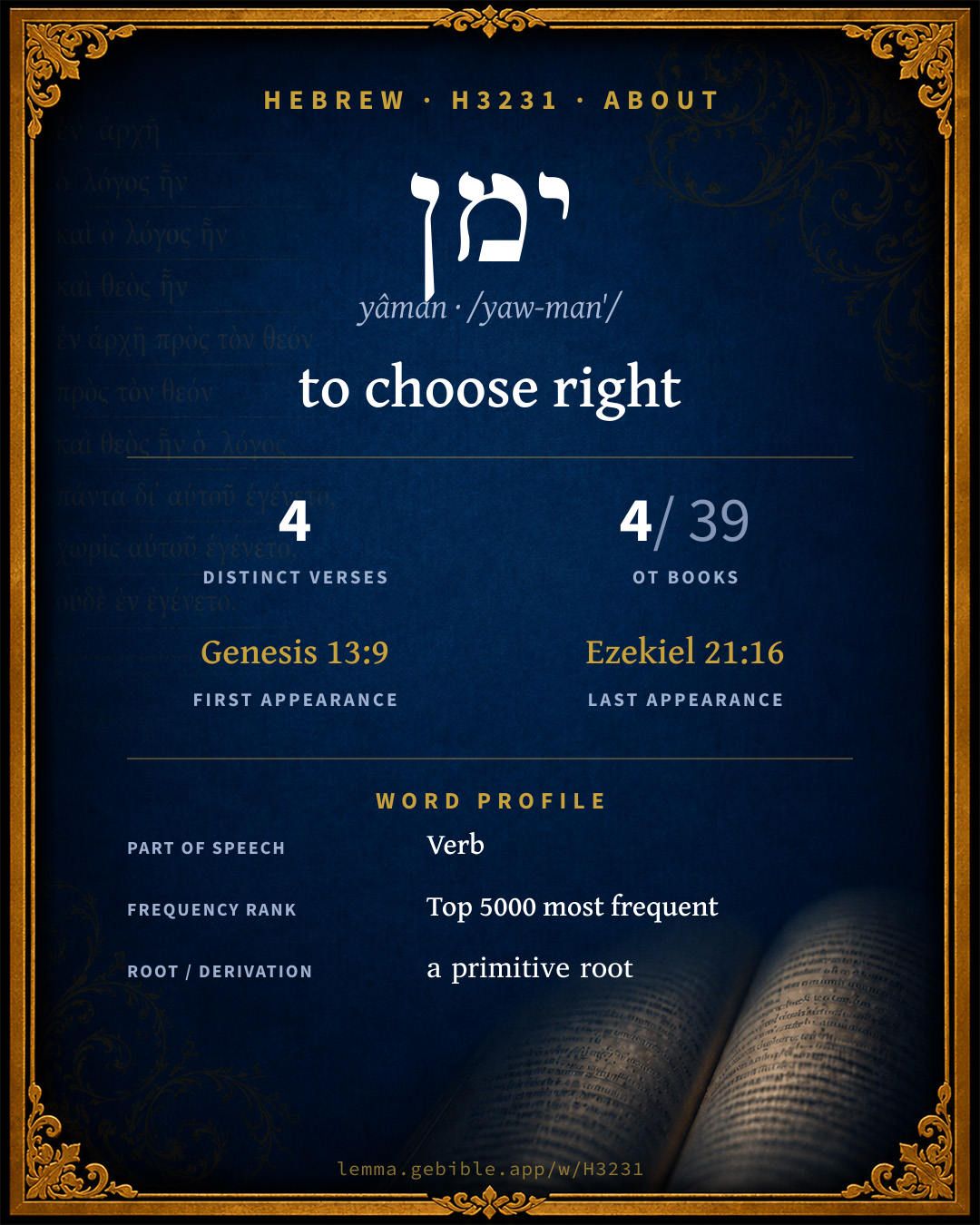
יָמַן
to choose right
Full lexicon entry — Brown-Driver-Briggs (BDB)
From Brown-Driver-Briggs (BDB)
Where this word appears
Grammar key — what these labels mean
Part of speech
- Verb
- An action or state-of-being word.
Stem
- Hiphil
- The causative active stem (“he caused / brought about”).
Form
- Cohortative
- A first-person volitional form expressing wish or resolve (“let me / let us write”).
- Infinitive Construct
- A bound verbal noun, frequently with prepositions (“to write / in writing”).
- Participle Active
- A verbal adjective expressing ongoing or characteristic action (“writing / one who writes”).
- Imperative
- A direct command (“write!”).
State
- Absolute
- The independent form of a noun, not bound to a following word.
Person
- 1st Person
- The speaker (“I / we”).
- 2nd Person
- The one addressed (“you”).
Gender
- Common
- Either gender — not distinguished for this form.
- Masculine
- Grammatically masculine.
- Feminine
- Grammatically feminine.
Number
- Singular
- One.
- Plural
- More than one (in Hebrew, generally three or more).
Grammatical forms
- Verb, Hiphil, Cohortative, 1st Person, Common, Singular 1 time (25%)
- Verb, Hiphil, Infinitive Construct 1 time (25%)
- Verb, Hiphil, Participle Active, Masculine, Plural, Absolute 1 time (25%)
- Verb, Hiphil, Imperative, 2nd Person, Feminine, Singular 1 time (25%)
Parsed forms decoded from the imported morphology (morphhb / Westminster Leningrad Codex — WLC text public domain, morphhb tagging CC BY 4.0), counted across 4 parsed occurrences — not distinct verses.
Every verse where H3231 appears — 4 distinct verses across 4 books. Click any verse to open its interlinear word-by-word view. Verse text shown in the World English Bible for context — . Each verse’s Hebrew form is shown with its reference; the English is not keyword-highlighted, since the data carries no word-level English alignment. Use “Compare translations” on any verse to read it across multiple English versions. This concordance covers the Hebrew Bible; Septuagint (Greek Old Testament) occurrences are not indexed here.
Genesis 1 verse
2 Samuel 1 verse
1 Chronicles 1 verse
Ezekiel 1 verse
About this entry
At a glance — auto-summarized from this page’s data, not written by a person. Every figure links to its source below. This summary describes the numbers; it doesn’t interpret them.
The Hebrew verb ימן centers on the idea of “to choose right.” It is rare — just 4 verses in the entire Hebrew Bible. The word gravitates to Genesis (25%), then 2 Samuel and 1 Chronicles. Its earliest occurrence is Genesis 13:9. It clusters with ימין, ימני and ימנה under a shared root. Dig into 4-verse concordance and the renderings breakdown below.
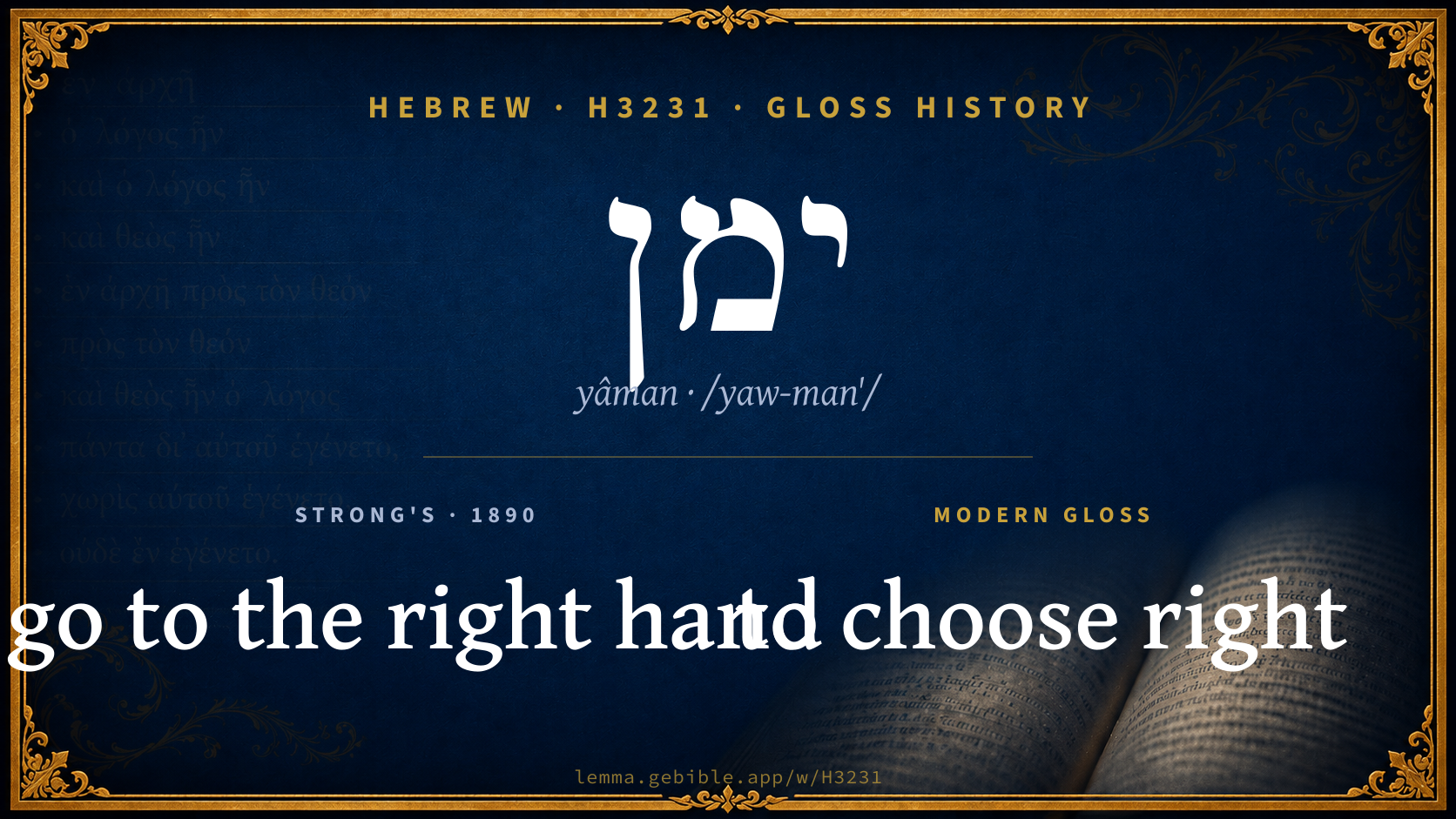
Gloss history
Strong's 1890 vs modern scholarship
About this word
Strong's H3231 catalogs a Hebrew word from the Hebrew Old Testament.
These counts are not copied from any lexicon or concordance. They are computed here, from the morphology-tagged Hebrew Old Testament. What Lemma adds →
- 4
- distinct verses
- The word appears in 4 distinct verses.
- 4 / 39
- OT books
- The word appears in 4 of 39 Old Testament books.
- #3,696
- by frequency
- Top 5000 most frequent Hebrew words (rank 3,696 of 8,640 Hebrew words by occurrence).
View all 4 occurrences in the concordance →
Most concentrated in
- Genesis 1 verse 25%
- 2 Samuel 1 verse 25%
- 1 Chronicles 1 verse 25%
By section of the Old Testament
By traditional corpus
Conventional, traditional groupings — biblical authorship is debated, so this is a traditional corpus grouping, not an authorship claim. Each share is this word’s portion of its verses in that division of the Hebrew canon. Each figure is a share of the word’s 4 distinct verses.
- Prophets (Nevi'im) 2 verses · 50%
- Torah (Pentateuch) 1 verse · 25%
- Writings (Ketuvim) 1 verse · 25%
How translations render this word
Counts come from each version’s own published word-to-Strong’s tagging or interlinear alignment — an approximate guide to how each version renders this word, not a word-level alignment the data otherwise carries. Because each total is that version’s own tagged count, the per-version totals vary from one another and need not match the appearance or distinct-verse counts above. These counts may also differ from a printed concordance because Lemma counts each distinctly tagged rendering and does not collapse phrase taggings into a single head-word total. This is a fixed set of word-tagged versions (KJV, ASV, BSB, ULT) and does not change with the reading translation you choose elsewhere. Each version’s license is shown beside its name below (and on Sources).
- King James Version: Could use both the right hand 1×, I will go to the right 1×, Right hand 1×
- American Standard Version: Could use both the right hand 1×, Right 1×, Thou wilt take the left hand then i will go to the right 1×
- Berean Standard Bible: Right 2×
- unfoldingWord Literal Text: Being right handed 1×, I will go right 1×, Strike to the right 1×
King James Version Public Domain
Renders H3231 across 4 tagged occurrences — most commonly:
American Standard Version Public Domain
Renders H3231 across 4 tagged occurrences — most commonly:
Berean Standard Bible Public Domain
Renders H3231 across 4 tagged occurrences — most commonly:
Plus 2 renderings that appear only once — usually multi-word phrases or single function words the recovered tagging swept in, not distinct renderings.
unfoldingWord Literal Text CC BY-SA 4.0
Renders H3231 across 4 tagged occurrences — most commonly:
Senses in BDB
The 1 sense BDB distinguishes for this word, in lexicon order (not ranked by frequency or importance). The full entry — with sub-senses — is in the Lexicon Entry tab.
- (Hiphil) to choose the right, go to the right, use the right hand, be right handed
Word origin
[ יָמַן ] vb. denom. Hiph. go to or choose the right, use the right hand
— Brown-Driver-Briggs (Oxford 1906, public domain), digitized via Sefaria, supplemented by the OpenScriptures HebrewLexicon (CC BY 4.0). See Sources.
Origin: a primitive root
Jastrow Dictionary
A second Hebrew/Aramaic lexicon for comparison, covering Aramaic and post-biblical (Talmudic, Targumic, Midrashic) usage that the biblical-Hebrew BDB does not. Matched by lemma rather than by Strong’s number, so a lemma may carry more than one Jastrow headword (shown separately below), and the entries cover usage well beyond the Bible.
יָמַן
- , Pi. יִמֵּן (denom. of יָמִין; cmp. אָמַן) to endow with skill, strength, distinction. Part. pass. מְיוּמָּן, f. מְיוּמֶּנֶת. Ḥull. 91ᵃ הירך המ׳ שבירך it says ‘the hip’ (Gen. XXXII, 33) that means the strongest of the hips (the right); ib. 134ᵇ הכא נמי הזרוע המ׳ וכ׳ here, too, we read ‘the arm’ (Deut. XVIII, 3), that means the right arm; Hor. 12ᵃ ה"נ המשיח המ׳ וכ׳ here, too, we read ‘the anointed’ (Lev. IV, 3), the distinguished among the anointed (the Highpriest). Sifra Vayikra, Ḥoba, ch. III, Par. 3 מה … הימנית המ׳ שבימין וכ׳ as the finger mentioned there (Lev. XIV, 16) is ‘the right’ which means the most skilled (the index) finger of the right hand &c.; [Zeb. 40ᵃ sq. לא נצרכא אלא להכשיר אָמוּן שבאצבע Ms. M. (ed. אמין, omitting אלא; v. Rabb. D. S. a. l. note) the את (Lev. IV, 6 את אצבעו) would not have been required, were it not to indicate, as the fittest for the ceremony, the most skilled of the fingers.—Rashi: אמין blister.] e.g. Genesis 32:33
- . Sabb. 63ᵃ (ref. to Prov. III, 16) למַיְימִינִין בה וכ׳ to those who make the right use of it &c.; Yalk. Prov. 934.—Cant. R. to I, 9 אלו מֵימִינִים וכ׳ the ones stand on the right side (pleading in favor of the accused) &c.—Sabb. 88ᵇ, v. next w. e.g. Proverbs 3:16
יְמַן
- Af. אַיְימִין same. Sabb. 88ᵇ דאַיְימִין ליה Ms. M. (ed. מיימינים) he who uses it in the right way (v. preced.); Yoma 72ᵇ דאוֹמַן לה (Ms. M. דאֵימִין).
A Dictionary of the Targumim, the Talmud Babli and Yerushalmi, and the Midrashic Literature (Marcus Jastrow; London, Luzac, 1903) — Public Domain. Digitized via Sefaria. Digitized via Sefaria. Full attribution on Sources.
Forms in the corpus
The 4 distinct written forms H3231 takes in the Hebrew Bible, most frequent first — each parse links to that stem’s occurrences in the concordance. Hebrew forms include their vowel points and cantillation, so a single lemma takes many written forms.
| Form | Parsing | Example | Uses |
|---|---|---|---|
| הֵימִ֖נִי | Verb, Hiphil, Imperative, 2nd Person, Feminine, Singular | Ezekiel 21:16 | 1 |
| וְ/אֵימִ֔נָה | Verb, Hiphil, Cohortative, 1st Person, Common, Singular | Genesis 13:9 | 1 |
| לְ/הֵמִ֣ין | Verb, Hiphil, Infinitive Construct | 2 Samuel 14:19 | 1 |
| מַיְמִינִ֤ים | Verb, Hiphil, Participle Active, Masculine, Plural, Absolute | 1 Chronicles 12:2 | 1 |
Same root — word family
Other BDB entries built from the same root as H3231, grouped by Strong’s listed origin. These share a root / origin per the lexicon — not necessarily a shared meaning. Each links to that word’s own entry.
Derived from this word
Proper names from this root
People and places named from this root — a name, not an additional meaning of the word.
Compare all same-root words → 1 of the same-root words is a proper name (a person or place). They share a root, not necessarily a meaning.
Septuagint verse parallels
This word appears in 4 verses that also exist in the Greek Old Testament (Septuagint), out of the 4 Hebrew verses it occurs in. You can read those verses in Greek by switching the Old Testament edition to the Septuagint.
Read these verses in the Septuagint
This is a verse-level parallel only — the same verses exist in both the Hebrew and Greek Old Testaments. No word-level Hebrew↔Greek correspondence is claimed: the data carries no such alignment, so no Greek word is shown as this Hebrew word’s translation. Coverage is not total — the Septuagint omits the deuterocanon and renumbers the Psalms, so some Hebrew verses have no direct Greek parallel.