
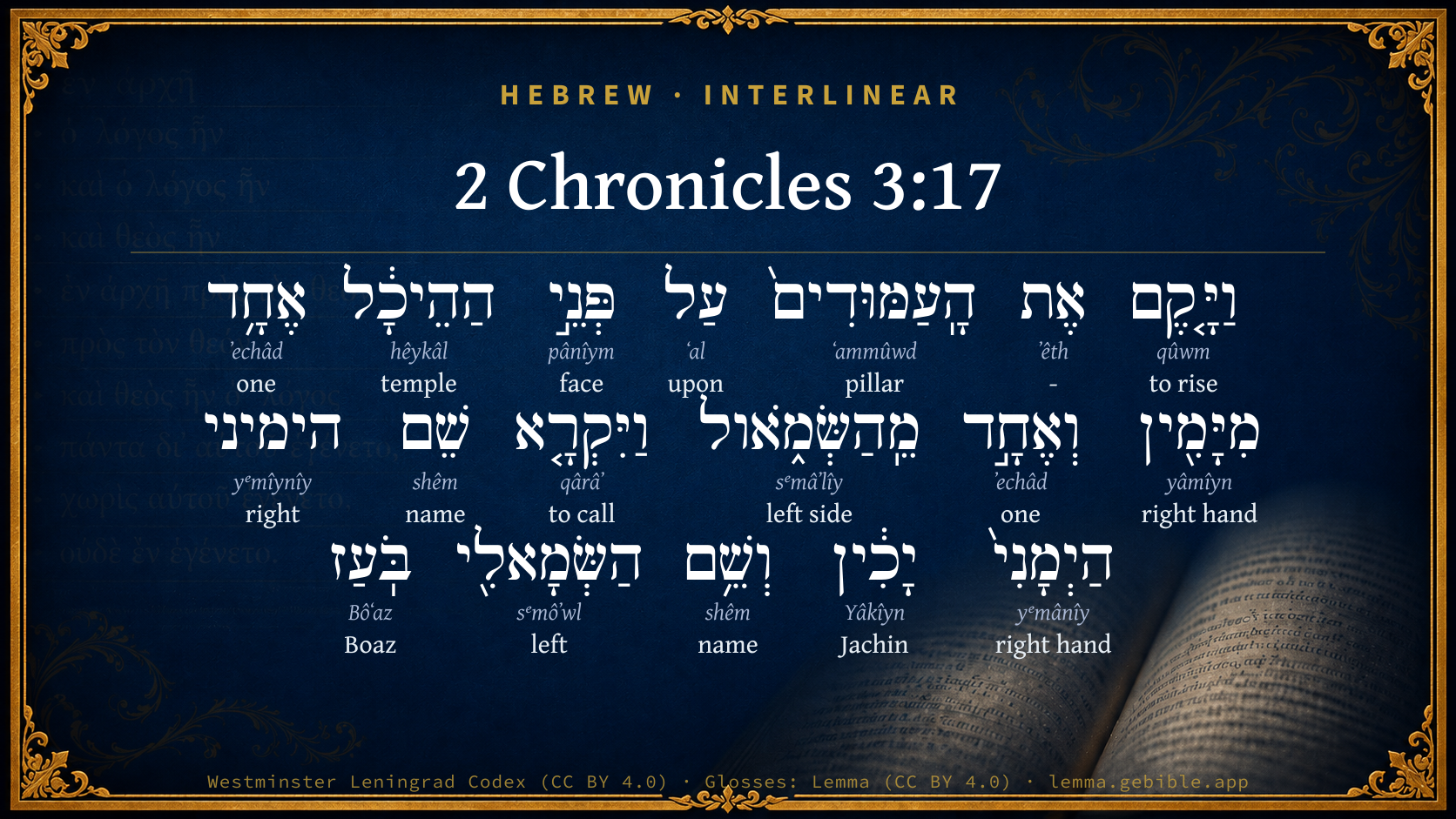
2 Chronicles 3:17

Hebrew (Westminster Leningrad Codex) 2 Chronicles 3:17 appears in the Hebrew Old Testament. The text above is from the Westminster Leningrad Codex. Each word links to its Strong’s number, a concise gloss, and parsing drawn from the Open Scriptures Hebrew Bible morphology. Click any word for its full Brown-Driver-Briggs (BDB) entry.
Download image
Cite this verse

2 Chronicles 3:17 (World English Bible). Public Domain. Lemma interlinear Bible study tool, https://lemma.gebible.app/v/2-chronicles/3/17.

Show BibTeX & RIS
BibTeX
RIS
English Translation
He set up the pillars before the temple, one on the right hand, and the other on the left; and called the name of that on the right hand Jachin, and the name of that on the left Boaz.
World English Bible · Public Domain
Download a study sheet

One document with this verse’s original text, its word-by-word gloss line, the meaning frame, cross-references with their text, attributed commentary, and full source and license credits — printable, and it pastes into notes with its structure intact.

This verse Autodidact and up

Study sheet (.html) Plain text (.txt)

A passage Seminary Student

Up to 50 verses in one chapter. A passage sheet keeps up to 6 commentary sources and 12 cross-references per verse, in the order this page ranks them, and says so on the sheet whenever that leaves anything out. Ask for a single verse and you get the Autodidact verse sheet above.

Everything on this page stays free to read, with no account — the sheet is a download of what is already on screen, not access to it.

Want to remove ads? Support Godless Engineer
Compare translations 3

The same verse in 3 English versions, stacked beneath the original-language interlinear above. Click any original word for its lexicon entry.

Each is an independent rendering of the whole verse — the interlinear is not word-aligned to these translations.

Highlighted words mark where these versions differ — a whole-verse word diff, not a word-by-word alignment.

  • World English Bible Public Domain
    He set up the pillars before the temple, one on the right hand, and the other on the left; and called the name of that on the right hand Jachin, and the name of that on the left Boaz.
  • King James Version Public Domain
    And he reared up the pillars before the temple, one on the right hand, and the other on the left; and called the name of that on the right hand Jachin, and the name of that on the left Boaz.
  • unfoldingWord Literal Text CC BY-SA 4.0
    And he set up the pillars on the face of the temple, one on the right hand, and one on the left. And he called the name of the right, Jakin, and the name of the left, Boaz.

unfoldingWord Literal Text — © unfoldingWord, licensed CC BY-SA 4.0. Word-aligned USFM3 via Door43 (git.door43.org/unfoldingWord/en_ult).

Versions to compare (up to 4)

3 of 4 selected

Show all 18 translations

Every available English version of this verse, each an independent rendering of the whole verse.

  • World English Bible Public Domain
    He set up the pillars before the temple, one on the right hand, and the other on the left; and called the name of that on the right hand Jachin, and the name of that on the left Boaz.
  • Berean Standard Bible Public Domain
    Then he set up the pillars in front of the temple, one on the south and one on the north. The pillar on the south he named Jachin, and the pillar on the north he named Boaz.
  • Majority Standard Bible Public Domain
    Then he set up the pillars in front of the temple, one on the south and one on the north. The pillar on the south he named Jachin, and the pillar on the north he named Boaz.
  • King James Version Public Domain
    And he reared up the pillars before the temple, one on the right hand, and the other on the left; and called the name of that on the right hand Jachin, and the name of that on the left Boaz.
  • American Standard Version (1901) Public Domain
    And he set up the pillars before the temple, one on the right hand, and the other on the left; and called the name of that on the right hand Jachin, and the name of that on the left Boaz.
  • Revised Version (1885) Public Domain
    And he set up the pillars before the temple, one on the right hand, and the other on the left; and called the name of that on the right hand Jachin, and the name of that on the left Boaz.
  • Geneva Bible (1599) Public Domain
    And he set vp the pillars before the Temple, one on the right hande and the other on the left, and called that on the right hand Iachin, and that on the left hand Boaz.
  • Douay-Rheims (1899) Public Domain
    These pillars he put at the entrance of the temple, one on the right hand, and the other on the left: that which was on the right hand, he called Jachin: and that on the left hand, Boot.
  • Young's Literal Translation Public Domain
    And he raiseth up the pillars on the front of the temple, one on the right, and one on the left, and calleth the name of that on the right Jachin, and the name of that on the left Boaz.
  • Literal Standard Version CC BY-SA 4.0
    And he raises up the pillars on the front of the temple, one on the right and one on the left, and calls the name of that on the right Jachin, and the name of that on the left Boaz.
  • Unlocked Literal Bible CC BY-SA 4.0
    He set up the pillars in front of the temple, one on the right hand, and the other on the left; he named the pillar on the right Jakin, and the pillar on the left Boaz.
  • unfoldingWord Literal Text CC BY-SA 4.0
    And he set up the pillars on the face of the temple, one on the right hand, and one on the left. And he called the name of the right, Jakin, and the name of the left, Boaz.
  • Darby Bible Public Domain
    And he set up the pillars in front of the temple, one on the right hand and the other on the left; and he called the name of that on the right Jachin, and the name of that on the left Boaz.
  • World Messianic Bible Public Domain
    He set up the pillars before the temple, one on the right hand and the other on the left; and called the name of that on the right hand Jachin, and the name of that on the left Boaz.
  • Webster's Bible Public Domain
    And he erected the pillars before the temple, one on the right hand, and the other on the left; and called the name of that on the right hand Jachin, and the name of that on the left Boaz.
  • Free Bible Version CC BY-SA 4.0
    He set up the columns in front of the Temple, one on the south, and one on the north. The column on the south he named Jachin, and the column on the north he named Boaz.
  • Bible in Basic English Public Domain
    He put up the pillars in front of the Temple, one on the right side and one on the left, naming the one on the right Jachin and that on the left Boaz.
  • JPS Tanakh (1917) Public Domain
    And he set up the pillars before the temple, one on the right hand, and the other on the left; and called the name of that on the right hand Jachin, and the name of that on the left Boaz.

Literal Standard Version (2020), Covenant Press — licensed CC BY-SA 4.0. Text via the HelloAO Bible API (eBible.org). Unlocked Literal Bible (unfoldingWord) — licensed CC BY-SA 4.0. Text via the HelloAO Bible API (eBible.org). unfoldingWord Literal Text — © unfoldingWord, licensed CC BY-SA 4.0. Word-aligned USFM3 via Door43 (git.door43.org/unfoldingWord/en_ult). Free Bible Version, Dr. Jonathan Gallagher — licensed CC BY-SA 4.0. Text via the HelloAO Bible API (eBible.org).

Word by word

More ways to search: Search by grammar → Find every occurrence → Compare this word →

Practice this passage: Drill this verse → Learn its vocabulary →

הימיני
yᵉmîynîy
H3227
“the · right”
Particle, Definite Article + Adjective, Adjective, Masculine, Singular, Absolute
Part of Speech
Particle + Adjective
Type
Adjective
Gender
Masculine
Number
Singular
State
Absolute
Full BDB Definition

Origin: for H3225

TWOT: 872b

right, on the right, right hand
  1. וַיָּ֤קֶם qûwm H6965 “and · to rise” Conjunction + Verb, Hiphil, Sequential Imperfect, 3rd Person, Masculine, Singular
  2. אֶת ʼêth H853 “-” Particle, Direct Object
  3. הָֽעַמּוּדִים֙ ʻammûwd H5982 “the · pillars” Particle, Definite Article + Noun, Common, Masculine, Plural, Absolute
  4. עַל ʻal H5921 “upon” Preposition
  5. פְּנֵ֣י pânîym H6440 “face(s) of” Noun, Common, Both, Plural, Construct
  6. הַהֵיכָ֔ל hêykâl H1964 “the · temple” Particle, Definite Article + Noun, Common, Masculine, Singular, Absolute
  7. אֶחָ֥ד ʼechâd H259 “one” Adjective, Cardinal number, Masculine, Singular, Absolute
  8. מִיָּמִ֖ין yâmîyn H3225 “from · right hand” Preposition + Noun, Common, Feminine, Singular, Absolute
  9. וְאֶחָ֣ד ʼechâd H259 “and · one” Conjunction + Adjective, Cardinal number, Masculine, Singular, Absolute
  10. מֵֽהַשְּׂמֹ֑אול sᵉmâʼlîy H8042 “from · the · left side” Preposition + Particle, Definite Article + Noun, Common, Masculine, Singular, Absolute
  11. וַיִּקְרָ֤א qârâʼ H7121 “and · to call” Conjunction + Verb, Qal, Sequential Imperfect, 3rd Person, Masculine, Singular
  12. שֵׁם shêm H8034 “name of” Noun, Common, Masculine, Singular, Construct
  13. הַיְמָנִי֙ yᵉmânîy H3233 “the · right hand” Particle, Definite Article + Adjective, Adjective, Masculine, Singular, Absolute
  14. יָכִ֔ין Yâkîyn H3199 “Jachin” Noun, Proper
  15. וְשֵׁ֥ם shêm H8034 “and · name of” Conjunction + Noun, Common, Masculine, Singular, Construct
  16. הַשְּׂמָאלִ֖י sᵉmôʼwl H8040 “the · left” Particle, Definite Article + Adjective, Adjective, Masculine, Singular, Absolute
  17. בֹּֽעַז Bôʻaz H1162 “Boaz” Noun, Proper

About this verse

These counts appear in no published source. They are computed here, from the morphology-tagged text and Lemma’s own curated glosses. What Lemma adds →

18
words
16
distinct lemmas
Historical
section

Notable vocabulary

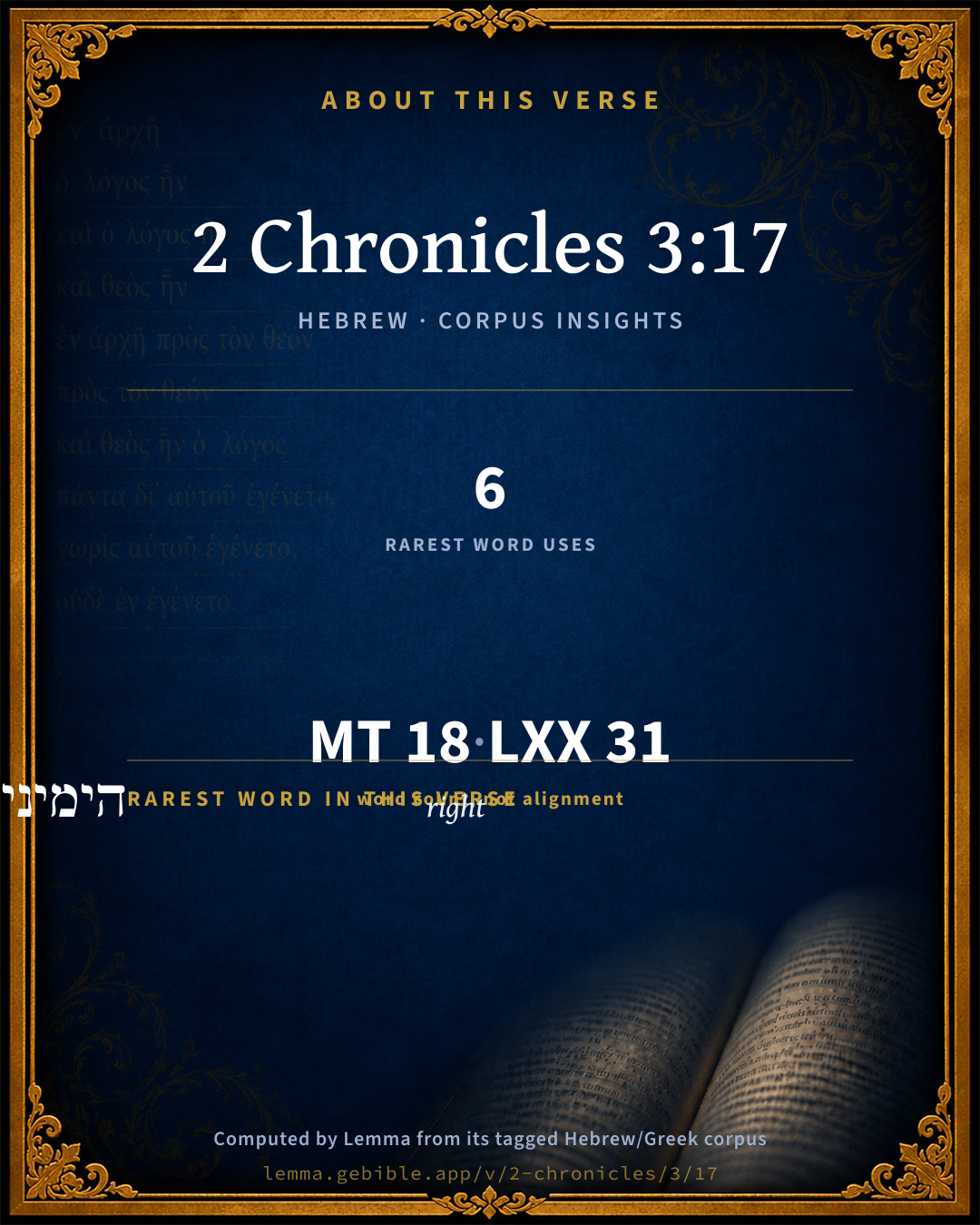
The rarest word here is הימיני right H3227 — appearing just 6 times in the whole Hebrew Bible.

Shared distinctive vocabulary

הימיני right H3227 occurs in 6 verses of the Hebrew Bible. Also found in:

Grammatical profile

  • 2 verbs
  • 9 nouns
  • 5 adjectives
  • 1 preposition
  • 1 particle

Verb forms

  • וַיָּ֤קֶם Hiphil · Sequential Imperfect
  • וַיִּקְרָ֤א Qal · Sequential Imperfect

Repetition

Words recur within this verse — often emphatic in Hebrew:

  • אֶחָ֥ד one H259 ×2
  • שֵׁם name H8034 ×2

Hebrew & Septuagint length

In English translation the verse runs 39 words from the Hebrew and 45 from the Septuagint (LXX English) — closely comparable.

A rough comparison of the two English renderings, which tokenize alike — not a word-level alignment.

Word counts can differ between the Hebrew and the Greek without any difference in meaning — e.g. the Hebrew direct-object marker אֵת has no separate Greek word, and Greek often adds the article ὁ.

In the original languages it is 18 Hebrew tokens and 31 Greek tokens — but the two are counted differently (Hebrew bundles its prefixes and suffixes into one token; the Greek is in lemma form), so that isn’t a like-for-like length.

Cross-references

1

Topical passages linked to 2 Chronicles 3:17 in the Treasury of Scripture Knowledge — connected by theme and wording, ordered by reader-vote popularity; previews shown in the World English Bible.

  • 1 Kings 7:21 He set up the pillars at the porch of the temple: and he set up the right pillar, and called the name of it Jachin; and he set up the left pillar, and called the name of it Boaz.

Cross-references courtesy of OpenBible.info (CC BY 4.0).

Hebrew and Greek witnesses Masoretic Hebrew ↔ Greek Septuagint

The same verse in the two great witnesses to the Old Testament, shown verse-for-verse.

These are two independent witnesses, not word-aligned to each other, and the Septuagint is shown in lemma (dictionary) form.

Hebrew 2 Chronicles 3:17 Masoretic · Westminster Leningrad Codex

וַיָּ֤קֶם אֶת הָֽעַמּוּדִים֙ עַל פְּנֵ֣י הַהֵיכָ֔ל אֶחָ֥ד מִיָּמִ֖ין וְאֶחָ֣ד מֵֽהַשְּׂמֹ֑אול וַיִּקְרָ֤א שֵׁם הימיני הַיְמָנִי֙ יָכִ֔ין וְשֵׁ֥ם הַשְּׂמָאלִ֖י בֹּֽעַז

He set up the pillars before the temple, one on the right hand, and the other on the left; and called the name of that on the right hand Jachin, and the name of that on the left Boaz.

World English Bible · Public Domain

Greek LXX 2 Chronicles 3:17 Septuagint · lemma form

καί ἵστημι ὁ στῦλος κατά πρόσωπον ὁ ναός εἷς ἐκ δεξιός καί ὁ εἷς ἐκ εὐώνυμος καί καλέω ὁ ὄνομα ὁ ἐκ δεξιός κατόρθωσις καί ὁ ὄνομα ὁ ἐκ ἀριστερός ἰσχύς

And he set up the pillars in front of the temple, one on the right hand and the other on the left: and he called the name of the one on the right hand 'Stability,' and the name of the one on the left 'Strength.'

LXX2012 (modern English Septuagint) · Public Domain

On this verse, The Cambridge Bible for Schools and Colleges discusses the Septuagint’s reading. Read the note in Commentary ↓

Hebrew: Westminster Leningrad Codex (CC BY 4.0). Greek: Septuagint (public domain); English from LXX2012 (modern English Septuagint) (Public Domain). How the Septuagint differs from the Hebrew →

Commentary

Notes on 2 Chronicles 3:17 from classic Christian and Jewish commentators (each source and its license shown beneath its notes). The classic Christian expositions comment on the surrounding passage and are grouped to its opening verse, so a note may address several verses; the Jewish commentaries on the Tanakh (Rashi and others) are per-verse, so they appear only where the commentator wrote on this verse.

Lemma curates 59 commentaries, every one of them public domain or Creative Commons licensed, each selected and text-cleaned for this edition rather than reprinted as found. About our sources →

Tyndale Open Study Notes

Tyndale Open Resources

3:17 Jakin (“he establishes”) might refer to God’s promise regarding the kingdom (see 1 Chr 17:7-14). Boaz (“in him is strength”) might have been a proclamation of trust in God. The gilded reliefs of cherubs, palms, and flowers adorning the doors and walls of the Temple suggest that the pillars were related to the tree of life (Gen 2:9).

Tyndale Open Study Notes — © Tyndale Open Resources, licensed CC BY-SA 4.0. Text via the HelloAO Bible API.

Adam Clarke's Commentary

Verse 17. He reared up the pillars] "The name of that on the right hand was Jachin, because the kingdom of the house of David was established; and the name of the left was Boaz, from the name of Boaz the patriarch of the family of Judah, from whom all the kings of the house of Judah have descended." - Targum. See on 1Kg 7:21; and see the parallel places for other matters contained in this chapter.

Adam Clarke's Commentary on the Bible (1810–1826) — public domain. Text from a community e-Sword/MySword module.

Ellicott's Commentary for English Readers

(17) Before the temple.—Vulg., in vestibulo templi. So 1Ki_7:21 has, “at the porch of the temple.” 1Ki_7:22 adds, “and upon the top of the pillars was lily-work.”

Jachin . . . Boaz.—See 1Ki_7:21. “The description of the two brazen pillars,” says Reuss, “much more detailed in 1Ki_7:15 ff., has become almost unintelligible, under the pen of the abbreviate.” This is a strong exaggeration. He also pronounces the word bad-debîr in 2Ch_3:16 “absolutely unintelligible,” and to be accounted “foreign to the text.” How little we agree with this hasty decision will be evident from our Note on that verse.

A Bible Commentary for English Readers, edited by Charles John Ellicott (1878–1897) — public domain. Text from a community e-Sword module.

The Cambridge Bible for Schools and Colleges

gen. ed. J. J. S. Perowne

17. he reared up] R.V. he set up (as in 1Ki_7:21).

Jachin … Boaz] R.V. mg. translates the two words; Jachin “he shall establish,” Boaz perhaps “In it is strength.” LXX. gives Κατόρθωσις (“setting up”) and Ἰσχύς (“strength”). The meaning of Boaz is quite uncertain.

The Cambridge Bible for Schools and Colleges (gen. ed. J. J. S. Perowne; Cambridge University Press, 1878–1918) — public domain. Text from a community e-Sword module.

Haydock's Catholic Bible Commentary

Booz. "Stability and strength" are derived from God alone. Thus Solomon designed to insinuate that God established the harmony of the universe. (Haydock) --- An orrery, or globe, was therefore placed on each of these pillars. (Parkhurst, in con.)

George Leo Haydock (1774–1849), Haydock's Catholic Family Bible and Commentary, 1859 edition — public domain. Excludes Psalms (Douay-Rheims chapter numbering differs from Protestant) and Deuterocanonical books (Catholic canon only).

The Pulpit Commentary

Jachin Boaz. The margin of our Authorized Version gives with sufficient correctness the meaning of these names of the pillars, which purport to set forth the safety and sure strength that belong to those who wait on, and who calmly and constantly abide by, the Divine leading. The latter, however, is one word, a substantive, not a compound of preposition, pronoun, and substantive; and the former, though by derivation the future of the hiph. conjugation of the verb Wh, is established as a substantive in its own right.

The Pulpit Commentary (1880–1919), ed. H.D.M. Spence-Jones & Joseph S. Exell — public domain. Text from a community e-Sword module.

John Wesley's Explanatory Notes

Jachin - That is, He shall establish. Boaz - That is, In it is strength.

John Wesley, Explanatory Notes Upon the Whole Bible (1754–1765) — public domain. Text via the GEBible commentary corpus.

Rashi

Rabbi Shlomo Yitzchaki (Rashi)

before the Heichal At the entrance of the Heichal on the outside, in the vestibule, as is proven in I Kings (7:19): “And the chapiters that were upon the top of the pillars were of lily work in the vestibule.”

one from the right of the entrance.

and one from the left of the entrance.

Jachin, etc. Boaz Jachin because of the kingdom of the house of David, which was compared to the moon, as it is written (Ps. 89:38): “Like the moon, which is established (יִכּוֹן) forever.”

Boaz, corresponding to the sun, [which emerges with might and strength (עֹז) (Yesod Veshoresh Haavodah)], as it is written (ibid. 19: 6): “it rejoices like a mighty man, running,” (Midrassh Tadshe, ch. 2). The “beth” of בֹּעַז is like the “mem” in (Gen. 5:29) נֹחַ יְנַחֲמֵנוּ and in (I Sam 1:20) שְּׁמוּאֵל כִּי מֵה' שְׁאִלְתִּיו.

and he named the right one Jachin although the moon is smaller than the sun, i.e., that it shou ld help him like an established moon, but not like a diminishing moon. Said Solomon, “If the Holy One, blessed be He, compares my kingdom to the sun and the moon, I too shall make an established and enduring thing, namely, large copper pillars.” Another explanation: Huram, who was one of the sons of Dan, made the pillars. He called one Jachin after his father Samson, about whom Scripture states (Jud. 16:29): “And Samson grasped the two pillars of the center, etc.” And Solomon called the second one Boaz after his grandfather, Boaz. A similar instance is (Gen. 31:47): “And Laban called it Yegar Sahadutha.”

Rashi on the Tanakh — English translations: “The Judaica Press complete Tanach with Rashi, translated by A. J. Rosenberg” (CC BY 4.0); “Pentateuch with Rashi's commentary by M. Rosenbaum and A.M. Silbermann, 1929-1934” (public domain); “The Metsudah Tanach series, Lakewood, N.J” (CC BY 4.0); and “The Book of Joshua, Metsudah Publications, 1997” (CC BY 4.0). Text via Sefaria.

Lesson kit

Teaching starters — assembled from the data on this page, not authored interpretation. Every prompt links to the verse data it draws on. Edit before teaching.

2 Chronicles, in the Historical, opens this verse with 18 words (16 distinct Hebrew lemmas). Its most distinctive word is yᵉmîynîy (“right”). A historical commentator’s framing appears above. Read the whole chapter for the surrounding context.

Discussion questions

  1. The word yᵉmîynîy carries the sense “right.” How does it shape the verse?
  2. How does 1 Samuel 9:1, which shares the word «right», read alongside this verse?
  3. What does the repetition of “one” (2× in this one verse) do in this verse?
  4. The translations on this page render this verse differently — a whole-verse word diff, not a word-by-word alignment. What might account for the different wordings?
  5. «וַיָּ֤קֶם» is a Hiphil Sequential Imperfect verb. How does that grammatical form shape the action described?
  6. Compare how Tyndale Open Study Notes and Adam Clarke's Commentary read this verse. Where do they agree or differ?

Things to notice

Reading settings

Reading text

Shown beneath each verse's original-language words.

Old Testament
Old Testament edition

Read the OT as the Masoretic Hebrew (MT) or the Greek Septuagint (LXX).

English shown for the Greek Septuagint (in the Hebrew ↔ Greek comparison).

Comparing translations? Open the Compare panel on any verse page to stack up to four side by side.