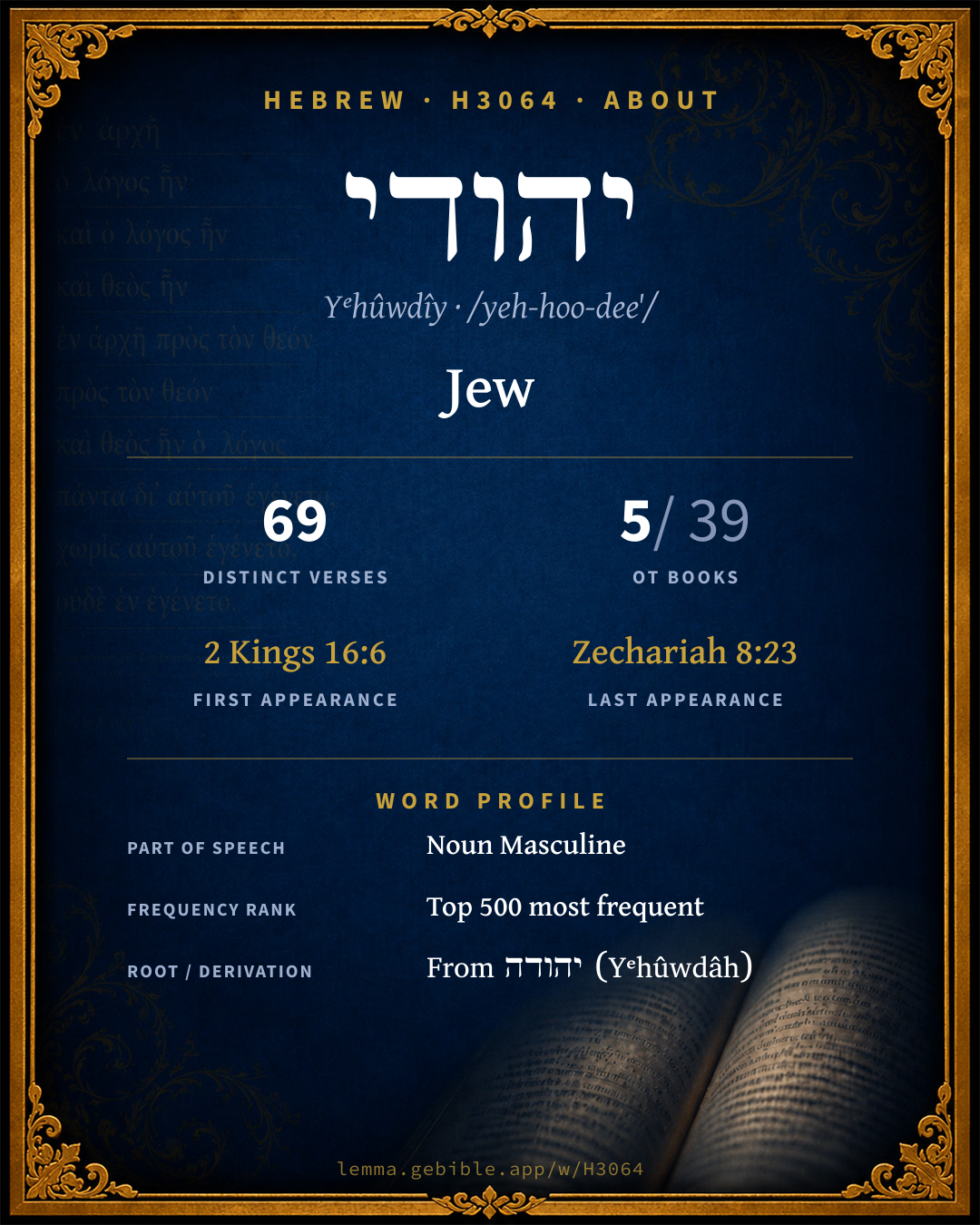
יְהוּדִי
Jew
Full lexicon entry — Brown-Driver-Briggs (BDB)
From Brown-Driver-Briggs (BDB)
Where this word appears
Grammar key — what these labels mean
Part of speech
- Noun
- A naming word — a person, place, thing, or idea.
Noun type
- Gentilic
- A noun naming a member of a people, tribe, or region of origin (e.g. an Israelite, a Moabite).
- Common
- A common noun — a general class of person, place, or thing (“king,” “city,” “water”), not a specific name.
- Proper
- A name of a specific person, place, or people (e.g. Abraham, Zion, Israel).
State
- Absolute
- The independent form of a noun, not bound to a following word.
Gender
- Masculine
- Grammatically masculine.
Number
- Plural
- More than one (in Hebrew, generally three or more).
- Singular
- One.
Grammatical forms
- Noun, Gentilic, Masculine, Plural, Absolute 68 times (84%)
- Noun, Gentilic, Masculine, Singular, Absolute 8 times (10%)
- Noun, Common, Masculine, Plural, Absolute 2 times (2%)
- Noun, Proper 1 time (1%)
- Adjective, Adjective, Masculine, Plural, Absolute 1 time (1%)
- Adjective, Adjective, Masculine, Singular, Absolute 1 time (1%)
Parsed forms decoded from the imported morphology (morphhb / Westminster Leningrad Codex — WLC text public domain, morphhb tagging CC BY 4.0), counted across 81 parsed occurrences — not distinct verses.
Every verse where H3064 appears — 69 distinct verses across 5 books. Click any verse to open its interlinear word-by-word view. Verse text shown in the World English Bible for context — . Each verse’s Hebrew form is shown with its reference; the English is not keyword-highlighted, since the data carries no word-level English alignment. Use “Compare translations” on any verse to read it across multiple English versions. This concordance covers the Hebrew Bible; Septuagint (Greek Old Testament) occurrences are not indexed here.
2 Kings 2 verses
- 2 Kings 16:6 הַ/יְהוּדִ֖ים ptcl def.art + n Gentilic mp At that time Rezin king of Syria recovered Elath to Syria, and drove the Jews from Elath; and the Syrians came to Elath, and lived there, to this day.
- 2 Kings 25:25 הַ/יְּהוּדִים֙ ptcl def.art + n Gentilic mp But it happened in the seventh month, that Ishmael the son of Nethaniah, the son of Elishama, of the royal seed came, and ten men with him, and struck Gedaliah, so that he died, and the Jews and the Chaldeans that were with him at Mizpah.
Nehemiah 10 verses
- Nehemiah 1:2 הַ/יְּהוּדִ֧ים ptcl def.art + n Gentilic mp that Hanani, one of my brothers, came, he and certain men out of Judah; and I asked them concerning the Jews who had escaped, who were left of the captivity, and concerning Jerusalem.
- Nehemiah 2:16 וְ/לַ/יְּהוּדִ֨ים conj + prep det + n Gentilic mp The rulers didn't know where I went, or what I did; neither had I as yet told it to the Jews, nor to the priests, nor to the nobles, nor to the rulers, nor to the rest who did the work.
- Nehemiah 4:1 הַ/יְּהוּדִֽים ptcl def.art + n Gentilic mp But it happened that when Sanballat heard that we were building the wall, he was angry, and took great indignation, and mocked the Jews.
- Nehemiah 4:2 הַ/יְּהוּדִ֥ים ptcl def.art + n Gentilic mp He spoke before his brothers and the army of Samaria, and said, What are these feeble Jews doing? will they fortify themselves? will they sacrifice? will they make an end in a day? will they revive the stones out of the heaps of rubbish, seeing they are burned?
- Nehemiah 4:12 הַ/יְּהוּדִ֔ים ptcl def.art + n Gentilic mp It happened that when the Jews who lived by them came, they said to us ten times from all places, You must return to us.
- Nehemiah 5:1 הַ/יְּהוּדִֽים ptcl def.art + n Gentilic mp Then there arose a great cry of the people and of their wives against their brothers the Jews.
- Nehemiah 5:8 הַ/יְּהוּדִ֜ים ptcl def.art + n Gentilic mp I said to them, We after our ability have redeemed our brothers the Jews, that were sold to the nations; and would you even sell your brothers, and should they be sold to us? Then held they their peace, and found never a word.
- Nehemiah 5:17 וְ/הַ/יְּהוּדִ֨ים conj + ptcl def.art + n Gentilic mp Moreover there were at my table, of the Jews and the rulers, one hundred fifty men, besides those who came to us from among the nations that were round about us.
- Nehemiah 6:6 וְ/הַ/יְּהוּדִים֙ conj + ptcl def.art + n Gentilic mp in which was written, It is reported among the nations, and Gashmu says it, that you and the Jews think to rebel; for which cause you are building the wall: and you would be their king, according to these words.
- Nehemiah 13:23 הַ/יְּהוּדִים֙ ptcl def.art + n Gentilic mp In those days also saw I the Jews who had married women of Ashdod, of Ammon, [and] of Moab:
Esther 46 verses
- Esther 2:5 יְהוּדִ֔י n Gentilic ms There was a certain Jew in Shushan the palace, whose name was Mordecai, the son of Jair, the son of Shimei, the son of Kish, a Benjamite,
- Esther 3:4 יְהוּדִֽי n Gentilic ms Now it came to pass, when they spoke daily to him, and he didn't listen to them, that they told Haman, to see whether Mordecai's matters would stand: for he had told those who he was a Jew.
- Esther 3:6 הַ/יְּהוּדִ֛ים ptcl def.art + n Gentilic mp But he scorned the thought of laying hands on Mordecai alone; for they had made known to him the people of Mordecai: therefore Haman sought to destroy all the Jews who were throughout the whole kingdom of Ahasuerus, even the people of Mordecai.
- Esther 3:10 הַ/יְּהוּדִֽים ptcl def.art + n Gentilic mp The king took his ring from his hand, and gave it to Haman the son of Hammedatha the Agagite, the Jews' enemy.
- Esther 3:13 הַ֠/יְּהוּדִים ptcl def.art + n Gentilic mp Letters were sent by posts into all the king's provinces, to destroy, to kill, and to cause to perish, all Jews, both young and old, little children and women, in one day, even on the thirteenth [day] of the twelfth month, which is the month Adar, and to take the spoil of them for a prey.
- Esther 4:3 לַ/יְּהוּדִ֔ים prep det + n Gentilic mp In every province, wherever the king's commandment and his decree came, there was great mourning among the Jews, and fasting, and weeping, and wailing; and many lay in sackcloth and ashes.
- Esther 4:7 ב/יהודיים בַּ/יְּהוּדִ֖ים prep det + n Gentilic mp prep det + n Gentilic mp Mordecai told him of all that had happened to him, and the exact sum of the money that Haman had promised to pay to the king's treasuries for the Jews, to destroy them.
- Esther 4:13 הַ/יְּהוּדִֽים ptcl def.art + n Gentilic mp Then Mordecai bade them return answer to Esther, Don't think to yourself that you shall escape in the king's house, more than all the Jews.
- Esther 4:14 לַ/יְּהוּדִים֙ prep det + n Gentilic mp For if you altogether hold your peace at this time, then will relief and deliverance arise to the Jews from another place, but you and your father's house will perish: and who knows whether you haven't come to the kingdom for such a time as this?
- Esther 4:16 הַ/יְּהוּדִ֜ים ptcl def.art + n Gentilic mp Go, gather together all the Jews who are present in Shushan, and fast you for me, and neither eat nor drink three days, night or day: I also and my maidens will fast in like manner; and so will I go in to the king, which is not according to the law: and if I perish, I perish.
- Esther 5:13 הַ/יְּהוּדִ֔י ptcl def.art + Adjective Adjective ms Yet all this avails me nothing, so long as I see Mordecai the Jew sitting at the king's gate.
- Esther 6:10 הַ/יְּהוּדִ֔י ptcl def.art + n Gentilic ms Then the king said to Haman, Make haste, and take the clothing and the horse, as you have said, and do even so to Mordecai the Jew, who sits at the king's gate: let nothing fail of all that you have spoken.
- Esther 6:13 הַ/יְּהוּדִ֡ים ptcl def.art + n Gentilic mp Haman recounted to Zeresh his wife and all his friends everything that had happened to him. Then his wise men and Zeresh his wife said to him, If Mordecai, before whom you have begun to fall, be of the seed of the Jews, you shall not prevail against him, but shall surely fall before him.
- Esther 8:1 ה/יהודיים הַ/יְּהוּדִ֑ים ptcl def.art + n Gentilic mp ptcl def.art + n Gentilic mp On that day did the king Ahasuerus give the house of Haman the Jews' enemy to Esther the queen. Mordecai came before the king; for Esther had told what he was to her.
- Esther 8:3 הַ/יְּהוּדִֽים ptcl def.art + n Gentilic mp Esther spoke yet again before the king, and fell down at his feet, and begged him with tears to put away the mischief of Haman the Agagite, and his device that he had devised against the Jews.
- Esther 8:5 הַ/יְּהוּדִ֔ים ptcl def.art + n Gentilic mp She said, If it please the king, and if I have found favor in his sight, and the thing seem right before the king, and I be pleasing in his eyes, let it be written to reverse the letters devised by Haman, the son of Hammedatha the Agagite, which he wrote to destroy the Jews who are in all the king's provinces:
- Esther 8:7 הַ/יְּהוּדִ֑י ב/יהודיים בַּ/יְּהוּדִֽים ptcl def.art + n Gentilic ms prep det + n Gentilic mp prep det + n Gentilic mp Then the king Ahasuerus said to Esther the queen and to Mordecai the Jew, See, I have given Esther the house of Haman, and him they have hanged on the gallows, because he laid his hand on the Jews.
- Esther 8:8 הַ/יְּהוּדִ֜ים ptcl def.art + n Gentilic mp Write you also to the Jews, as it pleases you, in the king's name, and seal it with the king's ring; for the writing which is written in the king's name, and sealed with the king's ring, may no man reverse.
- Esther 8:9 הַ/יְּהוּדִ֡ים הַ/יְּהוּדִ֔ים ptcl def.art + n Gentilic mp ptcl def.art + n Gentilic mp Then were the king's scribes called at that time, in the third month Sivan, on the three and twentieth [day] of it; and it was written according to all that Mordecai commanded to the Jews, and to the satraps, and the governors and princes of the provinces which are from India to Ethiopia, one hundred twenty-seven provinces, to every province according to the writing of it, and to every people after their language, and to the Jews according to their writing, and according to their language.
- Esther 8:11 לַ/יְּהוּדִ֣ים prep det + n Gentilic mp in which the king granted the Jews who were in every city to gather themselves together, and to stand for their life, to destroy, to kill, and to cause to perish, all the power of the people and province that would assault them, [their] little ones and women, and to take the spoil of them for a prey,
- Esther 8:13 ה/יהודיים הַ/יְּהוּדִ֤ים ptcl def.art + n Gentilic mp ptcl def.art + n Gentilic mp A copy of the writing, that the decree should be given out in every province, was published to all the peoples, and that the Jews should be ready against that day to avenge themselves on their enemies.
- Esther 8:16 לַ/יְּהוּדִ֕ים prep det + n Gentilic mp The Jews had light and gladness, and joy and honor.
- Esther 8:17 לַ/יְּהוּדִ֔ים הַ/יְּהוּדִ֖ים prep det + n Gentilic mp ptcl def.art + n Gentilic mp In every province, and in every city, wherever the king's commandment and his decree came, the Jews had gladness and joy, a feast and a good day. Many from among the peoples of the land became Jews; for the fear of the Jews was fallen on them.
- Esther 9:1 הַ/יְּהוּדִים֙ הַ/יְּהוּדִ֛ים ptcl def.art + n Gentilic mp ptcl def.art + n Gentilic mp Now in the twelfth month, which is the month Adar, on the thirteenth day of the same, when the king's commandment and his decree drew near to be put in execution, on the day that the enemies of the Jews hoped to have rule over them, (whereas it was turned to the contrary, that the Jews had rule over those who hated them),
- Esther 9:2 הַ/יְּהוּדִ֜ים ptcl def.art + n Gentilic mp the Jews gathered themselves together in their cities throughout all the provinces of the king Ahasuerus, to lay hand on such as sought their hurt: and no man could withstand them; for the fear of them was fallen on all the peoples.
- Esther 9:3 הַ/יְּהוּדִ֑ים ptcl def.art + n Gentilic mp All the princes of the provinces, and the satraps, and the governors, and those who did the king's business, helped the Jews; because the fear of Mordecai was fallen on them.
- Esther 9:5 הַ/יְּהוּדִים֙ ptcl def.art + n Gentilic mp The Jews struck all their enemies with the stroke of the sword, and with slaughter and destruction, and did what they would to those who hated them.
- Esther 9:6 הַ/יְּהוּדִים֙ ptcl def.art + n Gentilic mp In Shushan the palace the Jews killed and destroyed five hundred men.
- Esther 9:10 הַ/יְּהוּדִ֖ים ptcl def.art + n Gentilic mp the ten sons of Haman the son of Hammedatha, the Jew's enemy, killed they; but they didn't lay their hand on the spoil.
- Esther 9:12 הַ/יְּהוּדִ֨ים ptcl def.art + n Gentilic mp The king said to Esther the queen, The Jews have slain and destroyed five hundred men in Shushan the palace, and the ten sons of Haman; what then have they done in the rest of the king's provinces! Now what is your petition? and it shall be granted you: or what is your request further? and it shall be done.
- Esther 9:13 לַ/יְּהוּדִים֙ prep det + Adjective Adjective mp Then said Esther, If it please the king, let it be granted to the Jews who are in Shushan to do tomorrow also according to this day's decree, and let Haman's ten sons be hanged on the gallows.
- Esther 9:15 ה/יהודיים הַ/יְּהוּדִ֣ים ptcl def.art + n Gentilic mp ptcl def.art + n Gentilic mp The Jews who were in Shushan gathered themselves together on the fourteenth day also of the month Adar, and killed three hundred men in Shushan; but they didn't lay their hand on the spoil.
- Esther 9:16 הַ/יְּהוּדִ֡ים ptcl def.art + n Gentilic mp The other Jews who were in the king's provinces gathered themselves together, and stood for their lives, and had rest from their enemies, and killed of those who hated them seventy-five thousand; but they didn't lay their hand on the spoil.
- Esther 9:18 ו/ה/יהודיים וְ/הַ/יְּהוּדִ֣ים conj + ptcl def.art + n c mp conj + ptcl def.art + n c mp But the Jews who were in Shushan assembled together on the thirteenth [day] of it, and on the fourteenth of it; and on the fifteenth [day] of the same they rested, and made it a day of feasting and gladness.
- Esther 9:19 הַ/יְּהוּדִ֣ים ptcl def.art + n Gentilic mp Therefore do the Jews of the villages, who dwell in the unwalled towns, make the fourteenth day of the month Adar [a day of] gladness and feasting, and a good day, and of sending portions one to another.
- Esther 9:20 הַ/יְּהוּדִ֗ים ptcl def.art + n Gentilic mp Mordecai wrote these things, and sent letters to all the Jews who were in all the provinces of the king Ahasuerus, both near and far,
- Esther 9:22 הַ/יְּהוּדִים֙ ptcl def.art + n Gentilic mp as the days in which the Jews had rest from their enemies, and the month which was turned to them from sorrow to gladness, and from mourning into a good day; that they should make them days of feasting and gladness, and of sending portions one to another, and gifts to the needy.
- Esther 9:23 הַ/יְּהוּדִ֔ים ptcl def.art + n Gentilic mp The Jews undertook to do as they had begun, and as Mordecai had written to them;
- Esther 9:24 הַ/יְּהוּדִ֔ים הַ/יְּהוּדִ֖ים ptcl def.art + n Gentilic mp ptcl def.art + n Gentilic mp because Haman the son of Hammedatha, the Agagite, the enemy of all the Jews, had plotted against the Jews to destroy them, and had cast Pur, that is the lot, to consume them, and to destroy them;
- Esther 9:25 הַ/יְּהוּדִ֖ים ptcl def.art + n Gentilic mp but when [the matter] came before the king, he commanded by letters that his wicked device, which he had devised against the Jews, should return on his own head, and that he and his sons should be hanged on the gallows.
- Esther 9:27 הַ/יְּהוּדִים֩ ptcl def.art + n Gentilic mp the Jews ordained, and took on them, and on their seed, and on all such as joined themselves to them, so that it should not fail, that they would keep these two days according to the writing of it, and according to the appointed time of it, every year;
- Esther 9:28 הַ/יְּהוּדִ֔ים ptcl def.art + n Gentilic mp and that these days should be remembered and kept throughout every generation, every family, every province, and every city; and that these days of Purim should not fail from among the Jews, nor the memory of them perish from their seed.
- Esther 9:29 הַ/יְּהוּדִ֖י ptcl def.art + n Gentilic ms Then Esther the queen, the daughter of Abihail, and Mordecai the Jew, wrote with all authority to confirm this second letter of Purim.
- Esther 9:30 הַ/יְּהוּדִ֗ים ptcl def.art + n Gentilic mp He sent letters to all the Jews, to the hundred twenty-seven provinces of the kingdom of Ahasuerus, [with] words of peace and truth,
- Esther 9:31 הַ/יְּהוּדִי֙ ptcl def.art + n Gentilic ms to confirm these days of Purim in their appointed times, according as Mordecai the Jew and Esther the queen had enjoined them, and as they had ordained for themselves and for their seed, in the matter of the fastings and their cry.
- Esther 10:3 הַ/יְּהוּדִ֗י לַ/יְּהוּדִ֔ים ptcl def.art + n Gentilic ms prep det + n Gentilic mp For Mordecai the Jew was next to king Ahasuerus, and great among the Jews, and accepted of the multitude of his brothers, seeking the good of his people, and speaking peace to all his seed.
Jeremiah 10 verses
- Jeremiah 32:12 הַ/יְּהוּדִ֔ים ptcl def.art + n Gentilic mp and I delivered the deed of the purchase to Baruch the son of Neriah, the son of Mahseiah, in the presence of Hanamel my uncle's son, and in the presence of the witnesses who subscribed the deed of the purchase, before all the Jews who sat in the court of the guard.
- Jeremiah 34:9 בִּ/יהוּדִ֥י prep + n Gentilic ms that every man should let his man-servant, and every man his maid-servant, who is a Hebrew or a Hebrewess, go free; that none should make bondservants of them, [to wit], of a Jew his brother.
- Jeremiah 38:19 הַ/יְּהוּדִ֗ים ptcl def.art + n Gentilic mp Zedekiah the king said to Jeremiah, I am afraid of the Jews who are fallen away to the Chaldeans, lest they deliver me into their hand, and they mock me.
- Jeremiah 40:11 הַ/יְּהוּדִ֡ים ptcl def.art + n Gentilic mp Likewise when all the Jews who were in Moab, and among the children of Ammon, and in Edom, and who were in all the countries, heard that the king of Babylon had left a remnant of Judah, and that he had set over them Gedaliah the son of Ahikam, the son of Shaphan;
- Jeremiah 40:12 הַ/יְּהוּדִ֗ים ptcl def.art + n Gentilic mp then all the Jews returned out of all places where they were driven, and came to the land of Judah, to Gedaliah, to Mizpah, and gathered wine and summer fruits very much.
- Jeremiah 41:3 הַ/יְּהוּדִ֗ים ptcl def.art + n Gentilic mp Ishmael also killed all the Jews who were with him, [to wit], with Gedaliah, at Mizpah, and the Chaldeans who were found there, the men of war.
- Jeremiah 43:9 יְהוּדִֽים n Gentilic mp Take great stones in your hand, and hide them in mortar in the brick work, which is at the entry of Pharaoh's house in Tahpanhes, in the sight of the men of Judah;
- Jeremiah 44:1 הַ/יְּהוּדִ֔ים ptcl def.art + n Gentilic mp The word that came to Jeremiah concerning all the Jews who lived in the land of Egypt, who lived at Migdol, and at Tahpanhes, and at Memphis, and in the country of Pathros, saying,
- Jeremiah 52:28 יְהוּדִ֕ים n Gentilic mp This is the people whom Nebuchadrezzar carried away captive: in the seventh year three thousand twenty-three Jews;
- Jeremiah 52:30 יְהוּדִ֕ים n Gentilic mp in the three and twentieth year of Nebuchadrezzar Nebuzaradan the captain of the guard carried away captive of the Jews seven hundred forty-five persons: all the persons were four thousand and six hundred.
Zechariah 1 verse
About this entry
At a glance — auto-summarized from this page’s data, not written by a person. Every figure links to its source below. This summary describes the numbers; it doesn’t interpret them.
“Jew” is the headline sense of the Hebrew name יהודי (Yᵉhûwdîy). It clusters heavily in Esther, which alone accounts for 67% of its uses. It turns up in 69 verses across 5 books, a moderately common footprint. First canonically at 2 Kings 16:6, it enters the text early. See 69-verse concordance and the renderings breakdown below.
Gloss history
Strong's 1890 vs modern scholarship
About this word
Strong's H3064 catalogs a Hebrew word from the Hebrew Old Testament.
These counts are not copied from any lexicon or concordance. They are computed here, from the morphology-tagged Hebrew Old Testament. What Lemma adds →
- 69
- distinct verses
- The word appears in 69 distinct verses.
- 5 / 39
- OT books
- The word appears in 5 of 39 Old Testament books.
- #499
- by frequency
- Top 500 most frequent Hebrew words (rank 499 of 8,640 Hebrew words by occurrence).
View all 69 occurrences in the concordance →
By section of the Old Testament
By traditional corpus
Conventional, traditional groupings — biblical authorship is debated, so this is a traditional corpus grouping, not an authorship claim. Each share is this word’s portion of its verses in that division of the Hebrew canon. Each figure is a share of the word’s 69 distinct verses.
- Writings (Ketuvim) 56 verses · 81%
- Prophets (Nevi'im) 13 verses · 19%
How translations render this word
Counts come from each version’s own published word-to-Strong’s tagging or interlinear alignment — an approximate guide to how each version renders this word, not a word-level alignment the data otherwise carries. Because each total is that version’s own tagged count, the per-version totals vary from one another and need not match the appearance or distinct-verse counts above. These counts may also differ from a printed concordance because Lemma counts each distinctly tagged rendering and does not collapse phrase taggings into a single head-word total. This is a fixed set of word-tagged versions (KJV, ASV, BSB, ULT) and does not change with the reading translation you choose elsewhere. Each version’s license is shown beside its name below (and on Sources).
BDB lists this Strong’s number as 2 distinct words (homographs). Each count above pools all of them and is not split by sense — see the Senses section below. A low-frequency rendering may belong to a different one of those words, not the primary meaning.
- King James Version†: Jews 37×, All the jews 8×, Jew 7×
- American Standard Version†: Jews 37×, All the jews 8×, Jew 8×
- Berean Standard Bible†: Jews 56×, Jew 7×, Among the jews 3×
- unfoldingWord Literal Text†: Jews 50×, Jew 7×, Against the jews 2×
King James Version Public Domain
Renders H3064 across 75† tagged occurrences — most commonly:
Plus 16 renderings that appear only once — usually multi-word phrases or single function words the recovered tagging swept in, not distinct renderings. Not rendered by a distinct English word in 1 further occurrence.
American Standard Version Public Domain
Renders H3064 across 75† tagged occurrences — most commonly:
Plus 17 renderings that appear only once — usually multi-word phrases or single function words the recovered tagging swept in, not distinct renderings.
Berean Standard Bible Public Domain
Renders H3064 across 75† tagged occurrences — most commonly:
Plus 7 renderings that appear only once — usually multi-word phrases or single function words the recovered tagging swept in, not distinct renderings.
unfoldingWord Literal Text CC BY-SA 4.0
Renders H3064 across 67† tagged occurrences — most commonly:
Plus 6 renderings that appear only once — usually multi-word phrases or single function words the recovered tagging swept in, not distinct renderings.
Senses in the full BDB
What do BDB’s symbols mean?
BDB uses these scholarly abbreviations:
| Symbol | Meaning |
|---|---|
| 𝔊 | the Septuagint (the ancient Greek translation, LXX) |
| 𝔙 | the Vulgate (the Latin translation) |
| 𝔖 | the Syriac version (the Peshitta) |
| 𝔗 | the Targum (the Aramaic translation) |
| ψ | the Psalms |
| √ | root (the underlying root or stem) |
| ‖ | parallel passage (a synonymous or contrasted parallel) |
| † | the dagger: every passage where the word occurs is cited |
The 0 senses and sub-senses the full Brown-Driver-Briggs lexicon distinguishes for this word, in lexicon order (not ranked by frequency), with BDB’s own verbatim wording and sub-sense lettering. Shown in Hebrew script with BDB’s own scholarly abbreviations. The condensed entry is in the Lexicon Entry tab. See also the Forms in the corpus table below.
יהודי I Jewish, as subst. a Jew
יהודי II m. officer of Jehoiakim Je 36
Senses from the full Brown-Driver-Briggs lexicon (Brown, Driver, Briggs; Oxford 1906 — public domain), digitized via Sefaria, supplemented by the OpenScriptures HebrewLexicon (CC BY 4.0). Full attribution on Sources.
Word origin
I. adj.gent. Jewish, as subst. a Jew;—adj.m. אִישׁ יְהוּדִי Zc 8:23; pl. אֲנָשִׁים יְהוּדִים Jewish men Je 43:9 Est 2:5; as subst. Je 34:9 Est 3:4; הַיְהוּדִי the Jew Est 5:13; 6:10; 8:7; 9:29, 31; 10:3; f. הַיְּהֻדִיָּה the Jewess 1 Ch 4:18; pl. Jews יְהוּדִים Je 52:28, 30; הַיְּהוּדִים the Jews 2 K 16:6; 25:25 Je 32:12; 38:19; 40:11, 12; 41:3; 44:1 Ne 1:2; 2:16; 3:33, 34; 4:6; 5:1, 8, 17; 6:6; 13:23 Est 3:6, 10, 13; 4:3, 13, 14, 16; 6:13; 8:3, 5, 8, 9(×2), 11, 16, 17(×2); 9:1(×2), 2, 3, 5, 6, 10, 12, 13, 16, 19, 20, 22, 23, 24(×2), 25, 27, 28, 30; 10:3; הַיְּהוּדִיי֯ם Est 4:7; 8:1, 7, 13; 9:15, 18.
II. n.pr.m. officer of Jehoiakim Je 36:14, 21(×2), 23, 𝔊 Ιουδιν (perhaps orig. appell. Jewish, of one not so by ancestry, v. Gf Gie).
— Brown-Driver-Briggs (Oxford 1906, public domain), digitized via Sefaria, supplemented by the OpenScriptures HebrewLexicon (CC BY 4.0). See Sources.
Derived from יהודה (Yᵉhûwdâh) (H3063) — Judah.
Jastrow Dictionary
A second Hebrew/Aramaic lexicon for comparison, covering Aramaic and post-biblical (Talmudic, Targumic, Midrashic) usage that the biblical-Hebrew BDB does not. Matched by lemma rather than by Strong’s number, so a lemma may carry more than one Jastrow headword (shown separately below), and the entries cover usage well beyond the Bible.
יְהוּדִי
- (b. h.) Judaean, Jew (mostly in a religious sense), worshipper of one God. Meg. 12ᵇ קרי ליה י׳ אלמא מיהודה וכ׳ he is called Y’hudi (Esth. II, 5), which would indicate that he belongs to the tribe of Judah, and yet he is called ish y’mini &c.?, v. נִימוֹס. Ib. 13ᵃ … ואמאי י׳ … שכל הכופר בע"ז נקרא י׳ but why is he designated as Y’hudi? Because he disowned idolatry; for whosoever disowns idolatry, is called a Jew (ref. to Dan. III, 12); Esth. R. to II, 5 לפי שייחד … נקרא י׳ לומר י׳ יחירי because he professed the unity of God, he was called Y’hudi, meaning to say, a Y’hudi, a believer in One God. Ex. R. s. 42 אתה סבור … או י׳ או צלוב thou thinkest that calling Israel ‘persistent’ is meant for blame; it is meant for their praise, either a Jew or hanged. Meg. l. c. מאכל י׳ Jewish food (in accordance with the Jewish dietary laws); a. e.—[Pes. 113ᵇ י׳, read with Mss. a. early ed. מי; Yeb. 63ᵃ כל י׳, read אדם.]—Pl. יְהוּדִים. Esth. R. to III, 9. Ib. to VIII, 8 שונאי הי׳ the enemies of the Jews. Ib. 15 מלך … על הי׳ Mardecai was made king of the Jews; a. fr.—Fem. יְהוּדִיָּה, יְהוּדִית. Meg. l. c. (v. Rabb. D. S. a. l. note 7); Yalk. Esth. 1052 (ref. to I Chr. IV, 18) אמאי קרי לה י׳ why is she (Bithya, the daughter of Pharaoh) called Y’hudiyah (a Jewess)?—Esth. R. to III, I אם אסתר י׳ היא וכ׳ if Esther is a Jewess &c., opp. גויה.—Keth. VII, 6 (72ᵃ, sq.) דת י׳, v. דַּת. e.g. Esther 2:5
A Dictionary of the Targumim, the Talmud Babli and Yerushalmi, and the Midrashic Literature (Marcus Jastrow; London, Luzac, 1903) — Public Domain. Digitized via Sefaria. Digitized via Sefaria. Full attribution on Sources.
Forms in the corpus
The 41 distinct written forms H3064 takes in the Hebrew Bible, most frequent first — each parse links to that state’s occurrences in the concordance. Hebrew forms include their vowel points and cantillation, so a single lemma takes many written forms.
| Form | Parsing | Example | Uses |
|---|---|---|---|
| הַ/יְּהוּדִ֔ים | Noun, Gentilic, Masculine, Plural, Absolute | Esther 8:5 | 8 |
| הַ/יְּהוּדִים֙ | Noun, Gentilic, Masculine, Plural, Absolute | Esther 9:1 | 6 |
| הַ/יְּהוּדִ֗ים | Noun, Gentilic, Masculine, Plural, Absolute | Esther 9:20 | 5 |
| הַ/יְּהוּדִֽים | Noun, Gentilic, Masculine, Plural, Absolute | Esther 3:10 | 5 |
| הַ/יְּהוּדִ֖ים | Noun, Gentilic, Masculine, Plural, Absolute | Esther 8:17 | 4 |
| הַ/יְּהוּדִ֜ים | Noun, Gentilic, Masculine, Plural, Absolute | Esther 4:16 | 4 |
| הַ/יְּהוּדִ֡ים | Noun, Gentilic, Masculine, Plural, Absolute | Esther 6:13 | 4 |
| ה/יהודיים | Noun, Gentilic, Masculine, Plural, Absolute | Esther 8:1 | 3 |
| לַ/יְּהוּדִ֔ים | Noun, Gentilic, Masculine, Plural, Absolute | Esther 4:3 | 3 |
| הַ/יְּהוּדִ֔י | Adjective, Adjective, Masculine, Singular, Absolute | Esther 5:13 | 2 |
| לַ/יְּהוּדִים֙ | Adjective, Adjective, Masculine, Plural, Absolute | Esther 9:13 | 2 |
| ב/יהודיים | Noun, Gentilic, Masculine, Plural, Absolute | Esther 4:7 | 2 |
| הַ/יְּהוּדִ֑ים | Noun, Gentilic, Masculine, Plural, Absolute | Esther 8:1 | 2 |
| הַ/יְּהוּדִ֛ים | Noun, Gentilic, Masculine, Plural, Absolute | Esther 3:6 | 2 |
| הַ/יְּהוּדִ֣ים | Noun, Gentilic, Masculine, Plural, Absolute | Esther 9:15 | 2 |
| יְהוּדִ֕ים | Noun, Gentilic, Masculine, Plural, Absolute | Jeremiah 52:28 | 2 |
| בִּ/יהוּדִ֥י | Noun, Gentilic, Masculine, Singular, Absolute | Jeremiah 34:9 | 1 |
| בַּ/יְּהוּדִ֖ים | Noun, Gentilic, Masculine, Plural, Absolute | Esther 4:7 | 1 |
| בַּ/יְּהוּדִֽים | Noun, Gentilic, Masculine, Plural, Absolute | Esther 8:7 | 1 |
| הַ/יְהוּדִ֖ים | Noun, Gentilic, Masculine, Plural, Absolute | 2 Kings 16:6 | 1 |
| הַ/יְּהוּדִ֑י | Noun, Gentilic, Masculine, Singular, Absolute | Esther 8:7 | 1 |
| הַ/יְּהוּדִ֖י | Noun, Gentilic, Masculine, Singular, Absolute | Esther 9:29 | 1 |
| הַ/יְּהוּדִ֗י | Noun, Gentilic, Masculine, Singular, Absolute | Esther 10:3 | 1 |
| הַ/יְּהוּדִ֤ים | Noun, Gentilic, Masculine, Plural, Absolute | Esther 8:13 | 1 |
| הַ/יְּהוּדִ֥ים | Noun, Gentilic, Masculine, Plural, Absolute | Nehemiah 4:2 | 1 |
| הַ/יְּהוּדִ֧ים | Noun, Gentilic, Masculine, Plural, Absolute | Nehemiah 1:2 | 1 |
| הַ/יְּהוּדִ֨ים | Noun, Gentilic, Masculine, Plural, Absolute | Esther 9:12 | 1 |
| הַ/יְּהוּדִי֙ | Noun, Gentilic, Masculine, Singular, Absolute | Esther 9:31 | 1 |
| הַ/יְּהוּדִים֩ | Noun, Gentilic, Masculine, Plural, Absolute | Esther 9:27 | 1 |
| הַ֠/יְּהוּדִים | Noun, Gentilic, Masculine, Plural, Absolute | Esther 3:13 | 1 |
| ו/ה/יהודיים | Noun, Common, Masculine, Plural, Absolute | Esther 9:18 | 1 |
| וְ/הַ/יְּהוּדִ֣ים | Noun, Common, Masculine, Plural, Absolute | Esther 9:18 | 1 |
| וְ/הַ/יְּהוּדִ֨ים | Noun, Gentilic, Masculine, Plural, Absolute | Nehemiah 5:17 | 1 |
| וְ/הַ/יְּהוּדִים֙ | Noun, Gentilic, Masculine, Plural, Absolute | Nehemiah 6:6 | 1 |
| וְ/לַ/יְּהוּדִ֨ים | Noun, Gentilic, Masculine, Plural, Absolute | Nehemiah 2:16 | 1 |
| יְהוּדִ֔י | Noun, Gentilic, Masculine, Singular, Absolute | Esther 2:5 | 1 |
| יְהוּדִ֜י | Noun, Proper | Zechariah 8:23 | 1 |
| יְהוּדִֽי | Noun, Gentilic, Masculine, Singular, Absolute | Esther 3:4 | 1 |
| יְהוּדִֽים | Noun, Gentilic, Masculine, Plural, Absolute | Jeremiah 43:9 | 1 |
| לַ/יְּהוּדִ֕ים | Noun, Gentilic, Masculine, Plural, Absolute | Esther 8:16 | 1 |
| לַ/יְּהוּדִ֣ים | Noun, Gentilic, Masculine, Plural, Absolute | Esther 8:11 | 1 |
Same root — word family
Other BDB entries built from the same root as H3064, grouped by Strong’s listed origin. These share a root / origin per the lexicon — not necessarily a shared meaning. Each links to that word’s own entry.
Derives from
Proper names from this root
People and places named from this root — a name, not an additional meaning of the word.
- Ιουδα Ioudá G2448 Judah
- Ιουδας Ioúdas G2455 Judas
- יהוד Yᵉhûwd H3061 Judah
- הודיה Hôwdîyâh H1940 Hodiah
- יהדיה Yᵉhudîyâh H3057 Jehudijah
- יהודי Yᵉhûwdîy H3065 Jew
- יהודית Yᵉhûwdîyth H3066 Hebrew
Compare all same-root words → Showing 4 of 9 — not the complete family. 8 of the same-root words are proper names (people or places). They share a root, not necessarily a meaning.
Bible dictionary
Public-domain dictionary articles matched to this entry by name (Jew). A biblical name can be shared by more than one person or place, so an article may treat several.
Easton's Bible Dictionary · M. G. Easton, 1897
The name derived from the patriarch Judah, at first given to one belonging to the tribe of Judah or to the separate kingdom of Judah (2 Kings 16:6; 25:25; Jer. 32:12; 38:19; 40:11; 41:3), in contradistinction from those belonging to the kingdom of the ten tribes, who were called Israelites.
During the Captivity, and after the Restoration, the name, however, was extended to all the Hebrew nation without distinction (Esther 3:6, 10; Dan. 3:8, 12; Ezra 4:12; 5:1, 5).
Originally this people were called Hebrews (Gen. 39:14; 40:15; Ex. 2:7; 3:18; 5:3; 1 Sam. 4:6, 9, etc.), but after the Exile this name fell into disuse. But Paul was styled a Hebrew (2 Cor. 11:22; Phil. 3:5).
The history of the Jewish nation is interwoven with the history of Palestine and with the narratives of the lives of their rulers and chief men. They are now dispersed over all lands, and to this day remain a separate people, "without a king, and without a prince, and without a sacrifice, and without an image [R.V. pillar,' marg. obelisk'], and without an ephod, and without teraphim" (Hos. 3:4). Till about the beginning of the present century they were everywhere greatly oppressed, and often cruelly persecuted; but now their condition is greatly improved, and they are admitted in most European countries to all the rights of free citizens. In 1860 the "Jewish disabilities" were removed, and they were admitted to a seat in the British Parliament. Their number in all is estimated at about six millions, about four millions being in Europe.
There are three names used in the New Testament to designate this people, (1.) Jews, as regards their nationality, to distinguish them from Gentiles. (2.) Hebrews, with regard to their language and education, to distinguish them from Hellenists, i.e., Jews who spoke the Greek language. (3.) Israelites, as respects their sacred privileges as the chosen people of God. "To other races we owe the splendid inheritance of modern civilization and secular culture; but the religious education of mankind has been the gift of the Jew alone."
Smith's Bible Dictionary · William Smith, 1863
(a man of Judea). This name was properly applied to a member of the kingdom of Judah after the separation of the ten tribes. The term first makes its appearance just before the captivity of the ten tribes. The term first makes it appearance just before the captivity of the ten tribes. (2 Kings 16:6) After the return the word received a larger application. Partly from the predominance of the members of the old kingdom of Judah among those who returned to Palestine, partly from the identification of Judah with the religious ideas and hopes of the people, all the members of the new state were called Jews (Judeans) and the name was extended to the remnants of the race scattered throughout the nations. Under the name of "Judeans" the people of Israel were known to classical writers. (Tac. H. v.2, etc.) The force of the title "Jew" is seen particularly in the Gospel of St. John, who very rarely uses any other term to describe the opponents of our Lord. At an earlier stage of the progress of the faith it was contrasted with Greek as implying an outward covenant with God, (Romans 1:16; 2:9,10; Colossians 3:11) etc., which was the correlative of Hellenist [Hellenist], and marked a division of language subsisting within the entire body, and at the same time less expressive than Israelite, which brought out with especial clearness the privileges and hopes of the children of Jacob. (2 Corinthians 11:22; John 1:47)
Hitchcock's Bible Names Dictionary · Roswell D. Hitchcock, 1869
same as Judah
Classic public-domain reference works; full attribution on Sources.
Septuagint verse parallels
This word appears in 54 verses that also exist in the Greek Old Testament (Septuagint), out of the 69 Hebrew verses it occurs in. You can read those verses in Greek by switching the Old Testament edition to the Septuagint.
Read these verses in the Septuagint
This is a verse-level parallel only — the same verses exist in both the Hebrew and Greek Old Testaments. No word-level Hebrew↔Greek correspondence is claimed: the data carries no such alignment, so no Greek word is shown as this Hebrew word’s translation. Coverage is not total — the Septuagint omits the deuterocanon and renumbers the Psalms, so some Hebrew verses have no direct Greek parallel.