
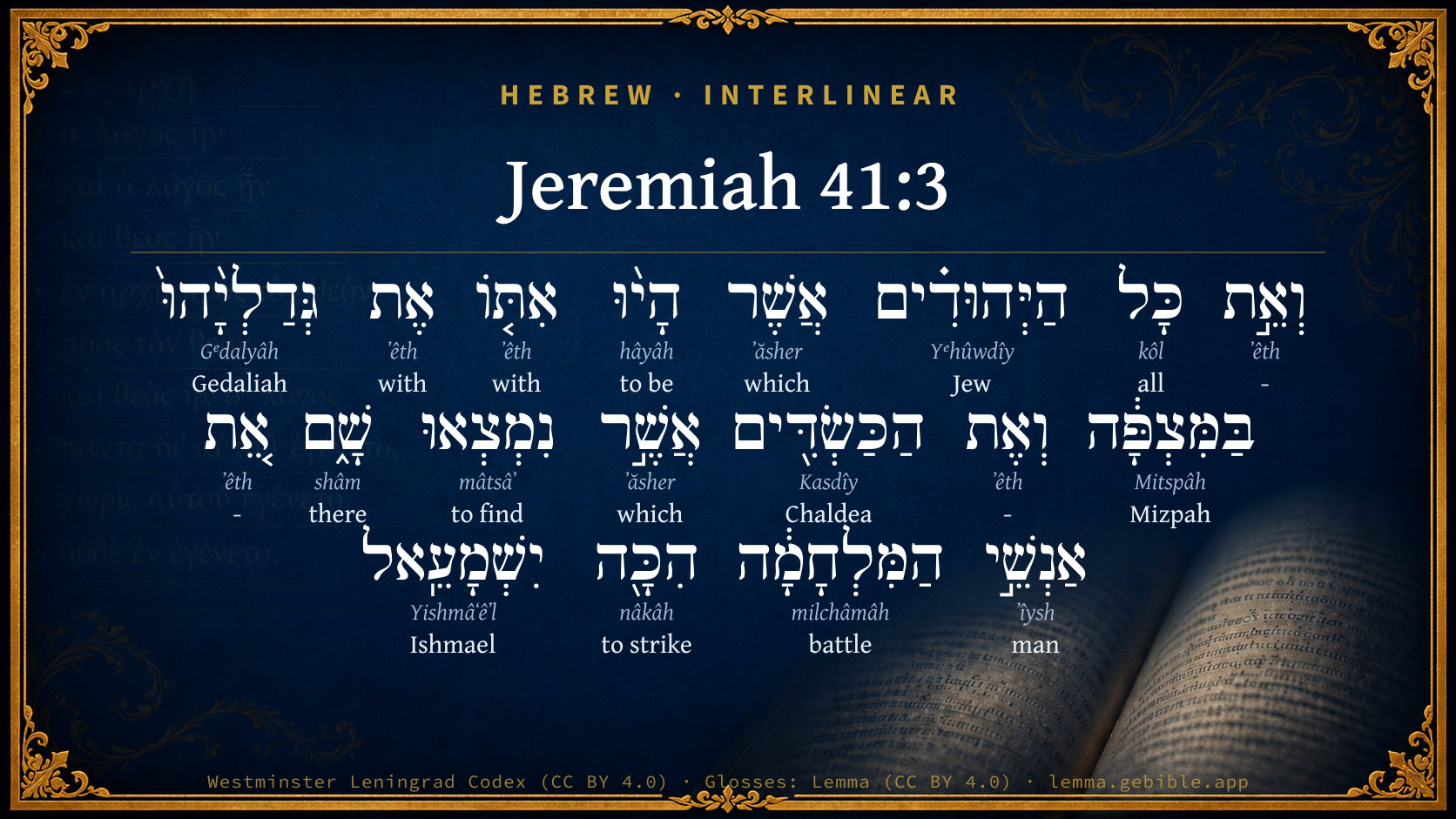
Jeremiah 41:3

Hebrew (Westminster Leningrad Codex) Jeremiah 41:3 appears in the Hebrew Old Testament. The text above is from the Westminster Leningrad Codex. Each word links to its Strong’s number, a concise gloss, and parsing drawn from the Open Scriptures Hebrew Bible morphology. Click any word for its full Brown-Driver-Briggs (BDB) entry.
Download image
Cite this verse

Jeremiah 41:3 (World English Bible). Public Domain. Lemma interlinear Bible study tool, https://lemma.gebible.app/v/jeremiah/41/3.

Show BibTeX & RIS
BibTeX
RIS
English Translation
Ishmael also killed all the Jews who were with him, [to wit], with Gedaliah, at Mizpah, and the Chaldeans who were found there, the men of war.
World English Bible · Public Domain
Download a study sheet

One document with this verse’s original text, its word-by-word gloss line, the meaning frame, cross-references with their text, attributed commentary, and full source and license credits — printable, and it pastes into notes with its structure intact.

This verse Autodidact and up

Study sheet (.html) Plain text (.txt)

A passage Seminary Student

Up to 50 verses in one chapter. A passage sheet keeps up to 6 commentary sources and 12 cross-references per verse, in the order this page ranks them, and says so on the sheet whenever that leaves anything out. Ask for a single verse and you get the Autodidact verse sheet above.

Everything on this page stays free to read, with no account — the sheet is a download of what is already on screen, not access to it.

Want to remove ads? Support Godless Engineer
Compare translations 3

The same verse in 3 English versions, stacked beneath the original-language interlinear above. Click any original word for its lexicon entry.

Each is an independent rendering of the whole verse — the interlinear is not word-aligned to these translations.

Highlighted words mark where these versions differ — a whole-verse word diff, not a word-by-word alignment.

  • World English Bible Public Domain
    Ishmael also killed all the Jews who were with him, [to wit], with Gedaliah, at Mizpah, and the Chaldeans who were found there, the men of war.
  • King James Version Public Domain
    Ishmael also slew all the Jews that were with him, even with Gedaliah, at Mizpah, and the Chaldeans that were found there, and the men of war.
  • unfoldingWord Literal Text CC BY-SA 4.0
    Then Ishmael killed all the Judeans who were with Gedaliah in Mizpah and the Chaldean fighting men found there.

unfoldingWord Literal Text — © unfoldingWord, licensed CC BY-SA 4.0. Word-aligned USFM3 via Door43 (git.door43.org/unfoldingWord/en_ult).

Versions to compare (up to 4)

3 of 4 selected

Show all 18 translations

Every available English version of this verse, each an independent rendering of the whole verse.

  • World English Bible Public Domain
    Ishmael also killed all the Jews who were with him, [to wit], with Gedaliah, at Mizpah, and the Chaldeans who were found there, the men of war.
  • Berean Standard Bible Public Domain
    Ishmael also killed all the Jews who were with Gedaliah at Mizpah, as well as the Chaldean soldiers who were there.
  • Majority Standard Bible Public Domain
    Ishmael also killed all the Jews who were with Gedaliah at Mizpah, as well as the Chaldean soldiers who were there.
  • King James Version Public Domain
    Ishmael also slew all the Jews that were with him, even with Gedaliah, at Mizpah, and the Chaldeans that were found there, and the men of war.
  • American Standard Version (1901) Public Domain
    Ishmael also slew all the Jews that were with him, `to wit', with Gedaliah, at Mizpah, and the Chaldeans that were found there, the men of war.
  • Revised Version (1885) Public Domain
    Ishmael also slew all the Jews that were with him, even with Gedaliah, at Mizpah, and the Chaldeans that were found there, even the men of war.
  • Geneva Bible (1599) Public Domain
    Ishmael also slewe all the Iewes that were with Gedaliah at Mizpah, and all the Caldeans that were found there, and the men of warre.
  • Douay-Rheims (1899) Public Domain
    Ismahel slew also all the Jews that were with Godolias in Masphath, and the Chaldeans that were found there, and the soldiers.
  • Young's Literal Translation Public Domain
    And all the Jews who have been with him, with Gedaliah, in Mizpah, and the Chaldeans who have been found there -- the men of war -- hath Ishmael smitten.
  • Literal Standard Version CC BY-SA 4.0
    And all the Jews who have been with him, with Gedaliah, in Mizpah, and the Chaldeans who have been found there—the men of war—Ishmael has struck.
  • Unlocked Literal Bible CC BY-SA 4.0
    Then Ishmael killed all the Judeans who were with Gedaliah in Mizpah and the Chaldean fighting men found there.
  • unfoldingWord Literal Text CC BY-SA 4.0
    Then Ishmael killed all the Judeans who were with Gedaliah in Mizpah and the Chaldean fighting men found there.
  • Darby Bible Public Domain
    And Ishmael smote all the Jews that were with him, with Gedaliah, at Mizpah, and the Chaldeans that were found there, the men of war.
  • World Messianic Bible Public Domain
    Ishmael also killed all the Jews who were with Gedaliah at Mizpah, and the Chaldean men of war who were found there.
  • Webster's Bible Public Domain
    Ishmael also slew all the Jews that were with him, even with Gedaliah, at Mizpah, and the Chaldeans that were found there, and the men of war.
  • Free Bible Version CC BY-SA 4.0
    Ishamel also killed all the other Judeans who were with Gedaliah at Mizpah, along with the Babylonian soldiers there.
  • Bible in Basic English Public Domain
    And Ishmael put to death all the Jews who were with him, even with Gedaliah, at Mizpah, and the Chaldaean men of war.
  • JPS Tanakh (1917) Public Domain
    Ishmael also slew all the Jews that were with him, even with Gedaliah, at Mizpah, and the Chaldeans that were found there, even the men of war.

Literal Standard Version (2020), Covenant Press — licensed CC BY-SA 4.0. Text via the HelloAO Bible API (eBible.org). Unlocked Literal Bible (unfoldingWord) — licensed CC BY-SA 4.0. Text via the HelloAO Bible API (eBible.org). unfoldingWord Literal Text — © unfoldingWord, licensed CC BY-SA 4.0. Word-aligned USFM3 via Door43 (git.door43.org/unfoldingWord/en_ult). Free Bible Version, Dr. Jonathan Gallagher — licensed CC BY-SA 4.0. Text via the HelloAO Bible API (eBible.org).

Word by word

More ways to search: Search by grammar → Find every occurrence → Compare this word →

Practice this passage: Drill this verse → Learn its vocabulary →

גְּדַלְיָ֨הוּ֙
Gᵉdalyâh
H1436
“Gedaliah”
Noun, Proper
Part of Speech
Noun
Type
Proper
Full BDB Definition

Origin: from H1431 and H3050

TWOT: None

Gedaliah = "Jehovah is great" - a son of Jeduthun in the time of David - son of Ahikam, the governor of Judea appointed by Nebuchadnezzar - son of Pashur, one of the chiefs of Jerusalem in the time of Jeremiah - son of Amariah and grandson of Hezekiah - a priest of the sons of Jeshua in the time of Ezra
  1. וְאֵ֣ת ʼêth H853 “and · -” Conjunction + Particle, Direct Object
  2. כָּל kôl H3605 “all of” Noun, Common, Masculine, Singular, Construct
  3. הַיְּהוּדִ֗ים Yᵉhûwdîy H3064 “the · Jews” Particle, Definite Article + Noun, Gentilic, Masculine, Plural, Absolute
  4. אֲשֶׁר ʼăsher H834 “which” Particle, Relative
  5. הָי֨וּ hâyâh H1961 “to be” Verb, Qal, Perfect, 3rd Person, Common, Plural
  6. אִתּ֤וֹ ʼêth H854 “with · him” Preposition + Suffix, Personal, 3rd Person, Masculine, Singular
  7. אֶת ʼêth H854 “with” Preposition
  8. בַּמִּצְפָּ֔ה Mitspâh H4709 “in/at the · Mizpah” Preposition, Determined + Noun, Proper
  9. וְאֶת ʼêth H853 “and · -” Conjunction + Particle, Direct Object
  10. הַכַּשְׂדִּ֖ים Kasdîy H3778 “the · Chaldea” Particle, Definite Article + Noun, Proper
  11. אֲשֶׁ֣ר ʼăsher H834 “which” Particle, Relative
  12. נִמְצְאוּ mâtsâʼ H4672 “to find” Verb, Niphal, Perfect, 3rd Person, Common, Plural
  13. שָׁ֑ם shâm H8033 “there” Adverb
  14. אֵ֚ת ʼêth H853 “-” Particle, Direct Object
  15. אַנְשֵׁ֣י ʼîysh H376 “men of” Noun, Common, Masculine, Plural, Construct
  16. הַמִּלְחָמָ֔ה milchâmâh H4421 “the · battle” Particle, Definite Article + Noun, Common, Feminine, Singular, Absolute
  17. הִכָּ֖ה nâkâh H5221 “to strike” Verb, Hiphil, Perfect, 3rd Person, Masculine, Singular
  18. יִשְׁמָעֵֽאל Yishmâʻêʼl H3458 “Ishmael” Noun, Proper

About this verse

These counts appear in no published source. They are computed here, from the morphology-tagged text and Lemma’s own curated glosses. What Lemma adds →

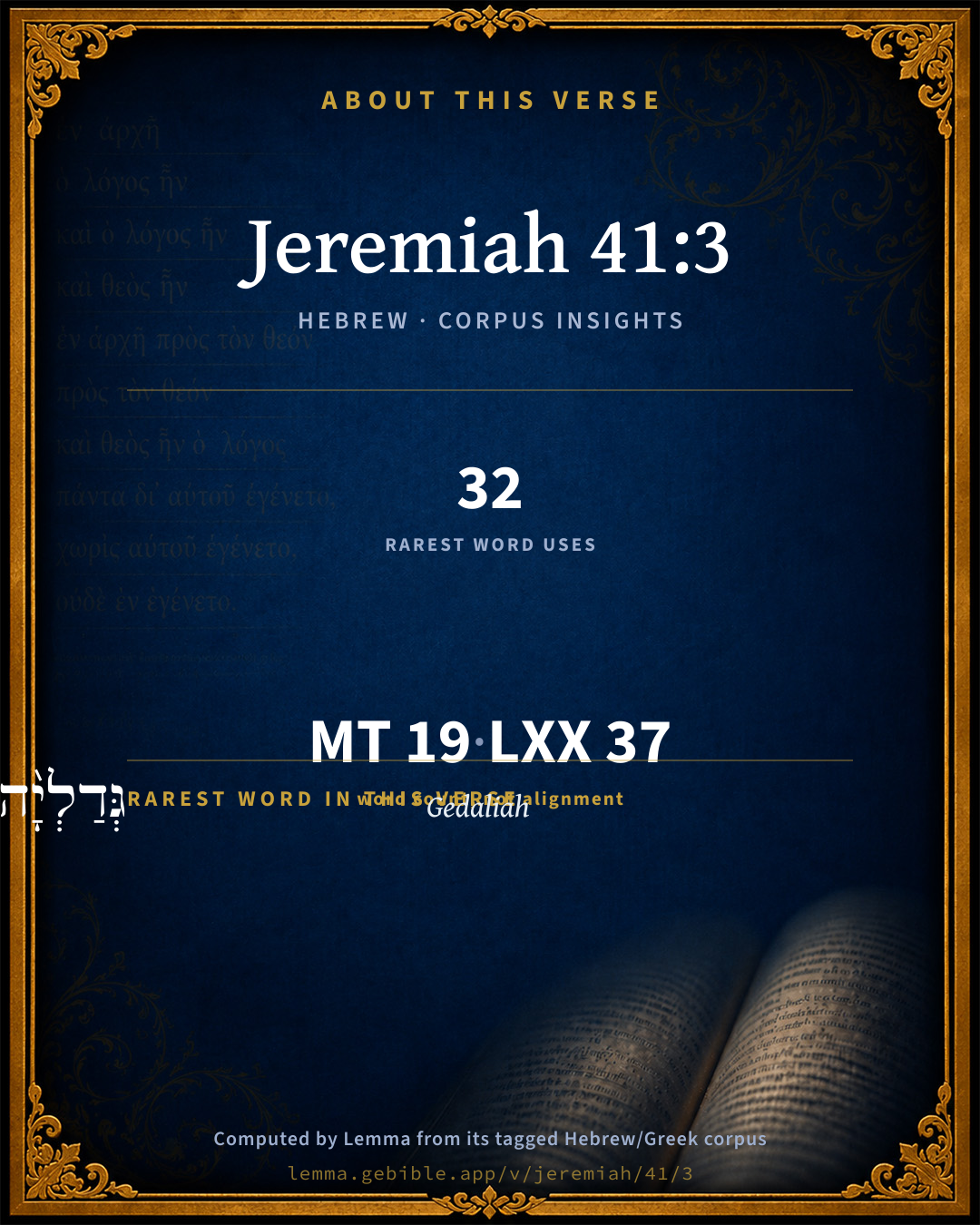
19
words
15
distinct lemmas
Prophets
section

Shared distinctive vocabulary

גְּדַלְיָ֨הוּ֙ Gedaliah H1436 occurs in 31 verses of the Hebrew Bible. Also found in:

Grammatical profile

  • 3 verbs
  • 8 nouns
  • 2 prepositions
  • 1 adverb
  • 5 particles

Verb forms

  • הָי֨וּ Qal · Perfect
  • נִמְצְאוּ Niphal · Perfect
  • הִכָּ֖ה Hiphil · Perfect

Repetition

Words recur within this verse — often emphatic in Hebrew:

  • אֲשֶׁר which H834 ×2
  • אִתּ֤וֹ with H854 ×2

Hebrew & Septuagint length

In the original languages it is 19 Hebrew tokens and 37 Greek tokens — but the two are counted differently (Hebrew bundles its prefixes and suffixes into one token; the Greek is in lemma form), so that isn’t a like-for-like length.

Cross-references

4

Topical passages linked to Jeremiah 41:3 in the Treasury of Scripture Knowledge — connected by theme and wording, ordered by reader-vote popularity; previews shown in the World English Bible.

  • 2 Kings 25:25 But it happened in the seventh month, that Ishmael the son of Nethaniah, the son of Elishama, of the royal seed came, and ten men with him, and struck Gedaliah, so that he died, and the Jews and the Chaldeans that were with him at Mizpah.
  • Ecclesiastes 9:18 Wisdom is better than weapons of war; but one sinner destroys much good.
  • Jeremiah 41:11–12 But when Johanan the son of Kareah, and all the captains of the forces who were with him, heard of all the evil that Ishmael the son of Nethaniah had done,
  • Lamentations 1:2 She weeps sore in the night, and her tears are on her cheeks; Among all her lovers she has none to comfort her: All her friends have dealt treacherously with her; they are become her enemies.

Cross-references courtesy of OpenBible.info (CC BY 4.0).

Hebrew and Greek witnesses Masoretic Hebrew ↔ Greek Septuagint

The same verse in the two great witnesses to the Old Testament, shown verse-for-verse.

These are two independent witnesses, not word-aligned to each other, and the Septuagint is shown in lemma (dictionary) form.

Hebrew Jeremiah 41:3 Masoretic · Westminster Leningrad Codex

וְאֵ֣ת כָּל הַיְּהוּדִ֗ים אֲשֶׁר הָי֨וּ אִתּ֤וֹ אֶת גְּדַלְיָ֨הוּ֙ בַּמִּצְפָּ֔ה וְאֶת הַכַּשְׂדִּ֖ים אֲשֶׁ֣ר נִמְצְאוּ שָׁ֑ם אֵ֚ת אַנְשֵׁ֣י הַמִּלְחָמָ֔ה הִכָּ֖ה יִשְׁמָעֵֽאל

Ishmael also killed all the Jews who were with him, [to wit], with Gedaliah, at Mizpah, and the Chaldeans who were found there, the men of war.

World English Bible · Public Domain

Greek LXX Structure differs

In the Septuagint, Jeremiah is about an eighth shorter than the Hebrew and arranges its material differently — the Oracles Against the Nations (Hebrew chapters 46–51) appear in the middle of the Greek book, after 25:13. Because the chapter and verse boundaries do not line up, a verse-for-verse comparison with the Hebrew is not shown.

A verse-for-verse comparison isn’t shown here because the chapters and verses don’t line up. Switch to the LXX edition with the MT / LXX toggle above to read the Greek directly.

On this verse, The Cambridge Bible for Schools and Colleges discusses the Septuagint’s reading. Read the note in Commentary ↓

Hebrew: Westminster Leningrad Codex (CC BY 4.0). Greek: Septuagint (public domain); English from a public-domain English Septuagint. How the Septuagint differs from the Hebrew →

Targum (Aramaic paraphrase)

1

The Targum is the ancient Jewish Aramaic paraphrase of the Hebrew Scriptures — an interpretive translation, not the Hebrew text itself. Onkelos (literal) and Pseudo-Jonathan (expansive) render the Torah, and Jonathan the Prophets. Coverage is partial: where no permissively-licensed English translation exists for a verse, only the Aramaic is shown. This is verse-level text, not a word-by-word alignment to the Hebrew.

  1. Targum Jonathan Prophets (Joshua–Malachi)
    וְיַת כָּל יְהוּדָאֵי דַהֲווֹ עִמֵיהּ עִם גְדַלְיָה בְּמִצְפְּיָא וְיַת כַּסְדָאֵי דְאִשְׁתְּכָחוּ תַמָן יַת גַבְרֵי עָבְדִי קְרָבָא קְטַל יִשְׁמָעֵאל:

    (no public-domain English translation for this verse)

    Targum Jonathan — Aramaic: “Mikraot Gedolot” (public domain). English: “Sefaria Community Translation” (CC0 1.0 (public-domain dedication)); “London "Chaldee Paraphrase," 1871” (public domain). Text via Sefaria.

Commentary

Notes on Jeremiah 41:3 from classic Christian and Jewish commentators (each source and its license shown beneath its notes). The classic Christian expositions comment on the surrounding passage and are grouped to its opening verse, so a note may address several verses; the Jewish commentaries on the Tanakh (Rashi and others) are per-verse, so they appear only where the commentator wrote on this verse.

Lemma curates 59 commentaries, every one of them public domain or Creative Commons licensed, each selected and text-cleaned for this edition rather than reprinted as found. About our sources →

Trapp's Complete Commentary

John Trapp

Jer 41:3 Ishmael also slew all the Jews that were with him, [even] with Gedaliah, at Mizpah, and the Chaldeans that were found there, [and] the men of war.

Ver. 3. Ishmael also slew all the Jews that were with him.] Not the Chaideans only. His sword knew no difference; but, being fleshed in blood, he killed all that came in his way. And the rather that his wickedness might not be noticed - mortui non mordent - but that he might carry on his bloody design the better.

John Trapp, A Commentary or Exposition upon All the Books of the Old and New Testament (1647–1656) — public domain. Text from a community e-Sword module.

Joseph Benson's Commentary

Jer 41:3-4. Ishmael also slew all the Jews and the men of war — That is, all that joined in opposing him, and in assisting Gedaliah: for several of the commanders, as well as the greater part of the people, were still left alive, as appears by the sequel of the story. And on the second day after, &c., no man knew it — That is, no man who lived at any considerable distance from Mizpah, for Ishmael undoubtedly used every means in his power to keep this slaughter secret, lest the news of it should reach the ears of some of the Chaldean commanders, and so he should be prevented from making his escape.

Joseph Benson's Commentary on the Old and New Testaments (1811–1818) — public domain. Text from a community e-Sword module.

Jamieson, Fausset & Brown

Robert Jamieson, A. R. Fausset & David Brown

slew all the Jews--namely, the attendants and ministers of Gedaliah; or, the military alone, about his person; translate, "even (not 'and,' as English Version) the men of war." The main portion of the people with Gedaliah, including Jeremiah, Ishmael carried away captive (Jer 41:10, Jer 41:16).

Jamieson, Fausset & Brown — Commentary Critical and Explanatory on the Whole Bible (1871) — public domain (CC PDM 1.0). Text via the HelloAO Bible API.

Ellicott's Commentary for English Readers

(3) Ishmael also slew all the Jews. . . .—We wonder at first that ten men were able to effect so much. It does not follow, however, that the massacre went beyond the Jews and Chaldæan officers who were sharing Gedaliah’s hospitality, and they may easily have been surprised, like Gedaliah, unarmed, and in the act of feasting. Possibly, too, the ten princes may each have brought their retinue of attendants. Greek history presents two analogous massacres—that of the Persian generals by Alexander, the son of Amyntas (Herod, v. 19, 20); and that of Archias and Leontiades, the tyrants of Thebes, by Pelopidas and his associates. The massacre in this case was so complete that none escaped to tell the tale (Jer_41:4). The italics in the last clause of the verse indicate that the conjunction “and” is not in the Hebrew, and that the words, “the men of war,” are in apposition with the previous clause, and limit their extent.

A Bible Commentary for English Readers, edited by Charles John Ellicott (1878–1897) — public domain. Text from a community e-Sword module.

The Cambridge Bible for Schools and Colleges

gen. ed. J. J. S. Perowne

3. The Jews on their return from the exile used to keep the third day of the seventh month (Tisri) as a fast in memory of Ishmael’s deed (Zec_7:5; Zec_8:19).

even the men of war] Gedaliah’s body-guard. But the words are absent, probably rightly, from LXX.

The Cambridge Bible for Schools and Colleges (gen. ed. J. J. S. Perowne; Cambridge University Press, 1878–1918) — public domain. Text from a community e-Sword module.

John Gill's Exposition

Ishmael also slew all the Jews that were with him, even with Gedaliah, at Mizpah,.... Not only those that were at table, but that were in the city also. Josephus (f) says, that having slain those that were at the feast with him, he went out in the night, and slew all the Jews in the city, and the soldiers that were left by the Babylonians in it; but this cannot be understood of all the individuals there, or of the main body of the people, for they were carried captive by him, Jer 41:9; but of those that opposed him, or were able to avenge the death of their governor, and he might suspect would do it:

and the Chaldeans that were found there, and the men of war; or, "even the men of war" (g); this describes more particularly who they were that were slain, those of the Jews, and especially the Chaldeans, who were in military service; either the bodyguards of the governor, or the city guards, or both, whom Ishmael thought it advisable to cut off, lest they should fall upon him, and revenge the death of Gedaliah, and prevent his further designs.

(f) Antiqu. l. 10. c. 9. sect. 4. (g) "inquam viros belli", Schmidt; "bellatores scilicet", Piscator.

John Gill's Exposition of the Whole Bible (1746–1763) — public domain (CC PDM 1.0). Text via the HelloAO Bible API.

Matthew Poole's English Annotations

It appeareth from Jer 41:10, that by all the Jews here must be understood only all those who were about the court of Gedaliah, for it is there said that he carried away many that were with him.

Matthew Poole's English Annotations on the Holy Bible (1683–1685) — public domain. Text from a community e-Sword/MySword module.

Whedon's Commentary on the Bible

Daniel D. Whedon

3. Slew all the Jews — Namely, those in the governor’s palace.

Daniel D. Whedon (gen. ed.), Commentary on the Old and New Testaments (1874–1909) — public domain. Text from a community e-Sword module.

The Pulpit Commentary

The Chaldeans. Gedaliah"s Chaldean bodyguard. And the men of war; rather, even the men of war. Jewish as well as Chaldean warriors are meant; the non-military Jews, including the prophet, were carried away captive (see vers. 10, 16).

The Pulpit Commentary (1880–1919), ed. H.D.M. Spence-Jones & Joseph S. Exell — public domain. Text from a community e-Sword module.

John Wesley's Explanatory Notes

Slew - All those who were about the court of Gedaliah.

John Wesley, Explanatory Notes Upon the Whole Bible (1754–1765) — public domain. Text via the GEBible commentary corpus.

Lesson kit

Teaching starters — assembled from the data on this page, not authored interpretation. Every prompt links to the verse data it draws on. Edit before teaching.

Jeremiah, in the Prophets, opens this verse with 19 words (15 distinct Hebrew lemmas). Its most distinctive word is Gᵉdalyâh (“Gedaliah”). A historical commentator’s framing appears above. Read the whole chapter for the surrounding context.

Discussion questions

  1. The word Gᵉdalyâh carries the sense “Gedaliah.” How does it shape the verse?
  2. How does 2 Kings 25:22, which shares the word «Gedaliah», read alongside this verse?
  3. What does the repetition of “which” (2× in this one verse) do in this verse?
  4. These translations render this verse differently. What is at stake in choosing one wording over another?
  5. «הָי֨וּ» is a Qal Perfect verb. How does that grammatical form shape the action described?
  6. Compare how Trapp's Complete Commentary and Joseph Benson's Commentary read this verse. Where do they agree or differ?

Things to notice

Reading settings

Reading text

Shown beneath each verse's original-language words.

Old Testament
Old Testament edition

Read the OT as the Masoretic Hebrew (MT) or the Greek Septuagint (LXX).

English shown for the Greek Septuagint (in the Hebrew ↔ Greek comparison).

Comparing translations? Open the Compare panel on any verse page to stack up to four side by side.