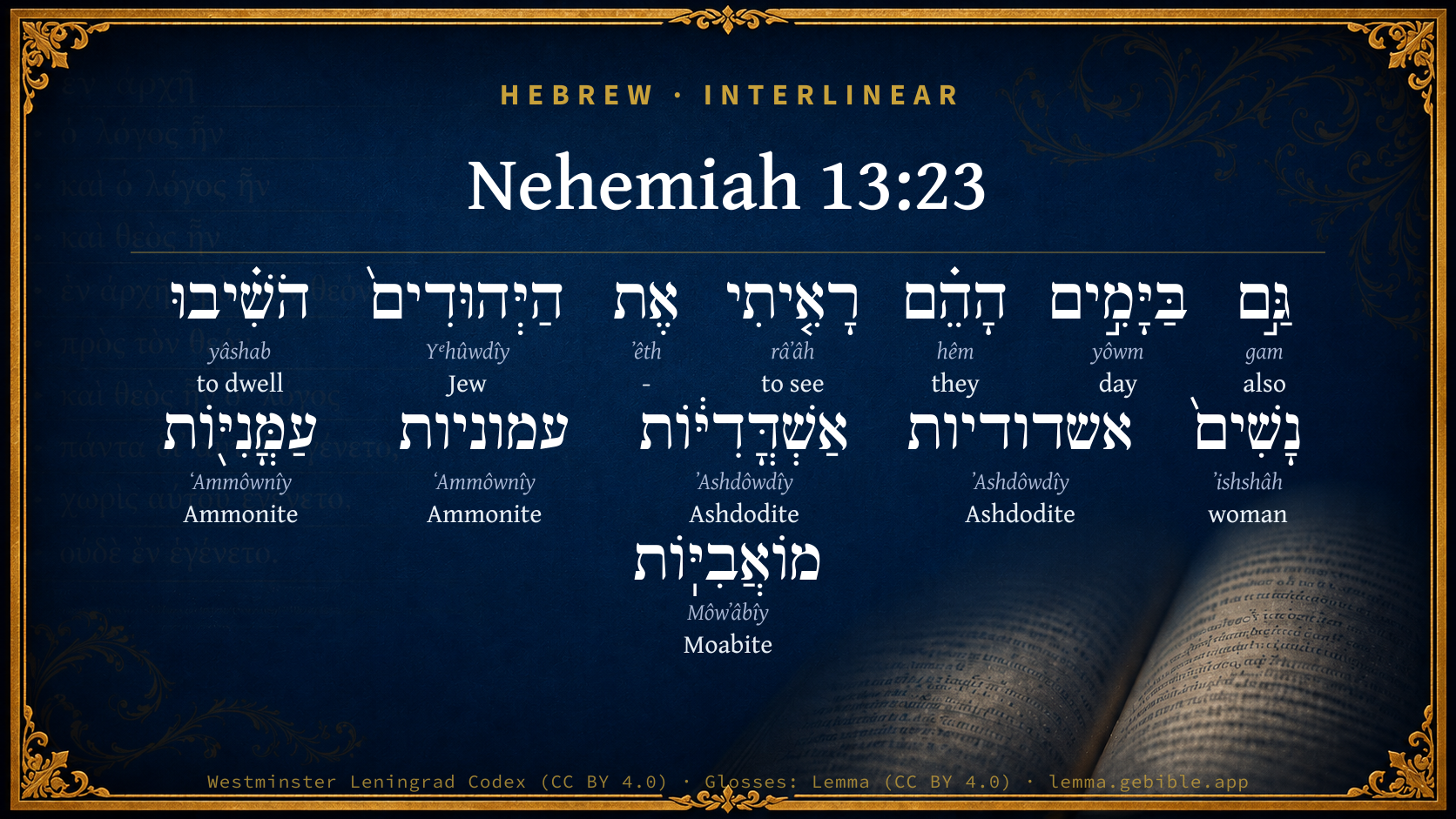
Nehemiah 13:23

Hebrew (Westminster Leningrad Codex) Nehemiah 13:23 appears in the Hebrew Old Testament. The text above is from the Westminster Leningrad Codex. Each word links to its Strong’s number, a concise gloss, and parsing drawn from the Open Scriptures Hebrew Bible morphology. Click any word for its full Brown-Driver-Briggs (BDB) entry.
Download image
Cite this verse

Nehemiah 13:23 (World English Bible). Public Domain. Lemma interlinear Bible study tool, https://lemma.gebible.app/v/nehemiah/13/23.

Show BibTeX & RIS
BibTeX
RIS
English Translation
In those days also saw I the Jews who had married women of Ashdod, of Ammon, [and] of Moab:
World English Bible · Public Domain
Download a study sheet

One document with this verse’s original text, its word-by-word gloss line, the meaning frame, cross-references with their text, attributed commentary, and full source and license credits — printable, and it pastes into notes with its structure intact.

This verse Autodidact and up

Study sheet (.html) Plain text (.txt)

A passage Seminary Student

Up to 50 verses in one chapter. A passage sheet keeps up to 6 commentary sources and 12 cross-references per verse, in the order this page ranks them, and says so on the sheet whenever that leaves anything out. Ask for a single verse and you get the Autodidact verse sheet above.

Everything on this page stays free to read, with no account — the sheet is a download of what is already on screen, not access to it.

Want to remove ads? Support Godless Engineer
Compare translations 3

The same verse in 3 English versions, stacked beneath the original-language interlinear above. Click any original word for its lexicon entry.

Each is an independent rendering of the whole verse — the interlinear is not word-aligned to these translations.

Highlighted words mark where these versions differ — a whole-verse word diff, not a word-by-word alignment.

  • World English Bible Public Domain
    In those days also saw I the Jews who had married women of Ashdod, of Ammon, [and] of Moab:
  • King James Version Public Domain
    In those days also saw I Jews that had married wives of Ashdod, of Ammon, and of Moab:
  • unfoldingWord Literal Text CC BY-SA 4.0
    In those days I also saw Jews who had given a dwelling to Ashdodite, Ammonite, and Moabite women.

unfoldingWord Literal Text — © unfoldingWord, licensed CC BY-SA 4.0. Word-aligned USFM3 via Door43 (git.door43.org/unfoldingWord/en_ult).

Versions to compare (up to 4)

3 of 4 selected

Show all 18 translations

Every available English version of this verse, each an independent rendering of the whole verse.

  • World English Bible Public Domain
    In those days also saw I the Jews who had married women of Ashdod, of Ammon, [and] of Moab:
  • Berean Standard Bible Public Domain
    In those days I also saw Jews who had married women from Ashdod, Ammon, and Moab.
  • Majority Standard Bible Public Domain
    In those days I also saw Jews who had married women from Ashdod, Ammon, and Moab.
  • King James Version Public Domain
    In those days also saw I Jews that had married wives of Ashdod, of Ammon, and of Moab:
  • American Standard Version (1901) Public Domain
    In those days also saw I the Jews that had married women of Ashdod, of Ammon, `and' of Moab:
  • Revised Version (1885) Public Domain
    In those days also saw I the Jews that had married women of Ashdod, of Ammon, and of Moab:
  • Geneva Bible (1599) Public Domain
    In those dayes also I saw Iewes that married wiues of Ashdod, of Ammon, and of Moab.
  • Douay-Rheims (1899) Public Domain
    In those days also I saw Jews that married wives, women of Azotus, and of Ammon, and of Moab.
  • Young's Literal Translation Public Domain
    Also, in those days, I have seen the Jews `who' have settled women of Ashdod, of Ammon, of Moab.
  • Literal Standard Version CC BY-SA 4.0
    Also, in those days, I have seen the Jews [who] have settled women of Ashdod, of Ammon, of Moab.
  • Unlocked Literal Bible CC BY-SA 4.0
    In those days I also saw Jews that had married women of Ashdod, Ammon, and Moab.
  • unfoldingWord Literal Text CC BY-SA 4.0
    In those days I also saw Jews who had given a dwelling to Ashdodite, Ammonite, and Moabite women.
  • Darby Bible Public Domain
    In those days also I saw Jews that had married wives of Ashdod, of Ammon, [and] of Moab.
  • World Messianic Bible Public Domain
    In those days I also saw the Jews who had married women of Ashdod, of Ammon, and of Moab;
  • Webster's Bible Public Domain
    In those days also I saw Jews that had married wives of Ashdod, of Ammon, and of Moab:
  • Free Bible Version CC BY-SA 4.0
    Around the same time I realized some Jews had married women from Ashdod, Moab, and Ammon.
  • Bible in Basic English Public Domain
    And in those days I saw the Jews who were married to women of Ashdod and Ammon and Moab:
  • JPS Tanakh (1917) Public Domain
    In those days also saw I the Jews that had married women of Ashdod, of Ammon, and of Moab;

Literal Standard Version (2020), Covenant Press — licensed CC BY-SA 4.0. Text via the HelloAO Bible API (eBible.org). Unlocked Literal Bible (unfoldingWord) — licensed CC BY-SA 4.0. Text via the HelloAO Bible API (eBible.org). unfoldingWord Literal Text — © unfoldingWord, licensed CC BY-SA 4.0. Word-aligned USFM3 via Door43 (git.door43.org/unfoldingWord/en_ult). Free Bible Version, Dr. Jonathan Gallagher — licensed CC BY-SA 4.0. Text via the HelloAO Bible API (eBible.org).

Word by word

More ways to search: Search by grammar → Find every occurrence → Compare this word →

Practice this passage: Drill this verse → Learn its vocabulary →

אשדודיות
ʼAshdôwdîy
H796
“Ashdodites”
Noun, Gentilic, Feminine, Plural, Absolute
Part of Speech
Noun
Type
Gentilic
Gender
Feminine
Number
Plural
State
Absolute
Full BDB Definition

Origin: patrial from H795

TWOT: None

Ashdodites = "I will spoil" - an inhabitant of Ashdod
  1. גַּ֣ם gam H1571 “also” Particle, Accusative
  2. בַּיָּמִ֣ים yôwm H3117 “in/at the · days” Preposition, Determined + Noun, Common, Masculine, Plural, Absolute
  3. הָהֵ֗ם hêm H1992 “the · they” Particle, Definite Article + Pronoun, Personal, 3rd Person, Masculine, Plural
  4. רָאִ֤יתִי râʼâh H7200 “to see” Verb, Qal, Perfect, 1st Person, Common, Singular
  5. אֶת ʼêth H853 “-” Particle, Direct Object
  6. הַיְּהוּדִים֙ Yᵉhûwdîy H3064 “the · Jews” Particle, Definite Article + Noun, Gentilic, Masculine, Plural, Absolute
  7. הֹשִׁ֗יבוּ yâshab H3427 “to dwell” Verb, Hiphil, Perfect, 3rd Person, Common, Plural
  8. נָשִׁים֙ ʼishshâh H802 “women” Noun, Common, Feminine, Plural, Absolute
  9. אַשְׁדֳּדִיּ֔וֹת ʼAshdôwdîy H796 “Ashdodites” Noun, Gentilic, Feminine, Plural, Absolute
  10. עמוניות ʻAmmôwnîy H5984 “Ammonites” Noun, Gentilic, Feminine, Plural, Absolute
  11. עַמֳּנִיּ֖וֹת ʻAmmôwnîy H5984 “Ammonites” Noun, Gentilic, Feminine, Plural, Absolute
  12. מוֹאֲבִיּֽוֹת Môwʼâbîy H4125 “Moabites” Noun, Gentilic, Feminine, Plural, Absolute

About this verse

These counts appear in no published source. They are computed here, from the morphology-tagged text and Lemma’s own curated glosses. What Lemma adds →

13
words
11
distinct lemmas
Historical
section

Notable vocabulary

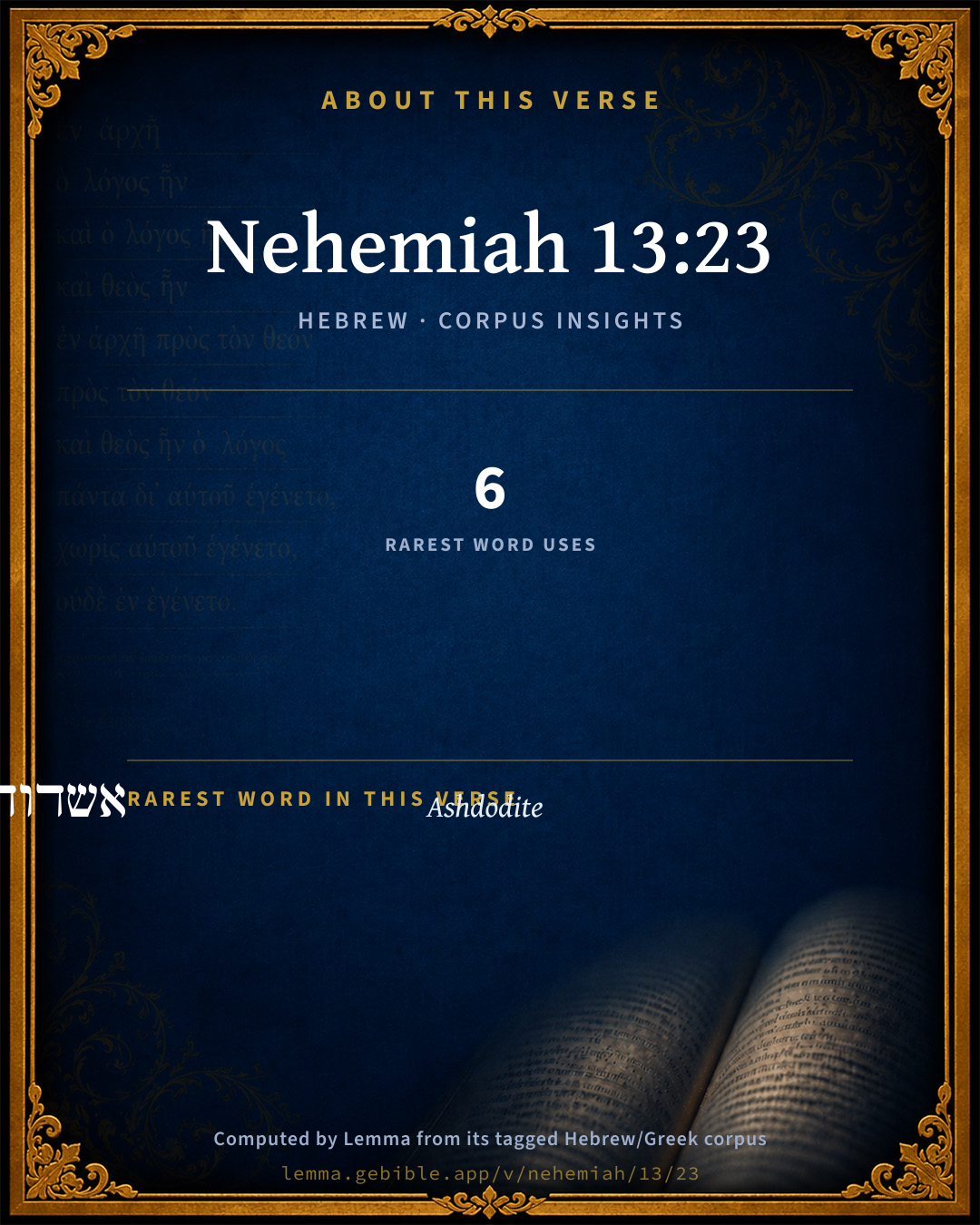
The rarest word here is אשדודיות Ashdodite H796 — appearing just 6 times in the whole Hebrew Bible.

Shared distinctive vocabulary

אשדודיות Ashdodite H796 occurs in 5 verses of the Hebrew Bible. Also found in:

Grammatical profile

  • 2 verbs
  • 8 nouns
  • 1 pronoun
  • 2 particles

Verb forms

  • רָאִ֤יתִי Qal · Perfect
  • הֹשִׁ֗יבוּ Hiphil · Perfect

Repetition

Words recur within this verse — often emphatic in Hebrew:

  • אשדודיות Ashdodite H796 ×2
  • עמוניות Ammonite H5984 ×2

Cross-references

9

Topical passages linked to Nehemiah 13:23 in the Treasury of Scripture Knowledge — connected by theme and wording, ordered by reader-vote popularity; previews shown in the World English Bible.

  • Ezra 9:1–2 Now when these things were done, the princes drew near to me, saying, The people of Israel, and the priests and the Levites, have not separated themselves from the peoples of the lands, [doing] according to their abominations, even of the Canaanites, the Hittites, the Perizzites, the Jebusites, the Ammonites, the Moabites, the Egyptians, and the Amorites.
  • Ezra 10:10 Ezra the priest stood up, and said to them, You have trespassed, and have married foreign women, to increase the guilt of Israel.
  • Nehemiah 10:30 and that we would not give our daughters to the peoples of the land, nor take their daughters for our sons;
  • Nehemiah 13:1 On that day they read in the book of Moses in the audience of the people; and therein was found written, that an Ammonite and a Moabite should not enter into the assembly of God forever,
  • 2 Corinthians 6:14 Don't be unequally yoked with unbelievers, for what fellowship have righteousness and iniquity? Or what communion has light with darkness?
  • Ezra 10:44 All these had taken foreign wives; and some of them had wives by whom they had children.
  • 1 Samuel 5:1 Now the Philistines had taken the ark of God, and they brought it from Ebenezer to Ashdod.
  • Ezra 9:11–12 which you have commanded by your servants the prophets, saying, The land, to which you go to possess it, is an unclean land through the uncleanness of the peoples of the lands, through their abominations, which have filled it from one end to another with their filthiness:
  • Nehemiah 4:7 But it happened that when Sanballat, Tobiah, the Arabians, the Ammonites, and the Ashdodites heard that the repairing of the walls of Jerusalem went forward, [and] that the breaches began to be stopped, then they were very angry;

Cross-references courtesy of OpenBible.info (CC BY 4.0).

Hebrew and Greek witnesses Masoretic Hebrew ↔ Greek Septuagint

The same verse in the two great witnesses to the Old Testament, shown verse-for-verse.

These are two independent witnesses, not word-aligned to each other, and the Septuagint is shown in lemma (dictionary) form.

Hebrew Nehemiah 13:23 Masoretic · Westminster Leningrad Codex

גַּ֣ם בַּיָּמִ֣ים הָהֵ֗ם רָאִ֤יתִי אֶת הַיְּהוּדִים֙ הֹשִׁ֗יבוּ נָשִׁים֙ אשדודיות אַשְׁדֳּדִיּ֔וֹת עמוניות עַמֳּנִיּ֖וֹת מוֹאֲבִיּֽוֹת

In those days also saw I the Jews who had married women of Ashdod, of Ammon, [and] of Moab:

World English Bible · Public Domain

Greek LXX Structure differs

The Septuagint has no separate book of Nehemiah. Its Greek text is the second half of Esdras B (2 Esdras), chapters 11–23; Ezra is the first half (1–10).

A verse-for-verse comparison isn’t shown here because the chapters and verses don’t line up. Switch to the LXX edition with the MT / LXX toggle above to read the Greek directly.

On this verse, The Cambridge Bible for Schools and Colleges discusses the Septuagint’s reading. Read the note in Commentary ↓

Hebrew: Westminster Leningrad Codex (CC BY 4.0). Greek: Septuagint (public domain); English from a public-domain English Septuagint. How the Septuagint differs from the Hebrew →

Commentary

Notes on Nehemiah 13:23 from classic Christian and Jewish commentators (each source and its license shown beneath its notes). The classic Christian expositions comment on the surrounding passage and are grouped to its opening verse, so a note may address several verses; the Jewish commentaries on the Tanakh (Rashi and others) are per-verse, so they appear only where the commentator wrote on this verse.

Lemma curates 59 commentaries, every one of them public domain or Creative Commons licensed, each selected and text-cleaned for this edition rather than reprinted as found. About our sources →

Matthew Henry's Commentary

We have here one instance more of Nehemiah's pious zeal for the purifying of his countrymen as a peculiar people to God; that was the thing he aimed at in the use of his power, not the enriching of himself. See here,

I. How they had corrupted themselves by marrying strange wives. This was complained of in Ezra's time, and much done towards a reformation, Ezr 9:1-15 and 10. But, when the unclean spirit is cast out, if a watchful eye be not kept upon him, he will re-enter; so he did here. Though in Ezra's time those that had married strange wives were forced to put them away, which could not but occasion trouble and confusion in families, yet others would not take warning. Nitimur in vetitum - we still lean towards what is forbidden. Nehemiah, like a good governor, enquired into the state of the families of those that were under his charge, that he might reform what was amiss in them, and so heal the streams by healing the springs. 1. He enquired whence they had their wives, and found that many of the Jews had married wives of Ashdod, of Ammon, and of Moab (Neh 13:23), either because they were fond of what was far-fetched or because they hoped by these alliances to strengthen and enrich themselves. See how God by the prophet reproves this, Mal 2:11. Judah has dealt treacherously, and broken covenant with God, the covenant made in Ezra's time with reference to this very thing; he has profaned the holiness of the Lord by marrying the daughter (that is, the worshipper) of a strange god. 2. He talked with the children, and found they were children of strangers, for their speech betrayed them. The children were bred up with their mothers, and learned of them and their nurses and servants to speak, so that they could not speak the Jews' language, could not speak it at all, or not readily, or not purely, but half in the speech of Ashdod, or Ammon, or Moab, according as the country was which the mother was a native of. Observe, (1.) Children, in their childhood, learn much of their mothers. Partus sequitur ventrem - they are prone to imitate their mothers. (2.) If either side be bad, the corrupt nature will incline the children to take after that, which is a good reason why Christians should not be unequally yoked. (3.) In the education of children great care should be taken about the government of their tongues, that they learn not the language of Ashdod, any impious or impure talk, any corrupt communication.

II. What course Nehemiah took to purge out this corruption, when he discovered how much it had prevailed.

1. He showed them the evil of it, and the obligation he lay under to witness against it. He did not seek an occasion against them, but this was an iniquity to be punished by the judge, and which he must by no means connive at (Neh 13:27): "Shall we hearken to you, who endeavour to palliate and excuse it? No, it is an evil, a great evil, it is a transgression against our God, to marry strange wives, and we must do our utmost to put a stop to it. You beg that they may not be divorced from you, but we cannot hearken to you, for there is no other remedy to clear us from the guilt and prevent infection." (1.) He quotes a precept, to prove that it was in itself a great sin; and makes them swear to that precept: You shall not give your daughters unto their sons, etc., which is taken from Deu 7:3. When we would reclaim people from sin we must show them the sinfulness of it in the glass of the commandment. (2.) He quotes a precedent, to show the pernicious consequences of it, which made it necessary to be animadverted upon by the government (Neh 13:26): Did not Solomon king of Israel sin by these things? The falls of great and good men are recorded in order that we may take warning by them to shun the temptations which they were overcome by. Solomon was famous for wisdom; there was no king like him for it; yet, when he married strange wives, his wisdom could not secure him from their snares, nay, it departed from him, and he did very foolishly. He was beloved of God, but his marrying strange wives threw him out of God's favour, and went near to extinguish the holy fire of grace in his soul: he was king over all Israel; but his doing this occasioned the loss of ten of his twelve tribes. You plead that you can marry strange wives and yet retain the purity of Israelites; but Solomon himself could not; even him did outlandish women cause to sin. Therefore let him that thinks he stands take heed lest he fall when he runs upon such a precipice.

2. He showed himself highly displeased at it, that he might awaken them to a due sense of the evil of it: He contended with them, Neh 13:25. They offered to justify themselves in what they did, but he showed them how frivolous their excuses were, and argued it warmly with them. When he had silenced them he cursed them, that is, he denounced the judgments of God against them, and showed them what their sin deserved. He then picked out some of them that were more obstinate than the rest, and fit to be made examples, and smote them (that is, ordered them to be beaten by the proper officers according to the law, Deu 25:2, Deu 25:3), to which he added this further mark of infamy that he plucked off their hair, or cut or shaved it off; for it may so be understood. Perhaps they had prided themselves in their hair, and therefore he took it off to deform and humble them, and put them to shame; it was, in effect, to stigmatize them, at least for a time. Ezra, in this case, had plucked off his own hair, in holy sorrow for the sin; Nehemiah plucked off their hair, in a holy indignation at the sinners. See the different tempers of wise, and good, and useful men, and the divers graces, as well as divers gifts, of the same Spirit.

3. He obliged them not to take any more such wives, and separated those whom they had taken: He cleansed them from all strangers, both men and women (Neh 13:30), and made them promise with an oath that they would never do so again, Neh 13:25. Thus did he try all ways and means to put a stop to this mischief and to prevent another relapse into this disease.

4. He took particular care of the priests' families, that they might not lie under this stain, this guilt. He found, upon enquiry, that a branch of the high priest's own family, one of his grandsons, had married a daughter of Sanballat, that notorious enemy of the Jews (Neh 2:10; Neh 4:1), and so had, in effect, twisted interests with the Samaritans, Neh 13:28. How little love had that man either to God or his country who could make himself in duty and interest a friend to him that was a sworn enemy to both. It seems this young priest would not put away his wife, and therefore Nehemiah chased him from him, deprived him, degraded him, and made him for ever incapable of the priesthood. Josephus says that this expelled priest was Manasseh, and that when Nehemiah drove him away he went to his father-in-law Sanballat, who built him a temple upon Mount Gerazim, like that at Jerusalem, and promised him he should be high priest in it, and that then was laid the foundation of the Samaritans' pretensions, which continued warm to our Saviour's time. Joh 4:20, Our fathers worshipped in this mountain. When Nehemiah had thus expelled one that had forfeited the honour of the priesthood he again posted the priests and Levites every one in his business, Neh 13:30. It was no loss to them to part with one that was the scandal of their cloth; the work would be done better without him. When Judas had gone out Christ said, Now is the Son of Man glorified, Joh 13:30, Joh 13:31. Here are Nehemiah's prayers on this occasion. (1.) He prays, Remember them, O my God! Neh 13:29. "Lord, convince and convert them; put them in mind of what they should be and do, that they may come to themselves." Or, "Remember them to reckon with them for their sin; remember it against them." If we take it so, this prayer is a prophecy that God would remember it against them. Those that defile the priesthood despise God, and shall be lightly esteemed. Perhaps they were too many and too great for him to deal with. "Lord" (says he), "deal thou with them; take the work into thy own hands." (2.) He prays, Remember me, O my God! Neh 13:31. The best services done to the public have sometimes been forgotten by those for whom they were done (Ecc 9:15); therefore Nehemiah refers it to God to recompense him, takes him for his paymaster, and then doubts not but he shall be well paid. This may well be the summary of our petitions; we need no more to make us happy than this: Remember me, O my God! for good.

Matthew Henry's Commentary on the Whole Bible (1708–1710) — public domain (CC PDM 1.0). Text via the HelloAO Bible API.

Trapp's Complete Commentary

John Trapp

Neh 13:23 In those days also saw I Jews [that] had married wives of Ashdod, of Ammon, [and] of Moab:

Ver. 23. In those days saw I Jews] Outwardly, at least (as the apostle distinguishes, Rom 2:28), and that also was then a prerogative, Rom 3:1, and shall appear to be so again, when their long looked for conversion day is come, Rom 11:26.

That had married wives of Ashdod] Outlandish wives, and of another religion; and with these they cohabited, as the Hebrew word here importeth.

John Trapp, A Commentary or Exposition upon All the Books of the Old and New Testament (1647–1656) — public domain. Text from a community e-Sword module.

Joseph Benson's Commentary

Neh 13:23. Also saw I Jews that had married wives of Ashdod — A city of the Philistines; of Ammon and of Moab — They had married strangers, though not long before they had most solemnly promised not to do so, Neh 10:30. So hard a thing it is perfectly to root out tares, which will be continually springing up again.

Joseph Benson's Commentary on the Old and New Testaments (1811–1818) — public domain. Text from a community e-Sword module.

Whedon's Commentary on the Bible

Daniel D. Whedon

FOREIGN MARRIAGES DISSOLVED, Neh_13:23-31.

“The sin of mixed marriages was one of the crying sins of the Jews at this time. The greatness of the sin arose from the fact that it tended to defeat one of the purposes of the Mosaic economy. God isolated the Jews from all other nations that they might be a nursery for the great ideas of religion that were to be elaborated in the history of the world, and a stock from which he would bring forth the Messiah. All mingling with other nations, who had not been trained in this way and preserved for this purpose, tended to defeat this design. Especially was this true of matrimonial alliances. Heathen women retained a natural longing for the indulgences of their own religion, and easily led their husbands into guilty compliances. The women of Moab and Philistia, and the wives of Solomon, furnish mournful proofs of this fact. They led their infatuated husbands and paramours into the grossest idolatry. They, therefore, who chose heathen wives, thereby rejected the God of Israel.” — T.V. Moore.

23. Saw I Jews — That is, he observed, or his attention was called to, certain Jews who had contracted foreign marriages. Perhaps he observed this during some journey through the province, for these Jews seem not to have lived in Jerusalem.

Had married wives — Literally, had caused to dwell. An expression originating in the custom of the husband’s bringing his wife home to dwell in his own house.

Ashdod — One of the principal cities of the Philistines. See on Jos_11:22.

Daniel D. Whedon (gen. ed.), Commentary on the Old and New Testaments (1874–1909) — public domain. Text from a community e-Sword module.

Keil & Delitzsch

C. F. Keil & F. Delitzsch

Marriages with foreign wives dissolved. - Neh 13:23 and Neh 13:24. "In those days I also saw, i.e., visited, the Jews who had brought home Ashdodite, Ammonite, and Moabite wives; and half of their children spoke the speech of Ashdod, because they understood not how to speak the Jews' language, and according to the speech of one and of another people." It is not said, I saw Jews; but, the Jews who ... Hence Bertheau rightly infers, that Nehemiah at this time found an opportunity of seeing them, perhaps upon a journey through the province. From the circumstance, too, that a portion of the children of these marriages were not able to speak the language of the Jews, but spoke the language of Ashdod, or of this or that nation from which their mothers were descended, we may conclude with tolerable certainty, that these people dwelt neither in Jerusalem nor in the midst of the Jewish community, but on the borders of the nations to which their wives belonged. הושׁיב like Ezr 10:2. וּבניהם precedes in an absolute sense: and as for their children, one half (of them) spake. יהוּדית (comp. Kg2 18:26; Isa 36:11; Ch2 32:18) is the language of the Jewish community, the vernacular Hebrew. The sentence וגו ואינם is an explanatory parenthesis, ועם עם וכלשׁן still depending upon מדבר: spake according to the language, i.e., spake the language, of this and that people (of their mothers). The speech of Ashdod is that of the Philistines, which, according to Hitzig (Urgeschichte u. Mythol. der Philister), belonged to the Indo-Germanic group. The languages, however, of the Moabites and Ammonites were undoubtedly Shemitic, but so dialectically different from the Hebrew, that they might be regarded as foreign tongues.

Keil & Delitzsch — Biblical Commentary on the Old Testament (1861–1891) — public domain (CC PDM 1.0). Text via the HelloAO Bible API. (Old Testament only.)

Tyndale Open Study Notes

Tyndale Open Resources

13:23-24 The earlier marriage reforms (9:2; 10:28; Ezra 9:1–10:44) had not lasted. The children’s inability to speak Hebrew (the language of Judah) was disastrous because they could not read or understand the Scriptures.

Tyndale Open Study Notes — © Tyndale Open Resources, licensed CC BY-SA 4.0. Text via the HelloAO Bible API.

Geneva Bible (1599)

Geneva Bible translators

Which was a city of the Philistines, and they had married wives thereof, and so had corrupted their speech and Religion.

Geneva Bible (1599) marginal notes — public domain. Text via Bolls.life.

Ellicott's Commentary for English Readers

(23) Saw I Jews.—The punishment shows that these were exceptional cases; but the transgression was of the most flagrant kind (see Neh_13:1).

(23-29) The mixed marriages again.

A Bible Commentary for English Readers, edited by Charles John Ellicott (1878–1897) — public domain. Text from a community e-Sword module.

The Cambridge Bible for Schools and Colleges

gen. ed. J. J. S. Perowne

23. saw I Jews] R.V. saw I the Jews. The article which the R.V. rightly renders shows that Nehemiah is not making a general charge against the Jewish nation, but reports what he had seen in the instance of a certain set of Jews. It has been suggested that Nehemiah came across them in the course of a journey (cf. Neh_13:15) through the southern districts of the Judean territory.

that had married wives (R.V. women)] R.V. marg. ‘Heb. had made to dwell with them ‘. LXX. οἳ ἐκάθισαν γυναῖκας. Cf. Ezr_10:2; Ezr_10:10; Ezr_10:14; Ezr_10:17-18.

23–29. Nehemiah’s protest against mixed marriages, cf. Neh_9:2, Neh_10:28; Neh_10:30; Ezr_9:1 ff; Ezr_10:1 ff.

The Cambridge Bible for Schools and Colleges (gen. ed. J. J. S. Perowne; Cambridge University Press, 1878–1918) — public domain. Text from a community e-Sword module.

John Gill's Exposition

Did not Solomon king of Israel sin by these things?.... By marrying strange wives, by whom he was drawn into idolatry, Kg1 11:3,

yet among many nations was there no king like him; as not for grandeur and riches, so not for wisdom, and yet was ensnared by his idolatrous wives:

who was beloved of God; alluding to his name Jedidiah, which signifies beloved of the Lord, Sa2 12:24

and God made him king over all Israel; which was a proof of his love to him, and so he was under the greater obligation to serve him, and him only, and yet his heart, through his wives, was turned after other gods:

even him did outlandish women cause to sin; and if so great and wise a man was enticed by them to idolatry, much more may you, and therefore it was very dangerous to marry with them.

John Gill's Exposition of the Whole Bible (1746–1763) — public domain (CC PDM 1.0). Text via the HelloAO Bible API.

Haydock's Catholic Bible Commentary

Azotus. In the country of the Philistines.

George Leo Haydock (1774–1849), Haydock's Catholic Family Bible and Commentary, 1859 edition — public domain. Excludes Psalms (Douay-Rheims chapter numbering differs from Protestant) and Deuterocanonical books (Catholic canon only).

Matthew Poole's English Annotations

Ashdod; a city of the Philistines, 1Sa 5:1,2, &c.

Matthew Poole's English Annotations on the Holy Bible (1683–1685) — public domain. Text from a community e-Sword/MySword module.

The Pulpit Commentary

In those days. i.e. "About this same time." Compare ver. 15. Saw I Jews. Rather, "looked I after the Jews." There is a reference to the first three verses of the present chapter, which had introduced the subject of the mixed marriages. Nehemiah wishes to put on record the part which he had taken in the matter, and begins by observing that it had not escaped him he had had his eye on the transgressors, and had noted their misconduct, and the evils whereto it led. Wives of Ashdod. Philistine wives, of a race always hostile to Israel, and natives of a city which had recently taken part with Nehemiah"s bitter enemies. (Neh_4:7) Of Ammon and of Moab. Compare Ezr_9:1, and Neh_13:1.

Vers. 23-29. Forbidden marriages.

This chapter might have been written to bring into pointed contrast the promises of the people (ch. 10.) and their subsequent practice. In nearly every particular the covenant so solemnly made was broken. We have recorded in this paragraph

I A GREAT EVIL.

1. Marriages with foreign women. It is probable that the Jews referred to here lived near the territories occupied by the peoples from whom they took wives. Marriage with such was expressly forbidden by the law, (Exo_34:16 Deu_7:3, Deu_7:4) and tended to destroy the distinctive character of the people as "holy to the Lord," and to frustrate the purposes of their national calling. Some of the marriages in this case were specially criminal, since Jewish wives had been divorced that heathens might take their place. (Mal_2:11-16)

2. The effect of these upon the children. They learned the language of their respective mothers, and were ignorant of the Jewish tongue. Or the meaning" may be that they spoke a corrupt dialect compounded of the languages of father and mother.

II THE COURSE TAKEN BY NEHEMIAH TO SUPPRESS IT.

1. He rebuked the offenders, pronouncing a curse upon them.

2. He administered to them an oath not to continue the forbidden practice.

3. He reasoned with them.

a. As to the sinfulness of the practice (ver. 27).

b. As to the peril of it (ver. 26).

This he showed by the example of Solomon, who, although so great and so beloved of God, was led into idolatry by his foreign wives. Enlightenment and conviction on these points would be more effectual in putting a stop to the practice than chastisement, or even the oath forced on them.

III NEHEMIAH"S SPECIAL TREATMENT OF AN OFFENDING PRIEST (vers. 28, 29). Although he was grandson to the high priest, yet because he had married a daughter of Sanballat, who was not only a foreigner, but a bitter enemy of Israel

1. He banished him from his presence, perhaps from Jerusalem, or even the Jewish community.

2. He appealed to God to punish him and his supporters or companions in sin. The tone of this appeal seems to favour the view that, owing to his high connections, or perhaps because the civil governor did not think it expedient to interfere with the internal discipline of the priesthood, Nehemiah felt he could only forbid the offender"s presence near himself, leaving his due punishment, and that of his favourers, to God. That they merited severer punishment than others who had similarly broken the law, Nehemiah intimates when he says, "They have defiled the priesthood," etc.

Lessons:

1. The evil of marriages between such as are and such as are not God"s people.

(1) They are contrary to the Christian law. (1Co_7:39 2Co_6:14)

(2) They are incompatible with the closest union and communion. Difference in some respects may promote union; but serious difference on a matter so vital and all-pervading as religion must constantly hinder fellowship of heart and unity of purpose.

(3) They are dangerous to the soul (ver. 26). The influence of wedded life in making the two like each other will more probably operate to injure piety in the one than to implant it in the other. The words of Tennyson are likely in this sense to be fulfilled in whichever of the parties is the better at first:"Thou shalt lower to his level day by day, What is fine within thee growing coarse to sympathise with clay As the husband is, the wife is: thou art mated with a clown, And the grossness of his nature will have weight to drag thee down.

(4) They prevent consistent family government.

(5) They operate to the serious injury of the children (ver. 24), and thus frustrate one Divinely-ordained end of matrimony. (see Mal_2:15)

(6) On these and other accounts they prevent the highest and purest happiness of married life.

1. The use to be made of the falls of others (ver. 26). Some quote the sins of such men as David, Solomon, Peter, etc. as excusing or palliating their own. The very opposite is the fact. With such beacons our guilt is increased, if we fall in like manner.

2. The greater guilt of some men"s sins (ver. 29). Professed special consecration to God increases guilt. Sins in ministers of religion are not only more injurious to others, but more wicked in themselves.

3. The certainty of the Divine punishment of sinners, though they escape the human (ver. 29).

4. The worth of those who are zealous in opposing and suppressing sin. They are among the best of patriots and philanthropists. For the perils of states, and the miseries of men in general, arise mainly from sin. How surpassingly worthy then of all praise and love is the Son of God, who "was manifested to take away our sins" and "destroy the works of the devil". (1Jn_3:5, 1Jn_3:8)

The Pulpit Commentary (1880–1919), ed. H.D.M. Spence-Jones & Joseph S. Exell — public domain. Text from a community e-Sword module.

Kretzmann's Popular Commentary

Paul E. Kretzmann

Intermarriages Forbidden

v. 23. In those days also saw I Jews that had married wives of Asbdod, women of the Philistines, of Ammon, and of Moab, the reforms of Ezra having been set aside;

v. 24. and their children spake half in the speech of Ashdod, a sort of mongrel dialect, with corresponding habits learned from their heathen mothers, and could not speak in the Jews’ language, but according to the language of each people.

v. 25. And I contended with them, chiding them not as a private person, but in his capacity as governor of the province, and cursed them and smote certain of them, and plucked off their hair, attacking them in their bodies for their disregard of the Law, and made them swear by God, saying, Ye shall not give your daughters unto their sons, nor take their daughters unto your sons or for yourselves.

v. 26. Did not Solomon, king of Israel, sin by these things? Cf 1Ki 11:1. Yet among many nations was there no king like him, who was beloved of his God, 2Sa 12:24, and God made him king over all Israel; nevertheless, even him did outlandish women cause to sin, 1Ki 11:4, the conclusion being that ordinary people would be led into misbelief and idolatry all the sooner.

v. 27. Shall we, then, hearken unto you to do all this great evil, to transgress against our God in marrying strange wives? The inference was, of course, that their bad example would lead others into the same sin.

v. 28. And one of the sans of Joiada, the son of Eliashib, the high priest, was son-in-law to Sanballat the Horonite, one of the implacable enemies of the Jews; therefore I chased him from me, forcing him to leave Jerusalem, so that he could no longer derive his support from the treasury of the priests.

v. 29. Remember them, O my God, because they have defiled the priesthood, Deu 33:8-11; Lev 21:6-8, and the covenant of the priesthood and of the Levites, bringing disgrace upon their office and setting a bad example for others.

v. 30. Thus cleansed I them from all strangers, by separating the mixed population from the Jews of pure blood, and appointed the wards of the priests and the Levites, every one in his business, restoring the ancient worship in all its parts;

v. 31. and for the wood-offering, at times appointed, Neh 10:34, and for the first-fruits. Remember me, O my God, for good! It is the Lord who rewards His faithful servants if they are zealous for His honor and truth and consistently oppose all godless, worldly innovations.

Paul E. Kretzmann, Popular Commentary of the Bible (1921–1924) — public domain. Text from a community e-Sword module.

unfoldingWord translationNotes

Door43 World Missions Community

Connecting Statement:

These verses introduce the action that follows.

Jews that had married women of Ashdod, Ammon, and Moab

"Jews that had married foreign women." God had forbidden intermarriage. The full meaning of this statement can be made clear. (See: Assumed Knowledge and Implicit Information)

Ashdod

This is the name of a city. (See: How to Translate Names)

Ammon ... Moab

These are the names of nations. (See: How to Translate Names)

Half of their children

"As a result, half of their children"

translationWords

Jew

Ashdod

Ammon

Moab

children

kingdom of Judah

unfoldingWord translationNotes — © Distant Shores Media and the Door43 World Missions Community, licensed CC BY-SA 4.0. Source: git.door43.org/Door43/en_tn.

Rashi

Rabbi Shlomo Yitzchaki (Rashi)

who had married who had married heathen wives.

Rashi on the Tanakh — English translations: “The Judaica Press complete Tanach with Rashi, translated by A. J. Rosenberg” (CC BY 4.0); “Pentateuch with Rashi's commentary by M. Rosenbaum and A.M. Silbermann, 1929-1934” (public domain); “The Metsudah Tanach series, Lakewood, N.J” (CC BY 4.0); and “The Book of Joshua, Metsudah Publications, 1997” (CC BY 4.0). Text via Sefaria.

Lesson kit

Teaching starters — assembled from the data on this page, not authored interpretation. Every prompt links to the verse data it draws on. Edit before teaching.

Nehemiah, in the Historical, opens this verse with 13 words (11 distinct Hebrew lemmas). Its most distinctive word is ʼAshdôwdîy (“Ashdodite”). A historical commentator’s framing appears above. Read the whole chapter for the surrounding context.

Discussion questions

  1. What does “Ashdodite” (ʼAshdôwdîy) contribute to the verse as a whole?
  2. Joshua 13:3 shares the word «Ashdodite» with this verse. How do the two illuminate each other?
  3. “Ashdodite” occurs 2× in this one verse. What is the effect of the repetition?
  4. These translations render this verse differently; the difference is in the English rendering, not the original. What questions does that raise?
  5. The verb «רָאִ֤יתִי» is Qal Perfect. How does its form color the action?
  6. Reading how Matthew Henry's Commentary and Trapp's Complete Commentary read this verse, where do the two commentators agree and where do they part?

Things to notice

Reading settings

Reading text

Shown beneath each verse's original-language words.

Old Testament
Old Testament edition

Read the OT as the Masoretic Hebrew (MT) or the Greek Septuagint (LXX).

English shown for the Greek Septuagint (in the Hebrew ↔ Greek comparison).

Comparing translations? Open the Compare panel on any verse page to stack up to four side by side.