
Jeremiah 34:9

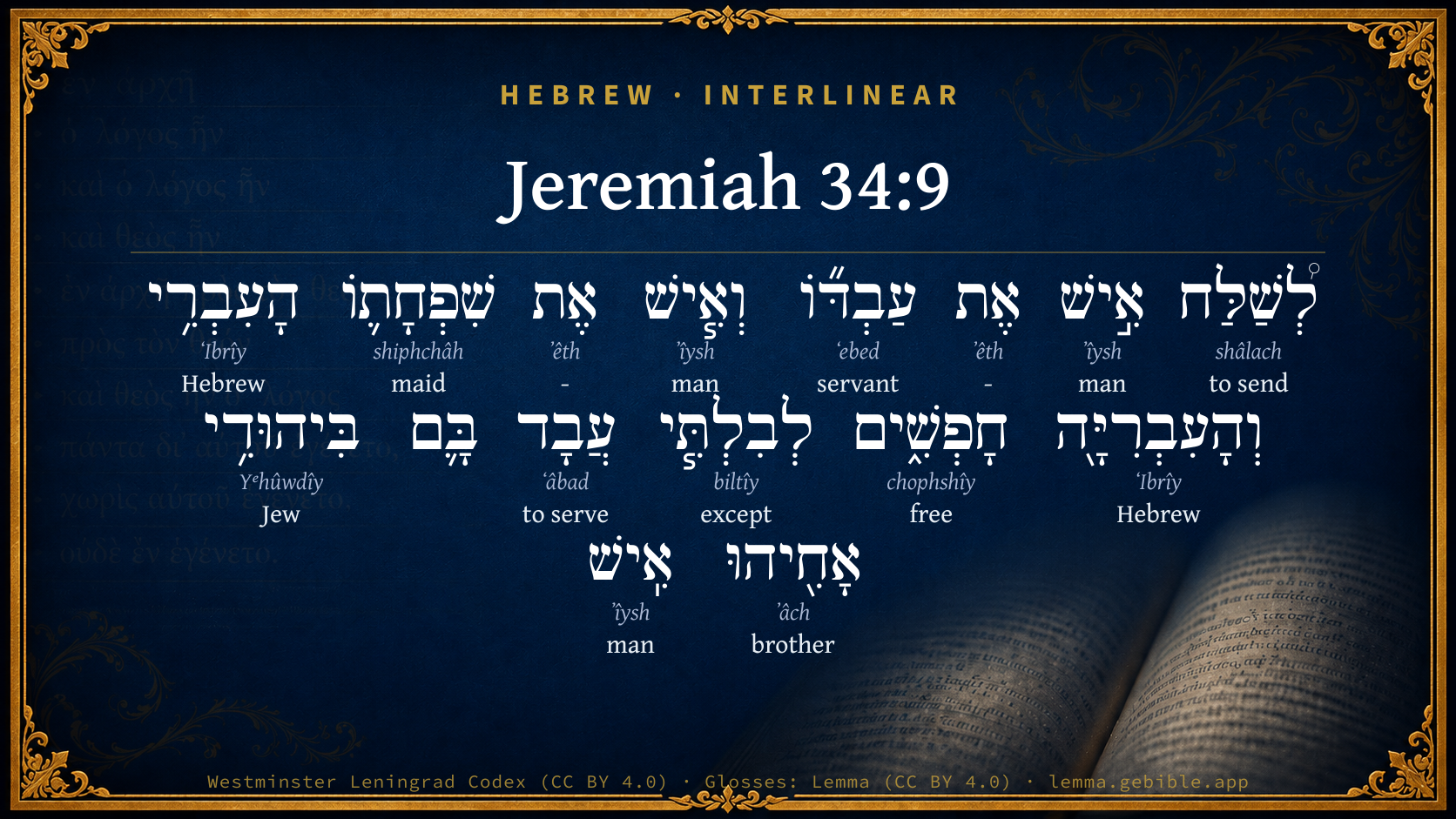
Hebrew (Westminster Leningrad Codex) Jeremiah 34:9 appears in the Hebrew Old Testament. The text above is from the Westminster Leningrad Codex. Each word links to its Strong’s number, a concise gloss, and parsing drawn from the Open Scriptures Hebrew Bible morphology. Click any word for its full Brown-Driver-Briggs (BDB) entry.
Download image
Cite this verse

Jeremiah 34:9 (World English Bible). Public Domain. Lemma interlinear Bible study tool, https://lemma.gebible.app/v/jeremiah/34/9.

Show BibTeX & RIS
BibTeX
RIS
English Translation
that every man should let his man-servant, and every man his maid-servant, who is a Hebrew or a Hebrewess, go free; that none should make bondservants of them, [to wit], of a Jew his brother.
World English Bible · Public Domain
Download a study sheet

One document with this verse’s original text, its word-by-word gloss line, the meaning frame, cross-references with their text, attributed commentary, and full source and license credits — printable, and it pastes into notes with its structure intact.

This verse Autodidact and up

Study sheet (.html) Plain text (.txt)

A passage Seminary Student

Up to 50 verses in one chapter. A passage sheet keeps up to 6 commentary sources and 12 cross-references per verse, in the order this page ranks them, and says so on the sheet whenever that leaves anything out. Ask for a single verse and you get the Autodidact verse sheet above.

Everything on this page stays free to read, with no account — the sheet is a download of what is already on screen, not access to it.

Want to remove ads? Support Godless Engineer
Compare translations 3

The same verse in 3 English versions, stacked beneath the original-language interlinear above. Click any original word for its lexicon entry.

Each is an independent rendering of the whole verse — the interlinear is not word-aligned to these translations.

Highlighted words mark where these versions differ — a whole-verse word diff, not a word-by-word alignment.

  • World English Bible Public Domain
    that every man should let his man-servant, and every man his maid-servant, who is a Hebrew or a Hebrewess, go free; that none should make bondservants of them, [to wit], of a Jew his brother.
  • King James Version Public Domain
    That every man should let his manservant, and every man his maidservant, being an Hebrew or an Hebrewess, go free; that none should serve himself of them, to wit, of a Jew his brother.
  • unfoldingWord Literal Text CC BY-SA 4.0
    that each man must free his Hebrew slaves, both male and female, so one was to make a slave of a Jew, who was his brother.

unfoldingWord Literal Text — © unfoldingWord, licensed CC BY-SA 4.0. Word-aligned USFM3 via Door43 (git.door43.org/unfoldingWord/en_ult).

Versions to compare (up to 4)

3 of 4 selected

Show all 18 translations

Every available English version of this verse, each an independent rendering of the whole verse.

  • World English Bible Public Domain
    that every man should let his man-servant, and every man his maid-servant, who is a Hebrew or a Hebrewess, go free; that none should make bondservants of them, [to wit], of a Jew his brother.
  • Berean Standard Bible Public Domain
    that each man should free his Hebrew slaves, both male and female, and no one should hold his fellow Jew in bondage.
  • Majority Standard Bible Public Domain
    that each man should free his Hebrew slaves, both male and female, and no one should hold his fellow Jew in bondage.
  • King James Version Public Domain
    That every man should let his manservant, and every man his maidservant, being an Hebrew or an Hebrewess, go free; that none should serve himself of them, to wit, of a Jew his brother.
  • American Standard Version (1901) Public Domain
    that every man should let his man-servant, and every man his maid-servant, that is a Hebrew or a Hebrewess, go free; that none should make bondmen of them, `to wit', of a Jew his brother.
  • Revised Version (1885) Public Domain
    that every man should let his manservant, and every man his maidservant, being an Hebrew or an Hebrewess, go free; that none should serve himself of them, to wit, of a Jew his brother:
  • Geneva Bible (1599) Public Domain
    That euery man should let his seruant go free, and euery man his handmayde, which was an Ebrue or an Ebruesse, and that none should serue himselfe of them, to wit, of a Iewe his brother.
  • Douay-Rheims (1899) Public Domain
    That every man should let his manservant, and every man his maidservant, being a Hebrew man or a Hebrew woman, go free: and that they should not lord it over them, to wit, over the Jews their brethren.
  • Young's Literal Translation Public Domain
    to send out each his man-servant, and each his maid-servant -- the Hebrew and the Hebrewess -- free, so as not to lay service on them, any on a Jew his brother;
  • Literal Standard Version CC BY-SA 4.0
    to each send out his manservant, and each his maidservant—the Hebrew and the Hebrewess—free, so as not to lay service on them—on any Jew, a brother, a man;
  • Unlocked Literal Bible CC BY-SA 4.0
    that each man must free his Hebrew slaves, both male and female, so one was to make a slave of a Jew, who was his brother.
  • unfoldingWord Literal Text CC BY-SA 4.0
    that each man must free his Hebrew slaves, both male and female, so one was to make a slave of a Jew, who was his brother.
  • Darby Bible Public Domain
    that every man should let his bondman, and every man his bondmaid, the Hebrew and the Hebrewess, go free, that none should exact service of them, [that is,] of a Jew his brother.
  • World Messianic Bible Public Domain
    that every man should let his male servant, and every man his female servant, who is a Hebrew or a Hebrewess, go free, that no one should make bondservants of them, of a Jew his brother.
  • Webster's Bible Public Domain
    That every man should liberate his man-servant, and every man his maid-servant, being a Hebrew or a Hebrewess; that none should retain them in service, to wit, a Jew his brother.
  • Free Bible Version CC BY-SA 4.0
    This meant that every slave owner should free their Hebrew slaves, both male and female. No one was to force their fellow citizens to remain slaves any longer.
  • Bible in Basic English Public Domain
    That every man was to let his Hebrew man-servant and his Hebrew servant-girl go free; so that no one might make use of a Jew, his countryman, as a servant:
  • JPS Tanakh (1917) Public Domain
    that every man should let his manservant, and every man his maidservant, being a Hebrew man or a Hebrew woman, go free; that none should make bondmen of them, even of a Jew his brother;

Literal Standard Version (2020), Covenant Press — licensed CC BY-SA 4.0. Text via the HelloAO Bible API (eBible.org). Unlocked Literal Bible (unfoldingWord) — licensed CC BY-SA 4.0. Text via the HelloAO Bible API (eBible.org). unfoldingWord Literal Text — © unfoldingWord, licensed CC BY-SA 4.0. Word-aligned USFM3 via Door43 (git.door43.org/unfoldingWord/en_ult). Free Bible Version, Dr. Jonathan Gallagher — licensed CC BY-SA 4.0. Text via the HelloAO Bible API (eBible.org).

Word by word

More ways to search: Search by grammar → Find every occurrence → Compare this word →

Practice this passage: Drill this verse → Learn its vocabulary →

חָפְשִׁ֑ים
chophshîy
H2670
“free”
Adjective, Adjective, Masculine, Plural, Absolute
Part of Speech
Adjective
Type
Adjective
Gender
Masculine
Number
Plural
State
Absolute
Full BDB Definition

Origin: from H2666

TWOT: 717c

free - free (from slavery) - free (from taxes or obligations)
  1. לְ֠שַׁלַּח shâlach H7971 “to send” Preposition + Verb, Piel, Infinitive Construct
  2. אִ֣ישׁ ʼîysh H376 “man” Noun, Common, Masculine, Singular, Absolute
  3. אֶת ʼêth H853 “-” Particle, Direct Object
  4. עַבְדּ֞וֹ ʻebed H5650 “servant · his” Noun, Common, Masculine, Singular, Construct + Suffix, Personal, 3rd Person, Masculine, Singular
  5. וְאִ֧ישׁ ʼîysh H376 “and · man” Conjunction + Noun, Common, Masculine, Singular, Absolute
  6. אֶת ʼêth H853 “-” Particle, Direct Object
  7. שִׁפְחָת֛וֹ shiphchâh H8198 “maid · his” Noun, Common, Feminine, Singular, Construct + Suffix, Personal, 3rd Person, Masculine, Singular
  8. הָעִבְרִ֥י ʻIbrîy H5680 “the · Hebrew” Particle, Definite Article + Noun, Gentilic, Masculine, Singular, Absolute
  9. וְהָעִבְרִיָּ֖ה ʻIbrîy H5680 “and · the · Hebrew” Conjunction + Particle, Definite Article + Noun, Gentilic, Feminine, Singular, Absolute
  10. לְבִלְתִּ֧י biltîy H1115 “to/for · except” Preposition + Conjunction
  11. עֲבָד ʻâbad H5647 “to serve” Verb, Qal, Infinitive Construct
  12. בִּיהוּדִ֥י Yᵉhûwdîy H3064 “in/at · Jew” Preposition + Noun, Gentilic, Masculine, Singular, Absolute
  13. אָחִ֖יהוּ ʼâch H251 “brother · his” Noun, Common, Masculine, Singular, Construct + Suffix, Personal, 3rd Person, Masculine, Singular
  14. אִֽישׁ ʼîysh H376 “man” Noun, Common, Masculine, Singular, Absolute

About this verse

These counts appear in no published source. They are computed here, from the morphology-tagged text and Lemma’s own curated glosses. What Lemma adds →

16
words
11
distinct lemmas
Prophets
section

Notable vocabulary

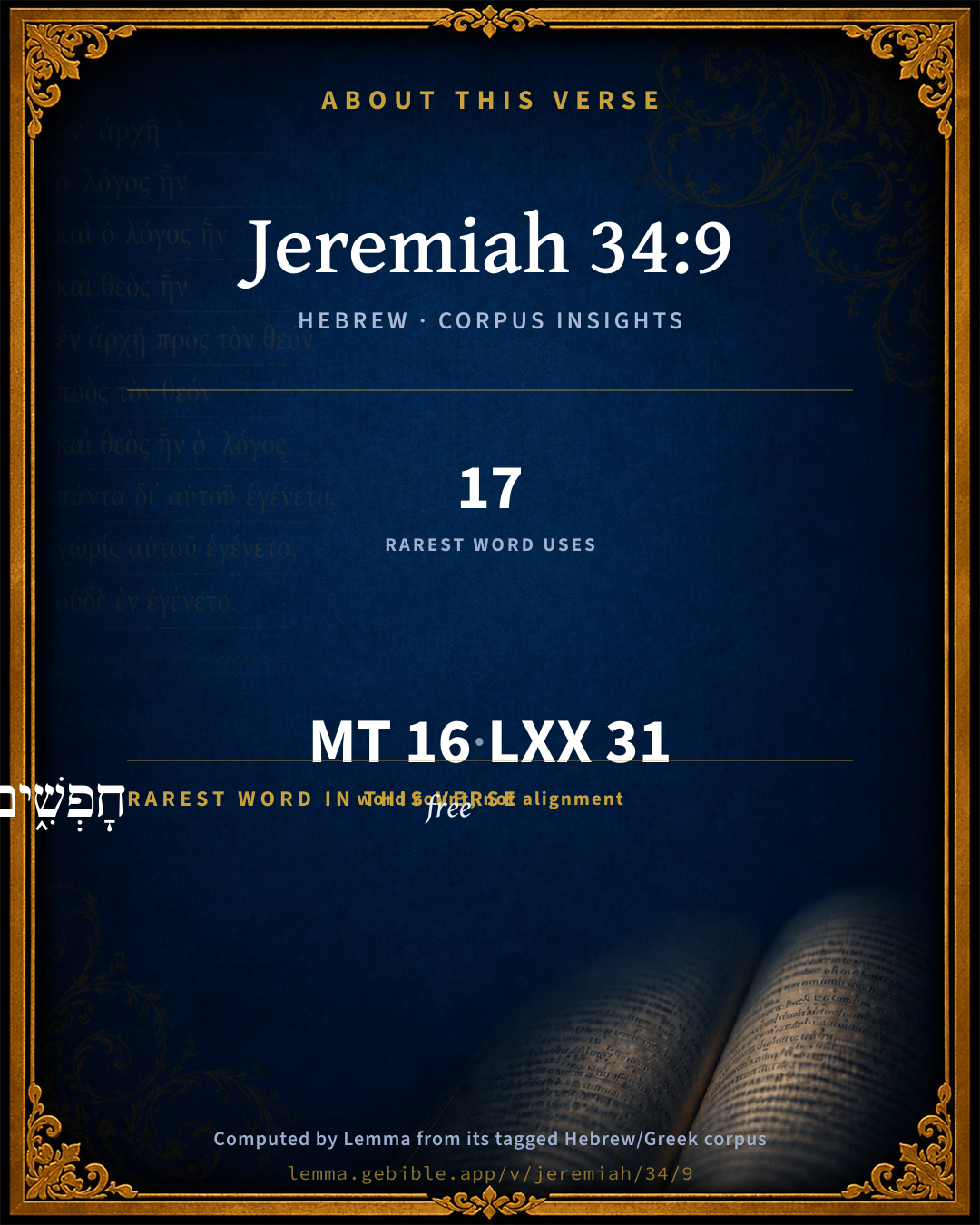
The rarest word here is חָפְשִׁ֑ים free H2670 — appearing just 17 times in the whole Hebrew Bible.

Shared distinctive vocabulary

חָפְשִׁ֑ים free H2670 occurs in 17 verses of the Hebrew Bible. Also found in:

Grammatical profile

  • 2 verbs
  • 9 nouns
  • 1 adjective
  • 1 preposition
  • 1 conjunction
  • 2 particles

Verb forms

  • לְ֠שַׁלַּח Piel · Infinitive Construct
  • עֲבָד Qal · Infinitive Construct

Repetition

Words recur within this verse — often emphatic in Hebrew:

  • אִ֣ישׁ man H376 ×3
  • הָעִבְרִ֥י Hebrew H5680 ×2

Hebrew & Septuagint length

In the original languages it is 16 Hebrew tokens and 31 Greek tokens — but the two are counted differently (Hebrew bundles its prefixes and suffixes into one token; the Greek is in lemma form), so that isn’t a like-for-like length.

Cross-references

16

Topical passages linked to Jeremiah 34:9 in the Treasury of Scripture Knowledge — connected by theme and wording, ordered by reader-vote popularity; previews shown in the World English Bible.

  • Genesis 14:13 One who had escaped came and told Abram, the Hebrew. Now he lived by the oaks of Mamre, the Amorite, brother of Eshcol, and brother of Aner; and these were allies of Abram.
  • Genesis 40:15 For indeed, I was stolen away out of the land of the Hebrews, and here also have I done nothing that they should put me into the dungeon."
  • Exodus 2:6 She opened it, and saw the child, and, behold, the baby cried. She had compassion on him, and said, "This is one of the Hebrews' children."
  • Exodus 3:18 They will listen to your voice, and you shall come, you and the elders of Israel, to the king of Egypt, and you shall tell him, 'Yahweh, the God of the Hebrews, has met with us. Now please let us go three days' journey into the wilderness, that we may sacrifice to Yahweh, our God.'
  • Leviticus 25:39–46 "'If your brother has grown poor among you, and sells himself to you; you shall not make him to serve as a slave.
  • Deuteronomy 15:12 If your brother, a Hebrew man, or a Hebrew woman, be sold to you, and serve you six years; then in the seventh year you shall let him go free from you.
  • 1 Samuel 4:6 When the Philistines heard the noise of the shout, they said, What means the noise of this great shout in the camp of the Hebrews? They understood that the ark of Yahweh was come into the camp.
  • 1 Samuel 4:9 Be strong, and behave yourselves like men, O you Philistines, that you not be servants to the Hebrews, as they have been to you: quit yourselves like men, and fight.
  • 1 Samuel 14:11 Both of them disclosed themselves to the garrison of the Philistines: and the Philistines said, Behold, the Hebrews come forth out of the holes where they had hid themselves.
  • Jeremiah 25:14 For many nations and great kings shall make bondservants of them, even of them; and I will recompense them according to their deeds, and according to the work of their hands.
  • Jeremiah 27:7 All the nations shall serve him, and his son, and his son's son, until the time of his own land come: and then many nations and great kings shall make him their bondservant.
  • Jeremiah 30:8 It shall come to pass in that day, says Yahweh of Hosts, that I will break his yoke from off your neck, and will burst your bonds; and strangers shall no more make him their bondservant;
  • Jeremiah 34:10 All the princes and all the people obeyed, who had entered into the covenant, that everyone should let his man-servant, and everyone his maid-servant, go free, that none should make bondservants of them any more; they obeyed, and let them go:
  • 1 Corinthians 6:8 No, but you yourselves do wrong, and defraud, and that against your brothers.
  • 2 Corinthians 11:22 Are they Hebrews? So am I. Are they Israelites? So am I. Are they the seed of Abraham? So am I.
  • Philippians 3:5 circumcised the eighth day, of the stock of Israel, of the tribe of Benjamin, a Hebrew of Hebrews; concerning the law, a Pharisee;

Cross-references courtesy of OpenBible.info (CC BY 4.0).

Hebrew and Greek witnesses Masoretic Hebrew ↔ Greek Septuagint

The same verse in the two great witnesses to the Old Testament, shown verse-for-verse.

These are two independent witnesses, not word-aligned to each other, and the Septuagint is shown in lemma (dictionary) form.

Hebrew Jeremiah 34:9 Masoretic · Westminster Leningrad Codex

לְ֠שַׁלַּח אִ֣ישׁ אֶת עַבְדּ֞וֹ וְאִ֧ישׁ אֶת שִׁפְחָת֛וֹ הָעִבְרִ֥י וְהָעִבְרִיָּ֖ה חָפְשִׁ֑ים לְבִלְתִּ֧י עֲבָד בָּ֛ם בִּיהוּדִ֥י אָחִ֖יהוּ אִֽישׁ

that every man should let his man-servant, and every man his maid-servant, who is a Hebrew or a Hebrewess, go free; that none should make bondservants of them, [to wit], of a Jew his brother.

World English Bible · Public Domain

Greek LXX Structure differs

In the Septuagint, Jeremiah is about an eighth shorter than the Hebrew and arranges its material differently — the Oracles Against the Nations (Hebrew chapters 46–51) appear in the middle of the Greek book, after 25:13. Because the chapter and verse boundaries do not line up, a verse-for-verse comparison with the Hebrew is not shown.

A verse-for-verse comparison isn’t shown here because the chapters and verses don’t line up. Switch to the LXX edition with the MT / LXX toggle above to read the Greek directly.

Hebrew: Westminster Leningrad Codex (CC BY 4.0). Greek: Septuagint (public domain); English from a public-domain English Septuagint. How the Septuagint differs from the Hebrew →

Targum (Aramaic paraphrase)

1

The Targum is the ancient Jewish Aramaic paraphrase of the Hebrew Scriptures — an interpretive translation, not the Hebrew text itself. Onkelos (literal) and Pseudo-Jonathan (expansive) render the Torah, and Jonathan the Prophets. Coverage is partial: where no permissively-licensed English translation exists for a verse, only the Aramaic is shown. This is verse-level text, not a word-by-word alignment to the Hebrew.

  1. Targum Jonathan Prophets (Joshua–Malachi)
    לְשַׁלְחָא גְבַר יַת עֲבָדֵיהּ וּגְבַר יַת אַמְתֵיהּ בַּר יִשְׂרָאֵל וּבַת יִשְׂרָאֵל בְּנֵי חוֹרִין בְּדִיל דְלָא יִפְלְחוּן בְּהוֹן גְבַר בַּאֲחוּהִי יְהוּדָאָה:

    (no public-domain English translation for this verse)

    Targum Jonathan — Aramaic: “Mikraot Gedolot” (public domain). English: “Sefaria Community Translation” (CC0 1.0 (public-domain dedication)); “London "Chaldee Paraphrase," 1871” (public domain). Text via Sefaria.

Commentary

Notes on Jeremiah 34:9 from classic Christian and Jewish commentators (each source and its license shown beneath its notes). The classic Christian expositions comment on the surrounding passage and are grouped to its opening verse, so a note may address several verses; the Jewish commentaries on the Tanakh (Rashi and others) are per-verse, so they appear only where the commentator wrote on this verse.

Lemma curates 59 commentaries, every one of them public domain or Creative Commons licensed, each selected and text-cleaned for this edition rather than reprinted as found. About our sources →

Trapp's Complete Commentary

John Trapp

Jer 34:9 That every man should let his manservant, and every man his maidservant, [being] an Hebrew or an Hebrewess, go free; that none should serve himself of them, [to wit], of a Jew his brother.

Ver. 9. That every man should let his manservant.] Should manumit and dismiss him at six years’ end, according to the law. {Exo 21:1-2} The seventh year {a} was called the year of liberty, and then they were to let go their brethren that served them, and this in a thankful remembrance of their deliverance from the Egyptian servitude. But this they had neglected to do; and now, to pacify God’s wrath, and to prevent, if it might be, the Chaldeans’ cruelty, this coarse they took, and not altogether without success, for the siege was thereupon raised for a season; and had they returned to God with all their heart and with all their soul, who knows what might have been further done for them? But they did nothing less; therefore came wrath upon them to the utmost.

{a} Hic septimus annus fuit typus aeternae liberationis post curriculum sex dierum mundi, sex mille annorum.

John Trapp, A Commentary or Exposition upon All the Books of the Old and New Testament (1647–1656) — public domain. Text from a community e-Sword module.

Geneva Bible (1599)

Geneva Bible translators

According to the Law, Exod. 21:2; Deut. 15:12.

Geneva Bible (1599) marginal notes — public domain. Text via Bolls.life.

Jamieson, Fausset & Brown

Robert Jamieson, A. R. Fausset & David Brown

none . . . serve himself of a Jew-- (Lev 25:39-46).

Jamieson, Fausset & Brown — Commentary Critical and Explanatory on the Whole Bible (1871) — public domain (CC PDM 1.0). Text via the HelloAO Bible API.

The Cambridge Bible for Schools and Colleges

gen. ed. J. J. S. Perowne

9. serve himself of them] The poverty, arising out of the devastation wrought by repeated wars, must have brought about a large amount of servitude, as was the case e.g. in later times. See Neh_5:5, and on Jer_30:8.

The Cambridge Bible for Schools and Colleges (gen. ed. J. J. S. Perowne; Cambridge University Press, 1878–1918) — public domain. Text from a community e-Sword module.

John Gill's Exposition

That every man should let his manservant, and every man his maidservant, being an Hebrew, or an Hebrewess, go free,.... This is the proclamation that was agreed to be made, that every manservant and maidservant, that serve six years an apprenticeship, should be freed from their servitude, according to the law in Exo 21:1; a law founded upon justice and equity, mercy and compassion; done for the honour of the Jewish nation, that they might be a free people, and in commemoration of their deliverance from their servitude in Egypt. This law, as it seems, had been long neglected, and servants had been retained in bondage beyond their due time, through the oppression and covetousness of their masters, and the neglect of the civil magistrates; who should have took care that such a law was put in execution, and that servants were not oppressed. Some have thought that it was at the beginning of the sabbatical year that this proclamation was made, when, according to the law, there should be a release of servants, Deu 15:1; but that was not a release of servants, but of debts; for if a servant had not served out his time, the sabbatical year, or year of release, did not discharge him; though the year of jubilee did, according to Maimonides (l), who says,

"if the year of release happens in any of the six years, he (the servant) serves in it; but if the year of jubilee happens within the time, even though he has been sold but one year before it, he is free;''

that none should serve himself of them, to wit, of a Jew his brother; or cause them to serve him, oblige them against their will to continue in his service; or by any means avail himself of them, and receive to himself any profit or advantage by their service, they being Jews and brethren; which seems to be added, both as the reason of the law, because they were brethren of the same nation and religion with them, and to distinguish them from other servants, who notwithstanding this law might be retained as such.

(l) Hilchot Abadim, c. 2. sect. 2.

John Gill's Exposition of the Whole Bible (1746–1763) — public domain (CC PDM 1.0). Text via the HelloAO Bible API.

Haydock's Catholic Bible Commentary

Brethren. The sabbatical year happened in the 9th of Sedecias, when the Chaldeans approaching, caused him to shew some signs of religion. But when they departed to meet the Egyptians, the people repented of what they had done well. (Calmet) --- Such a relapse offends God more than the former sins, as our Saviour shews by a parable, Matthew xviii. (Worthington)

George Leo Haydock (1774–1849), Haydock's Catholic Family Bible and Commentary, 1859 edition — public domain. Excludes Psalms (Douay-Rheims chapter numbering differs from Protestant) and Deuterocanonical books (Catholic canon only).

Matthew Poole's English Annotations

This was the tenor of God’s law mentioned in the above named texts; and it seemeth Zedekiah, taking notice of the common violation of this law, and the Jews’ ordinary oppressing those of their own nation this way, judging that this might be one of those sins for which the wrath of God was at this time kindled against them, he caused the people to make a covenant, that they would give that liberty to their servants of either sex which the law of God required, of which he made proclamation.

Matthew Poole's English Annotations on the Holy Bible (1683–1685) — public domain. Text from a community e-Sword/MySword module.

The Pulpit Commentary

Should serve himself of them; literally, should work through them; i.e. "should employ them for forced labour;" as in Jer_25:13.

The Pulpit Commentary (1880–1919), ed. H.D.M. Spence-Jones & Joseph S. Exell — public domain. Text from a community e-Sword module.

Lesson kit

Teaching starters — assembled from the data on this page, not authored interpretation. Every prompt links to the verse data it draws on. Edit before teaching.

Jeremiah, in the Prophets, opens this verse with 16 words (11 distinct Hebrew lemmas). Its most distinctive word is chophshîy (“free”). A historical commentator’s framing appears above. Read the whole chapter for the surrounding context.

Discussion questions

  1. What does “free” (chophshîy) contribute to the verse as a whole?
  2. How does Exodus 21:2, which shares the word «free», read alongside this verse?
  3. What does the repetition of “man” (3× in this one verse) do in this verse?
  4. The translations on this page render this verse differently — a whole-verse word diff, not a word-by-word alignment. What might account for the different wordings?
  5. «לְ֠שַׁלַּח» is a Piel Infinitive Construct verb. How does that grammatical form shape the action described?
  6. Compare how Trapp's Complete Commentary and Geneva Bible (1599) read this verse. Where do they agree or differ?

Things to notice

Reading settings

Reading text

Shown beneath each verse's original-language words.

Old Testament
Old Testament edition

Read the OT as the Masoretic Hebrew (MT) or the Greek Septuagint (LXX).

English shown for the Greek Septuagint (in the Hebrew ↔ Greek comparison).

Comparing translations? Open the Compare panel on any verse page to stack up to four side by side.