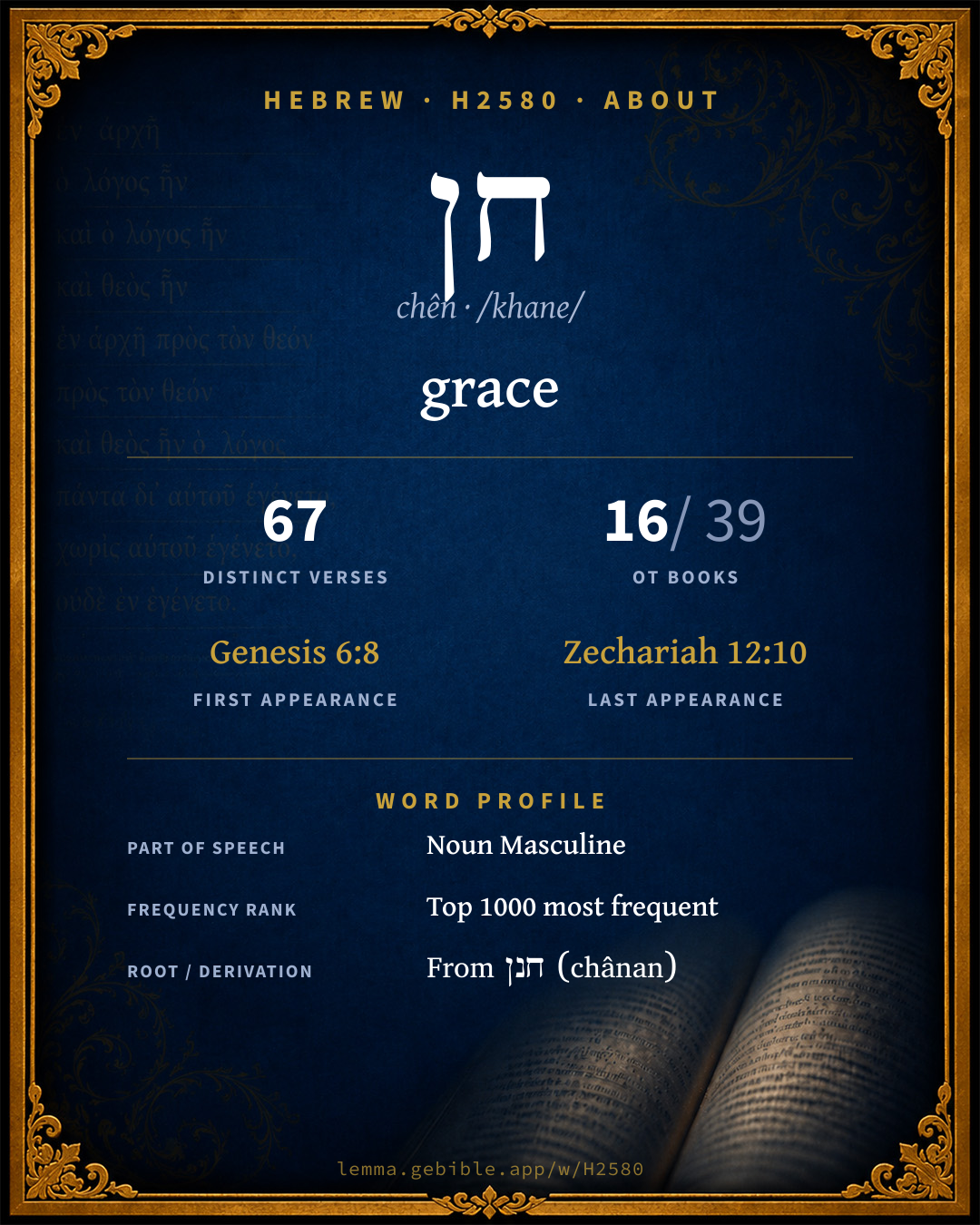
חֵן
grace
also: favour, charm fuller range ↓
Full lexicon entry — Brown-Driver-Briggs (BDB)
From Brown-Driver-Briggs (BDB)
Where this word appears
See every Absolute-state word in the Hebrew Bible →
Grammar key — what these labels mean
Part of speech
- Noun
- A naming word — a person, place, thing, or idea.
Noun type
- Common
- A common noun — a general class of person, place, or thing (“king,” “city,” “water”), not a specific name.
State
- Absolute
- The independent form of a noun, not bound to a following word.
- Construct
- A noun bound to a following noun in a possessive / “of” relationship (the construct chain).
Gender
- Masculine
- Grammatically masculine.
Number
- Singular
- One.
Grammatical forms
- Noun, Common, Masculine, Singular, Absolute 64 times (93%)
- Noun, Common, Masculine, Singular, Construct 5 times (7%)
Parsed forms decoded from the imported morphology (morphhb / Westminster Leningrad Codex — WLC text public domain, morphhb tagging CC BY 4.0), counted across 69 parsed occurrences — not distinct verses.
Every verse where H2580 appears — 67 distinct verses across 16 books. Click any verse to open its interlinear word-by-word view. Verse text shown in the World English Bible for context — . Each verse’s Hebrew form is shown with its reference; the English is not keyword-highlighted, since the data carries no word-level English alignment. Use “Compare translations” on any verse to read it across multiple English versions. This concordance covers the Hebrew Bible; Septuagint (Greek Old Testament) occurrences are not indexed here.
Genesis 14 verses
- Genesis 6:8 חֵ֖ן n c ms But Noah found favor in Yahweh's eyes.
- Genesis 18:3 חֵן֙ n c ms and said, "My lord, if now I have found favor in your sight, please don't go away from your servant.
- Genesis 19:19 חֵן֮ n c ms See now, your servant has found favor in your sight, and you have magnified your loving kindness, which you have shown to me in saving my life. I can't escape to the mountain, lest evil overtake me, and I die.
- Genesis 30:27 חֵ֖ן n c ms Laban said to him, "If now I have found favor in your eyes, stay here, for I have divined that Yahweh has blessed me for your sake."
- Genesis 32:5 חֵ֖ן n c ms I have oxen, donkeys, flocks, men-servants, and maid-servants. I have sent to tell my lord, that I may find favor in your sight.'"
- Genesis 33:8 חֵ֖ן n c ms Esau said, "What do you mean by all this company which I met?" Jacob said, "To find favor in the sight of my lord."
- Genesis 33:10 חֵן֙ n c ms Jacob said, "Please, no, if I have now found favor in your sight, then receive my present at my hand, because I have seen your face, as one sees the face of God, and you were pleased with me.
- Genesis 33:15 חֵ֖ן n c ms Esau said, "Let me now leave with you some of the folk who are with me." He said, "Why? Let me find favor in the sight of my lord."
- Genesis 34:11 חֵ֖ן n c ms Shechem said to her father and to her brothers, "Let me find favor in your eyes, and whatever you will tell me I will give.
- Genesis 39:4 חֵ֛ן n c ms Joseph found favor in his sight. He ministered to him, and he made him overseer over his house, and all that he had he put into his hand.
- Genesis 39:21 חִנּ֔/וֹ n c ms cs + sfx pers 3ms But Yahweh was with Joseph, and showed kindness to him, and gave him favor in the sight of the keeper of the prison.
- Genesis 47:25 חֵן֙ n c ms They said, "You have saved our lives! Let us find favor in the sight of my lord, and we will be Pharaoh's servants."
- Genesis 47:29 חֵן֙ n c ms The time drew near that Israel must die, and he called his son Joseph, and said to him, "If now I have found favor in your sight, please put your hand under my thigh, and deal kindly and truly with me. Please don't bury me in Egypt,
- Genesis 50:4 חֵן֙ n c ms When the days of weeping for him were past, Joseph spoke to the house of Pharaoh, saying, "If now I have found favor in your eyes, please speak in the ears of Pharaoh, saying,
Exodus 8 verses
- Exodus 3:21 חֵ֥ן n c ms cs I will give this people favor in the sight of the Egyptians, and it will happen that when you go, you shall not go empty-handed.
- Exodus 11:3 חֵ֥ן n c ms cs Yahweh gave the people favor in the sight of the Egyptians. Moreover the man Moses was very great in the land of Egypt, in the sight of Pharaoh's servants, and in the sight of the people.
- Exodus 12:36 חֵ֥ן n c ms cs Yahweh gave the people favor in the sight of the Egyptians, so that they let them have what they asked. They despoiled the Egyptians.
- Exodus 33:12 חֵ֖ן n c ms Moses said to Yahweh, "Behold, you tell me, 'Bring up this people:' and you haven't let me know whom you will send with me. Yet you have said, 'I know you by name, and you have also found favor in my sight.'
- Exodus 33:13 חֵ֜ן חֵ֖ן n c ms n c ms Now therefore, if I have found favor in your sight, please show me now your ways, that I may know you, so that I may find favor in your sight: and consider that this nation is your people."
- Exodus 33:16 חֵ֤ן n c ms For how would people know that I have found favor in your sight, I and your people? Isn't it in that you go with us, so that we are separated, I and your people, from all the people who are on the surface of the earth?"
- Exodus 33:17 חֵן֙ n c ms Yahweh said to Moses, "I will do this thing also that you have spoken; for you have found favor in my sight, and I know you by name."
- Exodus 34:9 חֵ֤ן n c ms He said, "If now I have found favor in your sight, Lord, please let the Lord go in the midst of us; although this is a stiff-necked people; pardon our iniquity and our sin, and take us for your inheritance."
Numbers 3 verses
- Numbers 11:11 חֵ֖ן n c ms Moses said to Yahweh, Why have you dealt ill with your servant? and why haven't I found favor in your sight, that you lay the burden of all this people on me?
- Numbers 11:15 חֵ֖ן n c ms If you deal thus with me, please kill me out of hand, if I have found favor in your sight; and let me not see my wretchedness.
- Numbers 32:5 חֵן֙ n c ms They said, If we have found favor in your sight, let this land be given to your servants for a possession; don't bring us over the Jordan.
Deuteronomy 1 verse
Judges 1 verse
Ruth 3 verses
- Ruth 2:2 חֵ֖ן n c ms Ruth the Moabitess said to Naomi, Let me now go to the field, and glean among the ears of grain after him in whose sight I shall find favor. She said to her, Go, my daughter.
- Ruth 2:10 חֵ֤ן n c ms Then she fell on her face, and bowed herself to the ground, and said to him, Why have I found favor in your sight, that you should take knowledge of me, seeing I am a foreigner?
- Ruth 2:13 חֵ֨ן n c ms Then she said, Let me find favor in your sight, my lord, because you have comforted me, and because you have spoken kindly to your handmaid, though I am not as one of your handmaidens.
1 Samuel 6 verses
- 1 Samuel 1:18 חֵ֖ן n c ms She said, Let your handmaid find favor in your sight. So the woman went her way, and ate; and her facial expression wasn't sad any more.
- 1 Samuel 16:22 חֵ֖ן n c ms Saul sent to Jesse, saying, Please let David stand before me; for he has found favor in my sight.
- 1 Samuel 20:3 חֵן֙ n c ms David swore moreover, and said, Your father knows well that I have found favor in your eyes; and he says, Don't let Jonathan know this, lest he be grieved: but truly as Yahweh lives, and as your soul lives, there is but a step between me and death.
- 1 Samuel 20:29 חֵן֙ n c ms and he said, Please let me go, for our family has a sacrifice in the city; and my brother, he has commanded me [to be there]: and now, if I have found favor in your eyes, let me get away, I pray you, and see my brothers. Therefore he is not come to the king's table.
- 1 Samuel 25:8 חֵן֙ n c ms Ask your young men, and they will tell you: therefore let the young men find favor in your eyes; for we come in a good day. Please give whatever comes to your hand, to your servants, and to your son David.
- 1 Samuel 27:5 חֵ֤ן n c ms David said to Achish, If now I have found favor in your eyes, let them give me a place in one of the cities in the country, that I may dwell there: for why should your servant dwell in the royal city with you?
2 Samuel 3 verses
- 2 Samuel 14:22 חֵ֤ן n c ms Joab fell to the ground on his face, and did obeisance, and blessed the king: and Joab said, Today your servant knows that I have found favor in your sight, my lord, king, in that the king has performed the request of his servant.
- 2 Samuel 15:25 חֵן֙ n c ms The king said to Zadok, Carry back the ark of God into the city: if I shall find favor in the eyes of Yahweh, he will bring me again, and show me both it, and his habitation:
- 2 Samuel 16:4 חֵ֥ן n c ms Then said the king to Ziba, Behold, all that pertains to Mephibosheth is yours. Ziba said, I do obeisance; let me find favor in your sight, my lord, O king.
1 Kings 1 verse
Esther 6 verses
- Esther 2:15 חֵ֔ן n c ms Now when the turn of Esther, the daughter of Abihail the uncle of Mordecai, who had taken her for his daughter, was come to go in to the king, she required nothing but what Hegai the king's chamberlain, the keeper of the women, appointed. Esther obtained favor in the sight of all those who looked at her.
- Esther 2:17 חֵ֥ן n c ms The king loved Esther above all the women, and she obtained favor and kindness in his sight more than all the virgins; so that he set the royal crown on her head, and made her queen instead of Vashti.
- Esther 5:2 חֵ֖ן n c ms It was so, when the king saw Esther the queen standing in the court, that she obtained favor in his sight; and the king held out to Esther the golden scepter that was in his hand. So Esther drew near, and touched the top of the scepter.
- Esther 5:8 חֵ֜ן n c ms if I have found favor in the sight of the king, and if it please the king to grant my petition, and to perform my request, let the king and Haman come to the banquet that I shall prepare for them, and I will do tomorrow as the king has said.
- Esther 7:3 חֵ֤ן n c ms Then Esther the queen answered, If I have found favor in your sight, O king, and if it please the king, let my life be given me at my petition, and my people at my request:
- Esther 8:5 חֵ֣ן n c ms She said, If it please the king, and if I have found favor in his sight, and the thing seem right before the king, and I be pleasing in his eyes, let it be written to reverse the letters devised by Haman, the son of Hammedatha the Agagite, which he wrote to destroy the Jews who are in all the king's provinces:
Psalms 2 verses
Proverbs 13 verses
- Proverbs 1:9 חֵ֓ן n c ms For they will be a garland to grace your head, And chains around your neck.
- Proverbs 3:4 חֵ֖ן n c ms So you will find favor, And good understanding in the sight of God and man.
- Proverbs 3:22 וְ֝/חֵ֗ן conj + n c ms So they will be life to your soul, And grace for your neck.
- Proverbs 3:34 חֵֽן n c ms Surely he mocks the mockers, But he gives grace to the humble.
- Proverbs 4:9 חֵ֑ן n c ms She will give to your head a garland of grace. She will deliver a crown of splendor to you."
- Proverbs 5:19 חֵ֥ן n c ms A loving doe and a graceful deer-- Let her breasts satisfy you at all times. Be captivated always with her love.
- Proverbs 11:16 חֵ֭ן n c ms A gracious woman obtains honor, But violent men obtain riches.
- Proverbs 13:15 חֵ֑ן n c ms Good understanding wins favor; But the way of the unfaithful is hard.
- Proverbs 17:8 חֵ֣ן n c ms A bribe is a precious stone in the eyes of him who gives it; Wherever he turns, he prospers.
- Proverbs 22:1 חֵ֣ן n c ms A good name is more desirable than great riches, And loving favor is better than silver and gold.
- Proverbs 22:11 חֵ֥ן n c ms cs He who loves purity of heart and speaks gracefully Is the king's friend.
- Proverbs 28:23 חֵ֣ן n c ms One who rebukes a man will afterward find more favor Than one who flatters with the tongue.
- Proverbs 31:30 הַ֭/חֵן ptcl def.art + n c ms Charm is deceitful, and beauty is vain; But a woman who fears Yahweh, she shall be praised.
Ecclesiastes 2 verses
- Ecclesiastes 9:11 חֵ֑ן n c ms I returned, and saw under the sun, that the race is not to the swift, nor the battle to the strong, neither yet bread to the wise, nor yet riches to men of understanding, nor yet favor to men of skill; but time and chance happen to them all.
- Ecclesiastes 10:12 חֵ֑ן n c ms The words of a wise man's mouth are gracious; but a fool is swallowed by his own lips.
Jeremiah 1 verse
Nahum 1 verse
Zechariah 2 verses
- Zechariah 4:7 חֵ֥ן חֵ֖ן n c ms n c ms Who are you, great mountain? Before Zerubbabel you are a plain; and he will bring out the capstone with shouts of 'Grace, grace, to it!'"
- Zechariah 12:10 חֵן֙ n c ms I will pour on the house of David, and on the inhabitants of Jerusalem, the spirit of grace and of supplication; and they will look to me whom they have pierced; and they shall mourn for him, as one mourns for his only son, and will grieve bitterly for him, as one grieves for his firstborn.
About this entry
At a glance — auto-summarized from this page’s data, not written by a person. Every figure links to its source below. This summary describes the numbers; it doesn’t interpret them.
At its core, חן (chên) means “grace.” The King James Version usually renders it “grace,” while modern versions prefer “favor” (Berean Standard Bible) — see the renderings breakdown. With 67 verses in 16 books, it is a moderately common word in the Hebrew Bible. Scripture first uses it in Genesis 6:8. Beyond its headline sense, its full sense range takes in “favour” and “charm”. Dig into 67-verse concordance and the renderings breakdown below.
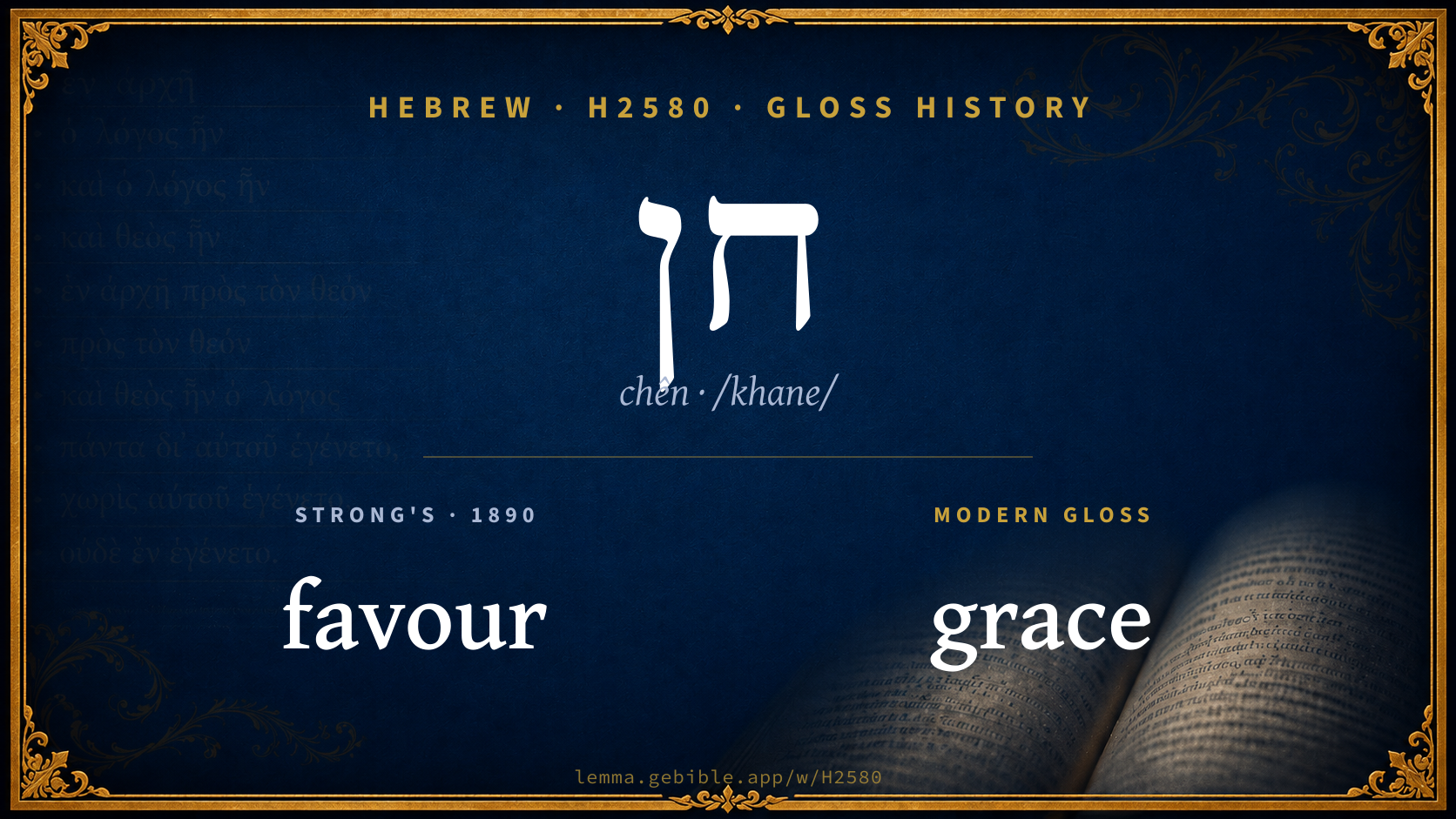
Gloss history
Strong's 1890 vs modern scholarship
About this word
Strong's H2580 catalogs a Hebrew word from the Hebrew Old Testament.
These counts are not copied from any lexicon or concordance. They are computed here, from the morphology-tagged Hebrew Old Testament. What Lemma adds →
- 67
- distinct verses
- The word appears in 67 distinct verses.
- 16 / 39
- OT books
- The word appears in 16 of 39 Old Testament books.
- #575
- by frequency
- Top 1000 most frequent Hebrew words (rank 575 of 8,640 Hebrew words by occurrence).
View all 67 occurrences in the concordance →
By section of the Old Testament
By traditional corpus
Conventional, traditional groupings — biblical authorship is debated, so this is a traditional corpus grouping, not an authorship claim. Each share is this word’s portion of its verses in that division of the Hebrew canon. Each figure is a share of the word’s 67 distinct verses.
- Torah (Pentateuch) 26 verses · 39%
- Writings (Ketuvim) 26 verses · 39%
- Prophets (Nevi'im) 15 verses · 22%
How translations render this word
Counts come from each version’s own published word-to-Strong’s tagging or interlinear alignment — an approximate guide to how each version renders this word, not a word-level alignment the data otherwise carries. Because each total is that version’s own tagged count, the per-version totals vary from one another and need not match the appearance or distinct-verse counts above. These counts may also differ from a printed concordance because Lemma counts each distinctly tagged rendering and does not collapse phrase taggings into a single head-word total. This is a fixed set of word-tagged versions (KJV, ASV, BSB, ULT) and does not change with the reading translation you choose elsewhere. Each version’s license is shown beside its name below (and on Sources).
BDB lists this Strong’s number as 3 distinct words (homographs). Each count above pools all of them and is not split by sense — see the Senses section below. A low-frequency rendering may belong to a different one of those words, not the primary meaning.
- King James Version†: Grace 37×, Favour 25×
- American Standard Version†: Favor 40×, Grace 11×, Now i have found favor 3×
- Berean Standard Bible†: Favor 47×, Grace 9×, Gracious 2×
- unfoldingWord Literal Text†: Favor 55×, Grace 8×
King James Version Public Domain
Renders H2580 across 68† tagged occurrences — most commonly:
Plus 6 renderings that appear only once — usually multi-word phrases or single function words the recovered tagging swept in, not distinct renderings. Not rendered by a distinct English word in 1 further occurrence.
American Standard Version Public Domain
Renders H2580 across 69† tagged occurrences — most commonly:
Plus 15 renderings that appear only once — usually multi-word phrases or single function words the recovered tagging swept in, not distinct renderings.
Berean Standard Bible Public Domain
Renders H2580 across 66† tagged occurrences — most commonly:
Plus 8 renderings that appear only once — usually multi-word phrases or single function words the recovered tagging swept in, not distinct renderings. Not rendered by a distinct English word in 3 further occurrences.
unfoldingWord Literal Text CC BY-SA 4.0
Renders H2580 across 68† tagged occurrences — most commonly:
Plus 5 renderings that appear only once — usually multi-word phrases or single function words the recovered tagging swept in, not distinct renderings.
Senses in the full BDB
What do BDB’s symbols mean?
BDB uses these scholarly abbreviations:
| Symbol | Meaning |
|---|---|
| 𝔊 | the Septuagint (the ancient Greek translation, LXX) |
| 𝔙 | the Vulgate (the Latin translation) |
| 𝔖 | the Syriac version (the Peshitta) |
| 𝔗 | the Targum (the Aramaic translation) |
| ψ | the Psalms |
| √ | root (the underlying root or stem) |
| ‖ | parallel passage (a synonymous or contrasted parallel) |
| † | the dagger: every passage where the word occurs is cited |
The 6 senses and sub-senses the full Brown-Driver-Briggs lexicon distinguishes for this word, in lexicon order (not ranked by frequency), with BDB’s own verbatim wording and sub-sense lettering. Shown in Hebrew script with BDB’s own scholarly abbreviations. The condensed entry is in the Lexicon Entry tab. See also the Forms in the corpus table below.
חן I
- 1. favour, grace, elegance:
- a. of form and appearance, of a woman ‖ יֹ֑פִי Pr 31:30; אֵשֶׁת חֵן Pr 11:16; זונה טובת חן Na 3:4; of a doe Pr 5:19; precious stone אבן חן Pr 17:8; of ornaments Pr 1:9 = 4:9, 3:22. e.g. Proverbs 31:30
- b. of speech, lips ψ 45:3 Pr 22:11; words Ec 10:12. e.g. Psalms 45:3
- 2. favour, acceptance:
- a. with men Pr 13:15; 22:1; Ec 9:11. e.g. Proverbs 13:15
- b. with God Zc 4:7(×2); 12:10; chiefly in phrases: מצא חן בעיני find favour in the eyes of: (1) men Gn 30:27; 32:6; 33:8, 10, 15; 34:11; 39:4; 47:25, 29; 50:4 Nu 32:5 (all J); Dt 24:1; Ru 2:2, 10, 13; 1 S 1:18; 16:22; 20:3, 29; 25:8; 27:5; 2 S 14:22; 16:4; 1 K 11:19; Est 5:8; 7:3; (2) of God Gn 6:8; 18:3; 19:19; Ex 33:12, 13(×2), 16, 17; 34:9 Nu 11:11, 15 (all J); Ju 6:17; 2 S 15:25; Pr 3:4; abs. מצא חן (with man) Pr 28:23; (with God) Je 31:2; מצא חן לפניו Est 8:5 (i.e. of the king); נתן חן בעיני give favour in the eyes of (1) man Gn 39:21; Ex 3:21; 11:3; 12:36 (J); abs. נתן חן of man ψ 84:12; (2) of God Pr 3:34; נשׂא חֵן בְּעֵינֵי obtain favour in the eyes of Est 2:15; of the king 5:2; so וַתִּשָּׂא־חֵן וָחֶסֶד לְפָנָיו Est 2:17. e.g. Zechariah 4:7
חן II m. (favour)
Senses from the full Brown-Driver-Briggs lexicon (Brown, Driver, Briggs; Oxford 1906 — public domain), digitized via Sefaria, supplemented by the OpenScriptures HebrewLexicon (CC BY 4.0). Full attribution on Sources.
Word origin
II. n.m. ψ 45:3 favour, grace;—ח׳ Gn 6:8 + 67 times; sf. חִנּוֹ Gn 39:21;—
III. n.pr.m. (favour)—contemp. of Zerubbabel Zc 6:14, so RV SS We, but RVm Ew Hi Ke Or grace, favour, kindness.
— Brown-Driver-Briggs (Oxford 1906, public domain), digitized via Sefaria, supplemented by the OpenScriptures HebrewLexicon (CC BY 4.0). See Sources.
Derived from חנן (chânan) (H2603) — to be gracious.
Jastrow Dictionary
A second Hebrew/Aramaic lexicon for comparison, covering Aramaic and post-biblical (Talmudic, Targumic, Midrashic) usage that the biblical-Hebrew BDB does not. Matched by lemma rather than by Strong’s number, so a lemma may carry more than one Jastrow headword (shown separately below), and the entries cover usage well beyond the Bible.
חָן
- , v. חָנָה a. חָנַן.
חַן
- , v. חֲנַן
חֵן
- grace, favor; loveliness. Ab. Zar. 20ᵃ (ref. to תחנם, Deut. VII, 2) לא תתן להם חן ascribe no gracefulness to them (pay no attention to their beauty). Yeb. 63ᵇ (quot. fr. Ben. Sira) אשת חן coquette. Keth. 17ᵃ; Snh. 14ᵃ, v. יַעֲלָה. Succ. 49ᵇ אדם שיש עליו חן (Ms. M. לו; Var. חסד) a person that makes a favorable impression on men. Ber. 60ᵇ ותנני … לחן וכ׳ and let me find grace and favor &c. Keth. 77ᵇ אם חן מעלה וכ׳ if the Law makes pleasing those who study it, will it not also protect them?—Y. Gitt. V, 46ᵈ top מפני חִינָּהּ וכ׳ for the sake of her grace (to raise her estimation in the eyes of men), that people may be anxious to marry her; v. next w.—Gen. R. s. 34, end שנתן חן וכ׳ who made every place attractive to its inhabitants; a. fr.—Pl. חִינּוֹת, חִינִּין. Sot. 47ᵃ ג׳ ח׳ הן וכ׳ there are three remarkable favors, the favor in which the inhabitants hold their place &c.; Y. Yoma IV, beg. 41ᵇ e.g. Deuteronomy 7:2
A Dictionary of the Targumim, the Talmud Babli and Yerushalmi, and the Midrashic Literature (Marcus Jastrow; London, Luzac, 1903) — Public Domain. Digitized via Sefaria. Digitized via Sefaria. Full attribution on Sources.
Forms in the corpus
The 17 distinct written forms H2580 takes in the Hebrew Bible, most frequent first — each parse links to that state’s occurrences in the concordance. Hebrew forms include their vowel points and cantillation, so a single lemma takes many written forms.
Same root — word family
Other BDB entries built from the same root as H2580, grouped by Strong’s listed origin. These share a root / origin per the lexicon — not necessarily a shared meaning. Each links to that word’s own entry.
Derives from
Shares the same root
- חנה chânâh H2583 to encamp
- חנון channûwn H2587 gracious
- חנות channôwth H2589 to be gracious
- חנינה chănîynâh H2594 compassion
- חנן chănan H2604 to show favour
- תחנה tᵉchinnâh H8467 supplication
- תחנון tachănûwn H8469 supplication
Derived from this word
Proper names from this root
People and places named from this root — a name, not an additional meaning of the word.
- חנה Channâh H2584 Hannah
- חנון Chânûwn H2586 Hanun
- חניאל Channîyʼêl H2592 Hanniel
- חנן Chânân H2605 Hanan
- חננאל Chănanʼêl H2606 Hananeel
- חנני Chănânîy H2607 Hanani
- חנניה Chănanyâh H2608 Hananiah
- חנתן Channâthôn H2615 Hannathon
- חן Chên H2581 Hen
Compare all same-root words → Showing 4 of 20 — not the complete family. 9 of the same-root words are proper names (people or places). They share a root, not necessarily a meaning.
Septuagint verse parallels
This word appears in 67 verses that also exist in the Greek Old Testament (Septuagint), out of the 67 Hebrew verses it occurs in. You can read those verses in Greek by switching the Old Testament edition to the Septuagint.
Read these verses in the Septuagint
- Genesis 6:8
- Exodus 3:21
- Numbers 11:11
- Deuteronomy 24:1
- Judges 6:17
- Ruth 2:2
- 1 Samuel 1:18
- 2 Samuel 14:22
- 1 Kings 11:19
- Esther 2:15
- Psalms 45:2
- Proverbs 1:9
This is a verse-level parallel only — the same verses exist in both the Hebrew and Greek Old Testaments. No word-level Hebrew↔Greek correspondence is claimed: the data carries no such alignment, so no Greek word is shown as this Hebrew word’s translation. Coverage is not total — the Septuagint omits the deuterocanon and renumbers the Psalms, so some Hebrew verses have no direct Greek parallel.