Jeremiah 31:2

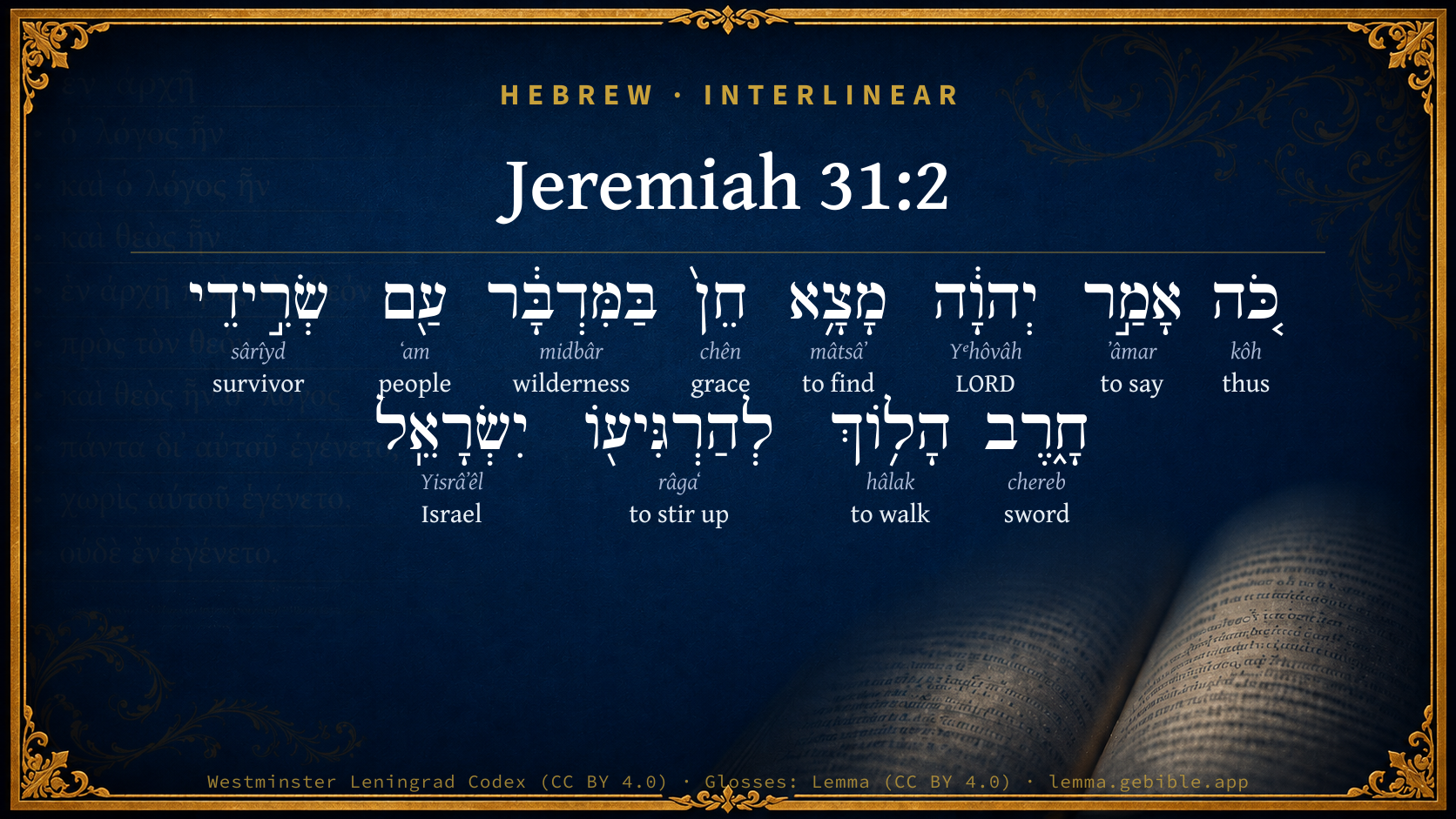
Hebrew (Westminster Leningrad Codex) Jeremiah 31:2 appears in the Hebrew Old Testament. The text above is from the Westminster Leningrad Codex. Each word links to its Strong’s number, a concise gloss, and parsing drawn from the Open Scriptures Hebrew Bible morphology. Click any word for its full Brown-Driver-Briggs (BDB) entry.
Download image
Cite this verse

Jeremiah 31:2 (World English Bible). Public Domain. Lemma interlinear Bible study tool, https://lemma.gebible.app/v/jeremiah/31/2.

Show BibTeX & RIS
BibTeX
RIS
English Translation
Thus says Yahweh, The people who were left of the sword found favor in the wilderness; even Israel, when I went to cause him to rest.
World English Bible · Public Domain
Download a study sheet

One document with this verse’s original text, its word-by-word gloss line, the meaning frame, cross-references with their text, attributed commentary, and full source and license credits — printable, and it pastes into notes with its structure intact.

This verse Autodidact and up

Study sheet (.html) Plain text (.txt)

A passage Seminary Student

Up to 50 verses in one chapter. A passage sheet keeps up to 6 commentary sources and 12 cross-references per verse, in the order this page ranks them, and says so on the sheet whenever that leaves anything out. Ask for a single verse and you get the Autodidact verse sheet above.

Everything on this page stays free to read, with no account — the sheet is a download of what is already on screen, not access to it.

Want to remove ads? Support Godless Engineer
Compare translations 3

The same verse in 3 English versions, stacked beneath the original-language interlinear above. Click any original word for its lexicon entry.

Each is an independent rendering of the whole verse — the interlinear is not word-aligned to these translations.

Highlighted words mark where these versions differ — a whole-verse word diff, not a word-by-word alignment.

  • World English Bible Public Domain
    Thus says Yahweh, The people who were left of the sword found favor in the wilderness; even Israel, when I went to cause him to rest.
  • King James Version Public Domain
    Thus saith the LORD, The people which were left of the sword found grace in the wilderness; even Israel, when I went to cause him to rest.
  • unfoldingWord Literal Text CC BY-SA 4.0
    Yahweh says this, “The people who have survived the sword have found favor in the wilderness; I will go out to give rest to Israel.”

unfoldingWord Literal Text — © unfoldingWord, licensed CC BY-SA 4.0. Word-aligned USFM3 via Door43 (git.door43.org/unfoldingWord/en_ult).

Versions to compare (up to 4)

3 of 4 selected

Show all 18 translations

Every available English version of this verse, each an independent rendering of the whole verse.

  • World English Bible Public Domain
    Thus says Yahweh, The people who were left of the sword found favor in the wilderness; even Israel, when I went to cause him to rest.
  • Berean Standard Bible Public Domain
    This is what the LORD says: “The people who survived the sword found favor in the wilderness when Israel went to find rest.”
  • Majority Standard Bible Public Domain
    This is what the LORD says: “The people who survived the sword found favor in the wilderness when Israel went to find rest.”
  • King James Version Public Domain
    Thus saith the LORD, The people which were left of the sword found grace in the wilderness; even Israel, when I went to cause him to rest.
  • American Standard Version (1901) Public Domain
    Thus saith Jehovah, The people that were left of the sword found favor in the wilderness; even Israel, when I went to cause him to rest.
  • Revised Version (1885) Public Domain
    Thus saith the LORD, The people which were left of the sword found grace in the wilderness; even Israel, when I went to cause him to rest.
  • Geneva Bible (1599) Public Domain
    Thus saith the Lord, The people which escaped the sworde, founde grace in the wildernes: he walked before Israel to cause him to rest.
  • Douay-Rheims (1899) Public Domain
    Thus saith the Lord: The people were left and escaped from the sword, found grace in the desert: Israel shall to his rest.
  • Young's Literal Translation Public Domain
    Thus said Jehovah: Found grace in the wilderness Hath a people remaining from the sword Going to cause it to rest -- Israel.
  • Literal Standard Version CC BY-SA 4.0
    Thus said YHWH: “A people remaining from the sword || Have found grace in the wilderness || When Israel went to find rest.”
  • Unlocked Literal Bible CC BY-SA 4.0
    Yahweh says this, “The people who have survived the sword have found favor in the wilderness; I will go out to give rest to Israel.”
  • unfoldingWord Literal Text CC BY-SA 4.0
    Yahweh says this, “The people who have survived the sword have found favor in the wilderness; I will go out to give rest to Israel.”
  • Darby Bible Public Domain
    Thus saith Jehovah: The people [that were] left of the sword have found grace in the wilderness, [even] Israel, when I go to give him rest.
  • World Messianic Bible Public Domain
    The LORD says, “The people who survive the sword found favor in the wilderness; even Israel, when I went to cause him to rest.”
  • Webster's Bible Public Domain
    Thus saith the LORD, The people who were left by the sword found grace in the wilderness; even Israel, when I went to cause him to rest.
  • Free Bible Version CC BY-SA 4.0
    This is what the Lord says: The Israelites who survive death by the sword were blessed by the Lord in the desert as they looked for peace and quiet.
  • Bible in Basic English Public Domain
    The Lord has said, Grace came in the waste land to a people kept safe from the sword, even to Israel on the way to his resting-place.
  • JPS Tanakh (1917) Public Domain
    Thus saith the LORD: The people that were left of the sword have found grace in the wilderness, even Israel, when I go to cause him to rest.

Literal Standard Version (2020), Covenant Press — licensed CC BY-SA 4.0. Text via the HelloAO Bible API (eBible.org). Unlocked Literal Bible (unfoldingWord) — licensed CC BY-SA 4.0. Text via the HelloAO Bible API (eBible.org). unfoldingWord Literal Text — © unfoldingWord, licensed CC BY-SA 4.0. Word-aligned USFM3 via Door43 (git.door43.org/unfoldingWord/en_ult). Free Bible Version, Dr. Jonathan Gallagher — licensed CC BY-SA 4.0. Text via the HelloAO Bible API (eBible.org).

Word by word

More ways to search: Search by grammar → Find every occurrence → Compare this word →

Practice this passage: Drill this verse → Learn its vocabulary →

לְהַרְגִּיע֖וֹ
râgaʻ
H7280
“to stir up · him”
Preposition + Verb, Hiphil, Infinitive Construct + Suffix, Personal, 3rd Person, Masculine, Singular
Part of Speech
Preposition + Verb
Stem
Hiphil
Form
Infinitive Construct
Full BDB Definition

Origin: a primitive root

TWOT: 2116 , 2117 , 2118

to act in an instant, stir up, disturb - (Qal) to stir up, disturb - (Hiphil) to make a twinkling - to rest or repose, be at rest or repose, settle, quiet, give rest - (Niphal) - to cause to rest (of sword, of the sea) - to wink (with preposition) - (Hiphil) - to give rest to - to rest, repose - to harden
  1. כֹּ֚ה kôh H3541 “thus” Adverb
  2. אָמַ֣ר ʼâmar H559 “to say” Verb, Qal, Perfect, 3rd Person, Masculine, Singular
  3. יְהוָ֔ה Yᵉhôvâh H3068 “LORD” Noun, Proper
  4. מָצָ֥א mâtsâʼ H4672 “to find” Verb, Qal, Perfect, 3rd Person, Masculine, Singular
  5. חֵן֙ chên H2580 “grace” Noun, Common, Masculine, Singular, Absolute
  6. בַּמִּדְבָּ֔ר midbâr H4057 “in/at the · wilderness” Preposition, Determined + Noun, Common, Masculine, Singular, Absolute
  7. עַ֖ם ʻam H5971 “people of” Noun, Common, Masculine, Singular, Construct
  8. שְׂרִ֣ידֵי sârîyd H8300 “survivors of” Noun, Common, Masculine, Plural, Construct
  9. חָ֑רֶב chereb H2719 “sword” Noun, Common, Feminine, Singular, Absolute
  10. הָל֥וֹךְ hâlak H1980 “to walk” Verb, Qal, Infinitive Absolute
  11. יִשְׂרָאֵֽל Yisrâʼêl H3478 “Israel” Noun, Proper

About this verse

These counts appear in no published source. They are computed here, from the morphology-tagged text and Lemma’s own curated glosses. What Lemma adds →

12
words
12
distinct lemmas
Prophets
section

Notable vocabulary

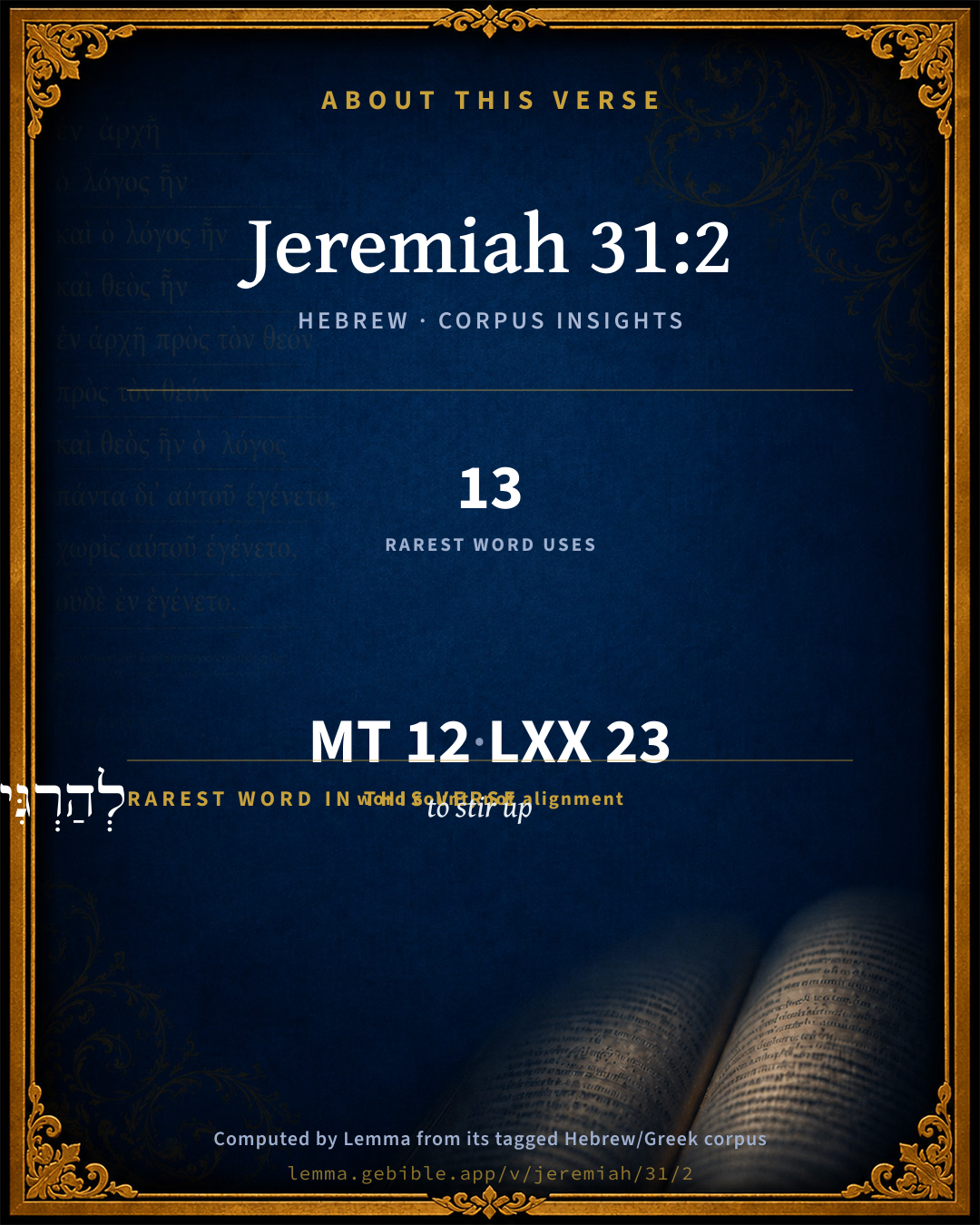
The rarest word here is לְהַרְגִּיע֖וֹ to stir up H7280 — appearing just 13 times in the whole Hebrew Bible.

Shared distinctive vocabulary

לְהַרְגִּיע֖וֹ to stir up H7280 occurs in 13 verses of the Hebrew Bible. Also found in:

Grammatical profile

  • 4 verbs
  • 7 nouns
  • 1 adverb

Verb forms

  • אָמַ֣ר Qal · Perfect
  • מָצָ֥א Qal · Perfect
  • הָל֥וֹךְ Qal · Infinitive Absolute
  • לְהַרְגִּיע֖וֹ Hiphil · Infinitive Construct

Hebrew & Septuagint length

In the original languages it is 12 Hebrew tokens and 23 Greek tokens — but the two are counted differently (Hebrew bundles its prefixes and suffixes into one token; the Greek is in lemma form), so that isn’t a like-for-like length.

Cross-references

29

Topical passages linked to Jeremiah 31:2 in the Treasury of Scripture Knowledge — connected by theme and wording, ordered by reader-vote popularity; previews shown in the World English Bible.

  • Numbers 10:33 They set forward from the Mount of Yahweh three days' journey; and the ark of the covenant of Yahweh went before them three days' journey, to seek out a resting-place for them.
  • Psalms 95:11 Therefore I swore in my wrath, "They won't enter into my rest."
  • Deuteronomy 1:33 who went before you in the way, to seek you out a place to pitch your tents in, in fire by night, to show you by what way you should go, and in the cloud by day.
  • Matthew 11:28 "Come to me, all you who labor and are heavily burdened, and I will give you rest.
  • Isaiah 63:7–14 I will make mention of the loving kindnesses of Yahweh, [and] the praises of Yahweh, according to all that Yahweh has bestowed on us, and the great goodness toward the house of Israel, which he has bestowed on them according to his mercies, and according to the multitude of his loving kindnesses.
  • Exodus 1:16 and he said, "When you perform the duty of a midwife to the Hebrew women, and see them on the birth stool; if it is a son, then you shall kill him; but if it is a daughter, then she shall live."
  • Exodus 1:22 Pharaoh charged all his people, saying, "You shall cast every son who is born into the river, and every daughter you shall save alive."
  • Exodus 14:8–12 Yahweh hardened the heart of Pharaoh king of Egypt, and he pursued after the children of Israel; for the children of Israel went out with a high hand.
  • Exodus 15:9–10 The enemy said, 'I will pursue, I will overtake, I will divide the spoil. My desire shall be satisfied on them. I will draw my sword, my hand shall destroy them.'
  • Exodus 17:8–13 Then Amalek came and fought with Israel in Rephidim.
  • Exodus 33:14 He said, "My presence will go with you, and I will give you rest."
  • Numbers 14:20 Yahweh said, I have pardoned according to your word:
  • Deuteronomy 1:30 Yahweh your God who goes before you, he will fight for you, according to all that he did for you in Egypt before your eyes,
  • Deuteronomy 2:7 For Yahweh your God has blessed you in all the work of your hand; he has known your walking through this great wilderness: these forty years Yahweh your God has been with you; you have lacked nothing.
  • Deuteronomy 8:2–3 You shall remember all the way which Yahweh your God has led you these forty years in the wilderness, that he might humble you, to prove you, to know what was in your heart, whether you would keep his commandments, or not.
  • Deuteronomy 8:16 who fed you in the wilderness with manna, which your fathers didn't know; that he might humble you, and that he might prove you, to do you good at your latter end:
  • Deuteronomy 12:9 for you haven't yet come to the rest and to the inheritance, which Yahweh your God gives you.
  • Nehemiah 9:12–15 Moreover in a pillar of cloud you led them by day; and in a pillar of fire by night, to give them light in the way in which they should go.
  • Psalms 78:14–16 In the daytime he also led them with a cloud, And all night with a light of fire.
  • Psalms 78:23–29 Yet he commanded the skies above, And opened the doors of heaven.
  • Psalms 78:52 But he led forth his own people like sheep, And guided them in the wilderness like a flock.
  • Psalms 105:37–43 He brought them forth with silver and gold. There was not one feeble person among his tribes.
  • Psalms 136:16–24 To him who led his people through the wilderness; For his loving kindness endures forever:
  • Jeremiah 2:2 Go, and cry in the ears of Jerusalem, saying, Thus says Yahweh, I remember for you the kindness of your youth, the love of your weddings; how you went after me in the wilderness, in a land that was not sown.
  • Ezekiel 20:14–17 But I worked for my name's sake, that it should not be profaned in the sight of the nations, in whose sight I brought them out.
  • Hebrews 4:8–9 For if Joshua had given them rest, he would not have spoken afterward of another day.
  • Exodus 2:23 It happened in the course of those many days, that the king of Egypt died, and the children of Israel sighed because of the bondage, and they cried, and their cry came up to God because of the bondage.
  • Exodus 5:21 and they said to them, "May Yahweh look at you, and judge, because you have made us a stench to be abhorred in the eyes of Pharaoh, and in the eyes of his servants, to put a sword in their hand to kill us."
  • Exodus 12:37 The children of Israel traveled from Rameses to Succoth, about six hundred thousand on foot who were men, besides children.

Cross-references courtesy of OpenBible.info (CC BY 4.0).

Hebrew and Greek witnesses Masoretic Hebrew ↔ Greek Septuagint

The same verse in the two great witnesses to the Old Testament, shown verse-for-verse.

These are two independent witnesses, not word-aligned to each other, and the Septuagint is shown in lemma (dictionary) form.

Hebrew Jeremiah 31:2 Masoretic · Westminster Leningrad Codex

כֹּ֚ה אָמַ֣ר יְהוָ֔ה מָצָ֥א חֵן֙ בַּמִּדְבָּ֔ר עַ֖ם שְׂרִ֣ידֵי חָ֑רֶב הָל֥וֹךְ לְהַרְגִּיע֖וֹ יִשְׂרָאֵֽל

Thus says Yahweh, The people who were left of the sword found favor in the wilderness; even Israel, when I went to cause him to rest.

World English Bible · Public Domain

Greek LXX Structure differs

In the Septuagint, Jeremiah is about an eighth shorter than the Hebrew and arranges its material differently — the Oracles Against the Nations (Hebrew chapters 46–51) appear in the middle of the Greek book, after 25:13. Because the chapter and verse boundaries do not line up, a verse-for-verse comparison with the Hebrew is not shown.

A verse-for-verse comparison isn’t shown here because the chapters and verses don’t line up. Switch to the LXX edition with the MT / LXX toggle above to read the Greek directly.

On this verse, Haydock's Catholic Bible Commentary discusses the Septuagint’s reading. Read the note in Commentary ↓

Hebrew: Westminster Leningrad Codex (CC BY 4.0). Greek: Septuagint (public domain); English from a public-domain English Septuagint. How the Septuagint differs from the Hebrew →

Targum (Aramaic paraphrase)

1

The Targum is the ancient Jewish Aramaic paraphrase of the Hebrew Scriptures — an interpretive translation, not the Hebrew text itself. Onkelos (literal) and Pseudo-Jonathan (expansive) render the Torah, and Jonathan the Prophets. Coverage is partial: where no permissively-licensed English translation exists for a verse, only the Aramaic is shown. This is verse-level text, not a word-by-word alignment to the Hebrew.

  1. Targum Jonathan Prophets (Joshua–Malachi)
    כִּדְנַן אֲמַר יְיָ דִיהַב רַחֲמִין לְעַמָא דִנְפַק מִמִצְרַיִם סִפּוּק צָרְכֵיהוֹן בְּמַדְבְּרָא כַּד הֲווֹ מְעָרְקִין מִן קֳדָם דְקַטְלִין בְּחַרְבָּא דַבֵּר בְּמֵימְרֵיהּ לְאַשְׁרָאָה בֵּית נְיָחָא יִשְׂרָאֵל:

    Thus said the Lord: I gave compassion to the people who came out of Egypt, and they needed sustenance in the desert, as they fled from those who had wished to killed them by sword, he led them by his word to show them the way to the home of rest; Israel."...

    Targum Jonathan — Aramaic: “Mikraot Gedolot” (public domain). English: “Sefaria Community Translation” (CC0 1.0 (public-domain dedication)); “London "Chaldee Paraphrase," 1871” (public domain). Text via Sefaria.

Commentary

Notes on Jeremiah 31:2 from classic Christian and Jewish commentators (each source and its license shown beneath its notes). The classic Christian expositions comment on the surrounding passage and are grouped to its opening verse, so a note may address several verses; the Jewish commentaries on the Tanakh (Rashi and others) are per-verse, so they appear only where the commentator wrote on this verse.

Lemma curates 59 commentaries, every one of them public domain or Creative Commons licensed, each selected and text-cleaned for this edition rather than reprinted as found. About our sources →

Trapp's Complete Commentary

John Trapp

Jer 31:2 Thus saith the LORD, The people [which were] left of the sword found grace in the wilderness; [even] Israel, when I went to cause him to rest.

Ver. 2. The people that were left of the sword.] Of Pharaoh’s sword, who pursued them; and though he smote them not, because the Lord kept him off, yet he is said to have done it: {a} like as Balak afterwards "arose and fought against Israel," {Jos 24:9} he had a mind so to have done, but that he was overawed: he did not indeed, because he dared not.

When I went to bring him to rest,] i.e., To the land of Canaan, after so long trouble and travel. I effected that then, though it were held improbable or impossible: so will I do this promised reduction of my people from Babylon.

{a} Fieri dicitur quod tentatur aut intenditur.

John Trapp, A Commentary or Exposition upon All the Books of the Old and New Testament (1647–1656) — public domain. Text from a community e-Sword module.

Joseph Benson's Commentary

Jer 31:2. The people that were left of the sword — That sword of Pharaoh with which he cut off the male children as soon as they were born, and that sword with which he threatened to cut them off when he pursued them to the Red sea. Found grace in the wilderness — Though in the wilderness, where they seemed to be lost and forgotten, as these latter Jews and Israelites were now in a strange land, yet they found grace in God’s sight, were owned, and highly honoured by him, and blessed with wonderful instances of his peculiar favour. And he went to cause them to rest — Went before them in a pillar of cloud, to mark out the places for them where they should pitch their tents, and conducted them to the land that he had provided for them. And after such evidences of his kindness to them, why should they doubt of the continuance of his favours?

Joseph Benson's Commentary on the Old and New Testaments (1811–1818) — public domain. Text from a community e-Sword module.

Tyndale Open Study Notes

Tyndale Open Resources

31:2 The Lord directed his message to those who would survive the coming destruction at the fall of Jerusalem in 586 BC.

Tyndale Open Study Notes — © Tyndale Open Resources, licensed CC BY-SA 4.0. Text via the HelloAO Bible API.

Geneva Bible (1599)

Geneva Bible translators

Which were delivered from the cruelty of Pharaoh.

To wit, God.

Geneva Bible (1599) marginal notes — public domain. Text via Bolls.life.

Jamieson, Fausset & Brown

Robert Jamieson, A. R. Fausset & David Brown

Upon the grace manifested to Israel "in the wilderness" God grounds His argument for renewing His favors to them now in their exile; because His covenant is "everlasting" (Jer 31:3), and changes not. The same argument occurs in Hos 13:5, Hos 13:9-10; Hos 14:4-5, Hos 14:8. Babylon is fitly compared to the "wilderness," as in both alike Israel was as a stranger far from his appointed "rest" or home, and Babylon is in Isa 40:3 called a "desert" (compare Jer 50:12).

I went to cause him to rest--namely, in the pillar of cloud and fire, the symbol of God's presence, which went before Israel to search a resting-place (Num 10:33; Isa 63:14) for the people, both a temporary one at each halt in the wilderness, and a permanent one in Canaan (Exo 33:14; Deu 3:20; Jos 21:44; Psa 95:11; Heb 3:11).

Jamieson, Fausset & Brown — Commentary Critical and Explanatory on the Whole Bible (1871) — public domain (CC PDM 1.0). Text via the HelloAO Bible API.

Adam Clarke's Commentary

Verse 2. The people which were left of the sword] Those of the ten tribes that had escaped death by the sword of the Assyrians.

Found grace in the wilderness] The place of their exile; a wilderness, compared to their own land.-Dahler. See Isa 40:3.

Adam Clarke's Commentary on the Bible (1810–1826) — public domain. Text from a community e-Sword/MySword module.

John Calvin's Commentaries

I omit here any remarks on the first verse; for it was explained in connection, with the 22d verse of the last chapter (Jeremiah 30:22). The verb הלוך eluk, in the second verse, is in the infinitive mood, but it is to be taken as a preterite, and in this interpreters agree. But some apply it to God, that he is a leader to his people, until he brings them to rest; and as the verb, להרגיעו, laeregiou, to rest him, so to speak, is in Hiphil, it seems that this ought to be ascribed to God. But we may take the words more simply, “until he betakes himself to rest;” added afterwards is the word “Israel;” and thus we may render the pronoun “himself,” and not “him,” — until then he betook himself to rest

Let us now come to the truth which the Prophet handles: he reminds the people, no doubt, of the ancient benefits of God, in order that the miserable exiles might entertain hope, and not doubt but that God would be their deliverer, though they were drowned, as it were, in Chaldea, and overwhelmed with a deluge of evils. This is the reason why he mentions the desert, and why Jeremiah also adds, that they who were then preserved had escaped from the sword For the people, though they dwelt in a pleasant and fertile country, were in a manner in a desert, when compared with their own country. As then the Israelites had been driven far away into foreign lands, all the regions where they then inhabited are compared to a desert. A similar mode of speaking is adopted by Isaiah when he says,

“A voice crying in the desert, Prepare ye the way of Jehovah, make straight paths in the wilderness.” (Isaiah 40:3)

What did he understand then by desert? even the most fertile regions, Chaldea, Assyria, and other neighboring countries. But with regard to the people, he thus calls these countries, because their exile was always sorrowful and miserable. So then in this place the Prophet, in order to animate the exiles with hope, says, that though they had been sent away to unknown regions, yet distance, or anything else which might seem opposed to their liberation, could not prevent God to restore them; for he formerly liberated their fathers when they were in Egypt.; Now as the Jews might again object and say, that they were few in number, and also that they were ever exposed to the sword, as they dwelt among conquerors the most cruel, he says, that their fathers were not preserved otherwise than by a miracle; they had been snatched, as it were, from the midst of death.

We now perceive the design of the Prophet; and we may include in a few words the substance of what he says, — That there was no reason to fear, that God would not, in due time, deliver his people; for it was well known, that when he became formerly the liberator of his people, his power was rendered illustrious in various ways, nay, that it was inconceivably great, since for forty years he nourished his people in the desert, and also that their coming out was as though the dead arose from their graves, for the Egyptians might have easily killed the whole people; so that they were taken as it were from death, when they were led into the land which had been promised to Abraham. There was therefore no doubt but that God would again, in a wonderful way, deliver them, and manifest the same power in liberating them as was formerly exhibited towards their fathers.

A profitable doctrine may hence be gathered: Whenever despair presents itself to our eyes, or whenever our miseries tempt us to despair, let the benefits of God come to our minds, not only those which we ourselves have experienced, but also those which he has in all ages conferred on his Church, according to what David also says, who had this one consolation in his grief, when pressed down with extreme evils and almost overwhelmed with despair,

“I remember the days of old.” (Psalm 143:5)

So that he not only called to mind the benefits of God which he himself had experienced, but also what he had heard of from his fathers, and what he had read of in the books of Moses. In the same manner the Prophet here reminds us of God’s benefits, when we seem to be forsaken by him; for this one thought is capable of alleviating and comforting us. This is the import of the whole. It now follows —

John Calvin's Commentaries (1540-1563) — public domain. Text from the Calvin Translation Society English edition (1840s-50s) via the Christian Classics Ethereal Library (ccel.org). Calvin's coverage is partial (roughly two-thirds of the Bible); uncommented books and verses are honest gaps, never fabricated. The 19th-century editor's footnotes and remarks are omitted so the notes are faithfully Calvin's own voice.

Ellicott's Commentary for English Readers

(2) The people which were left of the sword . . .—The main thought of this and the next verse is that the past experience of God’s love is a pledge or earnest for the future. Israel of old had “found grace in the wilderness” (comp. Hos_11:1). But as the prophet has in his thoughts a new manifestation of that love, his language is modified accordingly. He thinks of the captives that had escaped, or should hereafter escape, the sword of the Chaldæans (there had been no such deliverance in the case of the Egyptian exodus), and of their finding grace in the wilderness that lies between Palestine and the Euphrates. The verses that follow show, however, that the prophet is thinking also of the more distant exiles, the ten tribes in the cities of the Medes beyond the Tigris (2Ki_17:6).

Even Israel, when I went to cause him to rest.—The verb that answers to the last five words includes the meaning of “settling” or “establishing,” as well as of giving rest; and the whole clause is better translated Let me go, or I will go (the verb is in the infinitive with the force of an imperative, but this is its meaning) to set him at rest, even Israel.

A Bible Commentary for English Readers, edited by Charles John Ellicott (1878–1897) — public domain. Text from a community e-Sword module.

The Cambridge Bible for Schools and Colleges

gen. ed. J. J. S. Perowne

2. Gi., Du. and Co. agree in considering Jer_31:1-6 as, in their main substance, a genuine and early utterance of Jeremiah. The language suggests a date approximately that of ch. 3. Those of the Northern tribes who have survived the slaughter attendant upon their overthrow, and are in the “wilderness” of exile, shall see the Lord, and find favour in His eyes. Their hitherto restless wanderings shall have an end. They shall return to their old home. The verbs are in the “prophetic past.” The prophet describes the reconciliation with Jehovah as already accomplished.

when I went to cause him to rest] or, mg. when he went to find him rest; but better than either (as Jehovah appears still to be the speaker), I will go, that I may cause Israel to rest (so Dr.).

The Cambridge Bible for Schools and Colleges (gen. ed. J. J. S. Perowne; Cambridge University Press, 1878–1918) — public domain. Text from a community e-Sword module.

John Gill's Exposition

Thus saith the Lord, the people which were left of the sword,.... Which were not consumed by the sword of Pharaoh, who perished not through his cruel edicts, and by his sword, when drawn at the Red sea; nor by the sword of the Amalekites and Amorites; or of their own brethren, who sometimes, for their sins, were ordered to slay many, as on account of the molten calf, and joining to Baalpeor: but there was a remnant that escaped, who

found grace in the wilderness; in the sight of God, who went before them, protected and defended them from their enemies; gave them his holy law, his statutes, and his judgments; fed them with manna and quails; clave the rocks, and gave them water to drink; and supplied them with everything necessary for them, Psa 78:5;

even Israel, when I went to cause him to rest; went before him in a pillar of cloud by day, and in a pillar of fire by night; and in the ark, the symbol of his presence; and not only to search out a resting place for them for a few days, but to bring them to Canaan, the land of rest, which he had promised them, Exo 13:21; now this past instance of divine goodness is mentioned, to encourage faith in the fulfilment of the above promise. The whole is paraphrased by the Targum thus,

"these things saith the Lord, who gave mercies to the people that came out of Egypt; he supplied their necessities in the wilderness, when they fled from before those who slay with the sword; he led them by his word, to cause Israel to dwell in a place of rest.''

Some render the words in the future, "shall find grace", &c. "shall go to his rest", &c. and so apply it to the Jews that escaped the sword of the Chaldeans, and found favour in the wilderness of the people into which they were brought, and as they returned into their own land from the captivity. And it, nay be also applied to the Jews that were left of the sword of the Romans in their last destruction, who have found much favour among the nations; as they do in ours, and others, now; and who in time will return to their own land, and be in rest, Jer 30:10. Yea, it is applicable enough to the church and people of God in their present state; who are left of the sword of the Papists, and are now in the wilderness, where they are nourished for a time, and times, and half a time; and before long will be brought into a state of settled rest and tranquillity.

John Gill's Exposition of the Whole Bible (1746–1763) — public domain (CC PDM 1.0). Text via the HelloAO Bible API.

Albert Barnes' Notes on the Bible

The people which were left of the sword - A promise of the restoration of the ten tribes to their land.

The wilderness - Either the desert which lay between Assyria and Palestine; or more probably an allusion to the wilderness of Mount Sinai.

Found grace ... rest - Rather, “shall certainly find grace; I will go to give Israel rest.

Albert Barnes' Notes on the Bible (1834–1885) — public domain. Text from a community e-Sword/MySword module.

Haydock's Catholic Bible Commentary

Desert. From which the former inhabitants had been driven, (4 Kings xvii. 6, 24.; Calmet) or, as those under Moses were favoured, (Haydock) so shall the captives. (Grotius) --- Septuagint, "I found him warm," (Greek: thermon, means also a lupin, which has misled the old Latin interpreters. St. Jerome) murdered "in the desert, with those slain by the sword. Go, and destroy not Israel." (Haydock)

George Leo Haydock (1774–1849), Haydock's Catholic Family Bible and Commentary, 1859 edition — public domain. Excludes Psalms (Douay-Rheims chapter numbering differs from Protestant) and Deuterocanonical books (Catholic canon only).

Matthew Poole's English Annotations

God confirmeth the aforementioned promises, and his people’s hope and faith in them, by minding them of what he had anciently done for this very people. Though God did, in the journey which the Israelites had from Egypt to Canaan, cut off many of them by the sword for their iniquities, some by the Amalekites, Exo 17:8, some by the swords of their brethren for the idolatry they committed about the golden calf, Exo 32:28; yet those that survived that and other judgments found favour in God’s eyes while they were going to Canaan the land of rest, or while God, going before them, brought them into Canaan. God paralleleth his future providences and gracious purposes with his past gracious providences.

Matthew Poole's English Annotations on the Holy Bible (1683–1685) — public domain. Text from a community e-Sword/MySword module.

Whedon's Commentary on the Bible

Daniel D. Whedon

2. The people — Those of Jeremiah’s time, and not, as the language might suggest and as some have thought, of Moses’s time. See Jer_51:50.

Wilderness — Babylon.

Daniel D. Whedon (gen. ed.), Commentary on the Old and New Testaments (1874–1909) — public domain. Text from a community e-Sword module.

The Pulpit Commentary

The people which were left of the sword, etc.; literally, the people of those left of the sword. The expression clearly implies that the Jews at the time spoken of had escaped, or were about to escape, in some great battle or some other kind of slaughter. Hence the finding grace in the wilderness cannot refer to the sequel of the passage through the Red Sea, and we must perforce explain it of the second great deliverance, viz. from the Babylonian exile. This view is strongly confirmed by Jer_51:50, where the Israelites who escape the predicted slaughter at Babylon are called "escaped ones from the sword," and exhorted to remember Jehovah and Jerusalem "afar off." The "wilderness" of the present passage, like the "afar off" of Jer 51 (and of the next verse) seems to mean Babylon, which was, by comparison with the highly favoured Judah, a "barren and dry land", (comp. Psa_63:1) a spiritual Arabia. It may be objected that the tense here is the perfect; but there is abundance of analogy for explaining it as the prophetic perfect. The restoration of the chosen people to favour is as certain in the Divine counsels as if it were already an event past. (It seems less appropriate to understand "the wilderness" of the country which separated Assyria from Palestine. It was in Babylon that the covenant of Sinai was renewed to God"s repentant people.) Even Israel, when I went to cause him to rest; rather, when I went to cause Israel to rest (literally, to cause him Israel to rest; but the pleonastic pronoun need not be represented in the English). Another possible and perhaps preferable rendering is, I will go to cause, etc. "Rest" could only be had in the consciousness of God"s favor. With all the outward property of many of the Jews in Babylon, there was no true "rest." Comp. chap. 16, "Ask for the old paths.., and walk therein, and ye shall find rest for your souls" (the same verbal root in the Hebrew for "rest" in both passages).

HOMILIES BY A.F. MUIR Ver. 2. Grace preparing for grace.

There is some doubt as to the time alluded to, whether that of the Exodus or that of the Exile. A careful examination would seem to make it clear that the former alone corresponds to the description. Pharaoh"s cruel edict and the judgments and wars of the desert thinned the ranks of the Israelites. A remnant was left, with whom God entered into covenant relationship. Their survival under these circumstances was a sign of the Divine favour, at the time hard to be understood, but in the future abundantly confirmed. Their ultimate entrance into Canaan was the seal of their acceptance.

I THE PRESENT TROUBLES OF SAINTS ARE NO PROOF OF THEIR REJECTION. The history of the Church shows this. Here is an instance; there have been many such. The best of God"s servants have been most severely tried, and that just before attaining great rewards and satisfactions. The exiles of Babylon are, therefore, to be of good cheer. The afflictions of the present may not only be the punishment for past transgressions, but much more a preparation for future blessedness and usefulness, a grace in germ if not in formation. In the case of the Church they may bring back to a study of the title deeds of faith; in that of the individual they may promote humility, heart searching, and efforts to amend. However hard to bear, they should be endured as a grace preparing for grace.

II WHERE THE ESSENCE OF GOD"S GRACE IS PRESENT, THE FULNESS OF IT MAY BE WAITED FOR.

1. What is the essential element in grace? Is it not the consciousness of acceptance with God? The child of God knows that he is such, and that therefore he is the subject of gracious influences from the Holy Spirit, and heir of all that is truly good.

2. It is in view of this that present circumstances are to be interlarded. The good as well as the evil. Our true, eternal blessedness lies beyond our greatest present happiness, amongst the "things prepared." Our anxiety should be, not for immediate possessions, but for meetness for the inheritance, and for entering in by the right way. M.

Troubles lessened by increase.

"The people which were... wilderness." The sword by which Israel had been decimated, her ranks thinned, her homes desolated what a trouble was that! And now it is to be followed by "the wilderness that "waste howling wilderness" so vividly described by Moses. (Deu_1:19 Deu_8:15 Deu_32:10) This would seem another, a new, a sore trouble, but it was to be the means of healing the wound caused by the first. Cf. "I have given the valley of Achor for a door of hope". (Hos_2:15)

I THE MEANING OF THESE WORDS. It is not easy to say certainly what sword and what wilderness the prophet had in his mind when he thus wrote. Perhaps the sword of Pharaoh and the wilderness of Sinai. Yet more likely the sword of their Babylonian conquerors; and the wilderness, that great Syrian desert across which they must travel on their homeward way a wilderness far more deserving of the dread epithets which Moses applied to the wilderness of Sinai. Or the wilderness may mean the whole condition of the Jews in their exile, the deep sorrow, shame, and distress which their captivity seemed to threaten them with.

II But, let it be understood how it may, THE PROPHETIC STATEMENT IS TRUE. In the wilderness of Sinai what grace God"s people found there! Blessings in basket and in store, in guidance, governance, guardianship; in instruction, discipline, and development as a nation: how they were welded together, trained for duty, qualified for the high honour God designed for them! And in the wilderness which they had to cross on their return from their exile, infested, then as now, with robber tribes, to whom their comparatively scant numbers, their unwarlike character, and above all their treasures of gold and silver destined for the temple of God, would offer an irresistible temptation, how could the exiles have escaped this peril of the wilderness, to say nothing of many others, but for the grace of God? It was emphatically true that they "found grace in the wilderness." Those dreary leagues of burning sand, the awful dangers of the way, might well have daunted them, and no doubt did deter the majority of the people from all attempt at return; for it was but a remnant that came back. But all these perils were surmounted. Day after day for four months the caravan of the exiles crept along the wilderness way. "Unlike that of Sinai, it was diversified by no towering mountains, no delicious palm groves, no gushing springs. A hard gravel plain from the moment they left the banks of the Euphrates till they reached the northern extremity of Syria, with no solace except the occasional wells and walled stations. Ferocious hordes of Bedouin robbers then, as now, swept the whole trail." But like their great ancestor, "they went forth to go into the land of Canaan; and into the laud of Canaan they came." "They," as he, "found grace in the wilderness." And so abundant was that grace that their perilous enterprise became a veritable march of triumph. "The redeemed of the Lord shall return, and come with singing unto Zion; and everlasting joy shall be upon their head: they shall obtain gladness and joy; and sorrow and mourning shall flee away." "As before some royal potentate, there would go before them an invisible Protector, who should remove the hard stones from the bare feet of those that ran beside the camels, and cast them up in piles on either side to mark the broad track seen for miles along the desert." (Cf. Isa_40:1-4, for description of this grace found in the wilderness.) And so what seemed so sore a trouble added on to the sword of the exile, was in reality the healing of the wound caused by that sword. But this is often the Divine plan. The second trouble heals the first, and so trouble is lessened by increase. Note

III FURTHER ILLUSTRATIONS. The plague of London was followed by the fire, but that fire purged the city as nothing else could, and no such plague has visited it since. In medical science it is well known how often one disease is driven out by another. In the hot, close valleys of mountainous lands the wild storm is welcomed, notwithstanding its fierce might, overturning and destroying in ruthless manner, for it purges the whole atmosphere and drives away the seeds of disease and death. The heat was terrible, and the storm, but the second trouble lessened the first. To have to leave Paradise and to go out into a wilderness in which thorns and briars should abound was another trouble, but the labour the second demanded was to be the healing force whereby the first loss should be lessened and the curse turned into a blessing. What a tissue of troubles Jacob"s life seems to have been made up of! and yet once and again the new trouble healed the old. The imprisonment of his sons in Egypt led to his recovery of his lost son Joseph. Death follows on disease. Ah! what a new trouble is death in instances not a few! but in that wilderness of the grave what grace the departed soul finds there! Take our Lord"s illustration of the birth of children: how the last sorrows of the birth throes, the dread hour of travail, because thereby a new life is born, are with all the pain that went before forgotten, "remembered no more"! And in things spiritual the law of our text is true. The prodigal"s outward misery was followed by the inward pangs of shame, remorse, and sorrow. But they led to the "I will arise and go," etc. And to a renewed soul what misery there is in the return of temptation! and if it have overcome the soul, what yet greater misery haunts the soul then! "Out of the depths have I cried unto thee, O Lord." But that new distress is to render the recurrence of the first less and less possible, and by and by impossible. In God"s providential ordering of our affairs, this same law is often shown. The straitened means that follow bereavement of the breadwinner of the household that poverty often develops character, compels the mind to turn from perpetual brooding over its loss, which it is so apt to do, draws forth sympathy of friends, and in innumerable ways works good. "All things" do, as a fact, "work together for good to them that love God.

IV THE PHILOSOPHY OF THIS. (Cf. Rom_5:3, Rom_5:4) The outward ills may not always be removed, but their power to do aught else than bless the believer is taken away. Instead of casting him down, they lead him into the full possession of that hope, having which the soul is independent of all that man or hell can do against it.

V ITS LESSON. If "the wilderness" should follow "the sword," we need not fear; that is to say, if a second sorrow should come upon the steps of a former one, we may regard it as a probable means of lessening the former, and not increasing it. The long sorrow of no Isaac born to Abraham was followed by the awful command to slay him; but that led to an issue that swallowed up in glory and joy all the darkness and sorrow of all the past, and lit up all the future of the long ages to come with a light whose radiance is as bright today as ever. Then let our song be, "Father, I wait thy daily will," etc. C.

The Pulpit Commentary (1880–1919), ed. H.D.M. Spence-Jones & Joseph S. Exell — public domain. Text from a community e-Sword module.

John Wesley's Explanatory Notes

To rest - In Canaan.

John Wesley, Explanatory Notes Upon the Whole Bible (1754–1765) — public domain. Text via the GEBible commentary corpus.

Rashi

Rabbi Shlomo Yitzchaki (Rashi)

found favor The generation of the wilderness found favor in My eyes.

who had escaped the sword of the Egyptians the Amalekites and the Canaanites.

He [therefore] went to give Israel their resting place When He led them to take possession of the land of their rest.

Rashi on the Tanakh — English translations: “The Judaica Press complete Tanach with Rashi, translated by A. J. Rosenberg” (CC BY 4.0); “Pentateuch with Rashi's commentary by M. Rosenbaum and A.M. Silbermann, 1929-1934” (public domain); “The Metsudah Tanach series, Lakewood, N.J” (CC BY 4.0); and “The Book of Joshua, Metsudah Publications, 1997” (CC BY 4.0). Text via Sefaria.

Lesson kit

Teaching starters — assembled from the data on this page, not authored interpretation. Every prompt links to the verse data it draws on. Edit before teaching.

Jeremiah, in the Prophets, opens this verse with 12 words (12 distinct Hebrew lemmas). Its most distinctive word is râgaʻ (“to stir up”). A historical commentator’s framing appears above. Read the whole chapter for the surrounding context.

Discussion questions

  1. What does “to stir up” (râgaʻ) contribute to the verse as a whole?
  2. How does Deuteronomy 28:65, which shares the word «to stir up», read alongside this verse?
  3. These translations render this verse differently; the difference is in the English rendering, not the original. What questions does that raise?
  4. «אָמַ֣ר» is a Qal Perfect verb. How does that grammatical form shape the action described?
  5. Compare how Trapp's Complete Commentary and Joseph Benson's Commentary read this verse. Where do they agree or differ?

Things to notice

Reading settings

Reading text

Shown beneath each verse's original-language words.

Old Testament
Old Testament edition

Read the OT as the Masoretic Hebrew (MT) or the Greek Septuagint (LXX).

English shown for the Greek Septuagint (in the Hebrew ↔ Greek comparison).

Comparing translations? Open the Compare panel on any verse page to stack up to four side by side.