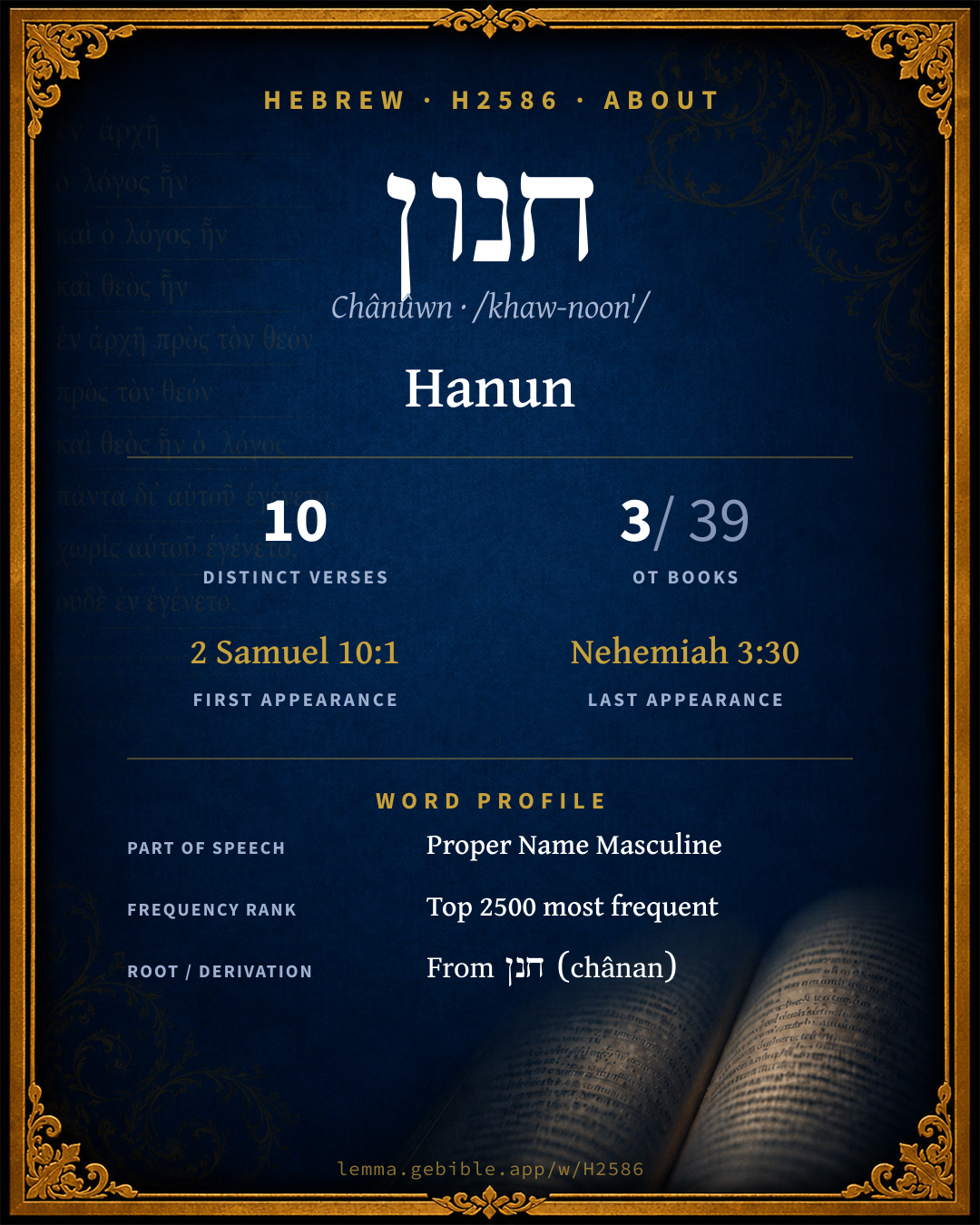
חָנוּן
Hanun
BDB lists 4 entries for ‘Hanun’ fuller range ↓
Full lexicon entry — Brown-Driver-Briggs (BDB)
From Brown-Driver-Briggs (BDB)
Where this word appears
Grammar key — what these labels mean
Part of speech
- Noun
- A naming word — a person, place, thing, or idea.
Noun type
- Proper
- A name of a specific person, place, or people (e.g. Abraham, Zion, Israel).
Every verse where H2586 appears — 10 distinct verses across 3 books. Click any verse to open its interlinear word-by-word view. Verse text shown in the World English Bible for context — . Each verse’s Hebrew form is shown with its reference; the English is not keyword-highlighted, since the data carries no word-level English alignment. Use “Compare translations” on any verse to read it across multiple English versions. This concordance covers the Hebrew Bible; Septuagint (Greek Old Testament) occurrences are not indexed here.
2 Samuel 4 verses
- 2 Samuel 10:1 חָנ֥וּן n Proper It happened after this, that the king of the children of Ammon died, and Hanun his son reigned in his place.
- 2 Samuel 10:2 חָנ֣וּן n Proper David said, I will show kindness to Hanun the son of Nahash, as his father shown kindness to me. So David sent by his servants to comfort him concerning his father. David's servants came into the land of the children of Ammon.
- 2 Samuel 10:3 חָנ֣וּן n Proper But the princes of the children of Ammon said to Hanun their lord, Do you think that David honors your father, in that he has sent comforters to you? Hasn't David sent his servants to you to search the city, and to spy it out, and to overthrow it?
- 2 Samuel 10:4 חָנ֜וּן n Proper So Hanun took David's servants, and shaved off the one half of their beards, and cut off their garments in the middle, even to their buttocks, and sent them away.
1 Chronicles 4 verses
- 1 Chronicles 19:2 חָנ֣וּן חָנ֖וּן n Proper n Proper David said, I will show kindness to Hanun the son of Nahash, because his father shown kindness to me. So David sent messengers to comfort him concerning his father. David's servants came into the land of the children of Ammon to Hanun, to comfort him.
- 1 Chronicles 19:3 לְ/חָנ֗וּן prep + n Proper But the princes of the children of Ammon said to Hanun, Think you that David does honor your father, in that he has sent comforters to you? Aren't his servants come to you to search, and to overthrow, and to spy out the land?
- 1 Chronicles 19:4 חָנ֜וּן n Proper So Hanun took David's servants, and shaved them, and cut off their garments in the middle, even to their buttocks, and sent them away.
- 1 Chronicles 19:6 חָ֠נוּן n Proper When the children of Ammon saw that they had made themselves odious to David, Hanun and the children of Ammon sent one thousand talents of silver to hire them chariots and horsemen out of Mesopotamia, and out of Arammaacah, and out of Zobah.
Nehemiah 2 verses
- Nehemiah 3:13 חָנוּן֮ n Proper The valley gate repaired Hanun, and the inhabitants of Zanoah; they built it, and set up the doors of it, the bolts of it, and the bars of it, and one thousand cubits of the wall to the dung gate.
- Nehemiah 3:30 וְ/חָנ֧וּן conj + n Proper After him repaired Hananiah the son of Shelemiah, and Hanun the sixth son of Zalaph, another portion. After him repaired Meshullam the son of Berechiah over against his chamber.
About this entry
At a glance — auto-summarized from this page’s data, not written by a person. Every figure links to its source below. This summary describes the numbers; it doesn’t interpret them.
At its core, חנון (Chânûwn) means “Hanun.” Debuting at 2 Samuel 10:1, it then recurs through the corpus. It appears 10 verses across 3 books of the Hebrew Bible, among its uncommon vocabulary. The word gravitates to 2 Samuel (40%), then 1 Chronicles and Nehemiah. For the data behind this summary, explore 10-verse concordance and the renderings breakdown below.
Gloss history
Strong's 1890 vs modern scholarship
About this word
Strong's H2586 catalogs a Hebrew word from the Hebrew Old Testament.
These counts are not copied from any lexicon or concordance. They are computed here, from the morphology-tagged Hebrew Old Testament. What Lemma adds →
- 10
- distinct verses
- The word appears in 10 distinct verses.
- 3 / 39
- OT books
- The word appears in 3 of 39 Old Testament books.
- #2,210
- by frequency
- Top 2500 most frequent Hebrew words (rank 2,210 of 8,640 Hebrew words by occurrence).
View all 10 occurrences in the concordance →
Most concentrated in
- 2 Samuel 4 verses 40%
- 1 Chronicles 4 verses 40%
- Nehemiah 2 verses 20%
By section of the Old Testament
By traditional corpus
Conventional, traditional groupings — biblical authorship is debated, so this is a traditional corpus grouping, not an authorship claim. Each share is this word’s portion of its verses in that division of the Hebrew canon. Each figure is a share of the word’s 10 distinct verses.
- Writings (Ketuvim) 6 verses · 60%
- Prophets (Nevi'im) 4 verses · 40%
How translations render this word
Counts come from each version’s own published word-to-Strong’s tagging or interlinear alignment — an approximate guide to how each version renders this word, not a word-level alignment the data otherwise carries. Because each total is that version’s own tagged count, the per-version totals vary from one another and need not match the appearance or distinct-verse counts above. These counts may also differ from a printed concordance because Lemma counts each distinctly tagged rendering and does not collapse phrase taggings into a single head-word total. This is a fixed set of word-tagged versions (KJV, ASV, BSB, ULT) and does not change with the reading translation you choose elsewhere. Each version’s license is shown beside its name below (and on Sources).
- King James Version: Hanun 9×, Wherefore hanun 2×
- American Standard Version: Hanun 11×
- Berean Standard Bible: Hanun 9×
- unfoldingWord Literal Text: Hanun 11×
King James Version Public Domain
Renders H2586 across 11 tagged occurrences — most commonly:
American Standard Version Public Domain
Renders H2586 across 11 tagged occurrences — most commonly:
Berean Standard Bible Public Domain
Renders H2586 across 10 tagged occurrences — most commonly:
Plus 1 rendering that appears only once — usually multi-word phrases or single function words the recovered tagging swept in, not distinct renderings. Not rendered by a distinct English word in 1 further occurrence.
unfoldingWord Literal Text CC BY-SA 4.0
Renders H2586 across 11 tagged occurrences — most commonly:
Senses in the full BDB
What do BDB’s symbols mean?
BDB uses these scholarly abbreviations:
| Symbol | Meaning |
|---|---|
| 𝔊 | the Septuagint (the ancient Greek translation, LXX) |
| 𝔙 | the Vulgate (the Latin translation) |
| 𝔖 | the Syriac version (the Peshitta) |
| 𝔗 | the Targum (the Aramaic translation) |
| ψ | the Psalms |
| √ | root (the underlying root or stem) |
| ‖ | parallel passage (a synonymous or contrasted parallel) |
| † | the dagger: every passage where the word occurs is cited |
The 4 senses and sub-senses the full Brown-Driver-Briggs lexicon distinguishes for this word, in lexicon order (not ranked by frequency), with BDB’s own verbatim wording and sub-sense lettering. Shown in Hebrew script with BDB’s own scholarly abbreviations. The condensed entry is in the Lexicon Entry tab. See also the Forms in the corpus table below.
- 1. an Ammonite king 2 S 10:1, 2, 3, 4; 1 Ch 19:2(×2), 3, 4, 6. e.g. 2 Samuel 10:1
- 2. Jewish chiefs, contemporaries of Nehemiah:
- a. Ne 3:13. e.g. Nehemiah 3:13
- b. Ne 3:30. e.g. Nehemiah 3:30
Senses from the full Brown-Driver-Briggs lexicon (Brown, Driver, Briggs; Oxford 1906 — public domain), digitized via Sefaria, supplemented by the OpenScriptures HebrewLexicon (CC BY 4.0). Full attribution on Sources.
Word origin
n.pr.m. (favoured; cf. Assyrian Ḫanunu, king of Gaza COT on 2 K 15:29);—
— Brown-Driver-Briggs (Oxford 1906, public domain), digitized via Sefaria, supplemented by the OpenScriptures HebrewLexicon (CC BY 4.0). See Sources.
Derived from חנן (chânan) (H2603) — to be gracious.
Jastrow Dictionary
A second Hebrew/Aramaic lexicon for comparison, covering Aramaic and post-biblical (Talmudic, Targumic, Midrashic) usage that the biblical-Hebrew BDB does not. Matched by lemma rather than by Strong’s number, so a lemma may carry more than one Jastrow headword (shown separately below), and the entries cover usage well beyond the Bible.
חַנּוּן
- merciful, gracious Sabb. 133ᵇ.
חִנּוּן
- , v. חִינּ׳.—[בְּנֵי חִ׳, or חָנוּן pr. n. pl., v. הִינִי 3).]
חָנוּן I
- 1. part. pass. of חָנַן.
- 2. (v. next w.) supplied with an application of Henna; [oth. opin.: mercifully protected]; fem. חֲנוּנָה, pl. חֲנוּנוֹת. Sabb. V, 4 (expl. ib. 54ᵇ a compress dipped in oil; Y. ib. 7ᶜ top a wool-cap; oth. opin., v. next w.). [Ms. Maim. יַחְנוּנוֹת, quot. Löw Pfl. p. 213.]
חָנוּן II
- Henna, Alcanet, a plant of the leaves of which a paste is made for dyeing nails, hair &c. Sabb. 54ᵇ (ref. to חנינות, v. preced.) there is a tree in the sea-towns (Cyprus), וח׳ שמו וכ׳ ed. (Ms. M. יחנון) its name is ḥ., and a chip thereof is taken and put into the nostrils (of the sick ewe), that it may sneeze and be released of the worms in the head (v. Löw Pfl. p. 213 a. quotations).—Y. ib. V, 7ᶜ top it is a root ושמיה יַחְנוּנָה its name is yaḥnunah
חָנוּן III
- pr. n. m., v. חָנָן
A Dictionary of the Targumim, the Talmud Babli and Yerushalmi, and the Midrashic Literature (Marcus Jastrow; London, Luzac, 1903) — Public Domain. Digitized via Sefaria. Digitized via Sefaria. Full attribution on Sources.
Forms in the corpus
The 8 distinct written forms H2586 takes in the Hebrew Bible, most frequent first — each parse links to that state’s occurrences in the concordance. Hebrew forms include their vowel points and cantillation, so a single lemma takes many written forms.
| Form | Parsing | Example | Uses |
|---|---|---|---|
| חָנ֣וּן | Noun, Proper | 1 Chronicles 19:2 | 3 |
| חָנ֜וּן | Noun, Proper | 1 Chronicles 19:4 | 2 |
| וְ/חָנ֧וּן | Noun, Proper | Nehemiah 3:30 | 1 |
| חָ֠נוּן | Noun, Proper | 1 Chronicles 19:6 | 1 |
| חָנ֖וּן | Noun, Proper | 1 Chronicles 19:2 | 1 |
| חָנ֥וּן | Noun, Proper | 2 Samuel 10:1 | 1 |
| חָנוּן֮ | Noun, Proper | Nehemiah 3:13 | 1 |
| לְ/חָנ֗וּן | Noun, Proper | 1 Chronicles 19:3 | 1 |
Same root — word family
Other BDB entries built from the same root as H2586, grouped by Strong’s listed origin. These share a root / origin per the lexicon — not necessarily a shared meaning. Each links to that word’s own entry.
Derives from
Shares the same root
- חן chên H2580 grace
- חנה chânâh H2583 to encamp
- חנון channûwn H2587 gracious
- חנות channôwth H2589 to be gracious
- חנינה chănîynâh H2594 compassion
- חנן chănan H2604 to show favour
- תחנה tᵉchinnâh H8467 supplication
- תחנון tachănûwn H8469 supplication
Proper names from this root
People and places named from this root — a name, not an additional meaning of the word.
- חנה Channâh H2584 Hannah
- חניאל Channîyʼêl H2592 Hanniel
- חנן Chânân H2605 Hanan
- חננאל Chănanʼêl H2606 Hananeel
- חנני Chănânîy H2607 Hanani
- חנניה Chănanyâh H2608 Hananiah
- חנתן Channâthôn H2615 Hannathon
Compare all same-root words → Showing 4 of 17 — not the complete family. 7 of the same-root words are proper names (people or places). They share a root, not necessarily a meaning.
Bible dictionary
Public-domain dictionary articles matched to this entry by name (Hanun). A biblical name can be shared by more than one person or place, so an article may treat several.
Easton's Bible Dictionary · M. G. Easton, 1897
Graciously given. (1.) The son and successor of Nahash, king of Moab. David's messengers, sent on an embassy of condolence to him to Rabbah Ammon, his capital, were so grossly insulted that he proclaimed war against Hanun. David's army, under the command of Joab, forthwith crossed the Jordan, and gained a complete victory over the Moabites and their allies (2 Sam. 10:1-14) at Medeba (q.v.).
(2.) Neh. 3:13. (3.) 3:30.
Smith's Bible Dictionary · William Smith, 1863
(favored).
+ Son of Nahash (2 Samuel 10:1,2; 1 Chronicles 19:1,2) king of Ammon, who dishonored the ambassadors of David, (2 Samuel 10:4) and involved the Ammonites in a disastrous war, (2 Samuel 12:31; 1 Chronicles 19:6) (B.C. 1035.) + A man who, with the people of Zanoah, repaired the ravine gate in the wall of Jerusalem. (Nehemiah 3:13) (B.C. 446). + The sixth son of Zalalph, who also assisted in the repair of the wall, apparently on the east side. (Nehemiah 3:30) (B.C. 446.)
Hitchcock's Bible Names Dictionary · Roswell D. Hitchcock, 1869
gracious; merciful
Classic public-domain reference works; full attribution on Sources.
Septuagint verse parallels
This word appears in 8 verses that also exist in the Greek Old Testament (Septuagint), out of the 10 Hebrew verses it occurs in. You can read those verses in Greek by switching the Old Testament edition to the Septuagint.
Read these verses in the Septuagint
This is a verse-level parallel only — the same verses exist in both the Hebrew and Greek Old Testaments. No word-level Hebrew↔Greek correspondence is claimed: the data carries no such alignment, so no Greek word is shown as this Hebrew word’s translation. Coverage is not total — the Septuagint omits the deuterocanon and renumbers the Psalms, so some Hebrew verses have no direct Greek parallel.