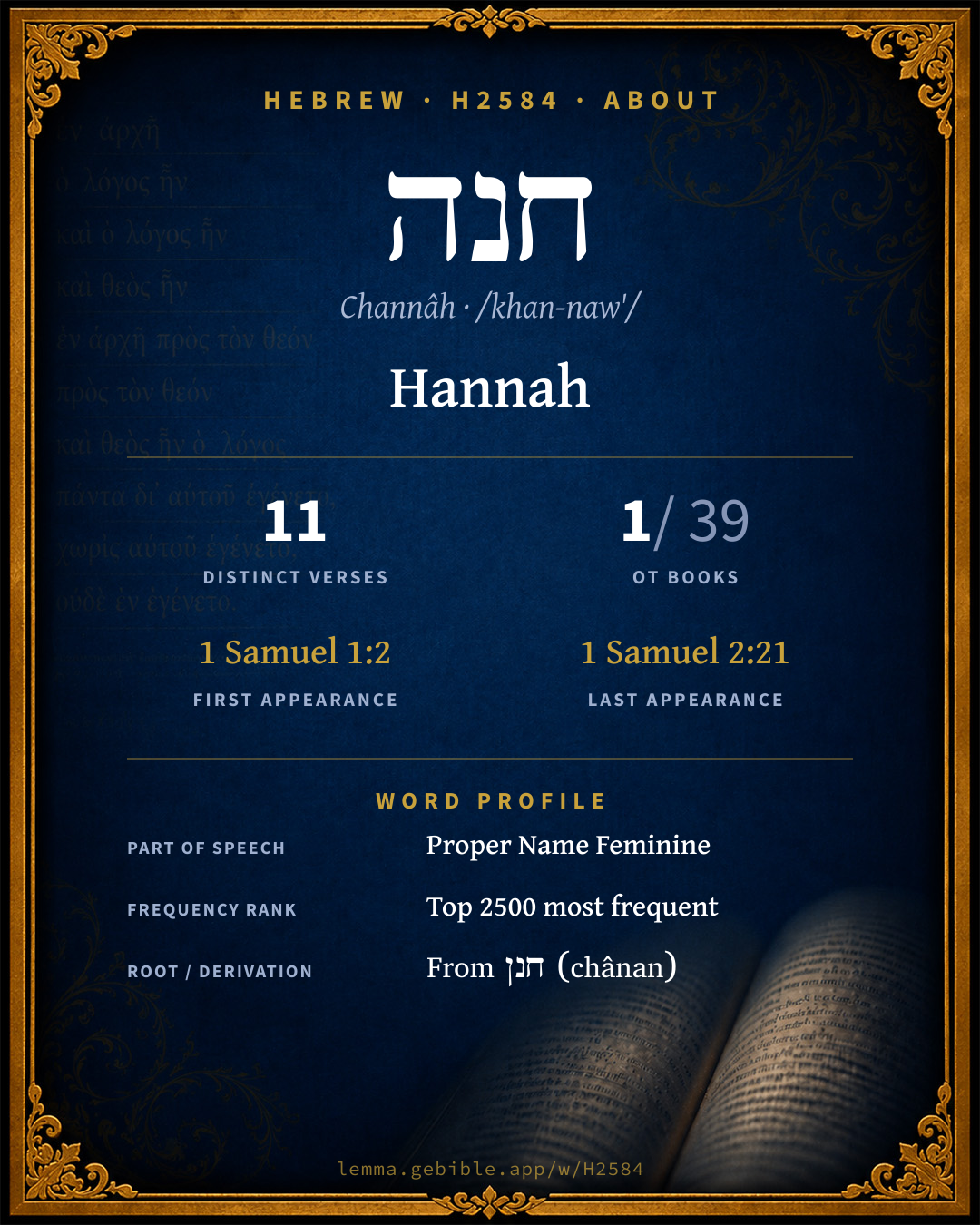
חַנָּה
Hannah
BDB lists 2 entries for ‘Hannah’ fuller range ↓
Full lexicon entry — Brown-Driver-Briggs (BDB)
From Brown-Driver-Briggs (BDB)
Where this word appears
Grammar key — what these labels mean
Part of speech
- Noun
- A naming word — a person, place, thing, or idea.
Noun type
- Proper
- A name of a specific person, place, or people (e.g. Abraham, Zion, Israel).
Every verse where H2584 appears — 11 distinct verses across 1 book. Click any verse to open its interlinear word-by-word view. Verse text shown in the World English Bible for context — . Each verse’s Hebrew form is shown with its reference; the English is not keyword-highlighted, since the data carries no word-level English alignment. Use “Compare translations” on any verse to read it across multiple English versions. This concordance covers the Hebrew Bible; Septuagint (Greek Old Testament) occurrences are not indexed here.
1 Samuel 11 verses
- 1 Samuel 1:2 חַנָּ֔ה וּ/לְ/חַנָּ֖ה n Proper conj + prep + n Proper and he had two wives; the name of the one was Hannah, and the name of other Peninnah: and Peninnah had children, but Hannah had no children.
- 1 Samuel 1:5 וּ/לְ/חַנָּ֕ה חַנָּה֙ conj + prep + n Proper n Proper but to Hannah he gave a double portion; for he loved Hannah, but Yahweh had shut up her womb.
- 1 Samuel 1:8 חַנָּה֙ n Proper Elkanah her husband said to her, Hannah, why weep you? and why don't you eat? and why is your heart grieved? am I not better to you than ten sons?
- 1 Samuel 1:9 חַנָּ֔ה n Proper So Hannah rose up after they had eaten in Shiloh, and after they had drunk. Now Eli the priest was sitting on his seat by the door-post of the temple of Yahweh.
- 1 Samuel 1:13 וְ/חַנָּ֗ה conj + n Proper Now Hannah, she spoke in her heart; only her lips moved, but her voice was not heard: therefore Eli thought she had been drunken.
- 1 Samuel 1:15 חַנָּ֤ה n Proper Hannah answered, No, my lord, I am a woman of a sorrowful spirit: I have drunk neither wine nor strong drink, but I poured out my soul before Yahweh.
- 1 Samuel 1:19 חַנָּ֣ה n Proper They rose up in the morning early, and worshiped before Yahweh, and returned, and came to their house to Ramah: and Elkanah knew Hannah his wife; and Yahweh remembered her.
- 1 Samuel 1:20 חַנָּ֖ה n Proper It happened, when the time was come about, that Hannah conceived, and bore a son; and she named him Samuel, [saying], Because I have asked him of Yahweh.
- 1 Samuel 1:22 וְ/חַנָּ֖ה conj + n Proper But Hannah didn't go up; for she said to her husband, [I will not go up] until the child be weaned; and then I will bring him, that he may appear before Yahweh, and there abide forever.
- 1 Samuel 2:1 חַנָּה֙ n Proper Hannah prayed, and said: My heart exults in Yahweh; My horn is exalted in Yahweh; My mouth is enlarged over my enemies; Because I rejoice in your salvation.
- 1 Samuel 2:21 חַנָּ֔ה n Proper Yahweh visited Hannah, and she conceived, and bore three sons and two daughters. The child Samuel grew before Yahweh.
About this entry
At a glance — auto-summarized from this page’s data, not written by a person. Every figure links to its source below. This summary describes the numbers; it doesn’t interpret them.
“Hannah” is the headline sense of the Hebrew name חנה (Channâh). It clusters heavily in 1 Samuel, which alone accounts for 100% of its uses. It turns up in 11 verses across 1 book, an uncommon footprint. Its earliest occurrence is 1 Samuel 1:2. For the data behind this summary, explore 11-verse concordance and the renderings breakdown below.
Gloss history
Strong's 1890 vs modern scholarship
About this word
Strong's H2584 catalogs a Hebrew word from the Hebrew Old Testament.
These counts are not copied from any lexicon or concordance. They are computed here, from the morphology-tagged Hebrew Old Testament. What Lemma adds →
- 11
- distinct verses
- The word appears in 11 distinct verses.
- 1 / 39
- OT books
- The word appears in 1 of 39 Old Testament books.
- #2,001
- by frequency
- Top 2500 most frequent Hebrew words (rank 2,001 of 8,640 Hebrew words by occurrence).
View all 11 occurrences in the concordance →
Most concentrated in
- 1 Samuel 11 verses 100%
By section of the Old Testament
By traditional corpus
Conventional, traditional groupings — biblical authorship is debated, so this is a traditional corpus grouping, not an authorship claim. Each share is this word’s portion of its verses in that division of the Hebrew canon. Each figure is a share of the word’s 11 distinct verses.
- Prophets (Nevi'im) 11 verses · 100%
How translations render this word
Counts come from each version’s own published word-to-Strong’s tagging or interlinear alignment — an approximate guide to how each version renders this word, not a word-level alignment the data otherwise carries. Because each total is that version’s own tagged count, the per-version totals vary from one another and need not match the appearance or distinct-verse counts above. These counts may also differ from a printed concordance because Lemma counts each distinctly tagged rendering and does not collapse phrase taggings into a single head-word total. This is a fixed set of word-tagged versions (KJV, ASV, BSB, ULT) and does not change with the reading translation you choose elsewhere. Each version’s license is shown beside its name below (and on Sources).
BDB lists this Strong’s number as 2 distinct words (homographs). Each count above pools all of them and is not split by sense — see the Senses section below. A low-frequency rendering may belong to a different one of those words, not the primary meaning.
- King James Version†: Hannah 10×
- American Standard Version†: Hannah 9×
- Berean Standard Bible†: Hannah 11×
- unfoldingWord Literal Text†: Hannah 11×
King James Version Public Domain
Renders H2584 across 13† tagged occurrences — most commonly:
Plus 3 renderings that appear only once — usually multi-word phrases or single function words the recovered tagging swept in, not distinct renderings.
American Standard Version Public Domain
Renders H2584 across 13† tagged occurrences — most commonly:
Plus 4 renderings that appear only once — usually multi-word phrases or single function words the recovered tagging swept in, not distinct renderings.
Berean Standard Bible Public Domain
Renders H2584 across 13† tagged occurrences — most commonly:
Plus 2 renderings that appear only once — usually multi-word phrases or single function words the recovered tagging swept in, not distinct renderings.
unfoldingWord Literal Text CC BY-SA 4.0
Renders H2584 across 13† tagged occurrences — most commonly:
Plus 2 renderings that appear only once — usually multi-word phrases or single function words the recovered tagging swept in, not distinct renderings.
Senses in BDB
The 2 senses BDB distinguishes for this word, in lexicon order (not ranked by frequency or importance). The full entry — with sub-senses — is in the Lexicon Entry tab.
- Hannah = "grace"
- the mother of Samuel, one of the wives of Elkanah
Word origin
n.pr.f. 𝔊 Ἄννα (cf. Nab. חנה EutNo. 20), mother of Samuel 1 S 1:2(×2), 5(×2), 8, 9, 13, 15, 19, 20, 22; 2:1, 21.
— Brown-Driver-Briggs (Oxford 1906, public domain), digitized via Sefaria, supplemented by the OpenScriptures HebrewLexicon (CC BY 4.0). See Sources.
Derived from חנן (chânan) (H2603) — to be gracious.
Jastrow Dictionary
A second Hebrew/Aramaic lexicon for comparison, covering Aramaic and post-biblical (Talmudic, Targumic, Midrashic) usage that the biblical-Hebrew BDB does not. Matched by lemma rather than by Strong’s number, so a lemma may carry more than one Jastrow headword (shown separately below), and the entries cover usage well beyond the Bible.
חָנָה
- , v. חני
חני
- [to be covered, surrounded,] to encamp, rest. Num. R. s. 11 (ref. to ויחנך, Num. VI, 25) יַחֲנֶה ד׳ אצלך the Lord have His tent with thee. Lam. R. introd. (R. Naḥm.) (ref. to Is. XXIX, 1) שח׳ בה וכ׳ where David (lawfully) resided, v. חַנְיָיא. Ib. (R. Alex. 1) נוסעים … וחוֹנִים וכ׳ they moved in discord and encamped in discord; Mekh. Yithro, Baḥod., s. 1; Lev. R. s. 9; a. fr.—Apocop. form: חָן (as if from חון). Midr. Till. to Ps. LXXVIII, 47 (play on ב̇ח̇נ̇מ̇ל ib.) ב̇א ח̇ן̇ מ̇ל̇ he (the locust) came, encamped, cut; (Tanḥ. Vaëra 14 בא נ"ח מ"ל; Ex. R. s. 12 interpol. from Midr. Till. l. c.: נח). e.g. Numbers 6:25
- to cause to rest. Fut. apocop. יַחַן. Y. Taan. III, 66ᶜ (play on י̇ח̇נ̇יף̇, Num. XXXV, 33) הדם י̇ח̇ן אף̇ וכ׳ bloodshed causes the anger (of the Lord) to rest upon the ground (rain being withheld); Sifré Num. 161, Yalk. ib. 788 יחון (corr. acc.). e.g. Numbers 35:33
A Dictionary of the Targumim, the Talmud Babli and Yerushalmi, and the Midrashic Literature (Marcus Jastrow; London, Luzac, 1903) — Public Domain. Digitized via Sefaria. Digitized via Sefaria. Full attribution on Sources.
Forms in the corpus
The 9 distinct written forms H2584 takes in the Hebrew Bible, most frequent first — each parse links to that state’s occurrences in the concordance. Hebrew forms include their vowel points and cantillation, so a single lemma takes many written forms.
| Form | Parsing | Example | Uses |
|---|---|---|---|
| חַנָּ֔ה | Noun, Proper | 1 Samuel 1:2 | 3 |
| חַנָּה֙ | Noun, Proper | 1 Samuel 1:5 | 3 |
| וְ/חַנָּ֖ה | Noun, Proper | 1 Samuel 1:22 | 1 |
| וְ/חַנָּ֗ה | Noun, Proper | 1 Samuel 1:13 | 1 |
| וּ/לְ/חַנָּ֕ה | Noun, Proper | 1 Samuel 1:5 | 1 |
| וּ/לְ/חַנָּ֖ה | Noun, Proper | 1 Samuel 1:2 | 1 |
| חַנָּ֖ה | Noun, Proper | 1 Samuel 1:20 | 1 |
| חַנָּ֣ה | Noun, Proper | 1 Samuel 1:19 | 1 |
| חַנָּ֤ה | Noun, Proper | 1 Samuel 1:15 | 1 |
Same root — word family
Other BDB entries built from the same root as H2584, grouped by Strong’s listed origin. These share a root / origin per the lexicon — not necessarily a shared meaning. Each links to that word’s own entry.
Derives from
Shares the same root
- חן chên H2580 grace
- חנה chânâh H2583 to encamp
- חנון channûwn H2587 gracious
- חנות channôwth H2589 to be gracious
- חנינה chănîynâh H2594 compassion
- חנן chănan H2604 to show favour
- תחנה tᵉchinnâh H8467 supplication
- תחנון tachănûwn H8469 supplication
Proper names from this root
People and places named from this root — a name, not an additional meaning of the word.
- חנון Chânûwn H2586 Hanun
- חניאל Channîyʼêl H2592 Hanniel
- חנן Chânân H2605 Hanan
- חננאל Chănanʼêl H2606 Hananeel
- חנני Chănânîy H2607 Hanani
- חנניה Chănanyâh H2608 Hananiah
- חנתן Channâthôn H2615 Hannathon
- Αννα Ánna G451 Anna
Compare all same-root words → Showing 4 of 18 — not the complete family. 8 of the same-root words are proper names (people or places). They share a root, not necessarily a meaning.
Bible dictionary
Public-domain dictionary articles matched to this entry by name (Hannah). A biblical name can be shared by more than one person or place, so an article may treat several.
Easton's Bible Dictionary · M. G. Easton, 1897
Favour, grace, one of the wives of Elkanah the Levite, and the mother of Samuel (1 Sam. 1; 2). Her home was at Ramathaim-zophim, whence she was wont every year to go to Shiloh, where the tabernacle had been pitched by Joshua, to attend the offering of sacrifices there according to the law (Ex. 23:15; 34:18; Deut. 16:16), probably at the feast of the Passover (comp. Ex. 13:10). On occasion of one of these "yearly" visits, being grieved by reason of Peninnah's conduct toward her, she went forth alone, and kneeling before the Lord at the sanctuary she prayed inaudibly. Eli the high priest, who sat at the entrance to the holy place, observed her, and misunderstanding her character he harshly condemned her conduct (1 Sam. 1:14-16). After hearing her explanation he retracted his injurious charge and said to her, "Go in peace: and the God of Israel grant thee thy petition." Perhaps the story of the wife of Manoah was not unknown to her. Thereafter Elkanah and his family retired to their quiet home, and there, before another Passover, Hannah gave birth to a son, whom, in grateful memory of the Lord's goodness, she called Samuel, i.e., "heard of God." After the child was weaned (probably in his third year) she brought him to Shiloh into the house of the Lord, and said to Eli the aged priest, "Oh my lord, I am the woman that stood by thee here, praying unto the Lord. For this child I prayed; and the Lord hath given me my petition which I asked of him: therefore I also have granted him to the Lord; as long as he liveth he is granted to the Lord" (1 Sam. 1:27, 28, R.V.). Her gladness of heart then found vent in that remarkable prophetic song (2:1-10; comp. Luke 1:46-55) which contains the first designation of the Messiah under that name (1 Sam. 2:10, "Annointed" = "Messiah"). And so Samuel and his parents parted. He was left at Shiloh to minister "before the Lord." And each year, when they came up to Shiloh, Hannah brought to her absent child "a little coat" (Heb. meil, a term used to denote the "robe" of the ephod worn by the high priest, Ex. 28:31), a priestly robe, a long upper tunic (1 Chr. 15:27), in which to minister in the tabernacle (1 Sam. 2:19; 15:27; Job 2:12). "And the child Samuel grew before the Lord." After Samuel, Hannah had three sons and two daughters.
Smith's Bible Dictionary · William Smith, 1863
(grace), one of the wives of Elkanah, and mother of Samuel. 1Sam 1,2 (B.C. 1141.) A hymn of thanks giving for the birth of her son is in the highest order of prophetic poetry, its resemblance to that of the Virgin Mary comp. (1 Samuel 2:1-10) with Luke 1:46-55 See also (Psalms 113:1) ... has been noticed.
Hitchcock's Bible Names Dictionary · Roswell D. Hitchcock, 1869
gracious; merciful; he that gives
Classic public-domain reference works; full attribution on Sources.
Septuagint verse parallels
This word appears in 11 verses that also exist in the Greek Old Testament (Septuagint), out of the 11 Hebrew verses it occurs in. You can read those verses in Greek by switching the Old Testament edition to the Septuagint.
Read these verses in the Septuagint
This is a verse-level parallel only — the same verses exist in both the Hebrew and Greek Old Testaments. No word-level Hebrew↔Greek correspondence is claimed: the data carries no such alignment, so no Greek word is shown as this Hebrew word’s translation. Coverage is not total — the Septuagint omits the deuterocanon and renumbers the Psalms, so some Hebrew verses have no direct Greek parallel.