
Proverbs 4:9

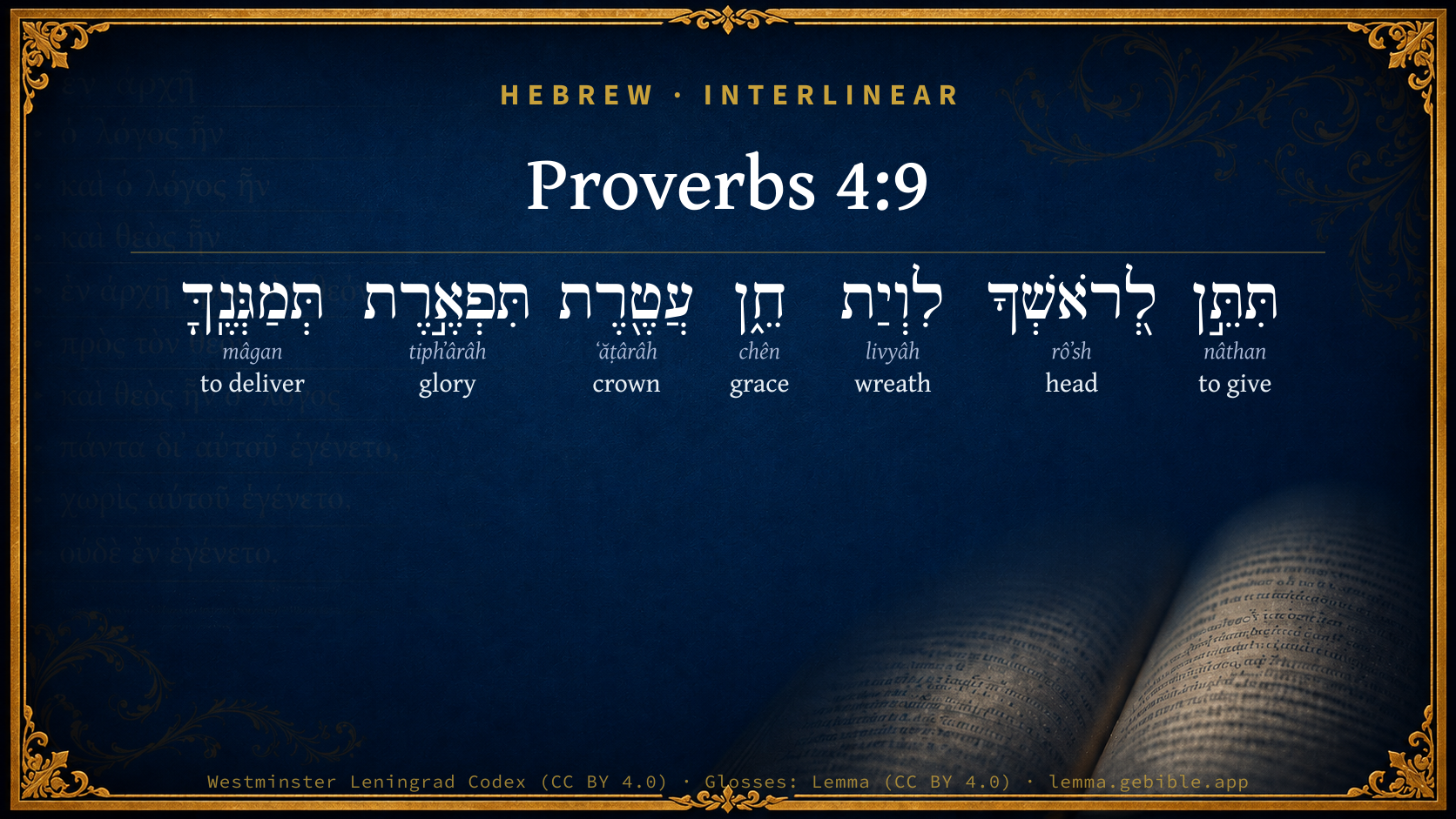
Hebrew (Westminster Leningrad Codex) Proverbs 4:9 appears in the Hebrew Old Testament. The text above is from the Westminster Leningrad Codex. Each word links to its Strong’s number, a concise gloss, and parsing drawn from the Open Scriptures Hebrew Bible morphology. Click any word for its full Brown-Driver-Briggs (BDB) entry.
Download image
Cite this verse

Proverbs 4:9 (World English Bible). Public Domain. Lemma interlinear Bible study tool, https://lemma.gebible.app/v/proverbs/4/9.

Show BibTeX & RIS
BibTeX
RIS
English Translation
She will give to your head a garland of grace. She will deliver a crown of splendor to you."
World English Bible · Public Domain
Download a study sheet

One document with this verse’s original text, its word-by-word gloss line, the meaning frame, cross-references with their text, attributed commentary, and full source and license credits — printable, and it pastes into notes with its structure intact.

This verse Autodidact and up

Study sheet (.html) Plain text (.txt)

A passage Seminary Student

Up to 50 verses in one chapter. A passage sheet keeps up to 6 commentary sources and 12 cross-references per verse, in the order this page ranks them, and says so on the sheet whenever that leaves anything out. Ask for a single verse and you get the Autodidact verse sheet above.

Everything on this page stays free to read, with no account — the sheet is a download of what is already on screen, not access to it.

Want to remove ads? Support Godless Engineer
Compare translations 3

The same verse in 3 English versions, stacked beneath the original-language interlinear above. Click any original word for its lexicon entry.

Each is an independent rendering of the whole verse — the interlinear is not word-aligned to these translations.

Highlighted words mark where these versions differ — a whole-verse word diff, not a word-by-word alignment.

  • World English Bible Public Domain
    She will give to your head a garland of grace. She will deliver a crown of splendor to you."
  • King James Version Public Domain
    She shall give to thine head an ornament of grace: a crown of glory shall she deliver to thee.
  • unfoldingWord Literal Text CC BY-SA 4.0
    She will give for your head a garland of grace; a crown of splendor she will cover you.”

unfoldingWord Literal Text — © unfoldingWord, licensed CC BY-SA 4.0. Word-aligned USFM3 via Door43 (git.door43.org/unfoldingWord/en_ult).

Versions to compare (up to 4)

3 of 4 selected

Show all 18 translations

Every available English version of this verse, each an independent rendering of the whole verse.

  • World English Bible Public Domain
    She will give to your head a garland of grace. She will deliver a crown of splendor to you."
  • Berean Standard Bible Public Domain
    She will set a garland of grace on your head; she will present you with a crown of beauty.”
  • Majority Standard Bible Public Domain
    She will set a garland of grace on your head; she will present you with a crown of beauty.”
  • King James Version Public Domain
    She shall give to thine head an ornament of grace: a crown of glory shall she deliver to thee.
  • American Standard Version (1901) Public Domain
    She will give to thy head a chaplet of grace; A crown of beauty will she deliver to thee.
  • Revised Version (1885) Public Domain
    She shall give to thine head a chaplet of grace: a crown of beauty shall she deliver to thee.
  • Geneva Bible (1599) Public Domain
    She shall giue a comely ornamet vnto thine head, yea, she shall giue thee a crowne of glorie.
  • Douay-Rheims (1899) Public Domain
    She shall give to thy head increase of graces, and protect thee with a noble crown.
  • Young's Literal Translation Public Domain
    She giveth to thy head a wreath of grace, A crown of beauty she doth give thee freely.
  • Literal Standard Version CC BY-SA 4.0
    She gives a wreath of grace to your head, || She gives you a crown of beauty freely.”
  • Unlocked Literal Bible CC BY-SA 4.0
    She will put a wreath of honor on your head; she will give you a beautiful crown.”
  • unfoldingWord Literal Text CC BY-SA 4.0
    She will give for your head a garland of grace; a crown of splendor she will cover you.”
  • Darby Bible Public Domain
    She shall give to thy head a garland of grace; a crown of glory will she bestow upon thee.
  • World Messianic Bible Public Domain
    She will give to your head a garland of grace. She will deliver a crown of splendor to you.”
  • Webster's Bible Public Domain
    She shall give to thy head an ornament of grace: a crown of glory shall she deliver to thee.
  • Free Bible Version CC BY-SA 4.0
    She will place on your head a wreath of grace; she will present to you a crown of glory.”
  • Bible in Basic English Public Domain
    She will put a crown of grace on your head, giving you a head-dress of glory.
  • JPS Tanakh (1917) Public Domain
    She will give to thy head a chaplet of grace; a crown of glory will she bestow on thee.'

Literal Standard Version (2020), Covenant Press — licensed CC BY-SA 4.0. Text via the HelloAO Bible API (eBible.org). Unlocked Literal Bible (unfoldingWord) — licensed CC BY-SA 4.0. Text via the HelloAO Bible API (eBible.org). unfoldingWord Literal Text — © unfoldingWord, licensed CC BY-SA 4.0. Word-aligned USFM3 via Door43 (git.door43.org/unfoldingWord/en_ult). Free Bible Version, Dr. Jonathan Gallagher — licensed CC BY-SA 4.0. Text via the HelloAO Bible API (eBible.org).

Word by word

More ways to search: Search by grammar → Find every occurrence → Compare this word →

Practice this passage: Drill this verse → Learn its vocabulary →

About this verse

These counts appear in no published source. They are computed here, from the morphology-tagged text and Lemma’s own curated glosses. What Lemma adds →

7
words
7
distinct lemmas
Wisdom
section

Notable vocabulary

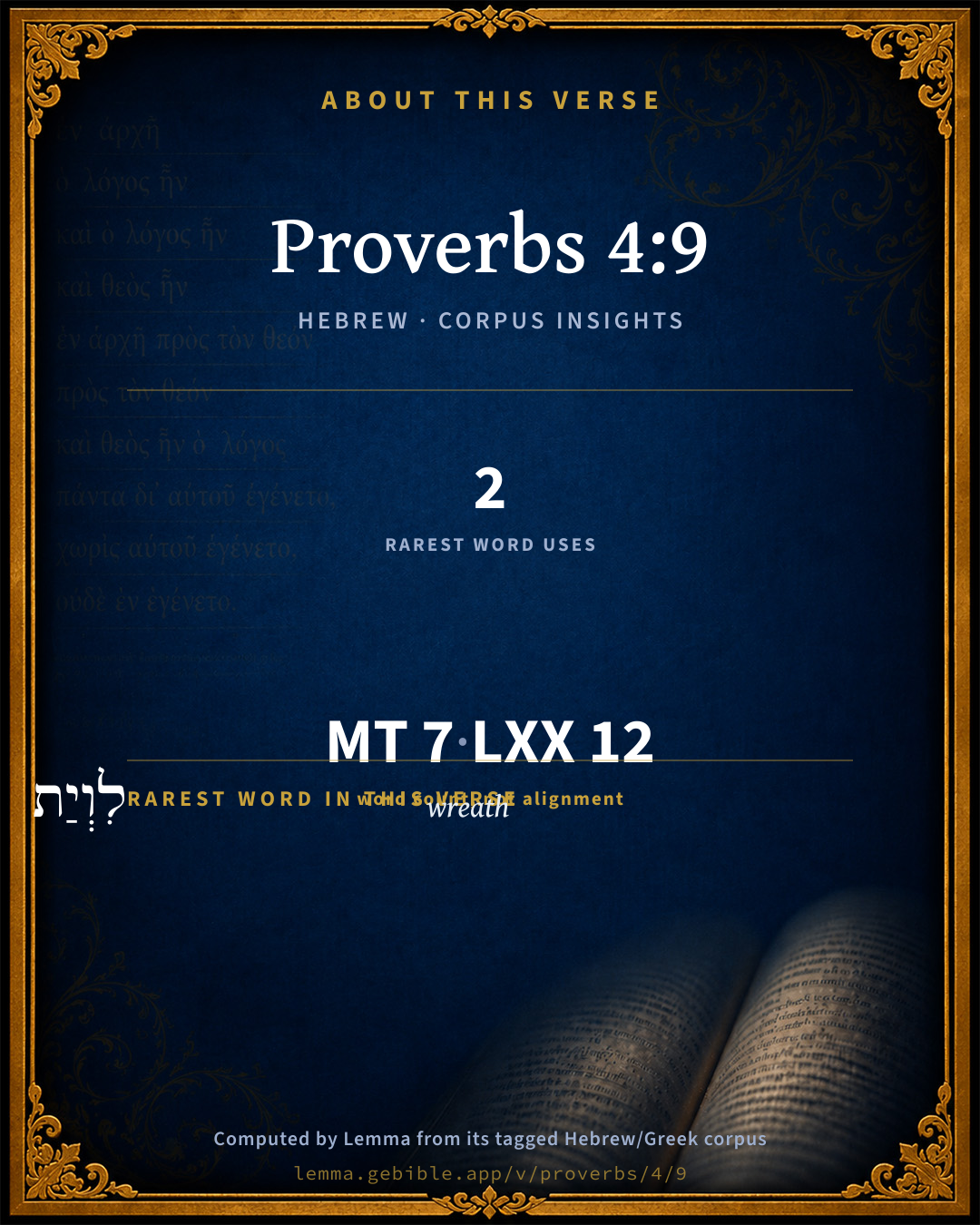
The rarest word here is לִוְיַת wreath H3880 — appearing just 2 times in the whole Hebrew Bible.

Shared distinctive vocabulary

לִוְיַת wreath H3880 occurs in 2 verses of the Hebrew Bible. Also found in:

Grammatical profile

  • 2 verbs
  • 5 nouns

Verb forms

  • תִּתֵּ֣ן Qal · Imperfect
  • תְּמַגְּנֶֽךָּ Piel · Imperfect

Hebrew & Septuagint length

In English translation the verse runs 19 words from the Hebrew and 20 from the Septuagint (LXX English) — closely comparable.

A rough comparison of the two English renderings, which tokenize alike — not a word-level alignment.

Word counts can differ between the Hebrew and the Greek without any difference in meaning — e.g. the Hebrew direct-object marker אֵת has no separate Greek word, and Greek often adds the article ὁ.

In the original languages it is 7 Hebrew tokens and 12 Greek tokens — but the two are counted differently (Hebrew bundles its prefixes and suffixes into one token; the Greek is in lemma form), so that isn’t a like-for-like length.

Cross-references

9

Topical passages linked to Proverbs 4:9 in the Treasury of Scripture Knowledge — connected by theme and wording, ordered by reader-vote popularity; previews shown in the World English Bible.

  • Proverbs 1:9 For they will be a garland to grace your head, And chains around your neck.
  • 1 Peter 5:4 When the chief Shepherd is revealed, you will receive the crown of glory that doesn't fade away.
  • Hebrews 2:7–9 You made him a little lower than the angels; You crowned him with glory and honor.
  • Proverbs 16:31 Gray hair is a crown of glory. It is attained by a life of righteousness.
  • Isaiah 28:5 In that day will Yahweh of Hosts become a crown of glory, and a diadem of beauty, to the residue of his people;
  • Revelation 3:21 He who overcomes, I will give to him to sit down with me on my throne, as I also overcame, and sat down with my Father on his throne.
  • Proverbs 3:22 So they will be life to your soul, And grace for your neck.
  • 1 Timothy 2:9–10 In the same way, that women also adorn themselves in decent clothing, with modesty and propriety; not just with braided hair, gold, pearls, or expensive clothing;
  • 1 Peter 3:4 but in the hidden person of the heart, in the incorruptible adornment of a gentle and quiet spirit, which is in the sight of God very precious.

Cross-references courtesy of OpenBible.info (CC BY 4.0).

Hebrew and Greek witnesses Masoretic Hebrew ↔ Greek Septuagint

The same verse in the two great witnesses to the Old Testament, shown verse-for-verse.

These are two independent witnesses, not word-aligned to each other, and the Septuagint is shown in lemma (dictionary) form.

Hebrew Proverbs 4:9 Masoretic · Westminster Leningrad Codex

תִּתֵּ֣ן לְ֭רֹאשְׁךָ לִוְיַת חֵ֑ן עֲטֶ֖רֶת תִּפְאֶ֣רֶת תְּמַגְּנֶֽךָּ

She will give to your head a garland of grace. She will deliver a crown of splendor to you."

World English Bible · Public Domain

Greek LXX Proverbs 4:9 Septuagint · lemma form

ἵνα δίδωμι ὁ σός κεφαλή στέφανος χάρις στέφανος δέ τρυφή ὑπερἀσπίζω σύ

that it may give to your head a crown of graces, and may cover you with a crown of delight.

LXX2012 (modern English Septuagint) · Public Domain

On this verse, The Pulpit Commentary discusses the Septuagint’s reading. Read the note in Commentary ↓

Hebrew: Westminster Leningrad Codex (CC BY 4.0). Greek: Septuagint (public domain); English from LXX2012 (modern English Septuagint) (Public Domain). How the Septuagint differs from the Hebrew →

Commentary

Notes on Proverbs 4:9 from classic Christian and Jewish commentators (each source and its license shown beneath its notes). The classic Christian expositions comment on the surrounding passage and are grouped to its opening verse, so a note may address several verses; the Jewish commentaries on the Tanakh (Rashi and others) are per-verse, so they appear only where the commentator wrote on this verse.

Lemma curates 59 commentaries, every one of them public domain or Creative Commons licensed, each selected and text-cleaned for this edition rather than reprinted as found. About our sources →

Trapp's Complete Commentary

John Trapp

Pro 4:9 She shall give to thine head an ornament of grace: a crown of glory shall she deliver to thee.

Ver. 9. A crown of glory.] The psalmist shows by prophesying {Psa 138:4-5; Psa 119:72} that even kings, coming to taste the excellence of the comforts of godliness, and to feel the power of God’s word, should sing for joy of heart, and greatly acknowledge the excelling glory of God and godliness.

John Trapp, A Commentary or Exposition upon All the Books of the Old and New Testament (1647–1656) — public domain. Text from a community e-Sword module.

Tyndale Open Study Notes

Tyndale Open Resources

4:9 A lovely wreath and a beautiful crown represent wisdom’s rewards (see also 1:9 and 3:22).

Tyndale Open Study Notes — © Tyndale Open Resources, licensed CC BY-SA 4.0. Text via the HelloAO Bible API.

Jamieson, Fausset & Brown

Robert Jamieson, A. R. Fausset & David Brown

ornament--such as the chaplet or wreath of conquerors.

deliver--(Compare Gen 14:20). The allusion to a shield, contained in the Hebrew, suggests protection as well as honor (compare Pro 4:6).

Jamieson, Fausset & Brown — Commentary Critical and Explanatory on the Whole Bible (1871) — public domain (CC PDM 1.0). Text via the HelloAO Bible API.

Adam Clarke's Commentary

Verse 9. A crown of glory] A tiara, diadem, or crown, shall not be more honourable to the princely wearer, than sound wisdom-true religion-coupled with deep learning, shall be to the Christian and the scholar.

Adam Clarke's Commentary on the Bible (1810–1826) — public domain. Text from a community e-Sword/MySword module.

John Gill's Exposition

She shall give to thine head an ornament of grace,.... This, and the following clause, explain what that honour is Christ promotes and brings his followers to here and hereafter: he gives them grace and more grace; "an increase of grace", so the Vulgate Latin version renders it; and some think James refers to this passage, Pro 4:6. The grace that Christ gives is very ornamental to his people: justifying grace greatly beautifies and adorns them; it not only covers the nakedness of their souls, and all their spots and imperfections, and through it all their sins are caused to pass from them; but they are made exceeding beautiful, perfectly comely through this comeliness, a perfection of beauty by it; and which is often signified by that which is very ornamental, rich, and costly, as fine linen, clothing of wrought gold, raiment of needlework, a Wedding garment, stuck with jewels and precious stones: sanctifying grace, which also is Christ's gift, is very ornamental; it is called "the beauty of holiness"; it is that by which a man is made like to God, and conformed to the image of Christ; it is the curious workmanship of the Spirit of God; or what makes a man beautiful, and makes him meet for heaven and happiness: every grace is ornamental; faith, hope, love, humility, &c. these are like rows of jewels, and chains of gold, about the neck. And when this ornament is said to be given "to the head", it is not to be understood of the natural head of a man, but of his whole person, it gives a comeliness to; and may denote the visibility of it, as it appears in the life and conversation;

a crown of glory shall she deliver to thee; by which is meant eternal glory and happiness, called a "crown", an ensign of royal dignity, which, belongs to such as are made kings and priests unto God; and is given to conquerors, even who are more than conquerors through Christ, and as a reward of diligence and faithfulness, Rev 2:10. It is sometimes called a crown of life, a crown of righteousness, an incorruptible and never-fading one, and, as here, "a crown of glory"; the saints in heaven will have a glory put upon them, both in soul and body; they will appear with Christ in glory, and be crowned with glory and honour, as he is; they will be clothed and surrounded with it: and so some render it,

"she will compass thee about with a crown of glory as with a shield'' (w);

see Psa 5:12. This Christ is said to "deliver"; it is in his hands, laid up in him, and is safe with him; he has power to dispose of it, and it may be expected from him; see Ti2 4:8.

(w) , Sept. "proteget te", V. L. "muniet te", Montanus, Tigerine version; "cinget te", Gejerus.

John Gill's Exposition of the Whole Bible (1746–1763) — public domain (CC PDM 1.0). Text via the HelloAO Bible API.

Matthew Poole's English Annotations

An ornament of grace, i.e. an acceptable or beautiful ornament, such as they used to put upon their heads.

Matthew Poole's English Annotations on the Holy Bible (1683–1685) — public domain. Text from a community e-Sword/MySword module.

Whedon's Commentary on the Bible

Daniel D. Whedon

9. A crown of glory — Among the Orientals the headdress was the most ornamental part, and the most esteemed. It was the ornament, par excellence. So this true wisdom, founded on piety, is the noblest ornament of man. Comp. Pro_1:9.

Daniel D. Whedon (gen. ed.), Commentary on the Old and New Testaments (1874–1909) — public domain. Text from a community e-Sword module.

The Pulpit Commentary

An ornament of grace (liv"yath khen). (On this, see Pro_1:9) A crown of glory shall she deliver to thee; or, as margin, she shall compass thee with a crown of glory. Deliver. The verb miggen, piel, since the kal, magan, is not used. is, however, properly, "to give, or deliver," as in Gen_14:20 Hos_11:8. That this is the meaning is clear from the corresponding "she shall give" (titten, but cf. nathan, "to give"). It is commonly found with an accusative and dative, but hero takes two accusatives. Both the LXX and the Vulgate render, "With a crown of glory or delights shall she protect (uperaspish , proteget) thee:" as if it were connected with magen, "a shield," but a crown is not usually associated with protection or defence. "A crown of glory," in the New Testament, is always associated with the everlasting honours of heaven, as in Heb_2:9 2Ti_4:8 1Pe_4:4 Rev_2:20. The meaning is here, "Wisdom shall confer on thee true dignity.

A coronation.

Wisdom is here represented as standing forth with garlands and crowns, rewarding her votary. The whole picture suggested to us by this brief verse may be taken as illustrative of the blessed experience of the people of God.

I THE CROWNING AUTHORITY. It is ridiculous to offer a crown except with the right and power to make the coronation effective. It was held that no one could be an emperor in the "holy Roman empire" of the Middle Ages unless he had been crowned by the pope, as Charles the Great had been crowned. In our picture we have a greater than the highest ecclesiastic. The Wisdom of God, ideally personified, offers crowns and garlands with her own hands. It is really an act of God. God"s wisdom is subsequently revealed in Christ who bestows the best blessings on his people. Coronation from such an authority must be effective.

II THE SUBJECT CROWNED. He is the votary of Wisdom, and it is on account of his allegiance to his heavenly mistress that he receives his honour. Solomon seems to be referring directly to himself (ver. 8). If so, it is the more remarkable that the most magnificent king of Israel should set less value on his regal dignity than on his fidelity to Wisdom. Even Solomon is here crowned, not because he is David"s son and sits on the throne of a great nation, but because he is a loyal servant of Wisdom. The same honour is open to all who follow the same course. Wisdom, Divine truth, the knowledge of God, the following of Christ these things are the true grounds for honour; not birth, rank, power, or wealth.

III THE ACT OF CORONATION. Wisdom stands forth and crowns her votary. She does it spontaneously. The pursuit of Divine Wisdom brings honour. Here we see that there is more than bare deliverance from ruin for the people of God. They are invited to receive honours from above. This happens in a measure upon earth in the elevation of character, the loftiness of the whole course of life, and perhaps even the worthy reputation of a true Christian. Yet we must remember that the coronation is not the world"s admiration, but God"s approval. This will be perfected in heaven when the saints who have borne the cross on earth will receive their crowns only to cast them at the feet of the Lord through whose grace alone they have won them. (Rev_4:10)

IV THE NATURE OF THE CROWNS. There is a garland as well as a crown.

1. A recognition of victory. A simple wreath has little inherent worth. But it is a token of victory. It is nobler to wear a true conqueror"s wreath than an idle monarch"s diadem. The pursuit of Divine Wisdom leads to victory over sin and the world.

2. A possession of wealth and honour. After the victor"s wreath comes the regal crown. Observe how it is constructed.

(1) Gold of truth.

(2) Precious stones of heavenly experience. Precious stones are symbolical of celestial structures. (Rev_21:18-21) The follower of Wisdom has the heavenly mind; he minds spiritual things.

(3) Pearls of purity. True wisdom leads to holiness.

The Pulpit Commentary (1880–1919), ed. H.D.M. Spence-Jones & Joseph S. Exell — public domain. Text from a community e-Sword module.

John Wesley's Explanatory Notes

Grace - A beautiful ornament, such as they used to put upon their heads.

John Wesley, Explanatory Notes Upon the Whole Bible (1754–1765) — public domain. Text via the GEBible commentary corpus.

Rashi

Rabbi Shlomo Yitzchaki (Rashi)

She will give your head a wreath of grace Heb. לוית חן, a wreath of grace, as in (1:9): “They are a wreath of grace (לוית חן) for your head.”

Rashi on the Tanakh — English translations: “The Judaica Press complete Tanach with Rashi, translated by A. J. Rosenberg” (CC BY 4.0); “Pentateuch with Rashi's commentary by M. Rosenbaum and A.M. Silbermann, 1929-1934” (public domain); “The Metsudah Tanach series, Lakewood, N.J” (CC BY 4.0); and “The Book of Joshua, Metsudah Publications, 1997” (CC BY 4.0). Text via Sefaria.

Lesson kit

Teaching starters — assembled from the data on this page, not authored interpretation. Every prompt links to the verse data it draws on. Edit before teaching.

Proverbs, in the Wisdom, opens this verse with 7 words (7 distinct Hebrew lemmas). Its most distinctive word is livyâh (“wreath”). A historical commentator’s framing appears above. Read the whole chapter for the surrounding context.

Discussion questions

  1. The word livyâh carries the sense “wreath.” How does it shape the verse?
  2. Proverbs 1:9 shares the word «wreath» with this verse. How do the two illuminate each other?
  3. These translations render this verse differently. What is at stake in choosing one wording over another?
  4. The verb «תִּתֵּ֣ן» is Qal Imperfect. How does its form color the action?
  5. Reading how Trapp's Complete Commentary and Tyndale Open Study Notes read this verse, where do the two commentators agree and where do they part?

Things to notice

Reading settings

Reading text

Shown beneath each verse's original-language words.

Old Testament
Old Testament edition

Read the OT as the Masoretic Hebrew (MT) or the Greek Septuagint (LXX).

English shown for the Greek Septuagint (in the Hebrew ↔ Greek comparison).

Comparing translations? Open the Compare panel on any verse page to stack up to four side by side.