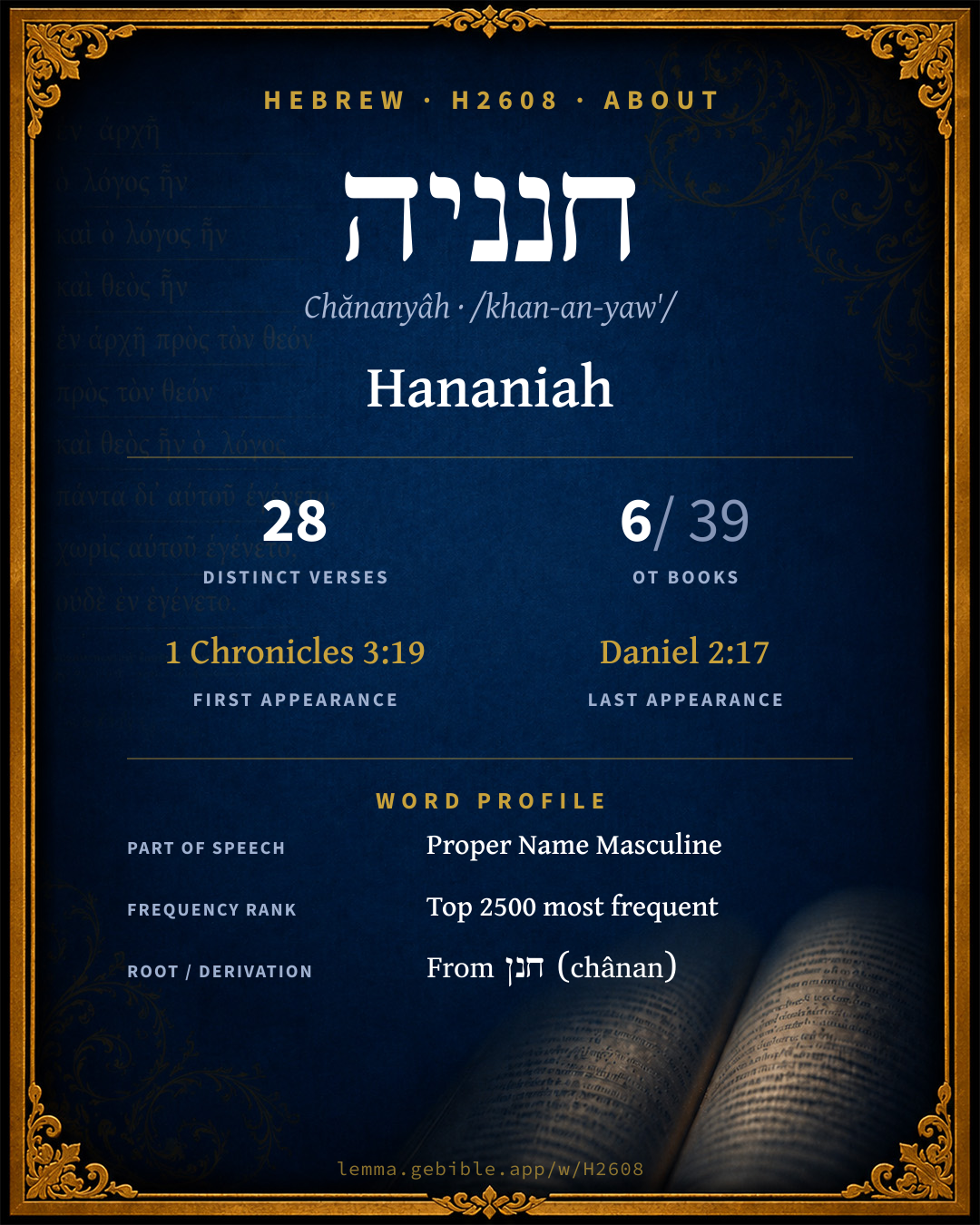
חֲנַנְיָה
Hananiah
BDB lists 9 entries for ‘Hananiah’ fuller range ↓
Full lexicon entry — Brown-Driver-Briggs (BDB)
From Brown-Driver-Briggs (BDB)
Where this word appears
Grammar key — what these labels mean
Part of speech
- Noun
- A naming word — a person, place, thing, or idea.
Noun type
- Proper
- A name of a specific person, place, or people (e.g. Abraham, Zion, Israel).
Every verse where H2608 appears — 28 distinct verses across 6 books. Click any verse to open its interlinear word-by-word view. Verse text shown in the World English Bible for context — . Each verse’s Hebrew form is shown with its reference; the English is not keyword-highlighted, since the data carries no word-level English alignment. Use “Compare translations” on any verse to read it across multiple English versions. This concordance covers the Hebrew Bible; Septuagint (Greek Old Testament) occurrences are not indexed here.
1 Chronicles 5 verses
- 1 Chronicles 3:19 וַ/חֲנַנְיָ֔ה conj + n Proper The sons of Pedaiah: Zerubbabel, and Shimei. The sons of Zerubbabel: Meshullam, and Hananiah; and Shelomith was their sister;
- 1 Chronicles 3:21 חֲנַנְיָ֖ה n Proper The sons of Hananiah: Pelatiah, and Jeshaiah; the sons of Rephaiah, the sons of Arnan, the sons of Obadiah, the sons of Shecaniah.
- 1 Chronicles 8:24 וַ/חֲנַנְיָ֥ה conj + n Proper and Hananiah, and Elam, and Anthothijah,
- 1 Chronicles 25:4 חֲנַנְיָ֣ה n Proper Of Heman; the sons of Heman: Bukkiah, Mattaniah, Uzziel, Shebuel, and Jerimoth, Hananiah, Hanani, Eliathah, Giddalti, and Romamti-ezer, Joshbekashah, Mallothi, Hothir, Mahazioth.
- 1 Chronicles 25:23 לַ/חֲנַנְיָ֔הוּ prep + n Proper for the sixteenth to Hananiah, his sons and his brothers, twelve:
2 Chronicles 1 verse
Ezra 1 verse
Nehemiah 6 verses
- Nehemiah 3:8 חֲנַנְיָ֖ה n Proper Next to him repaired Uzziel the son of Harhaiah, goldsmiths. Next to him repaired Hananiah one of the perfumers, and they fortified Jerusalem even to the broad wall.
- Nehemiah 3:30 חֲנַנְיָ֣ה n Proper After him repaired Hananiah the son of Shelemiah, and Hanun the sixth son of Zalaph, another portion. After him repaired Meshullam the son of Berechiah over against his chamber.
- Nehemiah 7:2 חֲנַנְיָ֛ה n Proper that I gave my brother Hanani, and Hananiah the governor of the castle, charge over Jerusalem; for he was a faithful man, and feared God above many.
- Nehemiah 10:23 חֲנַנְיָ֖ה n Proper Hoshea, Hananiah, Hasshub,
- Nehemiah 12:12 חֲנַנְיָֽה n Proper In the days of Joiakim were priests, heads of fathers' [houses]: of Seraiah, Meraiah; of Jeremiah, Hananiah;
- Nehemiah 12:41 חֲנַנְיָ֖ה n Proper and the priests, Eliakim, Maaseiah, Miniamin, Micaiah, Elioenai, Zechariah, and Hananiah, with trumpets;
Jeremiah 10 verses
- Jeremiah 28:1 חֲנַנְיָה֩ n Proper It happened the same year, in the beginning of the reign of Zedekiah king of Judah, in the fourth year, in the fifth month, that Hananiah the son of Azzur, the prophet, who was of Gibeon, spoke to me in the house of Yahweh, in the presence of the priests and of all the people, saying,
- Jeremiah 28:5 חֲנַנְיָ֖ה n Proper Then the prophet Jeremiah said to the prophet Hananiah in the presence of the priests, and in the presence of all the people who stood in the house of Yahweh,
- Jeremiah 28:10 חֲנַנְיָ֤ה n Proper Then Hananiah the prophet took the bar from off the prophet Jeremiah's neck, and broke it.
- Jeremiah 28:11 חֲנַנְיָה֩ n Proper Hananiah spoke in the presence of all the people, saying, Thus says Yahweh: Even so will I break the yoke of Nebuchadnezzar king of Babylon within two full years from off the neck of all the nations. The prophet Jeremiah went his way.
- Jeremiah 28:12 חֲנַנְיָ֤ה n Proper Then the word of Yahweh came to Jeremiah, after that Hananiah the prophet had broken the bar from off the neck of the prophet Jeremiah, saying,
- Jeremiah 28:13 חֲנַנְיָ֜ה n Proper Go, and tell Hananiah, saying, Thus says Yahweh: You have broken the bars of wood; but you have made in their place bars of iron.
- Jeremiah 28:15 חֲנַנְיָ֥ה חֲנַנְיָ֑ה n Proper n Proper Then said the prophet Jeremiah to Hananiah the prophet, Hear now, Hananiah: Yahweh has not sent you; but you make this people to trust in a lie.
- Jeremiah 28:17 חֲנַנְיָ֥ה n Proper So Hananiah the prophet died the same year in the seventh month.
- Jeremiah 36:12 חֲנַנְיָ֖הוּ n Proper he went down into the king's house, into the scribe's chamber: and, behold, all the princes were sitting there, [to wit], Elishama the scribe, and Delaiah the son of Shemaiah, and Elnathan the son of Achbor, and Gemariah the son of Shaphan, and Zedekiah the son of Hananiah, and all the princes.
- Jeremiah 37:13 חֲנַנְיָ֑ה n Proper When he was in the gate of Benjamin, a captain of the guard was there, whose name was Irijah, the son of Shelemiah, the son of Hananiah; and he laid hold on Jeremiah the prophet, saying, You are falling away to the Chaldeans.
Daniel 5 verses
- Daniel 1:6 חֲנַנְיָ֔ה n Proper Now among these were, of the children of Judah, Daniel, Hananiah, Mishael, and Azariah.
- Daniel 1:7 וְ/לַֽ/חֲנַנְיָה֙ conj + prep + n Proper The prince of the eunuchs gave names to them: to Daniel he gave [the name of] Belteshazzar; and to Hananiah, [of] Shadrach; and to Mishael, [of] Meshach; and to Azariah, [of] Abednego.
- Daniel 1:11 חֲנַנְיָ֔ה n Proper Then said Daniel to the steward whom the prince of the eunuchs had appointed over Daniel, Hananiah, Mishael, and Azariah:
- Daniel 1:19 חֲנַנְיָ֔ה n Proper The king talked with them; and among them all was found none like Daniel, Hananiah, Mishael, and Azariah: therefore stood they before the king.
- Daniel 2:17 וְ֠/לַ/חֲנַנְיָה conj + prep + n Proper Then Daniel went to his house, and made the thing known to Hananiah, Mishael, and Azariah, his companions:
About this entry
At a glance — auto-summarized from this page’s data, not written by a person. Every figure links to its source below. This summary describes the numbers; it doesn’t interpret them.
חנניה (Chănanyâh) is a Hebrew name most often rendered “Hananiah.” It first appears in 1 Chronicles 3:19. With 28 verses in 6 books, it is a moderately common word in the Hebrew Bible. Jeremiah dominates its distribution — 10 of 28 verses. The sections below give every occurrence and version rendering.
Gloss history
Strong's 1890 vs modern scholarship
About this word
Strong's H2608 catalogs a Hebrew word from the Hebrew Old Testament.
These counts are not copied from any lexicon or concordance. They are computed here, from the morphology-tagged Hebrew Old Testament. What Lemma adds →
- 28
- distinct verses
- The word appears in 28 distinct verses.
- 6 / 39
- OT books
- The word appears in 6 of 39 Old Testament books.
- #1,160
- by frequency
- Top 2500 most frequent Hebrew words (rank 1,160 of 8,640 Hebrew words by occurrence).
View all 28 occurrences in the concordance →
Most concentrated in
- Jeremiah 10 verses 36%
- Nehemiah 6 verses 21%
- 1 Chronicles 5 verses 18%
By section of the Old Testament
By traditional corpus
Conventional, traditional groupings — biblical authorship is debated, so this is a traditional corpus grouping, not an authorship claim. Each share is this word’s portion of its verses in that division of the Hebrew canon. Each figure is a share of the word’s 28 distinct verses.
- Writings (Ketuvim) 18 verses · 64%
- Prophets (Nevi'im) 10 verses · 36%
How translations render this word
Counts come from each version’s own published word-to-Strong’s tagging or interlinear alignment — an approximate guide to how each version renders this word, not a word-level alignment the data otherwise carries. Because each total is that version’s own tagged count, the per-version totals vary from one another and need not match the appearance or distinct-verse counts above. These counts may also differ from a printed concordance because Lemma counts each distinctly tagged rendering and does not collapse phrase taggings into a single head-word total. This is a fixed set of word-tagged versions (KJV, ASV, BSB, ULT) and does not change with the reading translation you choose elsewhere. Each version’s license is shown beside its name below (and on Sources).
- King James Version: Hananiah 28×
- American Standard Version: Hananiah 28×
- Berean Standard Bible: Hananiah 28×
- unfoldingWord Literal Text: Hananiah 27×
King James Version Public Domain
Renders H2608 across 29 tagged occurrences — most commonly:
Plus 1 rendering that appears only once — usually multi-word phrases or single function words the recovered tagging swept in, not distinct renderings.
American Standard Version Public Domain
Renders H2608 across 29 tagged occurrences — most commonly:
Plus 1 rendering that appears only once — usually multi-word phrases or single function words the recovered tagging swept in, not distinct renderings.
Berean Standard Bible Public Domain
Renders H2608 across 29 tagged occurrences — most commonly:
Plus 1 rendering that appears only once — usually multi-word phrases or single function words the recovered tagging swept in, not distinct renderings.
unfoldingWord Literal Text CC BY-SA 4.0
Renders H2608 across 28 tagged occurrences — most commonly:
Plus 1 rendering that appears only once — usually multi-word phrases or single function words the recovered tagging swept in, not distinct renderings.
15 senses and sub-senses in the full BDB
What do BDB’s symbols mean?
BDB uses these scholarly abbreviations:
| Symbol | Meaning |
|---|---|
| 𝔊 | the Septuagint (the ancient Greek translation, LXX) |
| 𝔙 | the Vulgate (the Latin translation) |
| 𝔖 | the Syriac version (the Peshitta) |
| 𝔗 | the Targum (the Aramaic translation) |
| ψ | the Psalms |
| √ | root (the underlying root or stem) |
| ‖ | parallel passage (a synonymous or contrasted parallel) |
| † | the dagger: every passage where the word occurs is cited |
The 15 senses and sub-senses the full Brown-Driver-Briggs lexicon distinguishes for this word, in lexicon order (not ranked by frequency), with BDB’s own verbatim wording and sub-sense lettering. Shown in Hebrew script with BDB’s own scholarly abbreviations. The condensed entry is in the Lexicon Entry tab. See also the Forms in the corpus table below.
- 1. father of a prince under Jehoiakim Je 36:12. e.g. Jeremiah 36:12
- 2. captain of Uzziah’s army 2 Ch 26:11. e.g. 2 Chronicles 26:11
- 3. chief of one of the divisions of musicians of David 1 Ch 25:23 = חֲנַנְיָה v 4.—חֲנַנְיָה: e.g. 1 Chronicles 25:23
- 4. a false prophet of Jeremiah’s time Je 28:1, 5, 10, 11, 12, 13, 15(×2), 17. e.g. Jeremiah 28:1
- 5. one of the three companions of Daniel Dn 1:6, 7, 11, 19. e.g. Daniel 1:6
- 6. grandfather of an officer of the guard in Jeremiah’s time Je 37:13. e.g. Jeremiah 37:13
- 7. a son of Zerubbabel 1 Ch 3:19, 21. e.g. 1 Chronicles 3:19
- 8. a Benjamite 1 Ch 8:24. e.g. 1 Chronicles 8:24
- 9. various postexilic persons.
- a. Ezr 10:28. e.g. Ezra 10:28
- b. Ne 3:8. e.g. Nehemiah 3:8
- c. Ne 3:30. e.g. Nehemiah 3:30
- d. Ne 7:2. e.g. Nehemiah 7:2
- e. Ne 10:24. e.g. Nehemiah 10:24
- f. Ne 12:12, 41. e.g. Nehemiah 12:12
Senses from the full Brown-Driver-Briggs lexicon (Brown, Driver, Briggs; Oxford 1906 — public domain), digitized via Sefaria, supplemented by the OpenScriptures HebrewLexicon (CC BY 4.0). Full attribution on Sources.
Word origin
n.pr.m. (י׳ hath been gracious)—𝔊 Ἀνανίας; חֲנַנְיָהוּ: (cf. חנניהו on Israel. seal, GanneauJAs Fev.-Mars 1883, 128, No. 1)—
— Brown-Driver-Briggs (Oxford 1906, public domain), digitized via Sefaria, supplemented by the OpenScriptures HebrewLexicon (CC BY 4.0). See Sources.
Derived from חנן (chânan) (H2603) — to be gracious.
Jastrow Dictionary
A second Hebrew/Aramaic lexicon for comparison, covering Aramaic and post-biblical (Talmudic, Targumic, Midrashic) usage that the biblical-Hebrew BDB does not. Matched by lemma rather than by Strong’s number, so a lemma may carry more than one Jastrow headword (shown separately below), and the entries cover usage well beyond the Bible.
חֲנַנְיָא
- Hanania;
- 1. H., one of the Babylonian exiles at the Babylonian court. Sabb. 67ᵃ אישתא דח׳ וכ׳ the fire prepared for H., Mishael and Azariah. Snh. 93ᵃ כי היכי … לחּ׳ וכ׳ as I tested H. &c.; a. v. fr.
- 2. several Tannaim and Amoraim (interchanging with חֲנִינָא q. v.); esp. Ḥ. b. ʿAkashia: Macc. III, 16. Tosef. Shek. III, 18.—H. b. T’radion, a martyr of the Adrianic persecution. Tosef. Kel. B. Kam. IV, 17. Ab. Zar. 17ᵇ, sq. (חנינא). Taan. 16ᵇ; a. fr.—H. b. ʿAkabia: M. Kat. 21ᵃ; (Keth. VIII, 1, a. fr. חנינא); a. e.—H., ‘the Haber of the Rabbis’. Y. Ter. VIII, 45ᶜ; (Y. Ber. I, 2ᶜ top. חנינא); a. fr.—Other Amoraim by that name, v. Frank. M’bo, p. 88ᵇ, sq.—כְּפַר ח׳ pr. n. pl. K’far Hanania in Galilee. Shebi. IX, 2; a. fr.
A Dictionary of the Targumim, the Talmud Babli and Yerushalmi, and the Midrashic Literature (Marcus Jastrow; London, Luzac, 1903) — Public Domain. Digitized via Sefaria. Digitized via Sefaria. Full attribution on Sources.
Forms in the corpus
The 17 distinct written forms H2608 takes in the Hebrew Bible, most frequent first — each parse links to that state’s occurrences in the concordance. Hebrew forms include their vowel points and cantillation, so a single lemma takes many written forms.
| Form | Parsing | Example | Uses |
|---|---|---|---|
| חֲנַנְיָ֖ה | Noun, Proper | Ezra 10:28 | 6 |
| חֲנַנְיָ֔ה | Noun, Proper | Daniel 1:6 | 3 |
| חֲנַנְיָ֑ה | Noun, Proper | Jeremiah 28:15 | 2 |
| חֲנַנְיָ֣ה | Noun, Proper | 1 Chronicles 25:4 | 2 |
| חֲנַנְיָ֤ה | Noun, Proper | Jeremiah 28:10 | 2 |
| חֲנַנְיָ֥ה | Noun, Proper | Jeremiah 28:15 | 2 |
| חֲנַנְיָה֩ | Noun, Proper | Jeremiah 28:1 | 2 |
| וְ/לַֽ/חֲנַנְיָה֙ | Noun, Proper | Daniel 1:7 | 1 |
| וְ֠/לַ/חֲנַנְיָה | Noun, Proper | Daniel 2:17 | 1 |
| וַ/חֲנַנְיָ֔ה | Noun, Proper | 1 Chronicles 3:19 | 1 |
| וַ/חֲנַנְיָ֥ה | Noun, Proper | 1 Chronicles 8:24 | 1 |
| חֲנַנְיָ֔הוּ | Noun, Proper | 2 Chronicles 26:11 | 1 |
| חֲנַנְיָ֖הוּ | Noun, Proper | Jeremiah 36:12 | 1 |
| חֲנַנְיָ֛ה | Noun, Proper | Nehemiah 7:2 | 1 |
| חֲנַנְיָ֜ה | Noun, Proper | Jeremiah 28:13 | 1 |
| חֲנַנְיָֽה | Noun, Proper | Nehemiah 12:12 | 1 |
| לַ/חֲנַנְיָ֔הוּ | Noun, Proper | 1 Chronicles 25:23 | 1 |
Same root — word family
Other BDB entries built from the same root as H2608, grouped by Strong’s listed origin. These share a root / origin per the lexicon — not necessarily a shared meaning. Each links to that word’s own entry.
Derives from
Shares the same root
- חן chên H2580 grace
- חנה chânâh H2583 to encamp
- חנון channûwn H2587 gracious
- חנות channôwth H2589 to be gracious
- חנינה chănîynâh H2594 compassion
- חנן chănan H2604 to show favour
- תחנה tᵉchinnâh H8467 supplication
- תחנון tachănûwn H8469 supplication
Proper names from this root
People and places named from this root — a name, not an additional meaning of the word.
- חנה Channâh H2584 Hannah
- חנון Chânûwn H2586 Hanun
- חניאל Channîyʼêl H2592 Hanniel
- חנן Chânân H2605 Hanan
- חננאל Chănanʼêl H2606 Hananeel
- חנני Chănânîy H2607 Hanani
- חנתן Channâthôn H2615 Hannathon
- Ανανιας Ananías G367 Ananias
- Αννας Ánnas G452 Annas
Compare all same-root words → Showing 4 of 19 — not the complete family. 9 of the same-root words are proper names (people or places). They share a root, not necessarily a meaning.
Bible dictionary
Public-domain dictionary articles matched to this entry by name (Hananiah). A biblical name can be shared by more than one person or place, so an article may treat several.
Easton's Bible Dictionary · M. G. Easton, 1897
Jehovah has given. (1.) A chief of the tribe of Benjamin (1 Chr. 8:24). (2.) One of the sons of Heman (1 Chr. 25:4, 23). (3.) One of Uzziah's military officers (2 Chr. 26:11). (4.) Grandfather of the captain who arrested Jeremiah (Jer. 37:13). (5.) Jer. 36:12. (6.) Neh. 10:23. (7.) Shadrach, one of the "three Hebrew children" (Dan. 1; 6:7). (8.) Son of Zerubbabel (1 Chr. 3:19, 21). (9.) Ezra 10:28. (10.) The "ruler of the palace; he was a faithful man, and feared God above many" (Neh. 7:2). (11.) Neh. 3:8. (12.) Neh. 3:30 (13.) A priest, son of Jeremiah (Neh. 12:12). (14.) A false prophet contemporary with Jeremiah (28:3, 17).
Smith's Bible Dictionary · William Smith, 1863
(gift of God).
+ One of the fourteen sons of Heman, and chief of the sixteenth course of singers. (1 Chronicles 25:4,5,23) (B.C. 1014.) + A general in the army of King Uzziah. (2 Chronicles 26:11) + Father of Zedekiah, in the reign of Jehoiakim. (B.C. before 605.) + Son of Azur, a Benjamite of Gibeon and a false prophet in the reign of Zedekiah king of Judah. In the fourth year of his reign, B.C. 595, Hananiah withstood Jeremiah the prophet, and publicly prophesied in the temple that within two years Jeconiah and all his fellow captives with the vessels of the Lord's house, should be brought back to Jerusalem. (Jeremiah 28:1) ... Hananiah corroborated his prophecy by taking from off the neck of Jeremiah the yoke which he wore by divine command. (Jeremiah 27:1) ... and breaking it. But Jeremiah was bidden to go tell Hananiah that for the wooden yokes which he had broken he should make yokes of iron, so firm was the dominion of Babylon destined to he for seventy years. The prophet Jeremiah added to this rebuke the prediction of Hananiah's death, the fulfillment of which closes the history of this false prophet. + Grandfather of Irijah, the captain of the ward at the gate of Benjamin who arrested Jeremiah on the charge of deserting to the Chaldeans. (Jeremiah 37:13) (B.C. before 589.) + Head of a Benjamite house. (1 Chronicles 8:24) + The Hebrew name of Shadrach. He was of the house of David, according to Jewish tradition (Daniel 1:3,6,7,11,19; 2:17) + Son of Zerubbabel, (1 Chronicles 3:19) from whom Christ derived his descent. He is the same person who is by St. Luke called Joanna. (B.C. after 536.) + One of the sons of Bebai who returned with Ezra from Babylon (Ezra 10:28) (B.C. 459.) + A priest, one of the makers of the sacred ointments and incense, who built a portion of the wall of Jerusalem in the days of Nehemiah. + Head of the priestly course of Jeremiah in the days of Joiakim. (Nehemiah 12:12) (B.C. 610.) + Ruler of the palace at Jerusalem under Nehemiah. The arrangements for guarding the gates of Jerusalem were intrusted to him with Hanani the Tirshatha's brother. (Nehemiah 7:2,3) (B.C. 446.) + An Israelite. (Nehemiah 10:23)
Hitchcock's Bible Names Dictionary · Roswell D. Hitchcock, 1869
grace; mercy; gift of the Lord
Classic public-domain reference works; full attribution on Sources.
Septuagint verse parallels
This word appears in 22 verses that also exist in the Greek Old Testament (Septuagint), out of the 28 Hebrew verses it occurs in. You can read those verses in Greek by switching the Old Testament edition to the Septuagint.
Read these verses in the Septuagint
This is a verse-level parallel only — the same verses exist in both the Hebrew and Greek Old Testaments. No word-level Hebrew↔Greek correspondence is claimed: the data carries no such alignment, so no Greek word is shown as this Hebrew word’s translation. Coverage is not total — the Septuagint omits the deuterocanon and renumbers the Psalms, so some Hebrew verses have no direct Greek parallel.