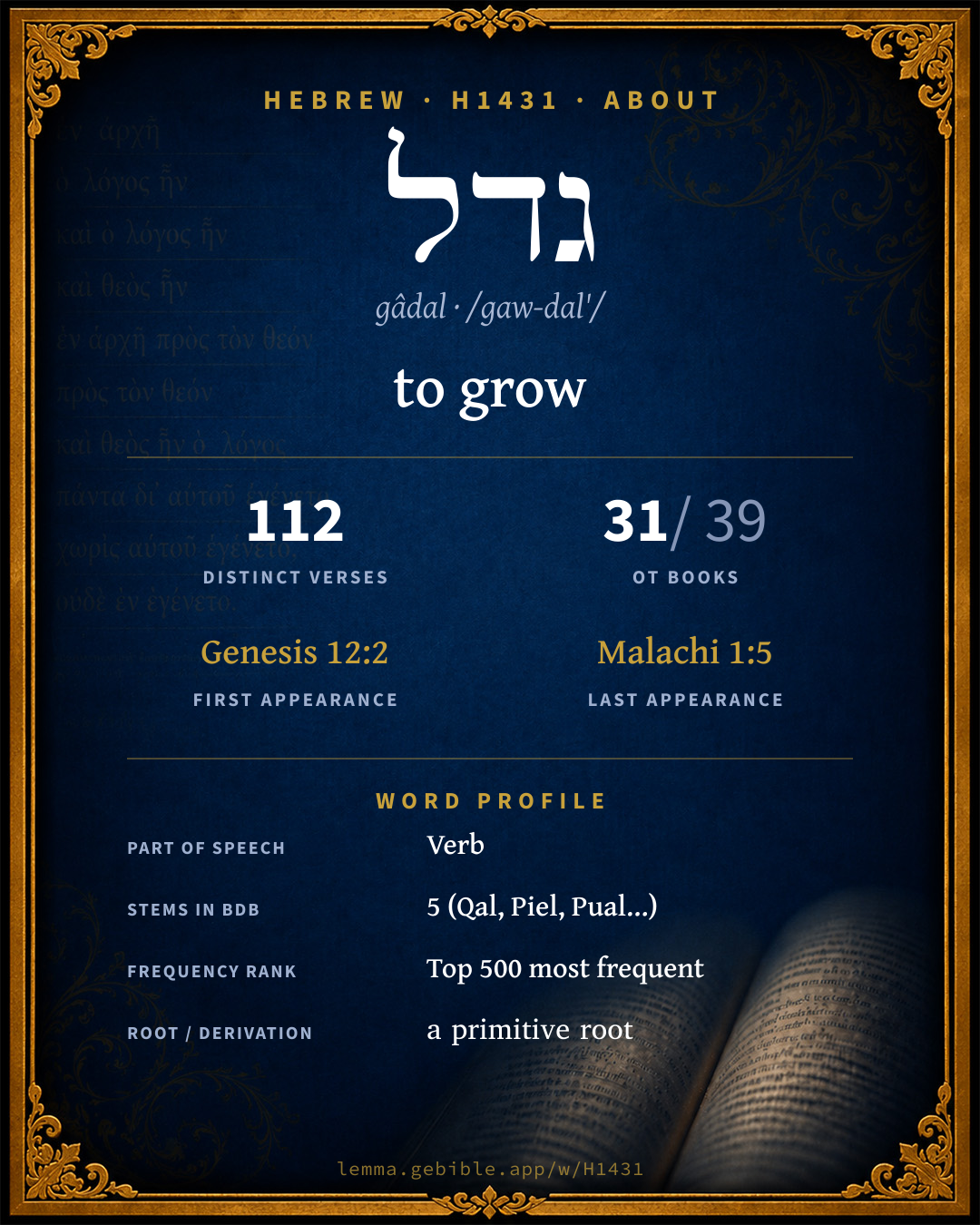
גָּדַל
to grow
also: promote, make powerful, praise, magnify fuller range ↓
Full lexicon entry — Brown-Driver-Briggs (BDB)
From Brown-Driver-Briggs (BDB)
Where this word appears
See every Hiphil verb in the Hebrew Bible →
Grammar key — what these labels mean
Part of speech
- Verb
- An action or state-of-being word.
Stem
- Hiphil
- The causative active stem (“he caused / brought about”). Here: ‘make great’
- Qal
- The basic, simple active stem — the plain form of the verb (“he wrote”). Here: ‘grow up’
- Piel
- An intensive or resultative active stem. Here: ‘cause to grow’
- Hithpael
- The reflexive or reciprocal stem (the subject acts on itself).
- Pual
- The passive counterpart of the Piel. Here: ‘pl.’
Form
- Perfect
- A completed action or state — Hebrew marks aspect (completeness) more than strict tense (“he wrote”).
- Sequential Imperfect
- An imperfect with prefixed waw — the standard past-narrative form (waw-consecutive imperfect).
- Imperfect
- An incomplete, ongoing, or future action (“he will / would write”).
- Jussive
- A third- or second-person volitional form expressing wish or command (“let him write”).
- Infinitive Construct
- A bound verbal noun, frequently with prepositions (“to write / in writing”).
- Sequential Perfect
- A perfect with prefixed waw continuing a preceding imperfect or command (waw-consecutive perfect).
- Cohortative
- A first-person volitional form expressing wish or resolve (“let me / let us write”).
- Participle Active
- A verbal adjective expressing ongoing or characteristic action (“writing / one who writes”).
- Participle Passive
- A verbal adjective expressing action received (“written”).
- Imperative
- A direct command (“write!”).
State
- Absolute
- The independent form of a noun, not bound to a following word.
- Construct
- A noun bound to a following noun in a possessive / “of” relationship (the construct chain).
Person
- 3rd Person
- The one spoken about (“he / she / it / they”).
- 1st Person
- The speaker (“I / we”).
- 2nd Person
- The one addressed (“you”).
Gender
- Masculine
- Grammatically masculine.
- Common
- Either gender — not distinguished for this form.
- Feminine
- Grammatically feminine.
Number
- Singular
- One.
- Plural
- More than one (in Hebrew, generally three or more).
1 verse where H1431 appears in the Qal stem in the Book of Ezekiel. Filtered view — show all forms. Click any verse to open its interlinear word-by-word view. Verse text shown in the World English Bible for context — . Each verse’s Hebrew form is shown with its reference; the English is not keyword-highlighted, since the data carries no word-level English alignment. Use “Compare translations” on any verse to read it across multiple English versions. This concordance covers the Hebrew Bible; Septuagint (Greek Old Testament) occurrences are not indexed here.
Ezekiel
About this entry
At a glance — auto-summarized from this page’s data, not written by a person. Every figure links to its source below. This summary describes the numbers; it doesn’t interpret them.
“to grow” is the headline sense of the Hebrew verb גדל (gâdal). As a verb its force shifts by stem, across 5 stems (Qal, Piel, and more). It turns up in 112 verses across 31 books, a common footprint. First canonically at Genesis 12:2, it enters the text early. From the same root come גדול, גדל and גדל. Each statement above links to its evidence; the full detail follows below.
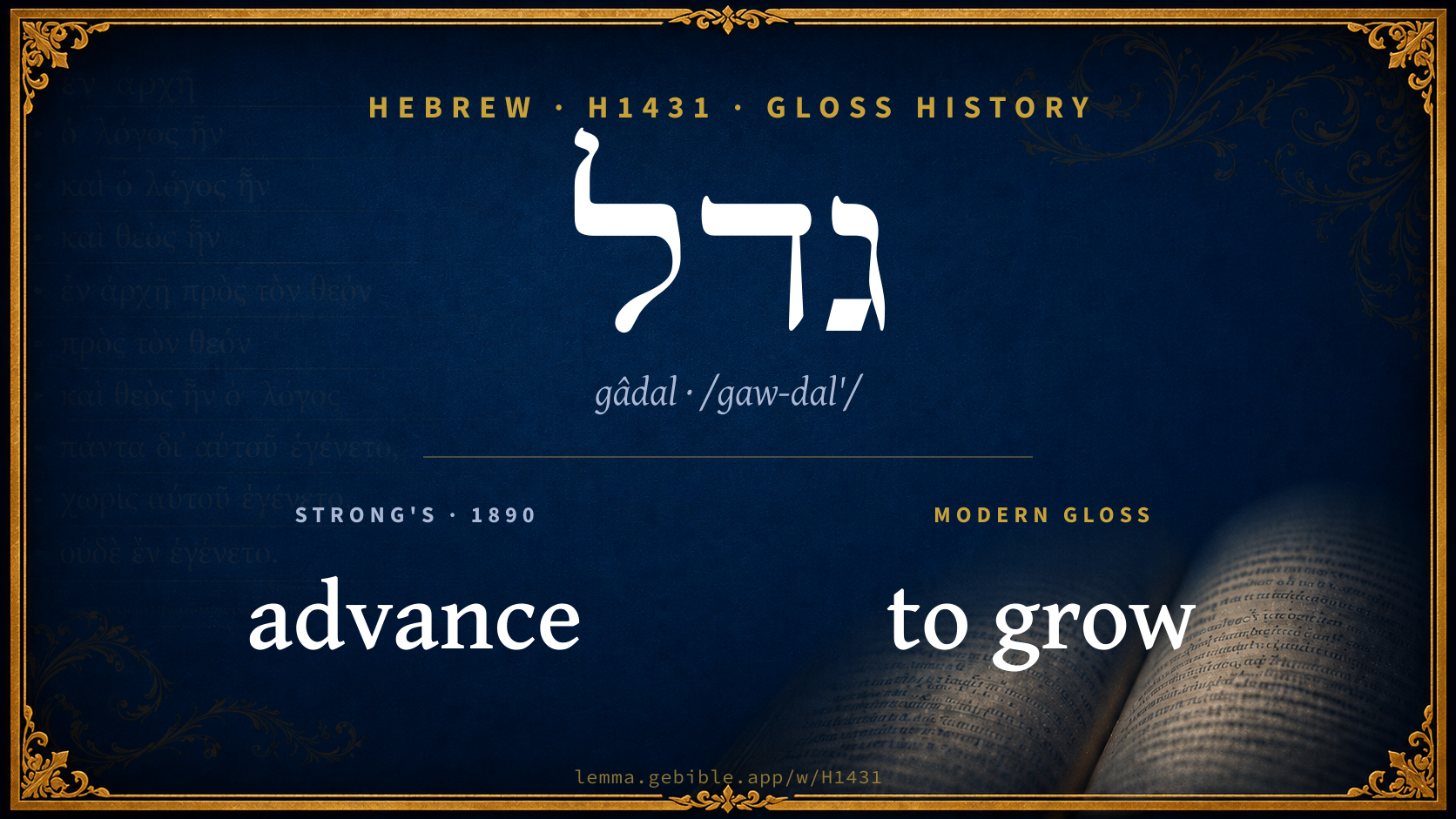
Gloss history
Strong's 1890 vs modern scholarship
About this word
Strong's H1431 catalogs a Hebrew word from the Hebrew Old Testament.
These counts are not copied from any lexicon or concordance. They are computed here, from the morphology-tagged Hebrew Old Testament. What Lemma adds →
- 112
- distinct verses
- The word appears in 112 distinct verses.
- 31 / 39
- OT books
- The word appears in 31 of 39 Old Testament books.
- #377
- by frequency
- Top 500 most frequent Hebrew words (rank 377 of 8,640 Hebrew words by occurrence).
View all 112 occurrences in the concordance →
By section of the Old Testament
By traditional corpus
Conventional, traditional groupings — biblical authorship is debated, so this is a traditional corpus grouping, not an authorship claim. Each share is this word’s portion of its verses in that division of the Hebrew canon. Each figure is a share of the word’s 112 distinct verses.
- Prophets (Nevi'im) 49 verses · 44%
- Writings (Ketuvim) 47 verses · 42%
- Torah (Pentateuch) 16 verses · 14%
How translations render this word
Counts come from each version’s own published word-to-Strong’s tagging or interlinear alignment — an approximate guide to how each version renders this word, not a word-level alignment the data otherwise carries. Because each total is that version’s own tagged count, the per-version totals vary from one another and need not match the appearance or distinct-verse counts above. These counts may also differ from a printed concordance because Lemma counts each distinctly tagged rendering and does not collapse phrase taggings into a single head-word total. This is a fixed set of word-tagged versions (KJV, ASV, BSB, ULT) and does not change with the reading translation you choose elsewhere. Each version’s license is shown beside its name below (and on Sources).
- King James Version: Great 8×, Grew 6×, Be magnified 4×
- American Standard Version: Great 8×, Grew 6×, Magnified 6×
- Berean Standard Bible: Great 9×, Had grown up 6×, Grew 5×
- unfoldingWord Literal Text: Great 13×, And 11×, Be great 7×
King James Version Public Domain
Renders H1431 across 118 tagged occurrences — most commonly:
Plus other, less common renderings. Plus 67 renderings that appear only once — usually multi-word phrases or single function words the recovered tagging swept in, not distinct renderings. Not rendered by a distinct English word in 1 further occurrence.
American Standard Version Public Domain
Renders H1431 across 119 tagged occurrences — most commonly:
Plus other, less common renderings. Plus 71 renderings that appear only once — usually multi-word phrases or single function words the recovered tagging swept in, not distinct renderings.
Berean Standard Bible Public Domain
Renders H1431 across 115 tagged occurrences — most commonly:
Plus 76 renderings that appear only once — usually multi-word phrases or single function words the recovered tagging swept in, not distinct renderings. Not rendered by a distinct English word in 3 further occurrences.
unfoldingWord Literal Text CC BY-SA 4.0
Renders H1431 across 156 tagged occurrences — most commonly:
Plus other, less common renderings. Plus 67 renderings that appear only once — usually multi-word phrases or single function words the recovered tagging swept in, not distinct renderings.
29 senses and sub-senses in the full BDB
Hebrew verbs can shift meaning by stem (binyan): Qal is the basic action, Niphal is often passive or reflexive, Piel often intensifies or makes it factitive, and Hiphil is typically causative. The senses below are grouped under the stem BDB assigns to each. This entry also uses Pual (the passive of Piel) and Hithpael (reflexive or reciprocal).
What do BDB’s symbols mean?
BDB uses these scholarly abbreviations:
| Symbol | Meaning |
|---|---|
| 𝔊 | the Septuagint (the ancient Greek translation, LXX) |
| 𝔙 | the Vulgate (the Latin translation) |
| 𝔖 | the Syriac version (the Peshitta) |
| 𝔗 | the Targum (the Aramaic translation) |
| ψ | the Psalms |
| √ | root (the underlying root or stem) |
| ‖ | parallel passage (a synonymous or contrasted parallel) |
| † | the dagger: every passage where the word occurs is cited |
The 29 senses and sub-senses the full Brown-Driver-Briggs lexicon distinguishes for this word, in lexicon order (not ranked by frequency), with BDB’s own verbatim wording and sub-sense lettering. Shown in Hebrew script with BDB’s own scholarly abbreviations. The condensed entry is in the Lexicon Entry tab. See also the Forms in the corpus table below.
Qal
- Pf. ג׳ etc. Gn 38:14 + 14 times; sf. גְּדֵלַנִי Jb 31:18; Impf. יִגְדַּל etc. ψ 35:27 + 34 times;— e.g. Genesis 38:14
- 1. grow up,
- a. child Gn 21:8, 20; 25:27; 38:11, 14 Ex 2:10, 11 (JE) Ju 11:2; 13:24 Ru 1:13 1 S 2:21; 3:19 1 K 12:8, 10 (= 2 Ch 10:8, 10) 2 K 4:18; גְּדֵלַנִי כְאָב he grew up to me as to a father Jb 31:18; e.g. Genesis 21:8
- b. lamb 2 S 12:3. e.g. 2 Samuel 12:3
- 2. become great,
- a. in extent, wealthy Gn 26:13(×2); 41:40 (JE) Je 5:27; e.g. Genesis 26:13
- b. in value, בְּעֵינֵי י׳, גָּֽדְלָה נֶפֶשׁ בְּעֵיָנ֑י prized by 1 S 26:24(×2); e.g. 1 Samuel 26:24
- c. in intensity, grief Jb 2:13, mourning Zc 12:11, punishment La 4:6, trespass Ezr 9:6; e.g. Job 2:13
- d. in sound, loud cry Gn 19:13 (J); e.g. Genesis 19:13
- e. in importance, of a king Ec 2:9 1 K 10:23 (= 2 Ch 9:22) Dn 8:9, 10 (under fig. of horn), chief Gn 24:35; 48:19 (J), Messiah Mi 5:3, Jerusalem Ez 16:7; e.g. Ecclesiastes 2:9
- f. of God 2 S 7:22 ψ 104:1, his works ψ 92:6, his power Nu 14:17 (J). e.g. 2 Samuel 7:22
- 3. to be magnified,
- a. house of David Zc 12:7; e.g. Zechariah 12:7
- b. Yahweh ψ 35:27; 40:17; 70:5 Mal 1:5, his name 2 S 7:26 (= 1 Ch 17:24). e.g. Psalms 35:27
Piel
- Pf. גִּדַּל Jos 4:14 Est 3:1; גִּדֵּ֔ל Is 49:21; גִּדֵּ֑לָה Is 51:18, etc.; Impf. יְגַדֵּל Is 44:14 + 8 times; Imv. גַּדְּלוּ ψ 34:4; Inf. גַּדֵּל Nu 6:5 + 3 times; Pt. מְגַדְּלִים 2 K 10:6 (מְגַדְּלוֹת) Ct 5:13 𝔊 𝔙 Hi Bö De);— e.g. Joshua 4:14
- 1. cause to grow, e.g. hair Nu 6:5 (P), plants Jon 4:10 Is 44:14 Ez 31:4 Ct 5:13; bring up children 2 K 10:6 Is 1:2; 23:4; 49:21; 51:18 Dn 1:5 Ho 9:12. e.g. Numbers 6:5
- 2. make great, powerful Gn 12:2 (J) Jos 3:7; 4:14 (D) 1 K 1:37, 47 1 Ch 29:12, 25 2 Ch 1:1 Est 3:1; 5:11; 10:2. e.g. Genesis 12:2
- 3. magnify,
- a. man Jb 7:17; e.g. Job 7:17
- b. God ψ 34:4 w. ל, 69:31. e.g. Psalms 34:4
Pual
- Pt. pl. מְגֻדָּלִים brought up ψ 144:12. e.g. Psalms 144:12
Hiphil
- Pf. הִגְדִּיל ψ 41:10 +, etc.; Impf. יַגְדִּיל Is 42:21 Dn 8:25, etc.; Inf. הַגְדִּיל 1 Ch 22:8 Am 8:5; Pt. מַגְדִּיל ψ 18:51 (= מִגְדֹּיל in ‖ 2 S 22:51); pl. מַגְדִּילִים ψ 35:26;— e.g. Psalms 41:10
- 1. make great, e.g. shekel Am 8:5, pile for fire Ez 24:9, joy Is 9:2, counsel Is 28:29, wisdom Ec 1:16, works Ec 2:4, house of Yahweh 1 Ch 22:5; the heel ψ 41:10 either lifted high (Ges), or (cf. De Now) gave me insidiously a great fall; cf. ג׳ פִּיךָ Ob 12 i.e. utter proud words (v. רחב Hiph.). e.g. Amos 8:5
- 2. magnify, salvation ψ 18:51, so ‖ 2 S 22:51 (Kt מַגְדִּיל; > Qr מִגְדֹּל). mercy Gn 19:19 (J), teaching Is 42:21, the word of Yahweh ψ 138:2. e.g. Psalms 18:51
- 3. do great things הִגְדִּיל לַעֲשׂוֹת,
- a. in a good sense, of God ψ 126:2, Jo 2:21, also pregn. without Inf. 1 S 12:24. e.g. Psalms 126:2
- b. in bad sense, of ‘the northern one’ Jo 2:20, also pregn. without Inf. La 1:9 Zp 2:8, 10 Dn 8:4, 8, 11, 25; with עַל, of enemies ψ 35:26; 38:17; 55:13 Jb 19:5 Je 48:26, 42; Ez 35:13 of speaking ג׳ עָלַי בְּפִיכֶם. e.g. Joel 2:20
- c. also, with Inf. implied, wept greatly 1 S 20:41. e.g. 1 Samuel 20:41
Hithpael
- Pf. וְהִתְגַּדִּלְתִּ֫י Ez 38:23 I will magnify myself, shew myself great and powerful (of God); Impf. יִתְגַּדֵּל, with עַל in a bad sense, magnify oneself against Is 10:15 Dn 11:36; יִתְגַּדָּ֑ל Dn 11:37. e.g. Ezekiel 38:23
Senses from the full Brown-Driver-Briggs lexicon (Brown, Driver, Briggs; Oxford 1906 — public domain), digitized via Sefaria, supplemented by the OpenScriptures HebrewLexicon (CC BY 4.0). Full attribution on Sources.
Word origin
vb. grow up, become great (Aramaic גְּדַל (Ithpe.), ܓܕܰܠ twist, twine, Arabic جَدَلَ twist a cord, make firm, strong, become strong, so NH)—
— Brown-Driver-Briggs (Oxford 1906, public domain), digitized via Sefaria, supplemented by the OpenScriptures HebrewLexicon (CC BY 4.0). See Sources.
Origin: a primitive root
Jastrow Dictionary
A second Hebrew/Aramaic lexicon for comparison, covering Aramaic and post-biblical (Talmudic, Targumic, Midrashic) usage that the biblical-Hebrew BDB does not. Matched by lemma rather than by Strong’s number, so a lemma may carry more than one Jastrow headword (shown separately below), and the entries cover usage well beyond the Bible.
גָּדַל I
- v. גדל II) to be high, to grow, be large, tall. Ex. R. s. 1 שהיה גָדֵל שלא וכ׳ he was extraordinarily tall for his age. Ib. וכי אין הכל גְּדֵילִים do not all children grow?—Y. Maasr. I, 49ᵃ, v. טְפוּס; a. fr. Fem. גְּדֵילָה, pl. גְּדֵילוֹת. Succ. 34ᵃ; a. fr.
- 1. to raise (of live stock and of plants); to rear, train. Kil. VIII, 1 מותרים לגַדֵּל you are permitted to raise. Snh. 19ᵇ מיכל גִּידְּלָה Michal reared (Mirab’s children). Ib.; Meg. 13ᵃ המְגַדֵּל יתום וכ׳ he who educates an orphan in his house. Gen. R. s. 98 היו … מְגַדְּלִים שער they let their hair grow (in mourning). Erub. 100ᵇ מְגַדָּלֶת שער she lets her hair grow (does not cut it); a. fr.
- 2. to raise to dignity, make famous; to praise. Hor. 9ᵃ (ref. to Lev. XXI, 10) whence do we know אם אין לו שחייבין לגַדְּלוֹ when he (the Highpriest) is poor, that they (the brethren) are bound to raise him (make him independent)? Ib. גַּדְּלֵהוּ משל אחיו raise him by a collection from his brethren (v. Rabb. D. S. a. l.). Esth. R. to III, 1 למה גִדְּלוֹ for what purpose did (the Lord) raise him? Yalk. Esth. 1053 עד היכן גִּידְּלוֹ וכ׳ how high did he raise him? Fifty cubits (to the gallows); a. fr.—Y. Meg. III, end, 74ᶜ (ref. to הגדול, Neh. VIII, 6) במה גִידְּלוֹ wherewith did he magnify the Lord (describe His greatness)?; Yoma 69ᵇ ג׳ בשם וכ׳ he praised the Lord by pronouncing the tetragrammaton; Y. Ber. VII, 11ᶜ גודלו (corr. acc.)—Part. pass. מְגוּדָּל well grown. Ber. 11ᵃ; a. fr.—Kidd. 49ᵃ; 49ᵇ, v. גַּדֶּלֶת. e.g. Leviticus 21:10
- to grow up, to become of age. Yeb. X, 9 וּמִשֶּׁהִ׳ and after he is of age. Ib. XIII, 1 עד שתַּגְדִּיל until she becomes of age; a. fr.
- , Nithpa. נִתְגַּדֵּל
- 1. to be raised to dignity. Esth. R. to III, 1 יִתְגַּדֵּל ואח"כ יתלה let him first become great and then be hanged. Gen. R. s. 99, end (play on פֹּרָת, Gen. XLIX, 22) ע"י פָּרוֹת נ׳ by means of cows (Pharaoh’s dream) was he raised to power; a. fr.— to be magnified. Y. Ber. IX, 14ᵃ top; Y. Taan. I, 64ᵇ top יִתְגַּדֵּל וכ׳ may Thy Name be glorified, sanctified &c.; a. e. e.g. Genesis 49:22
- 3. to glorify one’s self, to boast, parade. Ned. 62ᵃ; Ab. IV, 5 אל תעשם עטרה להִתְגַּדֵּל בהם make them (the words of the Law) not a crown to parade therewith.
- 4. to grow, prosper, be nursed. Tanḥ. V’zoth 1; Pesik. ib. p. 199ᵃ הרי … מִתְגַּדֵּל עמו the poison-bearing tree will be nursed along with it (the health-giving tree). Tanḥ. B’resh. 7 נִתְגַּדַּלְתָּ וחטאת thou didst grow older and didst sin, opp. תינוק היית; a. fr.
גְּדַל I
- Kidd. 71ᵇ ג׳ ולא נסיב was grown up and not yet married.
- to raise, rear. Ḥag. 4ᵇ מרים מְגַדְּלָא דרדקי Miryam, the childrens’ nurse.
- to be exalted. Targ. Ps. CIV, 1.
גָּדַל II
- (v. preced.; cmp. גדש) [to heap up, round;] to plait, dress the hair. Kel. XVI, 7 גּוֹדְלֵי מצנפות capweavers (on a model head, v. אִמּוּם). Ib. XV, 3 וגוֹדְלוֹת and dress their hair. Sabb. X, 6 הגּוֹדֶלֶת she who plaits her hair (on the Sabbath). Ib. 94ᵇ bot. גודלת משום אורגת plaiting the hair (is forbidden on the Sabbath) as an act of weaving; ib. 95ᵃ (another opin.) ג׳ … משום בונה as an act of building. Y. ib. VII, 10ᵈ הגודל כלי צורה he who forms raised figures on a vessel. M. Kat. 11ᵃ ג׳ תנור to build a stove.
גְּדַל II
- Gitt. 69ᵃ ניגדול תרתי וכ׳ let him twine two threads. M. Kat. 11ᵃ למִיגְדַּל אהורי to weave nets; למי׳ תנורא to build a stove, v. preced.
- same. Ḥag. 4ᵇ מרים מְגַדְּלָא נשייא Ms. M. (ed. מג׳ שיער נ׳) Miriam the women’s hair-dresser (v. Rabb. D. S. a. l. note); Snh. 67ᵃ; Sabb. 104ᵇ (missing in later editions). Succ. 37ᵃ הנהו מְגַדְּלֵי הושענא those twining the willow twigs (v. הוֹשַׁעְנָא).
גִּדָּל
- , v. גִּידּוֹל
גִּידּוֹל
- Giddol, name of several Amoraim. Y. Meg. III, end 74ᶜ ר׳ גי׳; Yoma 69ᵇ ר׳ גדל. Y. Bets. I, 60ᵃ (without title). Kidd. 59ᵃ ר׳ גידל; a. fr.—G. b. Binyamin, b. Minyamin (Minyomi). Y. Pes. VIII, end, 36ᵇ.—Y. B. Bath. III, 14ᵃ; Bab. B. Bath. 39ᵇ; a. fr.—G. b. R’ulai. Gitt. 34ᵃ
A Dictionary of the Targumim, the Talmud Babli and Yerushalmi, and the Midrashic Literature (Marcus Jastrow; London, Luzac, 1903) — Public Domain. Digitized via Sefaria. Digitized via Sefaria. Full attribution on Sources.
Forms in the corpus
The 94 distinct written forms H1431 takes in the Hebrew Bible, most frequent first — each parse links to that stem’s occurrences in the concordance. Hebrew forms include their vowel points and cantillation, so a single lemma takes many written forms.
The 60 most common forms are shown; 34 rarer forms follow in the full concordance.
Same root — word family
Other BDB entries built from the same root as H1431, grouped by Strong’s listed origin. These share a root / origin per the lexicon — not necessarily a shared meaning. Each links to that word’s own entry.
Derived from this word
- גדול gâdôwl H1419 great
- גדל gâdêl H1432 growing up
- גדל gôdel H1433 greatness
- גדל gᵉdil H1434 tassels
- מגדל migdâl H4026 tower
Proper names from this root
People and places named from this root — a name, not an additional meaning of the word.
- גדל Giddêl H1435 Giddel
- גדליה Gᵉdalyâh H1436 Gedaliah
- גדלתי Giddaltîy H1437 Giddalti
- יגדליהו Yigdalyâhûw H3012 Igdaliah
Compare all same-root words → Showing 4 of 10 — not the complete family. 4 of the same-root words are proper names (people or places). They share a root, not necessarily a meaning.
Septuagint verse parallels
This word appears in 104 verses that also exist in the Greek Old Testament (Septuagint), out of the 112 Hebrew verses it occurs in. You can read those verses in Greek by switching the Old Testament edition to the Septuagint.
Read these verses in the Septuagint
- Genesis 12:2
- Exodus 2:10
- Numbers 6:5
- Joshua 3:7
- Judges 11:2
- Ruth 1:13
- 1 Samuel 2:21
- 2 Samuel 7:22
- 1 Kings 1:37
- 2 Kings 4:18
- 1 Chronicles 17:24
- 2 Chronicles 1:1
This is a verse-level parallel only — the same verses exist in both the Hebrew and Greek Old Testaments. No word-level Hebrew↔Greek correspondence is claimed: the data carries no such alignment, so no Greek word is shown as this Hebrew word’s translation. Coverage is not total — the Septuagint omits the deuterocanon and renumbers the Psalms, so some Hebrew verses have no direct Greek parallel.