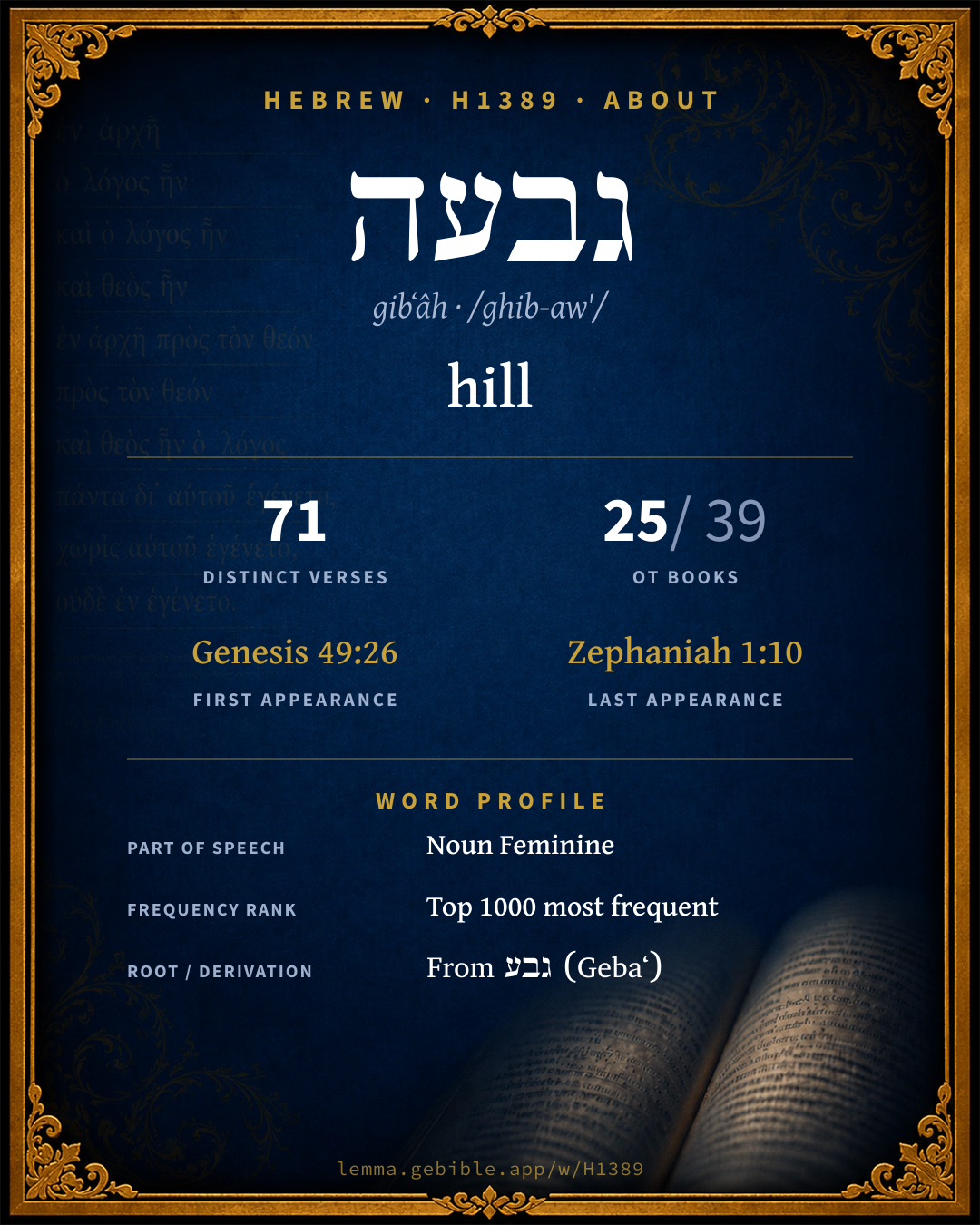
גִּבְעָה
hill
‘hill’ is one of 5 main senses fuller range ↓
Full lexicon entry — Brown-Driver-Briggs (BDB)
From Brown-Driver-Briggs (BDB)
Where this word appears
See every Absolute-state word in the Hebrew Bible →
Grammar key — what these labels mean
Part of speech
- Noun
- A naming word — a person, place, thing, or idea.
Noun type
- Common
- A common noun — a general class of person, place, or thing (“king,” “city,” “water”), not a specific name.
- Proper
- A name of a specific person, place, or people (e.g. Abraham, Zion, Israel).
State
- Absolute
- The independent form of a noun, not bound to a following word.
- Construct
- A noun bound to a following noun in a possessive / “of” relationship (the construct chain).
Gender
- Feminine
- Grammatically feminine.
Number
- Singular
- One.
- Plural
- More than one (in Hebrew, generally three or more).
Grammatical forms
- Noun, Common, Feminine, Plural, Absolute 35 times (49%)
- Noun, Common, Feminine, Singular, Absolute 18 times (25%)
- Noun, Common, Feminine, Singular, Construct 13 times (18%)
- Noun, Common, Feminine, Plural, Construct 4 times (6%)
- Noun, Proper 1 time (1%)
Parsed forms decoded from the imported morphology (morphhb / Westminster Leningrad Codex — WLC text public domain, morphhb tagging CC BY 4.0), counted across 71 parsed occurrences — not distinct verses.
Every verse where H1389 appears — 71 distinct verses across 25 books. Click any verse to open its interlinear word-by-word view. Verse text shown in the World English Bible for context — . Each verse’s Hebrew form is shown with its reference; the English is not keyword-highlighted, since the data carries no word-level English alignment. Use “Compare translations” on any verse to read it across multiple English versions. This concordance covers the Hebrew Bible; Septuagint (Greek Old Testament) occurrences are not indexed here.
Genesis 1 verse
Exodus 2 verses
- Exodus 17:9 הַ/גִּבְעָ֔ה ptcl def.art + n c fs Moses said to Joshua, "Choose men for us, and go out, fight with Amalek. Tomorrow I will stand on the top of the hill with God's rod in my hand."
- Exodus 17:10 הַ/גִּבְעָֽה ptcl def.art + n c fs So Joshua did as Moses had told him, and fought with Amalek; and Moses, Aaron, and Hur went up to the top of the hill.
Numbers 1 verse
Deuteronomy 2 verses
- Deuteronomy 12:2 הַ/גְּבָע֔וֹת ptcl def.art + n c fp You shall surely destroy all the places in which the nations that you shall dispossess served their gods, on the high mountains, and on the hills, and under every green tree:
- Deuteronomy 33:15 גִּבְע֥וֹת n c fp cs For the chief things of the ancient mountains, For the precious things of the everlasting hills,
Joshua 2 verses
- Joshua 5:3 גִּבְעַ֖ת n c fs cs Joshua made himself flint knives, and circumcised the children of Israel at the hill of the foreskins.
- Joshua 24:33 בְּ/גִבְעַת֙ prep + n c fs cs Eleazar the son of Aaron died; and they buried him in the hill of Phinehas his son, which was given him in the hill-country of Ephraim.
Judges 1 verse
1 Samuel 6 verses
- 1 Samuel 7:1 בַּ/גִּבְעָ֑ה prep det + n c fs The men of Kiriath Jearim came, and fetched up the ark of Yahweh, and brought it into the house of Abinadab in the hill, and sanctified Eleazar his son to keep the ark of Yahweh.
- 1 Samuel 10:5 גִּבְעַ֣ת n c fs cs After that you shall come to the hill of God, where is the garrison of the Philistines: and it shall happen, when you are come there to the city, that you shall meet a band of prophets coming down from the high place with a psaltery, and a tambourine, and a pipe, and a harp, before them; and they will be prophesying:
- 1 Samuel 10:10 הַ/גִּבְעָ֔תָ/ה ptcl def.art + n Proper + sfx dem When they came there to the hill, behold, a band of prophets met him; and the Spirit of God came mightily on him, and he prophesied among them.
- 1 Samuel 23:19 בְּ/גִבְעַת֙ prep + n c fs cs Then came up the Ziphites to Saul to Gibeah, saying, Doesn't David hide himself with us in the strongholds in the wood, in the hill of Hachilah, which is on the south of the desert?
- 1 Samuel 26:1 בְּ/גִבְעַ֣ת prep + n c fs cs The Ziphites came to Saul to Gibeah, saying, Doesn't David hide himself in the hill of Hachilah, which is before the desert?
- 1 Samuel 26:3 בְּ/גִבְעַ֣ת prep + n c fs cs Saul encamped in the hill of Hachilah, which is before the desert, by the way. But David abode in the wilderness, and he saw that Saul came after him into the wilderness.
2 Samuel 4 verses
- 2 Samuel 2:24 גִּבְעַ֣ת n c fs cs But Joab and Abishai pursued after Abner: and the sun went down when they were come to the hill of Ammah, that lies before Giah by the way of the wilderness of Gibeon.
- 2 Samuel 2:25 גִּבְעָ֖ה n c fs The children of Benjamin gathered themselves together after Abner, and became one band, and stood on the top of a hill.
- 2 Samuel 6:3 בַּ/גִּבְעָ֑ה prep det + n c fs They set the ark of God on a new cart, and brought it out of the house of Abinadab that was in the hill: and Uzzah and Ahio, the sons of Abinadab, drove the new cart.
- 2 Samuel 6:4 בַּ/גִּבְעָ֔ה prep det + n c fs They brought it out of the house of Abinadab, which was in the hill, with the ark of God: and Ahio went before the ark.
1 Kings 1 verse
2 Kings 2 verses
2 Chronicles 1 verse
Job 1 verse
Psalms 5 verses
- Psalms 65:12 גְּבָע֥וֹת n c fp The wilderness grasslands overflow. The hills are clothed with gladness.
- Psalms 72:3 וּ֝/גְבָע֗וֹת conj + n c fp The mountains shall bring prosperity to the people. The hills bring the fruit of righteousness.
- Psalms 114:4 גְּ֝בָע֗וֹת n c fp The mountains skipped like rams, The little hills like lambs.
- Psalms 114:6 גְּ֝בָע֗וֹת n c fp You mountains, that you skipped like rams; You little hills, like lambs?
- Psalms 148:9 גְּבָע֑וֹת n c fp Mountains and all hills; Fruit trees and all cedars;
Proverbs 1 verse
Song of Solomon 2 verses
- Song of Solomon 2:8 הַ/גְּבָעֽוֹת ptcl def.art + n c fp The voice of my beloved! Behold, he comes, Leaping on the mountains, Skipping on the hills.
- Song of Solomon 4:6 גִּבְעַ֖ת n c fs cs Until the day is cool, and the shadows flee away, I will go to the mountain of myrrh, To the hill of frankincense.
Isaiah 13 verses
- Isaiah 2:2 מִ/גְּבָע֑וֹת prep + n c fp It shall happen in the latter days, that the mountain of Yahweh's house shall be established on the top of the mountains, And shall be raised above the hills; And all nations shall flow to it.
- Isaiah 2:14 הַ/גְּבָע֥וֹת ptcl def.art + n c fp For all the high mountains, For all the hills that are lifted up,
- Isaiah 10:32 גִּבְעַ֖ת n c fs cs This very day shall he halt at Nob: he shakes his hand at the mountain of the daughter of Zion, the hill of Jerusalem.
- Isaiah 30:17 הַ/גִּבְעָֽה ptcl def.art + n c fs One thousand [shall flee] at the threat of one; at the threat of five shall you flee: until you be left as a beacon on the top of a mountain, and as an ensign on a hill.
- Isaiah 30:25 גִּבְעָ֣ה n c fs There shall be on every lofty mountain, and on every high hill, brooks [and] streams of waters, in the day of the great slaughter, when the towers fall.
- Isaiah 31:4 גִּבְעָתָֽ/הּ n c fs cs + sfx pers 3fs For thus says Yahweh to me, As the lion and the young lion growling over his prey, if a multitude of shepherds are called forth against him, will not be dismayed at their voice, nor abase himself for the noise of them: so will Yahweh of Hosts come down to fight on Mount Zion, and on the hill of it.
- Isaiah 40:4 וְ/גִבְעָ֖ה conj + n c fs Every valley shall be exalted, and every mountain and hill shall be made low; and the uneven shall be made level, and the rough places a plain:
- Isaiah 40:12 וּ/גְבָע֖וֹת conj + n c fp Who has measured the waters in the hollow of his hand, and meted out the sky with the span, and comprehended the dust of the earth in a measure, and weighed the mountains in scales, and the hills in a balance?
- Isaiah 41:15 וּ/גְבָע֖וֹת conj + n c fp Behold, I have made you [to be] a new sharp threshing instrument having teeth; you shall thresh the mountains, and beat them small, and shall make the hills as chaff.
- Isaiah 42:15 וּ/גְבָע֔וֹת conj + n c fp I will lay waste mountains and hills, and dry up all their herbs; and I will make the rivers islands, and will dry up the pools.
- Isaiah 54:10 וְ/הַ/גְּבָע֖וֹת conj + ptcl def.art + n c fp For the mountains may depart, and the hills be removed; but my loving kindness shall not depart from you, neither shall my covenant of peace be removed, says Yahweh who has mercy on you.
- Isaiah 55:12 וְ/הַ/גְּבָע֗וֹת conj + ptcl def.art + n c fp For you shall go out with joy, and be led forth with peace: the mountains and the hills shall break forth before you into singing; and all the trees of the fields shall clap their hands.
- Isaiah 65:7 הַ/גְּבָע֖וֹת ptcl def.art + n c fp your own iniquities, and the iniquities of your fathers together, says Yahweh, who have burned incense on the mountains, and blasphemed me on the hills; therefore will I first measure their work into their bosom.
Jeremiah 9 verses
- Jeremiah 2:20 גִּבְעָ֞ה n c fs For of old time I have broken your yoke, and burst your bonds; and you said, I will not serve; for on every high hill and under every green tree you did bow yourself, playing the prostitute.
- Jeremiah 3:23 מִ/גְּבָע֖וֹת prep + n c fp Truly in vain is [the help that is looked for] from the hills, the tumult on the mountains: truly in Yahweh our God is the salvation of Israel.
- Jeremiah 4:24 הַ/גְּבָע֖וֹת ptcl def.art + n c fp I saw the mountains, and, behold, they trembled, and all the hills moved back and forth.
- Jeremiah 13:27 גְּבָעוֹת֙ n c fp I have seen your abominations, even your adulteries, and your neighing, the lewdness of your prostitution, on the hills in the field. Woe to you, Jerusalem! you will not be made clean; how long shall it yet be?
- Jeremiah 16:16 גִּבְעָ֔ה n c fs Behold, I will send for many fishermen, says Yahweh, and they shall fish them up; and afterward I will send for many hunters, and they shall hunt them from every mountain, and from every hill, and out of the clefts of the rocks.
- Jeremiah 17:2 גְּבָע֥וֹת n c fp while their children remember their altars and their Asherim by the green trees on the high hills.
- Jeremiah 31:39 גִּבְעַ֣ת n c fs cs The measuring line shall go out further straight onward to the hill Gareb, and shall turn about to Goah.
- Jeremiah 49:16 גִּבְעָ֑ה n c fs As for your terror, the pride of your heart has deceived you, O you who dwell in the clefts of the rock, who hold the height of the hill: though you should make your nest as high as the eagle, I will bring you down from there, says Yahweh.
- Jeremiah 50:6 גִּבְעָה֙ n c fs My people have been lost sheep: their shepherds have caused them to go astray; they have turned them away on the mountains; they have gone from mountain to hill; they have forgotten their resting-place.
Ezekiel 8 verses
- Ezekiel 6:3 וְ/לַ/גְּבָע֜וֹת conj + prep det + n c fp and say, You mountains of Israel, hear the word of the Lord Yahweh: Thus says the Lord Yahweh to the mountains and to the hills, to the watercourses and to the valleys: Behold, I, even I, will bring a sword on you, and I will destroy your high places.
- Ezekiel 6:13 גִּבְעָ֨ה n c fs You shall know that I am Yahweh, when their slain men shall be among their idols round about their altars, on every high hill, on all the tops of the mountains, and under every green tree, and under every thick oak, the places where they offered sweet savor to all their idols.
- Ezekiel 20:28 גִּבְעָ֨ה n c fs For when I had brought them into the land, which I swore to give to them, then they saw every high hill, and every thick tree, and they offered there their sacrifices, and there they presented the provocation of their offering; there also they made their sweet savor, and they poured out there their drink-offerings.
- Ezekiel 34:6 גִּבְעָ֣ה n c fs My sheep wandered through all the mountains, and on every high hill: yes, my sheep were scattered on all the surface of the earth; and there was none who searched or sought.
- Ezekiel 34:26 גִּבְעָתִ֖/י n c fs cs + sfx pers 1cs I will make them and the places round about my hill a blessing; and I will cause the shower to come down in its season; there shall be showers of blessing.
- Ezekiel 35:8 גִּבְעוֹתֶ֤י/ךָ n c fp cs + sfx pers 2ms I will fill its mountains with its slain: in your hills and in your valleys and in all your watercourses shall they fall who are slain with the sword.
- Ezekiel 36:4 וְ/לַ/גְּבָע֜וֹת conj + prep det + n c fp therefore, you mountains of Israel, hear the word of the Lord Yahweh: Thus says the Lord Yahweh to the mountains and to the hills, to the watercourses and to the valleys, to the desolate wastes and to the cities that are forsaken, which are become a prey and derision to the residue of the nations that are round about;
- Ezekiel 36:6 וְ֠/לַ/גְּבָעוֹת conj + prep det + n c fp Therefore prophesy concerning the land of Israel, and tell the mountains and to the hills, to the watercourses and to the valleys, Thus says the Lord Yahweh: Behold, I have spoken in my jealousy and in my wrath, because you have borne the shame of the nations:
Hosea 2 verses
- Hosea 4:13 הַ/גְּבָעוֹת֙ ptcl def.art + n c fp They sacrifice on the tops of the mountains, And burn incense on the hills, under oaks and poplars and terebinths, Because its shade is good. Therefore your daughters play the prostitute, And your brides commit adultery.
- Hosea 10:8 וְ/לַ/גְּבָע֖וֹת conj + prep det + n c fp The high places also of Aven, the sin of Israel, will be destroyed. The thorn and the thistle will come up on their altars. They will tell the mountains, "Cover us!" and the hills, "Fall on us!"
Joel 1 verse
Amos 1 verse
Micah 2 verses
- Micah 4:1 מִ/גְּבָע֑וֹת prep + n c fp But in the latter days, It will happen that the mountain of Yahweh's temple will be established on the top of the mountains, And it will be exalted above the hills; And peoples will stream to it.
- Micah 6:1 הַ/גְּבָע֖וֹת ptcl def.art + n c fp Listen now to what Yahweh says: "Arise, plead your case before the mountains, And let the hills hear what you have to say.
Nahum 1 verse
Habakkuk 1 verse
Zephaniah 1 verse
About this entry
At a glance — auto-summarized from this page’s data, not written by a person. Every figure links to its source below. This summary describes the numbers; it doesn’t interpret them.
גבעה (gibʻâh) is a Hebrew noun most often rendered “hill.” It is not a single-sense word — see its full sense range. It turns up in 71 verses across 25 books, a moderately common footprint. It first appears in Genesis 49:26. From the same root come גבע, מגבעה and גבעון. The sections below give every sense, occurrence, and version rendering.
Gloss history
Strong's 1890 vs modern scholarship
About this word
Strong's H1389 catalogs a Hebrew word from the Hebrew Old Testament.
These counts are not copied from any lexicon or concordance. They are computed here, from the morphology-tagged Hebrew Old Testament. What Lemma adds →
- 71
- distinct verses
- The word appears in 71 distinct verses.
- 25 / 39
- OT books
- The word appears in 25 of 39 Old Testament books.
- #558
- by frequency
- Top 1000 most frequent Hebrew words (rank 558 of 8,640 Hebrew words by occurrence).
View all 71 occurrences in the concordance →
By section of the Old Testament
By traditional corpus
Conventional, traditional groupings — biblical authorship is debated, so this is a traditional corpus grouping, not an authorship claim. Each share is this word’s portion of its verses in that division of the Hebrew canon. Each figure is a share of the word’s 71 distinct verses.
- Prophets (Nevi'im) 55 verses · 77%
- Writings (Ketuvim) 10 verses · 14%
- Torah (Pentateuch) 6 verses · 8%
How translations render this word
Counts come from each version’s own published word-to-Strong’s tagging or interlinear alignment — an approximate guide to how each version renders this word, not a word-level alignment the data otherwise carries. Because each total is that version’s own tagged count, the per-version totals vary from one another and need not match the appearance or distinct-verse counts above. These counts may also differ from a printed concordance because Lemma counts each distinctly tagged rendering and does not collapse phrase taggings into a single head-word total. This is a fixed set of word-tagged versions (KJV, ASV, BSB, ULT) and does not change with the reading translation you choose elsewhere. Each version’s license is shown beside its name below (and on Sources).
BDB lists this Strong’s number as 2 distinct words (homographs). Each count above pools all of them and is not split by sense — see the Senses section below. A low-frequency rendering may belong to a different one of those words, not the primary meaning.
- King James Version†: Hill 26×, Hills 26×, All the hills 3×
- American Standard Version†: Hills 26×, Hill 24×, Above the hills 2×
- Berean Standard Bible†: Hills 37×, Hill 21×, Gibeah 3×
- unfoldingWord Literal Text†: Hills 32×, Hill 16×, Hill of 6×
King James Version Public Domain
Renders H1389 across 69† tagged occurrences — most commonly:
Plus 9 renderings that appear only once — usually multi-word phrases or single function words the recovered tagging swept in, not distinct renderings.
American Standard Version Public Domain
Renders H1389 across 69† tagged occurrences — most commonly:
Plus 13 renderings that appear only once — usually multi-word phrases or single function words the recovered tagging swept in, not distinct renderings.
Berean Standard Bible Public Domain
Renders H1389 across 69† tagged occurrences — most commonly:
Plus 8 renderings that appear only once — usually multi-word phrases or single function words the recovered tagging swept in, not distinct renderings. Not rendered by a distinct English word in 2 further occurrences.
unfoldingWord Literal Text CC BY-SA 4.0
Renders H1389 across 72† tagged occurrences — most commonly:
Plus 6 renderings that appear only once — usually multi-word phrases or single function words the recovered tagging swept in, not distinct renderings.
7 senses and sub-senses in the full BDB
What do BDB’s symbols mean?
BDB uses these scholarly abbreviations:
| Symbol | Meaning |
|---|---|
| 𝔊 | the Septuagint (the ancient Greek translation, LXX) |
| 𝔙 | the Vulgate (the Latin translation) |
| 𝔖 | the Syriac version (the Peshitta) |
| 𝔗 | the Targum (the Aramaic translation) |
| ψ | the Psalms |
| √ | root (the underlying root or stem) |
| ‖ | parallel passage (a synonymous or contrasted parallel) |
| † | the dagger: every passage where the word occurs is cited |
The 7 senses and sub-senses the full Brown-Driver-Briggs lexicon distinguishes for this word, in lexicon order (not ranked by frequency), with BDB’s own verbatim wording and sub-sense lettering. Shown in Hebrew script with BDB’s own scholarly abbreviations. The condensed entry is in the Lexicon Entry tab. See also the Forms in the corpus table below.
גבעה I hill
- 1. in ordinary prose, hill, lower than mountain Ex 17:9, 10 (E) 2 S 2:25; it may be n.pr. in 1 S 7:1; 10:10 2 S 6:3, 4 v. also sub ii. גִּבְעָה. e.g. Exodus 17:9
- 2. especially as place of illicit worship עַל כָּל־ג׳ גְּבֹהָה ותחת כל עץ רענן 1 K 14:23 2 K 17:10 Je 2:20; cf. Dt 12:2 2 K 16:4 2 Ch 28:4 (these two + במות); also Ho 4:13 Je 13:27; 17:2 Ez 6:13 (v. supr.). e.g. 1 Kings 14:23
- 3. very commonly ‖ הר in poet. & proph. Dt 33:15 ψ 72:3; 114:4, 6; 148:9 Ct 2:8; 4:6 Is 2:2, 14; 30:17, 25; 31:4; 40:4, 12; 41:15; 42:15; 54:10; 55:12; 65:7 Je 3:23; 4:24; 16:16; 50:7 Ez 6:3; 34:6; 35:8; 36:4, 6 Ho 4:13; 10:8 Jo 4:18 Am 9:13 Mi 4:1; 6:1 Na 1:5 Hb 3:6; rarely in prose Dt 12:2; sometimes as rejoicing ψ 65:13, majestic (poet.) ג׳ עולם Gn 49:26 Dt 33:15 Hb 3:6 (‘everlasting hills’); cf. also Jb 15:7; high Pr 8:25 (with adj. high, cf. supr.) Je 49:16. e.g. Deuteronomy 33:15
- 4. hills with special names, some nearly or quite = n.pr.loc., which see under the respective words: ג׳ הַמּוֹרֶה Ju 7:1 teacher’s hill, in valley of Jezreel; ג׳ הָעֲרָלוֹת Jos 5:3 hill of the fore-skins; ג׳ הָאֱלֹהִים 1 S 10:5 (a designation of Gibeah); ג׳ הַחֲכִילָה 1 S 23:19; 26:1, 3; ג׳ אַמָּה 2 S 2:24; ג׳ הַלְּבוֹנָה Ct 4:6 (i.e. hill where frankincense is grown); ג׳ גָּרֵ֑ב Je 31:39; ג׳ יְרוּשָׁלַם Is 10:32 cf. 31:4 (where ‖ הַר־צִיּוֹן), Ez 34:26 (v. supr.) & הַגְּבָעוֹת Zp 1:10 hills on which Jerusalem stands. e.g. Judges 7:1
גבעה II loc. (hill)
- 1. a city of Judah Jos 15:57 (perhaps one of two villages called Gabaa, Gabatha in Onom. v. LagOnom. 246, 128; 2nd ed. 255, 160). e.g. Joshua 15:57
- 2. city of Benj. Ju 19:14, 16 + 20 times Ju, 1 S 10:26; 14:2; 22:6; 26:1 2 S 23:29 = 1 Ch 11:31; also Ho 5:8; 9:9; 10:9(×2) (cf. Ju 19:12 ff.) 2 Ch 13:2; perhaps also 1 S 7:1; 10:10 2 S 6:3, 4 read also (for גבע) 1 S 13:16 Ju 20:10, 33; = גִּבְעַת Jos 18:28; called also גִּבְעַת בִּנְיָמִין 1 S 13:2, 15; 14:16, & גִּבְעַת שָׁאוּל 1 S 11:4; 15:34 Is 10:29; 2 S 21:6 read prob. גִּבְעוֹן, 𝔊 We Dr. e.g. Judges 19:14
- 3. a city of Ephraim, called גִּבְעַת פִּֽינְחָס Jos 24:33. e.g. Joshua 24:33
Senses from the full Brown-Driver-Briggs lexicon (Brown, Driver, Briggs; Oxford 1906 — public domain), digitized via Sefaria, supplemented by the OpenScriptures HebrewLexicon (CC BY 4.0). Full attribution on Sources.
Word origin
I. n.f. hill—abs. גִּבְעָה 2 S 2:25 + 13 times + Ez 6:13 (del. Co q.v.) 1 S 7:1 2 S 6:3, 4 (cf. Dr); cstr. גִּבְעַת Jos 5:3 + 8 times + 1 S 10:5 (cf. Dr); sf. גִּבְעָתִי Ez 34:26 (but del. Co), גִּבְעָתָהּ Is 31:4; pl. abs. גְּבָעוֹת Dt 12:2 + 35 times; cstr. גִּבְעוֹת Dt 33:15 Hb 3:6, גִּבְעֹת Gn 49:26; sf. גִּבְעוֹתֶיךָ Ez 35:8;—hill, height, elevation, both high and low, cf. ψ 148:9 ההרים וכל גבעות, 65:13;—
II. n.pr.loc. (hill)—ג׳ Jos 15:57 +; (הַ)גִּבְעָ֫תָה Ju 20:4 + 5 times; גִּבְעַת Jos 18:28; cstr. גִּבְעַת 1 S 11:4 + 9 times; abs. always c. art. except Jos 15:57; 18:28 Ju 19:12; 20:31 1 S 10:26 2 Ch 13:2;—
— Brown-Driver-Briggs (Oxford 1906, public domain), digitized via Sefaria, supplemented by the OpenScriptures HebrewLexicon (CC BY 4.0). See Sources.
Derived from גבע (Gebaʻ) (H1387) — Geba.
Jastrow Dictionary
A second Hebrew/Aramaic lexicon for comparison, covering Aramaic and post-biblical (Talmudic, Targumic, Midrashic) usage that the biblical-Hebrew BDB does not. Matched by lemma rather than by Strong’s number, so a lemma may carry more than one Jastrow headword (shown separately below), and the entries cover usage well beyond the Bible.
גִּבְעָה
- 1. hill. Lev. R. s. 10 כמין ג׳ like a hill (the bullock between the two rams). Cant. R. to IV, 6 עשה ערלותיהן ג׳ he piled up their preputia; Gen. R. s. 47 העמידן גִבְעַת ערלות; a. e.—Pl. גְּבָעוֹת. Ḥag. 15ᵃ ברא הרים ברא ג׳ He created mountains, and (corresponding to them) hills. Taan. 8ᵇ (ref. to Job XXXVII, 13) אם לשבט בהרים וג׳ if He sends rain as a scourge, He sends it on mountains and hills. Ab. Zar. 17ᵃ הרים וג׳ ye mountains and hills! Sot. 5ᵃ; a. fr. e.g. Job 37:13
- 2. pr. n. pl. Gibeah. Gitt. 6ᵇ עסיק בפלגש ג׳ studying the case of the woman murdered in Gibeah (Jud. XIX sq.). Pesik. R. s. 11 בפלגש בג׳ in the war about the woman of G.; a. e.—Shebu. 35ᵇ שמות האמורין בג׳ Rashi (ed. בגִבְעַת בִּנְיָמִין) the names (Adonai, El &c.) used in the chapter about Gibeah (Jud. XX).
A Dictionary of the Targumim, the Talmud Babli and Yerushalmi, and the Midrashic Literature (Marcus Jastrow; London, Luzac, 1903) — Public Domain. Digitized via Sefaria. Digitized via Sefaria. Full attribution on Sources.
Forms in the corpus
The 48 distinct written forms H1389 takes in the Hebrew Bible, most frequent first — each parse links to that state’s occurrences in the concordance. Hebrew forms include their vowel points and cantillation, so a single lemma takes many written forms.
Same root — word family
Other BDB entries built from the same root as H1389, grouped by Strong’s listed origin. These share a root / origin per the lexicon — not necessarily a shared meaning. Each links to that word’s own entry.
Derives from
Derived from this word
Proper names from this root
People and places named from this root — a name, not an additional meaning of the word.
- גבעון Gibʻôwn H1391 Gibeon
- גבעא Gibʻâʼ H1388 Gibea
- גבעה Gibʻâh H1390 Gibeah
- גבתון Gibbᵉthôwn H1405 Gibbethon
Compare all same-root words → Showing 4 of 7 — not the complete family. 5 of the same-root words are proper names (people or places). They share a root, not necessarily a meaning.
Septuagint verse parallels
This word appears in 68 verses that also exist in the Greek Old Testament (Septuagint), out of the 71 Hebrew verses it occurs in. You can read those verses in Greek by switching the Old Testament edition to the Septuagint.
Read these verses in the Septuagint
- Genesis 49:26
- Exodus 17:9
- Numbers 23:9
- Deuteronomy 12:2
- Joshua 5:3
- Judges 7:1
- 1 Samuel 7:1
- 2 Samuel 2:24
- 2 Kings 16:4
- 2 Chronicles 28:4
- Job 15:7
- Psalms 65:12
This is a verse-level parallel only — the same verses exist in both the Hebrew and Greek Old Testaments. No word-level Hebrew↔Greek correspondence is claimed: the data carries no such alignment, so no Greek word is shown as this Hebrew word’s translation. Coverage is not total — the Septuagint omits the deuterocanon and renumbers the Psalms, so some Hebrew verses have no direct Greek parallel.