Song of Solomon 4:6

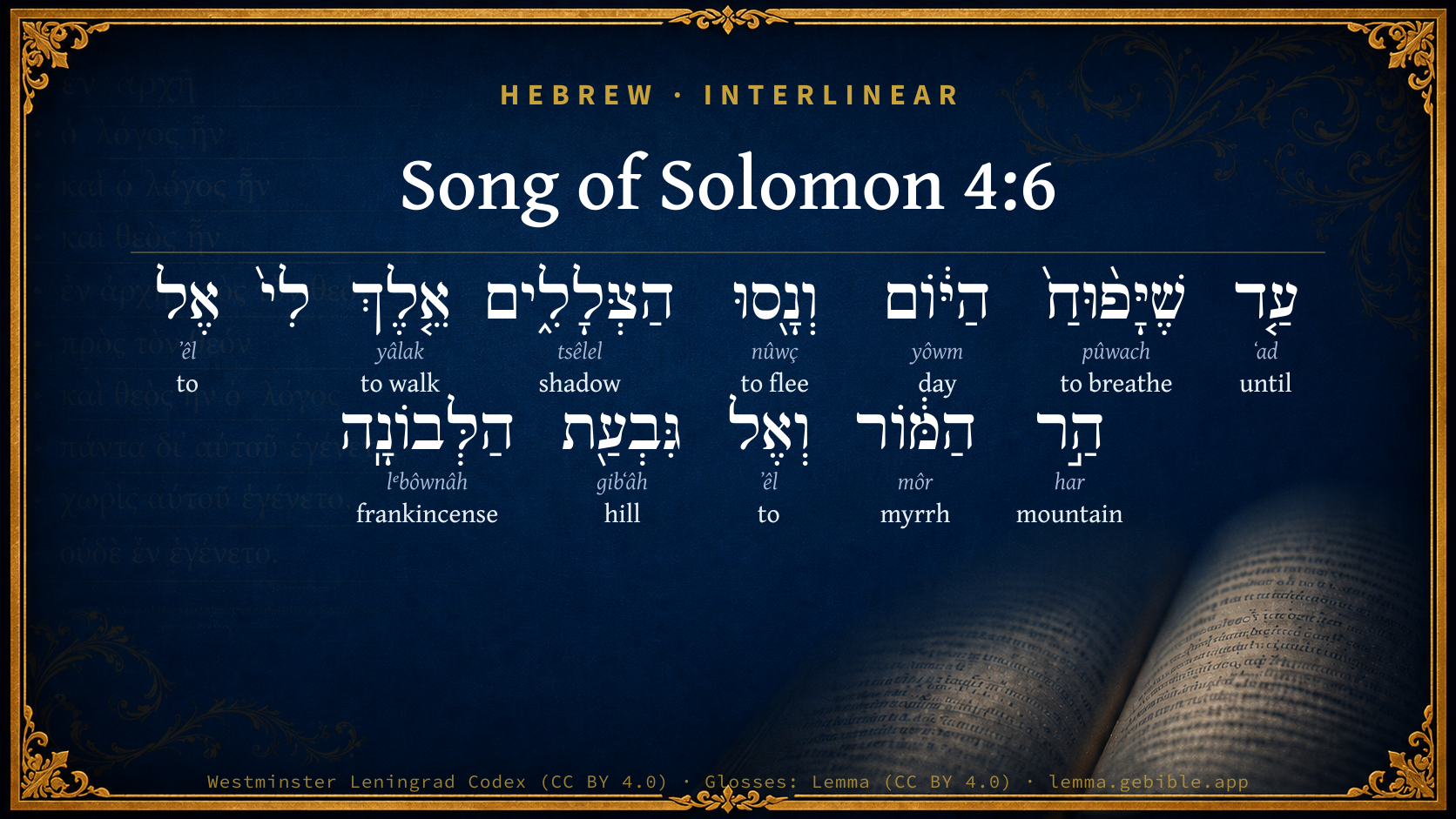
Hebrew (Westminster Leningrad Codex) Song of Solomon 4:6 appears in the Hebrew Old Testament. The text above is from the Westminster Leningrad Codex. Each word links to its Strong’s number, a concise gloss, and parsing drawn from the Open Scriptures Hebrew Bible morphology. Click any word for its full Brown-Driver-Briggs (BDB) entry.
Download image
Cite this verse

Song of Solomon 4:6 (World English Bible). Public Domain. Lemma interlinear Bible study tool, https://lemma.gebible.app/v/song-of-solomon/4/6.

Show BibTeX & RIS
BibTeX
RIS
English Translation
Until the day is cool, and the shadows flee away, I will go to the mountain of myrrh, To the hill of frankincense.
World English Bible · Public Domain
Download a study sheet

One document with this verse’s original text, its word-by-word gloss line, the meaning frame, cross-references with their text, attributed commentary, and full source and license credits — printable, and it pastes into notes with its structure intact.

This verse Autodidact and up

Study sheet (.html) Plain text (.txt)

A passage Seminary Student

Up to 50 verses in one chapter. A passage sheet keeps up to 6 commentary sources and 12 cross-references per verse, in the order this page ranks them, and says so on the sheet whenever that leaves anything out. Ask for a single verse and you get the Autodidact verse sheet above.

Everything on this page stays free to read, with no account — the sheet is a download of what is already on screen, not access to it.

Want to remove ads? Support Godless Engineer
Compare translations 3

The same verse in 3 English versions, stacked beneath the original-language interlinear above. Click any original word for its lexicon entry.

Each is an independent rendering of the whole verse — the interlinear is not word-aligned to these translations.

Highlighted words mark where these versions differ — a whole-verse word diff, not a word-by-word alignment.

  • World English Bible Public Domain
    Until the day is cool, and the shadows flee away, I will go to the mountain of myrrh, To the hill of frankincense.
  • King James Version Public Domain
    Until the day break, and the shadows flee away, I will get me to the mountain of myrrh, and to the hill of frankincense.
  • unfoldingWord Literal Text CC BY-SA 4.0
    Until the day breathes and the shadows flee, I myself will go to the mountain of myrrh and to the hill of frankincense.

unfoldingWord Literal Text — © unfoldingWord, licensed CC BY-SA 4.0. Word-aligned USFM3 via Door43 (git.door43.org/unfoldingWord/en_ult).

Versions to compare (up to 4)

3 of 4 selected

Show all 18 translations

Every available English version of this verse, each an independent rendering of the whole verse.

  • World English Bible Public Domain
    Until the day is cool, and the shadows flee away, I will go to the mountain of myrrh, To the hill of frankincense.
  • Berean Standard Bible Public Domain
    Before the day breaks and the shadows flee, I will make my way to the mountain of myrrh and to the hill of frankincense.
  • Majority Standard Bible Public Domain
    Before the day breaks and the shadows flee, I will make my way to the mountain of myrrh and to the hill of frankincense.
  • King James Version Public Domain
    Until the day break, and the shadows flee away, I will get me to the mountain of myrrh, and to the hill of frankincense.
  • American Standard Version (1901) Public Domain
    Until the day be cool, and the shadows flee away, I will get me to the mountain of myrrh, And to the hill of frankincense.
  • Revised Version (1885) Public Domain
    Until the day be cool, and the shadows flee away, I will get me to the mountain of myrrh, and to the hill of frankincense.
  • Geneva Bible (1599) Public Domain
    Vntill the day breake, and the shadowes flie away, I wil go into the mountaine of myrrhe and to the mountaine of incense.
  • Douay-Rheims (1899) Public Domain
    Till the day break, and the shadows retire, I will go to the mountain of myrrh, and to the hill of frankincense.
  • Young's Literal Translation Public Domain
    Till the day doth break forth, And the shadows have fled away, I will get me unto the mountain of myrrh, And unto the hill of frankincense.
  • Literal Standard Version CC BY-SA 4.0
    Until the day breaks forth, || And the shadows have fled away, || I go for myself to the mountain of myrrh, || And to the hill of frankincense.
  • Unlocked Literal Bible CC BY-SA 4.0
    Until the dawn arrives and the shadows flee away, I will go to the mountain of myrrh and to the hill of frankincense.
  • unfoldingWord Literal Text CC BY-SA 4.0
    Until the day breathes and the shadows flee, I myself will go to the mountain of myrrh and to the hill of frankincense.
  • Darby Bible Public Domain
    Until the day dawn, and the shadows flee away, I will get me to the mountain of myrrh, And to the hill of frankincense.
  • World Messianic Bible Public Domain
    Until the day is cool, and the shadows flee away, I will go to the mountain of myrrh, to the hill of frankincense.
  • Webster's Bible Public Domain
    Until the day shall break, and the shadows flee away, I will repair to the mountain of myrrh, and to the hill of frankincense.
  • Free Bible Version CC BY-SA 4.0
    Before the morning breezes blow and the shadows disappear, I must hurry to those mountains of myrrh and frankincense.
  • Bible in Basic English Public Domain
    Till the evening comes, and the sky slowly becomes dark, I will go to the mountain of myrrh, and to the hill of frankincense.
  • JPS Tanakh (1917) Public Domain
    Until the day breathe, and the shadows flee away, I will get me to the mountain of myrrh, and to the hill of frankincense.

Literal Standard Version (2020), Covenant Press — licensed CC BY-SA 4.0. Text via the HelloAO Bible API (eBible.org). Unlocked Literal Bible (unfoldingWord) — licensed CC BY-SA 4.0. Text via the HelloAO Bible API (eBible.org). unfoldingWord Literal Text — © unfoldingWord, licensed CC BY-SA 4.0. Word-aligned USFM3 via Door43 (git.door43.org/unfoldingWord/en_ult). Free Bible Version, Dr. Jonathan Gallagher — licensed CC BY-SA 4.0. Text via the HelloAO Bible API (eBible.org).

Word by word

More ways to search: Search by grammar → Find every occurrence → Compare this word →

Practice this passage: Drill this verse → Learn its vocabulary →

הַצְּלָלִ֑ים
tsêlel
H6752
“the · shadows”
Particle, Definite Article + Noun, Common, Masculine, Plural, Absolute
Part of Speech
Particle + Noun
Type
Common
Gender
Masculine
Number
Plural
State
Absolute
Full BDB Definition

Origin: from H6751

TWOT: 1921a

shadow, shade - shadow (on dial) - shadow, shade (as protection) - shadow (symbolic of transitoriness of life)
  1. עַ֤ד ʻad H5704 “until” Preposition
  2. שֶׁיָּפ֨וּחַ֙ pûwach H6315 “who/which · to breathe” Particle, Relative + Verb, Qal, Imperfect, 3rd Person, Masculine, Singular
  3. הַיּ֔וֹם yôwm H3117 “the · day” Particle, Definite Article + Noun, Common, Masculine, Singular, Absolute
  4. וְנָ֖סוּ nûwç H5127 “and · to flee” Conjunction + Verb, Qal, Sequential Perfect, 3rd Person, Common, Plural
  5. אֵ֤לֶךְ yâlak H3212 “to walk” Verb, Qal, Imperfect, 1st Person, Common, Singular
  6. אֶל ʼêl H413 “to” Preposition
  7. הַ֣ר har H2022 “mountain of” Noun, Common, Masculine, Singular, Construct
  8. הַמּ֔וֹר môr H4753 “the · myrrh” Particle, Definite Article + Noun, Common, Masculine, Singular, Absolute
  9. וְאֶל ʼêl H413 “and · to” Conjunction + Preposition
  10. גִּבְעַ֖ת gibʻâh H1389 “hill of” Noun, Common, Feminine, Singular, Construct
  11. הַלְּבוֹנָֽה lᵉbôwnâh H3828 “the · frankincense” Particle, Definite Article + Noun, Common, Feminine, Singular, Absolute

About this verse

These counts appear in no published source. They are computed here, from the morphology-tagged text and Lemma’s own curated glosses. What Lemma adds →

13
words
11
distinct lemmas
Wisdom
section

Notable vocabulary

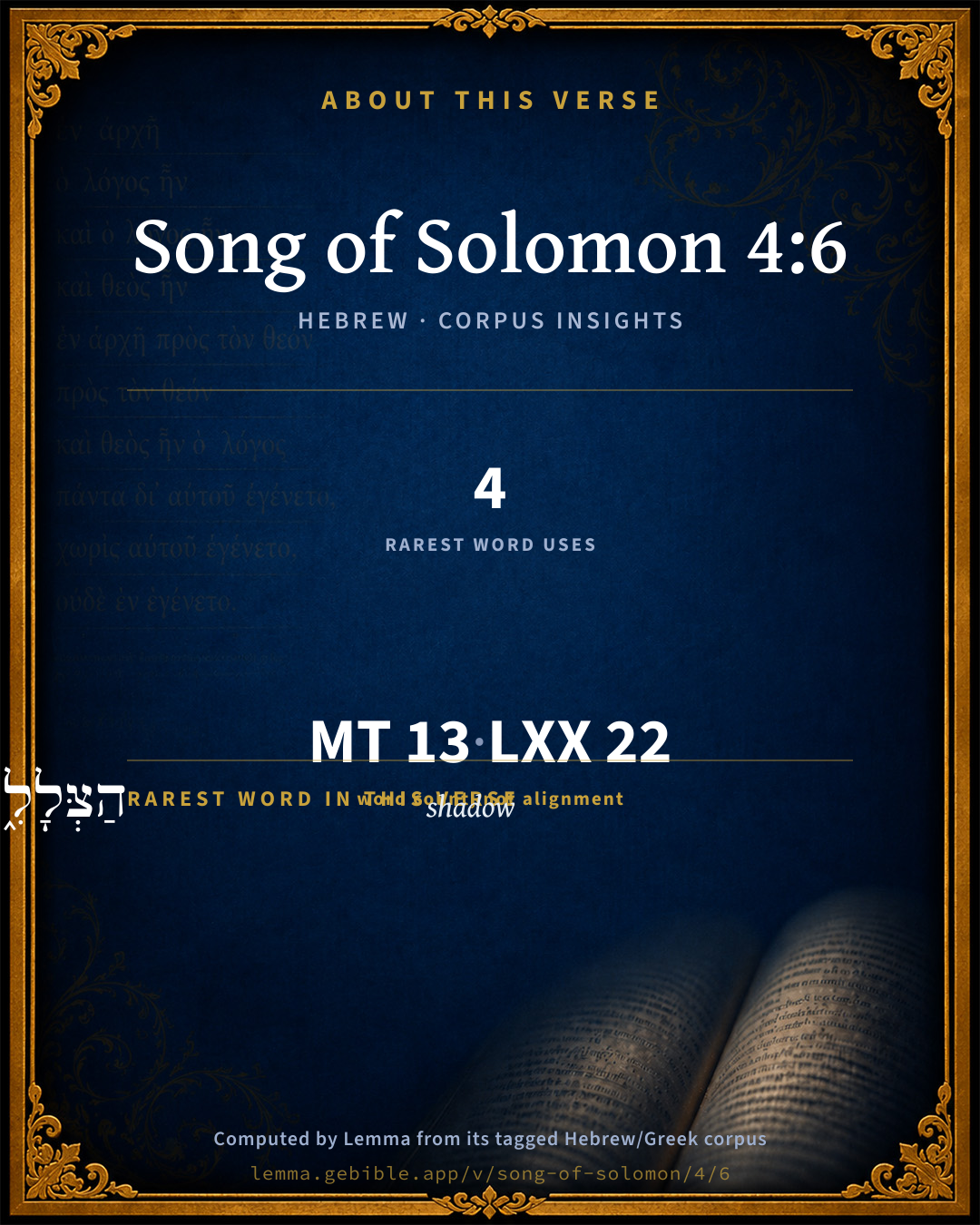
The rarest word here is הַצְּלָלִ֑ים shadow H6752 — appearing just 4 times in the whole Hebrew Bible.

Shared distinctive vocabulary

הַצְּלָלִ֑ים shadow H6752 occurs in 4 verses of the Hebrew Bible. Also found in:

Grammatical profile

  • 3 verbs
  • 6 nouns
  • 4 prepositions

Verb forms

  • שֶׁיָּפ֨וּחַ֙ Qal · Imperfect
  • וְנָ֖סוּ Qal · Sequential Perfect
  • אֵ֤לֶךְ Qal · Imperfect

Repetition

A word recurs within this verse — often emphatic in Hebrew:

  • אֶל to H413 ×2

Hebrew & Septuagint length

In English translation the verse runs 23 words from the Hebrew and 23 from the Septuagint (LXX English) — the same length.

A rough comparison of the two English renderings, which tokenize alike — not a word-level alignment.

Word counts can differ between the Hebrew and the Greek without any difference in meaning — e.g. the Hebrew direct-object marker אֵת has no separate Greek word, and Greek often adds the article ὁ.

In the original languages it is 13 Hebrew tokens and 22 Greek tokens — but the two are counted differently (Hebrew bundles its prefixes and suffixes into one token; the Greek is in lemma form), so that isn’t a like-for-like length.

Cross-references

17

Topical passages linked to Song of Solomon 4:6 in the Treasury of Scripture Knowledge — connected by theme and wording, ordered by reader-vote popularity; previews shown in the World English Bible.

  • Song of Solomon 2:17 Until the day is cool, and the shadows flee away, Turn, my beloved, And be like a roe or a young hart on the mountains of Bether.
  • Song of Solomon 4:14 Spikenard and saffron, Calamus and cinnamon, with every kind of incense tree; Myrrh and aloes, with all the best spices,
  • Luke 1:78 Because of the tender mercy of our God, Whereby the dawn from on high will visit us,
  • Exodus 20:24 You shall make an altar of earth for me, and shall sacrifice on it your burnt offerings and your peace-offerings, your sheep and your oxen. In every place where I record my name I will come to you and I will bless you.
  • Exodus 30:8 When Aaron lights the lamps at evening, he shall burn it, a perpetual incense before Yahweh throughout your generations.
  • Exodus 30:23–26 "Also take fine spices: of liquid myrrh, five hundred shekels; and of fragrant cinnamon half as much, even two hundred and fifty; and of fragrant cane, two hundred and fifty;
  • Exodus 37:29 He made the holy anointing oil and the pure incense of sweet spices, after the art of the perfumer.
  • Deuteronomy 12:5–6 But to the place which Yahweh your God shall choose out of all your tribes, to put his name there, even to his habitation shall you seek, and there you shall come;
  • Psalms 66:15 I will offer to you burnt offerings of fat animals, With the offering of rams, I will offer bulls with goats. Selah.
  • Isaiah 2:2 It shall happen in the latter days, that the mountain of Yahweh's house shall be established on the top of the mountains, And shall be raised above the hills; And all nations shall flow to it.
  • Malachi 1:11 For from the rising of the sun even to the going down of the same, my name is great among the nations, and in every place incense will be offered to my name, and a pure offering: for my name is great among the nations," says Yahweh of Hosts.
  • Malachi 4:2 But to you who fear my name shall the sun of righteousness arise with healing in its wings. You will go out, and leap like calves of the stall.
  • Luke 1:9–10 according to the custom of the priest's office, his lot was to enter into the temple of the Lord and burn incense.
  • 2 Peter 1:19 We have the more sure word of prophecy; whereunto you do well that you take heed, as to a lamp shining in a dark place, until the day dawns, and the day star arises in your hearts:
  • 1 John 2:8 Again, I write a new commandment to you, which is true in him and in you; because the darkness is passing away, and the true light already shines.
  • Revelation 5:8 Now when he had taken the book, the four living creatures and the twenty-four elders fell down before the Lamb, each one having a harp, and golden bowls full of incense, which are the prayers of the saints.
  • Revelation 22:16 I, Jesus, have sent my angel to testify these things to you for the assemblies. I am the root and the offspring of David; the Bright and Morning Star."

Cross-references courtesy of OpenBible.info (CC BY 4.0).

Hebrew and Greek witnesses Masoretic Hebrew ↔ Greek Septuagint

The same verse in the two great witnesses to the Old Testament, shown verse-for-verse.

These are two independent witnesses, not word-aligned to each other, and the Septuagint is shown in lemma (dictionary) form.

Hebrew Song of Solomon 4:6 Masoretic · Westminster Leningrad Codex

עַ֤ד שֶׁיָּפ֨וּחַ֙ הַיּ֔וֹם וְנָ֖סוּ הַצְּלָלִ֑ים אֵ֤לֶךְ לִי֙ אֶל הַ֣ר הַמּ֔וֹר וְאֶל גִּבְעַ֖ת הַלְּבוֹנָֽה

Until the day is cool, and the shadows flee away, I will go to the mountain of myrrh, To the hill of frankincense.

World English Bible · Public Domain

Greek LXX Song of Solomon 4:6 Septuagint · lemma form

ἕως ὅς διαπνέω ὁ ἡμέρα καί κινέω ὁ σκιά πορεύομαι ἐμαυτοῦ πρός ὁ ὄρος ὁ σμύρνα καί πρός ὁ βουνός ὁ λίβανος

Until the day dawn, and the shadows depart, I will betake me to the mountain of myrrh, and to the hill of frankincense.

LXX2012 (modern English Septuagint) · Public Domain

Hebrew: Westminster Leningrad Codex (CC BY 4.0). Greek: Septuagint (public domain); English from LXX2012 (modern English Septuagint) (Public Domain). How the Septuagint differs from the Hebrew →

Commentary

Notes on Song of Solomon 4:6 from classic Christian and Jewish commentators (each source and its license shown beneath its notes). The classic Christian expositions comment on the surrounding passage and are grouped to its opening verse, so a note may address several verses; the Jewish commentaries on the Tanakh (Rashi and others) are per-verse, so they appear only where the commentator wrote on this verse.

Lemma curates 59 commentaries, every one of them public domain or Creative Commons licensed, each selected and text-cleaned for this edition rather than reprinted as found. About our sources →

Trapp's Complete Commentary

John Trapp

Son 4:6 Until the day break, and the shadows flee away, I will get me to the mountain of myrrh, and to the hill of frankincense.

Ver. 6. Until the day break, and the shadows flee away,] i.e., Till that last and great day of the Lord dawn, that "day of refreshing," {Act 3:19} that day of consolation, as the Syriac hath it, {Joh 11:24} when "everlasting joy shall be upon the heads of all believers; they shall obtain joy and gladness, and sorrow and sighing shall flee away." {a} Till that blessed time, Christ, in answer to his spouse’s request, {Son 2:17} promiseth to get him "to the mountains of myrrh"; that is, not to heaven, as some sense it, but to his Church militant, frequently called God’s holy mountain, and here "mountains of myrrh, and hills of incense," as in allusion to Mount Moriah, whereon the temple was builded, so especially in reference to the prayers and good works of the saints, those evangelical sacrifices wherewith God is well pleased. Some there are that, comparing this with Son 2:17, make these to be the Church’s words; that as there she requested speedy help of Christ in the time of her sorrow, so here in like temptation she fleeth for refuge to the "mount of myrrh, and hill of frankincense," to the holy ordinances where she hopeth for comfort.

{a} Benuchama. {Isa 35:10}

John Trapp, A Commentary or Exposition upon All the Books of the Old and New Testament (1647–1656) — public domain. Text from a community e-Sword module.

Joseph Benson's Commentary

Son 4:6. Until the day break, &c. — These words are uttered by the bride, (chap. 2:17,) and here returned by the bridegroom as an answer to that request. And this place may be understood of the day of glory, when all shadows and ordinances shall cease; I will get me to the mountain of myrrh, &c. — To my church upon earth, which was typified by the mountain of Moriah and the temple upon it. This, in prophetic writings, is called a mountain, and may well be called a mountain of myrrh and frankincense, both for the acceptable services which were there offered to God, and for the precious gifts and graces of the Holy Spirit, which are of a sweet-smelling savour to God and men. Thus Christ directs believers where they may find him, namely, in his church and ordinances.

Joseph Benson's Commentary on the Old and New Testaments (1811–1818) — public domain. Text from a community e-Sword module.

Tyndale Open Study Notes

Tyndale Open Resources

4:6 After mention of the breasts in the previous verse, the man’s exclamation that he wants to hurry to the mountain of myrrh and hill of frankincense is easily understood as his desire to be intimately close to this beautiful woman.

Tyndale Open Study Notes — © Tyndale Open Resources, licensed CC BY-SA 4.0. Text via the HelloAO Bible API.

Adam Clarke's Commentary

Verse 6. Until the day break] Until the morning breeze. See So 2:17.

The shadows flee away] Till the sun sets.

Mountain of myrrh] Probably the same as the mountains of Bether, So 2:17. Mountains where the trees grew from which myrrh and incense were extracted.

Adam Clarke's Commentary on the Bible (1810–1826) — public domain. Text from a community e-Sword/MySword module.

Ellicott's Commentary for English Readers

(6) Until the day break.—See Note, Son_2:17. Until the day breathe = when evening is come. Commentators have tried to identify the mountain of myrrh and hill of frankincense, but these only carry on the thought of Son_4:5 under another figure. We have come to another break in the poem, the end of another day, and, as before, though the metaphor is changed, the curtain falls on the complete union of the bridegroom with his bride.

A Bible Commentary for English Readers, edited by Charles John Ellicott (1878–1897) — public domain. Text from a community e-Sword module.

The Cambridge Bible for Schools and Colleges

gen. ed. J. J. S. Perowne

6. Until the day break] As in Son_3:7 we must translate, Until the day cool and the shadows have fled, i.e. until the evening. This verse, by its transition to action on the part of one of the chief speakers, a thing that does not occur in the bridal wasf, shews that we have not here a regular wasf. Budde and Bickell would consequently omit it.

to the mountain of myrrh, and to the hill of frankincense] This is taken by Oettli to mean, ‘I will get me into a garden of spices in hilly ground.’ He supposes that Solomon, thinking he has triumphed, says he will go away to a garden where he has planted exotic plants, and will return in the evening. This seems much preferable to the interpretations which find in these words allegorical references to the person of the bride. Cheyne would read Hermon for ‘myrrh’ (Heb. mor) and Lebanon for ‘frankincense’ (Heb. lebhônâh). But no one could say that he was going on one afternoon to both Lebanon and Hermon, which is the highest peak of Anti-Libanus. The emendation would be feasible only if the whole complex of mountains were included in the name Lebanon.

The Cambridge Bible for Schools and Colleges (gen. ed. J. J. S. Perowne; Cambridge University Press, 1878–1918) — public domain. Text from a community e-Sword module.

Haydock's Catholic Bible Commentary

Retire. In the morning, (Sanctius) or rather the bridegroom takes his leave early, promising to return in the evening, chap. ii. 17. (Calmet) --- Myrrh. To Calvary, where the fervent will pour forth their prayers, and learn mortification. (Calmet) --- Christ dwells in mortified and devout minds.

George Leo Haydock (1774–1849), Haydock's Catholic Family Bible and Commentary, 1859 edition — public domain. Excludes Psalms (Douay-Rheims chapter numbering differs from Protestant) and Deuterocanonical books (Catholic canon only).

Matthew Poole's English Annotations

Until the day break, and the shadows flee away: these words are uttered by the bride, Son 2:17, and here returned by the Bridegroom, as an answer to that request. And this place may be understood either,

1. Of the day of the gospel, when all legal shadows shall vanish; or,

2. Of the day of glory, or of the general resurrection, when all manner of shadows and ordinances shall cease; till which time either the spouse feeds among lilies, as was now said, Son 2:5, or the Bridegroom gets him to the mountains, &c., as it follows. For the words are by most joined with the foregoing, and by some with the following clause.

To the mountain of myrrh, and to the kill of frankincense; either,

1. To the temple at Jerusalem, which is oft and fitly expressed by the name of a mountain or hill, because it was built upon a mountain, and which may be called a mountain of myrrh and frankincense, because of the abundance of myrrh and frankincense which was there used and offered; in which place the church was to feed, and Christ would continue his presence, until the dawning of the gospel day. Or,

2. To my church upon earth, which was typified by the mountain of Moriah, and the temple upon it, and which in prophetical writings is called a mountain, as Isa 2:2,3; Mic 4:1,2, and elsewhere; and which may well be called

a mountain of myrrh and frankincense, both for the acceptable services which are there offered to God, and for the precious gifts, and graces, and comforts of the Holy Spirit, which are of a sweet-smelling savour to God and men, and which there, and there only, are poured forth. Thus Christ directs his bride, to wit, particular believers, where they may find and enjoy him, namely, in his church and ordinances.

Matthew Poole's English Annotations on the Holy Bible (1683–1685) — public domain. Text from a community e-Sword/MySword module.

Whedon's Commentary on the Bible

Daniel D. Whedon

6. In the play of feeling here traced, this verse is of great importance. Amid the splendours of the palace of which, as will soon plainly appear, (and must have been already suggested,) she can, if she choose, become an inmate, the voice of her Beloved still controls her feelings. Not the compliments which he pays, but the tones of his voice, the music of a faithful heart, and the beaming of a love-lighted face, prevail. The palace fades from her thought. Better to be queen of one true heart in the poor simplicities of country life, than to share with many rivals the marble court of the king. This verse is the crisis of the Song. There has been a test and trial in her spirit, but the difficult point is now passed. All blandishments will hereafter be vain. Until, etc. — See Son_2:17. The Enamoured decides to leave the palace at the cool and shelter of evening, and go back to the country, which takes now a sudden charm in her thought.

Mountain of myrrh — An old traveller speaks of Syrian hills so overgrown with spicy shrubs and bushes that the very air was fragrant as he passed.

Daniel D. Whedon (gen. ed.), Commentary on the Old and New Testaments (1874–1909) — public domain. Text from a community e-Sword module.

The Pulpit Commentary

Until the day be cool, and the shadows flee away, I will get me to the mountain of myrrh, and to the hill of frankincense. If this be the language of the bride, which most modern interpreters think, the meaning is to check the ardour of her lover, in the modesty of her fresh and maidenly feeling Let me retire from such praises. They are too ardent for me. It is only a moment"s interruption, which is followed by still more loving words from the bridegroom. We must naturally connect the words Son_2:17, where the bride certainly speaks. Louis de Leon thinks that the meaning is general, "shady and fragrant places." Anton (1773) suggests that she is desiring to escape and be free. It cannot be included as a description of the neighbourhood of the royal palace. She might, however, mean merely Let me walk alone in the lovely gardens of the palace until the shades of night shall hide my blushes. It is unlikely that the words are in the mouth of Solomon; for then it would be impossible to explain their use by Shulamith previously. She is not referring to Lebanon and its neighbourhood, and there can be no idea of looking back to a lover from whom she is torn. The interpretation which connects it with maidenly feeling is certainly the most in harmony with what has preceded. Perhaps the typical meaning is underlying the words Let me find a place of devout meditation to feed my thoughts on the sweetness of this Divine love into which I have entered.

Where Christ is now.

"Until the day break," etc.

I BY THIS IS MEANT THE PRESENT LIFE. It does not matter whether the words be taken as telling of the time until the day break or until the day close. In the former case, the speaker would mean that all the night long he would be on the mountains of myrrh, etc.; but in the latter, he would mean that until the day were done he would be there. It matters not, for the present life may be likened to either night or day. If to the night, then night time is meant to suggest the darkness in which men live. As to knowledge: "We see through a glass, darkly." As to happiness: "Man is born to trouble." As to the use of life: men choose to walk in darkness. The land sits "in darkness and in the shadow of death," because they who dwell in such land are in that deep spiritual darkness of which the prophet tells. If to the day, then as the time for toil, the season for diligent work, the period during which the busy affairs of men are transacted such is our life so long as it continues. On either interpretation the present life is meant.

II THE PLACE WHERE DURING THIS LIFE WE MAY FIND CHRIST. On "the mountains of myrrh," etc. By this is meant, not heaven, for we cannot ascend into heaven; and the place told of here is evidently a place accessible. Therefore we take the "mountains of myrrh," etc., to mean the Church. (cf. Isa_2:2) And there are many other Scriptures in which the Church is likened to hills or mountains. (Psa_68:15, 16 87:1-3, etc.) Some have thought that the throne of grace, the place of prayer, is meant and so it is; but more than that is included. Nothing less than the Church of Christ. And the similitude employed here is just. For the Church is as a mountain.

1. For elevation. The Church should be above the world. Hence, in the magnificent ministers which adorn this and other lands, the sacred fabric towers in lordly height far above all the dwellings that cluster around it. It symbolizes this very truth. Our Lord said, "Ye are a city set on a hill.

2. For visibility. "Which cannot be hid." Goodness ever betrays itself; like him from whom it comes, and of whom it was said, "He could not be hid." Does the visibility consist in anything else but character? Is not the Church the company of all the good?

3. For its majesty. It is God"s vicegerent here on earth. By it "kings rule, and princes decree justice." Kings were its nursing fathers and queens its nursing mothers. (cf. Isa 60)

4. For its immovability. (Psa_135:1) "The gates of hell shall not prevail against it," said our Lord. And here it is today, and it never seemed more likely to continue than it does today.

5. For its fruitfulness. The mountains and hills told of are not mere rocky heights, stony and barren, but rich and fruitful, their sides covered with noblest trees. "They that be planted in the house of the Lord," etc.

6. For its delightfulness. Myrrh and frankincense are the product of its trees, and make the whole place fragrant, precious, full of delight to him who dwells or comes there (cf. "The Lord loveth the gates of Zion more than," etc.). Christ loves to be there, and his people love to meet him there. For it is the place of accepted prayer, of hallowed communion, of adoring worship, of manifold spiritual help. And there Christ is to be found. He is there according to his Word, in his unseen but real presence, and in his gracious power. Myriads attest this. Therefore

III WE SHOULD SEEK HIM THERE. The verse seems to be a suggestion to this effect. To forsake the assemblies, communion, and fellowship of the Church is to suffer great loss. Some say, "We can pray at home;" and when they must be at home no doubt they can, but when they need not be we doubt if many do. And when we think of the treasure store of help that is gained by them who seek the Lord in his Church, who get them to the mountain, etc., where he is, we commiserate, even whilst we condemn, those who never get themselves there at all. S.C.

HOMILIES BY J.D. DAVIES Ver. 6. Night and morning.

In the experiences of the heavenly life in the soul there are fluctuations of health and joy as great as the fluctuations of the seasons, as great as the change from night to day. Our globe is as near to the sun at dead of night as at noon, but, being turned away from the sun, loses the enjoyment of his beams. So Jesus may be equally near to us in our times of depression, though unbelief hides him from our eyes.

I THIS LANGUAGE WELL DENOTES THE PURPOSE OF A MAN IN A STATE OF INTELLECTUAL DOUBT. The gloom of night has fallen upon him.

1. Note his difficulties. Grave doubts haunt his mind whether there be a personal God. The probabilities for and against seem to him fairly equal. In the busy world honest men often suffer. Innocent children sometimes starve. The righteous are crushed to the wall, or are pining in a gaol. Is this consistent with the jurisdiction of a benevolent God? Or if there be a God, the man has serious doubts whether the Bible can be accepted as a revelation to men of God"s plans and designs. Evidently the book is marked with imperfections, traceable to man. Or he is perplexed with the theories respecting Christ"s atonement. Is it possible for one person to bear the penalty of another"s guilt? Or he is in darkness touching man"s future state. Will there be a resurrection of the body? Will the identical man have a second life? What will become of the ungodly? How can redemption be a success if the majority of men perish? He is compassed and overborne with these shadows. What shall be his course?

2. Note his conduct. "I will take me to the mountains of myrrh," etc. Now, mountains are the emblems of substantial durability. Changes may pass over the plains of earth, but the hills abide. So amid all this flux of doubt some things are certain. It is certain that I ought to be truthful. I must ever follow the truth, and must hate falsehood. It is certain that I ought to be meek, patient, industrious, sober, chaste; a diligent inquirer after the truth, a champion of righteousness. These are our "mountains of myrrh," and on these we will dwell until clearer light dawns upon our path.

3. Mark his expectation. Certainly these shadows of night shall in due time vanish; the day of perfect certitude will dawn. Perhaps the mind itself, as an instrument for discerning truth, may grow more perfect. Perhaps some element of probability has been underrated. Perhaps personal inclination has biassed judgment. Very likely new light from some quarter will break upon us touching the destiny of mankind. We will calmly wait. We will keep our minds open to instruction, open to correction, and light will assuredly come. We find a sweet and healthful fragrance in a life of conscientious service, and we are in the best position to catch the first rays of the morning sun.

II THIS LANGUAGE DESCRIBES THE PURPOSE OF A MAN WHO ASPIRES TO A HIGHER PLANE OF CHRISTIAN LIFE. He is now among the mists of the valley; he resolves to dwell in the clear bracing air of the breezy hills.

1. Note his lamentations. He is in darkness respecting his personal relationship with God. He questions the reality of his faith. His religion is devoid of joy. Now and again some old lust reasserts its power. The old life and the new still struggle for the mastery. He makes no progress in holiness or in self-conquest. He finds no liberty in prayer, no sweet sense of the Brother"s friendship. He is impotent. He waits for light and help from above. "Tis a dark and wintry night.

2. Observe his purpose. "I will betake me to the hills of frankincense," etc. There are some things he cannot do for himself. But there are some things he can do. He cannot create light, but he can climb into the place where the light is best seen. He will act as a dependent servant, and carefully do his Master"s will. He will deny himself all evil indulgence. He will dwell upon the fragrant mountains of Divine promise. He will be a devout searcher of the Scriptures. He will confess his every sin before God, and cherish a temper of self-humiliation. He will hope for clearer proof of sonship. He will aspire for the full light of God"s countenance. What God has done for others, he will surely do for him.

3. Note his outlook. "Until the day breaks," etc. Most certainly "we have not yet attained." There is a higher experience to be reached, greater conquests to be gained. It is possible to have closer and more joyous friendship with God. It is possible for the principle of generous love to be fully dominant in the soul. There is fine scope for the development of faith. We want a more entire consecration to our Lord. In a word, we want the heavenly King to reign in us more manifestly. And that spring morn of consecration and of gladness shall come. The "shadows shall flee away, the day shall break.

III THIS LANGUAGE WILL EXPRESS THE CHRISTIAN"S HOPE RESPECTING THE TRIUMPH OF CHRIST"S KINGDOM. Now darkness and light commingle in the world like a thick mist in the valley. But presently the light shall conquer.

1. Observe the present condition of Messiahs cause. In some empires that cause moves forward, in others it apparently retrogrades. Once flourishing Churches are now dead. The Churches of Antioch and Samaria and Carthage have disappeared. Waves of ritual superstition have swept over some regions where once godly Churches flourished. Forms of faith have disappeared. The seraphic zeal of one age yields to spiritual stupor in the next. We scarcely know whether the kingdom of grace is on the ebb tide or on the flow the outlook is checkered.

2. Observe the Church"s present duty. In this case duty is clear. She should resort to the mountain of prayer to the spicy hills of a new devotement. Sensible of her weakness, she must get into closer union with the eternal Source of strength. The methods which have been successful in the past must be plied in the future. We must be better instructed in the will of God. Perhaps our zeal has been sectarian and selfish in the past, and we want a purer purpose, a simpler aim. We must be ready for greater sacrifices in the Master"s cause. To please the Bridegroom must be our supreme motive.

3. The outlook of faith. The day shall certainly dawn. Great is the truth; it must prevail. The prophecies of saintly seers shall certainly be fulfilled. The covenant with Christ must be observed. "To him every knee shall bow." The heathen is "given to him for an inheritance." "He shall see of the travail of his soul, and shall be satisfied." We can afford to wait. Jesus must reign." Love is the mightiest force in the universe, and must conquer. In due time the sun of conquest shall rise on man"s vision, and the light shall expand into the glories of the perfect day.

IV THIS LANGUAGE SERVES TO ILLUSTRATE THE CHRISTIAN"S PROSPECT OF HEAVEN.

1. His present depression. At present he does not perceive any organic difference between himself and unconverted men. He may have a livelier taste for religious pursuits. He may find more enjoyment in prayer. Yet he cannot discover any radical difference to warrant the sublime expectation that he shall be claimed as a son, and join in the occupations of angels. Daily he feels the power of evil principles within him. Certainly the realities of righteousness and the things of the spiritual world do not absorb his thoughts. He is of the earth, earthy. When and how shall the great change pass over me, to fit me for the society of the redeemed? When will the glorified body be assumed? Will it be developed out of the present organism, or will it be a new creation? What will be my location and my experience immediately after death? Will the eternal state be totally different from anything I have expected? Such things disquiet me?

2. Present duty. "I will get me to the hills of frankincense." I will get away from secular pursuits as much as I can, and will get into familiar fellowship with God. Inasmuch as his presence is the centre of all joy and activity in heaven, it is well to have his society and fellowship now. The veil that hides him from me is not on his side, but on mine; it is the veil of unbelief. I will get me to the mount of communion, and in close heart fellowship with God I shall await with calm composure the tremendous change. I want purity of heart wherewith to see God.

3. Note the glorious prospect. "The day shall break, and the shadows shall flee away." All dark thoughts of God and of God"s dealings shall by and by disappear. All his mysterious ways will be illuminated in the blaze of noon. Whereas now we feel some of our earthly conditions hard to bear, then shall we discover that these were ordered by the ripest wisdom, combined with tenderest love. Every puzzling doctrine shall be made plain. Paradoxes will blend in perfect harmony. Gracious reasons will appear for every disappointment, every sorrow, every conflict, we endured on earth. The mysteries of pain and sin and death will all be solved, and God"s great plan for training men will be pronounced the best. So on "the mountains of myrrh and on the hills of frankincense" we will cheerfully abide, in filial fellowship with Jesus, "until the day breaks, and the shadows flee away. D.

The Pulpit Commentary (1880–1919), ed. H.D.M. Spence-Jones & Joseph S. Exell — public domain. Text from a community e-Sword module.

John Wesley's Explanatory Notes

Until - These words are uttered by the bride, chap. ii, 17, and here returned by the bridegroom as an answer to that request. And this place may be understood of the day of glory, when all shadows and ordinances shall cease. To the hill - To my church upon earth, which was typified by the mountain of Moriah and the temple upon it. This in prophetic writings is called a mountain, and may well be called a mountain of myrrh and frankincense, both for the acceptable services which are there offered to God, and for the precious gifts and graces of the Holy Spirit, which are of a sweet smelling savour to God and men. Thus Christ directs believers, where they may find him, namely in his church and ordinances.

John Wesley, Explanatory Notes Upon the Whole Bible (1754–1765) — public domain. Text via the GEBible commentary corpus.

unfoldingWord translationNotes

Door43 World Missions Community

General Information:

The man continues to praise the woman.

Until the dawn arrives and the shadows flee away

Translate similar wording in this line as you did the line in Song of Songs 2:17.

I will go to the mountain of myrrh and to the hill of frankincense

The "mountain of myrrh" and "hill of frankincense" are metaphors for the woman's breasts (See: Song of Songs 1:13). AT: "I will lie close to your breasts, which are like mountains that smell like myrrh and frankincense" or "I will lie close to your breasts, which smell very sweet" or "I will go to the sweet-smelling mountains" (See: Metaphor)

the mountain of myrrh

"the mountain made of myrrh" or "the mountain that has myrrh growing on it"

the hill of frankincense

"the hill where there are clouds of smoke from burning frankincense in the air"

You are beautiful in every way

"Every part of you is beautiful" or "All of you is beautiful"

my love

"you whom I love." See how you translated this in Song of Songs 1:9.

there is no blemish in you

"you have no blemish"

translationWords

shadow

myrrh

frankincense

blemish

unfoldingWord translationNotes — © Distant Shores Media and the Door43 World Missions Community, licensed CC BY-SA 4.0. Source: git.door43.org/Door43/en_tn.

Rashi

Rabbi Shlomo Yitzchaki (Rashi)

and the shadows flee That is the time of heat, the hottest time of the day. I will save you, and you are pleasant to me.

the sun Heb. הַיוֹם, usually “the day.” This refers to the sun, and likewise, (Gen. 3: 8): “in the direction of the sun (לְרוּחַ הַיוֹם), and so, (Mal. 3:19): “For lo, the sun (הַיוֹם) comes, glowing like a furnace,” and when the sun spreads, I will go to Mount Moriah, to the everlasting Temple. [This is] in Genesis Rabbah (55:7). i.e., When they will then sin before Me by profaning My sacred offerings and by spurning My meal offerings in the days of Hophni and Phinehas (I Sam. 3:12-17), I will withdraw from them and I will abandon this Tabernacle, and I will choose for Myself Mount Moriah, the everlasting Temple, and there, “You are all fair...and there is no blemish in you,” and there I will accept all your sacrifices.

Rashi on the Tanakh — English translations: “The Judaica Press complete Tanach with Rashi, translated by A. J. Rosenberg” (CC BY 4.0); “Pentateuch with Rashi's commentary by M. Rosenbaum and A.M. Silbermann, 1929-1934” (public domain); “The Metsudah Tanach series, Lakewood, N.J” (CC BY 4.0); and “The Book of Joshua, Metsudah Publications, 1997” (CC BY 4.0). Text via Sefaria.

Lesson kit

Teaching starters — assembled from the data on this page, not authored interpretation. Every prompt links to the verse data it draws on. Edit before teaching.

Song of Solomon, in the Wisdom, opens this verse with 13 words (11 distinct Hebrew lemmas). Its most distinctive word is tsêlel (“shadow”). A historical commentator’s framing appears above. Read the whole chapter for the surrounding context.

Discussion questions

  1. The word tsêlel carries the sense “shadow.” How does it shape the verse?
  2. How does Job 40:22, which shares the word «shadow», read alongside this verse?
  3. What does the repetition of “to” (2× in this one verse) do in this verse?
  4. These translations render this verse differently. What is at stake in choosing one wording over another?
  5. «שֶׁיָּפ֨וּחַ֙» is a Qal Imperfect verb. How does that grammatical form shape the action described?
  6. Compare how Trapp's Complete Commentary and Joseph Benson's Commentary read this verse. Where do they agree or differ?

Things to notice

Reading settings

Reading text

Shown beneath each verse's original-language words.

Old Testament
Old Testament edition

Read the OT as the Masoretic Hebrew (MT) or the Greek Septuagint (LXX).

English shown for the Greek Septuagint (in the Hebrew ↔ Greek comparison).

Comparing translations? Open the Compare panel on any verse page to stack up to four side by side.