Jeremiah 17:2

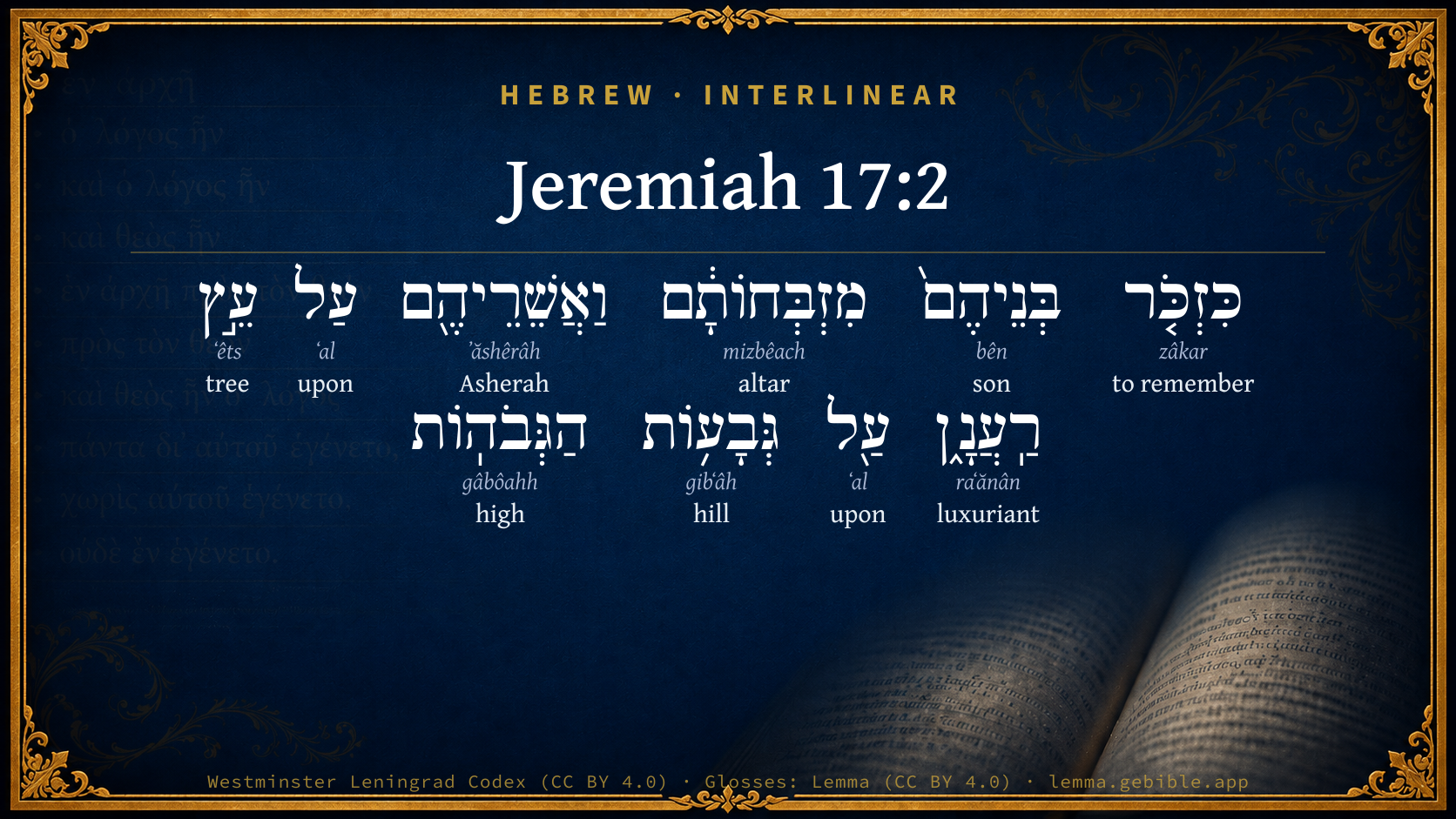
Hebrew (Westminster Leningrad Codex) Jeremiah 17:2 appears in the Hebrew Old Testament. The text above is from the Westminster Leningrad Codex. Each word links to its Strong’s number, a concise gloss, and parsing drawn from the Open Scriptures Hebrew Bible morphology. Click any word for its full Brown-Driver-Briggs (BDB) entry.
Download image
Cite this verse

Jeremiah 17:2 (World English Bible). Public Domain. Lemma interlinear Bible study tool, https://lemma.gebible.app/v/jeremiah/17/2.

Show BibTeX & RIS
BibTeX
RIS
English Translation
while their children remember their altars and their Asherim by the green trees on the high hills.
World English Bible · Public Domain
Download a study sheet

One document with this verse’s original text, its word-by-word gloss line, the meaning frame, cross-references with their text, attributed commentary, and full source and license credits — printable, and it pastes into notes with its structure intact.

This verse Autodidact and up

Study sheet (.html) Plain text (.txt)

A passage Seminary Student

Up to 50 verses in one chapter. A passage sheet keeps up to 6 commentary sources and 12 cross-references per verse, in the order this page ranks them, and says so on the sheet whenever that leaves anything out. Ask for a single verse and you get the Autodidact verse sheet above.

Everything on this page stays free to read, with no account — the sheet is a download of what is already on screen, not access to it.

Want to remove ads? Support Godless Engineer
Compare translations 3

The same verse in 3 English versions, stacked beneath the original-language interlinear above. Click any original word for its lexicon entry.

Each is an independent rendering of the whole verse — the interlinear is not word-aligned to these translations.

Highlighted words mark where these versions differ — a whole-verse word diff, not a word-by-word alignment.

  • World English Bible Public Domain
    while their children remember their altars and their Asherim by the green trees on the high hills.
  • King James Version Public Domain
    Whilst their children remember their altars and their groves by the green trees upon the high hills.
  • unfoldingWord Literal Text CC BY-SA 4.0
    as their children remember their altars and their Asherim, by the green tree on the high hills.

unfoldingWord Literal Text — © unfoldingWord, licensed CC BY-SA 4.0. Word-aligned USFM3 via Door43 (git.door43.org/unfoldingWord/en_ult).

Versions to compare (up to 4)

3 of 4 selected

Show all 18 translations

Every available English version of this verse, each an independent rendering of the whole verse.

  • World English Bible Public Domain
    while their children remember their altars and their Asherim by the green trees on the high hills.
  • Berean Standard Bible Public Domain
    Even their children remember their altars and Asherah poles by the green trees and on the high hills.
  • Majority Standard Bible Public Domain
    Even their children remember their altars and Asherah poles by the green trees and on the high hills.
  • King James Version Public Domain
    Whilst their children remember their altars and their groves by the green trees upon the high hills.
  • American Standard Version (1901) Public Domain
    whilst their children remember their altars and their Asherim by the green trees upon the high hills.
  • Revised Version (1885) Public Domain
    whilst their children remember their altars and their Asherim by the green trees upon the high hills.
  • Geneva Bible (1599) Public Domain
    They remember their altars as their children, with their groues by the greene trees vpon the hilles.
  • Douay-Rheims (1899) Public Domain
    When their children shall remember their altars, and their groves, and their green trees upon high mountains,
  • Young's Literal Translation Public Domain
    As their sons remember their altars and their shrines, By the green tree, by the high hills.
  • Literal Standard Version CC BY-SA 4.0
    As their sons remember their altars and their Asherim, || By the green tree, by the high hills.
  • Unlocked Literal Bible CC BY-SA 4.0
    Even their children remember their altars and their Asherah poles that were beside the spreading trees and on the high hills.
  • unfoldingWord Literal Text CC BY-SA 4.0
    as their children remember their altars and their Asherim, by the green tree on the high hills.
  • Darby Bible Public Domain
    whilst their children remember their altars and their Asherahs, by the green trees, upon the high hills.
  • World Messianic Bible Public Domain
    Even their children remember their altars and their Asherah poles by the green trees on the high hills.
  • Webster's Bible Public Domain
    Whilst their children remember their altars and their groves by the green trees upon the high hills.
  • Free Bible Version CC BY-SA 4.0
    Even their children remember to worship at their pagan altars and Asherah poles, set up by the green trees and on the high hills,
  • Bible in Basic English Public Domain
    Their altars and their wood pillars under every branching tree, on the high hills and the mountains in the field.
  • JPS Tanakh (1917) Public Domain
    Like the symbols of their sons are their altars, and their Asherim are by the leafy trees, upon the high hills.

Literal Standard Version (2020), Covenant Press — licensed CC BY-SA 4.0. Text via the HelloAO Bible API (eBible.org). Unlocked Literal Bible (unfoldingWord) — licensed CC BY-SA 4.0. Text via the HelloAO Bible API (eBible.org). unfoldingWord Literal Text — © unfoldingWord, licensed CC BY-SA 4.0. Word-aligned USFM3 via Door43 (git.door43.org/unfoldingWord/en_ult). Free Bible Version, Dr. Jonathan Gallagher — licensed CC BY-SA 4.0. Text via the HelloAO Bible API (eBible.org).

Word by word

More ways to search: Search by grammar → Find every occurrence → Compare this word →

Practice this passage: Drill this verse → Learn its vocabulary →

רַֽעֲנָ֑ן
raʻănân
H7488
“luxuriant”
Adjective, Adjective, Masculine, Singular, Absolute
Part of Speech
Adjective
Type
Adjective
Gender
Masculine
Number
Singular
State
Absolute
Full BDB Definition

Origin: from an unused root meaning to be green

TWOT: 2190a

(Palel) to be or grow luxuriant or fresh or green (verb) - luxuriant, fresh (adjective)
  1. כִּזְכֹּ֤ר zâkar H2142 “like/as · to remember” Preposition + Verb, Qal, Infinitive Construct
  2. בְּנֵיהֶם֙ bên H1121 “sons · their” Noun, Common, Masculine, Plural, Construct + Suffix, Personal, 3rd Person, Masculine, Plural
  3. מִזְבְּחוֹתָ֔ם mizbêach H4196 “altars · their” Noun, Common, Masculine, Plural, Construct + Suffix, Personal, 3rd Person, Masculine, Plural
  4. וַאֲשֵׁרֵיהֶ֖ם ʼăshêrâh H842 “and · Asherah · their” Conjunction + Noun, Proper + Suffix, Personal, 3rd Person, Masculine, Plural
  5. עַל ʻal H5921 “upon” Preposition
  6. עֵ֣ץ ʻêts H6086 “tree” Noun, Common, Masculine, Singular, Absolute
  7. עַ֖ל ʻal H5921 “upon” Preposition
  8. גְּבָע֥וֹת gibʻâh H1389 “hills” Noun, Common, Feminine, Plural, Absolute
  9. הַגְּבֹהֽוֹת gâbôahh H1364 “the · high” Particle, Definite Article + Adjective, Adjective, Feminine, Plural, Absolute

About this verse

These counts appear in no published source. They are computed here, from the morphology-tagged text and Lemma’s own curated glosses. What Lemma adds →

10
words
9
distinct lemmas
Prophets
section

Notable vocabulary

The rarest word here is רַֽעֲנָ֑ן luxuriant H7488 — appearing just 20 times in the whole Hebrew Bible.

Shared distinctive vocabulary

רַֽעֲנָ֑ן luxuriant H7488 occurs in 20 verses of the Hebrew Bible. Also found in:

Grammatical profile

  • 1 verb
  • 5 nouns
  • 2 adjectives
  • 2 prepositions

Verb forms

  • כִּזְכֹּ֤ר Qal · Infinitive Construct

Repetition

A word recurs within this verse — often emphatic in Hebrew:

Cross-references

11

Topical passages linked to Jeremiah 17:2 in the Treasury of Scripture Knowledge — connected by theme and wording, ordered by reader-vote popularity; previews shown in the World English Bible.

  • 2 Chronicles 24:18 They forsook the house of Yahweh, the God of their fathers, and served the Asherim and the idols: and wrath came on Judah and Jerusalem for this their guiltiness.
  • Jeremiah 2:20 For of old time I have broken your yoke, and burst your bonds; and you said, I will not serve; for on every high hill and under every green tree you did bow yourself, playing the prostitute.
  • Judges 3:7 The children of Israel did that which was evil in the sight of Yahweh, and forgot Yahweh their God, and served the Baals and the Asheroth.
  • 2 Chronicles 33:3 For he built again the high places which Hezekiah his father had broken down; and he reared up altars for the Baals, and made Asheroth, and worshiped all the host of the sky, and served them.
  • Isaiah 1:29 For they shall be ashamed of the oaks which you have desired, And you shall be confounded for the gardens that you have chosen.
  • Isaiah 17:8 They shall not look to the altars, the work of their hands; neither shall they have respect to that which their fingers have made, either the Asherim, or the sun-images.
  • 2 Chronicles 33:19 His prayer also, and how [God] was entreated of him, and all his sin and his trespass, and the places in which he built high places, and set up the Asherim and the engraved images, before he humbled himself: behold, they are written in the history of Hozai.
  • Psalms 78:58 For they provoked him to anger with their high places, And moved him to jealousy with their engraved images.
  • Jeremiah 7:18 The children gather wood, and the fathers kindle the fire, and the women knead the dough, to make cakes to the queen of the sky, and to pour out drink-offerings to other gods, that they may provoke me to anger.
  • Ezekiel 20:28 For when I had brought them into the land, which I swore to give to them, then they saw every high hill, and every thick tree, and they offered there their sacrifices, and there they presented the provocation of their offering; there also they made their sweet savor, and they poured out there their drink-offerings.
  • Hosea 4:13–14 They sacrifice on the tops of the mountains, And burn incense on the hills, under oaks and poplars and terebinths, Because its shade is good. Therefore your daughters play the prostitute, And your brides commit adultery.

Cross-references courtesy of OpenBible.info (CC BY 4.0).

Hebrew and Greek witnesses Masoretic Hebrew ↔ Greek Septuagint

The same verse in the two great witnesses to the Old Testament, shown verse-for-verse.

These are two independent witnesses, not word-aligned to each other, and the Septuagint is shown in lemma (dictionary) form.

Hebrew Jeremiah 17:2 Masoretic · Westminster Leningrad Codex

כִּזְכֹּ֤ר בְּנֵיהֶם֙ מִזְבְּחוֹתָ֔ם וַאֲשֵׁרֵיהֶ֖ם עַל עֵ֣ץ רַֽעֲנָ֑ן עַ֖ל גְּבָע֥וֹת הַגְּבֹהֽוֹת

while their children remember their altars and their Asherim by the green trees on the high hills.

World English Bible · Public Domain

Greek LXX Structure differs

In the Septuagint, Jeremiah is about an eighth shorter than the Hebrew and arranges its material differently — the Oracles Against the Nations (Hebrew chapters 46–51) appear in the middle of the Greek book, after 25:13. Because the chapter and verse boundaries do not line up, a verse-for-verse comparison with the Hebrew is not shown.

A verse-for-verse comparison isn’t shown here because the chapters and verses don’t line up. Switch to the LXX edition with the MT / LXX toggle above to read the Greek directly.

Hebrew: Westminster Leningrad Codex (CC BY 4.0). Greek: Septuagint (public domain); English from a public-domain English Septuagint. How the Septuagint differs from the Hebrew →

Targum (Aramaic paraphrase)

1

The Targum is the ancient Jewish Aramaic paraphrase of the Hebrew Scriptures — an interpretive translation, not the Hebrew text itself. Onkelos (literal) and Pseudo-Jonathan (expansive) render the Torah, and Jonathan the Prophets. Coverage is partial: where no permissively-licensed English translation exists for a verse, only the Aramaic is shown. This is verse-level text, not a word-by-word alignment to the Hebrew.

  1. Targum Jonathan Prophets (Joshua–Malachi)
    כְּאִדְכָּרָא בְנֵיהוֹן אֱגוֹרֵיהוֹן וַאֲשֵׁירֵיהוֹן תְּחוֹת כָּל אִילַן עַבּוּף וְעַל רָמָתָא מְנַטְלָתָא:

    (no public-domain English translation for this verse)

    Targum Jonathan — Aramaic: “Mikraot Gedolot” (public domain). English: “Sefaria Community Translation” (CC0 1.0 (public-domain dedication)); “London "Chaldee Paraphrase," 1871” (public domain). Text via Sefaria.

Commentary

Notes on Jeremiah 17:2 from classic Christian and Jewish commentators (each source and its license shown beneath its notes). The classic Christian expositions comment on the surrounding passage and are grouped to its opening verse, so a note may address several verses; the Jewish commentaries on the Tanakh (Rashi and others) are per-verse, so they appear only where the commentator wrote on this verse.

Lemma curates 59 commentaries, every one of them public domain or Creative Commons licensed, each selected and text-cleaned for this edition rather than reprinted as found. About our sources →

Trapp's Complete Commentary

John Trapp

Jer 17:2 Whilst their children remember their altars and their groves by the green trees upon the high hills.

Ver. 2. While their children remember their altars.] Or, As they remember their children, so they remember their altars and their groves, scil., with greatest love and delight. The Greeks call children φιλτατα, the comedian Charissima; so were their idols to these Jews.

John Trapp, A Commentary or Exposition upon All the Books of the Old and New Testament (1647–1656) — public domain. Text from a community e-Sword module.

Tyndale Open Study Notes

Tyndale Open Resources

17:2 Asherah poles were cut from trees and erected near altars dedicated to Baal, the Canaanite storm god. Asherah was the Canaanite goddess who symbolized the fertility of moist ground that could produce crops. Ritual sex was performed near these altars to cause rain to fall, seeds to sprout, and plants to grow. A tree growing near an altar could also represent this fertility goddess. The people of Judah were so depraved that parents encouraged their children to join them in these rituals.

Tyndale Open Study Notes — © Tyndale Open Resources, licensed CC BY-SA 4.0. Text via the HelloAO Bible API.

Geneva Bible (1599)

Geneva Bible translators

Some read, So that their children remember their altars, that is, follow their fathers’ wickedness.

Geneva Bible (1599) marginal notes — public domain. Text via Bolls.life.

Jamieson, Fausset & Brown

Robert Jamieson, A. R. Fausset & David Brown

children remember--Instead of forsaking the idolatries of their fathers, they keep them up (Jer 7:18). This is given as proof that their sin is "graven upon . . . altars" (Jer 17:1), that is, is not merely temporary. They corrupt their posterity after them. CASTALIO less probably translates, "They remember their altars as (fondly as) they do their children."

groves--rather, "images of Astarte," the goddess of the heavenly hosts, represented as a sacred tree, such as is seen in the Assyrian sculptures (Kg2 21:7; Ch2 24:18). "Image of the grove." The Hebrew for "grove" is Asherah, that is, Assarak, Astarte, or Ashtaroth.

by the green trees--that is, near them: the sacred trees (idol symbols) of Astarte being placed in the midst of natural trees: "green trees" is thus distinguished from "groves," artificial trees. HENDERSON, to avoid taking the same Hebrew particle in the same sentence differently, "by . . . upon" translates "images of Astarte on the green trees." But it is not probable that images, in the form of a sacred tree, should be hung on trees, rather than near them.

Jamieson, Fausset & Brown — Commentary Critical and Explanatory on the Whole Bible (1871) — public domain (CC PDM 1.0). Text via the HelloAO Bible API.

Adam Clarke's Commentary

Verse 2. Whilst their children remember] Even the rising generation have their imagination stocked with idol images, and their memories with the frantic rites and ceremonies which they saw their parents observe in this abominable worship.

Adam Clarke's Commentary on the Bible (1810–1826) — public domain. Text from a community e-Sword/MySword module.

John Calvin's Commentaries

Interpreters seem not to me to have perceived the design of the Prophet here, at least they have not clearly explained the subject. He proceeds, as I think, with what he said at the end of the last verse, — that the iniquity of Judah was graven on the altars, or on the horns of the altars: how was this? even because they transmitted to posterity whatever they devised as to their ungodly forms of worship. How then was iniquity graven on the horns of the altars? even because it was not a temporary wickedness only, when the Jews cast aside the Law and followed their corrupt superstitions; but, on the contrary, their iniquity flowed down, as it were, by a hereditary right, to their posterity. Justly then does Jeremiah accuse them, that they were not only led away into evil through the whole course of their own lives, but that they also corrupted their children, for they left to them memorials of their own superstitions.

Some give this explanation, “As they remember their children, so also their altars;” as though the Prophet had said, that idolaters burnt with such ardor, that they held the altars dedicated to their idols as dear to them as their own children. But this view seems too forced. I then have no doubt but that the Prophet here amplifies their wickedness, when he says, that it was graven on the horns of the altars; for their posterity remembered the superstitions, which they had received from their fathers. He mentions also their groves; for on or near every shady tree they built altars; and also on all high hills. It follows —

John Calvin's Commentaries (1540-1563) — public domain. Text from the Calvin Translation Society English edition (1840s-50s) via the Christian Classics Ethereal Library (ccel.org). Calvin's coverage is partial (roughly two-thirds of the Bible); uncommented books and verses are honest gaps, never fabricated. The 19th-century editor's footnotes and remarks are omitted so the notes are faithfully Calvin's own voice.

Ellicott's Commentary for English Readers

(2) Whilst their children remember . . .—If we take “children” as referring to age, there may be a reference to the way in which the horrors of Molech worship were burnt in upon the minds of boys who were present at such a spectacle, so as never to be forgotten, but the general sense in which we speak of the “children” of Israel or Judah seems sufficient. The thought expressed is that every locality that could be used for idolatrous worship made them “remember” that worship, and set about reproducing it. By some interpreters the clause is rendered, as they remember their children so do they their altars and their groves; i.e., their idols are as dear to them as their offspring. The former construction is, however, the more natural, and is best supported by the versions.

Groves.—i.e., as throughout the Old Testament, when connected with idolatry, the wooden columns that were the symbols of the Phœnician goddess Asherah, possibly the same as Astarte (Exo_34:13; Deu_16:21; 1Ki_14:23). The “green trees” suggested the thought of this worship—for the Asherah, though not a grove, was generally connected with one—as the “high hills” did that of the altars. Commonly the worship is described as “under every green tree.” Here a different preposition is used, “on the green trees,” connecting them with the verb “remember.”

A Bible Commentary for English Readers, edited by Charles John Ellicott (1878–1897) — public domain. Text from a community e-Sword module.

The Cambridge Bible for Schools and Colleges

gen. ed. J. J. S. Perowne

2, 3. The text is difficult, and pretty certainly contains some error. Du. and Co. omit from “whilst their” to “Asherim,” as a gloss, introduced to shew how indelible was Judah’s guilt, to be remembered by future generations. If this change be adopted, the passage will stand thus:

“The sin of Judah is written with a pen of iron,

With the point of a diamond is it graven upon the table of their heart,

Upon the horns of their altars, upon [every] spreading tree,

Upon the high hills, the mountains in the field.” (Dr. in notes.) Gi. suggests, with the change of one letter in MT., “so that their children will remember,” but prefers “for a remembrance before me,” omitting the rest of the v. as a gloss. He thus obtains Ḳinah measure for the passage.

Asherim] The Asherah was a rough hewn post, probably representing a sacred tree, and placed alongside of an altar. As having associations with heathenism, it was forbidden to worshippers of Jehovah. See Exo_34:13 (and mg.); Deu_12:3, etc. It may have been connected with devotions paid to a goddess Asherah or Ashrat.

The Cambridge Bible for Schools and Colleges (gen. ed. J. J. S. Perowne; Cambridge University Press, 1878–1918) — public domain. Text from a community e-Sword module.

John Gill's Exposition

Whilst their children remember their altars,.... Which is a further proof of their long continuance in idolatrous practices, and a fresh witness against them; they trained up their children in them; who, when grown up, could not forget them, but imitated them, and went on in the same evil ways. Some render the words, "as they remember their children, so they remember their altars (i), and their groves, by the green trees upon the high hills"; they had the same love to their idols, and the worship of them, as they had to their children. This sense is received by Kimchi (k); yea, they had a greater affection for their idols than for their children; since they made their children pass through the fire to Moloch, and burnt their sons and their daughters to Baal. The Targum renders it, "their groves under every green tree": see Jer 2:20. Kimchi and Ben Melech connect green trees not with groves but with altars; and take the sense to be, that their altars were by green trees; since groves and green trees were the same, and which altars also were upon high hills.

(i) "sicut recordantur filiorum suorum, ita recordantur ararum suarum"; so some in Vatablus. (k) So in T. Bab. Sanhedrin, fol. 63. 2. & Gloss in ib.

John Gill's Exposition of the Whole Bible (1746–1763) — public domain (CC PDM 1.0). Text via the HelloAO Bible API.

Albert Barnes' Notes on the Bible

While their children remember their altars - Perhaps an allusion to their sacrifices of children to Moloch. Present perhaps at some such blood-stained rite, its horrors would be engraven forever upon the memory.

Groves - “Asherahs,” i. e., wooden images of Astarte (see Exo 34:13 note).

Albert Barnes' Notes on the Bible (1834–1885) — public domain. Text from a community e-Sword/MySword module.

Matthew Poole's English Annotations

This showed how inveterate they were in this sin of idolatry, that they taught it their children, and their children remembered their idolatrous altars and the groves where they were wont to worship idols by the green trees, as they did also upon the high hills; so their sin was derived from one age to another. Others think that the phrase rather expresseth their fondness of their idols, and think it should be read, as their children they remember, &c.; that is, they loved their idols and their idolatrous services as they loved their children, which also was true; yea, they that made their children pass through the fire to Molech loved them better than their children.

Matthew Poole's English Annotations on the Holy Bible (1683–1685) — public domain. Text from a community e-Sword/MySword module.

Whedon's Commentary on the Bible

Daniel D. Whedon

2. Whilst their children remember, etc. — Two senses of this verse have been given: 1) That of the common Version, but the first word should be translated “as.” 2) That of Keil — As their children, they remember their altars, that is, as fondly. This is best.

Groves — Rather, their asherahs: wooden images of Astarte, the female divinity answering to Baal.

By the green trees — Literally, upon the “green trees,” the preposition being the same as that before hills. Some explain this difficulty by referring it back to the word “remember;” but this is far from satisfactory.

Daniel D. Whedon (gen. ed.), Commentary on the Old and New Testaments (1874–1909) — public domain. Text from a community e-Sword module.

The Pulpit Commentary

Whilst their children remember, etc. The connection of this with the preceding verse is rather obscure. Probably it is intended as an exemplification of the "sin of Judah," the inveterateness of which is shown by their thoughts spontaneously turning to the altars and symbols of the false gods whenever they are near a leafy tree or a high hill (probably "under the green trees" is the right reading; comp. 1Ki_14:23; so Targum). To make "their sons" the accusative (with Hitzig and Keil), rendering, "As they remember their children, even so they remember their altars," seems unnatural; why should "children" and "altars" be associated in idea? Groves; rather, idols of Asherah, the Canaanitish goddess.

The Pulpit Commentary (1880–1919), ed. H.D.M. Spence-Jones & Joseph S. Exell — public domain. Text from a community e-Sword module.

John Wesley's Explanatory Notes

Their children - This shewed how inveterate they were in this sin of idolatry, that they taught it their children.

John Wesley, Explanatory Notes Upon the Whole Bible (1754–1765) — public domain. Text via the GEBible commentary corpus.

Rashi

Rabbi Shlomo Yitzchaki (Rashi)

As they remember their children, [so do they remember] their altars Like the remembrance of their children, so was the remembrance of their altars to them, like a man who longs for his son.

and their asherim which are by the green trees. by...trees like אֵצֶּל, by. And Jonathan renders in this manner. under every green tree.

Rashi on the Tanakh — English translations: “The Judaica Press complete Tanach with Rashi, translated by A. J. Rosenberg” (CC BY 4.0); “Pentateuch with Rashi's commentary by M. Rosenbaum and A.M. Silbermann, 1929-1934” (public domain); “The Metsudah Tanach series, Lakewood, N.J” (CC BY 4.0); and “The Book of Joshua, Metsudah Publications, 1997” (CC BY 4.0). Text via Sefaria.

Lesson kit

Teaching starters — assembled from the data on this page, not authored interpretation. Every prompt links to the verse data it draws on. Edit before teaching.

Jeremiah, in the Prophets, opens this verse with 10 words (9 distinct Hebrew lemmas). Its most distinctive word is raʻănân (“luxuriant”). A historical commentator’s framing appears above. Read the whole chapter for the surrounding context.

Discussion questions

  1. What does “luxuriant” (raʻănân) contribute to the verse as a whole?
  2. How does Deuteronomy 12:2, which shares the word «luxuriant», read alongside this verse?
  3. What does the repetition of “upon” (2× in this one verse) do in this verse?
  4. These translations render this verse differently. What is at stake in choosing one wording over another?
  5. «כִּזְכֹּ֤ר» is a Qal Infinitive Construct verb. How does that grammatical form shape the action described?
  6. Compare how Trapp's Complete Commentary and Tyndale Open Study Notes read this verse. Where do they agree or differ?

Things to notice

  • These translations choose different wording for 7 words in this verse.
  • “upon” occurs 2× in this single verse.
  • 9 distinct Hebrew lemmas span 10 words in this verse.

Reading settings

Reading text

Shown beneath each verse's original-language words.

Old Testament
Old Testament edition

Read the OT as the Masoretic Hebrew (MT) or the Greek Septuagint (LXX).

English shown for the Greek Septuagint (in the Hebrew ↔ Greek comparison).

Comparing translations? Open the Compare panel on any verse page to stack up to four side by side.