
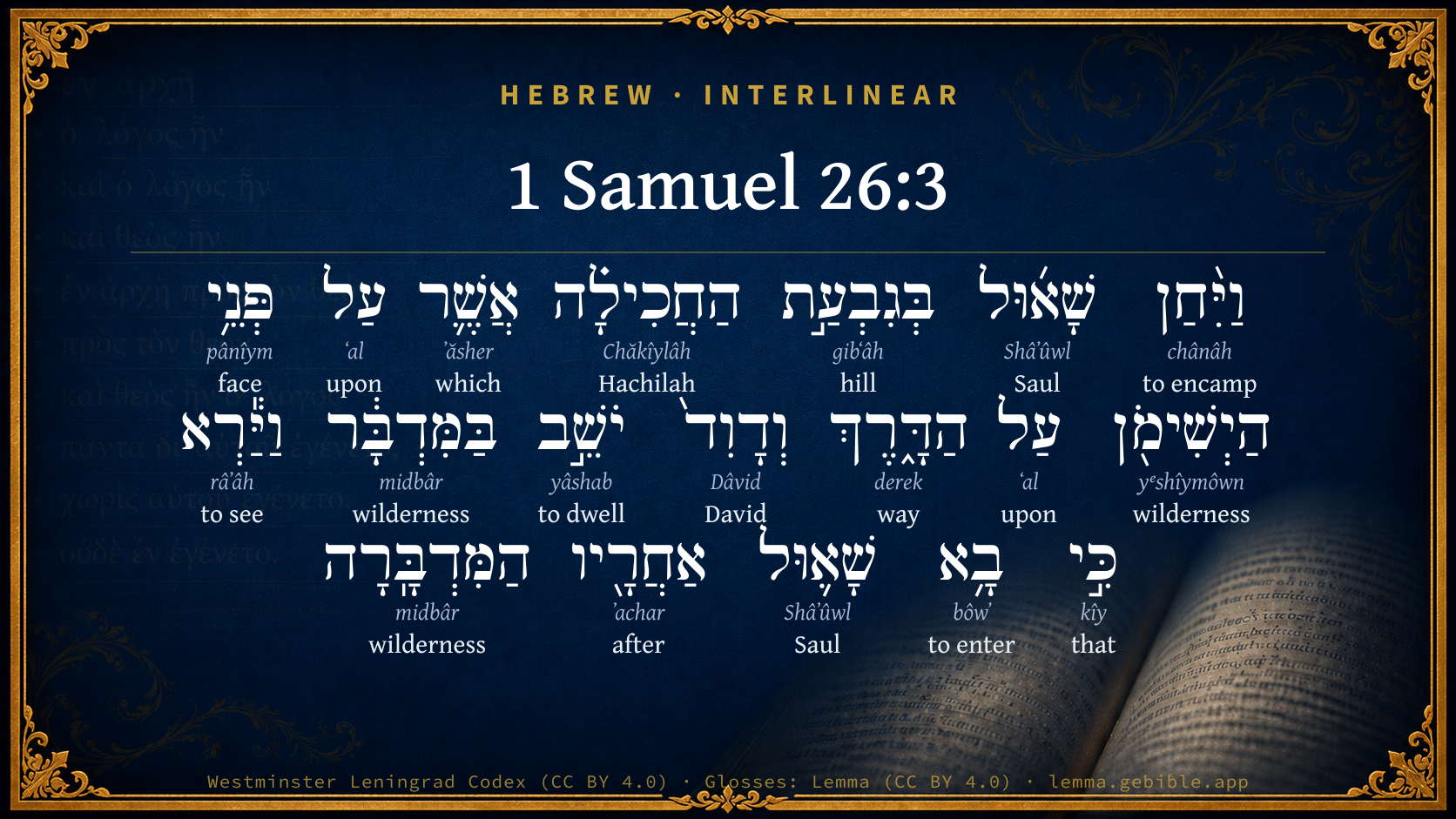
1 Samuel 26:3

Hebrew (Westminster Leningrad Codex) 1 Samuel 26:3 appears in the Hebrew Old Testament. The text above is from the Westminster Leningrad Codex. Each word links to its Strong’s number, a concise gloss, and parsing drawn from the Open Scriptures Hebrew Bible morphology. Click any word for its full Brown-Driver-Briggs (BDB) entry.
Download image
Cite this verse

1 Samuel 26:3 (World English Bible). Public Domain. Lemma interlinear Bible study tool, https://lemma.gebible.app/v/1-samuel/26/3.

Show BibTeX & RIS
BibTeX
RIS
English Translation
Saul encamped in the hill of Hachilah, which is before the desert, by the way. But David abode in the wilderness, and he saw that Saul came after him into the wilderness.
World English Bible · Public Domain
Download a study sheet

One document with this verse’s original text, its word-by-word gloss line, the meaning frame, cross-references with their text, attributed commentary, and full source and license credits — printable, and it pastes into notes with its structure intact.

This verse Autodidact and up

Study sheet (.html) Plain text (.txt)

A passage Seminary Student

Up to 50 verses in one chapter. A passage sheet keeps up to 6 commentary sources and 12 cross-references per verse, in the order this page ranks them, and says so on the sheet whenever that leaves anything out. Ask for a single verse and you get the Autodidact verse sheet above.

Everything on this page stays free to read, with no account — the sheet is a download of what is already on screen, not access to it.

Want to remove ads? Support Godless Engineer
Compare translations 3

The same verse in 3 English versions, stacked beneath the original-language interlinear above. Click any original word for its lexicon entry.

Each is an independent rendering of the whole verse — the interlinear is not word-aligned to these translations.

Highlighted words mark where these versions differ — a whole-verse word diff, not a word-by-word alignment.

  • World English Bible Public Domain
    Saul encamped in the hill of Hachilah, which is before the desert, by the way. But David abode in the wilderness, and he saw that Saul came after him into the wilderness.
  • King James Version Public Domain
    And Saul pitched in the hill of Hachilah, which is before Jeshimon, by the way. But David abode in the wilderness, and he saw that Saul came after him into the wilderness.
  • unfoldingWord Literal Text CC BY-SA 4.0
    And Saul camped on the hill of Hakilah, which on the face of Jeshimon, by the road. But David was staying in the wilderness. And he saw that Saul was coming after him into the wilderness.

unfoldingWord Literal Text — © unfoldingWord, licensed CC BY-SA 4.0. Word-aligned USFM3 via Door43 (git.door43.org/unfoldingWord/en_ult).

Versions to compare (up to 4)

3 of 4 selected

Show all 18 translations

Every available English version of this verse, each an independent rendering of the whole verse.

  • World English Bible Public Domain
    Saul encamped in the hill of Hachilah, which is before the desert, by the way. But David abode in the wilderness, and he saw that Saul came after him into the wilderness.
  • Berean Standard Bible Public Domain
    Saul camped beside the road at the hill of Hachilah opposite Jeshimon, but David was living in the wilderness. When he realized that Saul had followed him there,
  • Majority Standard Bible Public Domain
    Saul camped beside the road at the hill of Hachilah opposite Jeshimon, but David was living in the wilderness. When he realized that Saul had followed him there,
  • King James Version Public Domain
    And Saul pitched in the hill of Hachilah, which is before Jeshimon, by the way. But David abode in the wilderness, and he saw that Saul came after him into the wilderness.
  • American Standard Version (1901) Public Domain
    And Saul encamped in the hill of Hachilah, which is before the desert, by the way. But David abode in the wilderness, and he saw that Saul came after him into the wilderness.
  • Revised Version (1885) Public Domain
    And Saul pitched in the hill of Hachilah, which is before the desert, by the way. But David abode in the wilderness, and he saw that Saul came after him into the wilderness.
  • Geneva Bible (1599) Public Domain
    And Saul pitched in the hill of Hachilah, which is before Ieshimon by the way side. Now Dauid abode in the wildernesse, and he sawe that Saul came after him into the wildernesse.
  • Douay-Rheims (1899) Public Domain
    And Saul encamped in Gabaa Hachila, which was over against the wilderness in the way: and David abode in the wilderness. And seeing that Saul was come after him into the wilderness,
  • Young's Literal Translation Public Domain
    And Saul encampeth in the height of Hachilah, which `is' on the front of the desert, by the way, and David is abiding in the wilderness, and he seeth that Saul hath come after him in to the wilderness;
  • Literal Standard Version CC BY-SA 4.0
    And Saul encamps in the height of Hachilah, which [is] on the front of the desert, by the way, and David is abiding in the wilderness, and he sees that Saul has come into the wilderness after him;
  • Unlocked Literal Bible CC BY-SA 4.0
    Saul camped on the hill of Hakilah, which is before Jeshimon, by the road. But David was staying in the wilderness, and he saw that Saul was coming after him into the wilderness.
  • unfoldingWord Literal Text CC BY-SA 4.0
    And Saul camped on the hill of Hakilah, which on the face of Jeshimon, by the road. But David was staying in the wilderness. And he saw that Saul was coming after him into the wilderness.
  • Darby Bible Public Domain
    And Saul encamped in the hill of Hachilah, which faces the waste, by the way side. And David abode in the wilderness; and when he saw that Saul had come after him into the wilderness,
  • World Messianic Bible Public Domain
    Saul encamped in the hill of Hachilah, which is before the desert, by the way. But David stayed in the wilderness, and he saw that Saul came after him into the wilderness.
  • Webster's Bible Public Domain
    And Saul pitched in the hill of Hachilah, which is before Jeshimon, by the way. But David abode in the wilderness, and he saw that Saul came after him into the wilderness.
  • Free Bible Version CC BY-SA 4.0
    Saul set up camp beside the road at the hill of Hachilah opposite the wastelands, near to where David was living in the desert. When he realized that Saul had come looking for him there,
  • Bible in Basic English Public Domain
    And Saul put up his tents on the hill of Hachilah, which is in front of the waste land on the road. But David was in the waste land, and he saw that Saul was coming after him.
  • JPS Tanakh (1917) Public Domain
    And Saul pitched in the hill of Hachilah, which is before Jeshimon, by the way. But David abode in the wilderness, and he saw that Saul came after him into the wilderness.

Literal Standard Version (2020), Covenant Press — licensed CC BY-SA 4.0. Text via the HelloAO Bible API (eBible.org). Unlocked Literal Bible (unfoldingWord) — licensed CC BY-SA 4.0. Text via the HelloAO Bible API (eBible.org). unfoldingWord Literal Text — © unfoldingWord, licensed CC BY-SA 4.0. Word-aligned USFM3 via Door43 (git.door43.org/unfoldingWord/en_ult). Free Bible Version, Dr. Jonathan Gallagher — licensed CC BY-SA 4.0. Text via the HelloAO Bible API (eBible.org).

Word by word

More ways to search: Search by grammar → Find every occurrence → Compare this word →

Practice this passage: Drill this verse → Learn its vocabulary →

הַחֲכִילָ֗ה
Chăkîylâh
H2444
“the · Hachilah”
Particle, Definite Article + Noun, Proper
Part of Speech
Particle + Noun
Type
Proper
Full BDB Definition

Origin: from the same as H2447

TWOT: None

Hachilah = "dark" - a hill is southern Judah, on the edge of the wilderness of Ziph
  1. וַיִּ֨חַן chânâh H2583 “and · to encamp” Conjunction + Verb, Qal, Sequential Imperfect, 3rd Person, Masculine, Singular
  2. שָׁא֜וּל Shâʼûwl H7586 “Saul” Noun, Proper
  3. בְּגִבְעַ֣ת gibʻâh H1389 “in/at · hill of” Preposition + Noun, Common, Feminine, Singular, Construct
  4. אֲשֶׁ֛ר ʼăsher H834 “which” Particle, Relative
  5. עַל ʻal H5921 “upon” Preposition
  6. פְּנֵ֥י pânîym H6440 “face(s) of” Noun, Common, Both, Plural, Construct
  7. הַיְשִׁימֹ֖ן yᵉshîymôwn H3452 “the · wilderness” Particle, Definite Article + Noun, Common, Masculine, Singular, Absolute
  8. עַל ʻal H5921 “upon” Preposition
  9. הַדָּ֑רֶךְ derek H1870 “the · way” Particle, Definite Article + Noun, Common, Both, Singular, Absolute
  10. וְדָוִד֙ Dâvid H1732 “and · David” Conjunction + Noun, Proper
  11. יֹשֵׁ֣ב yâshab H3427 “dwelling” Verb, Qal, Participle Active, Masculine, Singular, Absolute
  12. בַּמִּדְבָּ֔ר midbâr H4057 “in/at the · wilderness” Preposition, Determined + Noun, Common, Masculine, Singular, Absolute
  13. וַיַּ֕רְא râʼâh H7200 “and · to see” Conjunction + Verb, Qal, Sequential Imperfect, 3rd Person, Masculine, Singular
  14. כִּ֣י kîy H3588 “that” Conjunction
  15. בָ֥א bôwʼ H935 “to enter” Verb, Qal, Perfect, 3rd Person, Masculine, Singular
  16. שָׁא֛וּל Shâʼûwl H7586 “Saul” Noun, Proper
  17. אַחֲרָ֖יו ʼachar H310 “after · him” Preposition + Suffix, Personal, 3rd Person, Masculine, Singular
  18. הַמִּדְבָּֽרָה midbâr H4057 “the · wilderness · toward” Particle, Definite Article + Noun, Common, Masculine, Singular, Absolute + Suffix, Demonstrative

About this verse

These counts appear in no published source. They are computed here, from the morphology-tagged text and Lemma’s own curated glosses. What Lemma adds →

19
words
16
distinct lemmas
Historical
section

Notable vocabulary

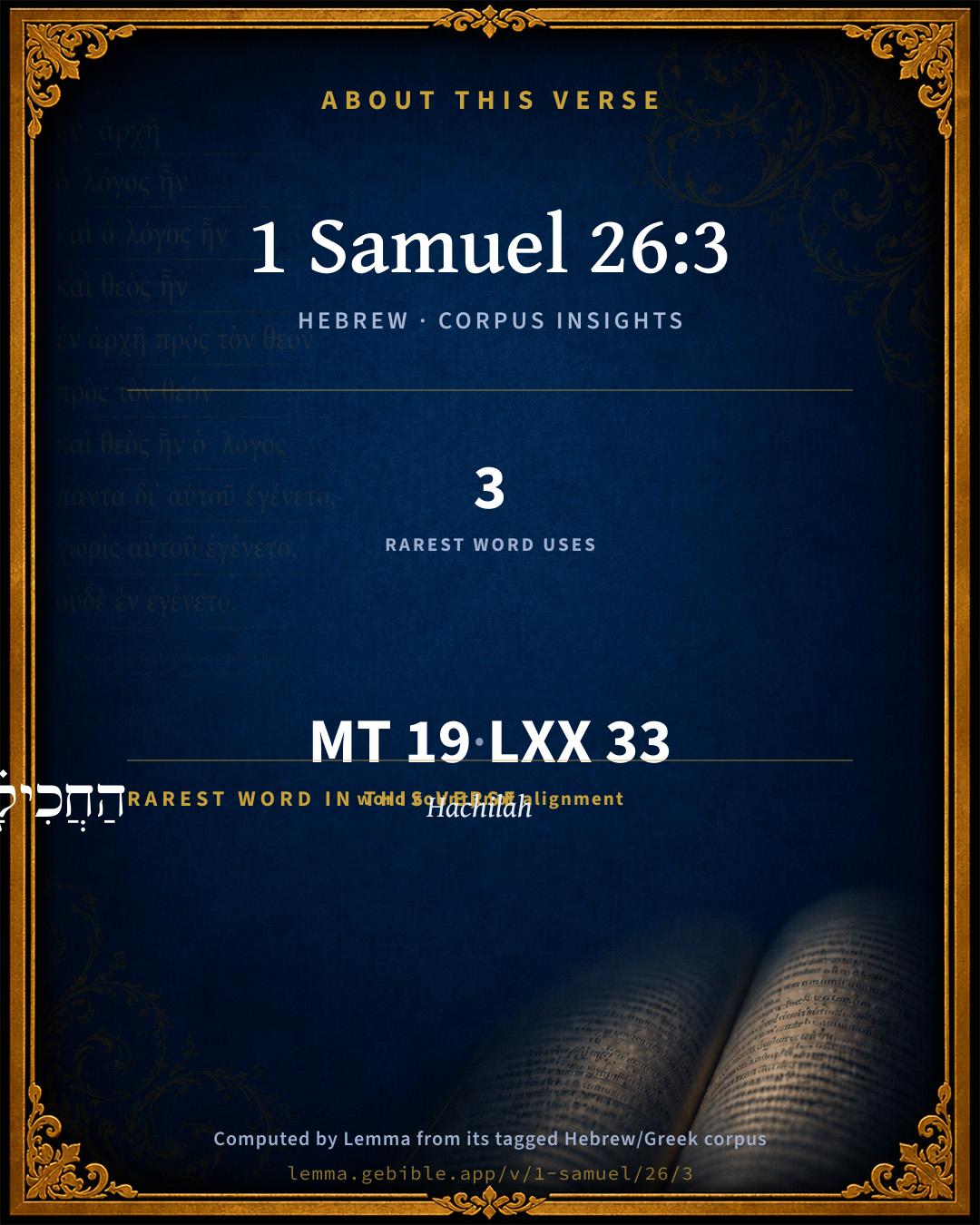
The rarest word here is הַחֲכִילָ֗ה Hachilah H2444 — appearing just 3 times in the whole Hebrew Bible.

Shared distinctive vocabulary

הַחֲכִילָ֗ה Hachilah H2444 occurs in 3 verses of the Hebrew Bible. Also found in:

Grammatical profile

  • 4 verbs
  • 10 nouns
  • 3 prepositions
  • 1 conjunction
  • 1 particle

Verb forms

  • וַיִּ֨חַן Qal · Sequential Imperfect
  • יֹשֵׁ֣ב Qal · Participle Active
  • וַיַּ֕רְא Qal · Sequential Imperfect
  • בָ֥א Qal · Perfect

Repetition

Words recur within this verse — often emphatic in Hebrew:

  • שָׁא֜וּל Saul H7586 ×2
  • עַל upon H5921 ×2
  • בַּמִּדְבָּ֔ר wilderness H4057 ×2

Hebrew & Septuagint length

In English translation the verse runs 32 words from the Hebrew and 32 from the Septuagint (LXX English) — the same length.

A rough comparison of the two English renderings, which tokenize alike — not a word-level alignment.

Word counts can differ between the Hebrew and the Greek without any difference in meaning — e.g. the Hebrew direct-object marker אֵת has no separate Greek word, and Greek often adds the article ὁ.

In the original languages it is 19 Hebrew tokens and 33 Greek tokens — but the two are counted differently (Hebrew bundles its prefixes and suffixes into one token; the Greek is in lemma form), so that isn’t a like-for-like length.

Cross-references

2

Topical passages linked to 1 Samuel 26:3 in the Treasury of Scripture Knowledge — connected by theme and wording, ordered by reader-vote popularity; previews shown in the World English Bible.

  • 1 Samuel 23:19 Then came up the Ziphites to Saul to Gibeah, saying, Doesn't David hide himself with us in the strongholds in the wood, in the hill of Hachilah, which is on the south of the desert?
  • 1 Samuel 26:1 The Ziphites came to Saul to Gibeah, saying, Doesn't David hide himself in the hill of Hachilah, which is before the desert?

Cross-references courtesy of OpenBible.info (CC BY 4.0).

Hebrew and Greek witnesses Masoretic Hebrew ↔ Greek Septuagint

The same verse in the two great witnesses to the Old Testament, shown verse-for-verse.

These are two independent witnesses, not word-aligned to each other, and the Septuagint is shown in lemma (dictionary) form.

Hebrew 1 Samuel 26:3 Masoretic · Westminster Leningrad Codex

וַיִּ֨חַן שָׁא֜וּל בְּגִבְעַ֣ת הַחֲכִילָ֗ה אֲשֶׁ֛ר עַל פְּנֵ֥י הַיְשִׁימֹ֖ן עַל הַדָּ֑רֶךְ וְדָוִד֙ יֹשֵׁ֣ב בַּמִּדְבָּ֔ר וַיַּ֕רְא כִּ֣י בָ֥א שָׁא֛וּל אַחֲרָ֖יו הַמִּדְבָּֽרָה

Saul encamped in the hill of Hachilah, which is before the desert, by the way. But David abode in the wilderness, and he saw that Saul came after him into the wilderness.

World English Bible · Public Domain

Greek LXX 1 Samuel 26:3 Septuagint · lemma form

καί παρα ἐνβάλλω σαούλ ἐν ὁ βουνός ὁ εχελα ἐπί πρόσωπον ὁ ιεσσαιμου ἐπί ὁ ὁδός καί δαυίδ καταἵζω ἐν ὁ ἔρημος καί ὁράω δαυίδ ὅτι ἥκω σαούλ ὀπίσω αὐτός εἰς ὁ ἔρημος

And Saul encamped in the hill of Echela in front of Jessemon, by the way, and David lived in the wilderness: and David saw that Saul came after him into the wilderness.

LXX2012 (modern English Septuagint) · Public Domain

Hebrew: Westminster Leningrad Codex (CC BY 4.0). Greek: Septuagint (public domain); English from LXX2012 (modern English Septuagint) (Public Domain). How the Septuagint differs from the Hebrew →

Targum (Aramaic paraphrase)

1

The Targum is the ancient Jewish Aramaic paraphrase of the Hebrew Scriptures — an interpretive translation, not the Hebrew text itself. Onkelos (literal) and Pseudo-Jonathan (expansive) render the Torah, and Jonathan the Prophets. Coverage is partial: where no permissively-licensed English translation exists for a verse, only the Aramaic is shown. This is verse-level text, not a word-by-word alignment to the Hebrew.

  1. Targum Jonathan Prophets (Joshua–Malachi)
    וּשְׁרָא שָׁאוּל בְּגִבְעֲת חֲבִילָה דִי עַל אַפֵי יְשִׁימוֹן עַל אוֹרְחָא וְדָוִד יָתֵיב בְּמַדְבְּרָא וַחֲזָא אֲרֵי אֲתָא שָׁאוּל בַּתְרוֹהִי לְמַדְבְּרָא:

    (no public-domain English translation for this verse)

    Targum Jonathan — Aramaic: “Mikraot Gedolot” (public domain). English: “Sefaria Community Translation” (CC0 1.0 (public-domain dedication)); “London "Chaldee Paraphrase," 1871” (public domain). Text via Sefaria.

Commentary

Notes on 1 Samuel 26:3 from classic Christian and Jewish commentators (each source and its license shown beneath its notes). The classic Christian expositions comment on the surrounding passage and are grouped to its opening verse, so a note may address several verses; the Jewish commentaries on the Tanakh (Rashi and others) are per-verse, so they appear only where the commentator wrote on this verse.

Lemma curates 59 commentaries, every one of them public domain or Creative Commons licensed, each selected and text-cleaned for this edition rather than reprinted as found. About our sources →

Trapp's Complete Commentary

John Trapp

1Sa 26:3 And Saul pitched in the hill of Hachilah, which [is] before Jeshimon, by the way. But David abode in the wilderness, and he saw that Saul came after him into the wilderness.

Ver. 3. He saw that Saul came after him.] He had an inkling of it; and knowing that sine vano publica fama, rumours are neither to be too much heeded, nor yet altogether slighted.

John Trapp, A Commentary or Exposition upon All the Books of the Old and New Testament (1647–1656) — public domain. Text from a community e-Sword module.

Tyndale Open Study Notes

Tyndale Open Resources

26:3 Saul had come after David again, despite his earlier remorse (24:17-21). Saul had become incapable of acting rationally or speaking truthfully.

Tyndale Open Study Notes — © Tyndale Open Resources, licensed CC BY-SA 4.0. Text via the HelloAO Bible API.

Ellicott's Commentary for English Readers

(3) But David abode in the wilderness.—The former incident, when David spared Saul’s life, happened long after the information of the Ziphites brought the king to the hill “Hachilah, on the south of Jeshimon.” Then David, on hearing of the march of Saul and his army, retired into the wilderness of Maon. Saul pursued him, and David and his force were then only saved from destruction owing to the news of a formidable Philistine invasion. This intelligence called Saul’s forces away from the pursuit of David. David, unmolested, drew off his band, and sought refuge et En-gedi (1 Samuel 23). After the Philistine invasion had been repulsed, Saul again commenced operations against David; and marched his force to En-gedi, in one of the caves of which took place the scene where David for the first time spared the king’s life (1 Samuel 24). Now, after the information of the Ziphites had brought down Saul and his soldiers from Gibeah, David does not flee in haste to Maon, and thence to En-gedi, nor is Saul called away to any Philistine invasion; but David abides in the wilderness, and his scouts come and tell him that Saul in very deed (1Sa_26:4) was come after him in force.

A Bible Commentary for English Readers, edited by Charles John Ellicott (1878–1897) — public domain. Text from a community e-Sword module.

The Cambridge Bible for Schools and Colleges

gen. ed. J. J. S. Perowne

3. by the way] Close to some well-known high road. Cp. 1Sa_24:3. he saw] i.e. perceived or learned. Cp. 1Sa_23:15.

The Cambridge Bible for Schools and Colleges (gen. ed. J. J. S. Perowne; Cambridge University Press, 1878–1918) — public domain. Text from a community e-Sword module.

John Gill's Exposition

And Saul pitched in the hill of Hachilah, which is before Jeshimon, by the way,.... To the wilderness; the very same place where the Ziphites suggested David was:

but David abode in the wilderness; not in the hill of Hachilah, but in the wilderness of Ziph itself:

and he saw that Saul came after him into the wilderness; he understood, by some information he had, that Saul had set out from Gibeah, and was coming to seek for him in the wilderness of Ziph; perhaps Jonathan had given him intelligence; however, he was not quite certain, as appears by what follows.

John Gill's Exposition of the Whole Bible (1746–1763) — public domain (CC PDM 1.0). Text via the HelloAO Bible API.

Matthew Poole's English Annotations

i.e. He understood by information, probably from his dear friend Jonathan.

Matthew Poole's English Annotations on the Holy Bible (1683–1685) — public domain. Text from a community e-Sword/MySword module.

unfoldingWord translationNotes

Door43 World Missions Community

before Jeshimon

"from which they could see Jeshimon"

Jeshimon

This is the name of a desert area near the Dead Sea. It can also be translated as "the Judean Wilderness" or "the wasteland." See how you translated this in 1 Samuel 23:19. (See: How to Translate Names)

translationWords

Saul (OT)

desert

David

unfoldingWord translationNotes — © Distant Shores Media and the Door43 World Missions Community, licensed CC BY-SA 4.0. Source: git.door43.org/Door43/en_tn.

Lesson kit

Teaching starters — assembled from the data on this page, not authored interpretation. Every prompt links to the verse data it draws on. Edit before teaching.

1 Samuel, in the Historical, opens this verse with 19 words (16 distinct Hebrew lemmas). Its most distinctive word is Chăkîylâh (“Hachilah”). A historical commentator’s framing appears above. Read the whole chapter for the surrounding context.

Discussion questions

  1. What does “Hachilah” (Chăkîylâh) contribute to the verse as a whole?
  2. How does 1 Samuel 23:19, which shares the word «Hachilah», read alongside this verse?
  3. What does the repetition of “Saul” (2× in this one verse) do in this verse?
  4. The translations on this page render this verse differently — a whole-verse word diff, not a word-by-word alignment. What might account for the different wordings?
  5. «וַיִּ֨חַן» is a Qal Sequential Imperfect verb. How does that grammatical form shape the action described?
  6. Compare how Trapp's Complete Commentary and Tyndale Open Study Notes read this verse. Where do they agree or differ?

Things to notice

Reading settings

Reading text

Shown beneath each verse's original-language words.

Old Testament
Old Testament edition

Read the OT as the Masoretic Hebrew (MT) or the Greek Septuagint (LXX).

English shown for the Greek Septuagint (in the Hebrew ↔ Greek comparison).

Comparing translations? Open the Compare panel on any verse page to stack up to four side by side.