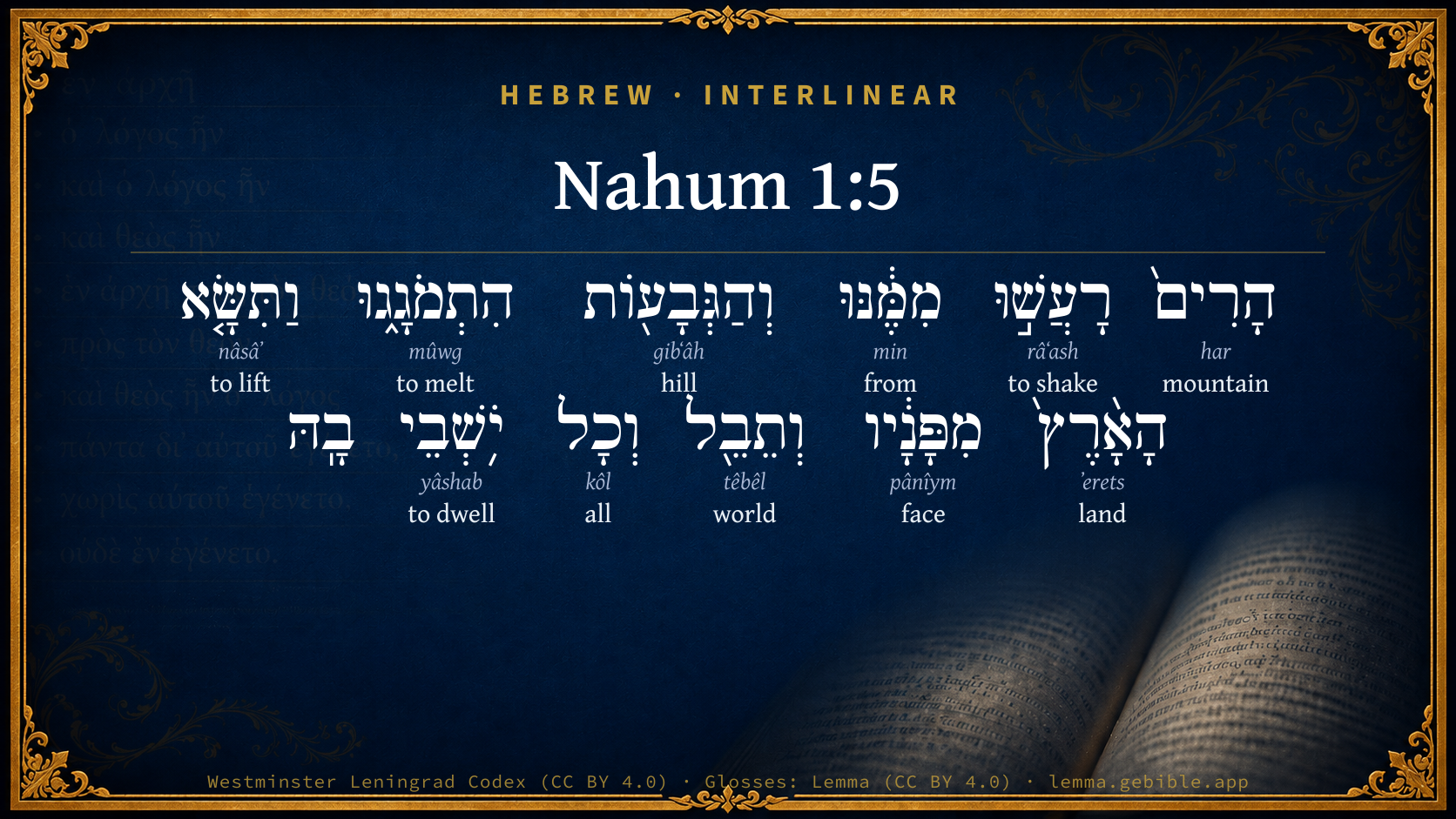
Nahum 1:5

Hebrew (Westminster Leningrad Codex) Nahum 1:5 appears in the Hebrew Old Testament. The text above is from the Westminster Leningrad Codex. Each word links to its Strong’s number, a concise gloss, and parsing drawn from the Open Scriptures Hebrew Bible morphology. Click any word for its full Brown-Driver-Briggs (BDB) entry.
Download image
Cite this verse

Nahum 1:5 (World English Bible). Public Domain. Lemma interlinear Bible study tool, https://lemma.gebible.app/v/nahum/1/5.

Show BibTeX & RIS
BibTeX
RIS
English Translation
The mountains quake before him, and the hills melt away. The earth trembles at his presence, yes, the world, and all who dwell in it.
World English Bible · Public Domain
Download a study sheet

One document with this verse’s original text, its word-by-word gloss line, the meaning frame, cross-references with their text, attributed commentary, and full source and license credits — printable, and it pastes into notes with its structure intact.

This verse Autodidact and up

Study sheet (.html) Plain text (.txt)

A passage Seminary Student

Up to 50 verses in one chapter. A passage sheet keeps up to 6 commentary sources and 12 cross-references per verse, in the order this page ranks them, and says so on the sheet whenever that leaves anything out. Ask for a single verse and you get the Autodidact verse sheet above.

Everything on this page stays free to read, with no account — the sheet is a download of what is already on screen, not access to it.

Want to remove ads? Support Godless Engineer
Compare translations 3

The same verse in 3 English versions, stacked beneath the original-language interlinear above. Click any original word for its lexicon entry.

Each is an independent rendering of the whole verse — the interlinear is not word-aligned to these translations.

Highlighted words mark where these versions differ — a whole-verse word diff, not a word-by-word alignment.

  • World English Bible Public Domain
    The mountains quake before him, and the hills melt away. The earth trembles at his presence, yes, the world, and all who dwell in it.
  • King James Version Public Domain
    The mountains quake at him, and the hills melt, and the earth is burned at his presence, yea, the world, and all that dwell therein.
  • unfoldingWord Literal Text CC BY-SA 4.0
    Mountains shake before him, and the hills melt; and the earth heaves before his face; and the world and all the dwellers in it.

unfoldingWord Literal Text — © unfoldingWord, licensed CC BY-SA 4.0. Word-aligned USFM3 via Door43 (git.door43.org/unfoldingWord/en_ult).

Versions to compare (up to 4)

3 of 4 selected

Show all 18 translations

Every available English version of this verse, each an independent rendering of the whole verse.

  • World English Bible Public Domain
    The mountains quake before him, and the hills melt away. The earth trembles at his presence, yes, the world, and all who dwell in it.
  • Berean Standard Bible Public Domain
    The mountains quake before Him, and the hills melt away; the earth trembles at His presence—the world and all its dwellers.
  • Majority Standard Bible Public Domain
    The mountains quake before Him, and the hills melt away; the earth trembles at His presence—the world and all its dwellers.
  • King James Version Public Domain
    The mountains quake at him, and the hills melt, and the earth is burned at his presence, yea, the world, and all that dwell therein.
  • American Standard Version (1901) Public Domain
    The mountains quake at him, and the hills melt; and the earth is upheaved at his presence, yea, the world, and all that dwell therein.
  • Revised Version (1885) Public Domain
    The mountains quake at him, and the hills melt; and the earth is upheaved at his presence, yea, the world, and all that dwell therein.
  • Geneva Bible (1599) Public Domain
    The mountaines tremble for him, and the hilles melt, and the earth is burnt at his sight, yea, the worlde, and all that dwell therein.
  • Douay-Rheims (1899) Public Domain
    The mountains tremble at him, and the hills are made desolate: and the earth hath quaked at his presence, and the world, and all that dwell therein.
  • Young's Literal Translation Public Domain
    Mountains have shaken because of Him, And the hills have been melted; And lifted up `is' the earth at His presence, And the world and all dwelling in it.
  • Literal Standard Version CC BY-SA 4.0
    Mountains have shaken because of Him, || And the hills have been melted; And the earth [is] lifted up at His presence, || And the world and all dwelling in it.
  • Unlocked Literal Bible CC BY-SA 4.0
    The mountains shake in his presence, and the hills melt; the earth collapses in his presence, indeed, the world and all people who live in it.
  • unfoldingWord Literal Text CC BY-SA 4.0
    Mountains shake before him, and the hills melt; and the earth heaves before his face; and the world and all the dwellers in it.
  • Darby Bible Public Domain
    The mountains quake before him, and the hills melt, and the earth is upheaved at his presence, and the world, and all that dwell therein.
  • World Messianic Bible Public Domain
    The mountains quake before him, and the hills melt away. The earth trembles at his presence, yes, the world, and all who dwell in it.
  • Webster's Bible Public Domain
    The mountains quake at him, and the hills melt, and the earth is burned at his presence, even the world, and all that dwell therein.
  • Free Bible Version CC BY-SA 4.0
    Mountains quake in his presence; hills melt away. The earth trembles before him—the whole world and everyone who lives there.
  • Bible in Basic English Public Domain
    The mountains are shaking because of him, and the hills flowing away; the earth is falling to bits before him, the world and all who are in it.
  • JPS Tanakh (1917) Public Domain
    The mountains quake at Him, and the hills melt; and the earth is upheaved at His presence, yea, the world, and all that dwell therein.

Literal Standard Version (2020), Covenant Press — licensed CC BY-SA 4.0. Text via the HelloAO Bible API (eBible.org). Unlocked Literal Bible (unfoldingWord) — licensed CC BY-SA 4.0. Text via the HelloAO Bible API (eBible.org). unfoldingWord Literal Text — © unfoldingWord, licensed CC BY-SA 4.0. Word-aligned USFM3 via Door43 (git.door43.org/unfoldingWord/en_ult). Free Bible Version, Dr. Jonathan Gallagher — licensed CC BY-SA 4.0. Text via the HelloAO Bible API (eBible.org).

Word by word

More ways to search: Search by grammar → Find every occurrence → Compare this word →

Practice this passage: Drill this verse → Learn its vocabulary →

הִתְמֹגָ֑גוּ
mûwg
H4127
“to melt”
Verb, Hithpolel, Perfect, 3rd Person, Common, Plural
Part of Speech
Verb
Stem
Hithpolel
Form
Perfect
Person
3rd Person
Gender
Common
Number
Plural
Full BDB Definition

Origin: a primitive root

TWOT: 1156

to melt, cause to melt - (Qal) - to melt, faint - to cause to melt - (Niphal) to melt away - (Polel) to soften, dissolve, dissipate - (Hithpolel) to melt, flow
  1. הָרִים֙ har H2022 “mountains” Noun, Common, Masculine, Plural, Absolute
  2. רָעֲשׁ֣וּ râʻash H7493 “to shake” Verb, Qal, Perfect, 3rd Person, Common, Plural
  3. מִמֶּ֔נּוּ min H4480 “from · us” Preposition + Suffix, Personal, 1st Person, Common, Plural
  4. וְהַגְּבָע֖וֹת gibʻâh H1389 “and · the · hills” Conjunction + Particle, Definite Article + Noun, Common, Feminine, Plural, Absolute
  5. וַתִּשָּׂ֤א nâsâʼ H5375 “and · to lift” Conjunction + Verb, Qal, Sequential Imperfect, 3rd Person, Feminine, Singular
  6. הָאָ֨רֶץ֙ ʼerets H776 “the · land” Particle, Definite Article + Noun, Common, Both, Singular, Absolute
  7. מִפָּנָ֔יו pânîym H6440 “from · face(s) · his” Preposition + Noun, Common, Both, Plural, Construct + Suffix, Personal, 3rd Person, Masculine, Singular
  8. וְתֵבֵ֖ל têbêl H8398 “and · world” Conjunction + Noun, Common, Feminine, Singular, Absolute
  9. וְכָל kôl H3605 “and · all of” Conjunction + Noun, Common, Masculine, Singular, Construct
  10. יֹ֥שְׁבֵי yâshab H3427 “dwelling” Verb, Qal, Participle Active, Masculine, Plural, Construct

About this verse

These counts appear in no published source. They are computed here, from the morphology-tagged text and Lemma’s own curated glosses. What Lemma adds →

12
words
11
distinct lemmas
Prophets
section

Notable vocabulary

The rarest word here is הִתְמֹגָ֑גוּ to melt H4127 — appearing just 17 times in the whole Hebrew Bible.

Shared distinctive vocabulary

הִתְמֹגָ֑גוּ to melt H4127 occurs in 17 verses of the Hebrew Bible. Also found in:

Grammatical profile

  • 4 verbs
  • 6 nouns
  • 2 prepositions

Verb forms

  • רָעֲשׁ֣וּ Qal · Perfect
  • הִתְמֹגָ֑גוּ Hithpolel · Perfect
  • וַתִּשָּׂ֤א Qal · Sequential Imperfect
  • יֹ֥שְׁבֵי Qal · Participle Active

Hebrew & Septuagint length

In English translation the verse runs 25 words from the Hebrew and 26 from the Septuagint (LXX English) — closely comparable.

A rough comparison of the two English renderings, which tokenize alike — not a word-level alignment.

Word counts can differ between the Hebrew and the Greek without any difference in meaning — e.g. the Hebrew direct-object marker אֵת has no separate Greek word, and Greek often adds the article ὁ.

Cross-references

19

Topical passages linked to Nahum 1:5 in the Treasury of Scripture Knowledge — connected by theme and wording, ordered by reader-vote popularity; previews shown in the World English Bible.

  • Micah 1:4 The mountains melt under him, And the valleys split apart, Like wax before the fire, Like waters that are poured down a steep place.
  • 2 Samuel 22:8 Then the earth shook and trembled, The foundations of heaven quaked Were shaken, because he was angry.
  • Jeremiah 4:24 I saw the mountains, and, behold, they trembled, and all the hills moved back and forth.
  • Judges 5:5 The mountains quaked at the presence of Yahweh, Even yon Sinai at the presence of Yahweh, the God of Israel.
  • Psalms 68:8 The earth trembled. The sky also poured down rain at the presence of the God of Sinai-- At the presence of God, the God of Israel.
  • Psalms 97:4–5 His lightning lights up the world. The earth sees, and trembles.
  • Isaiah 64:1–2 Oh that you would tear the heavens, that you would come down, that the mountains might quake at your presence,
  • Habakkuk 3:10 The mountains saw you, and were afraid. The tempest of waters passed by. The deep roared and lifted up its hands on high.
  • Exodus 19:18 Mount Sinai, the whole of it, smoked, because Yahweh descended on it in fire; and its smoke ascended like the smoke of a furnace, and the whole mountain quaked greatly.
  • Psalms 29:5–6 The voice of Yahweh breaks the cedars. Yes, Yahweh breaks in pieces the cedars of Lebanon.
  • Psalms 46:6 The nations raged. The kingdoms were moved. He lifted his voice, and the earth melted.
  • Psalms 98:7 Let the sea roar with its fullness; The world, and those who dwell therein.
  • Psalms 114:4 The mountains skipped like rams, The little hills like lambs.
  • Psalms 114:6 You mountains, that you skipped like rams; You little hills, like lambs?
  • Isaiah 2:12–14 For there will be a day of Yahweh of Hosts for all that is proud and haughty, And for all that is lifted up; And it shall be brought low:
  • Matthew 27:51 Behold, the veil of the temple was torn in two from the top to the bottom. The earth quaked and the rocks were split.
  • Matthew 28:2 Behold, there was a great earthquake, for an angel of the Lord descended from the sky, and came and rolled away the stone from the door, and sat on it.
  • 2 Peter 3:7–12 But the heavens that now are, and the earth, by the same word have been stored up for fire, being reserved against the day of judgment and destruction of ungodly men.
  • Revelation 20:11 I saw a great white throne, and him who sat on it, from whose face the earth and the heaven fled away. There was found no place for them.

Cross-references courtesy of OpenBible.info (CC BY 4.0).

Hebrew and Greek witnesses Masoretic Hebrew ↔ Greek Septuagint

The same verse in the two great witnesses to the Old Testament, shown verse-for-verse.

These are two independent witnesses, not word-aligned to each other, and the Septuagint is shown in lemma (dictionary) form.

Hebrew Nahum 1:5 Masoretic · Westminster Leningrad Codex

הָרִים֙ רָעֲשׁ֣וּ מִמֶּ֔נּוּ וְהַגְּבָע֖וֹת הִתְמֹגָ֑גוּ וַתִּשָּׂ֤א הָאָ֨רֶץ֙ מִפָּנָ֔יו וְתֵבֵ֖ל וְכָל יֹ֥שְׁבֵי בָֽהּ

The mountains quake before him, and the hills melt away. The earth trembles at his presence, yes, the world, and all who dwell in it.

World English Bible · Public Domain

Greek LXX Nahum 1:5 Septuagint · lemma form

ὁ ὄρος σείω ἀπό αὐτός καί ὁ βουνός σαλεύω καί ἀναστέλλω ὁ γῆ ἀπό πρόσωπον αὐτός ὁ σύμπας καί πᾶς ὁ καταοἰκέω ἐν αὐτός

The mountains quake at him, and the hills are shaken, and the earth recoils at his presence, even the world, and all that dwell in it.

LXX2012 (modern English Septuagint) · Public Domain

On this verse, Haydock's Catholic Bible Commentary discusses the Septuagint’s reading. Read the note in Commentary ↓

Hebrew: Westminster Leningrad Codex (CC BY 4.0). Greek: Septuagint (public domain); English from LXX2012 (modern English Septuagint) (Public Domain). How the Septuagint differs from the Hebrew →

Targum (Aramaic paraphrase)

1

The Targum is the ancient Jewish Aramaic paraphrase of the Hebrew Scriptures — an interpretive translation, not the Hebrew text itself. Onkelos (literal) and Pseudo-Jonathan (expansive) render the Torah, and Jonathan the Prophets. Coverage is partial: where no permissively-licensed English translation exists for a verse, only the Aramaic is shown. This is verse-level text, not a word-by-word alignment to the Hebrew.

  1. Targum Jonathan Prophets (Joshua–Malachi)
    טוּרַיָא זָעוּ מִן קֳדָמוֹהִי וְרָמָתָא אִתְפְּרָקָא וַחֲרוֹכַת אַרְעָא מִן קֳדָמוֹהִי וְתֵבֵל וְכָל דְיָתְבִין בָּהּ:

    (no public-domain English translation for this verse)

    Targum Jonathan — Aramaic: “Mikraot Gedolot” (public domain). English: “Sefaria Community Translation” (CC0 1.0 (public-domain dedication)); “London "Chaldee Paraphrase," 1871” (public domain). Text via Sefaria.

Commentary

Notes on Nahum 1:5 from classic Christian and Jewish commentators (each source and its license shown beneath its notes). The classic Christian expositions comment on the surrounding passage and are grouped to its opening verse, so a note may address several verses; the Jewish commentaries on the Tanakh (Rashi and others) are per-verse, so they appear only where the commentator wrote on this verse.

Lemma curates 59 commentaries, every one of them public domain or Creative Commons licensed, each selected and text-cleaned for this edition rather than reprinted as found. About our sources →

The Cambridge Bible for Schools and Colleges

gen. ed. J. J. S. Perowne

5. Nah_1:5 returns to describe the Theophany in the tempest, and its effects.

mountains quake at him] lit., from Him, the effect comes from Him. It is not an earthquake that is described but the effect of the thunder and roar of the tempest. This shakes the mountains. It is not out of terror alone that the mountains tremble, it is the goings, the tread of the mighty God by which they are shaken, Mic_1:3-4. Hab_3:6, “He stood (stepped on earth) and the earth rocked”; Jdg_5:4.

the hills melt] What the physical phenomenon is which suggests this figure is not quite clear. Possibly Jdg_5:4-5 explains the meaning: “When thou wentest forth from Seir the earth trembled, the heavens also dropped, the clouds dropped water, the mountains flowed down”—the streams rushing down the mountains on all sides seemed as if the mountains themselves had become fluid. The rendering “flowed down” Jdg_5:5, is the most natural, though others derive the form used from another root which might mean “to quake.” In this case the melting of the mountains might refer to their motion, their undulating as if fluid. Mic_1:3-4, “Behold the Lord cometh forth out of his place, and will tread upon the heights of the earth (the storm cloud trailing over the mountains), and the mountains shall be molten under him, and the valleys shall be cleft, as wax before the fire, as waters that are poured down a steep place.” The figure of melting wax hardly means that the mountains melt under the fiery feet of Jehovah.

the earth is burnt] Rather: riseth up, reference being to the rising and sinking motion of the earth—not its oscillation; cf. R.V. Amo_9:5. R.V. is upheaved. Bickell from a different root, becomes waste. The last clause is a not unusual formula; Psa_24:1.

The Cambridge Bible for Schools and Colleges (gen. ed. J. J. S. Perowne; Cambridge University Press, 1878–1918) — public domain. Text from a community e-Sword module.

Trapp's Complete Commentary

John Trapp

Nah 1:5 The mountains quake at him, and the hills melt, and the earth is burned at his presence, yea, the world, and all that dwell therein.

Ver. 5. The mountains quake at him, and the hills melt] Though valleys and low places are also liable to earthquakes, as Antioch often, Ferrara in Italy, A.D. 1516 and 1578, yet hill countries much more, because there are more holes and caverns: see Psa 29:6; Psa 144:4 Zec 14:4-5. In the year 1618, Aug. 25, Pleurs, a town in Rhoetia, was overwhelmed by a hill, which, with a most swift motion, buried 1500 men. So that village mentioned before, in the country of Bern, that was covered over by a hill in an earthquake, to the destruction of 50 families. All this and that which followeth is alleged here, to show how easily God can overturn the Assyrian greatness.

And the earth is burnt at his presence] Viz. by his fire from heaven, as Sodom, and by others of his land desolating judgments, such as Judea (that once fertile, now barren country), Greece, Asia (once so flourishing), Germany, Ireland, &c., do at this day groan under. God turneth "a fruitful land into barrenness, for the wickedness of them that dwell therein," Psa 107:34.

Yea, the world, and all that dwell therein] Quae quidem sunt mira, sed tamen vera divinae potentiae effecta (Turnov.). Wicked men, besides what they here suffer, shall one day give an account of what they have done in the body, with the world all on a light of fire about their ears: the trial of their works shall be by fire, 1Co 3:13, the tribunal of fire, Eze 1:27, the judge a consuming fire, Heb 12:29, his attendants seraphims, flaming creatures, Isa 6:2 his pleading with sinners in flames of fire, 2Th 1:7, the place of punishment a lake of fire fed with tormenting temper, Isa 30:33, Sodom’s fire and brimstone was but a toy to it. And shall the Ninevites think to mort up themselves against this formidable fire, which the most solid parts of the world cannot avoid or abide?

John Trapp, A Commentary or Exposition upon All the Books of the Old and New Testament (1647–1656) — public domain. Text from a community e-Sword module.

Tyndale Open Study Notes

Tyndale Open Resources

1:5 Old Testament poetry often mentions the shaking of the earth to commemorate the Exodus period (e.g., Ps 18:7; Hab 3:6; see Exod 19:18).

Tyndale Open Study Notes — © Tyndale Open Resources, licensed CC BY-SA 4.0. Text via the HelloAO Bible API.

Jamieson, Fausset & Brown

Robert Jamieson, A. R. Fausset & David Brown

earth is burned--so GROTIUS. Rather, "lifts itself," that is, "heaveth" [MAURER]: as the Hebrew is translated in Psa 89:9; Hos 13:1; compare Sa2 5:21, Margin.

Jamieson, Fausset & Brown — Commentary Critical and Explanatory on the Whole Bible (1871) — public domain (CC PDM 1.0). Text via the HelloAO Bible API.

John Calvin's Commentaries

Nahum continues still on the same subject, — that when God ascended his tribunal and appeared as the Judge of the world, he would not only shake all the elements, but would also constrain them to change their nature. For what can be less consonant to nature than for mountains to tremble, and for hills to be dissolved or to melt? This is more strange than what we can comprehend. But the Prophet intimates that the mountains cannot continue in their own strength, but as far as they are sustained by the favor of God. As soon, then, as God is angry, the mountains melt like snow, and flow away like water. And all these things are to be applied to this purpose, and are designed for this end, — that the wicked might not daringly despise the threatening of God, nor think that they could, through his forbearance, escape the punishment which they deserved: for he will be their Judge, however he may spare them; and though God is ready to pardon, whenever men hate themselves on account of their sins, and seriously repent; he will be yet irreconcilable to all the reprobate and the perverse. The mountains, then, before him tremble, and the hills dissolve or melt.

This useful instruction may be gathered from these words, that the world cannot for a moment stand, except as it is sustained by the favor and goodness of God; for we see what would immediately be, as soon as God manifests the signals of his judgment. Since the very solidity of mountains would be as snow or wax, what would become of miserable men, who are like a shadow or an apparition? They would then vanish away as soon as God manifested his wrath against them, as it is so in Psalm 39, that men pass away like a shadow. This comparison ought ever to be remembered by us whenever a forgetfulness of God begins to creep over us, that we may not excite his wrath by self-complacencies, than which there is nothing more pernicious. Burned, then shall be the earth, and the world, and all who dwell on it

John Calvin's Commentaries (1540-1563) — public domain. Text from the Calvin Translation Society English edition (1840s-50s) via the Christian Classics Ethereal Library (ccel.org). Calvin's coverage is partial (roughly two-thirds of the Bible); uncommented books and verses are honest gaps, never fabricated. The 19th-century editor's footnotes and remarks are omitted so the notes are faithfully Calvin's own voice.

Ellicott's Commentary for English Readers

(5) Is burned.—Better, heaves.

A Bible Commentary for English Readers, edited by Charles John Ellicott (1878–1897) — public domain. Text from a community e-Sword module.

John Gill's Exposition

The mountains quake at him, and the hills melt,.... As Sinai of old did, when the Lord descended on it, Exo 19:18. Mountains figuratively signify kings and princes; and hills large countries, as Jarchi and Abarbinel observe, and the inhabitants of them; particularly the kingdoms and nations belonging to the Assyrian empire, which would tremble and quake, and their hearts melt with fear, when they should hear of the destruction of Nineveh their chief city; and of the devastation made by the enemy there and in other parts, under the direction of the Lord of hosts; his power and providence succeeding him:

and the earth is burnt at his presence; either when he withholds rain from it, and so it be comes parched and burnt up with the heat of the sun; or when he rains fire and brimstone on it, as he did on Sodom and Gomorrah; or consumes any part of it with thunder and lightning, as he sometimes does; nay, if he but touch the mountains, they smoke; see Psa 104:32;

yea, the world, and all that dwell therein; as in the last day, at the general conflagration, when the world, and all the wicked inhabitants of it, will be burnt up; see Pe2 3:10.

John Gill's Exposition of the Whole Bible (1746–1763) — public domain (CC PDM 1.0). Text via the HelloAO Bible API.

Albert Barnes' Notes on the Bible

The mountains quaked at Him, and the hills melted - As of their own accord. The words are a renewal of those of Amos Amo 9:13. Inanimate nature is pictured as endowed with the terror, which guilt feels at the presence of God. All power; whether greater or less, whatsoever lifteth itself up, shall give way in that Day, which shall be “upon all the cedars of Lebanon that are high and lifted up, and upon all the oaks of Bashan, and upon all the high mountains, and upon all the hills that are lifted up” Isa 2:13-14. “And the earth is burned” (rather lifteth itself up; as an an earthquake it seems, as it were, to rise and sink down, lifting itself as if to meet its God or to flee. What is strongest, shaketh; what is hardest, melteth; yea, the whole world trembles and is removed. : “If,” said even Jews of old, “when God made Himself known in mercy, to give the law to His people, the world was so moved at His presence, how much more, when He shall reveal Himself in wrath!” The words are so great that they bear the soul on to the time, when the heaven and earth shall flee away from the Face of Him “Who sitteth on the throne, and the elements shall melt with fervent heat” Rev 20:11; 2Pe 3:10. And since all judgments are images of the Last, and the awe at tokens of God’s presence is a shadow of the terror of that coming, he adds,

Albert Barnes' Notes on the Bible (1834–1885) — public domain. Text from a community e-Sword/MySword module.

Haydock's Catholic Bible Commentary

Made. Septuagint, "shaken." --- Quaked. Hebrew and Septuagint, "risen." (Calmet)

George Leo Haydock (1774–1849), Haydock's Catholic Family Bible and Commentary, 1859 edition — public domain. Excludes Psalms (Douay-Rheims chapter numbering differs from Protestant) and Deuterocanonical books (Catholic canon only).

Matthew Poole's English Annotations

The mountains; the more known mountains of that country were mentioned Nah 1:4, now the prophet doth extend his speech to all mountains, how great soever, and how fast soever their foundations are laid.

Quake; tremble at his rebuke; not only are shaken by earthquakes from natural causes, disposed by God’s power and wisdom, but are shaken and tremble under the effects of his extraordinary presence, Jdg 5:4; Job 9:5; Psa 29:6; Jer 10:10.

At him; by his power, or at his displeasure, or indeed at his presence, Psa 68:8, and so the Chaldee paraphrast.

The hills; the lesser hills, distinguished from mountains, or else it is a confirming ingemination of what he had said.

Melt: God’s rebuke is as fire; mountains and hills, like wax, melt down before it, Psa 114:6-8.

The earth, which seems to be secure against the fury of the fire, yet proves combustible under the fire of God’s wrath.

Is burnt; or else, is taken away, withdraws itself, lifts up itself, as sometimes in earthquakes; or, as the Gallic version, mounteth up in fire; the Hebrew imports all these.

The world; the habitable world.

All that dwell therein; whether they be far off or near to Israel; both men, and all the rest of the creatures, whose abode is on earth, are wonderfully shaken, affrighted, and overwhelmed at the tokens of God’s rebuke.

Matthew Poole's English Annotations on the Holy Bible (1683–1685) — public domain. Text from a community e-Sword/MySword module.

The Pulpit Commentary

The mountains quake. The mountains, the very emblems of stability, tremble before him. (Amo_8:8) The hills melt; Oi bounoi esaleuyhsan , "The hills were shaken" (Septuagint). The hills dissolve like wax or anew at his presence. (see Amo_4:13 Mic_1:4) Burned; Septuagint, anestalh , "recoils," "is upheaved," as by an earthquake. This rendering has the greatest authority. The world; i.e. the habitable world, and all living creatures therein. (Joe_1:18-20) Nature animate and inanimate is represented as actuated by the terror of conscious guilt.

The Pulpit Commentary (1880–1919), ed. H.D.M. Spence-Jones & Joseph S. Exell — public domain. Text from a community e-Sword module.

Rashi

Rabbi Shlomo Yitzchaki (Rashi)

Mountains quaked because of Him—The kings and the princes (of the heathens) shall fear His decree.

raised up Heb. וַתִּשָׂא; i.e., raised up a pillar of smoke.

Rashi on the Tanakh — English translations: “The Judaica Press complete Tanach with Rashi, translated by A. J. Rosenberg” (CC BY 4.0); “Pentateuch with Rashi's commentary by M. Rosenbaum and A.M. Silbermann, 1929-1934” (public domain); “The Metsudah Tanach series, Lakewood, N.J” (CC BY 4.0); and “The Book of Joshua, Metsudah Publications, 1997” (CC BY 4.0). Text via Sefaria.

Lesson kit

Teaching starters — assembled from the data on this page, not authored interpretation. Every prompt links to the verse data it draws on. Edit before teaching.

Nahum, in the Prophets, opens this verse with 12 words (11 distinct Hebrew lemmas). Its most distinctive word is mûwg (“to melt”). A historical commentator’s framing appears above. Read the whole chapter for the surrounding context.

Discussion questions

  1. How does “to melt” (mûwg) shape what this verse is saying?
  2. How does Exodus 15:15, which shares the word «to melt», read alongside this verse?
  3. The translations on this page render this verse differently — a whole-verse word diff, not a word-by-word alignment. What might account for the different wordings?
  4. «רָעֲשׁ֣וּ» is a Qal Perfect verb. How does that grammatical form shape the action described?
  5. Compare how The Cambridge Bible for Schools and Colleges and Trapp's Complete Commentary read this verse. Where do they agree or differ?

Things to notice

Reading settings

Reading text

Shown beneath each verse's original-language words.

Old Testament
Old Testament edition

Read the OT as the Masoretic Hebrew (MT) or the Greek Septuagint (LXX).

English shown for the Greek Septuagint (in the Hebrew ↔ Greek comparison).

Comparing translations? Open the Compare panel on any verse page to stack up to four side by side.