
Micah 4:1

Hebrew (Westminster Leningrad Codex) Micah 4:1 appears in the Hebrew Old Testament. The text above is from the Westminster Leningrad Codex. Each word links to its Strong’s number, a concise gloss, and parsing drawn from the Open Scriptures Hebrew Bible morphology. Click any word for its full Brown-Driver-Briggs (BDB) entry.
Download image
Cite this verse

Micah 4:1 (World English Bible). Public Domain. Lemma interlinear Bible study tool, https://lemma.gebible.app/v/micah/4/1.

Show BibTeX & RIS
BibTeX
RIS
English Translation
But in the latter days, It will happen that the mountain of Yahweh's temple will be established on the top of the mountains, And it will be exalted above the hills; And peoples will stream to it.
World English Bible · Public Domain
Download a study sheet

One document with this verse’s original text, its word-by-word gloss line, the meaning frame, cross-references with their text, attributed commentary, and full source and license credits — printable, and it pastes into notes with its structure intact.

This verse Autodidact and up

Study sheet (.html) Plain text (.txt)

A passage Seminary Student

Up to 50 verses in one chapter. A passage sheet keeps up to 6 commentary sources and 12 cross-references per verse, in the order this page ranks them, and says so on the sheet whenever that leaves anything out. Ask for a single verse and you get the Autodidact verse sheet above.

Everything on this page stays free to read, with no account — the sheet is a download of what is already on screen, not access to it.

Want to remove ads? Support Godless Engineer
Compare translations 3

The same verse in 3 English versions, stacked beneath the original-language interlinear above. Click any original word for its lexicon entry.

Each is an independent rendering of the whole verse — the interlinear is not word-aligned to these translations.

Highlighted words mark where these versions differ — a whole-verse word diff, not a word-by-word alignment.

  • World English Bible Public Domain
    But in the latter days, It will happen that the mountain of Yahweh's temple will be established on the top of the mountains, And it will be exalted above the hills; And peoples will stream to it.
  • King James Version Public Domain
    But in the last days it shall come to pass, that the mountain of the house of the LORD shall be established in the top of the mountains, and it shall be exalted above the hills; and people shall flow unto it.
  • unfoldingWord Literal Text CC BY-SA 4.0
    But it will be in the last of the days the mountain of the house of Yahweh will be established as the head of the mountains. And it will be lifted above the hills, and peoples will stream to it.

unfoldingWord Literal Text — © unfoldingWord, licensed CC BY-SA 4.0. Word-aligned USFM3 via Door43 (git.door43.org/unfoldingWord/en_ult).

Versions to compare (up to 4)

3 of 4 selected

Show all 18 translations

Every available English version of this verse, each an independent rendering of the whole verse.

  • World English Bible Public Domain
    But in the latter days, It will happen that the mountain of Yahweh's temple will be established on the top of the mountains, And it will be exalted above the hills; And peoples will stream to it.
  • Berean Standard Bible Public Domain
    In the last days the mountain of the house of the LORD will be established as the chief of the mountains; it will be raised above the hills, and the peoples will stream to it.
  • Majority Standard Bible Public Domain
    In the last days the mountain of the house of the LORD will be established as the chief of the mountains; it will be raised above the hills, and the peoples will stream to it.
  • King James Version Public Domain
    But in the last days it shall come to pass, that the mountain of the house of the LORD shall be established in the top of the mountains, and it shall be exalted above the hills; and people shall flow unto it.
  • American Standard Version (1901) Public Domain
    But in the latter days it shall come to pass, that the mountain of Jehovah's house shall be established on the top of the mountains, and it shall be exalted above the hills; and peoples shall flow unto it.
  • Revised Version (1885) Public Domain
    But in the latter days it shall come to pass, that the mountain of the LORD’S house shall be established in the top of the mountains, and it shall be exalted above the hills; and peoples shall flow unto it.
  • Geneva Bible (1599) Public Domain
    But in the last dayes it shall come to passe, that the mountaine of the House of the Lord shall be prepared in the toppe of the mountaines, and it shall bee exalted aboue the hilles, and people shall flowe vnto it.
  • Douay-Rheims (1899) Public Domain
    And it shall come to pass in the last days, that the mountain of the house of the Lord shall be prepared in the top of mountains, and high above the hills: and people shall flow to it.
  • Young's Literal Translation Public Domain
    And it hath come to pass, In the latter end of the days, The mount of the house of Jehovah Is established above the top of the mounts, And it hath been lifted up above the hills, And flowed unto it have peoples.
  • Literal Standard Version CC BY-SA 4.0
    And it has come to pass, || In the latter end of the days, || The mountain of the house of YHWH || Is established above the top of the mountains, || And it has been lifted up above the hills, || And flowed to it have peoples.
  • Unlocked Literal Bible CC BY-SA 4.0
    But in the last days it will come about that the mountain of Yahweh's house will be established over the other mountains. It will be exalted above the hills, and peoples will stream to it.
  • unfoldingWord Literal Text CC BY-SA 4.0
    But it will be in the last of the days the mountain of the house of Yahweh will be established as the head of the mountains. And it will be lifted above the hills, and peoples will stream to it.
  • Darby Bible Public Domain
    But it shall come to pass in the end of days [that] the mountain of Jehovah's house shall be established on the top of the mountains, and shall be lifted up above the hills; and the peoples shall flow unto it.
  • World Messianic Bible Public Domain
    But in the latter days, it will happen that the mountain of the LORD’s temple will be established on the top of the mountains, and it will be exalted above the hills; and peoples will stream to it.
  • Webster's Bible Public Domain
    But in the last days it shall come to pass, that the mount of the house of the LORD shall be established on the top of the mountains, and it shall be exalted above the hills; and people shall flow to it.
  • Free Bible Version CC BY-SA 4.0
    In the last days, the mountain where the Lord's Temple stands will be recognized as the highest of all mountains, rising above other hills. Crowds of people from many places will travel to it.
  • Bible in Basic English Public Domain
    But in the last days it will come about that the mountain of the Lord's house will be placed on the top of the mountains, and be lifted up over the hills; and peoples will be flowing to it.
  • JPS Tanakh (1917) Public Domain
    But in the end of days it shall come to pass, that the mountain of the LORD'S house shall be established as the top of the mountains, and it shall be exalted above the hills; and peoples shall flow unto it.

Literal Standard Version (2020), Covenant Press — licensed CC BY-SA 4.0. Text via the HelloAO Bible API (eBible.org). Unlocked Literal Bible (unfoldingWord) — licensed CC BY-SA 4.0. Text via the HelloAO Bible API (eBible.org). unfoldingWord Literal Text — © unfoldingWord, licensed CC BY-SA 4.0. Word-aligned USFM3 via Door43 (git.door43.org/unfoldingWord/en_ult). Free Bible Version, Dr. Jonathan Gallagher — licensed CC BY-SA 4.0. Text via the HelloAO Bible API (eBible.org).

Word by word

More ways to search: Search by grammar → Find every occurrence → Compare this word →

Practice this passage: Drill this verse → Learn its vocabulary →

וְנָהֲר֥וּ
nâhar
H5102
“and · to shine”
Conjunction + Verb, Qal, Sequential Perfect, 3rd Person, Common, Plural
Part of Speech
Conjunction + Verb
Stem
Qal
Form
Sequential Perfect
Person
3rd Person
Gender
Common
Number
Plural
Full BDB Definition

Origin: a primitive root

TWOT: 1316 , 1315

to shine, beam, light, burn - (Qal) to beam, be radiant - to flow, stream - (Qal) to flow, stream
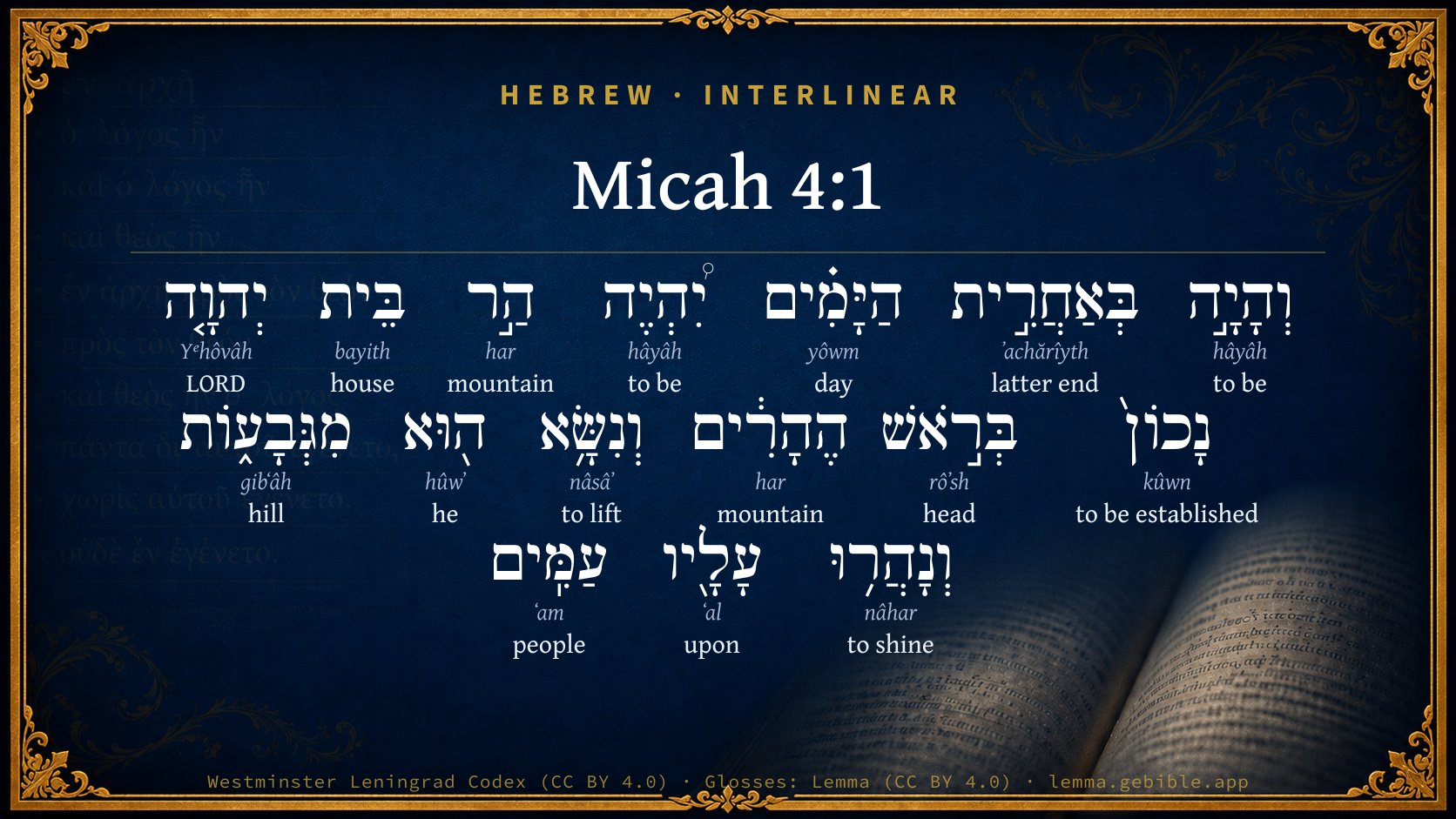
  1. וְהָיָ֣ה hâyâh H1961 “and · to be” Conjunction + Verb, Qal, Sequential Perfect, 3rd Person, Masculine, Singular
  2. בְּאַחֲרִ֣ית ʼachărîyth H319 “in/at · latter end of” Preposition + Noun, Common, Feminine, Singular, Construct
  3. הַיָּמִ֗ים yôwm H3117 “the · days” Particle, Definite Article + Noun, Common, Masculine, Plural, Absolute
  4. יִ֠הְיֶה hâyâh H1961 “to be” Verb, Qal, Imperfect, 3rd Person, Masculine, Singular
  5. הַ֣ר har H2022 “mountain of” Noun, Common, Masculine, Singular, Construct
  6. בֵּית bayith H1004 “house of” Noun, Common, Masculine, Singular, Construct
  7. יְהוָ֤ה Yᵉhôvâh H3068 “LORD” Noun, Proper
  8. נָכוֹן֙ kûwn H3559 “being established” Verb, Niphal, Participle Active, Masculine, Singular, Absolute
  9. בְּרֹ֣אשׁ rôʼsh H7218 “in/at · head of” Preposition + Noun, Common, Masculine, Singular, Construct
  10. הֶהָרִ֔ים har H2022 “the · mountains” Particle, Definite Article + Noun, Common, Masculine, Plural, Absolute
  11. וְנִשָּׂ֥א nâsâʼ H5375 “and · lifting” Conjunction + Verb, Niphal, Participle Active, Masculine, Singular, Absolute
  12. ה֖וּא hûwʼ H1931 “he” Pronoun, Personal, 3rd Person, Masculine, Singular
  13. מִגְּבָע֑וֹת gibʻâh H1389 “from · hills” Preposition + Noun, Common, Feminine, Plural, Absolute
  14. עָלָ֖יו ʻal H5921 “upon · him” Preposition + Suffix, Personal, 3rd Person, Masculine, Singular
  15. עַמִּֽים ʻam H5971 “peoples” Noun, Common, Masculine, Plural, Absolute

About this verse

These counts appear in no published source. They are computed here, from the morphology-tagged text and Lemma’s own curated glosses. What Lemma adds →

16
words
14
distinct lemmas
Prophets
section

Notable vocabulary

The rarest word here is וְנָהֲר֥וּ to shine H5102 — appearing just 6 times in the whole Hebrew Bible.

Shared distinctive vocabulary

וְנָהֲר֥וּ to shine H5102 occurs in 6 verses of the Hebrew Bible. Also found in:

Grammatical profile

  • 5 verbs
  • 9 nouns
  • 1 pronoun
  • 1 preposition

Verb forms

  • וְהָיָ֣ה Qal · Sequential Perfect
  • יִ֠הְיֶה Qal · Imperfect
  • נָכוֹן֙ Niphal · Participle Active
  • וְנִשָּׂ֥א Niphal · Participle Active
  • וְנָהֲר֥וּ Qal · Sequential Perfect

Repetition

Words recur within this verse — often emphatic in Hebrew:

  • וְהָיָ֣ה to be H1961 ×2
  • הַ֣ר mountain H2022 ×2

Hebrew & Septuagint length

In English translation the verse runs 37 words from the Hebrew and 35 from the Septuagint (LXX English) — closely comparable.

A rough comparison of the two English renderings, which tokenize alike — not a word-level alignment.

Word counts can differ between the Hebrew and the Greek without any difference in meaning — e.g. the Hebrew direct-object marker אֵת has no separate Greek word, and Greek often adds the article ὁ.

In the original languages it is 16 Hebrew tokens and 27 Greek tokens — but the two are counted differently (Hebrew bundles its prefixes and suffixes into one token; the Greek is in lemma form), so that isn’t a like-for-like length.

Cross-references

48

Topical passages linked to Micah 4:1 in the Treasury of Scripture Knowledge — connected by theme and wording, ordered by reader-vote popularity; previews shown in the World English Bible.

  • Isaiah 2:1–4 This is what Isaiah the son of Amoz saw concerning Judah and Jerusalem.
  • Jeremiah 3:17 At that time they shall call Jerusalem the throne of Yahweh; and all the nations shall be gathered to it, to the name of Yahweh, to Jerusalem: neither shall they walk any more after the stubbornness of their evil heart.
  • Psalms 22:27 All the ends of the earth shall remember and turn to Yahweh. All the relatives of the nations shall worship before you.
  • Zechariah 14:16–21 It will happen that everyone who is left of all the nations that came against Jerusalem will go up from year to year to worship the King, Yahweh of Hosts, and to keep the feast of tents.
  • Acts 2:17 'It will be in the last days, says God, That I will pour out my Spirit on all flesh. Your sons and your daughters will prophesy. Your young men will see visions. Your old men will dream dreams.
  • Psalms 86:9 All nations you have made will come and worship before you, Lord. They shall glorify your name.
  • Zechariah 8:3 Thus says Yahweh: "I have returned to Zion, and will dwell in the midst of Jerusalem. Jerusalem shall be called 'The City of Truth;' and the mountain of Yahweh of Hosts, 'The Holy Mountain.'"
  • Ezekiel 43:12 This is the law of the house: on the top of the mountain the whole limit of it round about shall be most holy. Behold, this is the law of the house.
  • Hosea 3:5 Afterward the children of Israel shall return, and seek Yahweh their God, and David their king, and shall come with trembling to Yahweh and to his blessings in the last days.
  • Malachi 1:11 For from the rising of the sun even to the going down of the same, my name is great among the nations, and in every place incense will be offered to my name, and a pure offering: for my name is great among the nations," says Yahweh of Hosts.
  • Revelation 21:1–8 I saw a new heaven and a new earth: for the first heaven and the first earth have passed away, and the sea is no more.
  • Isaiah 54:2 Enlarge the place of your tent, and let them stretch forth the curtains of your habitations; don't spare: lengthen your cords, and strengthen your stakes.
  • Zechariah 2:11 Many nations shall join themselves to Yahweh in that day, and shall be my people; and I will dwell in the midst of you, and you shall know that Yahweh of Hosts has sent me to you.
  • Genesis 49:1 Jacob called to his sons, and said: "Gather yourselves together, that I may tell you that which will happen to you in the days to come.
  • Isaiah 49:6 yes, he says, It is too light a thing that you should be my servant to raise up the tribes of Jacob, and to restore the preserved of Israel: I will also give you for a light to the Gentiles, that you may be my salvation to the end of the earth.
  • Ezekiel 38:16 and you shall come up against my people Israel, as a cloud to cover the land: it shall happen in the latter days, that I will bring you against my land, that the nations may know me, when I shall be sanctified in you, Gog, before their eyes.
  • Daniel 2:44 In the days of those kings shall the God of heaven set up a kingdom which shall never be destroyed, nor shall the sovereignty of it be left to another people; but it shall break in pieces and consume all these kingdoms, and it shall stand forever.
  • Daniel 7:27 The kingdom and the dominion, and the greatness of the kingdoms under the whole the sky, shall be given to the people of the saints of the Most High: his kingdom is an everlasting kingdom, and all dominions shall serve and obey him.
  • Zephaniah 3:9–10 For then I will purify the lips of the peoples, that they may all call on the name of Yahweh, to serve him shoulder to shoulder.
  • Romans 11:25–26 For I don't desire, brothers, to have you ignorant of this mystery, so that you won't be wise in your own conceits, that a partial hardening has happened to Israel, until the fullness of the Gentiles has come in,
  • Hebrews 1:2 has at the end of these days spoken to us by his Son, whom he appointed heir of all things, through whom also he made the worlds.
  • Revelation 11:15 The seventh angel sounded, and great voices in heaven followed, saying, "The kingdom of the world has become the Kingdom of our Lord, and of his Christ. He will reign forever and ever!"
  • Revelation 20:4 I saw thrones, and they sat on them, and judgment was given to them. I saw the souls of those who had been beheaded for the testimony of Jesus, and for the word of God, and such as didn't worship the beast nor his image, and didn't receive the mark on their forehead and on their hand. They lived, and reigned with Christ for the thousand years.
  • Genesis 49:10 The scepter will not depart from Judah, Nor the ruler's staff from between his feet, Until he comes to whom it belongs. To him will the obedience of the peoples be.
  • Psalms 68:15–16 The mountains of Bashan are majestic mountains. The mountains of Bashan are rugged.
  • Psalms 68:29–32 Because of your temple at Jerusalem, Kings shall bring presents to you.
  • Psalms 72:7–11 In his days, the righteous shall flourish, And abundance of peace, until the moon is no more.
  • Psalms 72:16–19 There shall be abundance of grain throughout the land. Its fruit sways like Lebanon. Let it flourish, thriving like the grass of the field.
  • Psalms 110:3 Your people offer themselves willingly in the day of your power, in holy array. Out of the womb of the morning, you have the dew of your youth.
  • Isaiah 11:9–10 They shall not hurt nor destroy in all my holy mountain; for the earth shall be full of the knowledge of Yahweh, as the waters cover the sea.
  • Isaiah 27:13 It shall happen in that day, that a great trumpet shall be blown; and they shall come who were ready to perish in the land of Assyria, and those who were outcasts in the land of Egypt; and they shall worship Yahweh in the holy mountain at Jerusalem.
  • Isaiah 43:6 I will tell the north, Give up; and to the south, Don't keep back; bring my sons from far, and my daughters from the end of the earth;
  • Isaiah 49:19–23 For, as for your waste and your desolate places, and your land that has been destroyed, surely now shall you be too small for the inhabitants, and those who swallowed you up shall be far away.
  • Isaiah 60:3–14 Nations shall come to your light, and kings to the brightness of your rising.
  • Isaiah 66:18–23 For I [know] their works and their thoughts: [the time] comes, that I will gather all nations and languages; and they shall come, and shall see my glory.
  • Jeremiah 16:19 Yahweh, my strength, and my stronghold, and my refuge in the day of affliction, to you shall the nations come from the ends of the earth, and shall say, Our fathers have inherited nothing but lies, [even] vanity and things in which there is no profit.
  • Jeremiah 48:47 Yet will I bring back the captivity of Moab in the latter days, says Yahweh. Thus far is the judgment of Moab.
  • Ezekiel 17:22–24 Thus says the Lord Yahweh: I will also take of the lofty top of the cedar, and will set it; I will crop off from the topmost of its young twigs a tender one, and I will plant it on a high and lofty mountain:
  • Ezekiel 40:2 In the visions of God brought he me into the land of Israel, and set me down on a very high mountain, whereon was as it were the frame of a city on the south.
  • Daniel 2:28 but there is a God in heaven who reveals secrets, and he has made known to the king Nebuchadnezzar what shall be in the latter days. Your dream, and the visions of your head on your bed, are these:
  • Daniel 2:35 Then was the iron, the clay, the brass, the silver, and the gold, broken in pieces together, and became like the chaff of the summer threshing floors; and the wind carried them away, so that no place was found for them: and the stone that struck the image became a great mountain, and filled the whole earth.
  • Daniel 7:14 There was given him dominion, and glory, and a kingdom, that all the peoples, nations, and languages should serve him: his dominion is an everlasting dominion, which shall not pass away, and his kingdom that which shall not be destroyed.
  • Daniel 7:18 But the saints of the Most High shall receive the kingdom, and possess the kingdom forever, even forever and ever.
  • Daniel 10:14 Now I have come to make you understand what shall happen to your people in the latter days; for the vision is yet for [many] days:
  • Micah 3:12 Therefore Zion for your sake will be plowed like a field, And Jerusalem will become heaps of rubble, And the mountain of the temple like the high places of a forest.
  • 2 Peter 3:3 knowing this first, that in the last days mockers will come, walking after their own lusts,
  • Revelation 15:4 Who wouldn't fear you, Lord, And glorify your name? For you only are holy. For all the nations will come and worship before you. For your righteous acts have been revealed."
  • Daniel 7:22 until the ancient of days came, and judgment was given to the saints of the Most High, and the time came that the saints possessed the kingdom.

Cross-references courtesy of OpenBible.info (CC BY 4.0).

Hebrew and Greek witnesses Masoretic Hebrew ↔ Greek Septuagint

The same verse in the two great witnesses to the Old Testament, shown verse-for-verse.

These are two independent witnesses, not word-aligned to each other, and the Septuagint is shown in lemma (dictionary) form.

Hebrew Micah 4:1 Masoretic · Westminster Leningrad Codex

וְהָיָ֣ה בְּאַחֲרִ֣ית הַיָּמִ֗ים יִ֠הְיֶה הַ֣ר בֵּית יְהוָ֤ה נָכוֹן֙ בְּרֹ֣אשׁ הֶהָרִ֔ים וְנִשָּׂ֥א ה֖וּא מִגְּבָע֑וֹת וְנָהֲר֥וּ עָלָ֖יו עַמִּֽים

But in the latter days, It will happen that the mountain of Yahweh's temple will be established on the top of the mountains, And it will be exalted above the hills; And peoples will stream to it.

World English Bible · Public Domain

Greek LXX Micah 4:1 Septuagint · lemma form

καί εἰμί ἐπί ἔσχατος ὁ ἡμέρα ἐμφανής ὁ ὄρος ὁ κύριος ἕτοιμος ἐπί ὁ κορυφή ὁ ὄρος καί μετεωρίζω ὑπεράνω ὁ βουνός καί σπεύδω πρός αὐτός λαός

And at the last days the mountain of the Lord shall be manifest, established on the tops of the mountains, and it shall be exalted above the hills; and the peoples shall hasten to it.

LXX2012 (modern English Septuagint) · Public Domain

On this verse, The Pulpit Commentary discusses the Septuagint’s reading. Read the note in Commentary ↓

Hebrew: Westminster Leningrad Codex (CC BY 4.0). Greek: Septuagint (public domain); English from LXX2012 (modern English Septuagint) (Public Domain). How the Septuagint differs from the Hebrew →

Targum (Aramaic paraphrase)

1

The Targum is the ancient Jewish Aramaic paraphrase of the Hebrew Scriptures — an interpretive translation, not the Hebrew text itself. Onkelos (literal) and Pseudo-Jonathan (expansive) render the Torah, and Jonathan the Prophets. Coverage is partial: where no permissively-licensed English translation exists for a verse, only the Aramaic is shown. This is verse-level text, not a word-by-word alignment to the Hebrew.

  1. Targum Jonathan Prophets (Joshua–Malachi)
    וִיהֵי בְּסוֹף יוֹמַיָא יְהֵי טוּר בֵית מַקְדְשָׁא דַייָ מְתַקֵן בְּרֵישׁ טוּרַיָא וּמְנַטֵל הוּא מֵרָמָתָא וְיִתְפַּנְיָן לְמִפְלַח עֲלוֹהִי מַלְכְּוָתָא:

    (no public-domain English translation for this verse)

    Targum Jonathan — Aramaic: “Mikraot Gedolot” (public domain). English: “Sefaria Community Translation” (CC0 1.0 (public-domain dedication)); “London "Chaldee Paraphrase," 1871” (public domain). Text via Sefaria.

Commentary

Notes on Micah 4:1 from classic Christian and Jewish commentators (each source and its license shown beneath its notes). The classic Christian expositions comment on the surrounding passage and are grouped to its opening verse, so a note may address several verses; the Jewish commentaries on the Tanakh (Rashi and others) are per-verse, so they appear only where the commentator wrote on this verse.

Lemma curates 59 commentaries, every one of them public domain or Creative Commons licensed, each selected and text-cleaned for this edition rather than reprinted as found. About our sources →

Matthew Henry's Commentary

It is a very comfortable but with which this chapter begins, and very reviving to those who lay the interests of God's church near their heart and are concerned for the welfare of it. When we sometimes see the corruptions of the church, especially of church-rulers, princes, priests, and prophets, seeking their own things and not the things of God, and when we soon after see the desolations of the church, Zion for their sakes ploughed as a field, we are ready to fear that it will one day perish between both, that the name of Israel shall be no more in remembrance; we are ready to give up all for gone, and to conclude the church will have neither root not branch upon earth. But let not our faith fail in this matter; out of the ashes of the church another phoenix shall arise. In the last words of the foregoing chapter we left the mountain of the house as desolate and waste as the high places of the forest; and is it possible that such a wilderness should ever become a fruitful field again? Yes, the first words of this chapter bring in the mountain of the Lord's house as much dignified by being frequented as ever it had been disgraced by being deserted. Though Zion be ploughed as a field, yet God has not cast off his people, but by the fall of the Jews salvation has come to the Gentiles, so that it proves to be the riches of the world, Rom 11:11, Rom 11:12. This is the mystery which God by the prophet here shows us, and he says the very same in the first three verses of this chapter which another prophet said by the word of the Lord at the same time (Isa 2:2-4), that out of the mouth of these two witnesses these promises might be established; and very precious promises they are, relating to the gospel-church, which have been in part accomplished, and will be yet more and more, for he is faithful that has promised.

I. That there shall be a church for God set up in the world, after the defection and destruction of the Jewish church, and this in the last days; that is, as some of the rabbin themselves acknowledge, in the days of the Messiah. The people of God shall be incorporated by a new charter, a new spiritual way of worship shall be enacted, and a new institution of offices to attend it; better privileges shall be granted by this new charter, and better provision made for enlarging and establishing the kingdom of God among men than had been made by the Old Testament constitution: The mountain of the house of the Lord shall again appear firm ground for God's faithful worshippers to stand, and go, and build upon, in their attendance on him, Mic 4:1. And it shall be a centre of unity to them; a church shall be set up in the world, to which the Lord will be daily adding such as shall be saved.

II. That this church shall be firmly founded and well-built: It shall be established in the top of the mountains; Christ himself will build it upon a rock; it shall be an impregnable fort upon an immovable foundation, so that the gates of hell shall neither overthrow the one nor undermine the other (Mat 16:18); its foundations are still in the holy mountains (Psa 87:1), the everlasting mountains, which cannot, which shall not, be removed. It shall be established, not as the temple, upon one mountain, but upon many; for the foundations of the church, as they are sure, so they are large.

III. That it shall be highly advanced, and become eminent and conspicuous: It shall be exalted above the hills, observed with wonder for its growing greatness from small beginnings. The kingdom of Christ shall shine with greater lustre than ever any of the kingdoms of the earth did. It shall be as a city on a hill, which cannot be hid, Mat 5:14. The glory of this latter house is greater than that of the former, Hag 2:9. See Co2 3:7, Co2 3:8, etc.

IV. That there shall be a great accession of converts to it and succession of converts in it. People shall flow unto it as the waters of a river are continually flowing; there shall be a constant stream of believers flowing in from all parts into the church, as the people of the Jews flowed into the temple, while it was standing, to worship there. Then many tribes came to the mountain of the house, to enquire of God's temple; but in gospel-times many nations shall flow into the church, shall fly like a cloud and as the doves to their windows. Ministers shall be sent forth to disciple all nations, and they shall not labour in vain; for, multitudes being wrought upon to believe the gospel and embrace the Christian religion, they shall excite and encourage one another, and shall say, "Come, and let us go up to the mountain of the Lord now raised among us, even to the house of the God of Jacob, the spiritual temple which we need not travel far to, for it is brought to our doors and set up in the midst of us." Thus shall people be made willing in the day of his power (Psa 110:3), and shall do what they can to make others willing, as Andrew invited Peter, and Philip Nathanael, to be acquainted with Christ. They shall call the people to the mountain (Deu 33:19), for there is in Christ enough for all, enough for each. Now observe what it is, 1. Which these converts expect to find in the house of the God of Jacob. They come thither for instruction: "He will teach us of his ways, what is the way in which he would have us to walk with him and in which we may depend upon him to meet us graciously." Note, Where we come to worship God we come to be taught of him. 2. Which they engage to do when they are thus taught of God: We will walk in his paths. Note, Those may comfortably expect that God will teach them who are firmly resolved by his grace to do as they are taught.

V. That, in order to this, a new revelation shall be published to the world, on which the church shall be founded, and by which multitudes shall be brought into it: For the law shall go forth of Zion, and the word of the Lord from Jerusalem. The gospel is here called the word of the Lord, for the Lord gave the word, and great was the company of those that published it, Psa 68:11. It was of a divine original, a divine authority; it began to be spoken by the Lord Christ himself, Heb 2:3. And it is a law, a law of faith; we are under the law to Christ. This was to go forth from Jerusalem, from Zion, the metropolis of the Old Testament dispensation, where the temple, and altars, and oracles were, and whither the Jews went to worship from all parts; thence the gospel must take rise, to show the connexion between the Old Testament and the New, that the gospel is not set up in opposition to the law, but is an explication and illustration of it, and a branch growing out of its roots. It was in Jerusalem that Christ preached and wrought miracles; there he died, rose again, and ascended; there the Spirit was poured out; and those that were to preach repentance and remission of sins to all nations were ordered to begin at Jerusalem, so that thence flowed the streams that were to water the desert world.

VI. That a convincing power should go along with the gospel of Christ, in all places where it should be preached (Mic 4:3): He shall judge among many people. Messiah, the lawgiver (Mic 4:2.), is here the judge, for to him the Father committed all judgment, and for judgment he came into this world; his word, the word of his gospel, that was to go forth from Jerusalem, was the golden sceptre by which he shall rule and judge when he sits as king on the holy hill of Zion, Psa 2:6. By it he shall rebuke strong nations afar off; for the Spirit working with the word shall reprove the world, Joh 16:8. It is promised to the Son of David that he shall judge among the heathen (Psa 110:6), which he does when in the chariot of his everlasting gospel he goes forth, and goes on, conquering and to conquer.

VII. That a disposition to mutual peace and love shall be the happy effect of the setting up of the kingdom of the Messiah: They shall beat their swords into plough-shares; that is, angry passionate men, that have been fierce and furious, shall be wonderfully sweetened, and made mild and meek, Tit 3:2, Tit 3:3. Those who, before their conversion, did injuries, and would bear none, after their conversion can bear injuries, but will do none. As far as the gospel prevails it makes men peaceable, for such is the wisdom from above; it is gentle and easy to be entreated; and if nations were but leavened by it, there would be universal peace. When Christ was born there was universal peace in the Roman empire; those that were first brought into the gospel church were all of one heart and of one soul (Act 4:32); and it was observed of the primitive Christians how well they loved one another. In heaven this will have its full accomplishment. It is promised, 1. That none shall be quarrelsome. The art of war, instead of being improved (which some reckon the glory of a kingdom), shall be forgotten and laid aside as useless. They shall not learn war any more as they have done, for they shall have no need to defend themselves nor any inclination to offend their neighbours. Nation shall no longer lift up sword against nation; not that the gospel will make men cowards, but it will make men peaceable. 2. That all shall be quiet, both from evil and from the fear of evil (Mic 4:4): They shall sit safely, and none shall disturb them; they shall sit securely, and shall not disturb themselves, every man under his vine and under his fig-tree, enjoying the fruit of them, and needing no other shelter than the leaves of them. None shall make them afraid; not only there shall be nothing that is likely to frighten them, but they shall not be disposed to fear. under the dominion of Christ, as that of Solomon, there shall be abundance of peace. Though his followers have trouble in the world, in him they enjoy great tranquillity. If this seems unlikely, yet we may depend upon it, for the mouth of the Lord has spoken it, and no word of his shall fall to the ground; what he has spoken by his word he will do by his providence and grace. He that is the Lord of hosts will be the God of peace; and those may well be easy whom the Lord of hosts, of all hosts, undertakes the protection of.

VIII. That the churches shall be constant in their duty, and so shall make a good use of their tranquillity and shall not provoke the Lord to deprive them of it, Mic 4:5. When the churches have rest they shall be edified, and confirmed, and comforted, and shall resolve to be as firm to their God as other nations are to theirs, though they be no gods. Where we find the foregoing promises, Isa 2:2, etc. it follows (Mic 4:5), O house of Jacob! come ye, and let us walk in the light of the Lord; and here, We will walk in the name of the Lord our God. Note, Peace is a blessing indeed when it strengthens our resolutions to cleave to the Lord. Observe, 1. How constant other nations were to their gods: All people will walk every one in the name of his god, will own their god and cleave to him, will worship their god and serve him, will depend upon him and put confidence in him. Whatever men make a god of they will make use of, and take his name along with them in all their actions and affairs. The mariners, in a storm, cried every man to his god, Jon 1:5. And no instance could be found of a nation's changing its gods, Jer 2:11 : If the hosts of heaven were their gods, they loved them, and served them, and walked after them, Jer 8:2. 2. How constant God's people now resolve to be to him: "We will walk in the name of the Lord our God, will acknowledge him in all our ways, and govern ourselves by a continual regard to him, doing nothing but what we have warrant from him for, and openly professing our relation to him." Observe, Their resolution is peremptory; it is not a thing that needs be disputed: "We will walk in the name of the Lord our God." It is just and reasonable: He is our God. And it is a resolution for a perpetuity: "We will do it for ever and ever, and will never leave him. He will be ours for ever, and therefore so we will be his, and never repent our choice."

IX. That notwithstanding the dispersions, distress, and infirmities of the church, it shall be formed and established, and made very considerable, Mic 4:6, Mic 4:7. 1. The state of the church had been low, and weak, and very helpless, in the latter times of the Old Testament, partly through the corruptions of the Jewish nation, and partly through the oppressions under which they groaned. They were like a flock of sheep that were maimed, worried, and scattered, Eze 34:16; Jer 50:6. 17. The good people among them, and in other places, that were well inclined, were dispersed, were very infirm, and in a manner lost and cast far off. 2. It is promised that all these grievances shall be redressed and the distemper healed. Christ will come himself (Mat 15:24), and send his apostles to the lost sheep of the house of Israel, Mat 10:6. From among the Jews that halted, or that for want of strength, could not go upright, God gathered a remnant (Mic 4:7), that remnant according to the election of grace which is spoken of in Rom 11:7, which embraced the gospel of Christ. And from among the Gentiles that were cast far off (so the Gentiles are described to be, Eph 2:13, Act 2:39) he raised a strong nation; greater numbers of them were brought into the church than of the Jews, Gal 4:27. And such a strong nation the gospel-church is that the gates of hell shall never be able to prevail against it. The church of Christ is more numerous than any other nation, and strong in the Lord and in the power of his might.

X. That the Messiah shall be the king of this kingdom, shall protect and govern it, and order all the affairs of it for the best, and this to the end of time. The Lord Jesus shall reign over them in Mount Zion by his word and Spirit in his ordinances, and this henceforth and for ever, for of the increase of his government and peace there shall be no end.

Matthew Henry's Commentary on the Whole Bible (1708–1710) — public domain (CC PDM 1.0). Text via the HelloAO Bible API.

The Cambridge Bible for Schools and Colleges

gen. ed. J. J. S. Perowne

1–4. The Ideal of Happiness realized

1. But] The Auth. Vers. has done its best to soften the abruptness of the transition from Mic_3:12 to Mic_4:1. It understands the meaning to be something like this:—In spite of this awful prospect of judgment, God has a bright future in store both for Jerusalem and for Israel. In the Hebrew, however, the passage Mic_4:1-4 is simply added on to Mic_3:12; there is no properly adversative particle prefixed; the contrast is rather implied than expressed. It seems as if Micah’s mind was so filled up by the thought of judgment, that there was hardly any room for the thought of national regeneration. When the image does present itself to his imagination, it is only as by a lightning-flash, which soon passes away, and leaves the horizon as gloomy as before. There is nothing in Micah like a developed doctrine of the latter days, such as we have to some extent in Isaiah.

in the last days] Hebr. b’akharith hayyâmîm. This rendering is misleading; the Messianic period described in the following verses has no ‘last days;’ it is without an end (Isa_9:7). Render, therefore, in stricter accordance with the Hebrew, in the days to come (lit., ‘in the sequel of the days’); and comp. Jer_23:20, ‘The anger of Jehovah shall not turn back, till he have executed, and till he have carried into effect the purposes of his heart: in future days ye shall duly consider it’ (Henderson’s translation), also Deu_4:30; Deu_31:29, and the phrase in an Assyrian historical inscription ana akhrat yumi = ‘for future days.’ A similar mistake has been made in 1Ti_4:1, where ἐν ὑστέροις καιροῖς is rendered in Auth. Vers. ‘in the latter times;’ the Revised Version corrects, ‘in later times.’

the mountain of the house of the Lord] i.e. not merely mount Moriah (as in Mic_3:12), but by synecdoche for Jerusalem (comp. end of Mic_4:2).

in the top] Rather, at the head. The lower mountains radiating, as it were, in all directions from it. “A similar physical change is anticipated for Jerusalem in Zec_14:10, and for the valley of Jehoshaphat, in connexion with the ‘day of Jehovah,’ in Joe_3:12. Ezekiel, too, speaks of having been transported in an ecstatic state to ‘a very high mountain’ (Eze_40:2), evidently alluding to this passage.” The rendering of Auth. Vers. implies an image too hyperbolical to be accepted without compulsion.

The Cambridge Bible for Schools and Colleges (gen. ed. J. J. S. Perowne; Cambridge University Press, 1878–1918) — public domain. Text from a community e-Sword module.

Trapp's Complete Commentary

John Trapp

Mic 4:1 But in the last days it shall come to pass, [that] the mountain of the house of the LORD shall be established in the top of the mountains, and it shall be exalted above the hills; and people shall flow unto it.

Ver. 1. But in the last days it shall come to pass] God reserveth his best comforts till the last, as that ruler of the feast did his best wine, Joh 2:10, and as the sweetest of the honey lieth at the bottom. These last days are the Gospel days, Heb 1:2, times of reformation, Heb 9:10, of restitution, Act 3:21, called the world to come, Heb 2:5, that "new heaven and earth, wherein dwelleth righteousness," 2Pe 3:13, that new Jerusalem, that is all of gold, Rev 21:18, Ezekiel’s new temple, larger than all the old Jerusalem, and his new Jerusalem, larger than all the land of Canaan, Eze 40:41-49. Let Popish buzzards blaspheme that description of the temple and city; calling it (as Sanctius doth once and again) insulsam descriptionem, a senseless description; so speaking evil of the things that they know not, Jdg 1:10. We believe and are sure, Joh 6:69, that God hath provided some better thing for us than for those under the law, Heb 11:40, viz. that great mystery of godliness, God manifested in the flesh, 1Ti 3:16, who should again restore the kingdom to Israel, the spiritual kingdom to the Israel of God; as is here foretold in the self same words with those of Isaiah, Isa 2:1-2, whence he is not ashamed to take it.

That the mountain of the house of the Lord] The Church, 1Ti 3:15, called elsewhere the mountain of the Lord, and his holy hill, Psa 15:1; Psa 24:3; Psa 48:2 Isa 30:17, both for its sublimity, Gal 4:26, and firmness, Psa 46:3; Psa 125:1 : winds and storms move it not; no more can all the power and policy of hell combined prevail against the Church, Mat 16:18. She is ανικητος και ακινητος, a kingdom that cannot be shaken; and may, better than the city of Venice, take for her posy Immota manet. May she stand immovable.

Shall be established in the top of the mountains] Constituetur firmiter, She shall be established more securely, shall be strongly set upon a sure bottom, upon munitions of rocks; yea, upon the Rock of Ages, Mat 15:18 Jer 31:35 Isa 33:16. Some by "the house of the Lord" here understand the Church; and by the mountain of this house, Christ, whereon it is built, and whom Daniel describeth by that great mountain that filled the whole earth, that stone cut out without hands that smote in pieces the four monarchies, Dan 2:35. And hence it is that this mountain of the Lord’s house is exalted above the hills: the Church must needs be above all earthly eminences whatsoever, because founded upon Christ; who therefore cannot be exalted, but she must be lifted up aloft together with him. God, who is rich in mercy, saith that great apostle, "hath quickened us together with Christ, and hath raised us up together, and made us sit together in heavenly places in Christ Jesus," Eph 2:5-6. The Church is mystical Christ, 1Co 12:12, she is his wife, and wherever he is Caius she is Caia; she shineth with his beams and partaketh of his honours; union being the ground of communion.

And people shall flow unto it] As waters roll and run toward the sea; but that these waters shall flow upward, flow to the mountain, as here, is as wonderful as that the sun should send his beams downward to the earth, when as it is the property of all fire to aspire and fly upwards. This is the Lord’s own work, and it is marvellous in our eyes. The metaphor of flowing importeth the coming of people to Christ by the preaching of the Gospel. 1. Freely, Psa 110:3 2. Swiftly, as the waters of the river Tigris, swift as an arrow out of a bow. See Isa 60:8 3. Plentifully, by whole nations turned to the faith, and giving up their names to Christ. 4. Jointly, as Mic 4:2 Zec 8:21 5. Zealously, bearing down all obstacles that would dam up their way. 6. Constantly and continually, as rivers run perpetually, by reason of the perennity of their fountains; and are never dried up, though sometimes fuller than some: quin ut fluvii repentinis imbribus augentur, saith Gualther; as rivers swell often with sudden showers, and overflow the banks, so, beyond all expectation, many times doth God take away tyrants, and propagates his truth, enlarging the bounds of his Church with new confluxes of converts.

John Trapp, A Commentary or Exposition upon All the Books of the Old and New Testament (1647–1656) — public domain. Text from a community e-Sword module.

Albert Barnes' Notes on the Bible

But (And) in the last days it shall come to pass - God’s promises, goodness, truth, fail not. He withdraws His Presence from those who receive Him not, only to give Himself to those who will receive Him. Mercy is the sequel and end of chastisement. Micah then joins on this great prophecy of future mercy to the preceding woe, as its issue in the order of God’s Will. “And it shall be.” He fixes the mind to some great thing which shall come to pass; “it shall be.” Then follows, in marked reference to the preceding privations, a superabundance of mercy. For “the mountain of the house,” which should be as a forest and which was left unto them desolate, there is “the mountain of the Lord’s house established;” for the heap of dust and the plowed field, there is the flowing-in of the Gentiles; for the night and darkness, that there shall be no vision, there is the fullness of revelation; for corrupt judgment, teaching, divining, a law from God Himself going forth through the world; for the building of Jerusalem with blood, one universal peace.

In the last days - Literally, the end of the days, that is, of those days which are in the thoughts of the speaker. Politically, there are many beginnings and many endings; as many endings as there are beginnings, since all human polity begins, only to end, and to be displaced in its turn by some new beginning, which too runs its course, only to end. Religiously, there are but two consummations. All time, since man fell, is divided into two halves, the looking forward to Christ to come in humility; the looking forward to His coming in glory. These are the two events on which man’s history turns. To that former people the whole period of Christ’s kingdom was one future, the fullness of all their own shadows, types, sacrifices, services, prophecies, longing, being. The “end of their days” was the beginning of the new Day of Christ: the coming of His Day was necessarily the close of the former days, the period of the dispensation which prepared for it.

The prophets then by the words, “the end of the days,” always mean the times of the Gospel . “The end of the days” is the close of all which went before, the last dispensation, after which there shall be no other. Yet this too hast “last days” of its own, which shall close God’s kingdom of grace and shall issue in the Second Coming of Christ; as the end of those former days, which closed the times of “the law,” issued in His First Coming. We are then at once living in the last times, and looking on to a last time still to come. In the one way Peter speaks Eph 1:20 of the last times, or the end of the times , in which Christ was manifested for us, in contrast with the foundations of the world, before which He was foreordained.

And Paul contrasts God’s Heb 1:1 speaking to the fathers in the prophets, and at the end of these days speaking to us in the Son; and of our Lord coming Heb 9:26 at the end, consummation, of the times , to put away sins by the sacrifice of Himself; and says that the things which befell the Jews 1Co 10:11 were written for our admonition, unto whom the ends of the times (that is, of those of the former people of whom he had been speaking) are come; and John speaks of this as 1Jo 2:18 the last time. In the other way, they contrast the last days, not with the times before them but with their own, and then plainly they are a last and distant part of this their own last time .

The Spirit speaketh expressly, that in the latter times some shall depart from the faith ; In the last days perilous times shall come : There shall come at the end of the days scoffers : They told you that there should be mockers in the last time. The Jews distributed all time between “this world” and “the coming world” , including under “the coming world” the time of grace under the Messiah’s reign, and the future glory. To us the names have shifted, since this present world Mat 13:40; Eph 1:21; Tit 2:12 is to us the kingdom of Christ, and there remains nothing further on this earth to look to, beyond what God has already given us. Our future then, placed as we are between the two Comings of our Lord, is, of necessity, beyond this world .

The mountain of the house of the Lord shall be - abidingly

Established - He does not say merely, “it shall be established.” Kingdoms may be established at one time, and then come to an end. He says, “it shall be a thing established” . His saying is expanded by Daniel; “In the days of these kings shall the God of heaven set up a kingdom which shall not be destroyed forever, and it shall abide forever” Dan 2:44. The house of the Lord was the center of His worship, the token of His Presence, the pledge of His revelations and of His abiding acceptance, protection, favor. All these were to be increased and continuous. The image is one familiar to us in the Hebrew Scriptures. People were said to go up to it, as to a place of dignity.

In the Psalm on the carrying of the Ark thither, the hill of God is compared to the many-topped mountains of Basan Psa 68:16-17, (the Hermon-peaks which bound Basan,) and so declared to be greater than they, as being the object of God’s choice. The mountain where God was worshiped rose above the mountains of idolatry. Ezekiel, varying the image, speaks of the Gospel as an overshadowing cedar Eze 17:22-23, planted by God upon an high mountain and an eminent, in the mountain of the height of Israel, under which should dwell all fowl of every wing; and, in his vision of the Temple, he sees this, the image of the Christian Church Eze 40:2, upon a very high mountain. Our Lord speaks of His Apostles and the Church in them, as Mat 5:14 a city set upon a hill which cannot be hid. The seat of God’s worship was to be seen far and wide; nothing was to obscure it. It, now lower than the surrounding hills, was then to be as on the summit of them. Human elevation, the more exalted it is, the more unstable is it. Divine greatness alone is at once solid and exalted. The new kingdom of God was at once to be “exalted above the hills,” and “established on the top of the mountains;” “exalted,” at once, above everything human, and yet “established,” strong as the mountains on which it rested, and unassailable, unconquerable, seated secure aloft, between heaven, whence it came and to which it tends, and earth, on which it just tests in the sublime serenity of its majesty.

The image sets forth the supereminence of the Lord’s House above all things earthly. It does not define wherein that greatness consists. The flowing in of the nations is a fruit of it Mic 4:1-2. The immediate object of their coming is explained to be, to learn to know and to do the will of God Mic 4:2. But the new revelation does not form all its greatness. That greatness is from the Presence of God, revealing and evermore teaching His Will, ruling, judging, rebuking, peacemaking Mic 4:3-4. Dionysius: “The ‘mountain of the Lord’s House’ was then ‘exalted above the hills’ by the bodily Presence of Christ, when He, in the Temple built on that mountain, spake, preached, worked so many miracles; as, on the same ground, Haggai says, ‘the glory of this latter house shall be greater than the glory of the former’ Hag 2:9.” Lap.: “This ‘mountain,’ the church of Christ, transcends all laws, schools, doctrines, religions, Synagogues of Jews and Philosophers, which seemed to rise aloft among men, like mountain-tops, yea, whatever under the sun is sublime and lofty, it will overpass, trample on, subdue to itself.”

Even Jews have seen the meaning of this figure. Their oldest mystical book explains it. Zohar, f. 93: “‘And it shall be in the last days,’ when namely the Lord shall visit the daughter of Jacob, then shall ‘the mountain of the house of the Lord be firmly established, that is, the Jerusalem which is above, which shall stand firmly in its place, that it may shine by the light which is above. (For no light can retain its existence, except through the light from above.) For in that time shall the light from above shine sevenfold more than before; according to that, Moreover, the light of the moon shall be as the light of the sun; and the light of the sun shall be sevenfold, as the light of seven days, in the day that the Lord bindeth up the breach of His people and healeth the stroke of their wound” Isa 30:26. Another, of the dry literal school, says (Aben Ezra), “It is well known that the house of the Temple is not high. The meaning then is, that its fame shall go forth far, and there shall return to it from all quarters persons with offerings, so that it shall be, as if it were on the top of all hills, so that all the inhabitants of the earth should see it.”

Some interpret “the mountain” to be Christ, who is called the Rock 1Co 10:4-6, on the confession of whom, God-Man, “the house of the Lord,” that is, the Church is built , the precious Cornerstone Isa 28:16; 1Pe 2:6; Eph 2:20, which is laid, beside which no foundation can be laid 1Co 3:11; “the great mountain,” of which Daniel Dan 2:35 prophesied. It is “firmly established,” so that the gates of Hell shall not prevail against the Church, being built thereon; “exalted above hills and mountains”, that is above all beside, greater or smaller, which has any eminence; for He in truth is Phi 2:9 highly exalted and hath a Name above every name, being Eph 1:20-23 at the Right Hand of God in the heavenly places, far above all principality and power and might and dominion, and every name that is named, not only in this world but also in that which is to come; and all things are under His Feet. And this for us, in that He, the Same, is the Head over all things to the Church which is His Body, the fullness of Him that filleth all in all. Rup.: “He is God and Man, King and Priest, King of kings, and a Priest abiding forever. Since then His Majesty reacheth to the Right Hand of God, neither mountains nor hills, Angels nor holy men, reach thereto; for “to which of the Angels said God at any time, Sit thou on My Right Hand?” Heb 1:13.

Cyril: “Aloft then is the Church of God raised, both in that its Head is in heaven and the Lord of all, and that, on earth, it is not like the Temple, in one small people, but “set on a hill that it cannot be hid” Mat 5:14, or remain unseen even to those tar from it. Its doctrine too and life are far above the wisdom of this world, showing in them nothing of earth, but are above; its wisdom is the knowledge and love of God and of His Son Jesus Christ, and its life is bid with Christ in God, in those who are justified in Him and hallowed by His Spirit.” In Him, it is lifted above all things, and with the eyes of the mind beholdeth (as far as may be) the glory of God, soaring on high toward Him who is the Author of all being, and, filled with divine light, it owneth Him the Maker of all.

And people (peoples, nations) shall flow unto (literally upon) it - A mighty tide should set in to the Gospel. The word is used only figuratively) is appropriated to the streaming in of multitudes, such as of old poured into Babylon, the merchant-empress of the world Jer 51:44. It is used of the distant nations who should throng in one continuous stream into the Gospel, or of Israel streaming together from the four corners of the world . So, Isaiah foretells, “Thy gates shall be open continually; they shall not be shut day nor night; that they may bring unto thee the forces of the Gentiles, and that their kings may be brought” (Isa 60:11, add Rev 21:25-26). These were to flow upon it, perhaps so as to cover it, expressing both the multitude and density of the throng of nations, how full the Church should be, as the swollen river spreads itself over the whole champaign country, and the surging flood-tide climbs up the face of the rock which hounds it. The flood once covered the highest mountains to destroy life; this flood should pour in for the saving of life. Lap.: “It is a miracle, if waters ascend from a valley and flow to a mountain. So is it a miracle that earthly nations should ascend to the church, whose doctrine and life are lofty, arduous, sublime. This the grace of Christ effecteth, mighty and lofty, as being sent from heaven. As then waters, conducted from the fountains by pipes into a valley, in that valley bound up and rise nearly to their original height, so these waters of heavenly grace, brought down into valleys, that is, the hearts of men, make them to bound up with them into heaven and enter upon and embrace a heavenly life.”

Albert Barnes' Notes on the Bible (1834–1885) — public domain. Text from a community e-Sword/MySword module.

The Biblical Illustrator

Joseph S. Exell

Mic_4:1-5

The mountain of the house of the Lord shall be established in the top of the mountains

The moral grandeur of the Christian Church

The gift of prophecy would have been to its possessor a source of the most exquisite misery if it had been restricted only to the dark passages of human history. But the future had a bright side as well as a dark, and it was as cheering to contemplate the former as it was dismal to apprehend the latter. As the sorrows of the prophets were greater, their joys also were higher than those of ordinary mere In the chapter immediately preceding the text the prophet had announced the future desolation of Zion and Jerusalem. The sins of her priests and princes, he foresaw, would attain such a height of aggravation that the very day itself would, in a manner, be dark over them. But as in the ashes of winter the husbandman can read the glories of spring, the prophetic eye could discern in the ruin of one city the establishment of another more glorious by far. Seine goes on to expatiate with rapture on the glory that was to follow. By last days are meant the times of the Messiah, or, in other words, the Christian era. The meaning is, that the Christian dispensation would be the last of all, and that no other economy would be after it. It was an economy that was to last until the end of time. In these last days it is foretold by the prophet that the mountain of the Lords house shall be established on the top of the mountains, and exalted above the hills. In a mountainous region, among the multitude of hills that rise one above another in sublimity and grandeur, there is generally one that proudly and preeminently lifts its head above them all. It is seen from a greater distance than any of the others, and towers in glorious majesty over the heights which are allied to it. Under this bold and significant image, the prophet exhibits to us the moral grandeur and elevation of the Christian Church. It was, like the loftiest of mountains in an extensive range, to be visible from afar. A house, or temple, was to be reared on its summit. The Christian religion would surpass every other in majesty, and look down triumphantly on every other system of worship. This prophecy is fulfilled in part. Where is there a creed or system of theology that can compare with it? In the Gospel there is prominence, there is attractiveness, there is conspicuity. The hill of Calvary is more illustrious than the mountains of any land. He who was lifted up there, draws towards Him the eyes of many nations. The language of the prophet implies that, before this mountain could be exalted, there must be a shaking of the hills around. The prediction is to receive its full and perfect accomplishment in days still future--in, if we may so speak, the latest of the last days. Then indeed shall the mountain of the Lords house rise sublimely above all the hills. There is reason, too, for believing, that just as at the first propagation of the Gospel, so likewise at its universal diffusion, there shall be a series of great and momentous changes in the political world. The great battle of contending principles must be fought out--the old warfare between sense and spirit must be renewed--and a period of intense misery must precede the final adjustment of the question. Nevertheless, truth which is mighty must prevail. At the close of the first verse the prophet intimates the triumph of the Gospel, and the immense number of its converts. People shall flow unto it. The metaphor signifies that the triumph of the Gospel would be sure and certain, though it looked like a physical impossibility. The nations of the earth are not only compared to a river, but to a river flowing upward. To a certain extent this part of the prophecy has already been accomplished. The success of the Gospel hitherto in the world has been like the flowing of a river up a hill. Nothing, humanly speaking, could have been pronounced more improbable than the conversion of the nations to Christianity. It is the religion of purity; and the hearts of men are naturally unclean. It is the religion of benevolence and peace; but the spirit that is in men lusteth to envy. It is the religion of principle; and the heart of man is naturally disposed to content itself with forms. It were a curious enough question whether the age in which we ourselves live is an approximation to that glorious period of which the prophet speaks. But we dare not with certainty affirm it. While we rejoice in the symptoms of good, it becomes us, before pronouncing a positive judgment on the matter, to tremble at so many prognostications of evil. We may take warning against any fanatical use of this doctrine. The passage is not to be understood literally. The very terms of it intimate as much. The ultimate establishment of Messiahs throne will not interfere with the forms and modes of earthly government. There will be liberty and equality and fraternity. It will not be the grossly misnamed liberty, equality, and fraternity of infidel and republican France. It will be a liberty, not from the salutary restraints of government, but from Satan and the tyranny of evil passions. An equality, not of spoil, plunder, and substance, but of principle and unity of spirit. A fraternisation, not of robbery, under the mask of communism, but of love and generosity, and of men preferring one another in honour. (J. L. Adamson.)

A vision of the latter-day glories

The prophets frequently described what they saw with spiritual eyes after the form or fashion of something which could be seen by the eye of nature. The Church will be like a high mountain, for she will be preeminently conspicuous. I believe that at this period the thoughts of men are more engaged upon the religion of Christ than upon any other. The Christian religion has become more conspicuous now than ever it was. The Church will become awful and venerable in her grandeur. There is something awfully grand in a mountain, but how much more so in such a mountain as is described in our text, which is to be exalted above all hills, and above all the highest mountains of the earth. Now the Church is despised; the infidel barketh at her. But the day shall come when the Cross shall command universal homage. The day is coming when the Church shall have absolute supremacy. Now she has to fight for her existence. The day is coming when she shall be so mighty that there shall be nought left to compete with her. Here is the meaning of the text, the Church growing and rising up till she becomes conspicuous, venerable, and supreme. But how is this to be done? Three things will ensure the growth of the Church.

1. The individual exertion of every Christian. We shall indeed see something more than natural agency, but this is to contribute to it.

2. The Church has within her a living influence. This must expand and grow.

3. The great hope of the Church is the second advent of Christ. When He shall come, then shall the mountain of the Lords house be exalted above the hills. We know not when Jesus may come. (C. H. Spurgeon.)

The established Church

Such is the established Church predicted in ancient prophecy. Compare the similar prophecy in Isaiah

2. In the chapter immediately preceding this passage God denounces the severest and most unsparing judgments upon a guilty people. The text is couched in the language of promise. In order to cheer those on whom God was about to pour many and merited judgments, He gives them--not a precept, which would only depress them; not another threatening, for that might overwhelm them; not an invitation, for that they might not be able to obey--but a promise, causing the future to unbosom rays of light for the comfort of the present. From this prophecy, see that the last days of the Gospel are predicted as the brightest. Divisions and discords have been the history of the visible Church from its cradle downwards to the present hour. Notice the epithet. The Church of Christ is here called a mountain. This symbol is taken from the fact that the sacred site of the temple at Jerusalem was a mountain--Mount Moriah. It suggests that the Church of Christ shall be exalted above all the obstructions or impediments of the world; principalities and powers bending before it. Notwithstanding then all the difficulties, discords, divisions, heresies, Schisms, errors, misconstruction, and misapprehensions that prevail amid the Church of God, not one of them is retarding in the least degree the ultimate and glorious outburst. The Church is beautifully and suitably symbolised by a mountain. A mountain is a fixed and stable thing. In Scripture strength and stability are represented by mountains. A mountain most suitably represents the varied climacterics of the Church of Christ, from this circumstance, that it is sometimes covered with clouds, and thereby involved in darkness, and swept by the hurricane, while at other times it basks and spreads its bosom before the uninterrupted and meridian sunbeams. This is precisely the history of the Church. A mountain is a place of safety or retreat. The true Church becomes a place of retreat, in which there is found the Rock of Ages, and the shadow of those wings beneath which there is safety. A mountain is a source of streams and rivulets. The dews descend from heaven upon it; those dews collect into streams, which irrigate and refresh the valley below. The Church of Christ is the great preserver of the earth. A mountain is the spot, standing on which we can see to the greatest distance. In this is shadowed one of the great functions which the Church of Christ is meant to discharge, namely, to enable the believer to see the Sun of Righteousness more clearly and distinctly. A mountain was selected in the ancient economy for those who sounded the trumpet of jubilee. And the acceptable year of the Lord ought to be proclaimed in the pulpits of every true and apostolic Church. It is predicted that this mountain shall be established in the top of the mountains. Establishment is not to be understood as popularly applied to certain modern Churches. The passage does not mean that the Church is established or built upon Peter. There cannot be two foundations. If Christ be the foundation, there can be no room for another; whatever comes next must be laid upon the foundation, and must be part of the superstructure, and not the foundation. The Church is established on Christ, the Rock of Ages. This is a tried foundation. It is Called precious. It is called a living rock, and the cornerstone. This foundation is an everlasting foundation. (John Cumming, A. M.)

A missionary discourse

II. A description of the Church. Such phrases as the mountain of the Lords house, and Zion, signify, in such connection as this, the Church of God. The visible Church has, from the beginning, always had an existence; but its boundaries have generally been very limited, and its situation has often been very obscure. But the Church shall be conspicuous to all; as on the top of the mountains. She shall be exalted above the hills. And philosophy, idolatry, superstition, and errors, shall no longer obstruct her view, or obscure her glory. And she shall be established. She has been tossed about by Commotions. One day she shall be no longer oppressed by persecutions, or disturbed by the arm of human power.

II. A disposition in all towards the Church. All nations shall flow into it. Their movements shall he characterised by friendly cooperation. By a definite and sacred object. By proper intentions and correct views. By right dispositions. By confidence in the excellency of the Divine instructions.

III. The blessings resulting from these circumstances. Taught from above, then, nations generally will own the authority of God, acknowledge His right to judge, and submit to His laws.

IV. The period of these great events, In the last days. The Church of God has had her days; and these days have been somewhat commensurate with the progress of time, and with the limited or more extended population of the earth. Day of patriarchal Church was a day of small things. But patriarchs and prophets spoke of another day, of other days, which they called the last days. Evidently the prophet referred to the days of the Gospel. Improvement--

1. Let our spirits be cheered though so few have hitherto embraced real Christianity.

2. We may well be excited to renewed exertions in rendering Divine truth conspicuous to all.

3. Let this prospect call forth the gratitude of all who already participate in the blessings of redemption. (Sketches of Four Hundred Sermons.)

The law of the Spirit

Pentecost is the culminating point of Divine revelation. This great event is the focus of all prophecy. The text is not exhausted in its reference to Israel, but stretches forward to the renovation of mankind in the Church by the Holy Ghost.

I. The law of the Spirit is an universal law. Adapted to all men, in all circumstances, and in all times. Because it is the announcing of eternal principles, accompanied with Divine power to enforce them.

II. Hence its preeminence over all laws. It absorbs and expresses the truth of all other laws. All nations recognise it as something higher, deeper, more complete than their previous revelation or religion.

III. Mark its effects.

1. In judgment (verse 3). It is the conviction of right and wrong, good and evil. It is the conviction that right will be maintained and vindicated, and wrong put down. This must be the foundation of all real moral and spiritual life.

2. In producing obedience (verse 2). Not mere conviction, but submission.

3. In working love. The real root of obedience. Leading men to mutual respect, and to a care for each others good.

4. In producing safety and security, This can never be fully attained by mere external law and restrictive measures. The best laws will be obeyed only when mens hearts are in harmony with their requirements. The true way to safety is by the spirit of love and mutual consideration. The great lesson of Pentecost is this,--When love is universal, discord of acts and words and purpose will cease. (William R. Clark, M. A.)

The promise of God regarding. His Church

The sin of the Church had necessitated frequent denunciations and words of warning on the part of God. He had been speaking very tempestuously to His people; He now exhibits the gentler aspects of His character. There is a pause--a calm after tempest; and the sweet birds of promise troop forth with their notes of peace and gladness.

I. The Churchs hope. In the last days. etc. Who can interpret these words? Not the man of mere dates. The world has not seen its brightest day yet. The light is still struggling--not meridian glory. This world has a rich promise hidden in its heart, like the snow drops of winter--anticipatory of spring. Death is now in the majority. It shall not always be so. The Church, like youth, lives in hope--of brighter days to come--of what it is to be. Thou livest in the infinitive mood!

II. The Churchs revival. And many nations shall come, and say, Come, and let us go up to the mountain of the Lord . . . and He will teach us of His ways, and we will walk in His paths, etc. (Mic_4:2-3). Then shall the Church illustrate the fulness of meaning contained in the Saviours words: I am come that they might have life, and that they might have it more abundantly. Souls shall be enfranchised, and know the liberty of infinitude, etc.

III. The Churchs security. They shall sit every man under his vine, and under his fig tree; and none shall make them afraid (Mic_4:4). The history of human progress has been written in fear. For fear of the Jews the disciples had to move about cautiously, and assemble in quiet and concealed places. Not until the doors were shut could they worship with any sense of security. And through all subsequent ages the history of religious progress has thus been illustrated. In the fastnesses of the wilderness and fissures of the rocks, the low murmurings of sacred song have been heard by God alone, for fear of the persecuting hand; as in the days of the Covenanters, Lollards, and others. But behold, the days come--the last days--when doors shall be no longer shut, when bolts shall be all withdrawn, every gate thrown wide open, and no barrier intervene between the soul and its perfected liberty.

IV. The improbability of all this. Looked at in the light of the present state of the world, this bright perspective is a dream--an extravaganza--insanitys wild vision. Look at the corruption of the world; look at a Church dying of doctrine; and see whether such a future be probable. Apart from the Word of the Lord it is not; but the mouth of the Lord of hosts hath spoken it (Mic_4:4). What are the improbabilities of a frozen river, or field, in winter? Shall the waters ever flow again, or the field wave its ears of corn again? Yes. What is the guarantee? The mouth of the Lord that says: seed time and harvest, summer and winter, shall not cease. The text speaks of a life flowing upwards all people shall flow unto it--to the top of the mountains. Who ever heard of water flowing upwards, or fire burning downwards? You say to one unacquainted with electricity: I can send a message to a friend in India, and get an answer in the course of an hour or two. How utterly absurd, is the reply. There are laws that defy gravitation; a life sublimer than science, and more eloquent than music. Sceptical science says: This thing cannot be. Faith says: It shall be, for the mouth of the Lord hath spoken it. (Joseph Parker, D. D.)

The Gospel age

The last days means the times of the Messiah.

I. The true religion on the Gospel age will become a great power. The temple was the greatest thing in the religion of the Jews; it was the mountain in their scenery. The true religion is to become a mountain. The true religion, where it exists, is the biggest thing. It is either everything or nothing.

II. The true religion of the Gospel age will become universally attractive. And people shall flow unto it. This is a figurative expression, denoting that they shall be converted to the true religion. It indicates that they shall come in multitudes, like the flowing of a mighty river. The idea of the flowing of the nation, as of the movement of many people towards an object like a broad stream on the tides of the ocean, is one that is very grand and sublime (Barnes). In this period the social element will be brought into full play in connection with true religion,

1. They will study its laws, in order to obey them. He will teach us His ways, and we will walk in His paths.

2. They will study its laws at the fountain head. For the law shall go forth of Zion, and the Word of the Lord from Jerusalem.

III. The true religion of the Gospel age will become powerful to terminate all wars.

1. Here is the destruction of war. Beat their swords into ploughshares, and their spears into pruning hooks.

2. Here is the establishment of peace. Shall sit every man under his vine and under his fig tree. Most incredible must this prediction have been to the men of Micahs time; but it will be accomplished, for the mouth of the Lord of hosts hath spoken it. If He has spoken it and it does not come to pass, it must be for one of three reasons--

(1) Insincerity; which cannot be entertained.

(2) Change of purpose; which is equally inadmissible.

(3) Unexpected difficulties; which is an absurdity when applied to Omniscience. (Homilist.)

Mountain top religion

The true way to conquer temptations is not to fight them in detail, but to go up into a loftier region where they cease to be temptations. How is it that grown men do not like the sweetmeats that used to tempt them when they were children? They have outgrown them. Then outgrow the temptations of the world! How is it that there are no mosquitoes nor malaria on the mountain tops? They cannot rise above the level of the swamps by the river. Go up to the mountain top, and neither malaria nor mosquito will follow you,--which, being interpreted, is, live near Jesus Christ and keep your hearts and minds occupied with Him, and you will dwell in a region high above the temptations which buzz and sting, which infest and slay on the lower levels. (A. Maclaren, D. D.)

The Saviours kingdom

The world has always had its dreams of a Golden Age. A better state of things than that which exists, has been felt to be not only possible, but normal, and so men have reasoned that what ought to be, either has been in the old time, or will be in the new. Either as a memory or a hope, this idea has done much to reconcile men to the confusion and contradictions of life. To the vagueness and mist of that human dream Scripture gives the sharpness and substance of fact. It speaks with positiveness. The Golden Age has not passed. Humanity is on the way to the realisation of its long hope. The Scripture idea, however, differs from the human in the importance which it attaches to the spiritual element. The transformations in society, which must precede the ushering in of the golden age, are moral, not material. Betterment of laws, advance in knowledge, multiplication of industrial arts, increase of wealth--these things cannot transfigure humanity. It is the established and recognised sovereignty of Christ and His truth on which the desired blessed ness depends. It is important to emphasise this truth at the present time, when religion is depreciated in the popular estimate. There is a prevalent idea that it is weak and on the wane. It has recently been said that fifty years hence no one will go to church except for culture. Note that the function of religion is not limited to the regeneration of a single man. It works through the individual, upon the organic life of the race. And it employs varied methods. Sometimes it sparks on the surface of history; sometimes it works out of sight. There is a river in Kentucky that, after unrolling its silver thread through leagues of verdant meadows, suddenly disappears. The earth swallows it up. But though lost to view, its flow is not checked. It channels its way through the hidden rocks; it hollows out the vast halls and the glittering galleries of the Mammoth Cave. It springs the arches of that grandest of cathedrals, and inlays the rocky roof with stars, after the pattern of the heavens. The sculpture of the silent waters outstrips the skill of human artists. The weird and the beautiful, the quaint and the sublime are clustered in groupings, whose impressiveness is eloquent of the wonder workings of the Divine hand. So Christs religion has its epochs of disappearance from the surface of life. But it works nevertheless, works persistently, works mightily. Divine truth never comes to a standstill. In sight, or out of sight it is forever busy. Standing at the easement of prospect, let us note some of the glories of the coming kingdom.

1. The acknowledged supremacy of the Christian Church (Mic_4:1).

2. A universal desire to know and obey the truth (Mic_4:1-2). Till now, religious truth has had to be carried to men and pressed upon their attention.

3. An adjustment of international relations on the basis of righteousness (Mic_4:3). The two forces which men have always used for the regulation of international affairs, are diplomacy and war. The cunning of intrigue or the edge of the sword is employed to untangle or cut every knot of dispute. By and by righteousness shall be both the basis and substance of the international code.

4. Safety of life and property secured by individual piety (Mic_4:4-5). One principal office of organised society is to surround with safeguards the individual man. Barbarism is every man for himself; communism is the rule of the caprice or frenzy of a mob; civilisation is the effort of all for the good of each; and yet the efficient agent in these widely diverse types of society is the same,--brute force. In the coming kingdom individual character is to be the security of society.

5. The elimination of the elements of weakness in society (Mic_4:6-7). What is to be done with the dependent and dangerous classes? What society cannot do, God can, and by and by He will. The value of such an outlook as has been now attempted is incalculable. It gives men the inspiration of a great expectation; composure of mind in the midst of discouragements; and the true ideal of life. This blessed consummation, whether near or far off, is not so near but what it needs our help; it is not so far off but what we can make ourselves felt as a force in it. We need to clothe our selves in workmans garments, not in the ascension robes of those who sit down and dream about the second advent. (Monday Club Sermons.)

The golden age

But in the latter days it shall come to pass The prophet lifts his eyes away to the latter days to gain refreshment in his present toil. He feasts his soul upon the golden age which is to be, in order that he may serve himself in his immediate service. Without the anticipation of a golden age he would lose his buoyancy, and the spirit of endeavour would go out of his work. Our visions always determine the quality of our tasks. Our dominant thought regulates our activities. What pattern am I working by? What golden age have I in my mind? What do I see as the possible consummation of my labours? There is your child at home. You are ministering to him in your daily attention and service. What is your pattern in the mind? What sort of a man do you see in your boy? How would you fill up this imperfect phrase concerning him, In the latter days it shall come to pass? Have you ever painted his possibilities? If you have no clear golden age for the boy your training will be un certain, your discipline will be a guesswork and a chance. Our vision of possibilities helps to shape the actuality. There is the scholar in the school. When a teacher goes to his class, be it of boys or girls, what kind of men or women has he in his eye? Surely we do not go to work among our children in blind and good humoured chance? We are the architects and builders of their characters, and we must have some completed conception even before we begin our work. I suppose the architect sees the finished building in his eye even before he takes a pencil in his hand, and certainly long before the pick and the spade touch the virgin soil. That boy who gives the teacher so much trouble, restless, indifferent, bursting with animal vitality, how is he depicted as man in your chamber of imagery? Do you only see him as he is? Little, then, will be your influence to make him what he might be. Let me assume that your work is among the outcasts. When you go to court and alley, or to the elegant house in the favoured suburb, and find men and women, sunk in animalism, trailing the robes of human dignity in unamiable mire, how do you see them with the eyes of the soul? In the latter days it shall come to pass . . . What? To the eye of sense they are filthy, offensive, repellant. What like are their faces, and what sort of robes do they wear in the vision of the soul? Are we dealing with the might-be or only with the thing that is? Sir Titus Salt was pacing the docks at Liverpool and saw great quantities of dirty, waste material lying in unregarded heaps. He looked at the unpromising substance, and in the minds eye saw finished fabrics and warm and welcome garments; and ere long the power of the imagination devised ministeries for converting the outcast stuff into refined and finished robes. We must look at all our waste material in human life and see the vision of the might-be. Surely this was the Masters way! He is always calling the thing that is by the name of its might-be. Thou art Simon, a mere hearer; Thou shalt be called Peter, a rock. To the woman of sin, the outcast child of the city, He addressed the gracious word daughter, and spoke to her as if she were already a child of the golden age; her weary heart leapt to the welcome speech. And so we have got to come to our work with visions of the latter days. I am not surprised, therefore, that all great reformers and all men and women who have profoundly influenced the life and thought of their day have been visionaries, having a clear sight of things as they might be, feeling the cheery glow of the light and heat of the golden age. In the latter days the spiritual is to have emphasis above pleasure, money, armaments. In whatever prominence these may be seen, they are all to be subordinate to the reverence and worship of God. Military prowess and money making and pleasure seeking are to be put in their own place, and not to be permitted to leave it. First things first! In the beginning God. This is the first characteristic of the golden age. And many nations shall come and say: Come and let us go up to the mountain of the Lord and to the house of the God of Jacob, and he will teach us His ways, and we will walk in His paths. Then the second characteristic of the golden age is that people are to find their confluence and unity in common worship. The brotherhood is to be discovered in spiritual communion. We are not to find profound community upon the river of pleasure or in the ways of business or in the armaments of the castle. These are never permanently cohesive. Pleasure is more frequently divisive than cohesive. No, it is in the mountain of the Lords house the peoples will discover their unity and kinship. It is in the common worship of the one Lord. And they shall beat their swords into ploughshares, and their spears into pruning hooks. Then the third characteristic of the golden age is to be the conversion of merely destructive force into positive and constructive ministries. No energy is to be destroyed; it is all to be transfigured. The sword is to become a ploughshare; the weapon of destruction an implement of culture. After the Franco-German war many of the cannon balls were remade into church bells. One of our manufacturers in Birmingham told me only a week ago that he was busy turning the empty bases of the shells used in the recent war into dinner gongs! That is the suggestion we seek in the golden age: all destructive forces are to be changed into helpful ministries. Tongues that speak nothing but malice are to be turned into instructors of wisdom. All mens gifts and powers and all material forces are to be used in the employment of the kingdom of God. They shall sit every man under his vine and under his fig tree. There is to be a distribution of comforts. Lifes monotony is to be broken up. Sweet and winsome things are to be brought into the common life. Dinginess and want are both to be banished. There is to be a little beauty for everybody, something of the vine and the fig tree. There is to be a little ease for everybody, time to sit down and rest. To every mortal man there is to be given a little treasure, a little leisure, and a little pleasure. And none shall make them afraid. And they are not only to have comfort, but the added glory of peace. The gift of the vine and fig tree would be nothing if peace remained an exile. And now mark the beautiful final touches in this prophets dream: I will assemble her that halteth, and I will gather her that is driven out and her that is afflicted. They are all to be found in Gods family. Her that halteth, the child of ifs and buts and fears and indecision, she shall lose her halting and obtain a firm and confident step. And her that is driven out, the child of exile, the self-banished son or daughter, the outcast by reason of sin; they shall all be home again. He gathereth together the outcasts. And along with these there is to come her that is afflicted, the child of sorrows. The day of grief is to be ended, mourning shall be the thing of the preparatory day which is over; He shall wipe away all tears from their eyes, and sorrow and sighing shall flee away. (J. H. Jowett, M. A.)

He will teach us of His ways--

Gaining knowledge of God

They do not go to God because they know Him, but that they may know Him. They are drawn by a mighty impulse towards Him. Howsoever attracted, they come, not making bargains with God what they should be taught, that He should reveal to them nothing transcending reason, nothing exceeding or contradicting their notions of God; they do not come with reserves, that God should not take away this or that error, or should not disclose anything of His incomprehensibleness. They come in holy simplicity, to learn whatever He will condescend to tell them; in holy confidence, that He, the infallible truth, will teach them infallibly. They say of His ways, for all learning is by degrees, and all which all creatures could learn in all eternity falls infinitely short of His truth and holiness. Nay, in all eternity, the highest creature which He has made, and which He has admitted most deeply into the secrets of His wisdom will be as infinitely removed as ever from the full knowledge of His wisdom and His love. For what is finite, enlarged, expanded, accumulated to the utmost degree possible, remains finite still. It has no proportion to the infinite. But even here, all growth in grace implies growth in knowledge. The more we love God, the more we know of Him; and with increased knowledge of Him come higher perceptions of worship, praise, thanksgiving, of the character of faith, hope, charity, of our outward and inward acts and relations to God, the unboundedness of Gods love to us, and the manifoldness of the ways of pleasing Him, which, in His love, He has given us. St. Paul was ever learning in intensity what he knew by revelation. The way of life to Godwards is one, in that it looketh to one end, to please God: but there are many tracks along it, as there are many modes of life; and each several grace is a part of the way to God. (E. B. Pusey, D. D.)

The law shall go forth of Zion, and the Word of the Lord from Jerusalem--

Christianity--its nature, diffusion, and effects

Immortality, guilt, and danger, are intuitions of our common nature always felt to possess arresting attractive power. Unprepared to throw away the hope of immortality, the question arises: how can we forecast its issues, or determine its conditions? Whither shall we turn for light and guidance? The revelations of Christianity are alone able to solve the mystery. The Bible is the book and the gift of God. The Christian revelation was not intended merely or mainly to gratify the intellectual curiosity and enrich the mind of man, but so to change his nature and reverse his moral condition as to establish him in the final virtue and happiness of heaven. The portion of prophecy now claiming attention relates to the entire of the Christian dispensation.

1. Some of the more distinguishing elements and attributes of the Gospel denominated in our subject, with distinctive significance, the law and Word of Jehovah.

(1) The source of its origination is Divine.

(2) The great object of the bestowment of the Gospel was the happiness of mankind.

(3) The excellence of its matter--the subject matter of its revelations--vindicates the conclusion to which we have arrived.

(4) Christianity is a system exhibiting in its nature, evidence, and claims, not only an uncompounded oneness, but a most striking distinctive uniqueness of character. The Gospel appeals to the mind and heart with an illumination and efficacy unknown to any other system, or in any other department of inquiry. It exerts a remarkable influence on the character and destiny of man. It is not more Divine in theory than Godlike in issue.

2. The extent of the provisions of the Gospel, and its corresponding publication. Glance at a few of its provisional adaptations.

(1) Christianity stands pledged for the destruction of the great primal curse.

(2) Of ignorance and error.

(3) Of violence and wrong in the structure and relations of government and society.

(4) Of national war and bloodshed.

(5) The conversion of the Gentiles ranks high among the provisions of the Gospel.

(6) Universal and unmolested brotherhood between man and man, nation and nation, is equally a promise of the Gospel.

3. The agency and means by the operation and instrumentality of which the Gospel was to go forth from the place of its first publication, and, disdaining all locality, diffuse itself among the nations. Providence will prepare the way. Divine influence will prepare the heart. Divine truth--the Bible--shall be the grand exclusive instrument. The spread of the Gospel will receive its direction from the purposes, and its impulse from the energy of heaven, while the pulpit, press, social intercourse, and the force of example, shall secure its acceleration.

4. What will be the effect of the whole? An incalculable enlargement of the Church, both in extent and influence--a boundless multiplication of its numbers and blessings. Consider also its more distinctive influence upon--

(1) The mind;

(2) The morals;

(3) The movements, of the world.

Christianity is identified with the growth and the glory of the ages. Her work cannot be retarded. The indestructible elements of rejuvenescence and immortality found in the Gospel will secure the triumph and multiply the conquests of Christianity, until the empire of sin is destroyed, and death is swallowed up in victory. It is reserved for Christianity to realise the fable of the bird of Jove; grasping the thunder of heaven in her hand, and spreading her wings from sunrise to the oceans of the West, she throws her shadow over the world; and the laurels of peaceful triumph and imperishable glory shall encircle her brow when the wreath of the Caesars shall only be remembered as the badge of crime. (Bishop H. B. Bascom, D. D.)

And He shall judge among many people, etc.

International Christianity

The time of which the prophet speaks has evidently not yet arrived. Let us assume that what the prophet saw was a real purpose of the Lord, a purpose which might be worked out gradually or suddenly, quickly or after a long interval, but distinct in its character and practical in its effects--that peace amongst the nations was, and therefore is, in the counsels of the eternal God. Looking at the prophecy in this light, we ought not to be slow to admit that a very real progress has been made towards the prophets goal. Compare what the world is now with what it was before Christ came, and the difference as regards the peaceable enjoyment of life is immense; and the improvement is everywhere associated with Christian civilisation. History does not leave us without hope, or mock the encouragement to be drawn from such prophecies as those we are considering. In this prophecy the peace is set forth as a result produced by an antecedent cause. The nations are described as agreeing together to go up to the house of the God of Jacob, that He may teach them His ways, and that they may walk in His paths. In modem words, it is through an increasing prevalence of the authority of justice, through the growth of an international sentiment recognising Christian obligations that international peace is to be looked for. We need not wonder that the prospect of universal peace is still remote, when we consider how slow a progress has been made in international morality. There must be a morality between nations as well as a morality between persons. A biblical ideal of true concord amongst the nations has been beckoning on mankind through the ages, though men have been slow to pay it due homage. But it is probably in accordance with the laws of appointed development that the sentiment of international obligation should be of late growth. Family duty seems to come first. Some think that duty to the clan, or larger family, takes precedence even of that. Then follows duty to the chief, or sovereign, or nation, and to fellow members of the same community. Personal duty towards persons of a different race and country and tongue is felt later and less strongly. But perhaps that which waits to the last to be felt is the duty of a nation as a body to other national branches of the great family of man. The theory of international duty is not altogether a simple matter. A man is certainly not so free to give up the interests of his country as he is to give up his own private interests. Our country is a sacred name, including nearly all that is dear to us. Is patriotism selfish? No. But there may be a selfish taint in it. Experience and the common sense of mankind bear witness that it is not impossible to reconcile the due moral sentiment of the small circle with the due moral sentiment of the larger. A man may love his family, and yet feel that it would be a shame to him to push its interests to the detriment of other families of his people. A man may be ardently patriotic, and may not the less wish well to other countries. In all moral perplexities resulting from an apparent conflict of obligations, our wisdom is to go forward tentatively and in faith, following after the better ideal, yielding to the nobler instinct. Micah lifts us up to the higher international atmosphere towards which we ought to aspire. He shows us nations persuaded and constrained into mutual peace by a common reverence for the righteous and merciful God. These nations have been chastened by the judgments and rebukes of God, so that they have learnt not to abuse their strength for wrong doing, but to use it rather for the righting of the injured and the help of the weak. (J. Llewelyn Davies, M. A.)

An emblem of peace

Upon the plains of Waterloo there stands a great bronze lion, forged from the captured guns of Britains foes in 1815. The beasts mouth is open, and seems snarling through his teeth over the battlefield. When I saw it last, one spring noonday, a bird had built its nest right in the lions mouth, twining the twigs of the downy bed where the fledglings nestled around the very teeth of the metal monster, and from the very jaws of the bronze beast the chirp of the swallows seemed to twitter forth timidly the tocsin of peace. It was the audacity of hope. May it be prophetic!

The Biblical Illustrator, edited by Joseph S. Exell (c. 1880s–1900s) — public domain. Text from a community e-Sword module.

Joseph Benson's Commentary

Mic 4:1-5. In the last days it shall come to pass, &c., — The first three of these verses are the same as Isa 2:2-4, where see the notes. They evidently “contain a prophecy which was to be fulfilled by the coming of the Messiah; when the [believing] Gentiles were to be admitted into covenant with God, and the apostles were to preach the gospel, beginning at Jerusalem; when Christ was to be the spiritual Judge and King of many people, was to convince many nations of their errors and vices, and was to found a religion which had the strongest tendency to promote peace.” — Newcome. They shall sit every man under his vine, &c. — This shall be the effect of that peace foretold in the foregoing verse, every man shall securely enjoy his own possessions, and the fruits of his labours. The expressions are figurative, signifying a state of uninterrupted tranquillity. All people will walk every one in the name of his god — It is the practice of all people to serve their gods, and to be attached to the religion of their forefathers, though false and absurd. And surely it much more becomes us to cleave steadfastly to the service of the true God, and not to disobey his laws or forsake his ordinances, as we have too often done. This prophecy will be remarkably fulfilled at the time of the general conversion of the Jews, as has been observed in the notes on the parallel place in Isaiah.

Joseph Benson's Commentary on the Old and New Testaments (1811–1818) — public domain. Text from a community e-Sword module.

Dummelow's Commentary on the Holy Bible

J. R. Dummelow

Bright Visions of the Future

Micah's view of Israel's future, especially in relation to the nations. He believes that God chose Israel to maintain and teach true religion, and that in this lies Israel's greatness. The people have forgotten this and have tried to emulate the other nations in wealth and pride and armed strength. Such a contest was hopeless, and God will prove its hopelessness by bringing ruin on Jerusalem, where these pomps were gathered. But, when the chastisement has done its work, the nation will return to its divinely-given task. It will have a mission to the nations.

The chapters appear to contradict each other as to the result on the nations' fate. This is because Micah regards the peoples as free agents, and the religion Israel teaches as no mere ceremonial observances. The nations may recognise Israel's message, and, submitting to God's will, receive the blessing He gives (Mic_4:1-5). They may refuse it. But, if they obstinately oppose it, they shall be overthrown (Mic_4:11-13). For, since the truths Israel represents are divine in their origin, these must be a blessing or a curse, according as men accept or refuse them (Mic_5:7-9)

Zion the Spiritual Centre of the Earth

1-10. Here purified Israel is the light to the nations, which joyously acknowledge the supremacy of its God. The Temple shall be glorified, because known as the source of a help which all men need. When men grow eager for this, their wars shall cease (Mic_4:1-4). Because Israel is holding its faith as a trust for all men, Micah bids his people hold it more resolutely (Mic_4:5). Though their very national existence is threatened (Mic_4:9-10), let them not despair, God can restore them. Their being driven out of their own land may be His means for making them see themselves as bearers of His religion (Mic_4:6-8, Mic_4:10). The oracle may have been uttered when Sennacherib was threatening Judah, 701.

1-3. Cp. Isa_2:2-4. The great Messianic prophecy of the OT. which has been fulfilled since Jesus Christ of the stem of Jesse became the Light of the world. Some think that this locus classicus of Messianic prophecy was taken by both Micah and Isaiah from an older prophet. Professor Cheyne thinks that it is a post-exilic utterance, and was inserted by compilers or editors into the works of these prophets.

1. In the top] RM 'at the head.' The kingdom of God will be supreme. People] RV 'peoples': Micah means the heathen nations.

3. Judge among] RV 'between.' God shall be the arbiter of their quarrels, and so war will cease. The nations shall be more eager for justice than aggrandisement.

4. This v. is not in Isaiah. Isaiah belonged to the city, Micah to the country.

5. Translate: 'because all the peoples walk, every one in the name of his god, let us (or, we will) walk in the name of the Lord.' Micah drops back into the present. Since Israel's faith is to enlighten the world, let them be the more diligent to keep the faith.

6. In that day] the latter days of Mic_4:1.

7. Here and in Mic_2:12 Micah expects the return from the Assyrian captivity, not of all Israel, but of the remnant who, remaining faithful to their religion, shall become the stock from which the Messianic future will spring: cp. Isa_6:13; Isa_10:20. Isa_11:11. Isa_24:13.

8. Tower of the flock, etc.] i.e. Jerusalem. Unto thee, etc.] RV 'unto thee shall it come; yea, the former dominion shall come, the kingdom of the daughter of Jerusalem.' When the people have repented of the sins which brought their ruin, God will restore them as wide a dominion as in the days of David.

9. The captivity which seems to destroy the kingdom with its king and counsellors will be the birthpangs of a better state.

10. Probably Thou shalt go even to Babylon was added to explain the prophet's meaning, by one who saw the Babylonian exile. Essentially he was right. But the enemy in Micah's time was, not Babylon, but Assyria. And what Micah means is that his people shall be cast out of Jerusalem, and, when they are compelled to dwell in the field, i.e. without a capital and a court, they shall learn that God's ideal of a kingdom can be realised without these.

11-13. But Assyria is about to besiege Jerusalem: cp. Isaiah 36. Their aim is to destroy Jerusalem (Mic_4:11). But they are only the instruments in God's hand (Mic_4:12). Their proud self-confidence shall bring them to shame before Israel (Mic_4:13).

11. Many nations] the polyglot hordes of Assyria: cp. Isa_33:3.

12. He shall gather] RV 'He hath gathered.' God has brought them to their ruin.

13. Hoofs] oxen were used to tread out corn (Deu_25:4). I will consecrate] RV 'thou shalt devote': cp. Lev_27:28.

The nations, which try to destroy Israel, shall be destroyed by Israel in the interest of the truth Israel represents.

J. R. Dummelow, A Commentary on the Holy Bible (Macmillan, 1909) — public domain. Text from a community e-Sword module.

Whedon's Commentary on the Bible

Daniel D. Whedon

Zion the center of the universal religion of the future, Mic_4:1-5.

These five verses furnish the first sublime picture of the glory of the Messianic era. 1.

In the last days — Better, R.V., “latter days”; literally, sequel of days. “Last” days is ambiguous; the prophet does not mean to point to the end of the world, or to the end of the Jewish dispensation, but to some indefinite future. The phrase is used by the prophets only in referring to the Messianic age.

The mountain of the house of Jehovah — The temple mount.

In the top — Better, at the head. The meaning is not, “Zion will be so exalted above all the mountains and hills that it will appear to be founded upon the top of the mountains,” but rather that it will be at the head of the procession, towering above all others. By some this phrase has been taken literally, as if the prophet expected that, at some future time, the temple mount would in reality become the highest mountain, and Eze_40:2, and Zec_14:10, have been quoted in favor of this interpretation. On the other hand, Psa_68:15-16, shows that to the Hebrew the physical elevation of the temple site was not a necessary element of its pre-eminence as a sanctuary, and it is better to interpret the words figuratively as meaning that the fame of Jehovah will become so great that it will eclipse that of all other deities. The metaphor may be based upon an ancient belief that there was a mountain reaching from earth to heaven, on whose summit the gods dwelt.

People shall flow unto it — Even outside nations will come to recognize Jehovah as the true God and Jerusalem as his earthly dwelling place; hence they will flock to Jerusalem in great numbers and will exhort others to come, that they may receive instruction in the principles of true religion. 2.

Law — Parallel with “word.” Not “law” in the technical sense, but in the general sense of instruction (so R.V. margin). This instruction Jehovah gives through his servants, the prophets and priests (see on Hos_4:6).

Zion — As the holy city was the religious center of Israel, so the prophet expects it to be the center of the universal religion during the Messianic era, the city in which Jehovah will dwell and from which all his activities will proceed.

Of his ways — The “ways” of Jehovah denote the principles of ethics and religion laid down by Jehovah; of these he will teach the nations as the needs or circumstances of each may demand.

Daniel D. Whedon (gen. ed.), Commentary on the Old and New Testaments (1874–1909) — public domain. Text from a community e-Sword module.

The Pulpit Commentary

Ver. 1-5. The prophet suddenly announces the future glory of the temple mountain and the ideal happiness of the people.

But. There is no adversative particle here; the verse is merely connected with what precedes without any expressed contrast. What is implied is that it was impossible that the temple, to which God"s high promises attached, should lie waste forever. The passage, vers. 1-3, occurs Isa_2:2-4, The question as to which prophecy is the earlier cannot be settled. Possibly both prophets borrowed the language of some earlier work, as Isaiah is thought to have done on other occasions, e.g. Isa 15 and Isa 16 the community of ideas leading them to the same source of testimony. In the last days; literally, at the end of the days; Cheyne, "in the days to come." It is the usual phrase to designate the time of Messiah, unto which the prophet"s thoughts are directed, and for which all preceding events and periods are a preparation. (Jer_23:20 Hos_3:5 1Co_10:11 1Ti_4:1) Septuagint, ep escatwn twn hmerwn , "at the last days." The phrase may often suitably be rendered, "in latter days," as spoken not absolutely, but relatively to preceding times. The mountain of the house of the Lord. Mount Moriah, the ruin of which was foretold. (Mic_3:12) But the term here seems to include Jerusalem itself. Shall be established, firmly and permanently, (as 1Ki_2:45) no longer subject to ruin and devastation. In the top of the mountains; better, on the head of the mountains. The idea is that the temple mountain shall be raised above, and stand forth prominently from the lower hills that surround it and form its basis. (comp. Eze_40:2 Zec_14:10 Rev_21:10) The prophet speaks as if he contemplated a physical change, expressing thereby with singular force the notion that the worship of the true God (of which the temple was the symbol) shall be promulgated among all nations of the world; that from the old Jewish centre of religion a new order of things shall arise, not transitory, nor local, but extending to all time and pervading the utmost parts of the earth. And people (peoples) shall flow unto it. The prophet beholds the nations of the world coming up in formal procession to join in the service of the temple. Thus is adumbrated the comprehension of all nations in the Catholic Church. Isaiah says "all nations" in the parallel passage. (comp. Zep_2:11 and Zec_8:22, and notes there)

Vers. 1-8. The Messiah"s spiritual kingdom.

These verses call us away from the contemplation of sin and its effects as set forth in the previous chapters, and hid us turn our thoughts to the golden age that rose before the prophet"s vision, and animated and cheered his heart in the dark days in which his lot was cast. We live in happier times. Much that was to him only distant expectation has become fully realized by us. "Blessed are our eyes," etc. (Mat_13:16, Mat_13:17) Still, favoured as we are, the kingdom of Christ has not, even in our own day, attained unto the highest perfection. The noontide splendour of his rule has not yet been reached. The cross has brought the crown, and the Lord Christ now reigneth as King in Zion; but u we see not yet all things put under him." There are still many difficulties and discouragements, and there is much to sicken and sadden the hearts of all to whom his Name is precious, and his truth and kingdom dear. And amidst all this we do well, like this seer, to look on to the ultimate complete triumph which the Christ shall assuredly win, and by this bright vision to gain the renewal of heart and hope. We have indicated here

I CERTAIN CHARACTERISTICS OF THE MESSIAH"S KINGDOM.

1. Its spirituality. We shall assuredly lose sight of the beauty of these prophetic descriptions if we give to them a literal and material significance. This, indeed, is what the Jews themselves did, and hence the true Messiah was by them "despised and rejected." "As upon the figure of David the prophetic figure of the Messiah is developed, so upon the figure of Jerusalem is the prophetic figure of the holy community of the future" (Lange). Connecting ver. 1 with the last verse of the previous chapter, we are reminded that whilst the material kingdom was marked to fall, and should, in due course and as the result of national guilt, decay and pass away, yet this mournful apostasy of the chosen race should be rendered in the Divine wisdom "the riches of the world". (Rom_11:11, Rom_11:12) The old economy should eventually disappear, but the new dispensation should follow. The long promised Messiah should appear and establish a spiritual kingdom, the subjects of which should be renewed and sanctified men; to which kingdom higher privileges and honours should be attached than Judaism had ever presented, and the influence of which should extend to the wide world.

2. Its pure and righteous principles of government. "For the Law shall go forth of Zion," etc. (ver. 2). These have been framed with a due regard to the interests of all the subjects; they are not only designed to regulate the outward conduct and actions of men, but they go deeper and effect the heart and the secret springs of action. The great law of the kingdom is love love to God and to man. "Love is the fulfilling of the Law". (Rom_13:10)

3. Its comprehensiveness. "Peoples shall flow unto it" (ver. 1); "And many nations shall come" (ver. 2). Judaism was marked by its exclusiveness. Its privileges were confined to a particular nationality. But lo! it is here declared that the kingdom of the Messiah should be world embracing. It shall become indeed "a great nation," for "unto it" all peoples and tribes "shall flow." The King whom Jehovah has "set upon his holy hill of Zion," and who shall "reign in righteousness," shall sway his sceptre at length over a ransomed, regenerated, happy world.

4. Its perpetuity. "It shall be abidingly established" (ver. 1). "The Lord shall reign over them in Mount Zion from henceforth, even forever" (ver. 7). The kingdoms of this world are unenduring. "They all shall perish." They rise, progress, attain unto their zenith, and then decline and pass away. Egypt and Tyre, Assyria and Babylon, Greece and Rome, powers that once dominated the world, their glory is laid in the dust, their pomp has passed away like a dream, their works survive only in chambers of antiquity, and their deeds have only a record in historical lore. So perishes the glory of this world! But this spiritual kingdom of the Lord Christ lives and shall never fail. Its throne shall never be shaken, its riches shall never be impoverished, its glory shall never be dimmed. "Thy kingdom is an everlasting kingdom," etc. (Psa_145:13)

5. And hence, its pre-eminence. "It shall be exalted above the hills" (ver. 1). It shall attain unto heights such as no worldly power has ever reached, and its King shall enjoy distinction and honour such as earthly monarchs have never known. "He shall be exalted and extolled, and be very high"; (Isa_52:13) "And he shall bear the glory". (Zec_6:13)

II THE INFLUENCE OF THE MESSIAH"S RULE. It is here predicted that this should be of the most healthy and beneficent nature. Under his sway:

1. Enthusiasm should be enkindled. "Come, and let us go up," etc. (ver. 2). Men drawn to him in the spirit of whole souled devotion should seek to lead others to participate with them in the enjoyment of the blessings he imparts. "The love of Christ" has "constrained" men to the consecration of all their energies to his service. So Paul. (Act_20:23, Act_20:24) Xavier said, "You say they will kill me by poison. It is an honour unto which such a poor sinner as I dare not aspire; but I am ready to die ten thousand deaths for the salvation of a single soul." In our own day we have seen men thus impelled to go forth to distant and uncivilized tribes; and when they have been stricken down by fever ending in death, lo! others have been found ready to be "baptized for the dead.

2. Knowledge should be diffused. "And he will teach us," etc. (ver. 2). The true Messiah is also "the true Light," "the Light of men," "the Light of the world." He came to rule, but his rule should be an enlightened one. Where his influence touches there is light. He dissipates the darkness of error, superstition, idolatry; and his enlightening power shall extend until the knowledge of the Lord shall cover the earth". (Isa_11:9)

3. Obedience should be rendered. "And we will walk in his paths" (ver. 2). The connection between this and the preceding sentence is very intimate. All true knowledge is designed to affect the conduct and life. Knowing and doing are closely related. (Joh_13:17) How purifying and elevating Christ"s moral influence upon the world has proved! Wherever the influence of his truth is felt, there, as sure as day succeeds night, a higher morality becomes developed.

4. Peace should be established. (Ver. 3) The Messiah is "the Prince of Peace". (Isa_9:6) "Glory to God in the highest," etc., (Luk_2:14) was the song of angels as they welcomed his advent. Strange, then, that men should ascribe to his religion the prevalence in the world of war and conflict. His religion has often been made the pretext for entering into deadly strife; but underlying this there has been some ambitious design which has been the real though concealed cause. The growing disposition amongst the nations to seek peaceful solutions of existing difficulties, and not to draw the sword until these have been exhausted, is an effect of the influence of the principles of Christ upon society at large. The universal dissemination of his truth shall be followed by the complete fulfilment of this glowing prediction (ver. 3).

5. Security should be realized. (Ver. 4) In the Assyrian monuments representations are given of men in a reclining posture, with the vines in rich profusion over their heads, suggestive of quiet and rest and freedom from everything calculated to disturb and alarm. And this is the idea expressed here. Fear had taken possession of the hearts of those whom the prophet was addressing. They thought with sadness and dismay of the awaiting judgments to follow national sin. The enemy had come well nigh to the gates; but lo! the seer cheers them by the prospect of happier days which should at length dawn upon them. As it had been with the nation in the peaceful days of Solomon, so he declared it should be in a spiritual sense under the rule of the Messiah. "Such is that most quiet fearlessness which the law of Christ bringeth as being the law of charity, peace, and concord.

6. Restoration should be effected. (Vers. 6, 7) Into the enjoyment of these high blessings even they should be brought who had erred from God"s ways, who had "halted" in his service, and had divided their allegiance between him and Baal. They must, in consequence of their sin, be "driven out" and "afflicted" and "cast off;" yet in their exile he would watch over them, seeking them in his deep compassion, "devising means that his banished be not expelled from him", (2Sa_14:14) and in his own time and way these should be brought in with "the fulness of the Gentiles," to form "a strong nation" over whom he would reign forever and ever (vers. 6, 7).

III THE CERTAINTY OF THE REALIZATION OF ALL THUS EXPRESSED. The seer throughout uses the language of holy confidence. And he was warranted in this; for:

1. Such is the Divine purpose. The issue is divinely guaranteed. God has promised the kingdom to his Son.

2. This Divine purpose has been repeatedly expressed. "For the mouth of the Lord hath spoken it" (ver. 4).

3. That which God has purposed and declared, his power can and will fulfil. Despite the humble circumstances and conditions through which the chosen of Heaven would have to pass, "the kingdom should come to the daughter of Jerusalem first or former dominion;" i.e. the rich spiritual honour which had been promised to David"s line should be bestowed (ver. 8), for such was the Divine will and which the Divine power would assuredly accomplish. Our hope for a bright future rests upon the same foundation. And as God requires us to put him in remembrance of his Word, we will say, "For Zion"s sake," etc.; (Isa_62:1) and will cry in the words of our own Milton, "Come forth out of thy royal chamber, O Prince of all the kings of the earth! Put on the visible robes of thy imperial majesty; take up that unlimited sceptre which thy Almighty Father hath bequeathed thee; for now the voice of thy bride calls thee, and all creatures sigh to be renewed.

HOMILIES BY E.S. PROUT Vers. 1, 2. A new Mount Zion.

The threat of Mic_3:12 has been fulfilled. Mount Zion, the glory of the nation on account of its situation, its buildings, its history, and its religious associations, (Ps 48 Ps 122, etc.) has become as a forest, or as desolate heaps of ruins. But while the prophet gazes through the tears which patriotism and piety bring to his eyes, as in some dissolving view a new vision unfolds itself before him. Instead of a ploughed field and a ruinous mound, he sees an exceeding high mountain, a glorious city, and countless multitudes flocking towards it. It is the new Mount Zion.

I ITS ELEVATION. There were other hills or mountains that already were or soon would be of note among men, such as the "high places" of a corrupt worship in Judaea and Samaria, the huge artificial hill of Babylon sacred to Belus, the acropolis of Athens, the seven hills of Rome. But this Mount Zion was founded on the summits of the world"s loftiest heights, and towered above them all. Thus the mountain is seen to be spiritual and the elevation figurative. It is a vision of "the latter days," of the days of the Messiah, when the new kingdom of God is set up. Because it is "the mountain of the house of the Lord," it is thus exalted. Illustrate from Ezekiel"s vision of the "very high mountain", (Eze_40:2) and the sublime conclusion of it, "Jehovah-Shammah". (Eze_48:35; and of 1Ti_3:15) "This mountain of the Church of Christ transcends all laws, schools, doctrines, religions, synagogues, and philosophies, which seemed to rise among men like mountain tops" (Corn. a Lapide, in Pusey). It is "a city set on a hill.

II ITS CONGREGATION. The prophet sees a stream of worshippers ascending that hill; not an unfamiliar sight in the old days of the literal Zion. But much earnestness is needed to scale this lofty mountain. And it is a miracle of grace that not only the chosen people of God, but "the peoples" of the world lying in wickedness, should be attracted by a Church so lofty and so pure. For, as the prophet watches, he sees strange companies gathering, of varied colours, costumes, and languages negroes from Ethiopia, Chinese from the land of Sinim, and pale-faced strangers from the western isles of Europe. Contrast the mountain-like tower of Babel, man"s scheme of unity, issuing in dispersion, and this Mount Zion, God"s way of union, attracting a congregation from all kindreds and peoples and tongues. (Isa_55:8, Isa_55:9) The prophet hears their language as they encourage one another," Come ye," etc. They thus confess:

1. Their ignorance. "He shall teach us of his ways a comprehensive. (Psa_25:4, Psa_25:8, Psa_25:9)

2. Their dissatisfaction. Their old paths had been "broad;" "destruction and misery had been in them. Henceforth they desire to walk in other "paths," in God"s way of holiness.

3. Their confidence; that the God of Jacob alone was both able and willing to supply their need. The prophet foresaw what Christ still more clearly predicted, (Mat_8:11, Mat_8:12) and what we are seeing in these days of missionary enterprise.

III ITS EMANATIONS. As light and heat stream from the sun, and fragrance from the flowers, so from this new Mount Zion, this city of God, there stream forth the very blessings which the nations need truth, light, life. It is a Divine power that first draws this congregation towards the Church of Christ. (Joh_6:44, Joh_6:45) And the blessings they need and receive are summed up in two terms.

1. The Law. " They receive it as a rule of life, as an ideal of daily conduct. It goes forth as a stream of blessing which can turn the wastes of heathen life into a paradise. But more than law is needed:

2. The Word of the Lord. " This is a more comprehensive term. It includes the revelation of his will, his mercy and grace, "the word of the truth of the gospel." This goes forth with all the attractiveness of a message of mercy, (Luk_24:47, etc.) but also with all the authority of a law. (1Jn_3:23) The preaching of the cross proves itself the power of God. This word of the Lord has free course and is glorified. No wonder that such blessings follow as are described in the following verses. E.S.P.

HOMILIES BY D. THOMAS Vers. 1-4. The gospel age.

"But in the last days it shall come to pass, that the mountain of the house of the Lord shall be established in the top of the mountains," etc. "The last days" is an expression frequently used in the Old Testament. It points to the future, beginning with the Christian dispensation and running on to its close. It means the times of the Messiah. The patriarchal times had passed away, the Mosaic epoch was on the wane, and would soon vanish. The times of the Messiah, or "the last days," would succeed, and run on to the end of time. This prophecy, with scarcely any variation, is found in Isaiah 2. Whether Isaiah borrowed it from Micah, or Micah from Isaiah, or both from some older prophecy, does not appear. One thing seems certain, that the prophecy has never yet been fulfilled in the history of the world, and that its accomplishment must be in some distant period last days." It enables us to make certain remarks concerning the true religion of the gospel age.

I THE TRUE RELIGION OF THE GOSPEL AGE WILL BECOME A GREAT POWER, "The mountain of the house of the Lord." Referring particularly to the temple that was built on Mount Moriah, and called the mountain of the Lord"s house. The temple was the greatest thing in the religion of the Jews; it was the "mountain" in their scenery. The true religion is to become a mountain. The little stone will become a mountain, and fill the whole earth. In truth, the true religion, where it exists, is the biggest thing. In the individual soul it is the largest thing. It is the dominant power, it is the mountain in the scenery of a good man"s experience. Let all men possess it, and then it will be to the whole world what it is to the individual. In sooth, true religion is either everything or nothing; supremacy is its essence the supreme thought, the supreme love, the supreme aim. Two things are here stated about this mountain.

1. It is to become established. How is it to be established? By civil authority, legislative enactments? Our foolish forefathers have thought so, and many of the dolts of this generation think so too. But this to the last point is unphilosophic and absurd. The weakness of religion in Christendom today may be ascribed to the futile attempts of unwise and ambitious men to establish it by law. You may as well endeavour to govern the planetary universe by the ten commandments as to establish religion by civil laws.

2. It is to become conspicuous. "In the top of the mountains." It will be seen from afar the most elevated power of the world. It will be the chief thing in the markets, professions, and governments of the world, high up on the top of all.

II THE TRUE RELIGION OF THE GOSPEL AGE WILL BECOME UNIVERSALLY ATTRACTIVE. "And people shall flow unto it." "This is a figurative expression, denoting that they shall be converted to the true religion. It indicates that they shall come in multitudes, like the flowing of a mighty river. The idea of the flowing of the nation is of the movement of many people towards an object like a broad stream on the tides of the ocean, and is one that is very grand and sublime" (Barnes). In this period the social element will be brought into lull play in connection with true religion. Men will stimulate each other to inquire after truth. "Come, and let us go up to the mountain of the Lord.

1. They will study its laws in order to obey them. "He will teach us of his ways, and we will walk in his paths." In those good times that are coming, men will study God"s ways, and not man"s theories, and study these ways, not as a matter of intellectual speculation, but in order to obey them, to walk in his ways. Religion in those days will be practical; it will be the law of every one"s life, the great regulative force of society.

2. They will study its laws at the fountainhead. "For the Law shall go forth of Zion, and the Word of the Lord from Jerusalem." Jerusalem was the fountainhead of Christianity. Christ commanded his disciples to tarry at Jerusalem until they should be endued with power from on high. There also he commanded that the first sermon should be preached, a sermon concerning repentance and remission of sins; and there Peter opened his commission in his wonderful Pentecostal discourse. In those days men will go for religious instruction, not to patristic, puritanic, Anglican, or any other theological school, but to the fountainhead, to Jerusalem, where it is fresh and pure, most potent in spiritual stimulation and suggestion. Men in these days have gone far away from the theology of Jerusalem. In that theology there are none of those miserable dogmas that are now preached, but facts concerning a Person, and that Person none other than the Son of man and the Son of God.

III THE TRUE RELIGION OF THE GOSPEL AGE WILL BECOME POWERFUL TO TERMINATE ALL WARS.

1. Here is the destruction of war. "Beat their swords into ploughshares, and their spears into pruning hooks." The arts of war destroyed, in their stead will flourish the arts of peace. The sword and spear, what ills of immeasurable enormity they have inflicted upon the race! Implements of hell, instruments by which all the infernal passions of the human heart have been excited and gratified. War is antichrist.

2. Here is the establishment of peace. "Shall sit every man under his vine and under his fig tree." The words, "sit under his vine," are taken from 1Ki_4:25, etc. Most incredible must this prediction have been to the men of Micah"s time; but it will be accomplished, for the mouth of the Lord of hosts hath spoken it. If he has spoken it and it does not come to pass, it must be for one of three reasons:

a. Insincerity; which cannot be entertained.

b. Change of purpose; which is equally inadmissible.

c. Unexpected difficulties; which is an absurdity when applied to Omniscience. D.T.

The Pulpit Commentary (1880–1919), ed. H.D.M. Spence-Jones & Joseph S. Exell — public domain. Text from a community e-Sword module.

The Preacher's Complete Homiletical Commentary

Joseph S. Exell (gen. ed.)

CRITICAL NOTES.] The salvation of Zion is closely connected with its destruction, and a future glory awaits the mountain, which is a wild forest. Last] The days of Messiah, the completion of all things. Mountain] i.e. the whole city; its elevation, moral dignity, not local situation. Estab.] A permanent foundation. Heb. abidingly established. “An expression denoting continuance and perpetuity, that it shall continually remain on its settlement.”

Mic_4:2. Many] All nations (Isa_2:2; Mat_24:14) a powerful movement in the heathen world. For] The reason for such intense zeal in going up. Law] i.e. instruction in the ways of God; the law as a rule of holy life; the Word as the source of salvation.

Mic_4:3. Judge] Instead of nations going to war (Isa_2:4). Rebuke] Convict (Jer_16:8-9); lit. to set right, settle disputes. Many] In contrast to one nation, which formerly acknowledged Jehovah; “who were hitherto for the most part inclined of their own will to grasp the sword” [Hengst.]. Beat] implements of war into implements of peace.

Mic_4:4. Sit] An image of safety even in open fields (cf. 1Ki_4:25; Lev_26:6).

HOMILETICS

THE CHURCH OF THE FUTURE.—Mic_4:1-4

Mount Zion is not doomed to be a perpetual waste. A glory is here predicted which it has not yet realized; but its chastisement shall end in mercy and moral dignity. It will become the residence of God and the centre of nations.

I. The moral elevation of the Church. The elevation here is not physical, but moral; a spiritual exaltation.

1. Its eminent site. “The tops of the mountains,” &c., “exalted above the hills.” It is pre-eminently above all worldly heights. Above earthly potentates and above idols. Other eminences are insignificant compared to this mountain. Its doctrine and design, its author and its life, are above the wisdom of men. Small in its beginning, it shall grow and shine with greater lustre than kingdoms of this world. Lower than they, it will rise above and overtop them all. “A city that is set on an hill cannot be hid.”

2. Its impregnable nature. It shall “be established.” Exalted, it shall be established above human institutions. Human elevation is unstable. This is built upon a rock, and the gates of hell cannot prevail against it. Its foundations are in the holy mountains (Psa_87:1); its head stands securely aloft, between heaven and earth, and it rests, unassailable and serene, upon the purpose of God. “Mount Zion cannot be removed, but abideth for ever.”

II. The attractive power of the Church. As a dominant, supreme power, it will be attractive to all nations.

1. As the centre of numbers. “Many nations shall come.” It shall not be confined to one people nor locality. “I will make of thee a great nation.” “People shall flow into it;” indicating multitude and eagerness. Like a river, distant peoples shall come and throng in one continuous stream. A flood once covered the highest mountains and destroyed everything on the face of the earth. But this river shall bring spiritual life and fertilize the universe “They shall come and sing in the height of Zion, and shall flow together to the goodness of the Lord.”

2. As the place of instruction. They go to know God and to learn his ways; not to be amused with idle speculations and novel theories. They go for grace, to practise what they know, to “hear of heaven and learn the way.” Religious instruction has ever been connected with Divine worship. The more we know of God, the more anxious shall we be to praise and please him. “He will teach us of his ways, and we will walk in his paths.”

3. As the residence of God. “The house of the God of Jacob.” More glorious than the tabernacle and the temple of old. This is the pavilion of God’s splendour, the place where his honour dwelleth. Here he dwells and displays special signs of grace. “The glory of this latter house shall be greater than of the former, saith the Lord of hosts.”

4. As the seat of empire. “And he shall judge among many people.” God will here fix his throne and exercise spiritual rule over the world. He will rebuke the proud, convict the sinner, and subdue all things to himself. Tyrants and thrones, idolatries and superstitions, shall fall before the power of the Gospel. “For the law shall go forth of Zion, and the Word of the Lord from Jerusalem.”

III. The abiding prosperity of the Church. The Gospel is a rule of order and peace; brings tranquillity and prosperity to all people.

1. Wars shall cease. In the best governed states we see restlessness, suspicion, and insecurity. Kingdoms have been torn by civil and subdued by foreign wars. But here Jew shall not hate Gentile; implements of strife shall be instruments of peace; and nations shall learn war no more.

2. Social quietness shall be enjoyed. Vineyards shall be possessed by the poor; the fig, the characteristic fruitfulness of Palestine, shall not decay; and every one shall sit in domestic harmony. Each will be content and undisturbed in his lot. Abundance of peace shall mark the future Church. In secrecy men will sit securely, and openly walk in perfect safety. “None shall make them afraid.” This glorious future seems almost impossible, judging from the present. But God has purposed, and will bring it to pass. “For the mouth of the Lord hath spoken it”

HOMILETIC HINTS AND OUTLINES

Mic_4:1. Flow. The metaphor of flowing importeth the coming of people to Christ by the preaching of the Gospel.

1. Freely (Psa_110:3).

2. Swiftly, as the waters of the river Tigris; swift as an arrow out of a bow (see Isa_60:8).

3. Plentifully, by whole nations turned to the faith, and giving up their names to Christ.

4. Jointly, as Mic_4:2 (Zec_8:21).

5. Zealously, bearing down all obstacles that would dam up their way.

6. Constantly and continually, as rivers run perpetually, by reason of the perennity of their fountains; and are never dried up, though sometimes fuller than others; as rivers swell oft with sudden showers and overflow the banks, so, beyond all expectation, many times doth God propagate his truth, enlarging the bounds of his Church with new confluxes of converts [Trapp].

Mic_4:2. Let us go up.

1. The object of their journey. “The mountain of the Lord.”

2. The spirit in which they undertake it. “And say, Come, let us,” &c.

(1) A spirit of fervour.

(2) A spirit of mutual love. “Exhorting one another, as Andrew exhorted his brother Simon, and Philip Nathaniel, and the woman of Samaria those of her city, to come to Christ; and so all since, who have been won by him, by word or example, by preaching or by deed, in public or in private, bring along with them others to seek him whom they themselves have found” [Pusey].

3. The worthy end they have in view. “He will teach us of his ways.” “They come in holy simplicity to learn whatever he will condescend to teach them; in holy confidence, that he, the Infallible Truth, will teach them infallibly.”

4. The practical result. “We will walk in his paths.”

Law out of Zion.

1. The blessing issued. “Law.” Not mere doctrine or religion; not the Jewish law: but law (without the article) as the rule of life (Pro_6:23; Pro_28:4), which should be revealed to heathen nations (Lam_2:9; Isa_2:3).

2. The method of its issuing. “Go forth.” A personal, direct act of God; a continual influence of the Gospel and the Holy Spirit in the Church and Christian experience.

3. The centre from which it issues. Out of Zion and Jerusalem.

Mic_4:3-4. The universal spread of the Gospel. Modern theories of the future exposed and refuted. The guarantees for the fulfilment of this prediction and its benefits described. This prophecy is fulfilled—

(1) In the character of the Gospel.

(2) The prophecy has been fulfilled, within and without, among individuals or bodies of men, in body or mind, in temper or in deed, as far as the Gospel has prevailed [Pusey].

The cessation of war an effect of the prevalence of Christianity [Foster’s Lectures, vol. ii.].

“No more shall nation against nation rise,

Nor ardent warriors meet with hateful eves,

Nor fields with gleaming steel be covered o’er,

Nor brazen trumpets kindle rage no more:

But useless lances into scythes shall bend,

And the broad falchion in a ploughshare end” [Pope—The Messiah].

The Preacher's Complete Homiletical Commentary (gen. ed. Joseph S. Exell; Funk & Wagnalls, c. 1892) — public domain (pre-1929). A full-Bible homiletical/sermon-outline anthology covering 65 of 66 books (2 John is absent from the source module). Text from a community e-Sword module.

Keil & Delitzsch

C. F. Keil & F. Delitzsch

The promise of salvation opens, in closest connection with the destruction of Jerusalem and of the temple, with a picture of the glory awaiting in the remotest future the temple mountain, which has now become a wild forest-height. Mic 4:1. "And it comes to pass at the end of the days, that the mountain of Jehovah's house will be established on the head of the mountains, and it will be exalted above the hills, and nations stream to it. Mic 4:2. And many nations go, and say, Up, let us go up to the mountain of Jehovah, and to the house of the God of Jacob, that He may teach us of His ways, and we may walk in His paths: for from Zion will law go forth, and the word of Jehovah from Jerusalem. Mic 4:3. And He will judge between many nations, and pronounce sentence on strong nations afar off; and they forge their swords into coulters, and their spears into pruning-hooks: nation will not lift up sword against nation, nor will they learn war any more. Mic 4:4. And they will sit, every one under his vine, and under his fig-tree, and no one will make them afraid: for the mouth of Jehovah of hosts hath spoken it."

(Note: This promise is placed by Isaiah (Isa 2:2-4) at the head of his prophecy of Zion's way through judgment from the false glory to the true. The originality of the passage in Micah is open to no question. Delitzsch acknowledges this, and has given the principal arguments in its favour in the Commentary on Isaiah. For still more elaborate proofs, see Caspari's Micha, pp. 444-5.)

By the phrase "at the end of the days," which always denotes the Messianic era when used by the prophets (see at Hos 3:5), the predicted exaltation of the temple mountain is assigned to the period of the completion of the kingdom of God. The mountain of the house of Jehovah is the temple mountain, strictly speaking, Moriah, as the distinction made between the mountain of the house and Zion in Mic 3:12 clearly shows; but as a subordinate peak of Zion, it is embraced along with Zion in what follows (compare Mic 4:2 with Mic 4:7) as the seat of Jehovah's rule, from which the law proceeds. נכון does not mean placed or set up, but established, founded. By connecting the participle with יהיה, the founding is designated as a permanent one. בּראשׁ ההרים, upon (not at) the top of the mountains, as in Jdg 9:7; Sa1 26:13; Psa 72:16; whereas such passages as Mic 2:13; Amo 6:7, and Kg1 21:9 are of a different character, and have no bearing upon the point. The temple mountain, or Zion, will be so exalted above all the mountains and hills, that it will appear to be founded upon the top of the mountains. This exaltation is of course not a physical one, as Hofmann, Drechsler, and several of the Rabbins suppose, but a spiritual (ethical) elevation above all the mountains. This is obvious from Mic 4:2, according to which Zion will tower above all the mountains, because the law of the Lord issues from it. The assumption of a physical elevation cannot be established from Eze 40:2 and Rev 21:10, for in the visions described in both these passages the earthly elevation is a symbol of a spiritual one. "Through a new revelation of the Lord, which is made upon it, and which leaves the older revelations far behind, whether made upon Sinai or upon itself, Zion becomes the greatest and loftiest mountain in the world" (Caspari), and the mountain seen from afar, to which "nations" stream, and not merely the one nation of Israel.

עמּים is more precisely defined in Mic 4:2 as גּוים רבּים. The attractive power which this mountain exerts upon the nations, so that they call upon one another to go up to it (Mic 4:2), does not reside in its height, which towers above that of all other mountains, but in the fact that the house of the God of Jacob stands upon it, i.e., that Jehovah is enthroned there, and teacher how to walk in His ways. הורה מן, to teach out of the ways, so that the ways of God form the material from which they derive continual instruction. The desire for salvation, therefore, is the motive which prompts them to this pilgrimage; for they desire instruction in the ways of the Lord, that they may walk in them. The ways of Jehovah are the ways which God takes in His dealing with men, and by which men are led by Him; in reality, therefore, the ordinances of salvation which He has revealed in His word, the knowledge and observance of which secure life and blessedness. The words "for the law goes forth from Zion," etc., are words spoken not by the nations, but by the prophet, and assign the reason why the heathen go with such zeal to the mountain of Jehovah. The accent is laid upon מצּיון (from Zion), which stands at the head, and מירוּשׁלם (from Jerusalem), which is parallel to it. Thence does tōrâh, i.e., instruction in the ways of God, proceed, - in other words, the law as the rule of a godly life, and debhar Yehōvâh (the word of Jehovah), or the word of revelation as the source of salvation. It is evident from this that the mountain of the house of God is not thought of here as the place of worship, but as the scene of divine revelation, the centre of the kingdom of God. Zion is the source of the law and word of the Lord, from which the nations draw instruction how to walk in the ways of God, to make it their own, take it to their homes, and walk according to it. The fruit of this adoption of the word of the Lord will be, that they will not longer fight out their disputes with weapons of war, but let Jehovah judge and settle them, and thus acknowledge Him as their King and Judge. שׁפם signifies to act as judge; הוכיה (lit., to set right), to settle and put a stop to a dispute. "Many nations," in contrast with the one nation, which formerly was alone in acknowledge Jehovah as its King and Judge. This is strengthened still further by the parallel "strong, mighty nations afar off." In consequence of this they will turn their weapons into instruments of peaceful agriculture, and wage no more war; in fact, they will learn war no more, no longer exercise themselves in the use of arms. For the words וכתּתוּ וגו compare Joe 3:10, where the summons to the nations to a decisive conflict with the kingdom of God is described as turning the instruments of agriculture into weapons of war. With the cessation of war, universal peace will ensue, and Israel will have no further enemies to fear, so that every one will have undisturbed enjoyment of the blessings of peace, of which Israel had had a foretaste during the peaceful reign of Solomon. The words "sit under his vine" are taken from Kg1 5:5 (cf. Zac 3:10), and אין מחריד from the promise in Lev 26:6. All this, however incredible it might appear, not only for the Israel of that time, but even now under the Christian dispensation, will assuredly take place, for the mouth of Jehovah the true God has spoken it.

Keil & Delitzsch — Biblical Commentary on the Old Testament (1861–1891) — public domain (CC PDM 1.0). Text via the HelloAO Bible API. (Old Testament only.)

Lange's Commentary on the Holy Scriptures

THIRD DISCOURSE

Micah 4, 5

Mic_4:1 And it shall be in the last days,

That the mountain of the house of Jehovah

Shall be established on the top of the mountains;

And it shall be exalted above the hills:

And peoples shall flow unto it.

2 And many nations shall go,

And shall say: Come ye,

And let us go up to the mountain of Jehovah,

And to the house of the God of Jacob;

That he may teach us of his ways,

And we walk in his paths.

For out of Zion shall go forth law,

And the word of Jehovah out of Jerusalem,

3 And he shall judge between many peoples,

And decide for strong nations, to a great distance;

And they shall beat their swords into ploughshares,

And their spears into pruning-knives.

They shall not lift up sword, nation against nation,

Nor shall they learn war any more.

4 And they will sit, each one under his vine,

And under his fig tree,

And none shall terrify;

For the mouth of Jehovah of hosts hath spoken,

5     For all the peoples walk,

Each in the name of his God;

And we will walk in the name of Jehovah,

Our God for ever and ever.

6 In that day, whispers Jehovah,

I will gather her that is lame,

And her that is dispersed will I collect together,

And whom I have afflicted;

7 And will set the lame one for a remnant,

And the far removed1 for a strong nation;

And Jehovah shall reign over them in Mount Zion,

Henceforth and forever.

8 And thou, tower of the flock,

Ophel, daughter of Zion, to thee shall approach,

And come, the former dominion,

A kingdom to the daughter of Jerusalem.2

9     Now why dost thou cry out aloud?

Is there no king in thee?

Has thy counsellor perished,

That pangs have seized thee as the travailing woman?

10 Writhe, and bring forth,

Daughter of Zion, as the travailing woman!

For now thou must go forth out of the city,

And dwell in the field,

And come unto Babylon.

There shalt thou be redeemed,

There shall Jehovah deliver thee,

Out of the hand of thy enemies.

11     And now are gathered against thee

Many nations,

That say: Let her be defiled,

And let our eye gaze upon Zion!

12 But they know not

The thoughts of Jehovah,

And understand not his counsel;

That he collects them as sheaves into the threshing-floor.

13     Arise and thresh, daughter of Zion !

For thy horn will I make iron,

And thy hoofs will I make brass,

And thou shalt beat in pieces many nations,

And I will devote3 to Jehovah their gain,

And their treasure to the Lord of all the earth.

14 (Mic_5:1.4) Now gather thyself in troops, thou daughter of troops;

They have set a siege against us;

With a staff they smite on the cheek

The judge of Israel.

Mic_5:2. (1) And thou, Bethlehem Ephratah—

Small to be among the thousands of Judah,—

From thee shall come forth for me

He that is to be ruler in Israel;

Whose goings forth are from of old,

From the, days of eternity.

(2) 3Therefore will he give them up,

Until the time when she that travaileth hath borne;

And the residue of his brethren shall return

To the sons of Israel,

(3) 4And he shall stand and feed,

In the strength of Jehovah,

In the majesty of the name of Jehovah, his God;

And they shall dwell; for now shall he be great

Unto the ends of the earth,

5 (4) And he will be peace;

Asshur, when he cometh into our land,

And when he treadeth upon our castles,

Then will we set up against him

Seven herdsmen,

And eight anointed of men;

(5) 6And they shall pasture the land of Asshur with the sword,

And the land of Nimrod in her gates:

And he will deliver from Asshur,

When he cometh into our land,

And when he treadeth on our borders.

(6) 7And the remnant of Jacob shall be

In the midst of many peoples,

As the dew from Jehovah,

As rain upon the grass,

Which tarrieth not for man,

Nor waiteth for the sons of men.

(7) 8And the remnant of Jacob shall be

Among the nations, in the midst of many peoples,

As a lion among the beasts of the forest,

As a young lion among the flocks of sheep,

Which, if he pass through, treadeth down,

9 (8) High be thy hand over those that distress thee,

And let all thy enemies be cut off!

10 (9) And it will be in that day, whispers Jehovah,

That I will cut off thy horses from the midst of thee,

And will destroy thy chariots;

11 (10) And I will cut off the cities of thy land,

And pull down all thy fortresses;

12 (11) And I will cut off incantations out of thy hand,

And sorcerers thou shalt not have;

13 (12) And I will cut off thy carved images,

And thy statues out of the midst of thee,

And thou shalt no more worship the work of thy hands;

14 (13) And I will tear down thy Asherahs, out of the midst of thee,

And lay prostrate thy cities;

15 (14) And will in anger and fury execute vengeance

On the nations who have not heard.

EXEGETICAL AND CRITICAL

This discourse also falls into two main portions, chapters 4. and 5., the close connection of which is shown by their contents and arrangement. The leading thought common to both is, that the deliverance and glorification of Israel is certain to come, because the promise cannot be broken, while yet it will come only through grievous afflictions, and after the deepest humiliation. In respect to the plan, Micah 4. begins, in an immediate antithesis to the threatening which had preceded,—

a. Mic_4:1-8. With a description of the future glory of the kingdom of God in Israel, having Jerusalem for its central point (eight verses with forty members), and then passes,—

b. Mic_4:9-13. (Six verses with thirty members), to the description of the heavy affliction, distress, and banishment of the people, which must come before their salvation.

Parallel to this, Micah 5. begins:—

a. Mic_4:1-8. By describing the person and work of the Messiah, with whom that glorification must arrive (eight verses and forty members), and proceeds,—

b. (Six verses with fifteen members), to the threatening which, from the nature of the case, is pronounced with this promise upon all ungodly practices in Israel.

There is nothing in the historical situation to oblige us to assume a chronological advance from the preceding discourse. For, although in Mic_4:9 ff. the picture of the affliction appears to be drawn into the immediate present, still it is prophetically given throughout, and we easily perceive that the prophet speaks not out of a state of facts corporeally visible, but from prophetic intuition.

Micah 4 : Mic_4:1-8. The future kingdom of God in Jerusalem, the centre of the world.And it will come to pass—והיה, the usual form by which the discourse is transferred to the future, so that we have to recognize an antithesis to the conclusion of the preceding chapter, without any immediate progress, but with a new flight of the discourse (Hos_2:1; Joe_3:1). At the end of the days, therefore not soon, as those false prophets supposed (Mic_2:12 f.), but only in the final completion of salvation. The phrase בּאהרית הימים (Targ. בְּסוֹף וֹמַיָּא, “at the end of the days,” LXX. ἐν ταῖς ἐσχάταις ἡμέραις), is the opposite to בּרֵאשִׁית (Gen_1:1) and thus denotes in the prophets (Hos_3:5; Joe_3:1; Eze_38:16, cf. Deu_4:30), the completion of the world in contrast to its creation, the aim of all ages, the last time, witli which closes the historical development in which the prophet stands and in the light of which he tests the present time and foretells the future—the Messianic time. Then shall the mountain of the house of Jehovah, which represents, according to the connection, the whole elevated, (Mic_1:5), holy city, including Zion, called in the Messianic Psalms 87. also a foundation of God on the holy mouutains;—thus in gaining a universal character prophecy gives, instead of the localities named in connection with the destruction (Mic_3:12), etc., the ideal conception of Jerusalem (cf. the Doctrinal and Ethical below),—be established, not on the top of the mountains (Hengstenberg, Keil) for in this sense נכון is construed with על (Jdg_16:26), and the conception could not be carried out, but as the head of the mountains (בּ predicative as 1Ch_12:18; Psa_35:2; Exo_6:3; רושׁ metaphorically for “the first, most eminent,” as 1Ch_12:18. Thus the question is already answered, whether the exaltation is to be understood as physical (Hofm., Drechsl.) or moral (Casp., Hengstenb.). The ideal Zion will be elevated above all else in the world (Isa_2:17; 2Co_10:5). The apocalyptic style of directly designating the kingdoms of the world by mountains (Rev_17:9), would suit well here, but cannot be supported for the O. T., by the passages adduced by Hengstenberg. At the bottom of the phrase lies the image presented in Psa_63:7, where the advantage which Zion enjoys as the dwelling-place of God is indicated by the envy with which the higher mountains look upon it. Before God, not the lofty but the low has value

See Mic_5:1 ff for DOCTRINAL AND ETHICAL and HOMILETICAL AND PRACTICAL.

Footnotes:

[1][Mic_5:1 of the Eng. Vers is Micah 4:14 of the Hebrew Bible.—TR.]

[2] [Mic_4:8. The only considerable objection to the translation above, regarded merely as a translation, is that it makes too little account of the Athnac; but this pause seems here no more than a rhetorical suspension of the construction, and the repetition of the verb (not the same verb) “approach,” “come” (and with change of tense), makes no tautology, but only “raises the soul to think of the greatness of that which should come.” (Pusey.) This view appears to be favored also by the Rebhia in the second member, and is that adopted by Dr. Pusey, except that he treats בת צ ון as a genitive, not appositive, and translates “Ophel, of the daughter of Zion.” This is au allowable alternative. On Ophel. rid. Smith’s Diet, of the Bib., Am. Ed.

Zunz’s version reads: “And thou flock-tower, the height of the daughter of Zion will come to thee,” etc … which makes a separate subject for each verb, and allows a more complete division at the Athnach; but it labors under the equally serious difficulty of an irregular concord between עפל and האתה, and keeps not quite so close to the order of the Hebrew.

Kleinert’s translation, given in the exeget. notes, sacrifices the accent in making עפל as a genitive, limit the two preceding words as a compound term; but his interpretation deserves very careful consideration.—Tr.]

[3]Mic_4:13. On חרם, vid. Lange on Jos_2:10.—Tr.]

[4][Mic_4:1. Kleinert and Pusey: at the end of the days ; but אחרית means, properly, the “latter part,” “end” in that sense.—Tr.]

Lange's Commentary on the Holy Scriptures (Critical, Doctrinal, and Homiletical), ed. John Peter Lange, English translation edited by Philip Schaff (1864–1880) — public domain. Text from a community e-Sword module.

Scofield Reference Notes

C. I. Scofield

mountain

General predictions concerning the kingdom. In Scripture a mountain is the symbol of a great earth power Dan 2:35, hills, of smaller power. The prediction asserts

(1) the ultimate establishment of the kingdom, with Jerusalem for the capital (Mic 4:1);

(2) the universality of the future kingdom (Mic 4:2);

(3) its character--peace (Mic 4:3);

(4) its effect--prosperity (Mic 4:4) 4). Cf.; Isa 2:1-5; Isa 11:1-12

it shall be exalted See "remnant" (See Scofield "Jer 15:21")

The Scofield Reference Bible (1917 edition), notes by C. I. Scofield — public domain. Text from a community e-Sword module.

The Annotated Bible

Arno C. Gaebelein

CHAPTER 4

1. The future of glory (Mic 4:1-5)

2. The restoration and the final victory (Mic 4:6-13)

Mic 4:1-5. The last verse predicted the long desolation and ruin of Zion. This is followed at once by a great prophecy of the future of glory in store for Zion. Isaiah also uttered this great prediction. Not that Micah copied Isaiah, nor Isaiah Micah, but the same Spirit gave to the men the same prophecy. It concerns the latter days, which means the coming of Messiah’s kingdom on earth. These days are not yet here. To apply these words, even in a spiritual way, to the present age, or to the Church, is a serious mistake. The house of the Lord is not the Church, but the house in Jerusalem, to which in the kingdom the nations will come to worship the Lord of hosts. The nation will be judged and rebuked by Him whose glorious throne will be established in Jerusalem. Then, and only then, comes the time of universal, world-wide peace. How blind Christendom is in not seeing in what connection the favored text concerning peace on earth stands! It will be “in that day” when “they shall beat their swords into plowshares and their spears into pruning hooks.” The prediction of our Lord that throughout this age, down to its end, nation would lift up sword against nation, is then ended, and another order of things begins; for then “nation shall not lift up sword against nation, neither shall they learn war any more.” What peace and prosperity will then follow! It is described in the fourth verse, “But they shall sit every man under his vine and under his fig tree; and none shall make them afraid: for the mouth of the LORD hath spoken it.”

Mic 4:6-13. The regathering of all Israel then takes place. Not the boasting, proud, infidel, portion of the nation as it is today. Reform Judaism and the other apostates in the nation will suffer judgment in the future as they did in the past. But there is a feeble, God-fearing remnant, and to that remnant belong the promises. “In that day, saith the LORD, will I assemble her that halteth, and I will gather her that is driven out, and her that I have afflicted.” In His grace He will make the remnant a strong nation and reign over them in the established kingdom. To Zion shall return “the first dominion,” that is, the reign and power and glory that was manifested in the monarchy under David and Solomon; only it will be greater than David’s or Solomon’s kingdom.

All this is preceded by her sorrow and captivity. It must be noticed that Mic 4:10 goes beyond the Babylonian captivity, for it could not be said that the Lord redeemed in that past captivity Israel from the hands of her enemies. Nor was it true then that many nations were gathered against her. The Babylonian captivity is a type of the greater dispersion throughout this present age. When it ends, as it will end, the Lord will then redeem His people and deal in judgment with the opposing nations which finally gather against Jerusalem. (See the annotations of the last chapters of Zechariah.) He gathers the nations for the harvest time, when the sheaves are to be threshed. The daughter of Zion is to trample on them and beat them, and the grain, the riches of the Gentiles, will be consecrated unto the Lord. In connection with Mic 4:11-13 the following Scriptures should be read and studied with the annotations:Joe 3:1-21; Eze 38:1-23; Zec 12:1-14.

Arno C. Gaebelein, The Annotated Bible (1913–1922) — public domain. Text from a community e-Sword module.

The Sermon Bible

William Robertson Nicoll (ed.)

Mic 4:5

A very peculiar use is made of missions in our text. The heathen are surveyed, not as abandoning their falsehood and superstition, but as adhering to them with the greatest earnestness and tenacity. False gods they have, but they refuse to forsake them; dark and oppressive is their service, but they will not abandon it. And from this steadfastness of the heathen the argument is drawn for making the resolve, "and we will walk in the name of the Lord our God for ever and ever," as though it had been urged: If the pagan adhere to what is false, shall we forsake what is true? If he serve his idols with constancy, inexcusable must we be if we turn aside from the Lord our God.

I. What the missionary ascertains is, not that idolaters refuse to add to the number of their idols, but only that they will not exchange their idols. If they admit new, they nevertheless adhere to the old. Shall the pagan adhere to his idols, because they were the idols of his fathers?—and shall we virtually revolt from that God whom our ancestors served, and whose truth, though at the cost of substance and life, they handed down to us as the most precious possession? Shall the pagan hold that his idols are the tutelary deities of the land, and therefore not to be forsaken; and shall we turn away from that Almighty Being, who hath mercifully spread over our land the shield of His protection, or kept us within the hollow of His hand.

II. Far-off islands preach to us. The vast districts of the earth, which are yet darkened by superstition, assume the office of counsellors. Cities where the Cross of Christ has no place; mountains whose summits are yet altars to the stars, forests whose recesses shroud lying vanities; rivers whose waters are thought to wash away sin,—all these combine to give forth an utterance which chides the wavering, rebukes the unstable, and warns the indifferent. The heathen are not to be persuaded to forsake what is cruel, and oppressive, and galling; whereas we scarcely need persuasion to induce us to forsake what "hath the promise of the life that now is, and of that which is to come." They observe with all vigour what is stern and revolting, and we too often treat with all carelessness what is as gracious as it is glorious. Let us take a lesson from idolatry, and be shamed by it into zeal for our religion and faithfulness to our God. There are other spectators of our course besides angels, other witnesses than the noble army of martyrs. The millions of China look on; the untold tribes of Africa take the post of observation; the broad Pacific bears upon its bosom a multitude of watchers, and if we fall away from the faith, a cry shall be heard from heathen lands, a cry against which there will be no appeal.

H. Melvill, Penny Pulpit, No. 1,704.

References: Mic 4:1.—Spurgeon, Sermons, vol. v., No. 249. Mic 4:2.—Clergyman’s Magazine, vol. xvi., p. 222. Mic 4:3, Mic 4:4.—G. Carlyle, Christian World Pulpit, vol. xxii., p. 213. Mic 4:9.—Preacher’s Monthly, vol. iv., p. 13. Mic 5:1.—G. Lewis, Pulpit Analyst, vol. i., p. 318. Mic 5:2.—Spurgeon, Sermons, vol. ii., No. 57; Ibid., Evening by Evening, p. 58; Preacher’s Monthly, vol. x., p. 328. Mic 5:4.—Spurgeon, Sermons, vol. x., No. 560; Ibid., Morning by Morning, p. 232. Mic 5:4, Mic 5:5.—Archbishop Benson, Christian World Pulpit, vol. xxiv., p. 225. Mic 5:6-8.—Pulpit Analyst, vol. iii., p. 652. Mic 5:7.—W. Lindsay Alexander, Christian World Pulpit, vol. i., p. 248. Mic 6:2.—R. W. Evans, Parochial Sermons, vol. iii., p. 112. Mic 6:2, Mic 6:3.—Clergyman’s Magazine, vol. xvii., p. 225. Mic 6:3.—Spurgeon, My Sermon Notes: Ecclesiastes to Malachi, p. 342; G. Brooks, Outlines of Sermons, p. 167; R. W. Evans, Parochial Sermons, p. 103. Mic 6:3-8.—A. P. Stanley, Christian World Pulpit, vol. x., p. 289; Preacher’s Monthly, vol. vi., p. 299. Mic 6:6, Mic 6:7.—J. E. Vaux, Sermon Notes, 2nd series, p. 50.

The Sermon Bible, ed. William Robertson Nicoll (1888–1900) — public domain. Text from a community e-Sword module.

The Expositor's Bible

SECOND SECTION: CHAPTERS 4-5

This section of the book opens with two passages, verses Mic_4:1-5 and Mic_4:6-7, which there are serious objections against assigning to Micah.

1. The first of these, Mic_4:1-5, is the famous prophecy of the Mountain of the Lords House, which is repeated in Isa_2:2-5. Probably the Book of Micah presents this to us in the more original form. The alternatives therefore are four: Micah was the author, and Isaiah borrowed from him; or both borrowed from an earlier source; or the oracle is authentic in Micah, and has been inserted by a later editor in Isaiah; or it has been inserted by later editors in both Micah and Isaiah.

The last of these conclusions is required by the arguments first stated by Stade and Hackmann, and then elaborated, in a very strong piece of reasoning, by Cheyne. Hackmann, alter marking the want of connection with the previous chapter, alleges the keynotes of the passage to be three: that it is not the arbitration of Jehovah, but His sovereignty over foreign nations, and their adoption of His law, which the passage predicts; that it is the Temple at Jerusalem whose future supremacy is affirmed; and that there is a strong feeling against war. These, Cheyne contends, are the doctrines of a much later age than that of Micah; he holds the passage to be the work of a post-exilic imitator of the prophets, which was first intruded into the Book of Micah and afterwards borrowed from this by an editor of Isaiahs prophecies. It is just here, however, that the theory of these critics loses its strength. Agreeing heartily as I do with recent critics that the genuine writings of the early prophets have received some, and perhaps considerable, additions from the Exile and later periods, it seems to me extremely improbable that the same post-exilic insertion should find its way into two separate books. And I think that the undoubted bias towards the post-exilic period of all Canon Cheynes recent criticism, has in this case hurried him past due consideration of the possibility of a pre-exilic date. In fact, the gentle temper shown by the passage towards foreign nations, the absence of hatred or of any ambition to subject the Gentiles to servitude to Israel, contrasts strongly with the temper of many exilic and post-exilic prophecies; while the position which it demands for Jehovah and His religion is quite consistent with the fundamental principles of earlier prophecy. The passage really claims no more than a suzerainty of Jehovah over the heathen tribes, with the result only that their war with Israel and with one another shall cease, not that they shall become, as the great prophecy of the Exile demands, tributaries and servitors. Such a claim was no more than the natural deduction from the early prophets belief of Jehovahs supremacy in righteousness. And although Amos had not driven the principle so far as to promise the absolute cessation of war, he also had recognized in the most unmistakable fashion the responsibility of the Gentiles to Jehovah, and His supreme arbitrament upon them.

And Isaiah himself, in his prophecy on Tyre, promised a still more complete subjection of the life of the heathen to the service of Jehovah. {Isa_23:17} Moreover the fifth verse of the passage in Micah (though it is true its connection with the previous four is not apparent) is much more in harmony with pre-exilic than with post-exilic prophecy (Mic_4:5): "All the nations shall walk each in the name of his god, and we shall walk in the name of Jehovah our God forever and aye." This is consistent with more than one prophetic utterance before the Exile, {Jeremiah 17} but it is not consistent with the beliefs of Judaism after the Exile. Finally, the great triumph achieved for Jerusalem in 701 is quite sufficient to have prompted the feelings expressed by this strange passage for the "mountain of the house of the Lord"; though if we are to bring it down to a date subsequent to 701, we must rearrange our views with regard to the date and meaning of the second chapter of Isaiah. In Micah the passage is obviously devoid of all connection, not only with the previous chapter, but with the subsequent verses of chapter 4. The possibility of a date in the eighth or beginning of the seventh century is all that we can determine with regard to it: the other questions must remain in obscurity.

2. Mic_4:6-7 may refer to the Captivity of Northern Israel, the prophet adding that when it shall be restored the united kingdom shall be governed from Mount Zion; but a date during the Exile is, of course, equally probable.

3. Mic_4:8-13 contain a series of small pictures of Jerusalem in siege, from which, however, she issues triumphant. It is impossible to say whether such a siege is actually in course while the prophet writes, or is pictured by him as inevitable in the near future. The words "thou shalt go to Babylon" may be, but are not necessarily, a gloss.

4. Mic_5:1-8 again pictures such a siege of Jerusalem, but promises a deliverer out of Bethlehem, the city of David. Sufficient heroes will be raised up along with him to drive the Assyrians from the land, and what is left of Israel after all these disasters shall prove a powerful and sovereign influence upon the peoples. These verses were probably not all uttered at the same time.

5. Mic_5:9-14.-In prospect of such a deliverance the prophet returns to what chapter 1. has already described and Isaiah frequently emphasizes as the sin of Judah-her armaments and fortresses, her magic and idolatries, the things she trusted in instead of Jehovah. They will no more be necessary, and will disappear. The nations that serve not Jehovah will feel His wrath.

In all these oracles there is nothing inconsistent with the authorship in the eighth century: there is much that witnesses to this date. Everything that they threaten or promise is threatened or promised by Hosea and by Isaiah, with the exception of the destruction (in Mic_5:13) of the Macceboth, or sacred pillars, against which we find no sentence going forth from Jehovah before the Book of Deuteronomy, while Isaiah distinctly promises the erection of a Maccebah to Jehovah in the land of Egypt. But {Isa_19:19} waiving for the present the possibility of a date for Deuteronomy, or for part of it, in the reign of Hezekiah, we must remember the destruction, which took place under this king, of idolatrous sanctuaries in Judah, and feel also that, in spite of such a reform, it was quite possible for Isaiah to introduce a Maccebah into his poetic vision of the worship of Jehovah in Egypt. For has he not also dared to say that the "harlots hire" of the Phoenician commerce shall one day be consecrated to Jehovah?

ON TIMES HORIZON

Mic_4:1-7

THE immediate prospect of Zions desolation which closes chapter 3 is followed in the opening of chapter 4 by an ideal picture of her exaltation and supremacy "in the issue of the days." We can hardly doubt that this arrangement has been made of purpose, nor can we deny that it is natural and artistic. Whether it be due to Micah himself, or Whether he wrote the second passage, are questions we have already discussed. Like so many others of their kind, they cannot be answered with certainty, far less with dogmatism. But I repeat, I see no conclusive reason for denying either to the circumstances of Micahs times or to the principles of their prophecy the possibility of such a hope as inspires Mic_4:1-4. Remember how the prophets of the eighth century identified Jehovah with supreme and universal righteousness; remember how Amos explicitly condemned the aggravations of war and slavery among the heathen as sins against Him, and how Isaiah claimed the future gains of Tyrian commerce as gifts for His sanctuary; remember how Amos heard His voice come forth from Jerusalem, and Isaiah counted upon the eternal inviolateness of His shrine and city, -and you will not think it impossible for a third Judean prophet of that age, whether he was Micah or another, to have drawn the prospect of Jerusalem which now opens before us.

It is the far-off horizon of time, which, like the spatial horizon, always seems a fixed and eternal line, but as constantly shifts with the shifting of our standpoint or elevation. Every prophet has his own vision of "the latter days"; seldom is that prospect the same. Determined by the circumstances of the seer, by the desires these prompt or only partially fulfill, it changes from age to age. The ideal is always shaped by the real, and in this vision of the eighth century there is no exception. This is not any of the ideals of later ages, when the evil was the oppression of the Lords people by foreign armies or their scattering in exile; it is not, in contrast to these, the spectacle of the armies of the Lord of Hosts imbrued in the blood of the heathen, or of the columns of returning captives filling all the narrow roads to Jerusalem, "like streams in the south"; nor, again, is it a nation of priests gathering about a rebuilt temple and a restored ritual. But because the pain of the greatest minds of the eighth century was the contradiction between faith in the God of Zion as Universal Righteousness and the experience that, nevertheless, Zion had absolutely no influence upon surrounding nations, this vision shows a day when Zions influence will be as great as her right, and from far and wide the nations whom Amos has condemned for their transgressions against Jehovah will acknowledge His law, and be drawn to Jerusalem to learn of Him. Observe that nothing is said of Israel going forth to teach the nations the law of the Lord. That is the ideal of a later age, when Jews were scattered across the world. Here, in conformity with the experience of a still unraveled people, we see the Gentiles drawing in upon the Mountain of the House of the Lord. With the same lofty impartiality which distinguishes the oracles of Amos on the heathen, the prophet takes no account of their enmity to Israel; nor is there any talk-such as later generations were almost forced by the hostility of neighboring tribes to indulge in-of politically subduing them to the king in Zion. Jehovah will arbitrate between them, and the result shall be the institution of a great peace, with no special political privilege to Israel, unless this be understood in Mic_4:5, which speaks of such security to life as was impossible, at that time at least, in all borderlands of Israel. But among the heathen themselves there will be a resting from war: the factions and ferocities of that wild Semitic world, which Amos so vividly characterised, shall cease. In all this there is nothing beyond the possibility of suggestion by the circumstances of the eighth century or by the spirit of its prophecy.

A prophet speaks:-

"And it shall come to pass in the issue of the days, That the Mount of the House of Jehovah shall be established on the tops of the mountains, And lifted shall it be above the hills, And peoples shall flow to it,"

"And many nations shall go and say: "Come, and let us up to the Mount of Jehovah, And to the House of the God of Jacob, That He may teach us of His ways, And we will walk in His paths. For from Zion goeth forth the law, And the word of Jehovah from out of Jerusalem! And He shall judge between many peoples,"

"And decide for strong nations far and wide; And they shall hammer their swords into plough shares, And their spears into pruning-hooks: They shall not lift up, nation against nation, a sword, And they shall not any more learn war. Every man shall dwell under his vine And under his fig-tree, And none shall make afraid; For the mouth of Jehovah of Hosts has spoken."

What connection this last verse is intended to have with the preceding is not quite obvious. It may mean that every family among the Gentiles shall dwell in peace; or, as suggested above, that with the voluntary disarming of the surrounding heathendom, Israel herself shall dwell secure, in no fear of border raids and slave-hunting expeditions, with which especially Micahs Shephelah and other borderlands were familiar. The verse does not occur in Isaiahs quotation of the three which precede it. We can scarcely suppose, fain though we may be to do so, that Micah added the verse in order to exhibit the future correction of the evils he has been deploring in chapter 3: the insecurity of the householder in Israel before the unscrupulous land-grabbing of the wealthy. Such are not the evils from which this passage prophesies redemption. It deals only, like the first oracles of Amos, with the relentlessness and ferocity of the heathen under Jehovahs arbitrament these shall be at peace, and whether among themselves or in Israel, hitherto so exposed to their raids, men shall dwell in unalarmed possession of their houses and fields. Security from war, not from social tyranny, is what is promised.

The following verse (Mic_4:5) gives in a curious way the contrast of the present to that future in which all men will own the sway of one God. "For" at the present time "all the nations are walking each in the name of his God, but we go in the name of Jehovah forever and aye."

To which vision, complete in itself, there has been added by another hand, of what date we cannot tell, a further effect of Gods blessed influence. To peace among men shall be added healing and redemption, the ingathering of the outcast and the care of the crippled.

"In that day-tis the oracle of Jehovah-I will gather the halt, And the cast-off I will bring in, and all that I have afflicted; And I will make the halt for a Remnant, And her that was weakened into a strong people, And Jehovah shall reign over them In the Mount of Zion from now and forever."

Whatever be the origin of the separate oracles which compose this passage Mic_4:1-7, they form as they now stand a beautiful whole, rising from Peace through Freedom to Love. They begin with obedience to God and they culminate in the most glorious service which God or man may undertake, the service of saving the lost. See how the Divine spiral ascends. We have, first, Religion the center and origin of all, compelling the attention of men by its historical evidence of justice and righteousness. We have the worlds willingness to learn of it. We have the results in the widening brotherhood of nations, in universal Peace, in Labor freed from War, and with none of her resources absorbed by the conscriptions and armaments which in our times are deemed necessary for enforcing peace. We have the universal diffusion and security of Property, the prosperity and safety of the humblest home. And, finally, we have this free strength and wealth inspired by the example of God Himself to nourish the broken and to gather in the forwandered.

Such is the ideal world, seen and promised two thousand five hundred years ago, out of as real an experience of human sin and failure as ever mankind awoke to. Are we nearer the Vision today, or does it still hang upon times horizon, that line which seems so stable from every seers point of view, but which moves from the generations as fast as they travel to it?

So far from this being so, there is much in the Vision that is not only nearer us than it was to the Hebrew prophets, and not only abreast of us, but actually achieved and behind us, as we live and strive still onward. Yes, brothers, actually behind us! History has in part fulfilled the promised influence of religion upon the nations. The Unity of God has been owned, and the civilized peoples bow to the standards of justice and of mercy first revealed from Mount Zion. "Many nations" and "powerful nations" acknowledge the arbitrament of the God of the Bible. We have had revealed that High Fatherhood of which every family in heaven and earth is named; and wherever that is believed the brotherhood of men is confessed. We have seen Sin, that profound discord in man and estrangement from God, of which all human hatreds and malices are the fruit, atoned for and reconciled by a Sacrifice in face of which human pride and passion stand abashed. The first part of the Vision is fulfilled. "The nations stream to the God of Jerusalem and His Christ." And though today our Peace be but a paradox, and the "Christian" nations stand still from war not in love, but in fear of one another, there are in every nation an increasing number of men and women, with growing influence, who, without being fanatics for peace, or blind to the fact that war may be a peoples duty in fulfillment of its own destiny or in relief of the enslaved, do yet keep themselves from foolish forms of patriotism, and by their recognition of each other across all national differences make sudden and unconsidered war more and more of an impossibility. I write this in the sound of that call to stand upon arms which broke like thunder upon our Christmas peace; but, amid all the ignoble jealousies and hot rashness which prevail, how the air, burned clean by that first electric discharge, has filled with the determination that war shall not happen in the interests of mere wealth or at the caprice of a tyrant! God help us to use this peace for the last ideals of His prophet! May we see, not that of which our modern peace has been far too full, mere freedom for the wealth of the few to increase at the expense of the mass of mankind. May our Peace mean the gradual disarmament of the nations, the increase of labor, the diffusion of property, and, above all, the redemption of the waste of the people and the recovery of our outcasts. Without this, peace is no peace; and better were war to burn out by its fierce fires those evil humors of our secure comfort, which render us insensible to the needy and the fallen at our side. Without the redemptive forces at work which Christ brought to earth, peace is no peace; and the cruelties of war, that slay and mutilate so many, are as nothing to the cruelties of a peace which leaves us insensible to the outcasts and the perishing, of whom there are so many even in our civilization.

One application of the prophecy may be made at this moment. We are told by those who know best and have most responsibility in the matter that an ancient Church and people of Christ are being left a prey to the wrath of an infidel tyrant, not because Christendom is without strength to compel him to deliver, but because to use the strength, would be to imperil the peace, of Christendom. It is an ignoble peace which cannot use the forces of redemption, and with the cry of Armenia in our ears the Unity of Europe is but a mockery.

William Robertson Nicoll, ed., The Expositor's Bible (London: Hodder & Stoughton, 1887–1910) — public domain. 65 of 66 books (1 Corinthians is not separately keyed, as that volume carries no machine-parseable verse references); section-level commentary keyed to the opening verse. Introductory and overview sections not keyed to a specific passage are excluded.

Tyndale Open Study Notes

Tyndale Open Resources

4:1-5 Micah’s prophecy moves from utter despair to an eruption of hope as he expresses the future exaltation of Mount Zion in Jerusalem. God’s plan to bless all nations (Gen 12:3) through Abraham’s descendants will be realized when the nations and the Lord’s people stream to the Lord’s house . . . to worship. There (1) they will learn to follow God’s law and teachings; (2) the law and teachings will flow out among the nations as they are carried forth from God’s house; (3) peace and well-being will grow among the nations as they turn their energies to peaceful purposes and abandon war; and (4) the people will live without fear, having security, prosperity, and blessing (Mic 4:4). The idols of the nations fail them, but Israel’s faithful God accomplishes all this; the prosperity he brings lasts for endless ages (4:5).

4:1-2 In the last days: God promised to act in history to establish his kingdom. • The mountain of the Lord’s house was Mount Zion in Jerusalem, where Solomon’s Temple was built (see 2 Sam 24:18-25). It recalls Mount Sinai, the mountain of God (Exod 3:1; Num 10:33), where God appeared. The mountain of the Lord has significance as the place where God makes his identity known and his fellowship available. • teach us his ways . . . his paths: The wisdom of God’s laws and the knowledge of his ways will give the nations life (Deut 4:6; 32:47).

Tyndale Open Study Notes — © Tyndale Open Resources, licensed CC BY-SA 4.0. Text via the HelloAO Bible API.

Geneva Bible (1599)

Geneva Bible translators

Read Isa. 2:2.

When Christ shall come, and the Temple shall be destroyed.

Geneva Bible (1599) marginal notes — public domain. Text via Bolls.life.

Adam Clarke's Commentary

CHAPTER IV

In the commencement of this chapter we have a glorious prophecy

of the establishment and prosperity of the Messiah's kingdom;

its peaceful character, increasing spiritual and political

influence, ultimate universality, and everlasting duration,

1-4.

Then breaks in a chorus of his people declaring their peculiar

happiness in being members of his kingdom, 5.

The prophet resumes the subject; predicts the restoration and

future prosperity of Israel, 6-8;

and exhorts them not to be discouraged at their approaching

captivity, as they should in due time not only be delivered

from it, but likewise be victorious over all their enemies,

9-13.

These last verses, which evidently contain a prediction of the

final triumph of Christianity over every adversary, have been

applied to the conquests of the Maccabees; but the character

and beneficial results of their military exploits, as far as we

have any account of them, correspond but in a very faint degree

to the beautiful and highly wrought terms of the prophecy. The

first three verses of this chapter are very similar to the

commencement of the second chapter of Isaiah; and the fourth,

for beauty of imagery and elegance of expression, is not

unworthy of that prophet.

NOTES ON CHAP. IV

Verse 1. - 4. But in the last days it shall come to pass] These four verses contain, says Bp. Newcome, a prophecy that was to be fulfilled by the coming of the Messiah, when the Gentiles were to be admitted into covenant with God, and the apostles were to preach the Gospel, beginning at Jerusalem, Lu 24:47; Ac 2:14, c., when Christ was to be the spiritual Judge and King of many people, was to convince many nations of their errors and vices, and was to found a religion which had the strongest tendency to promote peace. Bp. Lowth thinks that "Micah took this passage from Isaiah" or the Spirit may have inspired both prophets with this prediction; or both may have copied some common original, the words of a prophet well known at that time. The variations (few and of little importance) may be seen in the notes on the parallel passages, Isa 2:2, c. to which the reader is requested to refer.

Adam Clarke's Commentary on the Bible (1810–1826) — public domain. Text from a community e-Sword/MySword module.

John Calvin's Commentaries

Here Micah begins his address to the faithful, who were a remnant among that people; for though the infection had nearly extended over the whole body, there were yet a few, we know, who sincerely worshipped God. Hence Micah, that he might not dishearten God’s children by extreme terror, reasonably adds what we have now heard, — that though for a time the temple would be demolished and laid waste, it would yet be only for a season, for the Lord would be again mindful of his covenant. When, therefore, the Prophet had hitherto spoken of God’s dreadful vengeance, he directed his discourse to the whole people and to the princess; but now, especially, and as it were apart, addresses the pious and sincere servants of God; as though he said, “There is now a reason why I should speak to the few: I have hitherto spoken of the near judgment of God on the king’s counselors, the priests and the prophets; in short, on the whole community, because they are all become wicked and ungodly; a contempt of God and an irreclaimable obstinacy have pervaded the whole body. Let them therefore have what they have deserved. But now I address the children of God by themselves, for I have something to say to them.”

For though the Prophet publicly proclaimed this promise, there is yet no doubt but that he had regard only to the children of God, for others were not capable of receiving this consolation; nay, he had shortly before condemned the extreme security of hypocrites, inasmuch as they leaned upon God; that is, relied on a false pretense of religion, in thinking that they were redeemed by a lawful price when they had offered their sacrifices. And we know that we meet with the same thing in the writings of the Prophets, and that it is a practice common among them to add consolations to threatening, not for the sake of the whole people, but to sustain the faithful in their hope, who would have despaired, had not a helping hand been stretched forth to them: for the faithful, we know, tremble, as soon as God manifests any token of wrath; for the more any one is touched with the fear of God, the more he dreads his judgment, and fears on account of his threatening. We hence see how necessary it is to moderate threatenings and terrors, when prophets and teachers have a regard to the children of God; for, as I have said, they are without these fearful enough. Let us then know that Micah has hitherto directed his discourse to the wicked despisers of God, who yet put on the cloak of religion; but now he turns his address to the true and pious worshipers of God. And he further so addresses the faithful of his age, that his doctrine especially belongs to us now; for how has it been, that the kingdom of God has been propagated through all parts of the earth? How has it been, that the truth of the gospel has come to us, and that we are made partakers with the ancient people of the same adoption, except that this prophecy has been fulfilled? Then the calling of the Gentiles, and consequently our salvation, is included in this prophecy.

But the Prophet says, And it shall be in the extremity of days, that the mount of the house of Jehovah shall be set in order on the top of mountains The extremity of days the Prophet no doubt calls the coming of Christ, for then it was that the Church of God was built anew; in short, since it was Christ that introduced the renovation of the world, his advent is rightly called a new age; and hence it is also said to be the extremity of days: and this mode of expression very frequently occurs in Scripture; and we know that the time of the gospel is expressly called the last days and the last time by John, (John 2:18,) as well as by the author of the Epistle to the Hebrews, (Hebrews 1:2,) and also by Paul, (2 Timothy 3:1;) and this way of speaking they borrowed from the prophets. On this subject some remarks were made on Joel 2. Paul gives us the reason for this mode of speaking in 1 Corinthians 10:11: “Upon whom,” he says, “the ends of the world are come.” As Christ then brought in the completion of all things at his coming, the Prophet rightly says that it would be the last days when God would restore his Church by the hand of the Redeemer. At the same time, Micah no doubt intended to intimate that the time of God’s wrath would not be short, but designed to show that its course would be for a long time.

It shall then be in the last of days; that is, when the Lord shall have executed his vengeance by demolishing the temple, by destroying the city, and by reducing the holy place into a solitude, this dreadful devastation shall continue, not for one year, nor for two; in a word, it will not remain only for forty or fifty years, but the Lord will let loose the reins of his wrath, that their minds may long languish, and that no restoration may be evident. We now then understand the Prophet’s design as to the last days.

He calls the mount, the mount of the house of Jehovah, in a sense different from what he did before; for then it was, as we have stated by way of concession; and now he sets forth the reason why God did not wish wholly to cast aside that mount; for he commanded his temple to be built there. It is the same, then, as though he said, — “This ought not to be ascribed to the holiness of the mountain, as if it excelled other mountains in dignity; but because there the temple was founded, not by the authority of men, but by a celestial oracle, as it is sufficiently known.”

The mount then of the house of Jehovah shall be set in order on the top of the mountains, that is it shall surpass in height all other mountains; and it shall be raised, he says, above the highest summits, and assemble there shall all nations. It is certain, that by these words of the Prophet is to be understood no visible eminence of situation: for that mount was not increased at the coming of Christ; and they who lived in the time of the Prophet entertained no gross idea of this kind. But he speaks here of the eminence of dignity, — that God would give to mount Zion a distinction so eminent, that all other mountains would yield to its honor. And how was this done? The explanation follows in the next verse. Lest, then, any one thought that there would be some visible change in mount Zion, that it would increase in size, the Prophet immediately explains what he meant and says, at the end of the verse, Come shall nations to God. It is now easy to see what its elevation was to be, — that God designed this mount to be, as it were, a royal seat. As under the monarchy of the king of Persia, the whole of the east, we know, was subject to one tower of the Persian; so also, when mount Zion became the seat of sovereign power, God designed to reign there, and there he designed that the whole world should be subject to him; and this is the reason and the Prophet said that it would be higher than all other mountains. Hence his meaning, in this expression, is sufficiently evident.

John Calvin's Commentaries (1540-1563) — public domain. Text from the Calvin Translation Society English edition (1840s-50s) via the Christian Classics Ethereal Library (ccel.org). Calvin's coverage is partial (roughly two-thirds of the Bible); uncommented books and verses are honest gaps, never fabricated. The 19th-century editor's footnotes and remarks are omitted so the notes are faithfully Calvin's own voice.

Ellicott's Commentary for English Readers

IV.

(1) But in the last days.—There is again a sudden transition. As the third chapter commenced with a startling denunciation, following immediately upon the predicted blessings of the restored kingdom, so upon that chapter, closed in deepest gloom, there now rises a vision of glorious light. The first three verses are almost identical with the second chapter of Isaiah, Mic_4:2-4; and it has been almost an open question which of the two prophets is the original author of them, or whether indeed they both adopted the words from an older prophecy current at the time. Dr. Pusey takes very decided ground, saying, “It is now owned, well-nigh on all hands, that the great prophecy, three verses of which Isaiah prefixed to his second chapter, was originally delivered by Micah. . . . No one now thinks Micah adopted that great prophecy from Isaiah” (Minor Prophets, p. 289). This last statement, however, is far too sweeping; all that can be correctly said is that the preponderance of opinion is in favour of Micah being regarded as the original writer.

In the top of the mountains—i.e., the mountain of the Lord’s house shall be spiritually elevated above all else, visible and invisible, and it shall be established for ever.

A Bible Commentary for English Readers, edited by Charles John Ellicott (1878–1897) — public domain. Text from a community e-Sword module.

John Gill's Exposition

But in the last days it shall come to pass, that the mountain of the house of the Lord shall be established in the top of the mountains,.... It appears by the adversative but, with which these words are introduced, that they have a dependence upon and a connection with the last of the preceding chapter; signifying, that though "the mountain of the house", on which the temple stood, should become desolate, yet "the mountain of the house of the Lord", which is not literally the same, but what that was typical of, the church of Christ, should be greatly exalted and enlarged; and which, according to this prophecy, would be "in the last days": that is, as Kimchi rightly interprets it, the days of the Messiah; and it should be observed, that all this will be in the last of his days, or of the Gospel dispensation: the first of these days were the days of Christ in the flesh, the times of his ministry, and of John the Baptist his forerunner, and of his disciples; and were indeed the last days of the Jewish world, or of their civil and church state; and when also it must be allowed the mountain of the Lord's house, or the temple literally taken, became glorious by the presence of Christ in it, by his doctrine and miracles there, and by the effusion of the Spirit on his disciples in that place, and the ministration of the Gospel; but then all this was before the destruction of the second temple; whereas this prophecy follows that, and is opposed to it, and supposes it; besides, in those times there was not such an exaltation and stability of the church of Christ; nor such a flow of nations to it; nor such a settled and universal peace and security as here promised: this prophecy therefore respects times yet to come, as Aben Ezra observes; the last of the days of the Messiah, or the last times of the Gospel dispensation, when the reign of antichrist will be at an end; he will be destroyed, and the kingdom of Christ set up, established, and enlarged in the world. The Prophet Isaiah predicts the same things, and much in the same words, Isa 2:2; these two prophets were contemporary, and might converse together, and communicate to each other what they had received from the Lord upon this subject; but it is needless to inquire which might have them from the other, since they were both holy men of God, and moved by his Spirit, and were inspired by the same Spirit, with the same things, and to speak the same language; yet there is a diversity in words, though an agreement in sentiment nor does it appear a clear case that they borrowed, much less that they stole, their words from one other, as the false prophets did; for they do not always use the same words to convey the same idea; and there are some words which Isaiah has that Micah has not and there are others that Micah uses that Isaiah has not; though in the whole there is a most beautiful harmony of sense in their diversity of expression. By "the mountain of the house of the Lord" is not meant the temple built on Mount Moriah, where the divine Majesty resided; where were the symbols of his presence, the ark and mercy seat, and where he was worshipped, which has been destroyed long ago, and will never be rebuilt more; for a third temple hereafter to be built at Jerusalem is a mere fiction of the Jews; nor indeed is any material building here intended, and still less any such building to be erected in such an absurd sense, literally taken, as if mountain was piled on mountain, and hill on hill, to raise it higher; but, mystically and spiritually, it designs the church of God, called so because it is built by him, and built for a habitation for him; where he will, at the time here referred to, more manifestly dwell in a spiritual manner; and by whom, and by which spiritual and gracious presence of his, it will be made very beautiful and glorious: and it is signified by a "mountain", to denote its visibility, immovableness, and perpetuity; and is said to be "established in the top of the mountains", with respect to the kingdoms of this world, and especially antichristian churches, which, because of their eminence, and largeness, and national establishment, may seem like mountains; but, in the latter day, the true church of Christ, which now may seem like a mole hill to them, will be above them, and will be in a settled state and condition, and not be fluctuating, and tossed to and fro, and removing here and there, as now; but be fixed and stable, and continue so until the second and personal coming of Christ:

and it shall be exalted above the hills: by "hills" may be meant petty kingdoms, inferior to greater monarchies; or religious states, not of Christ's constitution; and the "exaltation" of the church above them denotes her power over them, to enjoy the one, and crush the other: it may respect the glory of the church, both as to things temporal and spiritual; for now will the kingdoms under the whole heaven be given to the saints of the most High; civil government will come into their hands, the kings and princes of the earth being now members of Gospel churches; so that the church will be in a glorious and exalted state, having riches, power, and authority, a large extent everywhere, and a multitude of members, and those of the highest class and rank, as well as of the meaner and lower sort; and all of them possessed largely of the gifts and graces of the Spirit of God, and enjoying the Gospel and Gospel ordinances in their power and purity:

and the people shall flow unto it: in great abundance, in large numbers, in company like the flowing streams of a river; and may denote not only their numbers, but their swiftness and readiness to join themselves with the church of God, to hear the word, and partake of the ordinances, and of all the privileges of the house of the Lord. It may be rendered, "they shall look unto it", as the word is translated in Psa 34:6; and so the Targum here,

"and the kingdoms shall look (or turn their faces) to serve upon it;''

and this sense is preferred by many learned Jewish writers (n); and the meaning may be, that multitudes, seeing the glory of the church, and the many desirable things in it, shall look to it with a look of love and affection, and with a wishful look, greatly desiring to be admitted into it. In Isa 2:2; it is said, "and all nations shall flow unto it": not the people of the Jews only, now converted; or a single and, on only, or some out of that; but all the nations of the world, at least great numbers out of all, by far the greatest in them; such an increase will there be of the churches in the latter day.

(n) R. Saadiah, Abu Walid, R. Tanchuma apud Pocock in loc.

John Gill's Exposition of the Whole Bible (1746–1763) — public domain (CC PDM 1.0). Text via the HelloAO Bible API.

Haydock's Catholic Bible Commentary

Last days. This sometimes means after this, Isaias ix. 1. But here it denotes the time which shall elapse from Christ till the day of eternity. The Jews allow that this prediction regards the Messias, though they will not explain it of Jesus Christ. Their exceptions are well refuted by Ribera. (Worthington) --- It is plain that it can be verified nowhere else, but in the Church of Christ; though some expressions may, as usual, refer to the return of the captives. Isaias, (ii. 2.) &c., had already used the like terms under Ozias. Juda is here comforted, after its ruin had been denounced.

George Leo Haydock (1774–1849), Haydock's Catholic Family Bible and Commentary, 1859 edition — public domain. Excludes Psalms (Douay-Rheims chapter numbering differs from Protestant) and Deuterocanonical books (Catholic canon only).

Matthew Poole's English Annotations

But: this particle, which ushers in the following promise, doth also bid us look to somewhat before spoken, of a very different complexion; that was news of a total and a long-continued desolation, but this is of a happy restitution, which doth refer both to a temporal deliverance out of Babylon’s captivity, and to a spiritual deliverance out of ignorance, superstition, and all other ways of false worship. This latter is the principal, the former is typical, and so shall we consider them.

The last days; or the latter days, at the expiring of the seventy years’ captivity, (near two hundred years from Micah’s time,) as type of the days of the Messiah’s kingdom, which are most usually called the last days.

The mountain of the house of the Lord; the city Jerusalem; or, more particularly, the mountain on which the temple did stand, called the house of the Lord; the hieroglyphic of the church of Christ in gospel times.

Shall be established; literally, and in the type, fulfilled when the second temple was built by the Jews returned out of captivity. Spiritually, and in the antitype, accomplished when Christ did establish his church by the preaching of the gospel, and laid the foundations of it so that the gates of hell should never prevail against it, and made it this promise.

It shall be exalted above the hills; as the mountain or hill on which the temple stood was by this honoured above other mountains and hills, so shall it, after desolation and reproach of seventy years, be honoured with the temple rebuilt upon it for God’s true worship, whereas on other hills the heathens worship idols. So the gospel church and the way of worship to God shall excel all modes of religion.

People; the Gentiles as antitype, those who came up with Israel out of Babylon, said to be servants and maids, Ezr 2:65, above seven thousand three hundred and thirty-seven, many, if not all, of them proselyted to the Jewish religion, and a type, as well as first-fruits, of the Gentiles to be converted in the times of the Messiah. This number we are sure of; as for that Josephus reports of four thousand and seventy four of a mixed multitude, we look on with no more credit given than to his report of four million six hundred and twenty-eight thousand of Judah and Benjamin, Antiq. lib. 11. cap. 4.

Shall flow unto it; come in freely, continually, and in multitudes, which in the type was fulfilled, partly at the return out of Babylon, and partly in after-days when Darius Hystaspes favoured the Jews and encouraged them, as Josephus reports, Antiq. lib. II. cap. 4, consonant with Ezr 6:3-12; and we have reason to believe that God so disposed Darius’s mind to favour them, that it might occasion some to embrace the Jewish religion. But all this type was eminently fulfilled in the conversion of those multitudes we read of brought in to Christ by the preaching of the gospel in the apostolical times.

Matthew Poole's English Annotations on the Holy Bible (1683–1685) — public domain. Text from a community e-Sword/MySword module.

John Wesley's Explanatory Notes

The prosperity of the church, ver. 1-10. Her enemies shall be destroyed, ver. 11-13.

In the last days - Or, in the latter days, at the expiring of the seventy years captivity, near two hundred years from Micah's time, a type of the days of the Messiah's kingdom. The mountain - The mountain on which the temple stood, the type of the church of Christ. Established - Literally fulfilled when the second temple was built by the Jews. Spiritually, when Christ established his church by the preaching of the gospel.

John Wesley, Explanatory Notes Upon the Whole Bible (1754–1765) — public domain. Text via the GEBible commentary corpus.

Kretzmann's Popular Commentary

Paul E. Kretzmann

The Glory of the House of the Lord

v. 1. But in the last days, in the great Messianic period, it shall come to pass that the mountain of the house of the Lord, of old typical of the Church of the true God, shall be established in the top of the mountains, the ideal Zion being elevated above all else in the world, Cf Isa 2:17; 2Co 10:5, and it shall be exalted above the hills, visible before the eyes of all men; and people shall flow unto it, members of all the nations of the world being added to the communion of saints.

v. 2. And many nations shall come, namely, in the representatives whom the Lord would choose and call, and say, Come and let us go up to the mountain of the Lord, the place where salvation is proclaimed, and to the house of the God of Jacob, the Church of the Messiah; and He will teach us of His ways, the one way of deliverance and sanctification, and we will walk in His paths, in agreement with the revealed truth concerning the sanctification of the Lord’s people; for the Law, as the revelation of the holy and righteous will of God, shall go forth of Zion and the Word of the Lord, particularly in the revelation of the way of salvation, from Jerusalem, the proclamation of the Word, in speaking of sin and grace, being in the hands of the Church.

v. 3. And He, the God of the covenant, shall judge among many people, teaching them true justice in accordance with His will, and rebuke strong nations afar off, to make them cease their enmity against Him; and they shall beat their swords into plowshares and their spears into pruning-hooks, not in an earthly, temporal, millennial peace of which men are dreaming from time to time, but in the spiritual peace in Him who is our Peace, Eph 2:14, in whom there is truly peace on earth; nation shall not lift up a sword against nation, neither shall they learn war any more, this being said of the inner peace and harmony of the Church of Christ. Cf Joh 17:21.

v. 4. But they shall sit every man under his vine and under his fig-tree, in the enjoyment of the rich blessings of the New Testament; and none shall make them afraid, all the enemies of mankind having been overcome by the power of the Messiah; for the mouth of the Lord of hosts hath spoken it, His solemn declaration being the consolation of all believers until the end of time.

v. 5. For all people, all those concerned in this prophecy, will walk every one in the name of his God, in the power of the one true God in whom he believes, whose essence is thus made known, and we will walk in the name of the Lord, our God, forever and ever, with a full trust in His supporting strength and powerful protection, which turns aside all the efforts of the enemies to disturb the inner peace of the Church.

v. 6. In that day, in the great Messianic period, saith the Lord, will I assemble her that halteth, all those who are in distress, suffering with the misery of this world, and I will gather her that is driven out, those who are dispersed among the nations, and her that I have afflicted, whom He has punished for their sins;

v. 7. and I will make her that halted a remnant, the nucleus of His Church, and her that was cast far off a strong nation, those gathered from spiritual exile; and the Lord shall reign over them in Mount Zion, in His Church, from henceforth even forever, throughout all eternity. Thus this sketch, composed of bold figures taken from the general aspects of Judah’s history, sets forth the glory of the Church of the New Testament, beginning here in time, and continuing through all eternity, as the Church Triumphant.

Paul E. Kretzmann, Popular Commentary of the Bible (1921–1924) — public domain. Text from a community e-Sword module.

unfoldingWord translationNotes

Door43 World Missions Community

the mountain ... other mountains

Yahweh making the temple mount higher than all other mountains and hills is a metaphor for making his temple the most important place on earth. (See: Metaphor)

the mountain of Yahweh's house will be established

This can be translated in active form. AT: "Yahweh will establish the mountain on which his temple is built" or "Yahweh will make the mountain on which his temple is built great" (See: Active or Passive)

over the other mountains

Mount Zion will be the most important of all the mountains. It might also mean that this mountain will become the highest in the world, and not only in the region where it is located.

It will be exalted above the hills

This can be translated in active form. AT: "Yahweh will exalt it above the hills" or "Yahweh will make it higher than the hills" (See: Active or Passive)

peoples will stream to it

A stream flows continually to one place from many directions. Many people come to the temple mount from different directions. AT: "the people of the nations will flow like a stream to it" or "the people of the nations will go to it" (See: Metaphor)

translationWords

last day

Yahweh

house

exalt

people group

unfoldingWord translationNotes — © Distant Shores Media and the Door43 World Missions Community, licensed CC BY-SA 4.0. Source: git.door43.org/Door43/en_tn.

Rashi

Rabbi Shlomo Yitzchaki (Rashi)

shall stream Heb. וְנָהֲרוּ. And they shall gather there together like rivers flowing into the sea.

Rashi on the Tanakh — English translations: “The Judaica Press complete Tanach with Rashi, translated by A. J. Rosenberg” (CC BY 4.0); “Pentateuch with Rashi's commentary by M. Rosenbaum and A.M. Silbermann, 1929-1934” (public domain); “The Metsudah Tanach series, Lakewood, N.J” (CC BY 4.0); and “The Book of Joshua, Metsudah Publications, 1997” (CC BY 4.0). Text via Sefaria.

Lesson kit

Teaching starters — assembled from the data on this page, not authored interpretation. Every prompt links to the verse data it draws on. Edit before teaching.

Micah, in the Prophets, opens this verse with 16 words (14 distinct Hebrew lemmas). Its most distinctive word is nâhar (“to shine”). A historical commentator’s framing appears above. Read the whole chapter for the surrounding context.

Discussion questions

  1. How does “to shine” (nâhar) shape what this verse is saying?
  2. How does Psalms 34:5, which shares the word «to shine», read alongside this verse?
  3. What does the repetition of “to be” (2× in this one verse) do in this verse?
  4. The translations on this page render this verse differently — a whole-verse word diff, not a word-by-word alignment. What might account for the different wordings?
  5. «וְהָיָ֣ה» is a Qal Sequential Perfect verb. How does that grammatical form shape the action described?
  6. Compare how Matthew Henry's Commentary and The Cambridge Bible for Schools and Colleges read this verse. Where do they agree or differ?

Things to notice

Reading settings

Reading text

Shown beneath each verse's original-language words.

Old Testament
Old Testament edition

Read the OT as the Masoretic Hebrew (MT) or the Greek Septuagint (LXX).

English shown for the Greek Septuagint (in the Hebrew ↔ Greek comparison).

Comparing translations? Open the Compare panel on any verse page to stack up to four side by side.