
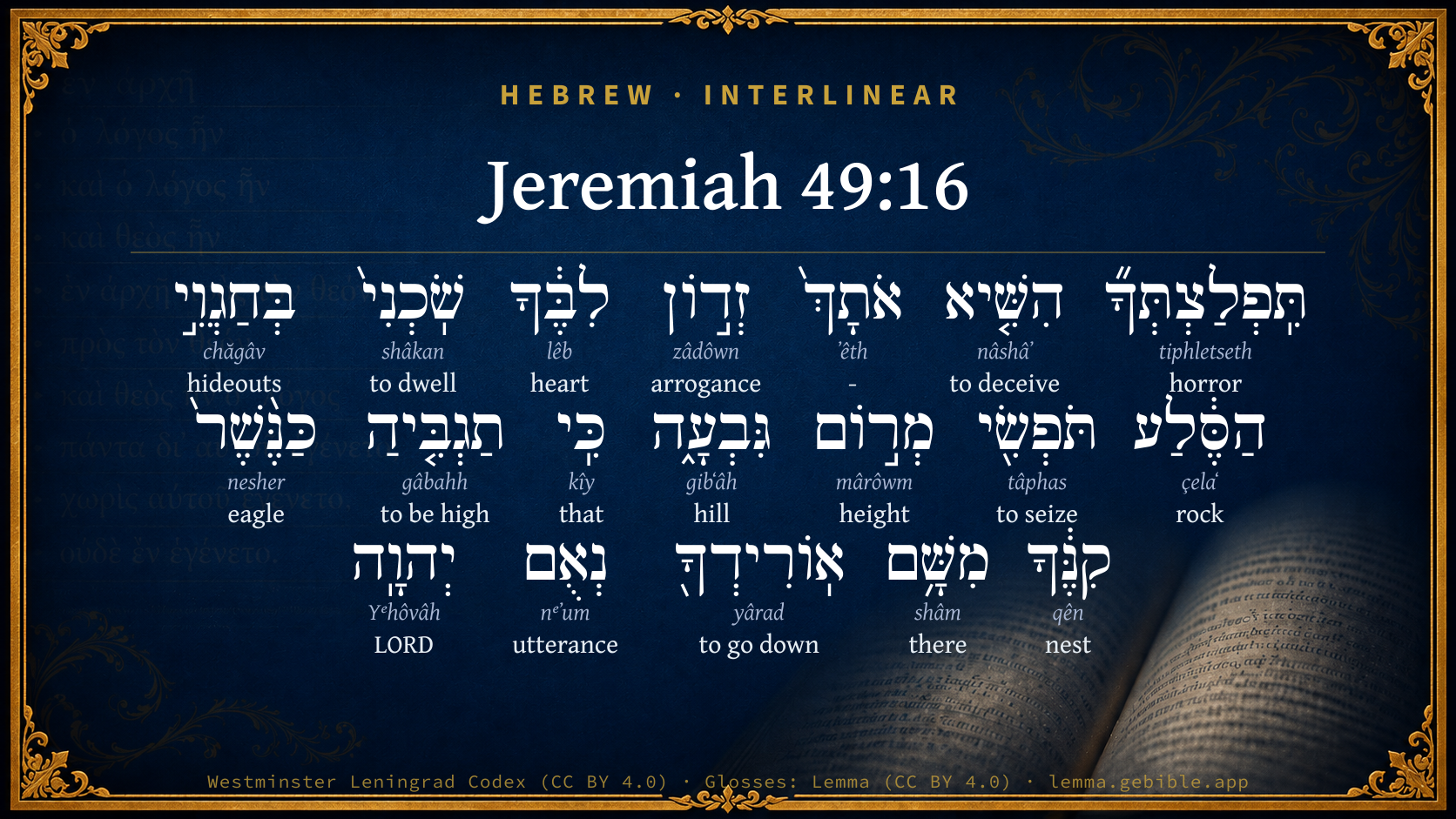
Jeremiah 49:16

Hebrew (Westminster Leningrad Codex) Jeremiah 49:16 appears in the Hebrew Old Testament. The text above is from the Westminster Leningrad Codex. Each word links to its Strong’s number, a concise gloss, and parsing drawn from the Open Scriptures Hebrew Bible morphology. Click any word for its full Brown-Driver-Briggs (BDB) entry.
Download image
Cite this verse

Jeremiah 49:16 (World English Bible). Public Domain. Lemma interlinear Bible study tool, https://lemma.gebible.app/v/jeremiah/49/16.

Show BibTeX & RIS
BibTeX
RIS
English Translation
As for your terror, the pride of your heart has deceived you, O you who dwell in the clefts of the rock, who hold the height of the hill: though you should make your nest as high as the eagle, I will bring you down from there, says Yahweh.
World English Bible · Public Domain
Highlights
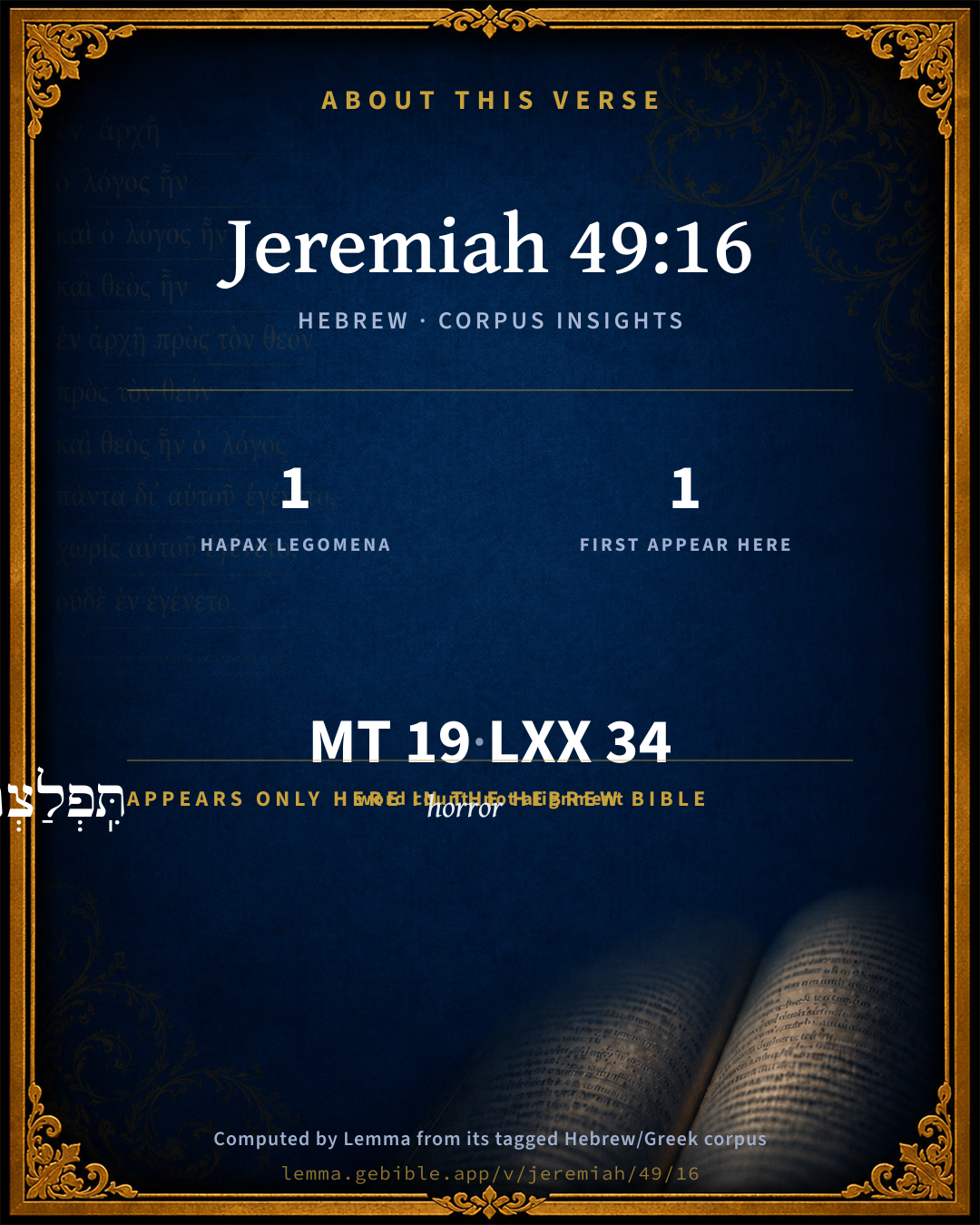
  • 1 hapax legomenon — only here in the Hebrew Bible
  • 1 first appearance in the Hebrew Bible
Full analysis ↓
Download a study sheet

One document with this verse’s original text, its word-by-word gloss line, the meaning frame, cross-references with their text, attributed commentary, and full source and license credits — printable, and it pastes into notes with its structure intact.

This verse Autodidact and up

Study sheet (.html) Plain text (.txt)

A passage Seminary Student

Up to 50 verses in one chapter. A passage sheet keeps up to 6 commentary sources and 12 cross-references per verse, in the order this page ranks them, and says so on the sheet whenever that leaves anything out. Ask for a single verse and you get the Autodidact verse sheet above.

Everything on this page stays free to read, with no account — the sheet is a download of what is already on screen, not access to it.

Want to remove ads? Support Godless Engineer
Compare translations 3

The same verse in 3 English versions, stacked beneath the original-language interlinear above. Click any original word for its lexicon entry.

Each is an independent rendering of the whole verse — the interlinear is not word-aligned to these translations.

Highlighted words mark where these versions differ — a whole-verse word diff, not a word-by-word alignment.

  • World English Bible Public Domain
    As for your terror, the pride of your heart has deceived you, O you who dwell in the clefts of the rock, who hold the height of the hill: though you should make your nest as high as the eagle, I will bring you down from there, says Yahweh.
  • King James Version Public Domain
    Thy terribleness hath deceived thee, and the pride of thine heart, O thou that dwellest in the clefts of the rock, that holdest the height of the hill: though thou shouldest make thy nest as high as the eagle, I will bring thee down from thence, saith the LORD.
  • unfoldingWord Literal Text CC BY-SA 4.0
    As for your fearsomeness, your heart’s pride has deceived you, inhabitants of places on the cliff, you who have occupied the highest hills so that you may make your nest high like an eagle. I will bring you down from there—this is Yahweh’s declaration.

unfoldingWord Literal Text — © unfoldingWord, licensed CC BY-SA 4.0. Word-aligned USFM3 via Door43 (git.door43.org/unfoldingWord/en_ult).

Versions to compare (up to 4)

3 of 4 selected

Show all 18 translations

Every available English version of this verse, each an independent rendering of the whole verse.

  • World English Bible Public Domain
    As for your terror, the pride of your heart has deceived you, O you who dwell in the clefts of the rock, who hold the height of the hill: though you should make your nest as high as the eagle, I will bring you down from there, says Yahweh.
  • Berean Standard Bible Public Domain
    The terror you cause and the pride of your heart have deceived you, O dwellers in the clefts of the rocks, O occupiers of the mountain summit. Though you elevate your nest like the eagle, even from there I will bring you down,” declares the LORD.
  • Majority Standard Bible Public Domain
    The terror you cause and the pride of your heart have deceived you, O dwellers in the clefts of the rocks, O occupiers of the mountain summit. Though you elevate your nest like the eagle, even from there I will bring you down,” declares the LORD.
  • King James Version Public Domain
    Thy terribleness hath deceived thee, and the pride of thine heart, O thou that dwellest in the clefts of the rock, that holdest the height of the hill: though thou shouldest make thy nest as high as the eagle, I will bring thee down from thence, saith the LORD.
  • American Standard Version (1901) Public Domain
    As for thy terribleness, the pride of thy heart hath deceived thee, O thou that dwellest in the clefts of the rock, that holdest the height of the hill: though thou shouldest make thy nest as high as the eagle, I will bring thee down from thence, saith Jehovah.
  • Revised Version (1885) Public Domain
    As for thy terribleness, the pride of thine heart hath deceived thee, O thou that dwellest in the clefts of the rock, that holdest the height of the hill: though thou shouldest make thy nest as high as the eagle, I will bring thee down from thence, saith the LORD;
  • Geneva Bible (1599) Public Domain
    Thy feare, and ye pride of thine heart hath deceiued thee, thou that dwellest in the cleftes of the rocke, and keepest the height of ye hil: though thou shouldest make thy nest as hie as the eagle, I wil bring thee downe from thece, sayth the Lord.
  • Douay-Rheims (1899) Public Domain
    Thy arrogancy hath deceived thee, and the pride of thy heart: O thou that dwellest in the clefts of the rock, and endeavourest to lay hold on the height of the hill: but though thou shouldst make thy nest as high as an eagle, I will bring thee down from thence, saith the Lord.
  • Young's Literal Translation Public Domain
    Thy terribleness hath lifted thee up, The pride of thy heart, O dweller in clefts of the rock, Holding the high place of the height, For thou makest high as an eagle thy nest, From thence I bring thee down, An affirmation of Jehovah.
  • Literal Standard Version CC BY-SA 4.0
    Your terribleness has lifted you up, || The pride of your heart, || O dweller in clefts of the rock, || Holding the high place of the height, || For you make your nest high as an eagle, || From there I bring you down, || A declaration of YHWH.
  • Unlocked Literal Bible CC BY-SA 4.0
    As for your fearsomeness, your heart's pride has deceived you, inhabitants of places on the cliff, you who have occupied the highest hills so that you may make your nest high like an eagle. I will bring you down from there—this is Yahweh's declaration.
  • unfoldingWord Literal Text CC BY-SA 4.0
    As for your fearsomeness, your heart’s pride has deceived you, inhabitants of places on the cliff, you who have occupied the highest hills so that you may make your nest high like an eagle. I will bring you down from there—this is Yahweh’s declaration.
  • Darby Bible Public Domain
    Thy terribleness, the pride of thy heart, hath deceived thee, thou that dwellest in the clefts of the rock, that holdest the height of the hill. Though thou shouldest make thy nest high as the eagle, I will bring thee down from thence, saith Jehovah.
  • World Messianic Bible Public Domain
    As for your terror, the pride of your heart has deceived you, O you who dwell in the clefts of the rock, who hold the height of the hill, though you should make your nest as high as the eagle, I will bring you down from there,” says the LORD.
  • Webster's Bible Public Domain
    Thy terribleness hath deceived thee, and the pride of thy heart, O thou that dwellest in the clefts of the rock, that holdest the hight of the hill: though thou shouldst make thy nest as high as the eagle, I will bring thee down from thence, saith the LORD.
  • Free Bible Version CC BY-SA 4.0
    The fear you once created in others, and your pride in yourselves, has fooled you into overconfidence, you people living on the rocky mountain tops. Though you make your homes high out of reach like an eagle's nest, I will tear you down, even from there, declares the Lord.
  • Bible in Basic English Public Domain
    ... the pride of your heart has been a false hope, O you who are living in the cracks of the rock, keeping your place on the top of the hill: even if you made your living-place as high as the eagle, I would make you come down, says the Lord.
  • JPS Tanakh (1917) Public Domain
    Thy terribleness hath deceived thee, even the pride of thy heart, O thou that dwellest in the clefts of the rock, that holdest the height of the hill; though thou shouldest make thy nest as high as the eagle, I will bring thee down from thence, saith the LORD.

Literal Standard Version (2020), Covenant Press — licensed CC BY-SA 4.0. Text via the HelloAO Bible API (eBible.org). Unlocked Literal Bible (unfoldingWord) — licensed CC BY-SA 4.0. Text via the HelloAO Bible API (eBible.org). unfoldingWord Literal Text — © unfoldingWord, licensed CC BY-SA 4.0. Word-aligned USFM3 via Door43 (git.door43.org/unfoldingWord/en_ult). Free Bible Version, Dr. Jonathan Gallagher — licensed CC BY-SA 4.0. Text via the HelloAO Bible API (eBible.org).

Word by word

More ways to search: Search by grammar → Find every occurrence → Compare this word →

Practice this passage: Drill this verse → Learn its vocabulary →

תִּֽפְלַצְתְּךָ֞
tiphletseth
H8606
“horror · your”
Noun, Common, Feminine, Singular, Construct + Suffix, Personal, 2nd Person, Masculine, Singular
Part of Speech
Noun
Type
Common
Gender
Feminine
Number
Singular
State
Construct
Full BDB Definition

Origin: from H6426

TWOT: 1778c

shuddering, horror
  1. הִשִּׁ֤יא nâshâʼ H5377 “to deceive” Verb, Hiphil, Perfect, 3rd Person, Masculine, Singular
  2. אֹתָךְ֙ ʼêth H853 “- · you” Particle, Direct Object + Suffix, Personal, 2nd Person, Feminine, Singular
  3. זְד֣וֹן zâdôwn H2087 “arrogance of” Noun, Common, Masculine, Singular, Construct
  4. לִבֶּ֔ךָ lêb H3820 “heart · your” Noun, Common, Masculine, Singular, Construct + Suffix, Personal, 2nd Person, Masculine, Singular
  5. שֹֽׁכְנִי֙ shâkan H7931 “dwelling” Verb, Qal, Participle Active, Masculine, Singular, Construct
  6. בְּחַגְוֵ֣י chăgâv H2288 “in/at · hideouts of” Preposition + Noun, Common, Masculine, Plural, Construct
  7. הַסֶּ֔לַע çelaʻ H5553 “the · rock” Particle, Definite Article + Noun, Common, Masculine, Singular, Absolute
  8. תֹּפְשִׂ֖י tâphas H8610 “seizing” Verb, Qal, Participle Active, Masculine, Singular, Construct
  9. מְר֣וֹם mârôwm H4791 “height of” Noun, Common, Masculine, Singular, Construct
  10. גִּבְעָ֑ה gibʻâh H1389 “hill” Noun, Common, Feminine, Singular, Absolute
  11. כִּֽי kîy H3588 “that” Conjunction
  12. תַגְבִּ֤יהַ gâbahh H1361 “to be high” Verb, Hiphil, Imperfect, 2nd Person, Masculine, Singular
  13. כַּנֶּ֨שֶׁר֙ nesher H5404 “like/as the · eagle” Preposition, Determined + Noun, Common, Masculine, Singular, Absolute
  14. קִנֶּ֔ךָ qên H7064 “nest · your” Noun, Common, Masculine, Singular, Construct + Suffix, Personal, 2nd Person, Masculine, Singular
  15. מִשָּׁ֥ם shâm H8033 “from · there” Preposition + Adverb
  16. אֽוֹרִידְךָ֖ yârad H3381 “to go down · you” Verb, Hiphil, Imperfect, 1st Person, Common, Singular + Suffix, Personal, 2nd Person, Masculine, Singular
  17. נְאֻם nᵉʼum H5002 “utterance of” Noun, Common, Masculine, Singular, Construct
  18. יְהוָֽה Yᵉhôvâh H3068 “LORD” Noun, Proper

About this verse

These counts appear in no published source. They are computed here, from the morphology-tagged text and Lemma’s own curated glosses. What Lemma adds →

19
words
19
distinct lemmas
Prophets
section

Notable vocabulary

1 hapax legomenon — a word that appears only here in the entire Hebrew Bible:

  • תִּֽפְלַצְתְּךָ֞ horror H8606

First appearance in Scripture

This word makes its first canonical appearance in the Hebrew Bible here:

  • תִּֽפְלַצְתְּךָ֞ horror H8606

Shared distinctive vocabulary

בְּחַגְוֵ֣י hideouts H2288 occurs in 3 verses of the Hebrew Bible. Also found in:

Grammatical profile

  • 5 verbs
  • 11 nouns
  • 1 conjunction
  • 1 adverb
  • 1 particle

Verb forms

  • הִשִּׁ֤יא Hiphil · Perfect
  • שֹֽׁכְנִי֙ Qal · Participle Active
  • תֹּפְשִׂ֖י Qal · Participle Active
  • תַגְבִּ֤יהַ Hiphil · Imperfect
  • אֽוֹרִידְךָ֖ Hiphil · Imperfect

Hebrew & Septuagint length

In the original languages it is 19 Hebrew tokens and 34 Greek tokens — but the two are counted differently (Hebrew bundles its prefixes and suffixes into one token; the Greek is in lemma form), so that isn’t a like-for-like length.

Cross-references

13

Topical passages linked to Jeremiah 49:16 in the Treasury of Scripture Knowledge — connected by theme and wording, ordered by reader-vote popularity; previews shown in the World English Bible.

  • Job 39:27 Is it at your command that the eagle mounts up, And makes his nest on high?
  • Isaiah 49:25 But thus says Yahweh, Even the captives of the mighty shall be taken away, and the prey of the terrible shall be delivered; for I will contend with him who contends with you, and I will save your children.
  • Amos 9:2 Though they dig into Sheol, there my hand will take them; and though they climb up to heaven, there I will bring them down.
  • Proverbs 16:18 Pride goes before destruction, And a haughty spirit before a fall.
  • Proverbs 29:23 A man's pride brings him low, But one of lowly spirit gains honor.
  • Isaiah 14:13–15 You said in your heart, I will ascend into heaven, I will exalt my throne above the stars of God; and I will sit on the mountain of congregation, in the uttermost parts of the north;
  • Obadiah 1:3–4 The pride of your heart has deceived you, you who dwell in the clefts of the rock, whose habitation is high, who says in his heart, 'Who will bring me down to the ground?'
  • Proverbs 18:21 Death and life are in the power of the tongue; Those who love it will eat its fruit.
  • Song of Solomon 2:14 My dove in the clefts of the rock, In the hiding places of the mountainside, Let me see your face. Let me hear your voice; For your voice is sweet, and your face is lovely.
  • Isaiah 2:21 To go into the caverns of the rocks, And into the clefts of the ragged rocks, From before the terror of Yahweh, And from the glory of his majesty, When he arises to shake the earth mightily.
  • Isaiah 25:4–5 For you have been a stronghold to the poor, a stronghold to the needy in his distress, a refuge from the storm, a shade from the heat, when the blast of the awesome ones is as a storm against the wall.
  • Ezekiel 28:11–19 Moreover the word of Yahweh came to me, saying,
  • Jeremiah 48:28–29 You inhabitants of Moab, leave the cities, and dwell in the rock; and be like the dove that makes her nest over the mouth of the abyss.

Cross-references courtesy of OpenBible.info (CC BY 4.0).

Hebrew and Greek witnesses Masoretic Hebrew ↔ Greek Septuagint

The same verse in the two great witnesses to the Old Testament, shown verse-for-verse.

These are two independent witnesses, not word-aligned to each other, and the Septuagint is shown in lemma (dictionary) form.

Hebrew Jeremiah 49:16 Masoretic · Westminster Leningrad Codex

תִּֽפְלַצְתְּךָ֞ הִשִּׁ֤יא אֹתָךְ֙ זְד֣וֹן לִבֶּ֔ךָ שֹֽׁכְנִי֙ בְּחַגְוֵ֣י הַסֶּ֔לַע תֹּפְשִׂ֖י מְר֣וֹם גִּבְעָ֑ה כִּֽי תַגְבִּ֤יהַ כַּנֶּ֨שֶׁר֙ קִנֶּ֔ךָ מִשָּׁ֥ם אֽוֹרִידְךָ֖ נְאֻם יְהוָֽה

As for your terror, the pride of your heart has deceived you, O you who dwell in the clefts of the rock, who hold the height of the hill: though you should make your nest as high as the eagle, I will bring you down from there, says Yahweh.

World English Bible · Public Domain

Greek LXX Structure differs

In the Septuagint, Jeremiah is about an eighth shorter than the Hebrew and arranges its material differently — the Oracles Against the Nations (Hebrew chapters 46–51) appear in the middle of the Greek book, after 25:13. Because the chapter and verse boundaries do not line up, a verse-for-verse comparison with the Hebrew is not shown.

A verse-for-verse comparison isn’t shown here because the chapters and verses don’t line up. Switch to the LXX edition with the MT / LXX toggle above to read the Greek directly.

Hebrew: Westminster Leningrad Codex (CC BY 4.0). Greek: Septuagint (public domain); English from a public-domain English Septuagint. How the Septuagint differs from the Hebrew →

Targum (Aramaic paraphrase)

1

The Targum is the ancient Jewish Aramaic paraphrase of the Hebrew Scriptures — an interpretive translation, not the Hebrew text itself. Onkelos (literal) and Pseudo-Jonathan (expansive) render the Torah, and Jonathan the Prophets. Coverage is partial: where no permissively-licensed English translation exists for a verse, only the Aramaic is shown. This is verse-level text, not a word-by-word alignment to the Hebrew.

  1. Targum Jonathan Prophets (Joshua–Malachi)
    טִפְּשׁוּתָךְ אַטְעִיאַת יָתָךְ רְשַׁע לִבָךְ דְאַתְּ דָמֵי לְנִשְׁרָא דְיִשְׁרֵי בְּשִׁינֵי כֵיפָא מוֹתְבֵיהּ בִּתְקוֹף רוּמָא אֲרֵי תָרֵים כְּנִשְׁרָא מְדוֹרָךְ מִתַּמָן בְּמֵימְרִי אַחֲתִינָךְ אֲמַר יְיָ:

    (no public-domain English translation for this verse)

    Targum Jonathan — Aramaic: “Mikraot Gedolot” (public domain). English: “Sefaria Community Translation” (CC0 1.0 (public-domain dedication)); “London "Chaldee Paraphrase," 1871” (public domain). Text via Sefaria.

Commentary

Notes on Jeremiah 49:16 from classic Christian and Jewish commentators (each source and its license shown beneath its notes). The classic Christian expositions comment on the surrounding passage and are grouped to its opening verse, so a note may address several verses; the Jewish commentaries on the Tanakh (Rashi and others) are per-verse, so they appear only where the commentator wrote on this verse.

Lemma curates 59 commentaries, every one of them public domain or Creative Commons licensed, each selected and text-cleaned for this edition rather than reprinted as found. About our sources →

Trapp's Complete Commentary

John Trapp

Jer 49:16 Thy terribleness hath deceived thee, [and] the pride of thine heart, O thou that dwellest in the clefts of the rock, that holdest the height of the hill: though thou shouldest make thy nest as high as the eagle, I will bring thee down from thence, saith the LORD.

Ver. 16. Thy terribleness,] i.e., Thine insolence and cruelty wherewith thou frighten folk. Or thine idol, that terrible business, so called in contempt.

Though thou shouldest make thy nest.] See Oba 1:4.

John Trapp, A Commentary or Exposition upon All the Books of the Old and New Testament (1647–1656) — public domain. Text from a community e-Sword module.

The Biblical Illustrator

Joseph S. Exell

Jer_49:16

Thy terribleness hath deceived thee, and the pride of thine heart

On the deceitfulness of the heart, in the abuse of prosperity

The words afford us the following doctrine, That worldly prosperity is often abused by the heart, as the occasion of self-deceit; or, that the heart often discovers its deceit in the abuse of prosperity.

All that is intended here is to illustrate the actions of this corrupt principle in abusing prosperity.

1. By ingratitude.

(1) Sinners receive all Gods mercies with an unthankful heart. They sit down to their table and rise from it, they eat and drink like the brutes that perish; without considering, that whether they eat or drink, or whatsoever they do, they should do all to the glory of God. Many are the spiritual mercies which the unregenerate receive from God. He gives them His Word and ordinances, wherein the Bread of Life is exhibited. He warns them by His servants. He strives with them by His Spirit. They reject and despise the heavenly manna. Their souls loathe this light food.

(2) Ingratitude is a sin eminently chargeable even against the children of God. When they are anxious for any mercy, they resolve, and perhaps solemnly vow, that if God will be pleased to bestow it, they will ever retain a grateful sense of His kindness. He condescends to grant their request. But often they remember not the multitude of His mercies, but provoke Him, like His ancient people, at the sea, even at the Red Sea. This conduct towards our gracious Benefactor is productive of bitter consequences. Our ingratitude for mercies received often provokes Him to deny us others which He would otherwise bestow, sometimes to recall those already given, and frequently, to blast them in the enjoyment.

2. By disposing us to make a God of our mercies. The deceitfulness of the heart, so violent is its opposition to the living God, works by contraries, and often by extremes. If it do not tempt us to despise His mercies altogether, it will excite us to put them out of their proper place. By either of these methods, although directly opposite, it gains its wicked purpose, in making us forget the God of our mercy. He will suffer no rival in thy heart, O Christian, for it all belongs to Him; and when thy love to worldly comforts ceases to be secondary and subordinate, it is an encroachment on His prerogative. Therefore must the usurper of the throne of God be cast down, that in all things He may have the pre-eminence. When precious comforts are thus converted into severe crosses, how great is the trial! There is a double bitterness attending it; not only that of the distress presently felt, but the painful recollection of the happiness formerly enjoyed.

3. By consuming Divine mercies on lust. The wicked ask that they may consume it on their lusts. They neither desire mercies, nor improve those which are bestowed, for the glory of God; but only as making provision for their inordinate or unlawful affections.

4. By ascribing their prosperity to some other cause than God. Even the Lords people, from the prevalence of deceit, are in great danger of ascribing their mercies to some other cause than God, or to something besides Him. They will not wholly deny the praise to the God of their salvation; but they do not ascribe it entirely to Him. When they receive signal mercies from Him, they are apt to imagine that these are in some degree deserved by their holiness and integrity of conversation; that He could not justly deny them such tokens of His favour, when they are so faithful and diligent in His service.

5. By denying God the use of those mercies which He hath Himself bestowed. When, in the course of His providence, He confers on one a greater portion of common blessings than on another; it is for this end, that he may use them for His glory, and in the manner of laying them out, return them to the Lord. No talent is to be laid up in a napkin. According to the measure of temporal benefits received from God, we are stewards for Him.

6. By unsatisfied desires and immoderate longings for a greater degree of temporal prosperity. When the heart hath tasted of mercies of this nature, it is not satisfied; it craves more. If its desires be fulfilled, instead of being content with these, it flatters itself, that if such another mercy were bestowed, it would ask nothing further. But this only argues its deceit; for even though this be granted, it is still as importunate as ever. The more it receives, its desires are enlivened and enlarged the more.

7. By hardening itself under prosperity. No mercy whatsoever can leave us as it finds us. It must either prove a blessing or a curse. It will either have a mollifying, or a hardening influence on our hearts. (J. Jamieson, M. A.)

Deceitfulness of pride

How nimbly does that little lark mount up, singing towards heaven in a right line, whereas the hawk, which is stronger of body and swifter of wing, towers up by many gradual compasses to its highest pitch. That bulk of body and length of wing hinder a direct ascent, and require the help both of air and scope to advance his flight; while the small bird cuts the air without resistance, and needs no outward furtherance of her motion. It is no otherwise with the souls of men. Some are hindered by those powers which would seem helps to their soaring: great wit, deep judgment, quick apprehension, send about men, with no small labour, for the recovery of their own incumbrance, while the good affections of plain and simple souls raise them up immediately to the fruition of God. Why should we be proud of that which may slacken our way to glory? (Bishop Hall.)

The Biblical Illustrator, edited by Joseph S. Exell (c. 1880s–1900s) — public domain. Text from a community e-Sword module.

Geneva Bible (1599)

Geneva Bible translators

Or, idol.

Geneva Bible (1599) marginal notes — public domain. Text via Bolls.life.

Jamieson, Fausset & Brown

Robert Jamieson, A. R. Fausset & David Brown

terribleness--the terror which thou didst inspire into others.

deceived thee--rendered thee proudly confident, as if none would dare to assail thee.

dwellest in . . . rock--Petra, the chief of Idumea, was cut in the rocks; its ruins are very remarkable. The whole south of Idumea abounds in cave dwellings and rocks.

though . . . nest . . . eagle-- (Job 39:27; Oba 1:3-4). The eagle builds its nest in the highest craggy eyry.

Jamieson, Fausset & Brown — Commentary Critical and Explanatory on the Whole Bible (1871) — public domain (CC PDM 1.0). Text via the HelloAO Bible API.

Adam Clarke's Commentary

Verse 16. O thou that dwellest] All Idumea is full of mountains and rocks, and these rocks and mountains full of caves, where, in time of great heats, and in time of war, the people take shelter.

Adam Clarke's Commentary on the Bible (1810–1826) — public domain. Text from a community e-Sword/MySword module.

John Calvin's Commentaries

Some render the first words thus, “Thine idol hath deceived thee;” and others, “Thy folly hath deceived thee.” The verb has, indeed, this meaning, though there is a different reading, for some put a point over the right side of the letter, and others on the left. But the most suitable meaning is thus conveyed, Deceived thee has thy terror, the pride of thy heart Those who render the first word “idol,” consider that superstition is referred to, that the false confidence which the Edomites placed in their idols had deceived them. But this seems to be a forced explanation. Why others have rendered the word “folly,” I know not. The word properly means terror. The verb פלף, pelets, means to terrify, and from this the noun is derived. And when the word is taken for an idol, it is so metaphorically, because idols terrify men, or because a terrible end awaits their worshippers. But I retain the proper meaning of the word. At the same time terror here is to be taken actively, because the Idumeans were a terror to other nations, and were thus blinded with pride on account of their conceit as to their power.

And the following words are explanatory, the pride of thy heart; for they who despise others fill themselves with empty pride, and thus elevate their own hearts. As then the Idumeans had gained for themselves the repute of being a warlike people, the terror entertained for them inflated their own hearts with pride: but the Prophet says, that they were deceived, as they arrogated to themselves too much power. At the same time he continues the subject which I have stated, as though he had said, “How comes it, that as God has designed thee to be contemptible, thou takest to thyself such authority among the nations? Thou fightest against nature, for thou hast hitherto in vain terrified thy neighbors: hence it is, that thou art swollen with pride; but it is a mere delusion; thou art greatly mistaken, and deceivest thyself in thus thinking of thy strength, since thy condition ought, on the contrary, to make thee humble.” We now see how well the whole passage runs, and how aptly the words agree together. He then says that it was a foolish confidence, by which the people of Edom, whom God had made contemptible, were deceived.

He now adds, by way of concession, Thou who dwellest in the fissures of rocks, and occupiest the heights of mountains In these words the Prophet concedes something to the Idumeans; but he afterwards adds, that the fortresses, by which they thought themselves to be protected, would come to nothing; though thou raisest high thy nest as the eagle, thence will I, says God, draw thee down We hence see that the Prophet concedes to the Idumeans some reason for boasting on account of their mountains, because they presented on every side a defense against enemies; and yet he shews that all this would be useless to them; for he says, though thou raisest high thy nest as the eagle, that is, though thou ascendest, as they commonly say, above the very clouds, thence will I draw thee down

Now this passage teaches us first, that all who trust in their own earthly defences deceive themselves; and, secondly, that all who arrogate to themselves more than what is just and right, contend, as it were, against God, and that it cannot, therefore, be otherwise but that God will lay them prostrate. We are then taught by this doctrine to cultivate humility. Humility has its roots fixed deeply within; so that the state of those who willingly submit themselves, becomes firm and permanent; for the root, which appears not on the surface, sustains the tree. So also that humility, which is not known by men, is our real and solid prop and support. Whosoever takes the wing and flies, and seeks, through his own presumption, to raise up himself, provokes God as it were designedly: and here the Prophet shews what end awaits all those who thus raise themselves on high, seeking to set their nest on a summit like the eagle; for God will draw them down and lay them prostrate, as he did to the Idumeans. It now follows —

John Calvin's Commentaries (1540-1563) — public domain. Text from the Calvin Translation Society English edition (1840s-50s) via the Christian Classics Ethereal Library (ccel.org). Calvin's coverage is partial (roughly two-thirds of the Bible); uncommented books and verses are honest gaps, never fabricated. The 19th-century editor's footnotes and remarks are omitted so the notes are faithfully Calvin's own voice.

Ellicott's Commentary for English Readers

(16) Thy terribleness hath deceived thee.—The substantive does not occur elsewhere. Etymo-logically it may mean “terror of,” or “object of terror;” but a cognate word is found in 1Ki_15:13; 2Ch_15:16 in the sense of an “idol,” probably of the Phallic or Priapus type, and that is probably the meaning. Such an idol is called scornfully the horror of Edom, just as the God of Israel was “the fear of Isaac” (Gen_31:42). So Milton speaks of Chemosh as the “obscene dread of Moab’s sons” (Par. Lost, I. 406.)

O thou that dwellest in the clefts of the rock.—Better, perhaps, in the fortresses of Sela. The words describe with a wonderful vividness the aspect of the rock-fortresses of Edom, the cities built into a ravine. The remains of Petra (the Sela of 2Ki_14:7; Isa_16:1), commonly referred to as illustrating this description, are, it must be remembered, of Roman origin; but there can be little doubt that it occupied the site of an earlier city, and that there were other fortresses, even more like the eagle’s nest, perched upon the summit of the crags. In Job_39:27-30 we have a picture of the eagle’s nest drawn by a writer who was probably familiar with these rock fortresses.

A Bible Commentary for English Readers, edited by Charles John Ellicott (1878–1897) — public domain. Text from a community e-Sword module.

The Cambridge Bible for Schools and Colleges

gen. ed. J. J. S. Perowne

16. As for thy terribleness] The text is probably corrupt, but no certain emendation has been suggested. If it stands, we must take the sense to be O thy trembling, i.e. either (a) how wilt thou tremble at the greatness of thy fall! or (b) how will the lookers on tremble at the horror of this sight! The Hebrew noun is absent from Ob. and is not found elsewhere.

the rock] mg. Sela. See 2Ki_14:7. Sela was perhaps identical with Petra, which “lay in an amphitheatre of mountains, accessible only through the narrow gorge, called the Sik, winding in with precipitous sides from the W.; and the mountain sides round Petra, and the ravines about it, contain innumerable rock-hewn cavities, some being tombs, but others dwellings, in which the ancient inhabitants lived.” Dr. See also G. A. Smith, The Book of the Twelve Prophets, II. 179. Petra was fifty miles S. of the Dead Sea.

the eagle] See on Jer_4:13.

The Cambridge Bible for Schools and Colleges (gen. ed. J. J. S. Perowne; Cambridge University Press, 1878–1918) — public domain. Text from a community e-Sword module.

John Gill's Exposition

Thy terribleness hath deceived thee, and the pride of thine heart,.... Some render it, "thine idol" (o); see Kg1 15:13; which, being terrible to them, they thought it might be so to others, and protect them. In the place referred to the word "miphlezeth" is used, and comes from the same root with this, which signifies to be terrible and formidable, and cause to tremble, as the idols of the Gentiles were to their worshippers, and others. The Vulgate Latin version of the above place interprets it of Priapus, which was an idol set up in gardens to frighten birds and thieves from coming thither (p). So Kimchi observes, that some interpret it here of idolatrous worship or superstition; but it is to be understood either of the roughness and terribleness of their country, abounding with rocks and mountains, which made it inaccessible; or rather of that terror which they struck into their neighbouring nations, by their wealth and riches, their power and strength, their courage and valour, and skill in military affairs; and having such strong cities, fortresses, and fastnesses, natural and artificial, of which they were proud; and, on account of all which, fancied that none would dare to invade them; or, if they did, their attempts would be fruitless; and this deceived them, making them careless and secure:

O thou that dwellest in the clefts of the rock; the land of Idumea being very hilly and rocky. Jerom (q) says, who lived near it, that all the southern part of Idumea, from Eleutheropolis to Petra and Hailah, had their habitations in caves cut out of rocks:

that holdest the height of the hill; that dwelt on the tops of hills and mountains, and in towers and fortified places built upon them, as Kimchi and Ben Melech; who think respect is had particularly to Mount Seir. The Targum is,

"for thou art like to an eagle that dwells in the clefts of the rock, whose high habitation is inn strong place;''

hence it follows:

though thou shouldest make thy nest as high as the eagle, I will bring thee down from thence, saith the Lord; signifying, though they might think themselves as safe and as much out of the reach of men as an eagle's nest, and were as high and as secure in their own imaginations; yet they should be come at by their enemies, be fetched out of their strong holds, and reduced to the lowest and most miserable state and condition; of which they might be assured, since the Lord had spoken it, who would do it by the hand of the Chaldeans. The allusion to the eagle is very pertinent to illustrate the self-exaltation and self-security of the Edomites; the eagle being a bird that flies higher than any other, as Kimchi on the place observes, even up to the clouds, and out of sight; hence Homer (r) calls it the high flying eagle; and which builds its nest in high places, in the tops of rocks; so Aristotle (s) says, they make their nests, not in plains, but in high places, especially in cragged rocks; and Pliny (t) relates that they build their nests in rocks; and he also says (u) of the vultures, who seem to be meant by the eagles in Mat 24:28; that they build their nests in the highest rocks, and which no man can reach.

(o) "simulacrum tuum", Pagninus, Vatablus; "idolum", Grotius. So R. Sol. Urbin Ohel Moed, fol. 12. 1. (p) "--------Deus, inde ego furum, aviumque Maxima formido." Horat. Sermon. l. 1. Satyr. 8. ver. 3, 4. "Et custos furum atque avium cum falce saligna Hellespontiaci servet tutela Priapi". Virgil. Georgic. l. 4. ver. 110, 111. (q) Comment. in Obad. fol. 52. C. (r) Iliad. 22. v. 308. (s) De Hist. Animal. l. 9. c. 32. (t) Nat. Hist. l. 10. c. 3. (u) Ibid. c. 6.

John Gill's Exposition of the Whole Bible (1746–1763) — public domain (CC PDM 1.0). Text via the HelloAO Bible API.

Haydock's Catholic Bible Commentary

Hill. The mountains were numerous, and full of caverns, ver. 8.

George Leo Haydock (1774–1849), Haydock's Catholic Family Bible and Commentary, 1859 edition — public domain. Excludes Psalms (Douay-Rheims chapter numbering differs from Protestant) and Deuterocanonical books (Catholic canon only).

Matthew Poole's English Annotations

Thy terribleness hath deceived thee, and the pride of thine heart: Obadiah in his prophecy against Edom useth much the same expressions, Oba 1:3,4. The word that is here used being of the number of those which are but once found in Scripture, hath given interpreters liberty to abound in their senses of it; some translating it arrogance, some, thine idol; but the best interpreters understand by it their terribleness to others, their being so potent that others were all afraid of them; this deceived them, making them to conclude themselves secure, and out of danger; to which is also added the pride of the heart. The country of Edom being mountainous, they are said to

dwell in the clefts of the rocks, that is, in places impregnable, and inaccessible as they thought, in the heights of the hill. But the Lord lets them know no place was to his power inaccessible or impregnable, for if they dwell as

high as the eagle, which the Scripture tells us, Job 39:27,28, maketh her nest on high, and dwelleth and abideth upon the rock, upon the crag of the rock, yet he would bring them down.

Matthew Poole's English Annotations on the Holy Bible (1683–1685) — public domain. Text from a community e-Sword/MySword module.

Whedon's Commentary on the Bible

Daniel D. Whedon

16. Thy terribleness — The terror which thou dost inspire. The original word is used nowhere else, and has been variously translated, but this sense stands most fully commended. Dwellest in the clefts of the rock…

holdest the height of the hill… nest as high as the eagle. These very characteristic and intelligible descriptions apply not only to Bozrah, but especially to Petra, which was literally cut in the rocks.

Daniel D. Whedon (gen. ed.), Commentary on the Old and New Testaments (1874–1909) — public domain. Text from a community e-Sword module.

The Pulpit Commentary

Thy terribleness. This is certainly the best rendering of this apax legomenon . The "terribleness" of Edom consisted in the fact that the other nations shrank from disturbing her in her rocky fastness. In the clefts of the rock. Probably with an allusion to the rock city Sela, or Petra ("rock"); as perhaps in "the height of the hill" to the situation of Bozrah; see on ver. 13 (Graf). As the eagle. Not any eagle is meant, but the griffon ( Gypsfulvus), or great vulture (Tristram).

A people deceived by its own terribleness.

I THEY WHO ARE A TERROR TO ALL HUMAN FOES MUST ULTIMATELY TREMBLE BEFORE SPIRITUAL FOES. Edom was to fall before Babylon, in spite of her terrible aspect. Much more must the fierce, proud sinner succumb to the unseen angel of Divine judgment. The rocks that keep back an army cannot retard the onrush of the heavenly host.

II THEY WHO NOW STAND HIGHEST IN PRIDE AND POWER WILL FALL LOWEST AT THE FINAL JUDGMENT. Rank, social position, honour, influence, will then count for nothing. Pride may have sat high as the eagle in its eyrie, but "every one that exalteth himself shall be abased;" "The first shall be last.

III THEY WHO POSSESS EARTHLY GREATNESS ARE IN DANGER OF DELUDING THEMSELVES WITH AN UNWARRANTABLE TRUST IN IT. Such cities as the rock-hewn Petra, and Bozrah seated on her lofty hill, would seem by natural position impregnable. Consequently their inhabitants would grow insolent and proud, and thus deserve the more that fate which their natural resources could not avert, and their self-confidence would prevent them from mitigating. Worldly resources are dangers when they lead us to forsake the true Refuge in order to trust in them. The rich and great are not the more secure for their privileges, and they will be the less safe if they lean upon them when without them they would seek help in God.

Vain confidences.

"Thy terribleness hath deceived thee," etc. Taking the different expressions in this verse, we can see how such confidences are begotten in men"s minds.

I THEIR FELLOW MEN HELP TO DECEIVE THEM. "Thy terribleness," etc. All around them held them in.terror, were afraid of them, deemed them too mighty to be overcome. And the consciousness of this kept in them a confidence which now was to be shown to be but vain.

II MEN"S OWN PRIDE. "The pride of thine heart." What myriads has not pride slain! what woe hath it not brought upon mankind! "Pride goeth before destruction," etc. (Cf. homily on Pride, Jer_48:29) See Sennacherib"s army, (Isa 37) Pharaoh"s overthrow; (Ex 14) and "all the ages all along" pride has done the like and does so still.

III MEN"S CIRCUMSTANCES. No dwellings could seem more secure than were theirs; their fortress seemed impregnable. Hence they said in their hearts, We shall never be moved." (Cf. on these dwellings, introduction to homily on Desirable habitations, supra, ver. 8) Cf. the rich fool. (Luk_12:20) Prosperity and security do tend to beget these vain confidences.

IV PAST SUCCESS. Not only did these Edomites dwell in the clefts of the rock, but they had held them fast hitherto against all invaders. A career of success, opponents vanquished, difficulties surmounted, wealth and honour won; who can persuade such a man to call himself a poor, lost sinner, dependent utterly on the mercy of God? It is much easier to say, "Have mercy on us miserable sinners," than to foal and believe we are so.

CONCLUSION. There are two ways in which this spirit of false confidence may be got rid of or kept under.

1. By surrender of the soul to Christ. He makes us like himself, forms his Spirit in us, so that the truer the surrender the more we become "meek and lowly in heart" as he was. This the best way, the easy yoke, the light burden.

2. By the crushing force of God"s judgments. Edom was to be humbled thus. And there are many who will only be humbled so. They will have their own way, and they have it for their woe, and then, after a weary while, they come to themselves. They "made their bed in hell," and as they made it so they had to lie upon it, until even there God"s band shall find them, and they shall humble themselves beneath the mighty hand they had heretofore dared to defy.

3. And in some way this humility must be wrought in us. For God will have all men to be saved; but without this lowly mind, this rejection of all vain confidences, we cannot be. Which way, then, shall it be through Christ or through the fire of hell? C.

The pride of apparent security.

I THE REAL EXTENT OF THE SECURITY. Not without some cause did Edom pride itself on its position. Security is a relative word. Mountain fastnesses are a sufficient defence against such attacks as Edom can measure and understand. Mountain fastnesses have done much for the cause of national liberty and independence. They ought not to be the shelter and home of brigands; but it is right to notice their glorious place in history as the shelter and home of struggling freemen. God would not have us undervalue any security so far as it is a real security. The mistake is when we live as if all precious things could be preserved by securities which Providence has only given for the preservation of certain outward things. So far from our overvaluing securities coming from our own strength and external resources, it may truly be said that we rather undervalue them. If we could only use them in the right way, with insight and without prejudice, we should find many dangers of the present life greatly diminished.

II THE WAY IN WHICH A SECURITY MAY BECOME A PERIL. Edom lives as it likes among its great natural strongholds. Long experience has taught it exactly how to deal with every attacking force, and it sees no danger with which it cannot effectually deal. Thus the dangers and deliverances which come out of the unseen alike escape attention. Men are protected outwardly; they have all that heart can wish; but meanwhile the heart is left exposed to every temptation. The fewer dangers there are outwardly, the more dangers there are inwardly; and the more dangers there are outwardly, the fewer there may be inwardly. For when men live amid dangers and inconveniences to the outward life, then their eyes are open to the comparative superficiality of such dangers. They see how the deepest treasures of life, the most abiding ones, may remain perfectly safe while outward things are going to pieces. Better would it have been for Edom to live in the exposed plain, if thereby it had been brought to trust and know that God who is the only true Refuge.

III THE FALLACY OF SEEKING SECURITY IN A HIGHER DEGREE OF THE ESSENTIALLY INSECURE. The eagle dwells in inaccessible heights, and thus it may be reckoned a symbol of the greatest security attainable here below. But after all, the word "inaccessible" is only a synonym for what is exceedingly difficult of attainment. Courage, patience, and perseverance may do much to blot out the word "inaccessible." And if this be so from the human point of view, how much plainer is it that all human securities, however high the degree they attain in our estimate, are in the sight of God as nothing! The great thing that sends us wrong in trying to make life really secure is that, instead of fixing our thoughts on an entirely different kind of danger, we allow ourselves to act as if the only thing needful was to guard against a higher degree of the danger already perceived. To God dealing with the ungodly and. the unrighteous, mountain and plain are alike. Y.

The Pulpit Commentary (1880–1919), ed. H.D.M. Spence-Jones & Joseph S. Exell — public domain. Text from a community e-Sword module.

unfoldingWord translationNotes

Door43 World Missions Community

General Information:

Yahweh continues speaking about what will happen to Edom.

As for your fearsomeness

Here the abstract noun "fearsomeness" can be translated with either an adjective or a verb. AT: "As for how terrifying you think you are" or "Although you think you scare other people" (See: Abstract Nouns)

your heart's pride has deceived you

Here "heart" represents the whole person. People deceiving themselves is spoken of as if their pride deceived them. AT: "you have become prideful, but you have deceived yourselves" (See: Metonymy and Metaphor)

so that you may make your nest high like an eagle

It is implied that the people made homes in high places to remain safe from enemies. AT: "live in safety like an eagle in the heights of the mountains" (See: Assumed Knowledge and Implicit Information and Simile)

eagle

This is a very large, powerful bird of prey. See how you translated this in Jeremiah 4:13.

this is Yahweh's declaration

Yahweh speaks of himself by name to express the certainty of what he is declaring. See how you translated this in Jeremiah 1:8. AT: "this is what Yahweh has declared" or "this is what I, Yahweh, have declared" (See: First, Second, or Third Person)

translationWords

heart

proud

deceive

unfoldingWord translationNotes — © Distant Shores Media and the Door43 World Missions Community, licensed CC BY-SA 4.0. Source: git.door43.org/Door43/en_tn.

Rashi

Rabbi Shlomo Yitzchaki (Rashi)

Your hastiness Heb. תפלצתך, an expression of haste, for you hurried and were hasty to arouse your hatred for your brother. And there are some who translate this as an expression of fright (פַּלָצוּת), and there are some who translate it as an expression of an image (מפלצת).

has enticed you to harm them.

you who dwell Heb. שכני, like שׁוֹכֵן.

who hold תפשי, like תּופֵשׂ, and the ‘yud’ is superfluous in it.

Rashi on the Tanakh — English translations: “The Judaica Press complete Tanach with Rashi, translated by A. J. Rosenberg” (CC BY 4.0); “Pentateuch with Rashi's commentary by M. Rosenbaum and A.M. Silbermann, 1929-1934” (public domain); “The Metsudah Tanach series, Lakewood, N.J” (CC BY 4.0); and “The Book of Joshua, Metsudah Publications, 1997” (CC BY 4.0). Text via Sefaria.

Lesson kit

Teaching starters — assembled from the data on this page, not authored interpretation. Every prompt links to the verse data it draws on. Edit before teaching.

Jeremiah, in the Prophets, opens this verse with 19 words (19 distinct Hebrew lemmas). Its most distinctive word is tiphletseth (“horror”). A historical commentator’s framing appears above. Read the whole chapter for the surrounding context.

Discussion questions

  1. The word tiphletseth carries the sense “horror.” How does it shape the verse?
  2. 1 word here appears nowhere else in the Hebrew Bible. Why might the author reach for such rare wording?
  3. This is the first place “horror” appears in Scripture (first appears here). What does its debut here establish?
  4. How does Song of Solomon 2:14, which shares the word «hideouts», read alongside this verse?
  5. The translations on this page render this verse differently — a whole-verse word diff, not a word-by-word alignment. What might account for the different wordings?
  6. «הִשִּׁ֤יא» is a Hiphil Perfect verb. How does that grammatical form shape the action described?
  7. Compare how Trapp's Complete Commentary and The Biblical Illustrator read this verse. Where do they agree or differ?

Things to notice

Reading settings

Reading text

Shown beneath each verse's original-language words.

Old Testament
Old Testament edition

Read the OT as the Masoretic Hebrew (MT) or the Greek Septuagint (LXX).

English shown for the Greek Septuagint (in the Hebrew ↔ Greek comparison).

Comparing translations? Open the Compare panel on any verse page to stack up to four side by side.