Judges 19:14

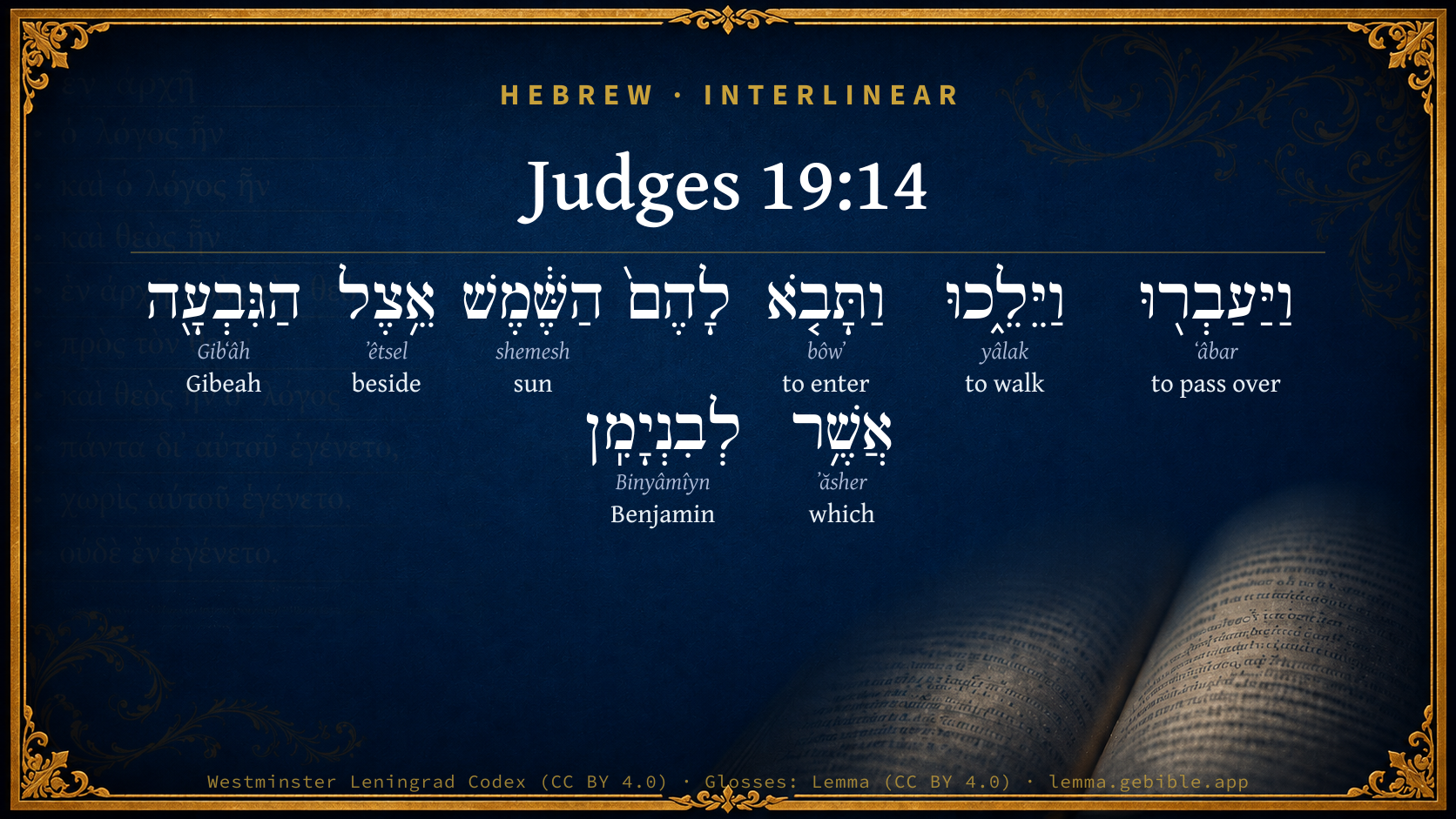
Hebrew (Westminster Leningrad Codex) Judges 19:14 appears in the Hebrew Old Testament. The text above is from the Westminster Leningrad Codex. Each word links to its Strong’s number, a concise gloss, and parsing drawn from the Open Scriptures Hebrew Bible morphology. Click any word for its full Brown-Driver-Briggs (BDB) entry.
Download image
Cite this verse

Judges 19:14 (World English Bible). Public Domain. Lemma interlinear Bible study tool, https://lemma.gebible.app/v/judges/19/14.

Show BibTeX & RIS
BibTeX
RIS
English Translation
So they passed on and went their way; and the sun went down on them near to Gibeah, which belongs to Benjamin.
World English Bible · Public Domain
Download a study sheet

One document with this verse’s original text, its word-by-word gloss line, the meaning frame, cross-references with their text, attributed commentary, and full source and license credits — printable, and it pastes into notes with its structure intact.

This verse Autodidact and up

Study sheet (.html) Plain text (.txt)

A passage Seminary Student

Up to 50 verses in one chapter. A passage sheet keeps up to 6 commentary sources and 12 cross-references per verse, in the order this page ranks them, and says so on the sheet whenever that leaves anything out. Ask for a single verse and you get the Autodidact verse sheet above.

Everything on this page stays free to read, with no account — the sheet is a download of what is already on screen, not access to it.

Want to remove ads? Support Godless Engineer
Compare translations 3

The same verse in 3 English versions, stacked beneath the original-language interlinear above. Click any original word for its lexicon entry.

Each is an independent rendering of the whole verse — the interlinear is not word-aligned to these translations.

Highlighted words mark where these versions differ — a whole-verse word diff, not a word-by-word alignment.

  • World English Bible Public Domain
    So they passed on and went their way; and the sun went down on them near to Gibeah, which belongs to Benjamin.
  • King James Version Public Domain
    And they passed on and went their way; and the sun went down upon them when they were by Gibeah, which belongeth to Benjamin.
  • unfoldingWord Literal Text CC BY-SA 4.0
    So they crossed over and they went. And the sun went down on them near Gibeah, which to Benjamin.

unfoldingWord Literal Text — © unfoldingWord, licensed CC BY-SA 4.0. Word-aligned USFM3 via Door43 (git.door43.org/unfoldingWord/en_ult).

Versions to compare (up to 4)

3 of 4 selected

Show all 18 translations

Every available English version of this verse, each an independent rendering of the whole verse.

  • World English Bible Public Domain
    So they passed on and went their way; and the sun went down on them near to Gibeah, which belongs to Benjamin.
  • Berean Standard Bible Public Domain
    So they continued on their journey, and the sun set as they neared Gibeah in Benjamin.
  • Majority Standard Bible Public Domain
    So they continued on their journey, and the sun set as they neared Gibeah in Benjamin.
  • King James Version Public Domain
    And they passed on and went their way; and the sun went down upon them when they were by Gibeah, which belongeth to Benjamin.
  • American Standard Version (1901) Public Domain
    So they passed on and went their way; and the sun went down upon them near to Gibeah, which belongeth to Benjamin.
  • Revised Version (1885) Public Domain
    So they passed on and went their way; and the sun went down upon them near to Gibeah, which belongeth to Benjamin.
  • Geneva Bible (1599) Public Domain
    So they went forward vpon their way, and the sunne went downe vpon them neere to Gibeah, which is in Beniamin.
  • Douay-Rheims (1899) Public Domain
    So they passed by Jebus, and went on their journey, and the sun went down upon them when they were by Gabaa, which is in the tribe of Benjamin:
  • Young's Literal Translation Public Domain
    And they pass over, and go on, and the sun goeth in upon them near Gibeah, which is to Benjamin;
  • Literal Standard Version CC BY-SA 4.0
    And they pass over, and go on, and the sun goes in on them near Gibeah, which is of Benjamin;
  • Unlocked Literal Bible CC BY-SA 4.0
    So they went on, and the sun set as they came near to Gibeah, in the territory of Benjamin.
  • unfoldingWord Literal Text CC BY-SA 4.0
    So they crossed over and they went. And the sun went down on them near Gibeah, which to Benjamin.
  • Darby Bible Public Domain
    So they passed on and went their way; and the sun went down on them near Gib'e-ah, which belongs to Benjamin,
  • World Messianic Bible Public Domain
    So they passed on and went their way; and the sun went down on them near Gibeah, which belongs to Benjamin.
  • Webster's Bible Public Domain
    And they passed on and went their way; and the sun went down upon them when they were by Gibeah, which belongeth to Benjamin.
  • Free Bible Version CC BY-SA 4.0
    So they carried on and reached Gibeah in the territory of Benjamin just as the sun was setting.
  • Bible in Basic English Public Domain
    So they went on their way; and the sun went down when they were near Gibeah in the land of Benjamin.
  • JPS Tanakh (1917) Public Domain
    So they passed on and went their way; and the sun went down upon them near to Gibeah, which belongeth to Benjamin.

Literal Standard Version (2020), Covenant Press — licensed CC BY-SA 4.0. Text via the HelloAO Bible API (eBible.org). Unlocked Literal Bible (unfoldingWord) — licensed CC BY-SA 4.0. Text via the HelloAO Bible API (eBible.org). unfoldingWord Literal Text — © unfoldingWord, licensed CC BY-SA 4.0. Word-aligned USFM3 via Door43 (git.door43.org/unfoldingWord/en_ult). Free Bible Version, Dr. Jonathan Gallagher — licensed CC BY-SA 4.0. Text via the HelloAO Bible API (eBible.org).

Word by word

More ways to search: Search by grammar → Find every occurrence → Compare this word →

Practice this passage: Drill this verse → Learn its vocabulary →

הַגִּבְעָ֖ה
Gibʻâh
H1390
“the · Gibeah”
Particle, Definite Article + Noun, Proper
Part of Speech
Particle + Noun
Type
Proper
Full BDB Definition

Origin: the same as H1389

TWOT: None

Gibeah = "hill" - a city in the mountain district of Judah - a city of Benjamin, birthplace of king Saul - a city in Kirjath-jearim of Ephraim
  1. וַיַּעַבְר֖וּ ʻâbar H5674 “and · to pass over” Conjunction + Verb, Qal, Sequential Imperfect, 3rd Person, Masculine, Plural
  2. וַיֵּלֵ֑כוּ yâlak H3212 “and · to walk” Conjunction + Verb, Qal, Sequential Imperfect, 3rd Person, Masculine, Plural
  3. וַתָּבֹ֤א bôwʼ H935 “and · to enter” Conjunction + Verb, Qal, Sequential Imperfect, 3rd Person, Feminine, Singular
  4. הַשֶּׁ֔מֶשׁ shemesh H8121 “the · sun” Particle, Definite Article + Noun, Common, Both, Singular, Absolute
  5. אֵ֥צֶל ʼêtsel H681 “beside” Preposition
  6. אֲשֶׁ֥ר ʼăsher H834 “which” Particle, Relative
  7. לְבִנְיָמִֽן Binyâmîyn H1144 “to/for · Benjamin” Preposition + Noun, Proper

About this verse

These counts appear in no published source. They are computed here, from the morphology-tagged text and Lemma’s own curated glosses. What Lemma adds →

9
words
8
distinct lemmas
Historical
section

Shared distinctive vocabulary

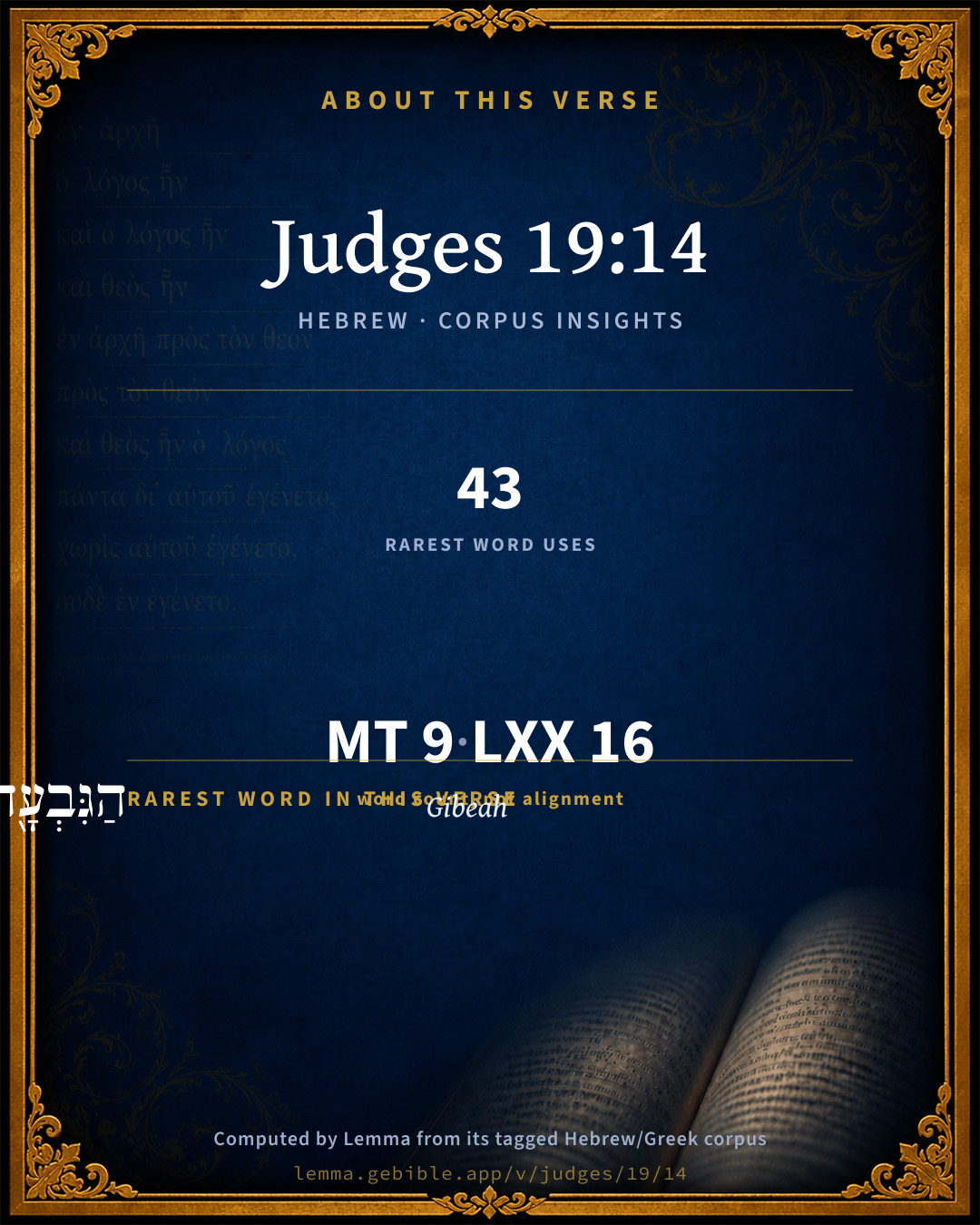
הַגִּבְעָ֖ה Gibeah H1390 occurs in 42 verses of the Hebrew Bible. Also found in:

Grammatical profile

  • 3 verbs
  • 3 nouns
  • 2 prepositions
  • 1 particle

Verb forms

  • וַיַּעַבְר֖וּ Qal · Sequential Imperfect
  • וַיֵּלֵ֑כוּ Qal · Sequential Imperfect
  • וַתָּבֹ֤א Qal · Sequential Imperfect

Hebrew & Septuagint length

In English translation the verse runs 22 words from the Hebrew and 21 from the Septuagint (LXX English) — closely comparable.

A rough comparison of the two English renderings, which tokenize alike — not a word-level alignment.

Word counts can differ between the Hebrew and the Greek without any difference in meaning — e.g. the Hebrew direct-object marker אֵת has no separate Greek word, and Greek often adds the article ὁ.

In the original languages it is 9 Hebrew tokens and 16 Greek tokens — but the two are counted differently (Hebrew bundles its prefixes and suffixes into one token; the Greek is in lemma form), so that isn’t a like-for-like length.

Hebrew and Greek witnesses Masoretic Hebrew ↔ Greek Septuagint

The same verse in the two great witnesses to the Old Testament, shown verse-for-verse.

These are two independent witnesses, not word-aligned to each other, and the Septuagint is shown in lemma (dictionary) form.

Hebrew Judges 19:14 Masoretic · Westminster Leningrad Codex

וַיַּעַבְר֖וּ וַיֵּלֵ֑כוּ וַתָּבֹ֤א לָהֶם֙ הַשֶּׁ֔מֶשׁ אֵ֥צֶל הַגִּבְעָ֖ה אֲשֶׁ֥ר לְבִנְיָמִֽן

So they passed on and went their way; and the sun went down on them near to Gibeah, which belongs to Benjamin.

World English Bible · Public Domain

Greek LXX Judges 19:14 Septuagint · lemma form

καί παραἔρχομαι καί πορεύομαι καί δύω ὁ ἥλιος αὐτός ἔχω ὁ γαβαα ὅς εἰμί ὁ βενιαμίν

And they passed by and went on, and the sun went down upon them near to Gabaa, which is in Benjamin.

LXX2012 (modern English Septuagint) · Public Domain

Hebrew: Westminster Leningrad Codex (CC BY 4.0). Greek: Septuagint (public domain); English from LXX2012 (modern English Septuagint) (Public Domain). How the Septuagint differs from the Hebrew →

Targum (Aramaic paraphrase)

1

The Targum is the ancient Jewish Aramaic paraphrase of the Hebrew Scriptures — an interpretive translation, not the Hebrew text itself. Onkelos (literal) and Pseudo-Jonathan (expansive) render the Torah, and Jonathan the Prophets. Coverage is partial: where no permissively-licensed English translation exists for a verse, only the Aramaic is shown. This is verse-level text, not a word-by-word alignment to the Hebrew.

  1. Targum Jonathan Prophets (Joshua–Malachi)
    וַעֲבָרוּ וַאֲזַלוּ וְעָלַת לְהוֹן שִׁמְשָׁא בִּסְטַר גִבְעֲתָא דִי לְשֵׁבֶט בִנְיָמִין:

    (no public-domain English translation for this verse)

    Targum Jonathan — Aramaic: “Mikraot Gedolot” (public domain). English: “Sefaria Community Translation” (CC0 1.0 (public-domain dedication)); “London "Chaldee Paraphrase," 1871” (public domain). Text via Sefaria.

Commentary

Notes on Judges 19:14 from classic Christian and Jewish commentators (each source and its license shown beneath its notes). The classic Christian expositions comment on the surrounding passage and are grouped to its opening verse, so a note may address several verses; the Jewish commentaries on the Tanakh (Rashi and others) are per-verse, so they appear only where the commentator wrote on this verse.

Lemma curates 59 commentaries, every one of them public domain or Creative Commons licensed, each selected and text-cleaned for this edition rather than reprinted as found. About our sources →

Trapp's Complete Commentary

John Trapp

Jdg 19:14 And they passed on and went their way; and the sun went down upon them [when they were] by Gibeah, which [belongeth] to Benjamin.

Ver. 14. Gibeah, which belongeth to Benjamin.] Called elsewhere Gibeah of Saul, {1Sa 11:4} at this time a very Poneropolis, a place where Satan’s throne was.

John Trapp, A Commentary or Exposition upon All the Books of the Old and New Testament (1647–1656) — public domain. Text from a community e-Sword module.

Ellicott's Commentary for English Readers

(14) The sun went down upon them.—They were evidently reluctant to stop at Gibeah; but it was dangerous to travel after dark, and the twilight in Palestine is very brief.

Which belongeth to Benjamin.—There were many other Gibeahs in Palestine, and for that reason Jibah and el-Jib are common names.

A Bible Commentary for English Readers, edited by Charles John Ellicott (1878–1897) — public domain. Text from a community e-Sword module.

John Gill's Exposition

And they passed on, and went their way,.... Proceeded on in their journey from Jebus or Jerusalem, near to which they were:

and the sun went down upon them when they were by Gibeah, which belongeth to Benjamin; which is added, to distinguish it from another Gibeah in the tribe of Judah, Jos 15:57 when they were come pretty near to this place, on the side of it, as it seems, the sun was just setting, which determined them to take up their lodging here, as follows.

John Gill's Exposition of the Whole Bible (1746–1763) — public domain (CC PDM 1.0). Text via the HelloAO Bible API.

Albert Barnes' Notes on the Bible

Gibeah, which belongeth to Benjamin - See Jos 18:24 note.

Albert Barnes' Notes on the Bible (1834–1885) — public domain. Text from a community e-Sword/MySword module.

Matthew Poole's English Annotations

This is added to difference it from another Gibeah in Judah, Jos 15:57. Possibly this is that which was called Gibeah of Saul, 1Sa 11:4.

Matthew Poole's English Annotations on the Holy Bible (1683–1685) — public domain. Text from a community e-Sword/MySword module.

The Pulpit Commentary

Vers. 14-21. Exceptional hospitality. How welcome!

Few of us but have at some time or other been belated in a strange place. We know nobody, and perhaps the people are reserved and suspicious. In such a case one friend, the only one, and, like this man, depending upon daily work for daily bread, becomes of inestimable service. The feeling of homelessness would be deepened in the case of the Levite when he recalled the good cheer from which he had come.

I THOSE WHO HAVE BEEN STRANGERS THEMSELVES ARE BEST ABLE TO SYMPATHISE WITH STRANGERS. "He sojourned in Gibeah.

II THE POOR ARE OFTEN MORE HOSPITABLE THAN THE RICH. Their occupation often introduces them to persons in distress. "What would the poor do if it were not for the poor?" Simplicity of life tends to cultivate true sympathy.

III THERE IS NO PLACE SO WICKED AND UNLOVING AS TO BE WITHOUT SOME WITNESS TO TRUTH AND GOODNESS. What a hell this Gibeah! Yet in it was one "like unto the Son of man." What judgments he may have averted from its guilty inhabitants! Exceptional piety like this is no accidental thing; still less can it be the product of surrounding social influences. There are many ways in which we nay serve our fellows, if the love of God be in our hearts. Perhaps the people thought him eccentric; many would despise him as poor and a stranger; but he was the one man who did God"s work at a time when it sorely needed to be done. Shall not such hospitality be remembered in the kingdom? "I was a hungred, and ye gave me meat; I was thirsty, and ye gave me drink; I was a stranger, and ye took me in," etc.. M. (Mat_25:35, Mat_25:40)

The Pulpit Commentary (1880–1919), ed. H.D.M. Spence-Jones & Joseph S. Exell — public domain. Text from a community e-Sword module.

Keil & Delitzsch

C. F. Keil & F. Delitzsch

Then they went forward, and the sun went down upon them as they were near (at) Gibeah of Benjamin.

Keil & Delitzsch — Biblical Commentary on the Old Testament (1861–1891) — public domain (CC PDM 1.0). Text via the HelloAO Bible API. (Old Testament only.)

unfoldingWord translationNotes

Door43 World Missions Community

turned aside

This means to take a break from their journey and stop at a place along the route. See how you translated a similar phrase in Judges 19:11. AT: "stopped" (See: Idiom)

the city square

the marketplace where people gathered during the day

took them into his house

This phrase means for someone to invite them to spend the night in their home. AT: "invited them to stay in their house for that night" (See: Idiom)

translationWords

Benjamin

unfoldingWord translationNotes — © Distant Shores Media and the Door43 World Missions Community, licensed CC BY-SA 4.0. Source: git.door43.org/Door43/en_tn.

Lesson kit

Teaching starters — assembled from the data on this page, not authored interpretation. Every prompt links to the verse data it draws on. Edit before teaching.

Judges, in the Historical, opens this verse with 9 words (8 distinct Hebrew lemmas). Its most distinctive word is Gibʻâh (“Gibeah”). A historical commentator’s framing appears above. Read the whole chapter for the surrounding context.

Discussion questions

  1. What does “Gibeah” (Gibʻâh) contribute to the verse as a whole?
  2. How does Joshua 15:57, which shares the word «Gibeah», read alongside this verse?
  3. The translations on this page render this verse differently — a whole-verse word diff, not a word-by-word alignment. What might account for the different wordings?
  4. «וַיַּעַבְר֖וּ» is a Qal Sequential Imperfect verb. How does that grammatical form shape the action described?
  5. Compare how Trapp's Complete Commentary and Ellicott's Commentary for English Readers read this verse. Where do they agree or differ?

Things to notice

Reading settings

Reading text

Shown beneath each verse's original-language words.

Old Testament
Old Testament edition

Read the OT as the Masoretic Hebrew (MT) or the Greek Septuagint (LXX).

English shown for the Greek Septuagint (in the Hebrew ↔ Greek comparison).

Comparing translations? Open the Compare panel on any verse page to stack up to four side by side.