
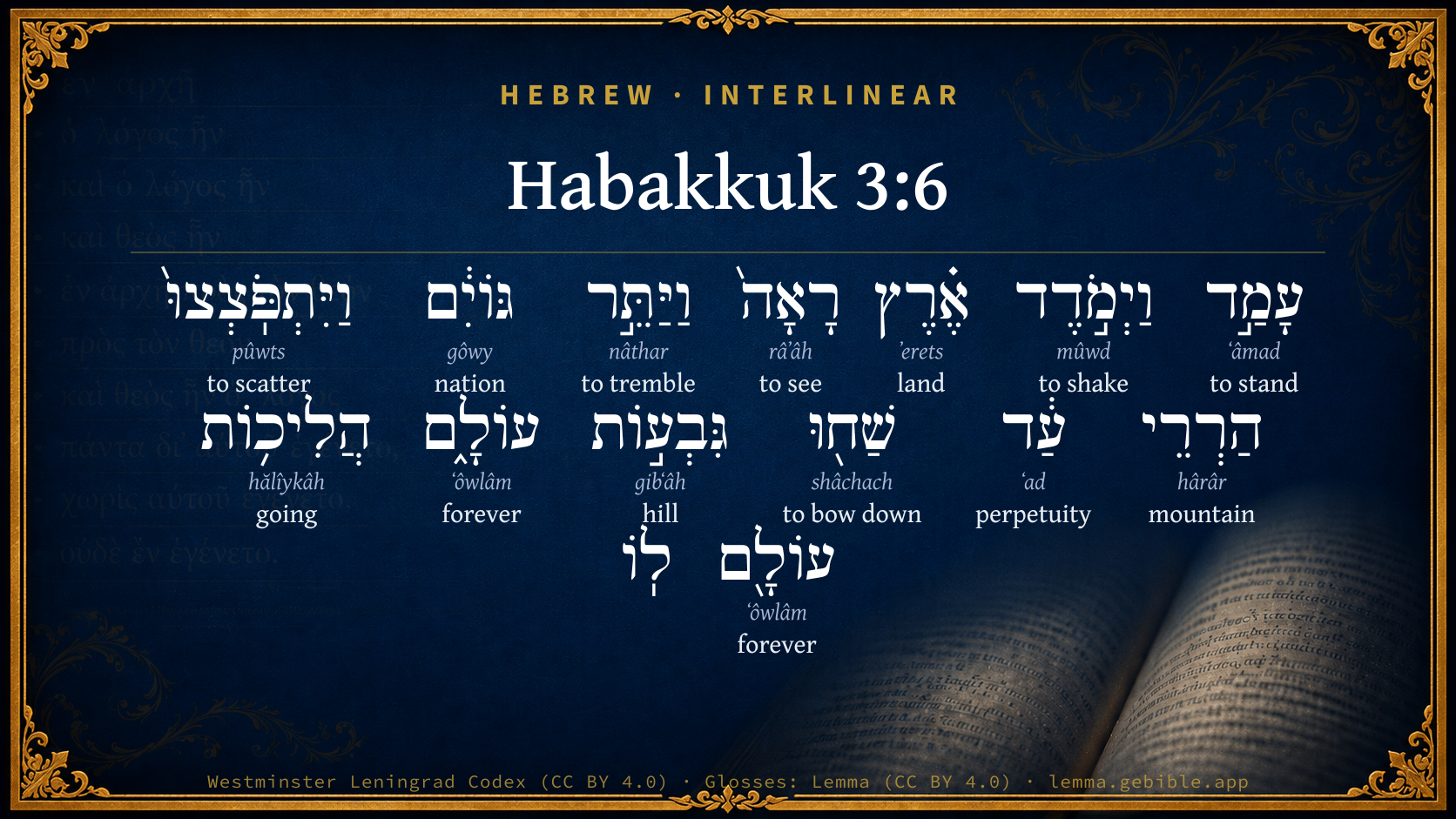
Habakkuk 3:6

Hebrew (Westminster Leningrad Codex) Habakkuk 3:6 appears in the Hebrew Old Testament. The text above is from the Westminster Leningrad Codex. Each word links to its Strong’s number, a concise gloss, and parsing drawn from the Open Scriptures Hebrew Bible morphology. Click any word for its full Brown-Driver-Briggs (BDB) entry.
Download image
Cite this verse

Habakkuk 3:6 (World English Bible). Public Domain. Lemma interlinear Bible study tool, https://lemma.gebible.app/v/habakkuk/3/6.

Show BibTeX & RIS
BibTeX
RIS
English Translation
He stood, and shook the earth. He looked, and made the nations tremble. The ancient mountains were crumbled. The age-old hills collapsed. His ways are eternal.
World English Bible · Public Domain
Highlights
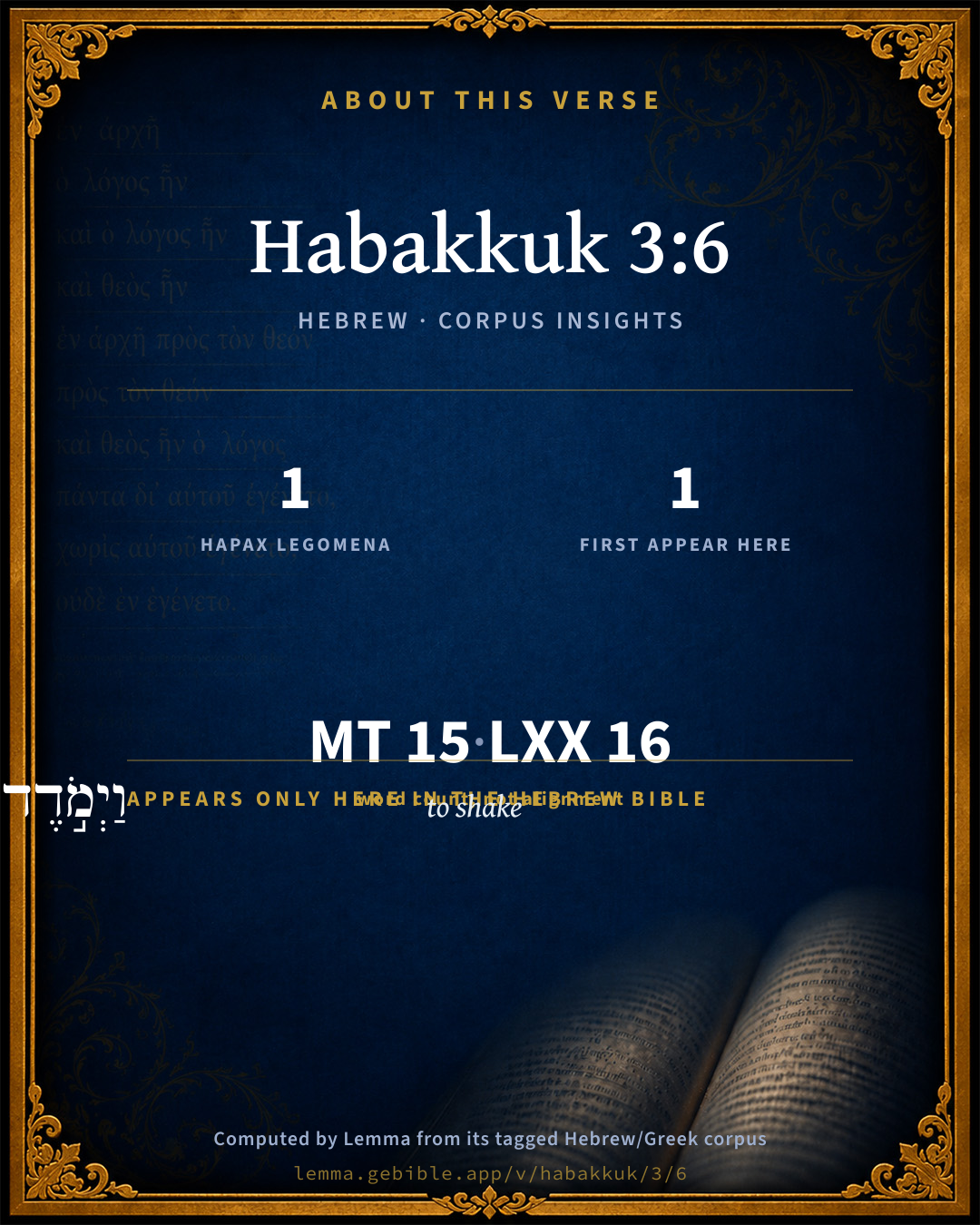
  • 1 hapax legomenon — only here in the Hebrew Bible
  • 1 first appearance in the Hebrew Bible
Full analysis ↓
Download a study sheet

One document with this verse’s original text, its word-by-word gloss line, the meaning frame, cross-references with their text, attributed commentary, and full source and license credits — printable, and it pastes into notes with its structure intact.

This verse Autodidact and up

Study sheet (.html) Plain text (.txt)

A passage Seminary Student

Up to 50 verses in one chapter. A passage sheet keeps up to 6 commentary sources and 12 cross-references per verse, in the order this page ranks them, and says so on the sheet whenever that leaves anything out. Ask for a single verse and you get the Autodidact verse sheet above.

Everything on this page stays free to read, with no account — the sheet is a download of what is already on screen, not access to it.

Want to remove ads? Support Godless Engineer
Compare translations 3

The same verse in 3 English versions, stacked beneath the original-language interlinear above. Click any original word for its lexicon entry.

Each is an independent rendering of the whole verse — the interlinear is not word-aligned to these translations.

Highlighted words mark where these versions differ — a whole-verse word diff, not a word-by-word alignment.

  • World English Bible Public Domain
    He stood, and shook the earth. He looked, and made the nations tremble. The ancient mountains were crumbled. The age-old hills collapsed. His ways are eternal.
  • King James Version Public Domain
    He stood, and measured the earth: he beheld, and drove asunder the nations; and the everlasting mountains were scattered, the perpetual hills did bow: his ways are everlasting.
  • unfoldingWord Literal Text CC BY-SA 4.0
    He stood, and he measured the earth. He looked, and he made the nations spring apart. The eternal mountains were shattered; the everlasting hills sank down. His goings everlasting. q1

unfoldingWord Literal Text — © unfoldingWord, licensed CC BY-SA 4.0. Word-aligned USFM3 via Door43 (git.door43.org/unfoldingWord/en_ult).

Versions to compare (up to 4)

3 of 4 selected

Show all 18 translations

Every available English version of this verse, each an independent rendering of the whole verse.

  • World English Bible Public Domain
    He stood, and shook the earth. He looked, and made the nations tremble. The ancient mountains were crumbled. The age-old hills collapsed. His ways are eternal.
  • Berean Standard Bible Public Domain
    He stood and measured the earth; He looked and startled the nations; the ancient mountains crumbled; the perpetual hills collapsed. His ways are everlasting.
  • Majority Standard Bible Public Domain
    He stood and measured the earth; He looked and startled the nations; the ancient mountains crumbled; the perpetual hills collapsed. His ways are everlasting.
  • King James Version Public Domain
    He stood, and measured the earth: he beheld, and drove asunder the nations; and the everlasting mountains were scattered, the perpetual hills did bow: his ways are everlasting.
  • American Standard Version (1901) Public Domain
    He stood, and measured the earth; He beheld, and drove asunder the nations; And the eternal mountains were scattered; The everlasting hills did bow; His goings were `as' of old.
  • Revised Version (1885) Public Domain
    He stood, and measured the earth; he beheld, and drove asunder the nations: and the eternal mountains were scattered, the everlasting hills did bow; his goings were as of old.
  • Geneva Bible (1599) Public Domain
    He stoode and measured the earth: he behelde and dissolued the nations and the euerlasting mountaines were broken, and the ancient hilles did bowe: his wayes are euerlasting.
  • Douay-Rheims (1899) Public Domain
    He stood and measured the earth. He beheld, and melted the nations: and the ancient mountains were crushed to pieces. The hills of the world were bowed down by the journeys of his eternity.
  • Young's Literal Translation Public Domain
    He hath stood, and He measureth earth, He hath seen, and He shaketh off nations, And scatter themselves do mountains of antiquity, Bowed have the hills of old, The ways of old `are' His.
  • Literal Standard Version CC BY-SA 4.0
    He has stood, and He measures earth, || He has seen, and He shakes off nations, || And mountains of antiquity scatter themselves, || The hills of old have bowed, || The ways of old [are] His.
  • Unlocked Literal Bible CC BY-SA 4.0
    He stood and measured the earth; he looked and shook the nations. Even the eternal mountains were shattered, and the everlasting hills bowed down. His path is everlasting.
  • unfoldingWord Literal Text CC BY-SA 4.0
    He stood, and he measured the earth. He looked, and he made the nations spring apart. The eternal mountains were shattered; the everlasting hills sank down. His goings everlasting. q1
  • Darby Bible Public Domain
    He stood, and measured the earth; He beheld, and discomfited the nations; And the eternal mountains were scattered, The everlasting hills gave way: His ways are everlasting.
  • World Messianic Bible Public Domain
    He stood, and shook the earth. He looked, and made the nations tremble. The ancient mountains were crumbled. The age-old hills collapsed. His ways are eternal.
  • Webster's Bible Public Domain
    He stood, and measured the earth: he beheld, and drove asunder the nations; and the everlasting mountains were scattered, the perpetual hills did bow: his ways are everlasting.
  • Free Bible Version CC BY-SA 4.0
    Where he stands, the earth shakes. When he looks the nations tremble. The ancient mountains shatter, the age-old hills collapse, but his ways are eternal.
  • Bible in Basic English Public Domain
    From his high place he sent shaking on the earth; he saw and nations were suddenly moved: and the eternal mountains were broken, the unchanging hills were bent down; his ways are eternal.
  • JPS Tanakh (1917) Public Domain
    He standeth, and shaketh the earth, He beholdeth, and maketh the nations to tremble; and the everlasting mountains are dashed in pieces, the ancient hills do bow; His goings are as of old.

Literal Standard Version (2020), Covenant Press — licensed CC BY-SA 4.0. Text via the HelloAO Bible API (eBible.org). Unlocked Literal Bible (unfoldingWord) — licensed CC BY-SA 4.0. Text via the HelloAO Bible API (eBible.org). unfoldingWord Literal Text — © unfoldingWord, licensed CC BY-SA 4.0. Word-aligned USFM3 via Door43 (git.door43.org/unfoldingWord/en_ult). Free Bible Version, Dr. Jonathan Gallagher — licensed CC BY-SA 4.0. Text via the HelloAO Bible API (eBible.org).

Word by word

More ways to search: Search by grammar → Find every occurrence → Compare this word →

Practice this passage: Drill this verse → Learn its vocabulary →

וַיְמֹ֣דֶד
mûwd
H4128
“and · to shake”
Conjunction + Verb, Polel, Sequential Imperfect, 3rd Person, Masculine, Singular
Part of Speech
Conjunction + Verb
Stem
Polel
Form
Sequential Imperfect
Person
3rd Person
Gender
Masculine
Number
Singular
Full BDB Definition

Origin: a primitive root

TWOT: 1157

(Polel) to shake
  1. עָמַ֣ד ʻâmad H5975 “to stand” Verb, Qal, Perfect, 3rd Person, Masculine, Singular
  2. אֶ֗רֶץ ʼerets H776 “land” Noun, Common, Both, Singular, Absolute
  3. רָאָה֙ râʼâh H7200 “to see” Verb, Qal, Perfect, 3rd Person, Masculine, Singular
  4. וַיַּתֵּ֣ר nâthar H5425 “and · to tremble” Conjunction + Verb, Hiphil, Sequential Imperfect, 3rd Person, Masculine, Singular
  5. גּוֹיִ֔ם gôwy H1471 “nations” Noun, Common, Masculine, Plural, Absolute
  6. וַיִּתְפֹּֽצְצוּ֙ pûwts H6327 “and · to scatter” Conjunction + Verb, Hithpolel, Sequential Imperfect, 3rd Person, Masculine, Plural
  7. הַרְרֵי hârâr H2042 “mountains of” Noun, Common, Masculine, Plural, Construct
  8. עַ֔ד ʻad H5703 “perpetuity” Noun, Common, Masculine, Singular, Absolute
  9. שַׁח֖וּ shâchach H7817 “to bow down” Verb, Qal, Perfect, 3rd Person, Common, Plural
  10. גִּבְע֣וֹת gibʻâh H1389 “hills of” Noun, Common, Feminine, Plural, Construct
  11. עוֹלָ֑ם ʻôwlâm H5769 “forever” Noun, Common, Masculine, Singular, Absolute
  12. הֲלִיכ֥וֹת hălîykâh H1979 “goings of” Noun, Common, Feminine, Plural, Construct
  13. עוֹלָ֖ם ʻôwlâm H5769 “forever” Noun, Common, Masculine, Singular, Absolute

About this verse

These counts appear in no published source. They are computed here, from the morphology-tagged text and Lemma’s own curated glosses. What Lemma adds →

15
words
13
distinct lemmas
Prophets
section

Notable vocabulary

1 hapax legomenon — a word that appears only here in the entire Hebrew Bible:

  • וַיְמֹ֣דֶד to shake H4128

First appearance in Scripture

This word makes its first canonical appearance in the Hebrew Bible here:

  • וַיְמֹ֣דֶד to shake H4128

Shared distinctive vocabulary

הֲלִיכ֥וֹת going H1979 occurs in 5 verses of the Hebrew Bible. Also found in:

Grammatical profile

  • 6 verbs
  • 8 nouns
  • 1 preposition

Verb forms

  • עָמַ֣ד Qal · Perfect
  • וַיְמֹ֣דֶד Polel · Sequential Imperfect
  • רָאָה֙ Qal · Perfect
  • וַיַּתֵּ֣ר Hiphil · Sequential Imperfect
  • וַיִּתְפֹּֽצְצוּ֙ Hithpolel · Sequential Imperfect
  • שַׁח֖וּ Qal · Perfect

Repetition

A word recurs within this verse — often emphatic in Hebrew:

  • עוֹלָ֑ם forever H5769 ×2

Hebrew & Septuagint length

In English translation the verse runs 26 words from the Hebrew and 30 from the Septuagint (LXX English) — closely comparable.

A rough comparison of the two English renderings, which tokenize alike — not a word-level alignment.

Word counts can differ between the Hebrew and the Greek without any difference in meaning — e.g. the Hebrew direct-object marker אֵת has no separate Greek word, and Greek often adds the article ὁ.

In the original languages it is 15 Hebrew tokens and 16 Greek tokens — but the two are counted differently (Hebrew bundles its prefixes and suffixes into one token; the Greek is in lemma form), so that isn’t a like-for-like length.

Cross-references

26

Topical passages linked to Habakkuk 3:6 in the Treasury of Scripture Knowledge — connected by theme and wording, ordered by reader-vote popularity; previews shown in the World English Bible.

  • Genesis 49:26 The blessings of your father Have prevailed above the blessings of the ancient mountains, Above the bounty of the age-old hills. They will be on the head of Joseph, On the crown of the head of him who is separated from his brothers.
  • Nahum 1:5 The mountains quake before him, and the hills melt away. The earth trembles at his presence, yes, the world, and all who dwell in it.
  • Deuteronomy 33:15 For the chief things of the ancient mountains, For the precious things of the everlasting hills,
  • Joshua 11:18–23 Joshua made war a long time with all those kings.
  • Isaiah 51:6 Lift up your eyes to the heavens, and look on the earth beneath; for the heavens shall vanish away like smoke, and the earth shall wax old like a garment; and those who dwell therein shall die in like manner: but my salvation shall be forever, and my righteousness shall not be abolished.
  • Isaiah 64:1–3 Oh that you would tear the heavens, that you would come down, that the mountains might quake at your presence,
  • Micah 5:8 The remnant of Jacob will be among the nations, In the midst of many peoples, Like a lion among the animals of the forest, Like a young lion among the flocks of sheep; Who, if he goes through, treads down and tears in pieces, And there is no one to deliver.
  • Zechariah 14:4–5 His feet will stand in that day on the Mount of Olives, which is before Jerusalem on the east; and the Mount of Olives will be split in two, from east to west, making a very great valley. Half of the mountain will move toward the north, and half of it toward the south.
  • Numbers 34:1–29 Yahweh spoke to Moses, saying,
  • Deuteronomy 32:8 When the Most High gave to the nations their inheritance, When he separated the children of men, He set the bounds of the peoples According to the number of the children of Israel.
  • Joshua 10:42 All these kings and their land did Joshua take at one time, because Yahweh, the God of Israel, fought for Israel.
  • Judges 5:5 The mountains quaked at the presence of Yahweh, Even yon Sinai at the presence of Yahweh, the God of Israel.
  • Nehemiah 9:22–24 Moreover you gave them kingdoms and peoples, which you did allot after their portions: so they possessed the land of Sihon, even the land of the king of Heshbon, and the land of Og king of Bashan.
  • Psalms 68:16 Why do you look in envy, you rugged mountains, At the mountain where God chooses to reign? Yes, Yahweh will dwell there forever.
  • Psalms 90:2 Before the mountains were brought forth, Or ever you had formed the earth and the world, Even from everlasting to everlasting, you are God.
  • Psalms 103:17 But Yahweh's loving kindness is from everlasting to everlasting with those who fear him, His righteousness to children's children;
  • Psalms 114:4–7 The mountains skipped like rams, The little hills like lambs.
  • Psalms 135:8–12 Who struck the firstborn of Egypt, Both of man and animal;
  • Isaiah 51:8 For the moth shall eat them up like a garment, and the worm shall eat them like wool; but my righteousness shall be forever, and my salvation to all generations.
  • Habakkuk 3:10 The mountains saw you, and were afraid. The tempest of waters passed by. The deep roared and lifted up its hands on high.
  • Luke 1:50 His mercy is for generations of generations on those who fear him.
  • Acts 17:26 He made from one blood every nation of men to dwell on all the surface of the earth, having determined appointed seasons, and the boundaries of their dwellings,
  • Exodus 21:31 Whether it has gored a son or has gored a daughter, according to this judgment it shall be done to him.
  • Matthew 24:35 Heaven and earth will pass away, but my words will not pass away.
  • Hebrews 13:8 Jesus Christ is the same yesterday, today, and forever.
  • Exodus 15:17 You shall bring them in, and plant them in the mountain of your inheritance, The place, Yahweh, which you have made for yourself to dwell in; The sanctuary, Lord, which your hands have established.

Cross-references courtesy of OpenBible.info (CC BY 4.0).

Hebrew and Greek witnesses Masoretic Hebrew ↔ Greek Septuagint

The same verse in the two great witnesses to the Old Testament, shown verse-for-verse.

These are two independent witnesses, not word-aligned to each other, and the Septuagint is shown in lemma (dictionary) form.

Hebrew Habakkuk 3:6 Masoretic · Westminster Leningrad Codex

עָמַ֣ד וַיְמֹ֣דֶד אֶ֗רֶץ רָאָה֙ וַיַּתֵּ֣ר גּוֹיִ֔ם וַיִּתְפֹּֽצְצוּ֙ הַרְרֵי עַ֔ד שַׁח֖וּ גִּבְע֣וֹת עוֹלָ֑ם הֲלִיכ֥וֹת עוֹלָ֖ם לֽוֹ

He stood, and shook the earth. He looked, and made the nations tremble. The ancient mountains were crumbled. The age-old hills collapsed. His ways are eternal.

World English Bible · Public Domain

Greek LXX Habakkuk 3:6 Septuagint · lemma form

ἵστημι καί σαλεύω ὁ γῆ ἐπιβλέπω καί διατήκω ἔθνος διαθρύπτω ὁ ὄρος βία τήκω βουνός αἰώνιος

the earth stood at his feet and trembled: he looked, and the nations melted away: the mountains were violently burst through, the everlasting hills melted at his everlasting going forth.

LXX2012 (modern English Septuagint) · Public Domain

On this verse, Albert Barnes' Notes on the Bible discusses the Septuagint’s reading. Read the note in Commentary ↓

Hebrew: Westminster Leningrad Codex (CC BY 4.0). Greek: Septuagint (public domain); English from LXX2012 (modern English Septuagint) (Public Domain). How the Septuagint differs from the Hebrew →

Targum (Aramaic paraphrase)

1

The Targum is the ancient Jewish Aramaic paraphrase of the Hebrew Scriptures — an interpretive translation, not the Hebrew text itself. Onkelos (literal) and Pseudo-Jonathan (expansive) render the Torah, and Jonathan the Prophets. Coverage is partial: where no permissively-licensed English translation exists for a verse, only the Aramaic is shown. This is verse-level text, not a word-by-word alignment to the Hebrew.

  1. Targum Jonathan Prophets (Joshua–Malachi)
    אִתְגְלֵי וְאֲזִיעַ אַרְעָא וְאַיְתֵי מַבּוּלָא עַל עַם דָרָא דַעֲבָרוּ עַל מֵימְרֵיהּ וְאַף בְּתִנְיָתָא כַּד חָבוּ קֳדָמוֹהִי בְּחוֹבֵיהוֹן כֵּן בַּלְבְּלִינוּן לְעַמְמַיָא וְאִתְפְּרָקוּ טוּרַיָא דְמִלְקָדְמִין מָכָא רָמָתָא דְמִן עַלְמָא גְבוּרַת עַלְמָא דִילֵיהּ:

    (no public-domain English translation for this verse)

    Targum Jonathan — Aramaic: “Mikraot Gedolot” (public domain). English: “Sefaria Community Translation” (CC0 1.0 (public-domain dedication)); “London "Chaldee Paraphrase," 1871” (public domain). Text via Sefaria.

Commentary

Notes on Habakkuk 3:6 from classic Christian and Jewish commentators (each source and its license shown beneath its notes). The classic Christian expositions comment on the surrounding passage and are grouped to its opening verse, so a note may address several verses; the Jewish commentaries on the Tanakh (Rashi and others) are per-verse, so they appear only where the commentator wrote on this verse.

Lemma curates 59 commentaries, every one of them public domain or Creative Commons licensed, each selected and text-cleaned for this edition rather than reprinted as found. About our sources →

Trapp's Complete Commentary

John Trapp

Hab 3:6 He stood, and measured the earth: he beheld, and drove asunder the nations; and the everlasting mountains were scattered, the perpetual hills did bow: his ways [are] everlasting.

Ver. 6. He stood, and measured the earth] Not Joshua, but God, brought his people into the promised land, and divided it among them, Psa 78:55. Like as also he had divided the whole earth by bounds and borders to the various nations, Psa 74:17, and doth still appoint men the bounds of their habitations, Act 17:26.

He beheld, and drove asunder the nations] He did it with his looks, as it were; that is, with very little ado. Let the Lord but arise only and his enemies shall be scattered, let him but frown and they fall before him. If Augustus could frown to death Asinius Pollio, and Queen Elizabeth her chancellor Hatton, what shall we think of God’s bended brows?

And the everlasting mountains were scattered] i.e. Those kingdoms of the Canaanites that were held firm and immoveable as the mountains, yea, riveted as it were upon eternity, see Num 13:28-29; Num 13:33. These were scattered, dissilierunt, fell in pieces, and leaped this way and that way, as stones broken with a great hammer. God threshed these mountains, and beat them small, he made the hills as chaff, Isa 41:15. No worldly height could stand before him. By mountains here some understand kings and princes, as by hills those of inferior rank.

His ways are everlasting] Heb. His walks or journeys, that is, his government of the world by his power and wisdom, is perpetual, he never casteth off the care thereof. There are those who refer the word his to the Canaanites, who had of old possessed the land without disturbance (αυτοχθονες); but the former sense is the better.

John Trapp, A Commentary or Exposition upon All the Books of the Old and New Testament (1647–1656) — public domain. Text from a community e-Sword module.

Joseph Benson's Commentary

Hab 3:6. He stood and measured the earth — “It was customary for a conqueror, as soon as he became possessed of a country, to measure it out, and divide it among his people. Thus David, (Psa 60:6,) I will divide Shechem, and mete out the valley of Succoth. Hence Jehovah, who takes possession of the land of Canaan, upon the flight and cession of its guilty inhabitants, is represented as dividing it among the tribes of Israel.” — Green, who translates the former part of the verse thus: He stood and measured out the land; he beheld and scattered the nations: the eternal mountains dispersed, the perpetual hills bowed. The passage is certainly extremely poetical; representing, not only the inhabitants of Canaan, but the land itself, as struck with conscious terror at the approach of Jehovah. His ways are everlasting — His purposes, foreknown from all eternity, will infallibly be executed in their appointed time: or, his wisdom, goodness, justice, holiness, and power, exerted and manifested in governing his people, are immutable and eternal.

Joseph Benson's Commentary on the Old and New Testaments (1811–1818) — public domain. Text from a community e-Sword module.

The Preacher's Complete Homiletical Commentary

Joseph S. Exell (gen. ed.)

CRITICAL NOTES.]

Hab_3:7.] Neighbouring nations tremble at his judgments. Saw] in vision.

HOMILETICS

THE MEASURED INHERITANCE.—Hab_3:6-7

These words describe the effects of God’s approach. He stood like a mighty warrior in his conquering career. The earth trembled, and primeval mountains dissolved into dust. We take it in reference to Canaan. As Joshua conquered and divided the land, so God measured and portioned it out to his people.

I. The inheritance measured. He “measured the earth.” He measured the whole, and the portion for each tribe. It was no scramble, but appointment by lot and rule. He “divided them an inheritance by line” (Psa_78:55). God measures the earth by bounds and borders to the various nations that dwell upon it. “Thou hast set all the borders of the earth” (Psa_74:17). Lands and seas, continents and islands, are mapped out by him. He defined the shape and weighed the elements of the world. In righteous judgment he observes the ways, and fixes the bounds of man’s habitations (Act_17:26). He ordains our present lot, and will fix our final destiny.

II. The inheritance gained. “He beheld, and drove asunder the nations.” Notice—

1. The ease by which it was gained. He stood in the midst of his glory, without going forth, and simply looked. What was the consequence?

(1) All nations were scattered. Though strong and numerous, and their possession ancient and stable as the everlasting hills.

(2) All opposition was subdued. At his presence, kings and princes, firm and immovable on their thrones, were overcome. The mountains were thrashed, and the hills made small before him (Isa_41:15).

(3) All enemies were terrified. “I saw the tents of Cushan in affliction.” The tidings of his wondrous acts threw neighbouring nations into despair (Exo_15:14-16). So now at the approach of God the sinner trembles in fear. Before his rebuke nations wither away. No shelters, no tents nor curtains can hide from him. “The mountains quake at him, and the hills melt, and the earth is burned at his presence, yea, the world, and all that dwell therein.”

2. The deliberation by which it was gained. “His ways are everlasting.” This was no sudden, precipitate work. It was by the eternal purpose and strict Justice of God. The works and ways of God are coherent, unchangeable, and true. They have steps and progress, but no change. His creative and providential acts are the same in all ages. “If God could change his purpose,” says Charnock, “he would change his nature.” “Known unto God are all his works from the beginning of the world.”

ILLUSTRATIONS TO CHAPTER 3

Hab_3:4-7. Hiding. Man’s knowledge is confined to parts only of God’s ways. The extremities or forthgoings of his administration are visible on earth only. The springs, principles, and anterior steps are above and out of man’s sight [Dr. Chalmers].

Hab_3:6. Measured the earth.

“Then stay’d the fervid wheels, and in his hand

He took the golden compasses, prepared

In God’s eternal store, to circumscribe

This universe, and all created things.

One foot he centred, and the other turn’d

Round through the vast profundity obscure;

And said, Thus far extend, thus far thy bounds,

This be thy just circumference, O world!” [Milton].

Hab_3:9. Bow naked. The drawing of the bow was a mark of great skill and slaughter.

“So the great master drew the mighty bow,

And drew with ease. One hand aloft display’d

The bending horns, and one the string essay’d.” [Pope’s Homer.]

The Preacher's Complete Homiletical Commentary (gen. ed. Joseph S. Exell; Funk & Wagnalls, c. 1892) — public domain (pre-1929). A full-Bible homiletical/sermon-outline anthology covering 65 of 66 books (2 John is absent from the source module). Text from a community e-Sword module.

Geneva Bible (1599)

Geneva Bible translators

Signifying, that God hath wonderful means, and ever had a marvelous power when he would deliver his Church.

Geneva Bible (1599) marginal notes — public domain. Text via Bolls.life.

Jamieson, Fausset & Brown

Robert Jamieson, A. R. Fausset & David Brown

He stood, and measured the earth--Jehovah, in His advance, is represented as stopping suddenly, and measuring the earth with His all-seeing glance, whereat there is universal consternation. MAURER, from a different root, translates, "rocked the earth"; which answers better to the parallel "drove asunder"; the Hebrew for which latter, however, may be better translated, "made to tremble."

everlasting mountains--which have ever been remembered as retaining the same place and form from the foundation of the world.

did bow--as it were, in reverent submission.

his ways are everlasting--His marvellous ways of working for the salvation of His people mark His everlasting character: such as He was in His workings for them formerly, such shall He be now.

Jamieson, Fausset & Brown — Commentary Critical and Explanatory on the Whole Bible (1871) — public domain (CC PDM 1.0). Text via the HelloAO Bible API.

Adam Clarke's Commentary

Verse 6. He stood, and measured the earth] ארץ erets, the land; he divided the promised land among the twelve tribes. This is the allusion; and this the prophet had in his eye. God not only made a general assignment of the land to the Hebrews; but he even divided it into such portions as the different families required. Here were both power and condescension. When a conqueror had subdued a country, he divided it among his soldiers. Among the Romans, those among whom the conquered lands were divided were termed beneficiary; and the lands beneficia, as being held on the beneficence of the sovereign.

He beheld, and drove asunder the nations] The nations of Canaan, the Hittites, Hivites, Jebusites, c., and all who opposed his people. Even his look dispersed them.

The everlasting mountains were scattered] Or, broken asunder. This may refer to the convulsions on Mount Sinai and to the earth quake which announced the descent of the Most High. See Ex 19:18. "God occupied the summit of the eternal Mount Sinai; and led his people over the eternal mountains of Arabia Petraea; and this sense is preferable to the figurative one, that his ways or doings are predetermined front everlasting." -Newcome.

The epithets עד ad, and עולם olam, eternal, and everlasting, are applied to mountains and immense rocks, because no other parts of nature are less subject to decay or change, than these immense masses of earth and stone, and that almost indestructible stone, granite, out of which Sinai appears to be formed. A piece of the beautiful granite of this mountain now lies before me. This is a figurative description of the passage of the Israelites through the deserts of Arabia, over mountains, rocks, and through the trackless wilderness; over and through which God, by his power and providence, gave them a safe passage.

The following beautiful piece from the Fragments of AEschylus will illustrate the preceding description, and please the learned reader.

Χωριζε θνητων τον Θεον, και μη δοκει

Ομοιον αυτῳ σαρκινον καθεσταναι·

Ουκ οισθα δ' αυτον· ποτε μεν ὡς πυρ φαινεται

Απλαστον ὁρμῃ ποτε δ' ὑδωρ, ποτε δε γνοφος.

Και θηρσιν αυτος γινεται παρεμφερης,

Ανεμῳ, νεφει τε, κᾳστραπῃ, βροντῃ, βροχῃ.

Ὑπηρετει δ' αυτῳ θαλασσα, και πετραι,

Και πασα πηγη, χ' ὑδατος συστηματα·

Τρεμει δ' ορη και γαια και πελωριος

Βυθος θαλασσης, κωρεων ὑψος μεγα,

Οταν επιβλεψῃ γοργον ομμα δεσποτου.

AESCHYLI Fragm.

Confound not God with man; nor madly deem

His form is mortal, and of flesh like thine.

Thou know'st him not. Sometimes like fire he glows

In wrath severe; sometimes as water flows;

In brooding darkness now his power conceals

And then in brutes that mighty power reveals.

In clouds tempestuous we the Godhead find;

He mounts the storm, and rides the winged wind;

In vivid lightnings flashes from on high;

In rattling thunders rends the lowering sky;

Fountains and rivers, seas and floods obey,

And ocean's deep abyss yields to his sway;

The mountains tremble, and the hills sink down,

Crumbled to dust by the Almighty's frown.

When God unfolds the terrors of his eye,

All things with horror quake, and in confusion lie.

J. B. B. CLARKE.

Adam Clarke's Commentary on the Bible (1810–1826) — public domain. Text from a community e-Sword/MySword module.

John Calvin's Commentaries

He says that God possessed every power to subdue the earth to himself, and that he could at his will destroy it, yea, dissolve mountains as veil as nations. Some of the Jews understood this of the ark, which stood at that time in Gilead. They then suppose that the Prophet meant this in short—that when God chose a place for the ark of the covenant in Gilgal, that he determined then what he would do, and that he then in his secret counsel divided the land, so that each should have his portion by lot. This, it is true, was accomplished shortly after, for Joshua, as we know, divided it by lot between the tribes. But what the Jews affirm of the ark seems to me strained and frigid. Habakkuk, on the contrary, means by the word stand, that God was openly conspicuous, like him who assumes an erect posture, so that he is seen at a distance. In this sense we are to take the expression that God stood.

The measuring, of the earth is not to be confined to Judea, but is to be extended to the whole world. God, he says, has measured the earth. To measure the earth is what properly belongs to a sovereign king; and it is done that he may assign to each his portion. Except God, then, had a sovereign right over the earth and the whole world, Habakkuk would not have ascribed to him this office; and this we learn from the verse itself, for he immediately subjoins, that the nations, as it were, melted away, that the mountains were destroyed, that the hills were bowed down

We hence see that by earth we are not to understand Judea only, but the whole world; as though he had said, that when God appeared on mount Sinai, he made it fully evident that the earth was under his power and authority, so that he could determine whatever he pleased, and prescribe limits to all nations. For he does not speak of God here as having, like a surveyor, a measuring line; but he says, that he measured the earth as one capable even then of changing the boundaries of the whole world; nay, he intimates that it was he himself who had at first created the earth and assigned it to men. It is indeed true that the nations did not then melt away, nor were the mountains demolished, nor the hills bowed down; but the Prophet simply means, that God’s power then appeared, which was capable of shaking the whole world.

But he calls these the mountains of eternity and the hills ages, which had been from the beginning fixed on their own foundations. For if an earthquake happens on a plain, it seems less wonderful; and then if any of those mountains cleave, which are not so firmly fixed, it may be on account of some hollow places; for when the winds fill the caverns, they are forced to burst, and they cleave the mountains and the earth. But the Prophet relates an unusual thing, and wholly different from the ordinary course of nature—that the mountains of eternity, which had been from the beginning, and had remained without any change, were thus demolished and bowed down. In short, the Prophet intended by all means to raise up to confidence the minds of the godly, so that they should become fully persuaded that God’s power to deliver them would be the same as that which their fathers had formerly experienced; for there is no other support under adverse, and especially under despairing circumstances, than that the faithful should know that they are still under the protection of that God who has adopted them. This is the reason why the Prophet amplifies, in so striking a manner, on the subject of God’s power.

And hence also he subjoins, that the ways of ages are those of God. Some render the clause, “the ways of the world.” The word עולם, oulam, however, means properly an age, or perpetual time. The Prophet, I have no doubt, means by ways of ages, the wonderful means which God is wont to adopt for the defense of his Church; for we are ever wont to reduce God’s wonder to our own understanding, while it is his purpose to perfect, in a manner that is wonderful, the work of our salvation. Hence the Prophet bids the faithful here to raise upwards their thoughts, and to conceive something greater of God’s power than what they can naturally comprehend. If we take the ways of eternity, in this sense, then they are to be understood as in opposition to those means which are known and usual. They are his daily ways, when the sun rises and sets, when the spring succeeds the winter, when the earth produces fruit; though even these are so many miracles, yet they are his common ways. But God has ways of eternity that is he has means unknown to us by which he can deliver us from death, whenever it may please him.

But yet, if any prefer taking the ways of eternity as signifying the continued power of God, which has ever appeared from the beginning, the sense would be appropriate and not less useful: for it especially avails to confirm our faith, when we consider that God’s power has ever been the same from the creation of heaven and earth, that it has never been lessened or undergone any change. Since, then, God has successively manifested his power through all ages, we ought hence to learn that we have no reason to despair, though he may for a time conceal his hand; for he is not on that account deprived of his right. He ever retains the sovereignty of the world. We ought, then, to be attentive to the ways of ages, that is, to the demonstration of that power, which was manifested in the creation of the world, and still continues to be manifested. It follows—

John Calvin's Commentaries (1540-1563) — public domain. Text from the Calvin Translation Society English edition (1840s-50s) via the Christian Classics Ethereal Library (ccel.org). Calvin's coverage is partial (roughly two-thirds of the Bible); uncommented books and verses are honest gaps, never fabricated. The 19th-century editor's footnotes and remarks are omitted so the notes are faithfully Calvin's own voice.

Ellicott's Commentary for English Readers

(6) He stood, and measured the earth . . .—Better, He has taken His stand and measured the earth, He has looked and made the heathen tremble; and the primeval mountains are broken up, the ancient hills sink down; His goings are as of old; i.e., His proceedings are the same as of old time, when He brought up Israel from Egypt. God measures or parcels out the earth; and the usurping invader is put to confusion. The mountains are convulsed, as was Sinai of old. (Comp. Jdg_5:5, Psa_68:8.)

A Bible Commentary for English Readers, edited by Charles John Ellicott (1878–1897) — public domain. Text from a community e-Sword module.

The Cambridge Bible for Schools and Colleges

gen. ed. J. J. S. Perowne

6. stood, and measured] “Measured” could only mean surveyed, measured with His eyes, and this might be supposed taken up again in “he looked” of next clause; but the parallelism with the next clause rather requires that the effect of His standing or taking His stand should be stated. Possibly the word “measured” has the sense of a similar word used Isa_24:19, he made the earth to rock. Sept. renders in the pass., the earth was shaken. The preceding verses describe the Theophany as seen in heaven, it has not yet touched the earth, though its baleful accompaniments of pestilence and fever-glow are spoken of. Now the tempest in which the Deity is shrouded descends and touches the earth, enfolding the heights within it. “He stood” means He took his stand, He set His foot; 2Sa_20:4; Isa_1:8; Eze_22:30. The earth felt His tread and rocked, Mic_1:3-4. Or, “stood” might describe an apparent stationariness of the storm-cloud during which it discharged itself, making the earth rock. Cf. Psa_29:4-5.

He beheld, and drove asunder] He looked, and His look scared the nations into violent commotion. The term means to make one spring, up from terror, Job_37:1.

mountains were scattered] Or, do cleave asunder. The sense is scarcely that the hills were scattered from one another, rather that the individual mountains were cleft. Cf. Zec_14:4, “His feet shall stand on the mount of Olives, and the mount of Olives shall cleave in the midst thereof, toward the east and toward the west.”

perpetual hills did bow] Or, eternal hills.—Gen_49:26; Deu_33:15. Their bowing refers to the sinking and rising motion, as in an earthquake, under the feet of Jehovah in the tempest.

His ways are everlasting] R.V. his goings were as of old. If this sense were adopted it would decide that the previous description referred to a Theophany about to appear, which is compared to the former historical one, the term “going” being equivalent to way. The term “goings” however might be in apposition to “eternal hills,” and the meaning be that these hills were Jehovah’s eternal pathways—the trailing tempests, in which Jehovah moves, are seen passing over the mountains, and thus these are considered the pathways of the Lord. Cf. Amo_4:13, “he treadeth upon the high places of the earth”; Mic_1:3.

The past tenses of A.V. might be retained in the verse, but as the poet feels himself in presence of the imposing phenomenon, it is perhaps better to throw them into the present:

He taketh his stand, and maketh the earth to quake,

He looketh, and causeth the nations to tremble;

And the everlasting mountains are cleft asunder,

The eternal hills do bow;

Even his pathways from of old.

The last line overloads the parallelism, and in whatever sense it be taken rather drags.

The Cambridge Bible for Schools and Colleges (gen. ed. J. J. S. Perowne; Cambridge University Press, 1878–1918) — public domain. Text from a community e-Sword module.

John Gill's Exposition

He stood and measured the earth,.... This alludes to the ark of the Lord, the symbol of his presence, standing and abiding at Gilgal for the space of fourteen years, while the land of Canaan was subdued by Joshua; and then measured out by him, and divided by lot, as an inheritance to the children of Israel, according to the direction and appointment of the Lord, Jos 13:1 &c.: here it may have respect to the mission of the apostles into the various parts of the world, and the distribution of it among them; some being sent into one part, and some into another, called their particular line and measure, Co2 10:14 some into India, others into Ethiopia; some into Asia, and others into Europe; by which means the Gospel was preached everywhere, and great part of the world became Christians:

he beheld, and drove asunder the nations; with a look of his he made them give way; he drove the Canaanites out of the land, and separated them from one another, and scattered them about, to make room for his people Israel, Psa 78:55,

and the everlasting mountains were scattered; or, "were broken" (i):

the perpetual hills did bow; the mountains and hills that were from the beginning of the creation, that were settled upon their bases, and never moved, now trembled, shook, and bowed, as Sinai and others did, at the presence of the God of Israel; see Jdg 5:5 or rather, figuratively, these may design the kingdoms and states, kings and princes, greater and lesser, belonging to the land of Canaan, which were shaken, moved, and taken by the Israelites, and brought into subjection to them; and in like manner kings and kingdoms, comparable to mountains and hills, through the preaching of the Gospel, and the power of Christ attending it, were brought to yield unto him, at the downfall of Paganism in the Roman empire: this is signified by every mountain and island being moved out of their places, and kings and great men calling to the rocks and mountains to fall on them, and hide them from the wrath of the Lamb, Rev 6:14,

his ways are everlasting; and what he has done in ages past he can do again; his power, his wisdom, and his grace, are unchangeably the same; and all he does in time, every step he takes, is according to his counsels, purposes, and decrees in eternity, which infallibly come to pass; nor can he be hindered and frustrated in the execution of them; as he has begun, he will go on; as he has set up his kingdom in the world, he will support and maintain it; and though there are many obstructions and remoras in the way of it, he will go on, and remove them, until he has thoroughly established it, and brought it to its highest glory, which he has designed; all mountains and hills are nothing before him; he can soon make them a plain; see Rev 11:15, or, "the ways of the world (k) are his"; the world is under his government, and all things in it subject to his providence; he can rule and overrule all things for his own glory, and the good of his interest, and he will do it; everything is subject to his control, and under his direction; not a step can be taken without his will. This the prophet observes along with the above things, to encourage the faith and expectation of the saints, that the work of the Lord will be revived, and his kingdom and interest promoted and established in the world; though there may, and will, be many difficulties and distresses previous to it.

(i) "contriti sunt", Pagninus, Montanus; so R. Sol. Urbin. Ohel Moed, fol. 95. 1. (k) "itinera mundi", Vatablus, Tigurine version.

John Gill's Exposition of the Whole Bible (1746–1763) — public domain (CC PDM 1.0). Text via the HelloAO Bible API.

Albert Barnes' Notes on the Bible

He stood - It is “a metaphor of his giving victory to Israel” Tanchum.

And measured - So Kimchi, A. E., Rashi, Tanchum, Vulgate. It is borne out by Hithpolel. “extended himself,” 1Ki 17:21. By an interchange of dentals; מוד might be = מוט, and so the Aramaic and the Septuagint but in no other case do the two forms co-exist in Hebrew.

The earth - Joshua, after he had conquered the land, meted it out and divided it among the people. He who should come, should measure out the earth in its length and breadth, that earth which His glory filleth. “He stood,” as Stephen saw Him, Act 7:56, “standing at the right hand of God.” Isaiah saith, Isa 3:13 : “The Lord standeth up to plead, and standeth to judge the people.” He had not need to go forth, but, in the abode of His glory, “He stood” and beheld and with His eye “measured the earth,” as His own, whereas, before the cross, it lay under 1Co 2:5, “the Prince of this world,” and he had said, Luk 4:6, “it is delivered unto me, and unto whomsoever I will, I give it.” “He measureth it,” and gave it to His apostles. Mat 28:18; Mar 16:15 : “all power is given unto Me in heaven and in earth. Go ye into all the world, and preach the gospel to every creature,” and, Psa 19:4, “their sound is gone out into all lands, and their words into the ends of the world.” He measureth it also, surveying and weighing all who dwell therein, their persons, qualities, deeds, good or bad, to requite them, as “Judge of quick and dead;” as David cast down Moab and measured them with a line, 2Sa 8:2, “to put to death and to keep alive.”

He beheld, and drove asunder the nations - or, “made the nations to tremble.” When Israel came out of Egypt and God divided the Red Sea before them, they sang: Exo 15:15-16 “The people shall hear and be afraid; terror shall take hold of the inhabitants of Palestine; the mighty men of Moab, trembling shall take hold of them; all the inhabitants of Canaan shall melt away; fear and dread shall fall on them; by the greatness of Thy power they shall be still as a stone.” Fear and awe were to be renewed. All nearness of God brings terror to sinful man. When the news came through the wise men, that they had, Mat 2:1-3, “seen in the East the star of Him who was born, King of the Jews,” not only was Herod the King troubled, but “all Jerusalem with him.” Pilate Joh 19:8 “was afraid” when he condemned Jesus; the high priests wondered “whereunto this should grow,” and expostulated, Act 5:24, Act 5:28, “ye have filled Jerusalem with your doctrine, and intend to bring this Man’s blood upon us.” Pagandom was as a beleaguered city, mastered by an ubiquitous Presence, which they knew not how to meet . “The state is beset: the Christians are in their fields. in their forts, in their islands. Every sex, age, condition, and now even rank is going over to this sect.” The fierceness of the persecutions was the measure of their fear. They put forth all human might to stamp out the spark, lest their gods, and the greatness of the empire which they ascribed to their gods, should fall before this unknown Power.

And the everlasting mountains were scattered; the perpetual hills did bow - all power, great or small, gave way before Him. All which withstood was scattered asunder, all which in pride lifted itself up was brought low, although before the coming of the Saviour it had ever gone with neck erect, and none could humble its pride. There is something so marvelous about those ancient mountains. There they stood before man was on the earth; they are so solid, man so slight; they have survived so many generations of man; they will long survive us; they seem as if they would stand forever; nothing could stand before the might of God. What symbol could be more apt? To the greater pride the heavier lot is assigned; the mountains lifted on high above the earth and, as it were, looking down upon it, are scattered or dispersed, as when a stone flieth in pieces under the stroke of the hammer. The “hills” are bowed down only; and this may be the pride of man humbled under the yoke of Christ.

His ways are everlasting - “Everlasting” is set over against “everlasting.” The “everlasting” of the creature, that which had been as long as creation had been, co-existing with its whole duration, its most enduring parts, are as things past and gone; “the everlasting mountains, the hills of eternity,” have been scattered in pieces and bowed, and are no more. Over against these stands the everpresent eternity of God. “His ways are everlasting,” ordered everlastingly, existing everlastingly in the Divine Mind, and, when in act among us, without change in Him. The prophet blends in these great words, things seemingly contrary, ways which imply progress, eternity which is unchangeable “God ever worketh, and ever resteth; unchangeable, yet changing all; He changeth His works, His purpose unchanged” . “For Thou art Most High, and art not changed, neither in Thee doth today come to a close; yet in Thee it doth come to a close; because all such things also are in Thee. For they had no way to pass away, unless Thou heldest them together. ‘And since Thy years fail not,’ Thy years are one Today. How many of our’s and our fathers’ years have flowed away through Thy today; and from it received the measure and the mould of such being as they had; and still others shall flow away, and so receive the mould of their degree of being. But Thou art still the Same; and all things of tomorrow, and all beyond, and all of yesterday, and all behind it, Thou wilt do in this today, Thou hast done in this today”

To these His goings, a highway is made by the breaking down of all which exalted itself, as Isaiah had said, “The loftiness of man shall be bowed down, and the haughtiness of men shall be made low and the Lord Alone shall be exalted in that day” Isa 2:17; and “The voice of him that crieth in the wilderness, Prepare ye the way of the Lord, make straight in the desert a highway for our God. Every valley shall be exalted, and every mountain and hill shall be made low” Isa 40:3.

Bernard in Ps. Qui habitat. Serra. xi. 8: “The Everlasting ways of the Everlasting God are Mercy and Truth, by these Ways are the hills of the world and the proud demons, the princes of the darkness of this world, bowed down, who knew not the way of mercy and truth nor remembered its paths. What hath he to do with truth, who is a liar and the father of it, and of whom it is written, ‘he abode not in the Truth?’ But how far he is from Mercy, our misery witnesseth, inflicted on us by him. When was he ever merciful, ‘who was a murderer from the beginning?’ So then those swelling hills were bowed down from the Everlasting Ways, when through their own crookedness they sunk away from the straight ways of the Lord, and became not so much ways as precipices. How much more prudently and wisely are other hills bowed down and humbled by these ways to salvation! For they were not bowed from them, as parting from their straightness, but the Everlasting Ways themselves bowed down. May we not now see the hills of the world bowed down, when those who are high and mighty with devoted submission bow themselves before the Lord. and worship at His Feet? Are they not bowed down, when from their own destructive loftiness of vanity and cruelty, they are turned to the humble way of mercy and truth?”

Albert Barnes' Notes on the Bible (1834–1885) — public domain. Text from a community e-Sword/MySword module.

Haydock's Catholic Bible Commentary

Measured. Septuagint, "the earth was troubled," (Calmet) or shaken. (Haydock) --- He beheld. One look of his eye is enough to melt all the nations, and to reduce them to nothing. For all heaven and earth disappear when they come before his light, Apocalypse xx. 11. (Challoner) --- The Chanaanites were dismayed at the approach of God’s people. He routed the nations, and determined the portion which he had chosen for Israel, Josue ii. 9. (Calmet) --- Mountains. By the mountains and hills are signified the great ones of the world, that persecute the Church, whose power was quickly crushed by the Almighty. (Challoner) --- The roughest roads in the wilderness were made smooth. God is poetically described at the head of his people, Deuteronomy viii. 4., and xxxiii. 15., and Psalm lxxv. 5. (Calmet)

George Leo Haydock (1774–1849), Haydock's Catholic Family Bible and Commentary, 1859 edition — public domain. Excludes Psalms (Douay-Rheims chapter numbering differs from Protestant) and Deuterocanonical books (Catholic canon only).

Matthew Poole's English Annotations

He stood; gave his presence with Joshua and others, as one that stood by while the work was done.

Measured: he divided to them their inheritance, and did this without toil or difficulty, his very presence with his people was enough to make it known what he allotted to them. The earth; the Promised Land.

He beheld; looked with a frowning countenance, with anger in his eye.

Drove asunder; cast them out, or caused them to flee, as many did out of that country; his eye did this, for he looked on them and did this.

The nations; the cursed nations.

The everlasting mountains were scattered; either literally understood, as Nah 1:5, and may relate to that the psalmist minds, Psa 114:4,6, when the whole mount, all the mountainous parts of Sinai, tremble, Exo 19:18, &c.; or figuratively, the state of these nations, seeming as immovable as mountains, yet soon shook and dissolved, before the rebuke of the Lord.

The perpetual hills did bow; an elegant immutation of the phrase, to illustrate and confirm the same thing.

His ways are everlasting; the wisdom, goodness, justice, holiness, faithfulness, and power of God, which he showeth in the methods of his governing his church and people, are everlasting, they are the same, and where the same circumstances concur the same effects of his power may be hoped for. So the prophet pursueth the argument; they are everlasting loving-kindnesses with which he embraceth his church.

Matthew Poole's English Annotations on the Holy Bible (1683–1685) — public domain. Text from a community e-Sword/MySword module.

The Pulpit Commentary

He stood, and measured the earth. God takes his stand, and surveys the earth which he is visiting in judgment. As his glory filled the heavens, so now he with his presence paces the earth, measuring it, as it were, with his foot. He considers, too, all the doings of the children of men, and requites them accordingly. Vulgate, Stetit, et mensus est terram. So the Syriac. On the other hand, the LXX gives, Esth kaiuqh hJ gh, "The earth stood and quaked." Thus the Chaldee, and many modem commentators, "rocketh the earth." This rendering seems to anticipate what follows, and is not so suitable as the other, though it is quite admissible. Drove asunder. Dispersed and scattered. Septuagint, dietakh e]qnh, "nations melted away." Others translate, "made to tremble". (Exo_15:15, etc.) The everlasting mountains. Mountains that have lasted as long as creation, and are emblems of stability and permanence. (Deu_33:15) Were scattered; or, were shattered (Mic_1:4; Nah_1:5) His ways are everlasting. This is best taken alone, not as connected grammatically with the preceding clause, and epexegetical of the "hills and mountains," which are called God"s "ways," i.e. his chief creative acts, as Job_40:19; Pro_8:22; but it means that, as God acted of old, so he acts now; "The ancient ways of acting are his". (Pro_31:27) "He reneweth his progresses of old time" (Delitzsch). The eternal, unchangeable purpose and operation of God are contrasted with the disruption of "the everlasting hills." The Greek and Latin Versions connect the words with what precedes. Septuagint, jEtakhsan bounoinioi poreiav aijwniav, "The everlasting hills melted at his everlasting goings;" Vulgate, Incurvati sunt colles mundi ab itineribus aeternitatis ejus, where the idea seems to be that the high places of the earth are God"s paths when he visits the world.

Vers. 6, 7An ideal theophany: 2. The wonderful acts of the Deity.

I MEASURING THE EARTH, AND DRIVING ASUNDER THE NATIONS.

1. Measuring the earth; i.e. either surveying it with his all-seeing glance whereat there is universal consternation (Fausset), or measuring it out among the peoples on its surface, as Joshua partitioned the Holy Land after its conquest among the tribes (Pusey). Both ideas are historically true, no Divine interposition of any magnitude occurring among earth"s inhabitants without bringing with it to thoughtful minds a conviction that the hand and eye of God are at work, and leaving after it, as a result, a rearrangement of the map of the globe. The marginal reading, "shaking the earth," causing it to reel (Delitzsch, Keil), as David says it trembled on the occasion of Jehovah"s coming down on Mount Sinai, (Psa_68:8) presents also a valuable truth that the Divine providential government of the world, especially when it takes to deal with long established iniquity for the purpose of punishing and destroying the same, is calculated to inspire awe among earth"s inhabitants, (Psa_99:1) as it did when it broke the pride of Egypt, (Exo_15:14) as it was to do when it overthrew the Chaldean power, and as it will do when it hurls the mystical Babylon to the. (Rev_18:19) This the thought contained in the parallel clause.

2. Driving asunder the nations. "He beheld and drove asunder or, "made to tremble the nations." He so paralyzed them with fear that he drove them asunder, rendering combination amongst them impossible.

II SCATTERING THE MOUNTAINS AND BOWING THE HILLS. Not the lesser heights of comparatively recent formation, but the primeval altitudes, whose hoary peaks have witnessed the passing by of millenniums, and whose roots go down amid the granite bars of the earth. (Psa_90:2) These by his encampment on their summits he causes to crumble, resolve themselves into dust, and vanish into nought (Nah_1:5; (Mic_1:4) The image may point to "the convulsions on Mount Sinai and to the earthquake which announced the descent of the Most High" (Adam Clarke), but it signifies the utter impossibility of even the strongest forces of nature, whether in matter or in man, resisting the advance of God, and that because his ways are older than even the everlasting hills (Psa_90:2) are the only things on earth to which everlastingness belongs. "The everlasting ways of the everlasting God are mercy and truth" (St. Bernard, quoted by Pusey).

III TERRIFYING THE HEATHEN AND PUNISHING THE ADVERSARIES OF HIS PEOPLE.

In prophetic vision Habakkuk beheld the impression made upon the neighbouring nations through which Jehovah passed on his march from Teman to the Red Sea the Cushites or African Ethiopians on the west "in affliction;" and the Midianites towards the east, "trembling." A different interpretation makes Cushan the Mesopotamian king, Chushan-Rishathaim, who oppressed Israel eight years in the time of the Judges, (Jud 3:8-10) and Midian the last enemy who seduced Israel into sin when on the borders of the promised land, (Num_25:17) and came up against them after they had settled in it. (Jud 6:4-11) In this case the prophet selects the judgments executed upon these upon the first by Othniel, upon the second by Gideon as typical of the inflictions that would fall upon Jehovah"s enemies at his future coming.

Learn:

1. The sovereignty of God over men and kings.

2. The duty and wisdom of recognizing God"s hand in the movements ofnations and in the phenomena of nature.

3. The impossibility of defeating the ultimate realization of God"s purposes,whether of judgment or of mercy.

The Pulpit Commentary (1880–1919), ed. H.D.M. Spence-Jones & Joseph S. Exell — public domain. Text from a community e-Sword module.

John Wesley's Explanatory Notes

He stood - Gave his presence with Joshua, as one that stood by while the work was done. The land - The promised land. He beheld - Looked with a frowning countenance. Drove asunder - Cast them out, his eye did this, for he looked on them, and did this. His ways - The wisdom, goodness, justice, holiness, and power of God, which he shews in governing his people.

John Wesley, Explanatory Notes Upon the Whole Bible (1754–1765) — public domain. Text via the GEBible commentary corpus.

Keil & Delitzsch

C. F. Keil & F. Delitzsch

"He stands, and sets the earth reeling: He looks, and makes nations tremble; primeval mountains burst in pieces, the early hills sink down: His are ways of the olden time. Hab 3:7. I saw the tents of Cushan under affliction: the curtains of the land of Midian tremble." God coming from afar has now drawn near and taken His stand, to smite the nations as a warlike hero (cf. Hab 3:8, Hab 3:9, and Hab 3:11, Hab 3:12). This is affirmed in עמד, He has stationed Himself, not "He steps forth or appears." This standing of Jehovah throws the earth and the nations into trembling. ימדד cannot mean to measure here, for there is no thought of any measuring of the earth, and it cannot be shown that mâdad is used in the sense of measuring with the eye (Ros. and Hitzig). Moreover, the choice of the poel, instead of the piel, would still remain unexplained, and the parallelism of the clauses would be disregarded. We must therefore follow the Chaldee, Ges., Delitzsch, and others, who take מדד as the poel of מוּד = טוּט, to set in a reeling motion. It is only with this interpretation that the two parallel clauses correspond, in which יתּר, the hiphil of נתר, to cause to shake or tremble, answers to ימדד. This explanation is also required by what follows. For just as Hab 3:7 unquestionably gives a further expansion of יתּר גּוים, so does לולם ... יתפּצצוּ contain the explanation of ימדד ארץ. The everlasting hills crumble (יתפּצצוּ from פּוּץ), i.e., burst and resolve themselves into dust, and the hills sink down, pass away, and vanish (compare the similar description in Nah 1:5 and Mic 1:4). הררי־עד (= הררי קדם, Deu 33:15) in parallelism with נּבעות עולם are the primeval mountains, as being the oldest and firmest constituents of the globe, which have existed from the beginning (מנּי עד, Job 20:4), and were formed at the creation of the earth (Psa 90:2; Job 15:7; Pro 8:25). הליכות עולם לו is not to be taken relatively, and connected with what precedes, "which are the old paths," according to which the hills of God are called everlasting ways (Hitzig); because this does not yield a sense in harmony with the context. It is a substantive clause, and to be taken by itself: everlasting courses or goings are to Him, i.e., He now goes along, as He went along in the olden time. הליכה, the going, advancing, or ways of God, analogous to the דּרך עפולם, the course of the primitive world (Job 22:15). The prophet had Psa 68:25 floating before his mind, in which hălı̄khōth 'ĕlōhı̄m denote the goings of God with His people, or the ways which God had taken from time immemorial in His guidance of them. As He once came down upon Sinai in the cloudy darkness, the thunder, lightning, and fire, to raise Israel up to be His covenant nation, so that the mountains shook (cf. Jdg 5:5); so do the mountains and hills tremble and melt away at His coming now. And as He once went before His people, and the tidings of His wondrous acts at the Red Sea threw the neighbouring nations into fear and despair (Exo 15:14-16); so now, when the course of God moves from Teman to the Red Sea, the nations on both sides of it are filled with terror. Of these, two are individualized in Hab 3:7, viz., Cushan and Midian. By Cushan we are not to understand the Mesopotamian king named Cushan Rishathaim, who subjugated Israel for eight years after the death of Joshua (Jdg 3:8.); for this neither agrees with אהלי, nor with the introduction of Midian in the parallel clause. The word is a lengthened form for Such, and the name of the African Ethiopians. The Midianites are mentioned along with them, as being inhabitants of the Arabian coast of the Red Sea, which was opposite to them (see at Exo 2:15). אהלי כ, the tents with their inhabitants, the latter being principally intended. The same remark applies to יריעות, lit., the tent-curtains of the land of Midian, i.e., of the tents pitched in the land of Midian.

Keil & Delitzsch — Biblical Commentary on the Old Testament (1861–1891) — public domain (CC PDM 1.0). Text via the HelloAO Bible API. (Old Testament only.)

unfoldingWord translationNotes

Door43 World Missions Community

General Information:

Habakkuk continues to describe his vision of Yahweh.

He stood

This means that Yahweh stopped walking and stood still, not that he stood up from a seated position.

measured the earth

Possible meanings are 1) the word translated as "measured" can be "shook" or 2) he surveyed the earth the way a conqueror would before assigning portions to his governors.

eternal mountains ... everlasting hills

"mountains that have existed since the beginning of time ... hills that will exist until the end of time." If your language has no different words for "hills" and "mountains" or for "eternal" and "everlasting," you can combine them as the UDB has done.

Even the eternal mountains were shattered

This can be stated in active form. AT: "Even the eternal mountains crumbled" or "He shattered even the eternal mountains" (See: Active or Passive)

the everlasting hills bowed down

The hills being flattened like level ground is spoken of as if they were people who bow down before Yahweh. AT: "the everlasting hills collapsed" (See: Personification)

His path is everlasting

Possible meanings are 1) the words "His path" may be a metaphor that speaks of Yahweh and his actions as a path on which he walks. AT: "He is everlasting" or 2) Habakkuk speaks of the path upon which Yahweh walks in the vision as being everlasting, indicating that this is the same path that Yahweh had taken in ancient times. AT: "He walks along an ancient path" (See: Metaphor)

translationWords

nation

eternity

unfoldingWord translationNotes — © Distant Shores Media and the Door43 World Missions Community, licensed CC BY-SA 4.0. Source: git.door43.org/Door43/en_tn.

Rashi

Rabbi Shlomo Yitzchaki (Rashi)

He stood and meted out to the earth He waited to examine minutely the case of the generation of the Flood, to mete out to them a measure for a measure, and He meted it out. “He stood” is to be understood in the sense of (Isa. 3: 13) “The Lord stands to plead, and He stands to judge the peoples.” He waits and examines their case minutely.

and meted out to the earth They sinned with heat, and they were judged with boiling water.

He saw the generation of separation, who, since they were of one language, all came upon the plan, as it is written (Gen. 11:1): “And all the earth was of one language.”

and caused nations to wander He caused them to jump into seventy languages as it is said (Lev. 11:21): “To jump with them on the earth,” and (Job 37:1) “My heart trembles and jumps from its place.”

the everlasting mountains The heavenly princes of the nations.

the procedures of the world are His He demonstrated to them that all the procedures of the world are His.

Rashi on the Tanakh — English translations: “The Judaica Press complete Tanach with Rashi, translated by A. J. Rosenberg” (CC BY 4.0); “Pentateuch with Rashi's commentary by M. Rosenbaum and A.M. Silbermann, 1929-1934” (public domain); “The Metsudah Tanach series, Lakewood, N.J” (CC BY 4.0); and “The Book of Joshua, Metsudah Publications, 1997” (CC BY 4.0). Text via Sefaria.

Lesson kit

Teaching starters — assembled from the data on this page, not authored interpretation. Every prompt links to the verse data it draws on. Edit before teaching.

Habakkuk, in the Prophets, opens this verse with 15 words (13 distinct Hebrew lemmas). Its most distinctive word is mûwd (“to shake”). A historical commentator’s framing appears above. Read the whole chapter for the surrounding context.

Discussion questions

  1. How does “to shake” (mûwd) shape what this verse is saying?
  2. 1 word here appears nowhere else in the Hebrew Bible. Why might the author reach for such rare wording?
  3. This is the first place “to shake” appears in Scripture (first appears here). What does its debut here establish?
  4. How does Job 6:19, which shares the word «going», read alongside this verse?
  5. What does the repetition of “forever” (2× in this one verse) do in this verse?
  6. The translations on this page render this verse differently — a whole-verse word diff, not a word-by-word alignment. What might account for the different wordings?
  7. «עָמַ֣ד» is a Qal Perfect verb. How does that grammatical form shape the action described?
  8. Compare how Trapp's Complete Commentary and Joseph Benson's Commentary read this verse. Where do they agree or differ?

Things to notice

  • 1 word in this verse appears nowhere else in the Hebrew Bible.
  • 1 word makes its first canonical appearance in Scripture here.
  • This verse counts 15 Hebrew ↔ 16 Greek words.
  • These translations choose different wording for 26 words in this verse.
  • “forever” occurs 2× in this single verse.

Reading settings

Reading text

Shown beneath each verse's original-language words.

Old Testament
Old Testament edition

Read the OT as the Masoretic Hebrew (MT) or the Greek Septuagint (LXX).

English shown for the Greek Septuagint (in the Hebrew ↔ Greek comparison).

Comparing translations? Open the Compare panel on any verse page to stack up to four side by side.