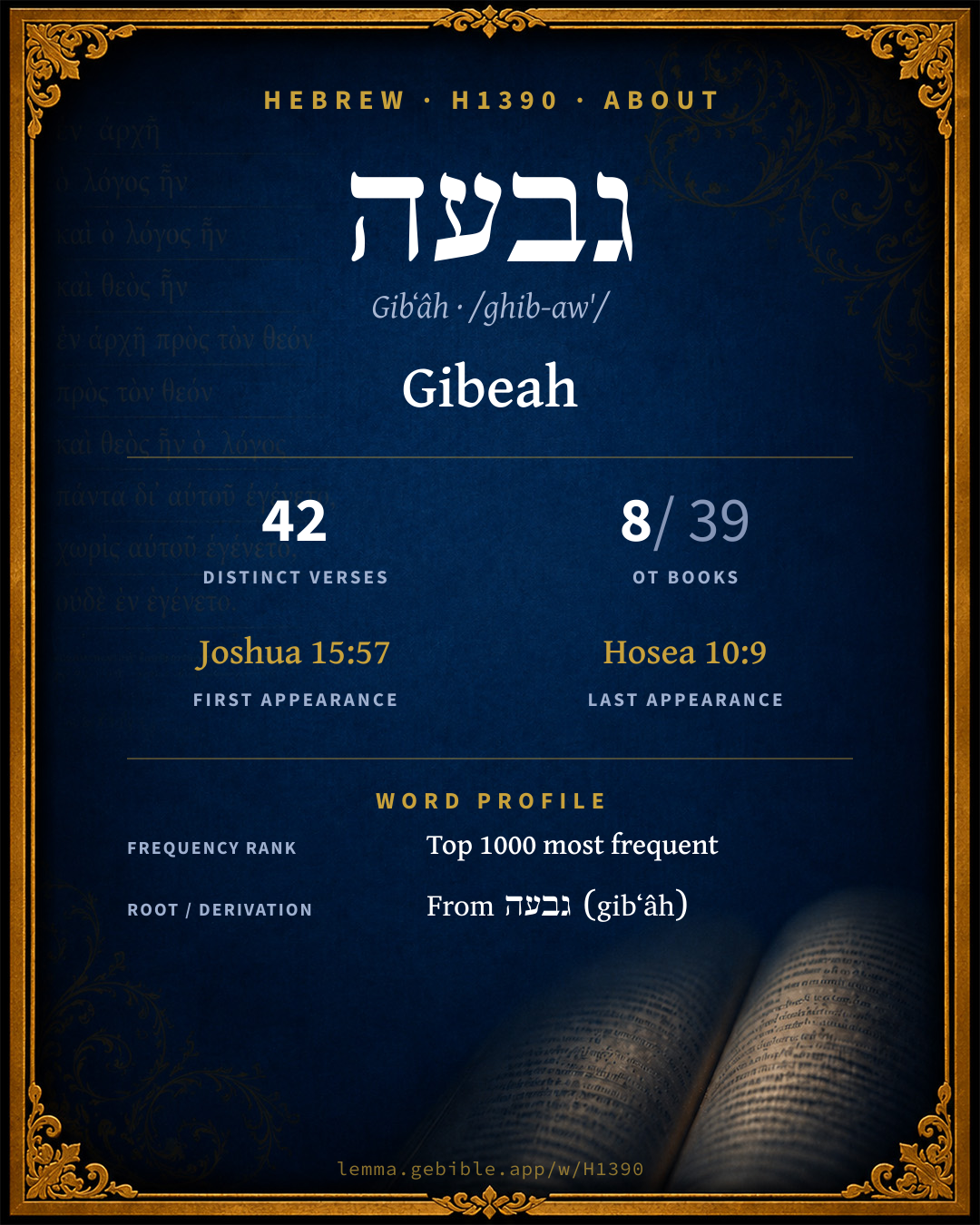
גִּבְעָה
Gibeah
BDB lists 4 entries for ‘Gibeah’ fuller range ↓
Full lexicon entry — Brown-Driver-Briggs (BDB)
From Brown-Driver-Briggs (BDB)
Where this word appears
Grammar key — what these labels mean
Part of speech
- Noun
- A naming word — a person, place, thing, or idea.
Noun type
- Proper
- A name of a specific person, place, or people (e.g. Abraham, Zion, Israel).
Every verse where H1390 appears — 42 distinct verses across 8 books. Click any verse to open its interlinear word-by-word view. Verse text shown in the World English Bible for context — . Each verse’s Hebrew form is shown with its reference; the English is not keyword-highlighted, since the data carries no word-level English alignment. Use “Compare translations” on any verse to read it across multiple English versions. This concordance covers the Hebrew Bible; Septuagint (Greek Old Testament) occurrences are not indexed here.
Joshua 1 verse
Judges 23 verses
- Judges 19:12 גִּבְעָֽה n Proper His master said to him, We won't turn aside into the city of a foreigner, that is not of the children of Israel; but we will pass over to Gibeah.
- Judges 19:13 בַ/גִּבְעָ֖ה prep det + n Proper He said to his servant, Come and let us draw near to one of these places; and we will lodge in Gibeah, or in Ramah.
- Judges 19:14 הַ/גִּבְעָ֖ה ptcl def.art + n Proper So they passed on and went their way; and the sun went down on them near to Gibeah, which belongs to Benjamin.
- Judges 19:15 בַּ/גִּבְעָ֑ה prep det + n Proper They turned aside there, to go in to lodge in Gibeah: and he went in, and sat him down in the street of the city; for there was no man who took them into his house to lodge.
- Judges 19:16 בַּ/גִּבְעָ֑ה prep det + n Proper Behold, there came an old man from his work out of the field at even: now the man was of the hill-country of Ephraim, and he sojourned in Gibeah; but the men of the place were Benjamites.
- Judges 20:4 הַ/גִּבְעָ֨תָ/ה֙ ptcl def.art + n Proper + sfx dem The Levite, the husband of the woman who was murdered, answered, I came into Gibeah that belongs to Benjamin, I and my concubine, to lodge.
- Judges 20:5 הַ/גִּבְעָ֔ה ptcl def.art + n Proper The men of Gibeah rose against me, and beset the house round about me by night; me they thought to have slain, and my concubine they forced, and she is dead.
- Judges 20:9 לַ/גִּבְעָ֑ה prep det + n Proper But now this is the thing which we will do to Gibeah: [we will go up] against it by lot;
- Judges 20:13 בַּ/גִּבְעָה֙ prep det + n Proper Now therefore deliver up the men, the base fellows, who are in Gibeah, that we may put them to death, and put away evil from Israel. But Benjamin would not listen to the voice of their brothers the children of Israel.
- Judges 20:14 הַ/גִּבְעָ֑תָ/ה ptcl def.art + n Proper + sfx dem The children of Benjamin gathered themselves together out of the cities to Gibeah, to go out to battle against the children of Israel.
- Judges 20:15 הַ/גִּבְעָה֙ ptcl def.art + n Proper The children of Benjamin were numbered on that day out of the cities twenty-six thousand men who drew the sword, besides the inhabitants of Gibeah, who were numbered seven hundred chosen men.
- Judges 20:19 הַ/גִּבְעָֽה ptcl def.art + n Proper The children of Israel rose up in the morning, and encamped against Gibeah.
- Judges 20:20 הַ/גִּבְעָֽה ptcl def.art + n Proper The men of Israel went out to battle against Benjamin; and the men of Israel set the battle in array against them at Gibeah.
- Judges 20:21 הַ/גִּבְעָ֑ה ptcl def.art + n Proper The children of Benjamin came forth out of Gibeah, and destroyed down to the ground of the Israelites on that day Twenty-two thousand men.
- Judges 20:25 הַ/גִּבְעָה֮ ptcl def.art + n Proper Benjamin went forth against them out of Gibeah the second day, and destroyed down to the ground of the children of Israel again eighteen thousand men; all these drew the sword.
- Judges 20:29 הַ/גִּבְעָ֖ה ptcl def.art + n Proper Israel set liers-in-wait against Gibeah round about.
- Judges 20:30 הַ/גִּבְעָ֖ה ptcl def.art + n Proper The children of Israel went up against the children of Benjamin on the third day, and set themselves in array against Gibeah, as at other times.
- Judges 20:31 גִּבְעָ֨תָ/ה֙ n Proper + sfx dem The children of Benjamin went out against the people, and were drawn away from the city; and they began to strike and kill of the people, as at other times, in the highways, of which one goes up to Bethel, and the other to Gibeah, in the field, about thirty men of Israel.
- Judges 20:33 גָֽבַע n Proper All the men of Israel rose up out of their place, and set themselves in array at Baal Tamar: and the liers-in-wait of Israel broke forth out of their place, even out of Maareh Geba.
- Judges 20:34 לַ/גִּבְעָ֜ה prep det + n Proper There came over against Gibeah ten thousand chosen men out of all Israel, and the battle was sore; but they didn't know that evil was close on them.
- Judges 20:36 הַ/גִּבְעָֽה ptcl def.art + n Proper So the children of Benjamin saw that they were struck; for the men of Israel gave place to Benjamin, because they trusted to the liers-in-wait whom they had set against Gibeah.
- Judges 20:37 הַ/גִּבְעָ֑ה ptcl def.art + n Proper The liers-in-wait hurried, and rushed on Gibeah; and the liers-in-wait drew themselves along, and struck all the city with the edge of the sword.
- Judges 20:43 הַ/גִּבְעָ֖ה ptcl def.art + n Proper They enclosed the Benjamites round about, [and] chased them, [and] trod them down at [their] resting-place, as far as over against Gibeah toward the sunrise.
1 Samuel 10 verses
- 1 Samuel 10:26 גִּבְעָ֑תָ/ה n Proper + sfx dem Saul also went to his house to Gibeah; and there went with him the host, whose hearts God had touched.
- 1 Samuel 11:4 גִּבְעַ֣ת n Proper Then came the messengers to Gibeah of Saul, and spoke these words in the ears of the people: and all the people lifted up their voice, and wept.
- 1 Samuel 13:2 בְּ/גִבְעַ֖ת prep + n Proper Saul chose him three thousand men of Israel, of which two thousand were with Saul in Michmash and in the Mount of Bethel, and one thousand were with Jonathan in Gibeah of Benjamin: and the rest of the people he sent every man to his tent.
- 1 Samuel 13:15 גִּבְעַ֣ת n Proper Samuel arose, and got him up from Gilgal to Gibeah of Benjamin. Saul numbered the people who were present with him, about six hundred men.
- 1 Samuel 14:2 הַ/גִּבְעָ֔ה ptcl def.art + n Proper Saul abode in the uttermost part of Gibeah under the pomegranate tree which is in Migron: and the people who were with him were about six hundred men;
- 1 Samuel 14:16 בְּ/גִבְעַ֖ת prep + n Proper The watchmen of Saul in Gibeah of Benjamin looked; and, behold, the multitude melted away, and they went [here] and there.
- 1 Samuel 15:34 גִּבְעַ֥ת n Proper Then Samuel went to Ramah; and Saul went up to his house to Gibeah of Saul.
- 1 Samuel 22:6 בַּ/גִּבְעָ֜ה prep det + n Proper Saul heard that David was discovered, and the men who were with him: now Saul was sitting in Gibeah, under the tamarisk tree in Ramah, with his spear in his hand, and all his servants were standing about him.
- 1 Samuel 23:19 הַ/גִּבְעָ֖תָ/ה ptcl def.art + n Proper + sfx dem Then came up the Ziphites to Saul to Gibeah, saying, Doesn't David hide himself with us in the strongholds in the wood, in the hill of Hachilah, which is on the south of the desert?
- 1 Samuel 26:1 הַ/גִּבְעָ֖תָ/ה ptcl def.art + n Proper + sfx dem The Ziphites came to Saul to Gibeah, saying, Doesn't David hide himself in the hill of Hachilah, which is before the desert?
2 Samuel 2 verses
- 2 Samuel 21:6 בְּ/גִבְעַ֥ת prep + n Proper let seven men of his sons be delivered to us, and we will hang them up to Yahweh in Gibeah of Saul, the chosen of Yahweh. The king said, I will give them.
- 2 Samuel 23:29 מִ/גִּבְעַ֖ת prep + n Proper Heleb the son of Baanah the Netophathite, Ittai the son of Ribai of Gibeah of the children of Benjamin,
1 Chronicles 1 verse
2 Chronicles 1 verse
Isaiah 1 verse
Hosea 3 verses
- Hosea 5:8 בַּ/גִּבְעָ֔ה prep det + n Proper "Blow the cornet in Gibeah, And the trumpet in Ramah! Sound a battle cry at Beth Aven, behind you, Benjamin!
- Hosea 9:9 הַ/גִּבְעָ֑ה ptcl def.art + n Proper They have deeply corrupted themselves, As in the days of Gibeah. He will remember their iniquity. He will punish them for their sins.
- Hosea 10:9 הַ/גִּבְעָ֔ה בַּ/גִּבְעָ֛ה ptcl def.art + n Proper prep det + n Proper "Israel, you have sinned from the days of Gibeah. There they remained. The battle against the children of iniquity doesn't overtake them in Gibeah.
About this entry
At a glance — auto-summarized from this page’s data, not written by a person. Every figure links to its source below. This summary describes the numbers; it doesn’t interpret them.
The Hebrew name גבעה centers on the idea of “Gibeah.” The word gravitates to Judges (55%), then 1 Samuel and Hosea. It appears 42 verses across 8 books of the Hebrew Bible, among its moderately common vocabulary. Debuting at Joshua 15:57, it then recurs through the corpus. For the data behind this summary, explore 42-verse concordance and the renderings breakdown below.
Gloss history
Strong's 1890 vs modern scholarship
About this word
Strong's H1390 catalogs a Hebrew word from the Hebrew Old Testament.
These counts are not copied from any lexicon or concordance. They are computed here, from the morphology-tagged Hebrew Old Testament. What Lemma adds →
- 42
- distinct verses
- The word appears in 42 distinct verses.
- 8 / 39
- OT books
- The word appears in 8 of 39 Old Testament books.
- #837
- by frequency
- Top 1000 most frequent Hebrew words (rank 837 of 8,640 Hebrew words by occurrence).
View all 42 occurrences in the concordance →
By section of the Old Testament
By traditional corpus
Conventional, traditional groupings — biblical authorship is debated, so this is a traditional corpus grouping, not an authorship claim. Each share is this word’s portion of its verses in that division of the Hebrew canon. Each figure is a share of the word’s 42 distinct verses.
- Prophets (Nevi'im) 40 verses · 95%
- Writings (Ketuvim) 2 verses · 5%
How translations render this word
Counts come from each version’s own published word-to-Strong’s tagging or interlinear alignment — an approximate guide to how each version renders this word, not a word-level alignment the data otherwise carries. Because each total is that version’s own tagged count, the per-version totals vary from one another and need not match the appearance or distinct-verse counts above. These counts may also differ from a printed concordance because Lemma counts each distinctly tagged rendering and does not collapse phrase taggings into a single head-word total. This is a fixed set of word-tagged versions (KJV, ASV, BSB, ULT) and does not change with the reading translation you choose elsewhere. Each version’s license is shown beside its name below (and on Sources).
BDB lists this Strong’s number as 2 distinct words (homographs). Each count above pools all of them and is not split by sense — see the Senses section below. A low-frequency rendering may belong to a different one of those words, not the primary meaning.
- King James Version†: Gibeah 36×, Against gibeah 2×
- American Standard Version†: Gibeah 34×, Against gibeah 3×, Was in the hill 2×
- Berean Standard Bible†: Gibeah 40×
- unfoldingWord Literal Text†: Gibeah 33×, Gibeah of 9×
King James Version Public Domain
Renders H1390 across 44† tagged occurrences — most commonly:
Plus 6 renderings that appear only once — usually multi-word phrases or single function words the recovered tagging swept in, not distinct renderings.
American Standard Version Public Domain
Renders H1390 across 44† tagged occurrences — most commonly:
Plus 5 renderings that appear only once — usually multi-word phrases or single function words the recovered tagging swept in, not distinct renderings.
Berean Standard Bible Public Domain
Renders H1390 across 42† tagged occurrences — most commonly:
Plus 2 renderings that appear only once — usually multi-word phrases or single function words the recovered tagging swept in, not distinct renderings.
unfoldingWord Literal Text CC BY-SA 4.0
Renders H1390 across 43† tagged occurrences — most commonly:
Plus 1 rendering that appears only once — usually multi-word phrases or single function words the recovered tagging swept in, not distinct renderings.
7 senses and sub-senses in the full BDB
What do BDB’s symbols mean?
BDB uses these scholarly abbreviations:
| Symbol | Meaning |
|---|---|
| 𝔊 | the Septuagint (the ancient Greek translation, LXX) |
| 𝔙 | the Vulgate (the Latin translation) |
| 𝔖 | the Syriac version (the Peshitta) |
| 𝔗 | the Targum (the Aramaic translation) |
| ψ | the Psalms |
| √ | root (the underlying root or stem) |
| ‖ | parallel passage (a synonymous or contrasted parallel) |
| † | the dagger: every passage where the word occurs is cited |
The 7 senses and sub-senses the full Brown-Driver-Briggs lexicon distinguishes for this word, in lexicon order (not ranked by frequency), with BDB’s own verbatim wording and sub-sense lettering. Shown in Hebrew script with BDB’s own scholarly abbreviations. The condensed entry is in the Lexicon Entry tab. See also the Forms in the corpus table below.
גבעה I hill
- 1. in ordinary prose, hill, lower than mountain Ex 17:9, 10 (E) 2 S 2:25; it may be n.pr. in 1 S 7:1; 10:10 2 S 6:3, 4 v. also sub ii. גִּבְעָה. e.g. Exodus 17:9
- 2. especially as place of illicit worship עַל כָּל־ג׳ גְּבֹהָה ותחת כל עץ רענן 1 K 14:23 2 K 17:10 Je 2:20; cf. Dt 12:2 2 K 16:4 2 Ch 28:4 (these two + במות); also Ho 4:13 Je 13:27; 17:2 Ez 6:13 (v. supr.). e.g. 1 Kings 14:23
- 3. very commonly ‖ הר in poet. & proph. Dt 33:15 ψ 72:3; 114:4, 6; 148:9 Ct 2:8; 4:6 Is 2:2, 14; 30:17, 25; 31:4; 40:4, 12; 41:15; 42:15; 54:10; 55:12; 65:7 Je 3:23; 4:24; 16:16; 50:7 Ez 6:3; 34:6; 35:8; 36:4, 6 Ho 4:13; 10:8 Jo 4:18 Am 9:13 Mi 4:1; 6:1 Na 1:5 Hb 3:6; rarely in prose Dt 12:2; sometimes as rejoicing ψ 65:13, majestic (poet.) ג׳ עולם Gn 49:26 Dt 33:15 Hb 3:6 (‘everlasting hills’); cf. also Jb 15:7; high Pr 8:25 (with adj. high, cf. supr.) Je 49:16. e.g. Deuteronomy 33:15
- 4. hills with special names, some nearly or quite = n.pr.loc., which see under the respective words: ג׳ הַמּוֹרֶה Ju 7:1 teacher’s hill, in valley of Jezreel; ג׳ הָעֲרָלוֹת Jos 5:3 hill of the fore-skins; ג׳ הָאֱלֹהִים 1 S 10:5 (a designation of Gibeah); ג׳ הַחֲכִילָה 1 S 23:19; 26:1, 3; ג׳ אַמָּה 2 S 2:24; ג׳ הַלְּבוֹנָה Ct 4:6 (i.e. hill where frankincense is grown); ג׳ גָּרֵ֑ב Je 31:39; ג׳ יְרוּשָׁלַם Is 10:32 cf. 31:4 (where ‖ הַר־צִיּוֹן), Ez 34:26 (v. supr.) & הַגְּבָעוֹת Zp 1:10 hills on which Jerusalem stands. e.g. Judges 7:1
גבעה II loc. (hill)
- 1. a city of Judah Jos 15:57 (perhaps one of two villages called Gabaa, Gabatha in Onom. v. LagOnom. 246, 128; 2nd ed. 255, 160). e.g. Joshua 15:57
- 2. city of Benj. Ju 19:14, 16 + 20 times Ju, 1 S 10:26; 14:2; 22:6; 26:1 2 S 23:29 = 1 Ch 11:31; also Ho 5:8; 9:9; 10:9(×2) (cf. Ju 19:12 ff.) 2 Ch 13:2; perhaps also 1 S 7:1; 10:10 2 S 6:3, 4 read also (for גבע) 1 S 13:16 Ju 20:10, 33; = גִּבְעַת Jos 18:28; called also גִּבְעַת בִּנְיָמִין 1 S 13:2, 15; 14:16, & גִּבְעַת שָׁאוּל 1 S 11:4; 15:34 Is 10:29; 2 S 21:6 read prob. גִּבְעוֹן, 𝔊 We Dr. e.g. Judges 19:14
- 3. a city of Ephraim, called גִּבְעַת פִּֽינְחָס Jos 24:33. e.g. Joshua 24:33
Senses from the full Brown-Driver-Briggs lexicon (Brown, Driver, Briggs; Oxford 1906 — public domain), digitized via Sefaria, supplemented by the OpenScriptures HebrewLexicon (CC BY 4.0). Full attribution on Sources.
Word origin
I. n.f. hill—abs. גִּבְעָה 2 S 2:25 + 13 times + Ez 6:13 (del. Co q.v.) 1 S 7:1 2 S 6:3, 4 (cf. Dr); cstr. גִּבְעַת Jos 5:3 + 8 times + 1 S 10:5 (cf. Dr); sf. גִּבְעָתִי Ez 34:26 (but del. Co), גִּבְעָתָהּ Is 31:4; pl. abs. גְּבָעוֹת Dt 12:2 + 35 times; cstr. גִּבְעוֹת Dt 33:15 Hb 3:6, גִּבְעֹת Gn 49:26; sf. גִּבְעוֹתֶיךָ Ez 35:8;—hill, height, elevation, both high and low, cf. ψ 148:9 ההרים וכל גבעות, 65:13;—
II. n.pr.loc. (hill)—ג׳ Jos 15:57 +; (הַ)גִּבְעָ֫תָה Ju 20:4 + 5 times; גִּבְעַת Jos 18:28; cstr. גִּבְעַת 1 S 11:4 + 9 times; abs. always c. art. except Jos 15:57; 18:28 Ju 19:12; 20:31 1 S 10:26 2 Ch 13:2;—
— Brown-Driver-Briggs (Oxford 1906, public domain), digitized via Sefaria, supplemented by the OpenScriptures HebrewLexicon (CC BY 4.0). See Sources.
Derived from גבעה (gibʻâh) (H1389) — hill.
Jastrow Dictionary
A second Hebrew/Aramaic lexicon for comparison, covering Aramaic and post-biblical (Talmudic, Targumic, Midrashic) usage that the biblical-Hebrew BDB does not. Matched by lemma rather than by Strong’s number, so a lemma may carry more than one Jastrow headword (shown separately below), and the entries cover usage well beyond the Bible.
גִּבְעָה
- 1. hill. Lev. R. s. 10 כמין ג׳ like a hill (the bullock between the two rams). Cant. R. to IV, 6 עשה ערלותיהן ג׳ he piled up their preputia; Gen. R. s. 47 העמידן גִבְעַת ערלות; a. e.—Pl. גְּבָעוֹת. Ḥag. 15ᵃ ברא הרים ברא ג׳ He created mountains, and (corresponding to them) hills. Taan. 8ᵇ (ref. to Job XXXVII, 13) אם לשבט בהרים וג׳ if He sends rain as a scourge, He sends it on mountains and hills. Ab. Zar. 17ᵃ הרים וג׳ ye mountains and hills! Sot. 5ᵃ; a. fr. e.g. Job 37:13
- 2. pr. n. pl. Gibeah. Gitt. 6ᵇ עסיק בפלגש ג׳ studying the case of the woman murdered in Gibeah (Jud. XIX sq.). Pesik. R. s. 11 בפלגש בג׳ in the war about the woman of G.; a. e.—Shebu. 35ᵇ שמות האמורין בג׳ Rashi (ed. בגִבְעַת בִּנְיָמִין) the names (Adonai, El &c.) used in the chapter about Gibeah (Jud. XX).
A Dictionary of the Targumim, the Talmud Babli and Yerushalmi, and the Midrashic Literature (Marcus Jastrow; London, Luzac, 1903) — Public Domain. Digitized via Sefaria. Digitized via Sefaria. Full attribution on Sources.
Forms in the corpus
The 29 distinct written forms H1390 takes in the Hebrew Bible, most frequent first — each parse links to that state’s occurrences in the concordance. Hebrew forms include their vowel points and cantillation, so a single lemma takes many written forms.
| Form | Parsing | Example | Uses |
|---|---|---|---|
| הַ/גִּבְעָ֖ה | Noun, Proper | Judges 19:14 | 4 |
| הַ/גִּבְעָ֑ה | Noun, Proper | Hosea 9:9 | 3 |
| הַ/גִּבְעָ֔ה | Noun, Proper | Hosea 10:9 | 3 |
| הַ/גִּבְעָֽה | Noun, Proper | Judges 20:19 | 3 |
| בְּ/גִבְעַ֖ת | Noun, Proper | 1 Samuel 13:2 | 2 |
| בַּ/גִּבְעָ֑ה | Noun, Proper | Judges 19:15 | 2 |
| גִּבְעַ֣ת | Noun, Proper | 1 Samuel 11:4 | 2 |
| גִּבְעַ֥ת | Noun, Proper | 1 Samuel 15:34 | 2 |
| הַ/גִּבְעָ֖תָ/ה | Noun, Proper | 1 Samuel 23:19 | 2 |
| בַ/גִּבְעָ֖ה | Noun, Proper | Judges 19:13 | 1 |
| בְּ/גִבְעַ֥ת | Noun, Proper | 2 Samuel 21:6 | 1 |
| בַּ/גִּבְעָ֔ה | Noun, Proper | Hosea 5:8 | 1 |
| בַּ/גִּבְעָ֛ה | Noun, Proper | Hosea 10:9 | 1 |
| בַּ/גִּבְעָ֜ה | Noun, Proper | 1 Samuel 22:6 | 1 |
| בַּ/גִּבְעָה֙ | Noun, Proper | Judges 20:13 | 1 |
| גָֽבַע | Noun, Proper | Judges 20:33 | 1 |
| גִּבְעָ֑ה | Noun, Proper | 2 Chronicles 13:2 | 1 |
| גִּבְעָ֑תָ/ה | Noun, Proper | 1 Samuel 10:26 | 1 |
| גִּבְעָ֣ה | Noun, Proper | Joshua 15:57 | 1 |
| גִּבְעָ֨תָ/ה֙ | Noun, Proper | Judges 20:31 | 1 |
| גִּבְעָֽה | Noun, Proper | Judges 19:12 | 1 |
| הַ/גִּבְעָ֑תָ/ה | Noun, Proper | Judges 20:14 | 1 |
| הַ/גִּבְעָ֨תָ/ה֙ | Noun, Proper | Judges 20:4 | 1 |
| הַ/גִּבְעָה֙ | Noun, Proper | Judges 20:15 | 1 |
| הַ/גִּבְעָה֮ | Noun, Proper | Judges 20:25 | 1 |
| לַ/גִּבְעָ֑ה | Noun, Proper | Judges 20:9 | 1 |
| לַ/גִּבְעָ֜ה | Noun, Proper | Judges 20:34 | 1 |
| מִ/גִּבְעַ֖ת | Noun, Proper | 2 Samuel 23:29 | 1 |
| מִ/גִּבְעַת֙ | Noun, Proper | 1 Chronicles 11:31 | 1 |
Same root — word family
Other BDB entries built from the same root as H1390, grouped by Strong’s listed origin. These share a root / origin per the lexicon — not necessarily a shared meaning. Each links to that word’s own entry.
Derives from
Shares the same root
Proper names from this root
People and places named from this root — a name, not an additional meaning of the word.
Compare all same-root words → Showing 4 of 6 — not the complete family. 3 of the same-root words are proper names (people or places). They share a root, not necessarily a meaning.
Bible dictionary
Public-domain dictionary articles matched to this entry by name (Gibeah). A biblical name can be shared by more than one person or place, so an article may treat several.
Easton's Bible Dictionary · M. G. Easton, 1897
A hill or hill-town, "of Benjamin" (1 Sam. 13:15), better known as "Gibeah of Saul" (11:4; Isa. 10:29). It was here that the terrible outrage was committed on the Levite's concubine which led to the almost utter extirpation of the tribe of Benjamin (Judg. 19; 20), only six hundred men surviving after a succession of disastrous battles. This was the birthplace of Saul, and continued to be his residence after he became king (1 Sam. 10:26; 11:4; 15:34). It was reckoned among the ancient sanctuaries of Palestine (10:26; 15:34; 23:19; 26:1; 2 Sam. 21:6-10), and hence it is called "Gibeah of God" (1 Sam. 10:5, R.V. marg.). It has been identified with the modern Tell el-Ful (i.e., "hill of the bean"), about 3 miles north of Jerusalem.
Smith's Bible Dictionary · William Smith, 1863
a word employed in the Bible to denote a hill. Like most words of this kind it gave its name to several towns and places in Palestine, which would doubtless be generally on or near a hill. They are--
+ Gibeah, a city in the mountain district of Judah, named with Maon and the southern Carmel, (Joshua 15:57) and comp. 1Chr 2:49 etc. + Gibeah of Benjamin first appears in the tragical story of the Levite and his concubine. (Judges 19:20) It was then a "city," with the usual open street or square, (Judges 19:15,17,20) and containing 700 "chosen men," ch. (Judges 20:15) probably the same whose skill as slingers is preserved in the next verse. In many particulars Gibeah agrees very closely with Tuleil-el-Ful, a conspicuous eminence just four mlles north of Jerusalem, to the right of the road. We next meet with Glbeah of Benjamin during the Philistine wars of Saul and Jonathan. (1 Samuel 13:15,16) It now bears its full title. As "Gibeah of Benjamin" this place is referred to in (2 Samuel 23:29) (comp. 1Chr 11:31), and as "Gibeah" it is mentioned by Hosea, (Hosea 5:8; 9:9; 10:9) but it does not again appear in the history. It is, however, almost without doubt identical with + Gibeah of Saul. This is not mentioned as Saul's city till after his anointing, (1 Samuel 10:26) when is said to have gone "home" to Gibeah. In the subsequent narrative the town bears its full name. ch (1 Samuel 11:4) + Gibeah in Kirjath-jearim was no doubt a hill in that city, and the place in which the ark remained from the time of its return by the Philistines till its removal by David. (2 Samuel 6:3,4) comp. 1Sam 7:1,2 + Gibeah in the field, named only in (Judges 20:31) as the place to which one of the "highways" led from Gibeah of Benjamin. It is probably the same as Geba. The "meadows of Gaba" (Authorized Version Gibeah), (Judges 20:33) have no connection with the "field," the Hebrew word being entirely different.
Hitchcock's Bible Names Dictionary · Roswell D. Hitchcock, 1869
a hill
Classic public-domain reference works; full attribution on Sources.
Septuagint verse parallels
This word appears in 42 verses that also exist in the Greek Old Testament (Septuagint), out of the 42 Hebrew verses it occurs in. You can read those verses in Greek by switching the Old Testament edition to the Septuagint.
Read these verses in the Septuagint
- Joshua 15:57
- Judges 19:12
- 1 Samuel 10:26
- 2 Samuel 21:6
- 1 Chronicles 11:31
- 2 Chronicles 13:2
- Isaiah 10:29
- Hosea 5:8
This is a verse-level parallel only — the same verses exist in both the Hebrew and Greek Old Testaments. No word-level Hebrew↔Greek correspondence is claimed: the data carries no such alignment, so no Greek word is shown as this Hebrew word’s translation. Coverage is not total — the Septuagint omits the deuterocanon and renumbers the Psalms, so some Hebrew verses have no direct Greek parallel.