1 Corinthians 3:6

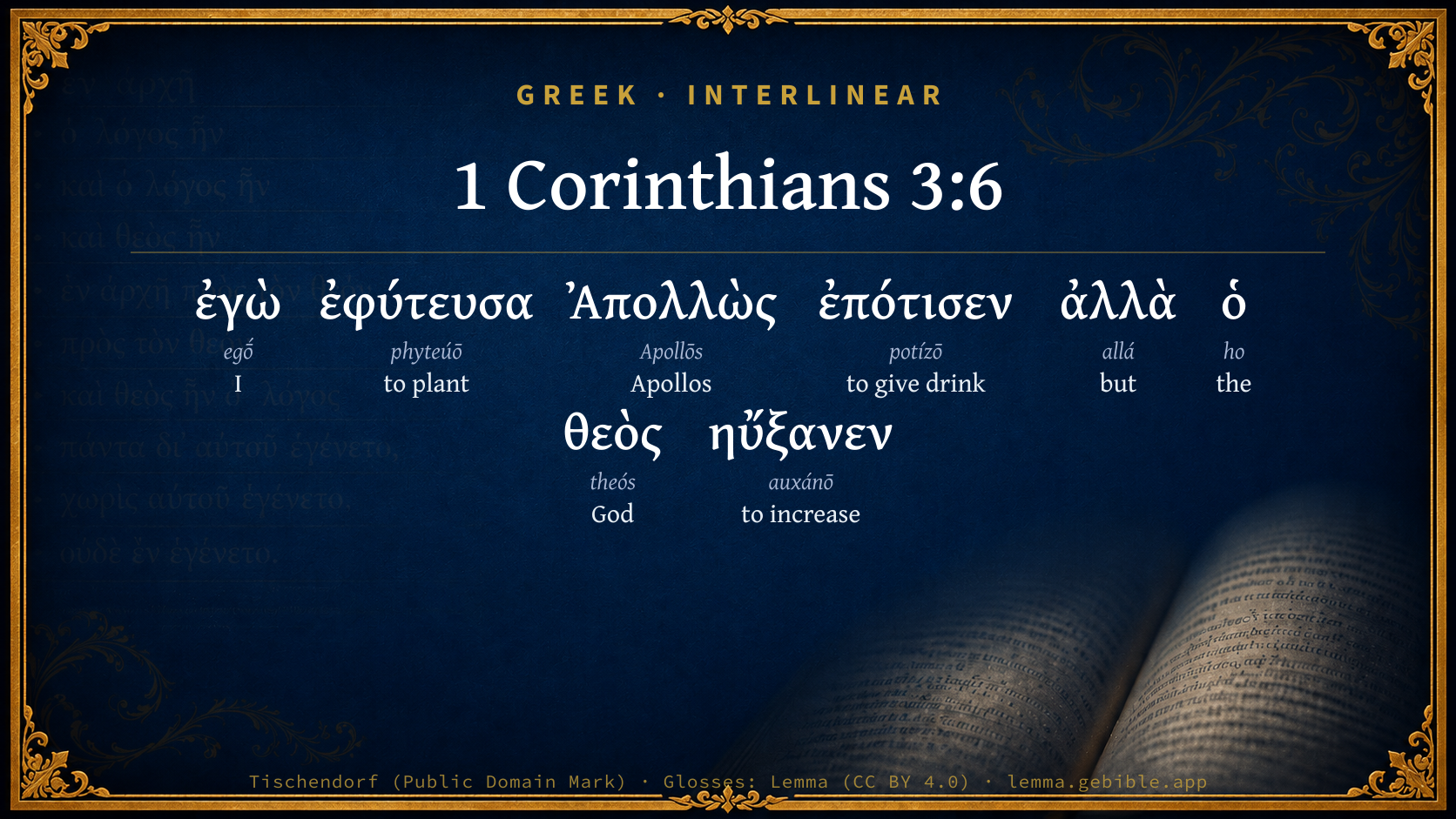
Greek (Tischendorf 8th ed.) 1 Corinthians 3:6 appears in the Greek New Testament. The text above is from the Tischendorf 8th edition. Each word links to its Strong’s number and a concise gloss. Click any word for its full Thayer’s Greek Lexicon entry.
Download image
Cite this verse

1 Corinthians 3:6 (World English Bible). Public Domain. Lemma interlinear Bible study tool, https://lemma.gebible.app/v/1-corinthians/3/6.

Show BibTeX & RIS
BibTeX
RIS
English Translation
I planted. Apollos watered. But God gave the increase.
World English Bible · Public Domain
Download a study sheet

One document with this verse’s original text, its word-by-word gloss line, the meaning frame, cross-references with their text, attributed commentary, and full source and license credits — printable, and it pastes into notes with its structure intact.

This verse Autodidact and up

Study sheet (.html) Plain text (.txt)

A passage Seminary Student

Up to 50 verses in one chapter. A passage sheet keeps up to 6 commentary sources and 12 cross-references per verse, in the order this page ranks them, and says so on the sheet whenever that leaves anything out. Ask for a single verse and you get the Autodidact verse sheet above.

Everything on this page stays free to read, with no account — the sheet is a download of what is already on screen, not access to it.

Want to remove ads? Support Godless Engineer
Compare translations 3

The same verse in 3 English versions, stacked beneath the original-language interlinear above. Click any original word for its lexicon entry.

Each is an independent rendering of the whole verse — the interlinear is not word-aligned to these translations.

Highlighted words mark where these versions differ — a whole-verse word diff, not a word-by-word alignment.

  • World English Bible Public Domain
    I planted. Apollos watered. But God gave the increase.
  • King James Version Public Domain
    I have planted, Apollos watered; but God gave the increase.
  • unfoldingWord Literal Text CC BY-SA 4.0
    I planted, Apollos watered, but God caused to grow.

unfoldingWord Literal Text — © unfoldingWord, licensed CC BY-SA 4.0. Word-aligned USFM3 via Door43 (git.door43.org/unfoldingWord/en_ult).

Versions to compare (up to 4)

3 of 4 selected

Show all 19 translations

Every available English version of this verse, each an independent rendering of the whole verse.

  • World English Bible Public Domain
    I planted. Apollos watered. But God gave the increase.
  • Berean Standard Bible Public Domain
    I planted the seed and Apollos watered it, but God made it grow.
  • Majority Standard Bible Public Domain
    I planted the seed and Apollos watered it, but God made it grow.
  • King James Version Public Domain
    I have planted, Apollos watered; but God gave the increase.
  • American Standard Version (1901) Public Domain
    I planted, Apollos watered; but God gave the increase.
  • Revised Version (1885) Public Domain
    I planted, Apollos watered; but God gave the increase.
  • Geneva Bible (1599) Public Domain
    I haue planted, Apollos watred, but God gaue the increase.
  • Douay-Rheims (1899) Public Domain
    I have planted, Apollo watered, but God gave the increase.
  • Young's Literal Translation Public Domain
    I planted, Apollos watered, but God was giving growth;
  • Literal Standard Version CC BY-SA 4.0
    I planted, Apollos watered, but God was giving growth;
  • Unlocked Literal Bible CC BY-SA 4.0
    I planted, Apollos watered, but God gave the growth.
  • unfoldingWord Literal Text CC BY-SA 4.0
    I planted, Apollos watered, but God caused to grow.
  • Darby Bible Public Domain
    *I* have planted; Apollos watered; but God has given the increase.
  • World Messianic Bible Public Domain
    I planted. Apollos watered. But God gave the increase.
  • Webster's Bible Public Domain
    I have planted, Apollos watered: but God hath given the increase.
  • Free Bible Version CC BY-SA 4.0
    I did the planting, Apollos did the watering—but it was God who made you grow!
  • Bible in Basic English Public Domain
    I did the planting, Apollos did the watering, but God gave the increase.
  • Text-Critical English NT CC BY 4.0
    I planted, Apollos watered, but God gave the growth.
  • Tyndale New Testament (1534) Public Domain
    I have planted: Apollo watred: but god gave increace.

Literal Standard Version (2020), Covenant Press — licensed CC BY-SA 4.0. Text via the HelloAO Bible API (eBible.org). Unlocked Literal Bible (unfoldingWord) — licensed CC BY-SA 4.0. Text via the HelloAO Bible API (eBible.org). unfoldingWord Literal Text — © unfoldingWord, licensed CC BY-SA 4.0. Word-aligned USFM3 via Door43 (git.door43.org/unfoldingWord/en_ult). Free Bible Version, Dr. Jonathan Gallagher — licensed CC BY-SA 4.0. Text via the HelloAO Bible API (eBible.org).

Word by word

More ways to search: Search by grammar → Find every occurrence → Compare this word →

Practice this passage: Drill this verse → Learn its vocabulary →

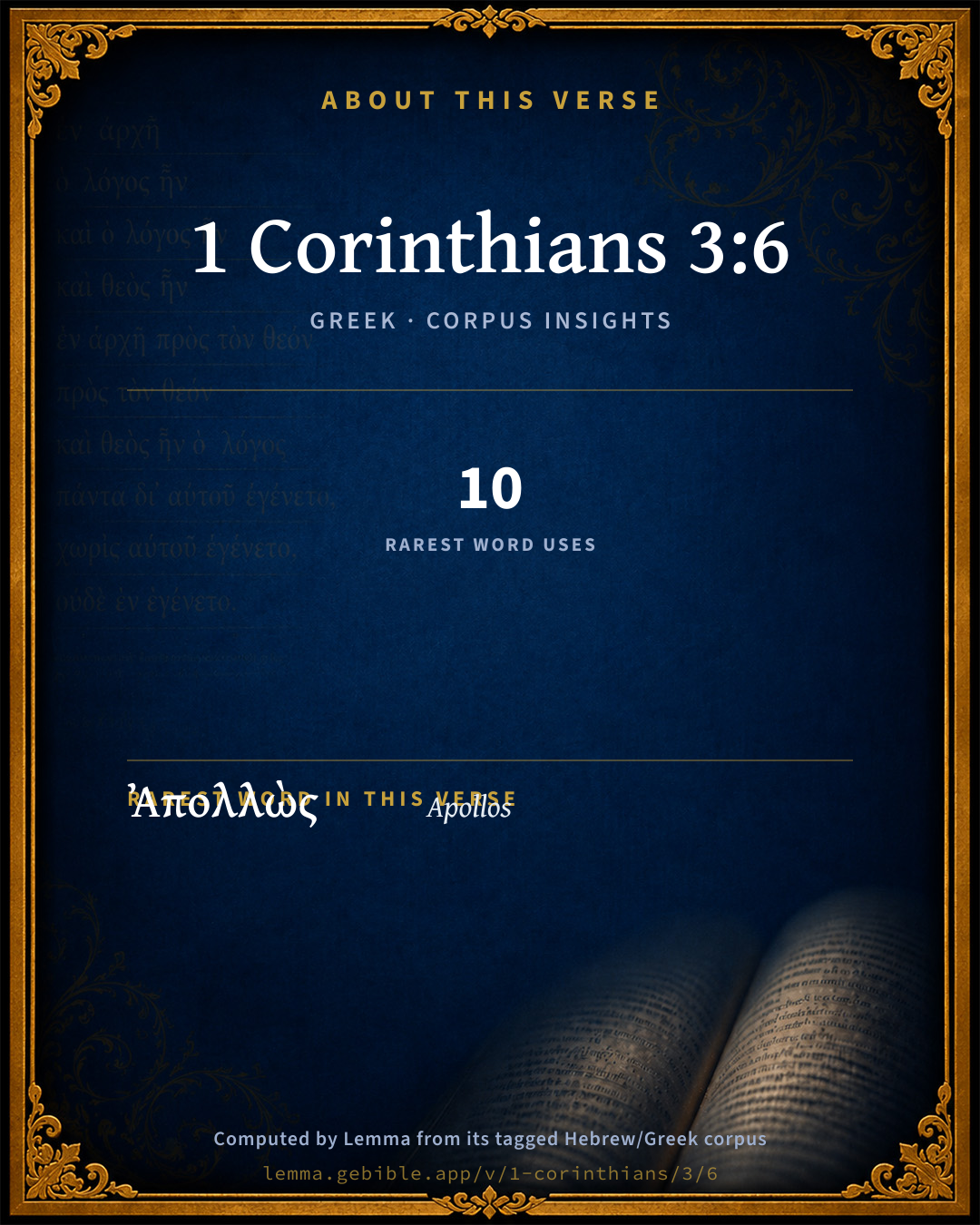
About this verse

These counts appear in no published source. They are computed here, from the morphology-tagged text and Lemma’s own curated glosses. What Lemma adds →

8
words
8
distinct lemmas
Pauline Epistles
section

Notable vocabulary

The rarest word here is Ἀπολλὼς Apollos G625 — appearing just 10 times in the whole Greek New Testament.

Shared distinctive vocabulary

Ἀπολλὼς Apollos G625 occurs in 10 verses of the Greek New Testament. Also found in:

Cross-references

25

Topical passages linked to 1 Corinthians 3:6 in the Treasury of Scripture Knowledge — connected by theme and wording, ordered by reader-vote popularity; previews shown in the World English Bible.

  • 1 Corinthians 3:9–10 For we are God's fellow workers. You are God's farming, God's building.
  • Proverbs 11:25 The liberal soul shall be made fat. He who waters shall be watered also himself.
  • 2 Corinthians 10:14–15 For we don't stretch ourselves too much, as though we didn't reach to you. For we came even as far as to you with the Gospel of Christ,
  • Acts 18:4–11 He reasoned in the synagogue every Sabbath, and persuaded Jews and Greeks.
  • 1 Corinthians 9:1 Am I not free? Am I not an apostle? Haven't I seen Jesus Christ, our Lord? Aren't you my work in the Lord?
  • Isaiah 55:10–11 For as the rain comes down and the snow from the sky, and doesn't return there, but waters the earth, and makes it bring forth and bud, and gives seed to the sower and bread to the eater;
  • Acts 19:1 It happened that, while Apollos was at Corinth, Paul, having passed through the upper country, came to Ephesus, and found certain disciples.
  • 1 Corinthians 1:30 But of him, you are in Christ Jesus, who was made to us wisdom from God, and righteousness and sanctification, and redemption:
  • Psalms 92:13–15 They are planted in Yahweh's house. They will flourish in our God's courts.
  • Acts 16:14 A certain woman named Lydia, a seller of purple, of the city of Thyatira, one who worshiped God, heard us; whose heart the Lord opened to listen to the things which were spoken by Paul.
  • Acts 18:26–27 He began to speak boldly in the synagogue. But when Priscilla and Aquila heard him, they took him aside, and explained to him the way of God more accurately.
  • 1 Corinthians 4:14–15 I don't write these things to shame you, but to admonish you as my beloved children.
  • 1 Corinthians 9:7–11 What soldier ever serves at his own expense? Who plants a vineyard, and doesn't eat of its fruit? Or who feeds a flock, and doesn't drink from the flock's milk?
  • 2 Corinthians 3:2–5 You are our letter, written in our hearts, known and read by all men;
  • Psalms 62:9 Surely men of low degree are just a breath, And men of high degree are a lie. In the balances they will go up. They are together lighter than a breath.
  • Psalms 62:11 God has spoken once, Twice I have heard this, That power belongs to God.
  • Psalms 127:1 Unless Yahweh builds the house, They labor in vain who build it. Unless Yahweh watches over the city, The watchman guards it in vain.
  • Isaiah 61:11 For as the earth brings forth its bud, and as the garden causes the things that are sown in it to spring forth; so the Lord Yahweh will cause righteousness and praise to spring forth before all the nations.
  • Acts 14:27 When they had arrived, and had gathered the assembly together, they reported all the things that God had done with them, and that he had opened a door of faith to the Gentiles.
  • Acts 18:24 Now a certain Jew named Apollos, an Alexandrian by race, an eloquent man, came to Ephesus. He was mighty in the Scriptures.
  • Acts 21:19 When he had greeted them, he reported one by one the things which God had worked among the Gentiles through his ministry.
  • Romans 15:18 For I will not dare to speak of any things except those which Christ worked through me, for the obedience of the Gentiles, by word and deed,
  • Acts 11:18 When they heard these things, they held their peace, and glorified God, saying, "Then God has also granted to the Gentiles repentance to life!"
  • 1 Thessalonians 1:5 and that our Gospel came to you not in word only, but also in power, and in the Holy Spirit, and with much assurance. You know what kind of men we showed ourselves to be among you for your sake.
  • 1 Corinthians 15:1–11 Now I declare to you, brothers, the Gospel which I preached to you, which also you received, in which you also stand,

Cross-references courtesy of OpenBible.info (CC BY 4.0).

Commentary

Notes on 1 Corinthians 3:6 from classic Christian and Jewish commentators (each source and its license shown beneath its notes). The classic Christian expositions comment on the surrounding passage and are grouped to its opening verse, so a note may address several verses; the Jewish commentaries on the Tanakh (Rashi and others) are per-verse, so they appear only where the commentator wrote on this verse.

Lemma curates 59 commentaries, every one of them public domain or Creative Commons licensed, each selected and text-cleaned for this edition rather than reprinted as found. About our sources →

Tyndale Open Study Notes

Tyndale Open Resources

3:6 I planted: See Acts 18:1-11. • Apollos watered: See Acts 18:27–19:1.

Tyndale Open Study Notes — © Tyndale Open Resources, licensed CC BY-SA 4.0. Text via the HelloAO Bible API.

Bengel's Gnomon

Johann Albrecht Bengel

1Co 3:6. Ἐφύτευσα—ἐπότισεν, I planted—he watered) Act 18:1; Act 19:1. Afterwards with the same view, he speaks of the foundation and what is reared upon it; of a father, and instructors [ch. 1Co 4:15].—ηὔξανεν, gave the increase) 1Co 3:10, at the beginning; Act 18:27, at the end.

Bengel's Gnomon of the New Testament — English translation (T&T Clark, Edinburgh, 1860) — public domain. Text from a community e-Sword module.

Meyer's Critical & Exegetical Commentary

Heinrich August Wilhelm Meyer

1Co_3:6-7. Statement of the difference in the διακονία of the two, and of the success of the ministry of both as dependent upon God, so that no one at all had any independent standing, but only God. Therewith Paul proceeds to point out the impropriety of the party-relation which men had taken up towards the two teachers.

ἐφύτευσα κ.τ.λ[489]] We are not to suppose the object left indefinite (de Wette); on the contrary, it emerges out of διʼ ὧν ἐπιστεύσατε, 1Co_3:5, namely: the faith of the Corinthian community. This is conceived of as a tree (comp Plato, Phaedr. p. 276 E) which was planted by Paul, inasmuch as he first brought the Corinthians to believe and founded the church; but watered[491] by Apollos, inasmuch as he had subsequently exerted himself in the way of confirming and developing the faith of the church, and for the increase of its numbers; and lastly, blessed with growth by God, inasmuch as it was under His influence (τῆς γὰρ αὐτοῦ χάριτος τὸ κατόρθωμα, Theodoret) that the work of both had success and prospered. This making it to grow is the effect of grace, without which the granum a primo sationis momento esset instar lapilli, Bengel. Comp Act_16:14; Act_14:27; 1Co_15:10.

ἐστί τι] may be taken to mean: is anything of importance, anything worth speaking of (Act_5:36; Gal_2:6; Gal_6:3. Plato, Phaedr. p. 242 E, Gorg. p. 472 A, Symp. p. 173 B; Xen. Mem. ii. 1. 12). It is more in accordance, however, with the decided tone of hostility to all human estimation which marks the whole context to take τι in quite a general sense (comp 1Co_10:19), so that of both in and by themselves (in comparison with God) it is said: they are nothing.

ἀλλʼ ὁ αὐξ. Θεός] sc[494] τὰ πάντα ἐστι (1Co_15:28; Col_3:11), which, according to the apostles intention, is to be drawn from what has been already said. An abbreviated form of the contrast, with which comp 1Co_7:19, and see generally Kühner, II. p. 604; Stallbaum, a[496] Rep. p. 366 D, 561 B. Theophylact says well: διδάξας, ὅτι Θεῷ δεῖ μόνῳ προσέχειν, καὶ εἰς αὐτὸν ἀνατιθέναι πάντα τὰ συμβαίνοντα ἀγαθά.

[489] .τ.λ. καὶ τὰ λοιπά.

[491] Augustine, Ep. 48, and several of the Fathers make ἐπότισεν refer in a totally inappropriate way to baptism.

[494] c. scilicet.

[496] d refers to the note of the commentator or editor named on the particular passage.

Meyer — Critical and Exegetical Commentary on the New Testament — English translation by Peter Christie, edited by Frederick Crombie (T&T Clark, 1880) — public domain. Text from a community e-Sword module.

Expositor's Greek Testament

ed. W. Robertson Nicoll

1Co 3:6-7 . The grammatical obj [500] of this sentence has been given by the foregoing context, viz. , the Cor [501] Church of believers ( cf. 1Co 4:15 ). φυτεύω Paul uses besides only in 1Co 9:7 ; his regular metaphor in this connexion is that of 1Co 3:10 . “Planting” and “watering” happily picture the relative services of P. and Ap. Ποτίζω , to give drink, to irrigate , may have for obj [502] men (1Co 3:2 , 1Co 12:13 , etc.), animals (Luk 13:15 ), or plants. In 1Co 3:2 , Paul was the ποτίζων γάλα . The vb [503] takes a double acc [504] , of person and thing (Wr [505] , p. 284). The ἀλλὰ of the last clause goes beyond a mere contrast ( δέ ) between God and men in their several parts, excluding the latter from the essential part: “but God He only, and no other made it to grow”. The planting and watering of Christ’s servants were occasions for the exercise of God’s vitalising energy. While the former vbs. are aor [506] , gathering up the work of the two ministers into single successive acts, ηὔξανεν is impf [507] of continued activity: “God was (all the while) making it to grow.” Several of the Ff [508] Aug [509] e.g. saw in ποτίζειν the baptism, in φυτεύειν the instruction of catechumens, “illustrating a general fault of patristic exegesis, the endeavour to attach a technical sense to words in the N.T. which had not yet acquired this meaning” (Lt [510] ). ὥστε , itaque ( and so, so then ), with ind [511] ( cf. 1Co 7:38 , 1Co 11:27 , 1Co 14:22 ), points out a result immediately flowing from what has been said: “the planter” and “the waterer,” in comparison with “the Lord” who dispensed their powers and “God” who makes their plants to grow, are reduced to nothing; “God who gives the growth” ( qui dat vim crescendi, Bz [512] ) alone remains. To the subject, ὁ αὐξάνων Θεός , the predicate τὰ πάντα ἐστὶν is tacitly supplied from the negative clauses foregoing. For ἐστίν τι ( anything of moment ), cf. Gal 2:6 ; Gal 6:3 , Act 5:36 , and note on τὶ εἰδέναι , 1Co 2:2 . The pr [513] ptp [514] with ὁ becomes, virtually, a (timeless) substantive the planter, waterer, Increaser (Wr [515] , p. 444).

[500] grammatical object.

[501] Corinth, Corinthian or Corinthians.

[502] grammatical object.

[503] verb

[504] accusative case.

[505] Winer-Moulton’s Grammar of N.T. Greek (8th ed., 1877).

[506] aorist tense.

[507]mpf. imperfect tense.

[508] Fathers.

[509] Augustine.

[510] J. B. Lightfoot’s (posthumous) Notes on Epp. of St. Paul (1895).

[511] indicative mood.

[512] Beza’s Nov. Testamentum: Interpretatio et Annotationes (Cantab., 1642).

[513] present tense.

[514] participle

[515] Winer-Moulton’s Grammar of N.T. Greek (8th ed., 1877).

The Expositor's Greek Testament, edited by W. Robertson Nicoll (1897–1910) — public domain. Text from a community e-Sword module.

Godet's Commentaries

Frédéric Louis Godet

Vv. 6, 7. “I planted, Apollos watered, but God gave the increase; 7. So then neither is he that planteth anything, neither he that watereth, but God that giveth the increase.” — The asyndeton between 1Co 3:6 and the preceding one arises from the fact that the verse reaffirms in a new form the last proposition of 1Co 3:5, of which it is only the development. In the two functions of planting and watering, there reappears in specialized form the idea of distribution contained in the “as the Lord gave to each.” In respect of Corinth Paul had received the mission of planting, that is to say, of founding the Church; Apollos, that of watering, that is to say, of developing the Church already founded. And if the labour of the one and the other had had some true success, it was due solely to the concurrence of God. As Edwards says: “God is the source of life in the physical as in the moral world. Man can indeed put the seed in contact with the soil; but life alone makes it spring and grow; and this life is not only beyond the power but even beyond the knowledge of man.” The imperfect ηὔξανεν denotes a Divine operation, which was in process at the very time when Paul and Apollos were labouring.

The apostle wishes decidedly to take away all individual and independent worth from the labour of the two workers whom he has chosen as examples, in view of a Church which tends to falsify the position of its ministers. This choice then has a perfectly natural explanation: was it not by speaking of himself and his friend that he could, with least scruple, remind them of the humble position of Christ’s ministers, by leaving it to the Church itself to make application of the truth to the other workers whom it exalted?

Frédéric Louis Godet — Commentaries on Luke, John, Romans, and 1 Corinthians — English translation (T&T Clark, Edinburgh, 1870s–1890s) — public domain. Text from a community e-Sword module.

Hodge's Commentary on Romans, Ephesians & First Corinthians

Charles Hodge

1Co_3:6

I have planted, Apollos watered: but God gave the increase.

This illustrates two points; first, the diversity of service on the part of ministers, spoken of in 1Co_3:5, one plants and another waters; and secondly, the entirely subordinate and instrumental character of their service. As in nature, planting and watering are not the efficient causes of vegetation; so in the church, ministerial acts are not the efficient causes of grace. In both cases all the efficiency is of God. And as in nature, planting and watering by human instrumentality, are not the necessary conditions of vegetation, so neither are ministerial acts the necessary conditions of faith. On the other hand, however, as the work of the husbandman is the ordinary and appointed means of securing a harvest, so the work of the ministry is the ordinary means of conversion.

Charles Hodge — Commentary on Romans (1835), First Corinthians (1857), and Ephesians (1856) — public domain. Text from a community e-Sword module.

Geneva Bible (1599)

Geneva Bible translators

He beautifieth the former sentence, with two similitudes: first comparing the company of the faithful, to a field which God maketh fruitful, when it is sowed and watered through the labor of his servants: next, by comparing it to a house, which indeed the Lord buildeth, but by the hands of his workmen, some of whom, he useth in laying the foundation, others in building of it up. Now, both these similitudes tend to this purpose, to show that all things are wholly accomplished by God’s only authority and might, so that we must only have an eye to him. Moreover, although that God useth some in the better part of the work, we must not therefore contemn others, in respect of them, and much less may we divide, or set them apart, (as these factious men did) seeing that all of them labor in God’s business, and in such sort, that they serve to finish one selfsame work, although by a divers manner of working, insomuch that they need one another’s help.

Geneva Bible (1599) marginal notes — public domain. Text via Bolls.life.

Jamieson, Fausset & Brown

Robert Jamieson, A. R. Fausset & David Brown

I . . . planted, Apollos watered-- (Act 18:1; Act 19:1). Apollos at his own desire (Act 18:27) was sent by the brethren to Corinth, and there followed up the work which Paul had begun.

God gave the increase--that is, the growth (Co1 3:10; Act 18:27). "Believed through grace." Though ministers are nothing, and God all in all, yet God works by instruments, and promises the Holy Spirit in the faithful use of means. This is the dispensation of the Spirit, and ours is the ministry of the Spirit.

Jamieson, Fausset & Brown — Commentary Critical and Explanatory on the Whole Bible (1871) — public domain (CC PDM 1.0). Text via the HelloAO Bible API.

Adam Clarke's Commentary

Verse 6. I have planted] I first sowed the seed of the Gospel at Corinth, and in the region of Achaia.

Apollos watered] Apollos came after me, and, by his preachings and exhortations, watered the seed which I had sowed; but God gave the increase. The seed has taken root, has sprung up, and borne much fruit; but this was by the especial blessing of God. As in the natural so in the spiritual world; it is by the especial blessing of God that the grain which is sown in the ground brings forth thirty, sixty, or a hundred fold: it is neither the sower nor the waterer that produces this strange and inexplicable multiplication; it is God alone. So it is by the particular agency of the Spirit of God that even good seed, sown in good ground, the purest doctrine conveyed to the honest heart, produces the salvation of the soul.

Adam Clarke's Commentary on the Bible (1810–1826) — public domain. Text from a community e-Sword/MySword module.

John Calvin's Commentaries

6. I have planted, Apollos watered He unfolds more clearly the nature of that ministry by a similitude, in which the nature of the word and the use of preaching are most appropriately depicted. That the earth may bring forth fruit, there is need of ploughing and sowing, and other means of culture; but after all this has been carefully done, the husbandman’s labor would be of no avail, did not the Lord from heaven give the increase, by the breaking forth of the sun, and still more by his wonderful and secret influence. Hence, although the diligence of the husbandman is not in vain, nor the seed that he throws in useless, yet it is only by the blessing of God that they are made to prosper, for what is more wonderful than that the seed, after it has rotted, springs up again! In like manner, the word of the Lord is seed that is in its own nature fruitful: ministers are as it were husbandmen, that plough and sow. Then follow other helps, as for example, irrigation. Ministers, too, act a corresponding part when, after casting the seed into the ground, they give help to the earth as much as is in their power, until it bring forth what it has conceived: but as for making their labor actually productive, that is a miracle of divine grace — not a work of human industry.

Observe, however, in this passage, how necessary the preaching of the word is, and how necessary the continuance of it. It were, undoubtedly, as easy a thing for God to bless the earth without diligence on the part of men, so as to make it bring forth fruit of its own accord, as to draw out, or rather press out its increase, at the expense of much assiduity on the part of men, and much sweat and sorrow; but as the Lord hath so ordained (1 Corinthians 9:14) that man should labor, and that the earth, on its part, yield a return to his culture, let us take care to act accordingly. In like manner, it were perfectly in the power of God, without the aid of men, if it so pleased him, to produce faith in persons while asleep; but he has appointed it otherwise, so that faith is produced by hearing. (Romans 10:17.) That man, then, who, in the neglect of this means, expects to attain faith, acts just as if the husbandman, throwing aside the plough, taking no care to sow; and leaving off all the labor of husbandry, were to open his mouth, expecting food to drop into it from heaven.

As to continuance we see what Paul says here — that it is not enough that the seed be sown, if it is not brought forward from time to time by new helps. He, then, who has already received the seed, has still need of watering, nor must endeavors be left off, until full maturity has been attained, or in other words, till life is ended. Apollos, then, who succeeded Paul in the ministry of the word at Corinth, is said to have watered what he had sown.

John Calvin's Commentaries (1540-1563) — public domain. Text from the Calvin Translation Society English edition (1840s-50s) via the Christian Classics Ethereal Library (ccel.org). Calvin's coverage is partial (roughly two-thirds of the Bible); uncommented books and verses are honest gaps, never fabricated. The 19th-century editor's footnotes and remarks are omitted so the notes are faithfully Calvin's own voice.

Ellicott's Commentary for English Readers

(6) I have planted, Apollos watered.—By an image borrowed from the processes of agriculture the Apostle explains the relation in which his teaching stood to that of Apollos—and how all the results were from God. This indication of St. Paul having been the founder, and Apollos the subsequent instructor, of the Corinthian Church, is in complete harmony with what we read of the early history of that Church in Act_18:27; Act_19:1. After St. Paul had been at Corinth (Act_18:1), Apollos, who had been taught by Aquila and Priscilla at Ephesus, came there and “helped them much which had already believed.”

A Bible Commentary for English Readers, edited by Charles John Ellicott (1878–1897) — public domain. Text from a community e-Sword module.

The Cambridge Bible for Schools and Colleges

gen. ed. J. J. S. Perowne

5–23. Christian Ministers only labourers of more or less efficiency, the substantial work being God’s

6. I have planted, Apollos watered; but God gave the increase] The Apostle would lead his converts to rise from the thought of those who had ministered the Gospel to them, to the thought of Him whom they ministered. Man does but obey the Divine command in his ministerial work, the results are God’s. See note on 1Co_3:9. It is to be observed that both here and in ch. 1Co_1:12, St Paul’s account of himself and Apollos is in precise agreement with that of St Luke in the Acts. In Acts 18 we read of the Church of Corinth being founded by St Paul. In the latter part of that chapter and in ch. Act_19:1, we read of Apollos’ visit to Greece, and his stay at Corinth. The remark in this Epistle is a purely incidental one, but it coincides exactly with the history. St Paul founded the Church, Apollos ‘mightily convinced the Jews and that publicly,’ thus carrying on the work St Paul had begun. See Paley, Horae Paulinae, 1st Ep. to Corinthians 5, who points out the argument derivable from hence for the genuineness of both this Epistle and the Acts.

The Cambridge Bible for Schools and Colleges (gen. ed. J. J. S. Perowne; Cambridge University Press, 1878–1918) — public domain. Text from a community e-Sword module.

John Gill's Exposition

I have planted,.... That is, ministerially; otherwise the planting of souls in Christ, and the implanting of grace in them, are things purely divine, and peculiar to God, and the power of his grace; but his meaning is, that he was at Corinth, as in other places, the first that preached the Gospel to them; and was an instrument of the conversion of many souls, and of laying the foundation, and of raising and forming a Gospel church state, and of planting them in it;

Apollos watered; he followed after, and his ministry was blessed for edification; he was a means of carrying on the superstructure, and of building up souls in faith and holiness, and of making them fruitful in every good word and work: each minister of the Gospel has his proper gifts, work, and usefulness; some are planters, others waterers; some are employed in hewing down the sturdy oaks, and others in squaring and fitting, and laying them in the building; some are "Boanergeses", sons of thunder, and are mostly useful in conviction and conversion; and others are "Barnabases", sons of consolation, who are chiefly made use of in comforting and edifying the saints: but God gave the increase: for as the gardener may put his plants into the earth, and water them when he has so done, but cannot cause them to grow, this is owing to a divine blessing; and as the husbandman tills his ground, casts the seed into it, and waits for the former and latter rain, but cannot cause it to spring up, or increase to perfection, this is done by a superior influence; so ministers of the Gospel plant and water, cast in the seed of the word, preach the Gospel, but all the success is from the Lord; God only causes it to spring up and grow; it is he that gives it its increasing, spreading, fructifying virtue and efficacy.

John Gill's Exposition of the Whole Bible (1746–1763) — public domain (CC PDM 1.0). Text via the HelloAO Bible API.

Trapp's Complete Commentary

John Trapp

6 I have planted, Apollos watered; but God gave the increase.

Ver. 6. But God gave the increase] The harp yields no sound till it be touched by the hand of the musician. The heart is never made good till the heavens answer the earth, Hos 2:21, till God strikes the stroke. Holy Melancthon, being newly converted, thought it impossible for his hearers to withstand the evidence of the gospel. But soon after he complained that old Adam was too hard for young Melancthon. No man can run the point aright, except God give wind to his sails; as, if he speak the word, our words shall not be only like Peter’s angle, which took a fish, but like Peter’s net, which enclosed a multitude of fishes.

John Trapp, A Commentary or Exposition upon All the Books of the Old and New Testament (1647–1656) — public domain. Text from a community e-Sword module.

Albert Barnes' Notes on the Bible

I have planted - The apostle here compares the establishment of the church at Corinth to the planting of a vine, a tree, or of grain. The figure is taken from agriculture, and the meaning is obvious. Paul established the church. He was the first preacher in Corinth; and if any distinction was due to anyone, it was rather to him than to the teachers who had labored there subsequently; but he regarded himself as worthy of no such honor as to be the head of a party, for it was not himself, but God who had given the increase.

Apollos watered - This figure is taken from the practice of watering a tender plant, or of watering a garden or field. This was necessary in a special manner in Eastern countries. Their fields became parched and dry from their long droughts, and it was necessary to irrigate them by artificial means. The sense here is, that Paul had labored in establishing the church at Corinth; but that subsequently Apollos had labored to increase it, and to build it, up. It is certain that Apollos did not go to Corinth until after Paul had left it; see Act 18:18; compare Act 18:27.

God gave the increase - God caused the seed sown to take root and spring up; and God blessed the irrigation of the tender plants as they sprung up, and caused them to grow. This idea is still taken from the farmer. It would be vain for the farmer to sow his seed unless God would give it life. There is no life in the seed, nor is there any inherent power in the earth to make it grow. Only God, the Giver of all life, can quicken the germ in the seed, and make it live. So it would be in vain for the farmer to water his plant unless God would bless it. There is no living principle in the water; no inherent power in the rains of heaven to make the plant grow. It is adapted, indeed, to this, and the seed would not germinate if it was not planted, nor grow if it was not watered; but the life is still from God. He arranged these means, and he gives life to the tender blade, and sustains it. And so it is with the word of life. It has no inherent power to produce effect by itself. The power is not in the naked word, nor in him that plants, nor in him that waters, nor in the heart where it is sown, but in God. But there is a Fitness of the means to the end. The word is adapted to save the soul. The seed must be sown or it will not germinate. Truth must be sown in the heart, and the heart must be prepared for it - as the earth must be plowed and made mellow, or it will not spring up. It must be cultivated with assiduous care, or it will produce nothing. But still it is all of God - as much so as the yellow harvest of the field, after all the toils of the farmer is of God. And as the farmer who has just views, will take no praise to himself because his grain and his vine start up and grow after all his care, but will ascribe all to God’s unceasing, beneficent agency; so will the minister of religion, and so will every Christian, after all their care, ascribe all to God.

Albert Barnes' Notes on the Bible (1834–1885) — public domain. Text from a community e-Sword/MySword module.

Matthew Poole's English Annotations

God honoured me first to preach the gospel amongst you, Act 18:1-28 &c., and blessed my preaching to convert you unto Christ; then I left you: Apollos stayed behind, and he watered what I had planted, daily preaching amongst you; see Act 18:24-26; he was a further means to build you up in faith and holiness; but God increased, or

gave the increase, God gave the power by which you brought forth any fruit. The similitude is drawn from planters, whether husbandmen or gardeners; they plant, they water, but the growing, the budding, the bringing forth flowers or fruit by the plant, doth much more depend upon the soil in which it stands, the influence of heaven upon it, by the beams of the sun, and the drops of the dew and rain, and the internal virtue which the God of nature hath created in the plant, than upon the hand of him that planteth, or him who useth his watering pot to water it. So it is with souls; one minister is used for conversion, or the first changing of souls; another is used for edification, or further building up of souls; but both conversion and edification are infinitely more from the new heart and new nature, which God giveth to souls, and from the influence of the Sun of righteousness by the Spirit of grace, working in and upon the soul, than from any minister, who is but God’s instrument in those works.

Matthew Poole's English Annotations on the Holy Bible (1683–1685) — public domain. Text from a community e-Sword/MySword module.

Whedon's Commentary on the Bible

Daniel D. Whedon

6. Planted—It was Paul’s pre-eminent gift to be a founder. His was the rare power, less conspicuous in Apollos and John, to convince the unbeliever, and create a new Church. Hence he sought new fields, and avoided to build on any other man’s foundation. Note on Rom_15:20.

Increase—Growth. As the seed planted in the earth produces no herb or fruit without the showers and sunshine from above, so the preached Gospel, sown in the soul or in the world, produces no increase without God’s gracious aid.

Daniel D. Whedon (gen. ed.), Commentary on the Old and New Testaments (1874–1909) — public domain. Text from a community e-Sword module.

The Pulpit Commentary

I planted. St. Paul everywhere recognized that his gift lay pre eminently in the ability to found Churches. (comp Act_18:1-11; 1Co_4:15 1Co_9:1 1Co_15:1) Apollos watered. If, as is now generally believed, Apollos wrote the Epistle to the Hebrews, we see how striking was his power of strengthening the faith of wavering Churches. Eloquence and a deep insight into the meaning of Scripture, enriched by Alexandrian culture, seem to have been his special endowments. (Act_18:24, Act_18:27) The reference of the word "watered" to baptism by Augustine (Ep. 48) is one of the numberless instances of Scripture distorted by ecclesiasticism. God gave the increase. (comp 1Co_15:10; 2Co_3:5) The thought of every true teacher always is, "Not unto us, O Lord, not unto us, but unto thy Name give the praise". (Psa_115:1)

HOMILIES BY J.R. THOMSON

Vers. 6-8.

Spiritual husbandry and growth.

A man, looking upon the world, sees according to his power of vision; i.e. not simply according to what he finds in it, but to what he brings to it. To the eye of the Apostle Paul, the world was a wilderness which might be made a garden. There was, he saw, rude, worthless growth to be extirpated, rich soil to be tilled, plants of worth and renown to replace the weeds. His prophetic eye beheld the desert rejoice and blossom as the rose. And to his mind Christians were plants, and Christian ministers were gardeners and husbandmen.

I SPIRITUAL CULTIVATION NEEDS HUMAN INDUSTRY. There is need, in order to the progress and perfection of the work of God, of:

1. Intelligent and willing labourers. Men are employed by Divine wisdom to labour among their fellow men. Saved, renewed, and consecrated labourers have ever been blessed in the work of securing a spiritual harvest. The olive yard, and the vineyard cannot flourish and prosper without unstinted toil, vigilance, skill, and care; so is it with the garden of the Lord.

2. Divinely commissioned labourers. They work best for Jesus who have heard his voice saying, "Go, work today in my vineyard;" whom the authoritative Lord has addressed in his own commanding language, "Unto men I now send thee.

II SPIRITUAL CULTIVATION DEMANDS A VARIETY OF CHARACTER AND ABILITY IN THE TOILERS.

1. One class of labourers are especially adapted to the work of planting. There are Christian missionaries and evangelists who have the gift of awakening attention, arousing concern, eliciting inquiry, calling forth repentance, founding Churches even among the ignorant and degraded heathen.

2. Another class possess the grace of watering the plants already placed in the spiritual soil. These, as pastors and bishops, impart instruction, administer consolation, exercise guidance and control. Catechists and teachers carry on the work which missionaries have begun.

3. All classes co operate towards the one great end in view. All true labourers are one in motive and in aim, in spirit, in mutual confidence and love. None may say to the other, "I have no need of thee." Each has his service, and none is more indispensable than another.

4. All are individually noticed, appreciated, and rewarded. "Then shall every one have praise of God;" "I will give unto every one of you according to your works;" "My reward is with me, to give every man according as his work shall be.

III SPIRITUAL CULTIVATION DEPENDS FOR ITS EFFICIENCY AND SUCCESS ENTIRELY UPON THE BLESSING OF THE LORD.

1. From God comes the vitality of the spiritual plant; his is the gospel and his the Spirit, by whose co-operation the result is brought about.

2. From God comes the preparation of the labourer; whose intellectual gifts, whose emotional sympathy, and whose spiritual power are all alike of heavenly origin.

3. From God comes the living energy to which is owing the progress and increase of that which man plants and waters. Thus the excellency of the power is seen to be of God, and not of us. T.

Man"s work and God"s.

I MAN"S WORK. It is:

1. Varied. Paul speaks of planting and watering; may extend to the multiform operations of agriculture. We cannot all do the same work. Let us seek to do that for which we are fitted. There is some spiritual work suited to each of us. In agriculture all find employment, from the boy with his clapper scaring away the birds, to the presiding mind which controls all operations. If Christians do nothing it is because they want to do nothing.

2. Important. As in husbandry, unless we sow and water we may not look for a harvest, so as a rule in things spiritual, Never think that what you can do is unimportant. You may think too little of your work as well as too much. You will think too little if you think that your work may safely be left undone.

3. Honourable. Christian work itself,what can compare with it for an instant? Further, in it we are God"s fellow workers (ver. 9). The Christian worker is one of God"s nobility.

4. Limited. We can only do so much. We may sow and water, but not give the.increase. It belongs to us to preach and teach, not to convince; to invite and warn, not to convert. We cannot produce spiritual results. We are not responsible for them.

5. Not independent. We cannot do our own work apart from God; it is "as the Lord gave to every man (ver. 5). The seed that we plant is God"s; the soil and water are God"s; our powers employed are not "ours" but "God"s.

6. To be rewarded. Upon just principles; according to the "labour" (ver. 8); according to faithfulness in the labour. (Mat_25:14-30) Not according to success. We cannot command this, though success usually follows faithful labour, and lack of success often means lack of diligence, or lack of something which should not have been lacking. Many Christians have an unhappy facility in accounting for failure.

II GOD"S WORK.

1. Wonderful. Deeply mysterious. How marvellous the development of the seed after it is planted! Before this expansion and multiplication of life science stands dumb and confounded. So with the seed of the Word in the human heart. What inexplicable working and result! Well may we bow in adoring awe before this mystery of Divine might.

2. All important. The great need: without this, all nothing. If the increase comes not, of what service is it to plant and irrigate? If the Divine blessing rests not on our preaching and teaching, of what possible service can it be?

Alas! how often we forget this! No harvest because God ignored.

3. Independent. God is not in any way dependent upon us or others for the increase; neither is he for the sowing and watering. The storm wind can be his seed sower, the rains and the dews are his servants.

III REFLECTIONS.

1. God"s work and man"s are usually conjoined. God works generally by means. Let us, therefore, see that our part is done.

2. As our part is important, let us do it with the utmost possible efficiency.

3. Let us ever remember that we are working in God"s field, and near to him, under his observation, etc.

4. Let us never attempt to do God"s part or take any of the glory when it is done.

5. Let us ever bear in mind the relative importance of God"s work and ours. Our work is nothing in comparison with his; we are nothing in comparison with him (ver. 7).

6. When we have done our part, let us look in faith to God to accomplish his.

7. Let us think little of man, much of God.

8. Let us never expect God"s work from man.

9. As we work with and for the same God, let us cultivate unity. H. Vers. 10, 11.

The great Foundation.

I WHAT IT IS. It is Christ (ver. 11). He is the Foundation of:

1. Christianity. Its basis is conveyed in its name. It rests upon Christ. If he be removed, it falls to the ground in ruins; if he be diminished (as in the denial of his divinity, for example), Christianity becomes weak and tottering. As Christianity is of Christ, so is it strong, abiding, glorious.

2. The Christian Church. Its doctrines and practice. How many other foundations have been laid for it from time to time! how often there has been an attempted union of other foundations with the one Foundation, Jesus Christ! To tamper with this Foundation is perilous indeed; to add to it is to deteriorate and to threaten the whole superstructure. The Christian Church should look to her Foundation, and clear away all that is not of Christ. No hurricane or storm will move her if she is on the Rock; but if her dependence be upon the shifting sands of wealth, position, world power, human learning, or other things of man, woe betide her!

3. Religious work. How Paul made Christ the Foundation of his work amongst the Corinthians when he determined to know nothing but Christ and him crucified! (1Co_2:2) When we teach we should teach Christ, when we preach we should preach Christ. Our work amongst men is not to be based upon our fancies or upon human theories, but upon Christ and his great redemptive work. We may amuse men with the fireworks of rhetoric or startling supposition, but the blaze will soon be over, and the old darkness will seem more intense than ever. If we want to bring abiding light to men, we must not divert them with pyrotechnic displays, but we must bring them to the Sun the Sun of Righteousness. Much "religious work" is like a house built upon nothing. The marvel is, not that it should last so short a time, but that it should last at all.

4. Godly life. There is no sure foundation but this. Christ is the way to holiness. A life"s labour after true excellence will be thrown away unless Christ be the Starting point. We shall not reach God without Christ: "No man cometh unto the Father but by me"; (Joh_14:6) "Without me ye can do nothing. From Christ we receive power to live aright. Many seek to be godly that they may come to Christ, instead of coming to Christ that they may be godly. We have heard of the man who resolved to rear the house first and put in the foundation afterwards, but he was not a successful builder.

5. National greatness. A nation is truly great only in so far as it is based upon Christ and the principles which he expounded. The nations have perished one after another; their greatness was spurious, and therefore they were ephemeral; they rested upon that which moved, not upon that which is immovable The same yesterday, today, and forever." When the nation arises which shall be founded upon Christ and his truth, its glory and greatness shall excel the palmiest days of Solomon, and it shall abide. Our duty as subjects is to remove from the national foundations all that is not of Christ. Sacrifice may be entailed, but never loss: it is never loss to cast away the bad.

II HOW IT IS LAID.

1. By human instrumentality. At Corinth by Paul: "wise" (ver. 10) was he as a master builder to lay this foundation, as well as wise in his manner of laying it. Here is marvellous honour conferred upon human creatures, that of laying the great foundation. We may participate in this vast privilege; we may have the high joy of laying the Foundation, Jesus Christ, in some unsaved souls. If archangels could envy, assuredly they would envy us this sublime, all glorious work. How readily should we run to it! how gladly devote to it our every power! how unceasingly labour and pray until "Christ be formed in" those whose salvation we desire!

2. Under Divine direction and by Divine help. What wisdom is here required! and of ourselves we are but foolish; what power! and we are weaklings. "Our sufficiency is of God." Only are we "wise master builders" when we constantly look up for guidance and rely upon Omnipotence. If we do anything in this matter it can only be "according to the grace of God" (ver. 10). This grace must be sought. When received and made effective in our lives, all the glory of that which is accomplished must be ascribed to him from whom the grace has flowed. H.

The Pulpit Commentary (1880–1919), ed. H.D.M. Spence-Jones & Joseph S. Exell — public domain. Text from a community e-Sword module.

Burkitt's Expository Notes on the New Testament

William Burkitt

I planted; That is, I first preached the gospel among you, and first instructed you in the principles of Christ. I converted you to Christ: after me came Apollos, and watered the seed which I had sown: but God it was, and God alone, that caused the seed (which I sowed, and Apollos watered) to fructify and increase.

Learn, 1. That it is an act of discriminating grace and favour in God, to send out his ministers to plant the gospel amongst a people that never before heard it.

2. That it is an act of farther favour and grace in God, to follow a people with a succession of ministers in order to the watering of the seed formerly sown amongst them.

Learn, 3. That all that ministers can do, is but to plant and water; they cannot give increase, nor procure the success of their ministerial endeavours.

Blessed be God that he doth not require the success of their ministerial endeavours.

Blessed be God that he doth not require the success of our labours at our hands.

Woe unto us, should he say, "Either reconcile my people to me, or I will never be reconciled unto you." Diligence and endeavour is ours, the blessing and success is God’s: he will never blame us for not doing his work.

William Burkitt's Expository Notes on the New Testament (1700–1703) — public domain. Text from a community e-Sword module.

Godbey's Commentary on the New Testament

William B. Godbey

6. “I have planted, Apollos watered, but God gave the increase:

William B. Godbey, Commentary on the New Testament (1896–1900) — public domain. Text from a community e-Sword module.

McGarvey & Pendleton's Commentaries

J. W. McGarvey

I planted, Apollos watered; but God gave the increase .

J. W. McGarvey (with Philip Y. Pendleton), Commentaries on the New Testament (The Fourfold Gospel, 1914; Acts; and the epistles) — public domain. Text from a community e-Sword/MySword module.

The People's New Testament

B. W. Johnson

6. I have planted, etc. It was Paul's work given him to plant the seed of the kingdom; it was the work of Apollos to afterwards water or cultivate the Christian plants which had come forth, but God gave the growth; gave the seed its vitality and the plant its life.

B. W. Johnson's The People's New Testament with Notes (1889–1891) — public domain. Electronic text from the Christian Classics Ethereal Library (CCEL) ThML edition.

unfoldingWord translationNotes

Door43 World Missions Community

I planted

The knowledge of God is compared to a seed which must be planted in order to grow. AT: "When I preached God's word to you, I was like one who plants seeds in a garden" (See: Metaphor)

Apollos watered

As seeds need water, faith needs further teaching in order for it to grow. AT: "and when Apollos continued to teach you God's word, he was like one who waters a garden" (See: Metaphor)

but God gave the growth

As plants grow and develop, so faith and knowledge in God also grow and become deeper and stronger. AT: "but God caused you to grow" or "but just as God causes plants to grow, he causes you to grow spiritually" (See: Metaphor)

neither he who plants ... is anything. But it is God who gives the growth

Paul stresses that neither he nor Apollos is responsible for the believers' spiritual growth, but it is God's doing.

it is God who gives the growth

Here to give growth means to cause growth. The abstract noun "growth" can be translated with a verbal phrase. AT: "it is God who causes you to grow" (See: Abstract Nouns)

translationWords

Apollos

unfoldingWord translationNotes — © Distant Shores Media and the Door43 World Missions Community, licensed CC BY-SA 4.0. Source: git.door43.org/Door43/en_tn.

Cambridge Greek Testament for Schools and Colleges

6. ἐγὼ ἐφύτευσα, Ἀπολλὼς ἐπότισεν, ἀλλὰ ὁ θεὸς ηὔξανεν. I planted, Apollos watered, but God gave the increase. The Apostle would lead his converts from the thought of those who had ministered the Gospel to them, to the thought of Him Whom they ministered. Man does but obey the Divine command in his ministerial work, the results are God’s. See note on 1Co 3:9. There is also (see ch. 1Co 4:6) a general reference to the Corinthian teachers intended here. But the Apostle desires to eschew personalities. It is to be observed that both here and in chap. 1Co 1:12, St Paul’s account of himself and Apollos is in precise agreement with that of St Luke in the Acts. In Acts 18 we read of the Church of Corinth being founded by St Paul. In the latter part of that chapter and in ch. Act 19:1, we read of Apollos’ visit to Greece, and his stay at Corinth. The remark in this Epistle is a purely incidental one, but it agrees exactly with the history. St Paul founded the Church, Apollos ‘mightily convinced the Jews and that publicly,’ thus carrying on the work St Paul had begun. See Paley, Horae Paulinae, 1st Ep. to Corinthians 5, who points out the argument derivable from hence for the genuineness of both this Epistle and the Acts. For ἐπότισεν see 1Co 3:2.

Cambridge Greek Testament for Schools and Colleges (Cambridge University Press, 1896; 21 vols, various authors incl. Carr, Maclear, Plummer, Farrar, Lumby, Moule, M. R. James, Simcox) — public domain. Text from a community e-Sword module.

Alford’s Greek Testament

Henry Alford

6.] The similitude is to a tilled field (γεώργιον, ver. 9): the plants are the Corinthians, as members of Christ, vines bearing fruit: these do not yet appear in the construction: so that I prefer, with De Wette, supplying nothing after ἐφύτευσα and ἐπότισεν, regarding merely the acts themselves, as in E. V. If any thing be supplied, it must be ὑμᾶς, which would but ill fit ver. 7.

Apollos was sent over to Corinth after Paul had left it (Act 18:27), at his own request, and remained there preaching during Paul’s journey through Upper Asia (ib. 19:1).

Henry Alford, The Greek Testament (1849–1861) — public domain. Text from a community e-Sword module.

International Critical Commentary

6. ἐλὼ ἐφύτενσα κ.τ.λ. St Paul expands the previous statement. Faith, whether initial or progressive, is the work of God alone, although He uses men as His instruments. Note the significant change from aorists to imperfect. The aorists sum up, as wholes, the initial work of Paul (Act 18:1-18) and the fostering ministry of Apollos (Act 18:24-1): the imperfect indicates what was going on throughout; God was all along causing the increase (Act 14:27, Act 16:14).† Sine hoc incremento granum a primo sationis momento esset instar lapilli: ex incremento statim fides germinat (Beng.). See Chadwick, Pastoral Teaching, p. 183.

International Critical Commentary — older volumes (1896–1929), various authors — public domain. Text from a community e-Sword module.

Vincent's Word Studies in the New Testament

Marvin R. Vincent

Planted - watered - gave the increase [εφυτευσα - εποτισεν - ηυξανεν] . The first two verbs are in the aorist tense, marking definite acts; the third is in the imperfect, marking the continued gracious agency of God, and possibly the simultaneousness of His work with that of the two preachers. God was giving the increase while we planted and watered. There is a parallel in the simultaneous work of Satan with that of the preachers of the word as indicated by the continuous presents in Mt 13:19. See note there.

Marvin R. Vincent, Word Studies in the New Testament (1887–1900) — public domain. Text from a community e-Sword/MySword module.

Lesson kit

Teaching starters — assembled from the data on this page, not authored interpretation. Every prompt links to the verse data it draws on. Edit before teaching.

1 Corinthians, in the Pauline Epistles, opens this verse with 8 words (8 distinct Greek lemmas). Its most distinctive word is Apollōs (“Apollos”). A historical commentator’s framing appears above. Read the whole chapter for the surrounding context.

Discussion questions

  1. What does “Apollos” (Apollōs) contribute to the verse as a whole?
  2. Acts 18:24 shares the word «Apollos» with this verse. How do the two illuminate each other?
  3. These translations render this verse differently. What is at stake in choosing one wording over another?
  4. Reading how Tyndale Open Study Notes and Bengel's Gnomon read this verse, where do the two commentators agree and where do they part?

Things to notice

Reading settings

Reading text

Shown beneath each verse's original-language words.

Old Testament
Old Testament edition

Read the OT as the Masoretic Hebrew (MT) or the Greek Septuagint (LXX).

English shown for the Greek Septuagint (in the Hebrew ↔ Greek comparison).

Comparing translations? Open the Compare panel on any verse page to stack up to four side by side.