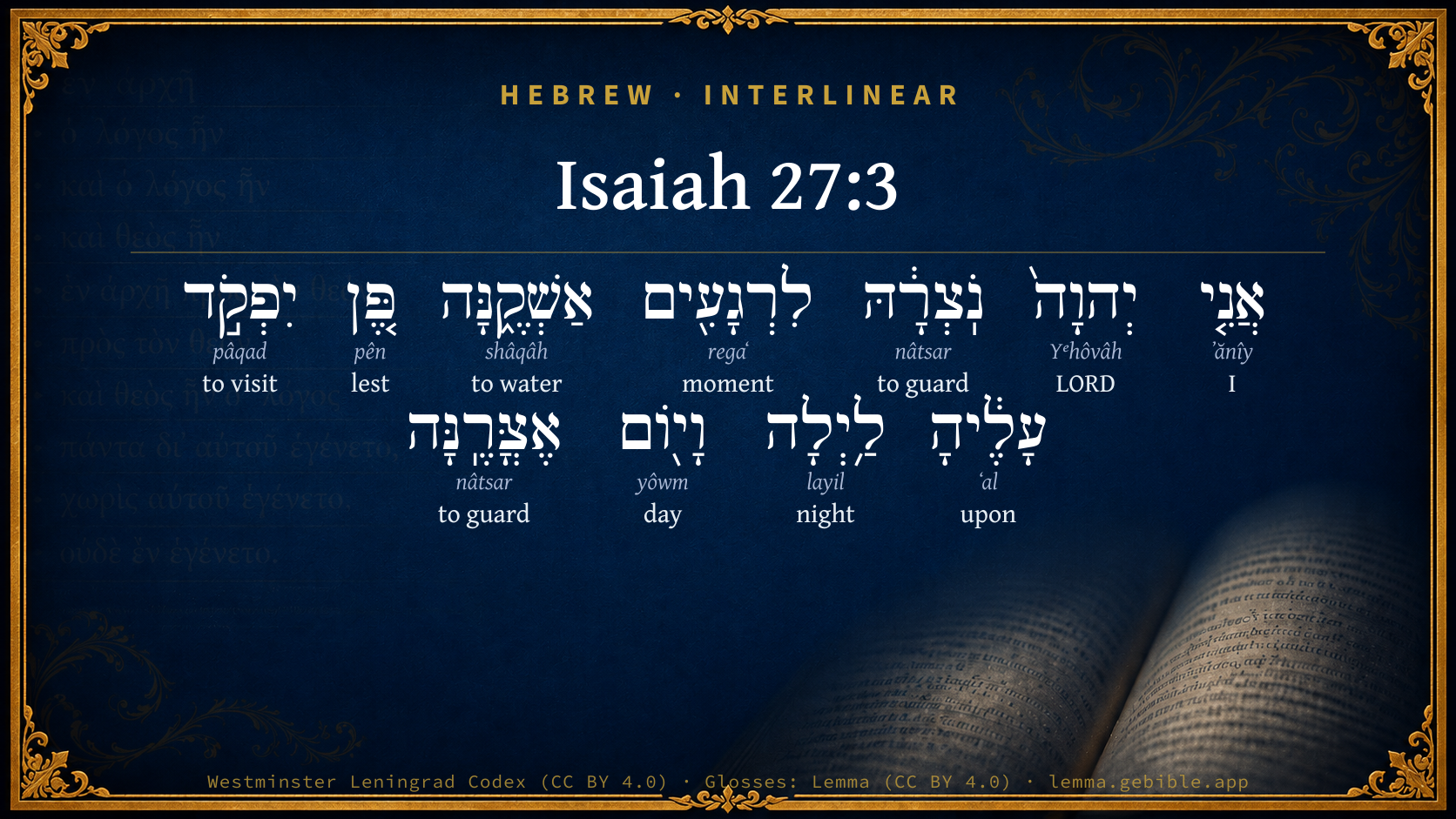
Isaiah 27:3

Hebrew (Westminster Leningrad Codex) Isaiah 27:3 appears in the Hebrew Old Testament. The text above is from the Westminster Leningrad Codex. Each word links to its Strong’s number, a concise gloss, and parsing drawn from the Open Scriptures Hebrew Bible morphology. Click any word for its full Brown-Driver-Briggs (BDB) entry.
Download image
Cite this verse

Isaiah 27:3 (World English Bible). Public Domain. Lemma interlinear Bible study tool, https://lemma.gebible.app/v/isaiah/27/3.

Show BibTeX & RIS
BibTeX
RIS
English Translation
I Yahweh am its keeper; I will water it every moment: lest any hurt it, I will keep it night and day.
World English Bible · Public Domain
Download a study sheet

One document with this verse’s original text, its word-by-word gloss line, the meaning frame, cross-references with their text, attributed commentary, and full source and license credits — printable, and it pastes into notes with its structure intact.

This verse Autodidact and up

Study sheet (.html) Plain text (.txt)

A passage Seminary Student

Up to 50 verses in one chapter. A passage sheet keeps up to 6 commentary sources and 12 cross-references per verse, in the order this page ranks them, and says so on the sheet whenever that leaves anything out. Ask for a single verse and you get the Autodidact verse sheet above.

Everything on this page stays free to read, with no account — the sheet is a download of what is already on screen, not access to it.

Want to remove ads? Support Godless Engineer
Compare translations 3

The same verse in 3 English versions, stacked beneath the original-language interlinear above. Click any original word for its lexicon entry.

Each is an independent rendering of the whole verse — the interlinear is not word-aligned to these translations.

Highlighted words mark where these versions differ — a whole-verse word diff, not a word-by-word alignment.

  • World English Bible Public Domain
    I Yahweh am its keeper; I will water it every moment: lest any hurt it, I will keep it night and day.
  • King James Version Public Domain
    I the LORD do keep it; I will water it every moment: lest any hurt it, I will keep it night and day.
  • unfoldingWord Literal Text CC BY-SA 4.0
    I, Yahweh, am guarding it. I water it to moments. Lest one visit against it, I guard it night and day.

unfoldingWord Literal Text — © unfoldingWord, licensed CC BY-SA 4.0. Word-aligned USFM3 via Door43 (git.door43.org/unfoldingWord/en_ult).

Versions to compare (up to 4)

3 of 4 selected

Show all 18 translations

Every available English version of this verse, each an independent rendering of the whole verse.

  • World English Bible Public Domain
    I Yahweh am its keeper; I will water it every moment: lest any hurt it, I will keep it night and day.
  • Berean Standard Bible Public Domain
    I, the LORD, am its keeper; I water it continually. I guard it night and day so no one can disturb it;
  • Majority Standard Bible Public Domain
    I, the LORD, am its keeper; I water it continually. I guard it night and day so no one can disturb it;
  • King James Version Public Domain
    I the LORD do keep it; I will water it every moment: lest any hurt it, I will keep it night and day.
  • American Standard Version (1901) Public Domain
    I Jehovah am its keeper; I will water it every moment: lest any hurt it, I will keep it night and day.
  • Revised Version (1885) Public Domain
    I the LORD do keep it; I will water it every moment: lest any hurt it, I will keep it night and day.
  • Geneva Bible (1599) Public Domain
    I the Lord doe keepe it: I will water it euery moment: least any assaile it, I will keepe it night and day.
  • Douay-Rheims (1899) Public Domain
    I am the Lord that keep it, I will suddenly give it drink: lest any hurt come to it, I keep it night and day.
  • Young's Literal Translation Public Domain
    I, Jehovah, am its keeper, every moment I water it, Lest any lay a charge against it, Night and day I keep it!
  • Literal Standard Version CC BY-SA 4.0
    I, YHWH, am its keeper, || I water it every moment, || Lest any lay a charge against it, || Night and day I keep it!
  • Unlocked Literal Bible CC BY-SA 4.0
    “I, Yahweh, am its protector; I water it every moment. I guard it night and day so no one will hurt it.
  • unfoldingWord Literal Text CC BY-SA 4.0
    I, Yahweh, am guarding it. I water it to moments. Lest one visit against it, I guard it night and day.
  • Darby Bible Public Domain
    I Jehovah keep it, I will water it every moment; lest any harm it, I will keep it night and day.
  • World Messianic Bible Public Domain
    I, the LORD, am its keeper. I will water it every moment. Lest anyone damage it, I will keep it night and day.
  • Webster's Bible Public Domain
    I the LORD do keep it; I will water it every moment: lest any hurt it, I will keep it night and day.
  • Free Bible Version CC BY-SA 4.0
    I, the Lord, take care of it, watering it often. I guard it night and day so that nobody can damage it.
  • Bible in Basic English Public Domain
    I, the Lord, am watching it; I will give it water at all times: I will keep it night and day, for fear that any damage comes to it.
  • JPS Tanakh (1917) Public Domain
    I the LORD do guard it, I water it every moment; lest Mine anger visit it, I guard it night and day.

Literal Standard Version (2020), Covenant Press — licensed CC BY-SA 4.0. Text via the HelloAO Bible API (eBible.org). Unlocked Literal Bible (unfoldingWord) — licensed CC BY-SA 4.0. Text via the HelloAO Bible API (eBible.org). unfoldingWord Literal Text — © unfoldingWord, licensed CC BY-SA 4.0. Word-aligned USFM3 via Door43 (git.door43.org/unfoldingWord/en_ult). Free Bible Version, Dr. Jonathan Gallagher — licensed CC BY-SA 4.0. Text via the HelloAO Bible API (eBible.org).

Word by word

More ways to search: Search by grammar → Find every occurrence → Compare this word →

Practice this passage: Drill this verse → Learn its vocabulary →

לִרְגָעִ֖ים
regaʻ
H7281
“to/for · moments”
Preposition + Noun, Common, Masculine, Plural, Absolute
Part of Speech
Preposition + Noun
Type
Common
Gender
Masculine
Number
Plural
State
Absolute
Full BDB Definition

Origin: from H7280 a wink (of the eyes), i.e. a very short space of time

TWOT: 2116a

a moment (noun masculine) - for a moment, at one moment...at another moment (adverb) - in a moment (with preposition)
  1. אֲנִ֤י ʼănîy H589 “I” Pronoun, Personal, 1st Person, Common, Singular
  2. יְהוָה֙ Yᵉhôvâh H3068 “LORD” Noun, Proper
  3. נֹֽצְרָ֔הּ nâtsar H5341 “guarding · her” Verb, Qal, Participle Active, Masculine, Singular, Construct + Suffix, Personal, 3rd Person, Feminine, Singular
  4. אַשְׁקֶ֑נָּה shâqâh H8248 “to water · her” Verb, Hiphil, Imperfect, 1st Person, Common, Singular + Suffix, Personal, 3rd Person, Feminine, Singular
  5. פֶּ֚ן pên H6435 “lest” Conjunction
  6. יִפְקֹ֣ד pâqad H6485 “to visit” Verb, Qal, Imperfect, 3rd Person, Masculine, Singular
  7. עָלֶ֔יהָ ʻal H5921 “upon · her” Preposition + Suffix, Personal, 3rd Person, Feminine, Singular
  8. לַ֥יְלָה layil H3915 “night” Noun, Common, Masculine, Singular, Absolute
  9. וָי֖וֹם yôwm H3117 “and · day” Conjunction + Noun, Common, Masculine, Singular, Absolute
  10. אֶצֳּרֶֽנָּה nâtsar H5341 “to guard · her” Verb, Qal, Imperfect, 1st Person, Common, Singular + Suffix, Personal, 3rd Person, Feminine, Singular

About this verse

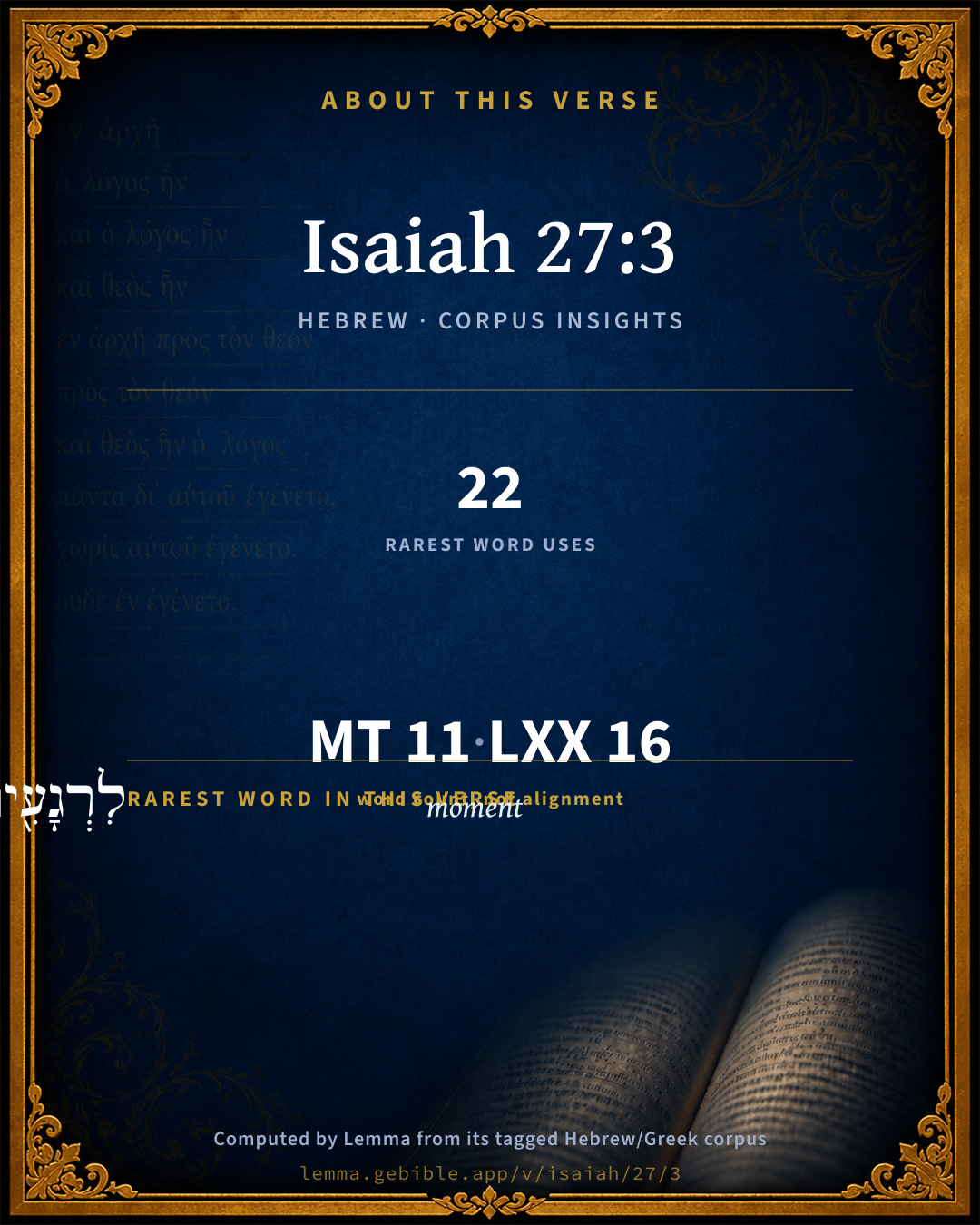
These counts appear in no published source. They are computed here, from the morphology-tagged text and Lemma’s own curated glosses. What Lemma adds →

11
words
10
distinct lemmas
Prophets
section

Notable vocabulary

The rarest word here is לִרְגָעִ֖ים moment H7281 — appearing just 22 times in the whole Hebrew Bible.

Shared distinctive vocabulary

לִרְגָעִ֖ים moment H7281 occurs in 22 verses of the Hebrew Bible. Also found in:

Grammatical profile

  • 4 verbs
  • 4 nouns
  • 1 pronoun
  • 1 preposition
  • 1 conjunction

Verb forms

  • נֹֽצְרָ֔הּ Qal · Participle Active
  • אַשְׁקֶ֑נָּה Hiphil · Imperfect
  • יִפְקֹ֣ד Qal · Imperfect
  • אֶצֳּרֶֽנָּה Qal · Imperfect

Repetition

A word recurs within this verse — often emphatic in Hebrew:

  • נֹֽצְרָ֔הּ to guard H5341 ×2

Hebrew & Septuagint length

In English translation the verse runs 22 words from the Hebrew and 30 from the Septuagint (LXX English) — closely comparable.

A rough comparison of the two English renderings, which tokenize alike — not a word-level alignment.

Word counts can differ between the Hebrew and the Greek without any difference in meaning — e.g. the Hebrew direct-object marker אֵת has no separate Greek word, and Greek often adds the article ὁ.

In the original languages it is 11 Hebrew tokens and 16 Greek tokens — but the two are counted differently (Hebrew bundles its prefixes and suffixes into one token; the Greek is in lemma form), so that isn’t a like-for-like length.

Cross-references

21

Topical passages linked to Isaiah 27:3 in the Treasury of Scripture Knowledge — connected by theme and wording, ordered by reader-vote popularity; previews shown in the World English Bible.

  • Isaiah 58:11 and Yahweh will guide you continually, and satisfy your soul in dry places, and make strong your bones; and you shall be like a watered garden, and like a spring of water, whose waters don't fail.
  • John 15:1–2 "I am the true vine, and my Father is the farmer.
  • 1 Samuel 2:9 He will keep the feet of his holy ones; But the wicked shall be put to silence in darkness; For by strength shall no man prevail.
  • Psalms 121:3–5 He will not allow your foot to be moved. He who keeps you will not slumber.
  • Ezekiel 34:11 For thus says the Lord Yahweh: Behold, I myself, even I, will search for my sheep, and will seek them out.
  • Ezekiel 37:14 I will put my Spirit in you, and you shall live, and I will place you in your own land: and you shall know that I, Yahweh, have spoken it and performed it, says Yahweh.
  • Isaiah 46:9 Remember the former things of old: for I am God, and there is none else; [I am] God, and there is none like me;
  • Isaiah 55:10–11 For as the rain comes down and the snow from the sky, and doesn't return there, but waters the earth, and makes it bring forth and bud, and gives seed to the sower and bread to the eater;
  • Isaiah 60:16 You shall also suck the milk of the nations, and shall suck the breast of kings; and you shall know that I, Yahweh, am your Savior, and your Redeemer, the Mighty One of Jacob.
  • Ezekiel 34:24 I, Yahweh, will be their God, and my servant David prince among them; I, Yahweh, have spoken it.
  • Genesis 6:17 I, even, I do bring the flood of waters on this earth, to destroy all flesh having the breath of life from under the sky. Everything that is in the earth will die.
  • Deuteronomy 33:26–29 There is none like God, Jeshurun, Who rides on the heavens for your help, In his excellency on the skies.
  • Psalms 46:5 God is in her midst. She shall not be moved. God will help her at dawn.
  • Psalms 46:11 Yahweh of Hosts is with us. The God of Jacob is our refuge. Selah.
  • Isaiah 5:6 I will lay it a wasteland. It won't be pruned nor hoed, But it will grow briers and thorns. I will also command the clouds that they rain no rain on it."
  • Isaiah 35:6–7 Then shall the lame man leap as a hart, and the tongue of the mute shall sing; for in the wilderness shall waters break out, and streams in the desert.
  • Isaiah 41:13–19 For I, Yahweh your God, will hold your right hand, saying to you, Don't be afraid; I will help you.
  • Isaiah 46:4 and even to old age I am he, and even to gray hairs will I carry you. I have made, and I will bear; yes, I will carry, and will deliver.
  • Genesis 9:9 "As for me, behold, I establish my covenant with you, and with your offspring after you,
  • Ezekiel 37:28 The nations shall know that I am Yahweh who sanctifies Israel, when my sanctuary shall be in the midst of them forevermore.
  • John 10:27–30 My sheep hear my voice, and I know them, and they follow me.

Cross-references courtesy of OpenBible.info (CC BY 4.0).

Hebrew and Greek witnesses Masoretic Hebrew ↔ Greek Septuagint

The same verse in the two great witnesses to the Old Testament, shown verse-for-verse.

These are two independent witnesses, not word-aligned to each other, and the Septuagint is shown in lemma (dictionary) form.

Hebrew Isaiah 27:3 Masoretic · Westminster Leningrad Codex

אֲנִ֤י יְהוָה֙ נֹֽצְרָ֔הּ לִרְגָעִ֖ים אַשְׁקֶ֑נָּה פֶּ֚ן יִפְקֹ֣ד עָלֶ֔יהָ לַ֥יְלָה וָי֖וֹם אֶצֳּרֶֽנָּה

I Yahweh am its keeper; I will water it every moment: lest any hurt it, I will keep it night and day.

World English Bible · Public Domain

Greek LXX Isaiah 27:3 Septuagint · lemma form

ἐγώ πόλις ἰσχυρός πόλις πολιορκέω μάτην ποτίζω αὐτός ἁλίσκω γάρ νύξ ἡμέρα δέ πίπτω ὁ τεῖχος

I am a strong city, a city in a siege: in vain shall I water it; for it shall be taken by night, and by day the wall shall fall.

LXX2012 (modern English Septuagint) · Public Domain

Hebrew: Westminster Leningrad Codex (CC BY 4.0). Greek: Septuagint (public domain); English from LXX2012 (modern English Septuagint) (Public Domain). How the Septuagint differs from the Hebrew →

Targum (Aramaic paraphrase)

1

The Targum is the ancient Jewish Aramaic paraphrase of the Hebrew Scriptures — an interpretive translation, not the Hebrew text itself. Onkelos (literal) and Pseudo-Jonathan (expansive) render the Torah, and Jonathan the Prophets. Coverage is partial: where no permissively-licensed English translation exists for a verse, only the Aramaic is shown. This is verse-level text, not a word-by-word alignment to the Hebrew.

  1. Targum Jonathan Prophets (Joshua–Malachi)
    אֲנָא יְיָ נְטַר לְהוֹן קְיָם אֲבָהָתְהוֹן וְלָא אֱשֵׁיצִינוּן אֶלָא בִזְמַן דְאִינוּן מַרְגְזִין קֳדָמַי אֲנָא מַשְׁקֵי לְהוֹן כָּס פּוּרְעֲנוּתְהוֹן אִלוּלֵי חוֹבֵיהוֹן גָרְמִין לְאִתְפְּרַע מִנְהוֹן כְּבַר לֵילֵי וֵימָם מֵימְרִי מֵגִין עֲלֵיהוֹן:

    I, the Lord, keep the covenant of their fathers with them, that I may not destroy them; but at the time that they provoked me to anger, I gave them the cup of their punishment to drink; but their sins were the cause of their punishment; nevertheless, my WORD shall protect them by day and by night.

    Targum Jonathan — Aramaic: “Mikraot Gedolot” (public domain). English: “Sefaria Community Translation” (CC0 1.0 (public-domain dedication)); “London "Chaldee Paraphrase," 1871” (public domain). Text via Sefaria.

Commentary

Notes on Isaiah 27:3 from classic Christian and Jewish commentators (each source and its license shown beneath its notes). The classic Christian expositions comment on the surrounding passage and are grouped to its opening verse, so a note may address several verses; the Jewish commentaries on the Tanakh (Rashi and others) are per-verse, so they appear only where the commentator wrote on this verse.

Lemma curates 59 commentaries, every one of them public domain or Creative Commons licensed, each selected and text-cleaned for this edition rather than reprinted as found. About our sources →

Trapp's Complete Commentary

John Trapp

Isa 27:3 I the LORD do keep it; I will water it every moment: lest [any] hurt it, I will keep it night and day.

Ver. 3. I the Lord do keep it.] And then it cannot but be well kept. The matter is well amended with God’s vineyard since {Isa 5:5} the Lord is with you while ye are with him. {2Ch 16:7} "The hand of our God is upon all them for good that seek him; but his power and his wrath is against all them that forsake him." {Ezr 8:12} Do good, O Lord, unto those that be good, &c. As for such as turn aside unto their crooked ways, &c. {Psa 125:4-5}

I will water it every moment.] God will be to his vineyard both a wall and a well, a sun and a shield, {Psa 84:11} all that heart can wish, or need require. Of all possessions, saith Cato, none requireth more care and pains than that of vineyards. Grain comes up and grows alone, {Mar 4:28} but vines must be daily dressed, fenced, supported, watered. Plantas tenellas frequentius adaquare proderit, saith Primasius. {a} Young vines must be often watered; God’s vines shall not want for watering, though once he forbade the clouds to rain upon them. {Isa 5:6} He hath not been wanting to England either for watching or for watering it. We may now much better say of it, than once Polydor Virgil did, Regnum Angliae Regnum Dei; the kingdom of England is the kingdom of God, he meant because none seemed to take care of England but God. He grant we may at length walk worthy of such a mercy! Amen. The Vulgate here rendereth it, but not so well, Repente propinabo ei, I will shortly drink to her.

Lest any hurt it.] Heb., Lest he visit on it, lest any profane person should rudely and unmannerly rush upon it, he guardeth it constantly.

{a} In Philip.

John Trapp, A Commentary or Exposition upon All the Books of the Old and New Testament (1647–1656) — public domain. Text from a community e-Sword module.

The Biblical Illustrator

Joseph S. Exell

Isa_27:3

I, the Lord, do keep it

The Lord the Keeper of His people

There is nothing to which we are naturally more prone, nothing more dangerous, nothing so difficult to eradicate as self-confidence.

And yet there is nothing so delightful as to feel that we have not anything in ourselves in which we can be confident. For the moment we have arrived at that experience we are prepared to turn to Him without whom we can do nothing.

I. IN WHAT SENSE THE LORD IS THE KEEPER OF HIS PEOPLE.

1. In one sense the Lord is the keeper of all; for in Him all live, and move, and have their being. And the Apostle Paul (1Ti_4:10) speaks of Him as the Saviour, or preserver, of all men, specially of those that believe.

2. He speaks of keeping them as a city from an enemy.

3. He speaks again of keeping them as a vineyard from foxes. In Son_2:15 we read, Take us the foxes, the little foxes that spoil the vines: for our vines have tender grapes. Those things which may appear gentle and innocent have a tendency to undermine the work of indwelling grace.

4. Again, the Lord speaks of keeping His people as the apple of His eye.

5. I might speak again of the fires of persecution, through which His people are called to pass. For here again the Lord is the Keeper of His people.

6. He not only defends and preserves His people, but He keeps them refreshed in seasons of drought by continual and plentiful supplies of mercy and grace. So in the text He says, I will water it every moment?

II. WHEN IS IT THAT HE KEEPS THEM? By day and by night. He watches over them continually, in the bright day of prosperity and in the dark night of adversity.

III. HOW IS IT THAT THE LORD KEEPS HIS PEOPLE?

1. By His angels (Heb_1:14).

2. By His ministers; by their warning voice in public; or by that advice and reproof, and instruction which they give in private.

3. By His providential dispensations.

4. By His own omnipotent arm. His people are kept by the power of God through faith unto salvation.

IV. WHAT WARRANT WE HAVE AS HIS PEOPLE TO EXPECT THAT THE LORD WILL BE OUR KEEPER.

1. The first plain proof of this is, that as His people we are not our own, but given to Christ.

2. Coupled with this, we may consider the faithfulness of Jesus (2Th_3:3).

3. Connect with this, the consideration of the love of Jesus for His people.

4. Indeed, we have as believers the warrant of the Triune Jehovah for believing that the Lord will be our keeper. Bear in mind that, until the time when knowledge shall be increased, and faith and hope end in sight and enjoyment, we shall never be aware of the full extent of our obligations to

Him as the Keeper of His people. Yet, while we thankfully lay hold of the comfort which this truth is calculated to give, let us remember that our own responsibility is not overthrown. On the contrary, it is increased. For though encouraged to trust in the Lord as our keeper, there is no excuse for neglect of duty on account of our own weakness; but rather encouragement to say with the apostle, I can do all things through Christ, who strengtheneth me. (M. Villiers M. A.)

Gods care of His vineyard

God takes care--

I. Of the SAFETY of this vineyard. I, the Lord, do keep it.

II. Of the FRUITFULNESS of this vineyard. I will water it every moment, and yet it shall not be over watered. (M. Henry.)

The keeper of the vineyard

I. THE CONTINUAL KEEPING which the Lord promises to His vineyard.

1. Do I need keeping?

2. Can I not keep myself?

3. Do I enjoy this keeping?

II. THE LORDS CONTINUAL WATERING.

1. Do I need watering within as well as keeping without? Yes, for there is not a single grace I have that can live an hour without being divinely watered. Besides, the soil in which I am planted is very dry. Then, the atmosphere that is round about us does not naturally yield us any water. The means of grace, which are like clouds hovering over our heads, are often nothing but clouds. The beauty of the text seems to me to lie in the last two words: I will water it every moment.

2. Have we all realised, as a matter of experience, that the Lord does water us every moment? (C. H. Spurgeon.)

Kept and watered

God is both a wall and a well to His people. (C. H.Spurgeon)

Gods vine needs keeping

1. There is the arch enemy; how he longs to lay the axe at the roots of Gods vines!

2. There is a wild boar of the woods, that would fain tear us up by the roots; I mean, that wild boar of unbelief that is constantly prowling around us. How does it seek with its sharp tusks to bark our vines and fig trees!

3. Then, the vine is often subject to injury from various kinds of insects. We have the fly of pride.

4. Then, the vine is subject to the attacks of the little foxes that Solomon speaks of,--I mean, false doctrine and sceptical teaching.

5. Besides, when we have a few grapes that are beginning to ripen there are the birds that come and try to pick the fruit,--those dark-winged thoughts of worldliness and selfishness which come to us all. (C. H. Spurgeon)

God the Keeper of His vineyard

A vineyard will engross the whole of a mans time--perhaps the time of many men. The nourishing of the soil, the pruning of the branches, the syringing of the leaves, the thinning of the grapes, the support of the heavy clusters--all demand constant and assiduous care. There is a tendency in all cultivated things to go back to their original type. However it may be made to agree with the modern ideas of development and evolution, it is nevertheless a fact that the fairest results of human skill are not in themselves permanent; but tend ever backward to the rudest and simplest forms of their species--the apple tree to the crab, the vine of Sorek to the wild vine of the hills. Therefore the keeper of the vineyard is ever engaged in fighting every tendency towards deterioration with unwavering patience. With similar care, but with much more tenderness, God is ever watching over us. With eager eyes He marks the slightest sign of deterioration--a hardening conscience; a deadening spirituality; a waning love. Any symptom of this sort fills Him with--if I may use the words--keen anxiety; and His gentle but skilful hand is at once at work to arrest the evil, restore the soul, and force it onward to new accessions of that Divine life which is our only true bliss and rest. Let us not carry the responsibility of our nurture. It is too much for us. Better far is it to devolve the care of our keeping on our faithful Creator. (F. B.Meyer, B. A.)

God the great Preserver

It is not with God as it is with carpenters and shipwrights, who make houses for other men to dwell in, vessels for others to sail in, and therefore after they are made look after them no more; God, who made all things for Himself, looks after the preservation of all. (John Arrowsmith, D. D.)

Gods solicitude for His people

The tear water, constantly flowing over our eyes, removes the grit and dust that alight on them, impairing our power of vision. The eager mother shields her children from any polluting words or influences that might approach them from child companion or school fellow. The physician is eagerly solicitous that no germ of disease should enter an open wound, and lays his instruments in carbolic that they may carry no spore on their keen edge. And may we not count even more certainly on Him who says, I, the Lord, do keep it, etc. (Christian Endeavour.)

I will water it every moment

A refreshing promise

In warm climates irrigation is essential to fertility; hence travellers see on all sides pools and watercourses, wheels and cisterns, and channels for the water to flow in.

I. There is a great NECESSITY for the watering promised in the text.

1. This we might conclude from the promise itself, since there is not one superfluous word of promise in the whole Scriptures, but it becomes more evident when we reflect that all creature life is dependent upon the perpetual outgoing of Divine power.

2. Moreover, the truth is specially certain as touching the believer, for a multitude of agencies are at work to dry up the moisture of his soul.

3. Neither have we any other source of supply but the living God. All my springs are in Thee.

4. Our need of Divine watering is clearly seen when we consider what drought, and barrenness, and death would come upon us if His hand were withdrawn. Without watering every moment the most faithful among us would be cast forth, and be only fit for the fire; every prophet would become a Balaam, every apostle a Judas, every disciple a Demas.

II. THE MANNER in which the Lord promises to water His people--I will water it every moment.

1. Our first thought is excited by the perpetual act--every moment. Mercy knows no pause. Grace has no canonical hours, or rather all hours are alike canonical: yea, and all moments too.

2. The Lords watering is a renewed act. He does not water us once in great abundance, and then leave us to live upon what He has already poured out.

3. A personal act. I will water it.

III. THE CERTAINTY that the Lord will water every plant that His own right hand hath planted. Here a vast number of arguments suggest themselves, but we wilt content ourselves with the one ground of confidence which is found in the Lord Himself and His previous deeds of love. Our souls need supplies so great as to drain rivers of grace, but the all-sufficient God is able to meet the largest demands of the innumerable company of His people, and He will meet them to His own honour and glory forever. Here, then, we see His truth, His power, and His all-sufficiency pledged to provide for His chosen, and we may be sure that the guarantee will stand. If we needed further confirmation we might well remember that the Lord has already watered His vineyard in a far more costly manner than it win ever need again. The Lord Jesus has watered it with a sweat of blood, and can it be supposed that He will leave it now? Hitherto the sacred promise has been fully kept, for we have been graciously preserved in spiritual life. Droughty times have befallen us, and yet our soul has not been suffered to famish; why, then, should we question the goodness of the Lord as to years to come! One thing is never to be forgotten--we are the Lords. Therefore, if He do not water us, He will Himself be the loser. An owner of vine lands, if he should suffer them to be parched with the drought, would derive nothing from his estate; the vineyard would be dried up, but he himself would receive no clusters. With reverence be it spoken, our Lord Himself will never see of the travail of His soul in untended vines, nor in hearts unsanctified, nor in men whose graces droop and die for want of Divine refreshings. (C. H. Spurgeon.)

The Biblical Illustrator, edited by Joseph S. Exell (c. 1880s–1900s) — public domain. Text from a community e-Sword module.

Tyndale Open Study Notes

Tyndale Open Resources

27:3 God identifies himself as the Lord of the covenant to assure his people that what he says and does is reliable (see Exod 6:2-3). The phrase is used many times throughout Isaiah. • watch . . . watering . . . watch: The Lord will provide even greater care and protection for his ultimate vineyard than he did for Israel, his first vineyard (see Isa 5:1-2).

Tyndale Open Study Notes — © Tyndale Open Resources, licensed CC BY-SA 4.0. Text via the HelloAO Bible API.

Jamieson, Fausset & Brown

Robert Jamieson, A. R. Fausset & David Brown

lest any hurt it--attack it [MAURER]. "Lest aught be wanting in her" [HORSLEY].

Jamieson, Fausset & Brown — Commentary Critical and Explanatory on the Whole Bible (1871) — public domain (CC PDM 1.0). Text via the HelloAO Bible API.

Adam Clarke's Commentary

Verse 3. Lest any hurt it, I will keep it night and day - "I will take care of her by night; and by day I will keep guard over her"] For פן יפקד pen yiphkod, lest any visit it, the Syriac read ואפקד veephkod, and I will visit it. Twenty MSS. of Kennicott's, fourteen of De Rossi's, and two of my own, and six editions read אפקד ephkod, I will visit, in the first person.

Adam Clarke's Commentary on the Bible (1810–1826) — public domain. Text from a community e-Sword/MySword module.

Ellicott's Commentary for English Readers

(3) I the Lord do keep it.—The words imply a distinct reversal of the sentence passed in Isa_5:1-7. Instead of abandonment, there is constant care. Instead of the clouds being commanded to give no rain, the vineyard is watered whenever it requires watering. Instead of being wasted by the wild boar or by spoilers, Jehovah tends it both by day and night.

A Bible Commentary for English Readers, edited by Charles John Ellicott (1878–1897) — public domain. Text from a community e-Sword module.

The Cambridge Bible for Schools and Colleges

gen. ed. J. J. S. Perowne

3. do keep it] Better: am its keeper. For I will water … I will keep, substitute I water … I keep.

The Cambridge Bible for Schools and Colleges (gen. ed. J. J. S. Perowne; Cambridge University Press, 1878–1918) — public domain. Text from a community e-Sword module.

John Gill's Exposition

I the Lord do keep it,.... The vineyard, the church, not only by his ministers, called the keepers of it, Sol 8:12 but by himself, by his own power; for unless he keeps it, who is Israel's keeper, the watchmen wake in vain; he keeps his church and people from sin, that it does not reign over them; and from Satan's temptations, that they are not destroyed by them; and from the malice of the world, and the poison of false teachers, that they are not ruined thereby; and from a final and total falling away; the Lord's preservation of his church and people will be very manifest in the latter day:

I will water it every moment; both more immediately with the dews of his grace, and the discoveries of his love; that being like dew, it comes from above, is according to the sovereign will of God, without the desert of man falls in the night, silently, gently, and insensibly, and greatly refreshes and makes fruitful, Hos 14:5 and more immediately by the ministry of the word and ordinances, by his ministers, the preachers of the Gospel, who water as well as plant, Co1 3:6 these are the clouds he sends about to let down the rain of the Gospel upon his church and people, by which they are revived, refreshed, and made fruitful, Isa 5:6 and this being done "every moment", shows, as the care of God, and his constant regard to his people, so that without the frequent communications of his grace, and the constant ministration of his word and ordinances, they would wither and become fruitless; but, by means of these, they are as a watered garden, whose springs fail not, Isa 58:11,

lest any hurt it; as would Satan, who goes about as a roaring lion, seeking whom he may devour; and the men of the world, who are the boar out of the wood, and the wild beast out of the field, that would waste and destroy the vineyard; and false teachers, who are the foxes that would spoil the vines, Pe1 5:8 but, to prevent any such hurt and damage, the Lord undertakes to keep the church, his vineyard, himself, which he repeats with some addition, to declare the certainty of it; or, "lest he visit it" (m); that is, an enemy, as some (n) supply it; lest he should break down the hedge, and push into it, and waste it; or Jehovah himself, that is, as Gussetius (o) interprets it, while Jehovah the Father, Isa 27:1, is striking leviathan, or inflicting his judgments upon his enemies, Jehovah the Son promises to take care of his vineyard, the church, that the visitation does not affect them, and they are not hurt by it, but are safe and secure from it; which is a much better sense than that of Kimchi mentioned by him, I will water it every moment, "that not one leaf of it should fail"; the same is observed by Ben Melech, as the sense given by Donesh Ben Labrat:

I will keep it night and day; that is, continually, for he never slumbers nor sleeps; he has kept, and will keep, his church and people, through all the vicissitudes of night and day, of adversity and prosperity, they come into: how great is the condescension of the Lord to take upon him the irrigation and preservation of his people! how dear and precious must they be to him! and what a privilege is it to be in such a plantation as this, watered and defended by the Lord himself!

(m) "ne forte visitet eum", Munster, Pagninus, Tigurine version. (n) So Munster, Pagninus, Vatablus, and Ben Melech. (o) Comment. Ebr. p. 668, 669.

John Gill's Exposition of the Whole Bible (1746–1763) — public domain (CC PDM 1.0). Text via the HelloAO Bible API.

Albert Barnes' Notes on the Bible

I the Lord do keep it - There is understood here or implied an introduction; as ‘Yahweh said’ (compare Psa 121:3-5).

I will water it every moment - That is, constantly, as a vinedresser does his vineyard.

Albert Barnes' Notes on the Bible (1834–1885) — public domain. Text from a community e-Sword/MySword module.

Haydock's Catholic Bible Commentary

Drink; or, as the Hebrew may also be rendered, I will continually water it. (Challoner) --- God will protect his people. (Calmet)

George Leo Haydock (1774–1849), Haydock's Catholic Family Bible and Commentary, 1859 edition — public domain. Excludes Psalms (Douay-Rheims chapter numbering differs from Protestant) and Deuterocanonical books (Catholic canon only).

Matthew Poole's English Annotations

I the Lord do keep it; I will secure it, that neither men, nor beasts, nor drought shall spoil it; which alone are the things that can hurt it. I will protect my church from all the assaults of her enemies, and supply her with all necessary provisions, with my ordinances, and with my Spirit and grace.

Matthew Poole's English Annotations on the Holy Bible (1683–1685) — public domain. Text from a community e-Sword/MySword module.

The Pulpit Commentary

I the Lord do keep it; or, guard it. (comp. Isa_26:3 Isa_42:6 Isa_49:8 Psa_121:5) Vineyards were considered to require special watching, since they were liable to damage both from thieves and foxes. (Son_2:15) It was usual to build towers in them, from which a watch could be kept. (Isa_5:2 Mat_21:33) I will water it every moment. (compare the threat in Isa_5:6, "I will command my clouds that they rain no rain upon it The Church needs and receives "the continual dew of God"s blessing.

Vers. 3-5. The means whereby God purifies and perfects his Church.

Despite human weakness and human perversity, God will build up and establish a faithful Church he will "purify to himself a peculiar people, zealous of good works". (Tit_2:14) It is for his honor that this should be so, and he is strong enough to effect it. His "strength is made perfect in weakness". (2Co_12:9) We are shown here some, at any rate, of the chief means whereby he effects his purpose. Most prominent of all is

I HIS PERPETUAL WATCHFUL GUARDIANSHIP. "I the Lord do keep it." "I will keep it night and day." Incessant watchful care, never slacking, never wearied, the fruit of abounding infinite love, this is the first thing. The Lord "keeps the city." The Lord is his Church"s "Keeper," so that "the sun shall not burn it by day, neither the moon by night;" so that the thief shall not enter in, nor the fox spoil; so that the hatred and wiles of Satan shall be of no avail; so that "the gates of hell shall not prevail against. (Mat_16:18) The Lord"s care is unceasing that keepeth Israel shall neither slumber nor sleep". (Psa_121:4) The Lord"s care is effectual keepeth his mercy forever". (Psa_89:28)

II HIS CONSTANT REFRESHING GRACE. "I will water it every moment." Not only day by day and hour by hour, but momently, does his grace descend on his Church, strengthening it, reviving it, refreshing it. His Holy Spirit teaches men"s hearts continually with a doctrine that "distils as the dew", (Deu_32:2) softens them with an influence that "drops as the rain." He gives "grace for grace;" leads on "from strength to strength;" converts, upholds, confirms, sustains, each weak and wavering soul; cleanses, purifies, infuses light, and strength, and sweetness, and every other virtue into each heart that will admit them; thus constituting and "presenting to himself a glorious Church, not having spot, or wrinkle, or any such thing... holy and without blemish". (Eph_5:27)

III HIS KEEN PURGING FIRES. "The briars and thorns... will I burn together." The Church, while on earth, will always have imperfections, weak brethren, unworthy members, faults, ay, sins, even in the best. It is among the greatest of God"s mercies to the Church that he does not overlook these, but is keenly alive to them yea, "sets men"s secret sins in the light of his countenance". (Psa_90:8) For when these things are noted, there is a hope that they may be remedied. God is ever purging his Church. He "turns his hand upon it, and purely purges away its dross and taketh away all its tin". (Isa_1:25) By pain and suffering, by chastisements of various kinds, by sickness, and disappointment, and ill success, and loss of those dear to them, he leads men to conviction of sin, and hatred of it, and aversion from it, and contrition, and amendment. Where these fail, there is the final remedy, which saves the Church, when the individual will not be saved the remedy of excision, when the dead branch is broken off, and "cast into the fire, and burned". (Joh_15:6) But in thousands of cases the purging is effectual, the keen fire does its work, and purifies without destroying. The soul that was in danger turns to God, and "takes hold of his strength," and "makes its peace with him," and both the Church and the individual gain.

HOMILIES BY W.M. STATHAM Ver. 3. Divine guardianship.

"Lest any hurt it, I will keep it night and day." Then there are hurtful powers and hurtful people in the world. The Word itself lets light in upon the condition of humanity. There are hidden invisible foes; and there is need for One who can discern and defeat them.

I THE EYE THAT SEES. This is all-important. For we are blind to our worst enemies. Evil puts on the garb of good. And evil hides itself. The serpent is coiled up at the bottom of the cup. The adder lurks in the grass. By the river-side the alligator lurks; his skin the very color of the stones. God"s eye can search all. His vision sweeps all space. His vigilance never sleeps. "He that keepeth thee will not slumber.

II THE HEART THAT LOVES. This is our truest defense. It is affection that keeps alive this vigilance. There is no eye like the eye of love. We know this in a measure from our observation of the human spheres. How quick a mother"s eye is to detect first departures from the holy and the true first dalliances with evil! The tutor is not so sure a guardian as the parent. All Divine revelation tells us that God is love. Why warn, rebuke, exhort? Why send the prophet to the guilty cities, and the only begotten Son, the Savior, to the lost race? This is the explanation of all: "God so loved the world.

III THE GUARDIANSHIP THAT IS COMPLETE. Lest "any." That includes all the" forms and forces of evil. We may be awake to special dangers, just as we pay honor to special virtues. There are dangers which are so pronounced, where the penalties are so marked, that our consciousness is awake to the dread results. But when we remember the vast and varied sources of peril, we rejoice to know that there may be immunity from all disaster. "Deliver us from evil" is the prayer taught us by the Savior; and God will hear that prayer, for "thine is the power.

IV THE WATCHFULNESS THAT NEVER SLEEPS. "By night and by day." In the darkness and in the night. For the darkness is no darkness to God. As Sentinel he never sleeps. Our watch-fires die out, and the beasts of the forest break into the camp in the silent hours of darkness. We cannot "keep." But the soul is too precious to be left to finite watchfulness. The Tower of London contains no jeweled crowns so rich in value as the nature that contains the pearl of great price. The temple of Jerusalem had costly vessels and sacred altars; but the temple of the soul has in it the true Shechinah. This is God"s promise. This is his own testimony to himself; and it is g promise to wear as an amulet on the heart in such a world as this. W.M.S.

The Pulpit Commentary (1880–1919), ed. H.D.M. Spence-Jones & Joseph S. Exell — public domain. Text from a community e-Sword module.

John Wesley's Explanatory Notes

I keep it - I will protect my church from all her enemies, and supply her with all necessary provisions.

John Wesley, Explanatory Notes Upon the Whole Bible (1754–1765) — public domain. Text via the GEBible commentary corpus.

J. A. Alexander on Isaiah

Joseph Addison Alexander

“I Jehovah (am) keeping her; every moment I will water her; lest any hurt her, night and day will I keep her.” That is, in spite of the afflictions which befall her I will still preserve her from destruction. The antecedent of the pronouns is the same as in v. 2, viz. the church or nation considered as a vineyard. To ‘visit upon’ has here its common meaning of inflicting evil upon, but without any special reference to crime or punishment. As the expression is a relative one, it must here be understood according to the context, as denoting fatal or at least excessive injury.

Joseph Addison Alexander, The Prophecies of Isaiah (1846–1847; New York: Scribner, 1870–1878) — public domain. Text from a community e-Sword module.

Rashi

Rabbi Shlomo Yitzchaki (Rashi)

I, the Lord, guard it in the time of exile.

every moment I water it Little by little I water it with the cup of retribution that comes upon it, lest I visit upon it at once and I destroy it. Therefore, night and day I ponder about it. Jonathan renders: Were it not that I visit upon them the iniquities that they are accustomed to commit before Me, I would guard it day and night.

Rashi on the Tanakh — English translations: “The Judaica Press complete Tanach with Rashi, translated by A. J. Rosenberg” (CC BY 4.0); “Pentateuch with Rashi's commentary by M. Rosenbaum and A.M. Silbermann, 1929-1934” (public domain); “The Metsudah Tanach series, Lakewood, N.J” (CC BY 4.0); and “The Book of Joshua, Metsudah Publications, 1997” (CC BY 4.0). Text via Sefaria.

Ibn Ezra

Rabbi Abraham ibn Ezra

I, the Lord, do keep it, that is to say, the Divine glory remains in Zion.

I will water it every moment. The prophecy will not cease. פן יפקד. R. Jonah, the Grammarian, says, that לא ═ פן, and פן יפקד עליה;אפקד ═ יפקד means accordingly, I will not punish her (though I shall punish all other nations). Comp. פן תפלס Do not ponder. R. Isaak ben Saul compares יפקד with נפקד there lacketh (Num. 31:49), and joins this with the preceding phrase in this way, I will water it every moment, lest its leaves drop.

עליה Its leaves. Each of its leaves. Comp. 1:30. R. Moses Hakkohen explains it thus, I shall guard it day and night, lest the enemy hurt it. I think that this explanation is the right one.

Ibn Ezra on the Tanakh — English translations: “Sefaria Community Translation” (CC0 1.0 (public-domain dedication)); “Yalkut, Sifsei Chachomim Chumash, Metsudah Publications, 2009” (CC BY 4.0); and “Commentary of Ibn Ezra on Isaiah - trans. by M. Friedlander, 1873” (public domain). Text via Sefaria.

Lesson kit

Teaching starters — assembled from the data on this page, not authored interpretation. Every prompt links to the verse data it draws on. Edit before teaching.

Isaiah, in the Prophets, opens this verse with 11 words (10 distinct Hebrew lemmas). Its most distinctive word is regaʻ (“moment”). A historical commentator’s framing appears above. Read the whole chapter for the surrounding context.

Discussion questions

  1. The word regaʻ carries the sense “moment.” How does it shape the verse?
  2. How does Exodus 33:5, which shares the word «moment», read alongside this verse?
  3. What does the repetition of “to guard” (2× in this one verse) do in this verse?
  4. The translations on this page render this verse differently — a whole-verse word diff, not a word-by-word alignment. What might account for the different wordings?
  5. «נֹֽצְרָ֔הּ» is a Qal Participle Active verb. How does that grammatical form shape the action described?
  6. Compare how Trapp's Complete Commentary and The Biblical Illustrator read this verse. Where do they agree or differ?

Things to notice

Reading settings

Reading text

Shown beneath each verse's original-language words.

Old Testament
Old Testament edition

Read the OT as the Masoretic Hebrew (MT) or the Greek Septuagint (LXX).

English shown for the Greek Septuagint (in the Hebrew ↔ Greek comparison).

Comparing translations? Open the Compare panel on any verse page to stack up to four side by side.