
Jeremiah 23:15

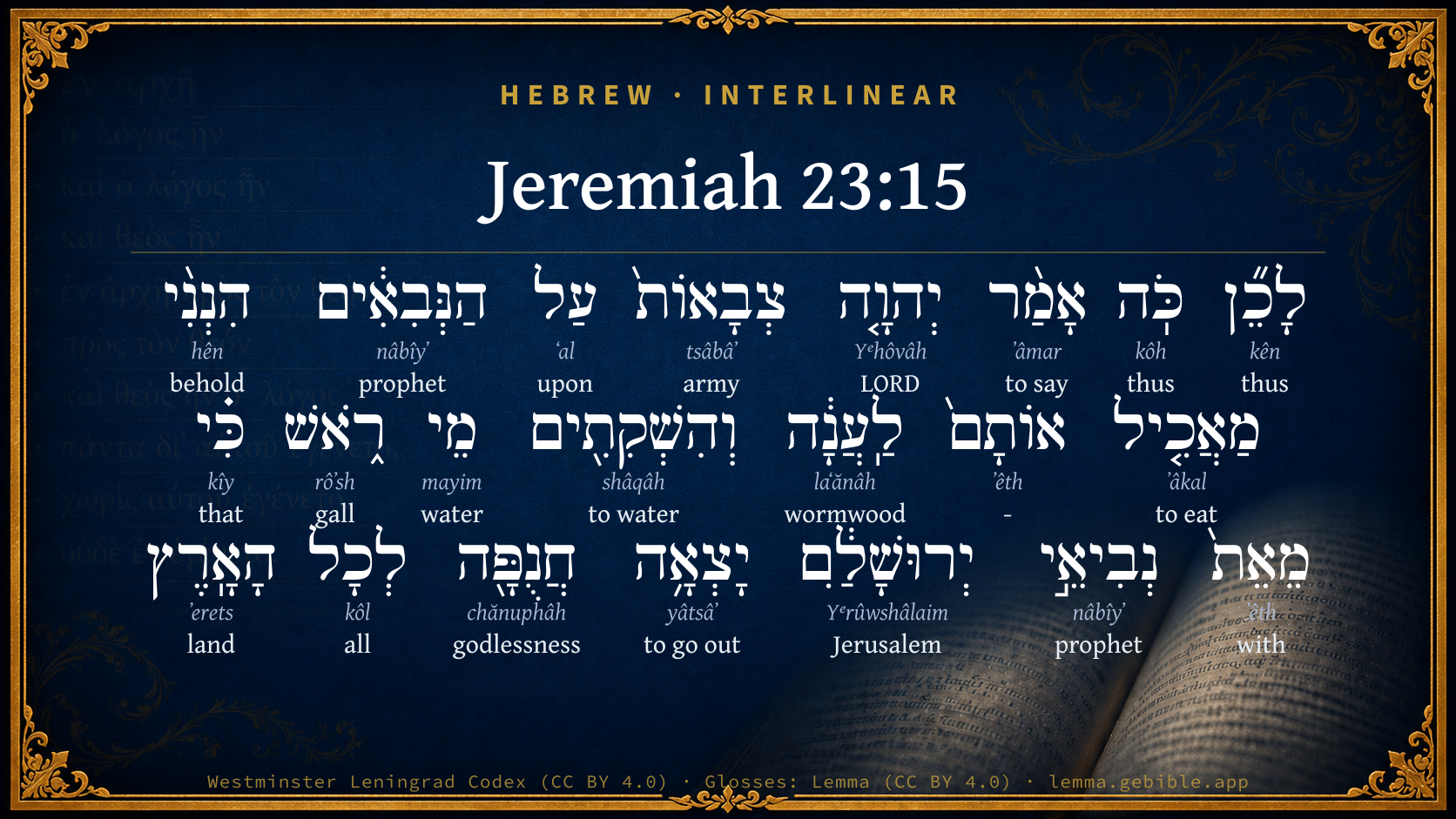
Hebrew (Westminster Leningrad Codex) Jeremiah 23:15 appears in the Hebrew Old Testament. The text above is from the Westminster Leningrad Codex. Each word links to its Strong’s number, a concise gloss, and parsing drawn from the Open Scriptures Hebrew Bible morphology. Click any word for its full Brown-Driver-Briggs (BDB) entry.
Download image
Cite this verse

Jeremiah 23:15 (World English Bible). Public Domain. Lemma interlinear Bible study tool, https://lemma.gebible.app/v/jeremiah/23/15.

Show BibTeX & RIS
BibTeX
RIS
English Translation
Therefore thus says Yahweh of Hosts concerning the prophets: Behold, I will feed them with wormwood, and make them drink the water of gall; for from the prophets of Jerusalem is ungodliness gone forth into all the land.
World English Bible · Public Domain
Highlights
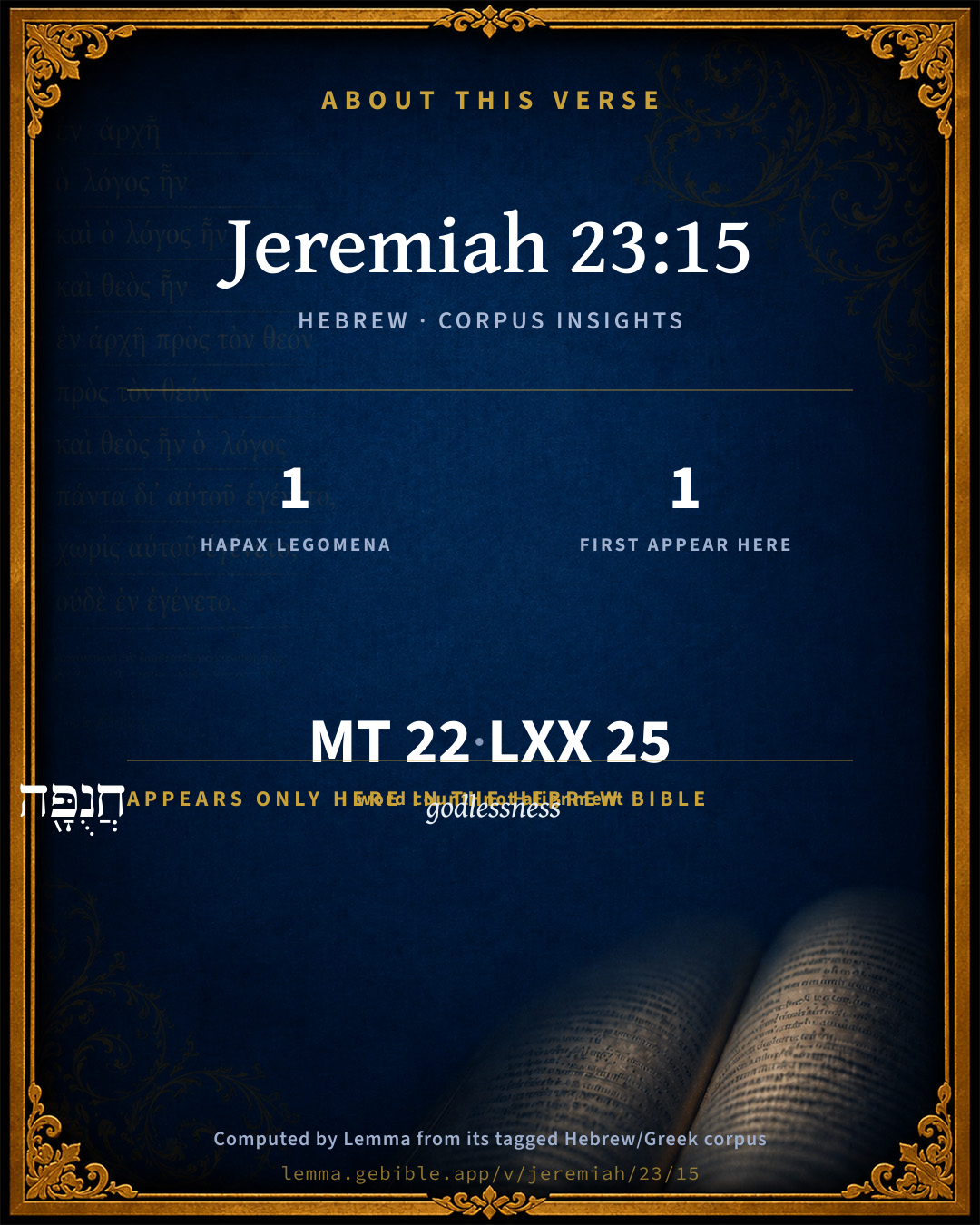
  • 1 hapax legomenon — only here in the Hebrew Bible
  • 1 first appearance in the Hebrew Bible
Full analysis ↓
Download a study sheet

One document with this verse’s original text, its word-by-word gloss line, the meaning frame, cross-references with their text, attributed commentary, and full source and license credits — printable, and it pastes into notes with its structure intact.

This verse Autodidact and up

Study sheet (.html) Plain text (.txt)

A passage Seminary Student

Up to 50 verses in one chapter. A passage sheet keeps up to 6 commentary sources and 12 cross-references per verse, in the order this page ranks them, and says so on the sheet whenever that leaves anything out. Ask for a single verse and you get the Autodidact verse sheet above.

Everything on this page stays free to read, with no account — the sheet is a download of what is already on screen, not access to it.

Want to remove ads? Support Godless Engineer
Compare translations 3

The same verse in 3 English versions, stacked beneath the original-language interlinear above. Click any original word for its lexicon entry.

Each is an independent rendering of the whole verse — the interlinear is not word-aligned to these translations.

Highlighted words mark where these versions differ — a whole-verse word diff, not a word-by-word alignment.

  • World English Bible Public Domain
    Therefore thus says Yahweh of Hosts concerning the prophets: Behold, I will feed them with wormwood, and make them drink the water of gall; for from the prophets of Jerusalem is ungodliness gone forth into all the land.
  • King James Version Public Domain
    Therefore thus saith the LORD of hosts concerning the prophets; Behold, I will feed them with wormwood, and make them drink the water of gall: for from the prophets of Jerusalem is profaneness gone forth into all the land.
  • unfoldingWord Literal Text CC BY-SA 4.0
    Therefore, thus says Yahweh of Armies concerning the prophets: “Behold, I am making them eat wormwood and making them drink water of poison, for from the prophets of Jerusalem pollution has gone out to all the land.”

unfoldingWord Literal Text — © unfoldingWord, licensed CC BY-SA 4.0. Word-aligned USFM3 via Door43 (git.door43.org/unfoldingWord/en_ult).

Versions to compare (up to 4)

3 of 4 selected

Show all 18 translations

Every available English version of this verse, each an independent rendering of the whole verse.

  • World English Bible Public Domain
    Therefore thus says Yahweh of Hosts concerning the prophets: Behold, I will feed them with wormwood, and make them drink the water of gall; for from the prophets of Jerusalem is ungodliness gone forth into all the land.
  • Berean Standard Bible Public Domain
    Therefore this is what the LORD of Hosts says concerning the prophets: “I will feed them wormwood and give them poisoned water to drink, for from the prophets of Jerusalem ungodliness has spread throughout the land.”
  • Majority Standard Bible Public Domain
    Therefore this is what the LORD of Hosts says concerning the prophets: “I will feed them wormwood and give them poisoned water to drink, for from the prophets of Jerusalem ungodliness has spread throughout the land.”
  • King James Version Public Domain
    Therefore thus saith the LORD of hosts concerning the prophets; Behold, I will feed them with wormwood, and make them drink the water of gall: for from the prophets of Jerusalem is profaneness gone forth into all the land.
  • American Standard Version (1901) Public Domain
    Therefore thus saith Jehovah of hosts concerning the prophets: Behold, I will feed them with wormwood, and make them drink the water of gall; for from the prophets of Jerusalem is ungodliness gone forth into all the land.
  • Revised Version (1885) Public Domain
    Therefore thus saith the LORD of hosts concerning the prophets: Behold, I will feed them with wormwood, and make them drink the water of gall: for from the prophets of Jerusalem is profaneness gone forth into all the land.
  • Geneva Bible (1599) Public Domain
    Therefore thus saith the Lord of hostes concerning the prophets, Beholde, I will feede them with wormewood, and make them drinke the water of gall: for from the prophets of Ierusalem is wickednesse gone forth into all the lande.
  • Douay-Rheims (1899) Public Domain
    Therefore thus saith the Lord of hosts to the prophets: Behold I will feed them with wormwood, and I will give them gall to drink: for from the prophets of Jerusalem corruption has gone forth into all the land.
  • Young's Literal Translation Public Domain
    Therefore, thus said Jehovah of Hosts, concerning the prophets: Lo, I am causing them to eat wormwood, And have caused them to drink water of gall, For, from prophets of Jerusalem Hath profanity gone forth to all the land.
  • Literal Standard Version CC BY-SA 4.0
    Therefore, thus said YHWH of Hosts, concerning the prophets: “Behold, I am causing them to eat wormwood, || And have caused them to drink water of gall, || For from prophets of Jerusalem || Profanity has gone forth to all the land.”
  • Unlocked Literal Bible CC BY-SA 4.0
    Therefore Yahweh of hosts says this concerning the prophets, “Look, I am about to make them eat wormwood and drink poisonous water, for pollution has gone out from the prophets of Jerusalem to all the land.”
  • unfoldingWord Literal Text CC BY-SA 4.0
    Therefore, thus says Yahweh of Armies concerning the prophets: “Behold, I am making them eat wormwood and making them drink water of poison, for from the prophets of Jerusalem pollution has gone out to all the land.”
  • Darby Bible Public Domain
    Therefore thus saith Jehovah of hosts concerning the prophets: Behold, I will feed them with wormwood, and make them drink water of gall; for from the prophets of Jerusalem is profaneness gone forth into all the land.
  • World Messianic Bible Public Domain
    Therefore the LORD of Hosts says concerning the prophets: “Behold, I will feed them with wormwood, and make them drink poisoned water; for from the prophets of Jerusalem ungodliness has gone out into all the land.”
  • Webster's Bible Public Domain
    Therefore thus saith the LORD of hosts concerning the prophets; Behold, I will feed them with wormwood, and make them drink the water of gall: for from the prophets of Jerusalem is profaneness gone forth into all the land.
  • Free Bible Version CC BY-SA 4.0
    So this is what the Lord Almighty says about the prophets: I will give them wormwood to eat and poisoned water to drink, because evil has spread across the country from the prophets of Jerusalem.
  • Bible in Basic English Public Domain
    So this is what the Lord of armies has said about the prophets: See, I will give them a bitter plant for their food, and bitter water for their drink: for from the prophets of Jerusalem unclean behaviour has gone out into all the land.
  • JPS Tanakh (1917) Public Domain
    Therefore thus saith the LORD of hosts concerning the prophets: Behold, I will feed them with wormwood, and make them drink the water of gall; for from the prophets of Jerusalem is ungodliness gone forth into all the land.

Literal Standard Version (2020), Covenant Press — licensed CC BY-SA 4.0. Text via the HelloAO Bible API (eBible.org). Unlocked Literal Bible (unfoldingWord) — licensed CC BY-SA 4.0. Text via the HelloAO Bible API (eBible.org). unfoldingWord Literal Text — © unfoldingWord, licensed CC BY-SA 4.0. Word-aligned USFM3 via Door43 (git.door43.org/unfoldingWord/en_ult). Free Bible Version, Dr. Jonathan Gallagher — licensed CC BY-SA 4.0. Text via the HelloAO Bible API (eBible.org).

Word by word

More ways to search: Search by grammar → Find every occurrence → Compare this word →

Practice this passage: Drill this verse → Learn its vocabulary →

חֲנֻפָּ֖ה
chănuphâh
H2613
“godlessness”
Noun, Common, Feminine, Singular, Absolute
Part of Speech
Noun
Type
Common
Gender
Feminine
Number
Singular
State
Absolute
Full BDB Definition

Origin: from H2610

TWOT: 696c

profaneness, pollution, hypocrisy, godlessness
  1. לָכֵ֞ן kên H3651 “to/for · thus” Preposition + Adverb
  2. כֹּֽה kôh H3541 “thus” Adverb
  3. אָמַ֨ר ʼâmar H559 “to say” Verb, Qal, Perfect, 3rd Person, Masculine, Singular
  4. יְהוָ֤ה Yᵉhôvâh H3068 “LORD” Noun, Proper
  5. צְבָאוֹת֙ tsâbâʼ H6635 “armies” Noun, Common, Both, Plural, Absolute
  6. עַל ʻal H5921 “upon” Preposition
  7. הַנְּבִאִ֔ים nâbîyʼ H5030 “the · prophets” Particle, Definite Article + Noun, Common, Masculine, Plural, Absolute
  8. הִנְנִ֨י hên H2005 “behold · me” Particle, Demonstrative + Suffix, Personal, 1st Person, Common, Singular
  9. מַאֲכִ֤יל ʼâkal H398 “eating” Verb, Hiphil, Participle Active, Masculine, Singular, Absolute
  10. אוֹתָם֙ ʼêth H853 “- · them” Particle, Direct Object + Suffix, Personal, 3rd Person, Masculine, Plural
  11. לַֽעֲנָ֔ה laʻănâh H3939 “wormwood” Noun, Common, Feminine, Singular, Absolute
  12. וְהִשְׁקִתִ֖ים shâqâh H8248 “and · to water · them” Conjunction + Verb, Hiphil, Sequential Perfect, 1st Person, Common, Singular + Suffix, Personal, 3rd Person, Masculine, Plural
  13. מֵי mayim H4325 “water(s) of” Noun, Common, Masculine, Plural, Construct
  14. רֹ֑אשׁ rôʼsh H7219 “gall” Noun, Common, Masculine, Singular, Absolute
  15. כִּ֗י kîy H3588 “that” Conjunction
  16. מֵאֵת֙ ʼêth H854 “from · with” Preposition + Preposition
  17. נְבִיאֵ֣י nâbîyʼ H5030 “prophets of” Noun, Common, Masculine, Plural, Construct
  18. יְרוּשָׁלִַ֔ם Yᵉrûwshâlaim H3389 “Jerusalem” Noun, Proper
  19. יָצְאָ֥ה yâtsâʼ H3318 “to go out” Verb, Qal, Perfect, 3rd Person, Feminine, Singular
  20. לְכָל kôl H3605 “to/for · all of” Preposition + Noun, Common, Masculine, Singular, Construct
  21. הָאָֽרֶץ ʼerets H776 “the · land” Particle, Definite Article + Noun, Common, Both, Singular, Absolute

About this verse

These counts appear in no published source. They are computed here, from the morphology-tagged text and Lemma’s own curated glosses. What Lemma adds →

22
words
21
distinct lemmas
Prophets
section

Notable vocabulary

1 hapax legomenon — a word that appears only here in the entire Hebrew Bible:

  • חֲנֻפָּ֖ה godlessness H2613

First appearance in Scripture

This word makes its first canonical appearance in the Hebrew Bible here:

  • חֲנֻפָּ֖ה godlessness H2613

Shared distinctive vocabulary

לַֽעֲנָ֔ה wormwood H3939 occurs in 8 verses of the Hebrew Bible. Also found in:

Grammatical profile

  • 4 verbs
  • 11 nouns
  • 2 prepositions
  • 1 conjunction
  • 2 adverbs
  • 2 particles

Verb forms

  • אָמַ֨ר Qal · Perfect
  • מַאֲכִ֤יל Hiphil · Participle Active
  • וְהִשְׁקִתִ֖ים Hiphil · Sequential Perfect
  • יָצְאָ֥ה Qal · Perfect

Repetition

A word recurs within this verse — often emphatic in Hebrew:

  • הַנְּבִאִ֔ים prophet H5030 ×2

Hebrew & Septuagint length

In the original languages it is 22 Hebrew tokens and 25 Greek tokens — but the two are counted differently (Hebrew bundles its prefixes and suffixes into one token; the Greek is in lemma form), so that isn’t a like-for-like length.

Cross-references

8

Topical passages linked to Jeremiah 23:15 in the Treasury of Scripture Knowledge — connected by theme and wording, ordered by reader-vote popularity; previews shown in the World English Bible.

  • Jeremiah 8:14 Why do we sit still? assemble yourselves, and let us enter into the fortified cities, and let us be silent there; for Yahweh our God has put us to silence, and given us water of gall to drink, because we have sinned against Yahweh.
  • Jeremiah 9:15 therefore thus says Yahweh of Hosts, the God of Israel, Behold, I will feed them, even this people, with wormwood, and give them water of gall to drink.
  • Psalms 69:21 They also gave me gall for my food. In my thirst, they gave me vinegar to drink.
  • Lamentations 3:5 He has built against me, and compassed me with gall and travail.
  • Lamentations 3:15 He has filled me with bitterness, he has sated me with wormwood.
  • Lamentations 3:19 Remember my affliction and my misery, the wormwood and the gall.
  • Matthew 27:34 They gave him sour wine to drink mixed with gall. When he had tasted it, he would not drink.
  • Revelation 8:11 The name of the star is called "Wormwood." One third of the waters became wormwood. Many people died from the waters, because they were made bitter.

Cross-references courtesy of OpenBible.info (CC BY 4.0).

Hebrew and Greek witnesses Masoretic Hebrew ↔ Greek Septuagint

The same verse in the two great witnesses to the Old Testament, shown verse-for-verse.

These are two independent witnesses, not word-aligned to each other, and the Septuagint is shown in lemma (dictionary) form.

Hebrew Jeremiah 23:15 Masoretic · Westminster Leningrad Codex

לָכֵ֞ן כֹּֽה אָמַ֨ר יְהוָ֤ה צְבָאוֹת֙ עַל הַנְּבִאִ֔ים הִנְנִ֨י מַאֲכִ֤יל אוֹתָם֙ לַֽעֲנָ֔ה וְהִשְׁקִתִ֖ים מֵי רֹ֑אשׁ כִּ֗י מֵאֵת֙ נְבִיאֵ֣י יְרוּשָׁלִַ֔ם יָצְאָ֥ה חֲנֻפָּ֖ה לְכָל הָאָֽרֶץ

Therefore thus says Yahweh of Hosts concerning the prophets: Behold, I will feed them with wormwood, and make them drink the water of gall; for from the prophets of Jerusalem is ungodliness gone forth into all the land.

World English Bible · Public Domain

Greek LXX Structure differs

In the Septuagint, Jeremiah is about an eighth shorter than the Hebrew and arranges its material differently — the Oracles Against the Nations (Hebrew chapters 46–51) appear in the middle of the Greek book, after 25:13. Because the chapter and verse boundaries do not line up, a verse-for-verse comparison with the Hebrew is not shown.

A verse-for-verse comparison isn’t shown here because the chapters and verses don’t line up. Switch to the LXX edition with the MT / LXX toggle above to read the Greek directly.

Hebrew: Westminster Leningrad Codex (CC BY 4.0). Greek: Septuagint (public domain); English from a public-domain English Septuagint. How the Septuagint differs from the Hebrew →

Targum (Aramaic paraphrase)

1

The Targum is the ancient Jewish Aramaic paraphrase of the Hebrew Scriptures — an interpretive translation, not the Hebrew text itself. Onkelos (literal) and Pseudo-Jonathan (expansive) render the Torah, and Jonathan the Prophets. Coverage is partial: where no permissively-licensed English translation exists for a verse, only the Aramaic is shown. This is verse-level text, not a word-by-word alignment to the Hebrew.

  1. Targum Jonathan Prophets (Joshua–Malachi)
    בְּכֵן כִּדְנַן אֲמַר יְיָ צְבָאוֹת עַל נְבִיֵי שִׁקְרָא הָאֲנָא מַיְתֵי עֲלֵיהוֹן עָקָא מְרַר כְּגִידִין וְאַשְׁקִינוּן כָּס דִלְוָט בִּישׁ כְּרֵישֵׁי חֵיוִין אֲרֵי מִן נְבִיֵי יְרוּשְׁלֵם נְפָקֵית חַנֻפְתָּא לְכָל יַתְבֵי אַרְעָא:

    (no public-domain English translation for this verse)

    Targum Jonathan — Aramaic: “Mikraot Gedolot” (public domain). English: “Sefaria Community Translation” (CC0 1.0 (public-domain dedication)); “London "Chaldee Paraphrase," 1871” (public domain). Text via Sefaria.

Commentary

Notes on Jeremiah 23:15 from classic Christian and Jewish commentators (each source and its license shown beneath its notes). The classic Christian expositions comment on the surrounding passage and are grouped to its opening verse, so a note may address several verses; the Jewish commentaries on the Tanakh (Rashi and others) are per-verse, so they appear only where the commentator wrote on this verse.

Lemma curates 59 commentaries, every one of them public domain or Creative Commons licensed, each selected and text-cleaned for this edition rather than reprinted as found. About our sources →

Trapp's Complete Commentary

John Trapp

Jer 23:15 Therefore thus saith the LORD of hosts concerning the prophets; Behold, I will feed them with wormwood, and make them drink the water of gall: for from the prophets of Jerusalem is profaneness gone forth into all the land.

Ver. 15. I will feed them with wormwood,] {a} i.e., I will slay them with most bitter and grievous kinds of deaths. See Jer 8:14; Jer 9:15.

For from the prophets of Jerusalem is profaneness gone forth into all the land.] Their place adding two wings to their sin - viz., Example and scandal, whereby it soareth higher and flieth much further. See Jer 23:11.

{a} Potabo eos calice maledictionis pessimae, quasi capribus draconum. - Chald. Paraph.

John Trapp, A Commentary or Exposition upon All the Books of the Old and New Testament (1647–1656) — public domain. Text from a community e-Sword module.

Joseph Benson's Commentary

Jer 23:15. Therefore thus saith the Lord concerning the prophets — The priests also, and all ecclesiastical guides, are included. Behold, I will feed them with wormwood — Will afflict them with most bitter calamities. For from the prophets of Jerusalem is profaneness gone forth — Or, hypocrisy, which seems rather to be the meaning of חנפה, the word here used. Certain it is, that this was a vice they were generally addicted to. These false prophets affected to be looked upon as pious, while they indulged themselves in various acts of wickedness; and as this could not be totally concealed, the people took example from them, and indulged themselves in vice, while they put on the garb of piety. The Jewish nation continued much in this habit even to the times of Christ, as is sufficiently evident from what is said of the Pharisees in the New Testament.

Joseph Benson's Commentary on the Old and New Testaments (1811–1818) — public domain. Text from a community e-Sword module.

Tyndale Open Study Notes

Tyndale Open Resources

23:15 Although the people needed to be held responsible for their own sins, the prophets bore the blame for Jerusalem’s spiritual apostasy.

Tyndale Open Study Notes — © Tyndale Open Resources, licensed CC BY-SA 4.0. Text via the HelloAO Bible API.

Geneva Bible (1599)

Geneva Bible translators

Read Jer. 8:14.

Or, hypocrisy.

Geneva Bible (1599) marginal notes — public domain. Text via Bolls.life.

Jamieson, Fausset & Brown

Robert Jamieson, A. R. Fausset & David Brown

gall--poison (see on Jer 8:14; Jer 9:15).

Jamieson, Fausset & Brown — Commentary Critical and Explanatory on the Whole Bible (1871) — public domain (CC PDM 1.0). Text via the HelloAO Bible API.

John Calvin's Commentaries

This verse is addressed to the prophets of the kingdom of Judah, as we learn from its conclusion; and thus the exposition which I have given is confirmed, even this, that God extenuates the fault of other prophets, in speaking of the prophets of Jerusalem, who boasted of greater sanctity. But he declares that they would have poison for meat and gall for drink; as though he had said, “I will pursue them with every kind of punishment.” He expresses evidently the same thing I have before referred to, that their table would become a snare to them. (Psalm 69:22.) The ungodly, indeed, always think that they can by their arts escape; God on the other hand declares, that though they might have a table prepared, they yet would find nothing on it, but poison for meat, and gall for drink. For as to God’s children and faithful servants, evils are turned to their benefit; so as to the ungodly and his wicked despisers, all things must necessarily turn out for their ruin, even meat and drink, and their course of life, and in a word everything.

The cause follows, For gone forth is impiety through the whole land from the prophets of Jerusalem By which words he declares that they were the authors of all evils, so that in comparison with them the prophets of Samaria might have been deemed in a manner righteous. But there is no doubt but that this declaration was considered too severe; yet we see by what necessity Jeremiah was constrained thus to speak; for the lamp of God as yet remained at Jerusalem, according to what is said in many passages, nor was the light of sound doctrine wholly put out. They professed that they continued to obey the Law; and at the same time they were much worse than others, for not only the worship of God in the Temple and in the city was corrupted, but adulteries, frauds, plunders, and all kinds of wickedness prevailed everywhere. He adds —

John Calvin's Commentaries (1540-1563) — public domain. Text from the Calvin Translation Society English edition (1840s-50s) via the Christian Classics Ethereal Library (ccel.org). Calvin's coverage is partial (roughly two-thirds of the Bible); uncommented books and verses are honest gaps, never fabricated. The 19th-century editor's footnotes and remarks are omitted so the notes are faithfully Calvin's own voice.

Ellicott's Commentary for English Readers

(15) Wormwood . . . water of gall.—See Notes on Jer_8:14; Jer_9:15.

Profaneness.—The root-meaning of the Hebrew word is that of “veiling,” hence that of simulated holiness, or, as in the margin, “hypocrisy;” but the associations of the word attached to it the further sense of the hypocrisy that desecrates, so that “profaneness” is, on the whole, the best rendering. The corresponding concrete noun is rendered in Isa_9:17 by “hypocrite;” in Psa_35:16 by “hypocritical mocker;” above, in Jer_23:11, by “profane.”

A Bible Commentary for English Readers, edited by Charles John Ellicott (1878–1897) — public domain. Text from a community e-Sword module.

The Cambridge Bible for Schools and Colleges

gen. ed. J. J. S. Perowne

15. Behold, I will.…] identical with words in Jer_9:15, where see notes. Here it may be originally a marginal note by a copyist, reminiscent of that passage.

wormwood] Cp. Deu_29:18; Pro_5:4; Lam_3:15.

The Cambridge Bible for Schools and Colleges (gen. ed. J. J. S. Perowne; Cambridge University Press, 1878–1918) — public domain. Text from a community e-Sword module.

John Gill's Exposition

Therefore thus saith the Lord of hosts concerning the prophets,.... Concerning the false prophets, as the Targum; their sin is before declared, and now their punishment:

behold, I will feed them with wormwood; with some bitter affliction and calamity; so the Targum,

"behold, I will bring upon them distress bitter as wormwood;''

they that have been fed with dainties, and lived upon the fat of the land; their views in pleasing the people with their lies being to serve their own bellies; now they shall fare after another manner:

and make them drink the water of gall: or, "the juice of hemlock", as some; or "poison", as others; "the savour of death", so Kimchi; as they poisoned the people with their false doctrines, they shall drink poison themselves; they shall not only have that which is bitter and unpleasant, but that which is noxious and hurtful; not only a bitter potion, but a destructive one. The Targum is,

"I will cause them to drink a cup of the curse, bad as the heads of serpents;''

as pernicious as poison; see Jer 8:14;

for from the prophets of Jerusalem is profaneness gone forth into all the land; by their false doctrines, and bad examples, debauchery, irreligion, and wickedness of all kinds, were encouraged, and spread all over the land; Jerusalem, the metropolis of the nation, being infected by them, the contagion spread from thence throughout the country. Evil teachers have a bad influence all around them; from whom, and from whence, true doctrine and real religion should have been propagated; from them, and thence, was the source of all impiety and pollution. Some render it, "hypocrisy" (z), or "flattery"; as if by means of the hypocrisy and flattery of these false prophets, all manner of sin was countenanced; and the like hypocritical spirit and behaviour everywhere prevailed.

(z) "hypocrisis", Vatablus, Piscastor, Cocceius, Schmidt.

John Gill's Exposition of the Whole Bible (1746–1763) — public domain (CC PDM 1.0). Text via the HelloAO Bible API.

Albert Barnes' Notes on the Bible

Profaneness - Desecration.

Albert Barnes' Notes on the Bible (1834–1885) — public domain. Text from a community e-Sword/MySword module.

Haydock's Catholic Bible Commentary

Gall, or something mortally bitter, chap. ix. 15. (Haydock)

George Leo Haydock (1774–1849), Haydock's Catholic Family Bible and Commentary, 1859 edition — public domain. Excludes Psalms (Douay-Rheims chapter numbering differs from Protestant) and Deuterocanonical books (Catholic canon only).

Matthew Poole's English Annotations

Under the term prophets he comprehendeth all the ecclesiastical guides of Jerusalem at this time, whether priests or prophets. He threatens to

feed them with wormwood; some think the word is better translated poison: by wormwood, or poison, and the water of gall, he threatens great and fatal judgments that he would bring upon them. And he giveth the reason why God would deal so severely with that order of men, who seemed by their office and employment to have the nearest relation to himself, because they were the fountain of wickedness, those from whom wickedness flowed out over the whole land. This was either by their conniving at wicked men’s sins, for fear of displeasing them; or by teaching them licentious doctrine, that gave a liberty to the flesh; or by their vile lives setting the people patterns of sin. And indeed thus it is generally, when ministers, and such as are to teach others, are wicked, either in their doctrine or practice, they are a fountain of wickedness; wickedness floweth from them to the whole city, town, parish where they are employed: and on the contrary it is observed, that where God gives a place a good ministry, goodness in one degree or other floweth from them to the whole city, town, or parish; though all are not converted, yet the generality are civilized and restrained from those gross and brutish immoralities which other places abound with. Ill ministers must look for the severest indignation of God. Others sin, and shall die in their sins; but they teach others to break God’s commandments, and have the sins of many to answer for, who perish either by their flatteries, or loose doctrine, or looser lives and examples.

Matthew Poole's English Annotations on the Holy Bible (1683–1685) — public domain. Text from a community e-Sword/MySword module.

Whedon's Commentary on the Bible

Daniel D. Whedon

15. See Jer_8:14; Jer_9:15.

Daniel D. Whedon (gen. ed.), Commentary on the Old and New Testaments (1874–1909) — public domain. Text from a community e-Sword module.

The Pulpit Commentary

On the punishment hero threatened, see note on Jer_9:15.

The Pulpit Commentary (1880–1919), ed. H.D.M. Spence-Jones & Joseph S. Exell — public domain. Text from a community e-Sword module.

Lesson kit

Teaching starters — assembled from the data on this page, not authored interpretation. Every prompt links to the verse data it draws on. Edit before teaching.

Jeremiah, in the Prophets, opens this verse with 22 words (21 distinct Hebrew lemmas). Its most distinctive word is chănuphâh (“godlessness”). A historical commentator’s framing appears above. Read the whole chapter for the surrounding context.

Discussion questions

  1. What does “godlessness” (chănuphâh) contribute to the verse as a whole?
  2. This verse holds 1 word here found nowhere else in the Hebrew Bible. What might the rare word draw attention to?
  3. The word “godlessness” first appears here in Scripture. What is being introduced at this debut?
  4. Deuteronomy 29:18 shares the word «wormwood» with this verse. How do the two illuminate each other?
  5. “prophet” occurs 2× in this one verse. What is the effect of the repetition?
  6. These translations render this verse differently; the difference is in the English rendering, not the original. What questions does that raise?
  7. The verb «אָמַ֨ר» is Qal Perfect. How does its form color the action?
  8. Reading how Trapp's Complete Commentary and Joseph Benson's Commentary read this verse, where do the two commentators agree and where do they part?

Things to notice

  • 1 word in this verse appears nowhere else in the Hebrew Bible.
  • 1 word makes its first canonical appearance in Scripture here.
  • This verse counts 22 Hebrew ↔ 25 Greek words.
  • These translations choose different wording for 20 words in this verse.
  • “prophet” occurs 2× in this single verse.

Reading settings

Reading text

Shown beneath each verse's original-language words.

Old Testament
Old Testament edition

Read the OT as the Masoretic Hebrew (MT) or the Greek Septuagint (LXX).

English shown for the Greek Septuagint (in the Hebrew ↔ Greek comparison).

Comparing translations? Open the Compare panel on any verse page to stack up to four side by side.