
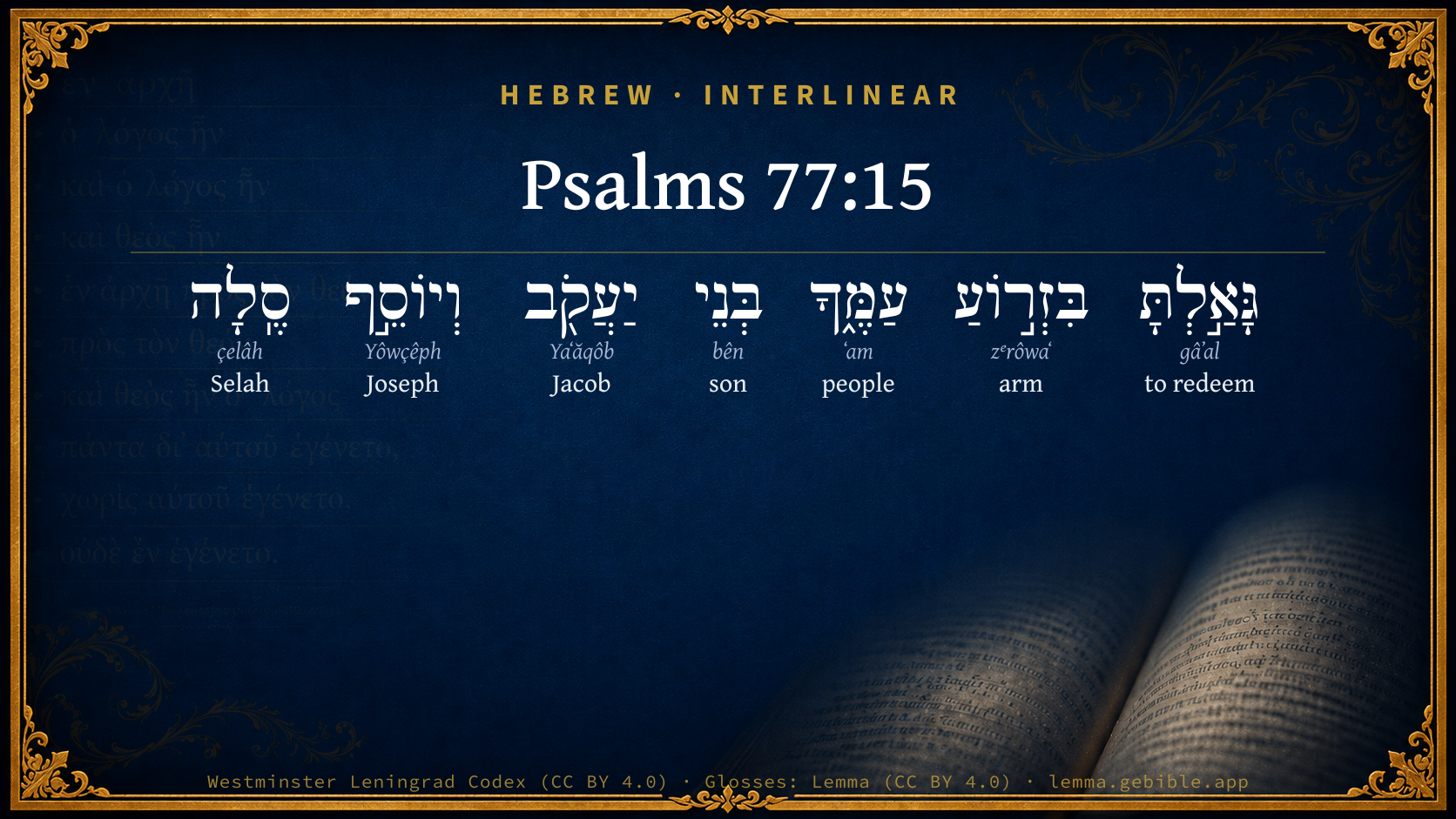
Psalms 77:15

Hebrew (Westminster Leningrad Codex) Psalms 77:15 appears in the Hebrew Old Testament. The text above is from the Westminster Leningrad Codex. Each word links to its Strong’s number, a concise gloss, and parsing drawn from the Open Scriptures Hebrew Bible morphology. Click any word for its full Brown-Driver-Briggs (BDB) entry.
Download image
Cite this verse

Psalms 77:15 (World English Bible). Public Domain. Lemma interlinear Bible study tool, https://lemma.gebible.app/v/psalms/77/15.

Show BibTeX & RIS
BibTeX
RIS
English Translation
You have redeemed your people with your arm, The sons of Jacob and Joseph. Selah.
World English Bible · Public Domain
Download a study sheet

One document with this verse’s original text, its word-by-word gloss line, the meaning frame, cross-references with their text, attributed commentary, and full source and license credits — printable, and it pastes into notes with its structure intact.

This verse Autodidact and up

Study sheet (.html) Plain text (.txt)

A passage Seminary Student

Up to 50 verses in one chapter. A passage sheet keeps up to 6 commentary sources and 12 cross-references per verse, in the order this page ranks them, and says so on the sheet whenever that leaves anything out. Ask for a single verse and you get the Autodidact verse sheet above.

Everything on this page stays free to read, with no account — the sheet is a download of what is already on screen, not access to it.

Want to remove ads? Support Godless Engineer
Compare translations 3

The same verse in 3 English versions, stacked beneath the original-language interlinear above. Click any original word for its lexicon entry.

Each is an independent rendering of the whole verse — the interlinear is not word-aligned to these translations.

Highlighted words mark where these versions differ — a whole-verse word diff, not a word-by-word alignment.

  • World English Bible Public Domain
    You have redeemed your people with your arm, The sons of Jacob and Joseph. Selah.
  • King James Version Public Domain
    Thou hast with thine arm redeemed thy people, the sons of Jacob and Joseph. Selah.
  • unfoldingWord Literal Text CC BY-SA 4.0
    You have redeemed your people with arm, the sons of Jacob and Joseph. Selah

unfoldingWord Literal Text — © unfoldingWord, licensed CC BY-SA 4.0. Word-aligned USFM3 via Door43 (git.door43.org/unfoldingWord/en_ult).

Versions to compare (up to 4)

3 of 4 selected

Show all 18 translations

Every available English version of this verse, each an independent rendering of the whole verse.

  • World English Bible Public Domain
    You have redeemed your people with your arm, The sons of Jacob and Joseph. Selah.
  • Berean Standard Bible Public Domain
    With power You redeemed Your people, the sons of Jacob and Joseph. Selah
  • Majority Standard Bible Public Domain
    With power You redeemed Your people, the sons of Jacob and Joseph. Selah
  • King James Version Public Domain
    Thou hast with thine arm redeemed thy people, the sons of Jacob and Joseph. Selah.
  • American Standard Version (1901) Public Domain
    Thou hast with thine arm redeemed thy people, The sons of Jacob and Joseph. Selah
  • Revised Version (1885) Public Domain
    Thou hast with thine arm redeemed thy people, the sons of Jacob and Joseph. Selah
  • Geneva Bible (1599) Public Domain
    Thou hast redeemed thy people with thine arme, euen the sonnes of Iaakob and Ioseph. Selah.
  • Douay-Rheims (1899) Public Domain
    Thou art the God that dost wonders. Thou hast made thy power known among the nations:
  • Young's Literal Translation Public Domain
    Thou hast redeemed with strength Thy people, The sons of Jacob and Joseph. Selah.
  • Literal Standard Version CC BY-SA 4.0
    You have redeemed Your people with strength, || The sons of Jacob and Joseph. Selah.
  • Unlocked Literal Bible CC BY-SA 4.0
    You gave your people victory by your great power— the descendants of Jacob and Joseph. Selah
  • unfoldingWord Literal Text CC BY-SA 4.0
    You have redeemed your people with arm, the sons of Jacob and Joseph. Selah
  • Darby Bible Public Domain
    Thou hast with [thine] arm redeemed thy people, the sons of Jacob and Joseph. Selah.
  • World Messianic Bible Public Domain
    You have redeemed your people with your arm, the sons of Jacob and Joseph. Selah.
  • Webster's Bible Public Domain
    \\77:14\\Thou art the God that doest wonders: thou hast declared thy strength among the people.
  • Free Bible Version CC BY-SA 4.0
    Through your strength you saved your people, the descendants of Jacob and Joseph. Selah.
  • Bible in Basic English Public Domain
    With your arm you have made your people free, the sons of Jacob and Joseph. (Selah.)
  • JPS Tanakh (1917) Public Domain
    (77-16) Thou hast with Thine arm redeemed Thy people, the sons of Jacob and Joseph. Selah

Literal Standard Version (2020), Covenant Press — licensed CC BY-SA 4.0. Text via the HelloAO Bible API (eBible.org). Unlocked Literal Bible (unfoldingWord) — licensed CC BY-SA 4.0. Text via the HelloAO Bible API (eBible.org). unfoldingWord Literal Text — © unfoldingWord, licensed CC BY-SA 4.0. Word-aligned USFM3 via Door43 (git.door43.org/unfoldingWord/en_ult). Free Bible Version, Dr. Jonathan Gallagher — licensed CC BY-SA 4.0. Text via the HelloAO Bible API (eBible.org).

Word by word

More ways to search: Search by grammar → Find every occurrence → Compare this word →

Practice this passage: Drill this verse → Learn its vocabulary →

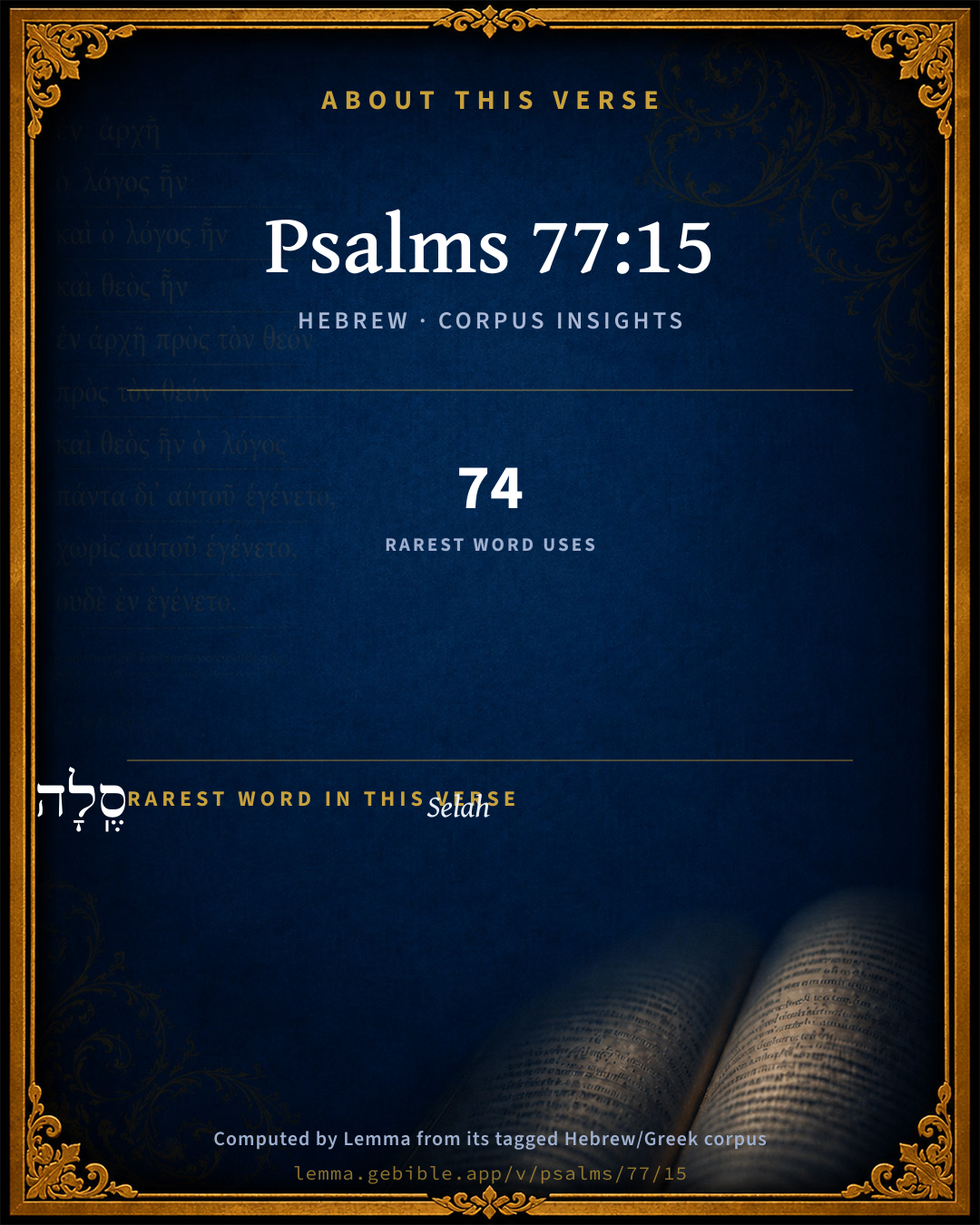
About this verse

These counts appear in no published source. They are computed here, from the morphology-tagged text and Lemma’s own curated glosses. What Lemma adds →

7
words
7
distinct lemmas
Wisdom
section

Grammatical profile

  • 1 verb
  • 5 nouns
  • 1 particle

Verb forms

  • גָּאַ֣לְתָּ Qal · Perfect

Hebrew & Septuagint length

In English translation the verse runs 15 words from the Hebrew and 15 from the Septuagint (LXX English) — the same length.

A rough comparison of the two English renderings, which tokenize alike — not a word-level alignment.

Word counts can differ between the Hebrew and the Greek without any difference in meaning — e.g. the Hebrew direct-object marker אֵת has no separate Greek word, and Greek often adds the article ὁ.

Cross-references

7

Topical passages linked to Psalms 77:15 in the Treasury of Scripture Knowledge — connected by theme and wording, ordered by reader-vote popularity; previews shown in the World English Bible.

  • Exodus 6:6 Therefore tell the children of Israel, 'I am Yahweh, and I will bring you out from under the burdens of the Egyptians, and I will rid you out of their bondage, and I will redeem you with an outstretched arm, and with great judgments:
  • Deuteronomy 9:29 Yet they are your people and your inheritance, which you brought out by your great power and by your outstretched arm.
  • Isaiah 63:9 In all their affliction he was afflicted, and the angel of his presence saved them: in his love and in his pity he redeemed them; and he bore them, and carried them all the days of old.
  • Deuteronomy 9:26 I prayed to Yahweh, and said, Lord Yahweh, don't destroy your people and your inheritance, that you have redeemed through your greatness, that you have brought forth out of Egypt with a mighty hand.
  • Psalms 74:2 Remember your congregation, which you purchased of old, Which you have redeemed to be the tribe of your inheritance; Mount Zion, in which you have lived.
  • Genesis 48:3–20 Jacob said to Joseph, "God Almighty appeared to me at Luz in the land of Canaan, and blessed me,
  • Psalms 136:11–12 And brought out Israel from among them; For his loving kindness endures forever;

Cross-references courtesy of OpenBible.info (CC BY 4.0).

Hebrew and Greek witnesses Masoretic Hebrew ↔ Greek Septuagint

The same verse in the two great witnesses to the Old Testament, shown verse-for-verse.

You’re reading Greek Psalm 76 (Hebrew Psalm 77). The Septuagint counts the superscription, so verse numbers can differ from the Hebrew — chapter-level alignment, not verse-by-verse. Numbering follows Rahlfs.

These are two independent witnesses, not word-aligned to each other, and the Septuagint is shown in lemma (dictionary) form.

Hebrew Psalms 77:15 Masoretic · Westminster Leningrad Codex

גָּאַ֣לְתָּ בִּזְר֣וֹעַ עַמֶּ֑ךָ בְּנֵי יַעֲקֹ֖ב וְיוֹסֵ֣ף סֶֽלָה

You have redeemed your people with your arm, The sons of Jacob and Joseph. Selah.

World English Bible · Public Domain

Greek LXX Greek Psalm 76:15 Septuagint · lemma form

σύ εἰμί ὁ θεός ὁ ποιέω θαυμάσιος γνωρίζω ἐν ὁ λαός ὁ δύναμις σύ

You have with your arm redeemed your people, the sons of Jacob and Joseph. Pause.

LXX2012 (modern English Septuagint) · Public Domain

Hebrew: Westminster Leningrad Codex (CC BY 4.0). Greek: Septuagint (public domain); English from LXX2012 (modern English Septuagint) (Public Domain). How the Septuagint differs from the Hebrew →

Commentary

Notes on Psalms 77:15 from classic Christian and Jewish commentators (each source and its license shown beneath its notes). The classic Christian expositions comment on the surrounding passage and are grouped to its opening verse, so a note may address several verses; the Jewish commentaries on the Tanakh (Rashi and others) are per-verse, so they appear only where the commentator wrote on this verse.

Lemma curates 59 commentaries, every one of them public domain or Creative Commons licensed, each selected and text-cleaned for this edition rather than reprinted as found. About our sources →

Trapp's Complete Commentary

John Trapp

Psa 77:15 Thou hast with [thine] arm redeemed thy people, the sons of Jacob and Joseph. Selah.

Ver. 15. Thou hast with thine arm redeemed thy people] viz. Out of the bondage of Egypt, that memorable mercy; but nothing to that of ours and theirs from sin’s thraldom.

The sons of Jacob and Joseph] Joseph is instanced, quia nobilis inter fratres, vel in malis quae pendit, vel in bonis quae rependit, as Austin hath it (De Doct. Christ. 1. iv. c. 6).

John Trapp, A Commentary or Exposition upon All the Books of the Old and New Testament (1647–1656) — public domain. Text from a community e-Sword module.

J. A. Alexander on Psalms

Joseph Addison Alexander

16. (Psa 77:15). Thou hast redeemed with the arm thy people, the sons of Jacob and Joseph. Selah. The particular display of the divine strength just referred to is now specified. Redeemed, recovered from captivity or bondage. With the arm, i.e. by the exercise of power. See above, on Psa 44:3. Joseph is named as well as Jacob, in order to include the ten tribes in the statement, which might otherwise have been applied to Judah only, as the legitimate successor of the ancient Israel. In this clause some interpreters see a distinct allusion to the downfall of the kingdom of the ten tribes, as an event which had already taken place when the psalm was written.

Joseph Addison Alexander, The Psalms Translated and Explained (1850) — public domain. Text from a community e-Sword module.

Adam Clarke's Commentary

Verse 15. The sons of Jacob and Joseph.] "The sons which Jacob begat and Joseph nourished." says the Chaldee. The Israelites are properly called the sons of Joseph as well as of Jacob, seeing Ephraim and Manasseh, his sons, were taken into the number of the tribes. All the latter part of this Psalm refers to the deliverance of the Israelites from Egypt; and the psalmist uses this as an argument to excite the expectation of the captives. As God delivered our fathers from Egypt, so we may expect him to deliver us from Chaldea. It required his arm to do the former, and that arm is not shortened that it cannot save.

Adam Clarke's Commentary on the Bible (1810–1826) — public domain. Text from a community e-Sword/MySword module.

John Calvin's Commentaries

15. Thou hast redeemed thy people by thy arm. The Psalmist here celebrates, above all the other wonderful works of God, the redemption of the chosen people, to which the Holy Spirit everywhere throughout the Scriptures invites the attention of true believers, in order to encourage them to cherish the hope of their salvation. It is well known that the power of God was at that time manifested to the Gentiles. The truth of history, indeed, through the artifice of Satan, was corrupted and falsified by many fables; but this is to be imputed to the wickedness of those in whose sight those wonderful works were wrought, who, although they saw them, chose rather to blind their eyes and disguise the truth of their existence, than to preserve the true knowledge of them. How can we explain the fact that they made Moses to be I know not what kind of a magician or enchanter, and invented so many strange and monstrous stories, which Josephus has collected together in his work against Apion, but upon the principle that it was their deliberate purpose to bury in forgetfulness the power of God? It is not, however, so much the design of the prophet to condemn the Gentiles of the sin of ingratitude, as to furnish himself and others of the children of God matter of hope as to their own circumstances; for at the time referred to, God openly exhibited for the benefit of all future ages a proof of his love towards his chosen people. The word arm is here put metaphorically for power of an extraordinary character, and which is worthy of remembrance. God did not deliver his ancient people secretly and in an ordinary way, but openly, and, as it were, with his arm stretched forth. The prophet, by calling the chosen tribes the sons of Jacob and Joseph, assigns the reason why God accounted them as his people. The reason is, because of the covenant into which he entered with their godly ancestors. The two tribes which descended from the two sons of Joseph derived their origin from Jacob as well as the rest; but the name of Joseph is expressed to put honor upon him, by whose instrumentality the whole race of Abraham were preserved in safety.

John Calvin's Commentaries (1540-1563) — public domain. Text from the Calvin Translation Society English edition (1840s-50s) via the Christian Classics Ethereal Library (ccel.org). Calvin's coverage is partial (roughly two-thirds of the Bible); uncommented books and verses are honest gaps, never fabricated. The 19th-century editor's footnotes and remarks are omitted so the notes are faithfully Calvin's own voice.

The Cambridge Bible for Schools and Colleges

gen. ed. J. J. S. Perowne

15. Thou hast &c.] With a (strong) arm didst thou redeem thy people. Cp. Exo_15:13; Exo_15:16; Exo_6:6; Psa_74:2.

the sons of Jacob and Joseph] According to the Targum, Joseph is named because, by preserving the lives of his brethren in Egypt, lie became as it were a second father of the nation. But more probably Joseph is named as the father of Ephraim and Manasseh, the ancestors of the most powerful tribes of the Northern Kingdom. Cp. Psa_78:67; Psa_80:1; Psa_81:5. In Amos (Amo_5:6; Amo_5:15; Amo_6:6) Joseph denotes the Northern Kingdom. In Oba_1:18, the house of Jacob and the house of Joseph stands for the whole nation. Cp. Zec_10:6; Eze_37:16; Eze_37:19; Eze_47:13; Eze_48:32.

The Cambridge Bible for Schools and Colleges (gen. ed. J. J. S. Perowne; Cambridge University Press, 1878–1918) — public domain. Text from a community e-Sword module.

John Gill's Exposition

Thou hast with thine arm redeemed thy people,.... The people of Israel out of Egypt, which was typical of the redemption of the Lord's people by Christ, the arm and power of God:

the sons of Jacob and Joseph. Joseph is particularly mentioned for honour's sake, and because he was the means of supporting Jacob and his family in Egypt; and had special faith in their deliverance from thence; the Targum is,

"the sons whom Jacob begot, and Joseph nourished.''

Selah. See Gill on Psa 3:2.

John Gill's Exposition of the Whole Bible (1746–1763) — public domain (CC PDM 1.0). Text via the HelloAO Bible API.

Albert Barnes' Notes on the Bible

Thou hast with thine arm - That is, with strength or power, the arm being a symbol of strength. Exo 6:6; Exo 15:16; Psa 10:15.

Redeemed thy people - Thou didst rescue or deliver them from Egyptian bondage. See the notes at Isa 43:3.

The sons of Jacob and Joseph - The descendants of Jacob and Joseph. Jacob is mentioned because he was the ancestor of the twelve tribes; Joseph, because he was conspicuous or eminent among the sons of Jacob, and particularly because he acted so important a part in the affairs of Egypt, from whose dominion they were redeemed.

Albert Barnes' Notes on the Bible (1834–1885) — public domain. Text from a community e-Sword/MySword module.

Matthew Poole's English Annotations

Redeemed thy people, to wit, out of Egypt, after a long and hard bondage; which he here mentions to strengthen his faith in their present captivity.

Jacob and Joseph; whom he mentions, partly, as a most eminent portion of the sons of Jacob, branched forth into two numerous tribes; partly, because the sons of Joseph were born in Egypt, which Jacob’s other sons were not; and partly, because he laid the foundation of that redemption by bringing them into Egypt, and preserving and nourishing Jacob and his sons there, as a little child is nourished, as it is expressed in the Hebrew text, Gen 47:12; in which respect he was a second father to them, and they might well be called his sons; without whose care (to speak humanly) there had been no such redemption, nor people to be redeemed.

Matthew Poole's English Annotations on the Holy Bible (1683–1685) — public domain. Text from a community e-Sword/MySword module.

The Treasury of David

Charles H. Spurgeon

Ver. 15. Thou hast with thine arm redeemed thy people, the sons of Jacob and Joseph. All Israel, the two tribes of Joseph as well as those which sprang from the other sons of Jacob, were brought out of Egypt by a display of divine power, which is here ascribed not to the hand but to the arm of the Lord, because it was the fulness of his might. Ancient believers were in the constant habit of referring to the wonders of the Red Sea, and we also can unite with them, taking care to add the song of the Lamb to that of Moses, the servant of God. The comfort derivable from such a meditation is obvious and abundant, for he who brought up his people from the house of bondage will continue to redeem and deliver till we come into the promised rest.

Selah. Here we have another pause preparatory to a final burst of song.

Whole Psalm. See Psalms on "Ps 77:1" for further information.

Ver. 15. The sons of Jacob and Joseph. The distinction between the sons of Jacob and Joseph is not meaningless. For by the sons of Jacob or Israel the believing Jews are properly intended, those that trace their descent to him not only according to the flesh but according to faith. Of whom although Joseph was one, yet since he was sold by his brethren and after many sufferings among foreign tribes raised to high rank, it is highly congruous to distinguish him from the sons of Jacob, and he is fitly regarded as a prince of the Gentiles apart from Jacob's sons, who sold him. Gerhohus.

Ver. 15. The sons of Jacob and Joseph. Was it Joseph or was it Jacob that begat the children of Israel? Certainly Jacob begat, but as Joseph nourished them, they are called by his name also. Talmud.

Ver. 15. And Joseph. The honour of nourishing those who have been begotten of God by other men's labours.

Ver. 15. Redemption thy power, the consequence, evidence, and necessary attendant of redemption by price.

Ver. 15.

I. The redeemed: thy people; the sons of, etc.

1. In captivity though they are his people.

2. His people though they are in captivity. II. The redemption: from Egyptian bondage. III. The Redeemer: Thou, with thine arm, etc. God by Christ, his arm: Mine own arm brought, etc. To whom is the arm of the Lord revealed? G. R.

Psalms 77:16*

Charles H. Spurgeon's The Treasury of David (1869–1885) — public domain. Psalms only. Text from a community e-Sword/MySword module.

Whedon's Commentary on the Bible

Daniel D. Whedon

15. Sons of Jacob and Joseph— “Joseph,” here, represents the tribes of Ephraim and Manasseh, (Genesis 48,) and these, in later times, the kingdom of Israel. Psa_80:2; Isa_11:13. “Jacob and Joseph” stand for the total Hebrew family. See introductory note, Psalms 81. The thought of the psalmist is on the redemption of his race.

Daniel D. Whedon (gen. ed.), Commentary on the Old and New Testaments (1874–1909) — public domain. Text from a community e-Sword module.

The Pulpit Commentary

Thou hast with thine arm (i.e. with thy mighty strength) redeemed thy people. The deliverance from Egypt is constantly called a "redemption". (Exo_6:6 Exo_15:13 Deu_7:8 Deu_9:26, etc.; 2Sa_7:23 1Ch_17:21, etc.) It is brought forward here "as the greatest and most wonderful of all the works of God, and hence as containing the strongest pledge of future deliverance" (Hengstenberg). The sons of Jacob and Joseph. A new designation of the people of Israel, and one which elsewhere occurs only in Oba_1:18. Professor Cheyne suggests that it is a geographical division by Jacob southern Israel, and by Joseph northern Israel, being intended. (comp. Hos_12:2 Amo_5:6, 15 6:6)

The Pulpit Commentary (1880–1919), ed. H.D.M. Spence-Jones & Joseph S. Exell — public domain. Text from a community e-Sword module.

Scofield Reference Notes

C. I. Scofield

redeemed

Heb. "goel," Redemp. (Kinsman type). (See Scofield "Isa 59:20").

The Scofield Reference Bible (1917 edition), notes by C. I. Scofield — public domain. Text from a community e-Sword module.

Lesson kit

Teaching starters — assembled from the data on this page, not authored interpretation. Every prompt links to the verse data it draws on. Edit before teaching.

Psalms, in the Wisdom, opens this verse with 7 words (7 distinct Hebrew lemmas). Its most distinctive word is çelâh (“Selah”). A historical commentator’s framing appears above. Read the whole chapter for the surrounding context.

Discussion questions

  1. How does “Selah” (çelâh) shape what this verse is saying?
  2. Exodus 6:6 shares this passage’s theme. How do the two illuminate each other?
  3. These translations render this verse differently; the difference is in the English rendering, not the original. What questions does that raise?
  4. The verb «גָּאַ֣לְתָּ» is Qal Perfect. How does its form color the action?
  5. Reading how Trapp's Complete Commentary and J. A. Alexander on Psalms read this verse, where do the two commentators agree and where do they part?

Things to notice

Reading settings

Reading text

Shown beneath each verse's original-language words.

Old Testament
Old Testament edition

Read the OT as the Masoretic Hebrew (MT) or the Greek Septuagint (LXX).

English shown for the Greek Septuagint (in the Hebrew ↔ Greek comparison).

Comparing translations? Open the Compare panel on any verse page to stack up to four side by side.