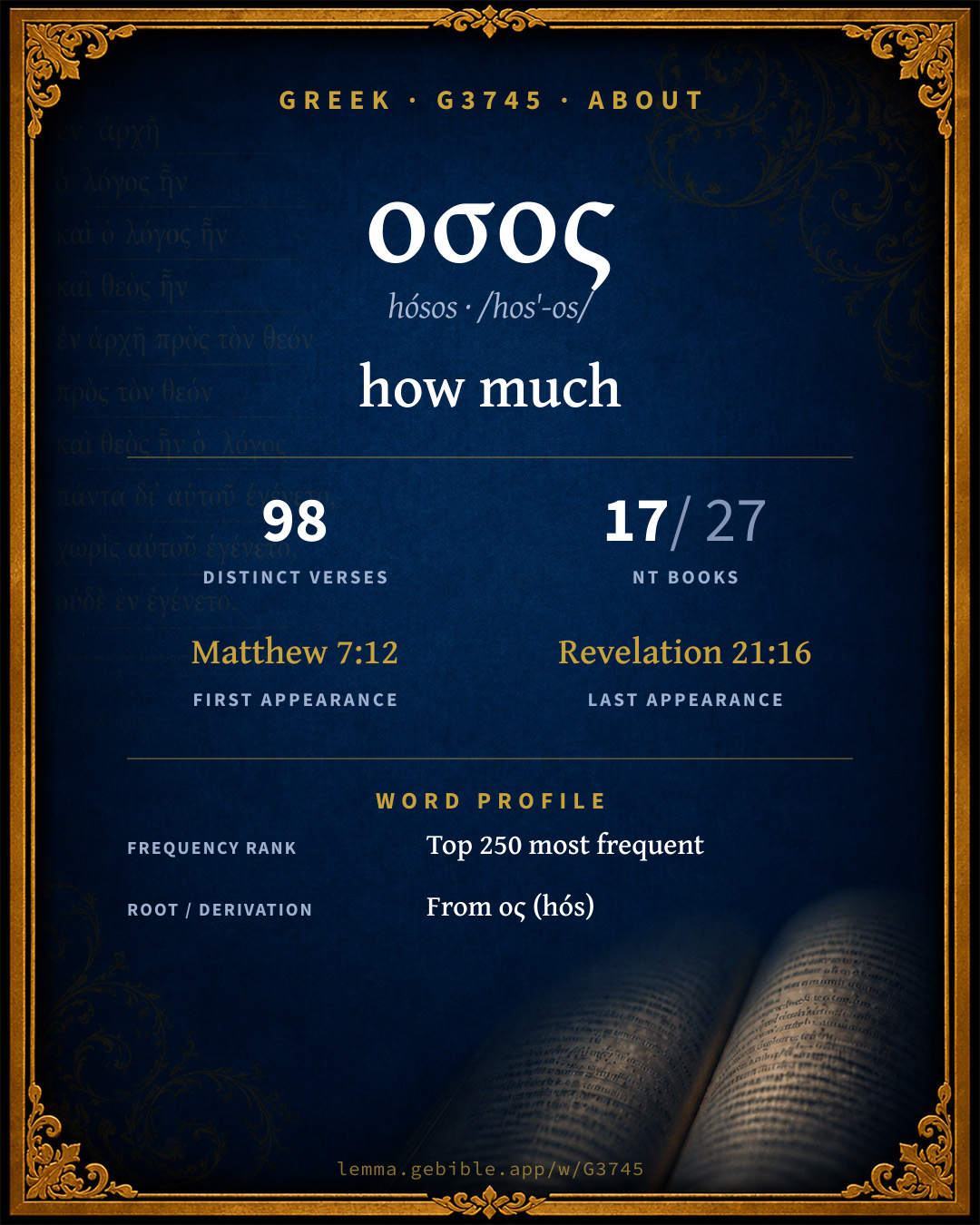
ὅσος
how much
Full lexicon entry — Thayer's Greek Lexicon
From Thayer's Greek Lexicon
Where this word appears
See every Accusative-case word in the Greek New Testament →
Grammar key — what these labels mean
Part of speech
- Correlative pronoun
- Pairs with another term (“such… as,” “as many… as”).
Case
- Accusative
- The case of the direct object and of extent.
- Nominative
- The case of the subject (and the predicate nominative).
- Dative
- The case of the indirect object, means, or location — “to / for / with / in.”
- Genitive
- The case of source, possession, or “of” — answers “whose / from what.”
Gender
- Neuter
- Grammatically neuter.
- Masculine
- Grammatically masculine.
- Feminine
- Grammatically feminine.
Number
- Plural
- More than one.
- Singular
- One.
1 verse where G3745 appears in the Genitive case in the Book of Luke. Filtered view — show all forms. Click any verse to open its interlinear word-by-word view. Verse text shown in the World English Bible for context — . Each verse’s Greek form is shown with its reference; the English is not keyword-highlighted, since the data carries no word-level English alignment. Use “Compare translations” on any verse to read it across multiple English versions. This concordance covers the Greek New Testament; Septuagint (Greek Old Testament) occurrences of this word are not indexed here.
Luke
About this entry
At a glance — auto-summarized from this page’s data, not written by a person. Every figure links to its source below. This summary describes the numbers; it doesn’t interpret them.
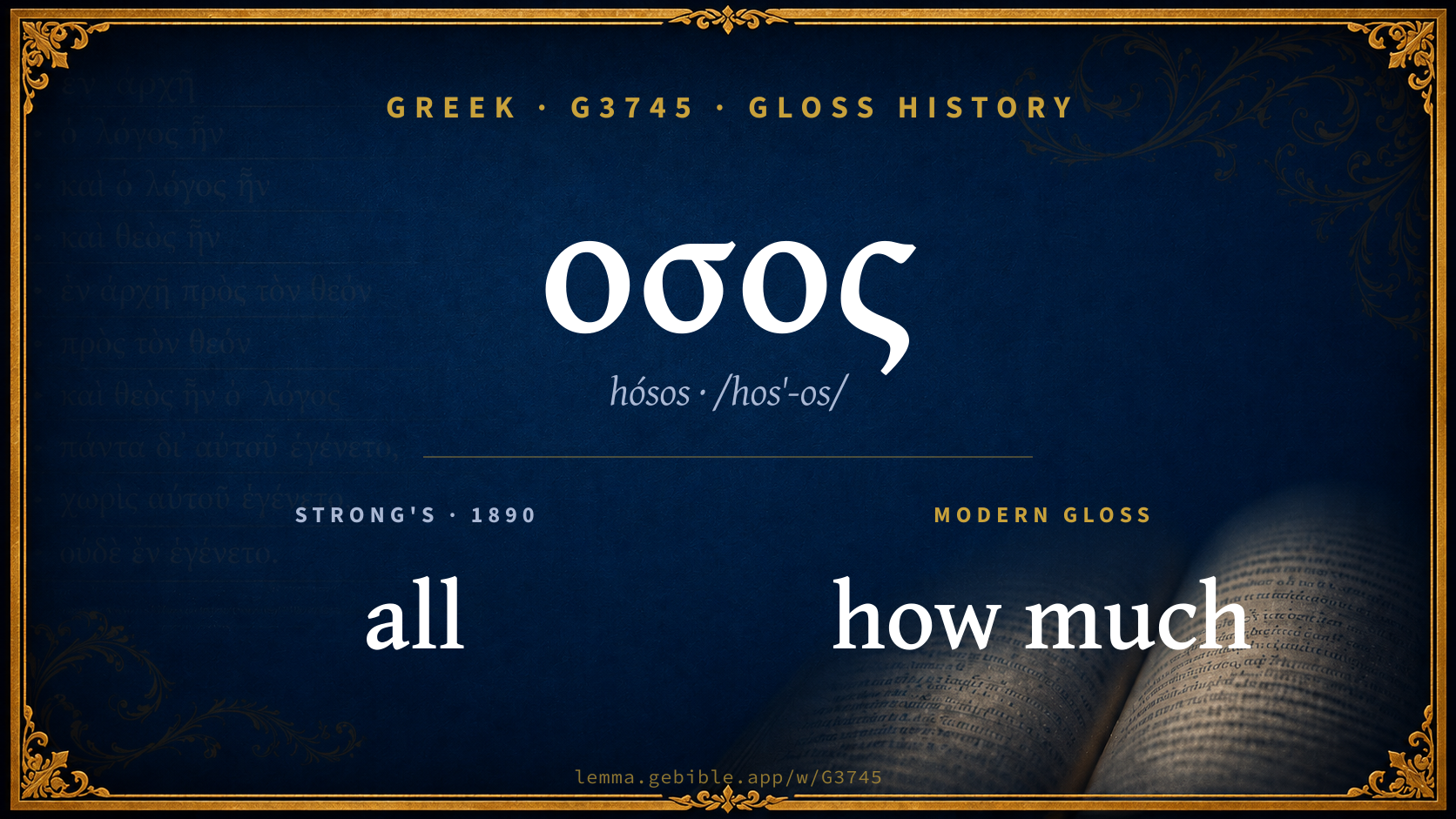
“how much” is the headline sense of the Greek word οσος (hósos). Where the King James Version says “many as,” newer translations reach for “whatever” (Berean Standard Bible); the renderings breakdown has the detail. It appears 98 verses across 17 books of the Greek New Testament, among its moderately common vocabulary. First canonically at Matthew 7:12, it enters the text early. Related forms include ος, ο εστι and οθεν. The sections below give every sense, occurrence, and version rendering.
Gloss history
Strong's 1890 vs modern scholarship
About this word
Strong's G3745 catalogs a Greek word from the Greek New Testament.
These counts are not copied from any lexicon or concordance. They are computed here, from the morphology-tagged Greek New Testament. What Lemma adds →
- 98
- distinct verses
- The word appears in 98 distinct verses.
- 17 / 27
- NT books
- The word appears in 17 of 27 New Testament books.
- #153
- by frequency
- Top 250 most frequent Greek words (rank 153 of 5,347 Greek words by occurrence).
View all 98 occurrences in the concordance →
By section of the New Testament
By traditional corpus
Conventional, traditional groupings — biblical authorship is debated, so this is a traditional corpus grouping, not an authorship claim. Some books belong to more than one corpus (Luke is in both the Gospels and the Lukan corpus, and so on), so these shares overlap and need not total 100%. Each figure is a share of the word’s 98 distinct verses.
- Gospels 45 verses · 46%
- Lukan (Luke–Acts) 26 verses · 27%
- Pauline corpus 19 verses · 19%
- Johannine 15 verses · 15%
- Hebrews 8 verses · 8%
- Revelation 7 verses · 7%
- General (Catholic) Epistles 2 verses · 2%
How translations render this word
Counts come from each version’s own published word-to-Strong’s tagging or interlinear alignment — an approximate guide to how each version renders this word, not a word-level alignment the data otherwise carries. Because each total is that version’s own tagged count, the per-version totals vary from one another and need not match the appearance or distinct-verse counts above. These counts may also differ from a printed concordance because Lemma counts each distinctly tagged rendering and does not collapse phrase taggings into a single head-word total. This is a fixed set of word-tagged versions (KJV, ASV, BSB, ULT) and does not change with the reading translation you choose elsewhere. Each version’s license is shown beside its name below (and on Sources).
- King James Version: Many as 26×, Whatsoever 14×, That 8×
- American Standard Version: Many as 23×, Whatsoever 16×, As 10×
- Berean Standard Bible: Whatever 13×, All who 11×, All 6×
- unfoldingWord Literal Text: Many as 36×, Much as 30×, Whatever 10×
King James Version Public Domain
Renders G3745 across 103 tagged occurrences — most commonly:
Plus other, less common renderings. Plus 14 renderings that appear only once — usually multi-word phrases or single function words the recovered tagging swept in, not distinct renderings. Not rendered by a distinct English word in 13 further occurrences.
American Standard Version Public Domain
Renders G3745 across 109 tagged occurrences — most commonly:
Plus other, less common renderings. Plus 18 renderings that appear only once — usually multi-word phrases or single function words the recovered tagging swept in, not distinct renderings.
Berean Standard Bible Public Domain
Renders G3745 across 88 tagged occurrences — most commonly:
Plus other, less common renderings. Plus 11 renderings that appear only once — usually multi-word phrases or single function words the recovered tagging swept in, not distinct renderings. Not rendered by a distinct English word in 22 further occurrences.
unfoldingWord Literal Text CC BY-SA 4.0
Renders G3745 across 114 tagged occurrences — most commonly:
Plus 10 renderings that appear only once — usually multi-word phrases or single function words the recovered tagging swept in, not distinct renderings.
Senses in Thayer's
The 1 sense Thayer's distinguishes for this word, in lexicon order (not ranked by frequency or importance). The full entry — with sub-senses — is in the Lexicon Entry tab.
- as great as, as far as, how much, how many, whoever
Word origin
Derived from ος (hós) (G3739) — who.
By reduplication from G3739 ; as ( much great long etc.) as : - all (that) as (long many much) (as) how great (many much) [in-] asmuch as so many as that (ever) the more those things what (great -soever) wheresoever wherewithsoever which X while who (-soever).
— Strong’s Exhaustive Concordance (1890), public domain.
Forms in the corpus
The 8 distinct written forms G3745 takes in the Greek New Testament, most frequent first — each parse links to that case’s occurrences in the concordance.
| Form | Parsing | Example | Uses |
|---|---|---|---|
| ὅσα hósa | Correlative pronoun, Accusative, Plural, Neuter | Matthew 7:12 | 53 |
| ὅσοι hósoi | Correlative pronoun, Nominative, Plural, Masculine | Matthew 14:36 | 28 |
| ὅσον hóson | Correlative pronoun, Accusative, Singular, Neuter | Matthew 9:15 | 17 |
| ὅσους hósous | Correlative pronoun, Accusative, Plural, Masculine | Matthew 22:9 | 4 |
| ὅσῳ hósō | Correlative pronoun, Dative, Singular, Neuter | Hebrews 1:4 | 3 |
| ὅσαι hósai | Correlative pronoun, Nominative, Plural, Feminine | 2 Corinthians 1:20 | 1 |
| ὅσων hósōn | Correlative pronoun, Genitive, Plural, Masculine | Luke 11:8 | 1 |
| Ὅσοι Hósoi | Correlative pronoun, Nominative, Plural, Masculine | 1 Timothy 6:1 | 1 |
Same root — word family
Other Thayer's entries built from the same root as G3745, grouped by Strong’s listed origin. These share a root / origin per the lexicon — not necessarily a shared meaning. Each links to that word’s own entry.
Derives from
Shares the same root
- ο εστι hó esti G3603 which is
- οθεν hóthen G3606 from which
- οποιος hopoîos G3697 what sort
- οποτε hopóte G3698 when
- οπου hópou G3699 where
- οπως hópōs G3704 how
- οσακις hosákis G3740 as often as
- οσπερ hósper G3746 whomever
- οστις hóstis G3748 whoever
- οτε hóte G3753 when
- ου hoû G3757 where
- ποσος pósos G4214 how much
- ως hōs G5613 as
Compare all same-root words → Showing 4 of 15 — not the complete family. They share a root, not necessarily a meaning.
Septuagint usage
The same Greek word οσος appears 503 times in the Greek Old Testament (Septuagint), across 463 verses in 31 books.
- 503
- LXX occurrences
- Tagged occurrences of this Greek word in the Septuagint.
- 463
- verses
- Distinct Septuagint verses containing this word.
- 31 / 39
- OT books
- The word appears in 31 of the 39 Old Testament books.
Sample Septuagint occurrences
- Genesis 1:31 ὅσος
- Exodus 3:16 ὅσος
- Leviticus 5:4 ὅσος
- Numbers 1:50 ὅσος
- Deuteronomy 1:3 ὅσος
- Joshua 1:16 ὅσος
- Judges 2:7 ὅσος
- Ruth 2:11 ὅσος
- 1 Samuel 3:12 ὅσος
- 2 Samuel 3:19 ὅσος
- 1 Kings 2:3 ὅσος
- 2 Kings 1:18 ὅσος
Septuagint occurrences (same lexeme)
Every verse where the same Strong’s number (G3745) appears in the Greek Septuagint — showing the first 50 of 463. Verse text shown in the World English Bible for context; the Greek form is the matched word — the English is not keyword-highlighted.
- Genesis 1:31 ὅσος God saw everything that he had made, and, behold, it was very good. There was evening and there was morning, the sixth day.
- Genesis 6:17 ὅσος I, even, I do bring the flood of waters on this earth, to destroy all flesh having the breath of life from under the sky. Everything that is in the earth will die.
- Genesis 6:22 ὅσος Thus Noah did. According to all that God commanded him, so he did.
- Genesis 7:5 ὅσος Noah did everything that Yahweh commanded him.
- Genesis 7:22 ὅσος All in whose nostrils was the breath of the spirit of life, of all that was on the dry land, died.
- Genesis 8:1 ὅσος God remembered Noah, all the animals, and all the cattle that were with him in the ark; and God made a wind to pass over the earth. The waters subsided.
- Genesis 8:17 ὅσος Bring forth with you every living thing that is with you of all flesh, including birds, cattle, and every creeping thing that creeps on the earth; that they may breed abundantly in the earth, and be fruitful, and multiply on the earth."
- Genesis 9:10 ὅσος and with every living creature that is with you: the birds, the cattle, and every animal of the earth with you. Of all that go out of the ark, even every animal of the earth.
- Genesis 9:24 ὅσος Noah awoke from his wine, and knew what his youngest son had done to him.
- Genesis 11:6 ὅσος Yahweh said, "Behold, they are one people, and they have all one language; and this is what they begin to do. Now nothing will be withheld from them, which they intend to do.
- Genesis 12:5 ὅσος Abram took Sarai his wife, Lot his brother's son, all their substance that they had gathered, and the souls who they had gotten in Haran; and they went forth to go into the land of Canaan. Into the land of Canaan they came.
- Genesis 12:20 ὅσος Pharaoh gave men charge concerning him: and they brought him on the way, and his wife, and all that he had.
- Genesis 18:19 ὅσος For I have known him, to the end that he may command his children and his household after him, that they may keep the way of Yahweh, to do righteousness and justice; to the end that Yahweh may bring on Abraham that which he has spoken of him."
- Genesis 21:12 ὅσος God said to Abraham, "Don't let it be grievous in your sight because of the boy, and because of your handmaid. In all that Sarah says to you, listen to her voice. For from Isaac will your seed be called.
- Genesis 24:36 ὅσος Sarah, my master's wife, bore a son to my master when she was old. He has given all that he has to him.
- Genesis 25:7 ὅσος These are the days of the years of Abraham's life which he lived: one hundred seventy-five years.
- Genesis 28:15 ὅσος Behold, I am with you, and will keep you, wherever you go, and will bring you again into this land. For I will not leave you, until I have done that which I have spoken of to you."
- Genesis 30:29 ὅσος He said to him, "You know how I have served you, and how your cattle have fared with me.
- Genesis 30:30 ὅσος For it was little which you had before I came, and it has increased to a multitude. Yahweh has blessed you wherever I turned. Now when will I provide for my own house also?"
- Genesis 31:12 ὅσος He said, 'Now lift up your eyes, and behold, all the male goats which leap on the flock are streaked, speckled, and grizzled, for I have seen all that Laban does to you.
- Genesis 31:16 ὅσος For all the riches which God has taken away from our father, that is ours and our children's. Now then, whatever God has said to you, do."
- Genesis 31:43 ὅσος Laban answered Jacob, "The daughters are my daughters, the children are my children, the flocks are my flocks, and all that you see is mine: and what can I do this day to these my daughters, or to their children whom they have borne?
- Genesis 34:28 ὅσος They took their flocks, their herds, their donkeys, that which was in the city, that which was in the field;
- Genesis 34:29 ὅσος and all their wealth. They took captive all their little ones and their wives, and took as plunder everything that was in the house.
- Genesis 36:6 ὅσος Esau took his wives, his sons, his daughters, and all the members of his household, with his cattle, all his animals, and all his possessions, which he had gathered in the land of Canaan, and went into a land away from his brother Jacob.
- Genesis 39:3 ὅσος His master saw that Yahweh was with him, and that Yahweh made all that he did prosper in his hand.
- Genesis 39:4 ὅσος Joseph found favor in his sight. He ministered to him, and he made him overseer over his house, and all that he had he put into his hand.
- Genesis 39:5 ὅσος It happened from the time that he made him overseer in his house, and over all that he had, that Yahweh blessed the Egyptian's house for Joseph's sake; and the blessing of Yahweh was on all that he had, in the house and in the field.
- Genesis 39:6 ὅσος He left all that he had in Joseph's hand. He didn't concern himself with anything, except for the food which he ate. Joseph was well-built and handsome.
- Genesis 39:8 ὅσος But he refused, and said to his master's wife, "Behold, my master doesn't know what is with me in the house, and he has put all that he has into my hand.
- Genesis 39:19 ὅσος It happened, when his master heard the words of his wife, which she spoke to him, saying, "This is what your servant did to me," that his wrath was kindled.
- Genesis 39:22 ὅσος The keeper of the prison committed to Joseph's hand all the prisoners who were in the prison. Whatever they did there, he was the doer of it.
- Genesis 39:23 ὅσος The keeper of the prison didn't look after anything that was under his hand, because Yahweh was with him; and that which he did, Yahweh made it prosper.
- Genesis 41:25 ὅσος Joseph said to Pharaoh, "The dream of Pharaoh is one. What God is about to do he has declared to Pharaoh.
- Genesis 41:28 ὅσος That is the thing which I spoke to Pharaoh. What God is about to do he has shown to Pharaoh.
- Genesis 44:1 ὅσος He commanded the steward of his house, saying, "Fill the men's sacks with food, as much as they can carry, and put every man's money in his sack's mouth.
- Genesis 45:10 ὅσος You shall dwell in the land of Goshen, and you will be near to me, you, your children, your children's children, your flocks, your herds, and all that you have.
- Genesis 45:13 ὅσος You shall tell my father of all my glory in Egypt, and of all that you have seen. You shall hurry and bring my father down here."
- Genesis 45:27 ὅσος They told him all the words of Joseph, which he had said to them. When he saw the wagons which Joseph had sent to carry him, the spirit of Jacob, their father, revived.
- Exodus 3:16 ὅσος Go, and gather the elders of Israel together, and tell them, 'Yahweh, the God of your fathers, the God of Abraham, of Isaac, and of Jacob, has appeared to me, saying, "I have surely visited you, and seen that which is done to you in Egypt;
- Exodus 6:29 ὅσος that Yahweh spoke to Moses, saying, "I am Yahweh. Speak to Pharaoh king of Egypt all that I speak to you."
- Exodus 7:2 ὅσος You shall speak all that I command you; and Aaron your brother shall speak to Pharaoh, that he let the children of Israel go out of his land.
- Exodus 9:19 ὅσος Now therefore command that all of your cattle and all that you have in the field be brought into shelter. Every man and animal that is found in the field, and isn't brought home, the hail shall come down on them, and they shall die."'"
- Exodus 10:2 ὅσος and that you may tell in the hearing of your son, and of your son's son, what things I have done to Egypt, and my signs which I have done among them; that you may know that I am Yahweh."
- Exodus 11:7 ὅσος But against any of the children of Israel a dog won't even bark or move its tongue, against man or animal; that you may know that Yahweh makes a distinction between the Egyptians and Israel.
- Exodus 12:16 ὅσος In the first day there shall be to you a holy convocation, and in the seventh day a holy convocation; no manner of work shall be done in them, except that which every man must eat, that only may be done by you.
- Exodus 13:12 ὅσος that you shall set apart to Yahweh all that opens the womb, and every firstborn which you have that comes from an animal. The males shall be Yahweh's.
- Exodus 16:23 ὅσος He said to them, "This is that which Yahweh has spoken, 'Tomorrow is a solemn rest, a holy Sabbath to Yahweh. Bake that which you want to bake, and boil that which you want to boil; and all that remains over lay up for yourselves to be kept until the morning."
- Exodus 18:1 ὅσος Now Jethro, the priest of Midian, Moses' father-in-law, heard of all that God had done for Moses, and for Israel his people, how that Yahweh had brought Israel out of Egypt.
- Exodus 18:8 ὅσος Moses told his father-in-law all that Yahweh had done to Pharaoh and to the Egyptians for Israel's sake, all the hardships that had come on them on the way, and how Yahweh delivered them.
These are occurrences of the same Greek lexeme (G3745) in the Septuagint — not a translation of any one Hebrew word. The store carries no word-level Hebrew↔Greek alignment, so no Hebrew original is asserted here. Counts come from the recovered LXX Strong's tagging — high-frequency vocabulary is well covered, while rare or late forms may be untagged — so they reflect tagged occurrences and may slightly undercount.