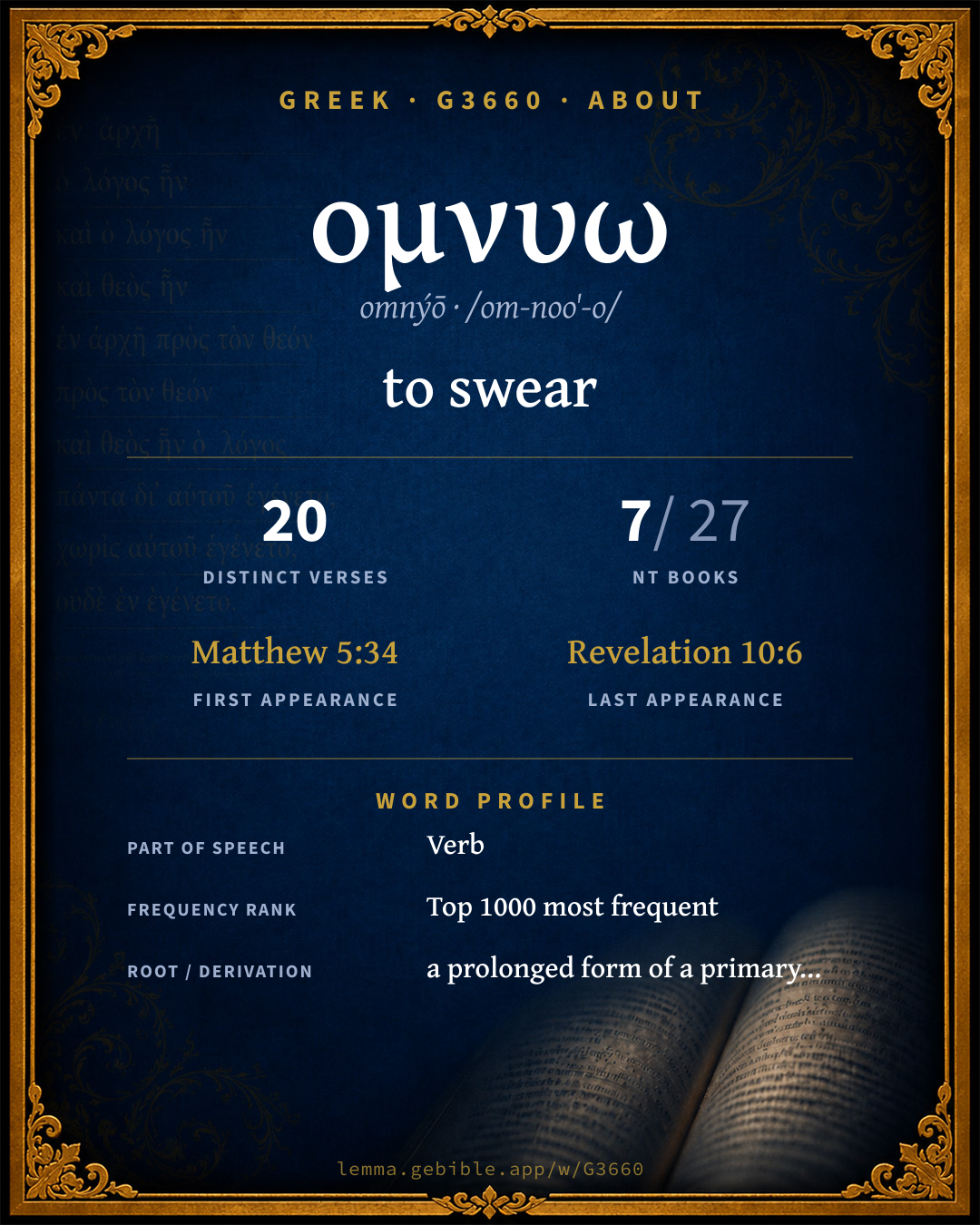
ὀμνύω
to swear
‘to swear’ is one of 3 main senses fuller range ↓
Full lexicon entry — Thayer's Greek Lexicon
From Thayer's Greek Lexicon
Where this word appears
See every Aorist-tense verb in the Greek New Testament →
Grammar key — what these labels mean
Part of speech
- Verb
- An action or state-of-being word.
Tense
- Aorist
- Action viewed as a simple whole, without regard to duration — often past (perfective aspect).
- Present
- Ongoing or general action in present time (imperfective aspect).
Voice
- Active
- The subject performs the action.
Mood
- Indicative
- States a fact or asks a factual question (the mood of reality).
- Subjunctive
- Expresses probability, purpose, or possibility (the mood of contingency).
- Participle
- A verbal adjective (“writing,” “having written”).
- Infinitive
- A verbal noun (“to write”), unmarked for person or number.
- Imperative
- Expresses a command or request.
Case
- Nominative
- The case of the subject (and the predicate nominative).
Person
- 3rd person
- The one spoken about (“he / she / it / they”).
- 1st person
- The speaker (“I / we”).
- 2nd person
- The one addressed (“you”).
Gender
- Masculine
- Grammatically masculine.
Number
- Singular
- One.
- Plural
- More than one.
Grammatical forms 10 distinct
- Verb, Aorist, Active, Indicative, 3rd person, Singular 7 times (27%)
- Verb, Aorist, Active, Subjunctive, 3rd person, Singular 4 times (15%)
- Verb, Aorist, Active, Participle, Nominative, Singular, Masculine 3 times (12%)
- Verb, Present, Active, Indicative, 3rd person, Singular 3 times (12%)
- Verb, Aorist, Active, Indicative, 1st person, Singular 2 times (8%)
- Verb, Aorist, Active, Infinitive 2 times (8%)
- Verb, Present, Active, Infinitive 2 times (8%)
- Verb, Aorist, Active, Subjunctive, 2nd person, Singular 1 time (4%)
+2 more forms (2 occurrences)
Parsed forms decoded from the imported morphology (Robinson–Tischendorf, public domain), counted across 26 parsed occurrences — not distinct verses.
Every verse where G3660 appears — 20 distinct verses across 7 books. Click any verse to open its interlinear word-by-word view. Verse text shown in the World English Bible for context — . Each verse’s Greek form is shown with its reference; the English is not keyword-highlighted, since the data carries no word-level English alignment. Use “Compare translations” on any verse to read it across multiple English versions. This concordance covers the Greek New Testament; Septuagint (Greek Old Testament) occurrences of this word are not indexed here.
Matthew 8 verses
- Matthew 5:34 ὀμόσαι aor act inf but I tell you, don't swear at all: neither by heaven, for it is the throne of God;
- Matthew 5:36 ὀμόσῃς aor act subj 2sg Neither shall you swear by your head, for you can't make one hair white or black.
- Matthew 23:16 ὀμόσῃ ὀμόσῃ aor act subj 3sg aor act subj 3sg "Woe to you, you blind guides, who say, 'Whoever swears by the temple, it is nothing; but whoever swears by the gold of the temple, he is obligated.'
- Matthew 23:18 ὀμόσῃ ὀμόσῃ aor act subj 3sg aor act subj 3sg 'Whoever swears by the altar, it is nothing; but whoever swears by the gift that is on it, he is obligated.'
- Matthew 23:20 ὀμόσας ὀμνύει aor act ptcp nom sg masc pres act ind 3sg He therefore who swears by the altar, swears by it, and by everything on it.
- Matthew 23:21 ὀμόσας ὀμνύει aor act ptcp nom sg masc pres act ind 3sg He who swears by the temple, swears by it, and by him who was living in it.
- Matthew 23:22 ὀμόσας ὀμνύει aor act ptcp nom sg masc pres act ind 3sg He who swears by heaven, swears by the throne of God, and by him who sits on it.
- Matthew 26:74 ὀμνύειν pres act inf Then he began to curse and to swear, "I don't know the man!" Immediately the rooster crowed.
Mark 2 verses
Luke 1 verse
Acts 1 verse
Hebrews 6 verses
- Hebrews 3:11 ὤμοσα aor act ind 1sg As I swore in my wrath, 'They will not enter into my rest.'"
- Hebrews 3:18 ὤμοσεν aor act ind 3sg To whom did he swear that they wouldn't enter into his rest, but to those who were disobedient?
- Hebrews 4:3 ὤμοσα aor act ind 1sg For we who have believed do enter into that rest, even as he has said, "As I swore in my wrath, they will not enter into my rest;" although the works were finished from the foundation of the world.
- Hebrews 6:13 ὀμόσαι ὤμοσεν aor act inf aor act ind 3sg For when God made a promise to Abraham, since he could swear by none greater, he swore by himself,
- Hebrews 6:16 ὀμνύουσιν pres act ind 3pl For men indeed swear by a greater one, and in every dispute of theirs the oath is final for confirmation.
- Hebrews 7:21 ὤμοσεν aor act ind 3sg (for they indeed have been made priests without an oath), but he with an oath by him that says of him, "The Lord swore and will not change his mind, 'You are a priest forever, According to the order of Melchizedek'".
James 1 verse
Revelation 1 verse
About this entry
At a glance — auto-summarized from this page’s data, not written by a person. Every figure links to its source below. This summary describes the numbers; it doesn’t interpret them.
The Greek verb ομνυω centers on the idea of “to swear.” Translators differ — “swear” in the King James Version, then “swears” (Berean Standard Bible), as the renderings breakdown shows. It turns up in 20 verses across 7 books, an uncommon footprint. The word gravitates to Matthew (40%), then Hebrews and Mark. Lexicons map it across 3 senses. Dig into 20-verse concordance and the renderings breakdown below.
Gloss history
Strong's 1890 vs modern scholarship
About this word
Strong's G3660 catalogs a Greek word from the Greek New Testament.
These counts are not copied from any lexicon or concordance. They are computed here, from the morphology-tagged Greek New Testament. What Lemma adds →
- 20
- distinct verses
- The word appears in 20 distinct verses.
- 7 / 27
- NT books
- The word appears in 7 of 27 New Testament books.
- #513
- by frequency
- Top 1000 most frequent Greek words (rank 513 of 5,347 Greek words by occurrence).
View all 20 occurrences in the concordance →
By section of the New Testament
By traditional corpus
Conventional, traditional groupings — biblical authorship is debated, so this is a traditional corpus grouping, not an authorship claim. Some books belong to more than one corpus (Luke is in both the Gospels and the Lukan corpus, and so on), so these shares overlap and need not total 100%. Each figure is a share of the word’s 20 distinct verses.
- Gospels 11 verses · 55%
- Hebrews 6 verses · 30%
- Lukan (Luke–Acts) 2 verses · 10%
- Johannine 1 verse · 5%
- General (Catholic) Epistles 1 verse · 5%
- Revelation 1 verse · 5%
How translations render this word
Counts come from each version’s own published word-to-Strong’s tagging or interlinear alignment — an approximate guide to how each version renders this word, not a word-level alignment the data otherwise carries. Because each total is that version’s own tagged count, the per-version totals vary from one another and need not match the appearance or distinct-verse counts above. These counts may also differ from a printed concordance because Lemma counts each distinctly tagged rendering and does not collapse phrase taggings into a single head-word total. This is a fixed set of word-tagged versions (KJV, ASV, BSB, ULT) and does not change with the reading translation you choose elsewhere. Each version’s license is shown beside its name below (and on Sources).
- King James Version: Swear 6×, Shall swear 4×, Sweareth 4×
- American Standard Version: Swear 5×, Shall swear 4×, Sweareth 4×
- Berean Standard Bible: Swears 10×, Swear 6×, He swore 4×
- unfoldingWord Literal Text: Swears 7×, Swear 6×, Having sworn 3×
King James Version Public Domain
Renders G3660 across 27 tagged occurrences — most commonly:
Plus 6 renderings that appear only once — usually multi-word phrases or single function words the recovered tagging swept in, not distinct renderings.
American Standard Version Public Domain
Renders G3660 across 29 tagged occurrences — most commonly:
Plus 8 renderings that appear only once — usually multi-word phrases or single function words the recovered tagging swept in, not distinct renderings.
Berean Standard Bible Public Domain
Renders G3660 across 26 tagged occurrences — most commonly:
Plus 4 renderings that appear only once — usually multi-word phrases or single function words the recovered tagging swept in, not distinct renderings.
unfoldingWord Literal Text CC BY-SA 4.0
Renders G3660 across 27 tagged occurrences — most commonly:
Plus 4 renderings that appear only once — usually multi-word phrases or single function words the recovered tagging swept in, not distinct renderings.
Senses in Thayer's
The 3 senses Thayer's distinguishes for this word, in lexicon order (not ranked by frequency or importance). The full entry — with sub-senses — is in the Lexicon Entry tab.
- to swear
- to affirm, promise, threaten, with an oath
- in swearing to call a person or thing as witness, to invoke, swear by
Word origin
Origin: a prolonged form of a primary but obsolete omo, for which another prolonged form (omoo om-o'-o) is used in certain tenses
A prolonged form of a primary but obsolete word ὄμω omō for which another prolonged form ( ὀμόω omoō om-o'-o ) is used in certain tenses. To swear that is take (or declare on ) oath : - swear.
— Strong’s Exhaustive Concordance (1890), public domain.
Forms in the corpus
The 11 distinct written forms G3660 takes in the Greek New Testament, most frequent first — each parse links to that tense’s occurrences in the concordance.
| Form | Parsing | Example | Uses |
|---|---|---|---|
| ὤμοσεν ṓmosen | Verb, Aorist, Active, Indicative, 3rd person, Singular | Mark 6:23 | 7 |
| ὀμόσῃ omósē | Verb, Aorist, Active, Subjunctive, 3rd person, Singular | Matthew 23:16 | 4 |
| ὀμνύει omnýei | Verb, Present, Active, Indicative, 3rd person, Singular | Matthew 23:20 | 3 |
| ὀμόσας omósas | Verb, Aorist, Active, Participle, Nominative, Singular, Masculine | Matthew 23:20 | 3 |
| ὀμόσαι omósai | Verb, Aorist, Active, Infinitive | Matthew 5:34 | 2 |
| ὤμοσα ṓmosa | Verb, Aorist, Active, Indicative, 1st person, Singular | Hebrews 3:11 | 2 |
| ὀμνύειν omnýein | Verb, Present, Active, Infinitive | Matthew 26:74 | 1 |
| ὀμνύετε omnýete | Verb, Present, Active, Imperative, 2nd person, Plural | James 5:12 | 1 |
| ὀμνύναι omnýnai | Verb, Present, Active, Infinitive | Mark 14:71 | 1 |
| ὀμνύουσιν omnýousin | Verb, Present, Active, Indicative, 3rd person, Plural | Hebrews 6:16 | 1 |
| ὀμόσῃς omósēs | Verb, Aorist, Active, Subjunctive, 2nd person, Singular | Matthew 5:36 | 1 |
Septuagint usage
The same Greek word ομνυω appears 154 times in the Greek Old Testament (Septuagint), across 149 verses in 26 books.
- 154
- LXX occurrences
- Tagged occurrences of this Greek word in the Septuagint.
- 149
- verses
- Distinct Septuagint verses containing this word.
- 26 / 39
- OT books
- The word appears in 26 of the 39 Old Testament books.
Sample Septuagint occurrences
- Genesis 21:23 ὄμνυμι
- Exodus 13:5 ὄμνυμι
- Leviticus 5:4 ὄμνυμι
- Numbers 11:12 ὄμνυμι
- Deuteronomy 1:8 ὄμνυμι
- Joshua 1:6 ὄμνυμι
- Judges 2:1 ὄμνυμι
- 1 Samuel 3:14 ὄμνυμι
- 2 Samuel 3:9 ὄμνυμι
- 1 Kings 1:13 ὄμνυμι
- 2 Kings 25:24 ὄμνυμι
- 2 Chronicles 15:14 ὄμνυμι
Septuagint occurrences (same lexeme)
Every verse where the same Strong’s number (G3660) appears in the Greek Septuagint — showing the first 50 of 149. Verse text shown in the World English Bible for context; the Greek form is the matched word — the English is not keyword-highlighted.
- Genesis 21:23 ὄμνυμι Now therefore swear to me here by God that you will not deal falsely with me, nor with my son, nor with my son's son. But according to the kindness that I have done to you, you shall do to me, and to the land in which you have lived as a foreigner."
- Genesis 21:24 ὄμνυμι Abraham said, "I will swear."
- Genesis 21:31 ὄμνυμι Therefore he called that place Beersheba, because they both swore there.
- Genesis 22:16 ὄμνυμι and said, "I have sworn by myself, says Yahweh, because you have done this thing, and have not withheld your son, your only son,
- Genesis 24:7 ὄμνυμι Yahweh, the God of heaven, who took me from my father's house, and from the land of my birth, who spoke to me, and who swore to me, saying, 'I will give this land to your seed.' He will send his angel before you, and you shall take a wife for my son from there.
- Genesis 24:9 ὄμνυμι The servant put his hand under the thigh of Abraham his master, and swore to him concerning this matter.
- Genesis 25:33 ὄμνυμι Jacob said, "Swear to me first." He swore to him. He sold his birthright to Jacob.
- Genesis 26:3 ὄμνυμι Sojourn in this land, and I will be with you, and will bless you. For to you, and to your seed, I will give all these lands, and I will establish the oath which I swore to Abraham your father.
- Genesis 26:31 ὄμνυμι They rose up some time in the morning, and swore one to another. Isaac sent them away, and they departed from him in peace.
- Genesis 31:53 ὄμνυμι The God of Abraham, and the God of Nahor, the God of their father, judge between us." Then Jacob swore by the fear of his father, Isaac.
- Genesis 47:31 ὄμνυμι He said, "Swear to me," and he swore to him. Israel bowed himself on the bed's head.
- Genesis 50:24 ὄμνυμι Joseph said to his brothers, "I am dying, but God will surely visit you, and bring you up out of this land to the land which he swore to Abraham, to Isaac, and to Jacob."
- Exodus 13:5 ὄμνυμι It shall be, when Yahweh shall bring you into the land of the Canaanite, and the Hittite, and the Amorite, and the Hivite, and the Jebusite, which he swore to your fathers to give you, a land flowing with milk and honey, that you shall keep this service in this month.
- Exodus 13:11 ὄμνυμι "It shall be, when Yahweh shall bring you into the land of the Canaanite, as he swore to you and to your fathers, and shall give it you,
- Exodus 22:7 ὄμνυμι "If a man delivers to his neighbor money or stuff to keep, and it is stolen out of the man's house; if the thief is found, he shall pay double.
- Exodus 32:13 ὄμνυμι Remember Abraham, Isaac, and Israel, your servants, to whom you swore by your own self, and said to them, 'I will multiply your seed as the stars of the sky, and all this land that I have spoken of I will give to your seed, and they shall inherit it forever.'"
- Exodus 33:1 ὄμνυμι Yahweh spoke to Moses, "Depart, go up from here, you and the people that you have brought up out of the land of Egypt, to the land of which I swore to Abraham, to Isaac, and to Jacob, saying, 'I will give it to your seed.'
- Leviticus 5:4 ὄμνυμι "'Or if anyone swears rashly with his lips to do evil, or to do good, whatever it is that a man might utter rashly with an oath, and it is hidden from him; when he knows of it, then he shall be guilty of one of these.
- Leviticus 5:22 ὄμνυμι
- Leviticus 5:24 ὄμνυμι
- Leviticus 19:12 ὄμνυμι "'You shall not swear by my name falsely, and profane the name of your God. I am Yahweh.
- Numbers 11:12 ὄμνυμι Have I conceived all this people? have I brought them forth, that you should tell me, Carry them in your bosom, as a nursing-father carries the sucking child, to the land which you swore to their fathers?
- Numbers 14:16 ὄμνυμι Because Yahweh was not able to bring this people into the land which he swore to them, therefore he has slain them in the wilderness.
- Numbers 14:23 ὄμνυμι surely they shall not see the land which I swore to their fathers, neither shall any of those who despised me see it:
- Numbers 30:3 ὄμνυμι Also when a woman vows a vow to Yahweh, and binds herself by a bond, being in her father's house, in her youth,
- Numbers 32:10 ὄμνυμι Yahweh's anger was kindled in that day, and he swore, saying,
- Numbers 32:11 ὄμνυμι Surely none of the men who came up out of Egypt, from twenty years old and upward, shall see the land which I swore to Abraham, to Isaac, and to Jacob; because they have not wholly followed me:
- Deuteronomy 1:8 ὄμνυμι Behold, I have set the land before you: go in and possess the land which Yahweh swore to your fathers, to Abraham, to Isaac, and to Jacob, to give to them and to their seed after them.
- Deuteronomy 1:34 ὄμνυμι Yahweh heard the voice of your words, and was angry, and swore, saying,
- Deuteronomy 1:35 ὄμνυμι Surely there shall not one of these men of this evil generation see the good land, which I swore to give to your fathers,
- Deuteronomy 2:14 ὄμνυμι The days in which we came from Kadesh-barnea, until we were come over the brook Zered, were thirty-eight years; until all the generation of the men of war were consumed from the midst of the camp, as Yahweh swore to them.
- Deuteronomy 4:21 ὄμνυμι Furthermore Yahweh was angry with me for your sakes, and swore that I should not go over the Jordan, and that I should not go in to that good land, which Yahweh your God gives you for an inheritance:
- Deuteronomy 4:31 ὄμνυμι for Yahweh your God is a merciful God; he will not fail you, neither destroy you, nor forget the covenant of your fathers which he swore to them.
- Deuteronomy 6:10 ὄμνυμι It shall be, when Yahweh your God shall bring you into the land which he swore to your fathers, to Abraham, to Isaac, and to Jacob, to give you, great and goodly cities, which you didn't build,
- Deuteronomy 6:13 ὄμνυμι You shall fear Yahweh your God; and him shall you serve, and shall swear by his name.
- Deuteronomy 6:18 ὄμνυμι You shall do that which is right and good in the sight of Yahweh; that it may be well with you, and that you may go in and possess the good land which Yahweh swore to your fathers,
- Deuteronomy 6:23 ὄμνυμι and he brought us out from there, that he might bring us in, to give us the land which he swore to our fathers.
- Deuteronomy 7:8 ὄμνυμι but because Yahweh loves you, and because he would keep the oath which he swore to your fathers, has Yahweh brought you out with a mighty hand, and redeemed you out of the house of bondage, from the hand of Pharaoh king of Egypt.
- Deuteronomy 7:12 ὄμνυμι It shall happen, because you listen to these ordinances, and keep and do them, that Yahweh your God will keep with you the covenant and the loving kindness which he swore to your fathers:
- Deuteronomy 7:13 ὄμνυμι and he will love you, and bless you, and multiply you; he will also bless the fruit of your body and the fruit of your ground, your grain and your new wine and your oil, the increase of your cattle and the young of your flock, in the land which he swore to your fathers to give you.
- Deuteronomy 8:1 ὄμνυμι All the commandment which I command you this day shall you observe to do, that you may live, and multiply, and go in and possess the land which Yahweh swore to your fathers.
- Deuteronomy 8:18 ὄμνυμι But you shall remember Yahweh your God, for it is he who gives you power to get wealth; that he may establish his covenant which he swore to your fathers, as at this day.
- Deuteronomy 9:5 ὄμνυμι Not for your righteousness, or for the uprightness of your heart, do you go in to possess their land; but for the wickedness of these nations Yahweh your God does drive them out from before you, and that he may establish the word which Yahweh swore to your fathers, to Abraham, to Isaac, and to Jacob.
- Deuteronomy 9:27 ὄμνυμι Remember your servants, Abraham, Isaac, and Jacob; don't look to the stubbornness of this people, nor to their wickedness, nor to their sin,
- Deuteronomy 10:11 ὄμνυμι Yahweh said to me, Arise, take your journey before the people; and they shall go in and possess the land, which I swore to their fathers to give to them.
- Deuteronomy 10:20 ὄμνυμι You shall fear Yahweh your God; him shall you serve; and to him shall you cleave, and by his name shall you swear.
- Deuteronomy 11:9 ὄμνυμι and that you may prolong your days in the land, which Yahweh swore to your fathers to give to them and to their seed, a land flowing with milk and honey.
- Deuteronomy 11:21 ὄμνυμι that your days may be multiplied, and the days of your children, in the land which Yahweh swore to your fathers to give them, as the days of the heavens above the earth.
- Deuteronomy 13:18 ὄμνυμι when you shall listen to the voice of Yahweh your God, to keep all his commandments which I command you this day, to do that which is right in the eyes of Yahweh your God.
- Deuteronomy 19:8 ὄμνυμι If Yahweh your God enlarge your border, as he has sworn to your fathers, and give you all the land which he promised to give to your fathers;
These are occurrences of the same Greek lexeme (G3660) in the Septuagint — not a translation of any one Hebrew word. The store carries no word-level Hebrew↔Greek alignment, so no Hebrew original is asserted here. Counts come from the recovered LXX Strong's tagging — high-frequency vocabulary is well covered, while rare or late forms may be untagged — so they reflect tagged occurrences and may slightly undercount.