Hebrews 3:11

Greek (Tischendorf 8th ed.) Hebrews 3:11 appears in the Greek New Testament. The text above is from the Tischendorf 8th edition. Each word links to its Strong’s number and a concise gloss. Click any word for its full Thayer’s Greek Lexicon entry.
Download image
Cite this verse

Hebrews 3:11 (World English Bible). Public Domain. Lemma interlinear Bible study tool, https://lemma.gebible.app/v/hebrews/3/11.

Show BibTeX & RIS
BibTeX
RIS
English Translation
As I swore in my wrath, 'They will not enter into my rest.'"
World English Bible · Public Domain
Download a study sheet

One document with this verse’s original text, its word-by-word gloss line, the meaning frame, cross-references with their text, attributed commentary, and full source and license credits — printable, and it pastes into notes with its structure intact.

This verse Autodidact and up

Study sheet (.html) Plain text (.txt)

A passage Seminary Student

Up to 50 verses in one chapter. A passage sheet keeps up to 6 commentary sources and 12 cross-references per verse, in the order this page ranks them, and says so on the sheet whenever that leaves anything out. Ask for a single verse and you get the Autodidact verse sheet above.

Everything on this page stays free to read, with no account — the sheet is a download of what is already on screen, not access to it.

Want to remove ads? Support Godless Engineer
Compare translations 3

The same verse in 3 English versions, stacked beneath the original-language interlinear above. Click any original word for its lexicon entry.

Each is an independent rendering of the whole verse — the interlinear is not word-aligned to these translations.

Highlighted words mark where these versions differ — a whole-verse word diff, not a word-by-word alignment.

  • World English Bible Public Domain
    As I swore in my wrath, 'They will not enter into my rest.'"
  • King James Version Public Domain
    So I sware in my wrath, They shall not enter into my rest.)
  • unfoldingWord Literal Text CC BY-SA 4.0
    As I swore in my wrath, ‘…if they will enter into my rest!’”

unfoldingWord Literal Text — © unfoldingWord, licensed CC BY-SA 4.0. Word-aligned USFM3 via Door43 (git.door43.org/unfoldingWord/en_ult).

Versions to compare (up to 4)

3 of 4 selected

Show all 19 translations

Every available English version of this verse, each an independent rendering of the whole verse.

  • World English Bible Public Domain
    As I swore in my wrath, 'They will not enter into my rest.'"
  • Berean Standard Bible Public Domain
    So I swore on oath in My anger, ‘They shall never enter My rest.’”
  • Majority Standard Bible Public Domain
    So I swore on oath in My anger, ‘They shall never enter My rest.’”
  • King James Version Public Domain
    So I sware in my wrath, They shall not enter into my rest.)
  • American Standard Version (1901) Public Domain
    As I sware in my wrath, They shall not enter into my rest.
  • Revised Version (1885) Public Domain
    As I sware in my wrath, They shall not enter into my rest.
  • Geneva Bible (1599) Public Domain
    Therefore I sware in my wrath, If they shall enter into my rest.
  • Douay-Rheims (1899) Public Domain
    As I have sworn in my wrath: If they shall enter into my rest.
  • Young's Literal Translation Public Domain
    so I sware in My anger, If they shall enter into My rest --!')
  • Literal Standard Version CC BY-SA 4.0
    so I swore in My anger, They will [not] enter into My rest.”
  • Unlocked Literal Bible CC BY-SA 4.0
    It is just as I swore in my anger: 'They will never enter my rest.'”
  • unfoldingWord Literal Text CC BY-SA 4.0
    As I swore in my wrath, ‘…if they will enter into my rest!’”
  • Darby Bible Public Domain
    so I swore in my wrath, If they shall enter into my rest.
  • World Messianic Bible Public Domain
    As I swore in my wrath, ‘They will not enter into my rest.’”
  • Webster's Bible Public Domain
    So I swore in my wrath, They shall not enter into my rest.)
  • Free Bible Version CC BY-SA 4.0
    So in my frustration I vowed, ‘They shall not enter my rest.’”
  • Bible in Basic English Public Domain
    And being angry I made an oath, saying, They may not come into my rest.
  • Text-Critical English NT CC BY 4.0
    As I swore in my wrath, ‘They shall never enter my rest!’ ”
  • Tyndale New Testament (1534) Public Domain
    so that I sware in my wrathe that they shuld not enter into my rest.

Literal Standard Version (2020), Covenant Press — licensed CC BY-SA 4.0. Text via the HelloAO Bible API (eBible.org). Unlocked Literal Bible (unfoldingWord) — licensed CC BY-SA 4.0. Text via the HelloAO Bible API (eBible.org). unfoldingWord Literal Text — © unfoldingWord, licensed CC BY-SA 4.0. Word-aligned USFM3 via Door43 (git.door43.org/unfoldingWord/en_ult). Free Bible Version, Dr. Jonathan Gallagher — licensed CC BY-SA 4.0. Text via the HelloAO Bible API (eBible.org).

Word by word

More ways to search: Search by grammar → Find every occurrence → Compare this word →

Practice this passage: Drill this verse → Learn its vocabulary →

κατάπαυσίν
katápausis
G2663
“resting place”
Noun, Accusative, Singular, Feminine
Part of Speech
Noun
Case
Accusative
Number
Singular
Gender
Feminine
Full Thayer's Definition

Origin: from G2664

TDNT: 13:28,4

1. a putting to rest a. calming of the winds 2. a resting place a. metaph. the heavenly blessedness in which God dwells, and of which he has promised to make persevering believers in Christ partakers after the toils and trials of life on earth are ended
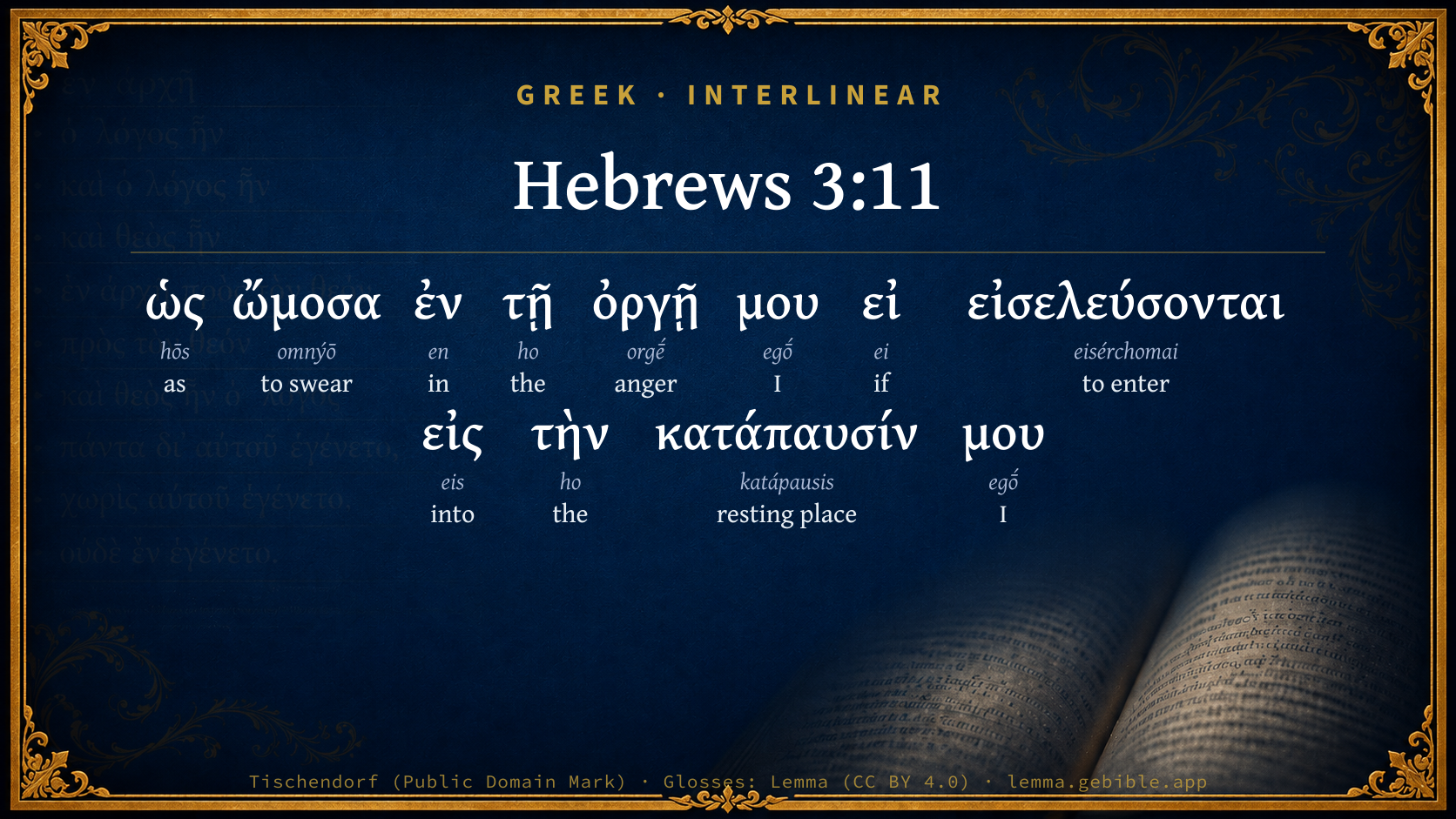
  1. ὡς hōs G5613 “as” Adverb
  2. ὤμοσα omnýō G3660 “to swear” Verb, Aorist, Active, Indicative, 1st person, Singular
  3. ἐν en G1722 “in” Preposition
  4. τῇ ho G3588 “the” Article, Dative, Singular, Feminine
  5. ὀργῇ orgḗ G3709 “anger” Noun, Dative, Singular, Feminine
  6. μου egṓ G1473 “I” Personal pronoun, 1st person, Genitive, Singular
  7. εἰ ei G1487 “if” Conditional
  8. εἰσελεύσονται eisérchomai G1525 “to enter” Verb, Future, Middle deponent, Indicative, 3rd person, Plural
  9. εἰς eis G1519 “into” Preposition
  10. τὴν ho G3588 “the” Article, Accusative, Singular, Feminine
  11. μου egṓ G1473 “I” Personal pronoun, 1st person, Genitive, Singular

About this verse

These counts appear in no published source. They are computed here, from the morphology-tagged text and Lemma’s own curated glosses. What Lemma adds →

12
words
10
distinct lemmas
General Epistles
section

Notable vocabulary

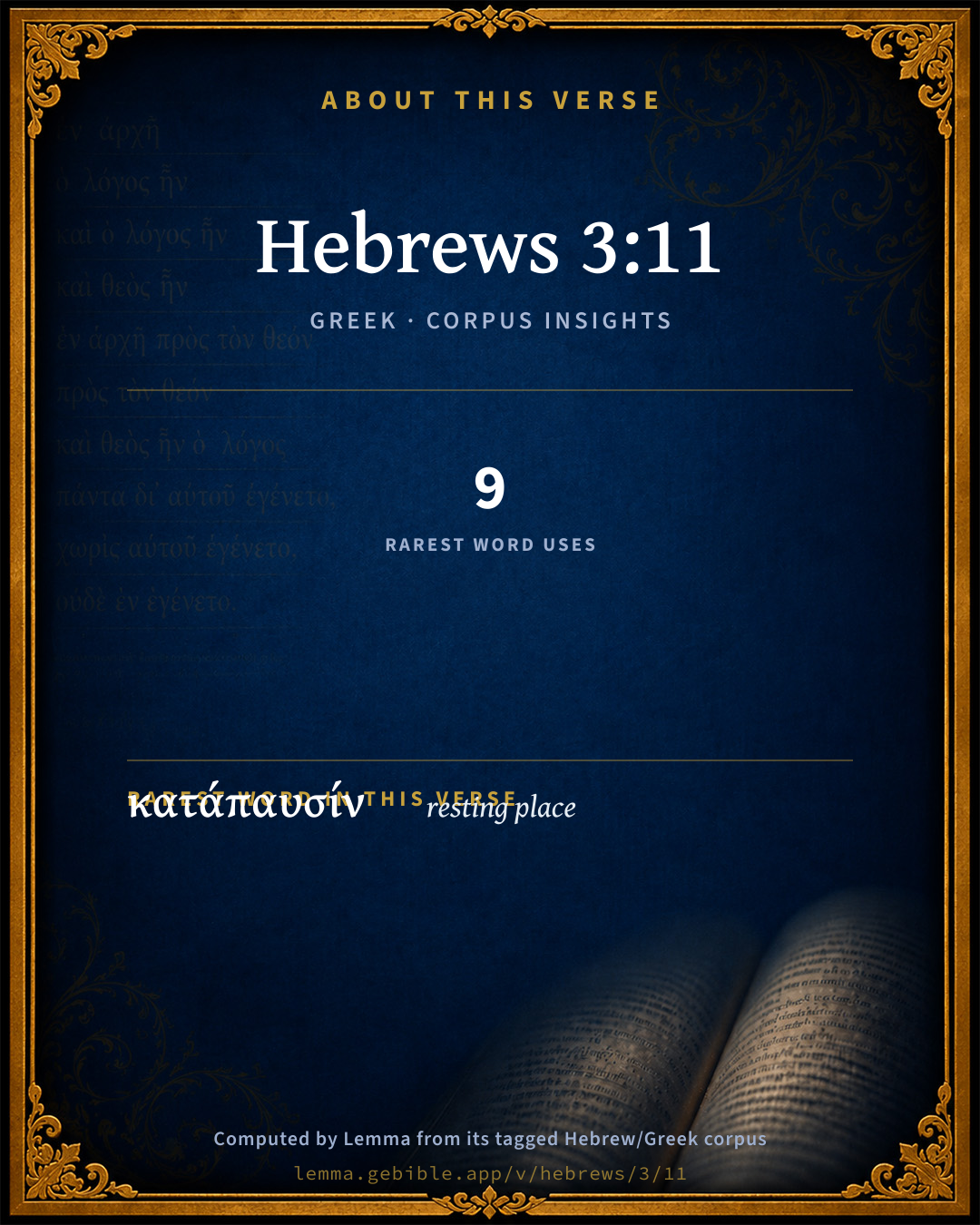
The rarest word here is κατάπαυσίν resting place G2663 — appearing just 9 times in the whole Greek New Testament.

Shared distinctive vocabulary

κατάπαυσίν resting place G2663 occurs in 8 verses of the Greek New Testament. Also found in:

Repetition

Words recur within this verse:

Cross-references

11

Topical passages linked to Hebrews 3:11 in the Treasury of Scripture Knowledge — connected by theme and wording, ordered by reader-vote popularity; previews shown in the World English Bible.

  • Deuteronomy 1:34–35 Yahweh heard the voice of your words, and was angry, and swore, saying,
  • Hebrews 4:3 For we who have believed do enter into that rest, even as he has said, "As I swore in my wrath, they will not enter into my rest;" although the works were finished from the foundation of the world.
  • Numbers 14:20–23 Yahweh said, I have pardoned according to your word:
  • Numbers 14:35 I, Yahweh, have spoken, surely this will I do to all this evil congregation, who are gathered together against me: in this wilderness they shall be consumed, and there they shall die.
  • Numbers 32:10–13 Yahweh's anger was kindled in that day, and he swore, saying,
  • Deuteronomy 2:14 The days in which we came from Kadesh-barnea, until we were come over the brook Zered, were thirty-eight years; until all the generation of the men of war were consumed from the midst of the camp, as Yahweh swore to them.
  • Hebrews 4:5 and in this place again, "They will not enter into my rest."
  • Numbers 14:27–30 How long [shall I bear] with this evil congregation, that murmur against me? I have heard the murmurings of the children of Israel, which they murmur against me.
  • Psalms 95:11 Therefore I swore in my wrath, "They won't enter into my rest."
  • Hebrews 4:9 There remains therefore a Sabbath rest for the people of God.
  • Numbers 14:25 Now the Amalekite and the Canaanite dwell in the valley: tomorrow turn you, and get you into the wilderness by the way to the Red Sea.

Cross-references courtesy of OpenBible.info (CC BY 4.0).

Commentary

Notes on Hebrews 3:11 from classic Christian and Jewish commentators (each source and its license shown beneath its notes). The classic Christian expositions comment on the surrounding passage and are grouped to its opening verse, so a note may address several verses; the Jewish commentaries on the Tanakh (Rashi and others) are per-verse, so they appear only where the commentator wrote on this verse.

Lemma curates 59 commentaries, every one of them public domain or Creative Commons licensed, each selected and text-cleaned for this edition rather than reprinted as found. About our sources →

Tyndale Open Study Notes

Tyndale Open Resources

3:11 Rebellion has consequences. • God’s anger is not merely an emotional reaction; it is his just displeasure toward sin (John 3:36; Rom 1:18; 1 Thes 2:16). • God’s oath (see Heb 6:13-20; 7:20-22, 28) was that they would never enter Canaan, the place of rest from their wanderings (Deut 1:19-46; 3:20; 12:10; Josh 1:13).

Tyndale Open Study Notes — © Tyndale Open Resources, licensed CC BY-SA 4.0. Text via the HelloAO Bible API.

Bengel's Gnomon

Johann Albrecht Bengel

Heb 3:11. Ὡς ὤμοσα, as [so] I sware) The oath preceded the forty years.—εἰ, if) The Apodosis omits something for the sake of euphemism, which has the force of the oath itself: εἰ here is negative, as ἦ μὴν is affirmative, ch. Heb 6:14.—εἰσελεύσονται, they shall enter) by My ways.—εἰς τὴν κατάπαυσίν μου, into My rest) in the promised land. The people, the sheep; Psa 95:7. מנוחה, rest, is their benefit [their peculiar privilege], Psa 23:2.

Bengel's Gnomon of the New Testament — English translation (T&T Clark, Edinburgh, 1860) — public domain. Text from a community e-Sword module.

Meyer's Critical & Exegetical Commentary

Heinrich August Wilhelm Meyer

Heb_3:11. Ὡς ὤμοσα ἐν τῇ ὀργῇ μου] as accordingly I (as to the sense equivalent to: so that I; see Winer, Gramm., 7 Aufl. p. 431; in the Hebrew אֲשֶׁר) sware (comp. Num_14:21 ff; Num_32:10 ff.; Deu_1:34 ff.) in (not: by) my wrath.

εἰ εἰσελεύσονται εἰς τὴν κατάπαυσίν μου] not enter, shall they, into my rest. εἰ is an exact imitation of the negative Hebrew particle אִם in formulas of swearing, and is to be explained from an aposiopesis of the latter clause. Comp. Mar_8:12; Ewald, Krit. Gramm. p. 661; Winer, Gramm., 7 Aufl. p. 466; Buttmann, Gramm. des neutest. Sprachgebr. p. 308.

κατάπαυσις] in the sense of the psalmist, the undisturbed possession of the land of Canaan promised by God; comp. Deu_12:9-10 : Οὐ γὰρ ἥκατε ἕως τοῦ νῦν εἰς τὴν κατάπαυσιν καὶ εἰς τὴν κληρονομίαν, ἣν κύριος ὁ θεὸς ἡμῶν δίδωσιν ὑμῖν· καὶ διαβήσεσθε τὸν Ἰορδάνην καὶ κατοικήσετε ἐπὶ τῆς γῆς, ἧς κύριος ὁ θεὸς ἡμῶν κατακληρονομεῖ ὑμῖν καὶ καταπαύσει ὑμᾶς ἀπὸ πάντων τῶν ἐχθρῶν ὑμῶν τῶν κύκλῳ καὶ κατοικήσετε μετὰ ἀσφαλείας. Afterwards, because with the possession of the promised land the expected full repose and happiness had as yet by no means come in, the meaning of the promise was sublimated, just as that of the kindred κληρονομεῖν τὴν γῆν Psa_37:9, into the everlasting Messianic blessedness This reference obtains, as is evident from the following disquisition, with our author also.

Meyer — Critical and Exegetical Commentary on the New Testament — English translation by Peter Christie, edited by Frederick Crombie (T&T Clark, 1880) — public domain. Text from a community e-Sword module.

Expositor's Greek Testament

ed. W. Robertson Nicoll

Heb 3:11 . ὡς ὤμοσα . “As I sware,” i.e. , justifying my oath to exclude them from the land. εἰ εἰσελεύσονται , the common form of oath with εἰ which supposes that some such words as “God do so to me and more also” have preceded the “if”. The oath quoted in Psa 95 is recorded in Num 14:21-23 . εἰς τὴν κατάπαυσίν μου , “into my rest,” primarily, the rest in Canaan, but see on chap. 4.

The Expositor's Greek Testament, edited by W. Robertson Nicoll (1897–1910) — public domain. Text from a community e-Sword module.

Jamieson, Fausset & Brown

Robert Jamieson, A. R. Fausset & David Brown

So--literally, "as."

I sware--BENGEL remarks the oath of God preceded the forty years.

not--literally, "If they shall enter . . . (God do so to me and more also)," Sa2 3:35. The Greek is the same, Mar 8:12.

my rest--Canaan, primarily, their rest after wandering in the wilderness: still, even when in it, they never fully enjoyed rest; whence it followed that the threat extended farther than the exclusion of the unbelieving from the literal land of rest, and that the rest promised to the believing in its full blessedness was, and is, yet future: Psa 25:13; Psa 37:9, Psa 37:11, Psa 37:22, Psa 37:29, and Christ's own beatitude (Mat 5:5) all accord with this, Heb 3:9.

Jamieson, Fausset & Brown — Commentary Critical and Explanatory on the Whole Bible (1871) — public domain (CC PDM 1.0). Text via the HelloAO Bible API.

Adam Clarke's Commentary

Verse 11. So I sware in my wrath] God's grief at their continued disobedience became wrath at their final impenitence, and therefore he excluded them from the promised rest.

Adam Clarke's Commentary on the Bible (1810–1826) — public domain. Text from a community e-Sword/MySword module.

John Calvin's Commentaries

11. So I sware, etc. It was the punishment of their madness, that they were deprived of the rest promised them. Moreover, the Lord calls the land, where they might have had their dwelling, his rest. For they had been sojourners in Egypt and wanderers in the wilderness; but the land of Canaan was to be, according to the promise, their perpetual inheritance; and it was in reference to this promise that God called it his rest: for nowhere can we have a settled dwelling, except where we are fixed by his hand. But their right to a sure possession was founded on what God said to Abraham,

“To thy seed will I give this land.” (Genesis 12:7.)

By God swearing, If they shall enter, etc., the atrocity of their evil conduct is made more evident and is more forcibly set forth, for it is an evidence of wrath greatly inflamed. “If they shall enter,” is in the form of an oath, in which something is to be understood, as an imprecation, or some such thing, when men speak; but when God speaks, it is the same as though he said, “Let me not be deemed true,”, or, “Let me not be hereafter believed, if such a thing shall not be so.” However, this defective mode of speaking recommends fear and reverence to us, so that we may not rashly swear, as many do, who are often in the habit of pouring forth dreadful curses.

But as to the present passage, we ought not to think that they were then for the first time denied entrance into the land by God’s oath, when they tempted him in Rephidim; for they had long before been excluded, even from the time they had refused to march forward at the report of the spies. God then does not here ascribe their expulsion from the land to this instance of tempting him as to the first cause; but he intimates that by no chastisement could they have been restored to a sound mind, but that they continually added new offenses: and thus he shows that they fully deserved to be thus severely punished, for they never ceased to increase more and more his wrath by various sins, as though he had said, “This is the generation to which I denied the possession of the promised land, for during whole forty years afterwards it betrayed its obstinate madness by innumerable sins.”

John Calvin's Commentaries (1540-1563) — public domain. Text from the Calvin Translation Society English edition (1840s-50s) via the Christian Classics Ethereal Library (ccel.org). Calvin's coverage is partial (roughly two-thirds of the Bible); uncommented books and verses are honest gaps, never fabricated. The 19th-century editor's footnotes and remarks are omitted so the notes are faithfully Calvin's own voice.

Ellicott's Commentary for English Readers

(11) So.—Rather, as (Heb_4:3). It is with these as it was with their fathers, the generations that came out of Egypt, unto whom God sware, “They shall not enter into My rest” (Num_14:21-24). The form in which these words appear below (Heb_4:3; Heb_4:5) in the Authorised version, “If they shall enter into my rest,” is an imitation of the original construction. See Num_14:23, where “they shall not see” is. as the margin shows, expressed in Hebrew by “if they (shall) see” the land.

Into my rest.—Into the land where Jehovah shall give rest to His people and shall dwell with them. (See Deu_12:9; 1Ki_8:56; Psa_132:14; Isa_66:1; 1Ch_6:31; 2Ch_6:41.)

A Bible Commentary for English Readers, edited by Charles John Ellicott (1878–1897) — public domain. Text from a community e-Sword module.

The Cambridge Bible for Schools and Colleges

gen. ed. J. J. S. Perowne

11. So I sware in my wrath] The reference is to Num_14:28-30; Num_33:13.

They shall not enter] This is the correct rendering of the idiom (here used by a Hebraism) “if they shall enter.”

my rest] The writer proceeds to argue that this expression could not refer to the past Sabbath-rest of God: or to the partial and symbolic rest of Canaan; and must therefore refer to the final rest of heaven. But he does not of course mean to sanction any inference about the future and final salvation either of those who entered Canaan or of those who died in the wilderness.

The Cambridge Bible for Schools and Colleges (gen. ed. J. J. S. Perowne; Cambridge University Press, 1878–1918) — public domain. Text from a community e-Sword module.

John Gill's Exposition

So I sware in my wrath,.... Swearing is ascribed to God, to show the certainty of the thing spoken of; as of mercies, when he swears in love, and by his holiness; so here, of punishment, when he swears in wrath, in indignation, in sore displeasure, and the threatened evil is irrevocable and inevitable:

they shall not enter into my rest; into the land of Canaan, called God's rest, because he promised it, and gave it to the Israelites as their rest; and where he himself had a place of rest; and where he gave the Messiah, the author of peace and rest; and which was a type of heaven, that rest from toil and labour, which remains for the people of God; and into which it is said this generation did not enter; for the Jews say (f),

"the generation of the wilderness have no part in the world to come:''

but this seems too harsh, for doubtless there were many who died in the wilderness, that went safe to heaven, notwithstanding all their sins and provocations.

(f) Tzeror Hammor, fol. 118. 1.

John Gill's Exposition of the Whole Bible (1746–1763) — public domain (CC PDM 1.0). Text via the HelloAO Bible API.

Trapp's Complete Commentary

John Trapp

11 So I sware in my wrath, They shall not enter into my rest.)

Ver. 11. They shall not enter] This the apostle propounds to unbelievers of his time, that they may beware. Alterius perditio tua sit cautio. Seest thou another suffer shipwreck? look well to thy tackling.

John Trapp, A Commentary or Exposition upon All the Books of the Old and New Testament (1647–1656) — public domain. Text from a community e-Sword module.

Albert Barnes' Notes on the Bible

So I sware in my wrath - God is often represented in the Scriptures as “swearing” - and usually as swearing by himself, or by his own existence. Of course this in figurative, and denotes a strong affirmation, or a settled and determined purpose. An oath with us implies the strongest affirmation, or the expression of the most settled and determined purpose of mind. The meaning here is, that so refractory and perverse had they showed themselves, that he solemnly resolved that they should never enter into the land of Canaan.

They shall not enter into my rest - Margin, As in the original, “if they shall enter.” That is, they shall not enter. The word (אם ‛im) “if” has this negative meaning in Hebrew, and this meaning is transferred to the Greek word “if;” compare 1Sa 3:17; 2Sa 3:35; 2Ki 6:31. It is called “my rest” here, meaning that it was such rest as God had provided, or such as he enjoyed. The particular “rest” referred to here was that of the land of Canaan, but which was undoubtedly regarded as emblematic of the “rest” in heaven. Into that rest God solemnly said they should never enter. They had been rebellious. All the means of reclaiming them had failed. God had warned and entreated them; he had caused his mercies to pass before them, and had visited them with judgments in vain; and he now declares that for all their rebellion they should be excluded from the promised land. God speaks here in the manner of human beings. Men are affected with feelings of indignation in such circumstances, and God makes use of such language as expresses such feelings. But we are to understand it in a manner consistent with his character, and we are not to suppose that he is affected with the same emotions which agitate the bosoms of people. The meaning is, that he formed and expressed a deliberate and solemn purpose that they should never enter into the promised land. Whether this “rest” refers here to heaven, and whether the meaning is that God would exclude them from that blessed world, will be more appropriately considered in the next chapter. The particular idea is, that they were to be excluded from the promised land, and that they should fall in the wilderness. No one can doubt, also, that their conduct had been such as to show that the great body of them were unfit to enter into heaven.

Albert Barnes' Notes on the Bible (1834–1885) — public domain. Text from a community e-Sword/MySword module.

Haydock's Catholic Bible Commentary

As I have sworn in my wrath:[1] if they shall enter into my rest. But if here implies the same as they shall not. See Mark viii. 12. And that this is the sense here, appears by the 18th verse, where it is expressly said, they should not enter into his rest; i.e. to rest in the land of Chanaan [Canaan], promised to them. (Witham)

===============================

[BIBLIOGRAPHY]

Si introibunt, Greek: ei eiseleusontai.

George Leo Haydock (1774–1849), Haydock's Catholic Family Bible and Commentary, 1859 edition — public domain. Excludes Psalms (Douay-Rheims chapter numbering differs from Protestant) and Deuterocanonical books (Catholic canon only).

Matthew Poole's English Annotations

So I sware in my wrath: such were their provocations and temptations of their Redeemer, that he determined their punishment; the certainty of which he fixed by an irreversible oath, which is the highest confirmation of vengeance when it cometh from wrath; as of his promise, when it issueth from grace, Num 14:27-36; Psa 95:11; compare Heb 6:17,18. And the spring of it here is wrath, enraged by their murmurings and unbelief.

They shall not enter into my rest: the punishment is expressed in an expostulatory form, which is vehemently asserting the negative of the question; They shall never enter into my rest. If they enter in, then I am neither true nor God. The rest literal was the land of Canaan, Deu 12:9; in the truth of that type, heaven. It is the Redeemer who speaks this, whose rest is by way of efficiency, purchase, and donation; he gives entrance into it, and shuts out of it, Mat 7:21-23. This is a shutting them out of all peace, into eternal sorrow, anguish, distress, and trouble, and every other evil contrary unto this rest.

Matthew Poole's English Annotations on the Holy Bible (1683–1685) — public domain. Text from a community e-Sword/MySword module.

Whedon's Commentary on the Bible

Daniel D. Whedon

11. I sware—Made an affirmation, to be held as sure and firm as the divine existence. So Num_14:21, “As truly as I live;” and Num_14:28-29, “As truly as I live… your carcasses shall fall in this wilderness.”

My rest— To the Israelites the words meant a failure to attain Canaan; with the deeper implications underlying of a death under the divine wrath. To the spiritual Israel the literal Canaan had no significance except as a type of the eternal rest.

Daniel D. Whedon (gen. ed.), Commentary on the Old and New Testaments (1874–1909) — public domain. Text from a community e-Sword module.

The People's New Testament

B. W. Johnson

11. So I sware in my wrath. A figure of speech which means that God, indignant at their unbelief and sin, declared they should not enter Canaan. See Num. 14:20–35. Shall not enter my rest. Canaan, while the Israelites were yet in bondage, was promised as a land of rest. On the weary journey in the wilderness it was still looked to as the rest. To prohibit from entering the rest was then to prohibit from entering Canaan. It is, however, a type of heaven, the land of eternal rest. Hence, the warnings that are pointed out in the next verses.

B. W. Johnson's The People's New Testament with Notes (1889–1891) — public domain. Electronic text from the Christian Classics Ethereal Library (CCEL) ThML edition.

Cambridge Greek Testament for Schools and Colleges

11. ὡς, “as” (Heb. אֲשֶׁר), not “so” (ὥς) as in A. V., for ὥς is rare in prose, and is not found in the N. T.

ὤμοσα. The reference is to Num 14:28-30; Num 32:13.

Εἰ ἐλεύσονται, “if they shall enter”; but “They shall not enter” (Heb 3:18 μὴ εἰσελεύσεσθαι) is here a correct rendering (A. V., R. V.) of the Hebraism. It is an imitation of the Hebrew אִם, and the apodosis is suppressed (aposiopesis, see Winer, p. 627).

τὴν κατάπαυσίν μου. See Deu 12:9-10. The writer proceeds to argue that this expression could not refer to the past Sabbath-rest of God: or to the partial and symbolic rest of Canaan; and must therefore refer to the final rest of heaven. But he does not of course mean to sanction any inference about the future and final salvation either of those who entered Canaan or of those who died in the wilderness.

Cambridge Greek Testament for Schools and Colleges (Cambridge University Press, 1896; 21 vols, various authors incl. Carr, Maclear, Plummer, Farrar, Lumby, Moule, M. R. James, Simcox) — public domain. Text from a community e-Sword module.

Westcott on Hebrews & the Epistles of John

Brooke Foss Westcott

11. ds μοσα) according as I sware, -Vulg. sicut juravi, in that time of disobedience. Loqui Dei magnum est: jurare vero nimis metuendum .(Primas.).

The rendering so that is not required by the original Hebrew, and is (apparently) unexampled in Greek. -Comp. Winer p. 578 (Moulton’s note),

εἰ εἰσελεύσονται) They shall not enter... Oompare Mark viii. 12 (εἰ 30; 1 Sam. iii. 17, See Winer-Moulton p. 627.

els τὴν κατάπαυσιν) The rest was primarily Oanaan (Deut. xii. 9 f.), and then that divine kingdom and order of which the earthly Oanaan was an imperfoct typo. At the first tho occupation of the promised Laud was treated as being ideally the fulfilment of the highest destiny of Israel in perfect fellowship with God (Lev. xxvi, 11 f). But the partial outward accomplishment of the national hope necessarily fized attention upon tho spiritual realities with which the imperfect earthly blessings corresponded. The unsatisfying character of the temporal inheritance quickened the

KaTénaycin MOoY—"

aspiration after a truer inheritance which the prophets cherished and deepened.

The writer of the Epistle afterwards identifies the true rest with the rest of God after Oreation (iv. 4. Th rest which God had proposed for His people was no other than that into which He [imself had entered.

Primasius (translating Chrysostom) distinguishes these three reste: Notandum tres requies ab apostolo in ‘hac epistola commemorari, unam sabbati, quo requiovit Deus ab operibus suis; socundam Palastinw, in quam ingressi Israclitw roquicturi erant a miseria et laboribus multis; tertiam quoque, qua vora eat requies, regnum videlicet cslorum, ad quam quos .pervenire coutigerit planissime requicscont a laboribus et srumnis hujus ssculi.

κατάπαυσις) In classical Greok the word means ‘a stopping,’ ‘a causing to cease,’ literally or figuratively: in the uxx. ‘a rest’ or ‘rest.’ Comp. Deut. xii. 9; Is. Ixvi. 1 (Acts vii. 49); 2 Macc. xv. 1. It is found in the N. T. only in this context besides the quotation in the Acts.

(ὃ) The general application of the lesson of the wilderness (12—15).

The words of the Psalm which have boon quoted at longth aro now applicd gonerally to Christians. Tho reality of the blessings which they havo received depends upon the faith with which they receive the present voice of God while it is still addressed to them.

[Wherefore, I repeat,] '* take head, brethren, lest haply there shall be in any one Of you an evil heart of unbelia/, in falling away from Him who is a living God; "but exhort your own selves day by day so long

THE EPISTLE ΤῸ THE HEBREWS.

- ’ ** Brerere, ἀδελφοί, μή ποτε ἔσται ἔν τινι ὑμῶν καρδία πονηρὰ ἀπιστίας ἐν τῷ ἀποστῆναι ἀπὸ θεοῦ ζῶντος,

as it is called Today, that no one of you be hardened by the deceitfuiness of sin—" for we are become partakers of Christ, if at least we hold the beginning of our confidence firm eento the end—'S while it ie said

Today, if ye shall hear His voice,

Harden not your hearts, as in the Provocation.

Brooke Foss Westcott (1825–1901), The Epistle to the Hebrews (1889) and The Epistles of St John (1883) — public domain (pre-1929). Text recovered from Internet Archive / Google Books OCR scans. Westcott’s Gospel of John commentary is not included (its OCR lost the chapter running-heads required for reliable verse-keying). Some Greek quoted in the Hebrews volume is imperfectly rendered by the OCR.

Lesson kit

Teaching starters — assembled from the data on this page, not authored interpretation. Every prompt links to the verse data it draws on. Edit before teaching.

Hebrews, in the General Epistles, opens this verse with 12 words (10 distinct Greek lemmas). Its most distinctive word is katápausis (“resting place”). A historical commentator’s framing appears above. Read the whole chapter for the surrounding context.

Discussion questions

  1. What does “resting place” (katápausis) contribute to the verse as a whole?
  2. How does Acts 7:49, which shares the word «resting place», read alongside this verse?
  3. What does the repetition of “the” (2× in this one verse) do in this verse?
  4. The translations on this page render this verse differently — a whole-verse word diff, not a word-by-word alignment. What might account for the different wordings?
  5. Compare how Tyndale Open Study Notes and Bengel's Gnomon read this verse. Where do they agree or differ?

Things to notice

Reading settings

Reading text

Shown beneath each verse's original-language words.

Old Testament
Old Testament edition

Read the OT as the Masoretic Hebrew (MT) or the Greek Septuagint (LXX).

English shown for the Greek Septuagint (in the Hebrew ↔ Greek comparison).

Comparing translations? Open the Compare panel on any verse page to stack up to four side by side.