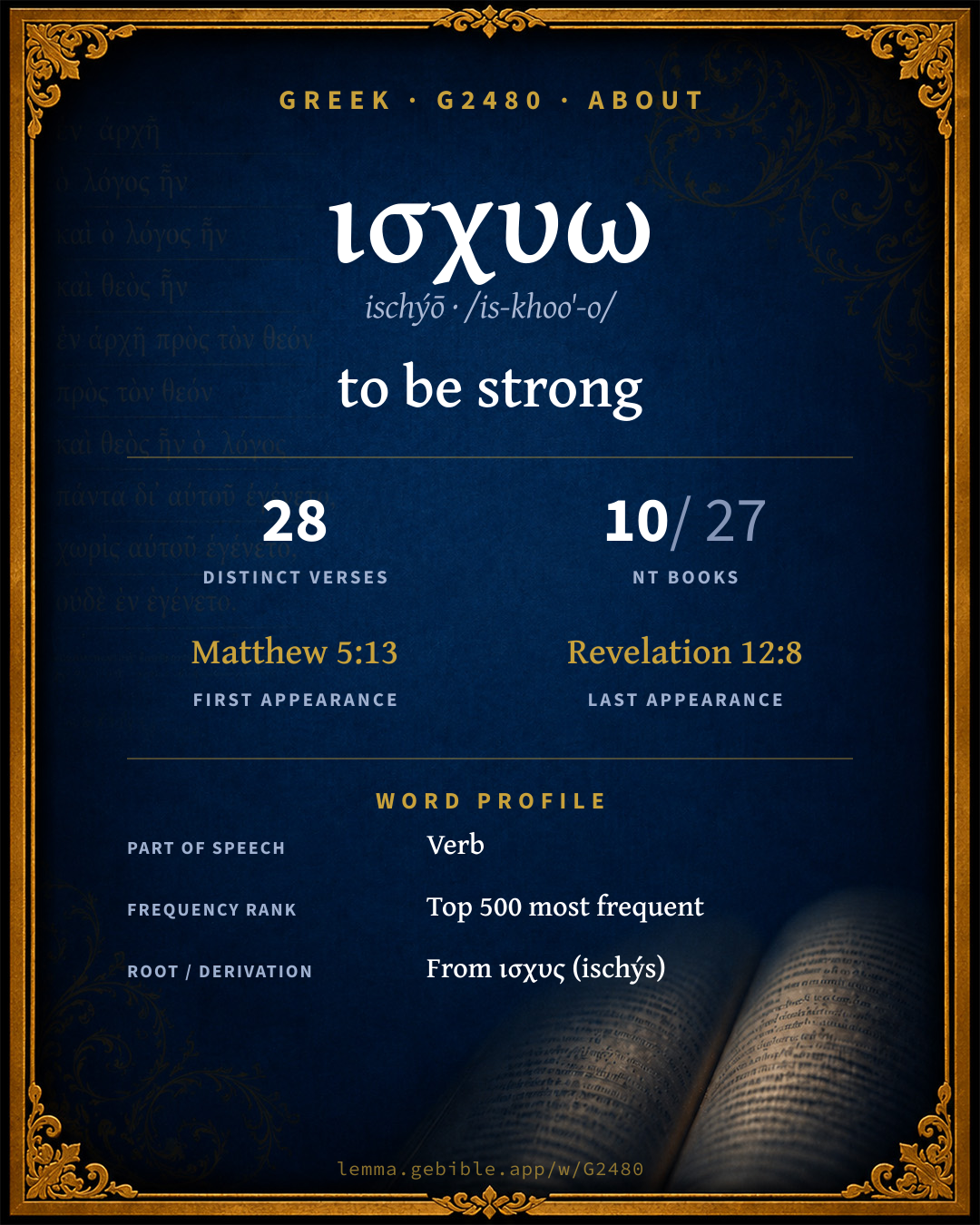
ἰσχύω
to be strong
‘to be strong’ is one of 5 main senses fuller range ↓
Full lexicon entry — Thayer's Greek Lexicon
From Thayer's Greek Lexicon
Where this word appears
See every Aorist-tense verb in the Greek New Testament →
Grammar key — what these labels mean
Part of speech
- Verb
- An action or state-of-being word.
Tense
- Aorist
- Action viewed as a simple whole, without regard to duration — often past (perfective aspect).
- Present
- Ongoing or general action in present time (imperfective aspect).
- Imperfect
- Continuous or repeated action in past time (“was writing”).
- Future
- Action expected in future time.
Voice
- Active
- The subject performs the action.
Mood
- Indicative
- States a fact or asks a factual question (the mood of reality).
- Participle
- A verbal adjective (“writing,” “having written”).
- Infinitive
- A verbal noun (“to write”), unmarked for person or number.
Case
- Nominative
- The case of the subject (and the predicate nominative).
- Genitive
- The case of source, possession, or “of” — answers “whose / from what.”
Person
- 3rd person
- The one spoken about (“he / she / it / they”).
- 1st person
- The speaker (“I / we”).
- 2nd person
- The one addressed (“you”).
Gender
- Masculine
- Grammatically masculine.
Number
- Plural
- More than one.
- Singular
- One.
Grammatical forms 13 distinct
- Verb, Aorist, Active, Indicative, 3rd person, Plural 4 times (14%)
- Verb, Aorist, Active, Indicative, 3rd person, Singular 4 times (14%)
- Verb, Present, Active, Indicative, 3rd person, Singular 4 times (14%)
- Verb, Imperfect, Active, Indicative, 3rd person, Plural 3 times (11%)
- Verb, Aorist, Active, Indicative, 1st person, Plural 2 times (7%)
- Verb, Imperfect, Active, Indicative, 3rd person, Singular 2 times (7%)
- Verb, Present, Active, Indicative, 1st person, Singular 2 times (7%)
- Verb, Present, Active, Participle, Nominative, Plural, Masculine 2 times (7%)
+5 more forms (5 occurrences)
Parsed forms decoded from the imported morphology (Robinson–Tischendorf, public domain), counted across 28 parsed occurrences — not distinct verses.
Every verse where G2480 appears — 28 distinct verses across 10 books. Click any verse to open its interlinear word-by-word view. Verse text shown in the World English Bible for context — . Each verse’s Greek form is shown with its reference; the English is not keyword-highlighted, since the data carries no word-level English alignment. Use “Compare translations” on any verse to read it across multiple English versions. This concordance covers the Greek New Testament; Septuagint (Greek Old Testament) occurrences of this word are not indexed here.
Matthew 4 verses
- Matthew 5:13 ἰσχύει pres act ind 3sg "You are the salt of the earth, but if the salt has lost its flavor, with what will it be salted? It is then good for nothing, but to be cast out and trodden under the feet of men.
- Matthew 8:28 ἰσχύειν pres act inf When he came to the other side, into the country of the Gergesenes, two people possessed by demons met him there, coming out of the tombs, exceedingly fierce, so that nobody could pass by that way.
- Matthew 9:12 ἰσχύοντες pres act ptcp nom pl masc When Jesus heard it, he said to them, "Those who are healthy have no need for a physician, but those who are sick do.
- Matthew 26:40 ἰσχύσατε aor act ind 2pl He came to the disciples, and found them sleeping, and said to Peter, "What, couldn't you watch with me for one hour?
Mark 4 verses
- Mark 2:17 ἰσχύοντες pres act ptcp nom pl masc When Jesus heard it, he said to them, "Those who are healthy have no need for a physician, but those who are sick. I came not to call the righteous, but sinners to repentance."
- Mark 5:4 ἴσχυεν impf act ind 3sg because he had been often bound with fetters and chains, and the chains had been torn apart by him, and the fetters broken in pieces. Nobody had the strength to tame him.
- Mark 9:18 ἴσχυσαν aor act ind 3pl and wherever it seizes him, it throws him down, and he foams at the mouth, and grinds his teeth, and wastes away. I asked your disciples to cast it out, and they weren't able."
- Mark 14:37 ἴσχυσας aor act ind 2sg He came and found them sleeping, and said to Peter, "Simon, are you sleeping? Couldn't you watch one hour?
Luke 8 verses
- Luke 6:48 ἴσχυσεν aor act ind 3sg He is like a man building a house, who dug and went deep, and laid a foundation on the rock. When a flood arose, the stream broke against that house, and could not shake it, because it was founded on the rock.
- Luke 8:43 ἴσχυσεν aor act ind 3sg A woman who had a flow of blood for twelve years, who had spent all her living on physicians, and could not be healed by any,
- Luke 13:24 ἰσχύσουσιν fut act ind 3pl "Strive to enter in by the narrow door, for many, I tell you, will seek to enter in, and will not be able.
- Luke 14:6 ἴσχυσαν aor act ind 3pl They couldn't answer him regarding these things.
- Luke 14:29 ἰσχύοντος pres act ptcp gen sg masc Or perhaps, when he has laid a foundation, and is not able to finish, everyone who sees begins to mock him,
- Luke 14:30 ἴσχυσεν aor act ind 3sg saying, 'This man began to build, and wasn't able to finish.'
- Luke 16:3 ἰσχύω pres act ind 1sg "The manager said within himself, 'What will I do, seeing that my lord is taking away the management position from me? I don't have strength to dig. I am ashamed to beg.
- Luke 20:26 ἴσχυσαν aor act ind 3pl They weren't able to trap him in his words before the people. They marveled at his answer, and were silent.
John 1 verse
Acts 6 verses
- Acts 6:10 ἴσχυον impf act ind 3pl They weren't able to withstand the wisdom and the Spirit by which he spoke.
- Acts 15:10 ἰσχύσαμεν aor act ind 1pl Now therefore why do you tempt God, that you should put a yoke on the neck of the disciples which neither our fathers nor we were able to bear?
- Acts 19:16 ἴσχυσεν aor act ind 3sg The man in whom the evil spirit was leaped on them, and overpowered them, and prevailed against them, so that they fled out of that house naked and wounded.
- Acts 19:20 ἴσχυεν impf act ind 3sg So the word of the Lord was growing and becoming mighty.
- Acts 25:7 ἴσχυον impf act ind 3pl When he had come, the Jews who had come down from Jerusalem stood around him, bringing against him many and grievous charges which they could not prove,
- Acts 27:16 ἰσχύσαμεν aor act ind 1pl Running under the lee of a small island called Clauda, we were able, with difficulty, to secure the boat.
Galatians 1 verse
Philippians 1 verse
Hebrews 1 verse
James 1 verse
Revelation 1 verse
About this entry
At a glance — auto-summarized from this page’s data, not written by a person. Every figure links to its source below. This summary describes the numbers; it doesn’t interpret them.
ισχυω — transliterated ischýō — is a Greek verb carrying the sense “to be strong.” Thayer's distinguishes 5 senses for it. With 28 verses in 10 books, it is a moderately common word in the Greek New Testament. Its uses concentrate in Luke (29% of all occurrences). Debuting at Matthew 5:13, it then recurs through the corpus. See the sense tree, 28-verse concordance, and the renderings breakdown below.
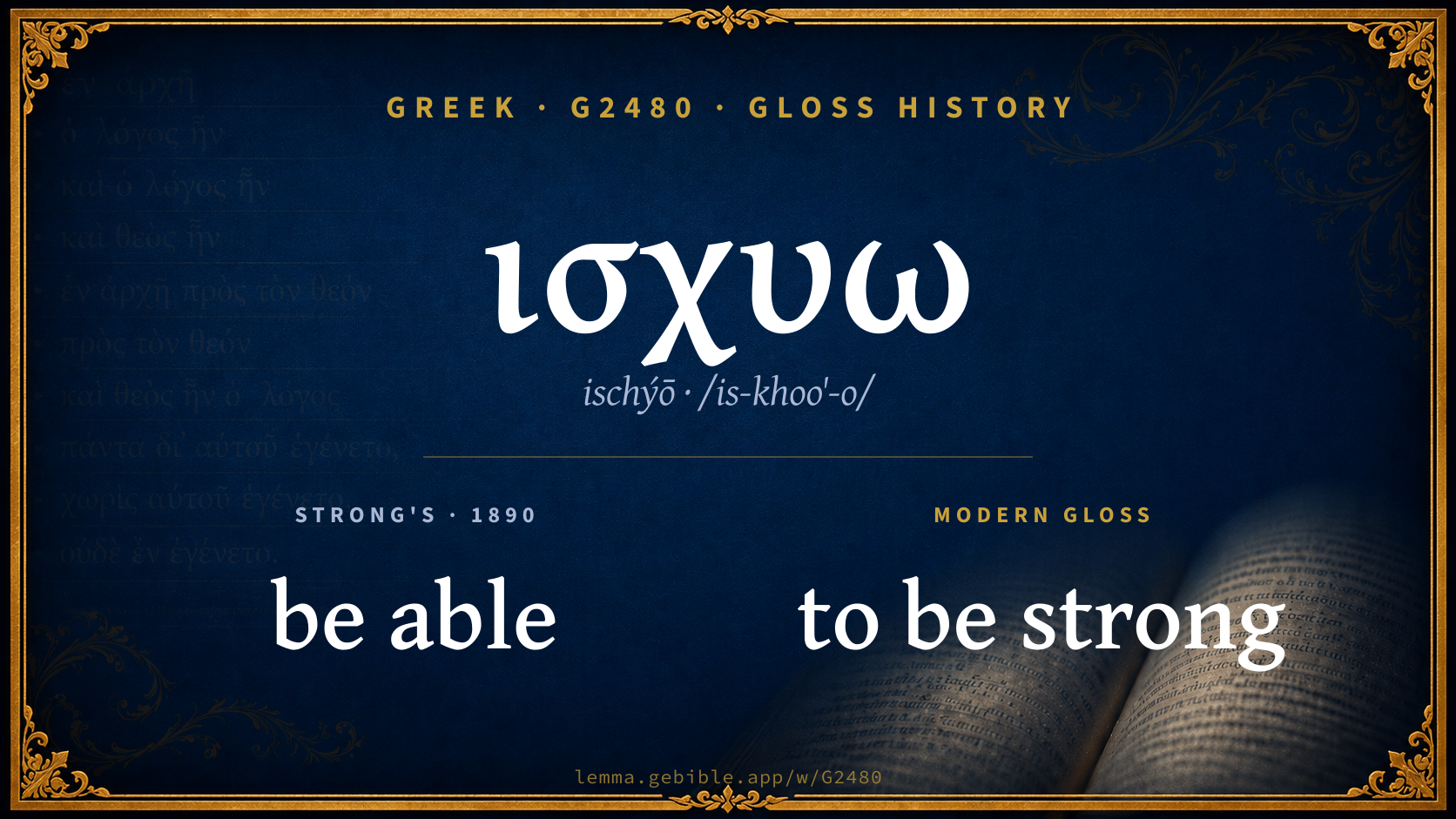
Gloss history
Strong's 1890 vs modern scholarship
About this word
Strong's G2480 catalogs a Greek word from the Greek New Testament.
These counts are not copied from any lexicon or concordance. They are computed here, from the morphology-tagged Greek New Testament. What Lemma adds →
- 28
- distinct verses
- The word appears in 28 distinct verses.
- 10 / 27
- NT books
- The word appears in 10 of 27 New Testament books.
- #485
- by frequency
- Top 500 most frequent Greek words (rank 485 of 5,347 Greek words by occurrence).
View all 28 occurrences in the concordance →
By section of the New Testament
By traditional corpus
Conventional, traditional groupings — biblical authorship is debated, so this is a traditional corpus grouping, not an authorship claim. Some books belong to more than one corpus (Luke is in both the Gospels and the Lukan corpus, and so on), so these shares overlap and need not total 100%. Each figure is a share of the word’s 28 distinct verses.
- Gospels 17 verses · 61%
- Lukan (Luke–Acts) 14 verses · 50%
- Johannine 2 verses · 7%
- Pauline corpus 2 verses · 7%
- Hebrews 1 verse · 4%
- General (Catholic) Epistles 1 verse · 4%
- Revelation 1 verse · 4%
How translations render this word
Counts come from each version’s own published word-to-Strong’s tagging or interlinear alignment — an approximate guide to how each version renders this word, not a word-level alignment the data otherwise carries. Because each total is that version’s own tagged count, the per-version totals vary from one another and need not match the appearance or distinct-verse counts above. These counts may also differ from a printed concordance because Lemma counts each distinctly tagged rendering and does not collapse phrase taggings into a single head-word total. This is a fixed set of word-tagged versions (KJV, ASV, BSB, ULT) and does not change with the reading translation you choose elsewhere. Each version’s license is shown beside its name below (and on Sources).
- King James Version: Able 4×, They could 4×, Availeth 3×
- American Standard Version: Able 6×, Is 3×, Availeth 2×
- Berean Standard Bible: They were unable 4×, Could 3×, Healthy 2×
- unfoldingWord Literal Text: Able 9×, They were 5×, Being healthy 2×
King James Version Public Domain
Renders G2480 across 35 tagged occurrences — most commonly:
Plus 16 renderings that appear only once — usually multi-word phrases or single function words the recovered tagging swept in, not distinct renderings. Not rendered by a distinct English word in 1 further occurrence.
American Standard Version Public Domain
Renders G2480 across 36 tagged occurrences — most commonly:
Plus 17 renderings that appear only once — usually multi-word phrases or single function words the recovered tagging swept in, not distinct renderings.
Berean Standard Bible Public Domain
Renders G2480 across 28 tagged occurrences — most commonly:
Plus 13 renderings that appear only once — usually multi-word phrases or single function words the recovered tagging swept in, not distinct renderings.
unfoldingWord Literal Text CC BY-SA 4.0
Renders G2480 across 43 tagged occurrences — most commonly:
Plus 19 renderings that appear only once — usually multi-word phrases or single function words the recovered tagging swept in, not distinct renderings.
Senses in Thayer's
The 5 senses Thayer's distinguishes for this word, in lexicon order (not ranked by frequency or importance). The full entry — with sub-senses — is in the Lexicon Entry tab.
- to be strong in body, to be robust, to be in sound health
- to have power as shown by extraordinary deeds
- to be a force, avail
- to be serviceable
- to be able, can
Word origin
Derived from ισχυς (ischýs) (G2479) — strength.
From G2479 ; to have (or exercise ) force (literally or figuratively): - beable avail can do ([-not]) could be good might prevail be of strength be whole + much work.
— Strong’s Exhaustive Concordance (1890), public domain.
Forms in the corpus
The 13 distinct written forms G2480 takes in the Greek New Testament, most frequent first — each parse links to that tense’s occurrences in the concordance.
Same root — word family
Other Thayer's entries built from the same root as G2480, grouped by Strong’s listed origin. These share a root / origin per the lexicon — not necessarily a shared meaning. Each links to that word’s own entry.
Derives from
Shares the same root
Compare all same-root words → They share a root, not necessarily a meaning.
Septuagint usage
The same Greek word ισχυω appears 67 times in the Greek Old Testament (Septuagint), across 63 verses in 17 books.
- 67
- LXX occurrences
- Tagged occurrences of this Greek word in the Septuagint.
- 63
- verses
- Distinct Septuagint verses containing this word.
- 17 / 39
- OT books
- The word appears in 17 of the 39 Old Testament books.
Sample Septuagint occurrences
- Genesis 31:29 ἰσχύω
- Exodus 1:9 ἰσχύω
- Leviticus 5:7 ἰσχύω
- Numbers 22:6 ἰσχύω
- Deuteronomy 2:10 ἰσχύω
- Joshua 1:6 ἰσχύω
- Judges 6:2 ἰσχύω
- 1 Kings 2:2 ἰσχύω
- 1 Chronicles 16:11 ἰσχύω
- 2 Chronicles 2:5 ἰσχύω
- Job 36:9 ἰσχύω
- Psalms 12:5 ἰσχύω
Septuagint occurrences (same lexeme)
Every verse where the same Strong’s number (G2480) appears in the Greek Septuagint — showing the first 50 of 63. Verse text shown in the World English Bible for context; the Greek form is the matched word — the English is not keyword-highlighted.
- Genesis 31:29 ἰσχύω It is in the power of my hand to hurt you, but the God of your father spoke to me last night, saying, 'Take heed to yourself that you don't speak to Jacob either good or bad.'
- Exodus 1:9 ἰσχύω He said to his people, "Behold, the people of the children of Israel are more and mightier than we.
- Exodus 1:12 ἰσχύω But the more they afflicted them, the more they multiplied and the more they spread out. They were grieved because of the children of Israel.
- Exodus 1:20 ἰσχύω God dealt well with the midwives, and the people multiplied, and grew very mighty.
- Leviticus 5:7 ἰσχύω "'If he can't afford a lamb, then he shall bring his trespass offering for that in which he has sinned, two turtledoves, or two young pigeons, to Yahweh; one for a sin offering, and the other for a burnt offering.
- Leviticus 27:8 ἰσχύω But if he is poorer than your valuation, then he shall be set before the priest, and the priest shall value him; according to the ability of him who vowed shall the priest value him.
- Numbers 22:6 ἰσχύω Please come now therefore curse me this people; for they are too mighty for me: peradventure I shall prevail, that we may strike them, and that I may drive them out of the land; for I know that he whom you bless is blessed, and he whom you curse is cursed.
- Deuteronomy 2:10 ἰσχύω (The Emim lived therein before, a people great, and many, and tall, as the Anakim:
- Deuteronomy 16:10 ἰσχύω You shall keep the feast of weeks to Yahweh your God with a tribute of a freewill-offering of your hand, which you shall give, according as Yahweh your God blesses you:
- Deuteronomy 28:32 ἰσχύω Your sons and your daughters shall be given to another people; and your eyes shall look, and fail with longing for them all the day: and there shall be nothing in the power of your hand.
- Deuteronomy 31:6 ἰσχύω Be strong and of good courage, don't be afraid, nor be scared of them: for Yahweh your God, he it is who does go with you; he will not fail you, nor forsake you.
- Deuteronomy 31:7 ἰσχύω Moses called to Joshua, and said to him in the sight of all Israel, Be strong and of good courage: for you shall go with this people into the land which Yahweh has sworn to their fathers to give them; and you shall cause them to inherit it.
- Deuteronomy 31:23 ἰσχύω He gave Joshua the son of Nun a charge, and said, Be strong and of good courage; for you shall bring the children of Israel into the land which I swore to them: and I will be with you.
- Joshua 1:6 ἰσχύω Be strong and of good courage; for you shall cause this people to inherit the land which I swore to their fathers to give them.
- Joshua 1:7 ἰσχύω Only be strong and very courageous, to observe to do according to all the law, which Moses my servant commanded you: don't turn from it to the right hand or to the left, that you may have good success wherever you go.
- Joshua 1:9 ἰσχύω Haven't I commanded you? Be strong and of good courage; don't be afraid, neither be dismayed: for Yahweh your God is with you wherever you go.
- Joshua 1:14 ἰσχύω Your wives, your little ones, and your cattle, shall abide in the land which Moses gave you beyond the Jordan; but you shall pass over before your brothers armed, all the mighty men of valor, and shall help them;
- Joshua 1:18 ἰσχύω Whoever he be who shall rebel against your commandment, and shall not listen to your words in all that you command him, he shall be put to death: only be strong and of good courage.
- Joshua 10:25 ἰσχύω Joshua said to them, Don't be afraid, nor be dismayed; be strong and of good courage: for thus shall Yahweh do to all your enemies against whom you fight.
- Joshua 14:11 ἰσχύω As yet I am as strong this day as I as in the day that Moses sent me: as my strength was then, even so is my strength now, for war, and to go out and to come in.
- Judges 6:2 ἰσχύω The hand of Midian prevailed against Israel; and because of Midian the children of Israel made them the dens which are in the mountains, and the caves, and the strongholds.
- Judges 7:11 ἰσχύω and you shall hear what they say; and afterward shall your hands be strengthened to go down into the camp. Then went he down with Purah his servant to the outermost part of the armed men who were in the camp.
- 1 Kings 2:2 ἰσχύω I am going the way of all the earth: be you strong therefore, and show yourself a man;
- 1 Chronicles 16:11 ἰσχύω Seek you Yahweh and his strength; Seek his face forever more.
- 1 Chronicles 22:13 ἰσχύω Then shall you prosper, if you observe to do the statutes and the ordinances which Yahweh gave Moses concerning Israel. Be strong, and of good courage. Don't be afraid, neither be dismayed.
- 1 Chronicles 28:7 ἰσχύω I will establish his kingdom forever, if he be constant to do my commandments and my ordinances, as at this day.
- 1 Chronicles 28:10 ἰσχύω Take heed now; for Yahweh has chosen you to build a house for the sanctuary: be strong, and do it.
- 1 Chronicles 28:20 ἰσχύω David said to Solomon his son, Be strong and of good courage, and do it: don't be afraid, nor be dismayed; for Yahweh God, even my God, is with you; he will not fail you, nor forsake you, until all the work for the service of the house of Yahweh is finished.
- 1 Chronicles 29:14 ἰσχύω But who am I, and what is my people, that we should be able to offer so willingly as this? For all things come of you, and of your own have we given you.
- 2 Chronicles 2:5 ἰσχύω The house which I build is great; for great is our God above all gods.
- 2 Chronicles 15:7 ἰσχύω But be you strong, and don't let your hands be slack; for your work shall be rewarded.
- 2 Chronicles 17:13 ἰσχύω He had many works in the cities of Judah; and men of war, mighty men of valor, in Jerusalem.
- 2 Chronicles 19:11 ἰσχύω Behold, Amariah the chief priest is over you in all matters of Yahweh; and Zebadiah the son of Ishmael, the ruler of the house of Judah, in all the king's matters: also the Levites shall be officers before you. Deal courageously, and Yahweh be with the good.
- 2 Chronicles 25:8 ἰσχύω But if you will go, do [valiantly], be strong for the battle: God will cast you down before the enemy; for God has power to help, and to cast down.
- 2 Chronicles 32:7 ἰσχύω Be strong and of good courage, don't be afraid nor dismayed for the king of Assyria, nor for all the multitude who is with him; for there is a greater with us than with him:
- Job 36:9 ἰσχύω Then he shows them their work, And their transgressions, that they have behaved themselves proudly.
- Job 36:31 ἰσχύω For by these he judges the people. He gives food in abundance.
- Psalms 12:5 ἰσχύω "Because of the oppression of the weak and because of the groaning of the needy, I will now arise," says Yahweh; "I will set him in safety from those who malign him."
- Proverbs 7:1 ἰσχύω My son, keep my words. Lay up my commandments within you.
- Proverbs 18:19 ἰσχύω A brother offended is more difficult than a fortified city; And disputes are like the bars of a castle.
- Isaiah 1:24 ἰσχύω Therefore the Lord, Yahweh of Hosts, The Mighty One of Israel, says: "Ah, I will get relief from my adversaries, And avenge myself of my enemies;
- Isaiah 3:1 ἰσχύω For, behold, the Lord, Yahweh of Hosts, takes away from Jerusalem and from Judah supply and support, The whole supply of bread, And the whole supply of water;
- Isaiah 3:2 ἰσχύω The mighty man, The man of war, The judge, The prophet, The diviner, The elder,
- Isaiah 3:25 ἰσχύω Your men shall fall by the sword, And your mighty in the war.
- Isaiah 5:22 ἰσχύω Woe to those who are mighty to drink wine, And champions at mixing strong drink;
- Isaiah 8:9 ἰσχύω Make an uproar, O you peoples, and be broken in pieces! And give ear, all you of far countries: gird yourselves, and be broken in pieces! Gird yourselves, and be broken in pieces!
- Isaiah 10:21 ἰσχύω A remnant shall return, [even] the remnant of Jacob, to the mighty God.
- Isaiah 22:3 ἰσχύω All your rulers fled away together, they were bound by the archers; all who were found of you were bound together; they fled afar off.
- Isaiah 23:8 ἰσχύω Who has purposed this against Tyre, the giver of crowns, whose merchants are princes, whose traffickers are the honorable of the earth?
- Isaiah 23:11 ἰσχύω He has stretched out his hand over the sea, he has shaken the kingdoms: Yahweh has given commandment concerning Canaan, to destroy the strongholds of it.
These are occurrences of the same Greek lexeme (G2480) in the Septuagint — not a translation of any one Hebrew word. The store carries no word-level Hebrew↔Greek alignment, so no Hebrew original is asserted here. Counts come from the recovered LXX Strong's tagging — high-frequency vocabulary is well covered, while rare or late forms may be untagged — so they reflect tagged occurrences and may slightly undercount.