Philippians 4:13

Greek (Tischendorf 8th ed.) Philippians 4:13 appears in the Greek New Testament. The text above is from the Tischendorf 8th edition. Each word links to its Strong’s number and a concise gloss. Click any word for its full Thayer’s Greek Lexicon entry.
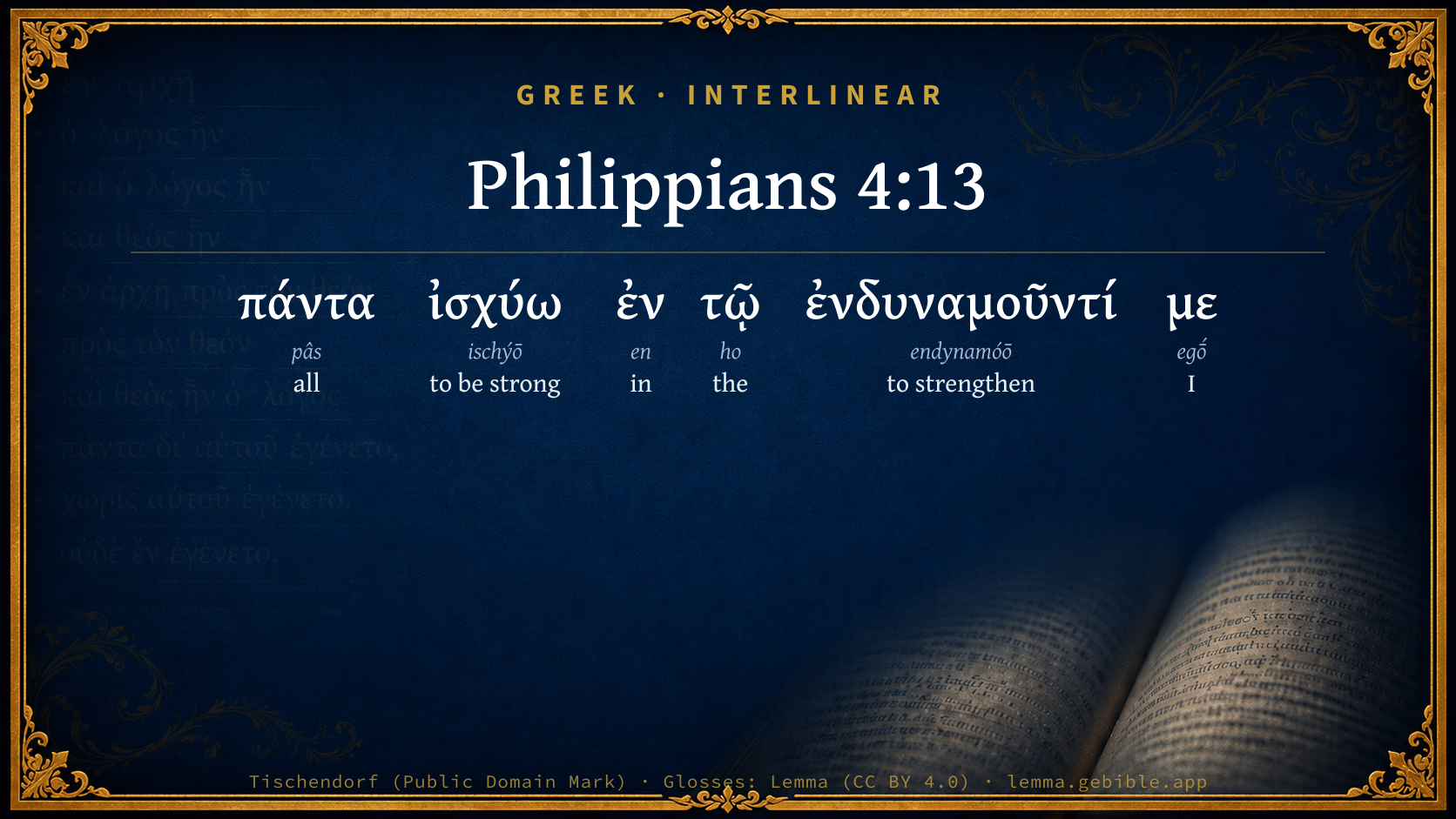
Download image
Cite this verse

Philippians 4:13 (World English Bible). Public Domain. Lemma interlinear Bible study tool, https://lemma.gebible.app/v/philippians/4/13.

Show BibTeX & RIS
BibTeX
RIS
English Translation
I can do all things through Christ, who strengthens me.
World English Bible · Public Domain
Download a study sheet

One document with this verse’s original text, its word-by-word gloss line, the meaning frame, cross-references with their text, attributed commentary, and full source and license credits — printable, and it pastes into notes with its structure intact.

This verse Autodidact and up

Study sheet (.html) Plain text (.txt)

A passage Seminary Student

Up to 50 verses in one chapter. A passage sheet keeps up to 6 commentary sources and 12 cross-references per verse, in the order this page ranks them, and says so on the sheet whenever that leaves anything out. Ask for a single verse and you get the Autodidact verse sheet above.

Everything on this page stays free to read, with no account — the sheet is a download of what is already on screen, not access to it.

Want to remove ads? Support Godless Engineer
Compare translations 3

The same verse in 3 English versions, stacked beneath the original-language interlinear above. Click any original word for its lexicon entry.

Each is an independent rendering of the whole verse — the interlinear is not word-aligned to these translations.

Highlighted words mark where these versions differ — a whole-verse word diff, not a word-by-word alignment.

  • World English Bible Public Domain
    I can do all things through Christ, who strengthens me.
  • King James Version Public Domain
    I can do all things through Christ which strengtheneth me.
  • unfoldingWord Literal Text CC BY-SA 4.0
    I can do all things in the one strengthening me.

unfoldingWord Literal Text — © unfoldingWord, licensed CC BY-SA 4.0. Word-aligned USFM3 via Door43 (git.door43.org/unfoldingWord/en_ult).

Versions to compare (up to 4)

3 of 4 selected

Show all 19 translations

Every available English version of this verse, each an independent rendering of the whole verse.

  • World English Bible Public Domain
    I can do all things through Christ, who strengthens me.
  • Berean Standard Bible Public Domain
    I can do all things through Christ who gives me strength.
  • Majority Standard Bible Public Domain
    I can do all things through Christ who gives me strength.
  • King James Version Public Domain
    I can do all things through Christ which strengtheneth me.
  • American Standard Version (1901) Public Domain
    I can do all things in him that strengtheneth me.
  • Revised Version (1885) Public Domain
    I can do all things in him that strengtheneth me.
  • Geneva Bible (1599) Public Domain
    I am able to do al things through the helpe of Christ, which strengtheneth me.
  • Douay-Rheims (1899) Public Domain
    I can do all these things in him who strengtheneth me.
  • Young's Literal Translation Public Domain
    For all things I have strength, in Christ's strengthening me;
  • Literal Standard Version CC BY-SA 4.0
    I have strength for all things, in Christ’s strengthening me;
  • Unlocked Literal Bible CC BY-SA 4.0
    I can do all things through him who strengthens me.
  • unfoldingWord Literal Text CC BY-SA 4.0
    I can do all things in the one strengthening me.
  • Darby Bible Public Domain
    I have strength for all things in him that gives me power.
  • World Messianic Bible Public Domain
    I can do all things through Messiah who strengthens me.
  • Webster's Bible Public Domain
    I can do all things through Christ who strengtheneth me.
  • Free Bible Version CC BY-SA 4.0
    I can do anything through him who makes me strong!
  • Bible in Basic English Public Domain
    I am able to do all things through him who gives me strength.
  • Text-Critical English NT CC BY 4.0
    I can do all things through Christ who strengthens me.
  • Tyndale New Testament (1534) Public Domain
    I can do all thynges thorow the helpe of Christ which strengtheth me.

Literal Standard Version (2020), Covenant Press — licensed CC BY-SA 4.0. Text via the HelloAO Bible API (eBible.org). Unlocked Literal Bible (unfoldingWord) — licensed CC BY-SA 4.0. Text via the HelloAO Bible API (eBible.org). unfoldingWord Literal Text — © unfoldingWord, licensed CC BY-SA 4.0. Word-aligned USFM3 via Door43 (git.door43.org/unfoldingWord/en_ult). Free Bible Version, Dr. Jonathan Gallagher — licensed CC BY-SA 4.0. Text via the HelloAO Bible API (eBible.org).

Word by word

More ways to search: Search by grammar → Find every occurrence → Compare this word →

Practice this passage: Drill this verse → Learn its vocabulary →

About this verse

These counts appear in no published source. They are computed here, from the morphology-tagged text and Lemma’s own curated glosses. What Lemma adds →

6
words
6
distinct lemmas
Pauline Epistles
section

Notable vocabulary

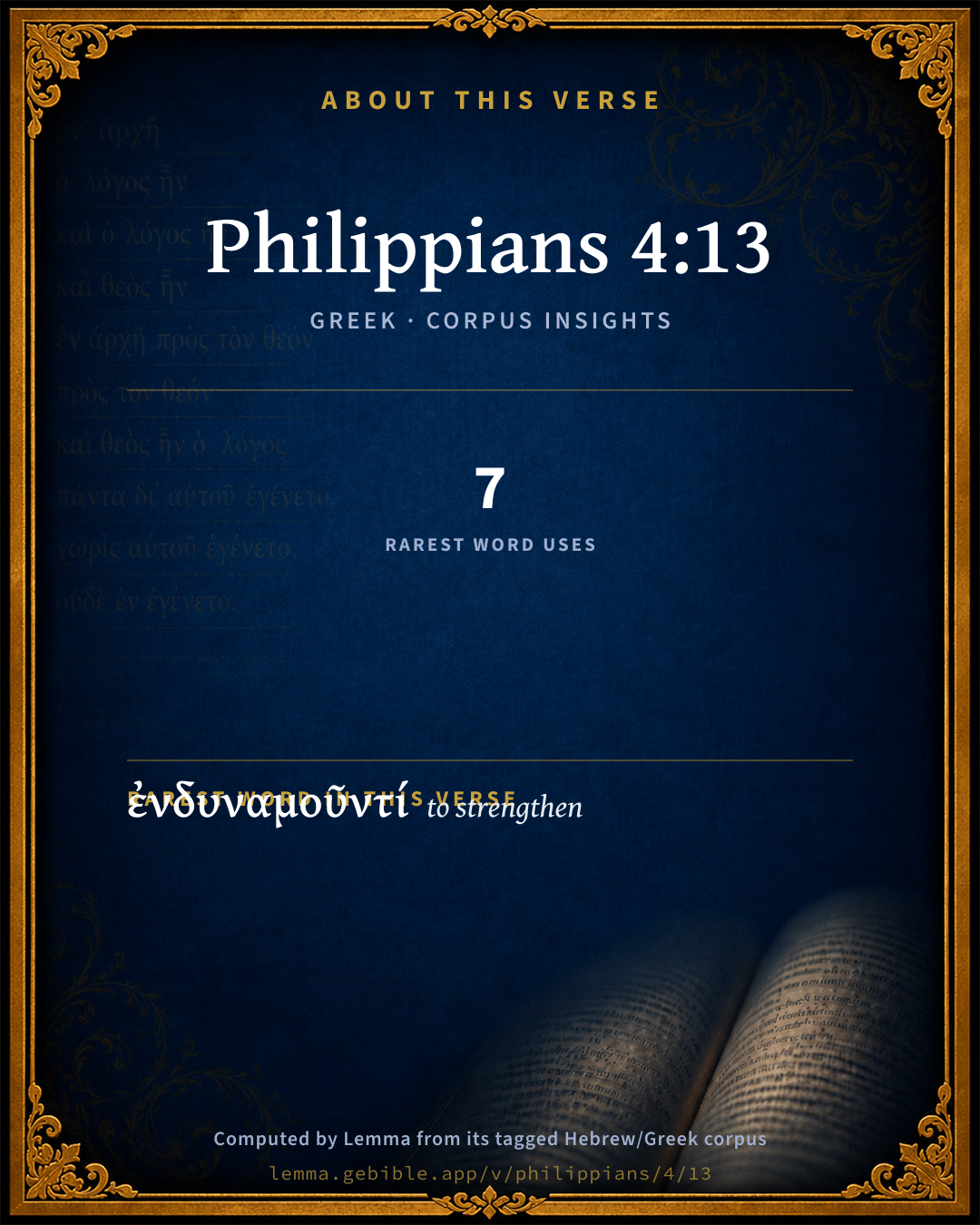
The rarest word here is ἐνδυναμοῦντί to strengthen G1743 — appearing just 7 times in the whole Greek New Testament.

Shared distinctive vocabulary

ἐνδυναμοῦντί to strengthen G1743 occurs in 7 verses of the Greek New Testament. Also found in:

Cross-references

10

Topical passages linked to Philippians 4:13 in the Treasury of Scripture Knowledge — connected by theme and wording, ordered by reader-vote popularity; previews shown in the World English Bible.

  • Isaiah 41:10 Don't you be afraid, for I am with you; don't be dismayed, for I am your God; I will strengthen you; yes, I will help you; yes, I will uphold you with the right hand of my righteousness.
  • 2 Corinthians 12:9–10 He has said to me, "My grace is sufficient for you, for my power is made perfect in weakness." Most gladly therefore I will rather glory in my weaknesses, that the power of Christ may rest on me.
  • Colossians 1:11 strengthened with all power, according to the might of his glory, for all endurance and perseverance with joy;
  • Ephesians 6:10 Finally, be strong in the Lord, and in the strength of his might.
  • Isaiah 40:29–31 He gives power to the faint; and to him who has no might he increases strength.
  • Ephesians 3:16 that he would grant you, according to the riches of his glory, that you may be strengthened with power through his Spirit in the inward man;
  • John 15:7 If you remain in me, and my words remain in you, you will ask whatever you desire, and it will be done for you.
  • 2 Corinthians 3:4–5 Such confidence we have through Christ toward God;
  • John 15:4–5 Remain in me, and I in you. As the branch can't bear fruit by itself, unless it remains in the vine, so neither can you, unless you remain in me.
  • Isaiah 45:24 Only in Yahweh, it is said of me, is righteousness and strength; even to him shall men come; and all those who were incensed against him shall be disappointed.

Cross-references courtesy of OpenBible.info (CC BY 4.0).

Where the printed editions differ

1 variant

Places in this verse where the major printed Greek editions disagree on the wording in a way that affects the translation — a comparison of editions, not a manuscript-by-manuscript collation. The editions are the modern critical texts (Nestlé-Aland 28/27, SBL, Westcott-Hort, Tregelles, Tyndale House) and the traditional texts behind the KJV (the Textus Receptus and the Byzantine/Majority text). It is not a claim about which reading is original.

  1. Extra text
    Χριστῷ.

    “in Christ.”

    In TRByz Not in NA28NA27TynSBLWHTreg

    Χριστῷ. (Christō) 'in Christ.' is only in traditional manuscripts (TR+Byz)

Textual data: Translators Amalgamated Greek New Testament (STEPBible TAGNT) · CC BY 4.0.

Commentary

Notes on Philippians 4:13 from classic Christian and Jewish commentators (each source and its license shown beneath its notes). The classic Christian expositions comment on the surrounding passage and are grouped to its opening verse, so a note may address several verses; the Jewish commentaries on the Tanakh (Rashi and others) are per-verse, so they appear only where the commentator wrote on this verse.

Lemma curates 59 commentaries, every one of them public domain or Creative Commons licensed, each selected and text-cleaned for this edition rather than reprinted as found. About our sources →

The Biblical Illustrator

Joseph S. Exell

Php_4:13

I can do all things through Christ which strengtheneth me

Here we find

I.

Weakness and strength. The believer is weak in himself. Looking to the all things to be done he laments this with shame and tears. But he is not alone. Allied to Christ he is strong to overcome evil and to do good. He has courage and hope. Nothing in the way of duty is impossible (2Co_12:8-10).

II. Dependence and freedom. Dependence is the law of our being. Of the natural life it is said, In God we live and move and have our being; how much more is this true of the spiritual life, and yet we are free. Of our own choice we trust in Christ; of our own will, every moment we abide in Him. I can implies the personal life, reason, conscience, will, and endeavour.

III. Humility and aspiration. Paul was remarkable for humility; it grew with him. But he was not discouraged. Fired with the noblest ambition, his inspiration was from above. So with all Christians. In spite of conscious weakness, opposition, and failure, through Christ they take heart to persevere. My soul cleaveth to the dust: quicken thou me according to Thy Word.

IV. Suffering and contentment. Pauls life was marked by vicissitudes and trouble; he was now in prison. But what then? His soul was free; there was peace within, Christ was with him. As a scholar under the great Master he had ]earned many things, and among others the Divine secret of content (Php_4:11). So with Christians. Their satisfaction is not from without but from within; not from the lower and perishable things of the world, but from the immortal affection of their Saviour and God.

Learn--

1. The greatness of Christ as suggested by the place given Him by such a man as Paul. Consider his zeal, labours, achievements, and yet he ascribes the praise of all to Christ. But Paul was only one of many.

2. The grandeur of the Christian life. There is no limit to its possibilities. What has been done is only an earnest of what will be done. Take courage. Through Christ, His blood, Word, Spirit, resurrection, etc., all things are possible. What inspiration here for prayer and holy endeavour (Eph_3:20-21).

3. The certain triumph of Christianity. Strengthened by Him, His people shall never cease to pray and strive, till all the kingdoms of this world have become the kingdom of our God and of His Christ. (W. Forsyth.)

All-sufficiency magnified

The former part of the sentence would be a piece of impudent daring without the latter. There have been men who, puffed up with vanity, have said, I can do all things. Their destruction has been sure--Nebuchadnezzar, Xerxes, Napoleon. And what shall we say to our apostle, weak in presence and contemptible in speech, the leader of a hated and persecuted sect. Has Gamaliel taught him an eloquence that can baffle all opposers? Have his sufferings given him so stern a courage that he is not to be turned away? Is it on himself he relies? No; he turns his face towards his Saviour and with devout reverence but dauntless courage. Through Christ, etc.

I. The measure of the text. It is exceeding broad. Paul meant that he was able--

1. To endure all trials.

2. To perform all duties.

3. To conquer all corruptions. He once said, O wretched man that I am, etc. But he did not stay there, Thanks be unto God that giveth us the victory. Have you a violent temper? Through Christ you can curb it. Are you timid? Christ can give you a lions boldness. Are you slothful? Christ can make you energetic. Are you incapable for strong effort? Christ can increase your capacity. Are you inconstant? Christ can settle you. There is not a Hittite or Jebusite in the whole land that cannot be east out.

4. To serve God in any state! (Php_4:12). Some Christians are called to undergo extreme changes from wealth to poverty, and from poverty to wealth, and, alas, there is often a corresponding spiritual change; the one desponds, the other is elated or becomes avaricious. This need not be. When you gave yourself to Christ you gave yourself wholly to serve Him in everything and anywhere.

5. You can do all things through Christ in respect to all worlds. In this world you can enlighten and uplift it. You may pass through the dark gate of death with Christ without fear into the world of spirits, and there you are more than conqueror.

II. The manner of it. None of us can explain this; but we may see how the acts of the Spirit for Christ tend to strengthen the soul for all things.

1. By strengthening our faith. It is remarkable how timid and doubting Christians have in time of trial behaved most bravely. God gives faith equal to the emergency. Weak faith can sprout and grow till it becomes great under the pressure of a great trial. Nothing braces a mans nerves like the cold winters blast. Together with faith often comes a singular firmness of mind. When John Ardley was brought before Bonner the latter said, The fire will convert you; faggots are sharp preachers. Said Ardley, I am not afraid to try it; and I tell thee, Bishop, if I had as many lives as I have hairs on my head, I would give them all up sooner than I would give up Christ. And then Christians are often enabled to anticipate the joys of heaven when their pangs are greatest. Look at old Ignatius with his arm in the lions mouth, exclaiming, Now I begin to be a Christian.

2. By quickening the mental faculties. It is astonishing how poor illiterate persons have been able to refute their clever opponents. Cranmer and Ridley were no match for Jane Bouchier the Baptist martyr. I am as true a servant of God as any of you; and if you put your poor sister to death, take care lest God should let loose the wolf of Rome on you, and you have to suffer for God, too.

3. By enabling the believer to overcome himself. He can lose all things, because he is already prepared to do it; he can suffer all things, because he does not value his body as the worldling does; he can brave all things, because he has learned to fear God, and therefore has no reason to fear man; he can perform wonders, because his body and spirit are disciplined.

4. Note the present tense. Not Christ has strengthened, did strengthen at conversion, As thy days so shall thy strength be.

III. The message of it.

1. One of encouragement to those who are doing something for Christ, but feel painfully their own inability. Cease not from Gods work, because you are unable to perform it of yourself. Cease from yourself, from man. Before Zerubbabel the mountain shall become a plain. If we believed great things we should do great things. Do net go through the world saying, I was born little. You were not meant to be little. Act as David did in spite of his brothers sneers.

2. Take heed that you do it in Christs strength. You can do nothing without that. Go not forth till thou hast first prayed. The battle that begins with holy reliance on God means victory.

3. Paul speaks in the name of all Christians. How is it that some of you then are doing nothing? What a work there is to do! And what may not one resolute Christian accomplish. (G. H. Spurgeon.)

The power of the Christian

I. There are two main errors by which men are deceived. The first is the fancy that they can do all things that they wish and try to do of themselves. The second is that they cannot and need not do anything. These have been the sources of two of the most mischievous heresies, the one undermining all spiritual, the other all practical religion; the first is Pelagianism, the other Antinomianism.

II. The end of these errors is to keep men in sin. Pride says it will pay off the debt it owes to God when it has grown bigger. Why should I do that today, it cries, which I can do any day whenever I please? Meanwhile sloth alleges that it is a bankrupt and demands as such to be let off all manner of payment, for getting that a negligent and fraudulent bankrupt has no claim to favour. Pride says it can obey God and does not. Sloth says it cannot and need not.

III. These errors, irreconcilable though they may seem, are often found side by side. They are Satans right and left hand in which he tosses our souls from one to the other. The proud man, although he makes himself believe that he can obey God by himself, must be often warned by his conscience that he has not done so. At such times he will try to stifle his qualms by saying that he has done his best, and that Christs merits will be sufficient to make up. The slothful man, too, who has drugged his conscience with the notion that as his best works cannot earn heaven, so it matters not what his works are, must be startled now and then by scriptural exhortations to holiness; but when so startled he whispers to himself that let the worst come to the worst he will reform by and by.

IV. Both these errors are answered by the text, which picks out the truth involved in each and separates it from the false. When an error is long-lived it is by means of some truth mixed up with it.

1. As the pride of man says, I can do all things, so does Paul; only pride stops short here, whereas Paul adds, through Christ, etc. Pride forgets the Fall, and also that what it calls its own strength is really Gods gift.

2. The sluggard is also bereft of his only excuse. God never demands of us what we cannot do; and Paul tells us that there is no limit to our power; he poor, weak, frail as he was, could do all things when strengthened by Christ.

V. What does paul mean by this.

1. Certainly not in the same sense that God can do all things--make a world, arrest the sun, etc.; but--

2. In accordance with the previous verse. These things, however, seem to some hardly sufficient to bear the lofty declaration of the text, and would rather have expected to hear of some great victory gained or miracle wrought. Yet it is in these things that our hardest trials lie, for they are the things that the natural man cannot do of himself. He may brave dangers and accomplish many wonderful works, but he does not know how to be abased and how to abound. A cup knows how to be full and how to be empty, and stands equally straight in either case. But mans hand cannot lift the full cup and will not lift the empty one. It is only through Christ that whether the Lord giveth or taketh away we can say, Blessed be His name.

3. The true children of God can do all things that they can ever desire to do, viz., the will of God. (Archdeacon Hare.)

Strength by Christ

The more literal rendering is I am strong for all things; or, I am equal to all things, Christ invigorating me, either doing or suffering. Let us look at--

I. Christ strengthening Paul.

1. Every man needs strength. Weakness is so much less of life. Lack of strength is more serious than any rack of outward possession. A weak rich man is in a worse position than a strong poor man. Weakness lessens work, reduces enjoyment, and aggravates suffering. It is also the cause of wickedness, exposing the individual to fierce temptation. As a preservative against sin we need to ask for daily strength.

2. Every man requires strengthening. Even the strong by constitution and education. The child learning to walk alone is strengthened by the hand of the mother, and the aged mother is in return strengthened by the arm of her son. The boy is strengthened to learn by his tutor or employer, and the man to pursue the objects of life by various invigorating influences; while all are strengthened by God.

3. The Christian is no exception. His conversion is not translation to ease. There are times when he lies down in green pastures; but he lies down tired, and that he may rise stronger. We rest not for restings sake but for works sake. The Christian life is a race to be run and a battle to be fought. To cease either is to cease to be a Christian.

4. A Christians strength can come only by his being strengthened. There is not within the man as a man or a Christian any stock of strength given at the commencement. Our resources are supplied as we need them. This arrangement keeps us close to the source of all energy and wisdom, communion with whom alone, apart from imparted blessings, invigorates.

5. An apostle is no exception to this rule. On the battlefield the eye of the soldier is upon the officers of the opposing army. So ministers are more tried than others, partly because of their vocation, and partly that they may have wisdom and grace to succour the tempted.

6. And Christ did strengthen Paul. By His example, grace, promises, doctrines, precepts,

II. Paul hereby assured that all things were possible to him. He felt equal to labour, suffering, and dying. Yet this was not undue self-confidence, but humility.

1. if we Christians are not equal to all the demands which God makes upon us our inability involves guilt. Weakness is not a misfortune but a crime, needing not pity but blame. Christ does not require anything impossible or injuriously difficult, nothing for which He does not guarantee strength.

2. The Divine help is manifold and constant. Look at the assistance obtained from--

(1) The Scriptures, which thoroughly furnish us unto all good works.

(2) Providence, under which all things work together for our good.

(3) Christian principle--faith, love, hope, joy, obedience.

3. If we turn from this various help to Christ personally and then remember that He is with us, immutable in His love, unfailing in His resources, unwearied in His oversight, we can understand what Paul meant.

(1) I cannot do many things which my fellow Christians say is my duty;

(2) Nor what in my ignorance I conclude to be my duty;

(3) Nor what is actually my duty, if I go about it in a wrong spirit or way;

(4) But Christ will strengthen us for all His will.

What can hinder? Not our ignorance, for He is our teacher; not our feebleness, for He never breaks the bruised reed; not our sinfulness, for He is our Saviour.

4. This assurance covers all the necessities of our Christian life--perseverance, cross-bearing and self-crucifixion, Christian work, the prospect and experience of death. (S. Martin.)

The fountain of strength

We all need strength. Whether conscious or unconscious of it, we are all weak. Our very strength is weakness. We may trust it and be deceived by it. This is a defect we cannot supply. The exertion of weakness can not produce strength. We must look out of ourselves; and to save us from a vain search God sets Christ before us as our strength and strengthener.

I. How Christ strengthens us.

1. Not by miracle or magic; not by acting upon us without our knowledge or against our will, but through our own intelligent and active powers.

2. By instructing us in the knowledge of our weakness and His own strength.

3. By His example, showing us how to do all that He requires in His own life.

4. By supplying us with the great motive power--His constraining love.

5. By working faith in us, which brings us into vital union with Him who is the source of strength.

II. For what He strengthens us.

1. To fulfil the law as a rule of duty.

2. To resist temptation.

3. To suffer and endure. (J. A. Alexander, D. D.)

Dependence on Christ

(Text in conjunction with Joh_15:5.) Two speakers, Divine-human and human. From how different a platform do they speak; one from conscious power to help, the other from conscious need of help. One a great Giver, the other a great receiver. A fine harmony in the two statements. Though Pauls is not quite so universal as Christs, it forms a pleasing testimony to the correctness of Christs statement, and the usefulness of the promised aid.

I. The divine assertion. God in Christ speaks.

1. It applies to mans spiritual life.

2. To His everyday purpose and action. Good is understood. There are some things we can do without Christ--and yet considering Him as God we cannot even do evil without the strength He supplies. Similarly, in a high spiritual sense, we can do nothing good without Him. We may feel our dignity affronted, and our first impulse will be denial of, or objection to the universality of the statement. But our life will prove that Christ is right. In every part of our life we have Christs influence. The Christian becomes a law unto himself, but behind the Christian and the law is the great Inspirer--Christ. Christ is the only one who can make this sweeping assertion without fear of ultimate contradiction.

II. The human confirmation. Paul gives particular instances, then generalizes. How does Christ strengthen us?

1. By His having done all things Himself. In all lifes experiences, conflicts, emergencies, Christ has preceded us. We have to walk in His steps.

2. By the effects of His wondrous life. We linger around the four great landmarks, Bethlehem, Nazareth, Gethsemane, Calvary, and they are a ceaseless inspiration to us. His miracles have made many a life path brighter, and they yield constant consolation. He healed the sick; sickness can be better borne. He hushed the waves; He stills the storm today.

3. By the effect of His unique teaching. Every word of His is the bread of life.

4. By His Cross and death. He is the Saviour from the curse of life--sin. Thus we hear Paul, I can do all things, not by his immediate environment, men, or things; not by his inherent energy; but by Christ which strengtheneth him with strength in his soul (Psa_138:3). Our strength is not superseded. It is linked with Gods and made the grander for the union. It is all things, even the otherwise impossible. It applies to the whole life. Without me--nothing. Our power through Christ which strengthens us is limitless. So should our gratitude be. (J. B. Swallow.)

Strength through Christ

When I was at Princeton, Professor Henry had so constructed a huge bar of iron, bent into the form of a horseshoe, that it used to hang suspended from another iron bar above it. Not only did it hang there but it upheld four thousand pounds weight attached to it! The horseshoe magnet was not welded or glued to the metal above it, but through the iron wire coiled round it there ran a subtle current of electricity from a galvanic battery. Stop the flow of the current for one instant and the huge horseshoe dropped. So does all the lifting power of the Christian come from the currents of spiritual influence which flow into his heart from the living Jesus. The strength of the Almighty One enters into the believer. If his connection with Christ is cut off, in an instant he becomes as any other man. (T. L. Cuyler, D. D.)

The secret of fortitude

In the days of bloody Mary a poor Protestant was condemned to be burned alive. When he came in sight of the stake he exclaimed, Oh! I cannot burn! I cannot burn! Those who heard him supposed he intended to recant, but they misunderstood him. He felt he needed more strength to bear the dread ordeal in a worthy manner, so being left a few moments to himself, he cried in an agony of prayer that God would more sensibly reveal Himself to him. As the result of this, instead of recanting, he cried out triumphantly, Now I can burn! Now I can burn! (J. F. B. Tinling, B. A.)

Strength in Christ

I was requested, said the late Dr. Macleod, by a brother minister, who was unwell, to go and visit a dying boy. He told me before some remarkable things of this boy. He was eleven years of age, and during three years sickness had manifested the most patient submission to the will of God, with a singular enlightenment of the Spirit. I went to visit him. He had suffered the most excruciating pain. For years he had not known one days rest. I gazed with wonder at the boy. After drawing near to him, and speaking some words of sympathy, he looked at me with his blue eyes--he could not move, it was the night before he died--and breathed into my ear these few words: I am strong in Him. The words were few, and uttered feebly; they were the words of a feeble child, in a poor home, where the only ornament was that of a meek, and quiet, and affectionate mother; but these words seemed to lift the burden from the very heart; they seemed to make the world more beautiful than ever it was before; they brought home to my heart a great and a blessed truth. May all of us be strong in Him.

Courageous Christians needed

No man is likely to accomplish much who moodily indulges a desponding view of his own capacities. By Gods help the weakest of us may be strong, and it is the way to become so, to resolve never to give up a good work till we have tried our best to achieve it. To think nothing impossible is the privilege of faith. We deprecate the indolent cowardice of the man who always felt assured that every new enterprise would be too much for him, and therefore declined it; but we admire the pluck of the ploughman who was asked on his cross examination if he could read Greek, and replied he did not know, because he had never tried. Those Suffolk horses which will pull at a post till they drop are worth a thousand times as much as jibbing animals that run back as soon as ever the collar begins to press them. (C. H. Spurgeon.)

The hidden source of power

A minister says: The other day I was up in Lancashire, and my host took me to see one of those monster factories which are the wonders of civilization, covering acres of ground--nobody knows how many stories high, and how many hundreds of windows they have to let in the light upon the industrious work people inside. As I walked in and through those rooms, and went from one story to another, and saw the rolling of the pinions and heard the rattling of the wheels, and felt the vibration of the floor beneath my feet, while the raw material was being, as by magic, brought out at the other end to be a robe for a peasant or a prince, I said, Why, where in the world is the motive power that sets all this to work? He took me out of the building altogether, to a little circumscribed place beneath, where there was only one door and a window to the whole room; but through the open door I saw the great piston moving in silent and majestic power as it was doing this wondrous work. There, said he, is the mighty force that sets the work in motion.

Power through the Spirit of Christ

A young Italian boy knocked one day at the door of an artists studio in Rome, and when it was opened, exclaimed, Please, madam, will you give me the masters brush? The painter was dead, and the boy, feeling inflamed with longing to be an artist, wished for the great masters brush, with the idea that it would inspire him with his genius. The lady placed the brush belonging to her departed husband in the hand of the boy, saying, This is his brush; try it, my boy. With a flush of earnestness on his face, he tried, but found he could paint no better with the masters brush than with his own. The lady then said to him, You cannot paint like the great master unless you have his spirit. (W. Birch.)

Power through the love of Christ

ONE day, one the gigantic eagles of Scotland carried away an infant, which was sleeping by the fireside in its mothers cottage. THE whole village ran after it; but the eagle soon perched itself upon the loftiest eyrie, and everyone despaired of the child being recovered. A sailor tried to climb the ascent, but his strong limbs trembled, and he was at last obliged to give up the attempt. A robust Highlander, accustomed to climb the hills, tried next, and even his limbs gave way, and he was in fact precipitated to the bottom. But, at last, a poor peasant woman came forward. She put her feet on one shelf of the rock, then on a second, and then on a third; and in this manner, amid the trembling hearts of all who were looking on, she rose to the very top of the cliff, and at last whilst the breasts of those below were heaving, came down step by step, until, amid the shouts of the villagers, she stood at the bottom of the rock with the child on her bosom. Why did that woman succeed, when the strong sailor and the practised Highlander had failed? Why, because between her and the babe there was a tie; that woman was the mother of the babe. Let there be love to Christ and to souls in your hearts, and greater wonders will be accomplished. (Manual of Anecdotes.)

The Biblical Illustrator, edited by Joseph S. Exell (c. 1880s–1900s) — public domain. Text from a community e-Sword module.

Tyndale Open Study Notes

Tyndale Open Resources

4:13 through Christ: With Christ’s help, Paul had the strength to do everything. In everything, especially while enduring suffering, Paul relied on the strength of Christ, who lived in him and worked through him (see 2 Cor 1:8-10; 4:7-12; 12:8-10; Gal 2:20; Col 1:27).

Tyndale Open Study Notes — © Tyndale Open Resources, licensed CC BY-SA 4.0. Text via the HelloAO Bible API.

Meyer's Critical & Exegetical Commentary

Heinrich August Wilhelm Meyer

Php_4:13. After the special statement, the consciousness of the αὐτάρκεια now finds fresh utterance generally; and in the grand brevity of the latter how marked is the assurance, and, at the same time, the humility!

ἰσχύω] of moral strength, homogeneous as to category with ἔμαθον in Php_4:11, and with οἶδα and μεμύημαι in Php_4:12, because these predicates also were dynamically meant, of the understanding of ethical practice. There is therefore the less reason for limiting πάντα in any way (van Hengel: omnia memorata; comp. Weiss); there is nothing for which Paul did not feel himself morally strong; for every relation he knew himself to be morally adequate. πάντα is the accusative of the object. Gal_5:6; Jam_5:16. The opposite to it: μηδὲν ἰσχύωσιν, Plat. Crit. p. 50 B, Ael. V. H. xii. 22, et al.

ἐν τῷ ἐνδυν. με] Not in his own human ability does Paul feel this power, but it has its basis in Christ, whose δύναμις the apostle experiences in his fellowship of life with Him (2Co_12:9). Comp. 1Ti_1:12; 2Ti_2:1; 2Ti_4:17. Thus he is able to do all things ἐν τῷ κράτει τῆς ἰσχύος αὐτοῦ, Eph_6:10.

Meyer — Critical and Exegetical Commentary on the New Testament — English translation by Peter Christie, edited by Frederick Crombie (T&T Clark, 1880) — public domain. Text from a community e-Sword module.

Expositor's Greek Testament

ed. W. Robertson Nicoll

Phi 4:13 . π . Ισχ . It is difficult to decide whether π . is accusative or merely adverbial. Cf. Jas 5:16 (where apparently ἰσχύει has the accusative), and Wis 16:20 , ἄρτον … ἀπʼ οὐρανοῦ ἔπεμψας … πᾶσαν ἡδονὴν ἰσχύοντα . For the other alternative see Hom., Odyss. , 8, 214. ἐνδυν . Cf. Eph 6:10 , ἐνδυναμοῦσθε ἐν Κυρίῳ ; Jud 1:6 :34 (cod. A), πνεῦμα Θεοῦ ἐνεδυνάμωσεν τὸν Γεδεών . It is a rare word. The adjective ἐνδύναμος , from which it springs, is only found in late Byzantine Greek. An apt parallel to the whole context is Ps. Sol. 16:12, ἑν τῷ ἐνισχῦσαί σε τὴν ψυχήν μου ἀρκέσει μοι τὸ δοθέν . Χριστῷ must be omitted. See crit. note supr.

The Expositor's Greek Testament, edited by W. Robertson Nicoll (1897–1910) — public domain. Text from a community e-Sword module.

Jamieson, Fausset & Brown

Robert Jamieson, A. R. Fausset & David Brown

I can do all things--Greek, "I have strength for all things"; not merely "how to be abased and how to abound." After special instances he declares his universal power--how triumphantly, yet how humbly! [MEYER].

through Christ which strengtheneth me--The oldest manuscripts omit "Christ"; then translate, "In Him who giveth me power," that is, by virtue of my living union and identification with Him, who is my strength (Gal 2:20). Compare Ti1 1:12, whence probably, "Christ" was inserted here by transcribers.

Jamieson, Fausset & Brown — Commentary Critical and Explanatory on the Whole Bible (1871) — public domain (CC PDM 1.0). Text via the HelloAO Bible API.

Adam Clarke's Commentary

Verse 13. I can do all things] It was not a habit which he had acquired by frequent exercise, it was a disposition which he had by grace; and he was enabled to do all by the power of an indwelling Christ. Through Him who strengtheneth me is the reading of some of the best MSS., versions, and fathers; the word χριστω, Christ, being omitted.

Adam Clarke's Commentary on the Bible (1810–1826) — public domain. Text from a community e-Sword/MySword module.

John Calvin's Commentaries

13 I can do all things through Christ As he had boasted of things that were very great, in order that this might not be attributed to pride or furnish others with occasion of foolish boasting, he adds, that it is by Christ that he is endowed with this fortitude. “I can do all things,” says he, “but it is in Christ, not by my own power, for it is Christ that supplies me with strength.” Hence we infer, that Christ will not be less strong and invincible in us also, if, conscious of our own weakness, we place reliance upon his power alone. When he says all things, he means merely those things which belong to his calling.

John Calvin's Commentaries (1540-1563) — public domain. Text from the Calvin Translation Society English edition (1840s-50s) via the Christian Classics Ethereal Library (ccel.org). Calvin's coverage is partial (roughly two-thirds of the Bible); uncommented books and verses are honest gaps, never fabricated. The 19th-century editor's footnotes and remarks are omitted so the notes are faithfully Calvin's own voice.

Ellicott's Commentary for English Readers

(13) I can do all things.—Properly, I have strength in all things, rather (according to the context) to bear than to do. But the universal extension of the maxim beyond the immediate occasion and context is not inadmissible. It represents the ultimate and ideal consciousness of the Christian. The first thing needful is to throw off mere self-sufficiency, to know our weakness and sin, and accept the salvation of God’s free grace in Christ; the next, to find the “strength made perfect in weakness,” and in that to be strong.

Through Christ which strengtheneth me.—The word “Christ” is not found in the best MSS.; it is a gloss, perhaps suggested by 1Ti_1:12, where we have exactly the same phrase, “Christ Jesus, our Lord, who hath enabled me.” The same word is used in Eph_6:10, “Be strong (strengthened within) in the Lord.” In this sentence we have the world-wide distinction between the Stoic and the Christian. Each teaches respect for the higher humanity in the soul; but to the one that humanity is our own, to the other it is “the Christ within,” dwelling in the heart, regenerating and conforming it to Himself. The words of St. Paul are but a practical corollary to the higher truth (comp. Php_1:21) “To me to live is Christ.” In this consciousness alone is any thoughtful teaching of “self-reverence, self-knowledge, self-distrust,” intelligible and coherent.

A Bible Commentary for English Readers, edited by Charles John Ellicott (1878–1897) — public domain. Text from a community e-Sword module.

The Cambridge Bible for Schools and Colleges

gen. ed. J. J. S. Perowne

13. I can do all things] More exactly, I have strength for all things; whether to do or to bear. The Latin versions, beautifully, render, omnia possum. The “all things” are, of course, not all things absolutely; he is not the Omnipotent. They are “all things” with which he has to do, as the will of God brings them to him; not the boundless field of possibilities, but a straight line across it, the actual path of duty and suffering, chosen not by himself but by his Lord and Master. The reference is thus limited and practical; but within that reference it is, observe, not “some” but “all” things that he can meet in peace and strength. Cp. 1Co_10:13; Eph_2:12.

through Christ which strengtheneth me] With the best attested reading, and more exactly, in Him who enableth me. The verb occurs elsewhere in the active, 1Ti_1:12; 2Ti_4:17. It occurs in the middle or passive, Act_9:22; Rom_4:20; Eph_6:10; 2Ti_2:1; Heb_11:34. It imports the supply on the one hand and reception and realization on the other of a supernatural ability (dynamis), coming out in action.

Observe the phrase, “in Him.” It is in vital union with his Head that the “member” is thus able for “all things,” and in no other way (cp. Joh_15:4-5; 2Co_9:8; 2Co_12:9-10). But this way is open to the submissive faith of every true Christian, not of Apostles and Martyrs only.

The word “Christ” is not in the true text, but is manifestly a true “gloss.”

The Cambridge Bible for Schools and Colleges (gen. ed. J. J. S. Perowne; Cambridge University Press, 1878–1918) — public domain. Text from a community e-Sword module.

John Gill's Exposition

I can do all things,.... Which must not be understood in the greatest latitude, and without any limitation; for the apostle was not omnipotent, either in himself, or by the power of Christ; nor could he do all things that Christ could do; but it must be restrained to the subject matter treated of: the sense is, that he could be content in every state, and could know how to behave himself in adversity and prosperity, amidst both poverty and plenty; yea, it may be extended to all the duties incumbent on him both as a Christian and as an apostle, as to exercise a conscience void of offence towards God and men; to take the care of all the churches; to labour more abundantly than others in preaching the Gospel; and to bear all afflictions, reproaches, and persecutions for the sake of it; yea, he could willingly and cheerfully endure the most cruel and torturing death for the sake of Christ: all these things he could do, not in his own strength, for no man was more conscious of his own weakness than he was, or knew more of the impotency of human nature; and therefore always directed others to be strong in the Lord, and in, the power of his might, and in the grace that is in Christ, on which he himself always depended, and by which he did what he did; as he adds here,

through Christ which strengtheneth me. The Vulgate Latin and Ethiopic versions leave out the word "Christ", and only read "him"; and so the Alexandrian copy and others; but intend Christ as those that express it: strength to perform duty and to bear sufferings is in Christ, and which he communicates to his people; he strengthens them with strength in their souls, internally, as the word here used signifies; by virtue of which they can do whatever he enjoins them or calls them to, though without him they can do nothing.

John Gill's Exposition of the Whole Bible (1746–1763) — public domain (CC PDM 1.0). Text via the HelloAO Bible API.

Trapp's Complete Commentary

John Trapp

13 I can do all things through Christ which strengtheneth me.

Ver. 13. I can do all things] A Christian walks about the world like a conqueror, having power given him over all, Rev 2:26-27. It was a vain brag of that heathen prince that caused it to be engraven upon his tombstone, παντα ποιειν εδυναμην, I could do all things. (Cyrus Major. Arrian.) None can say so but the man in Christ, without whom also he himself can do nothing, Joh 15:5. Suffer nothing, as the word ισχυω here used properly signifieth.

John Trapp, A Commentary or Exposition upon All the Books of the Old and New Testament (1647–1656) — public domain. Text from a community e-Sword module.

Albert Barnes' Notes on the Bible

I can do all things - From the experience which Paul had in these various circumstances of life, he comes here to the general conclusion that he could “do all things.” He could bear any trial, perform any duty, subdue any evil propensity of his nature, and meet all the temptations incident to any condition of prosperity or adversity. His own experience in the various changes of life had warranted him in arriving at this conclusion; and he now expresses the firm confidence that nothing would be required of him which he would not be able to perform. In Paul, this declaration was not a vain self-reliance, nor was it the mere result of his former experience. He knew well where the strength was to be obtained by which to do all things, and on that arm that was able to uphold him he confidently relied.

Through Christ which strengtheneth me - See the notes at Joh 15:5. Of the strength which Christ can impart, Paul had had abundant experience; and now his whole reliance was there. It was not in any native ability which he had; not in any vigor of body or of mind; not in any power which there was in his own resolutions; it was in the strength that he derived from the Redeemer. By that he was enabled to bear cold, fatigue, and hunger; by that, he met temptations and persecutions; and by that, he engaged in the performance of his arduous duties let us learn, hence:

(1) That we need not sink under any trial, for there is one who can strengthen us.

(2) That we need not yield to temptation. There is one who is able to make a way for our escape.

(3) That we need not be harassed, and vexed, and tortured with improper thoughts and unholy desires. There is one who can enable us to banish such thoughts from the mind, and restore the right balance to the affections of the soul.

(4) That we need not dread what is to come. Trials, temptations, poverty, want, persecution, may await us; but we need not sink into despondency. At every step of life, Christ is able to strengthen us, and can bring us triumphantly through. What a privilege it is, therefore, to be a Christian - to feel, in the trials of life, that we have one friend, unchanging and most mighty, who can always help us! How cheerfully should we engage in our duties, and meet the trials that are before us, leaning on the arm of our Almighty Redeemer! Let us not shrink from duty; let us not dread persecution let us not fear the bed of death. In all circumstances, Christ, our unchanging Friend, can uphold us. Let the eye and the affections of the heart be fixed on him; let the simple, fervent, believing prayer be directed always to him when trials come, when temptations assail, when duty presses hard upon us, and when a crowd of unholy and forbidden thoughts rush into the soul: and we shall be safe.

Albert Barnes' Notes on the Bible (1834–1885) — public domain. Text from a community e-Sword/MySword module.

Matthew Poole's English Annotations

Having written of the great things he had learned, that it might not be attributed to his proud conceit, or give occasion to any others’ vanity to boast, (as he had recourse before to the Divine efficiency to will and do, Phi 2:13), he rests solely for power upon Christ, being found in whom, when he saith he

can do all things, we are not to understand it absolutely, but restrictively to the subject matter he had before mentioned in the precedent verses, intimating he could by the Lord’s help use well both prosperity and adversity: or, all those things the Lord called him to and put him upon. Not, as the papists urge, that any mere man since the fall is able in this life perfectly to keep the commandments of God; but that he by faith being united to Christ, by the power of his Spirit dwelling in him, hath in the Lord righteousness and strength, Isa 45:24; and thereupon hath a sincere respect to all God’s commands, as David had, Psa 119:6; so also had Zacharias and Elisabeth, Luk 1:6; in opposition to Pharisaical obedience: not by any power he had of himself, but through Christ strengthening of him, so that God would accept of his sincere performance (though not every way perfect) of what was incumbent on him.

Matthew Poole's English Annotations on the Holy Bible (1683–1685) — public domain. Text from a community e-Sword/MySword module.

Whedon's Commentary on the Bible

Daniel D. Whedon

13. I can do all things—St. Paul now passes from knowledge to power. The severe discipline through which he had passed, had taught him the secret of all strength for labour, endurance of persecution and privation, and victory in the pangs of martyrdom. Eadie well remarks, “This ability came not from his commission as an apostle, but from his faith as a saint. The endowment was not of miracle, but of grace.” So, in fellowship with the omnipotent Christ, every believer is omnipotent for all things to which he is called.

Daniel D. Whedon (gen. ed.), Commentary on the Old and New Testaments (1874–1909) — public domain. Text from a community e-Sword module.

The Pulpit Commentary

I can do all things through Christ which strengtheneth me; rather, as R.V, in him that strengtheneth me. The best manuscripts omit the word "Christ" in this place. In him. It is only in Christ, in spiritual union with him, that the Christian is autarkhv , self-sufficient. His presence gives strength to do and suffer all things. (comp. 2Co_12:9)

Christian omnipotence.

The language of faith resembles in form the language of boastful presumption. But the two are essentially dissimilar. So long as our ground of confidence is not in ourselves, but in Christ, it is no mark of humility, but rather a sign of unbelief and ingratitude, for one to make little of it. There is a legitimate boasting in Christ which is quite different from the boasting of the braggart in his own resources. "My soul will make her boast in the Lord this the humblest may say.

I THE TRUE CHRISTIAN IS A STRONG SOUL. He is not simply pardoned the failures of past weakness; he is prepared to be more successful in future trials. For those trials he is not merely protected by Divine armor; he is also girded by Divine strength. God does not simply hide his child in the cleft of a rock while the storm passes; he also inspires him with might wherewith to face and brave and conquer the storm even out in the open. He who protects the feeble fledglings in their warm nest also braces the strong branches of the oak to wrestle with the gale. Moreover, if strength is possible to the Christian, weakness is culpable. No one can plead his feebleness as an excuse for falling when he might have been strong in the energy of God.

II CHRIST IS THE SOURCE OF CHRISTIAN STRENGTH. We are made strong in Christ, not in ourselves. By himself the Christian is as weak as any one else. It is union with Christ that supplies Christ"s strength made perfect in our weakness.

1. Christ strengthens with an inspiration of Divine energy. The language of the apostle points to a real supply of strength, not a mere sense of courage, etc. There is a positive outflow of God"s might into a soul that is united to Christ.

2. Christ strengthens by his union with us. We must be in him and he in us. Then his life-power flows through us.

3. Christ strengthens though our faith. We are able to receive Christ"s energy just in proportion as we trust him, as they who were cured by him had. blessings according to their faith. The energy is not in our faith, but in Christ. Still, faith is the channel of communication. Faith can move mountains, not by reason of its own inherent virtue, but because it invokes the omnipotence of God, as the engineer starts the train when he turns on the steam.

III THERE ARE GREAT CLAIMS ON CHRISTIAN STRENGTH. It is not allowed to rust in idleness. St. Paul writes of "all things," as though there were many things to be done in the power of Christ.

1. Troubles, temptations, and changing circumstances of life must be borne with contentment. It is in regard to this requirement that the apostle more immediately records this assurance of sufficiency of strength.

2. Duties have to be fulfilled. Christ gives strength for work as well as strength for endurance. The Christian must not only stand firmly like a rock; he must put forth active power like a Samson. The calls for strength are many and various, flesh and heart fail before them; but "they that wait on the Lord shall renew their strength," so that in Christ the heaviest burden may be borne and the hardest task accomplished and the weakest soul win the victory over the most powerful foe, with a strength which is practically omnipotent, because it is derived frown an almighty source. W.F.A.

The Pulpit Commentary (1880–1919), ed. H.D.M. Spence-Jones & Joseph S. Exell — public domain. Text from a community e-Sword module.

John Wesley's Explanatory Notes

I can do all things - Even fulfil all the will of God.

John Wesley, Explanatory Notes Upon the Whole Bible (1754–1765) — public domain. Text via the GEBible commentary corpus.

The People's New Testament

B. W. Johnson

13. I can do all things. He can rise superior to every condition through the strength that Christ gives.

B. W. Johnson's The People's New Testament with Notes (1889–1891) — public domain. Electronic text from the Christian Classics Ethereal Library (CCEL) ThML edition.

Cambridge Greek Testament for Schools and Colleges

13. ἐν τῷ ἐνδυναμοῦντί με. So א**Oba 1:2; Oba 1:17, vulg copt arm æth, Clem Victorin Amb. So all recent Editors. אcD2cG2K2L, almost all cursives, Orig Ath Cyr Chrys add Χριστῷ, and a few fathers Χριστῷ Ἰησοῦ (or Ἰ. Χ., or Χ. Ἰ. τῷ κυρίῳ ἡμῶν).

13. πάντα ἰσχύω. “For all things I have strength”; to do or to bear. Ἰσχύς tends to denote physical strength; the idea here passes into metaphor; his spiritual frame is strong.—Vulg., beautifully, omnia possum.—Πάντα is not, of course, “all things” absolutely. It is “all things” in the actual path of duty and suffering allotted by his Master. Along that path (let us note the word and its message) not only some things but all can be met in peace and strength.

ἐν τῷ ἐνδυναμοῦντί με. “In Him who enableth me,” who gives me δύναμις, ability.—For the reading, see critical note.—Ἐνδυναμόω in the active occurs 1Ti 1:12, χάριν ἔχω τῷ ἐνδυναμώσαντί με: 2Ti 4:17, ὁ κύριος ἐνεδυνάμωσέ με: and in the middle or passive, Act 9:22, Σαῦλος ἐνεδυναμοῦτο: Rom 4:20, ἐνεδυναμώθη τῇ πίστει: Eph 6:10; 2Ti 2:1; Heb 11:34.

Observe ἐν τῷ ἐνδ. It is only in vital union with the Head that the member is thus “able” (Joh 15:5, χωρὶς ἐμοῦ οὐ δύνασθε: cp. 2Co 9:8; 2Co 12:9-10).

Cambridge Greek Testament for Schools and Colleges (Cambridge University Press, 1896; 21 vols, various authors incl. Carr, Maclear, Plummer, Farrar, Lumby, Moule, M. R. James, Simcox) — public domain. Text from a community e-Sword module.

Alford’s Greek Testament

Henry Alford

13.] ‘After these special notices, he declares his universal power,—how triumphantly, yet how humbly!’ Meyer. I can do (reff.: so μηδὲν ἰσχύειν, Plato Crit. p. 50 b) all things (not ‘all these things,’ τὰ πάντα, as Van Hengel: ‘the Apostle rises above mere relations of prosperous and adverse circumstance, to the general,’ De W.) in (in union with,—by means of my spiritual life, which is not mine, but Christ living in me, Gal 2:20: the E. V. ‘through’ does not give this union sufficiently) him who strengthens me (i.e. Christ, as the gloss rightly supplies: cf. 1Ti 1:12).

Henry Alford, The Greek Testament (1849–1861) — public domain. Text from a community e-Sword module.

International Critical Commentary

13. πάντα ἰσχύω: ‘I can do all things.’ Not only all the things just mentioned, but everything.

Ἰσχύειν and the kindred words ἰσχὺς, ἰσχυρὸς, are not of frequent occurrence in Paul. The meanings of ἰσχὺς and δύναμις (see ἐνδυναμοῦντι) often run together, as do those of δύναμις and ἐνέργεια. (See on 3:21.) The general distinction, however, is that ἰσχὺς is indwelling power put forth or embodied, either aggressively, or as an obstacle to resistance; physical power organised, or working under individual direction. An army and a fortress are both ἰσχυρὸς. The power inhering in the magistrate, which is put forth in laws or judicial decisions, is ἰσχὺς, and makes the edicts ἰσχυρὰ, ‘valid,’ and hard to resist. Δύναμις is rather the indwelling power or virtue which comes to manifestation in ἰσχὺς. (See Schmidt, Synon. 148, 3, 4, 5.) For the accus. with ἰσχύειν, comp. Gal 5:6.

ἐν τῷ ἐνδυναμοῦντί με: ‘in him that strengtheneth me,’ or, more literally, ‘infuses strength into me.’ The ἐνδυν. appears in the ἰσχύω.

Χριστω is added by אc DFGKLP.

ἐν: Not ‘through,’ but ‘in’; for he is in Christ (3:9). Ἐνδυναμοῦν, mostly in Paul. (See Rom 4:20; Eph 6:10; 1Ti 1:12.) With the thought here, comp. 2Co 12:9; 1Ti 1:12; 2Ti 2:1, 2Ti 2:4:17; and Ign. Smyr. iv., πάντα ὑπομένω, αὐτοῦ με ἐνδυναμοῦντος τοῦ τελείου ἀνθρώπου: ‘I endure all things, seeing that he himself enableth me who is perfect man.” Any possible misunderstanding of αὐτάρκης (vs. 11) is corrected by these words.

He guards against a possible inference from his words that he lightly esteems their gift, or thinks it superfluous. Not, as Chr., Œc., and Theoph., very strangely, that he feared lest his apparent contempt for the gift might dissuade them from similar acts in the future. It is characteristic that there is no formal expression of thanks beyond his recognition and commendation of the moral and spiritual significance of the act, in which he virtually acknowledges the benefit to himself. The best thanks he can give them is to recognise their fidelity to the principle of Christian love, and to see in their gift an expression of that principle. On the other hand, there is no attempt to conceal the fact that he was in real affliction (θλίψει), and that their act relieved it; and only the most perverted and shallow exegesis, such as Holsten’s, can read into his words an expression of indifference to the love displayed by the church, and describe them as “thankless thanks,” or see in them a contradiction of 1Th 2:9.

International Critical Commentary — older volumes (1896–1929), various authors — public domain. Text from a community e-Sword module.

Vincent's Word Studies in the New Testament

Marvin R. Vincent

I can do [ισχυω] . See on Luk 14:30.

Strengtheneth [ενδυναμουντι] . More literally, infuses strength into me, as the old verb inforce.

Marvin R. Vincent, Word Studies in the New Testament (1887–1900) — public domain. Text from a community e-Sword/MySword module.

Lesson kit

Teaching starters — assembled from the data on this page, not authored interpretation. Every prompt links to the verse data it draws on. Edit before teaching.

Philippians, in the Pauline Epistles, opens this verse with 6 words (6 distinct Greek lemmas). Its most distinctive word is endynamóō (“to strengthen”). A historical commentator’s framing appears above. Read the whole chapter for the surrounding context.

Discussion questions

  1. How does “to strengthen” (endynamóō) shape what this verse is saying?
  2. How does Acts 9:22, which shares the word «to strengthen», read alongside this verse?
  3. The translations on this page render this verse differently — a whole-verse word diff, not a word-by-word alignment. What might account for the different wordings?
  4. Compare how The Biblical Illustrator and Tyndale Open Study Notes read this verse. Where do they agree or differ?

Things to notice

Reading settings

Reading text

Shown beneath each verse's original-language words.

Old Testament
Old Testament edition

Read the OT as the Masoretic Hebrew (MT) or the Greek Septuagint (LXX).

English shown for the Greek Septuagint (in the Hebrew ↔ Greek comparison).

Comparing translations? Open the Compare panel on any verse page to stack up to four side by side.