
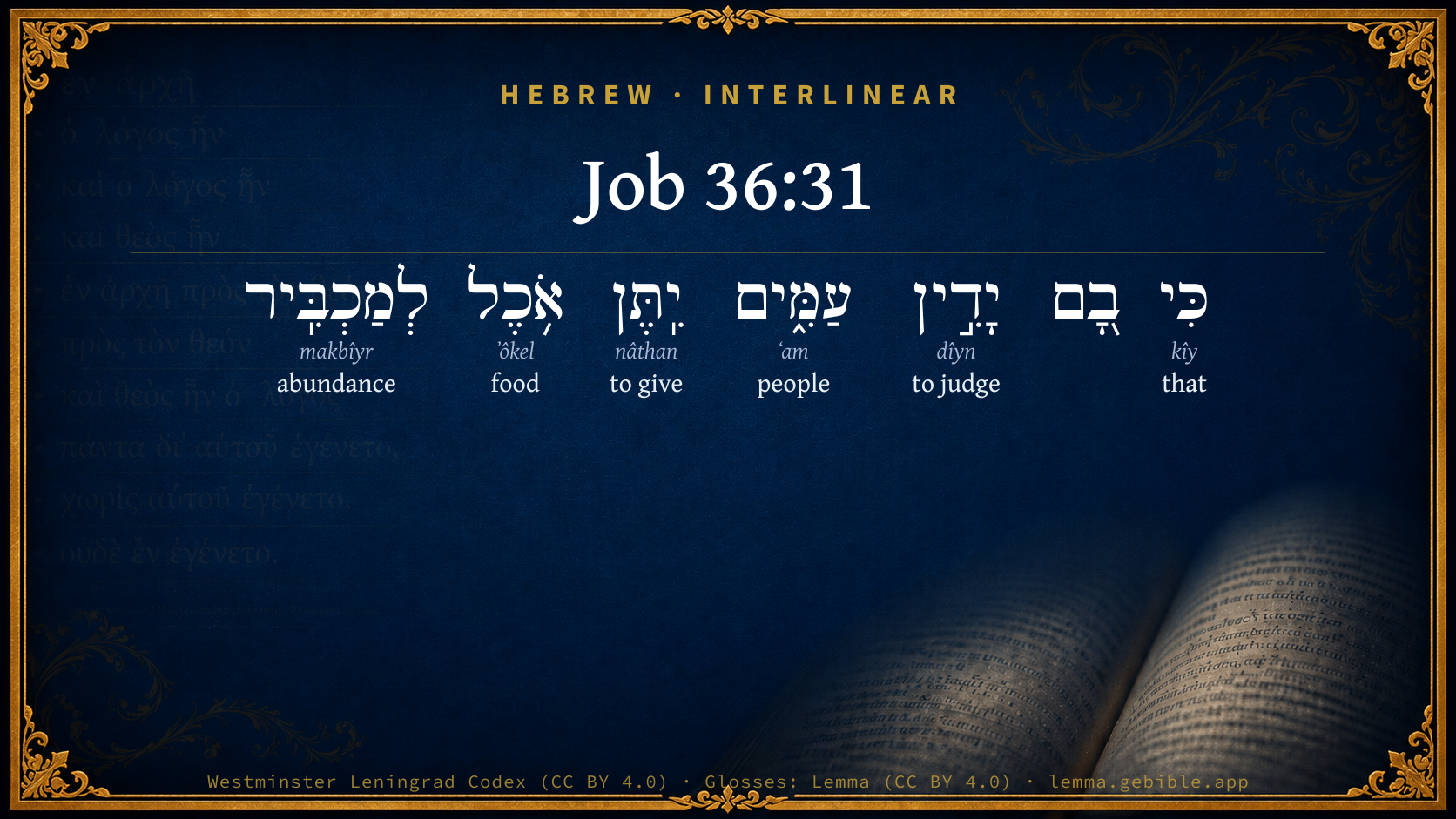
Job 36:31

Hebrew (Westminster Leningrad Codex) Job 36:31 appears in the Hebrew Old Testament. The text above is from the Westminster Leningrad Codex. Each word links to its Strong’s number, a concise gloss, and parsing drawn from the Open Scriptures Hebrew Bible morphology. Click any word for its full Brown-Driver-Briggs (BDB) entry.
Download image
Cite this verse

Job 36:31 (World English Bible). Public Domain. Lemma interlinear Bible study tool, https://lemma.gebible.app/v/job/36/31.

Show BibTeX & RIS
BibTeX
RIS
English Translation
For by these he judges the people. He gives food in abundance.
World English Bible · Public Domain
Highlights Full analysis ↓
Download a study sheet

One document with this verse’s original text, its word-by-word gloss line, the meaning frame, cross-references with their text, attributed commentary, and full source and license credits — printable, and it pastes into notes with its structure intact.

This verse Autodidact and up

Study sheet (.html) Plain text (.txt)

A passage Seminary Student

Up to 50 verses in one chapter. A passage sheet keeps up to 6 commentary sources and 12 cross-references per verse, in the order this page ranks them, and says so on the sheet whenever that leaves anything out. Ask for a single verse and you get the Autodidact verse sheet above.

Everything on this page stays free to read, with no account — the sheet is a download of what is already on screen, not access to it.

Want to remove ads? Support Godless Engineer
Compare translations 3

The same verse in 3 English versions, stacked beneath the original-language interlinear above. Click any original word for its lexicon entry.

Each is an independent rendering of the whole verse — the interlinear is not word-aligned to these translations.

Highlighted words mark where these versions differ — a whole-verse word diff, not a word-by-word alignment.

  • World English Bible Public Domain
    For by these he judges the people. He gives food in abundance.
  • King James Version Public Domain
    For by them judgeth he the people; he giveth meat in abundance.
  • unfoldingWord Literal Text CC BY-SA 4.0
    For by them he judges the peoples; he gives food in abundance.

unfoldingWord Literal Text — © unfoldingWord, licensed CC BY-SA 4.0. Word-aligned USFM3 via Door43 (git.door43.org/unfoldingWord/en_ult).

Versions to compare (up to 4)

3 of 4 selected

Show all 18 translations

Every available English version of this verse, each an independent rendering of the whole verse.

  • World English Bible Public Domain
    For by these he judges the people. He gives food in abundance.
  • Berean Standard Bible Public Domain
    For by these He judges the nations and provides food in abundance.
  • Majority Standard Bible Public Domain
    For by these He judges the nations and provides food in abundance.
  • King James Version Public Domain
    For by them judgeth he the people; he giveth meat in abundance.
  • American Standard Version (1901) Public Domain
    For by these he judgeth the peoples; He giveth food in abundance.
  • Revised Version (1885) Public Domain
    For by these he judgeth the peoples; he giveth meat in abundance.
  • Geneva Bible (1599) Public Domain
    For thereby hee iudgeth the people, and giueth meate abundantly.
  • Douay-Rheims (1899) Public Domain
    For by these he judgeth people, and giveth food to many mortals.
  • Young's Literal Translation Public Domain
    For by them He doth judge peoples, He giveth food in abundance.
  • Literal Standard Version CC BY-SA 4.0
    For He judges peoples by them, || He gives food in abundance.
  • Unlocked Literal Bible CC BY-SA 4.0
    In this way he judges the peoples and gives food in abundance.
  • unfoldingWord Literal Text CC BY-SA 4.0
    For by them he judges the peoples; he gives food in abundance.
  • Darby Bible Public Domain
    For with them he judgeth the peoples; he giveth food in abundance.
  • World Messianic Bible Public Domain
    For by these he judges the people. He gives food in abundance.
  • Webster's Bible Public Domain
    For by them he judgeth the people; he giveth food in abundance.
  • Free Bible Version CC BY-SA 4.0
    By these actions he rules the people, he provides abundant food.
  • Bible in Basic English Public Domain
    For by these he gives food to the peoples, and bread in full measure.
  • JPS Tanakh (1917) Public Domain
    For by these He judgeth the peoples; He giveth food in abundance.

Literal Standard Version (2020), Covenant Press — licensed CC BY-SA 4.0. Text via the HelloAO Bible API (eBible.org). Unlocked Literal Bible (unfoldingWord) — licensed CC BY-SA 4.0. Text via the HelloAO Bible API (eBible.org). unfoldingWord Literal Text — © unfoldingWord, licensed CC BY-SA 4.0. Word-aligned USFM3 via Door43 (git.door43.org/unfoldingWord/en_ult). Free Bible Version, Dr. Jonathan Gallagher — licensed CC BY-SA 4.0. Text via the HelloAO Bible API (eBible.org).

Word by word

More ways to search: Search by grammar → Find every occurrence → Compare this word →

Practice this passage: Drill this verse → Learn its vocabulary →

לְמַכְבִּֽיר
makbîyr
H4342
“to/for · abundance”
Preposition + Verb, Hiphil, Participle Active, Masculine, Singular, Absolute
Part of Speech
Preposition + Verb
Stem
Hiphil
Form
Participle Active
Gender
Masculine
Number
Singular
State
Absolute
Full BDB Definition

Origin: transitive participle of H3527

TWOT: 947

(Hiphil) to be in abundance - abundance (participle)
  1. כִּי kîy H3588 “that” Conjunction
  2. יָדִ֣ין dîyn H1777 “to judge” Verb, Qal, Imperfect, 3rd Person, Masculine, Singular
  3. עַמִּ֑ים ʻam H5971 “peoples” Noun, Common, Masculine, Plural, Absolute
  4. יִֽתֶּן nâthan H5414 “to give” Verb, Qal, Imperfect, 3rd Person, Masculine, Singular
  5. אֹ֥כֶל ʼôkel H400 “food” Noun, Common, Masculine, Singular, Absolute

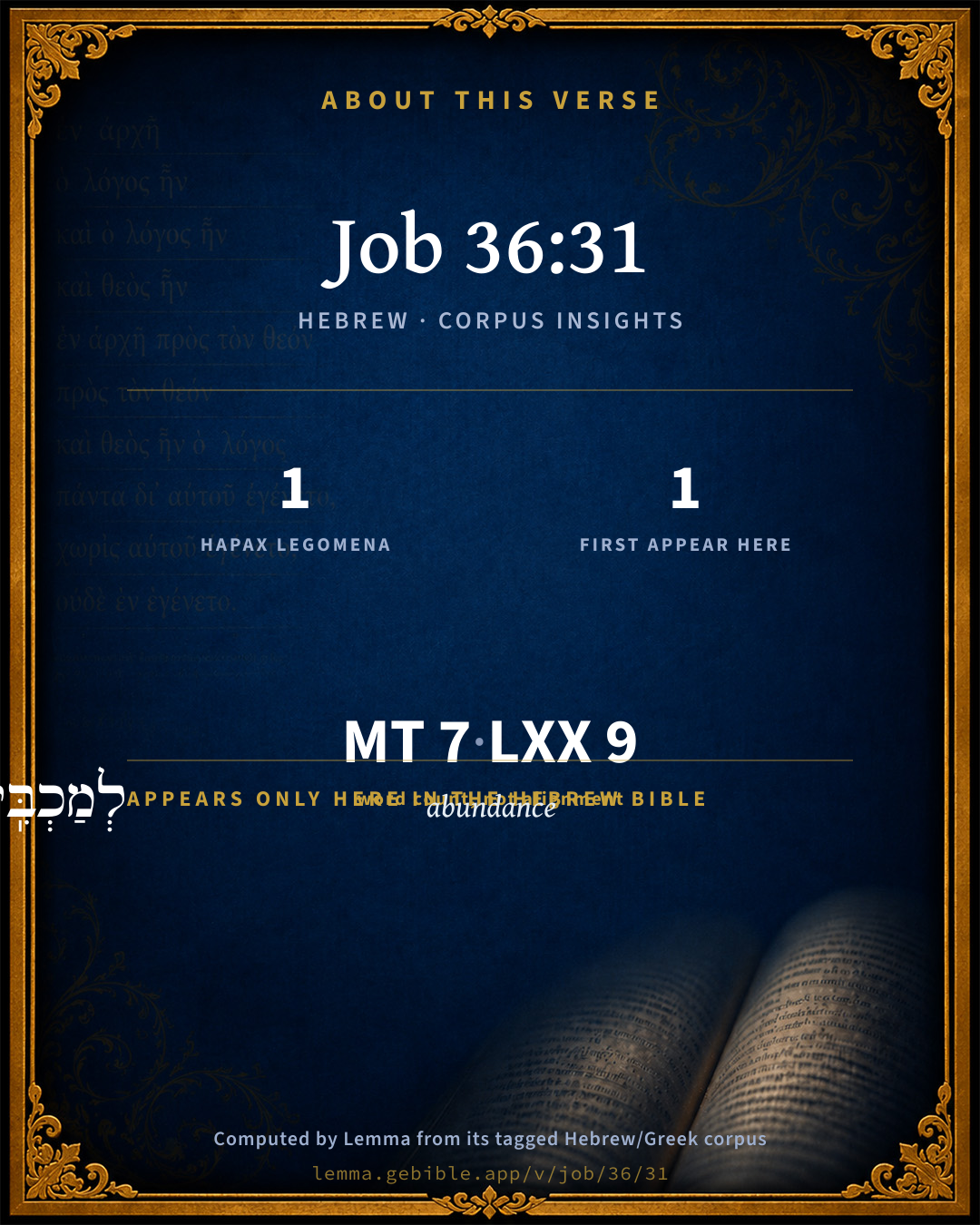
About this verse

These counts appear in no published source. They are computed here, from the morphology-tagged text and Lemma’s own curated glosses. What Lemma adds →

7
words
6
distinct lemmas
Wisdom
section

Notable vocabulary

1 hapax legomenon — a word that appears only here in the entire Hebrew Bible:

  • לְמַכְבִּֽיר abundance H4342

First appearance in Scripture

This word makes its first canonical appearance in the Hebrew Bible here:

  • לְמַכְבִּֽיר abundance H4342

Shared distinctive vocabulary

יָדִ֣ין to judge H1777 occurs in 24 verses of the Hebrew Bible. Also found in:

Grammatical profile

  • 3 verbs
  • 2 nouns
  • 1 preposition
  • 1 conjunction

Verb forms

  • יָדִ֣ין Qal · Imperfect
  • יִֽתֶּן Qal · Imperfect
  • לְמַכְבִּֽיר Hiphil · Participle Active

Hebrew & Septuagint length

In English translation the verse runs 12 words from the Hebrew and 17 from the Septuagint (LXX English) — the Septuagint runs noticeably longer here. See the side-by-side →

A rough comparison of the two English renderings, which tokenize alike — not a word-level alignment.

Word counts can differ between the Hebrew and the Greek without any difference in meaning — e.g. the Hebrew direct-object marker אֵת has no separate Greek word, and Greek often adds the article ὁ.

In the original languages it is 7 Hebrew tokens and 9 Greek tokens — but the two are counted differently (Hebrew bundles its prefixes and suffixes into one token; the Greek is in lemma form), so that isn’t a like-for-like length.

Cross-references

18

Topical passages linked to Job 36:31 in the Treasury of Scripture Knowledge — connected by theme and wording, ordered by reader-vote popularity; previews shown in the World English Bible.

  • Psalms 136:25 Who gives food to every creature; For his loving kindness endures forever.
  • Job 37:13 Whether it is for correction, or for his land, Or for loving kindness, that he causes it to come.
  • Acts 14:17 Yet he didn't leave himself without witness, in that he did good and gave you rains from the sky and fruitful seasons, filling our hearts with food and gladness."
  • Psalms 104:13–15 He waters the mountains from his chambers. The earth is filled with the fruit of your works.
  • Job 38:26–27 To cause it to rain on a land where no man is; On the wilderness, in which there is no man;
  • Psalms 65:9–13 You visit the earth, and water it. You greatly enrich it. The river of God is full of water. You provide them grain, for so you have ordained it.
  • Psalms 104:27–28 These all wait for you, That you may give them their food in due season.
  • Genesis 6:17 I, even, I do bring the flood of waters on this earth, to destroy all flesh having the breath of life from under the sky. Everything that is in the earth will die.
  • Genesis 7:17–24 The flood was forty days on the earth. The waters increased, and lifted up the ark, and it was lifted up above the earth.
  • Genesis 19:24 Then Yahweh rained on Sodom and on Gomorrah sulfur and fire from Yahweh out of the sky.
  • Exodus 9:23–25 Moses stretched forth his rod toward the heavens, and Yahweh sent thunder, hail, and lightning flashed down to the earth. Yahweh rained hail on the land of Egypt.
  • Deuteronomy 8:2 You shall remember all the way which Yahweh your God has led you these forty years in the wilderness, that he might humble you, to prove you, to know what was in your heart, whether you would keep his commandments, or not.
  • Deuteronomy 8:15 who led you through the great and terrible wilderness, [in which were] fiery serpents and scorpions, and thirsty ground where was no water; who brought you forth water out of the rock of flint;
  • Joshua 10:11 It happened, as they fled from before Israel, while they were at the descent of Beth Horon, that Yahweh cast down great stones from the sky on them to Azekah, and they died: they were more who died with the hailstones than they whom the children of Israel killed with the sword.
  • 1 Samuel 2:10 Those who strive with Yahweh shall be broken to pieces; Against them will he thunder in the sky: Yahweh will judge the ends of the earth; He will give strength to his king, Exalt the horn of his anointed.
  • 1 Samuel 7:10 As Samuel was offering up the burnt offering, the Philistines drew near to battle against Israel; but Yahweh thundered with a great thunder on that day on the Philistines, and confused them; and they were struck down before Israel.
  • 1 Samuel 12:18 So Samuel called to Yahweh; and Yahweh sent thunder and rain that day: and all the people greatly feared Yahweh and Samuel.
  • Job 38:22–23 Have you entered the treasuries of the snow, Or have you seen the treasures of the hail,

Cross-references courtesy of OpenBible.info (CC BY 4.0).

Hebrew and Greek witnesses Masoretic Hebrew ↔ Greek Septuagint

The same verse in the two great witnesses to the Old Testament, shown verse-for-verse.

Here the Septuagint runs noticeably longer than the Hebrew — LXX2012 (modern English Septuagint) 17 words vs World English Bible 12. A rough length comparison of the two English translations, not a word-level alignment — read both below.

These are two independent witnesses, not word-aligned to each other, and the Septuagint is shown in lemma (dictionary) form.

Hebrew Job 36:31 Masoretic · Westminster Leningrad Codex

כִּי בָ֭ם יָדִ֣ין עַמִּ֑ים יִֽתֶּן אֹ֥כֶל לְמַכְבִּֽיר

For by these he judges the people. He gives food in abundance.

World English Bible · Public Domain

Greek LXX Job 36:31 Septuagint · lemma form

ἐν γάρ αὐτός κρίνω λαός δίδωμι τροφή ὁ ἰσχύω

For by them he will judge the nations: he will give food to him that has strength.

LXX2012 (modern English Septuagint) · Public Domain

Hebrew: Westminster Leningrad Codex (CC BY 4.0). Greek: Septuagint (public domain); English from LXX2012 (modern English Septuagint) (Public Domain). How the Septuagint differs from the Hebrew →

Commentary

Notes on Job 36:31 from classic Christian and Jewish commentators (each source and its license shown beneath its notes). The classic Christian expositions comment on the surrounding passage and are grouped to its opening verse, so a note may address several verses; the Jewish commentaries on the Tanakh (Rashi and others) are per-verse, so they appear only where the commentator wrote on this verse.

Lemma curates 59 commentaries, every one of them public domain or Creative Commons licensed, each selected and text-cleaned for this edition rather than reprinted as found. About our sources →

Trapp's Complete Commentary

John Trapp

Job 36:31 For by them judgeth he the people; he giveth meat in abundance.

Ver. 31. For by them judgeth he the people] i.e. By rain and drought in excess or defect, he punisheth people at his pleasure; whom oh how easily could he affamish by denying them a harvest or two! in granting whereof he giveth testimony of his bounty, Job 14:17.

He giveth meat in abundance] sc. By sending moderate showers fattening the earth; whereunto also the preaching of the Word is fitly compared, Isa 55:10-11, which those that drink not in and fructify, Deu 32:2, are accursed, Heb 6:8.

John Trapp, A Commentary or Exposition upon All the Books of the Old and New Testament (1647–1656) — public domain. Text from a community e-Sword module.

Joseph Benson's Commentary

Job 36:31-33. For by them he judgeth the people — By thunder and lightning, and rain from the clouds, he executes his judgments against ungodly people. He giveth meat — By the same clouds by which he punisheth wicked men, he provideth plentiful showers to drop fatness upon the earth. With clouds he covereth the light — With thick and black clouds spread over the whole heavens, as in times of great thunders and lightnings, he obscures the light of the day, or the splendour of the shining sun. Hebrew, על כפים, gnal cappaim, with hands he covereth the sun; either the clouds are so called for their resemblance to hands, or the meaning is, that God covereth the light as by the hollow of his hand. And commandeth it not to shine — Or, יצו, jetzav, giveth a charge concerning it, that it shall be covered; by the cloud that cometh betwixt — Which God interposes as a veil between the sun and the earth. The noise thereof showeth concerning it — The thunder gives notice of the approaching rain. The cattle also, &c. — As the thunder, so also the cattle showeth concerning the vapour — Concerning the coming of the rain, by a strange instinct, seeking for shelter when a change of weather is near.

Joseph Benson's Commentary on the Old and New Testaments (1811–1818) — public domain. Text from a community e-Sword module.

Tyndale Open Study Notes

Tyndale Open Resources

36:31 The Hebrew yadin can mean he governs or he nourishes, which parallels food in abundance (38:26; Pss 65:9-13; 104:13-15, 27-28). The more common meaning for yadin is “judge,” which would mean that God does all things to bless his people and judge his enemies (Job 37:11-13; 38:22-23; see Gen 6:17; 19:24; Exod 9:23-25; Josh 10:11-14; 1 Sam 12:18).

Tyndale Open Study Notes — © Tyndale Open Resources, licensed CC BY-SA 4.0. Text via the HelloAO Bible API.

Geneva Bible (1599)

Geneva Bible translators

He showeth that the rain hath double use: the one that it declareth God’s judgments, when it doth overflow any places, and the other that it maketh the land fruitful.

Geneva Bible (1599) marginal notes — public domain. Text via Bolls.life.

Jamieson, Fausset & Brown

Robert Jamieson, A. R. Fausset & David Brown

These (rain and lightnings) are marvellous and not to be understood (Job 36:29), yet necessary. "For by them He judgeth (chastiseth on the one hand), &c. (and on the other, by them) He giveth meat" (food), &c. (Job 37:13; Job 38:23, Job 38:27; Act 14:17).

Jamieson, Fausset & Brown — Commentary Critical and Explanatory on the Whole Bible (1871) — public domain (CC PDM 1.0). Text via the HelloAO Bible API.

Adam Clarke's Commentary

Verse 31. By them judgeth he the people] He makes storms, tempests, winds, hurricanes, tornadoes, thunder and lightning, drought and inundation, the instruments of his justice, to punish rebellious nations.

He giveth meat in abundance.] Though by these he punishes offenders, yet through the same, as instruments, he provides for the wants of men and animals in general. Storms, tempests, and hurricanes, agitate the lower regions of the atmosphere, disperse noxious vapours, and thus render it fit for respiration; and without these it would soon become a stagnant, putrid, and deadly mass, in which neither animals could live, nor vegetables thrive. And by dews, rains, snows, frosts, winds, cold, and heat, he fructifies the earth, and causes it to bring forth abundantly, so that every thing living is filled with plenteousness.

Some critics translate this latter clause thus: - He passeth sentence amain. I cannot see this meaning in the original words. Not one of the versions has so understood them; nor does this translation, supposing even that the Hebrew would bear it, give so fine and so elegant an idea as that of the common version. I always feel reluctant to give a sense in any case that is not supported in some of its parts by any of the ancient versions, and more especially when it is contrary to the whole of them; and still more particularly when opposed to the Arabic, which in the Book of Job, containing so many Arabisms, I consider to be of very great importance.

Adam Clarke's Commentary on the Bible (1810–1826) — public domain. Text from a community e-Sword/MySword module.

Ellicott's Commentary for English Readers

(31) For by them—i.e., these roots of the sea, these drops of water, these rain-clouds. “He judgeth peoples” by withholding them, or “giveth meat in abundance” by sending rain on the earth; or He may use them in excess, to chastise nations by inundations and the like. The change from roots of the sea to bottom of the sea in the Authorised Version has obscured the meaning of “them” in the next verse, unless, indeed, we understand it generally, by these things.

A Bible Commentary for English Readers, edited by Charles John Ellicott (1878–1897) — public domain. Text from a community e-Sword module.

The Cambridge Bible for Schools and Colleges

gen. ed. J. J. S. Perowne

31. For by them judgeth he the people] Rather, the peoples. He judges the peoples by the lightning and the rain cloud. By the one He “scatters” and “discomfits” His enemies (Psa_18:14), and by the other He watereth the earth and makes it fruitful (Isa_55:10).

The Cambridge Bible for Schools and Colleges (gen. ed. J. J. S. Perowne; Cambridge University Press, 1878–1918) — public domain. Text from a community e-Sword module.

John Gill's Exposition

For by them judgeth he the people,.... That is, by the clouds; which the Lord uses both in a way of judgment, as expressed in this clause; and in a way of mercy, as in the following; by these, and what issue out of them, as rain, hail, winds, thunder, and lightning, he sometimes punishes the inhabitants of the earth, as he did the old world by a deluge of water, which came partly from the fountains of the great deep, and partly from the windows of heaven, which destroyed man and beast, and the increase of the earth, Gen 7:11; he punished the Egyptians by a violent storm of hail, Exo 9:23; and slew many of the Canaanites with hailstones, Jos 10:11; Pharaoh and his host sunk like lead when he blew with his wind, Exo 15:10; and Sodom and Gomorrah, with the cities of the plain, were destroyed with thunder and lightning, fire and brimstone, from heaven, Gen 19:24; as the army of the Philistines were discomfited by thunder in the times of Samuel, Sa1 7:10; and the captains of fifties, with their men, were consumed by lightning in the times of Elijah, Kg2 1:14; and as the heavens and the earth will be burnt with fire at the end of all things, Mat 13:40, Pe2 3:12;

he giveth meat in abundance; very plentifully, or to a multitude of creatures, both men and cattle; who have a liberal supply of food by means of the clouds and rain, which falling upon the earth make it fruitful, so that it gives bread to the eater, and seed to the sower; causes grass to grow up for the beasts of the field, and produces bread corn, oil, and wine, for the benefit of men; an emblem of the variety and plenty of spiritual food dispensed to the churches of Christ, through the ministry of the word, and by the ministers of it.

John Gill's Exposition of the Whole Bible (1746–1763) — public domain (CC PDM 1.0). Text via the HelloAO Bible API.

Albert Barnes' Notes on the Bible

For by them judgeth he the people - By means of the clouds, the rain, the dew, the tempest, and the thunderbolt. The idea seems to be, that he makes use of all these to execute his purposes on mankind. He can either make them the means of imparting blessings, or of inflicting the severest, judgments. He can cause the tornado to sweep over the earth; he can arm the forked lightning against the works of art; he can withhold rain and dew, and spread over a land the miseries of famine.

He giveth meat in abundance - That is, by the clouds, the dew, the rain. The idea is, that he can send timely showers if he chooses, and the earth will be clothed with plenty. All these things are under his control, and he can, as he pleases, make them the means of comfort to man, or of punishing him for his sins; compare Psa 65:11-13.

Albert Barnes' Notes on the Bible (1834–1885) — public domain. Text from a community e-Sword/MySword module.

Haydock's Catholic Bible Commentary

Mortals. Hebrew, "in abundance." (Haydock) --- By thunder he overwhelms many nations, while by moderate rains, he causes the earth ot fructify (Calmet) and nourish mankind. (Menochius)

George Leo Haydock (1774–1849), Haydock's Catholic Family Bible and Commentary, 1859 edition — public domain. Excludes Psalms (Douay-Rheims chapter numbering differs from Protestant) and Deuterocanonical books (Catholic canon only).

Matthew Poole's English Annotations

By thunder and lightning he manifests his displeasure and executes his judgments against ungodly people or countries.

He giveth meat in abundance; or, and (which conjunction is oft understood) he giveth meat, &c., i.e. by the selfsame clouds he punisheth wicked men by thunder and lightning, and provideth for others by those plentiful showers which accompany them.

Matthew Poole's English Annotations on the Holy Bible (1683–1685) — public domain. Text from a community e-Sword/MySword module.

Whedon's Commentary on the Bible

Daniel D. Whedon

31. By them (the lightning and the cloud) He ruleth the nations. The verse is parenthetical. The lightning is his sceptre, the fertilizing cloud his storehouse of food. With the one he smites, with the other he blesses.

Daniel D. Whedon (gen. ed.), Commentary on the Old and New Testaments (1874–1909) — public domain. Text from a community e-Sword module.

The Pulpit Commentary

For by them judgeth he the people. By his clouds God works two opposite effects. On the one hand, he executes judgment upon the peoples, destroying their crops, causing widespread ruin by inundations, smiting and slaying numbers with his thunderbolts; on the other, he giveth meat in abundance, restoring to the parched earth its fertility by means of copious and refreshing showers, stimulating vegetation, and so furthering the harvest.

The Pulpit Commentary (1880–1919), ed. H.D.M. Spence-Jones & Joseph S. Exell — public domain. Text from a community e-Sword module.

John Wesley's Explanatory Notes

Judgeth - By thunder and lightning, and rain from the clouds, he executes his judgments against ungodly people. Meat - Giveth meat. By the same clouds, he provides plentiful showers dropping fatness on the earth.

John Wesley, Explanatory Notes Upon the Whole Bible (1754–1765) — public domain. Text via the GEBible commentary corpus.

Rashi

Rabbi Shlomo Yitzchaki (Rashi)

For...therewith With the clouds He judges peoples and chastises them by withholding rain, causing famine, as well as all sorts of plagues. When the Generation of the Flood sinned (Gen. 7:11), “and the floodgates of the heavens were opened.” As for the people of Sodom (Deut. 29:22), “Sulfur and salt, all the soil is burned up.” As for Sisera (Jud. 5:20), “From heaven they fought...against Sisera.”

He gives food to one who has many From there comes sustenance (Ex. 16:4): “See, I am about to have bread rain down from heaven for you.” This is to be compared to a baker who is standing before the oven. If an enemy comes in, he rakes coals and casts them at him; if his friend comes in, he takes out hot bread and gives it to him.

to the one who has many to the one whose children are many and numerous; to one who increases children and requires food.

Rashi on the Tanakh — English translations: “The Judaica Press complete Tanach with Rashi, translated by A. J. Rosenberg” (CC BY 4.0); “Pentateuch with Rashi's commentary by M. Rosenbaum and A.M. Silbermann, 1929-1934” (public domain); “The Metsudah Tanach series, Lakewood, N.J” (CC BY 4.0); and “The Book of Joshua, Metsudah Publications, 1997” (CC BY 4.0). Text via Sefaria.

Lesson kit

Teaching starters — assembled from the data on this page, not authored interpretation. Every prompt links to the verse data it draws on. Edit before teaching.

Job, in the Wisdom, opens this verse with 7 words (6 distinct Hebrew lemmas). Its most distinctive word is makbîyr (“abundance”). The Greek Septuagint runs longer here. A historical commentator’s framing appears above. Read the whole chapter for the surrounding context.

Discussion questions

  1. The word makbîyr carries the sense “abundance.” How does it shape the verse?
  2. This verse holds 1 word here found nowhere else in the Hebrew Bible. What might the rare word draw attention to?
  3. The word “abundance” first appears here in Scripture. What is being introduced at this debut?
  4. Genesis 6:3 shares the word «to judge» with this verse. How do the two illuminate each other?
  5. Compared with the Hebrew, the Septuagint runs longer here. What questions does that raise?
  6. These translations render this verse differently. What is at stake in choosing one wording over another?
  7. The verb «יָדִ֣ין» is Qal Imperfect. How does its form color the action?
  8. Reading how Trapp's Complete Commentary and Joseph Benson's Commentary read this verse, where do the two commentators agree and where do they part?

Things to notice

Reading settings

Reading text

Shown beneath each verse's original-language words.

Old Testament
Old Testament edition

Read the OT as the Masoretic Hebrew (MT) or the Greek Septuagint (LXX).

English shown for the Greek Septuagint (in the Hebrew ↔ Greek comparison).

Comparing translations? Open the Compare panel on any verse page to stack up to four side by side.