
Isaiah 8:9

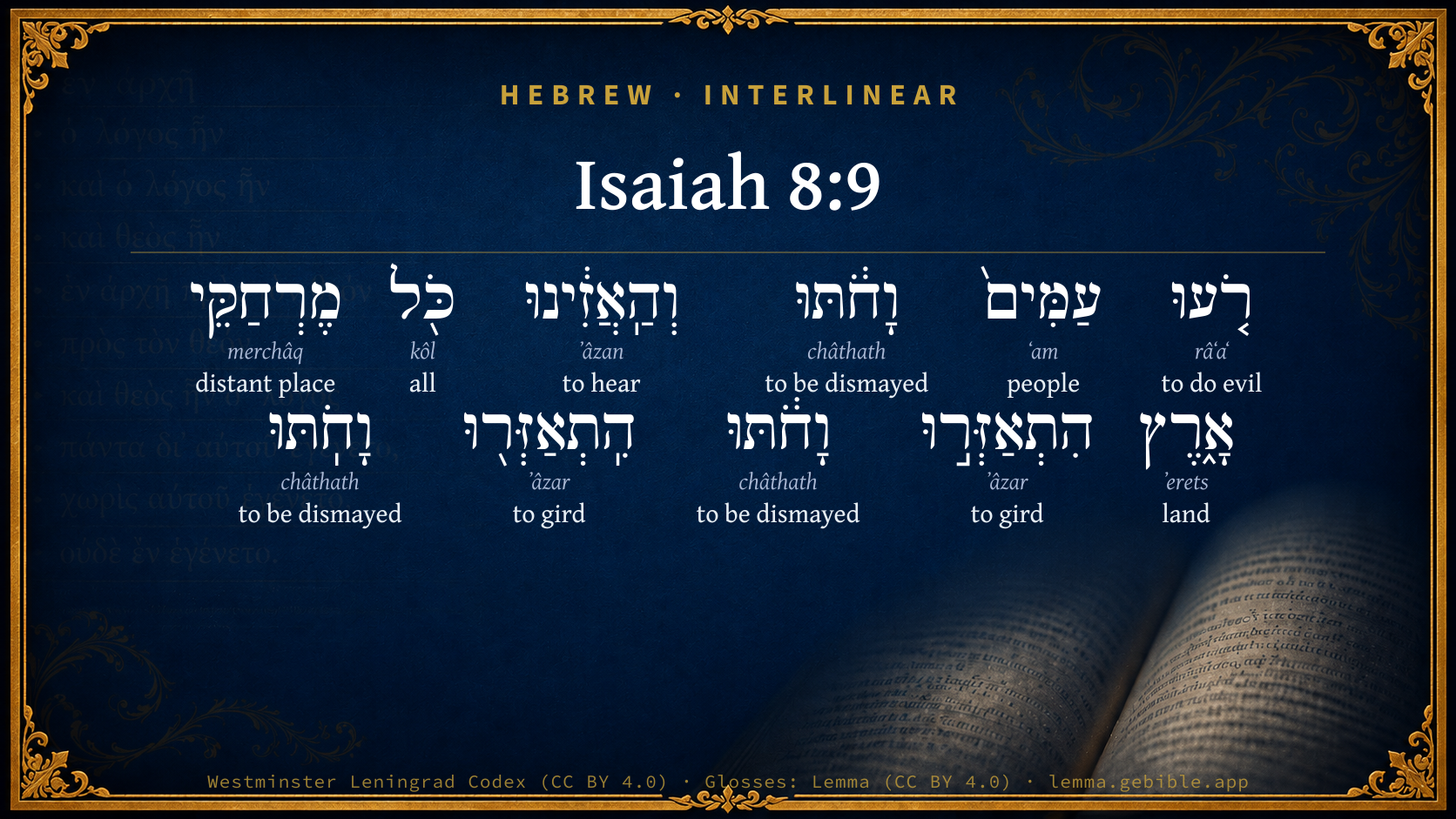
Hebrew (Westminster Leningrad Codex) Isaiah 8:9 appears in the Hebrew Old Testament. The text above is from the Westminster Leningrad Codex. Each word links to its Strong’s number, a concise gloss, and parsing drawn from the Open Scriptures Hebrew Bible morphology. Click any word for its full Brown-Driver-Briggs (BDB) entry.
Download image
Cite this verse

Isaiah 8:9 (World English Bible). Public Domain. Lemma interlinear Bible study tool, https://lemma.gebible.app/v/isaiah/8/9.

Show BibTeX & RIS
BibTeX
RIS
English Translation
Make an uproar, O you peoples, and be broken in pieces! And give ear, all you of far countries: gird yourselves, and be broken in pieces! Gird yourselves, and be broken in pieces!
World English Bible · Public Domain
Download a study sheet

One document with this verse’s original text, its word-by-word gloss line, the meaning frame, cross-references with their text, attributed commentary, and full source and license credits — printable, and it pastes into notes with its structure intact.

This verse Autodidact and up

Study sheet (.html) Plain text (.txt)

A passage Seminary Student

Up to 50 verses in one chapter. A passage sheet keeps up to 6 commentary sources and 12 cross-references per verse, in the order this page ranks them, and says so on the sheet whenever that leaves anything out. Ask for a single verse and you get the Autodidact verse sheet above.

Everything on this page stays free to read, with no account — the sheet is a download of what is already on screen, not access to it.

Want to remove ads? Support Godless Engineer
Compare translations 3

The same verse in 3 English versions, stacked beneath the original-language interlinear above. Click any original word for its lexicon entry.

Each is an independent rendering of the whole verse — the interlinear is not word-aligned to these translations.

Highlighted words mark where these versions differ — a whole-verse word diff, not a word-by-word alignment.

  • World English Bible Public Domain
    Make an uproar, O you peoples, and be broken in pieces! And give ear, all you of far countries: gird yourselves, and be broken in pieces! Gird yourselves, and be broken in pieces!
  • King James Version Public Domain
    Associate yourselves, O ye people, and ye shall be broken in pieces; and give ear, all ye of far countries: gird yourselves, and ye shall be broken in pieces; gird yourselves, and ye shall be broken in pieces.
  • unfoldingWord Literal Text CC BY-SA 4.0
    Shout, peoples, and shatter! And listen, all of the distant of the earth! Gird yourselves and shatter! Gird yourselves and shatter!

unfoldingWord Literal Text — © unfoldingWord, licensed CC BY-SA 4.0. Word-aligned USFM3 via Door43 (git.door43.org/unfoldingWord/en_ult).

Versions to compare (up to 4)

3 of 4 selected

Show all 18 translations

Every available English version of this verse, each an independent rendering of the whole verse.

  • World English Bible Public Domain
    Make an uproar, O you peoples, and be broken in pieces! And give ear, all you of far countries: gird yourselves, and be broken in pieces! Gird yourselves, and be broken in pieces!
  • Berean Standard Bible Public Domain
    Huddle together, O peoples, and be shattered; pay attention, all you distant lands; prepare for battle, and be shattered; prepare for battle, and be shattered!
  • Majority Standard Bible Public Domain
    Huddle together, O peoples, and be shattered; pay attention, all you distant lands; prepare for battle, and be shattered; prepare for battle, and be shattered!
  • King James Version Public Domain
    Associate yourselves, O ye people, and ye shall be broken in pieces; and give ear, all ye of far countries: gird yourselves, and ye shall be broken in pieces; gird yourselves, and ye shall be broken in pieces.
  • American Standard Version (1901) Public Domain
    Make an uproar, O ye peoples, and be broken in pieces; and give ear, all ye of far countries: gird yourselves, and be broken in pieces; gird yourselves, and be broken in pieces.
  • Revised Version (1885) Public Domain
    Make an uproar; O ye peoples, and ye shall be broken in pieces; and give ear, all ye of far countries: gird yourselves, and ye shall be broken in pieces: gird yourselves, and ye shall be broken in pieces.
  • Geneva Bible (1599) Public Domain
    Gather together on heapes, O ye people, and ye shalbe broken in pieces, and hearken all ye of farre countreys: gird your selues, and you shalbe broken in pieces: gird your selues, and you shalbe broken in pieces.
  • Douay-Rheims (1899) Public Domain
    Gather yourselves together, O ye people, and be overcome, and give ear, all ye lands afar off: strengthen yourselves, end be overcome, gird yourselves, and be overcome.
  • Young's Literal Translation Public Domain
    Be friends, O nations, and be broken, And give ear, all ye far off ones of earth, Gird yourselves, and be broken, Gird yourselves, and be broken.
  • Literal Standard Version CC BY-SA 4.0
    Be friends, O nations, and be broken, || And give ear, all you far-off ones of earth, || Gird yourselves, and be broken, || Gird yourselves, and be broken.
  • Unlocked Literal Bible CC BY-SA 4.0
    You peoples will be broken to pieces. Listen, all you distant countries: arm yourselves for war and be broken in pieces; arm yourselves and be broken in pieces.
  • unfoldingWord Literal Text CC BY-SA 4.0
    Shout, peoples, and shatter! And listen, all of the distant of the earth! Gird yourselves and shatter! Gird yourselves and shatter!
  • Darby Bible Public Domain
    Rage, ye peoples, and be broken in pieces! And give ear, all ye distant parts of the earth: Gird yourselves, and be broken in pieces; gird yourselves, and be broken in pieces!
  • World Messianic Bible Public Domain
    Make an uproar, you peoples, and be broken in pieces! Listen, all you from far countries: dress for battle, and be shattered! Dress for battle, and be shattered!
  • Webster's Bible Public Domain
    Associate yourselves, O ye people, and ye shall be broken in pieces; and give ear, all ye of far countries: gird yourselves, and ye shall be broken in pieces; gird yourselves, and ye shall be broken in pieces.
  • Free Bible Version CC BY-SA 4.0
    Pay attention, you nations, and be smashed! Listen, all you distant lands, get ready, but you will be smashed. Get ready, but you will be smashed.
  • Bible in Basic English Public Domain
    Have knowledge, O peoples, and be in fear; give ear, all you far-off parts of the earth:
  • JPS Tanakh (1917) Public Domain
    Make an uproar, O ye peoples, and ye shall be broken in pieces; and give ear, all ye of far countries; gird yourselves, and ye shall be broken in pieces; gird yourselves, and ye shall be broken in pieces.

Literal Standard Version (2020), Covenant Press — licensed CC BY-SA 4.0. Text via the HelloAO Bible API (eBible.org). Unlocked Literal Bible (unfoldingWord) — licensed CC BY-SA 4.0. Text via the HelloAO Bible API (eBible.org). unfoldingWord Literal Text — © unfoldingWord, licensed CC BY-SA 4.0. Word-aligned USFM3 via Door43 (git.door43.org/unfoldingWord/en_ult). Free Bible Version, Dr. Jonathan Gallagher — licensed CC BY-SA 4.0. Text via the HelloAO Bible API (eBible.org).

Word by word

More ways to search: Search by grammar → Find every occurrence → Compare this word →

Practice this passage: Drill this verse → Learn its vocabulary →

הִתְאַזְּר֣וּ
ʼâzar
H247
“gird”
Verb, Hithpael, Imperative, 2nd Person, Masculine, Plural
Part of Speech
Verb
Stem
Hithpael
Form
Imperative
Person
2nd Person
Gender
Masculine
Number
Plural
Full BDB Definition

Origin: a primitive root

TWOT: 59

gird, encompass, equip, clothe - (Qal) to gird, gird on (metaphorical of strength) - (Niphal) be girded - (Piel) hold close, clasp - (Hithpael) gird oneself (for war)
  1. רֹ֤עוּ râʻaʻ H7489 “do evil” Verb, Qal, Imperative, 2nd Person, Masculine, Plural
  2. עַמִּים֙ ʻam H5971 “peoples” Noun, Common, Masculine, Plural, Absolute
  3. וָחֹ֔תּוּ châthath H2865 “and · be dismayed” Conjunction + Verb, Qal, Imperative, 2nd Person, Masculine, Plural
  4. וְהַֽאֲזִ֔ינוּ ʼâzan H238 “and · hear” Conjunction + Verb, Hiphil, Imperative, 2nd Person, Masculine, Plural
  5. כֹּ֖ל kôl H3605 “all of” Noun, Common, Masculine, Singular, Construct
  6. מֶרְחַקֵּי merchâq H4801 “distant places of” Noun, Common, Masculine, Plural, Construct
  7. אָ֑רֶץ ʼerets H776 “land” Noun, Common, Both, Singular, Absolute
  8. וָחֹ֔תּוּ châthath H2865 “and · be dismayed” Conjunction + Verb, Qal, Imperative, 2nd Person, Masculine, Plural
  9. הִֽתְאַזְּר֖וּ ʼâzar H247 “gird” Verb, Hithpael, Imperative, 2nd Person, Masculine, Plural
  10. וָחֹֽתּוּ châthath H2865 “and · be dismayed” Conjunction + Verb, Qal, Imperative, 2nd Person, Masculine, Plural

About this verse

These counts appear in no published source. They are computed here, from the morphology-tagged text and Lemma’s own curated glosses. What Lemma adds →

11
words
8
distinct lemmas
Prophets
section

Notable vocabulary

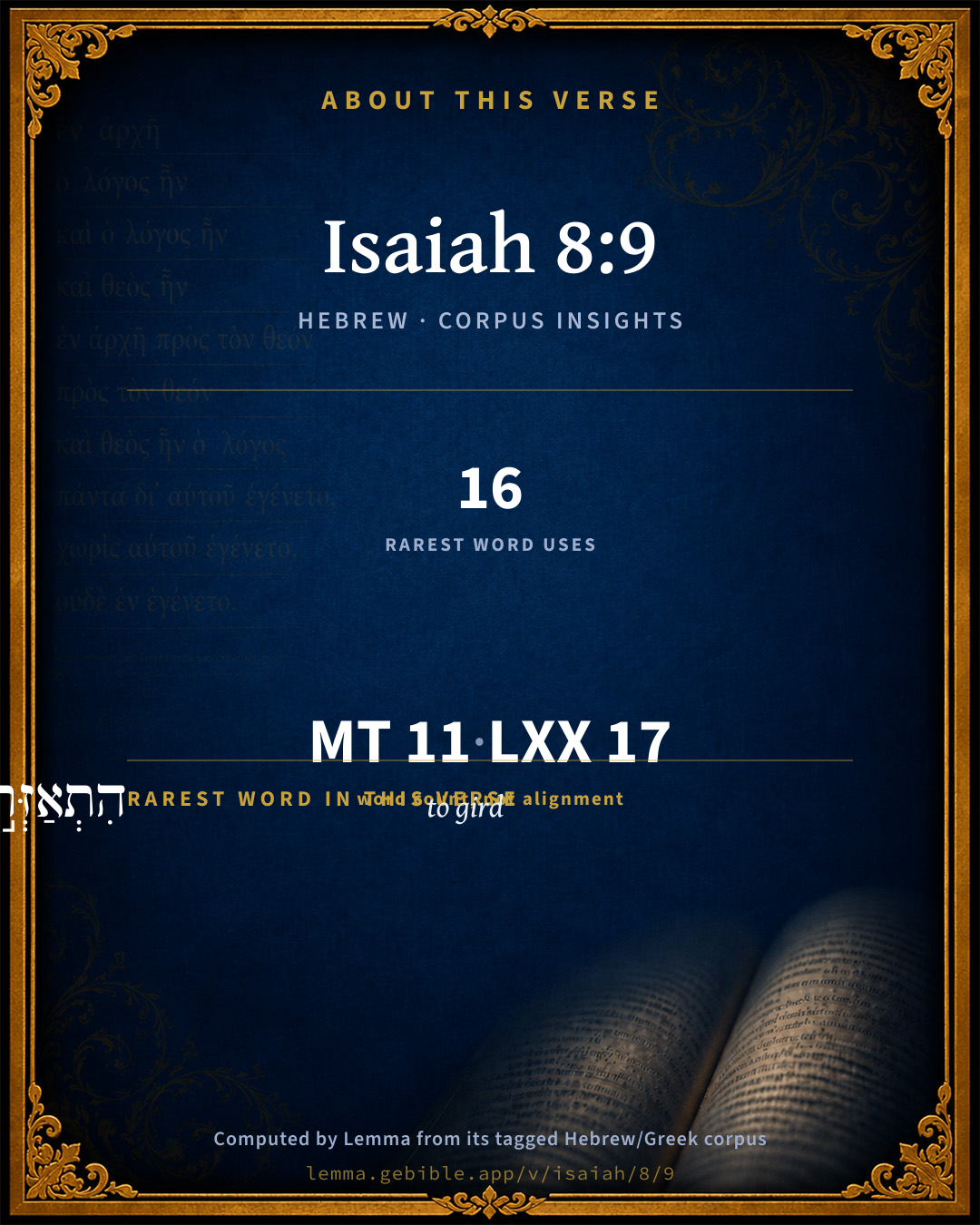
The rarest word here is הִתְאַזְּר֣וּ to gird H247 — appearing just 16 times in the whole Hebrew Bible.

Shared distinctive vocabulary

הִתְאַזְּר֣וּ to gird H247 occurs in 15 verses of the Hebrew Bible. Also found in:

Grammatical profile

  • 7 verbs
  • 4 nouns

Verb forms

  • רֹ֤עוּ Qal · Imperative
  • וָחֹ֔תּוּ Qal · Imperative
  • וְהַֽאֲזִ֔ינוּ Hiphil · Imperative
  • הִתְאַזְּר֣וּ Hithpael · Imperative
  • וָחֹ֔תּוּ Qal · Imperative
  • הִֽתְאַזְּר֖וּ Hithpael · Imperative
  • וָחֹֽתּוּ Qal · Imperative

Repetition

Words recur within this verse — often emphatic in Hebrew:

  • וָחֹ֔תּוּ to be dismayed H2865 ×3
  • הִתְאַזְּר֣וּ to gird H247 ×2

Hebrew & Septuagint length

In English translation the verse runs 33 words from the Hebrew and 34 from the Septuagint (LXX English) — closely comparable.

A rough comparison of the two English renderings, which tokenize alike — not a word-level alignment.

Word counts can differ between the Hebrew and the Greek without any difference in meaning — e.g. the Hebrew direct-object marker אֵת has no separate Greek word, and Greek often adds the article ὁ.

In the original languages it is 11 Hebrew tokens and 17 Greek tokens — but the two are counted differently (Hebrew bundles its prefixes and suffixes into one token; the Greek is in lemma form), so that isn’t a like-for-like length.

Cross-references

16

Topical passages linked to Isaiah 8:9 in the Treasury of Scripture Knowledge — connected by theme and wording, ordered by reader-vote popularity; previews shown in the World English Bible.

  • Isaiah 14:5–6 Yahweh has broken the staff of the wicked, the scepter of the rulers;
  • 1 Kings 20:11 The king of Israel answered, Tell him, Don't let him who girds on [his armor] boast himself as he who puts it off.
  • Psalms 37:14–15 The wicked have drawn out the sword, and have bent their bow, To cast down the poor and needy, To kill those who are upright in the way.
  • Proverbs 11:21 Most assuredly, the evil man will not be unpunished, But the seed of the righteous will be delivered.
  • Isaiah 7:1–2 It happened in the days of Ahaz the son of Jotham, the son of Uzziah, king of Judah, that Rezin the king of Syria, and Pekah the son of Remaliah, king of Israel, went up to Jerusalem to war against it, but could not prevail against it.
  • Isaiah 17:12–13 Ah, the uproar of many peoples, who roar like the roaring of the seas; and the rushing of nations, that rush like the rushing of mighty waters!
  • Joel 3:9–14 Proclaim this among the nations: Prepare war. Stir up the mighty men. Let all the warriors draw near. Let them come up.
  • Isaiah 28:13 Therefore shall the word of Yahweh be to them precept on precept, precept on precept; line on line, line on line; here a little, there a little; that they may go, and fall backward, and be broken, and snared, and taken.
  • Isaiah 37:36 The angel of Yahweh went forth, and struck in the camp of the Assyrians one hundred and eighty-five thousand; and when men arose early in the morning, behold, these were all dead bodies.
  • Isaiah 54:15 Behold, they may gather together, but not by me: whoever shall gather together against you shall fall because of you.
  • Micah 4:11–13 Now many nations have assembled against you, that say, 'Let her be defiled, And let our eye gloat over Zion.'
  • Zechariah 14:1–3 Behold, a day of Yahweh comes, when your spoil will be divided in your midst.
  • Revelation 17:12–14 The ten horns that you saw are ten kings who have received no kingdom as yet, but they receive authority as kings, with the beast, for one hour.
  • Revelation 20:8–9 and he will come out to deceive the nations which are in the four corners of the earth, Gog and Magog, to gather them together to the war; the number of whom is as the sand of the sea.
  • Jeremiah 46:9–11 Go up, you horses; and rage, you chariots; and let the mighty men go forth: Cush and Put, who handle the shield; and the Ludim, who handle and bend the bow.
  • Daniel 2:34–35 You saw until a stone was cut out without hands, which struck the image on its feet that were of iron and clay, and broke them in pieces.

Cross-references courtesy of OpenBible.info (CC BY 4.0).

Hebrew and Greek witnesses Masoretic Hebrew ↔ Greek Septuagint

The same verse in the two great witnesses to the Old Testament, shown verse-for-verse.

These are two independent witnesses, not word-aligned to each other, and the Septuagint is shown in lemma (dictionary) form.

Hebrew Isaiah 8:9 Masoretic · Westminster Leningrad Codex

רֹ֤עוּ עַמִּים֙ וָחֹ֔תּוּ וְהַֽאֲזִ֔ינוּ כֹּ֖ל מֶרְחַקֵּי אָ֑רֶץ הִתְאַזְּר֣וּ וָחֹ֔תּוּ הִֽתְאַזְּר֖וּ וָחֹֽתּוּ

Make an uproar, O you peoples, and be broken in pieces! And give ear, all you of far countries: gird yourselves, and be broken in pieces! Gird yourselves, and be broken in pieces!

World English Bible · Public Domain

Greek LXX Isaiah 8:9 Septuagint · lemma form

γιγνώσκω ἔθνος καί ἡττάω ἐπιἀκούω ἕως ἔσχατος ὁ γῆ ἰσχύω ἡττάω ἐάν γάρ πάλιν ἰσχύω πάλιν ἡττάω

Know, you⌃ Gentiles, and be conquered; listen you⌃, even to the extremity of the earth: be conquered, after you⌃ strengthened yourselves; for even if you⌃ should again strengthen yourselves, you⌃ shall again be conquered.

LXX2012 (modern English Septuagint) · Public Domain

On this verse, Trapp's Complete Commentary discusses the Septuagint’s reading. Read the note in Commentary ↓

Hebrew: Westminster Leningrad Codex (CC BY 4.0). Greek: Septuagint (public domain); English from LXX2012 (modern English Septuagint) (Public Domain). How the Septuagint differs from the Hebrew →

Targum (Aramaic paraphrase)

1

The Targum is the ancient Jewish Aramaic paraphrase of the Hebrew Scriptures — an interpretive translation, not the Hebrew text itself. Onkelos (literal) and Pseudo-Jonathan (expansive) render the Torah, and Jonathan the Prophets. Coverage is partial: where no permissively-licensed English translation exists for a verse, only the Aramaic is shown. This is verse-level text, not a word-by-word alignment to the Hebrew.

  1. Targum Jonathan Prophets (Joshua–Malachi)
    אִתְחַבָּרוּ עַמְמַיָא וְאִתְבָּרוּ וְאָצִיתוּ כֹּל דִי בִסְיָפֵי אַרְעָא אַתְקִיפוּ וְאִתְבָּרוּ אַתְקִיפוּ וְאִתְבָּרוּ:

    Associate yourselves, O ye people, yet ye shall be broken; and give ear all who are at the ends of the earth, strengthen yourselves, yet ye shall be broken, strengthen yourselves, yet ye shall be broken.

    Targum Jonathan — Aramaic: “Mikraot Gedolot” (public domain). English: “Sefaria Community Translation” (CC0 1.0 (public-domain dedication)); “London "Chaldee Paraphrase," 1871” (public domain). Text via Sefaria.

Commentary

Notes on Isaiah 8:9 from classic Christian and Jewish commentators (each source and its license shown beneath its notes). The classic Christian expositions comment on the surrounding passage and are grouped to its opening verse, so a note may address several verses; the Jewish commentaries on the Tanakh (Rashi and others) are per-verse, so they appear only where the commentator wrote on this verse.

Lemma curates 59 commentaries, every one of them public domain or Creative Commons licensed, each selected and text-cleaned for this edition rather than reprinted as found. About our sources →

Matthew Henry's Commentary

The prophet here returns to speak of the present distress that Ahaz and his court and kingdom were in upon account of the threatening confederacy of the ten tribes and the Syrians against them. And in these verses,

I. He triumphs over the invading enemies, and, in effect, sets them at defiance, and bids them do their worst (Isa 8:9, Isa 8:10): "O you people, you of far countries, give ear to what the prophet says to you in God's name." 1. "We doubt not but you will now make your utmost efforts against Judah and Jerusalem. You associate yourselves in a strict alliance. You gird yourselves, and again you gird yourselves; you prepare for action; you address yourselves to it with resolution; you gird on your swords; you gird up your loins. You animate and encourage yourselves and one another with all the considerations you can think of: you take counsel together, call councils of war, and all heads are at work about the proper methods for making yourselves masters of the land of Judah. You speak the word; you come to resolutions concerning it, and are not always deliberating; you determine what to do, and are very confident of the success of it, that the matter will be accomplished with a word's speaking." Note, It is with a great deal of policy, resolution, and assurance, that the church's enemies carry on their designs against it; and abundance of pains they take to roll a stone that will certainly return upon them. 2. "This is to let you know that all your efforts will be ineffectual. You cannot, you shall not, gain your point, nor carry the day: You shall be broken in pieces. Though you associate yourselves, though you gird yourselves, though you proceed with all the policy and precaution imaginable, yet, I tell you again and again, all your projects shall be baffled, you shall be broken in pieces. Nay, not only shall your attempts be ruined, but your attempts shall be your ruin; you shall be broken by those designs you have formed against Jerusalem: Your counsels shall come to nought; for there is no wisdom nor counsel against the Lord. Your resolves will not be put in execution; they shall not stand. You speak the word, but who is he that saith, and it cometh to pass, if the Lord commandeth it not? What sets up itself against God, and his cause and counsel, cannot stand, but must inevitably fall. For God is with us" (this refers to the name of Immanuel - God with us); "the Messiah is to be born among us, and a people designed for such an honour cannot be given up to utter ruin. We have now the special presence of God with us in his temple, his oracles, his promises, and these are our defence. God is with us; he is on our side, to take our part and fight for us; and, if God be for us, who can be against us?" Thus does the daughter of Zion despise them.

II. He comforts and encourages the people of God with the same comforts and encouragements which he himself had received. The attempt made upon them was very formidable; the house of David, the court and royal family, were at their wits' end (Isa 7:2), and then no marvel if the people were in a consternation. Now,

1. The prophet tells us how he was himself taught of God not to give way to such amazing fears as the people were disturbed with, nor to run into the same measures with them (Isa 8:11): "The Lord spoke to me with a strong hand not to walk in the way of this people, not to say as they say nor do as they do, not to entertain the same frightful apprehensions of things nor to approve of their projects of making peace upon any terms, or calling in the help of the Assyrians." God instructed the prophet not to go down the stream. Note, (1.) There is a proneness in the best of men to be frightened at threatening clouds, especially when fears are epidemic. We are all too apt to walk in the way of the people we live among, though it be not a good way. (2.) Those whom God loves and owns he will instruct and enable to swim against the stream of common corruptions, particularly of common fears. He will find ways to teach his own people not to walk in the way of other people, but in a sober singularity. (3.) Corruption is sometimes so active in the hearts even of good men that they have need to be taught their duty with a strong hand, and it is God's prerogative to teach so, for he only can give an understanding and overpower the contradiction of unbelief and prejudice. He can teach the heart; and herein none teaches like him. (4.) Those that are to teach others have need to be themselves well instructed in their duty, and then they teach most powerfully when they teach experimentally. The word that comes from the heart is most likely to reach to the heart; and what we are ourselves by the grace of God instructed in we should, as we are able, teach others also.

2. Now what is it that he says to God's people?

(1.) He cautions them against a sinful fear, Isa 8:12. It seems it was the way of this people at this time, and fear is catching. He whose heart fails him makes his brethren's heart to fail, like his heart (Deu 20:8); therefore Say you not, A confederacy, to all those to whom this people shall say, A confederacy; that is, [1.] "Be not associated with them in the confederacies they are projecting and forecasting for. Do not join with those that, for the securing of themselves, are for making a league with the Assyrians, through unbelief, and distrust of God and their cause. Do not come into any such confederacy." Note, It concerns us, in time of trouble, to watch against all such fears as put us upon taking any indirect courses for our own security. [2.] "Be not afraid of the confederacies they frighten themselves and one another with. Do not distress yourselves with the apprehension of a confederacy upon every thing that stirs, nor, when any little thing is amiss, cry out presently, There is a plot, a plot. When they talk what dismal news there is, Syria is joined with Ephraim, what will become of us? must we fight, or must we flee, or must we yield? do not you fear their fear: Be not afraid of the signs of heaven, as the heathen are, Jer 10:2. Be not afraid of evil tidings on earth, but let your hearts be fixed. Fear not that which they fear, nor be afraid as they are. Be not put into such a fright as causes trembling and shaking;" so the word signifies. Note, When the church's enemies have sinful confederacies on foot the church's friends should watch against the sinful fears of those confederacies.

(2.) He advises them to a gracious religious fear: But sanctify the Lord of hosts himself, Isa 8:13. Note, The believing fear of God is a special preservative against the disquieting fear of man; see Pe1 3:14, Pe1 3:15, where this is quoted, and applied to suffering Christians. [1.] We must look upon God as the Lord of hosts, that has all power in his hand and all creatures at his beck. [2.] We must sanctify him accordingly, give him the glory due to that name, and behave towards him as those that believe him to be a holy God. [3.] We must make him our fear, the object of our fear, and make him our dread, keep up a reverence of his providence and stand in awe of his sovereignty, be afraid of his displeasure and silently acquiesce in all his disposals. Were we but duly affected with the greatness and glory of God, we should see the pomp of our enemies eclipsed and clouded, and all their power restrained and under check; see Neh 4:14. Those that are afraid of the reproach of men forget the Lord their Maker, Isa 51:12, Isa 51:13. Compare Luk 12:4, Luk 12:5.

(3.) He assures them of a holy security and serenity of mind in so doing (Isa 8:14): "He shall be for a sanctuary; make him your fear, and you shall find him your hope, your help, your defence, and your mighty deliverer. He will sanctify and preserve you. He will be for a sanctuary," [1.] "To make you holy. He will be your sanctification;" so some read it. If we sanctify God by our praises, he will sanctify us by his grace. [2.] "To make you easy. He will be your sanctuary," to which you may flee for safety, and where you are privileged form all the arrests of fear; you shall find an inviolable refuge and security in him, and see yourselves our of the reach of danger. Those that truly fear God shall not need to fear any evil.

III. He threatens the ruin of the ungodly and unbelieving, both in Judah and Israel. They have no part nor lot in the foregoing comforts; that God who will be a sanctuary to those who trust in him will be a stone of stumbling, and a rock of offence, to those who leave these waters of Shiloah, and rejoice in Rezin and Remaliah's son, (Isa 8:6), who make the creature their fear and their hope, Isa 8:14, Isa 8:15. The prophet foresees that the greatest part of both the houses of Israel would not sanctify the Lord of hosts, and to them he would be for a gin and a snare; he would be a terror to them, as he would be a support and stay to those that trusted in him. Instead of profiting by the word of God, they should be offended at it; and the providences of God, instead of leading them to him, would drive them from him. What was a savour of life unto life to others would be a savour of death unto death to them. "So that many among them shall stumble and fall; they shall fall both into sin and into ruin; they shall fall by the sword, shall be taken prisoners, and go into captivity." Note, If the things of God be an offence to us, they will be an undoing to us. Some apply this to the unbelieving Jews, who rejected Christ, and to whom he became a stone of stumbling; for the apostle quotes this scripture with application to all those who persisted in their unbelief of the gospel of Christ (Pe1 2:8); to them he is a rock of offence, because, being disobedient to the word, they stumble at it.

Matthew Henry's Commentary on the Whole Bible (1708–1710) — public domain (CC PDM 1.0). Text via the HelloAO Bible API.

Trapp's Complete Commentary

John Trapp

Isa 8:9 Associate yourselves, O ye people, and ye shall be broken in pieces; and give ear, all ye of far countries: gird yourselves, and ye shall be broken in pieces; gird yourselves, and ye shall be broken in pieces.

Ver. 9. Associate yourselves, O ye people.] In confidence of her king Immanuel’s succour (help) and support, the Church thus holily insulteth over her most active enemies, foretelling their utter subversion. "The virgin daughter of Zion" doth the like, {Isa 37:22} as binding upon her invincible champion Immanuel, {Isa 8:2-3} whose very name here putteth spirits into her, and maketh her take ‘heart of grace,’ as they say. Basil biddeth the Christians in time of persecution boldly bespeak their adversaries in these words, though somewhat otherwise rendered by the Septuagint, by mistake of a letter. If again ye prevail, ye shall yet again be vanquished. And truly of the Church it may be foretold better than of Troy -

“ Victa tamen vinces, eversaque Troia resurges:

Obruet hostiles illa ruina domes. ”

- Ovid, Fast.

Gird yourselves and ye shall be broken in pieces.] "Ye shall," "ye shall," without fail, though ye little believe it. It shall be done (as is therefore here so often threatened), as sure as the coat is on your back, or the heart in your belly.

John Trapp, A Commentary or Exposition upon All the Books of the Old and New Testament (1647–1656) — public domain. Text from a community e-Sword module.

Joseph Benson's Commentary

Isa 8:9-10. Associate yourselves, O ye people — O ye Syrians and Israelites; and ye shall be broken in pieces — Your attempts against the house of David, and kingdom of Judah, will be fruitless, yea, will issue in your own ruin. And give ear, all ye of far countries — Immanuel’s name inspires the prophet with new courage, and makes him send a challenge to all God’s enemies, and foretel their certain downfall. He is, indeed, wrapt, as it were, into an ecstasy, upon considering the land as belonging to Immanuel, and foreseeing the future interposition of God for its protection. Gird yourselves — With armour: prepare for war; and ye shall be broken in pieces — He repeats it again for the greater assurance of the thing, and the comfort of God’s people. Take counsel together — Against the Lord, and against his anointed, Psa 2:2; and it shall come to naught — All your counsels shall be defeated, and your designs rendered abortive. Speak the word — Not only fix, but declare your purpose, and make your boast of it; and it shall not stand — Still you shall fail of accomplishing what you so ardently desire; for God is with us — The Almighty and only true God fighteth for us and against you. This address of the prophet, to the confederate nations, is most elegant and spirited; and the foundation of his confidence is finely expressed in this last clause, in which he himself interprets the name Immanuel before given to the Messiah.

Joseph Benson's Commentary on the Old and New Testaments (1811–1818) — public domain. Text from a community e-Sword module.

Keil & Delitzsch

C. F. Keil & F. Delitzsch

The prophet's imploring look at Immanuel does not remain unanswered. We may see this from the fact, that what was almost a silent prayer is changed at once into the jubilate of holy defiance. "Exasperate yourselves, O nations, and go to pieces; and see it, all who are far off in the earth! Gird yourselves, and go to pieces; gird yourselves, and go to pieces! Consult counsel, and it comes to nought; speak the word, and it is not realized: for with us is God." The second imperatives in Isa 8:9 are threatening words of authority, having a future signification, which change into futures in Isa 8:19 (Ges. 130, 2): Go on exasperating yourselves רעוּ( with the tone upon the penultimate, and therefore not the pual of רעה, consociari, which is the rendering adopted in the Targum, but the kal of רעע, malum esse; not vociferari, for which רוּע, a different verb from the same root, is commonly employed), go on arming; ye will nevertheless fall to pieces (Chōttu, from Châthath, related to Câthath, Confringi, Consternari). The prophet classes together all the nations that are warring against the people of God, pronounces upon them the sentence of destruction, and calls upon all distant lands to hear this ultimate fate of the kingdom of the world, i.e., of the imperial power. The world-kingdom must be wrecked on the land of Immanuel; "for with us," as the watchword of believers runs, pointing to the person of the Savour, "with us is God."

Keil & Delitzsch — Biblical Commentary on the Old Testament (1861–1891) — public domain (CC PDM 1.0). Text via the HelloAO Bible API. (Old Testament only.)

Lange's Commentary on the Holy Scriptures

2. THREATENING AGAINST THOSE THAT CONSPIRE AGAINST JUDAH, AND AGAINST THOSE THAT FEAR THESE CONSPIRACIES

Isa_8:9-15.

9 ASSOCIATE yourselves, O ye people, 1and ye shall be broken in pieces;

And give ear, all ye of far countries:

Gird yourselves, and ye shall be broken in pieces:

Gird yourselves, and ye shall be broken in pieces.

10 Take counsel together, and it shall come to nought;

Speak the word, and it shall not stand:

For God is with us.

11 For the LORD spake thus to me cwith a strong hand,

And instructed me that I should not walk in the way of this people, saying,

12 Say ye not, A confederacy,

To all them to whom this people shall say, A confederacy;

Neither fear ye their fear, nor be afraid.

13 Sanctify the LORD of Hosts himself;

And let him be your fear, and let him be your dread.

14 And he shall be for a sanctuary;

But for a stone of stumbling and for a rock of offence

To both the houses of Israel,

For a gin and for a snare to the inhabitants of Jerusalem.

15 And many among them shall stumble,

And fall, and be broken,

And be snared, and be taken.

TEXTUAL AND GRAMMATICAL

On Isa_8:9. רֹעוּ. The forms and meanings of the roots רוע ,רעע and ירע cross each other in a peculiar manner. רֹעוּ can only come from the root רָעַע; but to this root has been transferred the meaning, too, of רוּעַ. Although originally רוּעַ has the meaning malum esse, as appears from the imperf. Niph. יֵרוֹעַ (Pro_11:15; Pro_13:20) which can only be derived from a root עו׳, yet this root never occurs in Kal., but all Kal forms that mean “to be evil” are to be derived from a root רָעַע (comp. רָע Num_11:10, then the adjective רעַ, and perhaps, too, the forms רָעָה Deu_15:9; 2Sa_19:8 and infin. רֹעַ Ecc_7:3). On the other hand רעע has undoubtedly the meaning “to break” (Psa_2:9; Jer_11:16; Jer_15:12, etc.). We must therefore choose here between the meanings “be evil” and “break.” With DRECHSLER and others, I prefer the latter, because “be wicked” and “break in pieces” involve no contradiction; for where fore may not what is wicked also break in pieces? [“GESENIUS in his latest lexicons gives this verb its usual sense of being evil, malignant, which is also expressed by LUTHER (seid bِse, ihr Vِlker). It is here equivalent to do your worst.” J. A. ALEXANDER.].—מֶרְחָק frequent in Isaiah (Isa_10:3; Isa_13:5; Isa_17:13; Isa_30:27; Isa_46:11; plural מַרְחַקִּים Isa_33:17).—The double imperative התאזרו וחתו sustain an adverbial relation to one another: break up yet break in pieces yourselves; gird ye yourselves, and spite of it break in pieces. Comp. GESEN., § 130, 2. The former word seems to me not to mean bellum parare, for the war is far progressed; but in accord with the proper vis vocabult, the girding the loins, bracing oneself up as men are wont to do in the midst of an attack.

On Isa_8:10. עוּץ only here and Jdg_19:30. On עֵצָה comp. on Isa_5:19.——Pual תפר only here in Isaiah (Jer_33:21; Zec_11:11).——Other forms of פרר; Isa_14:27; Isa_24:5; Isa_24:19; Isa_33:8; Isa_44:25.

On Isa_8:11. חֶזְקָה wherever else it occurs (2Ch_12:1; 2Ch_26:16; Dan_11:2) means “the being strong,” and is used everywhere of the fortified power of a potentate. חזקת היד is therefore “the hand being strong.” It is the hand of God that comes over the prophets (Eze_1:3; Eze_3:22; Eze_8:1; Eze_33:22; Eze_37:1; Eze_40:1) and in fact our expression signifies the condition that Ezekiel describes with the words וְַיד י׳ עַָלי חָזָֽקָה Isa_3:14.——וְיִסְּרֵנִי cannot be the perf., or it must read יִסְרַנִי. But the imperf stands as jussive with the Vav. consec. (Comp. EWALD, § 347 a). ויסרני is, then, not co-ordinate with כה אמר as KNOBEL and even EWALD would have it; but it continues and declares the object of בחזקת היד, co-ordinate with the latter, subordinate to the former (DELITZSCH. As regards the form, the imperf. יִסֹּר underlies it, which Hos_10:10 is used in the first person.—The preposition מן is to be treated as dependent on the notion of “holding back, restraining,” contained in יסרני (constructio praegnans).

On Isa_8:12. לְכֹל וגו does not designate the object that is given a name. For then the second member must read: יִאמר העם הזה לו קשׁר. But, as DRECHSLER justly remarks, לְ before כֹּל = darauf hin, bei, “at,” “with,” and כֹּל has the meaning cunque (compare אֶל־בָּל־אֲשֶׁר Pro_17:8, “whither-so-ever”). Not so often as those, not incessantly shall they say קשׁר, as if there were nothing in the world to fear but this. מורא only here in Isaiah.—העריץ Hiph. in Isaiah also Isa_8:13; Isa_29:23. Kal. Isa_2:19; Isa_2:21; Isa_47:12. From Isa_29:23 it is seen that Isaiah uses the word in the sense of “timere aliquid;” in our passage it means “to fear” and Isa_9:13 “to affright.” Thus it appears that Isaiah uses the Hiph. sometimes as indirect, sometimes as direct causative, and then uses the latter in a transitive sense.

On Isa_8:13. In מראבם Isaiah has evidently in mind Gen_9:2; Deu_11:25.

On Isa_8:14. מקדשׁ (again in Isa_16:12; Isa_60:13; Isa_63:18) means sanctuary generally, here evidently with the additional notion of asylum (comp. 1Ki_1:50 sq.; 1Ki_2:28 sqq.). וּ before לְאֶבֶן is adversative.—נֶגֶף only here in Isaiah and moreover אבן נגף ἅπ. λεγ.—מבשׁל “that over which one stumbles,” (again Isa_57:14; צור מכשׁל only here).—פח (παγίς, “cord,” vid. Isa_24:17 sq.). מוקשׁ “loop-snare” of the bird-catcher, only here in Isaiah.

On Isa_8:15. The operation of מבשׁול and פח are in Isa_8:15 represented by five verbs, of which the first three relate to נגף and מבשׁל, and the last to פח and מוקשׁ.—Many, e. g., GESENIUS, HITZIG, UMBREIT, refer בָּם to the two notions of stone and snare. But as KNOBEL justly remarks, it is a “chief thought of Isaiah that the judgments overtake the sinners; the pious are left as a remnant: Isa_1:25; Isa_1:28; Isa_6:13; Isa_28:18 sq.; Isa_29:20 sq.; Isa_33:14.”—כָּשַׁל comp. Isa_3:8. Niph. נשׁבר Isa_14:29; Isa_24:10; Isa_27:11; Isa_28:13; Isa_41:1.—יקשׁ Isa_29:21; Isa_28:13, in which last cited passage the verbs here employed are repeated excepting נפלו.—לבד again in Isaiah only Isa_20:1; Isa_24:18.

EXEGETICAL AND CRITICAL

1. Having reproved the perverse policy of the earthly-minded Israel, the Prophet proclaims to the nations conspiring against Judah that they, the breakers-in-pieces, shall themselves be broken in pieces (Isa_9:9-10). Then he says—turning to the spiritually-minded Israel—the LORD has emphatically warned them against the ways of the fleshly-minded (Isa_9:11) and forbidden them to regard the conspiracy of the enemies as most to be dreaded (Isa_9:12). Jehovah ought to be feared (Isa_9:13). He is to the one a sanctuary (asylum), to the others, a stone of stumbling and a snare (Isa_9:14-15).

2. Associate—God is with us.

Isa_9:9-10. These words are addressed to the עַמִּים “peoples;” Isa_9:5-8 were addressed to “this people,” Isa_9:6. Evidently then “peoples,” Isa_9:9, is contrasted with “this people,” Isa_9:6. The Prophet plainly addresses nations, that arm themselves against the land of Immanuel, devise plans, issue commands. Nothing shall come of all this. Comparing Isa_7:7, it is seen that Syria and Ephraim must be meant here. A remarkable contrast is put, when he that has broken others to pieces himself breaks to pieces. Syria and Ephraim had already done Judah considerable harm (comp. on Isa_7:1-2); Isa_9:9, they are challenged to prepare still more, but spite of the breaking already accomplished, and these first attempts, they shall themselves be broken to pieces. The Prophet moreover summons distant nations to take notice of this for their own warning. The clause: “give ear—countries” is a parenthesis. As the Prophet repeats the words of Isa_7:7 “and it shall not stand,” with little alteration, he intimates that he has the same matter in his mind. And in fact Isa_7:5 sq., speaks of “evil counsel” on the part of Syria and Ephraim against Judah, the land of Immanuel, as here of “taking counsel together,” and “speaking a word.” By this arises the conspiracy (קֶשֶׁר) spoken of Isa_9:12, which can mean nothing but the alliance of the two states named. בי עמגו אל. For the third and last time we have the words Immanuel. They must certainly be read separate here as a clause. They express the idea of the name as an independent judgment. The world-power must shiver on the rock Israel, for it is thereby the strong rock in that God is with it. But this strong rock is not the ’Ισραὴλ σαρκικός, but the ’Ισραὴλ πνευματικός [not the fleshly Israel, but the spiritual Israel]. Comp. Psalms 2.

3. For the Lord——your dread.

Isa_9:11-13. Judah is safe from the breaker-in-pieces, for God is with it (Isa_9:10). That is, in a certain sense, not unconditionally. For the LORD will be an asylum only to those who fear and sanctify Him; but to others, who fear men more than Him, He will be their fall. “For the LORD spake thus,” etc.: “for,” relates to the thought contained in the words Immanuel, “God is with us.” This thought is both established and limited by what follows. For God is with that part of the people only that fears Him above all things, loves and trusts Him alone. Therefore the Prophet says that this word of the LORD was directed to him. But he is representative of the believing Israel. Therefore Isa_9:12 continues with “say ye not,” and those addressed are expressly distinguished from “this people,” Isa_9:11.

“Ye shall not say conspiracy.”

Isa_9:12. It is impossible that the Prophet can mean to say: “Ye shall not call everything conspiracy that people call conspiracy!” For what sort of confederations did they incorrectly call conspiracies? May, perhaps, Pekah’s alliance with Rezin be justified here? Or is some conspiracy of the Prophet and his followers against Ahaz (ROORDA) approved of? Or, are the believing Israelites warned against taking part in conspiracies (HOFMANN, DRECHSLER), which does not the least lie in the words? According to Isa_7:2, the heart of Ahaz, and his people quaked like trees before the wind, when intelligence came to Jerusalem of the union of Syria with Ephraim. At that time, assuredly, the political wiseacres might be seen in every corner putting their heads together, and anxiously whispering: קֶשֶׁר קֶשֶׁר, “conspiracy, conspiracy.” They called the alliance of Pekah with Rezin a קֶשֶׁר and saw therein, of course with some justice, the chief danger of Judah. Thus, the Prophet adds, “and what they fear shall not ye fear.” It must therefore have been a conspiracy that was the subject of fear to the mass of the nation of Judah. The meaning then is that men ought not to say “conspiracy” so often, not so incessantly to have this word in their months, and make the conspiracy the matter of greatest concern.

4. Sanctify——be taken.

Isa_9:13-15. Here begins the antithesis, that says what ought to be. They ought to sanctify Jehovah, (comp. Isa_29:23, the only other instance of this Hiph.); He ought to be the object of fear, the terror-maker. In such a case He will be for man a safe, sheltering, holy asylum (comp. Psa_15:1; Psa_18:3; Psa_23:6; Psa_84:5). But He will be a stone of stumbling to those that fear Him not. Therefore the two houses of Israel, Judah and Ephraim, shall be destroyed just by the LORD. It would have been better for this fleshly Israel, had it never known the LORD. Jerusalem is mentioned expressly, because, as capital city, its example had great influence. To it the LORD will be a snare.

[J. A. ALEXANDER on Isa_9:12-14. קֶשֶׁר, according to etymology and usage, is a treasonable combination or conspiracy. It is elsewhere commonly applied to such a combination on the part of subjects against their rulers (2Ki_11:14; 2Ki_12:21; 2Ki_14:19; 2Ki_15:30). It is not strictly applicable, therefore, to the confederacy of Syria and Israel against Judah (GESENIUS, ROSENMULLER, HENDERSON,etc.), nor to that of Ahaz with the king of Assyria (BARNES,etc.). It would be more appropriate to the factious combinations among the Jews themselves (ABEN EZRA, KIMCHI), if there were any trace of these in history. The correct view seems to be: that the opposition of the Prophet and his followers to seeking foreign aid, viz.: Assyrian, as a violation of duty to Jehovah, like the conduct of Jeremiah during the Babylonian siege, was regarded by the king and his adherents as a treasonable combination to betray them to their enemies. But God commands not to regard the cry of treason or conspiracy, nor to share the real or pretended terrors of the unbelievers.”

On Isa_9:14. מִקדָּשׁ. “Although the temples of the gods were regarded as asylums by the Greeks and Romans, no such usage seems to have prevailed among the Christians till the time of Constantine (BINGHAM’S,Orig. Ecc_8:11; Ecc_8:1). As to the Jews, the only case which has been cited to establish such a practice seems to prove the contrary. So far was the altar from protecting Joab, that he was not even dragged away, but killed on the spot. [The same obtains with 1Ki_1:50 sq., cited by NAEGELSBACH.—TR.]. The word was meant to bear the same relation to תקדישו (in Isa_9:13) that מורא bears to תיראו and מעריץ to מעריצו. God was the only proper object to be dreaded, feared and sanctified, i. e., regarded as a holy being in the widest and the most emphatic sense. Thus explained מהדשׁ corresponds almost exactly to the Greek τὸ ἅγιον, the term applied to Christ by the angel who announced His birth (Luk_1:35). In 1Pe_2:7, where this very passage is applied to Christ, ἡ τιμή seems to be employed as an equivalent to מקדשׁ as here used. To others he is a stone of stumbling, but to you who believe He is ἡ τιμή, something precious, something honored, something looked upon as holy. The same application of the words is made by Paul, Rom_9:33. These quotations seem to show that the Prophet’s words have an extensive import, and are not to be restricted either to his own times or to the times of Christ. The doctrine of the text is, that even the most glorious exhibitions of God’s holiness, i. e., of His infinite perfection, may occasion the destruction of the unbeliever.”]

DOCTRINAL AND ETHICAL

1. On Isa_7:1. “Hierosolyma oppugnatur, etc. Jerusalem is assaulted but not conquered. The church is pressed but not oppressed.”—Foerster.

2. On Isa_7:2. “Quando ecclesia, etc. When the Church is assaulted and Christ crucified over again in His elect, Rezin and Pekah, Herod and Pilate are wont to form alliance and enter into friendly relations. There are, so to speak, the foxes of Samson, joined indeed by the tails, but their heads are disconnected.”—Foerster.—“He that believes flees not (Isa_28:16). ‘The righteous is bold as a lion’ (Pro_28:1). Hypocrites and those that trust in works (work-saints) have neither reason nor faith. Therefore they cannot by any means quiet their heart. In prosperity they are, indeed, overweening, but in adversity they fall away (Jer_17:9).” Cramer.

3. On Isa_7:9. (“If ye will not believe, surely ye shall not be established.”) “Insignis sententia, etc. A striking sentiment that may be adapted generally to all temptation, because all earnest endeavor after anything, as you know, beguiles us in temptation. But only faith in the word of promise makes us abide and makes sure whatever we would execute. He warns Ahaz, therefore, as if he said: I now promise you by the word, it shall be that those two kings shall not hurt you. Believe this word! For if you do not, whatever you afterwards devise will deceive you: because all confidence is vain which is not supported by the word of God.”—Luther.

4. On Isa_7:10-12. “Wicked Ahaz pretends to great sanctity in abstaining from asking a sign through fear of God. Thus hypocrites are most conscientious where there is no need for it: on the other hand, when they ought to be humble, they are the most insolent. But where God commands to be bold, one must be bold. For to be obedient to the word is not tempting God. That is rather tempting God when one proposes something without having the word for it. It is, indeed, the greatest virtue to rest only in the word, and desire nothing more. But where God would add something more than the word, then it must not be thought a virtue to reject it as superfluous. We must therefore exercise such a faith in the word of God that we will not despise the helps that are given in addition to it as aids to faith. For example the Lord offers us in the gospel all that is necessary to salvation. Why then Baptism and the Lord’s Supper? Are they to be treated as superfluous? By no means. For if one believes the word he will at the same time exhibit an entire obedience toward God. We ought therefore to learn to join the sign with the word, for no man has the power to sever the two.

But do you ask: is it permitted to ask God for a sign? We have an example of this in Gideon. Answer: Although Gideon was not told of God to ask a sign, yet he did it by the impulse of the Holy Spirit, and not according to his own fancy. We must not therefore abuse his example, and must be content with the sign that is offered by the Lord. But there are extraordinary signs or miracles, like that of the text, and ordinary ones like Baptism and the Lord’s Supper. Yet both have the same object and use. For as Gideon was strengthened by that miraculous event, so, too, are we strengthened by Baptism and the Lord’s Supper, although no miracle appears before our eyes.” Heim and Hoffmann after Luther. Eliezer, the servant of Abraham, also asked the Lord to show him the right wife for Isaac by means of a sign of His own choosing, (Gen_24:14).

It ought to be said that this asking a sign (opening the Bible at a venture, or any other book) does not suit Christian perfection (Heb_6:1). A Christian ought to be inwardly sensible of the divine will. He ought to content himself with the guarantees that God Himself offers. Only one must have open eyes and ears for them. This thing of demanding a sign, if it is not directly an effect of superstition (Mat_12:39; Mat_16:4; 1Co_1:22), is certainly childish, and, because it easily leads to superstitious abuses, it is dangerous.

5. On Isa_7:13. “Non caret, etc. That the Prophet calls God his God is not without a peculiar emphasis. In Zec_2:12 it is said, that whoever touches the servants of God touches the pupil of God’s eye. Whoever opposes teacher and preacher will have to deal with God in heaven or with the Lord who has put them into office.”—Foerster.

6. On Isa_7:14. “The name Immanuel is one of the most beautiful and richest in contents of all the Holy Scripture. ‘God with us’ comprises God’s entire plan of salvation with sinful humanity. In a narrower sense it means ‘God-man’ (Mat_1:23), and points to the personal union of divinity and humanity, in the double nature of the Son of God become man. Jesus Christ was a God-with-us, however, in this, that for about 33 years He dwelt among us sinners (Joh_1:11; Joh_1:14). In a deeper and wider sense still He was such by the Immanuel’s work of the atonement (2Co_5:19; 1Ti_2:3). He will also be such to every one that believes on Him by the work of regeneration and sanctification and the daily renewal of His holy and divine communion of the Spirit (Joh_17:23; Joh_17:26; Joh_14:19-21; Joh_14:23). He is such now by His high-priestly and royal administration and government for His whole Church (Mat_28:20; Heb_7:25). He will be snch in the present time of the Church in a still more glorious fashion (Joh_10:16). The entire and complete meaning of the name Immanuel, however, will only come to light in the new earth, and in the heavenly Jerusalem (Rev_21:3; Rev_21:23; Rev_22:5).”—Wilh. Fried. Roos.

Isa_8:7. On Isa_8:5 sqq. “Like boastful swimmers despise small and quiet waters, and on the other hand, for the better display of their skill, boast of the great sea and master it, but often are lost in it,—thus, too, did the hypocrites that despised the small kingdom of Judah, and bragged much and great things of the power and splendor of the kingdom of Israel and of the Syrians; such hypocrites are still to be found now-a-days—such that bear in their eye the admiranda Romae, the splendor, riches, power, ceremonies and pomp of the Romish church, and thereupon ‘set their bushel by the bigger-heap.’ It is but the devil’s temptation over again: ‘I will give all this to thee.’ ”—Cramer.—“Fons Siloa,” etc. “The fountain of Siloam, near the temple, daily reminded the Jews that Christ was coming.”—Calvin on Joh_9:7.

8. On Isa_8:10. “When the great Superlatives sit in their council chambers and have determined everything, how it ought to be, and especially how they will extinguish the gospel, then God sends the angel Gabriel to them, who must look through the window and say: nothing will come of it.”—Luther.—“Christ, who is our Immanuel, is with us by His becoming man, for us by His office of Mediator, in us by the work of His sanctification, by us by His personal, gracious presence.”—Cramer.

9. On Isa_8:14-15. Christ alone is set by God to be a stone by which we are raised up. That He is, however, an occasion of offence to many is because of their purpose, petulance and contempt (1Pe_2:8). Therefore we ought to fear lest we take offence at Him. For whoever falls on this stone will shatter to pieces (Mat_21:44).” Cramer.

10. On Isa_8:16 sqq. He warns His disciples against heathenish superstition, and exhorts them to show respect themselves always to law and testimony. “They must not think that God must answer them by visions and signs, therefore He refers them to the written word, that they may not become altogether too spiritual, like those now-a-days who cry: spirit! spirit! … Christ says, Luke 16 : They have Moses and the prophets, and again Joh_5:39 : Search the Scriptures. So Paul says, 2Ti_3:16 : The Scripture is profitable for doctrine. So says Peter, 2Pe_1:9 : We have a sure word of prophecy. It is the word that changes hearts and moves them. But revelations puff people up and make them insolent.” Heim and Hoffmann after Luther.

Chap. 9–11. On Isa_9:1 sqq. (2). “Postrema pars, etc. The latter part of chap. 8 was νομικὴ καὶ ἀπειλητική (legal and threatening) so, on the other hand, the first and best part of chap. 9 is εὐαγγελικὴ καὶ παραμυθητική, (evangelical and comforting). Thus must ever law and gospel, preaching wrath and grace, words of reproof and words of comfort, a voice of alarm and a voice of peace follow one another in the church.” Foerster.

12. On Isa_9:1 (2). Both in the Old Testament and New Testament Christ is often called light. Thus Isaiah calls Him “a light to the gentiles,” Isa_42:6; Isa_49:6. The same Prophet says: “Arise, shine (make thyself light), for thy light is come,” Isa_60:1. And again Isa_9:19 : “The Lord shall be unto thee an everlasting light.” In the New Testament it is principally John that makes use of this expression: “The life was the light of men,” Joh_1:4, “and the light shined in the darkness,” Joh_9:5. John was not that light, but bore testimony to the light, Joh_9:8. “That was the true light that lighteth every man that cometh into the world,” Joh_9:9. And further: “And this is the condemnation that light is come into the world, and men loved darkness rather than light,” Joh_3:19. “I am the light of the world,” (Joh_8:12; Joh_9:5; comp. Joh_12:35).

13. On Isa_9:1 (2). The people that sit in darkness may be understood to comprise three grades. First, the inhabitants of Zebulon and Naphtali are called so (Isaiah 8:23), for the Prophet’s gaze is fixed first on that region lying in the extreme end of Palestine, which was neighbor to the heathen and mixed with them, and on this account was held in low esteem by the dwellers in Judah. The night that spreads over Israel in general is darkest there. But all Israel partakes of this night, therefore all Israel, too, may be understood, as among the people sitting in darkness. Finally, no one can deny that this night extends over the borders of Israel to the whole human race. For far as men dwell extends the night which Christ, as light of the world, came to dispel, Luk_1:76 sqq.

14. On Isa_9:5 (6). Many lay stress on the notion “child,” inasmuch as they see in that the reason for the reign of peace spoken of afterwards. It is not said a man, a king, a giant is given to us. But this is erroneous. For the child does not remain a child. He becomes a man: and the six names that are ascribed to Him and also the things predicted of His kingdom apply to Him, not as a child, but as a man. That His birth as a child is made prominent, has its reason in this, that thereby His relation to human kind should be designated as an organic one. He does not enter into humanity as a man, i.e. as one whose origin was outside of it, but He was born from it, and especially from the race of David. He is Son of man and Son of David. He is a natural offshoot, but also the crowning bloom of both. Precisely because He was to be conceived, carried and born of a human mother, and indeed of a virgin, this prophecy belongs here as the completion and definition of the two prophetic pictures Isa_7:10 sqq.; Isa_8:1 sqq.—“He came down from heaven for the sake of us men, and for our bliss (1Ti_1:15; Luk_2:7). For our advantage: for He undertook not for the seed of angels, but for the seed of Abraham (Heb_2:16). Not sold to us by God out of great love, but given (Rom_5:15; Joh_3:16). Therefore every one ought to make an application of the word ‘to us’ to himself, and to learn to say: this child was given to me, conceived for me, born to me.”—Cramer.—“Cur oportuit, etc. Why did it become the Redeemer of human kind to be not merely man nor merely God, but God and man conjoined or θεάνθρωπον? Anselm replies briefly, indeed, but pithily: Deum qui posset, hominem, qui deberet.” Foerster.

15. On Isa_9:5 (6). “You must not suppose here that He is to be named and called according to His person, as one usually calls another by his name; but these are names that one must preach, praise and celebrate on account of His act, works and office.” Luther.

16. On Isa_9:6. “Verba pauca, etc. A few words, but to be esteemed great, not for their number but for their weight.” Augustine. “Admirabilis in, etc. Wonderful in birth, counsellor in what He preaches, God in working, strong in suffering, father of the world to come in resurrection, Prince of peace in bliss perpetual.” Bernard of Clairvaux. In reference to “a child is born,” and “a son is given,” Joh. Cocceius remarks in his Heb. Lex. s. v. יֶלֶד: “respectu, etc., in respect to His human nature He is said to be born, and in respect to His divine nature and eternal generation not indeed born, but given, as, Joh_3:16, it reads God gave His only begotten Son.”

“In the application of this language all depends on the words is born to us, is given to us.” The angels are, in this matter, far from being as blessed as we are. They do not say: To us a Saviour is born this day, but; to you. As long as we do not regard Christ as ours, so long we shall have little joy in Him. But when we know Him as our wisdom, righteousness, sanctification and redemption, as a gift that our heavenly Father designed for us, we will appropriate Him to ourselves in humble faith, and take possession of all His redeeming effects that He has acquired. For giving and taking go together. The Son is given to us; we must in faith receive Him.” J. J. Rambach, Betracht. über das Ev. Esaj., Halle, 1724.

On Isa_9:6 (7). “The government is on His shoulders.” “It is further shown how Christ differs in this respect from worldly kings. They remove from themselves the burden of government and lay it on the shoulders of the privy counsellors. But He does not lay His dominion as a burden on any other; He needs no prime minister and vicegerent to help Him bear the burden of administration, but He bears all by the word of His power as He to whom all things are given of the Father. Therefore He says to the house of Jacob (Isa_46:3 sq.): Hearken unto me ye who were laid on my shoulders from your mothers’ womb. I will carry you to old age. I will do it, I will lift, and carry and deliver,—on the contrary the heathen must bear and lift up their idols, (Isa_46:1; Isa_46:7).”—Rambach. “In the first place we must keep in mind His first name: He is called Wonderful. This name affects all the following.” “All is wonderful that belongs to this king: wonderfully does He counsel and comfort; wonderfully He helps to acquire and conquer, and all this in suffering and want of strength. (Luther, Jen. germ. Tom. III. Fol. 184 b.). ” “He uses weakness as a means of subduing all things to Himself. A wretched reed, a crown of thorns and an infamous cross, are the weapons of this almighty God, by means of which He achieves such great things. In the second place, He was a hero and conqueror in that just by death, He robbed him of his might who had the power of death, i.e., the devil (Heb_2:14); in that He, like Samson, buried His enemies with Himself, yea, became poison to death itself, and a plague to hell (Hos_13:14) and more gloriously resumed His life so freely laid down, which none of the greatest heroes can emulate.”—Rambach.

17. On Isa_9:18 (19) sqq. True friendship can never exist among the wicked. For every one loves only himself. Therefore they are enemies one of another; and they are in any case friends to each other, only as long as it concerns making war on a third party.

Isaiah 10-18. On Isa_10:4. (Comp. the same expression in chap. 10). God’s quiver is well filled. If one arrow does not attain His object, He takes another, and so on, until the rights of God, and justice have conquered.

19. On Isa_10:5-7. “God works through men in a threefold way. First, we all live, move and have our being in Him, in that all activity is an outflow of His power. Then, He uses the services of the wicked so that they mutually destroy each other, or He chastises His people by their hand. Of this sort the Prophet speaks here. In the third place, by governing His people by the Spirit of sanctification: and this takes place only in the elect.”—Heim and Hoffmann.

20. On Isa_10:5 sqq. “Ad hunc, etc. Such places are to be turned to uses of comfort. Although the objects of temptation vary and enemies differ, yet the effects are the same, and the same spirit works in the pious. We are therefore to learn not to regard the power of the enemy nor our own weakness, but to look steadily and simply into the word, that will assuredly establish our minds that they despair not, but expect help of God. For God will not subdue our enemies, either spiritual or corporal, by might and power, but by weakness, as says the text: my strength is made perfect in weakness.” (2Co_12:9).—Luther.

21. On Isa_10:15. “Efficacia agendi penes Deum est, homines ministerium tantum praebent. Quare nunc sibilo suo se illos evocaturum minabatur (cap. Isa_5:26; Isa_7:18); nunc instar sagenae sibi fore ad irretiendos, nunc mallei instar ad feriendos Israelitas. Sed praecipue tum declaravit, quod non sit otiosus in illis, dum Sennacherib securim vocat, quae ad secandum manu sua et destinata fuit et impacta. Non male alicubi Augustinus ita definit, quod ipsi peccant, eorum esse; quod peccando hoc vel illud agant, ex virtute Dei esse, tenebras prout visum est dividentis (De praedest Sanctt.).”—Calvin Inst. II. 4, 4.

22. On Isa_10:20-27. “In time of need one ought to look back to the earlier great deliverances of the children of God, as to the deliverance of Israel out of Egypt, or later, from the hand of the Midianites. Israel shall again grow out of the yoke.”—Diedrich.

Isaiah 11-23. On Isa_11:4. “The staff of His mouth.” “Evidence that the kingdom of Christ will not be like an earthly kingdom, but consist in the power of the word and of the sacraments; not in leathern, golden or silver girdles, but in girdles of righteousness and faith.”—Cramer.

24. On Isa_11:10 sqq. If the Prophet honors the heathen in saying that they will come to Christ before Israel, he may be the more readily believed, when Isa_11:11 sqq., he gives the assurance that the return out of the first, the Egyptian exile, shall be succeeded by a return out of the second, the Assyrian exile, (taking this word in the wider sense of Isaiah). It is manifest that the return that took place under Zerubbabel and Ezra was only an imperfect beginning of that promised return. For according to our passage this second return can only take place after the Messiah has appeared. Farthermore, all Israelites that belong to “the remnant of Israel,” in whatever land they may dwell, shall take part in it. It will be, therefore, a universal, not a partial return. If now the Prophet paints this return too with the colors of the present (Isa_11:13 sqq.), still that is no reason for questioning the reality of the matter. Israel will certainly not disappear, but arise to view in the church of the new covenant. But if the nation is to be known among the nations as a whole, though no more as a hostile contrast, but in fraternal harmony, why then shall not the land, too, assume a like position among the lands? But the nation can neither assume its place among nations, nor the land its place among lands, if they are not both united: the people Israel in the land of their fathers.

25. On Isaiah 11 “We may here recall briefly the older, so-called spiritual interpretation. Isa_11:1-5 were understood of Christ’s prophetic office that He exercised in the days of His flesh, then of the overthrow of the Roman Empire and of Antichrist, who was taken to be the Pope. But the most thorough-going of those old expositors must acknowledge, at Isa_11:4, that the Antichrist is not yet enough overthrown, and must be yet more overthrown. If such is the state of the case, then this interpretation is certainly false, for Isa_11:4 describes not a gradual judgment, but one accomplished at once. There have been many Antichrists, and among the Popes too, but the genuine Antichrist described 2 Thessalonians 2, is yet to be expected, and also the fulfillment of Isa_11:4 of our chapter. Thereby is proved at the same time that the peaceful state of things in the brute world and the return of the Jews to their native land are still things of the future, for they must happen in that period when the Antichristian world, and its head shall be judged by Christ. But then, too, the dwelling together of tame and wild beasts is not the entrance of the heathen into the church, to which they were heretofore hostile, and the return of the Jews is not the conversion of a small part of Israel that took place at Pentecost and after. The miracles and signs too, contained in Isa_11:15-16 did not take place then. We see just here how one must do violence to the word if he will not take it as it stands. But if we take it as we have done, then the whole chapter belongs to the doctrine of hope (Hoffnungslehre) of the Scripture, and constitutes an important member of it. The Lord procures right and room for His church. He overthrows the world-kingdom, together with Antichrist. He makes of the remnant of Israel a congregation of believers filled with the Spirit, to whom He is near in an unusual way, and from it causes His knowledge to go out into all the world. He creates peace in the restless creatures, and shows us here in advance what more glorious things we may look for in the new earth. He presents to the world a church which, united in itself, unmolested by neighbors, stands under God’s mighty protection. All these facts are parts of a chain of hope that must be valuable and dear to our hearts. The light of this future illumines the obscurity of the present; the comfort of that day makes the heart fresh.” Weber, der Prophet Jesaja, 1875.

Chap. 12–26. On Isa_12:4 sq. “These will not be the works of the New Testament: sacrificing and slaying, and make pilgrimage to Jerusalem and to the Holy Sepulchre, but praising God and giving thanks, preaching and hearing, believing with the heart and confessing with the mouth. For to praise our God is good; such praise is pleasant and lovely” (Psa_147:1). Cramer.

27. On Chap. 12 “With these words conclude the prophetic discourses on Immanuel. Through what obscurity of history have we not had to go, until we came to the bright light of the kingdom of Christ! How Israel and the nations had to pass through the fire of judgment before the sun arises in Israel and the entire gentile world is illumined! It is the, same way that every Christian has to travel. In and through the fire we become blessed. Much must be burnt up in us, before we press to the full knowledge of God and of His Son, before we become entirely one with Him, entirely glad and joyful in Him. Israel was brought up and is still brought up for glory, and we too. O that our end too were such a psalm of praise as this psalm!” Weber, Der Pr. Jes. 1875.

Lange's Commentary on the Holy Scriptures (Critical, Doctrinal, and Homiletical), ed. John Peter Lange, English translation edited by Philip Schaff (1864–1880) — public domain. Text from a community e-Sword module.

Tyndale Open Study Notes

Tyndale Open Resources

8:9-10 God’s plan to rescue his stubborn people would ultimately be fulfilled. God planned to destroy Assyria, just as he does every other proud nation that rejects him or boasts in its own power.

Tyndale Open Study Notes — © Tyndale Open Resources, licensed CC BY-SA 4.0. Text via the HelloAO Bible API.

Geneva Bible (1599)

Geneva Bible translators

To wit, ye that are enemies to the Church, as the Assyrians, Egyptians, Syrians, etc.

Geneva Bible (1599) marginal notes — public domain. Text via Bolls.life.

Jamieson, Fausset & Brown

Robert Jamieson, A. R. Fausset & David Brown

Associate yourselves--rather, "Raise tumults," or, Rage, that is, Do your worst [MAURER], referring perhaps to the attack of Rezin and Pekah on Jerusalem.

and . . . be broken in pieces--rather, "yet ye shall be thrown into consternation." Imperative in the Hebrew, according to the idiom whereby the second of two imperatives implies the future, namely, the consequence of the action contained in the first (so Isa 6:9). The name "Immanuel" in Isa 8:8 (compare Isa 8:10) suggests the thought of the ultimate safety of Immanuel's land, both from its present two invaders, and even from the Assyrians, notwithstanding the grievous flood, wherewith the previous verses foretell they shall deluge it. The succession of the house of David cannot be set aside in Judah, for Immanuel Messiah is to be born in it as heir of David, of whom Isaiah's son is but a type (Isa 9:4, Isa 9:6).

give ear . . . far countries--witness the discomfiture of Judah's enemies. The prophecy probably looks on also to the final conspiracy of Antichrist and his supporters against the Heir of David's throne in the latter days and their utter overthrow [HORSLEY].

gird yourselves . . . gird yourselves--The repetition expresses vehemently the certainty of their being thrown into consternation (not as English Version, "broken in pieces").

Jamieson, Fausset & Brown — Commentary Critical and Explanatory on the Whole Bible (1871) — public domain (CC PDM 1.0). Text via the HelloAO Bible API.

Adam Clarke's Commentary

Verse 9. Associate yourselves - "Know ye this"] God by his prophet plainly declares to the confederate adversaries of Judah, and bids them regard and attend to his declaration, that all their efforts shall be in vain. The present reading, rou, is subject to many difficulties; I follow that of the Septuagint, דעו deu, γνωτε Archbishop Secker approves this reading. דעו deu, know ye this, is parallel and synonymous to האזינו haazinu, give ear to it, in the next line. The Septuagint have likewise very well paraphrased the conclusion of this verse: "When ye have strengthened yourselves, ye shall be broken; and though ye again strengthen yourselves, again shall ye be broken;" taking חתו chottu as meaning the same with נשברו, ye shall be broken.

Adam Clarke's Commentary on the Bible (1810–1826) — public domain. Text from a community e-Sword/MySword module.

Ellicott's Commentary for English Readers

(9) Associate yourselves, O ye people . . .—Better, O ye peoples. The words are not limited to the confederacy of Syria and Ephraim, but are, as it were, a challenge to all the peoples of the earth, far and near. No plan against the Divine kingdom, of which the earthly kingdom of the house of David was, for the time, the representative, shall prosper. The prophet falls back once more on the abiding promise of the name Immanuel (“with us is God”).

A Bible Commentary for English Readers, edited by Charles John Ellicott (1878–1897) — public domain. Text from a community e-Sword module.

The Cambridge Bible for Schools and Colleges

gen. ed. J. J. S. Perowne

9. Associate yourselves] Rather: Be exasperated. A.V. follows the Targum and Vulgate, whose translation is based on a wrong grammatical analysis of the word (the root being râ‘a‘, not râ‘âh).

and ye shall be broken in pieces] Lit.: and be dismayed,—a consecutive imperative (Davidson, Synt. § 64), forming the apodosis of a conditional sentence.

gird yourselves] for battle against the cause of Jehovah.

9, 10. The challenge of faith to the combined nations of the world. Cf. Psa_2:1-6.

The Cambridge Bible for Schools and Colleges (gen. ed. J. J. S. Perowne; Cambridge University Press, 1878–1918) — public domain. Text from a community e-Sword module.

John Gill's Exposition

Associate yourselves, O ye people,.... Both of Syria and Israel, whose two kings were confederate against Judah:

and ye shall be broken in pieces; as the kingdom of Syria was by Tilgathpilneser quickly after this, Kg2 16:9 and the kingdom of Ephraim or Israel by Shalmaneser, Kg2 17:6,

and give ear, all ye of far countries; the Assyrians, and the nations that belonged to them, who were more remote from Judea:

gird yourselves; for a long and tedious march, and for war; it may signify the putting on of their whole armour; for, as Pausanius (s) says, the ancients used to call putting on of armour, girding:

and ye shall be broken in pieces: as the Assyrian army was, which came up against Jerusalem in Hezekiah's time, Kg2 19:35,

gird yourselves, and ye shall be broken in pieces; this is repeated for confirmation sake, to denote the certainty of it.

(s) Boeotica sive, l. 9. p. 567.

John Gill's Exposition of the Whole Bible (1746–1763) — public domain (CC PDM 1.0). Text via the HelloAO Bible API.

Albert Barnes' Notes on the Bible

Associate yourselves - In the previous verses the prophet had seen the Assyrian coming up on the land like an overwhelming flood. He looked upon the danger, and his mind was turned to the pledge of safety which God had given. The name Immanuel, and the promise connected with the giving of that name Isa 7:16, reminded him of the perfect safety of the nation, for it was a pledge that God was with them; see Isa 8:10. In view of this pledge of the protection of God, this verse is a spirited apostrophe to the mighty host that was about to invade the land. Though confederated and vast, yet they could not prevail. They should be scattered, much as they might be prepared for victory, for God had given a pledge that he would defend his people.

Associate - There has been much variety among interpreters about the meaning of the Original word used here. It may mean “to be terrified, to be alarmed,” as well as to associate or become confederate. The Vulgate and Chaldee render it, ‘Be assembled, or congregated.’ The Septuagint, ‘Know, ye nations,’ etc. The Syriac, ‘Tremble, ye people,’ etc. Still the notion of associating, confederating, or entering into an alliance, suits the connection better; answers to the parallelism in the latter part of the verse, and is equally consonant with the original.

O ye people - Ye people of Assyria. This is an apostrophe to the mighty multitudes that were to come up upon the land from that country.

And ye shall be broken in pieces - That is, though the confederacy be mighty, yet shall not prevail. It shall not accomplish that which you purpose - the entire destruction of the land of Judah.

Give ear, all ye of far countries - That should be particularly engaged in the confederacy - Assyria, and the kingdoms allied with it.

Gird yourselves - As if for war; that is, prepare yourselves thoroughly for conquest; see the note at Isa 5:27. The repetition of this shows the excited and agitated state of the prophet’s mind. It is a strong, emphatic mode of expression - denoting that they should be certainly broken in pieces, notwithstanding the strength of their confederacy.

Albert Barnes' Notes on the Bible (1834–1885) — public domain. Text from a community e-Sword/MySword module.

Haydock's Catholic Bible Commentary

Overcome. The defeat of Sennacherib, of the Idumeans, &c., under Ezechias, is intimated, 4 Kings xviii. 8., and xix. 35.

George Leo Haydock (1774–1849), Haydock's Catholic Family Bible and Commentary, 1859 edition — public domain. Excludes Psalms (Douay-Rheims chapter numbering differs from Protestant) and Deuterocanonical books (Catholic canon only).

Matthew Poole's English Annotations

O ye people; Syrians and Israelites. Immanuel’s name inspireth the prophet with new courage, and makes him send a challenge to all God’s enemies, and foretell their certain downfall.

Ye of far countries; whosoever you be, whether far or near, who do or shall conspire against Immanuel’s land.

Gird yourselves with sword and belt; prepare yourselves for war.

Ye shall be broken in pieces: this is repeated for the greater assurance of the thing, and the comfort of God’s people, who are apt to despond upon such occasions.

Matthew Poole's English Annotations on the Holy Bible (1683–1685) — public domain. Text from a community e-Sword/MySword module.

Whedon's Commentary on the Bible

Daniel D. Whedon

9, 10. In full prophetic knowledge of how the results will be, the prophet, with impetuous transition, defies the foreign partisans. Associate yourselves, etc. — Rather, (Hebrews,) Rage ye. That is, do your utmost, it will end only in your tearing yourselves to pieces; all ye world-kingdoms far away, look on and see the ever-doubtful odds of contest ye undertake with Jehovah. These seem all but ironical commands, like Isa_6:9-10. They imply that though those world-kingdoms may have partial and temporary successes over Judah, their utter overthrow of its holy remnant is an impossible thing.

Take counsel together — Devise whatever plans ye may on this head of destroying God’s people; it shall be entirely vain.

Speak the word — Give forth your order; it cannot be carried into execution, for God is with us. It is Immanuel’s land. To Isaiah’s vision the antitypical Immanuel was already born. All the banded nations of the world could not dispossess Immanuel of his own possessions. Psalms 2. In the next verse Isaiah gives the reason why.

Daniel D. Whedon (gen. ed.), Commentary on the Old and New Testaments (1874–1909) — public domain. Text from a community e-Sword module.

The Pulpit Commentary

Associate yourselves. It is impossible to obtain this meaning from the existing Hebrew text, which must be translated, "Be ahoy," or Rage" ("Make an uproar," Revised Version). The prophet passes from the consideration of the opposition offered to Jehovah by Israel, Syria, and Assyria, to a general consideration of all the nations of the earth. He challenges them to the combat against Jehovah, and confidently predicts their defeat. O ye people; rather, O ye peoples (compare the corresponding expression in the next clause, "All ye of far countries").

Vers. 9, 10. The impotence of ungodliness.

We learnI THAT SIN SOMETIMES APPEARS IN IMPOSING ASPECTS. There were four aspects, not to say elements, of power in these world-kingdoms confederation, preparation (gird yourselves), consultation (take counsel together), authority (speak the word). Sin, which is the great enemy conducting a long campaign against the Church of Christ, certainly seems as superior in strength to its present foe as did these great kingdoms of the East to Judah and to Israel; indeed, far more so. Sin has on its side:

1. Vastly preponderating numbers.

2. Rank and authority.

3. The greater material resources, including military power and money.

4. Ancient tradition and inveterate habit.

5. An apparently impregnable seat; it is defended by the strong fortresses of worldly interests, animal appetite, spiritual pride, moral indifference.

II THAT THE PROPHETIC EYE SEES ITS UTTER OVERTHROW. "Ye shall be broken in pieces;" "it shall come to naught;" "it shall not stand." Under the shadow of the first promise we see the head of the serpent bruised. (Gen_3:15) At the feet of the prophet we see the "little stone" "break in pieces and consume all these (earthly) kingdoms," itself "standing forever". (Dan_2:44) Standing at our Master"s side, we "behold Satan as lightning fall from heaven". (Luk_10:18) With apostolic hope, we look on the time when Christ "will have put down all rule, and all authority, and power," all his enemies being "under his feet". (1Co_15:24, 1Co_15:25) The world-power shall be utterly broken, and on its ruins shall rise "the kingdom which cannot be moved.

III THAT OUR CONFIDENCE IS IN THE PRESENCE OF THE INVINCIBLE SAVIOR. "For God is with us." We may rejoice to reckon our trophies already gained; we may point, with congratulation, to the growing intelligence and enthusiasm of the army of the Lord; we may hail signs of decay in ancient, enfeebled systems; but this is our confidence: we have with us, working m us and for us, the Holy Spirit of the Divine Redeemer: "For Immanuel C.

The Pulpit Commentary (1880–1919), ed. H.D.M. Spence-Jones & Joseph S. Exell — public domain. Text from a community e-Sword module.

John Wesley's Explanatory Notes

Ye people - Syrians and Israelites. All ye - Whosoever you be, who conspire against Immanuel's land. Gird - Prepare yourselves for war. Broken - This is repeated for the greater assurance of the thing, and the comfort of God's people.

John Wesley, Explanatory Notes Upon the Whole Bible (1754–1765) — public domain. Text via the GEBible commentary corpus.

J. A. Alexander on Isaiah

Joseph Addison Alexander

He now turns to the enemies of Judah and assures them of the failure of their hostile plans. The prediction, as in Isa 6:9, is clothed in the form of an ironical command or exhortation. “Be wicked (i.e., indulge your malice, do your worst) and be broken (disappointed and confounded), and (that not only, Syria and Israel, but) give ear all remote parts of the earth (whoever may attack the chosen people), gird yourselves (i.e., arm and equip yourselves for action) and be broken, gird yourselves and be broken” (the repetition implying the certainty of the event). The failure or disappointment threatened is of course that of their ultimate design to overthrow the kingdom of Judah, and does not exclude the possibility of partial and temporary successes.

Joseph Addison Alexander, The Prophecies of Isaiah (1846–1847; New York: Scribner, 1870–1878) — public domain. Text from a community e-Sword module.

unfoldingWord translationNotes

Door43 World Missions Community

You peoples will be broken to pieces

This can be stated in active form. AT: "I will break your armies to pieces" (See: Active or Passive)

Listen, all you distant countries

Isaiah speaks as if people in other countries can hear him. AT: "Listen, all you people in far away places" (See: Apostrophe)

arm yourselves for war and be broken in pieces; arm yourselves and be broken in pieces

This is basically the same thing, stated twice for emphasis. This can be stated in active form. AT: "you can prepare yourselves for battle, but I will defeat you" (See: Parallelism and Active or Passive)

Form a plan, but it will not be carried out; issue the command, but it will not be carried out

This can be stated in active form. AT: "You can prepare to attack Judah, but you will not succeed" (See: Active or Passive)

it will not be carried out ... it will not be carried out

To "carry out" a plan or command is to do what the person who makes the plan or command wants the hearer to do. These clauses can be stated in active form. AT: "you will not be able to do what you plan to do ... your soldiers will not be able to do what their commanders tell them to do" (See: Active or Passive)

translationWords

people group

command

God

unfoldingWord translationNotes — © Distant Shores Media and the Door43 World Missions Community, licensed CC BY-SA 4.0. Source: git.door43.org/Door43/en_tn.

Rashi

Rabbi Shlomo Yitzchaki (Rashi)

Join together Heb. (רֹעוּ), an expression similar to (Prov. 27:10): “Your friend and your father’s friend (רֵעֲךָ וְרֵעַ אָבִיךָ), as Jonathan renders: Join together. Join together, armies of Sennacherib.

and be broken Heb. וָחֹתּוּ i.e., you shall be broken.

Gird yourselves and be broken You may gird yourselves with all sorts of might, but, eventually, you shall be broken.

Rashi on the Tanakh — English translations: “The Judaica Press complete Tanach with Rashi, translated by A. J. Rosenberg” (CC BY 4.0); “Pentateuch with Rashi's commentary by M. Rosenbaum and A.M. Silbermann, 1929-1934” (public domain); “The Metsudah Tanach series, Lakewood, N.J” (CC BY 4.0); and “The Book of Joshua, Metsudah Publications, 1997” (CC BY 4.0). Text via Sefaria.

Ibn Ezra

Rabbi Abraham ibn Ezra

רעו Break. Comp. תרועם thou shalt break them (Ps. 2:9.) רׂעוּ as well as חׂתּוּ are imperatives; like סׂבּוּ surround (Ps. 48:13).

Gird yourselves. These words are repeated twice, to indicate that they should be perpetually armed.

Ibn Ezra on the Tanakh — English translations: “Sefaria Community Translation” (CC0 1.0 (public-domain dedication)); “Yalkut, Sifsei Chachomim Chumash, Metsudah Publications, 2009” (CC BY 4.0); and “Commentary of Ibn Ezra on Isaiah - trans. by M. Friedlander, 1873” (public domain). Text via Sefaria.

Lesson kit

Teaching starters — assembled from the data on this page, not authored interpretation. Every prompt links to the verse data it draws on. Edit before teaching.

Isaiah, in the Prophets, opens this verse with 11 words (8 distinct Hebrew lemmas). Its most distinctive word is ʼâzar (“to gird”). A historical commentator’s framing appears above. Read the whole chapter for the surrounding context.

Discussion questions

  1. What does “to gird” (ʼâzar) contribute to the verse as a whole?
  2. 1 Samuel 2:4 shares the word «to gird» with this verse. How do the two illuminate each other?
  3. “to be dismayed” occurs 3× in this one verse. What is the effect of the repetition?
  4. These translations render this verse differently; the difference is in the English rendering, not the original. What questions does that raise?
  5. The verb «רֹ֤עוּ» is Qal Imperative. How does its form color the action?
  6. Reading how Matthew Henry's Commentary and Trapp's Complete Commentary read this verse, where do the two commentators agree and where do they part?

Things to notice

Reading settings

Reading text

Shown beneath each verse's original-language words.

Old Testament
Old Testament edition

Read the OT as the Masoretic Hebrew (MT) or the Greek Septuagint (LXX).

English shown for the Greek Septuagint (in the Hebrew ↔ Greek comparison).

Comparing translations? Open the Compare panel on any verse page to stack up to four side by side.