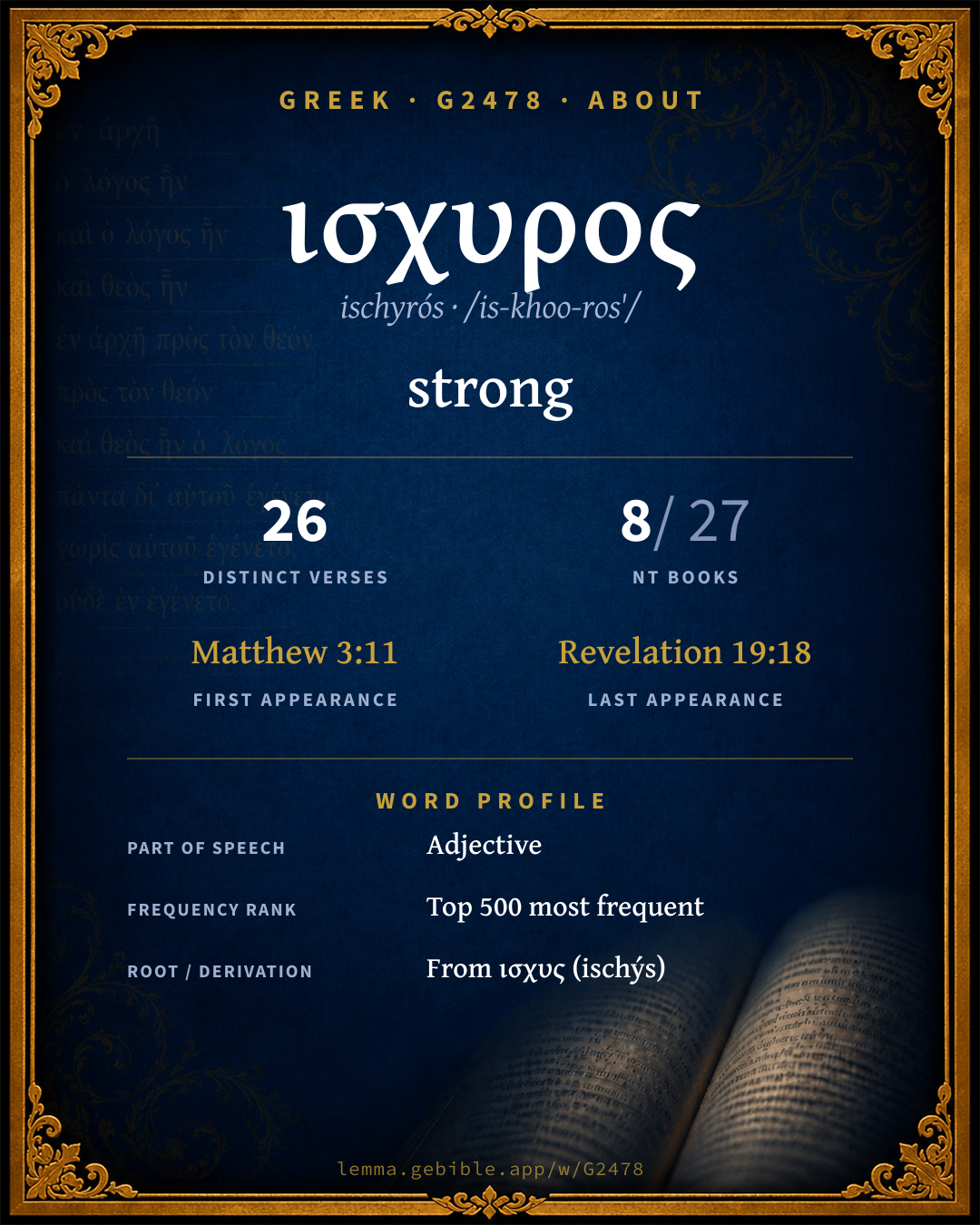
ἰσχυρός
strong
Full lexicon entry — Thayer's Greek Lexicon
From Thayer's Greek Lexicon
Where this word appears
See every Nominative-case word in the Greek New Testament →
Grammar key — what these labels mean
Part of speech
- Adjective
- A word that describes or qualifies a noun.
Case
- Accusative
- The case of the direct object and of extent.
- Nominative
- The case of the subject (and the predicate nominative).
- Genitive
- The case of source, possession, or “of” — answers “whose / from what.”
- Dative
- The case of the indirect object, means, or location — “to / for / with / in.”
Gender
- Masculine
- Grammatically masculine.
- Feminine
- Grammatically feminine.
- Neuter
- Grammatically neuter.
Number
- Singular
- One.
- Plural
- More than one.
Degree
- Comparative
- Expresses a greater degree (“greater,” “more”).
Grammatical forms 15 distinct
- Adjective, Accusative, Singular, Masculine 4 times (14%)
- Adjective, Nominative, Plural, Masculine 4 times (14%)
- Adjective, Nominative, Singular, Masculine, Comparative 4 times (14%)
- Adjective, Nominative, Singular, Masculine 3 times (11%)
- Adjective, Genitive, Singular, Masculine 2 times (7%)
- Adjective, Nominative, Singular, Feminine 2 times (7%)
- Adjective, Accusative, Plural, Neuter 1 time (4%)
- Adjective, Accusative, Singular, Feminine 1 time (4%)
+7 more forms (7 occurrences)
Parsed forms decoded from the imported morphology (Robinson–Tischendorf, public domain), counted across 28 parsed occurrences — not distinct verses.
Every verse where G2478 appears — 26 distinct verses across 8 books. Click any verse to open its interlinear word-by-word view. Verse text shown in the World English Bible for context — . Each verse’s Greek form is shown with its reference; the English is not keyword-highlighted, since the data carries no word-level English alignment. Use “Compare translations” on any verse to read it across multiple English versions. This concordance covers the Greek New Testament; Septuagint (Greek Old Testament) occurrences of this word are not indexed here.
Matthew 2 verses
- Matthew 3:11 ἰσχυρότερός adj nom sg masc comp I indeed baptize you in water for repentance, but he who comes after me is mightier than I, whose shoes I am not worthy to carry. He will baptize you in the Holy Spirit.
- Matthew 12:29 ἰσχυροῦ ἰσχυρόν adj gen sg masc adj acc sg masc Or how can one enter into the house of the strong man, and plunder his goods, unless he first bind the strong man? Then he will plunder his house.
Mark 2 verses
- Mark 1:7 ἰσχυρότερός adj nom sg masc comp He preached, saying, "After me comes he who is mightier than I, the thong of whose sandals I am not worthy to stoop down and loosen.
- Mark 3:27 ἰσχυροῦ ἰσχυρὸν adj gen sg masc adj acc sg masc But no one can enter into the house of the strong man to plunder, unless he first binds the strong man; and then he will plunder his house.
Luke 4 verses
- Luke 3:16 ἰσχυρότερός adj nom sg masc comp John answered them all, "I indeed baptize you with water, but he comes who is mightier than I, the latchet of whose sandals I am not worthy to loosen. He will baptize you in the Holy Spirit and fire,
- Luke 11:21 ἰσχυρὸς adj nom sg masc "When the strong man, fully armed, guards his own dwelling, his goods are safe.
- Luke 11:22 ἰσχυρότερος adj nom sg masc comp But when someone stronger attacks him and overcomes him, he takes from him his whole armor in which he trusted, and divides his spoils.
- Luke 15:14 ἰσχυρὰ adj nom sg fem When he had spent all of it, there arose a severe famine in that country, and he began to be in need.
1 Corinthians 4 verses
- 1 Corinthians 1:25 ἰσχυρότερον adj nom sg neut comp Because the foolishness of God is wiser than men, and the weakness of God is stronger than men.
- 1 Corinthians 1:27 ἰσχυρά adj acc pl neut but God chose the foolish things of the world that he might put to shame those who are wise. God chose the weak things of the world, that he might put to shame the things that are strong;
- 1 Corinthians 4:10 ἰσχυροί adj nom pl masc We are fools for Christ's sake, but you are wise in Christ. We are weak, but you are strong. You have honor, but we have dishonor.
- 1 Corinthians 10:22 ἰσχυρότεροι adj nom pl masc comp Or do we provoke the Lord to jealousy? Are we stronger than he?
2 Corinthians 1 verse
Hebrews 3 verses
- Hebrews 5:7 ἰσχυρᾶς adj gen sg fem He, in the days of his flesh, having offered up prayers and petitions with strong crying and tears to him who was able to save him from death, and having been heard for his godly fear,
- Hebrews 6:18 ἰσχυρὰν adj acc sg fem that by two immutable things, in which it is impossible for God to lie, we may have a strong encouragement, who have fled for refuge to take hold of the hope set before us.
- Hebrews 11:34 ἰσχυροὶ adj nom pl masc quenched the power of fire, escaped the edge of the sword, from weakness were made strong, grew mighty in war, and turned to flight armies of aliens.
1 John 1 verse
Revelation 9 verses
- Revelation 5:2 ἰσχυρὸν adj acc sg masc I saw a mighty angel proclaiming with a loud voice, "Who is worthy to open the book, and to break its seals?"
- Revelation 6:15 ἰσχυροὶ adj nom pl masc The kings of the earth, the princes, the commanding officers, the rich, the strong, and every slave and free person, hid themselves in the caves and in the rocks of the mountains.
- Revelation 10:1 ἰσχυρὸν adj acc sg masc I saw a mighty angel coming down out of the sky, clothed with a cloud. A rainbow was on his head. His face was like the sun, and his feet like pillars of fire.
- Revelation 18:2 ἰσχυρᾷ adj dat sg fem He cried with a mighty voice, saying, "Fallen, fallen is Babylon the great, and she has become a habitation of demons, a prison of every unclean spirit, and a prison of every unclean and hateful bird!
- Revelation 18:8 ἰσχυρὸς adj nom sg masc Therefore in one day her plagues will come: death, mourning, and famine; and she will be utterly burned with fire; for the Lord God who has judged her is strong.
- Revelation 18:10 ἰσχυρά adj nom sg fem standing far away for the fear of her torment, saying, 'Woe, woe, the great city, Babylon, the strong city! For your judgment has come in one hour.'
- Revelation 18:21 ἰσχυρὸς adj nom sg masc A mighty angel took up a stone like a great millstone and cast it into the sea, saying, "Thus with violence will Babylon, the great city, be thrown down, and will be found no more at all.
- Revelation 19:6 ἰσχυρῶν adj gen pl fem I heard something like the voice of a great multitude, and like the voice of many waters, and like the voice of mighty thunders, saying, "Hallelujah! For the Lord our God, the Almighty, reigns!
- Revelation 19:18 ἰσχυρῶν adj gen pl masc that you may eat the flesh of kings, the flesh of captains, the flesh of mighty men, and the flesh of horses and of those who sit on them, and the flesh of all men, both free and slave, and small and great."
About this entry
At a glance — auto-summarized from this page’s data, not written by a person. Every figure links to its source below. This summary describes the numbers; it doesn’t interpret them.
ισχυρος (ischyrós) is a Greek adjective most often rendered “strong.” Debuting at Matthew 3:11, it then recurs through the corpus. With 26 verses in 8 books, it is a moderately common word in the Greek New Testament. It concentrates in Revelation, which alone accounts for 35% of its uses. From the same root come ισχυς and ισχυω. For the data behind this summary, explore the sense tree and the renderings breakdown below.
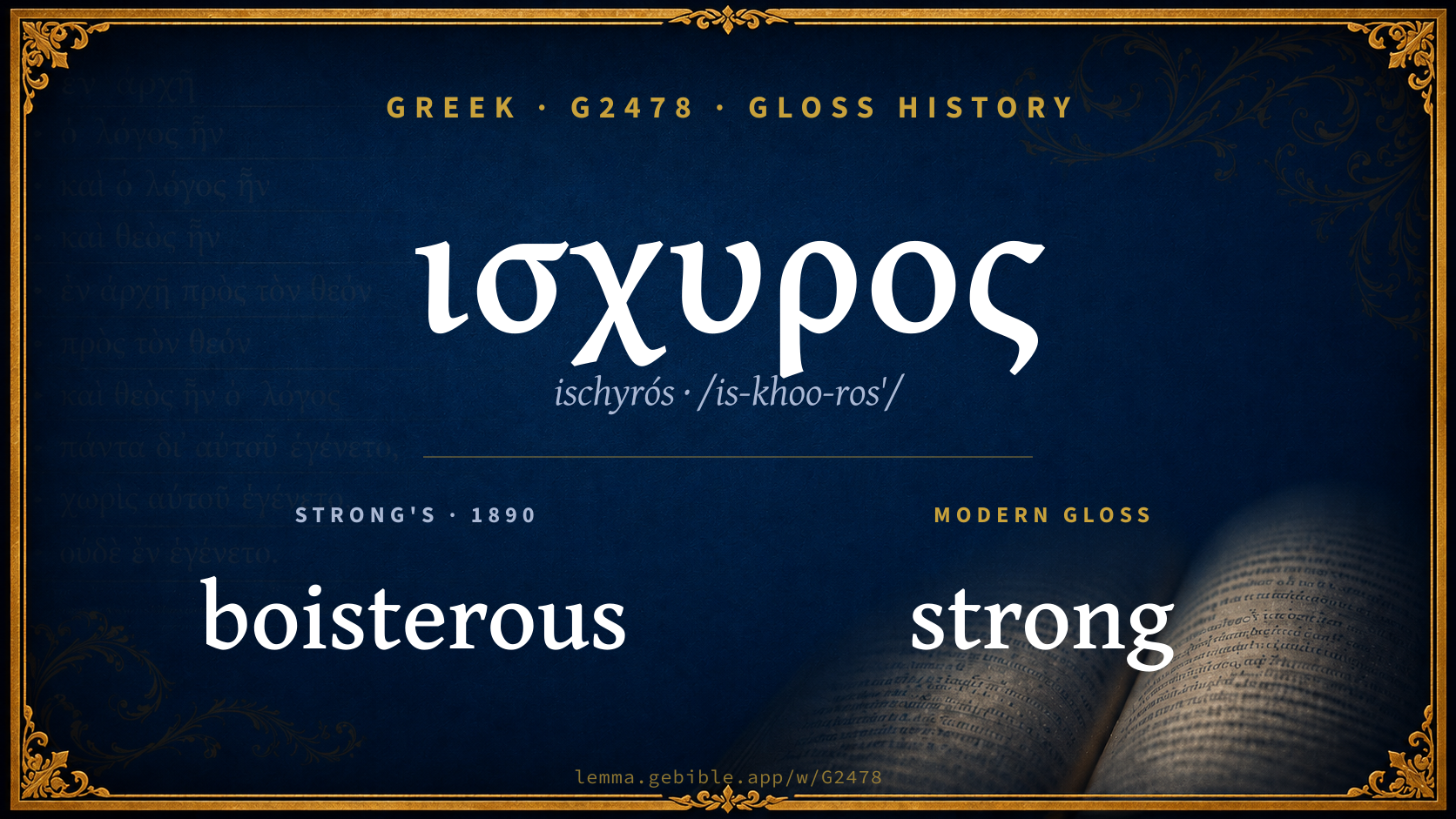
Gloss history
Strong's 1890 vs modern scholarship
About this word
Strong's G2478 catalogs a Greek word from the Greek New Testament.
These counts are not copied from any lexicon or concordance. They are computed here, from the morphology-tagged Greek New Testament. What Lemma adds →
- 26
- distinct verses
- The word appears in 26 distinct verses.
- 8 / 27
- NT books
- The word appears in 8 of 27 New Testament books.
- #485
- by frequency
- Top 500 most frequent Greek words (rank 485 of 5,347 Greek words by occurrence).
View all 26 occurrences in the concordance →
Most concentrated in
- Revelation 9 verses 35%
- Luke 4 verses 15%
- 1 Corinthians 4 verses 15%
By section of the New Testament
By traditional corpus
Conventional, traditional groupings — biblical authorship is debated, so this is a traditional corpus grouping, not an authorship claim. Some books belong to more than one corpus (Luke is in both the Gospels and the Lukan corpus, and so on), so these shares overlap and need not total 100%. Each figure is a share of the word’s 26 distinct verses.
- Johannine 10 verses · 38%
- Revelation 9 verses · 35%
- Gospels 8 verses · 31%
- Pauline corpus 5 verses · 19%
- Lukan (Luke–Acts) 4 verses · 15%
- Hebrews 3 verses · 12%
- General (Catholic) Epistles 1 verse · 4%
How translations render this word
Counts come from each version’s own published word-to-Strong’s tagging or interlinear alignment — an approximate guide to how each version renders this word, not a word-level alignment the data otherwise carries. Because each total is that version’s own tagged count, the per-version totals vary from one another and need not match the appearance or distinct-verse counts above. These counts may also differ from a printed concordance because Lemma counts each distinctly tagged rendering and does not collapse phrase taggings into a single head-word total. This is a fixed set of word-tagged versions (KJV, ASV, BSB, ULT) and does not change with the reading translation you choose elsewhere. Each version’s license is shown beside its name below (and on Sources).
- King James Version: Mighty 5×, Strong 5×, Strong man 3×
- American Standard Version: Strong 9×, Strong man 5×, Mighty 3×
- Berean Standard Bible: Mighty 10×, Strong 6×, More powerful 3×
- unfoldingWord Literal Text: Mighty 6×, Strong 5×, Strong man 5×
King James Version Public Domain
Renders G2478 across 26 tagged occurrences — most commonly:
Plus 9 renderings that appear only once — usually multi-word phrases or single function words the recovered tagging swept in, not distinct renderings. Not rendered by a distinct English word in 1 further occurrence.
American Standard Version Public Domain
Renders G2478 across 27 tagged occurrences — most commonly:
Plus 3 renderings that appear only once — usually multi-word phrases or single function words the recovered tagging swept in, not distinct renderings.
Berean Standard Bible Public Domain
Renders G2478 across 29 tagged occurrences — most commonly:
Plus 7 renderings that appear only once — usually multi-word phrases or single function words the recovered tagging swept in, not distinct renderings.
unfoldingWord Literal Text CC BY-SA 4.0
Renders G2478 across 29 tagged occurrences — most commonly:
Plus 7 renderings that appear only once — usually multi-word phrases or single function words the recovered tagging swept in, not distinct renderings.
Senses in Thayer's
The 1 sense Thayer's distinguishes for this word, in lexicon order (not ranked by frequency or importance). The full entry — with sub-senses — is in the Lexicon Entry tab.
- strong, mighty
Word origin
Derived from ισχυς (ischýs) (G2479) — strength.
From G2479 ; forcible (literally or figuratively): - boisterous mighty (-ier) powerful strong (-er man) valiant.
— Strong’s Exhaustive Concordance (1890), public domain.
Forms in the corpus
The 17 distinct written forms G2478 takes in the Greek New Testament, most frequent first — each parse links to that case’s occurrences in the concordance.
Same root — word family
Other Thayer's entries built from the same root as G2478, grouped by Strong’s listed origin. These share a root / origin per the lexicon — not necessarily a shared meaning. Each links to that word’s own entry.
Derives from
Shares the same root
Compare all same-root words → They share a root, not necessarily a meaning.
Septuagint usage
The same Greek word ισχυρος appears 112 times in the Greek Old Testament (Septuagint), across 112 verses in 23 books.
- 112
- LXX occurrences
- Tagged occurrences of this Greek word in the Septuagint.
- 112
- verses
- Distinct Septuagint verses containing this word.
- 23 / 39
- OT books
- The word appears in 23 of the 39 Old Testament books.
Sample Septuagint occurrences
- Genesis 14:5 ἰσχυρός
- Exodus 19:19 ἰσχυρός
- Numbers 13:18 ἰσχυρός
- Deuteronomy 4:38 ἰσχυρός
- Joshua 4:24 ἰσχυρός
- Judges 5:13 ἰσχυρός
- 2 Samuel 15:12 ἰσχυρός
- 1 Kings 11:28 ἰσχυρός
- 2 Kings 24:15 ἰσχυρός
- 1 Chronicles 5:24 ἰσχυρός
- Ezra 4:20 ἰσχυρός
- Job 22:13 ἰσχυρός
Septuagint occurrences (same lexeme)
Every verse where the same Strong’s number (G2478) appears in the Greek Septuagint — showing the first 50 of 112. Verse text shown in the World English Bible for context; the Greek form is the matched word — the English is not keyword-highlighted.
- Genesis 14:5 ἰσχυρός In the fourteenth year Chedorlaomer came, and the kings who were with him, and struck the Rephaim in Ashteroth Karnaim, and the Zuzim in Ham, and the Emim in Shaveh-kiriathaim,
- Genesis 41:31 ἰσχυρός and the plenty will not be known in the land by reason of that famine which follows; for it will be very grievous.
- Genesis 50:10 ἰσχυρός They came to the threshing floor of Atad, which is beyond the Jordan, and there they lamented with a very great and sore lamentation. He mourned for his father seven days.
- Exodus 19:19 ἰσχυρός When the sound of the trumpet grew louder and louder, Moses spoke, and God answered him by a voice.
- Numbers 13:18 ἰσχυρός and see the land, what it is; and the people who dwell therein, whether they are strong or weak, whether they are few or many;
- Numbers 13:31 ἰσχυρός But the men who went up with him said, We aren't able to go up against the people; for they are stronger than we.
- Numbers 20:20 ἰσχυρός He said, You shall not pass through. Edom came out against him with much people, and with a strong hand.
- Numbers 24:21 ἰσχυρός He looked at the Kenite, and took up his parable, and said, Strong is your dwelling-place, Your nest is set in the rock.
- Deuteronomy 4:38 ἰσχυρός to drive out nations from before you greater and mightier than you, to bring you in, to give you their land for an inheritance, as at this day.
- Deuteronomy 7:1 ἰσχυρός When Yahweh your God shall bring you into the land where you go to possess it, and shall cast out many nations before you, the Hittite, and the Girgashite, and the Amorite, and the Canaanite, and the Perizzite, and the Hivite, and the Jebusite, seven nations greater and mightier than you;
- Deuteronomy 9:1 ἰσχυρός Hear, Israel: you are to pass over the Jordan this day, to go in to dispossess nations greater and mightier than yourself, cities great and fortified up to the sky,
- Deuteronomy 9:14 ἰσχυρός let me alone, that I may destroy them, and blot out their name from under the sky; and I will make of you a nation mightier and greater than they.
- Deuteronomy 10:17 ἰσχυρός For Yahweh your God, he is God of gods, and Lord of lords, the great God, the mighty, and the awesome, who doesn't regard persons, nor takes reward.
- Deuteronomy 11:23 ἰσχυρός then will Yahweh drive out all these nations from before you, and you shall dispossess nations greater and mightier than yourselves.
- Joshua 4:24 ἰσχυρός that all the peoples of the earth may know the hand of Yahweh, that it is mighty; that you may fear Yahweh your God forever.
- Joshua 6:20 ἰσχυρός So the people shouted, and [the priests] blew the trumpets; and it happened, when the people heard the sound of the trumpet, that the people shouted with a great shout, and the wall fell down flat, so that the people went up into the city, every man straight before him, and they took the city.
- Joshua 10:2 ἰσχυρός that they feared greatly, because Gibeon was a great city, as one of the royal cities, and because it was greater than Ai, and all the men of it were mighty.
- Joshua 23:9 ἰσχυρός For Yahweh has driven out from before you great nations and strong: but as for you, no man has stood before you to this day.
- Judges 5:13 ἰσχυρός Then came down a remnant of the nobles [and] the people; Yahweh came down for me against the mighty.
- Judges 5:22 ἰσχυρός Then did the horse hoofs stamp By reason of the prancings, the prancings of their strong ones.
- Judges 6:12 ἰσχυρός The angel of Yahweh appeared to him, and said to him, Yahweh is with you, you mighty man of valor.
- Judges 9:51 ἰσχυρός But there was a strong tower within the city, and there fled all the men and women, and all they of the city, and shut themselves in, and got them up to the roof of the tower.
- Judges 14:14 ἰσχυρός He said to them, Out of the eater came forth food, Out of the strong came forth sweetness. They couldn't in three days declare the riddle.
- Judges 14:18 ἰσχυρός The men of the city said to him on the seventh day before the sun went down, What is sweeter than honey? and what is stronger than a lion? He said to them, If you hadn't plowed with my heifer, You wouldn't have found out my riddle.
- 2 Samuel 15:12 ἰσχυρός Absalom sent for Ahithophel the Gilonite, David's counselor, from his city, even from Giloh, while he was offering the sacrifices. The conspiracy was strong; for the people increased continually with Absalom.
- 2 Samuel 22:31 ἰσχυρός As for God, his way is perfect: The word of Yahweh is tried; He is a shield to all those who take refuge in him.
- 2 Samuel 22:32 ἰσχυρός For who is God, save Yahweh? Who is a rock, save our God?
- 2 Samuel 22:33 ἰσχυρός God is my strong fortress; He guides the perfect in his way.
- 2 Samuel 22:48 ἰσχυρός Even the God who executes vengeance for me, Who brings down peoples under me,
- 2 Samuel 23:5 ἰσχυρός Most assuredly my house is not so with God; Yet he has made with me an everlasting covenant, Ordered in all things, and sure: For it is all my salvation, and all [my] desire, Although he doesn't make it grow.
- 1 Kings 11:28 ἰσχυρός The man Jeroboam was a mighty man of valor; and Solomon saw the young man that he was industrious, and he gave him charge over all the labor of the house of Joseph.
- 2 Kings 24:15 ἰσχυρός He carried away Jehoiachin to Babylon; and the king's mother, and the king's wives, and his officers, and the chief men of the land, carried he into captivity from Jerusalem to Babylon.
- 1 Chronicles 5:24 ἰσχυρός These were the heads of their fathers' houses: even Epher, and Ishi, and Eliel, and Azriel, and Jeremiah, and Hodaviah, and Jahdiel, mighty men of valor, famous men, heads of their fathers' houses.
- 1 Chronicles 7:2 ἰσχυρός The sons of Tola: Uzzi, and Rephaiah, and Jeriel, and Jahmai, and Ibsam, and Shemuel, heads of their fathers' houses, [to wit], of Tola; mighty men of valor in their generations: their number in the days of David was twenty-two thousand six hundred.
- 1 Chronicles 7:4 ἰσχυρός With them, by their generations, after their fathers' houses, were bands of the host for war, thirty-six thousand; for they had many wives and sons.
- 1 Chronicles 7:5 ἰσχυρός Their brothers among all the families of Issachar, mighty men of valor, reckoned in all by genealogy, were eighty-seven thousand.
- 1 Chronicles 7:7 ἰσχυρός The sons of Bela: Ezbon, and Uzzi, and Uzziel, and Jerimoth, and Iri, five; heads of fathers' houses, mighty men of valor; and they were reckoned by genealogy twenty-two thousand thirty-four.
- 1 Chronicles 7:9 ἰσχυρός They were reckoned by genealogy, after their generations, heads of their fathers' houses, mighty men of valor, twenty thousand two hundred.
- 1 Chronicles 7:11 ἰσχυρός All these were sons of Jediael, according to the heads of their fathers' [houses], mighty men of valor, seventeen thousand and two hundred, who were able to go forth in the host for war.
- 1 Chronicles 7:40 ἰσχυρός All these were the children of Asher, heads of the fathers' houses, choice and mighty men of valor, chief of the princes. The number of them reckoned by genealogy for service in war was twenty-six thousand men.
- 1 Chronicles 8:40 ἰσχυρός The sons of Ulam were mighty men of valor, archers, and had many sons, and sons' sons, one hundred fifty. All these were of the sons of Benjamin.
- 1 Chronicles 9:13 ἰσχυρός and their brothers, heads of their fathers' houses, one thousand seven hundred sixty; very able men for the work of the service of the house of God.
- 1 Chronicles 12:9 ἰσχυρός Ezer the chief, Obadiah the second, Eliab the third,
- Ezra 4:20 ἰσχυρός There have been mighty kings also over Jerusalem, who have ruled over all [the country] beyond the River; and tribute, custom, and toll, was paid to them.
- Ezra 11:5 ἰσχυρός
- Ezra 19:31 ἰσχυρός
- Ezra 19:32 ἰσχυρός
- Job 22:13 ἰσχυρός You say, 'What does God know? Can he judge through the thick darkness?
- Job 33:29 ἰσχυρός "Behold, God works all these things, Twice, yes three times, with a man,
- Job 34:31 ἰσχυρός "For has any said to God, 'I am guilty, but I will not offend any more.
These are occurrences of the same Greek lexeme (G2478) in the Septuagint — not a translation of any one Hebrew word. The store carries no word-level Hebrew↔Greek alignment, so no Hebrew original is asserted here. Counts come from the recovered LXX Strong's tagging — high-frequency vocabulary is well covered, while rare or late forms may be untagged — so they reflect tagged occurrences and may slightly undercount.