Numbers 24:21

Hebrew (Westminster Leningrad Codex) Numbers 24:21 appears in the Hebrew Old Testament. The text above is from the Westminster Leningrad Codex. Each word links to its Strong’s number, a concise gloss, and parsing drawn from the Open Scriptures Hebrew Bible morphology. Click any word for its full Brown-Driver-Briggs (BDB) entry.
Download image
Cite this verse

Numbers 24:21 (World English Bible). Public Domain. Lemma interlinear Bible study tool, https://lemma.gebible.app/v/numbers/24/21.

Show BibTeX & RIS
BibTeX
RIS
English Translation
He looked at the Kenite, and took up his parable, and said, Strong is your dwelling-place, Your nest is set in the rock.
World English Bible · Public Domain
Download a study sheet

One document with this verse’s original text, its word-by-word gloss line, the meaning frame, cross-references with their text, attributed commentary, and full source and license credits — printable, and it pastes into notes with its structure intact.

This verse Autodidact and up

Study sheet (.html) Plain text (.txt)

A passage Seminary Student

Up to 50 verses in one chapter. A passage sheet keeps up to 6 commentary sources and 12 cross-references per verse, in the order this page ranks them, and says so on the sheet whenever that leaves anything out. Ask for a single verse and you get the Autodidact verse sheet above.

Everything on this page stays free to read, with no account — the sheet is a download of what is already on screen, not access to it.

Want to remove ads? Support Godless Engineer
Compare translations 3

The same verse in 3 English versions, stacked beneath the original-language interlinear above. Click any original word for its lexicon entry.

Each is an independent rendering of the whole verse — the interlinear is not word-aligned to these translations.

Highlighted words mark where these versions differ — a whole-verse word diff, not a word-by-word alignment.

  • World English Bible Public Domain
    He looked at the Kenite, and took up his parable, and said, Strong is your dwelling-place, Your nest is set in the rock.
  • King James Version Public Domain
    And he looked on the Kenites, and took up his parable, and said, Strong is thy dwelling place, and thou puttest thy nest in a rock.
  • unfoldingWord Literal Text CC BY-SA 4.0
    And he saw the Kenite, and he lifted up his discourse and said, “Your dwelling is permanent, and your nest is set in the cliff.

unfoldingWord Literal Text — © unfoldingWord, licensed CC BY-SA 4.0. Word-aligned USFM3 via Door43 (git.door43.org/unfoldingWord/en_ult).

Versions to compare (up to 4)

3 of 4 selected

Show all 18 translations

Every available English version of this verse, each an independent rendering of the whole verse.

  • World English Bible Public Domain
    He looked at the Kenite, and took up his parable, and said, Strong is your dwelling-place, Your nest is set in the rock.
  • Berean Standard Bible Public Domain
    Next he saw the Kenites and lifted up an oracle, saying: “Your dwelling place is secure, and your nest is set in a cliff.
  • Majority Standard Bible Public Domain
    Next he saw the Kenites and lifted up an oracle, saying: “Your dwelling place is secure, and your nest is set in a cliff.
  • King James Version Public Domain
    And he looked on the Kenites, and took up his parable, and said, Strong is thy dwelling place, and thou puttest thy nest in a rock.
  • American Standard Version (1901) Public Domain
    And he looked on the Kenite, and took up his parable, and said, Strong is thy dwelling-place, And thy nest is set in the rock.
  • Revised Version (1885) Public Domain
    And he looked on the Kenite, and took up his parable, and said, Strong is thy dwelling place, And thy nest is set in the rock.
  • Geneva Bible (1599) Public Domain
    And he looked on the Kenites, and vttered his parable, and sayde, Strong is thy dwelling place, and put thy nest in the rocke.
  • Douay-Rheims (1899) Public Domain
    He saw also the Cinite: and took up his parable, and said: Thy habitation in- deed is strong: but though thou build thy nest in a rock,
  • Young's Literal Translation Public Domain
    And he seeth the Kenite, and taketh up his simile, and saith: `Enduring `is' thy dwelling, And setting in a rock thy nest,
  • Literal Standard Version CC BY-SA 4.0
    And he sees the Kenite, and takes up his allegory, and says: “Your dwelling [is] enduring, || And your nest is being set in a rock,
  • Unlocked Literal Bible CC BY-SA 4.0
    Then Balaam looked toward the Kenites and began his prophecy. He said, “The place where you live is strong, and your nest is in the rocks.
  • unfoldingWord Literal Text CC BY-SA 4.0
    And he saw the Kenite, and he lifted up his discourse and said, “Your dwelling is permanent, and your nest is set in the cliff.
  • Darby Bible Public Domain
    And he saw the Kenites, and took up his parable, and said, Firm is thy dwelling-place, and thy nest fixed in the rock;
  • World Messianic Bible Public Domain
    He looked at the Kenite, and took up his parable, and said, “Your dwelling place is strong. Your nest is set in the rock.
  • Webster's Bible Public Domain
    And he looked on the Kenites, and took up his parable, and said, Strong is thy dwelling-place, and thou puttest thy nest in a rock.
  • Free Bible Version CC BY-SA 4.0
    He turned his attention to the Kenites and gave this declaration about them, saying, “Where you live is safe and secure, like a nest on a cliff-face.
  • Bible in Basic English Public Domain
    And looking on the Kenites he went on with his story and said, Strong is your living-place, and your secret place is safe in the rock.
  • JPS Tanakh (1917) Public Domain
    And he looked on the Kenite, and took up his parable, and said: Though firm be thy dwelling-place, and though thy nest be set in the rock;

Literal Standard Version (2020), Covenant Press — licensed CC BY-SA 4.0. Text via the HelloAO Bible API (eBible.org). Unlocked Literal Bible (unfoldingWord) — licensed CC BY-SA 4.0. Text via the HelloAO Bible API (eBible.org). unfoldingWord Literal Text — © unfoldingWord, licensed CC BY-SA 4.0. Word-aligned USFM3 via Door43 (git.door43.org/unfoldingWord/en_ult). Free Bible Version, Dr. Jonathan Gallagher — licensed CC BY-SA 4.0. Text via the HelloAO Bible API (eBible.org).

Word by word

More ways to search: Search by grammar → Find every occurrence → Compare this word →

Practice this passage: Drill this verse → Learn its vocabulary →

הַקֵּינִ֔י
Qêynîy
H7017
“the · Kenite”
Particle, Definite Article + Noun, Gentilic, Masculine, Singular, Absolute
Part of Speech
Particle + Noun
Type
Gentilic
Gender
Masculine
Number
Singular
State
Absolute
Full BDB Definition

Origin: from H7014

TWOT: 2016

Kenite = "smiths" - the tribe from which the father-in-law of Moses was a member and which lived in the area between southern Palestine and the mountains of Sinai
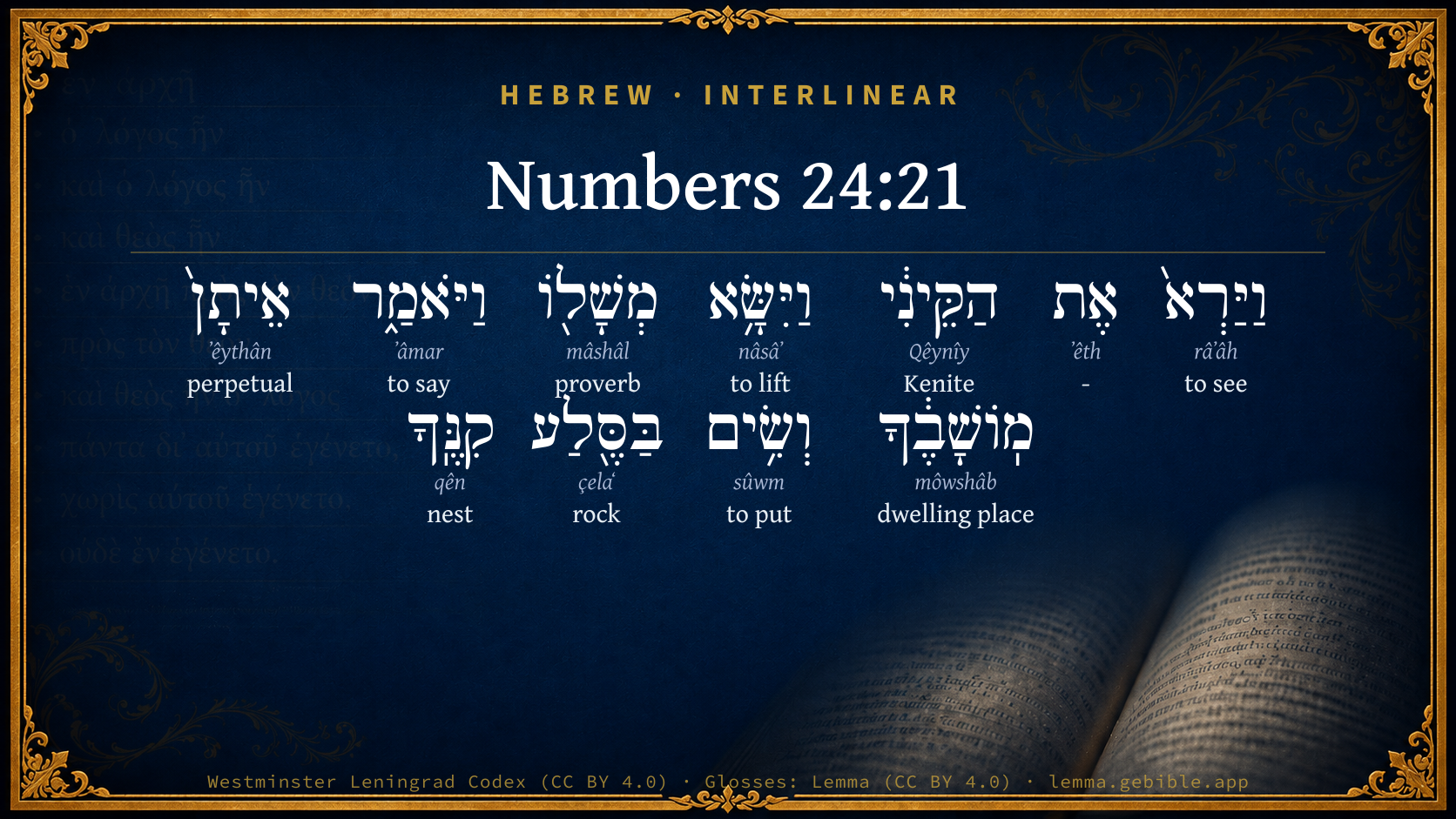
  1. וַיַּרְא֙ râʼâh H7200 “and · to see” Conjunction + Verb, Qal, Sequential Imperfect, 3rd Person, Masculine, Singular
  2. אֶת ʼêth H853 “-” Particle, Direct Object
  3. וַיִּשָּׂ֥א nâsâʼ H5375 “and · to lift” Conjunction + Verb, Qal, Sequential Imperfect, 3rd Person, Masculine, Singular
  4. מְשָׁל֖וֹ mâshâl H4912 “proverb · his” Noun, Common, Masculine, Singular, Construct + Suffix, Personal, 3rd Person, Masculine, Singular
  5. וַיֹּאמַ֑ר ʼâmar H559 “and · to say” Conjunction + Verb, Qal, Sequential Imperfect, 3rd Person, Masculine, Singular
  6. אֵיתָן֙ ʼêythân H386 “perpetual” Adjective, Adjective, Masculine, Singular, Absolute
  7. מֽוֹשָׁבֶ֔ךָ môwshâb H4186 “dwelling place · your” Noun, Common, Masculine, Singular, Construct + Suffix, Personal, 2nd Person, Masculine, Singular
  8. וְשִׂ֥ים sûwm H7760 “and · put” Conjunction + Verb, Qal, Participle Passive, Masculine, Singular, Absolute
  9. בַּסֶּ֖לַע çelaʻ H5553 “in/at the · rock” Preposition, Determined + Noun, Common, Masculine, Singular, Absolute
  10. קִנֶּֽךָ qên H7064 “nest · your” Noun, Common, Masculine, Singular, Construct + Suffix, Personal, 2nd Person, Masculine, Singular

About this verse

These counts appear in no published source. They are computed here, from the morphology-tagged text and Lemma’s own curated glosses. What Lemma adds →

11
words
11
distinct lemmas
Pentateuch
section

Notable vocabulary

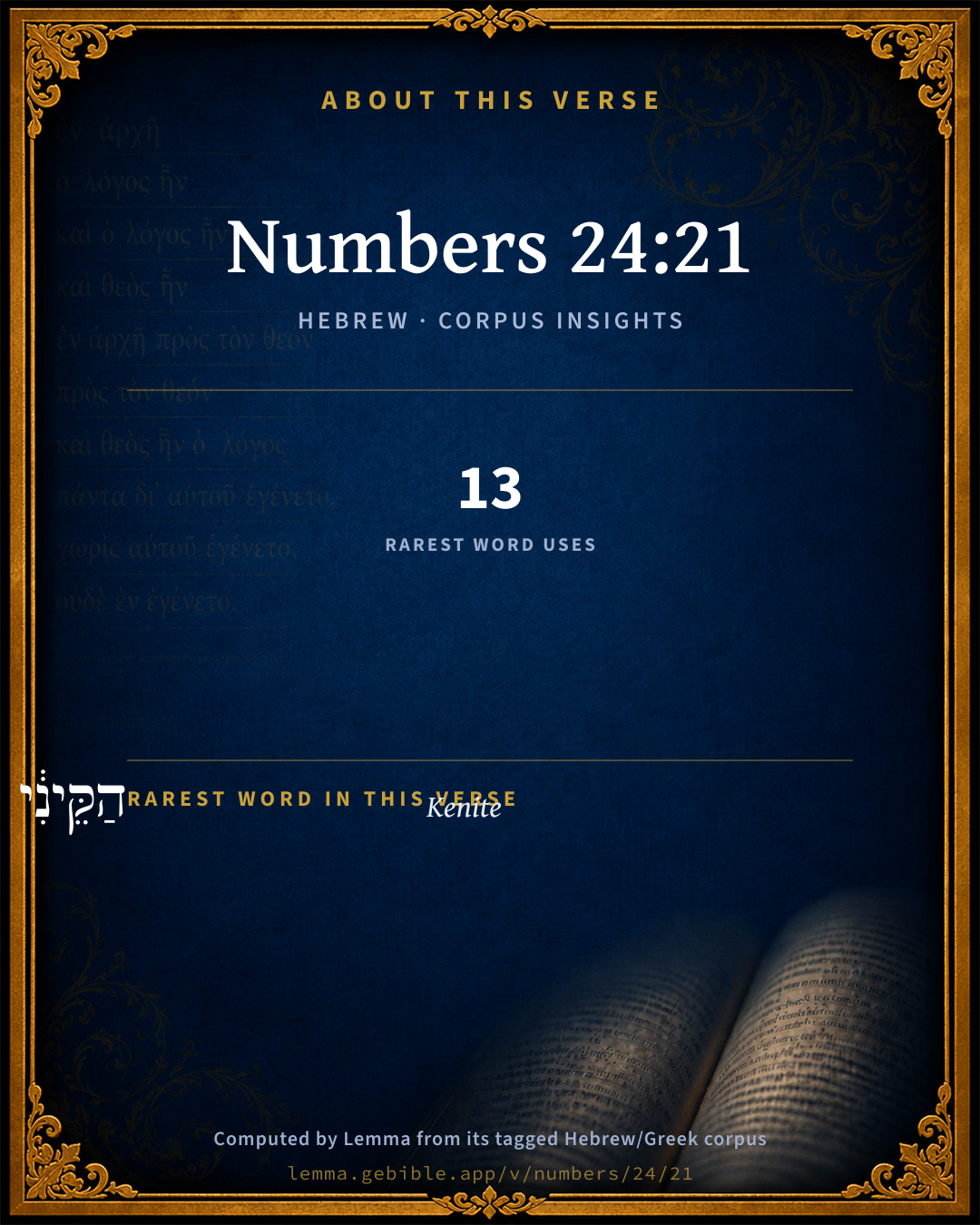
The rarest word here is הַקֵּינִ֔י Kenite H7017 — appearing just 13 times in the whole Hebrew Bible.

Shared distinctive vocabulary

הַקֵּינִ֔י Kenite H7017 occurs in 10 verses of the Hebrew Bible. Also found in:

Grammatical profile

  • 4 verbs
  • 5 nouns
  • 1 adjective
  • 1 particle

Verb forms

  • וַיַּרְא֙ Qal · Sequential Imperfect
  • וַיִּשָּׂ֥א Qal · Sequential Imperfect
  • וַיֹּאמַ֑ר Qal · Sequential Imperfect
  • וְשִׂ֥ים Qal · Participle Passive

Hebrew & Septuagint length

In English translation the verse runs 23 words from the Hebrew and 26 from the Septuagint (LXX English) — closely comparable.

A rough comparison of the two English renderings, which tokenize alike — not a word-level alignment.

Word counts can differ between the Hebrew and the Greek without any difference in meaning — e.g. the Hebrew direct-object marker אֵת has no separate Greek word, and Greek often adds the article ὁ.

Cross-references

3

Topical passages linked to Numbers 24:21 in the Treasury of Scripture Knowledge — connected by theme and wording, ordered by reader-vote popularity; previews shown in the World English Bible.

  • Genesis 15:19 the Kenites, the Kenizzites, the Kadmonites,
  • Judges 1:16 The children of the Kenite, Moses' brother-in-law, went up out of the city of palm trees with the children of Judah into the wilderness of Judah, which is in the south of Arad; and they went and lived with the people.
  • Job 29:18 Then I said, 'I shall die in my own house, I shall number my days as the sand.

Cross-references courtesy of OpenBible.info (CC BY 4.0).

Hebrew and Greek witnesses Masoretic Hebrew ↔ Greek Septuagint

The same verse in the two great witnesses to the Old Testament, shown verse-for-verse.

These are two independent witnesses, not word-aligned to each other, and the Septuagint is shown in lemma (dictionary) form.

Hebrew Numbers 24:21 Masoretic · Westminster Leningrad Codex

וַיַּרְא֙ אֶת הַקֵּינִ֔י וַיִּשָּׂ֥א מְשָׁל֖וֹ וַיֹּאמַ֑ר אֵיתָן֙ מֽוֹשָׁבֶ֔ךָ וְשִׂ֥ים בַּסֶּ֖לַע קִנֶּֽךָ

He looked at the Kenite, and took up his parable, and said, Strong is your dwelling-place, Your nest is set in the rock.

World English Bible · Public Domain

Greek LXX Numbers 24:21 Septuagint · lemma form

καί ὁράω ὁ καιναῖον καί ἀναλαμβάνω ὁ παραβολή αὐτός εἶπον ἰσχυρός ὁ κατοικία σύ καί ἐάν τίθημι ἐν πέτρα ὁ νοσσιά σύ

And having seen the Kenite, he took up his parable and said, your dwelling-place is strong; yet though you should put your nest in a rock,

LXX2012 (modern English Septuagint) · Public Domain

Hebrew: Westminster Leningrad Codex (CC BY 4.0). Greek: Septuagint (public domain); English from LXX2012 (modern English Septuagint) (Public Domain). How the Septuagint differs from the Hebrew →

Targum (Aramaic paraphrase)

2

The Targum is the ancient Jewish Aramaic paraphrase of the Hebrew Scriptures — an interpretive translation, not the Hebrew text itself. Onkelos (literal) and Pseudo-Jonathan (expansive) render the Torah, and Jonathan the Prophets. Coverage is partial: where no permissively-licensed English translation exists for a verse, only the Aramaic is shown. This is verse-level text, not a word-by-word alignment to the Hebrew.

  1. Targum Onkelos Torah (Genesis–Deuteronomy)
    וַחֲזָא יַת שַׁלְמָאָה וּנְטַל מַתְלֵיהּ וַאֲמַר תַּקִיף בֵּית מוֹתְבָךְ וְשַׁוֵי בִכְרַךְ תַּקִּיף מְדוֹרָךְ

    (no public-domain English translation for this verse)

    Targum Onkelos — Aramaic: “Onkelos Genesis” (public domain); “Onkelos Exodus” (public domain); “Onkelos Leviticus” (public domain); “Onkelos Numbers” (public domain); “Onkelos Deuteronomy” (public domain). English: “Sefaria Community Translation” (CC0 1.0 (public-domain dedication)); “J.W. Etheridge. The Targums of Onkelos and Jonathan Ben Uzziel on the Pentateuch. London: Longmans, Green, 1862” (public domain). Text via Sefaria.

  2. Targum Pseudo-Jonathan Torah (Genesis–Deuteronomy)
    וַחֲמָא יַת יִתְרוֹ דְמִתְגַיֵיר וּנְטַל מְתַל נְבוּתֵיהּ וַאֲמַר מַה תַּקִיף הוּא מַשִׁרְוְיָךְ דִי שַׁוֵיתָא בְּנִקְרַיָא דְטִינְרַיָא מְדוֹרָךְ

    And he looked upon Jethro, who had been made proselyte, and took up the parable of his prophecy, and said: How strong is thy habitation, who hast set thy dwelling in the clefts of the rocks!

    Targum Pseudo-Jonathan — Aramaic: “Targum Jonathan on Genesis” (public domain); “Targum Jonathan on Exodus” (public domain); “Targum Jonathan on Leviticus” (public domain); “Targum Jonathan on Numbers” (public domain); “Targum Jonathan on Deuteronomy” (public domain). English: “The Targum of Jonathan ben Uzziel, trans. J. W. Etheridge, London, 1862” (public domain). Text via Sefaria.

Commentary

Notes on Numbers 24:21 from classic Christian and Jewish commentators (each source and its license shown beneath its notes). The classic Christian expositions comment on the surrounding passage and are grouped to its opening verse, so a note may address several verses; the Jewish commentaries on the Tanakh (Rashi and others) are per-verse, so they appear only where the commentator wrote on this verse.

Lemma curates 59 commentaries, every one of them public domain or Creative Commons licensed, each selected and text-cleaned for this edition rather than reprinted as found. About our sources →

Trapp's Complete Commentary

John Trapp

Num 24:21 And he looked on the Kenites, and took up his parable, and said, Strong is thy dwellingplace, and thou puttest thy nest in a rock.

Ver. 21. The Kenites,] i.e., The Midianites, {Jdg 1:16; Jdg 4:11} mingled among the Amalekites, {1Sa 15:6} for whom they are, and fare the worse, as Hamath did for Damascus. {Zec 9:2}

John Trapp, A Commentary or Exposition upon All the Books of the Old and New Testament (1647–1656) — public domain. Text from a community e-Sword module.

Joseph Benson's Commentary

Num 24:21-22. He looked on the Kenites — Commentators are much at a loss to say, with any certainty, who these Kenites were. The most probable account of them, Bishop Newton thinks, is as follows: “Jethro, the father- in-law of Moses, is called the priest of Midian, Exo 3:1; and Jdg 1:16, the Kenite. We may infer, therefore, that the Midianites and Kenites were the same, or at least that the Kenites were some of the tribes of Midian. Now of the Kenites, part followed Israel, Jdg 1:6; but the greater part, we may presume, remained among the Midianites and Amalekites, 1Sa 15:6. Their situation is said to be strong and secure among the mountains: Strong is thy dwelling-place, and thou puttest thy nest in a rock — Wherein is an allusion to the name, the same word in the Hebrew signifying a nest and a Kenite. Nevertheless the Kenite shall be wasted, until Asshur shall carry thee away captive — The Amalekites were to be utterly destroyed, but the Kenites were to be carried captive. Accordingly, when Saul was sent by divine commission to destroy the Amalekites, he ordered the Kenites to depart from among them; for the kindness which some of them showed to Israel, their posterity was saved, 1Sa 15:6. This passage shows that they were wasted, and reduced to a low and weak condition; and as the kings of Assyria carried captive not only the Jews, but also the Syrians and several other nations, (2Ki 16:9; 2Ki 19:12-13,) it is most highly probable that the Kenites shared the same fate with their neighbours, and were carried away by the same torrent; and especially as we find some Kenites mentioned among the Jews after their return from captivity,” 1Ch 2:55.

Joseph Benson's Commentary on the Old and New Testaments (1811–1818) — public domain. Text from a community e-Sword module.

Tyndale Open Study Notes

Tyndale Open Resources

24:21-22 The Kenites, a desert people who occupied some of the same regions as the Amalekites and Midianites, would be destroyed by Assyria. Moses married a Kenite (Judg 1:16; 4:11; cp. Num 10:29-32), and the Kenites remained mostly friendly with Israel thereafter (e.g., 1 Sam 15:6; 27:10; 30:27-30).

Tyndale Open Study Notes — © Tyndale Open Resources, licensed CC BY-SA 4.0. Text via the HelloAO Bible API.

Geneva Bible (1599)

Geneva Bible translators

Or, Midianites.

Make thyself as strong as thou canst.

Geneva Bible (1599) marginal notes — public domain. Text via Bolls.life.

Jamieson, Fausset & Brown

Robert Jamieson, A. R. Fausset & David Brown

Kenites . . . nest in a rock--Though securely established among the clefts in the high rocks of En-gedi towards the west, they should be gradually reduced by a succession of enemies till the Assyrian invader carried them into captivity (Jdg 1:16; Jdg 4:11, Jdg 4:16-17; also Kg2 15:29; Kg2 17:6).

Jamieson, Fausset & Brown — Commentary Critical and Explanatory on the Whole Bible (1871) — public domain (CC PDM 1.0). Text via the HelloAO Bible API.

Adam Clarke's Commentary

Verse 21. He looked on the Kenites] Commentators are not well agreed who the Kenites were. Dr. Dodd's opinion is, I think, nearest to the truth. Jethro, the father-in-law of Moses, is called a priest or prince of Midian, Ex 3:1, and in Jdg 1:16 he is called a Kenite; we may infer, therefore, says he, that the Kenites and the Midianites were the same, or at least that the Kenites and the Midianites were confederate tribes. Some of these we learn from Judg. i., followed the Israelites, others abode still among the Midianites and Amalekites. When Saul destroyed the latter, we find he had no commission against the Kenites, 1Sa 15:6, for it appears that they were then a small and inconsiderable people; they had doubtless been wasted, as the text says, though by what means does not appear from history. On the other hand, it may be observed that the Midianites mentioned here lived close to the Dead Sea, at a great distance from the Midian where Jethro lived, which was near Horeb. Perhaps they were a colony or tribe that had migrated from the vicinity of Mount Sinai. It seems that at this time the Kenites occupied a very strong position: Strong is thy dwelling place, and thou puttest thy nest in a rock; where there is a play on the original word קי, which signifies both a Kenite and a nest. High rocks in these countries were generally used as their strong places.

Adam Clarke's Commentary on the Bible (1810–1826) — public domain. Text from a community e-Sword/MySword module.

Ellicott's Commentary for English Readers

(21-22) And he looked on the Kenites . . . —According to the ordinary interpretation of these verses the continuous destruction of the Kenites is foretold until the Israelites should be taken captive by the Assyrians. The Kenites are included amongst the tribes whose country Abraham’s descendants were to possess (Gen_15:19). A portion of this tribe, however (for there is no evidence that the Canaanitish and the Midianitish Kenites had a different origin), joined the Israelites, and settled on the southern border of Judah (Jdg_1:16). If the Authorised Version of these verses be adopted, it is reasonable to conclude that the Kenites to whom Balaam’s prophecy referred must have been included amongst the enemies of Israel, whose destruction, in common with their other foes, is here predicted. It is obvious that this interpretation is open to two serious objections:—(1) that the natural reference of the words “carry thee away captive” is to the Kenites, not to the Israelites; and (2) that as the later history, as well as the Book of Numbers, makes mention only of those Kenites who allied themselves with the Israelites, we should naturally expect that in accordance with the promise which was given to Hobab by Moses (Num_10:29), the Kenites should be distinguished from the enemies of Israel, and be exempted from the destruction with which they were threatened. Another rendering of Num_24:22, and one which appears to be more agreeable to the context in which it stands, is the following:—“For surely the Kenites shall not be destroyed until Asshur shall carry thee into captivity.” This version has the support of the Targum of Palestine and other authorities. It is true that there is no express record of the fulfilment of this prophecy, but it is not probable that the Assyrians spared the Kenites who were settled amongst the Israelites; and we know from Jer_35:11 that after the invasion of Nebuchadnezzar, the Rechabites, who were of the Kenite race (1Ch_2:55), came to Jerusalem for fear of the armies of the Chaldeans and Syrians. If Asshur denotes in this place the Assyrians in the later acceptation of the term, it must be remembered that one branch of the Kenites settled in Naphtali, near Kadesh (Jdg_4:11). Asshur, however, appears to be used in a wider sense, so as to include all the nations which proceeded from it (see Num_24:24). Even the Persian king is called, as Keil has observed, King of Asshur (Ezr_6:22). If this interpretation of the text be received, the antithesis between the doom of the Amalekites and the deliverance of the Kenites exactly corresponds to the attitude assumed by those tribes respectively in regard to Israel.

A Bible Commentary for English Readers, edited by Charles John Ellicott (1878–1897) — public domain. Text from a community e-Sword module.

The Cambridge Bible for Schools and Colleges

gen. ed. J. J. S. Perowne

21. The utterance on the Kenites.

And he saw the Kenite] The singular adjective stands for the whole tribe; cf. 1Sa_15:6; 1Sa_30:29 (Heb.). In the next verse the tribe is called by the name of its reputed ancestor Ḳain.

Enduring is thy dwelling place] With this and the following line cf. Obad. Num_24:3 f.

thy nest is set in the rock] The writer here plays upon the words ḳçn (‘nest’) and Ḳayin (‘Ḳain’).

Kain] The reputed ancestor of the tribe; cf. Jdg_4:11 (R.V. marg.). The name (Heb. Ḳayin) denotes ‘a lance,’ and Kênî in Aramaic means ‘a smith.’ This has led to the conjecture that the Kenites were at one time thought of not as a tribe in the strict sense but as an hereditary guild or caste of smiths. Such castes are still found in Arabia and many parts of Africa. In this connexion it is interesting to notice that Tubal-Cain (Ḳayin) is named as ‘the forger of every cutting instrument of brass and iron’ (Gen_4:22). Further, Cain (Ḳayin) the son of Adam may very possibly be identical with the Ḳayin of the present verse, and his story (Gen_4:1-17) ‘may preserve the recollection of some old collision between the agricultural and pastoral elements in prehistoric man.’ See Driver, Genesis, pp. 70–73.

The Cambridge Bible for Schools and Colleges (gen. ed. J. J. S. Perowne; Cambridge University Press, 1878–1918) — public domain. Text from a community e-Sword module.

John Gill's Exposition

Nevertheless the Kenite shall be wasted,.... Though they were so strongly fortified, and closely immured and surrounded with rocks and mountains, yet they should gradually waste away, as they were but few in Saul's time, Sa1 15:6.

until Ashur shall carry thee away captive; Tiglathpileser, king of Assyria, when he carried captive the people of Syria, took these with them, Kg2 16:9, though Jarchi thinks they were carried captives with the ten tribes, that is, by Shalmaneser, king of Assyria; and the Targum of Jonathan, by Sennacherib, king of Assyria; and others think by Nebuchadnezzar, who was sometimes reckoned a king of Assyria; taking them to be the same with the Amalekites, who were carried captives and returned with the two tribes.

John Gill's Exposition of the Whole Bible (1746–1763) — public domain (CC PDM 1.0). Text via the HelloAO Bible API.

Albert Barnes' Notes on the Bible

The Kenites - First mentioned Gen 15:19 as one of the tribes whose territory was promised to Abraham. In Jdg 1:16, where we read of them as moving with the children of Judah, to establish themselves in the pastures south of Arad, Moses’ father-in-law is spoken of as a Kenite (compare Jdg 4:11). It appears therefore, since Moses’ father-in-law was a prince or priest of Midian (Exo 2:15 ff), that the Kenites must have been of Midianite extraction, and so descended from Abraham through Keturah Gen 25:2.

But it seems unlikely that the Kenites of Gen 15:19, who were to be dispossessed by the descendants of Abraham, were identical with those of whom Balaam speaks, and who were, because of good offices rendered at the time of the Exodus, always regarded as kinsmen and friends by Israel (compare 1Sa 15:6; 1Sa 27:10). Rather, is it probable that the Kenites of Gen 15:19 were a Canaanite people, who derived their name from the city Kain, which fell eventually within the borders of the tribe of Judah Jos 15:22; and that the descendants of Hobab, who appear in Jdg 1:16 as making war in this very district, possessed themselves of this city, and with it of the name Kenite also. This they would seem to have already done when Balsam uttered his prediction; and in the next verse it is, as the margin correctly indicates, not of the Kenite, but of Kain the city, that he speaks. Nor is it surprising to find them in possession of their new abode in the promised land, while the Israelites were yet in their tents. It may well be that this roving band of Midianites had already entered Canaan, perhaps along the shores of the Dead Sea, and by routes impracticable for the huge host of Israel, and had, as a kind of advanced guard, made a beginning of the conquest of the country.

From 1Ch 2:54-55, we learn that the Rechabites were a branch of the Kenites; and the name Salmaites, always given to the Kenites in the Targums, connects them with Salma, the son of Caleb, there mentioned. Jer. 35 shows how tenaciously, for many centuries, they held fast the nomadic habits of their race.

Strong is thy dwellingplace, and thou puttest thy nest in a rock - Render, Strong (or firm) be thy dwelling-place, and put thou thy nest in the rock (or cliff). In the Hebrew there is a play on the words ken, “nest,” and Kain, the name of the Kenites’ abode. This nest in the cliff might be the city of Hazazon-tamar or Engedi, if that be (as is likely) the “city of palm-trees,” from which they went up subsequently Jdg 1:16. But there is another site, about 10 miles south of Engedi, to which Balaam’s words would be more appropriate, on the summit of the cliff rising perpendicularly from the level of the western shore of the Dead Sea, where was afterward built the city of Masada, the scene of the closing tragedy of the Jewish-Roman war. It is not likely that such a natural fortress would ever have been unoccupied, or even excluded from a place in the list of the cities of Judah. Nor is there any site in the Holy land which a rude but warlike people might more fittingly designate as either Ken, the Nest, or Kain, the Possession.

Albert Barnes' Notes on the Bible (1834–1885) — public domain. Text from a community e-Sword/MySword module.

Haydock's Catholic Bible Commentary

Cinite. From the top of the hill, he cast his eyes across the Dead Sea, and beholding the strong holds of the Cinite, whose country had been promised to the Hebrews, he is inspired to foretel what would happen to this people. He alludes to their name, which signifies a nest; (Calmet) and to the manner in which those nations of Arabia lived, in caverns cut out of a rock. (Bellon, ii. 61.)

George Leo Haydock (1774–1849), Haydock's Catholic Family Bible and Commentary, 1859 edition — public domain. Excludes Psalms (Douay-Rheims chapter numbering differs from Protestant) and Deuterocanonical books (Catholic canon only).

Matthew Poole's English Annotations

The Kenite; the posterity or kindred of Jethro; not that part of them which dwelt among the Israelites, to whom the following words do not agree, but those of them who were mingled with the Amalekites and Midianites. See Exo 3:1; Jdg 1:16; 4:11; 1Sa 15:6.

Thy nest, i.e. thy dwelling-place, so called, either because it was in a high place, as nests commonly are; or from their security and confidence of continuing long and safe in it; see Job 29:18; or in allusion to their name, for ken in Hebrew signifies a nest.

Matthew Poole's English Annotations on the Holy Bible (1683–1685) — public domain. Text from a community e-Sword/MySword module.

Whedon's Commentary on the Bible

Daniel D. Whedon

21. The Kenites — The marriage kindred of Moses. Gen_15:19; Exodus xviii; Jdg_1:16, note.

Nest — The Hebrew ken, nest, is a play upon the word Kenite. Their abode was lasting, because it was laid upon the rock of Jehovah’s promise, their original dwelling-place being amid the mountains of Horeb, the scene of their nomad life. Exo_2:15; Exo_3:1, note.

Daniel D. Whedon (gen. ed.), Commentary on the Old and New Testaments (1874–1909) — public domain. Text from a community e-Sword module.

The Pulpit Commentary

He looked on the Kenites. This mashal is excessively obscure, for both the subject of it and the drift of it are disputed. On the one hand, the Kenites are mentioned among the Canaanitish tribes that were to be dispossessed, in Gen_15:19; on the other, they are identified with the Midianitish tribe to which Hobab and Raguel belonged, in Jud_1:16, and apparently in 1Sa_15:6. (see on Num_10:29) It has been supposed that the friendly Kenites had by this time loft the camp of Israel and established themselves by conquest in the south of Canaan, and even that they had occupied the territory and taken the name of the original Kenites of Gen_15:19. This, however, is a mere conjecture, and a very improbable one. That a weak tribe like that of Hobab should have done what Israel had not dared to do, and settled themselves by force of arms in Southern Palestine, and, further, that they should be already known by the name of those whom they had destroyed, is extremely unlikely, and is inconsistent with the statement in Jud_1:16. And thou puttest thy nest in a rock. Rather, "and thy nest laid ( upon a rock." We do not know where the Kenites dwelt, and therefore we cannot tell whether this expression is to be understood literally or figuratively. If the Canaanitish tribe is here spoken of, it is very likely they had their residence in some strong mountain fastness, but if the Midianitish tribe, then there is no reason to suppose that they had crossed the Jordan at all In that case the "nest" must be wholly figurative, and must refer to that strong confidence which they placed in the protection of the God of Israel.

The Pulpit Commentary (1880–1919), ed. H.D.M. Spence-Jones & Joseph S. Exell — public domain. Text from a community e-Sword module.

John Wesley's Explanatory Notes

The Kenites - The posterity or kindred of Jethro; not that part of them which dwelt among the Israelites, to whom the following words do not agree, but those of them who were mingled with the Amalekites and Midianites. Thy nest - Thy dwelling-place, so called, either because it was in an high place, as nests commonly are: or in allusion to their name, for ken in Hebrew signifies a nest.

John Wesley, Explanatory Notes Upon the Whole Bible (1754–1765) — public domain. Text via the GEBible commentary corpus.

Keil & Delitzsch

C. F. Keil & F. Delitzsch

The third saying relates to the Kenites, whose origin is involved in obscurity (see at Gen 15:19), as there are no other Kenites mentioned in the whole of the Old Testament, with the exception of Gen 15:19, than the Kenites who went to Canaan with Hobab the brother-in-law of Moses (Num 10:29.: see Jdg 1:16; Jdg 4:11; Sa1 15:6; Sa1 27:10; Sa1 30:29); so that there are not sufficient grounds for the distinction between Canaanitish and Midianitish Kenites, as Michaelis, Hengstenberg, and others suppose. The hypothesis that Balaam is speaking of Canaanitish Kenites, or of the Kenites as representatives of the Canaanites, is as unfounded as the hypothesis that by the Kenites we are to understand the Midianites, or that the Kenites mentioned here and in Gen 15:19 are a branch of the supposed aboriginal Amalekites (Ewald). The saying concerning the Kenites runs thus: "Durable is thy dwelling-place, and thy nest laid upon the rock; for should Kain be destroyed until Asshur shall carry thee captive?" This saying "applies to friends and not to foes of Israel" (v. Hoffmann), so that it is perfectly applicable to the Kenites, who were friendly with Israel. The antithetical association of the Amalekites and Kenites answers perfectly to the attitude assumed at Horeb towards Israel, on the one hand by the Amalekites, and on the other hand by the Kenites, in the person of Jethro the leader of their tribe (see Exo 17:8., Ex 18). The dwelling-place of the Kenites was of lasting duration, because its nest was laid upon a rock (שׂים is a passive participle, as in Sa2 13:32, and Oba 1:4). This description of the dwelling-place of the Kenites cannot be taken literally, because it cannot be shown that either the Kenites or the Midianites dwelt in inaccessible mountains, as the Edomites are said to have done in Oba 1:3-4; Jer 49:16. The words are to be interpreted figuratively, and in all probability the figure is taken from the rocky mountains of Horeb, in the neighbourhood of which the Kenites led a nomade life before their association with Israel (see at Exo 3:1). As v. Hoffmann correctly observes: "Kain, which had left its inaccessible mountain home in Horeb, enclosed as it was by the desert, to join a people who were only wandering in search of a home, by that very act really placed its rest upon a still safer rock." This is sustained in Num 24:22 by the statement that Kain would not be given up to destruction till Asshur carried it away into captivity. אם כּי does not mean "nevertheless." It signifies "unless" after a negative clause, whether the negation be expressed directly by לא, or indirectly by a question; and "only" where it is not preceded by either a direct or an indirect negation, as in Gen 40:14; Job 42:8. The latter meaning, however, is not applicable here, because it is unsuitable to the עד־מה (until) which follows. Consequently אם yl can only be understood in the sense of "is it that," as in Kg1 1:27; Isa 29:16; Job 31:16, etc., and as introducing an indirect query in a negative sense: "For is it (the case) that Kain shall fall into destruction until...?" - equivalent to "Kain shall not be exterminated until Asshur shall carry him away into captivity;" Kain will only be overthrown by the Assyrian imperial power. Kain, the tribe-father, is used poetically for the Kenite, the tribe of which he was the founder. בּער, to exterminate, the sense in which it frequently occurs, as in Deu 13:6; Deu 17:7, etc. (cf. Sa2 4:11; Kg1 22:47). - For the fulfilment of this prophecy we are not to look merely to the fact that one branch of the Kenites, which separated itself, according to Jdg 4:11, from its comrades in the south of Judah, and settled in Naphtali near Kadesh, was probably carried away into captivity by Tiglath-Pileser along with the population of Galilee (Kg2 15:29); but the name Asshur, as the name of the first great kingdom of the world, which rose up from the east against the theocracy, is employed, as we may clearly see from Num 24:24, to designate all the powers of the world which took their rise in Asshur, and proceeded forth from it (see also Ezr 6:22, where the Persian king is still called king of Asshur or Assyria). Balaam did not foretell that this worldly power would oppress Israel also, and lead it into captivity, because the oppression of the Israelites was simply a transitory judgment, which served to refine the nation of God and not to destroy it, and which was even appointed according to the counsel of God to open and prepare the way for the conquest of the kingdoms of the world by the kingdom of God. To the Kenites only did the captivity become a judgment of destruction; because, although on terms of friendship with the people of Israel, and outwardly associated with them, yet, as is clearly shown by Sa1 15:6, they never entered inwardly into fellowship with Israel and Jehovah's covenant of grace, but sought to maintain their own independence side by side with Israel, and thus forfeited the blessing of God which rested upon Israel.

(Note: This simple but historically established interpretation completely removes the objection, "that Balaam could no more foretell destruction to the friends of Israel than to Israel itself," by which Kurtz would preclude the attempt to refer this prophecy to the Kenites, who were in alliance with Israel. His further objections to v. Hoffmann's view are either inconclusive, or at any rate do not affect the explanation that we have given.)

Keil & Delitzsch — Biblical Commentary on the Old Testament (1861–1891) — public domain (CC PDM 1.0). Text via the HelloAO Bible API. (Old Testament only.)

unfoldingWord translationNotes

Door43 World Missions Community

the Kenites

This is the name of a people group who descended from Kain. (See: How to Translate Names)

The place where you live is strong

"The place were you live is well defended"

your nest is in the rocks

This is a metaphor that means that they live in a secure place. AT: "your location is as secure as a nest high in the rocks" (See: Metaphor)

Nevertheless you Kenites will be consumed by fire when Assyria carries you away captive

Here the destruction of the Kenites is spoken of as if they were burned up in a fire. This can be stated in active form. AT: "Nevertheless the Assyrians will destroy you Kenites like a fire, and take you away as captives" (See: Active or Passive)

translationWords

ruin

Assyria

captive

unfoldingWord translationNotes — © Distant Shores Media and the Door43 World Missions Community, licensed CC BY-SA 4.0. Source: git.door43.org/Door43/en_tn.

Rashi

Rabbi Shlomo Yitzchaki (Rashi)

וירא את הקיני AND HE SAW THE KENITES — Because the Kenites were settled near the Amalekites — just as it is stated, (I Samuel 15:6) “And Saul said unto the Kenites, [Go, depart, get you down from among the Amalekites]’’ — he mentioned them immediately after the Amalekites. He beheld the greatness of the descendants of Jethro, of whom it is said, (I Chronicles 2:55) “The תרעתים, שמעתים, שוכתים" — [These are the Kenites] (see Sifrei Bamidbar 78:1 on Numbers 10:29; Sanhedrin 104a, 106a, Sotah 11a).

איתן מושבך FIRM IS THY DWELLING PLACE — “I wonder whence you merited this; for were you not with me in the advice we gave Pharaoh (Exodus 1:10): ‘Come, let us deal wisely with them’, and now you have a seat in the strength and power of Israel, (in the Sanhedrin)’’! (Sanhedrin 106a).

Rashi on the Tanakh — English translations: “The Judaica Press complete Tanach with Rashi, translated by A. J. Rosenberg” (CC BY 4.0); “Pentateuch with Rashi's commentary by M. Rosenbaum and A.M. Silbermann, 1929-1934” (public domain); “The Metsudah Tanach series, Lakewood, N.J” (CC BY 4.0); and “The Book of Joshua, Metsudah Publications, 1997” (CC BY 4.0). Text via Sefaria.

Ramban (Nachmanides)

Rabbi Moshe ben Nachman (Ramban / Nachmanides)

And the meaning of the verse, And ‘he saw’ the Kenite is also that Balaam [actually] saw their land, for he [the Kenite] dwelt with Amalek. And he took up his parable, and said to them by way of counsel, Firm is thy dwelling-place, and thou puttest thy nest in a rock, meaning: “Make thy dwelling in a firm place, and [set] thy nest in a rock, that is, depart and go away from the Amalekites, lest thou be swept away with them, and put in a firm rock thy dwelling, with Israel,” just as it is said, And the children of the Kenite, Moses’ father-in-law, went up out of the city of palm-trees with the children of Judah etc. And Balaam continued: For if the Kenite will be wasted, meaning to say: “Do not be afraid of coming [to settle] in Israel, because even if you will be wasted together with them, because when the enemy will exile Israel they will destroy all inhabitants from the Land, — ‘ad mah’ (for how long) will Ashur [Assyria] carry thee away captive? He will not hold you captive forever, because you shall be redeemed from his hand together with Israel, but if you will remain with the Amalekites, your end will be to perish with them forever.” Similarly we find [this usage of ad mah in the following verses]: ‘ad mah’ O Eternal, wilt Thou be angry forever?; ‘ad meh’ shall my glory be put to shame?, 4:3. — which [in both cases] means “for how long.” Or [it may be that the phrase ad mah] comes to emphasize the magnitude of something, such as: ‘mah’(how) weak is thy heart!; ‘mah’(how)was thy mother a lioness!, 19:2. and [here it means] to say: “To what extent can the captivity which Assyria will take captive of you reach, and how great [can it be]? It should be of no significance at all to you, because you will not [ultimately] be destroyed, as you would be if you were together with Amalek.” Therefore Balaam continued and took up his parable about Assyria, [saying] that the time of his own land will come for him too, and nobody will be saved from the great and terrible day of the Eternal [which will come] upon all the nations; for ships shall come from the coast of Kittim, which refers to the Romans, and they shall afflict [the] Ashur [who is] mentioned [later on in that verse], and shall afflict Eber, which means Israel. He is thus stating that [the Romans] will oppress both the captors [i.e., the Assyrians] and their captives [the Hebrews]; but he also — the people of Kittim [namely the Romans, as explained above] — shall come to destruction in the end.Thus Balaam completed his words [by foretelling] the destruction of the Kittim, who are the fourth beast which will be destroyed by the hand of the Messiah, as it is said, I beheld even till the beast was slain, and its body destroyed, and it was given to be burned with fire, [and the phrase here] shall come to destruction [is used] because their memory will be completely extirpated. Now it is well-known in the sayings of our Rabbis that the fourth beast which Daniel saw represents Rome who exiled us, and it is this [“beast”] which will be destroyed by the hand of the Messiah.Now do not be astonished at this [explanation we have given above, that Kittim means Rome, and do not refute it] because the third kingdom [mentioned in Daniel] was Greece, as is stated explicitly in the Book of Daniel, and the Kittim are of the seed of Javan [who was the ancestor of the Greeks], as it is said, And the sons of Javan: Elishah, and Tarshish, Kittim, and Dodanim [and therefore one might think that the Romans, who are the fourth beast, i.e., the fourth kingdom, could not be the Kittim]! For it is indeed true [that Kittim are the Greeks, as is stated in the verse quoted above, but nonetheless here it refers to the Romans, who were descendants of the Greeks]. And our Rabbis admit this [that the Greeks and Romans were related], as they have said: “Italy of Greece — this is the great city of Rome,” and it is well-known that the name of the land of which [the city of] Rome forms a part, is called in their books and in their language “Italy.” [Thus it is clear that Greece and Rome are related, and therefore the Kittim, who in the Book of Genesis are described as descendants of the Greeks, refer here in the prophecy of Balaam to Rome.] But the history [of the Kittim] is similar to that of Canaan; for the Jebusite, and the Amorite, and the Girgashite, and the Hivite, they and their children and their fathers, are each of them considered an independent nation, just as it says: the Hittite, and the Girgashite, and the Amorite, and the Canaanite, and the Perizzite, and the Hivite, and the Jebusite, seven nations greater and mightier than thou. The reason for this [i.e., for considering each one a separate nation], is because each one of these [seven] sons [of Canaan] became a mighty nation, and these [individual] nations were called by the names of their ancestors. But the other sons of Canaan, etc. who did not become strong as did their brothers, considered themselves a part of him [i.e., of Canaan]. as one of Canaan’s seven children, since, as we have explained, each of his seven sons founded a nation in his own right. So also the “land of Canaan” is so called because of [Canaan] the father [and not because of that particular son of his who founded the Canaanite people — since all his seven sons lived there with their peoples. ]. And the Philistines and Caphtorim, the sons of [Mitzraim] also became separate nations [whereas the other sons of Mitzraim: Ludim, Anamin etc. were known merely as descendants of Mitzraim]., Verse 13. Similarly we find in the families mentioned in the section of Pinchas: [The sons of Menasheh]: of Machir, the family of the Machirites — and Machir begot Gilead; of Gilead, the family of the Gileadites. — descended from Gilead the son of Machir — are counted by Scripture as a separate family, although it first mentioned the family of the Machirites. This is because Gilead increased more than the other sons of Machir, and became a large family in his own right. There are many such cases [in Scripture]. Here too: The sons of Javan: Elishah and Tarshish are considered part of Javan [Greece], and they constitute the third kingdom [in the vision of Daniel], but the Kittim [who were also amongst the sons of Javan] became a mighty nation, and are [therefore] counted as the fourth kingdom [i.e., that of Rome], and it is this kingdom which will continue until the [times of the] Messiah, and it will be destroyed by him.But Rabbi Abraham ibn Ezra has confused this matter, Ibn Ezra suggested that both Greece and Rome should be counted as the “third beast,” and the “fourth beast” will then be the Islamic empires of his times. Ramban totally rejects this interpretation. and introduced into it the kingdom of Ishmael [i.e., the Arabic kingdoms of his times] for their fear was fallen upon him, and he argued: “How can one not count such a great and powerful empire [as the Arabic empire, amongst those seen in Daniel’s visions]!” This argument stems from a lack of knowledge, for each of the four kingdoms which Daniel saw, gained power one after another, and each one prevailed over its predecessor and seized the kingdom [of the world] from it. [Likewise] each one continued the enslavement and exile of Israel during the period that it ruled. Therefore Daniel saw in his dream that the Chaldeans [i.e., the Babylonians] would [be the first] to enslave us [i.e., the Jewish people], and that after them the Persians would seize the kingdom, and would [continue] to enslave us, and after them in their stead would come the Greeks; and after them the Romans would become powerful and seize the kingdom, and subjugate us until the time of the end [of the exile], for their kingdom would only come to an end by the hand of the redeemer [i.e., the Messiah]. Thus [the extent of] our exile is the duration of [rule of] the four kingdoms [Babylon, Persia, Greece, and Rome], and even if there will be other empires in the world contemporaneously with these four kingdoms, Scripture does not count them and Daniel did not see them [in his visions], since he did not have to see them at all in order to know the [date of the final] redemption. And indeed in the days of [the kingdoms of] Persia and Greece, and today also, there are great empires in the world, besides those of Rome and Ishmael, such as the peoples of India, Ethiopia, Rumania, the Tartars, and others. And if so, [Ibn Ezra] should have counted many kingdoms! And [another reason why Ibn Ezra is mistaken is that] it is well-known that it was the Romans who exiled us in the days of Vespasian and Titus, and not the Ishmaelites [the Arabs]; therefore wherever we are, whether under Ishmael, or [anywhere] from India, even unto Ethiopia, we are in the exile of Rome, until her memory will be destroyed and we shall be redeemed from it. Who knows, perhaps the kingdom of Ishmael will still be destroyed before the coming of the Messiah! But the fourth beast is the one which exiled us, as is said with reference to it, I beheld, and the same horn made war with the saints and prevailed against them. We shall remain in this exile until the coming of the Messiah, as it is written, until the Ancient of days came, and judgment was given for the saints of the Most High; and the time came, and the saints possessed the kingdom., Verse 22. “The Ancient of Days” is a synonym for G-d the Eternal. And anyone who understands the visions of Daniel will find this interpretation clearly indicated there. For in the second vision Daniel saw the pushing ram, 8:4. which was explained to him as [representing the] kingdom of Persia, Verse 20. and the rough he-goat is the king of Greece, and the great horn is the first king, Verse 21. Alexander [of Greece], who prevailed over Persia. And when he was strong, his kingdom was broken, Verse 8. in the place whereof four stood up, Verse 22. these being his four generals [Ptolemy, Seleucus, Antigonus and Lysimachus] who reigned in his stead after his death. And Scripture mentions: And ‘out of one of them’ came forth a little horn, which waxed exceeding great, toward the south, and toward the east, and toward the beauteous Land, Verse 9. and it says concerning it, Yea, it magnified itself, even to the prince of the host, and from him the continual burnt-offering was taken away., Verse 11. Thus it clearly refers to the kingdom of Rome, which came “out of Greece” since [the Kittim referred to by Balaam, which means, as explained above, Rome] were of his sons [i.e., Javan’s, who is the ancestor of the Greeks], and it is that kingdom [Rome] which removed the continual burnt-offering, Verse 11. [through destroying the Second Temple]. Therefore [Daniel] calls both of them [Greece and Rome] one beast, this being the rough he-goat, Verse 21. one of whose [four] horns waxed great, Verse 9. and removed the continual burnt-offering., Verse 11. There are further such proofs there [in the Book of Daniel, that the fourth kingdom means the Romans]; however the tradition of our Rabbis, of blessed memory, [that the “fourth beast” is the kingdom of Rome] is true [in its own right] and needs no other support.

Ramban (Nachmanides) on the Tanakh — English translation: “Commentary on the Torah by Ramban (Nachmanides). Translated and annotated by Charles B. Chavel. New York, Shilo Pub. House, 1971-1976” (CC BY 4.0). Text via Sefaria.

Lesson kit

Teaching starters — assembled from the data on this page, not authored interpretation. Every prompt links to the verse data it draws on. Edit before teaching.

Numbers, in the Pentateuch, opens this verse with 11 words (11 distinct Hebrew lemmas). Its most distinctive word is Qêynîy (“Kenite”). A historical commentator’s framing appears above. Read the whole chapter for the surrounding context.

Discussion questions

  1. The word Qêynîy carries the sense “Kenite.” How does it shape the verse?
  2. How does Genesis 15:19, which shares the word «Kenite», read alongside this verse?
  3. These translations render this verse differently; the difference is in the English rendering, not the original. What questions does that raise?
  4. «וַיַּרְא֙» is a Qal Sequential Imperfect verb. How does that grammatical form shape the action described?
  5. Compare how Trapp's Complete Commentary and Joseph Benson's Commentary read this verse. Where do they agree or differ?

Things to notice

Reading settings

Reading text

Shown beneath each verse's original-language words.

Old Testament
Old Testament edition

Read the OT as the Masoretic Hebrew (MT) or the Greek Septuagint (LXX).

English shown for the Greek Septuagint (in the Hebrew ↔ Greek comparison).

Comparing translations? Open the Compare panel on any verse page to stack up to four side by side.