1 Corinthians 10:22

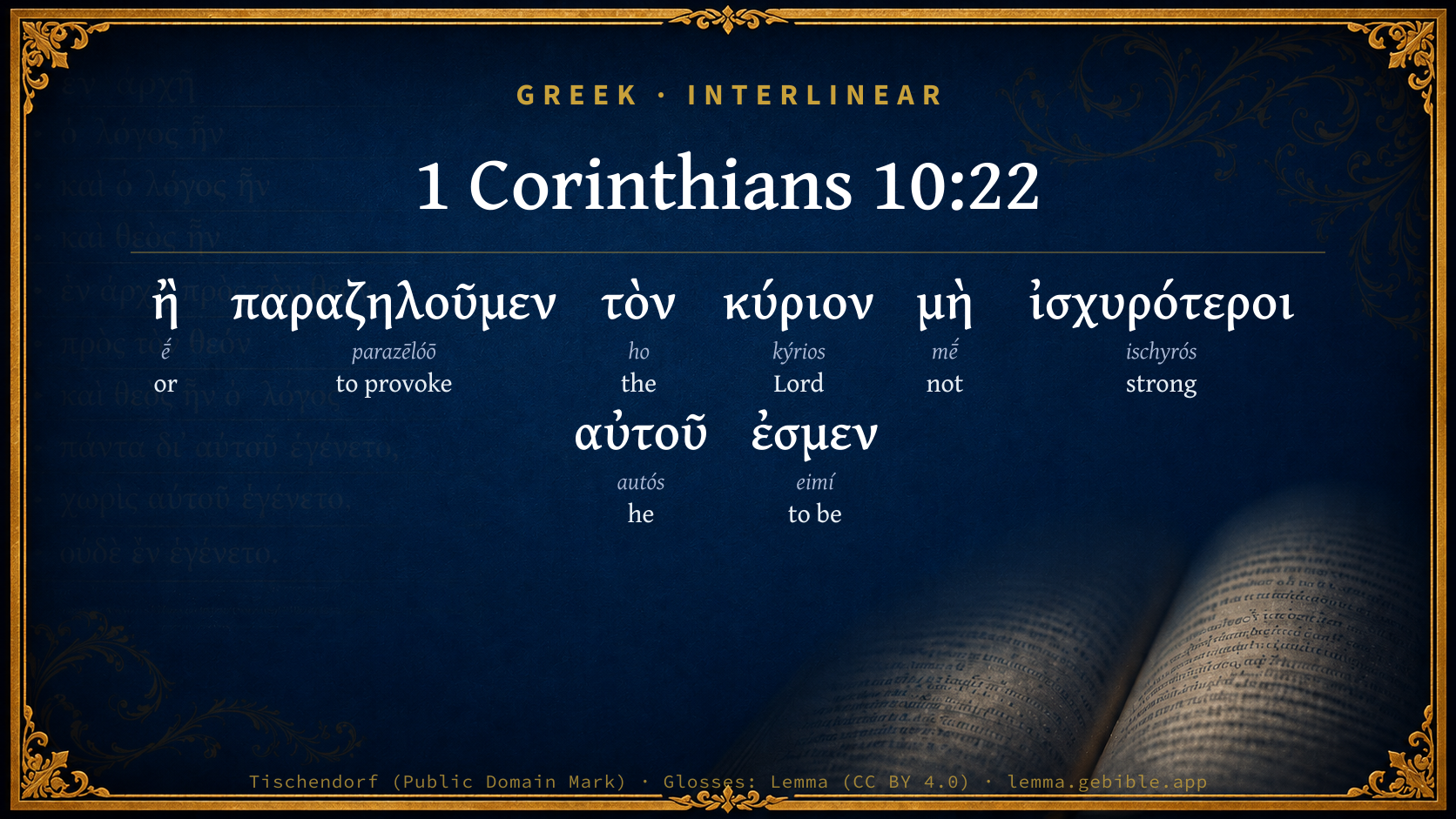
Greek (Tischendorf 8th ed.) 1 Corinthians 10:22 appears in the Greek New Testament. The text above is from the Tischendorf 8th edition. Each word links to its Strong’s number and a concise gloss. Click any word for its full Thayer’s Greek Lexicon entry.
Download image
Cite this verse

1 Corinthians 10:22 (World English Bible). Public Domain. Lemma interlinear Bible study tool, https://lemma.gebible.app/v/1-corinthians/10/22.

Show BibTeX & RIS
BibTeX
RIS
English Translation
Or do we provoke the Lord to jealousy? Are we stronger than he?
World English Bible · Public Domain
Download a study sheet

One document with this verse’s original text, its word-by-word gloss line, the meaning frame, cross-references with their text, attributed commentary, and full source and license credits — printable, and it pastes into notes with its structure intact.

This verse Autodidact and up

Study sheet (.html) Plain text (.txt)

A passage Seminary Student

Up to 50 verses in one chapter. A passage sheet keeps up to 6 commentary sources and 12 cross-references per verse, in the order this page ranks them, and says so on the sheet whenever that leaves anything out. Ask for a single verse and you get the Autodidact verse sheet above.

Everything on this page stays free to read, with no account — the sheet is a download of what is already on screen, not access to it.

Want to remove ads? Support Godless Engineer
Compare translations 3

The same verse in 3 English versions, stacked beneath the original-language interlinear above. Click any original word for its lexicon entry.

Each is an independent rendering of the whole verse — the interlinear is not word-aligned to these translations.

Highlighted words mark where these versions differ — a whole-verse word diff, not a word-by-word alignment.

  • World English Bible Public Domain
    Or do we provoke the Lord to jealousy? Are we stronger than he?
  • King James Version Public Domain
    Do we provoke the Lord to jealousy? are we stronger than he?
  • unfoldingWord Literal Text CC BY-SA 4.0
    Or do we provoke the Lord to jealousy? We are not stronger than him, are we?

unfoldingWord Literal Text — © unfoldingWord, licensed CC BY-SA 4.0. Word-aligned USFM3 via Door43 (git.door43.org/unfoldingWord/en_ult).

Versions to compare (up to 4)

3 of 4 selected

Show all 19 translations

Every available English version of this verse, each an independent rendering of the whole verse.

  • World English Bible Public Domain
    Or do we provoke the Lord to jealousy? Are we stronger than he?
  • Berean Standard Bible Public Domain
    Are we trying to provoke the Lord to jealousy? Are we stronger than He?
  • Majority Standard Bible Public Domain
    Are we trying to provoke the Lord to jealousy? Are we stronger than He?
  • King James Version Public Domain
    Do we provoke the Lord to jealousy? are we stronger than he?
  • American Standard Version (1901) Public Domain
    Or do we provoke the Lord to jealousy? are we stronger than he?
  • Revised Version (1885) Public Domain
    Or do we provoke the Lord to jealousy? are we stronger than he?
  • Geneva Bible (1599) Public Domain
    Doe we prouoke the Lord to anger? are we stronger then he?
  • Douay-Rheims (1899) Public Domain
    Do we provoke the Lord to jealousy? Are we stronger than he? All things are lawful for me, but all things are not expedient.
  • Young's Literal Translation Public Domain
    do we arouse the Lord to jealousy? are we stronger than He?
  • Literal Standard Version CC BY-SA 4.0
    do we arouse the LORD to jealousy? Are we stronger than He?
  • Unlocked Literal Bible CC BY-SA 4.0
    Or do we provoke the Lord to jealousy? Are we stronger than he is?
  • unfoldingWord Literal Text CC BY-SA 4.0
    Or do we provoke the Lord to jealousy? We are not stronger than him, are we?
  • Darby Bible Public Domain
    Do we provoke the Lord to jealousy? are we stronger than he?
  • World Messianic Bible Public Domain
    Or do we provoke the Lord to jealousy? Are we stronger than he?
  • Webster's Bible Public Domain
    Do we provoke the Lord to jealousy? are we stronger than he?
  • Free Bible Version CC BY-SA 4.0
    Are we trying to make the Lord jealous? Are we stronger than he is?
  • Bible in Basic English Public Domain
    Or may we be the cause of envy to the Lord? are we stronger than he?
  • Text-Critical English NT CC BY 4.0
    Or are we trying to provoke the Lord to jealousy? Are we stronger than he is?
  • Tyndale New Testament (1534) Public Domain
    Ether shall we provoke the lorde? Or are we stronger then he?

Literal Standard Version (2020), Covenant Press — licensed CC BY-SA 4.0. Text via the HelloAO Bible API (eBible.org). Unlocked Literal Bible (unfoldingWord) — licensed CC BY-SA 4.0. Text via the HelloAO Bible API (eBible.org). unfoldingWord Literal Text — © unfoldingWord, licensed CC BY-SA 4.0. Word-aligned USFM3 via Door43 (git.door43.org/unfoldingWord/en_ult). Free Bible Version, Dr. Jonathan Gallagher — licensed CC BY-SA 4.0. Text via the HelloAO Bible API (eBible.org).

Word by word

More ways to search: Search by grammar → Find every occurrence → Compare this word →

Practice this passage: Drill this verse → Learn its vocabulary →

About this verse

These counts appear in no published source. They are computed here, from the morphology-tagged text and Lemma’s own curated glosses. What Lemma adds →

8
words
8
distinct lemmas
Pauline Epistles
section

Notable vocabulary

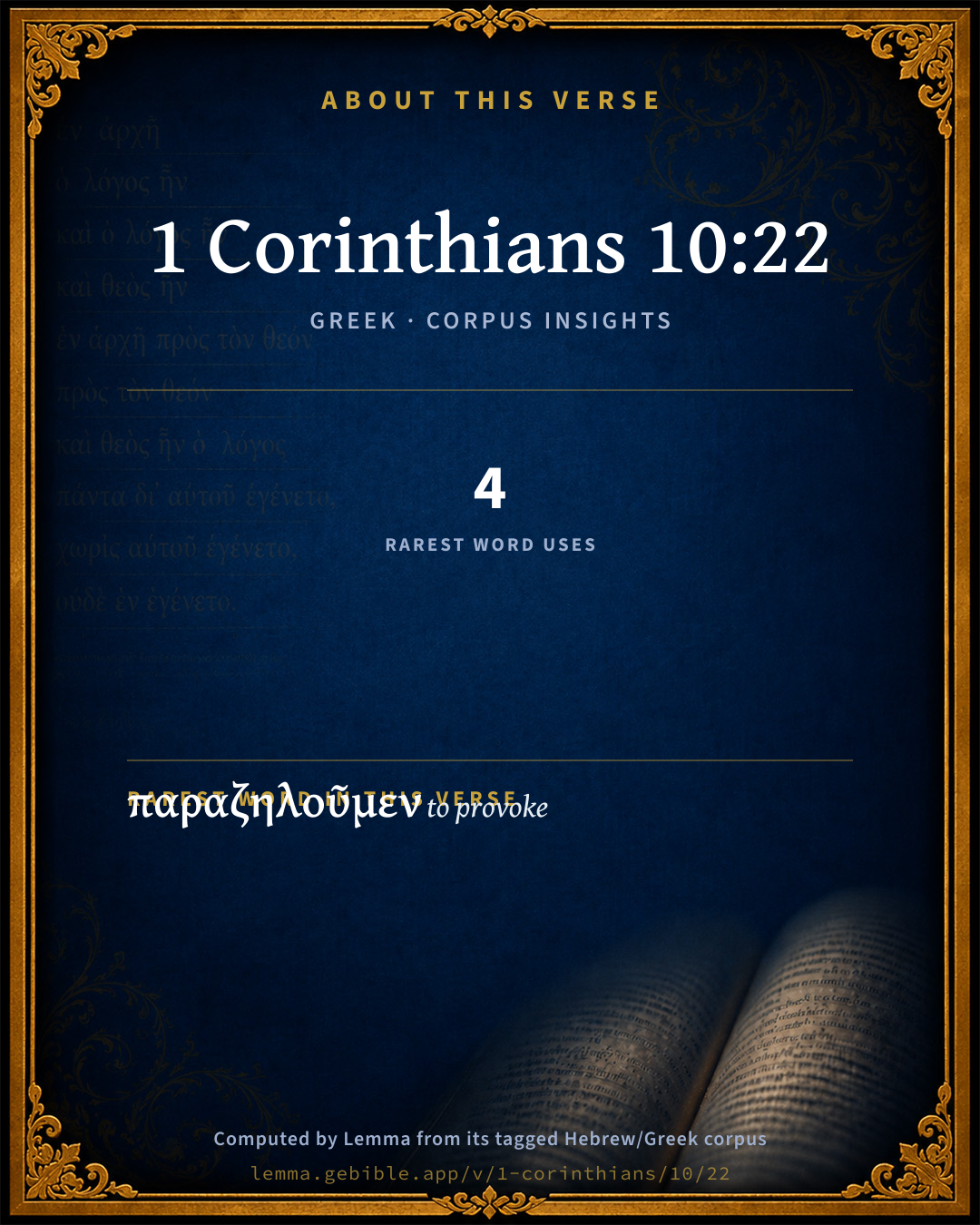
The rarest word here is παραζηλοῦμεν to provoke G3863 — appearing just 4 times in the whole Greek New Testament.

Shared distinctive vocabulary

παραζηλοῦμεν to provoke G3863 occurs in 4 verses of the Greek New Testament. Also found in:

Cross-references

15

Topical passages linked to 1 Corinthians 10:22 in the Treasury of Scripture Knowledge — connected by theme and wording, ordered by reader-vote popularity; previews shown in the World English Bible.

  • Deuteronomy 32:21 They have moved me to jealousy with that which is not God; They have provoked me to anger with their vanities: I will move them to jealousy with those who are not a people; I will provoke them to anger with a foolish nation.
  • Deuteronomy 32:16 They moved him to jealousy with strange [gods]; With abominations provoked they him to anger.
  • Hebrews 10:31 It is a fearful thing to fall into the hands of the living God.
  • Exodus 20:5 you shall not bow yourself down to them, nor serve them, for I, Yahweh your God, am a jealous God, visiting the iniquity of the fathers on the children, on the third and on the fourth generation of those who hate me,
  • Exodus 34:14 for you shall worship no other god: for Yahweh, whose name is Jealous, is a jealous God.
  • Deuteronomy 4:24 For Yahweh your God is a devouring fire, a jealous God.
  • Deuteronomy 6:15 for Yahweh your God in the midst of you is a jealous God; lest the anger of Yahweh your God be kindled against you, and he destroy you from off the face of the earth.
  • Joshua 24:19 Joshua said to the people, You can't serve Yahweh; for he is a holy God; he is a jealous God; he will not forgive your disobedience nor your sins.
  • Job 40:9–14 Or have you an arm like God? Can you thunder with a voice like him?
  • Psalms 78:58 For they provoked him to anger with their high places, And moved him to jealousy with their engraved images.
  • Ecclesiastes 6:10 Whatever has been, its name was given long ago; and it is known what man is; neither can he contend with him who is mightier than he.
  • Ezekiel 22:14 Can your heart endure, or can your hands be strong, in the days that I shall deal with you? I, Yahweh, have spoken it, and will do it.
  • Job 9:4 God who is wise in heart, and mighty in strength: Who has hardened himself against him, and prospered?
  • Isaiah 45:9 Woe to him who strives with his Maker--a potsherd among the potsherds of the earth! Shall the clay ask him who fashions it, "What are you making?" or your work, "He has no hands?"
  • Zephaniah 1:18 Neither their silver nor their gold will be able to deliver them in the day of Yahweh's wrath, but the whole land will be devoured by the fire of his jealousy; for he will make an end, yes, a terrible end, of all those who dwell in the land.

Cross-references courtesy of OpenBible.info (CC BY 4.0).

Commentary

Notes on 1 Corinthians 10:22 from classic Christian and Jewish commentators (each source and its license shown beneath its notes). The classic Christian expositions comment on the surrounding passage and are grouped to its opening verse, so a note may address several verses; the Jewish commentaries on the Tanakh (Rashi and others) are per-verse, so they appear only where the commentator wrote on this verse.

Lemma curates 59 commentaries, every one of them public domain or Creative Commons licensed, each selected and text-cleaned for this edition rather than reprinted as found. About our sources →

Tyndale Open Study Notes

Tyndale Open Resources

10:22 To ignore Paul’s advice on this matter is to rouse the Lord’s jealousy and judgment, just as Israel did (see 10:6-11; Exod 20:5; Deut 32:21).

Tyndale Open Study Notes — © Tyndale Open Resources, licensed CC BY-SA 4.0. Text via the HelloAO Bible API.

Bengel's Gnomon

Johann Albrecht Bengel

1Co 10:22. Παραζηλοῦμεν) do we provoke to jealousy? namely, by idolatry, 1Co 10:7; Exo 20:5. The kindred word is הלאות, ἀγῶνα παρέχειν, to cause one a conflict, to weary out, Isa 7:13. So Deu 32:21,—αὐτοὶ παρεζήλωσάν με ἐπʼ οὐ θεῷ, they have moved me to jealousy with that which is no god.—ἰσχυρότεροι, stronger) so that we may flee from His jealousy when kindled? [The weaker party is provoked without danger; but it is different in the stronger.—V. g.]

Bengel's Gnomon of the New Testament — English translation (T&T Clark, Edinburgh, 1860) — public domain. Text from a community e-Sword module.

Meyer's Critical & Exegetical Commentary

Heinrich August Wilhelm Meyer

1Co_10:22. Or do we provoke the Lord to jealousy? to prove that He will not suffer us to set Him on the same level with the demons? The connection is this: You cannot, etc., 1Co_10:21, unless it were the case that we Christians were people whose business it is to provoke Christ to jealousy. Hence the indicative, which should not be taken as deliberative, with Luther and others, including Pott, Flatt, and Rückert (or would we defy the Lord?), but: we occupy ourselves therewith, are engaged therein. Comp Bernhardy, Syntax, p. 370. The phrase, τὸν Κύριον, however, should not be referred to God on the ground of the allusion undoubtedly made here to Deu_32:21 (so commonly, as by Ewald, Pott, Billroth, Rückert, Olshausen), but (as by de Wette and Hofmann), on account of 1Co_10:21, to Christ.

μὴ ἰσχυρ. κ.τ.λ[1695]] we are not surely stronger than He? i.e. we are not surely persons, whom His strength, which He would put forth against us to carry out the promptings of that jealousy,[1696] cannot get the better of? Comp Job_37:23. Chrysostom already correctly notes the abductio ad absurdum, with which Paul winds up this part of his polemic against the eating of sacrificial meat.

[1695] .τ.λ. καὶ τὰ λοιπά.

[1696] According to Hofmann, Paul means that strength, which men must suppose themselves to possess if they are confident that they can take part with impunity in the sacrificial feasts, whereas Christ can by no means endure the sight of such participation on their part without becoming jealous. But the idea, with impunity, would be arbitrarily imported into the passage. The greater strength, upon this view of it, would be in truth the capacitynot existing in Christto do what was morally impossible (ver. 21). Had this, however, been the apostles meaning, he would have needed, in order to be logical and intelligible, to reverse the order of his clauses, so that ἰσχυρότεροι should have its sense determined by οὐ δύνασθε in ver. 21. According to the present order, the meaning of ἰσχυρ. is determined by παραζηλοῦμεν to be the strength which could make head against that of the ζῆλος thus aroused.

Meyer — Critical and Exegetical Commentary on the New Testament — English translation by Peter Christie, edited by Frederick Crombie (T&T Clark, 1880) — public domain. Text from a community e-Sword module.

Hodge's Commentary on Romans, Ephesians & First Corinthians

Charles Hodge

1Co_10:22

Do we provoke the Lord to jealousy? are we stronger than he?

Jealousy is the feeling which arises from wounded love, and is the fiercest of all human passions. It is therefore employed as an illustration of the hatred of God towards idolatry. It is as when a bride transfers her affections from her lawful husband, in every way worthy of her love, to some degraded and offensive object. This illustration, feeble as it is, is the most effective that can be borrowed from human relations, and is often employed in Scripture to set forth the heinousness of the sin of idolatry. Deu_32:21. Psa_78:58 and elsewhere. Or do we provoke, i.e. is it our object to provoke the Lord to jealousy. The Corinthians ought not to attend these feasts unless they intended to excite against themselves in the highest measure the displeasure of the Lord. And they ought not thus to excite his anger, unless they were stronger than he. By the Lord is to be understood Christ, as the context requires. It was the Lords table that was forsaken, and the same Lord that was provoked thereby to jealousy. Here again, the relation in which Christians stand to Christ, is said to be analogous to that in which the Israelites stood to Jehovah. Christ is therefore our Jehovah. He is our husband, to whom our supreme affection is due, and who loves us as a husband loves his wife. Thy maker is thy husband, Jehovah is his name, Isa_54:5; see Eph_5:25-31.

Charles Hodge — Commentary on Romans (1835), First Corinthians (1857), and Ephesians (1856) — public domain. Text from a community e-Sword module.

Jamieson, Fausset & Brown

Robert Jamieson, A. R. Fausset & David Brown

Do we provoke the Lord to jealousy?--by dividing our fellowship between Him and idols (Eze 20:39). Is it our wish to provoke Him to assert His power? Deu 32:21 is before the apostle's mind [ALFORD], (Exo 20:5).

are we stronger?--that we can risk a contest with Him.

Jamieson, Fausset & Brown — Commentary Critical and Explanatory on the Whole Bible (1871) — public domain (CC PDM 1.0). Text via the HelloAO Bible API.

Adam Clarke's Commentary

Verse 22. Do we provoke the Lord to jealousy?] All idolatry is represented as a sort of spiritual adultery; it is giving that heart to Satan that should be devoted to God; and he is represented as being jealous, because of the infidelity of those who have covenanted to give their hearts to him.

Are we stronger than he?] As he has threatened to punish such transgressors, and will infallibly do it, can we resist his omnipotence? A sinner should consider, while he is in rebellion against God, whether he be able to resist that power whereby God will inflict vengeance.

Adam Clarke's Commentary on the Bible (1810–1826) — public domain. Text from a community e-Sword/MySword module.

John Calvin's Commentaries

22. Do we provoke the Lord? Having laid down the doctrine, he assumes a more vehement tone, from observing, that what was a most atrocious offense against God was regarded as nothing, or, at least, was looked upon as a very trivial error. The Corinthians wished the liberty that they took to be reckoned excusable, as there is not one of us that willingly allows himself to be found fault with, but, on the contrary, we seek one subterfuge after another, under which to shelter ourselves. Now Paul says, and not without reason, that in this way we wage war against God; for nothing does God more require from us than this — that we adhere strictly to everything that he declares in his word. Do not those, then, who use subterfuges, in order that they may be at liberty to transgress the commandment of God, arm themselves openly against God? Hence that curse which the Prophet denounces against all those who call evil, good, and darkness, light (Isaiah 5:20.)

Are we stronger? He warns them how dangerous a thing it is to provoke God — because no one can do this but to his own ruin. Among men the chance of war, as they speak, is doubtful, but to contend with God is nothing short of voluntarily courting destruction. Accordingly, if we fear to have God as an enemy, let us shudder at the thought of framing excuses for manifest sins, that is, whatever stand opposed to his word. Let us, also, shudder at the thought of calling in question those things that he has himself pronounced upon — for this is nothing less than to rise up against heaven after the manner of the giants. (Genesis 11:4.)

John Calvin's Commentaries (1540-1563) — public domain. Text from the Calvin Translation Society English edition (1840s-50s) via the Christian Classics Ethereal Library (ccel.org). Calvin's coverage is partial (roughly two-thirds of the Bible); uncommented books and verses are honest gaps, never fabricated. The 19th-century editor's footnotes and remarks are omitted so the notes are faithfully Calvin's own voice.

The Cambridge Bible for Schools and Colleges

gen. ed. J. J. S. Perowne

22. Do we provoke the Lord to jealousy?] i.e. as the Jews had done to their cost See note on last verse. Cf. also Numbers 14; Deuteronomy 1; Deu_32:21 (see note on 1Co_10:19 and observe that it was idol worship which provoked God); Psa_95:8; Heb_3:16. The same word is found, with the same translation, in Rom_10:19; Rom_11:11, and in 1Co_10:14 of that chapter it is translated provoke to emulation.

are we stronger than he?] So as to be able to resist His wrath.

The Cambridge Bible for Schools and Colleges (gen. ed. J. J. S. Perowne; Cambridge University Press, 1878–1918) — public domain. Text from a community e-Sword module.

John Gill's Exposition

Do we provoke the Lord to jealousy?.... As they do who are guilty of idolatry in any shape: nothing is more highly resented by God, or stirs him up more to wrath and fury, and to inflict punishment; he cannot bear, nor will he admit of a rival in religious worship; he is a God jealous of his own honour; nor will he give, or suffer to be given by others, his praise and glory to graven images:

are we stronger than he? to give into idolatrous practices, is to proclaim and enter into a war against God; and what madness must this be? who can be so sottish and stupid as to think of succeeding? when God is omnipotent, and man a poor feeble impotent creature, a worm, and but dust and ashes: thus the apostle dissuades from idolatry, and every species and branch of it; partly from its ill effect, in bringing men into fellowship with devils; and partly from the impossibility of practising it, in consistence with a true and real participation of the cup and table of the Lord; and from the absurdity and stupidity of it, and its dangerous consequence, in exposing men to the vengeance of an almighty incensed Being.

John Gill's Exposition of the Whole Bible (1746–1763) — public domain (CC PDM 1.0). Text via the HelloAO Bible API.

Trapp's Complete Commentary

John Trapp

22 Do we provoke the Lord to jealousy? are we stronger than he?

Ver. 22. Do we provoke the Lord] As Caligula that dared his Jove to a duel; as the raging Turk at the last assault of Scodra most horribly blaspheming God. But who knoweth the power of his anger? Psa 90:11. It is such as none can avert or avoid, avoid or abide. To such therefore as will needs provoke the Lord, we may well say, as Ulysses’ companions said to him, when he would needs provoke Polydamas;

"Σχετλιε τιπτ εθελεις ερεθιζεμεν αγριον ανδρα.

What mean’st thou, wretch, to enrage this cruel man?"

John Trapp, A Commentary or Exposition upon All the Books of the Old and New Testament (1647–1656) — public domain. Text from a community e-Sword module.

Albert Barnes' Notes on the Bible

Do we provoke the Lord to jealousy? - That is, shall we, by joining in the worship of idols, “provoke” or “irritate” God, or excite him to anger? This is evidently the meaning of the word παραζηλοῦμεν parazēloumen, rendered “provoke to jealousy.” The word קנא qaana', usually rendered by this word by the Septuagint, has this sense in Deu 32:21; 1Ki 14:22; Ezr 8:3; Psa 78:58. There is a reference here, doubtless, to the truth recorded in EXO 20:5. That God “is a jealous God,” and that he regards the worship of idols as a direct affront to himself. The sentiment of Paul is, that to join in the worship of idols, or in the observance of their feasts, would be to participate in that which had ever been regarded by God with special abhorrence, and which more than anything else tended to provoke his wrath. We may observe, that any course of life that tends to alienate the affections from God, and to fix them on other beings or objects, is a sin of the same kind as that referred to here. Any inordinate love of friends, of property, of honor, has substantially the same idolatrous nature, and will tend to provoke him to anger. And it may be asked of Christians now, whether they will by such inordinate attachments provoke the Lord to wrath? whether they will thus excite his displeasure, and expose themselves to his indignation? Very often Christians do thus provoke him. They become unduly attached to a friend, or to wealth, and God in anger takes away that friend by death, or that property by the flames, or they conform to the world, and mingle in its scenes of fashion and gaiety, and forget God; and in displeasure he visits them with judgments, humbles them, and recalls them to Himself.

Are we stronger than he? - This is given as a reason why we should not provoke his displeasure. We cannot contend successfully with Him; and it is therefore madness and folly to contend with God, or to expose ourselves to the effects of His indignation.

Albert Barnes' Notes on the Bible (1834–1885) — public domain. Text from a community e-Sword/MySword module.

Matthew Poole's English Annotations

Jealousy is a violent passion in a man, not bearing a companion or a rival as to a thing or person which he loveth. It is in holy writ applied unto God, not to signify any such extravagancy, excess, or vehemence, as attendeth that passion in men, but only his just displeasure at the giving that homage to any creature which is due to him alone. It is most applied to God to express his anger against those who give Divine homage to idols; the worship of God being a great piece of his glory which he hath said he will not give to another, nor his praise to graven images, Isa 42:8. Hence divines observe, that jealousy is attributed to God in the second commandment, which concerns the more external worship of God, to deter men from the violation of it, Exo 20:5. So Exo 34:14; Deu 4:24; 5:9; 6:16, and in many other texts, it signifieth, that the worship of God is a thing that he is very tender of, and that his will is to endure no creature to share with him in it; and that his wrath shall flame against that man that offers to make any creature such a sharer. So that it is not safe for any to do any thing of that nature, unless he could fancy himself to be stronger than God; for he that doth it, must expect the power and strength of God to be engaged against him. Thus the apostle had dissuaded them from eating meat sacrificed to idols in the idol’s temple, from the impiety of it, it being a species of idolatry, against which God hath signally revealed his wrath. He returns in the following verses to an argument, by which he had before dissuaded it, 1Co 8:1-13, as it was against charity, and the duty of love, in which they were indebted to their brethren.

Matthew Poole's English Annotations on the Holy Bible (1683–1685) — public domain. Text from a community e-Sword/MySword module.

Whedon's Commentary on the Bible

Daniel D. Whedon

22. Provoke the Lord—As we have above intimated, St. Paul has in mind Deu_32:17-26, and this is an allusion to 1Co_10:21.

Stronger than he—So as to meet all the threatenings of Deu_32:21-26.

Daniel D. Whedon (gen. ed.), Commentary on the Old and New Testaments (1874–1909) — public domain. Text from a community e-Sword module.

The Pulpit Commentary

Do we provoke the Lord to jealousy?. (Deu_32:21," They have moved me to jealousy by that which is not God The expression, "a jealous God," is used in the second commandment with express reference to idolatry, as in Exo_34:14, Exo_34:15. Are we stronger than he? Can we, therefore, with impunity, kindle his anger against us? "He is mighty in strength: who hath hardened himself against him, and hath prospered?". (Job_9:4)

The Pulpit Commentary (1880–1919), ed. H.D.M. Spence-Jones & Joseph S. Exell — public domain. Text from a community e-Sword module.

John Wesley's Explanatory Notes

Do we provoke the Lord to jealousy - By thus caressing his rivals? Are we stronger than he - Are we able to resist, or to bear his wrath?

John Wesley, Explanatory Notes Upon the Whole Bible (1754–1765) — public domain. Text via the GEBible commentary corpus.

Kretzmann's Popular Commentary

Paul E. Kretzmann

The Christian principles involved:

v. 22. Do we provoke the Lord to jealousy? Are we stronger than He?

v. 23. All things are lawful for me, but all things are not expedient; all things are lawful for me, but all things edify not.

v. 24. Let no man seek his own, but every man another’s wealth.

The apostle here mentions a thought that may have been found in the hearts of some of the Corinthians: Is it that we want to provoke the Lord to jealousy? Was that the idea which made them partake at both tables? Should Christians venture upon such a course? See Deu 32:21. They may be assured that the Lord would be apt to feel the most intense displeasure at such an evidence of adulterous love on their part. And: Are we stronger than He? Shall we presume to risk His displeasure to that extent? Can we avert the power of His wrath? The very fact that Paul included himself in the question was to encourage and admonish his readers to stand on his side and answer with an emphatic: Nevermore! But he also urges a consideration which he has brought once before: All things are in my power, but all things are not expedient, not advantageous, if the welfare of my neighbor is taken into account. Between having the right to do a certain thing and insisting upon making use of this right at all times and under all circumstances there is a great difference. And again: All things are in my power, but not do they all edify. An act which I know to be right and good may be considered highly improper by a weak brother, and therefore my doing it will result in his being offended instead of his being furthered in piety and righteous living. See chap. 6:12. To go ahead at all times without exercising charitable care, in conceited security, may result in endangering a fellow-Christian’s immortal soul. But a basic principle of Christian love is: Let no one seek his own interest or benefit, but rather that of the other, of his neighbor, of his Christian brother. To make one’s own enjoyment, one’s own rights, one’s own liberty the sole and paramount consideration, regardless of the good of others, is the essence of selfishness, a violation of the great law of love. Even things indifferent become sinful when they result in detriment to one’s neighbor.

Paul E. Kretzmann, Popular Commentary of the Bible (1921–1924) — public domain. Text from a community e-Sword module.

Burkitt's Expository Notes on the New Testament

William Burkitt

Observe here, 1. That the worship of God is that which he is very tender and jealous of: never was husband so jealous of the chastity of his suspected wife, as God is jealous in point of worship; idolatry is a provoking God to jealousy.

Observe, 2. That such as worship idols, or are guilty of idolatrous worship in any kind or degree, must expect God a jealous revenger, and will find themselves not strong enough to contend with him. "Do we provoke the Lord to jealousy, by joining devils in competition with him? Are we stronger than he? Who knows the power of his anger? The strength of God should make sinners tremble."

William Burkitt's Expository Notes on the New Testament (1700–1703) — public domain. Text from a community e-Sword module.

McGarvey & Pendleton's Commentaries

J. W. McGarvey

Or do we provoke the Lord to jealousy? are we stronger than he? [God does not permit a division of his worship ( Mat_6:24 ). Any attempt to do this is said to arouse his jealousy, that passion which arises from wounded love ( Isa_54:5 ; Eph_5:23-32 ; Exo_20:5 ). Paul doubtless has in mind the passage at Deu_32:17-26 ; which shows the necessity of obedience on the part of those not able to resist.]

J. W. McGarvey (with Philip Y. Pendleton), Commentaries on the New Testament (The Fourfold Gospel, 1914; Acts; and the epistles) — public domain. Text from a community e-Sword/MySword module.

The People's New Testament

B. W. Johnson

22. Do we provoke the Lord to jealousy? Such acts in an idol temple would be worship of the idol. Yet Jehovah says that he is “a jealous God” (Exod. 20:5).

B. W. Johnson's The People's New Testament with Notes (1889–1891) — public domain. Electronic text from the Christian Classics Ethereal Library (CCEL) ThML edition.

Cambridge Greek Testament for Schools and Colleges

22. ἢ παραζηλοῦμεν τὸν κύριον; i.e. as the Jews had done to their cost. See note on last verse. Cf. also Numbers 14; Deu 32:21; Psa 95:8; Heb 3:16. The same word is found, with the same translation, in Rom 10:19; Rom 11:11, and in 1Co 10:14 of that chapter it is translated provoke to emulation.

μὴ ἰσχυρότεροι αὐτοῦ ἐσμέν; Surely we are not stronger than He? After having thus hinted at a wrath to come, St Paul turns abruptly aside, after his manner, to introduce a new argument.

Cambridge Greek Testament for Schools and Colleges (Cambridge University Press, 1896; 21 vols, various authors incl. Carr, Maclear, Plummer, Farrar, Lumby, Moule, M. R. James, Simcox) — public domain. Text from a community e-Sword module.

Alford’s Greek Testament

Henry Alford

22.] Or are we provoking (is it our wish to provoke, that He may assert His power) the Lord (Christ) to jealousy (by dividing our participation between Him and devils)?—see ref. Deut., which evidently is before the Apostle’s mind:—are we stronger than He (are we then such, that we can afford to defy His power to punish)?

Henry Alford, The Greek Testament (1849–1861) — public domain. Text from a community e-Sword module.

International Critical Commentary

22. ἢ παραζηλοῦμεν τὸν Κύριον; A reminiscence of Deu 32:21 quoted above; see on Rom 10:19, Rom 11:11: ‘Or are we provoking the Lord to jealousy?’ ‘Is that what we are engaged in—trying whether the Lord will suffer Himself to be placed on a level with demons?’ In Deut. ‘the Lord’ of course means Jehovah, and some understand it so here; but v. 21 almost necessitates a reference to Christ. The ἤ introduces the alternative, ‘Or (if you think that you can eat of Christ’s table and of the table of demons) are we going to provoke His jealousy?’

μὴ ἰσχυρότεροι αὐτοῦ ἐσμεν; ‘Surely we are not stronger than He?’ His anger cannot be braved with impunity; Job 9:32, 37:23; Ecc 6:10; Isa 45:9; Eze 22:14; some of which passages may have been in the Apostle’s mind when he thus reduced such an argument εἰς ἄτοπον. It is as when Jehovah answers Job out of the whirlwind. Cf. 1:13.

10:23-11:1. Idol-meats need not always be avoided, but brotherly love limits Christian freedom. Abstain from idolmeats when an over-scrupulous brother tells you that they have been sacrificed to idols. In this and in all things seek God’s glory. That is my rule, and it keeps one from injuring others. And it is my rule because it is Christ’s.

23 As was agreed before, In all things one may do as one likes, but not all things that one may do do good. In all things one may do as one likes, but not all things build up the life of the Church. 24 In all open questions, it is the well-being of the persons concerned, and not one’s own rights, that should determine one’s action.

25 See how this works in practice. Anything that is on sale in the meat-market buy and eat, asking for no information that might perplex your conscience; 26 for the meat in the market, like everything else in the world, is the Lord’s, and His children may eat what is His without scruple. 27 Take another case. If one of the heathen invites some of you to a meal, and you care to go, anything that may be set before you eat, asking for no information, as before. 28 But if one of your fellow-guests should think it his duty to warn you and say, This piece of meat has been offered in sacrifice, then refrain from eating it, so as to avoid shocking your informant and wounding conscience. 29 Of course I do not mean your own conscience, but the conscience of the over-scrupulous brother who warned you. For to what purpose should I, by using my liberty, place myself in a false position, judged by the conscience of another? 30 Fancy ‘saying grace’ for food which causes offence and involves me in blame!

31 In short, that aim solves all these questions. Whether you are eating or drinking or doing anything else, let your motive always be the promotion of God’s glory. 32 Beware of putting difficulties in the way of Jews by ill-considered liberty, or of Greeks by narrow-minded scruples, or of the Church of God by unchristian self-seeking. 33 That is just my own principle. I try to win the approval of everybody in everything, not aiming at my own advantage, but at that of the many, that they may be saved from perdition. 1 In this I am only following in the footsteps of Christ. Will not you follow in mine?

The whole discussion of εἰδωλόθυτος, accordingly, issues in three distinct classes of cases, for each of which St Paul has a definite solution:

(1) Eating at sacrificial feasts. This is idolatry, and absolutely forbidden.

(2) Eating food bought in the shops, which may or may not have an idolatrous history. This is unreservedly allowed.

There remains (3) the intermediate case of food at nonceremonial feasts in private houses. If no attention is drawn to the “history” of the food, this class falls into class (2). But if attention is pointedly called to the history of the food, its eating is prohibited, not as per se idolatrous, but because it places the eater in a false position, and confuses the conscience of others.

International Critical Commentary — older volumes (1896–1929), various authors — public domain. Text from a community e-Sword module.

Vincent's Word Studies in the New Testament

Marvin R. Vincent

Do we provoke - to jealousy [η παραζηλουμεν] . The A. V. does not translate h or, and thus breaks the connection with what precedes. You cannot be at the same time in communion with the Lord and with demons, or will you ignore this inconsistency and provoke God ? For the verb, see on Rom 10:19.

Are we stronger. The force of the interrogative particle is, surely we are not stronger.

Marvin R. Vincent, Word Studies in the New Testament (1887–1900) — public domain. Text from a community e-Sword/MySword module.

Lesson kit

Teaching starters — assembled from the data on this page, not authored interpretation. Every prompt links to the verse data it draws on. Edit before teaching.

1 Corinthians, in the Pauline Epistles, opens this verse with 8 words (8 distinct Greek lemmas). Its most distinctive word is parazēlóō (“to provoke”). A historical commentator’s framing appears above. Read the whole chapter for the surrounding context.

Discussion questions

  1. What does “to provoke” (parazēlóō) contribute to the verse as a whole?
  2. Romans 10:19 shares the word «to provoke» with this verse. How do the two illuminate each other?
  3. These translations render this verse differently; the difference is in the English rendering, not the original. What questions does that raise?
  4. Reading how Tyndale Open Study Notes and Bengel's Gnomon read this verse, where do the two commentators agree and where do they part?

Things to notice

Reading settings

Reading text

Shown beneath each verse's original-language words.

Old Testament
Old Testament edition

Read the OT as the Masoretic Hebrew (MT) or the Greek Septuagint (LXX).

English shown for the Greek Septuagint (in the Hebrew ↔ Greek comparison).

Comparing translations? Open the Compare panel on any verse page to stack up to four side by side.