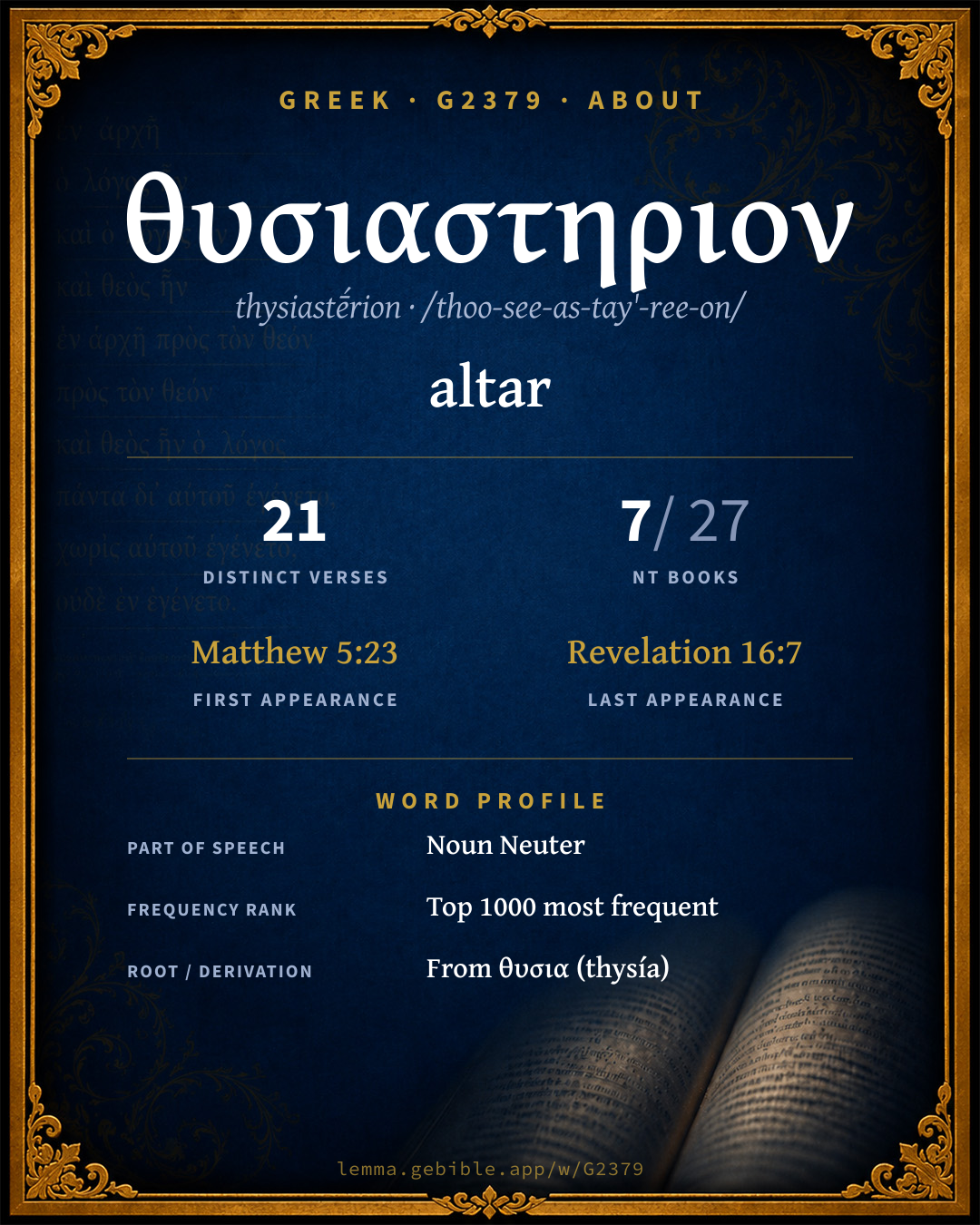
θυσιαστήριον
altar
Full lexicon entry — Thayer's Greek Lexicon
From Thayer's Greek Lexicon
Where this word appears
See every Genitive-case word in the Greek New Testament →
Grammar key — what these labels mean
Part of speech
- Noun
- A naming word — a person, place, thing, or idea.
Case
- Genitive
- The case of source, possession, or “of” — answers “whose / from what.”
- Accusative
- The case of the direct object and of extent.
- Dative
- The case of the indirect object, means, or location — “to / for / with / in.”
- Nominative
- The case of the subject (and the predicate nominative).
Gender
- Neuter
- Grammatically neuter.
Number
- Singular
- One.
- Plural
- More than one.
Grammatical forms
- Noun, Genitive, Singular, Neuter 11 times (48%)
- Noun, Accusative, Singular, Neuter 5 times (22%)
- Noun, Dative, Singular, Neuter 5 times (22%)
- Noun, Accusative, Plural, Neuter 1 time (4%)
- Noun, Nominative, Singular, Neuter 1 time (4%)
Parsed forms decoded from the imported morphology (Robinson–Tischendorf, public domain), counted across 23 parsed occurrences — not distinct verses.
Every verse where G2379 appears — 21 distinct verses across 7 books. Click any verse to open its interlinear word-by-word view. Verse text shown in the World English Bible for context — . Each verse’s Greek form is shown with its reference; the English is not keyword-highlighted, since the data carries no word-level English alignment. Use “Compare translations” on any verse to read it across multiple English versions. This concordance covers the Greek New Testament; Septuagint (Greek Old Testament) occurrences of this word are not indexed here.
Matthew 6 verses
- Matthew 5:23 θυσιαστήριον n acc sg neut "If therefore you are offering your gift at the altar, and there remember that your brother has anything against you,
- Matthew 5:24 θυσιαστηρίου n gen sg neut leave your gift there before the altar, and go your way. First be reconciled to your brother, and then come and offer your gift.
- Matthew 23:18 θυσιαστηρίῳ n dat sg neut 'Whoever swears by the altar, it is nothing; but whoever swears by the gift that is on it, he is obligated.'
- Matthew 23:19 θυσιαστήριον n nom sg neut You blind fools! For which is greater, the gift, or the altar that sanctifies the gift?
- Matthew 23:20 θυσιαστηρίῳ n dat sg neut He therefore who swears by the altar, swears by it, and by everything on it.
- Matthew 23:35 θυσιαστηρίου n gen sg neut that on you may come all the righteous blood shed on the earth, from the blood of righteous Abel to the blood of Zachariah son of Barachiah, whom you killed between the sanctuary and the altar.
Luke 2 verses
- Luke 1:11 θυσιαστηρίου n gen sg neut An angel of the Lord appeared to him, standing on the right side of the altar of incense.
- Luke 11:51 θυσιαστηρίου n gen sg neut from the blood of Abel to the blood of Zachariah, who perished between the altar and the sanctuary.' Yes, I tell you, it will be required of this generation.
Romans 1 verse
1 Corinthians 2 verses
- 1 Corinthians 9:13 θυσιαστηρίῳ θυσιαστηρίῳ n dat sg neut n dat sg neut Don't you know that those who serve around sacred things eat from the things of the temple, and those who wait on the altar have their portion with the altar?
- 1 Corinthians 10:18 θυσιαστηρίου n gen sg neut Consider Israel after the flesh. Don't those who eat the sacrifices have communion with the altar?
Hebrews 2 verses
James 1 verse
Revelation 7 verses
- Revelation 6:9 θυσιαστηρίου n gen sg neut When he opened the fifth seal, I saw underneath the altar the souls of those who had been killed for the Word of God, and for the testimony of the Lamb which they had.
- Revelation 8:3 θυσιαστηρίου θυσιαστήριον n gen sg neut n acc sg neut Another angel came and stood over the altar, having a golden censer. Much incense was given to him, that he should add it to the prayers of all the saints on the golden altar which was before the throne.
- Revelation 8:5 θυσιαστηρίου n gen sg neut The angel took the censer, and he filled it with the fire of the altar, and threw it on the earth. There followed thunders, sounds, lightnings, and an earthquake.
- Revelation 9:13 θυσιαστηρίου n gen sg neut The sixth angel sounded. I heard a voice from the horns of the golden altar which is before God,
- Revelation 11:1 θυσιαστήριον n acc sg neut A reed like a rod was given to me. Someone said, "Rise, and measure God's temple, and the altar, and those who worship in it.
- Revelation 14:18 θυσιαστηρίου n gen sg neut Another angel came out from the altar, he who has power over fire, and he called with a great voice to him who had the sharp sickle, saying, "Send forth your sharp sickle, and gather the clusters of the vine of the earth, for the earth's grapes are fully ripe!"
- Revelation 16:7 θυσιαστηρίου n gen sg neut I heard the altar saying, "Yes, Lord God, the Almighty, true and righteous are your judgments."
About this entry
At a glance — auto-summarized from this page’s data, not written by a person. Every figure links to its source below. This summary describes the numbers; it doesn’t interpret them.
“altar” is the headline sense of the Greek noun θυσιαστηριον (thysiastḗrion). Scripture first uses it in Matthew 5:23. With 21 verses in 7 books, it is an uncommon word in the Greek New Testament. It concentrates in Revelation, which alone accounts for 33% of its uses. The sections below give every sense, occurrence, and version rendering.
Gloss history
Strong's 1890 vs modern scholarship
About this word
Strong's G2379 catalogs a Greek word from the Greek New Testament.
These counts are not copied from any lexicon or concordance. They are computed here, from the morphology-tagged Greek New Testament. What Lemma adds →
- 21
- distinct verses
- The word appears in 21 distinct verses.
- 7 / 27
- NT books
- The word appears in 7 of 27 New Testament books.
- #563
- by frequency
- Top 1000 most frequent Greek words (rank 563 of 5,347 Greek words by occurrence).
View all 21 occurrences in the concordance →
Most concentrated in
- Revelation 7 verses 33%
- Matthew 6 verses 29%
- Luke 2 verses 10%
By section of the New Testament
By traditional corpus
Conventional, traditional groupings — biblical authorship is debated, so this is a traditional corpus grouping, not an authorship claim. Some books belong to more than one corpus (Luke is in both the Gospels and the Lukan corpus, and so on), so these shares overlap and need not total 100%. Each figure is a share of the word’s 21 distinct verses.
- Gospels 8 verses · 38%
- Johannine 7 verses · 33%
- Revelation 7 verses · 33%
- Pauline corpus 3 verses · 14%
- Lukan (Luke–Acts) 2 verses · 10%
- Hebrews 2 verses · 10%
- General (Catholic) Epistles 1 verse · 5%
How translations render this word
Counts come from each version’s own published word-to-Strong’s tagging or interlinear alignment — an approximate guide to how each version renders this word, not a word-level alignment the data otherwise carries. Because each total is that version’s own tagged count, the per-version totals vary from one another and need not match the appearance or distinct-verse counts above. These counts may also differ from a printed concordance because Lemma counts each distinctly tagged rendering and does not collapse phrase taggings into a single head-word total. This is a fixed set of word-tagged versions (KJV, ASV, BSB, ULT) and does not change with the reading translation you choose elsewhere. Each version’s license is shown beside its name below (and on Sources).
- King James Version: Altar 22×
- American Standard Version: Altar 22×
- Berean Standard Bible: Altar 21×
- unfoldingWord Literal Text: Altar 22×
King James Version Public Domain
Renders G2379 across 23 tagged occurrences — most commonly:
Plus 1 rendering that appears only once — usually multi-word phrases or single function words the recovered tagging swept in, not distinct renderings.
American Standard Version Public Domain
Renders G2379 across 23 tagged occurrences — most commonly:
Plus 1 rendering that appears only once — usually multi-word phrases or single function words the recovered tagging swept in, not distinct renderings.
Berean Standard Bible Public Domain
Renders G2379 across 22 tagged occurrences — most commonly:
Plus 1 rendering that appears only once — usually multi-word phrases or single function words the recovered tagging swept in, not distinct renderings. Not rendered by a distinct English word in 1 further occurrence.
unfoldingWord Literal Text CC BY-SA 4.0
Renders G2379 across 24 tagged occurrences — most commonly:
Plus 2 renderings that appear only once — usually multi-word phrases or single function words the recovered tagging swept in, not distinct renderings.
Senses in Thayer's
The 1 sense Thayer's distinguishes for this word, in lexicon order (not ranked by frequency or importance). The full entry — with sub-senses — is in the Lexicon Entry tab.
- the altar for slaying and burning of victims used of
Word origin
Derived from θυσια (thysía) (G2378) — sacrifice.
From a derivative of G2378 ; a place of sacrifice that is an altar (specifically or generally literally or figuratively): - altar.
— Strong’s Exhaustive Concordance (1890), public domain.
Forms in the corpus
The 4 distinct written forms G2379 takes in the Greek New Testament, most frequent first — each parse links to that case’s occurrences in the concordance.
| Form | Parsing | Example | Uses |
|---|---|---|---|
| θυσιαστηρίου thysiastēríou | Noun, Genitive, Singular, Neuter | Matthew 5:24 | 11 |
| θυσιαστήριον thysiastḗrion | Noun, Accusative, Singular, Neuter | Matthew 5:23 | 6 |
| θυσιαστηρίῳ thysiastēríō | Noun, Dative, Singular, Neuter | Matthew 23:18 | 5 |
| θυσιαστήριά thysiastḗriá | Noun, Accusative, Plural, Neuter | Romans 11:3 | 1 |
Septuagint usage
The same Greek word θυσιαστηριον appears 379 times in the Greek Old Testament (Septuagint), across 312 verses in 23 books.
- 379
- LXX occurrences
- Tagged occurrences of this Greek word in the Septuagint.
- 312
- verses
- Distinct Septuagint verses containing this word.
- 23 / 39
- OT books
- The word appears in 23 of the 39 Old Testament books.
Sample Septuagint occurrences
- Genesis 8:20 θυσιαστήριον
- Exodus 17:15 θυσιαστήριον
- Leviticus 1:5 θυσιαστήριον
- Numbers 3:31 θυσιαστήριον
- Deuteronomy 12:27 θυσιαστήριον
- Joshua 9:2 θυσιαστήριον
- Judges 2:2 θυσιαστήριον
- 1 Samuel 2:28 θυσιαστήριον
- 2 Samuel 24:18 θυσιαστήριον
- 1 Kings 1:50 θυσιαστήριον
- 2 Kings 11:11 θυσιαστήριον
- 1 Chronicles 6:34 θυσιαστήριον
Septuagint occurrences (same lexeme)
Every verse where the same Strong’s number (G2379) appears in the Greek Septuagint — showing the first 50 of 312. Verse text shown in the World English Bible for context; the Greek form is the matched word — the English is not keyword-highlighted.
- Genesis 8:20 θυσιαστήριον Noah built an altar to Yahweh, and took of every clean animal, and of every clean bird, and offered burnt offerings on the altar.
- Genesis 12:7 θυσιαστήριον Yahweh appeared to Abram, and said, "I will give this land to your seed." He built an altar there to Yahweh, who appeared to him.
- Genesis 12:8 θυσιαστήριον He left from there to the mountain on the east of Bethel, and pitched his tent, having Bethel on the west, and Ai on the east. There he built an altar to Yahweh, and called on the name of Yahweh.
- Genesis 13:4 θυσιαστήριον to the place of the altar, which he had made there at the first. There Abram called on the name of Yahweh.
- Genesis 13:18 θυσιαστήριον Abram moved his tent, and came and lived by the oaks of Mamre, which are in Hebron, and built an altar there to Yahweh.
- Genesis 22:9 θυσιαστήριον They came to the place which God had told him of. Abraham built the altar there, and laid the wood in order, bound Isaac his son, and laid him on the altar, on the wood.
- Genesis 26:25 θυσιαστήριον He built an altar there, and called on the name of Yahweh, and pitched his tent there. There Isaac's servants dug a well.
- Genesis 33:20 θυσιαστήριον He erected an altar there, and called it El Elohe Israel.
- Genesis 35:1 θυσιαστήριον God said to Jacob, "Arise, go up to Bethel, and live there. Make there an altar to God, who appeared to you when you fled from the face of Esau your brother."
- Genesis 35:3 θυσιαστήριον Let us arise, and go up to Bethel. I will make there an altar to God, who answered me in the day of my distress, and was with me in the way which I went."
- Genesis 35:7 θυσιαστήριον He built an altar there, and called the place El Beth El; because there God was revealed to him, when he fled from the face of his brother.
- Exodus 17:15 θυσιαστήριον Moses built an altar, and called the name of it Yahweh our Banner.
- Exodus 20:24 θυσιαστήριον You shall make an altar of earth for me, and shall sacrifice on it your burnt offerings and your peace-offerings, your sheep and your oxen. In every place where I record my name I will come to you and I will bless you.
- Exodus 20:25 θυσιαστήριον If you make me an altar of stone, you shall not build it of hewn stones; for if you lift up your tool on it, you have polluted it.
- Exodus 20:26 θυσιαστήριον Neither shall you go up by steps to my altar, that your nakedness may not be exposed to it.'
- Exodus 21:14 θυσιαστήριον If a man schemes and comes presumptuously on his neighbor to kill him, you shall take him from my altar, that he may die.
- Exodus 24:4 θυσιαστήριον Moses wrote all the words of Yahweh, and rose up early in the morning, and built an altar under the mountain, and twelve pillars for the twelve tribes of Israel.
- Exodus 24:6 θυσιαστήριον Moses took half of the blood and put it in basins, and half of the blood he sprinkled on the altar.
- Exodus 27:1 θυσιαστήριον "You shall make the altar of acacia wood, five cubits long, and five cubits broad; the altar shall be foursquare: and its height shall be three cubits.
- Exodus 27:3 θυσιαστήριον You shall make its pots to take away its ashes, its shovels, its basins, its flesh hooks, and its fire pans: all its vessels you shall make of brass.
- Exodus 27:5 θυσιαστήριον You shall put it under the ledge around the altar beneath, that the net may reach halfway up the altar.
- Exodus 27:6 θυσιαστήριον You shall make poles for the altar, poles of acacia wood, and overlay them with brass.
- Exodus 27:7 θυσιαστήριον Its poles shall be put into the rings, and the poles shall be on the two sides of the altar, when carrying it.
- Exodus 28:43 θυσιαστήριον They shall be on Aaron, and on his sons, when they go in to the tent of meeting, or when they come near to the altar to minister in the holy place; that they don't bear iniquity, and die: it shall be a statute forever to him and to his descendants after him.
- Exodus 29:12 θυσιαστήριον You shall take of the blood of the bull, and put it on the horns of the altar with your finger; and you shall pour out all the blood at the base of the altar.
- Exodus 29:13 θυσιαστήριον You shall take all the fat that covers the innards, the cover of the liver, the two kidneys, and the fat that is on them, and burn them on the altar.
- Exodus 29:16 θυσιαστήριον You shall kill the ram, and you shall take its blood, and sprinkle it around on the altar.
- Exodus 29:18 θυσιαστήριον You shall burn the whole ram on the altar: it is a burnt offering to Yahweh; it is a sweet savor, an offering made by fire to Yahweh.
- Exodus 29:21 θυσιαστήριον You shall take of the blood that is on the altar, and of the anointing oil, and sprinkle it on Aaron, and on his garments, and on his sons, and on the garments of his sons with him: and he shall be made holy, and his garments, and his sons, and his sons' garments with him.
- Exodus 29:25 θυσιαστήριον You shall take them from their hands, and burn them on the altar on the burnt offering, for a sweet savor before Yahweh: it is an offering made by fire to Yahweh.
- Exodus 29:36 θυσιαστήριον Every day shall you offer the bull of sin-offering for atonement: and you shall cleanse the altar, when you make atonement for it; and you shall anoint it, to sanctify it.
- Exodus 29:37 θυσιαστήριον Seven days you shall make atonement for the altar, and sanctify it: and the altar shall be most holy; whatever touches the altar shall be holy.
- Exodus 29:38 θυσιαστήριον "Now this is that which you shall offer on the altar: two lambs a year old day by day continually.
- Exodus 29:44 θυσιαστήριον I will sanctify the tent of meeting and the altar: Aaron also and his sons I will sanctify, to minister to me in the priest's office.
- Exodus 30:1 θυσιαστήριον "You shall make an altar to burn incense on. You shall make it of acacia wood.
- Exodus 30:18 θυσιαστήριον "You shall also make a basin of brass, and the base of it of brass, in which to wash. You shall put it between the tent of meeting and the altar, and you shall put water in it.
- Exodus 30:20 θυσιαστήριον When they go into the tent of meeting, they shall wash with water, that they not die; or when they come near to the altar to minister, to burn an offering made by fire to Yahweh.
- Exodus 30:27 θυσιαστήριον the table and all its articles, the lampstand and its accessories, the altar of incense,
- Exodus 30:28 θυσιαστήριον the altar of burnt offering with all its utensils, and the basin with its base.
- Exodus 31:8 θυσιαστήριον the table and its vessels, the pure lampstand with all its vessels, the altar of incense,
- Exodus 32:5 θυσιαστήριον When Aaron saw this, he built an altar before it; and Aaron made a proclamation, and said, "Tomorrow shall be a feast to Yahweh."
- Exodus 35:16 θυσιαστήριον the altar of burnt offering, with its grating of brass, it poles, and all its vessels, the basin and its base;
- Exodus 38:22 θυσιαστήριον Bezalel the son of Uri, the son of Hur, of the tribe of Judah, made all that Yahweh commanded Moses.
- Exodus 38:23 θυσιαστήριον With him was Oholiab, the son of Ahisamach, of the tribe of Dan, an engraver, and a skillful workman, and an embroiderer in blue, in purple, in scarlet, and in fine linen.
- Exodus 38:24 θυσιαστήριον All the gold that was used for the work in all the work of the sanctuary, even the gold of the offering, was twenty-nine talents, and seven hundred thirty shekels, after the shekel of the sanctuary.
- Exodus 38:27 θυσιαστήριον The one hundred talents of silver were for casting the sockets of the sanctuary, and the sockets of the veil; one hundred sockets for the one hundred talents, a talent for a socket.
- Exodus 39:9 θυσιαστήριον It was square. They made the breastplate double. Its length was a span, and its breadth a span, being double.
- Exodus 39:15 θυσιαστήριον They made on the breastplate chains like cords, of braided work of pure gold.
- Exodus 40:5 θυσιαστήριον You shall set the golden altar for incense before the ark of the testimony, and put the screen of the door to the tent.
- Exodus 40:6 θυσιαστήριον You shall set the altar of burnt offering before the door of the tent of the tent of meeting.
These are occurrences of the same Greek lexeme (G2379) in the Septuagint — not a translation of any one Hebrew word. The store carries no word-level Hebrew↔Greek alignment, so no Hebrew original is asserted here. Counts come from the recovered LXX Strong's tagging — high-frequency vocabulary is well covered, while rare or late forms may be untagged — so they reflect tagged occurrences and may slightly undercount.