Exodus 38:22

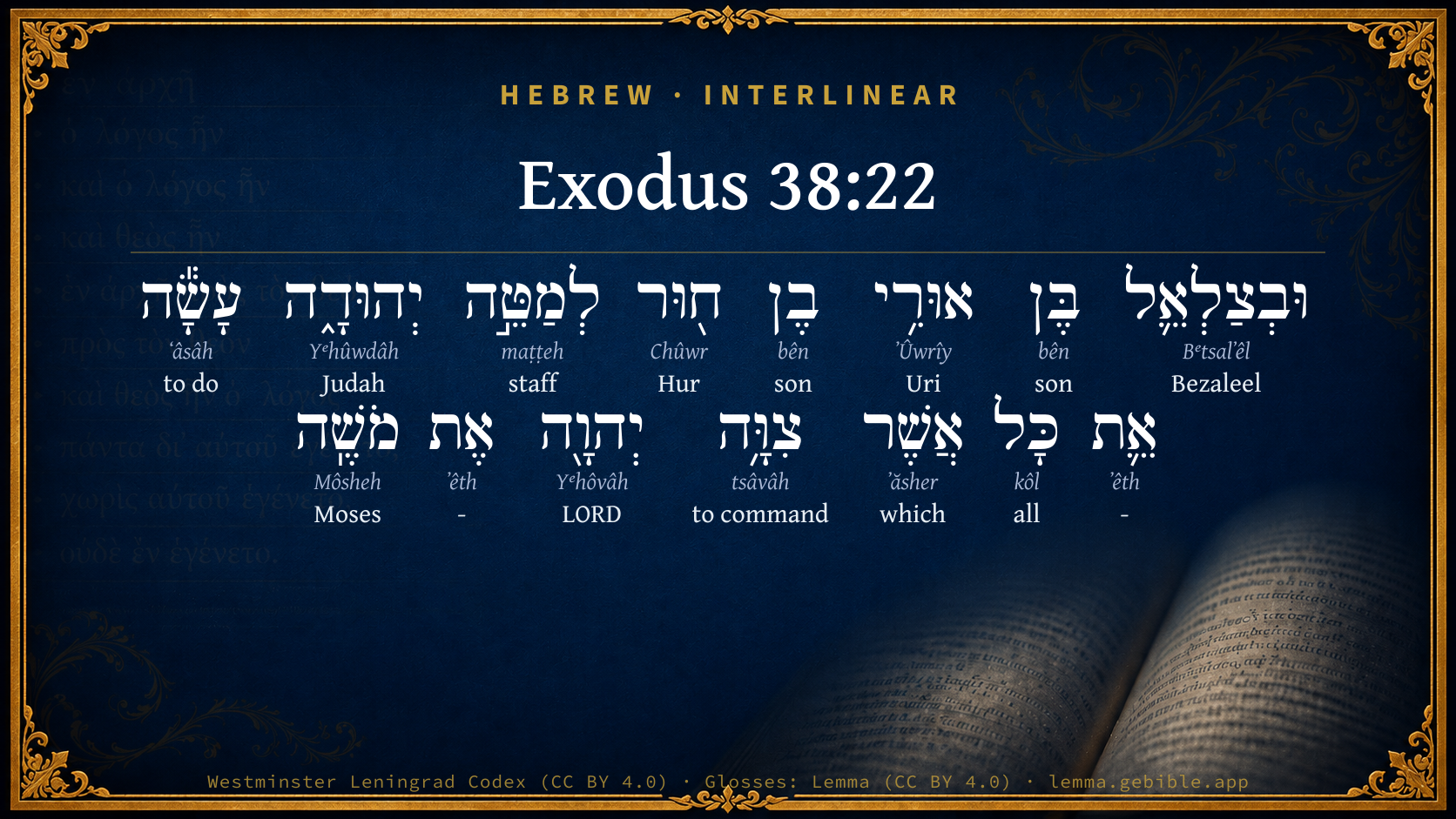
Hebrew (Westminster Leningrad Codex) Exodus 38:22 appears in the Hebrew Old Testament. The text above is from the Westminster Leningrad Codex. Each word links to its Strong’s number, a concise gloss, and parsing drawn from the Open Scriptures Hebrew Bible morphology. Click any word for its full Brown-Driver-Briggs (BDB) entry.
Download image
Cite this verse

Exodus 38:22 (World English Bible). Public Domain. Lemma interlinear Bible study tool, https://lemma.gebible.app/v/exodus/38/22.

Show BibTeX & RIS
BibTeX
RIS
English Translation
Bezalel the son of Uri, the son of Hur, of the tribe of Judah, made all that Yahweh commanded Moses.
World English Bible · Public Domain
Download a study sheet

One document with this verse’s original text, its word-by-word gloss line, the meaning frame, cross-references with their text, attributed commentary, and full source and license credits — printable, and it pastes into notes with its structure intact.

This verse Autodidact and up

Study sheet (.html) Plain text (.txt)

A passage Seminary Student

Up to 50 verses in one chapter. A passage sheet keeps up to 6 commentary sources and 12 cross-references per verse, in the order this page ranks them, and says so on the sheet whenever that leaves anything out. Ask for a single verse and you get the Autodidact verse sheet above.

Everything on this page stays free to read, with no account — the sheet is a download of what is already on screen, not access to it.

Want to remove ads? Support Godless Engineer
Compare translations 3

The same verse in 3 English versions, stacked beneath the original-language interlinear above. Click any original word for its lexicon entry.

Each is an independent rendering of the whole verse — the interlinear is not word-aligned to these translations.

Highlighted words mark where these versions differ — a whole-verse word diff, not a word-by-word alignment.

  • World English Bible Public Domain
    Bezalel the son of Uri, the son of Hur, of the tribe of Judah, made all that Yahweh commanded Moses.
  • King James Version Public Domain
    And Bezaleel the son Uri, the son of Hur, of the tribe of Judah, made all that the LORD commanded Moses.
  • unfoldingWord Literal Text CC BY-SA 4.0
    And Bezalel son of Uri son of Hur, from the tribe of Judah, made everything that Yahweh had commanded Moses.

unfoldingWord Literal Text — © unfoldingWord, licensed CC BY-SA 4.0. Word-aligned USFM3 via Door43 (git.door43.org/unfoldingWord/en_ult).

Versions to compare (up to 4)

3 of 4 selected

Show all 18 translations

Every available English version of this verse, each an independent rendering of the whole verse.

  • World English Bible Public Domain
    Bezalel the son of Uri, the son of Hur, of the tribe of Judah, made all that Yahweh commanded Moses.
  • Berean Standard Bible Public Domain
    Bezalel son of Uri, the son of Hur, of the tribe of Judah, made everything that the LORD had commanded Moses.
  • Majority Standard Bible Public Domain
    Bezalel son of Uri, the son of Hur, of the tribe of Judah, made everything that the LORD had commanded Moses.
  • King James Version Public Domain
    And Bezaleel the son Uri, the son of Hur, of the tribe of Judah, made all that the LORD commanded Moses.
  • American Standard Version (1901) Public Domain
    And Bezalel the son of Uri, the son of Hur, of the tribe of Judah, made all that Jehovah commanded Moses.
  • Revised Version (1885) Public Domain
    And Bezalel the son of Uri, the son of Hur, of the tribe of Judah, made all that the LORD commanded Moses.
  • Geneva Bible (1599) Public Domain
    So Bezaleel the sonne of Vri the sonne of Hur of the tribe of Iudah, made all that the Lord commanded Moses.
  • Douay-Rheims (1899) Public Domain
    Which Beseleel the son of Uri the son of Hur of the tribe of Juda had made as the Lord commanded by Moses,
  • Young's Literal Translation Public Domain
    And Bezaleel son of Uri, son of Hur, of the tribe of Judah, hath made all that Jehovah commanded Moses;
  • Literal Standard Version CC BY-SA 4.0
    And Bezaleel son of Uri, son of Hur, of the tribe of Judah, has made all that YHWH commanded Moses;
  • Unlocked Literal Bible CC BY-SA 4.0
    Bezalel son of Uri son of Hur, from the tribe of Judah, made everything that Yahweh had commanded Moses.
  • unfoldingWord Literal Text CC BY-SA 4.0
    And Bezalel son of Uri son of Hur, from the tribe of Judah, made everything that Yahweh had commanded Moses.
  • Darby Bible Public Domain
    And Bezaleel the son of Uri, the son of Hur, of the tribe of Judah, made all that Jehovah had commanded Moses;
  • World Messianic Bible Public Domain
    Bezalel the son of Uri, the son of Hur, of the tribe of Judah, made all that the LORD commanded Moses.
  • Webster's Bible Public Domain
    And Bezaleel the son of Uri, the son of Hur, of the tribe of Judah, made all that the LORD commanded Moses.
  • Free Bible Version CC BY-SA 4.0
    Bezalel, son of Uri, son of Hur, from the tribe of Judah, made everything that the Lord had ordered Moses to make.
  • Bible in Basic English Public Domain
    Bezalel, the son of Uri, the son of Hur, of the tribe of Judah, made everything as the Lord had given orders to Moses.
  • JPS Tanakh (1917) Public Domain
    And Bezalel the son of Uri, the son of Hur, of the tribe of Judah, made all that the LORD commanded Moses.

Literal Standard Version (2020), Covenant Press — licensed CC BY-SA 4.0. Text via the HelloAO Bible API (eBible.org). Unlocked Literal Bible (unfoldingWord) — licensed CC BY-SA 4.0. Text via the HelloAO Bible API (eBible.org). unfoldingWord Literal Text — © unfoldingWord, licensed CC BY-SA 4.0. Word-aligned USFM3 via Door43 (git.door43.org/unfoldingWord/en_ult). Free Bible Version, Dr. Jonathan Gallagher — licensed CC BY-SA 4.0. Text via the HelloAO Bible API (eBible.org).

Word by word

More ways to search: Search by grammar → Find every occurrence → Compare this word →

Practice this passage: Drill this verse → Learn its vocabulary →

אוּרִ֥י
ʼÛwrîy
H221
“Uri”
Noun, Proper
Part of Speech
Noun
Type
Proper
Full BDB Definition

Origin: from H217

TWOT: None

Uri = "fiery" - a prince of Judah, a son of Hur who was used by God to prepare the tabernacle - an officer (or the father of an officer) of Solomon in Gilead - a porter or gatekeeper in time of Ezra who took a foreign woman as wife
  1. וּבְצַלְאֵ֛ל Bᵉtsalʼêl H1212 “and · Bezaleel” Conjunction + Noun, Proper
  2. בֶּן bên H1121 “son of” Noun, Common, Masculine, Singular, Construct
  3. בֶן bên H1121 “son of” Noun, Common, Masculine, Singular, Construct
  4. ח֖וּר Chûwr H2354 “Hur” Noun, Proper
  5. לְמַטֵּ֣ה maṭṭeh H4294 “to/for · staff of” Preposition + Noun, Common, Masculine, Singular, Construct
  6. יְהוּדָ֑ה Yᵉhûwdâh H3063 “Judah” Noun, Proper
  7. עָשָׂ֕ה ʻâsâh H6213 “to do” Verb, Qal, Perfect, 3rd Person, Masculine, Singular
  8. אֵ֛ת ʼêth H853 “-” Particle, Direct Object
  9. כָּל kôl H3605 “all of” Noun, Common, Masculine, Singular, Construct
  10. אֲשֶׁר ʼăsher H834 “which” Particle, Relative
  11. צִוָּ֥ה tsâvâh H6680 “to command” Verb, Piel, Perfect, 3rd Person, Masculine, Singular
  12. יְהוָ֖ה Yᵉhôvâh H3068 “LORD” Noun, Proper
  13. אֶת ʼêth H853 “-” Particle, Direct Object
  14. מֹשֶֽׁה Môsheh H4872 “Moses” Noun, Proper

About this verse

These counts appear in no published source. They are computed here, from the morphology-tagged text and Lemma’s own curated glosses. What Lemma adds →

15
words
13
distinct lemmas
Pentateuch
section

Notable vocabulary

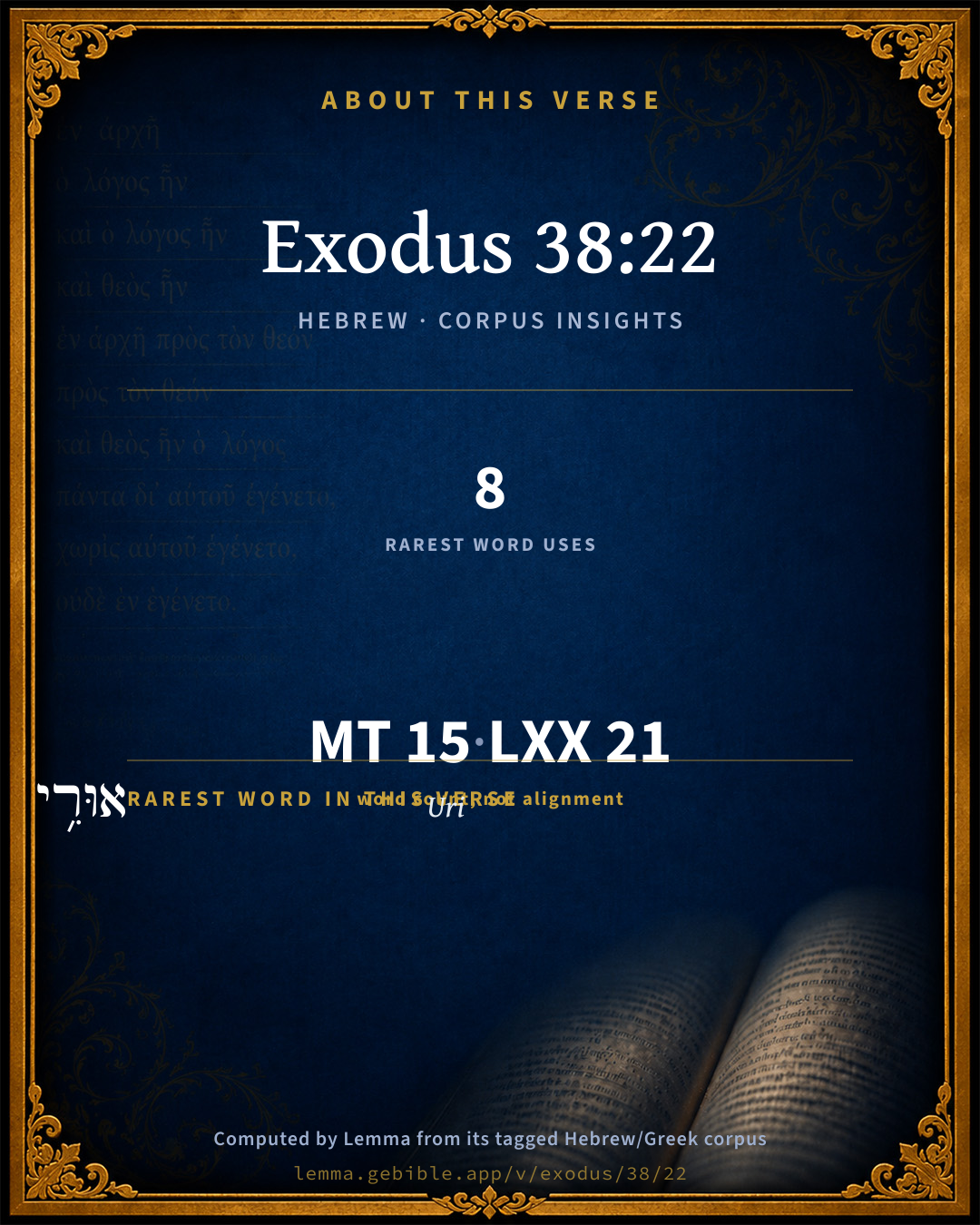
The rarest word here is אוּרִ֥י Uri H221 — appearing just 8 times in the whole Hebrew Bible.

Shared distinctive vocabulary

אוּרִ֥י Uri H221 occurs in 7 verses of the Hebrew Bible. Also found in:

Grammatical profile

  • 2 verbs
  • 10 nouns
  • 3 particles

Verb forms

  • עָשָׂ֕ה Qal · Perfect
  • צִוָּ֥ה Piel · Perfect

Repetition

A word recurs within this verse — often emphatic in Hebrew:

Hebrew & Septuagint length

In English translation the verse runs 20 words from the Hebrew and 22 from the Septuagint (LXX English) — closely comparable.

A rough comparison of the two English renderings, which tokenize alike — not a word-level alignment.

Word counts can differ between the Hebrew and the Greek without any difference in meaning — e.g. the Hebrew direct-object marker אֵת has no separate Greek word, and Greek often adds the article ὁ.

In the original languages it is 15 Hebrew tokens and 21 Greek tokens — but the two are counted differently (Hebrew bundles its prefixes and suffixes into one token; the Greek is in lemma form), so that isn’t a like-for-like length.

Cross-references

5

Topical passages linked to Exodus 38:22 in the Treasury of Scripture Knowledge — connected by theme and wording, ordered by reader-vote popularity; previews shown in the World English Bible.

  • Exodus 31:1–5 Yahweh spoke to Moses, saying,
  • Exodus 35:30–36:3 Moses said to the children of Israel, "Behold, Yahweh has called by name Bezalel the son of Uri, the son of Hur, of the tribe of Judah.
  • Psalms 119:6 Then I wouldn't be disappointed, When I consider all of your commandments.
  • Jeremiah 1:7 But Yahweh said to me, Don't say, I am a child; for to whoever I shall send you, you shall go, and whatever I shall command you, you shall speak.
  • Matthew 28:20 teaching them to observe all things that I commanded you. Behold, I am with you always, even to the end of the age." Amen.

Cross-references courtesy of OpenBible.info (CC BY 4.0).

Hebrew and Greek witnesses Masoretic Hebrew ↔ Greek Septuagint

The same verse in the two great witnesses to the Old Testament, shown verse-for-verse.

These are two independent witnesses, not word-aligned to each other, and the Septuagint is shown in lemma (dictionary) form.

Hebrew Exodus 38:22 Masoretic · Westminster Leningrad Codex

וּבְצַלְאֵ֛ל בֶּן אוּרִ֥י בֶן ח֖וּר לְמַטֵּ֣ה יְהוּדָ֑ה עָשָׂ֕ה אֵ֛ת כָּל אֲשֶׁר צִוָּ֥ה יְהוָ֖ה אֶת מֹשֶֽׁה

Bezalel the son of Uri, the son of Hur, of the tribe of Judah, made all that Yahweh commanded Moses.

World English Bible · Public Domain

Greek LXX Exodus 38:22 Septuagint · lemma form

οὗτος ποιέω ὁ θυσιαστήριον ὁ χαλκοῦς ἐκ ὁ πυρεῖον ὁ χαλκοῦς ὅς εἰμί ὁ ἀνήρ ὁ καταστασιάζω μετά ὁ κορε συναγωγή

He made the brazen altar of the brazen censers, which belonged to the men engaged in sedition with the gathering of Core.

LXX2012 (modern English Septuagint) · Public Domain

Hebrew: Westminster Leningrad Codex (CC BY 4.0). Greek: Septuagint (public domain); English from LXX2012 (modern English Septuagint) (Public Domain). How the Septuagint differs from the Hebrew →

Targum (Aramaic paraphrase)

2

The Targum is the ancient Jewish Aramaic paraphrase of the Hebrew Scriptures — an interpretive translation, not the Hebrew text itself. Onkelos (literal) and Pseudo-Jonathan (expansive) render the Torah, and Jonathan the Prophets. Coverage is partial: where no permissively-licensed English translation exists for a verse, only the Aramaic is shown. This is verse-level text, not a word-by-word alignment to the Hebrew.

  1. Targum Onkelos Torah (Genesis–Deuteronomy)
    וּבְצַלְאֵל בַּר אוּרִי בַר חוּר לְשִׁבְטָא דִיהוּדָה עֲבַד יָת כָּל דִי פַקֵיד יְיָ יָת משֶׁה:

    (no public-domain English translation for this verse)

    Targum Onkelos — Aramaic: “Onkelos Genesis” (public domain); “Onkelos Exodus” (public domain); “Onkelos Leviticus” (public domain); “Onkelos Numbers” (public domain); “Onkelos Deuteronomy” (public domain). English: “Sefaria Community Translation” (CC0 1.0 (public-domain dedication)); “J.W. Etheridge. The Targums of Onkelos and Jonathan Ben Uzziel on the Pentateuch. London: Longmans, Green, 1862” (public domain). Text via Sefaria.

  2. Targum Pseudo-Jonathan Torah (Genesis–Deuteronomy)
    וּבְצַלְאֵל בַּר אוּרִי בַּר חוּר לְשִׁבְטָא דִיהוּדָה עֲבַד יַת כָּל דְּפַקֵּיד יְיָ יַת משֶׁה

    And Bezalel bar Uri bar Hur, of the tribe of Jehudah, made all that the Lord had commanded Mosheh;

    Targum Pseudo-Jonathan — Aramaic: “Targum Jonathan on Genesis” (public domain); “Targum Jonathan on Exodus” (public domain); “Targum Jonathan on Leviticus” (public domain); “Targum Jonathan on Numbers” (public domain); “Targum Jonathan on Deuteronomy” (public domain). English: “The Targum of Jonathan ben Uzziel, trans. J. W. Etheridge, London, 1862” (public domain). Text via Sefaria.

Commentary

Notes on Exodus 38:22 from classic Christian and Jewish commentators (each source and its license shown beneath its notes). The classic Christian expositions comment on the surrounding passage and are grouped to its opening verse, so a note may address several verses; the Jewish commentaries on the Tanakh (Rashi and others) are per-verse, so they appear only where the commentator wrote on this verse.

Lemma curates 59 commentaries, every one of them public domain or Creative Commons licensed, each selected and text-cleaned for this edition rather than reprinted as found. About our sources →

The Cambridge Bible for Schools and Colleges

gen. ed. J. J. S. Perowne

22, 23. The writer, after mentioning what the Levites did (v. 21), reverts to the more important work done by the two artificers, Bĕẓal’çl and Oholiab (Exo_31:2; Exo_31:6, Exo_35:30; Exo_35:35).

The Cambridge Bible for Schools and Colleges (gen. ed. J. J. S. Perowne; Cambridge University Press, 1878–1918) — public domain. Text from a community e-Sword module.

John Gill's Exposition

All the gold that was occupied for the work, in all the work of the place,.... That was expended in making the mercy seat and cherubim, and the candlestick, which were all of pure gold; besides other things belonging to the ark and shewbread table; and the plates, with which the ark and many other things were covered or glided:

even the gold of the offering; which the people brought and offered freely; as their bracelets, earrings, and jewels of gold, Exo 35:22.

was twenty nine talents, and seven hundred and thirty shekels, after the shekel of the sanctuary: now as it is clear from Exo 38:25 that a talent is of the value of 3000 shekels, which, according to Brerewood, amount to three hundred and seventy five pounds of our money; and reckoning as he does the value of gold to be twelve times that of silver, a talent of gold, with him, is, of our money, 4500 pounds; so that twenty nine talents, seven hundred and thirty shekels, are reckoned by him at 131,595 pounds (m); but according to Dr. Cumberland (n), who is more exact in his calculation, and who reckons a talent of silver at three hundred and fifty three pounds, eleven shillings, and ten pence halfpenny, and the value of gold to be fourteen times that of silver; so that a talent of gold is, with him, 5067 pounds, three shillings, and ten pence; wherefore this whole sum of gold expended in the tabernacle, according to him, amounted to 148,719 pounds sterling: and, according to Waserus (o), the amount of the whole is 350,920 Hungarian ducats, which make three tons and a half of gold, and nine hundred and twenty ducats: when one considers the distressed case of the Israelites in Egypt, their late deliverance from thence, and the desert in which they were, it may be wondered how they came by these riches, here and after mentioned; but when it is observed, the riches of their ancestors, particularly what Joseph got in Egypt, which descended to their posterity; the repayment of the labour of the Israelites at their departure, with what they borrowed of the Egyptians, and what they found upon their carcasses when cast up by the Red sea, it will in a good measure be accounted for; to which may be added, that, according to Jerom (p), there were, eleven miles from Mount Horeb in the wilderness, fruitful mountains of gold; called Catachrysea.

(m) De Ponder. & pretiis. Vet. Num. c. 4, 5. (n) Of Scripture Weights and Measures, c. 4. p. 120, 121. (o) De Antiqu. Numis. l. 2. c. 18. (p) De locis Heb. fol. 90. A.

John Gill's Exposition of the Whole Bible (1746–1763) — public domain (CC PDM 1.0). Text via the HelloAO Bible API.

The Pulpit Commentary

Bezaleel made all. The direction of the whole work by Bezaleel is here asserted more definitely and decidedly than elsewhere. Compare Exo_31:2-6 Exo_36:1, Exo_36:2.

The Pulpit Commentary (1880–1919), ed. H.D.M. Spence-Jones & Joseph S. Exell — public domain. Text from a community e-Sword module.

Rashi

Rabbi Shlomo Yitzchaki (Rashi)

ובצלאל בן אורי וגו׳ עשה את כל אשר צוה ה' את משה AND BEZALEEL THE SON OF URI etc. MADE ALL THAT THE LORD COMMANDED MOSES — It is not stated here: אשר צֻוָּה (Bezaleel made all that he had been commanded), but “[Bezaleel made] all that the Lord commanded Moses” — even regarding such things which his teacher (Moses) did not tell him, his own opinion was in agreement with what had been told to Moses on Sinai (Jerusalem Talmud Peah 1:1; Bereishit Rabbah 1:14). [For Moses bade Bezaleel to make the vessels first and the Tabernacle afterwards but Bezaleel said to him: “Surely, it is the way of the world (the usual way) first to build a house and then to place the household utensils in it!” He (Moses) replied to him: “So, indeed, did I hear from the mouth of the Holy One, blessed be He”. Moses further said to him: (בצלאל), you must have been sitting in the shadow of God (בצל אל), for certainly did thus God command me!” And consequently Bezaleel made the Tabernacle first and afterwards he made the vessels (cf. Berakhot 55a).

Rashi on the Tanakh — English translations: “The Judaica Press complete Tanach with Rashi, translated by A. J. Rosenberg” (CC BY 4.0); “Pentateuch with Rashi's commentary by M. Rosenbaum and A.M. Silbermann, 1929-1934” (public domain); “The Metsudah Tanach series, Lakewood, N.J” (CC BY 4.0); and “The Book of Joshua, Metsudah Publications, 1997” (CC BY 4.0). Text via Sefaria.

Ramban (Nachmanides)

Rabbi Moshe ben Nachman (Ramban / Nachmanides)

AND BEZALEL THE SON OF URI, THE SON OF HUR, OF THE TRIBE OF JUDAH, MADE ALL THAT THE ETERNAL COMMANDED MOSES. The meaning of this is that everything was done through his direction, for he acted as instructor to all the wise men, and they all did heir work in his presence and showed him all that they had done, just as it is said, And He hath put in his heart that he may teach. But all the wise-hearted men also did the work, as it is said, and every wise-hearted man among them that wrought the work made the Tabernacle., 36:8. In the opinion of our Rabbis, this verse is intended to praise Bezalel, and to say that even these things that his master Moses did not tell him, he understood through his own mind in exactly the same way that they had been told to Moses on Sinai. Note 72. Moses agreed that originally G-d had told him to do it as Bezalel said it should be done. Thus the intention of Scripture is not to state that Bezalel did all the work, but that in all which was done through him, he fulfilled all that the Eternal commanded Moses. It is for this reason that Scripture does not state in connection with anything that was done until now: “as G-d spoke to Moses,” for this would have implied: “as Moses said by the word of G-d,” and he [i.e., Bezalel] changed their order from that which Moses had told him. Therefore Scripture stated everything in general terms, and said that Bezalel did everything as G-d had said, as I have written above.

Ramban (Nachmanides) on the Tanakh — English translation: “Commentary on the Torah by Ramban (Nachmanides). Translated and annotated by Charles B. Chavel. New York, Shilo Pub. House, 1971-1976” (CC BY 4.0). Text via Sefaria.

Lesson kit

Teaching starters — assembled from the data on this page, not authored interpretation. Every prompt links to the verse data it draws on. Edit before teaching.

Exodus, in the Pentateuch, opens this verse with 15 words (13 distinct Hebrew lemmas). Its most distinctive word is ʼÛwrîy (“Uri”). A historical commentator’s framing appears above. Read the whole chapter for the surrounding context.

Discussion questions

  1. The word ʼÛwrîy carries the sense “Uri.” How does it shape the verse?
  2. How does Exodus 31:2, which shares the word «Uri», read alongside this verse?
  3. What does the repetition of “son” (2× in this one verse) do in this verse?
  4. These translations render this verse differently. What is at stake in choosing one wording over another?
  5. «עָשָׂ֕ה» is a Qal Perfect verb. How does that grammatical form shape the action described?
  6. Compare how The Cambridge Bible for Schools and Colleges and John Gill's Exposition read this verse. Where do they agree or differ?

Things to notice

Reading settings

Reading text

Shown beneath each verse's original-language words.

Old Testament
Old Testament edition

Read the OT as the Masoretic Hebrew (MT) or the Greek Septuagint (LXX).

English shown for the Greek Septuagint (in the Hebrew ↔ Greek comparison).

Comparing translations? Open the Compare panel on any verse page to stack up to four side by side.