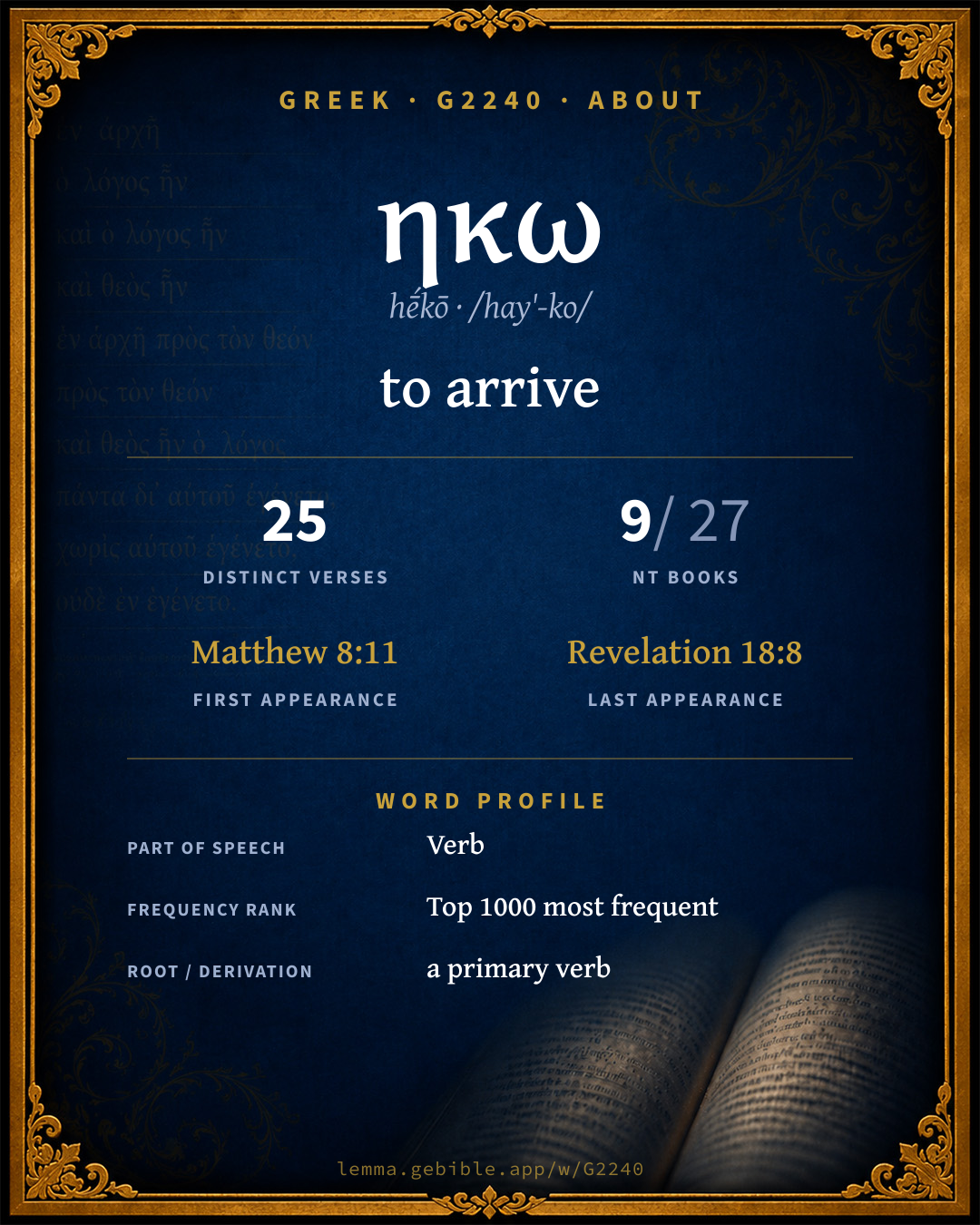
ἥκω
to arrive
‘to arrive’ is one of 2 main senses fuller range ↓
Full lexicon entry — Thayer's Greek Lexicon
From Thayer's Greek Lexicon
Where this word appears
See every Future-tense verb in the Greek New Testament →
Grammar key — what these labels mean
Part of speech
- Verb
- An action or state-of-being word.
Tense
- Future
- Action expected in future time.
- Present
- Ongoing or general action in present time (imperfective aspect).
- Aorist
- Action viewed as a simple whole, without regard to duration — often past (perfective aspect).
- Perfect
- A completed past action with continuing present results.
Voice
- Active
- The subject performs the action.
Mood
- Indicative
- States a fact or asks a factual question (the mood of reality).
- Subjunctive
- Expresses probability, purpose, or possibility (the mood of contingency).
Person
- 3rd person
- The one spoken about (“he / she / it / they”).
- 1st person
- The speaker (“I / we”).
Number
- Singular
- One.
- Plural
- More than one.
Every verse where G2240 appears in the Book of Luke — 5 distinct verses. Click any verse to open its interlinear word-by-word view. Verse text shown in the World English Bible for context — . Each verse’s Greek form is shown with its reference; the English is not keyword-highlighted, since the data carries no word-level English alignment. Use “Compare translations” on any verse to read it across multiple English versions. This concordance covers the Greek New Testament; Septuagint (Greek Old Testament) occurrences of this word are not indexed here.
Luke
- Luke 12:46 ἥξει fut act ind 3sg then the lord of that servant will come in a day when he isn't expecting him, and in an hour that he doesn't know, and will cut him in two, and place his portion with the unfaithful.
- Luke 13:29 ἥξουσιν fut act ind 3pl They will come from the east, west, north, and south, and will sit down in the Kingdom of God.
- Luke 13:35 ἥξει fut act ind 3sg Behold, your house is left to you desolate. I tell you, you will not see me, until you say, 'Blessed is he who comes in the name of the Lord!'"
- Luke 15:27 ἥκει pres act ind 3sg He said to him, 'Your brother has come, and your father has killed the fattened calf, because he has received him back safe and healthy.'
- Luke 19:43 ἥξουσιν fut act ind 3pl For the days will come on you, when your enemies will throw up a barricade against you, surround you, hem you in on every side,
About this entry
At a glance — auto-summarized from this page’s data, not written by a person. Every figure links to its source below. This summary describes the numbers; it doesn’t interpret them.
ηκω (hḗkō) is a Greek verb most often rendered “to arrive.” Older and newer Bibles part ways — “shall come” in the King James Version, “will come” (Berean Standard Bible) in modern versions. See the renderings breakdown. Spanning 25 verses in 9 books, it ranks among the uncommon words of the Greek New Testament. Its earliest occurrence is Matthew 8:11. Lexicons map it across 2 senses. Dig into 25-verse concordance and the renderings breakdown below.
Gloss history
Strong's 1890 vs modern scholarship

About this word
Strong's G2240 catalogs a Greek word from the Greek New Testament.
These counts are not copied from any lexicon or concordance. They are computed here, from the morphology-tagged Greek New Testament. What Lemma adds →
- 25
- distinct verses
- The word appears in 25 distinct verses.
- 9 / 27
- NT books
- The word appears in 9 of 27 New Testament books.
- #513
- by frequency
- Top 1000 most frequent Greek words (rank 513 of 5,347 Greek words by occurrence).
View all 25 occurrences in the concordance →
Most concentrated in
- Luke 5 verses 20%
- Revelation 5 verses 20%
- Matthew 4 verses 16%
By section of the New Testament
By traditional corpus
Conventional, traditional groupings — biblical authorship is debated, so this is a traditional corpus grouping, not an authorship claim. Some books belong to more than one corpus (Luke is in both the Gospels and the Lukan corpus, and so on), so these shares overlap and need not total 100%. Each figure is a share of the word’s 25 distinct verses.
- Gospels 14 verses · 56%
- Johannine 10 verses · 40%
- Lukan (Luke–Acts) 5 verses · 20%
- Revelation 5 verses · 20%
- Hebrews 3 verses · 12%
- General (Catholic) Epistles 2 verses · 8%
- Pauline corpus 1 verse · 4%
How translations render this word
Counts come from each version’s own published word-to-Strong’s tagging or interlinear alignment — an approximate guide to how each version renders this word, not a word-level alignment the data otherwise carries. Because each total is that version’s own tagged count, the per-version totals vary from one another and need not match the appearance or distinct-verse counts above. These counts may also differ from a printed concordance because Lemma counts each distinctly tagged rendering and does not collapse phrase taggings into a single head-word total. This is a fixed set of word-tagged versions (KJV, ASV, BSB, ULT) and does not change with the reading translation you choose elsewhere. Each version’s license is shown beside its name below (and on Sources).
- King James Version: Shall come 7×, Come 4×, Came 3×
- American Standard Version: Shall come 8×, Come 4×, Is come 2×
- Berean Standard Bible: Will come 13×, Come 2×, I have come 2×
- unfoldingWord Literal Text: Will come 12×, Has come 2×, I have come 2×
King James Version Public Domain
Renders G2240 across 28 tagged occurrences — most commonly:
Plus 5 renderings that appear only once — usually multi-word phrases or single function words the recovered tagging swept in, not distinct renderings. Not rendered by a distinct English word in 1 further occurrence.
American Standard Version Public Domain
Renders G2240 across 28 tagged occurrences — most commonly:
Plus 12 renderings that appear only once — usually multi-word phrases or single function words the recovered tagging swept in, not distinct renderings.
Berean Standard Bible Public Domain
Renders G2240 across 25 tagged occurrences — most commonly:
Plus 6 renderings that appear only once — usually multi-word phrases or single function words the recovered tagging swept in, not distinct renderings. Not rendered by a distinct English word in 1 further occurrence.
unfoldingWord Literal Text CC BY-SA 4.0
Renders G2240 across 27 tagged occurrences — most commonly:
Plus 7 renderings that appear only once — usually multi-word phrases or single function words the recovered tagging swept in, not distinct renderings.
Senses in Thayer's
The 2 senses Thayer's distinguishes for this word, in lexicon order (not ranked by frequency or importance). The full entry — with sub-senses — is in the Lexicon Entry tab.
- to have come, have arrived, be present
- metaph.
Word origin
Origin: a primary verb
A primary verb; to arrive that is be present (literally or figuratively): - come.
— Strong’s Exhaustive Concordance (1890), public domain.
Forms in the corpus
The 7 distinct written forms G2240 takes in the Greek New Testament, most frequent first — each parse links to that tense’s occurrences in the concordance.
| Form | Parsing | Example | Uses |
|---|---|---|---|
| ἥξει hḗxei | Verb, Future, Active, Indicative, 3rd person, Singular | Matthew 23:36 | 8 |
| ἥξουσιν hḗxousin | Verb, Future, Active, Indicative, 3rd person, Plural | Matthew 8:11 | 6 |
| ἥκει hḗkei | Verb, Present, Active, Indicative, 3rd person, Singular | Luke 15:27 | 4 |
| ἥξω hḗxō | Verb, Future, Active, Indicative, 1st person, Singular | Revelation 3:3 | 3 |
| ἥκω hḗkō | Verb, Present, Active, Indicative, 1st person, Singular | John 8:42 | 3 |
| ἥκασιν hḗkasin | Verb, Perfect, Active, Indicative, 3rd person, Plural | Mark 8:3 | 1 |
| Ἥξει Hḗxei | Verb, Future, Active, Indicative, 3rd person, Singular | 2 Peter 3:10 | 1 |
Same root — word family
Other Thayer's entries built from the same root as G2240, grouped by Strong’s listed origin. These share a root / origin per the lexicon — not necessarily a shared meaning. Each links to that word’s own entry.
Derived from this word
Compare all same-root words → They share a root, not necessarily a meaning.
Septuagint usage
The same Greek word ηκω appears 215 times in the Greek Old Testament (Septuagint), across 206 verses in 32 books.
- 215
- LXX occurrences
- Tagged occurrences of this Greek word in the Septuagint.
- 206
- verses
- Distinct Septuagint verses containing this word.
- 32 / 39
- OT books
- The word appears in 32 of the 39 Old Testament books.
Sample Septuagint occurrences
- Genesis 6:13 ἥκω
- Exodus 3:9 ἥκω
- Leviticus 13:9 ἥκω
- Numbers 22:36 ἥκω
- Deuteronomy 12:9 ἥκω
- Joshua 2:3 ἥκω
- Judges 16:2 ἥκω
- 1 Samuel 2:34 ἥκω
- 2 Samuel 3:23 ἥκω
- 1 Kings 8:42 ἥκω
- 2 Kings 8:7 ἥκω
- 1 Chronicles 12:18 ἥκω
Septuagint occurrences (same lexeme)
Every verse where the same Strong’s number (G2240) appears in the Greek Septuagint — showing the first 50 of 206. Verse text shown in the World English Bible for context; the Greek form is the matched word — the English is not keyword-highlighted.
- Genesis 6:13 ἥκω God said to Noah, "The end of all flesh has come before me, for the earth is filled with violence through them. Behold, I will destroy them with the earth.
- Genesis 18:10 ἥκω He said, "I will certainly return to you when the season comes round. Behold, Sarah your wife will have a son." Sarah heard in the tent door, which was behind him.
- Genesis 41:30 ἥκω There will arise after them seven years of famine, and all the plenty will be forgotten in the land of Egypt. The famine will consume the land,
- Genesis 42:7 ἥκω Joseph saw his brothers, and he recognized them, but acted like a stranger to them, and spoke roughly with them. He said to them, "Where did you come from?" They said, "From the land of Canaan to buy food."
- Genesis 42:9 ἥκω Joseph remembered the dreams which he dreamed about them, and said to them, "You are spies! You have come to see the nakedness of the land."
- Genesis 45:16 ἥκω The report of it was heard in Pharaoh's house, saying, "Joseph's brothers have come." It pleased Pharaoh well, and his servants.
- Genesis 45:18 ἥκω Take your father and your households, and come to me, and I will give you the good of the land of Egypt, and you will eat the fat of the land.'
- Genesis 46:31 ἥκω Joseph said to his brothers, and to his father's house, "I will go up, and speak with Pharaoh, and will tell him, 'My brothers, and my father's house, who were in the land of Canaan, have come to me.
- Genesis 47:4 ἥκω They said to Pharaoh, "We have come to live as foreigners in the land, for there is no pasture for your servants' flocks. For the famine is severe in the land of Canaan. Now therefore, please let your servants dwell in the land of Goshen."
- Genesis 47:5 ἥκω Pharaoh spoke to Joseph, saying, "Your father and your brothers have come to you.
- Exodus 3:9 ἥκω Now, behold, the cry of the children of Israel has come to me. Moreover I have seen the oppression with which the Egyptians oppress them.
- Exodus 18:23 ἥκω If you will do this thing, and God commands you so, then you will be able to endure, and all of these people also will go to their place in peace."
- Exodus 20:24 ἥκω You shall make an altar of earth for me, and shall sacrifice on it your burnt offerings and your peace-offerings, your sheep and your oxen. In every place where I record my name I will come to you and I will bless you.
- Leviticus 13:9 ἥκω "When the plague of leprosy is in a man, then he shall be brought to the priest;
- Leviticus 14:35 ἥκω then he who owns the house shall come and tell the priest, saying, 'There seems to me to be some sort of plague in the house.'
- Numbers 22:36 ἥκω When Balak heard that Balaam was come, he went out to meet him to the City of Moab, which is on the border of the Arnon, which is in the utmost part of the border.
- Numbers 22:38 ἥκω Balaam said to Balak, Behold, I have come to you: have I now any power at all to speak anything? the word that God puts in my mouth, that shall I speak.
- Deuteronomy 12:9 ἥκω for you haven't yet come to the rest and to the inheritance, which Yahweh your God gives you.
- Deuteronomy 12:26 ἥκω Only your holy things which you have, and your vows, you shall take, and go to the place which Yahweh shall choose:
- Deuteronomy 28:2 ἥκω and all these blessings shall come on you, and overtake you, if you shall listen to the voice of Yahweh your God.
- Deuteronomy 32:17 ἥκω They sacrificed to demons, [which were] no God, To gods that they didn't know, To new [gods] that came up of late, Which your fathers didn't dread.
- Deuteronomy 33:2 ἥκω He said, Yahweh came from Sinai, Rose from Seir to them; He shined forth from Mount Paran, He came from the ten thousands of holy ones: At his right hand was a fiery law for them.
- Joshua 2:3 ἥκω The king of Jericho sent to Rahab, saying, Bring forth the men who are come to you, who have entered into your house; for they have come to search out all the land.
- Joshua 9:6 ἥκω They went to Joshua to the camp at Gilgal, and said to him, and to the men of Israel, We are come from a far country: now therefore make you a covenant with us.
- Joshua 9:9 ἥκω They said to him, From a very far country your servants are come because of the name of Yahweh your God: for we have heard the fame of him, and all that he did in Egypt,
- Joshua 23:15 ἥκω It shall happen, that as all the good things are come on you of which Yahweh your God spoke to you, so will Yahweh bring on you all the evil things, until he have destroyed you from off this good land which Yahweh your God has given you.
- Judges 16:2 ἥκω [It was told] the Gazites, saying, Samson is come here. They compassed him in, and laid wait for him all night in the gate of the city, and were quiet all the night, saying, [Let be] until morning light, then we will kill him.
- 1 Samuel 2:34 ἥκω This shall be the sign to you, that shall come on your two sons, on Hophni and Phinehas: in one day they shall die both of them.
- 1 Samuel 2:36 ἥκω It shall happen, that everyone who is left in your house shall come and bow down to him for a piece of silver and a loaf of bread, and shall say, Please put me into one of the priests' offices, that I may eat a morsel of bread.
- 1 Samuel 4:6 ἥκω When the Philistines heard the noise of the shout, they said, What means the noise of this great shout in the camp of the Hebrews? They understood that the ark of Yahweh was come into the camp.
- 1 Samuel 4:7 ἥκω The Philistines were afraid, for they said, God is come into the camp. They said, Woe to us! for there has not been such a thing heretofore.
- 1 Samuel 4:16 ἥκω The man said to Eli, I am he who came out of the army, and I fled today out of the army. He said, How went the matter, my son?
- 1 Samuel 9:12 ἥκω They answered them, and said, He is; behold, [he is] before you: make haste now, for he is come today into the city; for the people have a sacrifice today in the high place:
- 1 Samuel 10:3 ἥκω Then shall you go on forward from there, and you shall come to the oak of Tabor; and there shall meet you there three men going up to God to Bethel, one carrying three kids, and another carrying three loaves of bread, and another carrying a bottle of wine:
- 1 Samuel 10:7 ἥκω Let it be, when these signs are come to you, that you do as occasion shall serve you; for God is with you.
- 1 Samuel 15:12 ἥκω Samuel rose early to meet Saul in the morning; and it was told Samuel, saying, Saul came to Carmel, and, behold, he set him up a monument, and turned, and passed on, and went down to Gilgal.
- 1 Samuel 16:2 ἥκω Samuel said, How can I go? if Saul hear it, he will kill me. Yahweh said, Take a heifer with you, and say, I am come to sacrifice to Yahweh.
- 1 Samuel 16:5 ἥκω He said, Peaceably; I am come to sacrifice to Yahweh: sanctify yourselves, and come with me to the sacrifice. He sanctified Jesse and his sons, and called them to the sacrifice.
- 1 Samuel 20:19 ἥκω When you have stayed three days, you shall go down quickly, and come to the place where you did hide yourself when the business was in hand, and shall remain by the stone Ezel.
- 1 Samuel 22:5 ἥκω The prophet Gad said to David, Don't stay in the stronghold; depart, and get you into the land of Judah. Then David departed, and came into the forest of Hereth.
- 1 Samuel 23:7 ἥκω It was told Saul that David was come to Keilah. Saul said, God has delivered him into my hand; for he is shut in, by entering into a town that has gates and bars.
- 1 Samuel 25:8 ἥκω Ask your young men, and they will tell you: therefore let the young men find favor in your eyes; for we come in a good day. Please give whatever comes to your hand, to your servants, and to your son David.
- 1 Samuel 26:3 ἥκω Saul encamped in the hill of Hachilah, which is before the desert, by the way. But David abode in the wilderness, and he saw that Saul came after him into the wilderness.
- 1 Samuel 26:4 ἥκω David therefore sent out spies, and understood that Saul was come of a certainty.
- 1 Samuel 29:6 ἥκω Then Achish called David, and said to him, As Yahweh lives, you have been upright, and your going out and your coming in with me in the host is good in my sight; for I have not found evil in you since the day of your coming to me to this day: nevertheless the lords don't favor you.
- 1 Samuel 29:9 ἥκω Achish answered David, I know that you are good in my sight, as an angel of God: notwithstanding the princes of the Philistines have said, He shall not go up with us to the battle.
- 1 Samuel 29:10 ἥκω Therefore now rise up early in the morning with the servants of your lord who have come with you; and as soon as you are up early in the morning, and have light, depart.
- 2 Samuel 3:23 ἥκω When Joab and all the host who was with him had come, they told Joab, saying, Abner the son of Ner came to the king, and he has sent him away, and he is gone in peace.
- 2 Samuel 17:12 ἥκω So shall we come on him in some place where he shall be found, and we will light on him as the dew falls on the ground; and of him and of all the men who are with him we will not leave so much as one.
- 1 Kings 8:42 ἥκω (for they shall hear of your great name, and of your mighty hand, and of your outstretched arm); when he shall come and pray toward this house;
These are occurrences of the same Greek lexeme (G2240) in the Septuagint — not a translation of any one Hebrew word. The store carries no word-level Hebrew↔Greek alignment, so no Hebrew original is asserted here. Counts come from the recovered LXX Strong's tagging — high-frequency vocabulary is well covered, while rare or late forms may be untagged — so they reflect tagged occurrences and may slightly undercount.