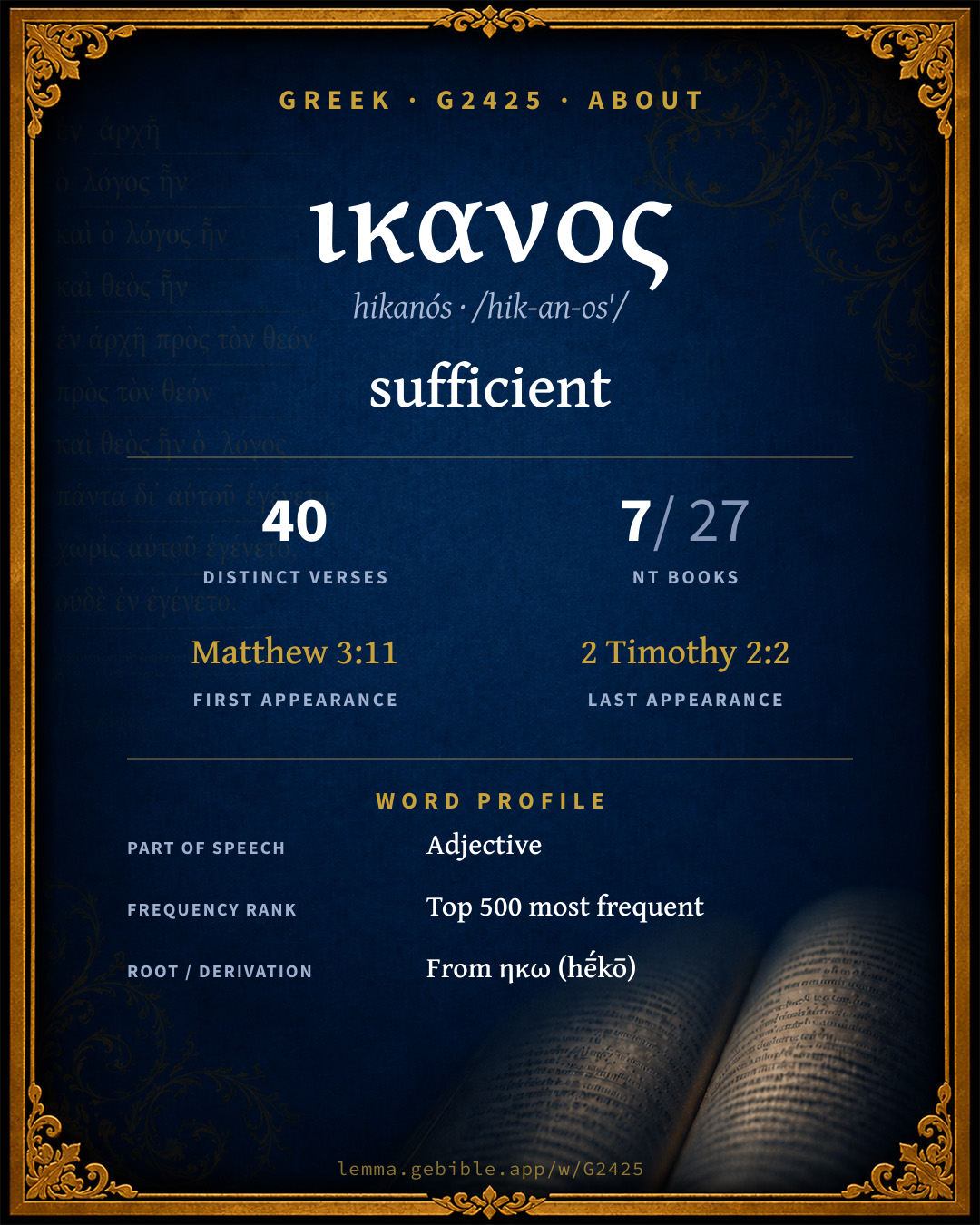
ἱκανός
sufficient
Full lexicon entry — Thayer's Greek Lexicon
From Thayer's Greek Lexicon
Where this word appears
See every Nominative-case word in the Greek New Testament →
Grammar key — what these labels mean
Part of speech
- Adjective
- A word that describes or qualifies a noun.
Case
- Nominative
- The case of the subject (and the predicate nominative).
- Accusative
- The case of the direct object and of extent.
- Dative
- The case of the indirect object, means, or location — “to / for / with / in.”
- Genitive
- The case of source, possession, or “of” — answers “whose / from what.”
Gender
- Masculine
- Grammatically masculine.
- Neuter
- Grammatically neuter.
- Feminine
- Grammatically feminine.
Number
- Singular
- One.
- Plural
- More than one.
Grammatical forms 14 distinct
- Adjective, Nominative, Singular, Masculine 10 times (25%)
- Adjective, Nominative, Plural, Masculine 6 times (15%)
- Adjective, Accusative, Singular, Masculine 3 times (8%)
- Adjective, Accusative, Singular, Neuter 3 times (8%)
- Adjective, Nominative, Singular, Neuter 3 times (8%)
- Adjective, Accusative, Plural, Feminine 2 times (5%)
- Adjective, Accusative, Plural, Masculine 2 times (5%)
- Adjective, Dative, Singular, Masculine 2 times (5%)
+6 more forms (9 occurrences)
Parsed forms decoded from the imported morphology (Robinson–Tischendorf, public domain), counted across 40 parsed occurrences — not distinct verses.
Every verse where G2425 appears — 40 distinct verses across 7 books. Click any verse to open its interlinear word-by-word view. Verse text shown in the World English Bible for context — . Each verse’s Greek form is shown with its reference; the English is not keyword-highlighted, since the data carries no word-level English alignment. Use “Compare translations” on any verse to read it across multiple English versions. This concordance covers the Greek New Testament; Septuagint (Greek Old Testament) occurrences of this word are not indexed here.
Matthew 3 verses
- Matthew 3:11 ἱκανὸς adj nom sg masc I indeed baptize you in water for repentance, but he who comes after me is mightier than I, whose shoes I am not worthy to carry. He will baptize you in the Holy Spirit.
- Matthew 8:8 ἱκανὸς adj nom sg masc The centurion answered, "Lord, I'm not worthy for you to come under my roof. Just say the word, and my servant will be healed.
- Matthew 28:12 ἱκανὰ adj acc pl neut When they were assembled with the elders, and had taken counsel, they gave a large amount of silver to the soldiers,
Mark 3 verses
- Mark 1:7 ἱκανὸς adj nom sg masc He preached, saying, "After me comes he who is mightier than I, the thong of whose sandals I am not worthy to stoop down and loosen.
- Mark 10:46 ἱκανοῦ adj gen sg masc They came to Jericho. As he went out from Jericho, with his disciples and a great multitude, the son of Timaeus, Bartimaeus, a blind beggar, was sitting by the road.
- Mark 15:15 ἱκανὸν adj acc sg neut Pilate, wishing to please the multitude, released Barabbas to them, and handed over Jesus, when he had flogged him, to be crucified.
Luke 10 verses
- Luke 3:16 ἱκανὸς adj nom sg masc John answered them all, "I indeed baptize you with water, but he comes who is mightier than I, the latchet of whose sandals I am not worthy to loosen. He will baptize you in the Holy Spirit and fire,
- Luke 7:6 ἱκανός adj nom sg masc Jesus went with them. When he was now not far from the house, the centurion sent friends to him, saying to him, "Lord, don't trouble yourself, for I am not worthy for you to come under my roof.
- Luke 7:11 ἱκανοὶ adj nom pl masc It happened soon afterwards, that he went to a city called Nain. Many of his disciples, along with a great multitude, went with him.
- Luke 7:12 ἱκανὸς adj nom sg masc Now when he drew near to the gate of the city, behold, one who was dead was carried out, the only son of his mother, and she was a widow. Many people of the city were with her.
- Luke 8:27 ἱκανῷ adj dat sg masc When Jesus stepped ashore, a certain man out of the city who had demons for a long time met him. He wore no clothes, and didn't live in a house, but in the tombs.
- Luke 8:32 ἱκανῶν adj gen pl masc Now there was there a herd of many pigs feeding on the mountain, and they begged him that he would allow them to enter into those. He allowed them.
- Luke 20:9 ἱκανούς adj acc pl masc He began to tell the people this parable. "A man planted a vineyard, and rented it out to some farmers, and went into another country for a long time.
- Luke 22:38 ἱκανόν adj nom sg neut They said, "Lord, behold, here are two swords." He said to them, "That is enough."
- Luke 23:8 ἱκανῶν adj gen pl masc Now when Herod saw Jesus, he was exceedingly glad, for he had wanted to see him for a long time, because he had heard many things about him. He hoped to see some miracle done by him.
- Luke 23:9 ἱκανοῖς adj dat pl masc He questioned him with many words, but he gave no answers.
Acts 18 verses
- Acts 8:11 ἱκανῷ adj dat sg masc They listened to him, because for a long time he had amazed them with his sorceries.
- Acts 9:23 ἱκαναί adj nom pl fem When many days were fulfilled, the Jews conspired together to kill him,
- Acts 9:43 ἱκανὰς adj acc pl fem It happened, that he stayed many days in Joppa with one Simon, a tanner.
- Acts 11:24 ἱκανὸς adj nom sg masc For he was a good man, and full of the Holy Spirit and of faith, and many people were added to the Lord.
- Acts 11:26 ἱκανόν adj acc sg masc When he had found him, he brought him to Antioch. It happened, that for a whole year they were gathered together with the assembly, and taught many people. The disciples were first called Christians in Antioch.
- Acts 12:12 ἱκανοὶ adj nom pl masc Thinking about that, he came to the house of Mary, the mother of John whose surname was Mark, where many were gathered together and were praying.
- Acts 14:3 ἱκανὸν adj acc sg masc Therefore they stayed there a long time, speaking boldly in the Lord, who testified to the word of his grace, granting signs and wonders to be done by their hands.
- Acts 14:21 ἱκανοὺς adj acc pl masc When they had preached the Gospel to that city, and had made many disciples, they returned to Lystra, Iconium, and Antioch,
- Acts 17:9 ἱκανὸν adj acc sg neut When they had taken security from Jason and the rest, they let them go.
- Acts 18:18 ἱκανὰς adj acc pl fem Paul, having stayed after this many more days, took his leave of the brothers, and sailed from there for Syria, together with Priscilla and Aquila. He shaved his head in Cenchreae, for he had a vow.
- Acts 19:19 ἱκανοὶ adj nom pl masc Many of those who practiced magical arts brought their books together and burned them in the sight of all. They counted the price of them, and found it to be fifty thousand pieces of silver.
- Acts 19:26 ἱκανὸν adj acc sg masc You see and hear, that not at Ephesus alone, but almost throughout all Asia, this Paul has persuaded and turned away many people, saying that they are no gods, that are made with hands.
- Acts 20:8 ἱκαναὶ adj nom pl fem There were many lights in the upper chamber where we were gathered together.
- Acts 20:11 ἱκανόν adj acc sg neut When he had gone up, and had broken bread, and eaten, and had talked with them a long while, even until break of day, he departed.
- Acts 20:37 ἱκανὸς adj nom sg masc They all wept a lot, and fell on Paul's neck and kissed him,
- Acts 22:6 ἱκανὸν adj nom sg neut It happened that, as I made my journey, and came close to Damascus, about noon, suddenly there shone from the sky a great light around me.
- Acts 27:7 ἱκαναῖς adj dat pl fem When we had sailed slowly many days, and had come with difficulty opposite Cnidus, the wind not allowing us further, we sailed under the lee of Crete, opposite Salmone.
- Acts 27:9 ἱκανοῦ adj gen sg masc When much time had passed and the voyage was now dangerous, because the Fast had now already gone by, Paul admonished them,
1 Corinthians 2 verses
2 Corinthians 3 verses
- 2 Corinthians 2:6 ἱκανὸν adj nom sg neut Sufficient to such a one is this punishment which was inflicted by the many;
- 2 Corinthians 2:16 ἱκανός adj nom sg masc to the one a stench from death to death; to the other a sweet aroma from life to life. Who is sufficient for these things?
- 2 Corinthians 3:5 ἱκανοί adj nom pl masc not that we are sufficient of ourselves, to account anything as from ourselves; but our sufficiency is from God;
2 Timothy 1 verse
About this entry
At a glance — auto-summarized from this page’s data, not written by a person. Every figure links to its source below. This summary describes the numbers; it doesn’t interpret them.
“sufficient” is the headline sense of the Greek adjective ικανος (hikanós). Translators differ — “many” in the King James Version, then “large” (Berean Standard Bible), as the renderings breakdown shows. With 40 verses in 7 books, it is a moderately common word in the Greek New Testament. It concentrates in Acts, which alone accounts for 45% of its uses. First canonically at Matthew 3:11, it enters the text early. See the sense tree, 40-verse concordance, and the renderings breakdown below.
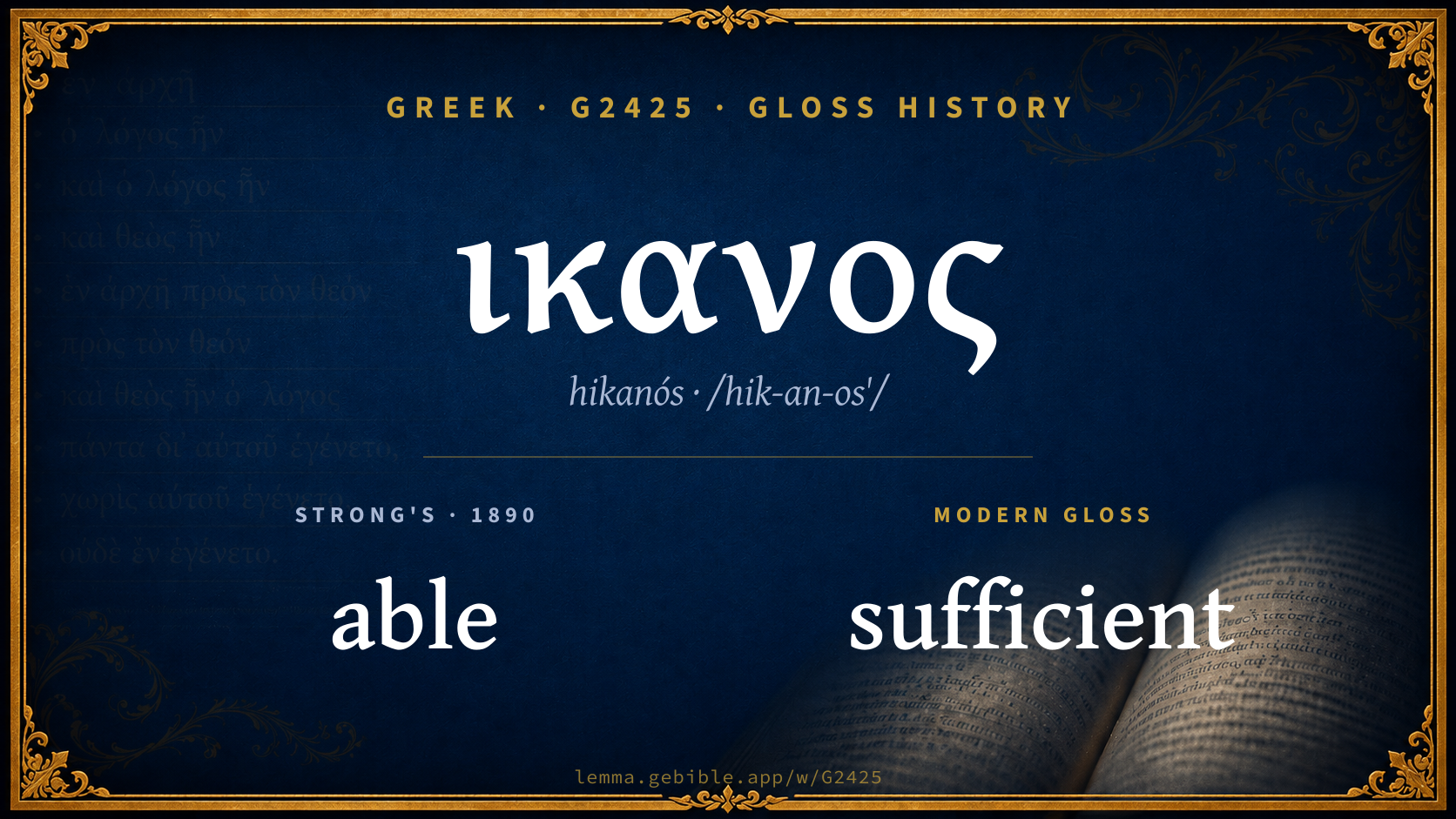
Gloss history
Strong's 1890 vs modern scholarship
About this word
Strong's G2425 catalogs a Greek word from the Greek New Testament.
These counts are not copied from any lexicon or concordance. They are computed here, from the morphology-tagged Greek New Testament. What Lemma adds →
- 40
- distinct verses
- The word appears in 40 distinct verses.
- 7 / 27
- NT books
- The word appears in 7 of 27 New Testament books.
- #380
- by frequency
- Top 500 most frequent Greek words (rank 380 of 5,347 Greek words by occurrence).
View all 40 occurrences in the concordance →
By section of the New Testament
By traditional corpus
Conventional, traditional groupings — biblical authorship is debated, so this is a traditional corpus grouping, not an authorship claim. Some books belong to more than one corpus (Luke is in both the Gospels and the Lukan corpus, and so on), so these shares overlap and need not total 100%. Each figure is a share of the word’s 40 distinct verses.
- Lukan (Luke–Acts) 28 verses · 70%
- Gospels 16 verses · 40%
- Pauline corpus 6 verses · 15%
How translations render this word
Counts come from each version’s own published word-to-Strong’s tagging or interlinear alignment — an approximate guide to how each version renders this word, not a word-level alignment the data otherwise carries. Because each total is that version’s own tagged count, the per-version totals vary from one another and need not match the appearance or distinct-verse counts above. These counts may also differ from a printed concordance because Lemma counts each distinctly tagged rendering and does not collapse phrase taggings into a single head-word total. This is a fixed set of word-tagged versions (KJV, ASV, BSB, ULT) and does not change with the reading translation you choose elsewhere. Each version’s license is shown beside its name below (and on Sources).
- King James Version: Many 11×, Much 6×, Worthy 5×
- American Standard Version: Many 9×, Much 6×, Long 5×
- Berean Standard Bible: Large 5×, Many 5×, Worthy 5×
- unfoldingWord Literal Text: Many 11×, Worthy 6×, Long 5×
King James Version Public Domain
Renders G2425 across 40 tagged occurrences — most commonly:
Plus 10 renderings that appear only once — usually multi-word phrases or single function words the recovered tagging swept in, not distinct renderings. Not rendered by a distinct English word in 1 further occurrence.
American Standard Version Public Domain
Renders G2425 across 38 tagged occurrences — most commonly:
Plus 7 renderings that appear only once — usually multi-word phrases or single function words the recovered tagging swept in, not distinct renderings.
Berean Standard Bible Public Domain
Renders G2425 across 38 tagged occurrences — most commonly:
Plus 13 renderings that appear only once — usually multi-word phrases or single function words the recovered tagging swept in, not distinct renderings. Not rendered by a distinct English word in 1 further occurrence.
unfoldingWord Literal Text CC BY-SA 4.0
Renders G2425 across 42 tagged occurrences — most commonly:
Plus 9 renderings that appear only once — usually multi-word phrases or single function words the recovered tagging swept in, not distinct renderings.
Senses in Thayer's
The 1 sense Thayer's distinguishes for this word, in lexicon order (not ranked by frequency or importance). The full entry — with sub-senses — is in the Lexicon Entry tab.
- sufficient
Word origin
Derived from ηκω (hḗkō) (G2240) — to arrive.
From ἵκω hikō ( ἱκάνω or ἱκνέομαι akin to G2240 ; to arrive ); competent (as if coming in season) that is ample (in amount) or fit (in character): - able + content enough good great large long (while) many meet much security sore sufficient worthy.
— Strong’s Exhaustive Concordance (1890), public domain.
Forms in the corpus
The 17 distinct written forms G2425 takes in the Greek New Testament, most frequent first — each parse links to that case’s occurrences in the concordance.
Same root — word family
Other Thayer's entries built from the same root as G2425, grouped by Strong’s listed origin. These share a root / origin per the lexicon — not necessarily a shared meaning. Each links to that word’s own entry.
Derives from
Shares the same root
Derived from this word
- ικανοτης hikanótēs G2426 sufficiency
- ικανοω hikanóō G2427 to make sufficient
- ικετηρια hiketēría G2428 olive branch
Compare all same-root words → Showing 4 of 6 — not the complete family. They share a root, not necessarily a meaning.
Septuagint usage
The same Greek word ικανος appears 28 times in the Greek Old Testament (Septuagint), across 27 verses in 17 books.
- 28
- LXX occurrences
- Tagged occurrences of this Greek word in the Septuagint.
- 27
- verses
- Distinct Septuagint verses containing this word.
- 17 / 39
- OT books
- The word appears in 17 of the 39 Old Testament books.
Sample Septuagint occurrences
- Genesis 30:15 ἱκανός
- Exodus 4:10 ἱκανός
- Leviticus 5:7 ἱκανός
- Ruth 1:20 ἱκανός
- 1 Kings 16:31 ἱκανός
- 2 Kings 4:8 ἱκανός
- 2 Chronicles 30:3 ἱκανός
- Job 21:15 ἱκανός
- Proverbs 25:16 ἱκανός
- Isaiah 40:16 ἱκανός
- Jeremiah 31:30 ἱκανός
- Ezekiel 34:18 ἱκανός
Septuagint occurrences (same lexeme)
Every verse where the same Strong’s number (G2425) appears in the Greek Septuagint. Verse text shown in the World English Bible for context; the Greek form is the matched word — the English is not keyword-highlighted.
- Genesis 30:15 ἱκανός She said to her, "Is it a small matter that you have taken away my husband? Would you take away my son's mandrakes, also?" Rachel said, "Therefore he will lie with you tonight for your son's mandrakes."
- Genesis 33:15 ἱκανός Esau said, "Let me now leave with you some of the folk who are with me." He said, "Why? Let me find favor in the sight of my lord."
- Exodus 4:10 ἱκανός Moses said to Yahweh, "Oh, Lord, I am not eloquent, neither before now, nor since you have spoken to your servant; for I am slow of speech, and of a slow tongue."
- Exodus 12:4 ἱκανός and if the household be too little for a lamb, then he and his neighbor next to his house shall take one according to the number of the souls; according to what everyone can eat you shall make your count for the lamb.
- Exodus 36:7 ἱκανός For the stuff they had was sufficient for all the work to make it, and too much.
- Leviticus 5:7 ἱκανός "'If he can't afford a lamb, then he shall bring his trespass offering for that in which he has sinned, two turtledoves, or two young pigeons, to Yahweh; one for a sin offering, and the other for a burnt offering.
- Leviticus 12:8 ἱκανός If she cannot afford a lamb, then she shall take two turtledoves, or two young pigeons; the one for a burnt offering, and the other for a sin offering: and the priest shall make atonement for her, and she shall be clean.'"
- Leviticus 25:26 ἱκανός If a man has no one to redeem it, and he becomes prosperous and finds sufficient means to redeem it;
- Leviticus 25:28 ἱκανός But if he isn't able to get it back for himself, then what he has sold shall remain in the hand of him who has bought it until the Year of Jubilee: and in the Jubilee it shall be released, and he shall return to his propery.
- Ruth 1:20 ἱκανός She said to them, "Don't call me Naomi, call me Mara; for the Almighty has dealt very bitterly with me.
- Ruth 1:21 ἱκανός I went out full, and Yahweh has brought me home again empty; why do you call me Naomi, seeing Yahweh has testified against me, and the Almighty has afflicted me?"
- 1 Kings 16:31 ἱκανός It happened, as if it had been a light thing for him to walk in the sins of Jeroboam the son of Nebat, that he took as wife Jezebel the daughter of Ethbaal king of the Sidonians, and went and served Baal, and worshiped him.
- 2 Kings 4:8 ἱκανός It fell on a day, that Elisha passed to Shunem, where was a great woman; and she constrained him to eat bread. So it was, that as often as he passed by, he turned in there to eat bread.
- 2 Chronicles 30:3 ἱκανός For they could not keep it at that time, because the priests had not sanctified themselves in sufficient number, neither had the people gathered themselves together to Jerusalem.
- Job 21:15 ἱκανός What is the Almighty, that we should serve him? What profit should we have, if we pray to him?'
- Job 31:2 ἱκανός For what is the portion from God above, And the heritage from the Almighty on high?
- Job 40:2 ἱκανός "Shall he who argues contend with the Almighty? He who argues with God, let him answer it."
- Proverbs 25:16 ἱκανός Have you found honey? Eat as much as is sufficient for you, Lest you eat too much, and vomit it.
- Proverbs 30:15 ἱκανός "The leach has two daughters: 'Give, give.' "There are three things that are never satisfied; Four that don't say, 'Enough:'
- Isaiah 40:16 ἱκανός Lebanon is not sufficient to burn, nor the animals of it sufficient for a burnt offering.
- Jeremiah 31:30 ἱκανός But everyone shall die for his own iniquity: every man who eats the sour grapes, his teeth shall be set on edge.
- Ezekiel 34:18 ἱκανός Seems it a small thing to you to have fed on the good pasture, but you must tread down with your feet the residue of your pasture? and to have drunk of the clear waters, but you must foul the residue with your feet?
- Joel 2:11 ἱκανός Yahweh thunders his voice before his army; For his forces are very great; For he is strong who obeys his command; For the day of Yahweh is great and very awesome, And who can endure it?
- Obadiah 1:5 ἱκανός If thieves came to you, if robbers by night-- oh, what disaster awaits you--wouldn't they only steal until they had enough? If grape pickers came to you, wouldn't they leave some gleaning grapes?
- Nahum 2:13 ἱκανός "Behold, I am against you," says Yahweh of Hosts, "and I will burn her chariots in the smoke, and the sword will devour your young lions; and I will cut off your prey from the earth, and the voice of your messengers will no longer be heard."
- Habakkuk 2:13 ἱκανός Behold, isn't it of Yahweh of Hosts that the peoples labor for the fire, and the nations weary themselves for vanity?
- Zechariah 7:3 ἱκανός and to speak to the priests of the house of Yahweh of Hosts, and to the prophets, saying, "Should I weep in the fifth month, separating myself, as I have done these so many years?"
These are occurrences of the same Greek lexeme (G2425) in the Septuagint — not a translation of any one Hebrew word. The store carries no word-level Hebrew↔Greek alignment, so no Hebrew original is asserted here. Counts come from the recovered LXX Strong's tagging — high-frequency vocabulary is well covered, while rare or late forms may be untagged — so they reflect tagged occurrences and may slightly undercount.