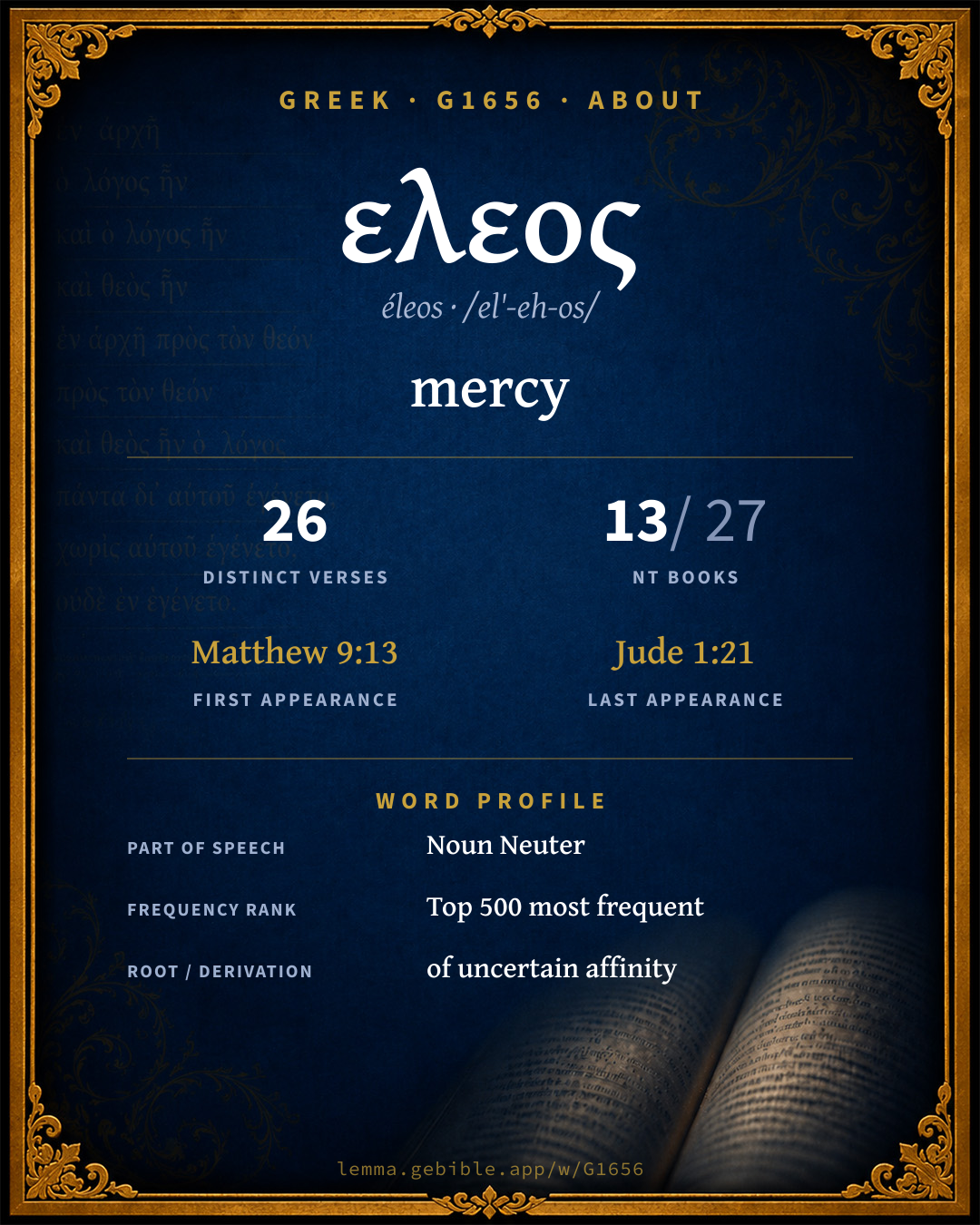
ἔλεος
mercy
Full lexicon entry — Thayer's Greek Lexicon
From Thayer's Greek Lexicon
Where this word appears
See every Accusative-case word in the Greek New Testament →
Grammar key — what these labels mean
Part of speech
- Noun
- A naming word — a person, place, thing, or idea.
Case
- Accusative
- The case of the direct object and of extent.
- Nominative
- The case of the subject (and the predicate nominative).
- Genitive
- The case of source, possession, or “of” — answers “whose / from what.”
- Dative
- The case of the indirect object, means, or location — “to / for / with / in.”
Gender
- Neuter
- Grammatically neuter.
Number
- Singular
- One.
Grammatical forms
- Noun, Accusative, Singular, Neuter 13 times (48%)
- Noun, Nominative, Singular, Neuter 7 times (26%)
- Noun, Genitive, Singular, Neuter 5 times (19%)
- Noun, Dative, Singular, Neuter 2 times (7%)
Parsed forms decoded from the imported morphology (Robinson–Tischendorf, public domain), counted across 27 parsed occurrences — not distinct verses.
Every verse where G1656 appears — 26 distinct verses across 13 books. Click any verse to open its interlinear word-by-word view. Verse text shown in the World English Bible for context — . Each verse’s Greek form is shown with its reference; the English is not keyword-highlighted, since the data carries no word-level English alignment. Use “Compare translations” on any verse to read it across multiple English versions. This concordance covers the Greek New Testament; Septuagint (Greek Old Testament) occurrences of this word are not indexed here.
Matthew 3 verses
- Matthew 9:13 ἔλεος n acc sg neut But you go and learn what this means: 'I desire mercy, and not sacrifice,' for I came not to call the righteous, but sinners to repentance."
- Matthew 12:7 ἔλεος n acc sg neut But if you had known what this means, 'I desire mercy, and not sacrifice,' you would not have condemned the guiltless.
- Matthew 23:23 ἔλεος n acc sg neut "Woe to you, scribes and Pharisees, hypocrites! For you tithe mint, dill, and cumin, and have left undone the weightier matters of the law: justice, mercy, and faith. But you ought to have done these, and not to have left the other undone.
Luke 6 verses
- Luke 1:50 ἔλεος n nom sg neut His mercy is for generations of generations on those who fear him.
- Luke 1:54 ἐλέους n gen sg neut He has given help to Israel, his servant, that he might remember mercy,
- Luke 1:58 ἔλεος n acc sg neut Her neighbors and her relatives heard that the Lord had magnified his mercy towards her, and they rejoiced with her.
- Luke 1:72 ἔλεος n acc sg neut To show mercy towards our fathers, To remember his holy covenant,
- Luke 1:78 ἐλέους n gen sg neut Because of the tender mercy of our God, Whereby the dawn from on high will visit us,
- Luke 10:37 ἔλεος n acc sg neut He said, "He who showed mercy on him." Then Jesus said to him, "Go and do likewise."
Romans 3 verses
- Romans 9:23 ἐλέους n gen sg neut and that he might make known the riches of his glory on vessels of mercy, which he prepared beforehand for glory,
- Romans 11:31 ἐλέει n dat sg neut even so these also have now been disobedient, that by the mercy shown to you they may also obtain mercy.
- Romans 15:9 ἐλέους n gen sg neut and that the Gentiles might glorify God for his mercy. As it is written, "Therefore will I give praise to you among the Gentiles, And sing to your name."
Galatians 1 verse
Ephesians 1 verse
1 Timothy 1 verse
2 Timothy 3 verses
- 2 Timothy 1:2 ἔλεος n nom sg neut to Timothy, my beloved child: Grace, mercy, and peace, from God the Father and Christ Jesus our Lord.
- 2 Timothy 1:16 ἔλεος n acc sg neut May the Lord grant mercy to the house of Onesiphorus, for he often refreshed me, and was not ashamed of my chain,
- 2 Timothy 1:18 ἔλεος n acc sg neut (the Lord grant to him to find the Lord's mercy in that day); and in how many things he served at Ephesus, you know very well.
Titus 1 verse
Hebrews 1 verse
James 2 verses
- James 2:13 ἔλεος ἔλεος n acc sg neut n nom sg neut For judgment is without mercy to him who has shown no mercy. Mercy triumphs over judgment.
- James 3:17 ἐλέους n gen sg neut But the wisdom that is from above is first pure, then peaceful, gentle, reasonable, full of mercy and good fruits, without partiality, and without hypocrisy.
1 Peter 1 verse
2 John 1 verse
Jude 2 verses
About this entry
At a glance — auto-summarized from this page’s data, not written by a person. Every figure links to its source below. This summary describes the numbers; it doesn’t interpret them.
At its core, ελεος (éleos) means “mercy.” Scripture first uses it in Matthew 9:13. With 26 verses in 13 books, it is a moderately common word in the Greek New Testament. Sharing its root, it stands alongside ελεεινος, ελεεω and ελεημοσυνη. Dig into 26-verse concordance and the renderings breakdown below.
Gloss history
Strong's 1890 vs modern scholarship
About this word
Strong's G1656 catalogs a Greek word from the Greek New Testament.
These counts are not copied from any lexicon or concordance. They are computed here, from the morphology-tagged Greek New Testament. What Lemma adds →
- 26
- distinct verses
- The word appears in 26 distinct verses.
- 13 / 27
- NT books
- The word appears in 13 of 27 New Testament books.
- #500
- by frequency
- Top 500 most frequent Greek words (rank 500 of 5,347 Greek words by occurrence).
View all 26 occurrences in the concordance →
By section of the New Testament
By traditional corpus
Conventional, traditional groupings — biblical authorship is debated, so this is a traditional corpus grouping, not an authorship claim. Some books belong to more than one corpus (Luke is in both the Gospels and the Lukan corpus, and so on), so these shares overlap and need not total 100%. Each figure is a share of the word’s 26 distinct verses.
- Pauline corpus 10 verses · 38%
- Gospels 9 verses · 35%
- Lukan (Luke–Acts) 6 verses · 23%
- General (Catholic) Epistles 6 verses · 23%
- Johannine 1 verse · 4%
- Hebrews 1 verse · 4%
How translations render this word
Counts come from each version’s own published word-to-Strong’s tagging or interlinear alignment — an approximate guide to how each version renders this word, not a word-level alignment the data otherwise carries. Because each total is that version’s own tagged count, the per-version totals vary from one another and need not match the appearance or distinct-verse counts above. These counts may also differ from a printed concordance because Lemma counts each distinctly tagged rendering and does not collapse phrase taggings into a single head-word total. This is a fixed set of word-tagged versions (KJV, ASV, BSB, ULT) and does not change with the reading translation you choose elsewhere. Each version’s license is shown beside its name below (and on Sources).
- King James Version: Mercy 27×
- American Standard Version: Mercy 27×
- Berean Standard Bible: Mercy 25×
- unfoldingWord Literal Text: Mercy 27×
King James Version Public Domain
Renders G1656 across 28 tagged occurrences — most commonly:
Plus 1 rendering that appears only once — usually multi-word phrases or single function words the recovered tagging swept in, not distinct renderings.
American Standard Version Public Domain
Renders G1656 across 29 tagged occurrences — most commonly:
Plus 2 renderings that appear only once — usually multi-word phrases or single function words the recovered tagging swept in, not distinct renderings.
Berean Standard Bible Public Domain
Renders G1656 across 26 tagged occurrences — most commonly:
Plus 1 rendering that appears only once — usually multi-word phrases or single function words the recovered tagging swept in, not distinct renderings. Not rendered by a distinct English word in 1 further occurrence.
unfoldingWord Literal Text CC BY-SA 4.0
Renders G1656 across 29 tagged occurrences — most commonly:
Plus 2 renderings that appear only once — usually multi-word phrases or single function words the recovered tagging swept in, not distinct renderings.
Senses in Thayer's
The 1 sense Thayer's distinguishes for this word, in lexicon order (not ranked by frequency or importance). The full entry — with sub-senses — is in the Lexicon Entry tab.
- mercy: kindness or good will towards the miserable and the afflicted, joined with a desire to help them
Word origin
Origin: of uncertain affinity
Of uncertain affinity; compassion (human or divine especially active): - (+ tender) mercy.
— Strong’s Exhaustive Concordance (1890), public domain.
Forms in the corpus
The 3 distinct written forms G1656 takes in the Greek New Testament, most frequent first — each parse links to that case’s occurrences in the concordance.
| Form | Parsing | Example | Uses |
|---|---|---|---|
| ἔλεος éleos | Noun, Accusative, Singular, Neuter | Matthew 9:13 | 20 |
| ἐλέους eléous | Noun, Genitive, Singular, Neuter | Luke 1:54 | 5 |
| ἐλέει eléei | Noun, Dative, Singular, Neuter | Romans 11:31 | 2 |
Same root — word family
Other Thayer's entries built from the same root as G1656, grouped by Strong’s listed origin. These share a root / origin per the lexicon — not necessarily a shared meaning. Each links to that word’s own entry.
Derived from this word
- ελεεινος eleeinós G1652 to be miserable
- ελεεω eleéō G1653 to have mercy
- ελεημοσυνη eleēmosýnē G1654 mercy
Compare all same-root words → They share a root, not necessarily a meaning.
Septuagint usage
The same Greek word ελεος appears 245 times in the Greek Old Testament (Septuagint), across 235 verses in 26 books.
- 245
- LXX occurrences
- Tagged occurrences of this Greek word in the Septuagint.
- 235
- verses
- Distinct Septuagint verses containing this word.
- 26 / 39
- OT books
- The word appears in 26 of the 39 Old Testament books.
Sample Septuagint occurrences
- Genesis 19:19 ἔλεος
- Exodus 20:6 ἔλεος
- Numbers 11:15 ἔλεος
- Deuteronomy 5:10 ἔλεος
- Joshua 2:12 ἔλεος
- Judges 1:24 ἔλεος
- Ruth 1:8 ἔλεος
- 1 Samuel 15:6 ἔλεος
- 2 Samuel 2:5 ἔλεος
- 1 Kings 2:7 ἔλεος
- 1 Chronicles 16:34 ἔλεος
- 2 Chronicles 1:8 ἔλεος
Septuagint occurrences (same lexeme)
Every verse where the same Strong’s number (G1656) appears in the Greek Septuagint — showing the first 50 of 235. Verse text shown in the World English Bible for context; the Greek form is the matched word — the English is not keyword-highlighted.
- Genesis 19:19 ἔλεος See now, your servant has found favor in your sight, and you have magnified your loving kindness, which you have shown to me in saving my life. I can't escape to the mountain, lest evil overtake me, and I die.
- Genesis 24:12 ἔλεος He said, "Yahweh, the God of my master Abraham, please give me success this day, and show kindness to my master Abraham.
- Genesis 24:14 ἔλεος Let it happen, that the young lady to whom I will say, 'Please let down your pitcher, that I may drink.' She will say, 'Drink, and I will also give your camels a drink.' Let the same be she who you have appointed for your servant Isaac. Thereby will I know that you have shown kindness to my master."
- Genesis 24:44 ἔλεος She will tell me, "Drink, and I will also draw for your camels." Let the same be the woman whom Yahweh has appointed for my master's son.'
- Genesis 24:49 ἔλεος Now if you will deal kindly and truly with my master, tell me. If not, tell me. That I may turn to the right hand, or to the left."
- Genesis 39:21 ἔλεος But Yahweh was with Joseph, and showed kindness to him, and gave him favor in the sight of the keeper of the prison.
- Genesis 40:14 ἔλεος But remember me when it will be well with you, and show kindness, please, to me, and make mention of me to Pharaoh, and bring me out of this house.
- Exodus 20:6 ἔλεος and showing loving kindness to thousands of those who love me and keep my commandments.
- Exodus 34:7 ἔλεος keeping loving kindness for thousands, forgiving iniquity and disobedience and sin; and that will by no means clear the guilty, visiting the iniquity of the fathers on the children, and on the children's children, on the third and on the fourth generation."
- Numbers 11:15 ἔλεος If you deal thus with me, please kill me out of hand, if I have found favor in your sight; and let me not see my wretchedness.
- Numbers 14:19 ἔλεος Pardon, Please, the iniquity of this people according to the greatness of your loving kindness, and according as you have forgiven this people, from Egypt even until now.
- Deuteronomy 5:10 ἔλεος and showing loving kindness to thousands of those who love me and keep my commandments.
- Deuteronomy 7:9 ἔλεος Know therefore that Yahweh your God, he is God, the faithful God, who keeps covenant and loving kindness with them who love him and keep his commandments to a thousand generations,
- Deuteronomy 7:12 ἔλεος It shall happen, because you listen to these ordinances, and keep and do them, that Yahweh your God will keep with you the covenant and the loving kindness which he swore to your fathers:
- Deuteronomy 13:18 ἔλεος when you shall listen to the voice of Yahweh your God, to keep all his commandments which I command you this day, to do that which is right in the eyes of Yahweh your God.
- Joshua 2:12 ἔλεος Now therefore, please swear to me by Yahweh, since I have dealt kindly with you, that you also will deal kindly with my father's house, and give me a true token;
- Joshua 2:14 ἔλεος The men said to her, Our life for yours, if you don't utter this our business; and it shall be, when Yahweh gives us the land, that we will deal kindly and truly with you.
- Joshua 11:20 ἔλεος For it was of Yahweh to harden their hearts, to come against Israel in battle, that he might utterly destroy them, that they might have no favor, but that he might destroy them, as Yahweh commanded Moses.
- Judges 1:24 ἔλεος The watchers saw a man come forth out of the city, and they said to him, Show us, we pray you, the entrance into the city, and we will deal kindly with you.
- Judges 6:17 ἔλεος He said to him, If now I have found favor in your sight, then show me a sign that it is you who talk with me.
- Judges 8:35 ἔλεος neither shown they kindness to the house of Jerubbaal, [who is] Gideon, according to all the goodness which he had shown to Israel.
- Judges 21:22 ἔλεος It shall be, when their fathers or their brothers come to complain to us, that we will say to them, Grant them graciously to us, because we didn't take for each man his wife in battle, neither did you give them to them, else would you now be guilty.
- Ruth 1:8 ἔλεος Naomi said to her two daughters-in-law, Go, return each of you to her mother's house: Yahweh deal kindly with you, as you have dealt with the dead, and with me.
- Ruth 2:20 ἔλεος Naomi said to her daughter-in-law, Blessed be he of Yahweh, who has not left off his kindness to the living and to the dead. Naomi said to her, The man is a close relative to us, one of our near kinsmen.
- Ruth 3:10 ἔλεος He said, Blessed are you by Yahweh, my daughter: you have shown more kindness in the latter end than at the beginning, inasmuch as you didn't follow young men, whether poor or rich.
- 1 Samuel 15:6 ἔλεος Saul said to the Kenites, Go, depart, get you down from among the Amalekites, lest I destroy you with them; for you shown kindness to all the children of Israel, when they came up out of Egypt. So the Kenites departed from among the Amalekites.
- 1 Samuel 20:8 ἔλεος Therefore deal kindly with your servant; for you have brought your servant into a covenant of Yahweh with you: but if there be in me iniquity, kill me yourself; for why should you bring me to your father?
- 1 Samuel 20:14 ἔλεος You shall not only while yet I live show me the loving kindness of Yahweh, that I not die;
- 1 Samuel 20:15 ἔλεος but also you shall not cut off your kindness from my house forever; no, not when Yahweh has cut off the enemies of David everyone from the surface of the earth.
- 2 Samuel 2:5 ἔλεος David sent messengers to the men of Jabesh Gilead, and said to them, Blessed be you of Yahweh, that you have shown this kindness to your lord, even to Saul, and have buried him.
- 2 Samuel 2:6 ἔλεος Now Yahweh show loving kindness and truth to you: and I also will requite you this kindness, because you have done this thing.
- 2 Samuel 3:8 ἔλεος Then was Abner very angry for the words of Ish-bosheth, and said, Am I a dog's head that belongs to Judah? This day do I show kindness to the house of Saul your father, to his brothers, and to his friends, and have not delivered you into the hand of David; and yet you charge me this day with a fault concerning this woman.
- 2 Samuel 7:15 ἔλεος but my loving kindness shall not depart from him, as I took it from Saul, whom I put away before you.
- 2 Samuel 9:1 ἔλεος David said, Is there yet any who is left of the house of Saul, that I may show him kindness for Jonathan's sake?
- 2 Samuel 9:3 ἔλεος The king said, Is there not yet any of the house of Saul, that I may show the kindness of God to him? Ziba said to the king, Jonathan has yet a son, who is lame of his feet.
- 2 Samuel 9:7 ἔλεος David said to him, "Don't be afraid of him; for I will surely show you kindness for Jonathan your father's sake, and will restore you all the land of Saul your father; and you shall eat bread at my table continually."
- 2 Samuel 10:2 ἔλεος David said, I will show kindness to Hanun the son of Nahash, as his father shown kindness to me. So David sent by his servants to comfort him concerning his father. David's servants came into the land of the children of Ammon.
- 2 Samuel 15:20 ἔλεος Whereas you came but yesterday, should I this day make you go up and down with us, seeing I go where I may? return you, and take back your brothers; mercy and truth be with you.
- 2 Samuel 16:17 ἔλεος Absalom said to Hushai, Is this your kindness to your friend? Why didn't you go with your friend?
- 2 Samuel 22:51 ἔλεος Great deliverance gives he to his king, Shows loving kindness to his anointed, To David and to his seed, forevermore.
- 1 Kings 2:7 ἔλεος But show kindness to the sons of Barzillai the Gileadite, and let them be of those who eat at your table; for so they came to me when I fled from Absalom your brother.
- 1 Kings 3:6 ἔλεος Solomon said, You have shown to your servant David my father great loving kindness, according as he walked before you in truth, and in righteousness, and in uprightness of heart with you; and you have kept for him this great loving kindness, that you have given him a son to sit on his throne, as it is this day.
- 1 Kings 8:23 ἔλεος and he said, Yahweh, the God of Israel, there is no God like you, in heaven above, or on earth beneath; who keep covenant and loving kindness with your servants, who walk before you with all their heart;
- 1 Kings 21:31 ἔλεος
- 1 Chronicles 16:34 ἔλεος Oh give thanks to Yahweh; for he is good; For his loving kindness endures forever.
- 1 Chronicles 16:41 ἔλεος and with them Heman and Jeduthun, and the rest who were chosen, who were mentioned by name, to give thanks to Yahweh, because his loving kindness endures forever;
- 1 Chronicles 17:13 ἔλεος I will be his father, and he shall be my son: and I will not take my loving kindness away from him, as I took it from him that was before you;
- 1 Chronicles 19:2 ἔλεος David said, I will show kindness to Hanun the son of Nahash, because his father shown kindness to me. So David sent messengers to comfort him concerning his father. David's servants came into the land of the children of Ammon to Hanun, to comfort him.
- 2 Chronicles 1:8 ἔλεος Solomon said to God, You have shown great loving kindness to David my father, and have made me king in his place.
- 2 Chronicles 5:13 ἔλεος it happened, when the trumpeters and singers were as one, to make one sound to be heard in praising and thanking Yahweh; and when they lifted up their voice with the trumpets and cymbals and instruments of music, and praised Yahweh, [saying], For he is good; for his loving kindness endures forever; that then the house was filled with a cloud, even the house of Yahweh,
These are occurrences of the same Greek lexeme (G1656) in the Septuagint — not a translation of any one Hebrew word. The store carries no word-level Hebrew↔Greek alignment, so no Hebrew original is asserted here. Counts come from the recovered LXX Strong's tagging — high-frequency vocabulary is well covered, while rare or late forms may be untagged — so they reflect tagged occurrences and may slightly undercount.