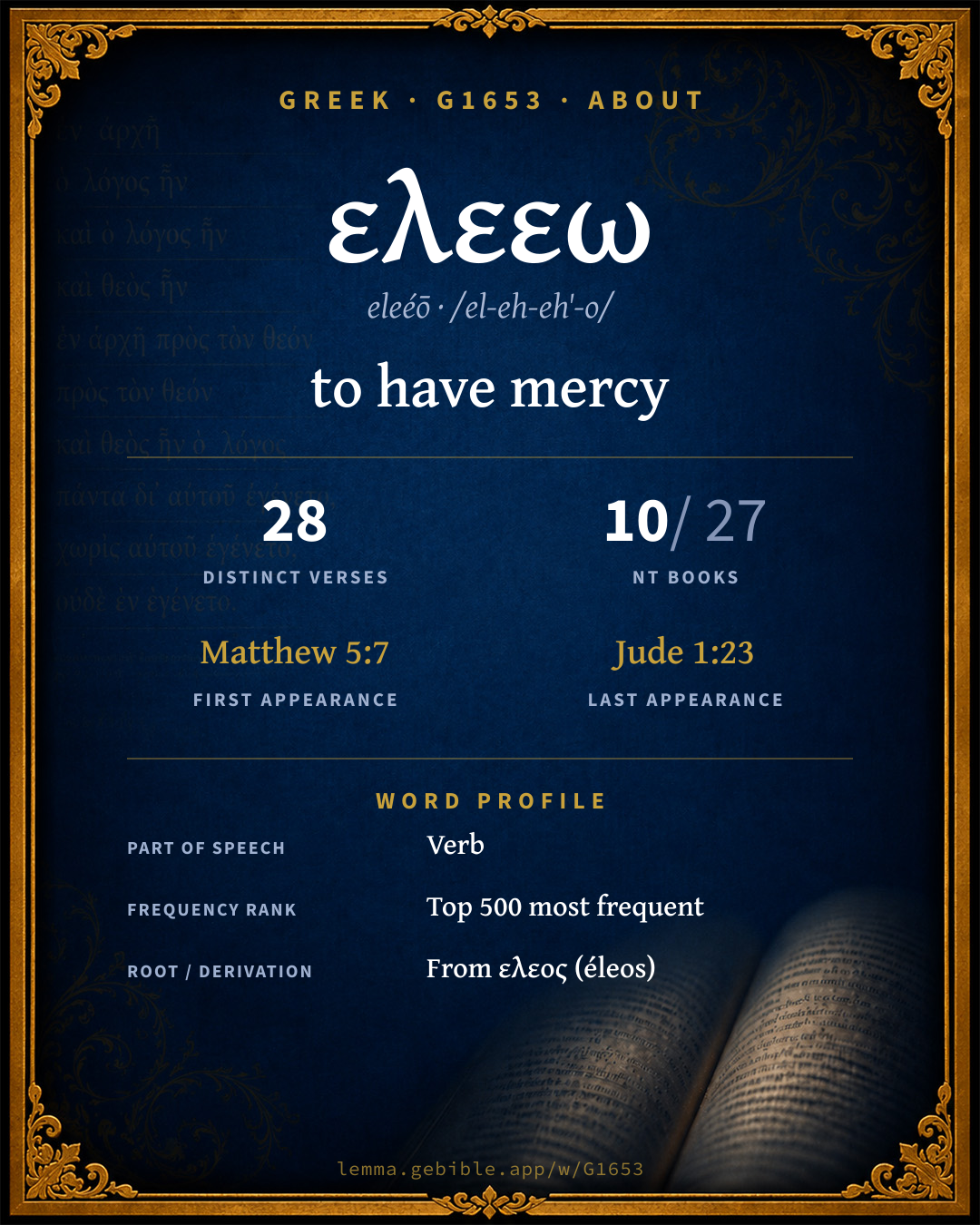
ἐλεέω
to have mercy
‘to have mercy’ is one of 4 main senses fuller range ↓
Full lexicon entry — Thayer's Greek Lexicon
From Thayer's Greek Lexicon
Where this word appears
See every Aorist-tense verb in the Greek New Testament →
Grammar key — what these labels mean
Part of speech
- Verb
- An action or state-of-being word.
Tense
- Aorist
- Action viewed as a simple whole, without regard to duration — often past (perfective aspect).
- Future
- Action expected in future time.
- Present
- Ongoing or general action in present time (imperfective aspect).
- Perfect
- A completed past action with continuing present results.
Voice
- Active
- The subject performs the action.
- Passive
- The subject receives the action.
Mood
- Imperative
- Expresses a command or request.
- Indicative
- States a fact or asks a factual question (the mood of reality).
- Infinitive
- A verbal noun (“to write”), unmarked for person or number.
- Subjunctive
- Expresses probability, purpose, or possibility (the mood of contingency).
- Participle
- A verbal adjective (“writing,” “having written”).
Case
- Nominative
- The case of the subject (and the predicate nominative).
- Genitive
- The case of source, possession, or “of” — answers “whose / from what.”
Person
- 2nd person
- The one addressed (“you”).
- 3rd person
- The one spoken about (“he / she / it / they”).
- 1st person
- The speaker (“I / we”).
Gender
- Masculine
- Grammatically masculine.
Number
- Singular
- One.
- Plural
- More than one.
Grammatical forms 19 distinct
- Verb, Aorist, Active, Imperative, 2nd person, Singular 11 times (35%)
- Verb, Aorist, Active, Indicative, 3rd person, Singular 2 times (6%)
- Verb, Aorist, Passive, Indicative, 1st person, Singular 2 times (6%)
- Verb, Aorist, Active, Indicative, 1st person, Singular 1 time (3%)
- Verb, Aorist, Active, Infinitive 1 time (3%)
- Verb, Aorist, Active, Subjunctive, 3rd person, Singular 1 time (3%)
- Verb, Aorist, Passive, Indicative, 1st person, Plural 1 time (3%)
- Verb, Aorist, Passive, Indicative, 2nd person, Plural 1 time (3%)
+11 more forms (11 occurrences)
Parsed forms decoded from the imported morphology (Robinson–Tischendorf, public domain), counted across 31 parsed occurrences — not distinct verses.
Every verse where G1653 appears — 28 distinct verses across 10 books. Click any verse to open its interlinear word-by-word view. Verse text shown in the World English Bible for context — . Each verse’s Greek form is shown with its reference; the English is not keyword-highlighted, since the data carries no word-level English alignment. Use “Compare translations” on any verse to read it across multiple English versions. This concordance covers the Greek New Testament; Septuagint (Greek Old Testament) occurrences of this word are not indexed here.
Matthew 7 verses
- Matthew 5:7 ἐλεηθήσονται fut pass ind 3pl Blessed are the merciful, For they shall obtain mercy.
- Matthew 9:27 ἐλέησον aor act impv 2sg As Jesus passed by from there, two blind men followed him, calling out and saying, "Have mercy on us, son of David!"
- Matthew 15:22 ἐλέησόν aor act impv 2sg Behold, a Canaanite woman came out from those borders, and cried, saying, "Have mercy on me, Lord, you son of David! My daughter is severely demonized!"
- Matthew 17:15 ἐλέησόν aor act impv 2sg "Lord, have mercy on my son, for he is epileptic, and suffers grievously; for he often falls into the fire, and often into the water.
- Matthew 18:33 ἐλεῆσαι ἠλέησα aor act inf aor act ind 1sg Shouldn't you also have had mercy on your fellow servant, even as I had mercy on you?'
- Matthew 20:30 ἐλέησον aor act impv 2sg Behold, two blind men sitting by the road, when they heard that Jesus was passing by, cried out, "Lord, have mercy on us, you son of David!"
- Matthew 20:31 ἐλέησον aor act impv 2sg The multitude rebuked them, telling them that they should be quiet, but they cried out even more, "Lord, have mercy on us, you son of David!"
Mark 3 verses
- Mark 5:19 ἠλέησέν aor act ind 3sg He didn't allow him, but said to him, "Go to your house, to your friends, and tell them what great things the Lord has done for you, and how he had mercy on you."
- Mark 10:47 ἐλέησόν aor act impv 2sg When he heard that it was Jesus the Nazarene, he began to cry out, and say, "Jesus, you son of David, have mercy on me!"
- Mark 10:48 ἐλέησόν aor act impv 2sg Many rebuked him, that he should be quiet, but he cried out much more, "You son of David, have mercy on me!"
Luke 4 verses
- Luke 16:24 ἐλέησόν aor act impv 2sg He cried and said, 'Father Abraham, have mercy on me, and send Lazarus, that he may dip the tip of his finger in water, and cool my tongue! For I am in anguish in this flame.'
- Luke 17:13 ἐλέησον aor act impv 2sg They lifted up their voices, saying, "Jesus, Master, have mercy on us!"
- Luke 18:38 ἐλέησόν aor act impv 2sg He cried out, "Jesus, you son of David, have mercy on me!"
- Luke 18:39 ἐλέησόν aor act impv 2sg Those who led the way rebuked him, that he should be quiet; but he cried out all the more, "You son of David, have mercy on me!"
Romans 7 verses
- Romans 9:15 ἐλεήσω ἐλεῶ fut act ind 1sg pres act subj 1sg For he said to Moses, "I will have mercy on whom I have mercy, and I will have compassion on whom I have compassion."
- Romans 9:16 ἐλεῶντος pres act ptcp gen sg masc So then it is not of him who wills, nor of him who runs, but of God who has mercy.
- Romans 9:18 ἐλεεῖ pres act ind 3sg So then, he has mercy on whom he desires, and he hardens whom he desires.
- Romans 11:30 ἠλεήθητε aor pass ind 2pl For as you in time past were disobedient to God, but now have obtained mercy by their disobedience,
- Romans 11:31 ἐλεηθῶσιν aor pass subj 3pl even so these also have now been disobedient, that by the mercy shown to you they may also obtain mercy.
- Romans 11:32 ἐλεήσῃ aor act subj 3sg For God has shut up all to disobedience, that he might have mercy on all.
- Romans 12:8 ἐλεῶν pres act ptcp nom sg masc or he who exhorts, to his exhorting: he who gives, let him do it with liberality; he who rules, with diligence; he who shows mercy, with cheerfulness.
1 Corinthians 1 verse
2 Corinthians 1 verse
Philippians 1 verse
1 Timothy 2 verses
- 1 Timothy 1:13 ἠλεήθην aor pass ind 1sg although I was before a blasphemer, a persecutor, and insolent. However, I obtained mercy, because I did it ignorantly in unbelief.
- 1 Timothy 1:16 ἠλεήθην aor pass ind 1sg However, for this cause I obtained mercy, that in me first, Jesus Christ might display all his patience, for an example of those who were going to believe in him for eternal life.
1 Peter 1 verse
Jude 1 verse
About this entry
At a glance — auto-summarized from this page’s data, not written by a person. Every figure links to its source below. This summary describes the numbers; it doesn’t interpret them.
At its core, ελεεω (eleéō) means “to have mercy.” Its English rendering has broadened — “have mercy” classically, “have mercy on” (Berean Standard Bible) in modern versions; see the renderings breakdown. Spanning 28 verses in 10 books, it ranks among the moderately common words of the Greek New Testament. Its uses concentrate in Matthew (25% of all occurrences). Ranging over 4 senses, it is not a single-sense word. Each statement above links to its evidence; the full detail follows below.
Gloss history
Strong's 1890 vs modern scholarship

About this word
Strong's G1653 catalogs a Greek word from the Greek New Testament.
These counts are not copied from any lexicon or concordance. They are computed here, from the morphology-tagged Greek New Testament. What Lemma adds →
- 28
- distinct verses
- The word appears in 28 distinct verses.
- 10 / 27
- NT books
- The word appears in 10 of 27 New Testament books.
- #448
- by frequency
- Top 500 most frequent Greek words (rank 448 of 5,347 Greek words by occurrence).
View all 28 occurrences in the concordance →
By section of the New Testament
By traditional corpus
Conventional, traditional groupings — biblical authorship is debated, so this is a traditional corpus grouping, not an authorship claim. Some books belong to more than one corpus (Luke is in both the Gospels and the Lukan corpus, and so on), so these shares overlap and need not total 100%. Each figure is a share of the word’s 28 distinct verses.
- Gospels 14 verses · 50%
- Pauline corpus 12 verses · 43%
- Lukan (Luke–Acts) 4 verses · 14%
- General (Catholic) Epistles 2 verses · 7%
How translations render this word
Counts come from each version’s own published word-to-Strong’s tagging or interlinear alignment — an approximate guide to how each version renders this word, not a word-level alignment the data otherwise carries. Because each total is that version’s own tagged count, the per-version totals vary from one another and need not match the appearance or distinct-verse counts above. These counts may also differ from a printed concordance because Lemma counts each distinctly tagged rendering and does not collapse phrase taggings into a single head-word total. This is a fixed set of word-tagged versions (KJV, ASV, BSB, ULT) and does not change with the reading translation you choose elsewhere. Each version’s license is shown beside its name below (and on Sources).
- King James Version: Have mercy 11×, I obtained mercy 2×, Obtained mercy 2×
- American Standard Version: Have mercy 7×, Have mercy on 5×, I obtained mercy 2×
- Berean Standard Bible: Have mercy on 12×, Mercy 3×, I was shown mercy 2×
- unfoldingWord Literal Text: Have mercy on 8×, Have mercy 5×, Having received mercy 3×
King James Version Public Domain
Renders G1653 across 33 tagged occurrences — most commonly:
Plus 18 renderings that appear only once — usually multi-word phrases or single function words the recovered tagging swept in, not distinct renderings.
American Standard Version Public Domain
Renders G1653 across 34 tagged occurrences — most commonly:
Plus 18 renderings that appear only once — usually multi-word phrases or single function words the recovered tagging swept in, not distinct renderings.
Berean Standard Bible Public Domain
Renders G1653 across 31 tagged occurrences — most commonly:
Plus 14 renderings that appear only once — usually multi-word phrases or single function words the recovered tagging swept in, not distinct renderings. Not rendered by a distinct English word in 1 further occurrence.
unfoldingWord Literal Text CC BY-SA 4.0
Renders G1653 across 33 tagged occurrences — most commonly:
Plus 11 renderings that appear only once — usually multi-word phrases or single function words the recovered tagging swept in, not distinct renderings.
Senses in Thayer's
The 4 senses Thayer's distinguishes for this word, in lexicon order (not ranked by frequency or importance). The full entry — with sub-senses — is in the Lexicon Entry tab.
- to have mercy on
- to help one afflicted or seeking aid
- to help the afflicted, to bring help to the wretched
- to experience mercy
Word origin
Derived from ελεος (éleos) (G1656) — mercy.
From G1656 ; to compassionate (by word or deed specifically by divine grace): - have compassion (pity on) have (obtain receive shew) mercy (on).
— Strong’s Exhaustive Concordance (1890), public domain.
Forms in the corpus
The 21 distinct written forms G1653 takes in the Greek New Testament, most frequent first — each parse links to that tense’s occurrences in the concordance.
Same root — word family
Other Thayer's entries built from the same root as G1653, grouped by Strong’s listed origin. These share a root / origin per the lexicon — not necessarily a shared meaning. Each links to that word’s own entry.
Derives from
Shares the same root
Derived from this word
Compare all same-root words → Showing 4 of 5 — not the complete family. They share a root, not necessarily a meaning.
Septuagint usage
The same Greek word ελεεω appears 90 times in the Greek Old Testament (Septuagint), across 84 verses in 17 books.
- 90
- LXX occurrences
- Tagged occurrences of this Greek word in the Septuagint.
- 84
- verses
- Distinct Septuagint verses containing this word.
- 17 / 39
- OT books
- The word appears in 17 of the 39 Old Testament books.
Sample Septuagint occurrences
- Genesis 33:5 ἐλεέω
- Exodus 23:3 ἐλεέω
- Numbers 6:25 ἐλεέω
- Deuteronomy 7:2 ἐλεέω
- 2 Samuel 12:22 ἐλεέω
- 2 Kings 13:23 ἐλεέω
- 2 Chronicles 36:17 ἐλεέω
- Job 19:21 ἐλεέω
- Psalms 6:3 ἐλεέω
- Proverbs 12:13 ἐλεέω
- Isaiah 9:16 ἐλεέω
- Jeremiah 6:23 ἐλεέω
Septuagint occurrences (same lexeme)
Every verse where the same Strong’s number (G1653) appears in the Greek Septuagint — showing the first 50 of 84. Verse text shown in the World English Bible for context; the Greek form is the matched word — the English is not keyword-highlighted.
- Genesis 33:5 ἐλεέω He lifted up his eyes, and saw the women and the children; and said, "Who are these with you?" He said, "The children whom God has graciously given your servant."
- Genesis 33:11 ἐλεέω Please take the gift that I brought to you; because God has dealt graciously with me, and because I have enough." He urged him, and he took it.
- Genesis 43:29 ἐλεέω He lifted up his eyes, and saw Benjamin, his brother, his mother's son, and said, "Is this your youngest brother, of whom you spoke to me?" He said, "God be gracious to you, my son."
- Exodus 23:3 ἐλεέω neither shall you favor a poor man in his cause.
- Exodus 33:19 ἐλεέω He said, "I will make all my goodness pass before you, and will proclaim the name of Yahweh before you. I will be gracious to whom I will be gracious, and will show mercy on whom I will show mercy."
- Numbers 6:25 ἐλεέω Yahweh make his face to shine on you, And be gracious to you.
- Deuteronomy 7:2 ἐλεέω and when Yahweh your God shall deliver them up before you, and you shall strike them; then you shall utterly destroy them: you shall make no covenant with them, nor show mercy to them;
- Deuteronomy 13:18 ἐλεέω when you shall listen to the voice of Yahweh your God, to keep all his commandments which I command you this day, to do that which is right in the eyes of Yahweh your God.
- Deuteronomy 28:50 ἐλεέω a nation of fierce facial expressions, that shall not regard the person of the old, nor show favor to the young,
- Deuteronomy 30:3 ἐλεέω that then Yahweh your God will turn your captivity, and have compassion on you, and will return and gather you from all the peoples, where Yahweh your God has scattered you.
- 2 Samuel 12:22 ἐλεέω He said, While the child was yet alive, I fasted and wept: for I said, Who knows whether Yahweh will not be gracious to me, that the child may live?
- 2 Kings 13:23 ἐλεέω But Yahweh was gracious to them, and had compassion on them, and had respect to them, because of his covenant with Abraham, Isaac, and Jacob, and would not destroy them, neither cast he them from his presence as yet.
- 2 Chronicles 36:17 ἐλεέω Therefore he brought on them the king of the Chaldeans, who killed their young men with the sword in the house of their sanctuary, and had no compassion on young man or virgin, old man or gray-headed: he gave them all into his hand.
- Job 19:21 ἐλεέω "Have pity on me, have pity on me, you my friends; For the hand of God has touched me.
- Job 24:21 ἐλεέω He devours the barren who don't bear. He shows no kindness to the widow.
- Job 27:15 ἐλεέω Those who remain of him shall be buried in death. His widows shall make no lamentation.
- Job 41:4 ἐλεέω Will he make a covenant with you, That you should take him for a servant forever?
- Psalms 6:3 ἐλεέω My soul is also in great anguish. But you, Yahweh--how long?
- Psalms 9:14 ἐλεέω That I may show forth all your praise. In the gates of the daughter of Zion, I will rejoice in your salvation.
- Psalms 24:16 ἐλεέω
- Psalms 25:11 ἐλεέω For your name's sake, Yahweh, Pardon my iniquity, for it is great.
- Psalms 26:7 ἐλεέω That I may make the voice of thanksgiving to be heard, And tell of all your wondrous works.
- Psalms 29:11 ἐλεέω Yahweh will give strength to his people. Yahweh will bless his people with peace.
- Psalms 30:10 ἐλεέω Hear, Yahweh, and have mercy on me. Yahweh, be my helper."
- Psalms 40:5 ἐλεέω Many, Yahweh, my God, are the wonderful works which you have done, And your thoughts which are toward us. They can't be set in order to you; If I would declare and speak of them, they are more than can be numbered.
- Psalms 40:11 ἐλεέω Don't withhold your tender mercies from me, Yahweh. Let your loving kindness and your truth continually preserve me.
- Psalms 50:3 ἐλεέω Our God comes, and does not keep silent. A fire devours before him. It is very tempestuous around him.
- Psalms 55:2 ἐλεέω Attend to me, and answer me. I am restless in my complaint, and moan,
- Psalms 56:2 ἐλεέω My enemies want to swallow me up all day long, For they are many who fight proudly against me.
- Psalms 85:3 ἐλεέω You have taken away all your wrath. You have turned from the fierceness of your anger.
- Psalms 85:16 ἐλεέω
- Psalms 118:29 ἐλεέω Oh give thanks to Yahweh, for he is good, For his loving kindness endures forever.
- Psalms 118:58 ἐλεέω
- Psalms 118:132 ἐλεέω
- Psalms 122:3 ἐλεέω Jerusalem, that is built as a city that is compact together;
- Proverbs 12:13 ἐλεέω An evil man is trapped by sinfulness of lips, But the righteous shall come out of trouble.
- Proverbs 14:21 ἐλεέω He who despises his neighbor sins, But blessed is he who has pity on the poor.
- Proverbs 17:5 ἐλεέω Whoever mocks the poor reproaches his Maker. He who is glad at calamity shall not be unpunished.
- Proverbs 19:17 ἐλεέω He who has pity on the poor lends to Yahweh; He will reward him.
- Proverbs 21:10 ἐλεέω The soul of the wicked desires evil; His neighbor finds no mercy in his eyes.
- Proverbs 22:9 ἐλεέω He who has a generous eye will be blessed; For he shares his food with the poor.
- Isaiah 9:16 ἐλεέω For those who lead this people cause them to err; and those who are led of them are destroyed.
- Isaiah 9:18 ἐλεέω For wickedness burns as the fire; it devours the briers and thorns; yes, it kindles in the thickets of the forest, and they roll upward in a column of smoke.
- Isaiah 12:1 ἐλεέω In that day you will say, "I will give thanks to you, Yahweh; for though you were angry with me, your anger has turned away and you comfort me.
- Isaiah 13:18 ἐλεέω [Their] bows shall dash the young men in pieces; and they shall have no pity on the fruit of the womb; their eye shall not spare children.
- Isaiah 14:1 ἐλεέω For Yahweh will have compassion on Jacob, and will yet choose Israel, and set them in their own land: and the foreigner shall join himself with them, and they shall cleave to the house of Jacob.
- Isaiah 27:11 ἐλεέω When the boughs of it are withered, they shall be broken off; the women shall come, and set them on fire; for it is a people of no understanding: therefore he who made them will not have compassion on them, and he who formed them will show them no favor.
- Isaiah 30:18 ἐλεέω Therefore will Yahweh wait, that he may be gracious to you; and therefore will he be exalted, that he may have mercy on you: for Yahweh is a God of justice; blessed are all those who wait for him.
- Isaiah 30:19 ἐλεέω For the people shall dwell in Zion at Jerusalem; you shall weep no more; he will surely be gracious to you at the voice of your cry; when he shall hear, he will answer you.
- Isaiah 33:2 ἐλεέω Yahweh, be gracious to us; we have waited for you: be our arm every morning, our salvation also in the time of trouble.
These are occurrences of the same Greek lexeme (G1653) in the Septuagint — not a translation of any one Hebrew word. The store carries no word-level Hebrew↔Greek alignment, so no Hebrew original is asserted here. Counts come from the recovered LXX Strong's tagging — high-frequency vocabulary is well covered, while rare or late forms may be untagged — so they reflect tagged occurrences and may slightly undercount.