

1 Timothy 1:16
Greek (Tischendorf 8th ed.) 1 Timothy 1:16 appears in the Greek New Testament. The text above is from the Tischendorf 8th edition. Each word links to its Strong’s number and a concise gloss. Click any word for its full Thayer’s Greek Lexicon entry.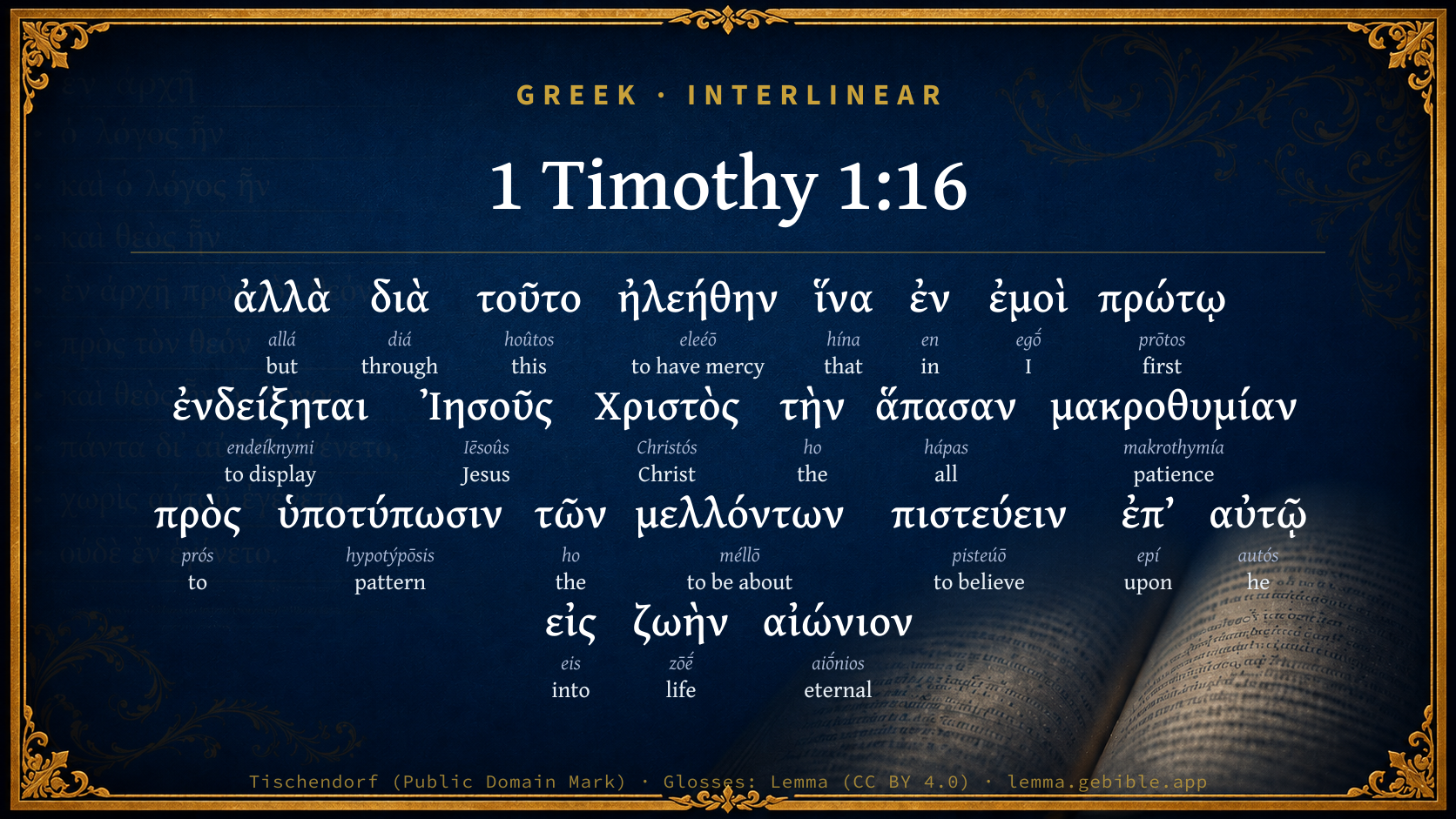
However, for this cause I obtained mercy, that in me first, Jesus Christ might display all his patience, for an example of those who were going to believe in him for eternal life.
Download a study sheet
One document with this verse’s original text, its word-by-word gloss line, the meaning frame, cross-references with their text, attributed commentary, and full source and license credits — printable, and it pastes into notes with its structure intact.
This verse Autodidact and up
A passage Seminary Student
Up to 50 verses in one chapter. A passage sheet keeps up to 6 commentary sources and 12 cross-references per verse, in the order this page ranks them, and says so on the sheet whenever that leaves anything out. Ask for a single verse and you get the Autodidact verse sheet above.
Everything on this page stays free to read, with no account — the sheet is a download of what is already on screen, not access to it.
Compare translations 3
The same verse in 3 English versions, stacked beneath the original-language interlinear above. Click any original word for its lexicon entry.
Each is an independent rendering of the whole verse — the interlinear is not word-aligned to these translations.
Highlighted words mark where these versions differ — a whole-verse word diff, not a word-by-word alignment.
-
World English Bible Public Domain
However, for this cause I obtained mercy, that in me first, Jesus Christ might display all his patience, for an example of those who were going to believe in him for eternal life.
-
King James Version Public Domain
Howbeit for this cause I obtained mercy, that in me first Jesus Christ might shew forth all longsuffering, for a pattern to them which should hereafter believe on him to life everlasting.
-
unfoldingWord Literal Text CC BY-SA 4.0
But because of this I was shown mercy so that in me, the first, Jesus Christ might demonstrate all patience as an example for the ones about to believe in him for eternal life.
unfoldingWord Literal Text — © unfoldingWord, licensed CC BY-SA 4.0. Word-aligned USFM3 via Door43 (git.door43.org/unfoldingWord/en_ult).
Show all 19 translations
Every available English version of this verse, each an independent rendering of the whole verse.
-
World English Bible Public Domain
However, for this cause I obtained mercy, that in me first, Jesus Christ might display all his patience, for an example of those who were going to believe in him for eternal life.
-
Berean Standard Bible Public Domain
But for this very reason I was shown mercy, so that in me, the worst of sinners, Christ Jesus might display His perfect patience as an example to those who would believe in Him for eternal life.
-
Majority Standard Bible Public Domain
But for this very reason I was shown mercy, so that in me, the worst of sinners, Jesus Christ might display all His patience as an example to those who would believe in Him for eternal life.
-
King James Version Public Domain
Howbeit for this cause I obtained mercy, that in me first Jesus Christ might shew forth all longsuffering, for a pattern to them which should hereafter believe on him to life everlasting.
-
American Standard Version (1901) Public Domain
howbeit for this cause I obtained mercy, that in me as chief might Jesus Christ show forth all his longsuffering, for an ensample of them that should thereafter believe on him unto eternal life.
-
Revised Version (1885) Public Domain
howbeit for this cause I obtained mercy, that in me as chief might Jesus Christ shew forth all his longsuffering, for an ensample of them which should hereafter believe on him unto eternal life.
-
Geneva Bible (1599) Public Domain
Notwithstanding, for this cause was I receiued to mercie, that Iesus Christ should first shewe on me all long suffering vnto the ensample of them, which shall in time to come beleeue in him vnto eternall life.
-
Douay-Rheims (1899) Public Domain
But for this cause have I obtained mercy: that in me first Christ Jesus might shew forth all patience, for the information of them that shall believe in him unto life everlasting.
-
Young's Literal Translation Public Domain
but because of this I found kindness, that in me first Jesus Christ might shew forth all long-suffering, for a pattern of those about to believe on him to life age-during:
-
Literal Standard Version CC BY-SA 4.0
but because of this I found kindness, that Jesus Christ might first show forth all long-suffering in me, for a pattern of those about to believe on Him to continuous life.
-
Unlocked Literal Bible CC BY-SA 4.0
But for this reason I was given mercy, so that in me, the foremost, Christ Jesus might demonstrate all patience. He did this as an example for those who would trust in him for eternal life.
-
unfoldingWord Literal Text CC BY-SA 4.0
But because of this I was shown mercy so that in me, the first, Jesus Christ might demonstrate all patience as an example for the ones about to believe in him for eternal life.
-
Darby Bible Public Domain
But for this reason mercy was shewn me, that in me, [the] first, Jesus Christ might display the whole long-suffering, for a delineation of those about to believe on him to life eternal.
-
World Messianic Bible Public Domain
However, for this cause I obtained mercy, that in me first, Yeshua the Messiah might display all his patience for an example of those who were going to believe in him for eternal life.
-
Webster's Bible Public Domain
However, for this cause I obtained mercy, that in me first Jesus Christ might show forth all long-suffering, for a pattern to them who should hereafter believe on him to life everlasting.
-
Free Bible Version CC BY-SA 4.0
For this reason I was shown mercy—since I'm the worst sinner, Jesus Christ could demonstrate his infinite patience as an example to those who choose to trust in him and gain eternal life.
-
Bible in Basic English Public Domain
But for this reason I was given mercy, so that in me, the chief of sinners, Jesus Christ might make clear all his mercy, as an example to those who in the future would have faith in him to eternal life.
-
Text-Critical English NT CC BY 4.0
But I received mercy for this reason, that in me, as the foremost sinner, Jesus Christ might show complete patience, making me an example for those who would come to believe in him for eternal life.
-
Tyndale New Testament (1534) Public Domain
Notwithstondinge for this cause was mercy geve vnto me that Iesus Christ shuld fyrst shewe on me all longe pacience vnto the ensample of them which shall in tyme to come beleve on him vnto eternall lyfe.
Literal Standard Version (2020), Covenant Press — licensed CC BY-SA 4.0. Text via the HelloAO Bible API (eBible.org). Unlocked Literal Bible (unfoldingWord) — licensed CC BY-SA 4.0. Text via the HelloAO Bible API (eBible.org). unfoldingWord Literal Text — © unfoldingWord, licensed CC BY-SA 4.0. Word-aligned USFM3 via Door43 (git.door43.org/unfoldingWord/en_ult). Free Bible Version, Dr. Jonathan Gallagher — licensed CC BY-SA 4.0. Text via the HelloAO Bible API (eBible.org).
Word by word
More ways to search: Search by grammar → Find every occurrence → Compare this word →
Practice this passage: Drill this verse → Learn its vocabulary →
- Appears 2× in the Greek New Testament
- First appears here
- Part of Speech
- Noun
- Case
- Accusative
- Number
- Singular
- Gender
- Feminine
Full Thayer's Definition
- ἀλλὰ allá G235 “but” Conjunction
- διὰ diá G1223 “through” Preposition
- τοῦτο hoûtos G3778 “this” Demonstrative pronoun, Accusative, Singular, Neuter
- ἠλεήθην eleéō G1653 “to have mercy” Verb, Aorist, Passive, Indicative, 1st person, Singular
- ἵνα hína G2443 “that” Conjunction
- ἐν en G1722 “in” Preposition
- ἐμοὶ egṓ G1473 “I” Personal pronoun, 1st person, Dative, Singular
- πρώτῳ prōtos G4413 “first” Adjective, Dative, Singular, Masculine, Superlative
- ἐνδείξηται endeíknymi G1731 “to display” Verb, Aorist, Middle, Subjunctive, 3rd person, Singular
- Ἰησοῦς Iēsoûs G2424 “Jesus” Noun, Nominative, Singular, Masculine
- Χριστὸς Christós G5547 “Christ” Noun, Nominative, Singular, Masculine
- τὴν ho G3588 “the” Article, Accusative, Singular, Feminine
- ἅπασαν hápas G537 “all” Adjective, Accusative, Singular, Feminine
- μακροθυμίαν makrothymía G3115 “patience” Noun, Accusative, Singular, Feminine
- πρὸς prós G4314 “to” Preposition
- ὑποτύπωσιν hypotýpōsis G5296 “pattern” Noun, Accusative, Singular, Feminine
- τῶν ho G3588 “the” Article, Genitive, Plural, Masculine
- μελλόντων méllō G3195 “to be about” Verb, Present, Active, Participle, Genitive, Plural, Masculine
- πιστεύειν pisteúō G4100 “to believe” Verb, Present, Active, Infinitive
- ἐπ’ epí G1909 “upon” Preposition
- αὐτῷ autós G846 “he” Personal pronoun, Dative, Singular, Masculine
- εἰς eis G1519 “into” Preposition
- ζωὴν zōḗ G2222 “life” Noun, Accusative, Singular, Feminine
- αἰώνιον aiṓnios G166 “eternal” Adjective, Accusative, Singular, Feminine
About this verse
These counts appear in no published source. They are computed here, from the morphology-tagged text and Lemma’s own curated glosses. What Lemma adds →
- 24
- words
- 23
- distinct lemmas
- Pauline Epistles
- section
Notable vocabulary
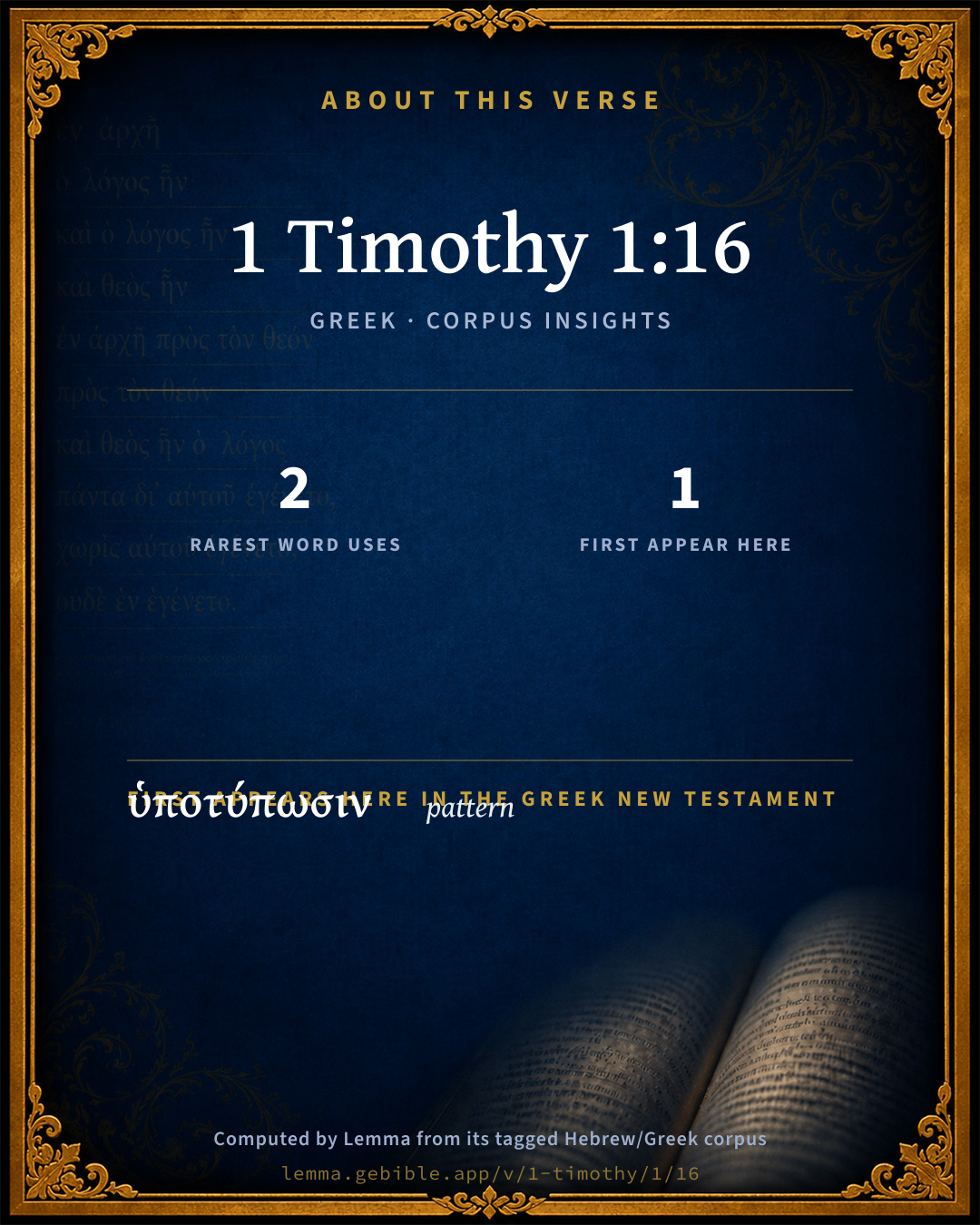
The rarest word here is ὑποτύπωσιν pattern G5296 — appearing just 2 times in the whole Greek New Testament.
First appearance in Scripture
This word makes its first canonical appearance in the Greek New Testament here:
- ὑποτύπωσιν pattern G5296
Shared distinctive vocabulary
ὑποτύπωσιν pattern G5296 occurs in 2 verses of the Greek New Testament. Also found in:
Repetition
A word recurs within this verse:
- τὴν the G3588 ×2
Cross-references
36Topical passages linked to 1 Timothy 1:16 in the Treasury of Scripture Knowledge — connected by theme and wording, ordered by reader-vote popularity; previews shown in the World English Bible.
- 1 Timothy 1:13 although I was before a blasphemer, a persecutor, and insolent. However, I obtained mercy, because I did it ignorantly in unbelief.
- Ephesians 2:7 that in the ages to come he might show the exceeding riches of his grace in kindness toward us in Christ Jesus;
- Psalms 25:11 For your name's sake, Yahweh, Pardon my iniquity, for it is great.
- 2 Peter 3:9 The Lord is not slow concerning his promise, as some count slowness; but is patient with us, not wishing that any should perish, but that all should come to repentance.
- Luke 7:47 Therefore I tell you, her sins, which are many, are forgiven, for she loved much. But to whom little is forgiven, the same loves little."
- 1 John 5:11–12 The testimony is this, that God gave to us eternal life, and this life is in his Son.
- 2 Peter 3:15 Regard the patience of our Lord as salvation; even as our beloved brother Paul also, according to the wisdom given to him, wrote to you;
- John 3:36 One who believes in the Son has eternal life, but one who disobeys the Son won't see life, but the wrath of God remains on him."
- John 6:54 He who eats my flesh and drinks my blood has eternal life, and I will raise him up at the last day.
- John 20:31 but these are written, that you may believe that Jesus is the Christ, the Son of God, and that believing you may have life in his name.
- 1 Peter 3:20 who before were disobedient, when God waited patiently in the days of Noah, while the ark was being built. In it, few, that is, eight souls, were saved through water.
- 2 Chronicles 33:9–13 Manasseh seduced Judah and the inhabitants of Jerusalem, so that they did evil more than did the nations whom Yahweh destroyed before the children of Israel.
- Isaiah 1:18 "Come now, and let us reason together," says Yahweh: "Though your sins be as scarlet, they shall be as white as snow. Though they be red like crimson, they shall be as wool.
- Isaiah 43:25 I, even I, am he who blots out your transgressions for my own sake; and I will not remember your sins.
- Isaiah 55:7 let the wicked forsake his way, and the unrighteous man his thoughts; and let him return to Yahweh, and he will have mercy on him; and to our God, for he will abundantly pardon.
- John 3:15–16 that whoever believes in him should not perish, but have eternal life.
- John 5:24 "Most assuredly I tell you, he who hears my word, and believes him who sent me, has eternal life, and doesn't come into judgment, but has passed out of death into life.
- John 6:40 This is the will of the one who sent me, that everyone who sees the Son, and believes in him, should have eternal life; and I will raise him up at the last day."
- Acts 13:39 and by him everyone who believes is justified from all things, from which you could not be justified by the law of Moses.
- Romans 6:23 For the wages of sin is death, but the free gift of God is eternal life in Christ Jesus our Lord.
- Exodus 34:8 Moses hurried and bowed his head toward the earth, and worshiped.
- Numbers 23:3 Balaam said to Balak, Stand by your burnt offering, and I will go: perhaps Yahweh will come to meet me; and whatever he shows me I will tell you. He went to a bare height.
- 2 Chronicles 33:19 His prayer also, and how [God] was entreated of him, and all his sin and his trespass, and the places in which he built high places, and set up the Asherim and the engraved images, before he humbled himself: behold, they are written in the history of Hozai.
- Luke 15:10 Even so, I tell you, there is joy in the presence of the angels of God over one sinner repenting."
- Luke 18:13–14 But the tax collector, standing far away, wouldn't even lift up his eyes to heaven, but beat his breast, saying, 'God, be merciful to me, a sinner!'
- Luke 19:7–9 When they saw it, they all murmured, saying, "He has gone in to lodge with a man who is a sinner."
- Luke 23:43 Jesus said to him, "Assuredly I tell you, today you will be with me in Paradise."
- John 6:37 All those who the Father gives me will come to me. Him who comes to me I will in no way throw out.
- Romans 2:4–5 Or do you despise the riches of his goodness, forbearance, and patience, not knowing that the goodness of God leads you to repentance?
- Romans 5:20–21 The law came in besides, that the trespass might abound; but where sin abounded, grace did abound more exceedingly;
- Romans 15:4 For whatever things were written before were written for our learning, that through patience and through encouragement of the Scriptures we might have hope.
- 2 Corinthians 4:1 Therefore seeing we have this ministry, even as we obtained mercy, we don't faint.
- Ephesians 1:6 to the praise of the glory of his grace, by which he freely bestowed favor on us in the Beloved,
- Ephesians 1:12 to the end that we should be to the praise of his glory, we who had before hoped in Christ:
- 2 Thessalonians 1:10 when he comes to be glorified in his saints, and to be admired among all those who have believed (because our testimony to you was believed) in that day.
- Hebrews 7:25 Therefore he is also able to save to the uttermost those who draw near to God through him, seeing he ever lives to make intercession for them.
Cross-references courtesy of OpenBible.info (CC BY 4.0).
Where the printed editions differ
1 variantPlaces in this verse where the major printed Greek editions disagree on the wording in a way that affects the translation — a comparison of editions, not a manuscript-by-manuscript collation. The editions are the modern critical texts (Nestlé-Aland 28/27, SBL, Westcott-Hort, Tregelles, Tyndale House) and the traditional texts behind the KJV (the Textus Receptus and the Byzantine/Majority text). It is not a claim about which reading is original.
-
Different wording
ἅπασαν
“[his] perfect”
In NA28NA27TynSBLWHTreg Not in TRByzπᾶσαν (pasan) 'all' occurs in traditional manuscripts (TR+Byz) instead of ἅπασαν (hapasan) '[his] perfect' in older manuscripts (NA28+NA27+Tyn+SBL+WH+Treg)
Textual data: Translators Amalgamated Greek New Testament (STEPBible TAGNT) · CC BY 4.0.
Lesson kit
Teaching starters — assembled from the data on this page, not authored interpretation. Every prompt links to the verse data it draws on. Edit before teaching.
1 Timothy, in the Pauline Epistles, opens this verse with 24 words (23 distinct Greek lemmas). Its most distinctive word is hypotýpōsis (“pattern”). A historical commentator’s framing appears above. Read the whole chapter for the surrounding context.
Discussion questions
- How does “pattern” (hypotýpōsis) shape what this verse is saying?
- This is the first place “pattern” appears in Scripture (first appears here). What does its debut here establish?
- How does 2 Timothy 1:13, which shares the word «pattern», read alongside this verse?
- What does the repetition of “the” (2× in this one verse) do in this verse?
- The translations on this page render this verse differently — a whole-verse word diff, not a word-by-word alignment. What might account for the different wordings?
- Compare how The Cambridge Bible for Schools and Colleges and The Biblical Illustrator read this verse. Where do they agree or differ?
Things to notice
- 1 word makes its first canonical appearance in Scripture here.
- These translations choose different wording for 23 words in this verse.
- “the” occurs 2× in this single verse.
- 23 distinct Greek lemmas span 24 words in this verse.
Commentary
Notes on 1 Timothy 1:16 from classic Christian and Jewish commentators (each source and its license shown beneath its notes). The classic Christian expositions comment on the surrounding passage and are grouped to its opening verse, so a note may address several verses; the Jewish commentaries on the Tanakh (Rashi and others) are per-verse, so they appear only where the commentator wrote on this verse.
Lemma curates 59 commentaries, every one of them public domain or Creative Commons licensed, each selected and text-cleaned for this edition rather than reprinted as found. About our sources →
The Cambridge Bible for Schools and Colleges
gen. ed. J. J. S. Perowne
The Cambridge Bible for Schools and Colleges (gen. ed. J. J. S. Perowne; Cambridge University Press, 1878–1918) — public domain. Text from a community e-Sword module.
The Biblical Illustrator
Joseph S. Exell
The Biblical Illustrator, edited by Joseph S. Exell (c. 1880s–1900s) — public domain. Text from a community e-Sword module.
MacLaren's Expositions of Holy Scripture
Alexander MacLaren
Alexander MacLaren, Expositions of Holy Scripture (1904–1910) — public domain. Text from a community e-Sword module.
Bengel's Gnomon
Johann Albrecht Bengel
Bengel's Gnomon of the New Testament — English translation (T&T Clark, Edinburgh, 1860) — public domain. Text from a community e-Sword module.
Meyer's Critical & Exegetical Commentary
Heinrich August Wilhelm Meyer
Meyer — Critical and Exegetical Commentary on the New Testament — English translation by Peter Christie, edited by Frederick Crombie (T&T Clark, 1880) — public domain. Text from a community e-Sword module.
Expositor's Greek Testament
ed. W. Robertson Nicoll
The Expositor's Greek Testament, edited by W. Robertson Nicoll (1897–1910) — public domain. Text from a community e-Sword module.
Jamieson, Fausset & Brown
Robert Jamieson, A. R. Fausset & David Brown
Jamieson, Fausset & Brown — Commentary Critical and Explanatory on the Whole Bible (1871) — public domain (CC PDM 1.0). Text via the HelloAO Bible API.
John Calvin's Commentaries
John Calvin's Commentaries (1540-1563) — public domain. Text from the Calvin Translation Society English edition (1840s-50s) via the Christian Classics Ethereal Library (ccel.org). Calvin's coverage is partial (roughly two-thirds of the Bible); uncommented books and verses are honest gaps, never fabricated. The 19th-century editor's footnotes and remarks are omitted so the notes are faithfully Calvin's own voice.
Ellicott's Commentary for English Readers
A Bible Commentary for English Readers, edited by Charles John Ellicott (1878–1897) — public domain. Text from a community e-Sword module.
John Gill's Exposition
John Gill's Exposition of the Whole Bible (1746–1763) — public domain (CC PDM 1.0). Text via the HelloAO Bible API.
Trapp's Complete Commentary
John Trapp
John Trapp, A Commentary or Exposition upon All the Books of the Old and New Testament (1647–1656) — public domain. Text from a community e-Sword module.
Albert Barnes' Notes on the Bible
Albert Barnes' Notes on the Bible (1834–1885) — public domain. Text from a community e-Sword/MySword module.
Matthew Poole's English Annotations
Matthew Poole's English Annotations on the Holy Bible (1683–1685) — public domain. Text from a community e-Sword/MySword module.
Whedon's Commentary on the Bible
Daniel D. Whedon
Daniel D. Whedon (gen. ed.), Commentary on the Old and New Testaments (1874–1909) — public domain. Text from a community e-Sword module.
The Pulpit Commentary
The Pulpit Commentary (1880–1919), ed. H.D.M. Spence-Jones & Joseph S. Exell — public domain. Text from a community e-Sword module.
John Wesley's Explanatory Notes
John Wesley, Explanatory Notes Upon the Whole Bible (1754–1765) — public domain. Text via the GEBible commentary corpus.
Fairbairn on Ezekiel, Jonah & the Pastoral Epistles
Patrick Fairbairn
Patrick Fairbairn — An Exposition of Ezekiel (1851), Jonah (1849), and The Pastoral Epistles (1874) — public domain. Text from a community e-Sword module.
Burkitt's Expository Notes on the New Testament
William Burkitt
William Burkitt's Expository Notes on the New Testament (1700–1703) — public domain. Text from a community e-Sword module.
The People's New Testament
B. W. Johnson
B. W. Johnson's The People's New Testament with Notes (1889–1891) — public domain. Electronic text from the Christian Classics Ethereal Library (CCEL) ThML edition.
Cambridge Greek Testament for Schools and Colleges
Cambridge Greek Testament for Schools and Colleges (Cambridge University Press, 1896; 21 vols, various authors incl. Carr, Maclear, Plummer, Farrar, Lumby, Moule, M. R. James, Simcox) — public domain. Text from a community e-Sword module.
Alford’s Greek Testament
Henry Alford
Henry Alford, The Greek Testament (1849–1861) — public domain. Text from a community e-Sword module.
International Critical Commentary
International Critical Commentary — older volumes (1896–1929), various authors — public domain. Text from a community e-Sword module.
Vincent's Word Studies in the New Testament
Marvin R. Vincent
Marvin R. Vincent, Word Studies in the New Testament (1887–1900) — public domain. Text from a community e-Sword/MySword module.