

Proverbs 19:17

Hebrew (Westminster Leningrad Codex) Proverbs 19:17 appears in the Hebrew Old Testament. The text above is from the Westminster Leningrad Codex. Each word links to its Strong’s number, a concise gloss, and parsing drawn from the Open Scriptures Hebrew Bible morphology. Click any word for its full Brown-Driver-Briggs (BDB) entry.
Download image
Cite this verse

Proverbs 19:17 (World English Bible). Public Domain. Lemma interlinear Bible study tool, https://lemma.gebible.app/v/proverbs/19/17.

Show BibTeX & RIS
BibTeX
RIS
English Translation
He who has pity on the poor lends to Yahweh; He will reward him.
World English Bible · Public Domain
Download a study sheet

One document with this verse’s original text, its word-by-word gloss line, the meaning frame, cross-references with their text, attributed commentary, and full source and license credits — printable, and it pastes into notes with its structure intact.

This verse Autodidact and up

Study sheet (.html) Plain text (.txt)

A passage Seminary Student

Up to 50 verses in one chapter. A passage sheet keeps up to 6 commentary sources and 12 cross-references per verse, in the order this page ranks them, and says so on the sheet whenever that leaves anything out. Ask for a single verse and you get the Autodidact verse sheet above.

Everything on this page stays free to read, with no account — the sheet is a download of what is already on screen, not access to it.

Want to remove ads? Support Godless Engineer
Compare translations 3

The same verse in 3 English versions, stacked beneath the original-language interlinear above. Click any original word for its lexicon entry.

Each is an independent rendering of the whole verse — the interlinear is not word-aligned to these translations.

Highlighted words mark where these versions differ — a whole-verse word diff, not a word-by-word alignment.

  • World English Bible Public Domain
    He who has pity on the poor lends to Yahweh; He will reward him.
  • King James Version Public Domain
    He that hath pity upon the poor lendeth unto the LORD; and that which he hath given will he pay him again.
  • unfoldingWord Literal Text CC BY-SA 4.0
    One who is gracious a lowly one lends Yahweh, and his dealing he will repay to him.

unfoldingWord Literal Text — © unfoldingWord, licensed CC BY-SA 4.0. Word-aligned USFM3 via Door43 (git.door43.org/unfoldingWord/en_ult).

Versions to compare (up to 4)

3 of 4 selected

Show all 18 translations

Every available English version of this verse, each an independent rendering of the whole verse.

  • World English Bible Public Domain
    He who has pity on the poor lends to Yahweh; He will reward him.
  • Berean Standard Bible Public Domain
    Kindness to the poor is a loan to the LORD, and He will repay the lender.
  • Majority Standard Bible Public Domain
    Kindness to the poor is a loan to the LORD, and He will repay the lender.
  • King James Version Public Domain
    He that hath pity upon the poor lendeth unto the LORD; and that which he hath given will he pay him again.
  • American Standard Version (1901) Public Domain
    He that hath pity upon the poor lendeth unto Jehovah, And his good deed will he pay him again.
  • Revised Version (1885) Public Domain
    He that hath pity upon the poor lendeth unto the LORD, and his good deed will he pay him again.
  • Geneva Bible (1599) Public Domain
    He that hath mercy vpon the poore, lendeth vnto the Lord: and the Lord will recompense him that which he hath giuen.
  • Douay-Rheims (1899) Public Domain
    He that hath mercy on the poor, lendeth to the Lord: and he will repay him.
  • Young's Literal Translation Public Domain
    Whoso is lending `to' Jehovah is favouring the poor, And his deed He repayeth to him.
  • Literal Standard Version CC BY-SA 4.0
    Whoever is lending [to] YHWH is favoring the poor, || And He repays his deed to him.
  • Unlocked Literal Bible CC BY-SA 4.0
    Whoever is kind to the poor lends to Yahweh and he will repay him for what he has done.
  • unfoldingWord Literal Text CC BY-SA 4.0
    One who is gracious a lowly one lends Yahweh, and his dealing he will repay to him.
  • Darby Bible Public Domain
    He that is gracious to the poor lendeth unto Jehovah; and what he hath bestowed will he repay unto him.
  • World Messianic Bible Public Domain
    He who has pity on the poor lends to the LORD; he will reward him.
  • Webster's Bible Public Domain
    He that hath pity upon the poor, lendeth to the LORD; and that which he hath given will he pay him again.
  • Free Bible Version CC BY-SA 4.0
    If you're kind to the poor, you're lending to the Lord, and he will repay you well for what you've done.
  • Bible in Basic English Public Domain
    He who has pity on the poor gives to the Lord, and the Lord will give him his reward.
  • JPS Tanakh (1917) Public Domain
    He that is gracious unto the poor lendeth unto the LORD; and his good deed will He repay unto him.

Literal Standard Version (2020), Covenant Press — licensed CC BY-SA 4.0. Text via the HelloAO Bible API (eBible.org). Unlocked Literal Bible (unfoldingWord) — licensed CC BY-SA 4.0. Text via the HelloAO Bible API (eBible.org). unfoldingWord Literal Text — © unfoldingWord, licensed CC BY-SA 4.0. Word-aligned USFM3 via Door43 (git.door43.org/unfoldingWord/en_ult). Free Bible Version, Dr. Jonathan Gallagher — licensed CC BY-SA 4.0. Text via the HelloAO Bible API (eBible.org).

Word by word

More ways to search: Search by grammar → Find every occurrence → Compare this word →

Practice this passage: Drill this verse → Learn its vocabulary →

About this verse

These counts appear in no published source. They are computed here, from the morphology-tagged text and Lemma’s own curated glosses. What Lemma adds →

7
words
6
distinct lemmas
Wisdom
section

Notable vocabulary

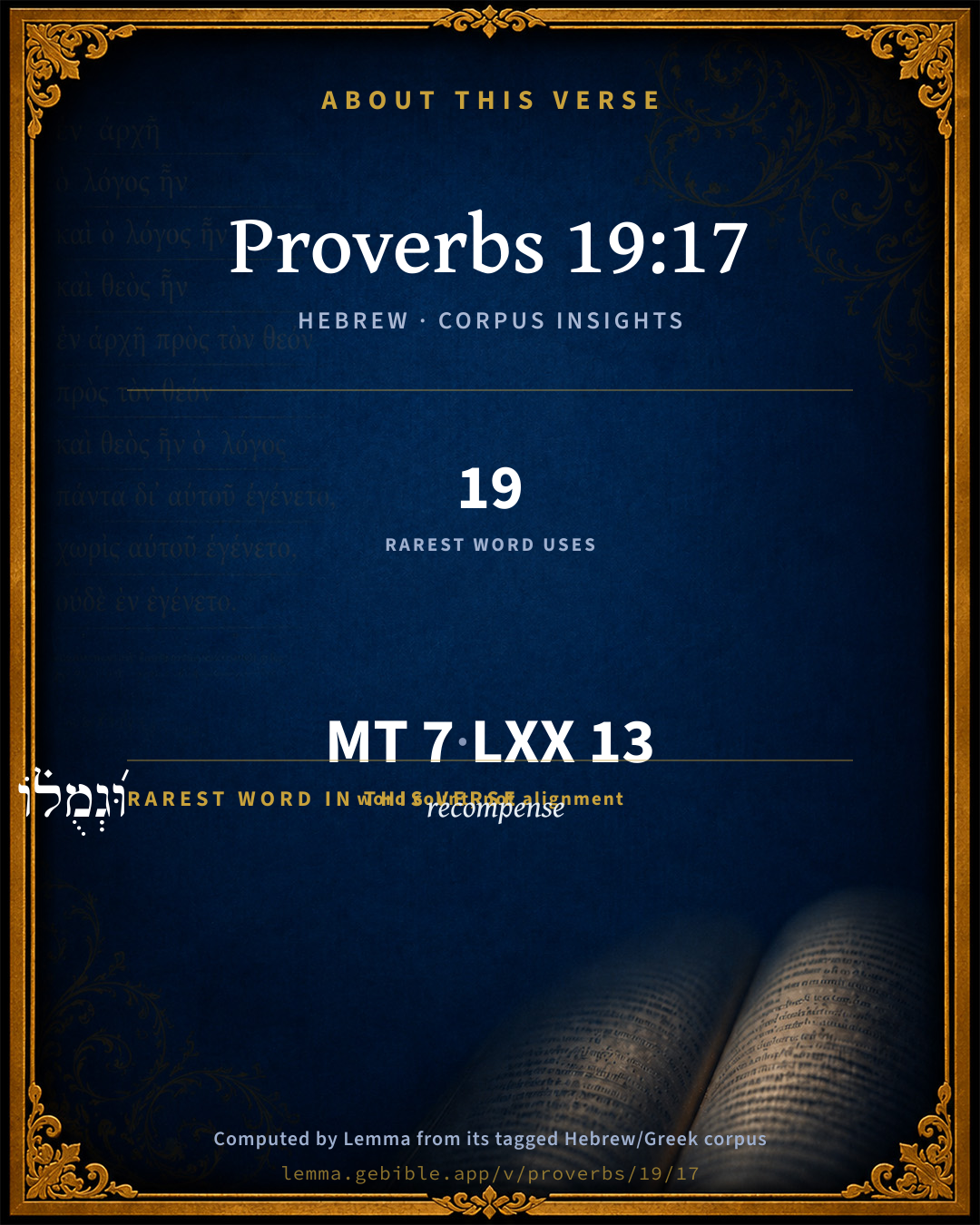
The rarest word here is וּ֝גְמֻל֗וֹ recompense H1576 — appearing just 19 times in the whole Hebrew Bible.

Shared distinctive vocabulary

וּ֝גְמֻל֗וֹ recompense H1576 occurs in 17 verses of the Hebrew Bible. Also found in:

Grammatical profile

  • 3 verbs
  • 2 nouns
  • 1 adjective
  • 1 preposition

Verb forms

  • מַלְוֵ֣ה Hiphil · Participle Active
  • ח֣וֹנֵֽן Qal · Participle Active
  • יְשַׁלֶּם Piel · Imperfect

Hebrew & Septuagint length

In English translation the verse runs 14 words from the Hebrew and 21 from the Septuagint (LXX English) — the Septuagint runs noticeably longer here. See the side-by-side →

A rough comparison of the two English renderings, which tokenize alike — not a word-level alignment.

Word counts can differ between the Hebrew and the Greek without any difference in meaning — e.g. the Hebrew direct-object marker אֵת has no separate Greek word, and Greek often adds the article ὁ.

In the original languages it is 7 Hebrew tokens and 13 Greek tokens — but the two are counted differently (Hebrew bundles its prefixes and suffixes into one token; the Greek is in lemma form), so that isn’t a like-for-like length.

Cross-references

16

Topical passages linked to Proverbs 19:17 in the Treasury of Scripture Knowledge — connected by theme and wording, ordered by reader-vote popularity; previews shown in the World English Bible.

  • Proverbs 28:27 One who gives to the poor has no lack; But one who closes his eyes will have many curses.
  • Hebrews 6:10 For God is not unrighteous, so as to forget your work and the labor of love which you showed toward his name, in that you served the saints, and still do serve them.
  • Luke 6:38 "Give, and it will be given to you: good measure, pressed down, shaken together, and running over, will be given to you. For with the same measure you measure it will be measured back to you."
  • 2 Corinthians 9:6–8 Remember this: he who sows sparingly will also reap sparingly. He who sows bountifully will also reap bountifully.
  • Matthew 25:40 "The King will answer them, 'Most assuredly I tell you, inasmuch as you did it to one of the least of these my brothers, you did it to me.'
  • Ecclesiastes 11:1 Cast your bread on the waters; For you shall find it after many days.
  • Proverbs 11:24–25 There is one who scatters, and increases yet more. There is one who withholds more than is appropriate, but gains poverty.
  • Isaiah 58:7–11 Isn't it to deal your bread to the hungry, and that you bring the poor who are cast out to your house? when you see the naked, that you cover him; and that you not hide yourself from your own flesh?
  • Matthew 10:41–42 He who receives a prophet in the name of a prophet will receive a prophet's reward: and he who receives a righteous man in the name of a righteous man will receive a righteous man's reward.
  • Deuteronomy 15:7–14 If there be with you a poor man, one of your brothers, within any of your gates in your land which Yahweh your God gives you, you shall not harden your heart, nor shut your hand from your poor brother;
  • Proverbs 14:21 He who despises his neighbor sins, But blessed is he who has pity on the poor.
  • Proverbs 14:31 He who oppresses the poor shows contempt for his Maker, But he who is kind to the needy honors him.
  • Philippians 4:17 Not that I seek for the gift, but I seek for the fruit that increases to your account.
  • Proverbs 28:8 He who increases his wealth by excessive interest Gathers it for one who has pity on the poor.
  • 2 Samuel 12:6 He shall restore the lamb fourfold, because he did this thing, and because he had no pity!"
  • Proverbs 12:14 A man shall be satisfied with good by the fruit of his mouth. The work of a man's hands shall be rewarded to him.

Cross-references courtesy of OpenBible.info (CC BY 4.0).

Hebrew and Greek witnesses Masoretic Hebrew ↔ Greek Septuagint

The same verse in the two great witnesses to the Old Testament, shown verse-for-verse.

Here the Septuagint runs noticeably longer than the Hebrew — LXX2012 (modern English Septuagint) 21 words vs World English Bible 14. A rough length comparison of the two English translations, not a word-level alignment — read both below.

These are two independent witnesses, not word-aligned to each other, and the Septuagint is shown in lemma (dictionary) form.

Hebrew Proverbs 19:17 Masoretic · Westminster Leningrad Codex

מַלְוֵ֣ה יְ֭הוָה ח֣וֹנֵֽן דָּ֑ל וּ֝גְמֻל֗וֹ יְשַׁלֶּם לֽוֹ

He who has pity on the poor lends to Yahweh; He will reward him.

World English Bible · Public Domain

Greek LXX Proverbs 19:17 Septuagint · lemma form

δανείζω θεός ὁ ἐλεέω πτωχός κατά δέ ὁ δόμα αὐτός ἀντι ἀποδίδωμι αὐτός

He that has pity on the poor lends to the Lord; and he will recompense to him according to his gift.

LXX2012 (modern English Septuagint) · Public Domain

On this verse, Keil & Delitzsch discusses the Septuagint’s reading. Read the note in Commentary ↓

Hebrew: Westminster Leningrad Codex (CC BY 4.0). Greek: Septuagint (public domain); English from LXX2012 (modern English Septuagint) (Public Domain). How the Septuagint differs from the Hebrew →

Commentary

Notes on Proverbs 19:17 from classic Christian and Jewish commentators (each source and its license shown beneath its notes). The classic Christian expositions comment on the surrounding passage and are grouped to its opening verse, so a note may address several verses; the Jewish commentaries on the Tanakh (Rashi and others) are per-verse, so they appear only where the commentator wrote on this verse.

Lemma curates 59 commentaries, every one of them public domain or Creative Commons licensed, each selected and text-cleaned for this edition rather than reprinted as found. About our sources →

Trapp's Complete Commentary

John Trapp

Pro 19:17 He that hath pity upon the poor lendeth unto the LORD; and that which he hath given will he pay him again.

Ver. 17. He that hath pity upon the poor lendeth, &c.] This is a second fruit of shaking off sloth, and working with the hands the thing that is good, that one may have to give to him that needeth. {Eph 4:28} He doth not give it, but lend it; God accepts it both as δωρον και δανεισμα, as a gift, and a loan, saith Basil. {a} Nay, he lends it upon usury, Faeneratur Domino; and that to the Lord, who both binds himself to repay, and gives us security for it under his own hand here. He will pay him again to be sure of it - ישׁלם in the Hebrew tense Piel - he will fully and abundantly repay him; mostly in this world, but infallibly in the world to come. Evagrius in Cedrenus bequeathed three hundred pounds to the poor in his will; but took a bond beforehand of Synesius the bishop for the repayment of it in another life; and the very next night after his departure, saith the history, appearing to him in his shape, delivered in the bond cancelled, and fully discharged.

{a} Orat. de Elcemos.

John Trapp, A Commentary or Exposition upon All the Books of the Old and New Testament (1647–1656) — public domain. Text from a community e-Sword module.

The Biblical Illustrator

Joseph S. Exell

Pro_19:17

He that hath pity upon the poor lendeth unto the Lord.

Christian pity for the Christian poor

I. The great stress which the Scriptures lay upon pity for the poor. That man must be a cursory reader of the Bible who does not see that it pervades the Bible. The old dispensation is full of it. In the new dispensation it is brought out still more prominently.

II. Why is so great a mass of the Lords people found among the poor? If wealth would have been their blessing, wealth they would have had. God would have this manifested by them--that He considers these things in themselves as nothing. Some part of the mystery is to answer Satans accusations. And it is for the trial of the grace that is in His people.

III. The motives urging a good man to show pity to the poor. He lendeth to the Lord. Here is a payment spoken of. The Lord is a bounteous giver. (J. H. Evans.)

The deserving poor

We are told that the poor shall never cease out of the land. Paley defines a poor man as he, of whatever rank, whose expenses exceed his resources. It is very clear from this that there may be poverty which has no claim to our commiseration and charity.

I. Mans duty towards the deserving poor. He that hath pity on the poor. Two things are implied concerning this pity.

1. It must be practical. The text speaks of it as lending to the Lord. It is pity, therefore, that gives, that does something to relieve distress. The pity that goes off in sentimental sighs, or goes no farther than words, saying, Depart in peace, be warmed, be filled, is not true pity--the pity that God demands for the poor.

2. It must be genuine. The words imply that the pity is accepted of the Lord. He takes it as a loan; therefore it must be genuine. The service rendered is from right principles. There is a large amount of charity shown to the poor which is inspired by motives abhorrent to Omniscient Purity.

II. Gods interest in the deserving poor. Gods interest in the poor is shown in three ways.

1. In the obligation that is imposed on the rich to help them. He denounces all neglect and cruelty of the poor. Woe unto him that buildeth his house by unrighteousness and his chamber by wrong, that useth his neighbours service without wages. Again, Whoso mocketh the poor reproacheth his Maker. He inculcates practical sympathy for the poor (Exo_22:21-22; Exo_23:9; Lev_19:33; Lev_25:35; Deu_10:19; Deu_24:19; Pro_22:22; Isa_1:17-23).

2. In the earthly condition into which He sent His Son.

3. In the class from which He selected His servants.

III. The Divine acknowledgment of service to the poor. And that which he hath given will He pay him again. Every gift of genuine piety to the poor is a loan to the Lord, and a loan that shall be paid.

1. It is often amply repaid in this world (Deu_16:17-20; 2Co_9:6-8).

2. It will be acknowledged in the day of judgment. Inasmuch as ye have done it unto the least of these My brethren, ye have done it unto Me. (D. Thomas, D. D.)

Lending to the Lord

We are to give to the poor out of pity. Not to be seen and applauded, much less to get influence over them; but out of pure sympathy and compassion we must give them help. We must not expect to get anything back from the poor, not even gratitude; but we should regard what we have done as a loan to the Lord. He undertakes the obligation, and if we look to Him in the matter we must not look to the second party. What an honour the Lord bestows upon us when He condescends to borrow of us! That merchant is greatly favoured who has the Lord on his books. It would seem a pity to have such a name down for a paltry pittance; let us make it a heavy amount. The next needy man that comes this way, let us help him. As for repayment, we can hardly think of it, and yet here is the Lords note of hand. Blessed be His name, His promise to pay is better than gold and silver. Are we running a little short through the depression of the times? We may venture humbly to present this bill at the Bank of Faith. (C. H. Spurgeon.)

For long credit

A wealthy but niggardly gentleman was waited on by the advocates of a charitable institution, for which they solicited his aid, reminding him of the Divine declaration, He that hath pity on the poor lendeth unto the Lord; and that which he hath given will He pay him again. To this he replied, The security, no doubt, is good, and the interest liberal; but I cannot give such long credit. Poor rich man! the day of payment was much nearer than he anticipated. Not a fortnight had elapsed from his refusing to honour this claim of God upon his substance before he received a summons with which he could not refuse to comply. He was dead.

The best loan

(to the young):--Pity is the feeling of sorrow we find in our hearts when we see a person in trouble or distress. There are two kinds of pity, a wrong and a right. The wrong kind of pity makes people feel without making them do or give. The right kind makes people do or give, as well as feel. What we do for, or give to the poor, God regards as done or given to Himself. What we lend to another we call a loan. There are many different kinds of loans, but that which is lent to the Lord is the best loan.

I. Because He receives the smallest sums.

II. Because it is so safe.

III. Because He pays good interest. (R. Newton, D. D.)

Argument for charity

This is an argument for charity of wonderful force. No pagan moralist could ever produce a motive for any social duty equal to this. It is sufficient to open the closest fist, and to enlarge the most selfish heart. Can we lose anything by lending it to the Lord? God will be sure to repay what is given to the poor at His command with great increase. The greatest usurer on earth cannot make so much of his money as the man that gives to the poor. (George Lawson, D. D.)

The Biblical Illustrator, edited by Joseph S. Exell (c. 1880s–1900s) — public domain. Text from a community e-Sword module.

Joseph Benson's Commentary

Pro 19:17. He that hath pity on the poor — And relieves their necessities; lendeth unto the Lord — Doth not empoverish, but enrich himself: for the Lord takes what is done to them as done to himself, because it is done to those whom he has appointed in his own stead to be his receivers, and whom he hath, in a peculiar manner, commended to the care and charity of all other men. He therefore will not fail to make a full compensation; he will return the benefit done to others, with large interest and increase of blessings, upon the beneficent man and his posterity.

Joseph Benson's Commentary on the Old and New Testaments (1811–1818) — public domain. Text from a community e-Sword module.

The Preacher's Complete Homiletical Commentary

Joseph S. Exell (gen. ed.)

MAIN HOMILETICS OF Pro_19:17

THE BEST INVESTMENT

I. A God-like disposition. To “pity the poor and to show that we do so by ministering to their necessities (for this is implied in the proverb) is to be like God. We have before seen how He identifies Himself with them, and how severe is the condemnation which He passes upon those who wrong them. (See Homiletics and Comments upon chap. Pro_14:31, page 390, and upon chap. Pro_17:5, page 504). God is a Being of compassion—the gospel of salvation is a testimony to the pitifulness of His nature. He has remembered man in his low estate and in his condition of spiritual poverty, and out of the “riches of His grace” (Eph_1:7) He has supplied his need. But he has not only an eye for the spiritual necessities of His creatures, but for those also which belong exclusively to their bodily nature. God manifest in flesh had compassion upon the multitude because “they had nothing to eat” (Mat_15:32), and the same pitiful heart is still moved with a like emotion when He looks into the haunts of poverty and sees men and women and little children without the necessaries of life, or toiling hard and long for a pittance that is only just enough to keep them from starvation. The man therefore who “has pity on the poor” manifests a disposition akin to that of his Father in heaven.

II. A most reliable debtor. God incarnate fed the hungry by miracle, but now that He has left the earth for a season He entrusts the duty to human hands. He does not now rain down bread from heaven to feed even his spiritual Israel, but He expects those of His children to whom He has given more than enough of this world’s good things to do it for Him, and looks upon the act as a loan to Himself.

1. That this investment will be a profitable one is certain, from the character of God. When men entrust others with their money, they have especial regard to the character of those whom they make their debtor. This forms the chief and most reliable security that a man can have that he will receive it again. God’s character is pre-eminently good—so good that His word is more than the bond of the most trustworthy human creature, and none in heaven or earth or hell will ever be able to say that He has not paid them what was their due.

2. The wealth of God is a guarantee that He will repay with interest. A man who is generous by nature, and possessed of abundant means, will not only faithfully repay a loan but, if his debtor is a needy man, will feel a pleasure in adding to it a large interest, or will press him to accept some extra token of his esteem. God is the great and bountiful proprietor of all the resources of the universe, whether spiritual or material, and He loves to give abundantly. He has been always giving out of His fulness since there has been a creature upon whom to lavish His gifts, and He delights to see His children give, like Himself, generously and ungrudgingly. And, seeing he takes upon Himself to repay what is given to the poor, His generosity and His wealth are sureties that the interest for the loan will be very ample. His children may have to wait long for it, but the longer they wait the greater the accumulation of interest. They may receive a partial repayment in material good, but the great recompense will be at the “resurrection of the just” (Luk_14:14) on that day when the King shall say unto them, “Come, ye blessed of my Father, inherit the kingdom prepared for you from the foundation of the world; for I was an hungered and ye gave me meat; I was thirsty and ye gave me drink; I was a stranger and ye took me in; naked and ye clothed me” (Mat_25:34; Mat_25:36).

OUTLINES AND SUGGESTIVE COMMENTS

When Alexander set forward upon his great exploits before he went from Macedonia, he divided among his captains and friends all that he had; for which, when one of his friends reproved him, saying that he was prodigal, for that he had reserved nothing for himself, the answer which Alexander gave was this: that he had reserved much unto himself, namely, hope of the monarchy of the world, which by the valour and help of those his captains and nobles he hoped to obtain. And thus, surely, he that giveth to the poor may seem to be prodigal, yet, in respect of the hope that he hath of profit, he is frugal-wise; neither is his hope such as Alexander’s was, which depended on the uncertainty of war, but such as is grounded upon the certainty of God’s word.—Spencer.

The Lord will not only pay for the poor man, but requite him that gave alms, with usury, returning great gifts for small. Give, then, thine house, and receive heaven; give transitory goods, and receive a durable substance; give a cup of cold water and receive God’s kingdom … If our rich friend should say unto us, lay out so much money for me, I will repay it, we would willingly and readily do it. Seeing, then, our best friend, yea, our king, the King of kings, biddeth us give to the poor, promising that He will see us answered for that we give, shall we not bestow alms at His motion and for His sake?—Muffet.

The off-hand sense is no doubt correct, and, as a worldly maxim, often the munificent are rewarded in this world.… But we are not to suppose the generous to suffer, and the saint might lose by being paid in money. The saint might need the chastisement of pecuniary distress. We are not to suppose, therefore, this sense to be the grand one. But the meaning is that obedience, if it be spiritual, is a positive thing; that it involves large and generous sacrifices; that it is to “visit the fatherless” (Jas_1:27); and to feed the hungry (Mat_25:35); and that, in the grandest sense, he that does these things “makes a borrower of Jehovah;” and that the transaction, under the grand head of guarding his own soul (Pro_19:16), will pay him better than any less positive and more mystic species of obedience.… It may be fancy, but causing to borrow seems to be more expressive than (as an equivalent) to lend (E.V.). We can make God borrow of us at any time among the widows and the orphans (Mat_25:40; Jer_49:11).—Miller.

The Preacher's Complete Homiletical Commentary (gen. ed. Joseph S. Exell; Funk & Wagnalls, c. 1892) — public domain (pre-1929). A full-Bible homiletical/sermon-outline anthology covering 65 of 66 books (2 John is absent from the source module). Text from a community e-Sword module.

Keil & Delitzsch

C. F. Keil & F. Delitzsch

These verses we take together. But we have no other reason for making a pause at Pro 19:21, than that Pro 19:22 is analogous to Pro 19:17, and thus presents itself to us as an initial verse.

Pro 19:17

17 He lendeth to Jahve who is compassionate to the lowly,

And his bounty He requites to him.

As at Pro 14:31, חונן is part. Kal. The Masoretically exact form of the word is חונן (as ואוזל, Pro 20:14) with Mercha on the first syllable, on which the tone is thrown back, and the העמדה on the second. The Roman legal phrase, mutui datione contrahitur obligatio, serves to explain the fundamental conception of לוה, mutuo accipere, and הלוה, mutuum dare (vid., Pro 22:7). The construction, Exo 22:24, "to make any one bound as a debtor, obligare," lies at the foundation of the genitive connection 'מלוה ה (not מלוה). With 17b cf. Pro 12:14, where the subject of ישׁיב (Kerı̂) remains in the background. גמלו (not גמלּו) is here his work done in the sense of good exhibited. "Love," Hedinger once said, "is an imperishable capital, which always bears interest." And the Archbishop Walther: nam Deo dat qui dat inopibus, ipse Deus est in pauperibus. Dr. Jonas, as Dchsel relates, once gave to a poor man, and said, "Who knows when God restores it!" There Luther interposed: "As if God had not long ago given it beforehand!" This answer of Luther meets the abuse of this beautiful proverb by the covetous.

Pro 19:18

This proverb brings to view once more the pedagogic character of this Older Book of Proverbs:

Correct thy son, for yet there is hope;

But go not too far to kill him.

That כּי tahT is meant relatively, as at Pro 11:15, is seen from Job 11:18; Job 14:7; Jer 31:16.; כּי־ישׁ תּקוה is the usual expression for etemin spes est. Though a son show obstinacy, and manifest a bad disposition, yet there is hope in the training of the youth of being able to break his self-will, and to wean him from his bad disposition; therefore his education should be carried forward with rigorous exactness, but in such a way that wisdom and love regulate the measure and limits of correction: ad eum interficiendum animam ne tollas (animum ne inducas). נפשׁך is not the subject, for in that case the word would have been תּשּׁאך (Kg2 14:10). It is the object: To raise the soul to something is equivalent to, to direct his desire to it, to take delight in it. The teacher should not seek correction as the object, but only as the means; he who has a desire after it, to put the child to death in the case of his guilt, changes correction into revenge, permits himself to be driven by passion from the proper end of correction, and to be pushed beyond its limits. The lxx translates freely εἰς δὲ ὕβρις, for ὕβρις is unrestrained abuse, מוסר אכזרי as Immanuel glosses. Besides, all the ancients and also the Venet. translate המיתו as the inf. of המית. But Oetinger (for he translates: lift not thy soul to his cry, for which Euchel: let not his complaining move thy compassion) follows the derivation from המה suggested by Kimchi, Meri, and Immanuel, and preferred by Ralbag, so that המיתו after the from בּכית is equivalent to המיתו. But leaving out of view that המה means strepere, not lamentari, and that נשׂא נפשׁו means attention, not desire, Pro 23:13 points out to us a better interpretation.

Pro 19:19

Another proverb with נשׂא:

A man of excessive wrath must suffer punishment;

For if thou layest hold of it, hindering it, thou makest it only worse.

The lxx, Syr., and Targ. translate as if the words were גּבר חמה (as בּעל חמה, Pro 29:22). Theodotion, the Venet., and Luther render the Kerı̂ גּדל־; Jerome's impatiens is colourless. The Chethı̂b גרל gives no appropriate meaning. The Arab. jaril means lapidosus (whence גּורל, cf. Aram. פּסּא = ψῆφος), and Schultens translates accordingly aspere scruposus iracundiae, which is altogether after the manner of his own heavy style. Ewald translates גּרל as derived from the Arab jazyl, largus, grandis; but the possibility of the passing over of ר into ז, as maintained by Ewald and also by Hitzig, or the reverse, is physiologically undemonstrable, and is confirmed by no example worthy of mention. Rather it may be possible that the Heb. had an adj. גּרל or גּרל in the sense of stony, gravel-like, hard as gravel, but tow rather than gravel would be appropriate to חמה. Hitzig corrects גּמל חמה, "who acts in anger;" but he says שׁלּם חמה, to recompense anger, Isa 59:18; גמל חמה is without support. This correction, however, is incomparably more feasible than Bttcher's, "moderate inheritance bears expiation;" חמה = חמאה must mean not only thick [curdled] milk, but also moderation, and Bttcher finds this "sound." From all these instances one sees that גרל is an error in transcription; the Kerı̂ גּדל־חמה rightly improves it, a man is thus designated whose peculiarity it is to fall into a high degree of passionate anger (חמה גדולה, Dan 11:44): such an one has to bear ענשׁ, a fine, i.e., to compensate, for he has to pay compensation or smart-money for the injury suffered, as e.g., he who in strife with another pushes against a woman with child, so that injury befalls her, Exo 21:22. If we compare this passage with Sa2 14:6, there appears for תּצּיל the meaning of taking away of the object (whether a person or a thing) against which the passionate hothead directs himself. Therewith the meaning of ועוד תּוסף accords. The meaning is not that, הצּיל, once is not enough, but much rather must be repeated, and yet is without effect; but that one only increases and heightens the חמה thereby. It is in vain to seek to spare such a violent person the punishment into which he obstinately runs; much more advisable is it to let him rage till he ceases; violent opposition only makes the evil the greater. With כּי אם, "denn wenn" [for then], cf. Pro 2:3, "ja wenn" [yea if], and with ועוד in the conclusion, Job 14:7 (a parallelism syntactically more appropriate than Psa 139:18).

Pro 19:20

20 Hearken to counsel, and receive instruction,

That thou mayest become wise afterwards.

The rule of morals, Pro 12:15, receives here the paraenetic tone which is the keynote of the introduction chap. 1-9. Lwenstein translates: that thou mayest finally become wise. But בּאחריתך corresponds rather to our "hinfort" [posthac] than to "endlich" [finally]. He to whom the warning is directed must break with the self-willed, undisciplined ראשׁית beginning of his life, and for the future (τὸν ἐπίλοιπον ἐν σαρκὶ χρόνον, Pe1 4:2) become wise. The relative contrast between the two periods of life is the same as at Job 8:7.

Pro 19:21

21 Many are the thoughts in a man's heart;

But Jahve's counsel, that stands.

In תּקוּם lies, as at Isa 40:8, both: that the counsel of God (His plan of the world and of salvation) is accomplished and comes into actual fact, and that it continues. This counsel is the true reality elevated above the checkered manifoldness of human purposes, aims, and subjectivities, which penetrates and works itself out in history. The thoughts of a man thus gain unity, substance, endurance, only in so far as he subjects himself to this counsel, and makes his thoughts and actions conformable and subordinate to this counsel.

Keil & Delitzsch — Biblical Commentary on the Old Testament (1861–1891) — public domain (CC PDM 1.0). Text via the HelloAO Bible API. (Old Testament only.)

Matthew Henry's Commentary

Here is, I. The duty of charity described. It includes two things: - 1. Compassion, which is the inward principle of charity in the heart; it is to have pity on the poor. Those that have not a penny for the poor, yet may have pity for them, a charitable concern and sympathy; and, if a man give all his goods to feed the poor and have not this charity in his heart, it is nothing, Co1 13:3. We must draw out our souls to the hungry, Isa 58:10. 2. Bounty and liberality. We must not only pity the poor, but give, according to their necessity and our ability, Jam 2:15, Jam 2:16. That which he has given. Margin, His deed. It is charity to do for the poor, as well as to give; and thus, if they have their limbs and senses, they may be charitable to one another.

II. The encouragement of charity. 1. A very kind construction shall be put upon it. What is given to the poor, or done for them, God will place it to account as lent to him, lent upon interest (so the word signifies); he takes it kindly, as if it were done to himself, and he would have us take the comfort of it and to be as well pleased as ever any usurer was when he had let out a sum of money into good hands. 2. A very rich recompence shall be made for it: He will pay him again, in temporal, spiritual, and eternal blessings. Almsgiving is the surest and safest way of thriving.

Matthew Henry's Commentary on the Whole Bible (1708–1710) — public domain (CC PDM 1.0). Text via the HelloAO Bible API.

Jamieson, Fausset & Brown

Robert Jamieson, A. R. Fausset & David Brown

(Compare Pro 14:21; Psa 37:26).

hath pity--shown by acts (compare Margin).

Jamieson, Fausset & Brown — Commentary Critical and Explanatory on the Whole Bible (1871) — public domain (CC PDM 1.0). Text via the HelloAO Bible API.

Adam Clarke's Commentary

Verse 17. Lendeth unto the Lord] O what a word is this! God makes himself debtor for every thing that is given to the poor! Who would not advance much upon such credit? God will pay it again. And in no case has he ever forfeited his word.

Adam Clarke's Commentary on the Bible (1810–1826) — public domain. Text from a community e-Sword/MySword module.

Ellicott's Commentary for English Readers

(17) Lendeth unto the Lord.—Who “for our sakes became poor, that we through his poverty might be rich” (2Co_8:9), and Who regards all done to one of his poor brethren as done unto Himself (Mat_25:40).

A Bible Commentary for English Readers, edited by Charles John Ellicott (1878–1897) — public domain. Text from a community e-Sword module.

The Cambridge Bible for Schools and Colleges

gen. ed. J. J. S. Perowne

17. that which he hath given] Better, his deed, A.V. marg.; or his good deed, R.V. Comp. Mat_25:34-40.

The Cambridge Bible for Schools and Colleges (gen. ed. J. J. S. Perowne; Cambridge University Press, 1878–1918) — public domain. Text from a community e-Sword module.

John Gill's Exposition

He that hath pity unto the poor lendeth unto the Lord,.... A man, whose heart is full of compassion to the poor, and whose hands distribute to their necessities, from a true principle of love and charity to men, and with a view to the glory of God, and not from any selfish principle and with a end; such a man's gift to the poor is a loan to the Lord; it is not cast away upon the creature, but is a "depositum" in the hands of God, and shall be returned with advantage;

and that which he hath given will, he pay him again; either in this life, in things temporal and spiritual, increasing his worldly substance, blessing his posterity, granting him larger measures of grace, indulging him with his gracious presence, and giving him peace of mind, which passeth all understanding; or in the world to come; not as a reward of debt, but of grace; see Ecc 11:1.

John Gill's Exposition of the Whole Bible (1746–1763) — public domain (CC PDM 1.0). Text via the HelloAO Bible API.

Albert Barnes' Notes on the Bible

Note the original greatness of the thought. We give to the poor. Have we lost our gift? No, what we gave, we have lent to One who will repay with usury. Compare the yet nobler truth of our Lord’s teaching Mat 25:40.

Albert Barnes' Notes on the Bible (1834–1885) — public domain. Text from a community e-Sword/MySword module.

Haydock's Catholic Bible Commentary

Lendeth. To receive interest, fœneratur. (Haydock) --- Such usury is lawful, and God will abundantly reward acts of mercy. (Calmet) --- He engages his word for the poor. (St. Augustine in Psalm xxxvi.)

George Leo Haydock (1774–1849), Haydock's Catholic Family Bible and Commentary, 1859 edition — public domain. Excludes Psalms (Douay-Rheims chapter numbering differs from Protestant) and Deuterocanonical books (Catholic canon only).

Matthew Poole's English Annotations

Lendeth unto the Lord; who takes what is done to them as done to himself, because it is done to them whom God, as to this particular, hath put in his own stead, to be his receivers, and whom God hath in a peculiar manner commended to the care and charity of all other men.

Matthew Poole's English Annotations on the Holy Bible (1683–1685) — public domain. Text from a community e-Sword/MySword module.

Whedon's Commentary on the Bible

Daniel D. Whedon

17. Hath pity… lendeth — The creditor of Jehovah is he that is gracious to the poor, and he will make good to him his return; that is, profit from the transaction — business language. Miller renders: “And his transaction repays him.” Jehovah charges to himself, and credits the benefactor of the poor, with what is done in the way of kindness. He keeps, too, a true account, and will repay it. All this is not expressed in so many words; some of it is, and the rest is implied. We can make God borrow of us at any time by relieving the necessities of the widows and orphans. “If you like the security,” (said Dean Swift, after reading this verse as a text for a charity sermon,) “down with the dust.” He said no more, and no more was needed.

Jer_49:11; Mat_25:40; Luk_6:30-35; 2Co_9:6-7; Pro_14:31.

Daniel D. Whedon (gen. ed.), Commentary on the Old and New Testaments (1874–1909) — public domain. Text from a community e-Sword module.

The Pulpit Commentary

He that hath pity upon the poor lendeth unto the Lord. English Church people are familiar with this distich, as being one of the sentences of Scripture read at the Offertory. The word for "poor" is here dal, "feeble" (see on vers. 1 and 4). It is a beautiful thought that by showing mercy and pity we are, as it were, making God our debtor; and the truth is wonderfully advanced by Christ, who pronounces, (Mat_25:40) "Inasmuch as ye have done it mite one of the least of these my brethren, ye have done it unto me". (see on Pro_11:24 Pro_28:27) St. Chrysostom, ("Horn.," 15, on 1Co 5) "To the more imperfect this is what we may say, Give of what you have unto the needy. Increase your substance. For, saith he, "He that giveth unto the poor lendeth unto God." But if you are in a hurry, and wait not for the time of retribution, think of those who lend money to men; for not even these desire to get their interest immediately; but they are anxious that the principal should remain a good long while in the hands of the borrower, provided only the repayment be secure, and they have no mistrust of the borrower. Let this be done, then, in the present case also. Leave them with God, that he may pay thee thy wages manifold. Seek not to have the whole here; for if you recover it all here, how will you receive it back there? And it is on this account that God stores them up there, inasmuch as this present life is full of decay. But he gives even here also; for, "Seek ye," saith he, "the kingdom of heaven, and all these things shall be added unto you." Well, then, let us look towards that kingdom, and not be in a hurry for the repayment of the whole, lest we diminish our recompense. But let us wait for the fit season. For the interest in these cases is not of that kind, but is such as is meet to be given by God. This, then, having collected together in great abundance, so let us depart hence, that we may obtain both the present and the future blessings" (Oxford transl.). That which he hath given will he pay him again; Vicissitudinem suam reddet ei, Vulgate, "According to his gift will he recompense him." lWmGi (gemul), "good deed". (Pro_12:14, where it is rendered "recompense Ecclus. 32 (35):10, etc., "Give unto the Most High according as he hath enriched thee; and as thou hast gotten give with a cheerful eye. For the Lord recompenseth, and will give thee seven times as much." There are proverbs rife in other lands to the same effect. The Turk says, "What you give in charity in this world you take with you after death. Do good, and throw it into the sea if the fish does not know it, God does." And the Russian, "Throw bread and salt behind you, you get them before you" (Lane).

Lending into the Lord.

I IN WHAT LENDING TO THE LORD CONSISTS. It is having pity upon the poor. This is more than almsgiving. Doles of charity may be given to the needy from very mixed motives, Inasmuch as "the Lord looketh at the heart," the thoughts and feelings that prompt our charity are of primary importance with him. In the same way, also, sympathy is prized by our suffering brethren on its own account, and the gifts that are flung from an unfeeling hand bring little comfort to the miserable. Therefore, both for God"s sake and for the sake of our suffering brethren, the first requirement is to cultivate a spirit of sympathy with the helpless. When this spirit is attainted, the application of practical remedies will require thought. It is easy to toss a sixpence to a beggar, but the inconsiderate act may work more harm than good. True sympathy will lead us to inquire into the unfortunate man"s circumstances, and to see whether there may not be some wiser way of helping him. This is one of the most pressing problems of our complicated condition of society. It is not so easy to be wisely helpful to the poor as it was in the simpler circumstances of ancient times. A true Christian sympathy must lead us to study the deep, dark problem of poverty. How can the lowest classes be permanently raised? How can they be really saved? How can we help people to help themselves?

II HOW THIS COMES TO BE LENDING TO THE LORD. In the olden times people thought to offer to God in material, visible sacrifices by slaying animals on the altar. Now money and service given to a Christian Church and to directly missionary agencies for spreading the kingdom of heaven, and so glorifying God, are regarded as devoted to God. Thus we are to see that we can serve him by ministering directly to the well being of our fellow men.

1. Men are God"s children. He who helps the child pleases the father.

2. God has pity on the suffering. Therefore for us to have pity is to be like God, and so to please him; it is to do his will, to do the thing he would have us do, and so to render him service.

3. This is within our reach. The difficulty is to see how we can do anything to help the Almighty, or give anything to enrich the Owner of all things. The cattle upon a thousand hills are his. But the poor we have always with us. Inasmuch as we do a kindness to one of the least of these, Christ"s brethren, we do it unto him. (Mat_25:40) All real love to man is also love to God. The noblest liturgy is the ministry of human charity. "Pure religion and undefiled before God and the Father is this, to visit the fatherless and widows in their affliction, and to keep himself unspotted from the world". (Jam_1:27)

III WHY THIS IS ONLY LENDING TO THE LORD. It is returned to the giver. Such a thought seems to lower the tone of the subject. To give, hoping for no return, is Christ"s method, and this lifts us to a higher level. Love asks for no payment. The pity that calculates its recompense is a false and selfish sentiment. Assuredly we must learn to love for love"s sake, and to pity because we are moved with compassion, irrespective of returns.

1. Yet the fact that there is a return remains. It may be well for selfish men who refrain from showing sympathy for the needy to reflect on this. Their selfishness is short-sighted.

2. The return is spiritual. We are not to look for our money back again. That would involve no real giving. The return is different in kind. It is of a higher character, and comes in peace of soul, in enlargement of affection, in the satisfaction of seeing good results flowing from our sympathy.

Valuable kindness. (see also Pro_10:14, 31 17:5)

We gather

I THAT HAUGHTY UNKINDNESS IS A HEINOUS SIN. To mock the poor or to oppress the poor is to reproach our Maker. For he that made us made them; and, in many instances, made them to be as they are. The Son of man himself was poor, having nowhere to lay his head; and although it is true that poverty is very often the consequence and penalty of sin, yet, on the other hand, it is often

(1) the accompaniment of virtue and piety; and

(2) frequently it has been the penalty of faithfulness to conviction, and therefore the sign of peculiar worth.

To treat with disdain a condition which God himself has associated with piety and even with nobility of character is to mock our Maker. And to oppress such is to he guilty of a flagrant sin; it is to take advantage of weakness in order to do a neighbour wrong; this is to add meanness to cruelty and injustice. It is, moreover, to do that which our Lord has told us he will consider to be directed against himself. (Mat_25:42, Mat_25:43)

II THAT PRACTICAL PITIFULNESS IS A MUCH REWARDED VIRTUE,

1. It is accepted by our Divine Lord as a service rendered to himself. (Mat_25:35, Mat_25:36) How gladly would we minister to Jesus Christ were we to recognize in some weary and troubled neighbour none other than the Redeemer himself clothed in human form again! But we need not long for such an opportunity; nor need we wait for it. It is ours. We have but to show practical kindness to "one of the least" of his brethren, and we show it unto him, the Lord himself. (Mat_25:40) And what we do shall be rendered unto us again; i.e. we shall receive in return from our Father that which will fully compensate us. Our reward will include not only this gracious acceptance, but:

2. We shall earn the gratitude of thankful hearts; and if (as is likely enough)we go sometimes unblessed of man, yet at other times we shall not want the cordial, loving, prayerful gratitude of a human heart; and what better treasure could we hold than that?

3. God will bless us in our own hearts for every kindness we render. He has so made our spirits that they are affected for good or evil by everything we do. Each thought, each deed, leaves us other than we were; stronger, wiser, worthier, or else weaker, less wise, less excellent, than before. Our character is the final result of everything that we have ever done, both in mind and in the flesh. So that each gracious word we speak, each kindly service we render to any one in need, is one more stroke of the chisel which is carving a beautiful character, fair in the sight of God himself.

4. We gain the present favour of our Divine Lord, and may look for his strong succour in our own time of need.

5. We shall receive his word of honour in the day "when every man shall have praise of God". C. (1Co_4:5)

The Pulpit Commentary (1880–1919), ed. H.D.M. Spence-Jones & Joseph S. Exell — public domain. Text from a community e-Sword module.

Bridges on Proverbs

Charles Bridges

The ordinance of God is, that "the poor shall never cease out of the land."†1 Hence the universal obligation is, to have pity upon the poor. This is according to the New Testament standard, which inculcates the spirit, no less than the act.†2 We must open our heart as much as our hand (Deu 15:7, Deu 15:10 ), "draw out our soul" as well as our bread, "to the hungry" (Isa 58:10 ); thus doubling the alms, by giving a part of ourselves. It is possible to "give all our goods to feed the poor," without one atom of the true charity of the heart. (1Co 13:3 .) But whatever we give, "if we shut up the bowels of compassion from our brother, how dwelleth the love of God in us?" (1Jn 3:17 .) The good Samaritan shewed true practical pity. Never let us forget our Lord’s application — "Go and do thou likewise." (Luk 10:33-37 .)

The appointment of the Deacons in the Primitive Church (Act 6:2-6 ); the anxiety of the Apostles when delegating a commission to their brethren (Gal 2:9-10 ); the high commendation of the Macedonian churches (2Co 3:1-18 . 9:1-15.), the weekly rule of charity, laid down (not enforcing a fixed standard, but "as God hath prospered") (1Co 16:2 ) — all this shews the acceptableness of this Christian service. Sir Thomas More used to say — ’There was more rhetoric in this little sentence, than in a whole library.’ The worldly philanthropist however has no conception of the Divine honour of the principle involved in it. If our brother is the object of pity, in truth the majesty of Heaven is concerned. The Lord considers it as a loan to himself. It is lending to the LORD. Selfishness would evade the obligation under the cover of prudence. But what we give is only a loan, to be paid again, and that with such security, as can never fail. The Lord of heaven condescends to be the Surety for the poor. He takes the debt upon himself, and gives us the bond of his word in promise of payment. Though he has a right to all, and is beholden to none,†3 he becomes a debtor to his own. Many acts of kindness have been buried and forgotten. The witness of our conscience is the only fruit. But here is a safe deposit in the very heart of God. It can never be lost or forgotten.†4 ’If then’ — as Bishop Hall writes — ’we will needs lay up, where should we rather repose it, than in the Christian’s treasury? The poor man’s hand is the treasury of Christ. All my superfluity shall there be hoarded up, where I know it will be safely kept, and surely returned me.’†5

And yet would not many rather lend to a rich man of known integrity, than to the LORD? It is indeed an act of faith, often of naked faith, when there seems no hope of return. (Luk 6:38 . Compare Pro 28:27 .) But this is the principle, which "the King delighteth to honour." Franke’s Orphan Institution stands out before us.†6 Doubtless if the experience of the Lord’s people were fully brought out, it would declare many similar manifestations of his faithfulness to his word. The resurrection-day will bring all to light. (Mat 25:34-40 .) Meanwhile let us admire this his wondrous grace. He puts the desire into the heart, disposes the heart, opens the opportunity, and after all accepts the act, as if it had been his own work, without spot or pollution!

Footnotes:

†1 Deu 15:11.

†2 Luk 6:30-36. Col 3:12 . Compare Pro 14:21 .

†3 Psa 16:2. Rom 11:35 .

†4 Mat 10:42; Mat 25:40 . Heb 6:10 .

†5 Works, viii. 32. No man is a better merchant, than he that lays out his time upon God, and his money upon the Poor. — Bp. Taylor’s Holy Living, Chapter i.

†6 See his interesting Life. (Seeleys.)

Charles Bridges, An Exposition of the Book of Proverbs (1846) — public domain. Text from a community e-Sword module.

Kretzmann's Popular Commentary

Paul E. Kretzmann

v. 17. He that hath pity upon the poor, showing him charity in the right spirit, lendeth unto the Lord, money given to the poor is deposited in the savings-bank of Jehovah; and that which he hath given, in helping out the poor and needy, will He pay him again. Cf Mat 25:40; Luk 6:30-35.

Paul E. Kretzmann, Popular Commentary of the Bible (1921–1924) — public domain. Text from a community e-Sword module.

unfoldingWord translationNotes

Door43 World Missions Community

Whoever is kind to the poor lends to Yahweh

Yahweh considers kindness shown to the poor to be kindness shown to him. One of the ways people are kind to the poor is by giving. AT: "The person who gives to the poor is giving to Yahweh" (See: Metaphor)

the poor

This refers to poor people. AT: "those who are poor" or "poor people" (See: Nominal Adjectives)

while there is hope

This refers to while the child is young and will still accept discipline and instruction. The full meaning of this can be made clear. AT: "while he is young" or "while he can still be taught" (See: Assumed Knowledge and Implicit Information)

and do not set your desire on putting him to death

Possible meanings are 1) this phrase describes punishing your child. AT: "but do not punish him so severely that he might die" or 2) this phrase describes what it is like if you do not punish your child. AT: "for if you do not punish him you are helping him destroy himself" (See: Assumed Knowledge and Implicit Information)

set your desire on putting him

This idiom means to be determined to cause something to happen. AT: "be determined to put him" (See: Idiom)

translationWords

Yahweh

discipline

son

hope

die

unfoldingWord translationNotes — © Distant Shores Media and the Door43 World Missions Community, licensed CC BY-SA 4.0. Source: git.door43.org/Door43/en_tn.

Rashi

Rabbi Shlomo Yitzchaki (Rashi)

He who is gracious to a poor man lends to the Lord, and He will repay him his reward When he becomes ill and is close to death, his charity defends him before the Divine standard of justice, saying, “The poor man’s soul was struggling to leave him because of hunger, and this one sustained it. I, too, will return his soul to him.”

Rashi on the Tanakh — English translations: “The Judaica Press complete Tanach with Rashi, translated by A. J. Rosenberg” (CC BY 4.0); “Pentateuch with Rashi's commentary by M. Rosenbaum and A.M. Silbermann, 1929-1934” (public domain); “The Metsudah Tanach series, Lakewood, N.J” (CC BY 4.0); and “The Book of Joshua, Metsudah Publications, 1997” (CC BY 4.0). Text via Sefaria.

Lesson kit

Teaching starters — assembled from the data on this page, not authored interpretation. Every prompt links to the verse data it draws on. Edit before teaching.

Proverbs, in the Wisdom, opens this verse with 7 words (6 distinct Hebrew lemmas). Its most distinctive word is gᵉmûwl (“recompense”). The Greek Septuagint runs longer here. A historical commentator’s framing appears above. Read the whole chapter for the surrounding context.

Discussion questions

  1. How does “recompense” (gᵉmûwl) shape what this verse is saying?
  2. How does Judges 9:16, which shares the word «recompense», read alongside this verse?
  3. The Septuagint runs longer here than the Hebrew. What might account for the difference?
  4. These translations render this verse differently; the difference is in the English rendering, not the original. What questions does that raise?
  5. «מַלְוֵ֣ה» is a Hiphil Participle Active verb. How does that grammatical form shape the action described?
  6. Compare how Trapp's Complete Commentary and The Biblical Illustrator read this verse. Where do they agree or differ?

Things to notice

Reading settings

Reading text

Shown beneath each verse's original-language words.

Old Testament
Old Testament edition

Read the OT as the Masoretic Hebrew (MT) or the Greek Septuagint (LXX).

English shown for the Greek Septuagint (in the Hebrew ↔ Greek comparison).

Comparing translations? Open the Compare panel on any verse page to stack up to four side by side.