
Psalms 30:10

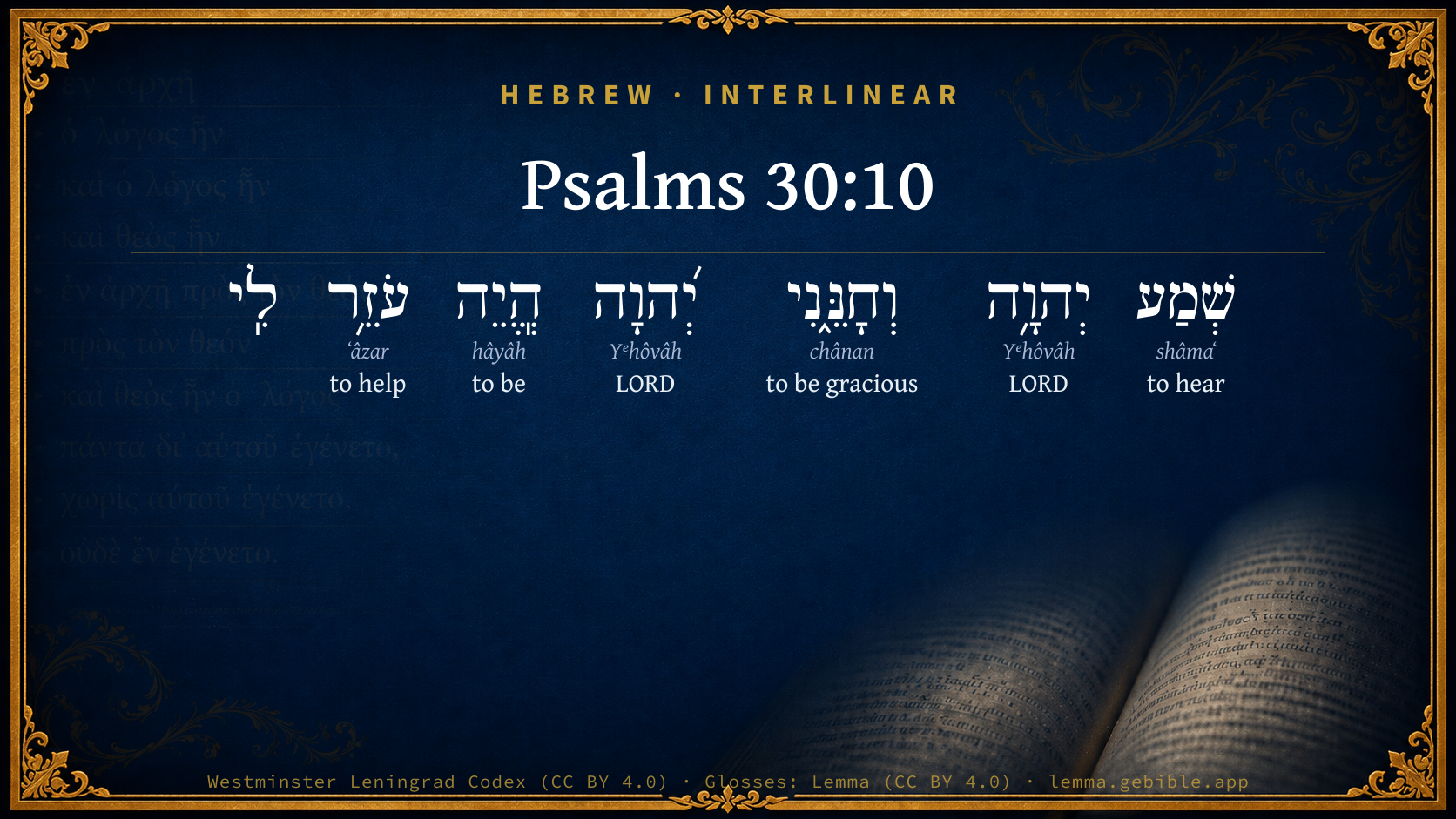
Hebrew (Westminster Leningrad Codex) Psalms 30:10 appears in the Hebrew Old Testament. The text above is from the Westminster Leningrad Codex. Each word links to its Strong’s number, a concise gloss, and parsing drawn from the Open Scriptures Hebrew Bible morphology. Click any word for its full Brown-Driver-Briggs (BDB) entry.
Download image
Cite this verse

Psalms 30:10 (World English Bible). Public Domain. Lemma interlinear Bible study tool, https://lemma.gebible.app/v/psalms/30/10.

Show BibTeX & RIS
BibTeX
RIS
English Translation
Hear, Yahweh, and have mercy on me. Yahweh, be my helper."
World English Bible · Public Domain
Download a study sheet

One document with this verse’s original text, its word-by-word gloss line, the meaning frame, cross-references with their text, attributed commentary, and full source and license credits — printable, and it pastes into notes with its structure intact.

This verse Autodidact and up

Study sheet (.html) Plain text (.txt)

A passage Seminary Student

Up to 50 verses in one chapter. A passage sheet keeps up to 6 commentary sources and 12 cross-references per verse, in the order this page ranks them, and says so on the sheet whenever that leaves anything out. Ask for a single verse and you get the Autodidact verse sheet above.

Everything on this page stays free to read, with no account — the sheet is a download of what is already on screen, not access to it.

Want to remove ads? Support Godless Engineer
Compare translations 3

The same verse in 3 English versions, stacked beneath the original-language interlinear above. Click any original word for its lexicon entry.

Each is an independent rendering of the whole verse — the interlinear is not word-aligned to these translations.

Highlighted words mark where these versions differ — a whole-verse word diff, not a word-by-word alignment.

  • World English Bible Public Domain
    Hear, Yahweh, and have mercy on me. Yahweh, be my helper."
  • King James Version Public Domain
    Hear, O LORD, and have mercy upon me: LORD, be thou my helper.
  • unfoldingWord Literal Text CC BY-SA 4.0
    Hear, Yahweh, and be gracious to me. Yahweh, be my helper.”

unfoldingWord Literal Text — © unfoldingWord, licensed CC BY-SA 4.0. Word-aligned USFM3 via Door43 (git.door43.org/unfoldingWord/en_ult).

Versions to compare (up to 4)

3 of 4 selected

Show all 18 translations

Every available English version of this verse, each an independent rendering of the whole verse.

  • World English Bible Public Domain
    Hear, Yahweh, and have mercy on me. Yahweh, be my helper."
  • Berean Standard Bible Public Domain
    Hear me, O LORD, and have mercy; O LORD, be my helper.”
  • Majority Standard Bible Public Domain
    Hear me, O LORD, and have mercy; O LORD, be my helper.”
  • King James Version Public Domain
    Hear, O LORD, and have mercy upon me: LORD, be thou my helper.
  • American Standard Version (1901) Public Domain
    Hear, O Jehovah, and have mercy upon me: Jehovah, be thou my helper.
  • Revised Version (1885) Public Domain
    Hear, O LORD, and have mercy upon me: LORD, be thou my helper.
  • Geneva Bible (1599) Public Domain
    Heare, O Lord, and haue mercy vpon me: Lord, be thou mine helper.
  • Douay-Rheims (1899) Public Domain
    What profit is there in my blood, whilst I go down to corruption? Shall dust confess to thee, or declare thy truth?
  • Young's Literal Translation Public Domain
    Hear, O Jehovah, and favour me, O Jehovah, be a helper to me.'
  • Literal Standard Version CC BY-SA 4.0
    Hear, O YHWH, and favor me, O YHWH, be a helper to me.”
  • Unlocked Literal Bible CC BY-SA 4.0
    Hear, Yahweh, and have mercy on me! Yahweh, be my helper.
  • unfoldingWord Literal Text CC BY-SA 4.0
    Hear, Yahweh, and be gracious to me. Yahweh, be my helper.”
  • Darby Bible Public Domain
    Hear, O Jehovah, and be gracious unto me; Jehovah, be my helper.
  • World Messianic Bible Public Domain
    Hear, LORD, and have mercy on me. LORD, be my helper.”
  • Webster's Bible Public Domain
    \\30:9\\What profit is there in my blood, when I go down to the pit? Shall the dust praise thee? shall it declare thy truth?
  • Free Bible Version CC BY-SA 4.0
    Please listen to me, Lord, and be gracious to me! Lord, you are the one who helps me.
  • Bible in Basic English Public Domain
    Give ear to me, O Lord, and have mercy on me: Lord, be my helper.
  • JPS Tanakh (1917) Public Domain
    (30-11) Hear, O LORD, and be gracious unto me; LORD, be Thou my helper.'

Literal Standard Version (2020), Covenant Press — licensed CC BY-SA 4.0. Text via the HelloAO Bible API (eBible.org). Unlocked Literal Bible (unfoldingWord) — licensed CC BY-SA 4.0. Text via the HelloAO Bible API (eBible.org). unfoldingWord Literal Text — © unfoldingWord, licensed CC BY-SA 4.0. Word-aligned USFM3 via Door43 (git.door43.org/unfoldingWord/en_ult). Free Bible Version, Dr. Jonathan Gallagher — licensed CC BY-SA 4.0. Text via the HelloAO Bible API (eBible.org).

Word by word

More ways to search: Search by grammar → Find every occurrence → Compare this word →

Practice this passage: Drill this verse → Learn its vocabulary →

וְחָנֵּ֑נִי
chânan
H2603
“and · be gracious · me”
Conjunction + Verb, Qal, Imperative, 2nd Person, Masculine, Singular + Suffix, Personal, 1st Person, Common, Singular
Part of Speech
Conjunction + Verb
Stem
Qal
Form
Imperative
Person
2nd Person
Gender
Masculine
Number
Singular
Full BDB Definition

Origin: a primitive root [compare H2583 ]

TWOT: 694 , 695

to be gracious, show favour, pity - (Qal) to show favour, be gracious - (Niphal) to be pitied - (Piel) to make gracious, make favourable, be gracious - (Poel) to direct favour to, have mercy on - (Hophal) to be shown favour, be shown consideration - (Hithpael) to seek favour, implore favour - to be loathsome
  1. שְׁמַע shâmaʻ H8085 “hear” Verb, Qal, Imperative, 2nd Person, Masculine, Singular
  2. יְהוָ֥ה Yᵉhôvâh H3068 “LORD” Noun, Proper
  3. יְ֝הוָה Yᵉhôvâh H3068 “LORD” Noun, Proper
  4. הֱֽיֵה hâyâh H1961 “be” Verb, Qal, Imperative, 2nd Person, Masculine, Singular
  5. עֹזֵ֥ר ʻâzar H5826 “helping” Verb, Qal, Participle Active, Masculine, Singular, Absolute

About this verse

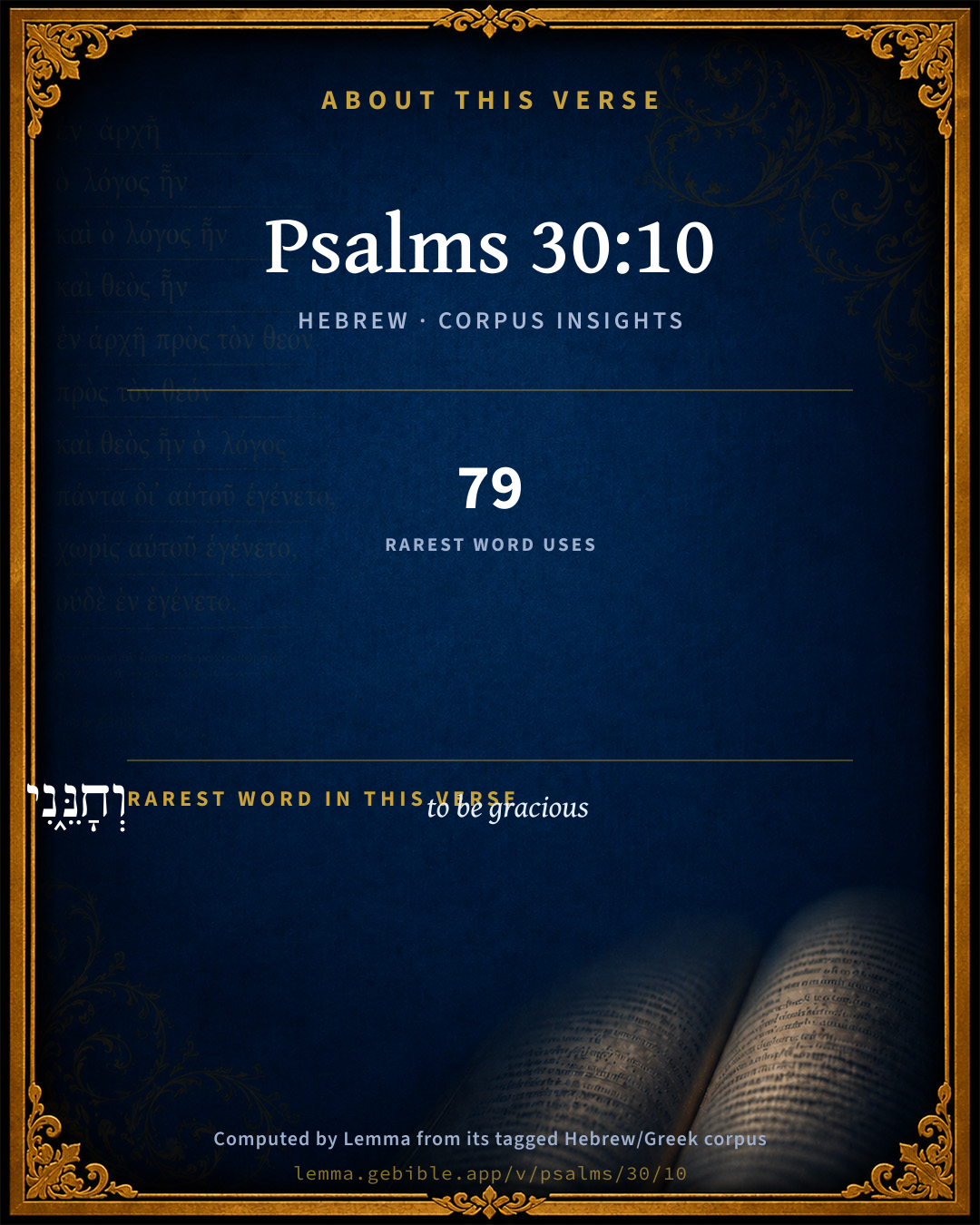
These counts appear in no published source. They are computed here, from the morphology-tagged text and Lemma’s own curated glosses. What Lemma adds →

7
words
5
distinct lemmas
Wisdom
section

Grammatical profile

  • 4 verbs
  • 2 nouns
  • 1 preposition

Verb forms

  • שְׁמַע Qal · Imperative
  • וְחָנֵּ֑נִי Qal · Imperative
  • הֱֽיֵה Qal · Imperative
  • עֹזֵ֥ר Qal · Participle Active

Repetition

A word recurs within this verse — often emphatic in Hebrew:

  • יְהוָ֥ה LORD H3068 ×2

Hebrew & Septuagint length

In English translation the verse runs 11 words from the Hebrew and 14 from the Septuagint (LXX English) — closely comparable.

A rough comparison of the two English renderings, which tokenize alike — not a word-level alignment.

Word counts can differ between the Hebrew and the Greek without any difference in meaning — e.g. the Hebrew direct-object marker אֵת has no separate Greek word, and Greek often adds the article ὁ.

Cross-references

6

Topical passages linked to Psalms 30:10 in the Treasury of Scripture Knowledge — connected by theme and wording, ordered by reader-vote popularity; previews shown in the World English Bible.

  • Psalms 54:4 Behold, God is my helper. The Lord is the one who sustains my soul.
  • Psalms 143:1 Hear my prayer, Yahweh. Listen to my petitions. In your faithfulness and righteousness, relieve me.
  • Psalms 143:7–9 Hurry to answer me, Yahweh. My spirit fails. Don't hide your face from me, So that I don't become like those who go down into the pit.
  • Psalms 28:7 Yahweh is my strength and my shield. My heart has trusted in him, and I am helped. Therefore my heart greatly rejoices. With my song I will thank him.
  • Psalms 27:7 Hear, Yahweh, when I cry with my voice. Have mercy also on me, and answer me.
  • Psalms 51:1–2 Have mercy on me, God, according to your loving kindness. According to the multitude of your tender mercies, blot out my transgressions.

Cross-references courtesy of OpenBible.info (CC BY 4.0).

Hebrew and Greek witnesses Masoretic Hebrew ↔ Greek Septuagint

The same verse in the two great witnesses to the Old Testament, shown verse-for-verse.

You’re reading Greek Psalm 29 (Hebrew Psalm 30). The Septuagint counts the superscription, so verse numbers can differ from the Hebrew — chapter-level alignment, not verse-by-verse. Numbering follows Rahlfs.

These are two independent witnesses, not word-aligned to each other, and the Septuagint is shown in lemma (dictionary) form.

Hebrew Psalms 30:10 Masoretic · Westminster Leningrad Codex

שְׁמַע יְהוָ֥ה וְחָנֵּ֑נִי יְ֝הוָה הֱֽיֵה עֹזֵ֥ר לִֽי

Hear, Yahweh, and have mercy on me. Yahweh, be my helper."

World English Bible · Public Domain

Greek LXX Greek Psalm 29:10 Septuagint · lemma form

τίς ὠφέλεια ἐν ὁ αἷμα ἐγώ ἐν ὁ καταβαίνω ἐγώ εἰς διαφθορά μή ἐκὁμολογέω σύ χοῦς ἤ ἀναἀγγέλλω ὁ ἀλήθεια σύ

The Lord heard, and had compassion upon me; the Lord is become my helper.

LXX2012 (modern English Septuagint) · Public Domain

Hebrew: Westminster Leningrad Codex (CC BY 4.0). Greek: Septuagint (public domain); English from LXX2012 (modern English Septuagint) (Public Domain). How the Septuagint differs from the Hebrew →

Commentary

Notes on Psalms 30:10 from classic Christian and Jewish commentators (each source and its license shown beneath its notes). The classic Christian expositions comment on the surrounding passage and are grouped to its opening verse, so a note may address several verses; the Jewish commentaries on the Tanakh (Rashi and others) are per-verse, so they appear only where the commentator wrote on this verse.

Lemma curates 59 commentaries, every one of them public domain or Creative Commons licensed, each selected and text-cleaned for this edition rather than reprinted as found. About our sources →

Trapp's Complete Commentary

John Trapp

Psa 30:10 Hear, O LORD, and have mercy upon me: LORD, be thou my helper.

Ver. 10. Hear, O Lord, and have mercy upon me] When Faith had once said to God what it hath to say, it will wait for a good answer, relying on his mercy, and expecting relief from the Lord, as here David doth; looking, in the mean while, through the anger of his corrections, to the sweetness of his loving countenance; as by a rainbow we see the beautiful image of the sun’s light in the midst of a dark and waterish cloud.

John Trapp, A Commentary or Exposition upon All the Books of the Old and New Testament (1647–1656) — public domain. Text from a community e-Sword module.

J. A. Alexander on Psalms

Joseph Addison Alexander

11. (Psa 30:10). Hear, Jehovah, and have mercy on me; Jehovah, be a helper for (or to) me. This petition is an indirect conclusion from the reasoning of the preceding verse. The logical connection may be made clear by a change of form. "Since thy glory will not be promoted by my death, I am entitled to deliverance, not for my sake but thy own." This last idea is suggested by his appealing to the divine mercy, as the ground on which he asked God to become his helper.

Joseph Addison Alexander, The Psalms Translated and Explained (1850) — public domain. Text from a community e-Sword module.

John Calvin's Commentaries

10. Hear, O Jehovah! In this clause the Psalmist softens and corrects his former complaint; for it would have been absurd to expostulate with God like one who despaired of safety, and to leave off in this fretful temper. Having asked, therefore, with tears, what profit God would derive from his death, he encourages himself to a more unconstrained manner of prayer, and, conceiving new hope, calls upon God for mercy and help. He puts God’s favor, however, in the first place, from whom alone he could expect the help which he implored.

John Calvin's Commentaries (1540-1563) — public domain. Text from the Calvin Translation Society English edition (1840s-50s) via the Christian Classics Ethereal Library (ccel.org). Calvin's coverage is partial (roughly two-thirds of the Bible); uncommented books and verses are honest gaps, never fabricated. The 19th-century editor's footnotes and remarks are omitted so the notes are faithfully Calvin's own voice.

John Gill's Exposition

Hear, O Lord, and have mercy upon me,.... By lifting up the light of his countenance again upon him; by manifesting and applying his pardoning grace to him, and by delivering him out of all his afflictions;

Lord, be thou my helper; in this time of trouble; for he knew that vain was the help of man; and he was entirely in the right to betake himself to the Lord, who was able to help him, when none else could.

John Gill's Exposition of the Whole Bible (1746–1763) — public domain (CC PDM 1.0). Text via the HelloAO Bible API.

Albert Barnes' Notes on the Bible

Hear, O Lord, and have mercy upon me, - etc. This, too, is the prayer which he uttered in the calamities adverted to in Psa 30:7. It is a cry for mercy founded on the idea referred to in Psa 30:9.

Albert Barnes' Notes on the Bible (1834–1885) — public domain. Text from a community e-Sword/MySword module.

The Treasury of David

Charles H. Spurgeon

Ver. 10. Hear, O Lord, and have mercy upon me. A short and comprehensive petition, available at all seasons, let us use it full often. It is the publican's prayer; be it ours. If God hears prayer, it is a great act of mercy; our petitions do not merit a reply. Lord, be thou my helper. Another compact, expressive, ever fitting prayer. It is suitable to hundreds of the cases of the Lord's people; it is well becoming in the minister when he is going to preach, to the sufferer upon the bed of pain, to the toiler in the field of service, to the believer under temptation, to the man of God under adversity; when God helps, difficulties vanish. He is the help of his people, a very present help in trouble. The two brief petitions of this verse are commended as ejaculations to believers full of business, denied to those longer seasons of devotion which are the rare privilege of those whose days are spent in retirement.

Ver. 10. Two gems of prayer; short, but full and needful.

Ver. 10. Lord, be thou my helper. I see many fall; I shall fall too except thou hold me up. I am weak; I am exposed to temptation. My heart is deceitful. My enemies are strong. I cannot trust in man; I dare not trust in myself. The grace I have received will not keep me without thee. Lord, be thou my helper. In every duty; in every conflict; in every trial; in every effort to promote the Lord's cause; in every season of prosperity; in every hour we live, this short and inspired prayer is suitable. May it flow from our hearts, be often on our lips, and be answered in our experience. For if the Lord help us, there is no duty which we cannot perform; there is no foe which we cannot overcome; there is no difficulty which we cannot surmount. James Smith's Daily Remembrancer.

Psalms 30:11*

Charles H. Spurgeon's The Treasury of David (1869–1885) — public domain. Psalms only. Text from a community e-Sword/MySword module.

The Pulpit Commentary

Hear, O Lord, and have mercy upon me: Lord, be thou my Helper. (comp. Psa_54:4 Heb_13:6) Here the psalmist"s prayer, uttered in his distress, ends, and he proceeds to declare the result.

The Pulpit Commentary (1880–1919), ed. H.D.M. Spence-Jones & Joseph S. Exell — public domain. Text from a community e-Sword module.

Lesson kit

Teaching starters — assembled from the data on this page, not authored interpretation. Every prompt links to the verse data it draws on. Edit before teaching.

Psalms, in the Wisdom, opens this verse with 7 words (5 distinct Hebrew lemmas). Its most distinctive word is chânan (“to be gracious”). A historical commentator’s framing appears above. Read the whole chapter for the surrounding context.

Discussion questions

  1. The word chânan carries the sense “to be gracious.” How does it shape the verse?
  2. Psalms 54:4 shares this passage’s theme. How do the two illuminate each other?
  3. “LORD” occurs 2× in this one verse. What is the effect of the repetition?
  4. These translations render this verse differently. What is at stake in choosing one wording over another?
  5. The verb «שְׁמַע» is Qal Imperative. How does its form color the action?
  6. Reading how Trapp's Complete Commentary and J. A. Alexander on Psalms read this verse, where do the two commentators agree and where do they part?

Things to notice

Reading settings

Reading text

Shown beneath each verse's original-language words.

Old Testament
Old Testament edition

Read the OT as the Masoretic Hebrew (MT) or the Greek Septuagint (LXX).

English shown for the Greek Septuagint (in the Hebrew ↔ Greek comparison).

Comparing translations? Open the Compare panel on any verse page to stack up to four side by side.